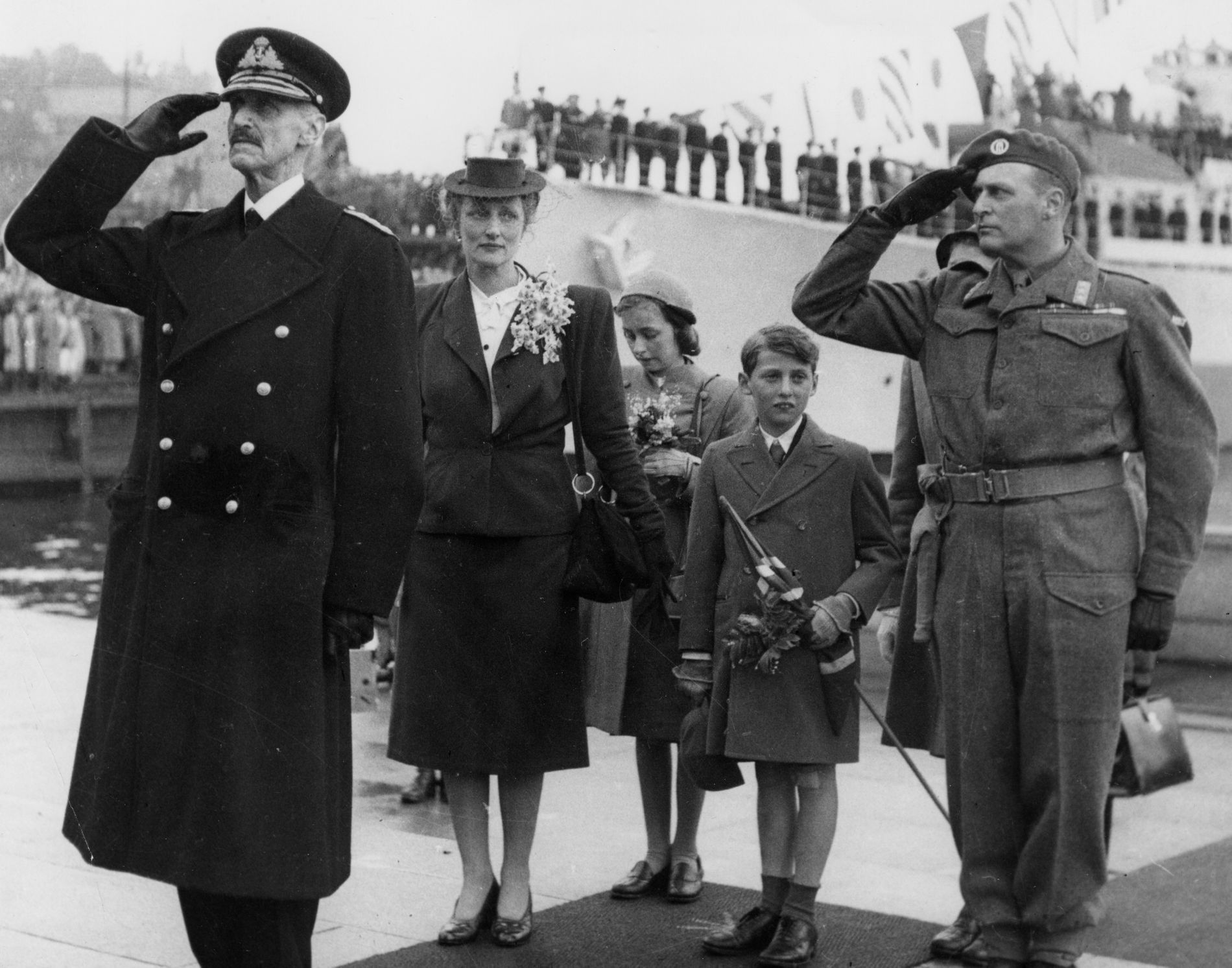
World War II — the King’s “No” and the Nazis in Norway
April 9, 1940 to May 8, 1945. Five years of Nazi occupation. The king's refusal of Quisling, the resistance of teachers and clergy, the heavy-water sabotage at Vemork, and the November 1942 deportation of Norwegian Jews to Auschwitz — carried out by Norwegian police.
At dawn on the ninth of April 1940, the German military attacks Norway simultaneously at Oslo 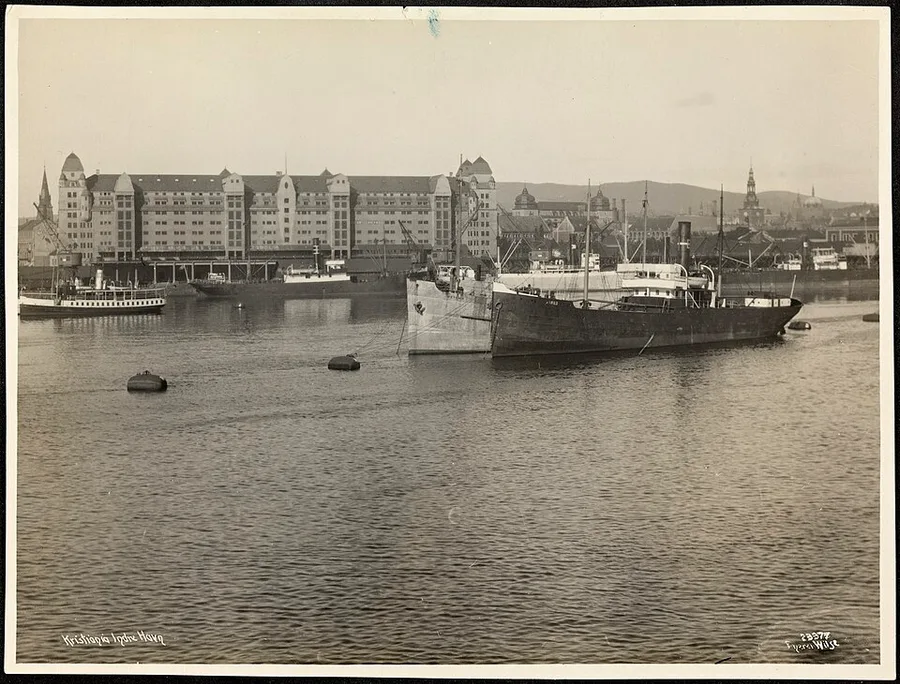 Anders Beer Wilse, Kristiania Indre Havn (1923), National Library of Norway Wilse's 1923 photograph of the inner harbor at Bjørvika, two years before Kristiania took back its old name Oslo — steamers at the quays beneath the spires of the city that grew from a medieval royal seat into Norway's capital. Capital of modern Norway, at the head of the Oslofjord on
the country's southeastern coast. Founded according to the
sagas by Harald Hardrada about 1049 and known through the
medieval period as a secondary royal seat behind Bergen and
Nidaros. Hákon V moved the royal residence permanently to
Oslo about 1300 and built Akershus Fortress to guard the
harbour. After a fire in 1624 the medieval town was
abandoned and Christian IV rebuilt the city to the west
under the new name Christiania (later Kristiania); the
name Oslo was restored in 1925. The original medieval
street pattern survives as the Gamlebyen district east of
the modern centre.
On the trip Days 1–2 belong to Oslo, with both groups together —
Roseslottet and the harbourside museums on Day 1, then the
Day-2 e-bike tour through Akershus Fortress, up Karl Johans
gate, and out to Vigeland Park.
Oslo Also discussed in The Long Fall — the sudden loss of Norwegian nobility, the end of the kings, and half of Norway gone foreverA Catholic Norway — the faith that gave the kingdom its first institutions and the stave churchesThe 400-Year Night — when the Northern Lion lay dormantThe Reformation, 1537 — one church eradicated and another imposedLutheran Norway and Pietism — a farmer named Hans Nielsen Hauge and a lay revival that could not be silencedThe Constitution That Saved a Nation — five radical weeks at Eidsvoll, 1814800,000 Norwegians Leave — the century that built a Second NorwayThe Quiet Revolution — how Norway won its independence without a warAlcohol and Vinmonopolet — when and where to buy a drinkEveryday etiquette — quiet voices, wide space, no smiling🚨 Emergencies - important numbers, hospitals, and what you can doLanding in Norway — off the plane in Oslo, where to go, step by stepMoney — currency, cards, prices, and tipping , Kristiansand, Stavanger
Anders Beer Wilse, Kristiania Indre Havn (1923), National Library of Norway Wilse's 1923 photograph of the inner harbor at Bjørvika, two years before Kristiania took back its old name Oslo — steamers at the quays beneath the spires of the city that grew from a medieval royal seat into Norway's capital. Capital of modern Norway, at the head of the Oslofjord on
the country's southeastern coast. Founded according to the
sagas by Harald Hardrada about 1049 and known through the
medieval period as a secondary royal seat behind Bergen and
Nidaros. Hákon V moved the royal residence permanently to
Oslo about 1300 and built Akershus Fortress to guard the
harbour. After a fire in 1624 the medieval town was
abandoned and Christian IV rebuilt the city to the west
under the new name Christiania (later Kristiania); the
name Oslo was restored in 1925. The original medieval
street pattern survives as the Gamlebyen district east of
the modern centre.
On the trip Days 1–2 belong to Oslo, with both groups together —
Roseslottet and the harbourside museums on Day 1, then the
Day-2 e-bike tour through Akershus Fortress, up Karl Johans
gate, and out to Vigeland Park.
Oslo Also discussed in The Long Fall — the sudden loss of Norwegian nobility, the end of the kings, and half of Norway gone foreverA Catholic Norway — the faith that gave the kingdom its first institutions and the stave churchesThe 400-Year Night — when the Northern Lion lay dormantThe Reformation, 1537 — one church eradicated and another imposedLutheran Norway and Pietism — a farmer named Hans Nielsen Hauge and a lay revival that could not be silencedThe Constitution That Saved a Nation — five radical weeks at Eidsvoll, 1814800,000 Norwegians Leave — the century that built a Second NorwayThe Quiet Revolution — how Norway won its independence without a warAlcohol and Vinmonopolet — when and where to buy a drinkEveryday etiquette — quiet voices, wide space, no smiling🚨 Emergencies - important numbers, hospitals, and what you can doLanding in Norway — off the plane in Oslo, where to go, step by stepMoney — currency, cards, prices, and tipping , Kristiansand, Stavanger 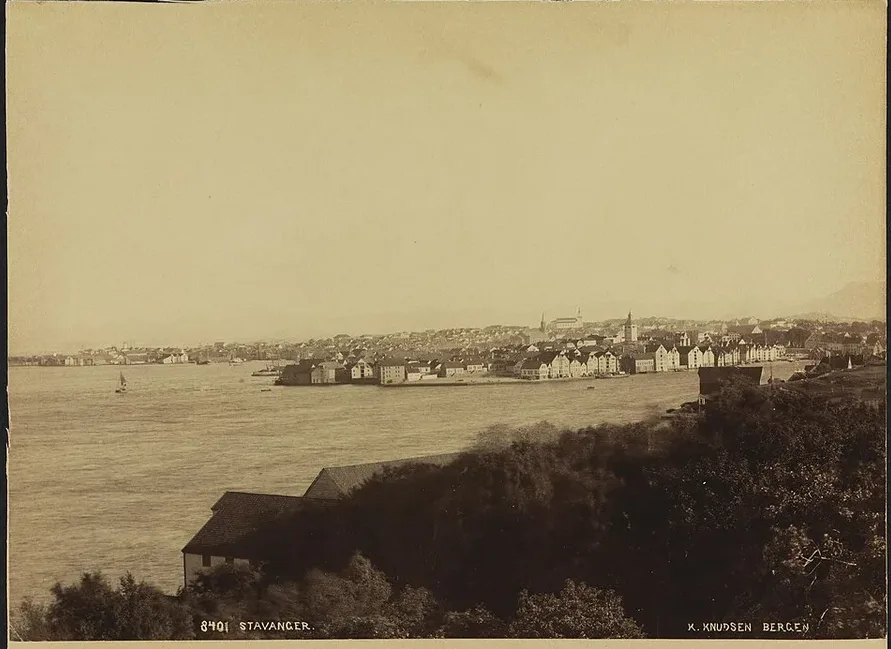 Knud Knudsen, Stavanger (1888-1894), National Library of Norway Stavanger in the late 1880s — the low wooden harbour town, church towers on the skyline, that the emigrant ships had been sailing from for two generations by the time Knudsen photographed it. City on the southwestern Norwegian coast in Rogaland; modern
Norway's fourth-largest city and the operational capital of the
Norwegian petroleum economy since the 1970s. The traditional site
of the sea-battle of Hafrsfjord that completed Harald Fairhair's
consolidation lies at the city's southwestern edge, marked by the
Sverd i fjell monument. The Norwegian Petroleum Directorate, the
safety regulator (Havtil), and Equinor (formerly Statoil) are all
headquartered in or around the city. Population around one hundred
and forty thousand in the municipality; metropolitan area roughly
twice that.
Stavanger Also discussed in Before There Was Norway — petty kingdoms at the edge of the worldThe Viking Age — longships, legends, and the first "Norway"A Catholic Norway — the faith that gave the kingdom its first institutions and the stave churchesThe 400-Year Night — when the Northern Lion lay dormantThe 'Lucky Country' — the discovery that changed everything800,000 Norwegians Leave — the century that built a Second Norway , Bergen
Knud Knudsen, Stavanger (1888-1894), National Library of Norway Stavanger in the late 1880s — the low wooden harbour town, church towers on the skyline, that the emigrant ships had been sailing from for two generations by the time Knudsen photographed it. City on the southwestern Norwegian coast in Rogaland; modern
Norway's fourth-largest city and the operational capital of the
Norwegian petroleum economy since the 1970s. The traditional site
of the sea-battle of Hafrsfjord that completed Harald Fairhair's
consolidation lies at the city's southwestern edge, marked by the
Sverd i fjell monument. The Norwegian Petroleum Directorate, the
safety regulator (Havtil), and Equinor (formerly Statoil) are all
headquartered in or around the city. Population around one hundred
and forty thousand in the municipality; metropolitan area roughly
twice that.
Stavanger Also discussed in Before There Was Norway — petty kingdoms at the edge of the worldThe Viking Age — longships, legends, and the first "Norway"A Catholic Norway — the faith that gave the kingdom its first institutions and the stave churchesThe 400-Year Night — when the Northern Lion lay dormantThe 'Lucky Country' — the discovery that changed everything800,000 Norwegians Leave — the century that built a Second Norway , Bergen 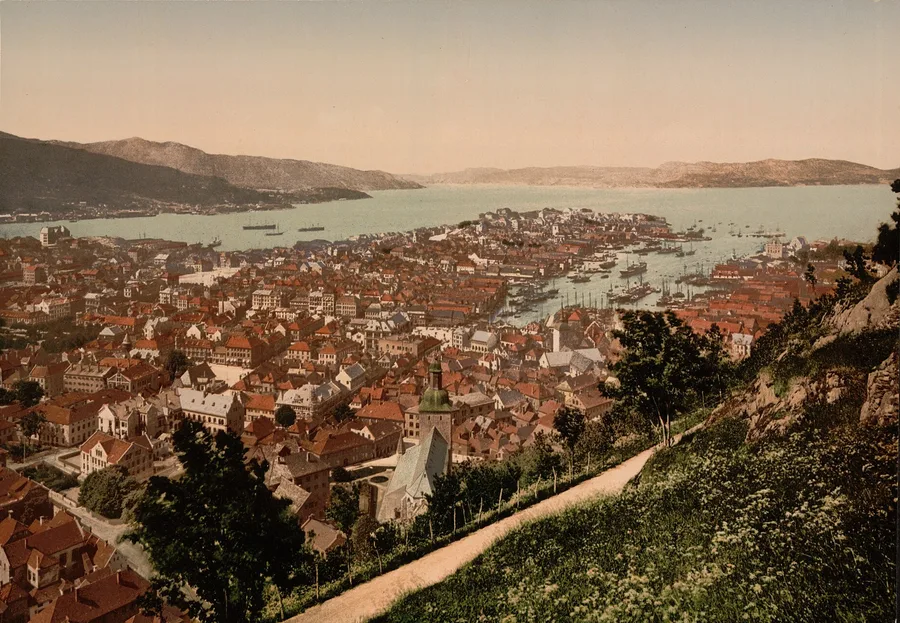 Photochrom print, General view from Fjeldveien, Bergen (c. 1890–1900), Library of Congress Bergen in the 1890s from the Fjellveien path on Fløyfjellet — the whole city between its mountains, Vågen harbour still crowded with sailing ships at its heart. For four centuries Norway's largest city, and the wharf through which the entire western export economy ran. Norway's western trading capital, founded around 1070 on the
inner Byfjorden. For four centuries the largest city in the
country and the wharf through which the entire western export
economy ran — dried cod from the Lofoten fisheries, stockpiled
and traded by the Hanseatic merchants at Bryggen from 1360 to
1754. Norway's commercial and intellectual heart through the
Hanseatic period; overtaken in size by Christiania (Oslo) in the
1830s. The painted wooden Bryggen wharf is on the UNESCO World
Heritage list and substantially what it was in the late
seventeenth century.
On the trip The Ungdommene (the Youngsters) reach Bergen late on Day 3
via the Norway-in-a-Nutshell train-and-ferry route from
Oslo. On the Day 4 morning they walk Bryggen and ride the
funicular up Mount Fløyen before flying back to Oslo and driving
on to Lillehammer that evening — a day ahead of the Gråhårsklubben
(the Oldsters), who spend the split days north in Trondheim and
the heritage country of Stjørdal, Hegra, and Kylloplass and come
south on Day 5.
Bergen Also discussed in The Germans Who "Ruled" Bergen — the Hanseatic merchants on Bryggen WharfBefore There Was Norway — petty kingdoms at the edge of the worldThe King Who Became a Saint — how the Nordmen came to ChristA Catholic Norway — the faith that gave the kingdom its first institutions and the stave churchesThe Long Fall — the sudden loss of Norwegian nobility, the end of the kings, and half of Norway gone foreverThe Golden Age — a North Atlantic empire … reaching farther than you thinkThe 400-Year Night — when the Northern Lion lay dormantThe Crusades?!!!! — sixty ships from Bergen, bound for the Holy LandThe Reformation, 1537 — one church eradicated and another imposedKraken — the island-sized beast, logged as factSjøormer — the serpents in the deep lakes and fjordsPesta — an old woman walking from farm to farmFossegrimen — the waterfall fiddler who teaches you to playAlcohol and Vinmonopolet — when and where to buy a drinkEveryday etiquette — quiet voices, wide space, no smilingFood and dining customs — having patience, free water, brunost on everything🚨 Emergencies - important numbers, hospitals, and what you can doLanguage basics — just enough Norwegian to be politeWhat to wear — the layering system, on the ground , Trondheim
Photochrom print, General view from Fjeldveien, Bergen (c. 1890–1900), Library of Congress Bergen in the 1890s from the Fjellveien path on Fløyfjellet — the whole city between its mountains, Vågen harbour still crowded with sailing ships at its heart. For four centuries Norway's largest city, and the wharf through which the entire western export economy ran. Norway's western trading capital, founded around 1070 on the
inner Byfjorden. For four centuries the largest city in the
country and the wharf through which the entire western export
economy ran — dried cod from the Lofoten fisheries, stockpiled
and traded by the Hanseatic merchants at Bryggen from 1360 to
1754. Norway's commercial and intellectual heart through the
Hanseatic period; overtaken in size by Christiania (Oslo) in the
1830s. The painted wooden Bryggen wharf is on the UNESCO World
Heritage list and substantially what it was in the late
seventeenth century.
On the trip The Ungdommene (the Youngsters) reach Bergen late on Day 3
via the Norway-in-a-Nutshell train-and-ferry route from
Oslo. On the Day 4 morning they walk Bryggen and ride the
funicular up Mount Fløyen before flying back to Oslo and driving
on to Lillehammer that evening — a day ahead of the Gråhårsklubben
(the Oldsters), who spend the split days north in Trondheim and
the heritage country of Stjørdal, Hegra, and Kylloplass and come
south on Day 5.
Bergen Also discussed in The Germans Who "Ruled" Bergen — the Hanseatic merchants on Bryggen WharfBefore There Was Norway — petty kingdoms at the edge of the worldThe King Who Became a Saint — how the Nordmen came to ChristA Catholic Norway — the faith that gave the kingdom its first institutions and the stave churchesThe Long Fall — the sudden loss of Norwegian nobility, the end of the kings, and half of Norway gone foreverThe Golden Age — a North Atlantic empire … reaching farther than you thinkThe 400-Year Night — when the Northern Lion lay dormantThe Crusades?!!!! — sixty ships from Bergen, bound for the Holy LandThe Reformation, 1537 — one church eradicated and another imposedKraken — the island-sized beast, logged as factSjøormer — the serpents in the deep lakes and fjordsPesta — an old woman walking from farm to farmFossegrimen — the waterfall fiddler who teaches you to playAlcohol and Vinmonopolet — when and where to buy a drinkEveryday etiquette — quiet voices, wide space, no smilingFood and dining customs — having patience, free water, brunost on everything🚨 Emergencies - important numbers, hospitals, and what you can doLanguage basics — just enough Norwegian to be politeWhat to wear — the layering system, on the ground , Trondheim 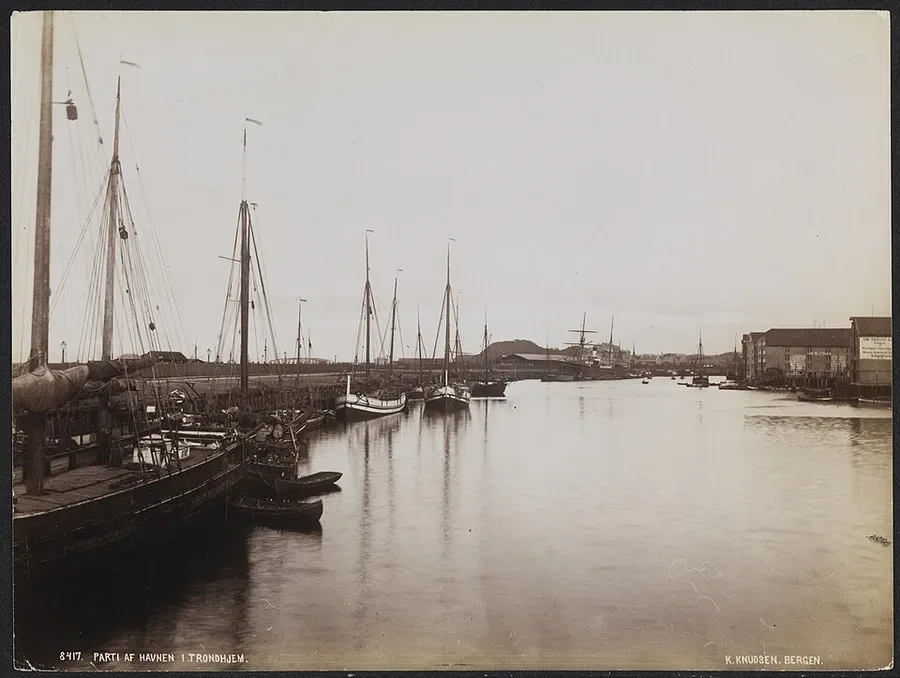 Knud Knudsen, Parti af Havnen i Trondhjem (1888-1894), National Library of Norway Knud Knudsen's photograph of Trondheim harbour in the early 1890s. Founded by Olav Tryggvason in 997 as Nidaros, the city was Norway's medieval capital and the seat of the archbishopric and the Olav cult that anchored the country's Christianity. Norway's third-largest city, founded by Olav Tryggvason in 997 as
Nidaros at the mouth of the Nid River on the inner Trondheim
Fjord. Capital of the Norwegian kingdom for much of the medieval
period; seat of the Norwegian archbishopric from 1153 and of the
Olav cult that anchored medieval Norwegian Christianity. Renamed
Trondheim in 1931 — after a controversial one-year spell
officially named Nidaros from 1930 — replacing the Danish-era
spelling Trondhjem and reviving the medieval Old Norse district
name (Þrándheimr). About two hundred thousand people in the municipality
today. Home to Nidaros Cathedral, NTNU (the Norwegian University
of Science and Technology), and the Trondheim Fjord harbour.
On the trip Day 3 of the trip routes the Gråhårsklubben (the Oldsters) through
Trondheim. The visit centres on Nidaros Cathedral — the building
the Olav devotion raised, and the architectural inheritance of
Bishop Grimkell's pronouncement on a summer day in 1031.
Trondheim Also discussed in The King Who Became a Saint — how the Nordmen came to ChristA Catholic Norway — the faith that gave the kingdom its first institutions and the stave churchesThe Crusades?!!!! — sixty ships from Bergen, bound for the Holy LandThe Golden Age — a North Atlantic empire … reaching farther than you thinkThe Long Fall — the sudden loss of Norwegian nobility, the end of the kings, and half of Norway gone foreverThe 400-Year Night — when the Northern Lion lay dormantThe Reformation, 1537 — one church eradicated and another imposedLutheran Norway and Pietism — a farmer named Hans Nielsen Hauge and a lay revival that could not be silencedBefore There Was Norway — petty kingdoms at the edge of the worldDriving in Norway — tolls, ferries, and a near-zero alcohol limitEveryday etiquette — quiet voices, wide space, no smiling🚨 Emergencies - important numbers, hospitals, and what you can doLanguage basics — just enough Norwegian to be polite , and Narvik
Knud Knudsen, Parti af Havnen i Trondhjem (1888-1894), National Library of Norway Knud Knudsen's photograph of Trondheim harbour in the early 1890s. Founded by Olav Tryggvason in 997 as Nidaros, the city was Norway's medieval capital and the seat of the archbishopric and the Olav cult that anchored the country's Christianity. Norway's third-largest city, founded by Olav Tryggvason in 997 as
Nidaros at the mouth of the Nid River on the inner Trondheim
Fjord. Capital of the Norwegian kingdom for much of the medieval
period; seat of the Norwegian archbishopric from 1153 and of the
Olav cult that anchored medieval Norwegian Christianity. Renamed
Trondheim in 1931 — after a controversial one-year spell
officially named Nidaros from 1930 — replacing the Danish-era
spelling Trondhjem and reviving the medieval Old Norse district
name (Þrándheimr). About two hundred thousand people in the municipality
today. Home to Nidaros Cathedral, NTNU (the Norwegian University
of Science and Technology), and the Trondheim Fjord harbour.
On the trip Day 3 of the trip routes the Gråhårsklubben (the Oldsters) through
Trondheim. The visit centres on Nidaros Cathedral — the building
the Olav devotion raised, and the architectural inheritance of
Bishop Grimkell's pronouncement on a summer day in 1031.
Trondheim Also discussed in The King Who Became a Saint — how the Nordmen came to ChristA Catholic Norway — the faith that gave the kingdom its first institutions and the stave churchesThe Crusades?!!!! — sixty ships from Bergen, bound for the Holy LandThe Golden Age — a North Atlantic empire … reaching farther than you thinkThe Long Fall — the sudden loss of Norwegian nobility, the end of the kings, and half of Norway gone foreverThe 400-Year Night — when the Northern Lion lay dormantThe Reformation, 1537 — one church eradicated and another imposedLutheran Norway and Pietism — a farmer named Hans Nielsen Hauge and a lay revival that could not be silencedBefore There Was Norway — petty kingdoms at the edge of the worldDriving in Norway — tolls, ferries, and a near-zero alcohol limitEveryday etiquette — quiet voices, wide space, no smiling🚨 Emergencies - important numbers, hospitals, and what you can doLanguage basics — just enough Norwegian to be polite , and Narvik 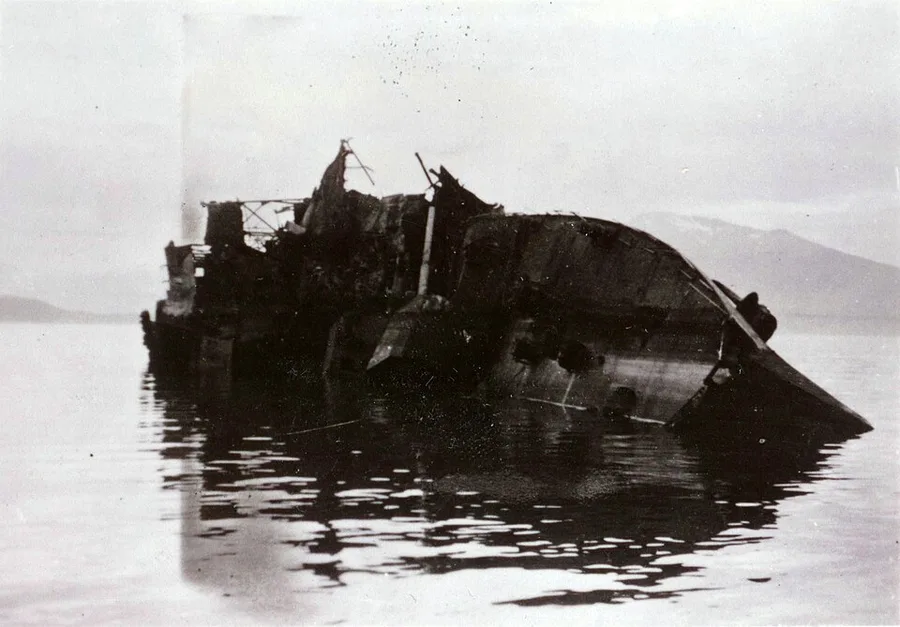 Franz Hollerweger, Narvik harbor with broken German destroyer (1940), Arkiv i Nordland One of the ten German destroyers sunk or scuttled in the Ofotfjord during the Battles of Narvik lies broken in the harbor — the Royal Navy's destruction of the flotilla was the first Allied operational victory of the war. Port city on the Ofotfjord in Nordland in northern Norway,
above the Arctic Circle. Modern population about twenty
thousand. The ice-free natural harbour, the rail terminus
of the Ofotbanen line that runs from the Swedish iron-ore
mines at Kiruna across the border, made Narvik
strategically central to Swedish iron-ore exports to
Germany. Attacked by German naval forces at dawn on 9
April 1940. Site of the Battles of Narvik (April–June
1940), the largest sustained ground combat of the
Norwegian campaign and the first Allied operational
victory of the war — Royal Navy destroyer engagements
sank a substantial part of the German destroyer flotilla,
and a combined Norwegian-French-Polish-British force
retook the town on 28 May 1940. Evacuated after the fall
of France.
, in an amphibious and airborne Operation Weserübung
Franz Hollerweger, Narvik harbor with broken German destroyer (1940), Arkiv i Nordland One of the ten German destroyers sunk or scuttled in the Ofotfjord during the Battles of Narvik lies broken in the harbor — the Royal Navy's destruction of the flotilla was the first Allied operational victory of the war. Port city on the Ofotfjord in Nordland in northern Norway,
above the Arctic Circle. Modern population about twenty
thousand. The ice-free natural harbour, the rail terminus
of the Ofotbanen line that runs from the Swedish iron-ore
mines at Kiruna across the border, made Narvik
strategically central to Swedish iron-ore exports to
Germany. Attacked by German naval forces at dawn on 9
April 1940. Site of the Battles of Narvik (April–June
1940), the largest sustained ground combat of the
Norwegian campaign and the first Allied operational
victory of the war — Royal Navy destroyer engagements
sank a substantial part of the German destroyer flotilla,
and a combined Norwegian-French-Polish-British force
retook the town on 28 May 1940. Evacuated after the fall
of France.
, in an amphibious and airborne Operation Weserübung 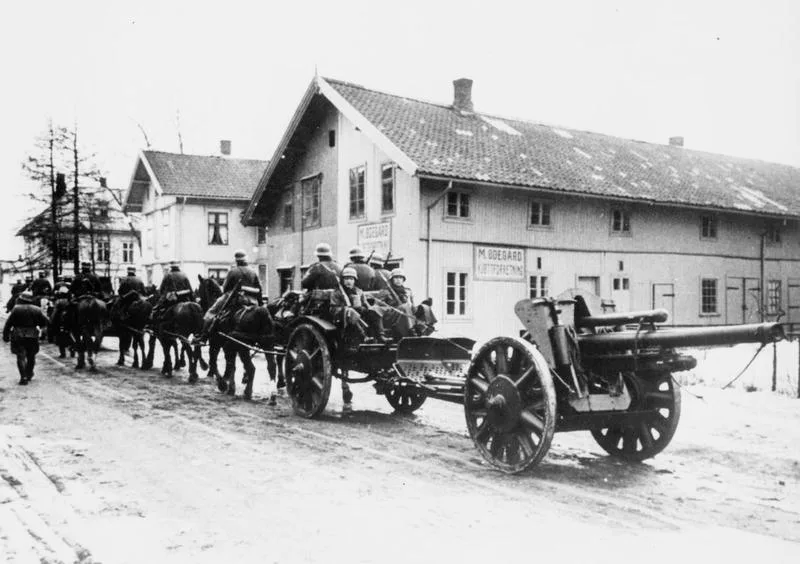 Press Agency photographer, The German Invasion of Norway (14 April 1940), Imperial War Museums (HU 93720) German horse-drawn field artillery moves inland from Oslo five days into Operation Weserübung — the combined amphibious-and-airborne invasion launched 9 April 1940 that, within two months, cost the German fleet the cruiser Blücher and two more light cruisers. German codename for the simultaneous invasion of Denmark
and Norway, launched at dawn 9 April 1940. The Norwegian
side (Weserübung Nord) attacked Oslo, Kristiansand,
Stavanger, Bergen, Trondheim, and Narvik simultaneously
in a combined amphibious and airborne operation. Planned
in under two months on Hitler's personal direction,
partly to forestall a feared British preemption of the
Norwegian coast and partly to secure the Swedish iron-ore
route through Narvik. The campaign succeeded militarily
but cost the German surface fleet heavily — the heavy
cruiser Blücher sunk at Oscarsborg on the first morning;
the light cruisers Karlsruhe and Königsberg and
several destroyers lost over the next two months. The
first major military operation Hitler personally directed.
that has been planned for less than two months and is being conducted with deliberate speed to forestall any British or French preemption of the Norwegian coast. The Norwegian armed forces, only partly on a war footing despite the mounting tensions of the previous week, are caught at the start of their assembly. The Norwegian coastal fortresses at Oscarsborg Fortress
Press Agency photographer, The German Invasion of Norway (14 April 1940), Imperial War Museums (HU 93720) German horse-drawn field artillery moves inland from Oslo five days into Operation Weserübung — the combined amphibious-and-airborne invasion launched 9 April 1940 that, within two months, cost the German fleet the cruiser Blücher and two more light cruisers. German codename for the simultaneous invasion of Denmark
and Norway, launched at dawn 9 April 1940. The Norwegian
side (Weserübung Nord) attacked Oslo, Kristiansand,
Stavanger, Bergen, Trondheim, and Narvik simultaneously
in a combined amphibious and airborne operation. Planned
in under two months on Hitler's personal direction,
partly to forestall a feared British preemption of the
Norwegian coast and partly to secure the Swedish iron-ore
route through Narvik. The campaign succeeded militarily
but cost the German surface fleet heavily — the heavy
cruiser Blücher sunk at Oscarsborg on the first morning;
the light cruisers Karlsruhe and Königsberg and
several destroyers lost over the next two months. The
first major military operation Hitler personally directed.
that has been planned for less than two months and is being conducted with deliberate speed to forestall any British or French preemption of the Norwegian coast. The Norwegian armed forces, only partly on a war footing despite the mounting tensions of the previous week, are caught at the start of their assembly. The Norwegian coastal fortresses at Oscarsborg Fortress 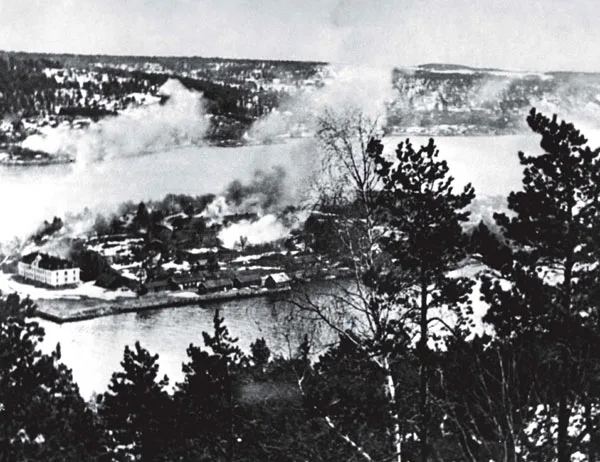 Unknown Norwegian military photographer, Oscarsborg Fortress under air attack (9 April 1940) The Main Fort under Luftwaffe attack on the very day its elderly Krupp guns sank the Blücher at the Drøbak Narrows — the single defensive engagement that bought Norway's king, government, and gold reserves the hours they needed to escape Oslo. Coastal artillery fortress at the Drøbak Narrows in the
inner Oslofjord, on the small island of Søndre Kaholmen
about thirty-five kilometres south of Oslo. Built in
stages through the nineteenth century. The fortress's
elderly Krupp guns and shore-launched torpedoes sank the
German heavy cruiser Blücher at the Drøbak Narrows in
the early morning of 9 April 1940 — the single most
consequential defensive engagement of the Norwegian
campaign, killing as many as a thousand of the German
invasion staff aboard and delaying the German seizure of
Oslo by enough hours to let King Haakon VII, the
government, the gold reserves of the Norges Bank, and the
Storting evacuate north. Today a national-monument museum
and concert venue, accessible by ferry from Drøbak.
in the Oslofjord and at Stavanger and Trondheim resist where they can, and the German heavy cruiser Blücher
Unknown Norwegian military photographer, Oscarsborg Fortress under air attack (9 April 1940) The Main Fort under Luftwaffe attack on the very day its elderly Krupp guns sank the Blücher at the Drøbak Narrows — the single defensive engagement that bought Norway's king, government, and gold reserves the hours they needed to escape Oslo. Coastal artillery fortress at the Drøbak Narrows in the
inner Oslofjord, on the small island of Søndre Kaholmen
about thirty-five kilometres south of Oslo. Built in
stages through the nineteenth century. The fortress's
elderly Krupp guns and shore-launched torpedoes sank the
German heavy cruiser Blücher at the Drøbak Narrows in
the early morning of 9 April 1940 — the single most
consequential defensive engagement of the Norwegian
campaign, killing as many as a thousand of the German
invasion staff aboard and delaying the German seizure of
Oslo by enough hours to let King Haakon VII, the
government, the gold reserves of the Norges Bank, and the
Storting evacuate north. Today a national-monument museum
and concert venue, accessible by ferry from Drøbak.
in the Oslofjord and at Stavanger and Trondheim resist where they can, and the German heavy cruiser Blücher 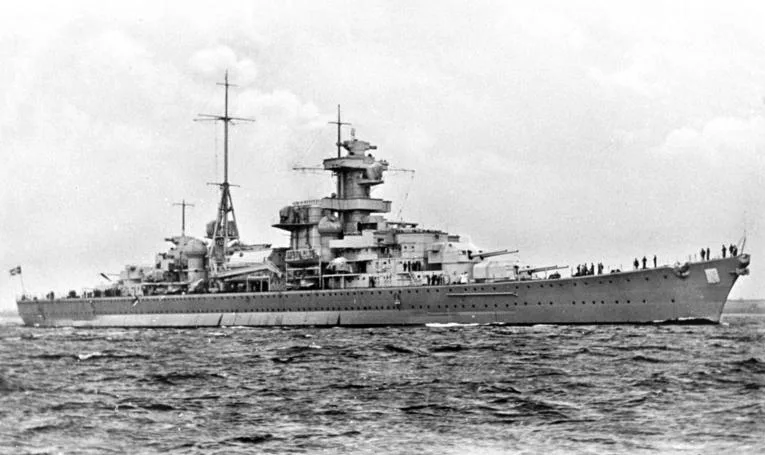 Klein, A., Kreuzer "Blücher" (1939), Deutsches Bundesarchiv, DVM 10 Bild-23-63-09, CC BY-SA 3.0 This is the Blücher months before the Oslofjord raid — the same ship that led the German task force up the fjord on the night of 8–9 April 1940 and sank at the Drøbak Narrows within two hours of Oscarsborg's guns opening fire. German Admiral Hipper-class heavy cruiser commissioned
September 1939, the lead ship of German naval task force
Group 5 assigned to seize Oslo on the first morning of
Operation Weserübung. Sailed up the Oslofjord on the
night of 8–9 April 1940 carrying senior German army and
Gestapo officers tasked with seizing the king, government,
and Norges Bank gold reserves. At the Drøbak Narrows in
the early morning of 9 April, the Oscarsborg Fortress's
elderly 28-cm Krupp guns and shore-launched Whitehead
torpedoes hit the Blücher; the ship capsized and sank
within two hours, taking 600–1,000 of those aboard. The
delay let the king and government escape Oslo. The wreck
remains on the bottom at the Narrows, a designated war
grave.
is sunk at Drøbak by gunfire and shore-launched torpedoes from the Oscarsborg fortress on the morning of the ninth, the most consequential single defensive engagement of the campaign, killing as many as a thousand of the German invasion staff who had been aboard. The wreck remains where it sank, a war grave below the channel. The fortress at Oscarsborg buys time for the Norwegian royal family and the government to evacuate Oslo. Within forty-eight hours, the Germans control most of the major Norwegian coastal cities. Within two months the British and French expeditionary forces that had landed in support of the Norwegians are withdrawn for the campaign in France. On the seventh of June 1940, the king and the government leave Norway by warship for Britain. The Norwegian forces in northern Norway capitulate three days later. The occupation begins.
Klein, A., Kreuzer "Blücher" (1939), Deutsches Bundesarchiv, DVM 10 Bild-23-63-09, CC BY-SA 3.0 This is the Blücher months before the Oslofjord raid — the same ship that led the German task force up the fjord on the night of 8–9 April 1940 and sank at the Drøbak Narrows within two hours of Oscarsborg's guns opening fire. German Admiral Hipper-class heavy cruiser commissioned
September 1939, the lead ship of German naval task force
Group 5 assigned to seize Oslo on the first morning of
Operation Weserübung. Sailed up the Oslofjord on the
night of 8–9 April 1940 carrying senior German army and
Gestapo officers tasked with seizing the king, government,
and Norges Bank gold reserves. At the Drøbak Narrows in
the early morning of 9 April, the Oscarsborg Fortress's
elderly 28-cm Krupp guns and shore-launched Whitehead
torpedoes hit the Blücher; the ship capsized and sank
within two hours, taking 600–1,000 of those aboard. The
delay let the king and government escape Oslo. The wreck
remains on the bottom at the Narrows, a designated war
grave.
is sunk at Drøbak by gunfire and shore-launched torpedoes from the Oscarsborg fortress on the morning of the ninth, the most consequential single defensive engagement of the campaign, killing as many as a thousand of the German invasion staff who had been aboard. The wreck remains where it sank, a war grave below the channel. The fortress at Oscarsborg buys time for the Norwegian royal family and the government to evacuate Oslo. Within forty-eight hours, the Germans control most of the major Norwegian coastal cities. Within two months the British and French expeditionary forces that had landed in support of the Norwegians are withdrawn for the campaign in France. On the seventh of June 1940, the king and the government leave Norway by warship for Britain. The Norwegian forces in northern Norway capitulate three days later. The occupation begins.
East of Trondheim, in the Stjørdal valley, the campaign produces its most stubborn small stand. A disused mountain fort in the hills above Hegra — built against Sweden after the 1905 dissolution of the union and mothballed since the 1920s — is reoccupied in mid-April by Major Reidar Holtermann with roughly two hundred and fifty volunteers and a single volunteer nurse, Anne Margrethe Strømsheim. Under artillery fire and repeated assault, the improvised garrison holds the mountain through some three weeks of siege and does not surrender until the fifth of May 1940 — among the last organized Norwegian resistance in the south. The stand at Stjørdal & Hegra Day 4 brings the Gråhårsklubben (the Oldsters) to the Stjørdal valley — the heritage day's walk climbs the fortress ridge above Hegra. Go to page → changes nothing strategically; the campaign is already lost. It becomes one of the war’s first Norwegian legends anyway, and the fort above the valley is a memorial site today.
Nybergsund
The single act that defines the Norwegian wartime response is performed by King Haakon VII 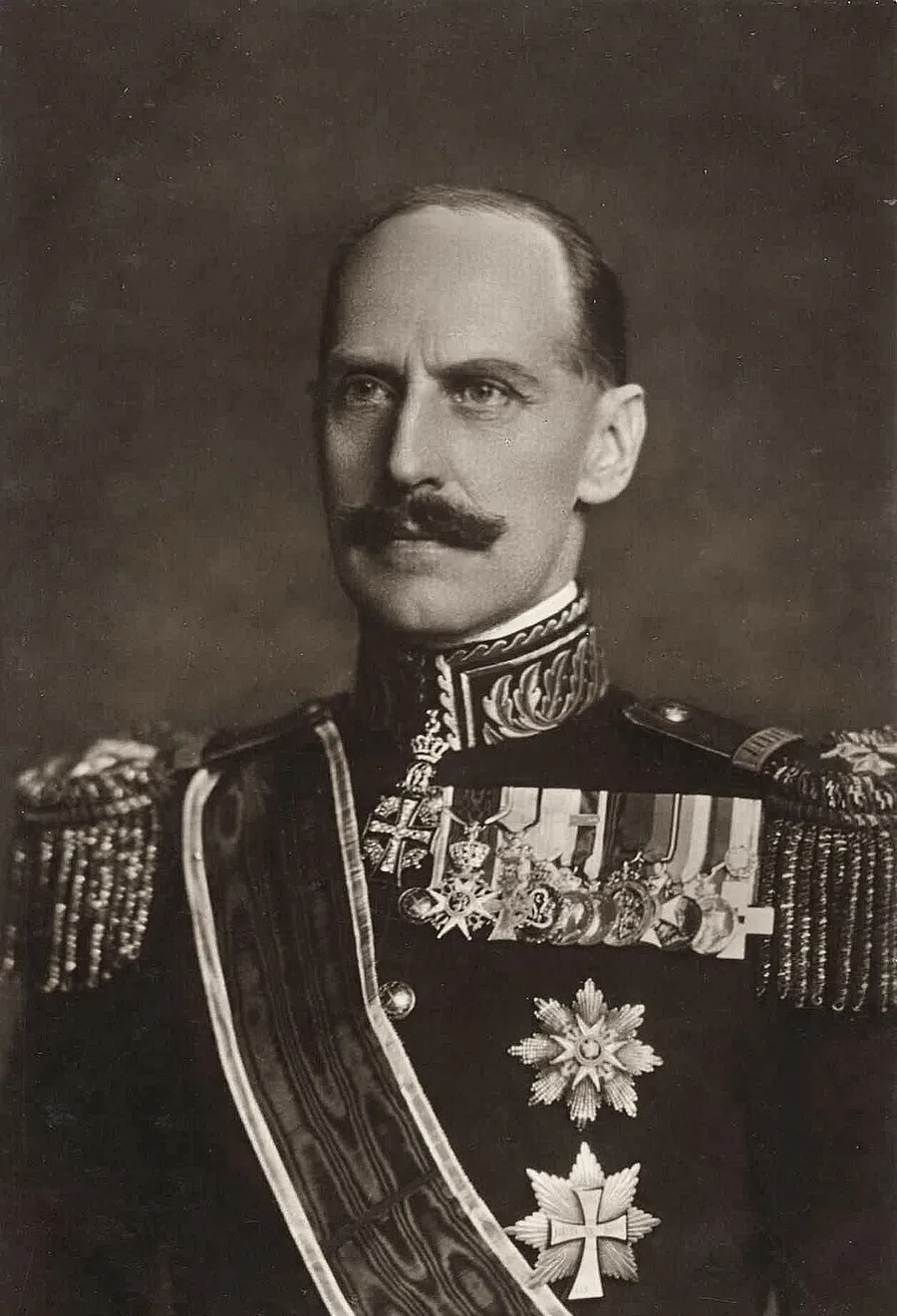 Mittet & Co., King Haakon VII of Norway (c. 1942), Library of Congress Mittet's wartime portrait of Haakon VII, around 1942 — the Danish-born naval officer elected to the Norwegian throne by referendum in 1905, aged here into the exile king whose April 1940 refusal of the German ultimatum made him the symbol of the resistance. King of Norway 1905–1957. Born Prince Carl of Denmark in 1872, the
thirty-three-year-old career naval officer was offered the
Norwegian throne after the dissolution of the Norwegian-Swedish
union in 1905, accepted after a confirmatory referendum, and took
the regnal name Haakon — last used by a Norwegian king at the
death of Haakon VI in 1380. Crowned at Nidaros Cathedral on 22
June 1906 — the last coronation in Norwegian history; the
coronation requirement was struck from the constitution in 1908.
His refusal to recognise the Quisling government in April 1940
became the founding constitutional act of the Norwegian wartime
resistance. Returned to Oslo on 7 June 1945 after five years of
exile in London; died in 1957.
Also discussed in The Quiet Revolution — how Norway won its independence without a warThe King Who Became a Saint — how the Nordmen came to ChristPolitikk — the left, the right, and the Norwegian way at the inland village of Nybergsund
Mittet & Co., King Haakon VII of Norway (c. 1942), Library of Congress Mittet's wartime portrait of Haakon VII, around 1942 — the Danish-born naval officer elected to the Norwegian throne by referendum in 1905, aged here into the exile king whose April 1940 refusal of the German ultimatum made him the symbol of the resistance. King of Norway 1905–1957. Born Prince Carl of Denmark in 1872, the
thirty-three-year-old career naval officer was offered the
Norwegian throne after the dissolution of the Norwegian-Swedish
union in 1905, accepted after a confirmatory referendum, and took
the regnal name Haakon — last used by a Norwegian king at the
death of Haakon VI in 1380. Crowned at Nidaros Cathedral on 22
June 1906 — the last coronation in Norwegian history; the
coronation requirement was struck from the constitution in 1908.
His refusal to recognise the Quisling government in April 1940
became the founding constitutional act of the Norwegian wartime
resistance. Returned to Oslo on 7 June 1945 after five years of
exile in London; died in 1957.
Also discussed in The Quiet Revolution — how Norway won its independence without a warThe King Who Became a Saint — how the Nordmen came to ChristPolitikk — the left, the right, and the Norwegian way at the inland village of Nybergsund 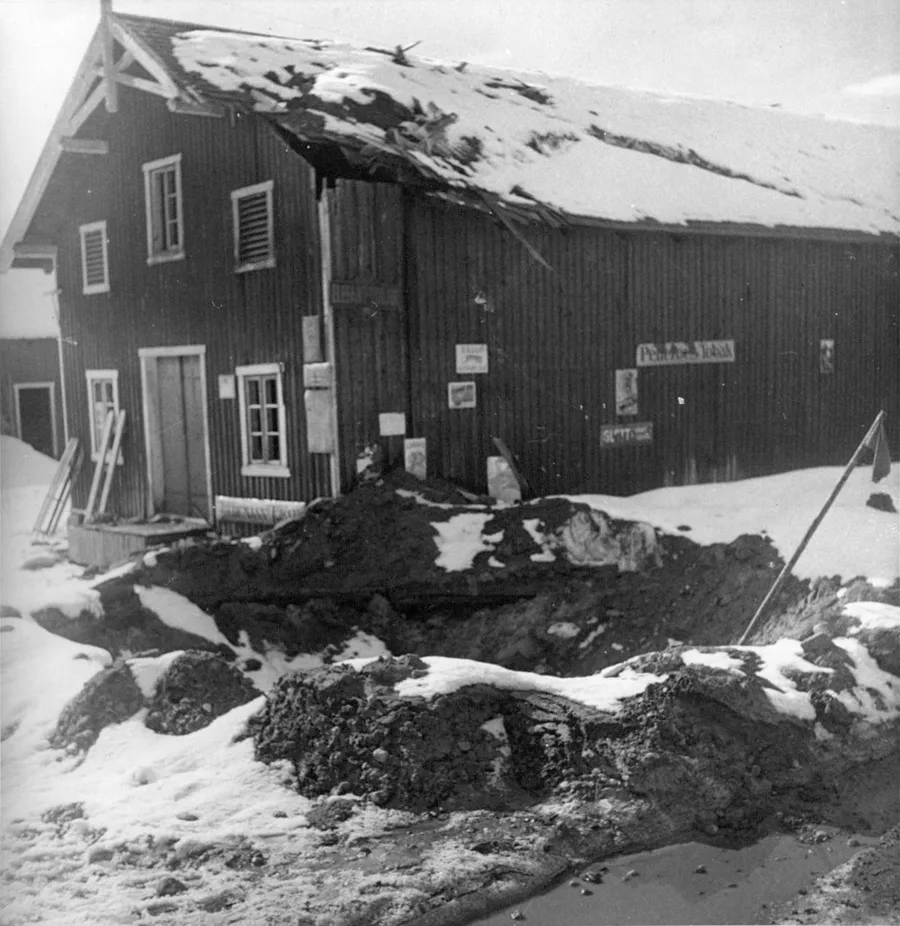 Unknown photographer, bomb crater in Nybergsund (April 1940), Åhlén & Åkerlund via IMS Vintage Photos German bombers hit Nybergsund on 11 April 1940, the day after King Haakon VII's refusal of the Quisling ultimatum — a crater like this one marks the raid that missed the fleeing king and his ministers by minutes. Inland village in Trysil municipality in Hedmark county,
in eastern Norway near the Swedish border. The temporary
refuge of King Haakon VII and the Norwegian government on
10 April 1940, the day after the German invasion. The
German ambassador Curt Bräuer had put the ultimatum — that
the king recognise a new Norwegian government under Vidkun
Quisling — to Haakon VII at Elverum earlier that day; at
Nybergsund the king told the cabinet he would abdicate
before he would appoint Quisling, the cabinet stood with
him, and the refusal was telephoned back that evening. The
Germans bombed Nybergsund the following day, missing the
king by minutes. The refusal became the constitutional
cornerstone of the Norwegian war effort and the moral
foundation of the resistance.
on the tenth of April 1940. The Germans, having occupied Oslo, dispatch their ambassador to Norway, Curt Bräuer
Unknown photographer, bomb crater in Nybergsund (April 1940), Åhlén & Åkerlund via IMS Vintage Photos German bombers hit Nybergsund on 11 April 1940, the day after King Haakon VII's refusal of the Quisling ultimatum — a crater like this one marks the raid that missed the fleeing king and his ministers by minutes. Inland village in Trysil municipality in Hedmark county,
in eastern Norway near the Swedish border. The temporary
refuge of King Haakon VII and the Norwegian government on
10 April 1940, the day after the German invasion. The
German ambassador Curt Bräuer had put the ultimatum — that
the king recognise a new Norwegian government under Vidkun
Quisling — to Haakon VII at Elverum earlier that day; at
Nybergsund the king told the cabinet he would abdicate
before he would appoint Quisling, the cabinet stood with
him, and the refusal was telephoned back that evening. The
Germans bombed Nybergsund the following day, missing the
king by minutes. The refusal became the constitutional
cornerstone of the Norwegian war effort and the moral
foundation of the resistance.
on the tenth of April 1940. The Germans, having occupied Oslo, dispatch their ambassador to Norway, Curt Bräuer 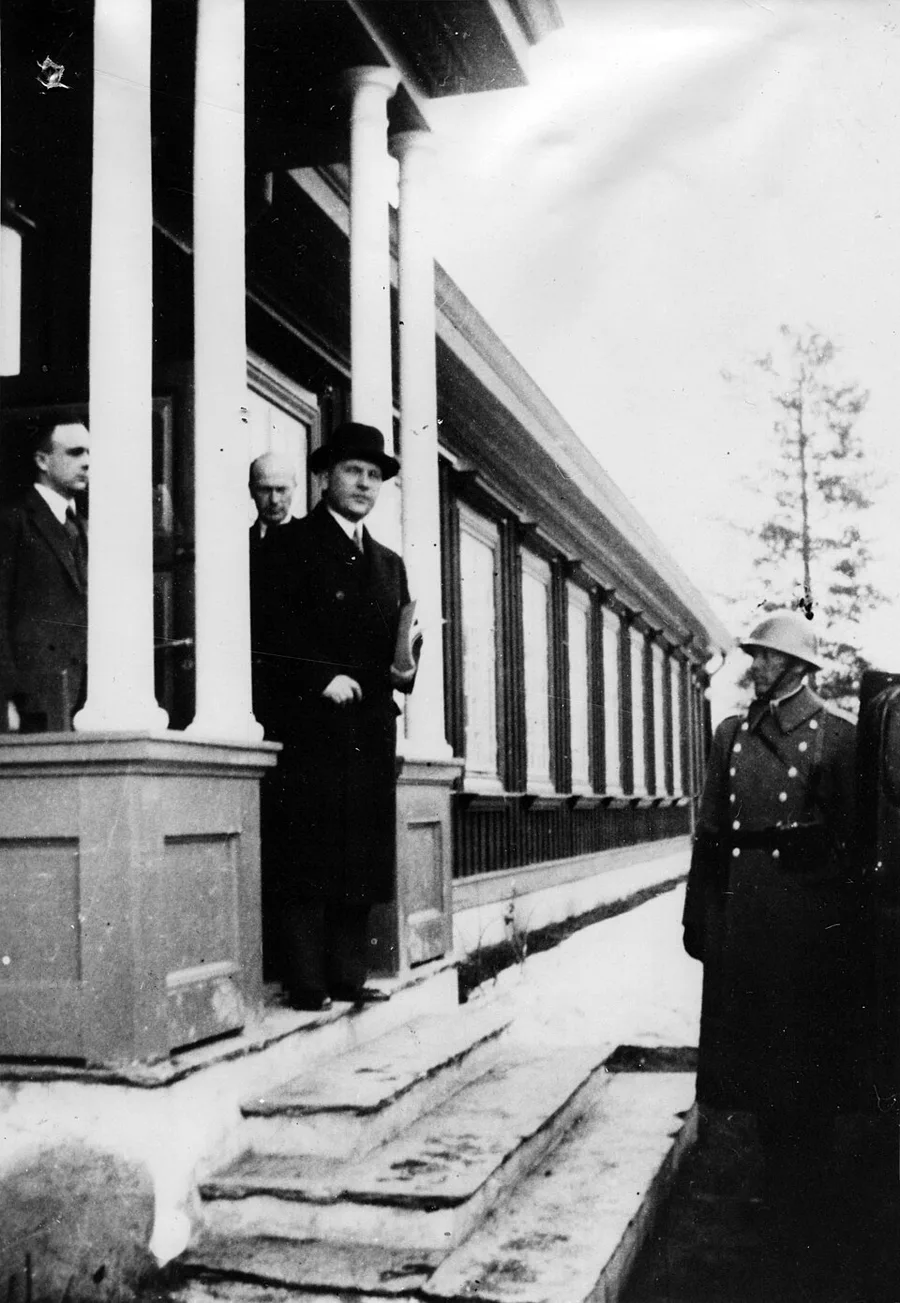 Norwegian News Agency (NTB) photographer, Curt Bräuer at Elverum (10 April 1940), Glomdalsmuseet Bräuer photographed just after delivering Germany's ultimatum to King Haakon VII at Elverum on 10 April 1940 — the king's refusal, communicated through Bräuer, ended the diplomatic phase of the invasion. German diplomat (1889–1969); the German ambassador to
Norway at the time of the 9 April 1940 invasion. Sent on
10 April 1940 to deliver the German ultimatum to King
Haakon VII and the Norwegian government in their inland
refuge at Nybergsund. Bräuer's terms required the king to
recognise a new Norwegian government under Vidkun
Quisling. The king's refusal at Nybergsund, communicated
through Bräuer, ended the diplomatic phase of the
invasion. Recalled to Berlin in May 1940 and replaced by
Reichskommissar Josef Terboven as the political head of
the German occupation administration. Subsequently served
on the Eastern Front; spent the years after 1945 as a
Soviet prisoner of war until his release in 1955.
, to deliver an ultimatum to the king at Elverum. The terms are that the king is to recognize a new Norwegian government under Vidkun Quisling
Norwegian News Agency (NTB) photographer, Curt Bräuer at Elverum (10 April 1940), Glomdalsmuseet Bräuer photographed just after delivering Germany's ultimatum to King Haakon VII at Elverum on 10 April 1940 — the king's refusal, communicated through Bräuer, ended the diplomatic phase of the invasion. German diplomat (1889–1969); the German ambassador to
Norway at the time of the 9 April 1940 invasion. Sent on
10 April 1940 to deliver the German ultimatum to King
Haakon VII and the Norwegian government in their inland
refuge at Nybergsund. Bräuer's terms required the king to
recognise a new Norwegian government under Vidkun
Quisling. The king's refusal at Nybergsund, communicated
through Bräuer, ended the diplomatic phase of the
invasion. Recalled to Berlin in May 1940 and replaced by
Reichskommissar Josef Terboven as the political head of
the German occupation administration. Subsequently served
on the Eastern Front; spent the years after 1945 as a
Soviet prisoner of war until his release in 1955.
, to deliver an ultimatum to the king at Elverum. The terms are that the king is to recognize a new Norwegian government under Vidkun Quisling 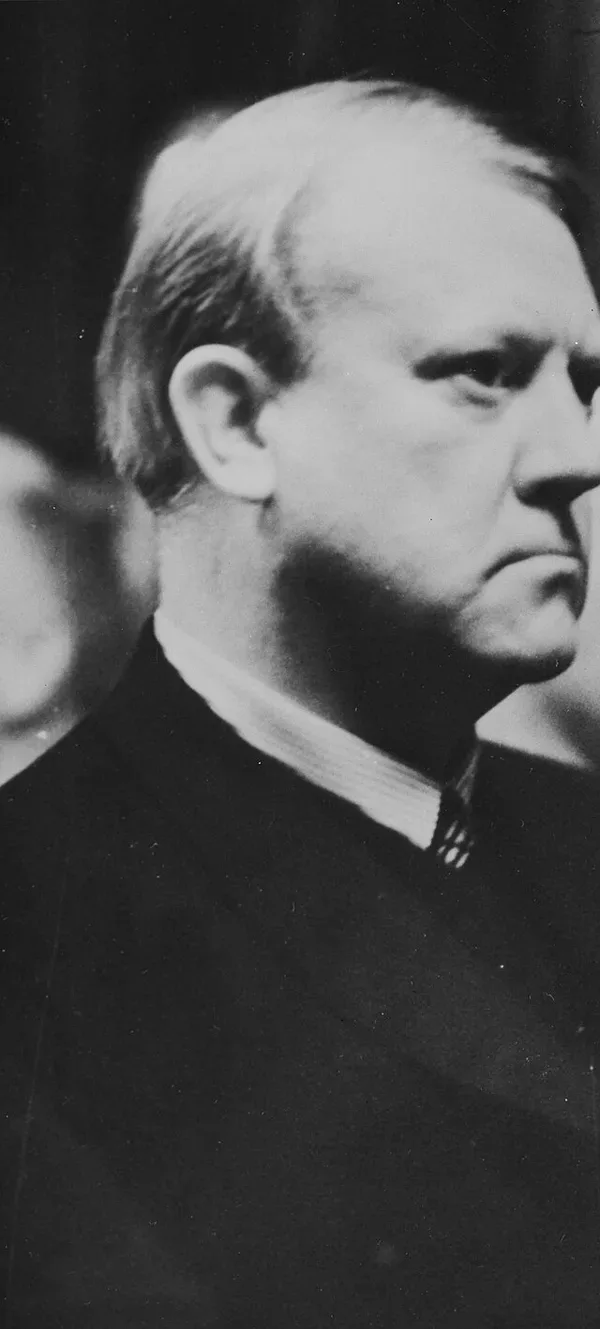 Henriksen & Steen, National Library of Norway, CC BY-SA 4.0 Quisling founded Nasjonal Samling and declared himself prime minister by radio on the night of the 9 April 1940 invasion; the Germans deposed him within a week, then restored him as puppet Ministerpräsident in 1942 — the arc this article follows to his 1945 execution. Norwegian fascist politician (1887–1945) and collaborator
prime minister of German-occupied Norway. Trained as an
army officer; served as Defence Minister 1931–1933.
Founded the Norwegian fascist party Nasjonal Samling in
1933; pre-war electoral support peaked at 2.2% in 1933 and
fell below 2% by 1936. Attempted an unauthorised coup the
evening of 9 April 1940 by broadcasting from the NRK
studio that he was forming a government; the Germans
pushed him aside within six days. Given the title
Ministerpräsident by Terboven on 1 February 1942 with
formal authority over a puppet Norwegian government.
Executed by firing squad at Akershus fortress on 24
October 1945. His name entered English as a common noun
for a traitorous collaborator.
Also discussed in The Quiet Revolution — how Norway won its independence without a war , the leader of the small Norwegian fascist party Nasjonal Samling
Henriksen & Steen, National Library of Norway, CC BY-SA 4.0 Quisling founded Nasjonal Samling and declared himself prime minister by radio on the night of the 9 April 1940 invasion; the Germans deposed him within a week, then restored him as puppet Ministerpräsident in 1942 — the arc this article follows to his 1945 execution. Norwegian fascist politician (1887–1945) and collaborator
prime minister of German-occupied Norway. Trained as an
army officer; served as Defence Minister 1931–1933.
Founded the Norwegian fascist party Nasjonal Samling in
1933; pre-war electoral support peaked at 2.2% in 1933 and
fell below 2% by 1936. Attempted an unauthorised coup the
evening of 9 April 1940 by broadcasting from the NRK
studio that he was forming a government; the Germans
pushed him aside within six days. Given the title
Ministerpräsident by Terboven on 1 February 1942 with
formal authority over a puppet Norwegian government.
Executed by firing squad at Akershus fortress on 24
October 1945. His name entered English as a common noun
for a traitorous collaborator.
Also discussed in The Quiet Revolution — how Norway won its independence without a war , the leader of the small Norwegian fascist party Nasjonal Samling 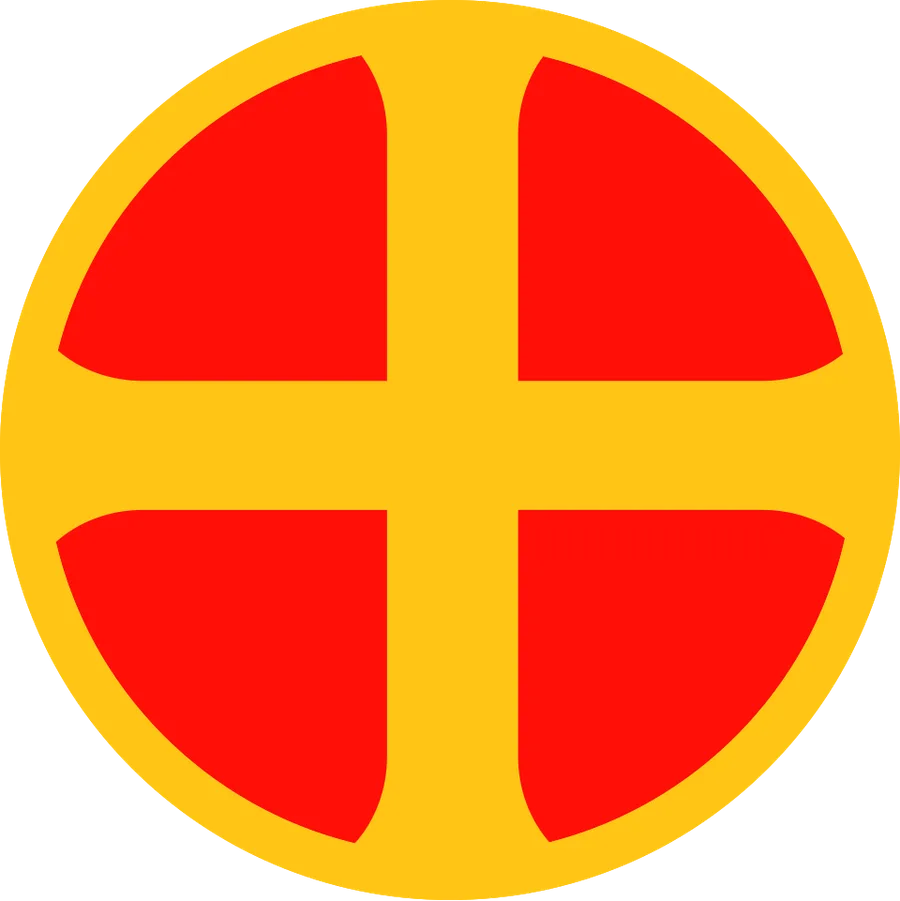 Nasjonal Samling sun-cross emblem, public domain vector reconstruction The sun-cross (solkors) was Nasjonal Samling's official emblem from the party's 1933 founding through the occupation, stamped on membership cards, armbands, and party flags — the badge of the only legal Norwegian political affiliation between 1940 and 1945. National Gathering — the Norwegian fascist party founded
by Vidkun Quisling in 1933. Pre-war electoral support
peaked at about 2.2% in the 1933 elections and fell below
2% by 1936. The party drew on a corporatist programme
borrowed from Italian Fascism, Nordic-racialist ideology,
and a Norwegian-nationalist appeal that never connected to
the broader electorate. Under the German occupation
(1940–1945) the only legal Norwegian political party.
Membership grew under the occupation as Norwegians sought
to insure themselves against the regime or to participate
in its administration; total registered membership across
the occupation was around 55,000. Banned at the
liberation; roughly 46,000 Norwegians were convicted of
Nasjonal Samling membership in the landssvikoppgjøret.
whose pre-war electoral support had peaked at about two and a quarter percent in 1933 and had fallen below two percent by 1936. The king meets with the Norwegian cabinet at Nybergsund in a small farmhouse parlor on the night of the tenth and tells the ministers that he will abdicate the throne before he will appoint Quisling. The cabinet, by his decision, refuses the German ultimatum. The Germans bomb Nybergsund the following morning, missing the king by minutes; the king and crown prince escape into the snow-covered woods, and the flight north continues. The previous day at Elverum, the Storting
Nasjonal Samling sun-cross emblem, public domain vector reconstruction The sun-cross (solkors) was Nasjonal Samling's official emblem from the party's 1933 founding through the occupation, stamped on membership cards, armbands, and party flags — the badge of the only legal Norwegian political affiliation between 1940 and 1945. National Gathering — the Norwegian fascist party founded
by Vidkun Quisling in 1933. Pre-war electoral support
peaked at about 2.2% in the 1933 elections and fell below
2% by 1936. The party drew on a corporatist programme
borrowed from Italian Fascism, Nordic-racialist ideology,
and a Norwegian-nationalist appeal that never connected to
the broader electorate. Under the German occupation
(1940–1945) the only legal Norwegian political party.
Membership grew under the occupation as Norwegians sought
to insure themselves against the regime or to participate
in its administration; total registered membership across
the occupation was around 55,000. Banned at the
liberation; roughly 46,000 Norwegians were convicted of
Nasjonal Samling membership in the landssvikoppgjøret.
whose pre-war electoral support had peaked at about two and a quarter percent in 1933 and had fallen below two percent by 1936. The king meets with the Norwegian cabinet at Nybergsund in a small farmhouse parlor on the night of the tenth and tells the ministers that he will abdicate the throne before he will appoint Quisling. The cabinet, by his decision, refuses the German ultimatum. The Germans bomb Nybergsund the following morning, missing the king by minutes; the king and crown prince escape into the snow-covered woods, and the flight north continues. The previous day at Elverum, the Storting 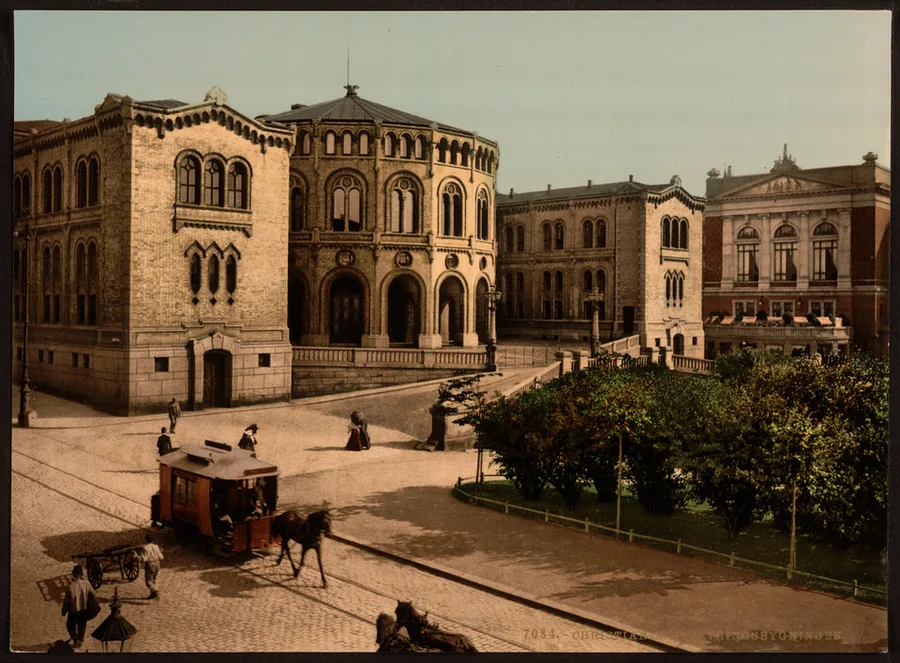 Detroit Publishing Company, Storthings Bygningen, Christiania, Norway (c. 1890-1900), Library of Congress / World Digital Library The Storting building in Kristiania (Oslo), Norway's parliament since the 1814 Constitution and the seat of the legislature that still governs the country. The Grand Assembly — the parliament of independent
Norway, established by the Eidsvoll Constitution of 17 May
1814 as the country's sovereign legislature. The name
Storting (Stór-Þing, the great assembly) deliberately
reaches back to the medieval Norwegian thing tradition,
asserting institutional continuity with the pre-Danish
Norwegian state. Under the 1814 constitution the Storting
divided into two chambers — Lagting and Odelsting —
for legislative purposes; the two-chamber arrangement was
abolished in 2009 and the Storting has been a single
chamber since. The current building, in central Oslo,
opened in 1866.
Also discussed in The 400-Year Night — when the Northern Lion lay dormantLutheran Norway and Pietism — a farmer named Hans Nielsen Hauge and a lay revival that could not be silencedThe Constitution That Saved a Nation — five radical weeks at Eidsvoll, 1814The Quiet Revolution — how Norway won its independence without a warThe 'Lucky Country' — the discovery that changed everythingAllemannsretten — the right to roamPolitikk — the left, the right, and the Norwegian way had passed the Elverumsfullmakten
Detroit Publishing Company, Storthings Bygningen, Christiania, Norway (c. 1890-1900), Library of Congress / World Digital Library The Storting building in Kristiania (Oslo), Norway's parliament since the 1814 Constitution and the seat of the legislature that still governs the country. The Grand Assembly — the parliament of independent
Norway, established by the Eidsvoll Constitution of 17 May
1814 as the country's sovereign legislature. The name
Storting (Stór-Þing, the great assembly) deliberately
reaches back to the medieval Norwegian thing tradition,
asserting institutional continuity with the pre-Danish
Norwegian state. Under the 1814 constitution the Storting
divided into two chambers — Lagting and Odelsting —
for legislative purposes; the two-chamber arrangement was
abolished in 2009 and the Storting has been a single
chamber since. The current building, in central Oslo,
opened in 1866.
Also discussed in The 400-Year Night — when the Northern Lion lay dormantLutheran Norway and Pietism — a farmer named Hans Nielsen Hauge and a lay revival that could not be silencedThe Constitution That Saved a Nation — five radical weeks at Eidsvoll, 1814The Quiet Revolution — how Norway won its independence without a warThe 'Lucky Country' — the discovery that changed everythingAllemannsretten — the right to roamPolitikk — the left, the right, and the Norwegian way had passed the Elverumsfullmakten 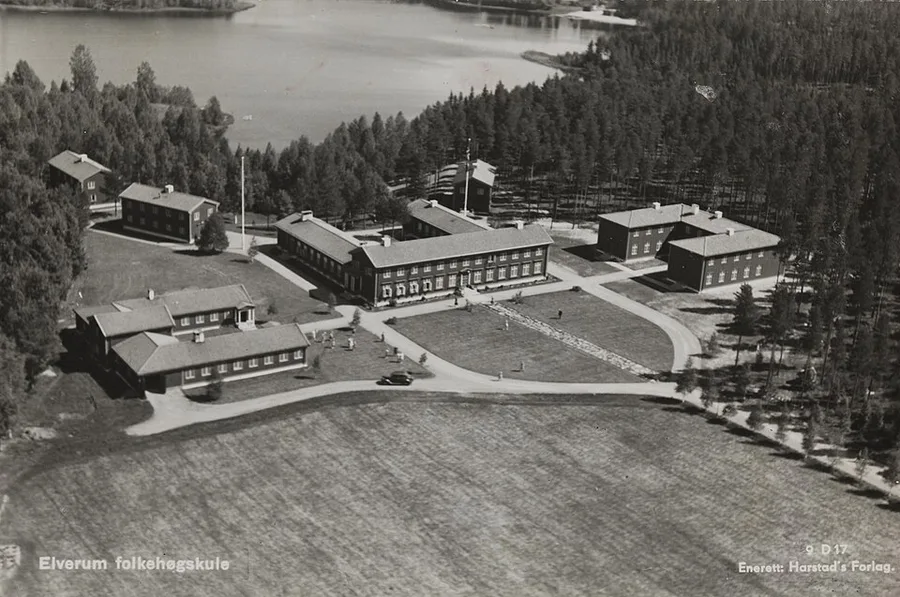 Unknown photographer, Elverum folkehøgskole (c. 1935–1938), National Library of Norway (Nasjonalbiblioteket) The Storting convened at this folk high school on 9 April 1940 and, that evening, granted the government emergency powers to act in its name for the rest of the war — the Elverum Authorization. The Elverum Authorization — the resolution passed by
the Norwegian Storting at Elverum on 9 April 1940, the
day of the German invasion, granting the Norwegian
government full emergency powers to act on the Storting's
behalf for the duration of the wartime crisis until a
regular Storting could be reconvened. Proposed by
Storting President C. J. Hambro. Operated as the legal
scaffolding under which the Norwegian state in exile in
London functioned for the next five years — the
constitutional authority behind every act of the exile
government, including Nortraship's commissioning of the
Norwegian merchant marine into Allied service. Combined
with Haakon VII's refusal of Quisling at Nybergsund the
following day, the foundation of the Norwegian war effort.
— the Elverum Authorization — granting the government emergency powers to act on the Storting’s behalf for the duration of the crisis; this becomes the legal scaffolding under which the Norwegian state in exile operates for the next five years. The refusal to recognize Quisling at Nybergsund is the moral cornerstone of that constitutional order. Every subsequent piece of the Norwegian war effort — the king and government in London, the resistance organization Milorg
Unknown photographer, Elverum folkehøgskole (c. 1935–1938), National Library of Norway (Nasjonalbiblioteket) The Storting convened at this folk high school on 9 April 1940 and, that evening, granted the government emergency powers to act in its name for the rest of the war — the Elverum Authorization. The Elverum Authorization — the resolution passed by
the Norwegian Storting at Elverum on 9 April 1940, the
day of the German invasion, granting the Norwegian
government full emergency powers to act on the Storting's
behalf for the duration of the wartime crisis until a
regular Storting could be reconvened. Proposed by
Storting President C. J. Hambro. Operated as the legal
scaffolding under which the Norwegian state in exile in
London functioned for the next five years — the
constitutional authority behind every act of the exile
government, including Nortraship's commissioning of the
Norwegian merchant marine into Allied service. Combined
with Haakon VII's refusal of Quisling at Nybergsund the
following day, the foundation of the Norwegian war effort.
— the Elverum Authorization — granting the government emergency powers to act on the Storting’s behalf for the duration of the crisis; this becomes the legal scaffolding under which the Norwegian state in exile operates for the next five years. The refusal to recognize Quisling at Nybergsund is the moral cornerstone of that constitutional order. Every subsequent piece of the Norwegian war effort — the king and government in London, the resistance organization Milorg 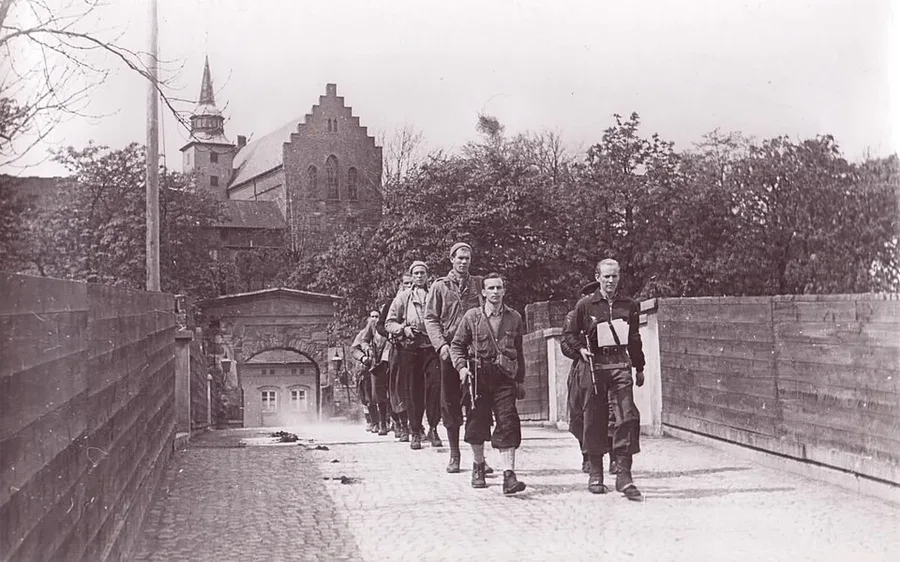 Unknown photographer, public domain (Norway) Milorg fighters march from Akershus Fortress on 11 May 1945, three days after the German capitulation, during the handover the organisation had spent years quietly preparing to manage across southern and central Norway. Militær Organisasjon — the principal Norwegian
home-front resistance organisation under the German
occupation, founded in 1941 as a coordinated successor to
the scattered resistance cells of 1940. Operated under
the constitutional authority of the exiled Norwegian
government in London, channelled through SOE liaison and
the Hjemmefrontens Ledelse. By early 1944 Milorg had
armed and trained several tens of thousands of Norwegian
volunteers and was organised in cells across all of
southern and central Norway. Contributed substantially to
the orderly liberation of the country in May 1945 — the
transfer of German installations into Allied hands was
largely managed by Milorg cells. Today commemorated at
the Norwegian Resistance Museum at Akershus.
inside Norway, the Norwegian merchant marine Nortraship
Unknown photographer, public domain (Norway) Milorg fighters march from Akershus Fortress on 11 May 1945, three days after the German capitulation, during the handover the organisation had spent years quietly preparing to manage across southern and central Norway. Militær Organisasjon — the principal Norwegian
home-front resistance organisation under the German
occupation, founded in 1941 as a coordinated successor to
the scattered resistance cells of 1940. Operated under
the constitutional authority of the exiled Norwegian
government in London, channelled through SOE liaison and
the Hjemmefrontens Ledelse. By early 1944 Milorg had
armed and trained several tens of thousands of Norwegian
volunteers and was organised in cells across all of
southern and central Norway. Contributed substantially to
the orderly liberation of the country in May 1945 — the
transfer of German installations into Allied hands was
largely managed by Milorg cells. Today commemorated at
the Norwegian Resistance Museum at Akershus.
inside Norway, the Norwegian merchant marine Nortraship 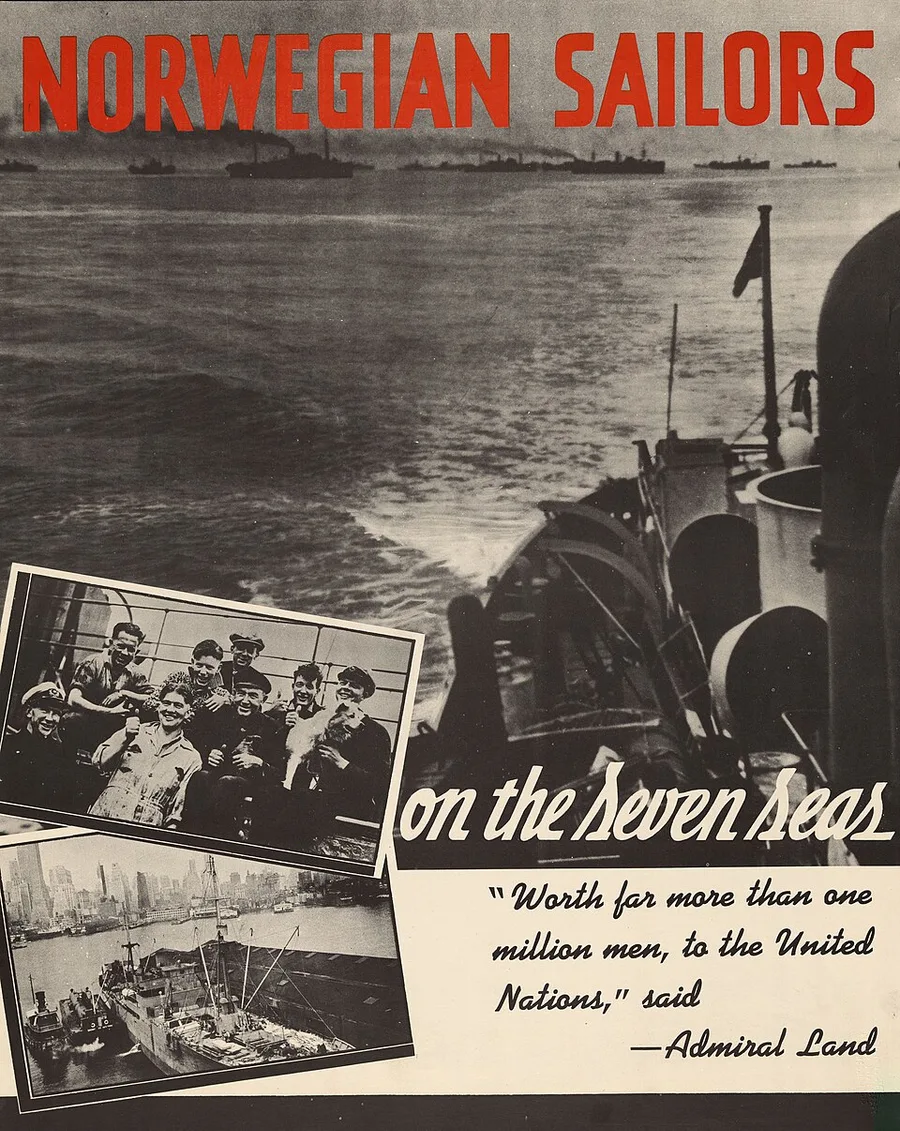 WWII-era poster, public domain (US), via Illinois State Univ./DPLA An Allied wartime poster quoting US Navy Vice Admiral Emory Land calling Norwegian sailors 'worth far more than one million men' — the tribute earned by Nortraship's roughly 1,000 requisitioned ships and 30,000 seamen. Norwegian Shipping and Trade Mission — the wartime
Norwegian government-in-exile body that managed the
Norwegian merchant marine in Allied service from 1940 to
1945. Established by Royal Decree on 22 April 1940 in
London under the Elverumsfullmakten authority. At its
peak Nortraship controlled approximately 1,000 Norwegian-
flagged merchant vessels and about 30,000 Norwegian
sailors, making it the third-largest Allied merchant
fleet after the British and American merchant marines.
Carried essential supplies — petroleum, foodstuffs,
matériel — across the North Atlantic, Mediterranean, and
Pacific. Approximately 3,500 Norwegian merchant seamen
were killed in service — the highest per-capita
merchant-marine loss of any Allied country. Dissolved at
the liberation.
that operated under the exiled government’s authority and became the third-largest Allied merchant fleet, the Norwegian forces fighting under British and Canadian commands — derives its constitutional legitimacy from the king’s refusal at Nybergsund.
WWII-era poster, public domain (US), via Illinois State Univ./DPLA An Allied wartime poster quoting US Navy Vice Admiral Emory Land calling Norwegian sailors 'worth far more than one million men' — the tribute earned by Nortraship's roughly 1,000 requisitioned ships and 30,000 seamen. Norwegian Shipping and Trade Mission — the wartime
Norwegian government-in-exile body that managed the
Norwegian merchant marine in Allied service from 1940 to
1945. Established by Royal Decree on 22 April 1940 in
London under the Elverumsfullmakten authority. At its
peak Nortraship controlled approximately 1,000 Norwegian-
flagged merchant vessels and about 30,000 Norwegian
sailors, making it the third-largest Allied merchant
fleet after the British and American merchant marines.
Carried essential supplies — petroleum, foodstuffs,
matériel — across the North Atlantic, Mediterranean, and
Pacific. Approximately 3,500 Norwegian merchant seamen
were killed in service — the highest per-capita
merchant-marine loss of any Allied country. Dissolved at
the liberation.
that operated under the exiled government’s authority and became the third-largest Allied merchant fleet, the Norwegian forces fighting under British and Canadian commands — derives its constitutional legitimacy from the king’s refusal at Nybergsund.
Quisling
On the evening of the ninth of April, before the king has reached Nybergsund, Quisling walks into the NRK radio studio in Oslo and broadcasts that he is forming a government. The coup is unauthorized — the Germans were preparing to install Quisling but had not done so, and the Norwegian state has not appointed him — and so unpopular inside Norway and so chaotic in execution that the Germans push him aside within six days. He spends much of the occupation thereafter in a peculiar position. The German Reichskommissar Josef Terboven 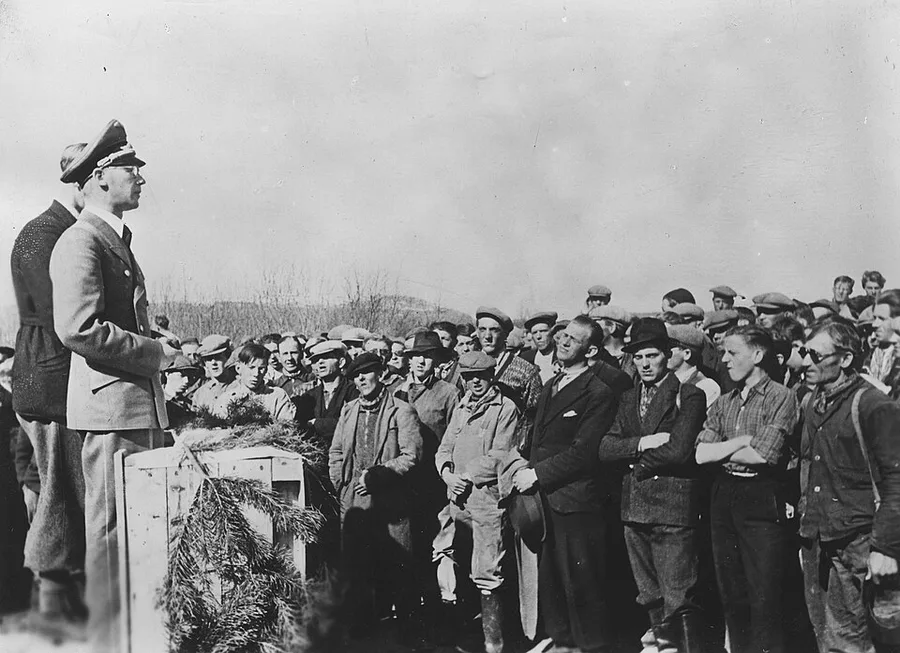 Photo: Lange / Scherl agency; Narodowe Archiwum Cyfrowe (Poland), CC BY-SA 4.0 Terboven speaks to Norwegian workers at Værnes garrison on 1 May 1940, weeks into his appointment as Reichskommissar — the same civilian administration he ran until dissolving the Storting, banning political parties, and enforcing the persecution of Norway's Jews. German Nazi Reichskommissar of occupied Norway (1898–1945).
A long-time Nazi Party member from 1923; Gauleiter of
Essen from 1928. Appointed by Hitler to head the civilian
occupation administration of Norway on 24 April 1940. From
his headquarters in the Storting building in central Oslo —
residing at the Skaugum estate outside the city — Terboven
ran the actual administration of occupied Norway and
regarded Quisling as politically useful but personally
unreliable. Pushed through the harsh policies that defined
the German occupation: the dissolution of the Storting and
political parties, the persecution of the Norwegian Jews,
the mass arrests of teachers and bishops. Refused to
surrender on 8 May 1945; blew himself up with dynamite in
his bunker at Skaugum the same day.
, sent by Berlin to administer occupied Norway, regards Quisling as politically useful but personally unreliable, and the actual administration of Norway runs from Terboven’s headquarters in the Storting building — the parliament he has dissolved — while he resides at Skaugum estate outside Oslo. Quisling is given the title of Ministerpräsident on the first of February 1942, with formal authority over a puppet Norwegian government, and he uses the position to push through measures that are unpopular with the Norwegian public and that produce some of the worst incidents of the occupation. He institutes a Nasjonal Samling-controlled state structure, attempts to impose Nasjonal Samling-controlled teachers’ and bishops’ corporations on the schools and the state church, and signs the October and November 1942 laws authorizing the arrest of all Norwegian Jewish men, the confiscation of Jewish-owned property, and the registration of all Norwegian Jews.
Photo: Lange / Scherl agency; Narodowe Archiwum Cyfrowe (Poland), CC BY-SA 4.0 Terboven speaks to Norwegian workers at Værnes garrison on 1 May 1940, weeks into his appointment as Reichskommissar — the same civilian administration he ran until dissolving the Storting, banning political parties, and enforcing the persecution of Norway's Jews. German Nazi Reichskommissar of occupied Norway (1898–1945).
A long-time Nazi Party member from 1923; Gauleiter of
Essen from 1928. Appointed by Hitler to head the civilian
occupation administration of Norway on 24 April 1940. From
his headquarters in the Storting building in central Oslo —
residing at the Skaugum estate outside the city — Terboven
ran the actual administration of occupied Norway and
regarded Quisling as politically useful but personally
unreliable. Pushed through the harsh policies that defined
the German occupation: the dissolution of the Storting and
political parties, the persecution of the Norwegian Jews,
the mass arrests of teachers and bishops. Refused to
surrender on 8 May 1945; blew himself up with dynamite in
his bunker at Skaugum the same day.
, sent by Berlin to administer occupied Norway, regards Quisling as politically useful but personally unreliable, and the actual administration of Norway runs from Terboven’s headquarters in the Storting building — the parliament he has dissolved — while he resides at Skaugum estate outside Oslo. Quisling is given the title of Ministerpräsident on the first of February 1942, with formal authority over a puppet Norwegian government, and he uses the position to push through measures that are unpopular with the Norwegian public and that produce some of the worst incidents of the occupation. He institutes a Nasjonal Samling-controlled state structure, attempts to impose Nasjonal Samling-controlled teachers’ and bishops’ corporations on the schools and the state church, and signs the October and November 1942 laws authorizing the arrest of all Norwegian Jewish men, the confiscation of Jewish-owned property, and the registration of all Norwegian Jews.
The Holocaust in Norway
The Jewish paragraph in the Norwegian Grunnloven 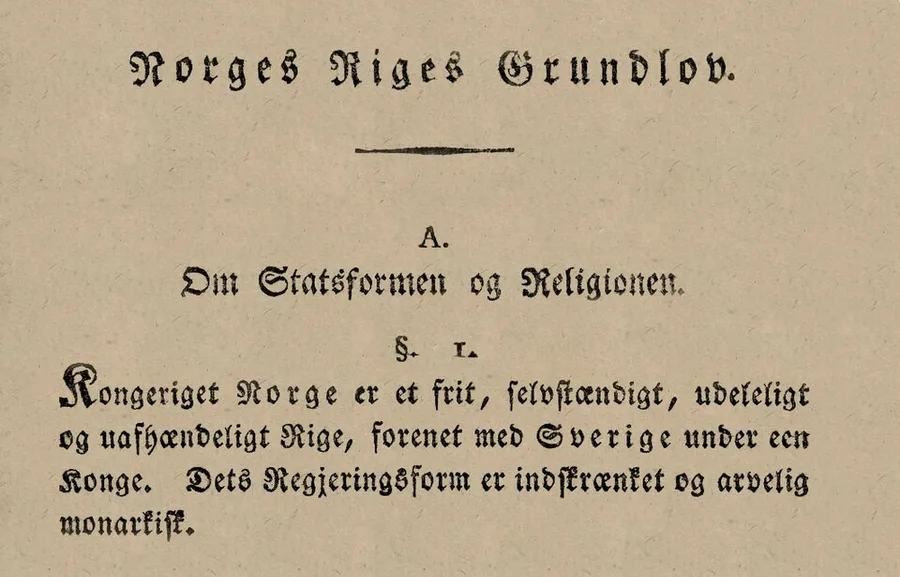 Norges Riges Grundlov §1, official printed edition (1814) The first article of Norway’s 1814 constitution as printed: the Kingdom of Norway is a free, independent, indivisible and inalienable realm. The November wording adds united with Sweden under one King — the compromise that preserved the constitution after the summer war. The Norwegian Constitution — drafted by the Eidsvoll
Constituent Assembly between 10 April and mid-May 1814,
settled in final form on 16 May and dated and signed on
17 May 1814: the founding text of the modern Norwegian
state. Grounded
explicitly in popular sovereignty; distributes governmental
authority across the three branches on the model of the
United States Constitution of 1787; establishes the
Storting as the principal legislature with a suspensive
veto for the king; guarantees freedom of expression,
public trial, and the prohibition of ex post facto law.
Adopted in a revised November 1814 form to fit the
Convention of Moss settlement and the Swedish union. As
of 2026 the second-oldest written constitution still in
force in the world after the US Constitution of 1787.
In this article Under the printed heading Om Statsformen og Religionen — On
the Form of Government and Religion — the next section of the
1814 text carried the clause excluding Jews from the realm:
the §2 ban Henrik Wergeland campaigned against until his death,
repealed in 1851. The document the wartime resistance defended
as the ground of Norwegian legitimacy was also the document
that had once written that exclusion.
Also discussed in The Constitution That Saved a Nation — five radical weeks at Eidsvoll, 1814 had stated, in Section 2, that Jews remained excluded from access to the realm — one of the most aggressive Jewish-exclusion clauses in any nineteenth-century European constitution. The Eidsvoll men had written it. Repeal came in 1851, after a sustained campaign by the poet Henrik Wergeland
Norges Riges Grundlov §1, official printed edition (1814) The first article of Norway’s 1814 constitution as printed: the Kingdom of Norway is a free, independent, indivisible and inalienable realm. The November wording adds united with Sweden under one King — the compromise that preserved the constitution after the summer war. The Norwegian Constitution — drafted by the Eidsvoll
Constituent Assembly between 10 April and mid-May 1814,
settled in final form on 16 May and dated and signed on
17 May 1814: the founding text of the modern Norwegian
state. Grounded
explicitly in popular sovereignty; distributes governmental
authority across the three branches on the model of the
United States Constitution of 1787; establishes the
Storting as the principal legislature with a suspensive
veto for the king; guarantees freedom of expression,
public trial, and the prohibition of ex post facto law.
Adopted in a revised November 1814 form to fit the
Convention of Moss settlement and the Swedish union. As
of 2026 the second-oldest written constitution still in
force in the world after the US Constitution of 1787.
In this article Under the printed heading Om Statsformen og Religionen — On
the Form of Government and Religion — the next section of the
1814 text carried the clause excluding Jews from the realm:
the §2 ban Henrik Wergeland campaigned against until his death,
repealed in 1851. The document the wartime resistance defended
as the ground of Norwegian legitimacy was also the document
that had once written that exclusion.
Also discussed in The Constitution That Saved a Nation — five radical weeks at Eidsvoll, 1814 had stated, in Section 2, that Jews remained excluded from access to the realm — one of the most aggressive Jewish-exclusion clauses in any nineteenth-century European constitution. The Eidsvoll men had written it. Repeal came in 1851, after a sustained campaign by the poet Henrik Wergeland 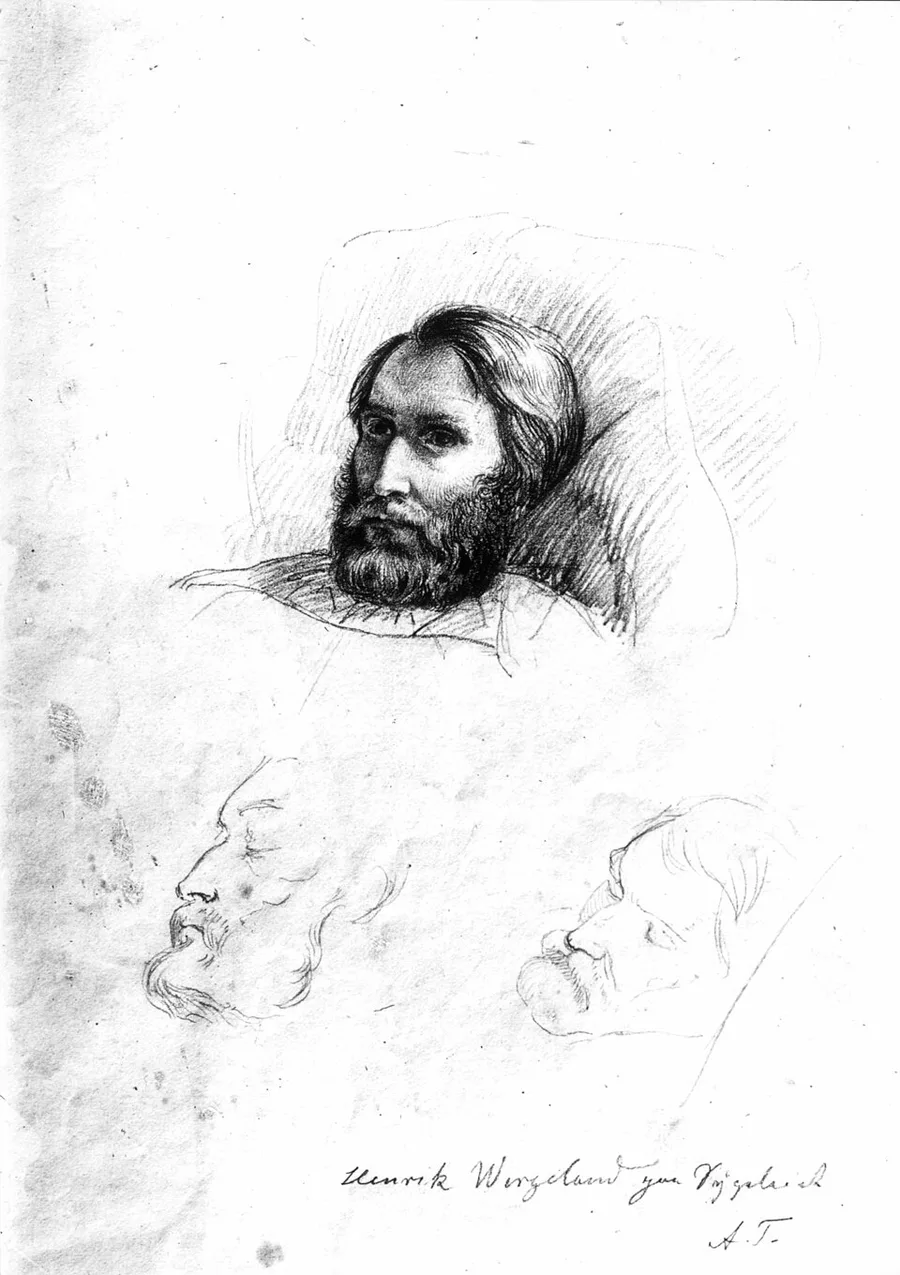 Adolph Tidemand, Portrait of Henrik Wergeland (1844), Norsk portrettarkiv, Riksantikvaren Tidemand's sheet is captioned "Henrik Wergeland paa Sygeleiet" — Wergeland on his sickbed, drawn in his final year — the Romantic-era poet who spent the 1830s and 1840s campaigning to remove Norway's constitutional ban on Jewish settlement, and died six years before it fell. Norwegian poet, dramatist, and political reformer (1808–1845),
the dominant literary figure of the first generation after the
1814 Constitution. Son of the Eidsvoll constitutional delegate
Nicolai Wergeland; brother of the writer Camilla Collett and
the officer Oscar Wergeland.
Pioneer of Norwegian Romantic poetry — his epic Skabelsen,
Mennesket og Messias (Creation, Man, and Messiah, 1830) is
among the founding works of modern Norwegian literature.
Through the 1830s and 1840s he campaigned
for the removal of Article 2 of the 1814
Constitution, which barred Jewish settlement in Norway. He
died in 1845 at thirty-seven, six years before
the campaign succeeded in 1851. Jewish congregations in Oslo
and Trondheim place flowers on his grave every year on the
anniversary of his death.
Also discussed in Lutheran Norway and Pietism — a farmer named Hans Nielsen Hauge and a lay revival that could not be silencedThe Constitution That Saved a Nation — five radical weeks at Eidsvoll, 1814 — who died in 1845, six years before his cause prevailed. The 1814 ban predated any imported German antisemitism by more than a century. It was a Norwegian story.
Adolph Tidemand, Portrait of Henrik Wergeland (1844), Norsk portrettarkiv, Riksantikvaren Tidemand's sheet is captioned "Henrik Wergeland paa Sygeleiet" — Wergeland on his sickbed, drawn in his final year — the Romantic-era poet who spent the 1830s and 1840s campaigning to remove Norway's constitutional ban on Jewish settlement, and died six years before it fell. Norwegian poet, dramatist, and political reformer (1808–1845),
the dominant literary figure of the first generation after the
1814 Constitution. Son of the Eidsvoll constitutional delegate
Nicolai Wergeland; brother of the writer Camilla Collett and
the officer Oscar Wergeland.
Pioneer of Norwegian Romantic poetry — his epic Skabelsen,
Mennesket og Messias (Creation, Man, and Messiah, 1830) is
among the founding works of modern Norwegian literature.
Through the 1830s and 1840s he campaigned
for the removal of Article 2 of the 1814
Constitution, which barred Jewish settlement in Norway. He
died in 1845 at thirty-seven, six years before
the campaign succeeded in 1851. Jewish congregations in Oslo
and Trondheim place flowers on his grave every year on the
anniversary of his death.
Also discussed in Lutheran Norway and Pietism — a farmer named Hans Nielsen Hauge and a lay revival that could not be silencedThe Constitution That Saved a Nation — five radical weeks at Eidsvoll, 1814 — who died in 1845, six years before his cause prevailed. The 1814 ban predated any imported German antisemitism by more than a century. It was a Norwegian story.
The Lutheran inheritance behind it ran longer still. Martin Luther 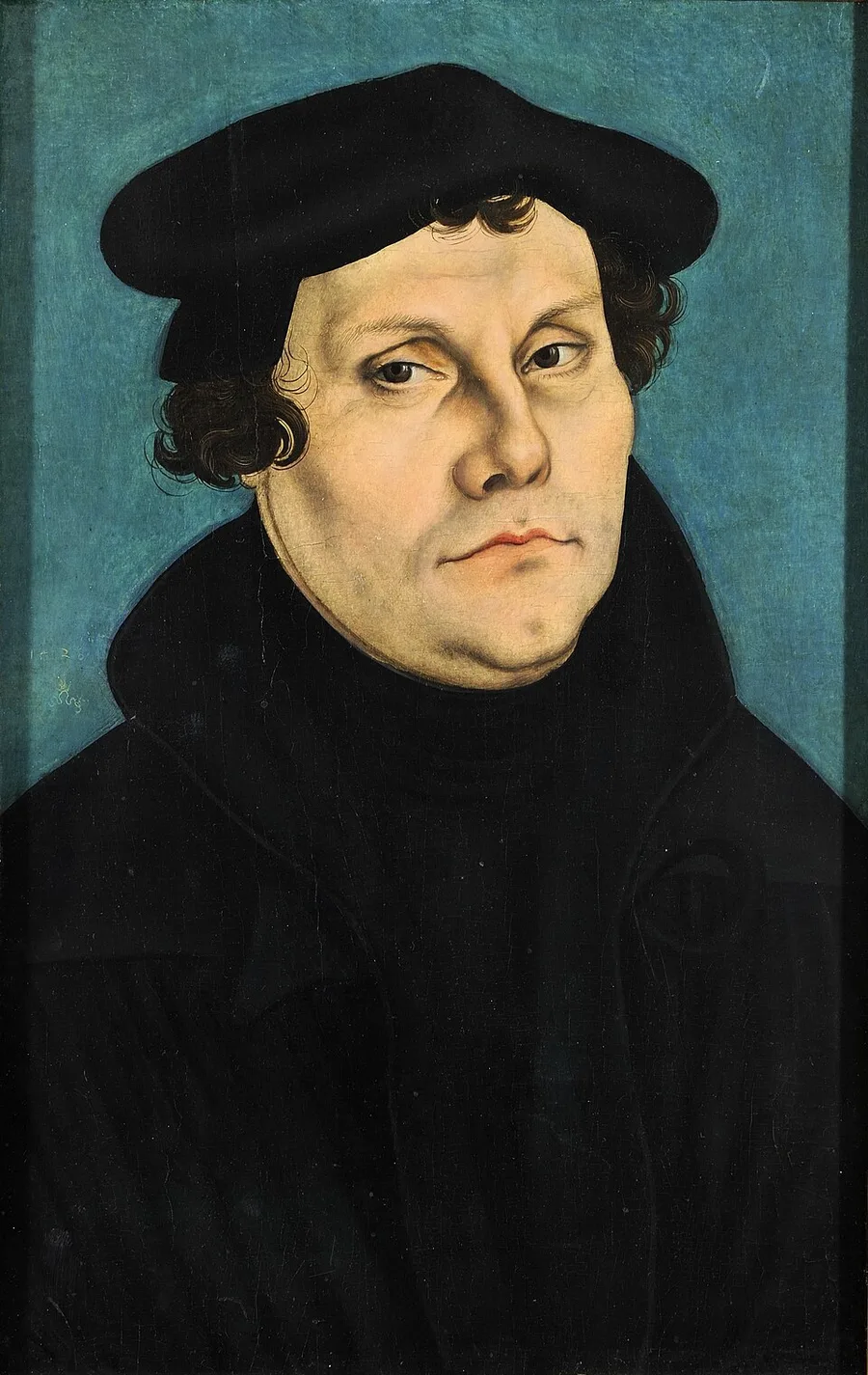 Lucas Cranach the Elder, Martin Luther (1528) Cranach's 1528 portrait of Martin Luther, whose Ninety-Five Theses and doctrine of justification by faith set off the ruptures with Rome that the 1537 Kirkeordinansen carried into Denmark-Norway a decade later. German theologian and Augustinian friar (1483–1546),
professor of biblical exegesis at Wittenberg. Originator of
the central Reformation ruptures with Rome through his
Ninety-Five Theses (October 1517), the Address to the
Christian Nobility (1520), and his refusal at the Diet of
Worms (April 1521) to recant his teachings on justification
by faith alone, scripture alone as the rule of teaching,
and the rejection of papal authority, indulgences, purgatory,
the Mass as sacrifice, and the invocation of saints. Held
throughout his life to a number of positions closer to
medieval Catholicism than to most later Protestant
tradition — the perpetual virginity of Mary, the bodily
Real Presence in the Eucharist, private confession, the
retention of liturgical vestments and ceremonial worship.
In this article Late in life Luther wrote Von den Juden und ihren Lügen — On
the Jews and Their Lies (1543) — a violently antisemitic tract
whose arguments survived inside Lutheran preaching and print
culture for four centuries. In a Norway where nearly everyone
passed through the state church's catechism, that inheritance
was part of the cultural ground on which the deportations of
1942 became thinkable.
Also discussed in The Reformation, 1537 — one church eradicated and another imposed ’s late polemical writings — particularly Von den Juden und ihren Lügen
Lucas Cranach the Elder, Martin Luther (1528) Cranach's 1528 portrait of Martin Luther, whose Ninety-Five Theses and doctrine of justification by faith set off the ruptures with Rome that the 1537 Kirkeordinansen carried into Denmark-Norway a decade later. German theologian and Augustinian friar (1483–1546),
professor of biblical exegesis at Wittenberg. Originator of
the central Reformation ruptures with Rome through his
Ninety-Five Theses (October 1517), the Address to the
Christian Nobility (1520), and his refusal at the Diet of
Worms (April 1521) to recant his teachings on justification
by faith alone, scripture alone as the rule of teaching,
and the rejection of papal authority, indulgences, purgatory,
the Mass as sacrifice, and the invocation of saints. Held
throughout his life to a number of positions closer to
medieval Catholicism than to most later Protestant
tradition — the perpetual virginity of Mary, the bodily
Real Presence in the Eucharist, private confession, the
retention of liturgical vestments and ceremonial worship.
In this article Late in life Luther wrote Von den Juden und ihren Lügen — On
the Jews and Their Lies (1543) — a violently antisemitic tract
whose arguments survived inside Lutheran preaching and print
culture for four centuries. In a Norway where nearly everyone
passed through the state church's catechism, that inheritance
was part of the cultural ground on which the deportations of
1942 became thinkable.
Also discussed in The Reformation, 1537 — one church eradicated and another imposed ’s late polemical writings — particularly Von den Juden und ihren Lügen 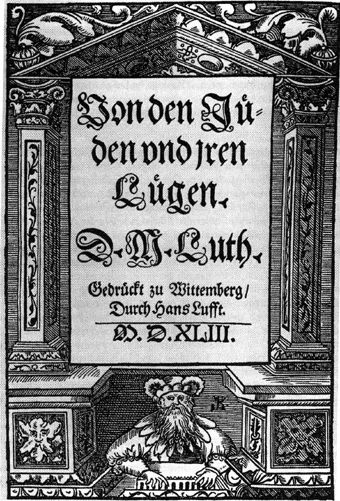 Martin Luther, Von den Juden und ihren Lügen, title page (Wittenberg, 1543), public domain The title page of Luther's 1543 tract, printed at Wittenberg — the text Nazi propagandists invoked four centuries later to claim a Reformation-era pedigree for the antisemitic ideology and persecution this article traces into occupied Norway. On the Jews and Their Lies — polemical theological tract
by Martin Luther, published in Wittenberg in 1543. One of
Luther's late writings (he died three years later). The
text is openly, graphically, programmatically
antisemitic — recommending the burning of Jewish
synagogues and homes, the seizure of Jewish books, the
prohibition of rabbinical teaching, and the conscripted-
labour expulsion of Jews from Christian territories. The
pamphlet circulated widely across Lutheran Europe in the
centuries that followed and was openly invoked by Nazi
propagandists in the 1930s. Its theological inheritance
— the figure of "the Jew" as Christ-rejecter — ran
through Norwegian and broader Lutheran preaching for
four centuries. Most modern Lutheran bodies have formally
repudiated the text.
, On the Jews and Their Lies, published in 1543 — were openly, graphically, programmatically antisemitic, and that theological inheritance had run into Norwegian Lutheran preaching through three centuries. The figure of “the Jew” in Norwegian Sunday sermons of the 1920s and 1930s was the Christ-rejecter, the stiff-necked, the figure outside the salvation the parish was inside. Most Norwegian Lutherans of the time did not experience this as antisemitism. They experienced it as Christianity. Naming that is the historian’s job.
Martin Luther, Von den Juden und ihren Lügen, title page (Wittenberg, 1543), public domain The title page of Luther's 1543 tract, printed at Wittenberg — the text Nazi propagandists invoked four centuries later to claim a Reformation-era pedigree for the antisemitic ideology and persecution this article traces into occupied Norway. On the Jews and Their Lies — polemical theological tract
by Martin Luther, published in Wittenberg in 1543. One of
Luther's late writings (he died three years later). The
text is openly, graphically, programmatically
antisemitic — recommending the burning of Jewish
synagogues and homes, the seizure of Jewish books, the
prohibition of rabbinical teaching, and the conscripted-
labour expulsion of Jews from Christian territories. The
pamphlet circulated widely across Lutheran Europe in the
centuries that followed and was openly invoked by Nazi
propagandists in the 1930s. Its theological inheritance
— the figure of "the Jew" as Christ-rejecter — ran
through Norwegian and broader Lutheran preaching for
four centuries. Most modern Lutheran bodies have formally
repudiated the text.
, On the Jews and Their Lies, published in 1543 — were openly, graphically, programmatically antisemitic, and that theological inheritance had run into Norwegian Lutheran preaching through three centuries. The figure of “the Jew” in Norwegian Sunday sermons of the 1920s and 1930s was the Christ-rejecter, the stiff-necked, the figure outside the salvation the parish was inside. Most Norwegian Lutherans of the time did not experience this as antisemitism. They experienced it as Christianity. Naming that is the historian’s job.
Alongside the theological inheritance ran a more recent and more transatlantic strand. Henry Ford 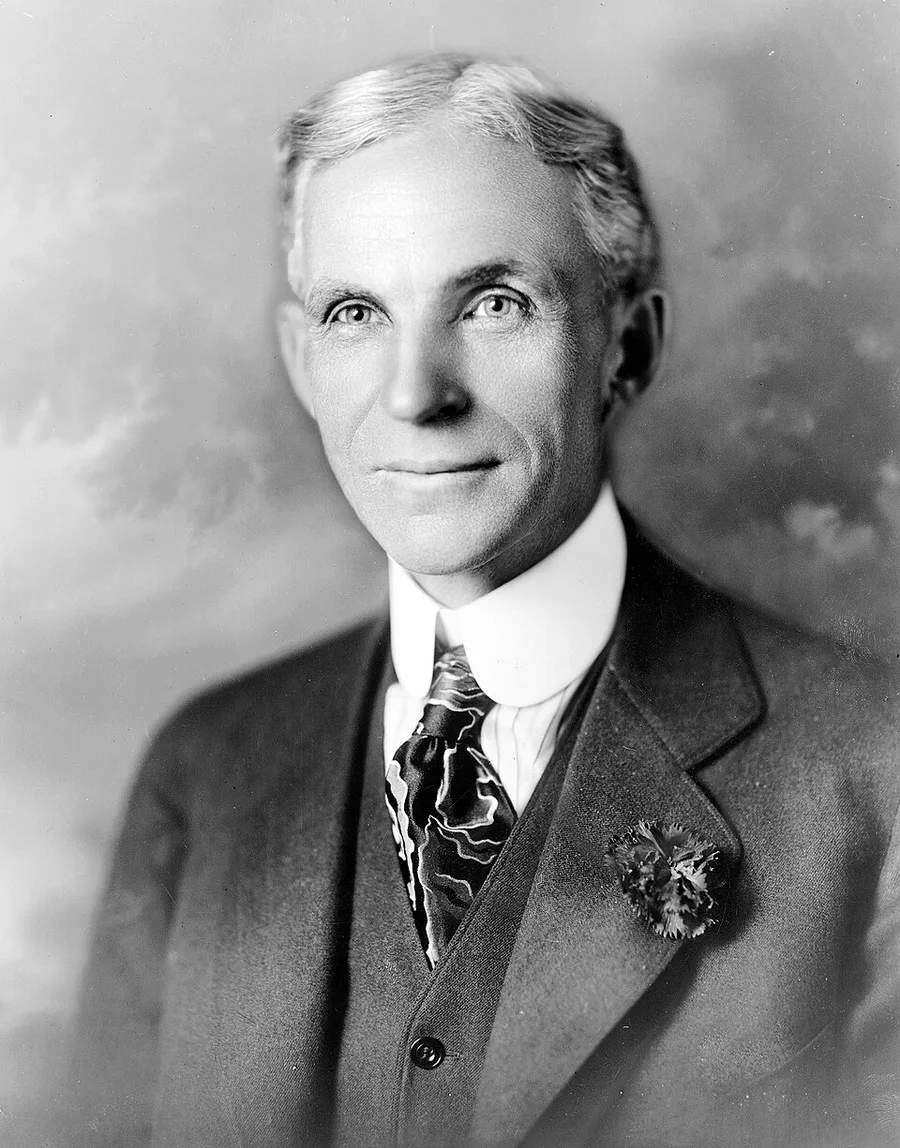 Fred Hartsook (1919), public domain Ford's antisemitic tract, funded and endorsed under his own name, carried the international-finance conspiracy theory into the European press Hitler drew on — a strand this article traces from 1920s Dearborn into occupied Norway. American industrialist (1863–1947), founder of the Ford
Motor Company and pioneer of mass-production automobile
manufacturing. Across the 1920s Ford funded and personally
endorsed the publication of The International Jew, a
four-volume antisemitic polemic serialised in his
Dearborn Independent newspaper from 1920 and translated
into German as Der internationale Jude in 1922. The
polemic, drawing on the Protocols of the Elders of Zion
forgery, advanced the international-finance conspiracy
theory that placed Jewish bankers behind global capital.
Ford's name and prestige carried the conspiracy theory
across the European and American antisemitic press in the
1920s and 1930s, including in the Norwegian conservative
and right-wing press. Hitler praised Ford in Mein Kampf.
’s serialized polemic The International Jew
Fred Hartsook (1919), public domain Ford's antisemitic tract, funded and endorsed under his own name, carried the international-finance conspiracy theory into the European press Hitler drew on — a strand this article traces from 1920s Dearborn into occupied Norway. American industrialist (1863–1947), founder of the Ford
Motor Company and pioneer of mass-production automobile
manufacturing. Across the 1920s Ford funded and personally
endorsed the publication of The International Jew, a
four-volume antisemitic polemic serialised in his
Dearborn Independent newspaper from 1920 and translated
into German as Der internationale Jude in 1922. The
polemic, drawing on the Protocols of the Elders of Zion
forgery, advanced the international-finance conspiracy
theory that placed Jewish bankers behind global capital.
Ford's name and prestige carried the conspiracy theory
across the European and American antisemitic press in the
1920s and 1930s, including in the Norwegian conservative
and right-wing press. Hitler praised Ford in Mein Kampf.
’s serialized polemic The International Jew 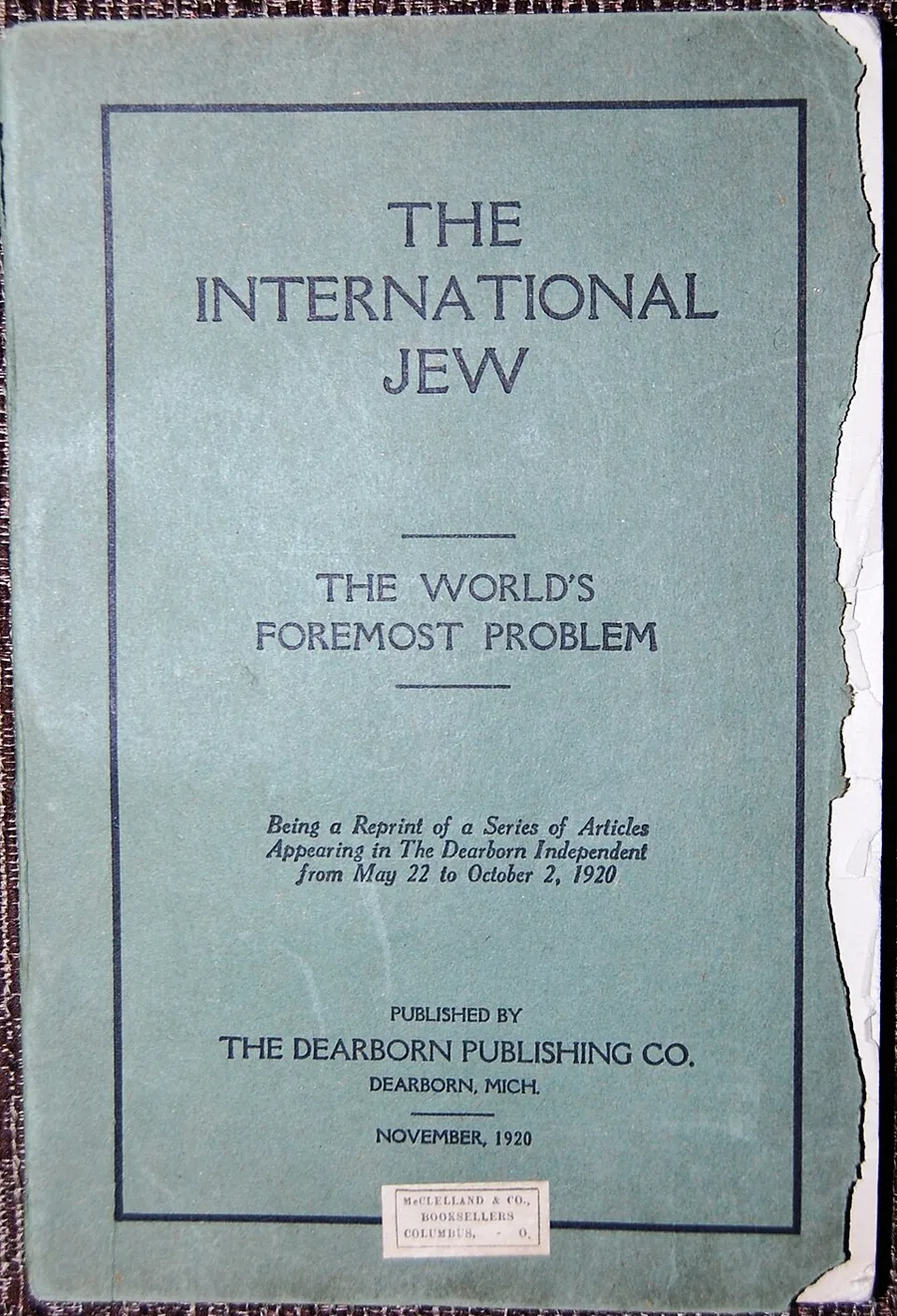 The International Jew, 1st ed. (1920), Dearborn Publishing Co.; cover photograph CC BY-SA 4.0 The cover of the 1920 first edition of Ford's antisemitic compilation — the book, serialised that year in his Dearborn Independent, that carried the international-finance conspiracy theory into the European and German antisemitic press Hitler drew on in Mein Kampf. Four-volume antisemitic polemic published by Henry Ford
in the early 1920s. Serialised in Ford's Dearborn
Independent newspaper from 1920 under the umbrella
title The International Jew: The World's Foremost
Problem; collected into four bound volumes 1920–1922.
Drew heavily on the Protocols of the Elders of Zion
forgery to advance the international-finance conspiracy
theory — that Jewish bankers stood behind global capital,
the international economic order was a Jewish project,
and Jewish wealth was illegitimately gained. Translated
into German as Der internationale Jude in 1922 and into
twelve other languages within a decade. Praised by
Hitler in Mein Kampf. Circulated widely across the
European antisemitic press. Ford formally apologised and
withdrew the pamphlets in 1927.
, published in his Dearborn Independent in 1920 and translated into German as Der internationale Jude in 1922, circulated widely across the European antisemitic press. The Norwegian intellectual class of the period — who read German fluently and followed the major American and European publications — encountered the same conspiracy machinery their American and German contemporaries did. The international-finance conspiracy theory — Jewish bankers behind global capital, the international economic order as a Jewish project, Jewish wealth as illegitimately gained — appeared in Norwegian conservative and right-wing press through the 1920s and 1930s. Ford’s name carried prestige, and his accusations carried weight. None of this was hidden, and none of it was the work of fringe extremists alone.
The International Jew, 1st ed. (1920), Dearborn Publishing Co.; cover photograph CC BY-SA 4.0 The cover of the 1920 first edition of Ford's antisemitic compilation — the book, serialised that year in his Dearborn Independent, that carried the international-finance conspiracy theory into the European and German antisemitic press Hitler drew on in Mein Kampf. Four-volume antisemitic polemic published by Henry Ford
in the early 1920s. Serialised in Ford's Dearborn
Independent newspaper from 1920 under the umbrella
title The International Jew: The World's Foremost
Problem; collected into four bound volumes 1920–1922.
Drew heavily on the Protocols of the Elders of Zion
forgery to advance the international-finance conspiracy
theory — that Jewish bankers stood behind global capital,
the international economic order was a Jewish project,
and Jewish wealth was illegitimately gained. Translated
into German as Der internationale Jude in 1922 and into
twelve other languages within a decade. Praised by
Hitler in Mein Kampf. Circulated widely across the
European antisemitic press. Ford formally apologised and
withdrew the pamphlets in 1927.
, published in his Dearborn Independent in 1920 and translated into German as Der internationale Jude in 1922, circulated widely across the European antisemitic press. The Norwegian intellectual class of the period — who read German fluently and followed the major American and European publications — encountered the same conspiracy machinery their American and German contemporaries did. The international-finance conspiracy theory — Jewish bankers behind global capital, the international economic order as a Jewish project, Jewish wealth as illegitimately gained — appeared in Norwegian conservative and right-wing press through the 1920s and 1930s. Ford’s name carried prestige, and his accusations carried weight. None of this was hidden, and none of it was the work of fringe extremists alone.
A third strand had run through the post-1814 romantic-nationalist project that had built modern Norwegian identity out of the rural Lutheran peasantry, the saga inheritance, the Bunad 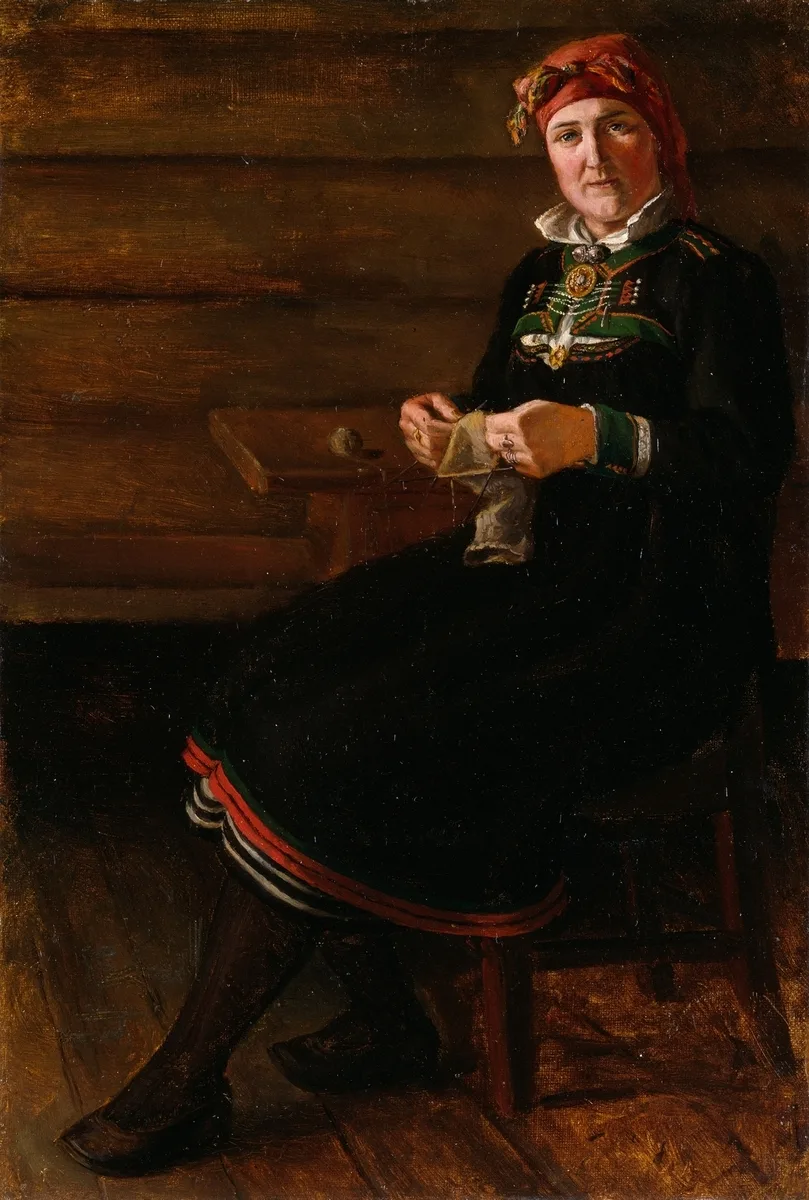 August Schneider, Sittende kvinne i Setesdals-bunad (1870), Nasjonalmuseet The costume by which the romantic-nationalist century defined who belonged to the folk — parish-rooted, inherited, stitched to a specific valley. In the ethno-national frame of the age, that definition of belonging also marked out who stood outside it. Norwegian regional folk costume — the rural traditional
dress that survived the four-hundred-year Danish period
intact, parish by parish, fjord by fjord. Each Norwegian
region (and many individual valleys) has its own bunad,
varying in colour, embroidery pattern, silver brooch
(sølje), shawl, and apron. The modern bunad tradition was
systematised in the late nineteenth and early twentieth
centuries by the textile historian Hulda Garborg and
others, but the underlying garments are pre-modern. Worn
on 17 May, at weddings, at confirmations, and at other
formal national occasions. The persistence of the bunad is
one of the most visible single signs of how the regional
substrate of Norway outlasted the long Danish absorption.
Also discussed in The 400-Year Night — when the Northern Lion lay dormantLutheran Norway and Pietism — a farmer named Hans Nielsen Hauge and a lay revival that could not be silencedThe Constitution That Saved a Nation — five radical weeks at Eidsvoll, 1814800,000 Norwegians Leave — the century that built a Second NorwayTradisjoner — celebrations across the Norwegian year , the dialect, the landscape. To this conception, Jews were implicitly foreign. They lived in cities. They spoke other languages at home. They did not have a bunad. The Norwegian “folk” was, by the romantic-nationalist definition, Nordic-Christian-rural. This was rarely screamed; it was assumed, in the way ethno-nationalism is always assumed where it is dominant. Its most prestigious literary voice was Knut Hamsun
August Schneider, Sittende kvinne i Setesdals-bunad (1870), Nasjonalmuseet The costume by which the romantic-nationalist century defined who belonged to the folk — parish-rooted, inherited, stitched to a specific valley. In the ethno-national frame of the age, that definition of belonging also marked out who stood outside it. Norwegian regional folk costume — the rural traditional
dress that survived the four-hundred-year Danish period
intact, parish by parish, fjord by fjord. Each Norwegian
region (and many individual valleys) has its own bunad,
varying in colour, embroidery pattern, silver brooch
(sølje), shawl, and apron. The modern bunad tradition was
systematised in the late nineteenth and early twentieth
centuries by the textile historian Hulda Garborg and
others, but the underlying garments are pre-modern. Worn
on 17 May, at weddings, at confirmations, and at other
formal national occasions. The persistence of the bunad is
one of the most visible single signs of how the regional
substrate of Norway outlasted the long Danish absorption.
Also discussed in The 400-Year Night — when the Northern Lion lay dormantLutheran Norway and Pietism — a farmer named Hans Nielsen Hauge and a lay revival that could not be silencedThe Constitution That Saved a Nation — five radical weeks at Eidsvoll, 1814800,000 Norwegians Leave — the century that built a Second NorwayTradisjoner — celebrations across the Norwegian year , the dialect, the landscape. To this conception, Jews were implicitly foreign. They lived in cities. They spoke other languages at home. They did not have a bunad. The Norwegian “folk” was, by the romantic-nationalist definition, Nordic-Christian-rural. This was rarely screamed; it was assumed, in the way ethno-nationalism is always assumed where it is dominant. Its most prestigious literary voice was Knut Hamsun 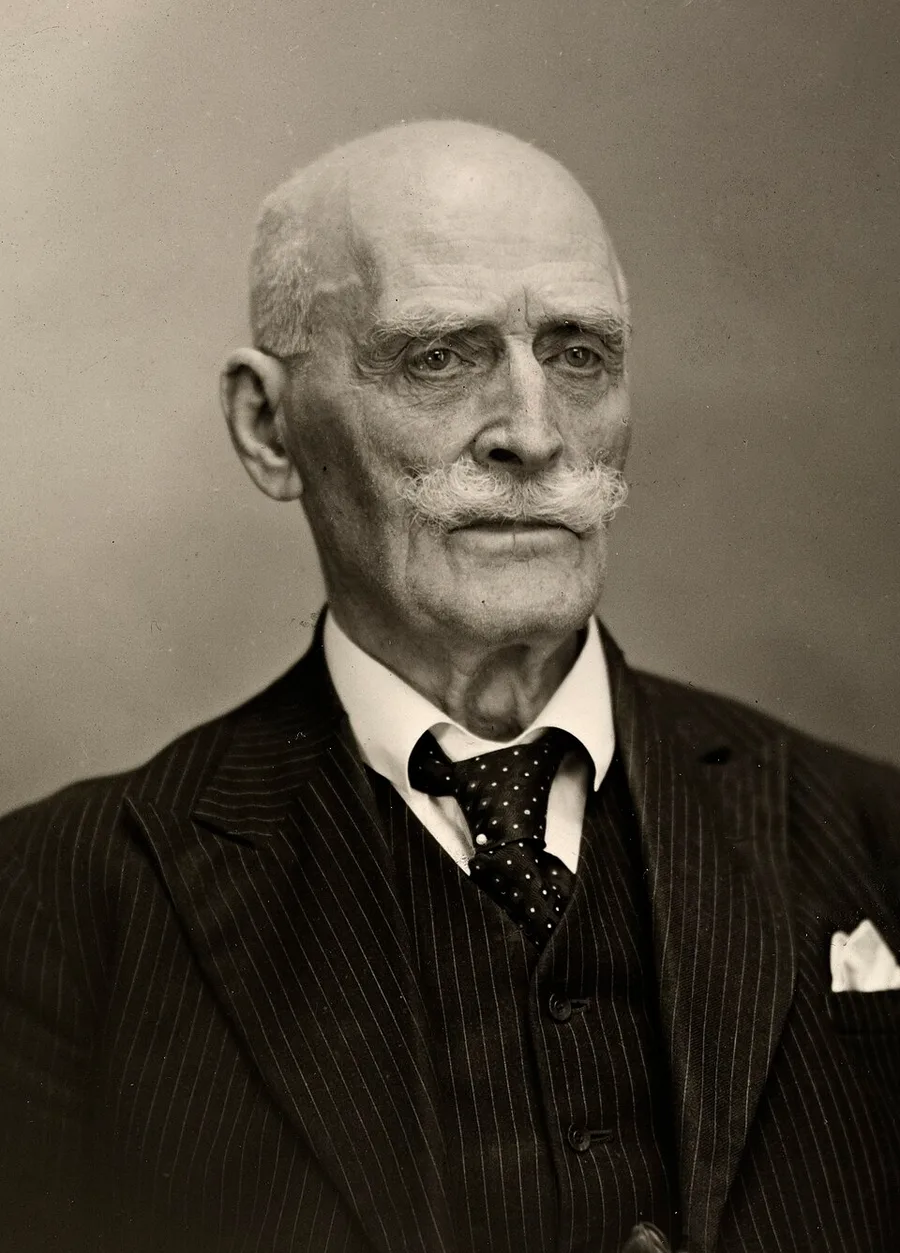 Martha Grande Myhrslo (1944), National Library of Norway, public domain Hamsun's public sympathy for National Socialism through the occupation, capped by his 1945 Aftenposten obituary praising Hitler, marks Norway's most prominent case of cultural collaboration with the regime this article traces. Norwegian novelist (1859–1952), the most celebrated
Norwegian writer of his generation and Nobel laureate in
Literature (1920) for Markens Grøde (Growth of the
Soil, 1917). Across the 1930s and through the Second World
War a public sympathiser of National Socialism. Met Joseph
Goebbels in 1943 and afterward sent his Nobel Prize medal
to Goebbels as a gift. In May 1945, one week after Hitler's
death, Hamsun published an obituary in Aftenposten
calling Hitler "a warrior, a warrior for humankind and a
preacher of the gospel of justice for all nations." A 1946
Norwegian psychiatric evaluation declared him to have
"permanently impaired mental faculties," letting the state
sidestep a treason trial; he was fined heavily for his
Nasjonal Samling membership. Died at Nørholm in 1952 at 92.
, Nobel laureate and the most celebrated Norwegian novelist of his generation. Hamsun meets with Joseph Goebbels
Martha Grande Myhrslo (1944), National Library of Norway, public domain Hamsun's public sympathy for National Socialism through the occupation, capped by his 1945 Aftenposten obituary praising Hitler, marks Norway's most prominent case of cultural collaboration with the regime this article traces. Norwegian novelist (1859–1952), the most celebrated
Norwegian writer of his generation and Nobel laureate in
Literature (1920) for Markens Grøde (Growth of the
Soil, 1917). Across the 1930s and through the Second World
War a public sympathiser of National Socialism. Met Joseph
Goebbels in 1943 and afterward sent his Nobel Prize medal
to Goebbels as a gift. In May 1945, one week after Hitler's
death, Hamsun published an obituary in Aftenposten
calling Hitler "a warrior, a warrior for humankind and a
preacher of the gospel of justice for all nations." A 1946
Norwegian psychiatric evaluation declared him to have
"permanently impaired mental faculties," letting the state
sidestep a treason trial; he was fined heavily for his
Nasjonal Samling membership. Died at Nørholm in 1952 at 92.
, Nobel laureate and the most celebrated Norwegian novelist of his generation. Hamsun meets with Joseph Goebbels 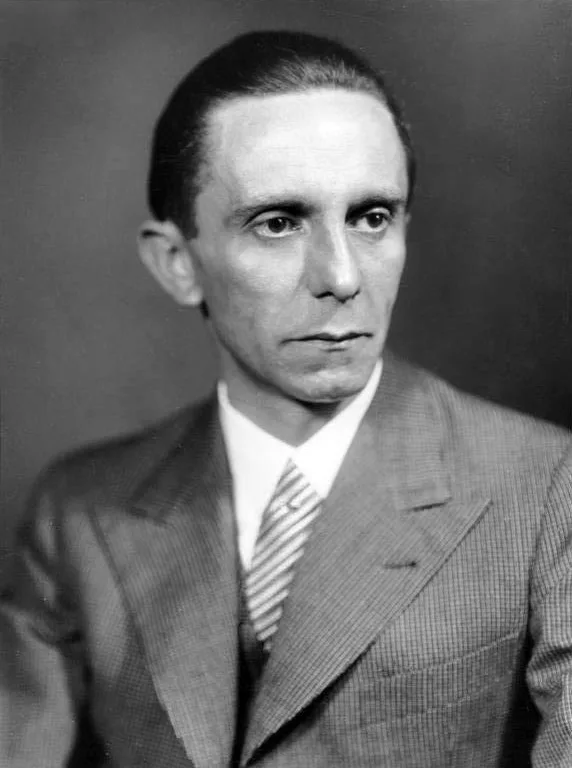 Heinrich Hoffmann, Bundesarchiv Bild 146-1968-101-20A, CC BY-SA 3.0 DE Goebbels ran the Nazi propaganda machine that shaped occupied Norway's press and cinema, and met Knut Hamsun in 1943 — an encounter that produced Hamsun's gift of his Nobel medal, a thread this article follows into cultural collaboration. Reich Minister of Public Enlightenment and Propaganda of
Nazi Germany (1897–1945). PhD in literature from
Heidelberg, 1921; joined the Nazi Party 1924; appointed
Gauleiter of Berlin 1926 and Propaganda Minister at
Hitler's accession in 1933. The architect of Nazi
propaganda, organising the book burnings of 1933, the 1936
Berlin Olympics propaganda, the "Total War" 1943 Sportpalast
speech, and the central direction of German wartime
cinema, radio, and press. Met Knut Hamsun in 1943, an
encounter that produced the Hamsun gift of his Nobel medal.
Killed his six children and himself by suicide in the
Führerbunker on 1 May 1945, the day after Hitler's death,
having been named Chancellor of Germany in Hitler's
political testament.
in 1943 and afterward sends his Nobel Prize medal to Goebbels as a gift of thanks. In May 1945, one week after Adolf Hitler
Heinrich Hoffmann, Bundesarchiv Bild 146-1968-101-20A, CC BY-SA 3.0 DE Goebbels ran the Nazi propaganda machine that shaped occupied Norway's press and cinema, and met Knut Hamsun in 1943 — an encounter that produced Hamsun's gift of his Nobel medal, a thread this article follows into cultural collaboration. Reich Minister of Public Enlightenment and Propaganda of
Nazi Germany (1897–1945). PhD in literature from
Heidelberg, 1921; joined the Nazi Party 1924; appointed
Gauleiter of Berlin 1926 and Propaganda Minister at
Hitler's accession in 1933. The architect of Nazi
propaganda, organising the book burnings of 1933, the 1936
Berlin Olympics propaganda, the "Total War" 1943 Sportpalast
speech, and the central direction of German wartime
cinema, radio, and press. Met Knut Hamsun in 1943, an
encounter that produced the Hamsun gift of his Nobel medal.
Killed his six children and himself by suicide in the
Führerbunker on 1 May 1945, the day after Hitler's death,
having been named Chancellor of Germany in Hitler's
political testament.
in 1943 and afterward sends his Nobel Prize medal to Goebbels as a gift of thanks. In May 1945, one week after Adolf Hitler 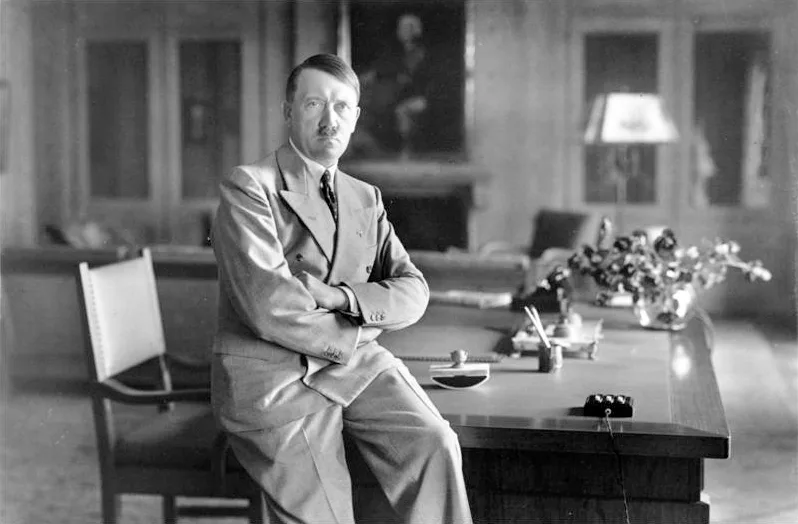 Heinrich Hoffmann, Bundesarchiv Bild 146-1990-048-29A, CC BY-SA 3.0 DE Hitler authorized the 9 April 1940 invasion of Norway and appointed Josef Terboven Reichskommissar, launching the five-year occupation this article traces — the Berghof was his seat of power in the years leading up to that decision. Austrian-born leader of Nazi Germany (1889–1945), Chancellor
from 30 January 1933 and Führer from 2 August 1934 to his
suicide in Berlin on 30 April 1945. Architect of the Nazi
regime that orchestrated the Second World War in Europe and
the systematic murder of approximately six million Jews and
millions of other victims in the Holocaust. Authorised the
9 April 1940 invasion of Norway and Denmark
(Operation Weserübung) and the appointment of Josef
Terboven as Reichskommissar. The Norwegian campaign
succeeded in occupying the country but cost the German
surface fleet heavily — the heavy cruiser Blücher was
sunk at Oscarsborg on the first morning. Norway was the
first major military operation Hitler personally directed.
’s death, Hamsun writes an obituary in Aftenposten calling Hitler “a warrior, a warrior for humankind and a preacher of the gospel of justice for all nations.” His prestige is not destroyed by these views in his own lifetime, and his postwar prosecution is opposed by a substantial Norwegian literary establishment uncomfortable with the spectacle of trying a great writer. In 1946 a Norwegian psychiatric evaluation declares him to have “permanently impaired mental faculties,” a finding that lets the state sidestep the treason trial it cannot stomach; he is fined heavily for his Nasjonal Samling membership and lives out his days at his estate at Nørholm, dying in 1952 at the age of ninety-two.
Heinrich Hoffmann, Bundesarchiv Bild 146-1990-048-29A, CC BY-SA 3.0 DE Hitler authorized the 9 April 1940 invasion of Norway and appointed Josef Terboven Reichskommissar, launching the five-year occupation this article traces — the Berghof was his seat of power in the years leading up to that decision. Austrian-born leader of Nazi Germany (1889–1945), Chancellor
from 30 January 1933 and Führer from 2 August 1934 to his
suicide in Berlin on 30 April 1945. Architect of the Nazi
regime that orchestrated the Second World War in Europe and
the systematic murder of approximately six million Jews and
millions of other victims in the Holocaust. Authorised the
9 April 1940 invasion of Norway and Denmark
(Operation Weserübung) and the appointment of Josef
Terboven as Reichskommissar. The Norwegian campaign
succeeded in occupying the country but cost the German
surface fleet heavily — the heavy cruiser Blücher was
sunk at Oscarsborg on the first morning. Norway was the
first major military operation Hitler personally directed.
’s death, Hamsun writes an obituary in Aftenposten calling Hitler “a warrior, a warrior for humankind and a preacher of the gospel of justice for all nations.” His prestige is not destroyed by these views in his own lifetime, and his postwar prosecution is opposed by a substantial Norwegian literary establishment uncomfortable with the spectacle of trying a great writer. In 1946 a Norwegian psychiatric evaluation declares him to have “permanently impaired mental faculties,” a finding that lets the state sidestep the treason trial it cannot stomach; he is fined heavily for his Nasjonal Samling membership and lives out his days at his estate at Nørholm, dying in 1952 at the age of ninety-two.
The Holocaust in Norway 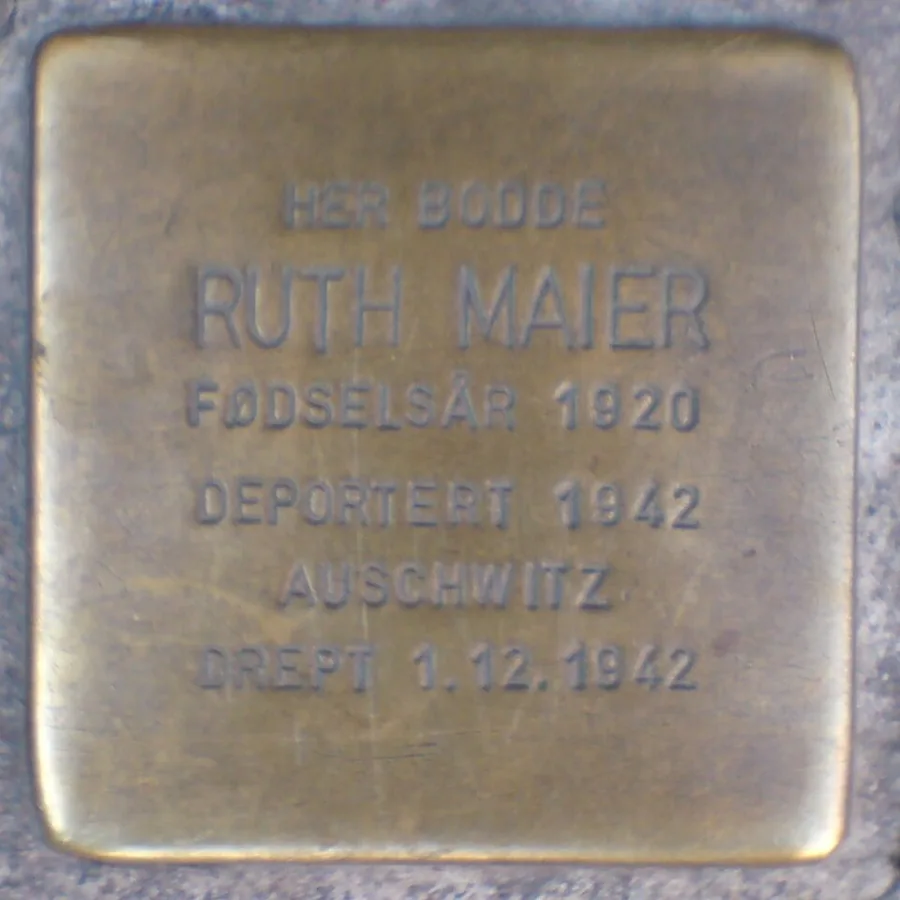 Erik den yngre, Stolperstein for Ruth Maier, Dalsbergstien 3, Oslo (2012) A brass Stolperstein set into the pavement at Dalsbergstien 3 in Oslo marks Ruth Maier's last home before her arrest: "Here lived Ruth Maier, born 1920, deported 1942, Auschwitz, killed 1 December 1942." Stones like this one mark the last homes of the deported across Oslo and other Norwegian cities. The murder of Norwegian Jews under the German occupation,
1940–1945. Of approximately 2,100 Jews in Norway at the
start of the occupation, 772 were deported to Auschwitz —
532 people aboard the Donau on 26 November 1942, with
further sailings following into February 1943.
Twenty-three more Norwegian Jews were killed inside Norway
during the war. Of the deported, about thirty survived.
Approximately 765 Norwegian Jews were murdered. The
October and November 1942 deportation laws were signed by
the Quisling administration; the arrests were carried out
by Norwegian state employees of the Statspolitiet,
Kriminalpolitiet, Hirden, and Germanske SS-Norge. About
900 Norwegian Jews escaped to Sweden, helped by Norwegian
resistance networks.
— religious, economic, ethnic — the Quisling administration issues the October and November 1942 laws against Norwegian Jews, and the arrests are carried out by Norwegians. The Statspolitiet
Erik den yngre, Stolperstein for Ruth Maier, Dalsbergstien 3, Oslo (2012) A brass Stolperstein set into the pavement at Dalsbergstien 3 in Oslo marks Ruth Maier's last home before her arrest: "Here lived Ruth Maier, born 1920, deported 1942, Auschwitz, killed 1 December 1942." Stones like this one mark the last homes of the deported across Oslo and other Norwegian cities. The murder of Norwegian Jews under the German occupation,
1940–1945. Of approximately 2,100 Jews in Norway at the
start of the occupation, 772 were deported to Auschwitz —
532 people aboard the Donau on 26 November 1942, with
further sailings following into February 1943.
Twenty-three more Norwegian Jews were killed inside Norway
during the war. Of the deported, about thirty survived.
Approximately 765 Norwegian Jews were murdered. The
October and November 1942 deportation laws were signed by
the Quisling administration; the arrests were carried out
by Norwegian state employees of the Statspolitiet,
Kriminalpolitiet, Hirden, and Germanske SS-Norge. About
900 Norwegian Jews escaped to Sweden, helped by Norwegian
resistance networks.
— religious, economic, ethnic — the Quisling administration issues the October and November 1942 laws against Norwegian Jews, and the arrests are carried out by Norwegians. The Statspolitiet 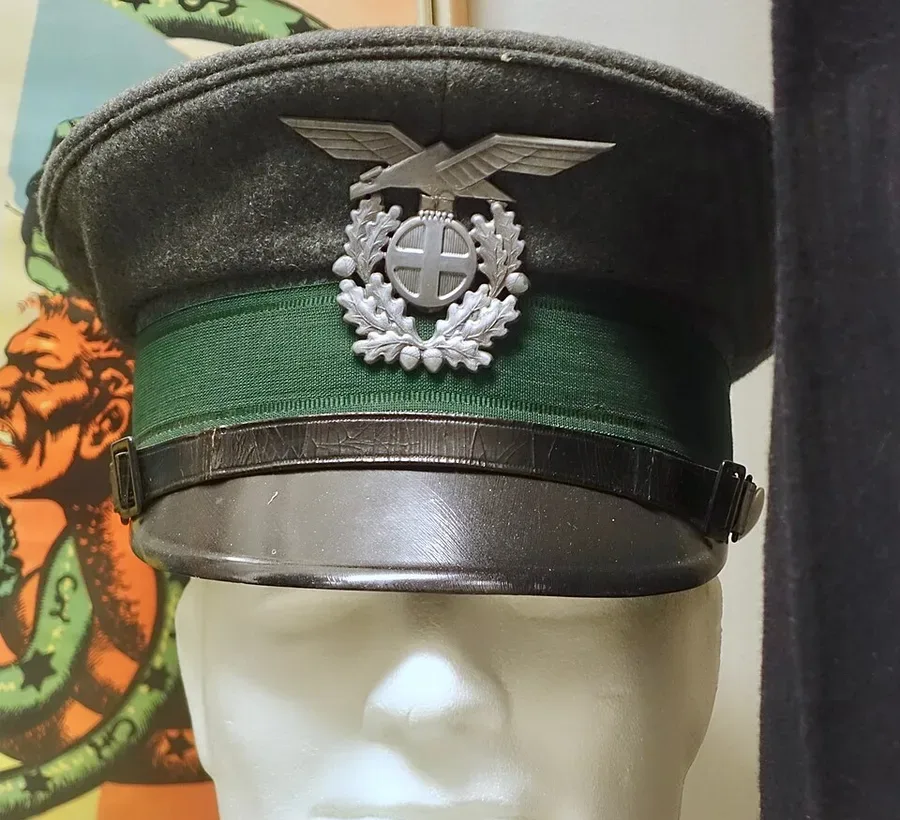 Wolfmann, Statspolitiet visor cap, model 1942 (photographed 2019), Lofoten Krigsminnemuseum, CC BY-SA 4.0 The suncross-and-eagle badge on this 1942-issue cap marks the Statspolitiet, the roughly 300-strong political police Quisling's administration modelled on the Gestapo to hunt the resistance, Communists, and Jewish Norwegians. The State Police — Norwegian political police force
created by Quisling's wartime administration on 1 July
1941. Modelled on the German Gestapo and tasked
specifically with surveillance, investigation, and arrest
of Norwegian-resistance, Communist, and Jewish targets.
Roughly 300 Norwegian state employees served in the
Statspolitiet across the war. The Statspolitiet, alongside
the Kriminalpolitiet and Hirden paramilitaries, executed
the November 1942 round-up of Norwegian Jews that put 532
people on the Donau bound for Auschwitz. Knut Rød, a
Statspolitiet officer, commanded the Oslo and Aker
women-and-children round-up on 26 November 1942.
Disbanded at the liberation in May 1945.
, the political police force the Quisling administration had created in 1941, takes the lead, and more than three hundred Norwegian state employees — Statspolitiet officers, Kriminalpolitiet, regular police, and members of Hirden and Germanske SS-Norge — execute the operation. Knut Rød
Wolfmann, Statspolitiet visor cap, model 1942 (photographed 2019), Lofoten Krigsminnemuseum, CC BY-SA 4.0 The suncross-and-eagle badge on this 1942-issue cap marks the Statspolitiet, the roughly 300-strong political police Quisling's administration modelled on the Gestapo to hunt the resistance, Communists, and Jewish Norwegians. The State Police — Norwegian political police force
created by Quisling's wartime administration on 1 July
1941. Modelled on the German Gestapo and tasked
specifically with surveillance, investigation, and arrest
of Norwegian-resistance, Communist, and Jewish targets.
Roughly 300 Norwegian state employees served in the
Statspolitiet across the war. The Statspolitiet, alongside
the Kriminalpolitiet and Hirden paramilitaries, executed
the November 1942 round-up of Norwegian Jews that put 532
people on the Donau bound for Auschwitz. Knut Rød, a
Statspolitiet officer, commanded the Oslo and Aker
women-and-children round-up on 26 November 1942.
Disbanded at the liberation in May 1945.
, the political police force the Quisling administration had created in 1941, takes the lead, and more than three hundred Norwegian state employees — Statspolitiet officers, Kriminalpolitiet, regular police, and members of Hirden and Germanske SS-Norge — execute the operation. Knut Rød 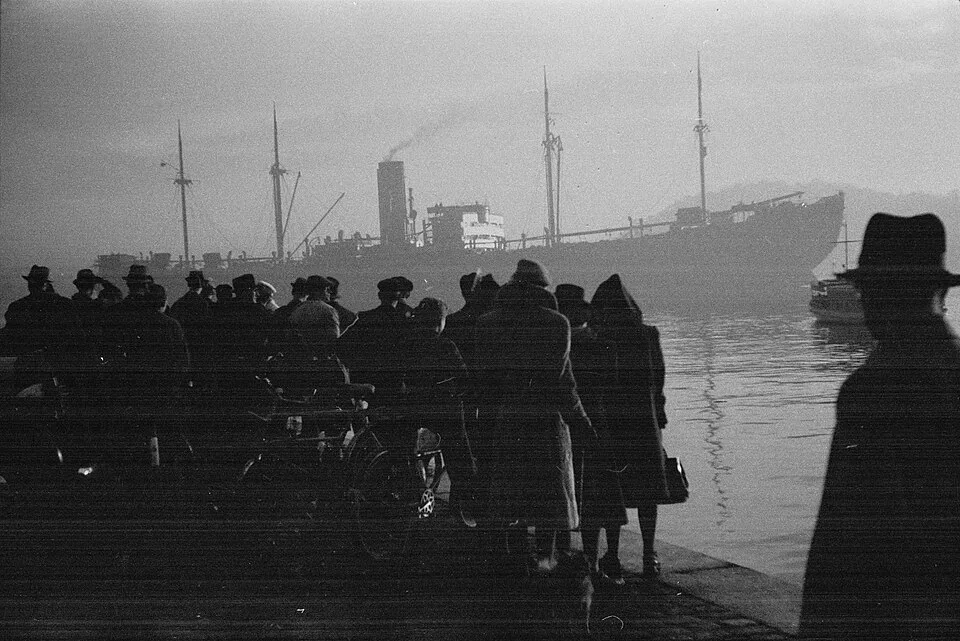 Georg W. Fossum, Norwegian Jews on the Akershus quay, Oslo, 26 November 1942, National Library of Norway No free portrait of Rød exists. This is Georg W. Fossum's photograph of the morning his order produced: Norwegian Jews on the Akershus quay in Oslo, 26 November 1942, the cargo ship Donau waiting behind them — the round-up Rød commanded and was twice acquitted for. Norwegian police officer (1900–1986). Member of the
Statspolitiet — the political police force the Quisling
administration had created in 1941. Commanded the
women-and-children arm of the round-up of Norwegian Jews
in Oslo and Aker on the morning of 26 November 1942 — part
of the operation that put 532 Norwegian Jews on the cargo
ship Donau bound for Auschwitz. Tried
twice for war crimes by Norwegian courts after the
liberation — in 1946 and again on appeal in 1948 — and
acquitted both times on the court's reasoning that his
role in the deportations had been necessary cover for
clandestine resistance work. Returned to the Oslo police
and served on the force until his retirement. The Rød
acquittals remain among the most contested verdicts of the
landssvikoppgjøret.
, a Statspolitiet officer, commands the round-up of women and children in Oslo and Aker on the morning of the twenty-sixth of November 1942. The arrested Jews are taken to the quay at Akershuskaia in Oslo harbor, the same waterfront the king returns to in June 1945, and forced onto the German cargo ship Donau
Georg W. Fossum, Norwegian Jews on the Akershus quay, Oslo, 26 November 1942, National Library of Norway No free portrait of Rød exists. This is Georg W. Fossum's photograph of the morning his order produced: Norwegian Jews on the Akershus quay in Oslo, 26 November 1942, the cargo ship Donau waiting behind them — the round-up Rød commanded and was twice acquitted for. Norwegian police officer (1900–1986). Member of the
Statspolitiet — the political police force the Quisling
administration had created in 1941. Commanded the
women-and-children arm of the round-up of Norwegian Jews
in Oslo and Aker on the morning of 26 November 1942 — part
of the operation that put 532 Norwegian Jews on the cargo
ship Donau bound for Auschwitz. Tried
twice for war crimes by Norwegian courts after the
liberation — in 1946 and again on appeal in 1948 — and
acquitted both times on the court's reasoning that his
role in the deportations had been necessary cover for
clandestine resistance work. Returned to the Oslo police
and served on the force until his retirement. The Rød
acquittals remain among the most contested verdicts of the
landssvikoppgjøret.
, a Statspolitiet officer, commands the round-up of women and children in Oslo and Aker on the morning of the twenty-sixth of November 1942. The arrested Jews are taken to the quay at Akershuskaia in Oslo harbor, the same waterfront the king returns to in June 1945, and forced onto the German cargo ship Donau 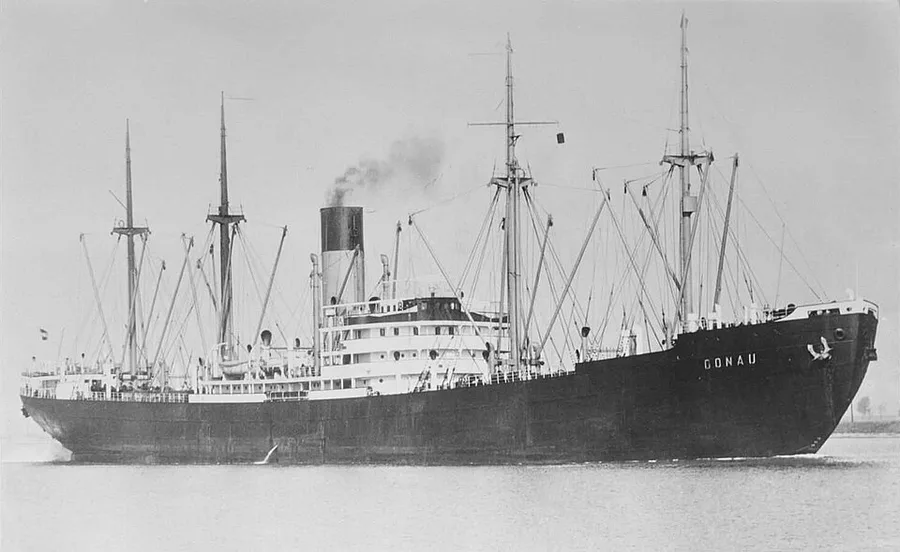 Norddeutscher Lloyd archive photograph, via Deutsche Digitale Bibliothek The Donau, photographed in ordinary peacetime service for her owner, Norddeutscher Lloyd. This same ship was seized for the deportation: on the morning of 26 November 1942 she carried 532 Norwegian Jews from the Akershuskaia quay in Oslo toward Auschwitz. German cargo ship (1929) used by the German occupation
authorities and the Norwegian Statspolitiet to deport
Norwegian Jews from Oslo to Stettin and from there by rail
to Auschwitz. On the morning of 26 November 1942, five
hundred and thirty-two Norwegian Jews — men, women, and
children — were forced aboard the Donau at the
Akershuskaia quay in Oslo harbour, the same waterfront
King Haakon VII would return to in June 1945. The
Donau sailed that day; the deportees arrived at
Auschwitz on 1 December. Two further transports followed
in February 1943. Of the 772 Norwegian Jews deported in
all, about thirty survived. The ship was sunk by Norwegian
resistance saboteurs in Oslo harbour on 16 January 1945.
— five hundred and thirty-two Norwegian Jews on this first transport, bound for Auschwitz. Of approximately twenty-one hundred Jews in Norway at the start of the occupation, seven hundred and seventy-two are deported. Twenty-three more are killed inside Norway through execution, murder, or suicide during the war. Of the deported, about thirty survive and return. Roughly seven hundred and sixty-five are murdered in all. The Norwegian state employees who choose which doors to knock on, execute the lists, and drive the trucks are Norwegians.
Norddeutscher Lloyd archive photograph, via Deutsche Digitale Bibliothek The Donau, photographed in ordinary peacetime service for her owner, Norddeutscher Lloyd. This same ship was seized for the deportation: on the morning of 26 November 1942 she carried 532 Norwegian Jews from the Akershuskaia quay in Oslo toward Auschwitz. German cargo ship (1929) used by the German occupation
authorities and the Norwegian Statspolitiet to deport
Norwegian Jews from Oslo to Stettin and from there by rail
to Auschwitz. On the morning of 26 November 1942, five
hundred and thirty-two Norwegian Jews — men, women, and
children — were forced aboard the Donau at the
Akershuskaia quay in Oslo harbour, the same waterfront
King Haakon VII would return to in June 1945. The
Donau sailed that day; the deportees arrived at
Auschwitz on 1 December. Two further transports followed
in February 1943. Of the 772 Norwegian Jews deported in
all, about thirty survived. The ship was sunk by Norwegian
resistance saboteurs in Oslo harbour on 16 January 1945.
— five hundred and thirty-two Norwegian Jews on this first transport, bound for Auschwitz. Of approximately twenty-one hundred Jews in Norway at the start of the occupation, seven hundred and seventy-two are deported. Twenty-three more are killed inside Norway through execution, murder, or suicide during the war. Of the deported, about thirty survive and return. Roughly seven hundred and sixty-five are murdered in all. The Norwegian state employees who choose which doors to knock on, execute the lists, and drive the trucks are Norwegians.
The same country produces the opposite. Approximately nine hundred Norwegian Jews escape to Sweden  Prince Eugen, Skogen / The Forest (1892), Göteborgs konstmuseum (photo CC BY 4.0) Skogen (The Forest), painted in 1892 by Prince Eugen — a son of Oscar II, the Swedish king Norway broke from in 1905. His twilight wall of pine trunks became a defining image of Swedish national-romantic landscape: the neighbour kingdom rendered as its own deep forest. The largest of the three Scandinavian kingdoms, occupying
the eastern two-thirds of the Scandinavian peninsula.
Unified in stages through the early medieval period and
Christianised from the eleventh century onward. United
with Norway and Denmark in the 1397 Kalmar Union under
Margaret I and her great-nephew Erik of Pomerania; broke
away under Gustav Vasa in 1523, ending the union. Modern
Sweden's borders were largely set by the 1658 Treaty of
Roskilde, which transferred the formerly Danish provinces
of Skåne, Halland, Blekinge, and Bohuslän to the Swedish
crown.
In this article Neutral through the war, Sweden is the escape route: resistance
couriers, refugees, and the Jews who evade the roundups cross
the long forest frontier to safety, and Norwegian police troops
train on Swedish soil for the liberation.
Also discussed in The Long Fall — the sudden loss of Norwegian nobility, the end of the kings, and half of Norway gone foreverThe 400-Year Night — when the Northern Lion lay dormantThe Quiet Revolution — how Norway won its independence without a war , helped across the long border by Norwegian resistance networks at substantial personal risk: drivers, route-keepers, safehouse families, forest guides. Some of the same Norwegian congregations whose Sunday sermons have been carrying the figure of the Christ-rejecting Jew for generations shelter Jewish families in 1942, drive them through the woods at night, and put their own lives on the line for their neighbors. The escape work intensifies in response to the October laws and the November arrests; those warned in time live, those warned too late are already on the Donau. Both threads belong on the page. Neither cancels the other.
Prince Eugen, Skogen / The Forest (1892), Göteborgs konstmuseum (photo CC BY 4.0) Skogen (The Forest), painted in 1892 by Prince Eugen — a son of Oscar II, the Swedish king Norway broke from in 1905. His twilight wall of pine trunks became a defining image of Swedish national-romantic landscape: the neighbour kingdom rendered as its own deep forest. The largest of the three Scandinavian kingdoms, occupying
the eastern two-thirds of the Scandinavian peninsula.
Unified in stages through the early medieval period and
Christianised from the eleventh century onward. United
with Norway and Denmark in the 1397 Kalmar Union under
Margaret I and her great-nephew Erik of Pomerania; broke
away under Gustav Vasa in 1523, ending the union. Modern
Sweden's borders were largely set by the 1658 Treaty of
Roskilde, which transferred the formerly Danish provinces
of Skåne, Halland, Blekinge, and Bohuslän to the Swedish
crown.
In this article Neutral through the war, Sweden is the escape route: resistance
couriers, refugees, and the Jews who evade the roundups cross
the long forest frontier to safety, and Norwegian police troops
train on Swedish soil for the liberation.
Also discussed in The Long Fall — the sudden loss of Norwegian nobility, the end of the kings, and half of Norway gone foreverThe 400-Year Night — when the Northern Lion lay dormantThe Quiet Revolution — how Norway won its independence without a war , helped across the long border by Norwegian resistance networks at substantial personal risk: drivers, route-keepers, safehouse families, forest guides. Some of the same Norwegian congregations whose Sunday sermons have been carrying the figure of the Christ-rejecting Jew for generations shelter Jewish families in 1942, drive them through the woods at night, and put their own lives on the line for their neighbors. The escape work intensifies in response to the October laws and the November arrests; those warned in time live, those warned too late are already on the Donau. Both threads belong on the page. Neither cancels the other.
The reckoning is slow. Surviving Norwegian Jews returning from Auschwitz in 1945 often find their homes occupied, their businesses sold, their property scattered. The Norwegian Jewish community after the war numbers a few hundred, perhaps a quarter of its pre-war size. Restitution is partial and piecemeal for half a century. The formal Norwegian state acknowledgement of the role Norwegian state employees had played in the deportations, and of the inadequacy of postwar restitution, comes only in 1999, when the Storting votes four hundred and fifty million kroner in compensation to survivors and to the Jewish community, funds what becomes the Holocaust Center ( HL-senteret 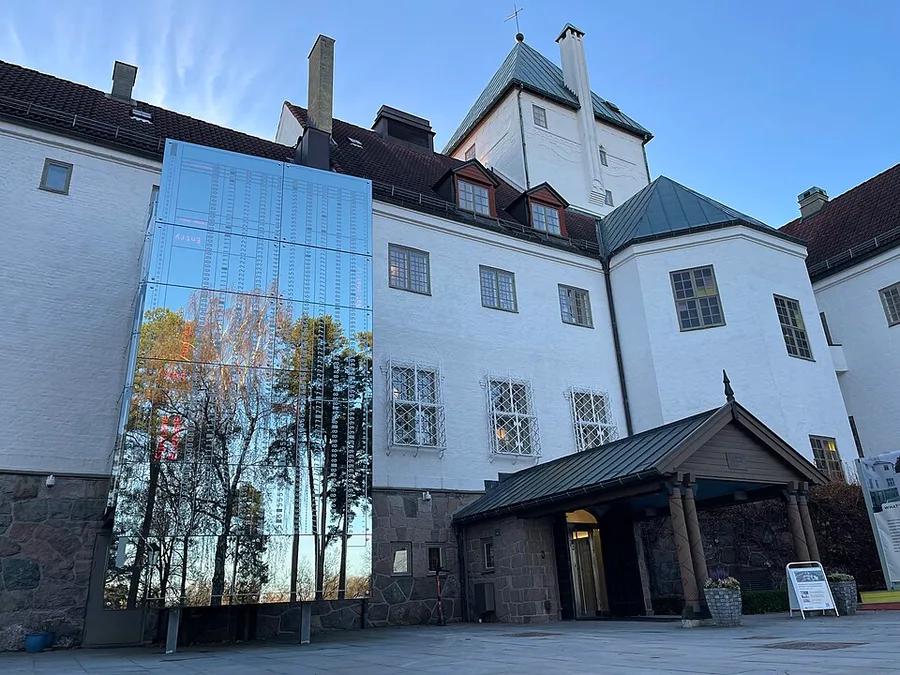 Wolfmann, Villa Grande entrance, Bygdøy, Oslo (2021), CC BY-SA 4.0 Villa Grande on Bygdoy, seen from its entrance drive - since 2006 the home of HL-senteret, the Norwegian Center for Studies of the Holocaust and Religious Minorities, deliberately sited inside the mansion Vidkun Quisling used as his wartime residence. Senter for studier av Holocaust og livssynsminoriteter —
the Center for Studies of the Holocaust and Religious
Minorities. The Norwegian national Holocaust memorial
institution. Formally established in 2001 by Storting
resolution as part of the 1999 compensation settlement to
surviving Norwegian Jews and the Jewish community. Opened
at Villa Grande on Bygdøy in Oslo in 2006 — the deliberate
institutional gesture of siting the Norwegian Holocaust
memorial inside Vidkun Quisling's wartime residence is the
most pointed piece of Norwegian memorial architecture of
the modern period. The Center houses the permanent
exhibition on the Holocaust in Norway and conducts
research on religious minorities, contemporary
antisemitism, and Holocaust memory.
) on Bygdøy in Oslo — formally established in 2001 and opened at Villa Grande
Wolfmann, Villa Grande entrance, Bygdøy, Oslo (2021), CC BY-SA 4.0 Villa Grande on Bygdoy, seen from its entrance drive - since 2006 the home of HL-senteret, the Norwegian Center for Studies of the Holocaust and Religious Minorities, deliberately sited inside the mansion Vidkun Quisling used as his wartime residence. Senter for studier av Holocaust og livssynsminoriteter —
the Center for Studies of the Holocaust and Religious
Minorities. The Norwegian national Holocaust memorial
institution. Formally established in 2001 by Storting
resolution as part of the 1999 compensation settlement to
surviving Norwegian Jews and the Jewish community. Opened
at Villa Grande on Bygdøy in Oslo in 2006 — the deliberate
institutional gesture of siting the Norwegian Holocaust
memorial inside Vidkun Quisling's wartime residence is the
most pointed piece of Norwegian memorial architecture of
the modern period. The Center houses the permanent
exhibition on the Holocaust in Norway and conducts
research on religious minorities, contemporary
antisemitism, and Holocaust memory.
) on Bygdøy in Oslo — formally established in 2001 and opened at Villa Grande 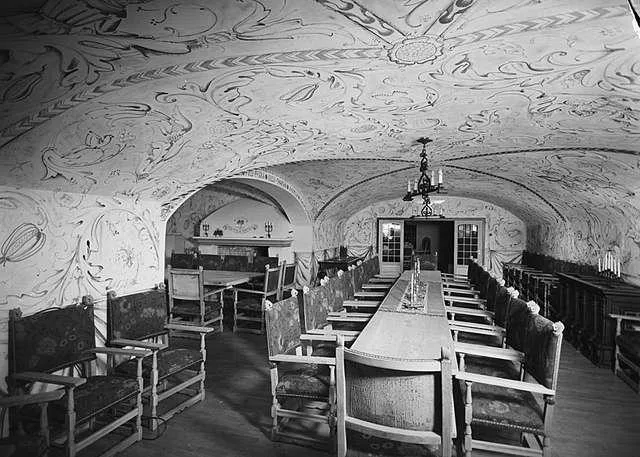 Anders Beer Wilse, Villa Grande, Bygdøy, Oslo (1 October 1945), Norwegian Museum of Cultural History / Galleri NOR Villa Grande, the grand Bygdøy mansion Vidkun Quisling took as his residence and renamed ‘Gimle’ during the occupation. Its opulent painted halls, photographed in 1945, today house Norway’s Center for Holocaust and Minority Studies. Large neoclassical mansion on the Huk peninsula at Bygdøy
in Oslo, built 1917–1947 and bought by Vidkun Quisling in
1941 to use as his wartime residence — Quisling renamed
it Gimle, after the eternal hall of the gods in Norse
mythology. Confiscated by the Norwegian state at the
liberation in 1945. Opened in 2006 as the home of
HL-senteret, the Center for Studies of the Holocaust
and Religious Minorities. The deliberate institutional
gesture — siting the Norwegian Holocaust memorial museum
inside the wartime residence of the Norwegian
collaborator who signed the laws authorising the
deportations — is the most pointed piece of Norwegian
memorial architecture of the modern period.
, Quisling’s own wartime mansion, in 2006 — and acknowledges what was done.
Anders Beer Wilse, Villa Grande, Bygdøy, Oslo (1 October 1945), Norwegian Museum of Cultural History / Galleri NOR Villa Grande, the grand Bygdøy mansion Vidkun Quisling took as his residence and renamed ‘Gimle’ during the occupation. Its opulent painted halls, photographed in 1945, today house Norway’s Center for Holocaust and Minority Studies. Large neoclassical mansion on the Huk peninsula at Bygdøy
in Oslo, built 1917–1947 and bought by Vidkun Quisling in
1941 to use as his wartime residence — Quisling renamed
it Gimle, after the eternal hall of the gods in Norse
mythology. Confiscated by the Norwegian state at the
liberation in 1945. Opened in 2006 as the home of
HL-senteret, the Center for Studies of the Holocaust
and Religious Minorities. The deliberate institutional
gesture — siting the Norwegian Holocaust memorial museum
inside the wartime residence of the Norwegian
collaborator who signed the laws authorising the
deportations — is the most pointed piece of Norwegian
memorial architecture of the modern period.
, Quisling’s own wartime mansion, in 2006 — and acknowledges what was done.
Norway’s cultural inheritance — the Lutheran theology, the Ford-derived conspiracy theories, the romantic-nationalist ethno-frame — was not different from its neighbors’. The same Ford-derived conspiracy theories ran on the editorial pages of American, British, French, and German newspapers in the 1930s. The same Lutheran theological inheritance from Luther’s 1543 polemic was carried by Lutheran congregations across northern Europe and across the upper American Midwest — the Norwegian-American Lutheran synods the emigrant generation had entered in Minnesota and the Dakotas were drinking from the same theological well as the rural Norwegian parishes they had left. The interwar antisemitic current was a continental and transatlantic one, and Norway was a participant in it. The outcomes, however, diverged. In neighboring Denmark  Johan Thomas Lundbye, En dansk kyst (A Danish Coast, 1843), Statens Museum for Kunst Lundbye painted this stretch of Roskilde Fjord shoreline in 1843 and titled it simply "A Danish Coast" — a Golden Age portrait of the low, mild landscape of Denmark itself, the neighbour kingdom that ran the joint Scandinavian monarchy from Copenhagen and governed Norway for close to four centuries. The southernmost of the three Scandinavian kingdoms,
consisting of the Jutland peninsula and the islands between
Jutland and the Swedish coast. Unified under Harald Bluetooth
in the late tenth century and Christianised in his reign,
Denmark was the dominant Scandinavian power through most of
the medieval and early modern centuries. From the 1397
Kalmar Union onward Denmark ran the joint Scandinavian
monarchy from Copenhagen; after Sweden left the union in
1523, Denmark and Norway remained joined as the Dano-
Norwegian state until 1814, with Norway governed as a Danish
province through that period.
In this article The comparison case. Invaded the same April morning in 1940,
Denmark keeps its king and government at home under a far
lighter occupation — and in October 1943 Danish fishermen
ferry nearly all of Denmark's Jews across the sound to
neutral Sweden, the rescue Norway's harder occupation never
allowed.
Also discussed in The Long Fall — the sudden loss of Norwegian nobility, the end of the kings, and half of Norway gone foreverThe 400-Year Night — when the Northern Lion lay dormantThe Quiet Revolution — how Norway won its independence without a war , where an autonomous Danish government and a still-Danish police remained in place until August 1943, the resistance ferried approximately seven thousand of seventy-five hundred Danish Jews across the Øresund to Sweden in October 1943; only about four hundred and seventy were deported. In Norway, where the Quisling-restructured state police had been operating for over a year by November 1942, roughly a third of the Jewish population was murdered. The conditions were shared; the institutional response was not. The point of saying so is not to relativize the Holocaust. The Holocaust was the systematic murder of approximately six million Jews; the Norwegian portion of that murder claimed roughly seven hundred and sixty-five lives. The point is to deny the comfort of distance — the comfort of thinking the conditions which made the Holocaust possible were foreign to the cultures one belongs to. They were not. The cultural conditions were here too. They were everywhere. The institutional choices that translated those conditions into bodies were closer to home.
Johan Thomas Lundbye, En dansk kyst (A Danish Coast, 1843), Statens Museum for Kunst Lundbye painted this stretch of Roskilde Fjord shoreline in 1843 and titled it simply "A Danish Coast" — a Golden Age portrait of the low, mild landscape of Denmark itself, the neighbour kingdom that ran the joint Scandinavian monarchy from Copenhagen and governed Norway for close to four centuries. The southernmost of the three Scandinavian kingdoms,
consisting of the Jutland peninsula and the islands between
Jutland and the Swedish coast. Unified under Harald Bluetooth
in the late tenth century and Christianised in his reign,
Denmark was the dominant Scandinavian power through most of
the medieval and early modern centuries. From the 1397
Kalmar Union onward Denmark ran the joint Scandinavian
monarchy from Copenhagen; after Sweden left the union in
1523, Denmark and Norway remained joined as the Dano-
Norwegian state until 1814, with Norway governed as a Danish
province through that period.
In this article The comparison case. Invaded the same April morning in 1940,
Denmark keeps its king and government at home under a far
lighter occupation — and in October 1943 Danish fishermen
ferry nearly all of Denmark's Jews across the sound to
neutral Sweden, the rescue Norway's harder occupation never
allowed.
Also discussed in The Long Fall — the sudden loss of Norwegian nobility, the end of the kings, and half of Norway gone foreverThe 400-Year Night — when the Northern Lion lay dormantThe Quiet Revolution — how Norway won its independence without a war , where an autonomous Danish government and a still-Danish police remained in place until August 1943, the resistance ferried approximately seven thousand of seventy-five hundred Danish Jews across the Øresund to Sweden in October 1943; only about four hundred and seventy were deported. In Norway, where the Quisling-restructured state police had been operating for over a year by November 1942, roughly a third of the Jewish population was murdered. The conditions were shared; the institutional response was not. The point of saying so is not to relativize the Holocaust. The Holocaust was the systematic murder of approximately six million Jews; the Norwegian portion of that murder claimed roughly seven hundred and sixty-five lives. The point is to deny the comfort of distance — the comfort of thinking the conditions which made the Holocaust possible were foreign to the cultures one belongs to. They were not. The cultural conditions were here too. They were everywhere. The institutional choices that translated those conditions into bodies were closer to home.
The teachers and the bishops
The civilian resistance to Quisling and to the occupation runs through several parallel networks. The Norwegian teachers’ corporation refuses, in 1942, to teach Nasjonal Samling-mandated curriculum. The Norwegian police arrest approximately eleven hundred teachers; about five hundred of them are shipped to forced-labor camps at Kirkenes in the far north. The resistance holds, and Quisling backs down on the teachers’ question. Under the leadership of Bishop Eivind Berggrav 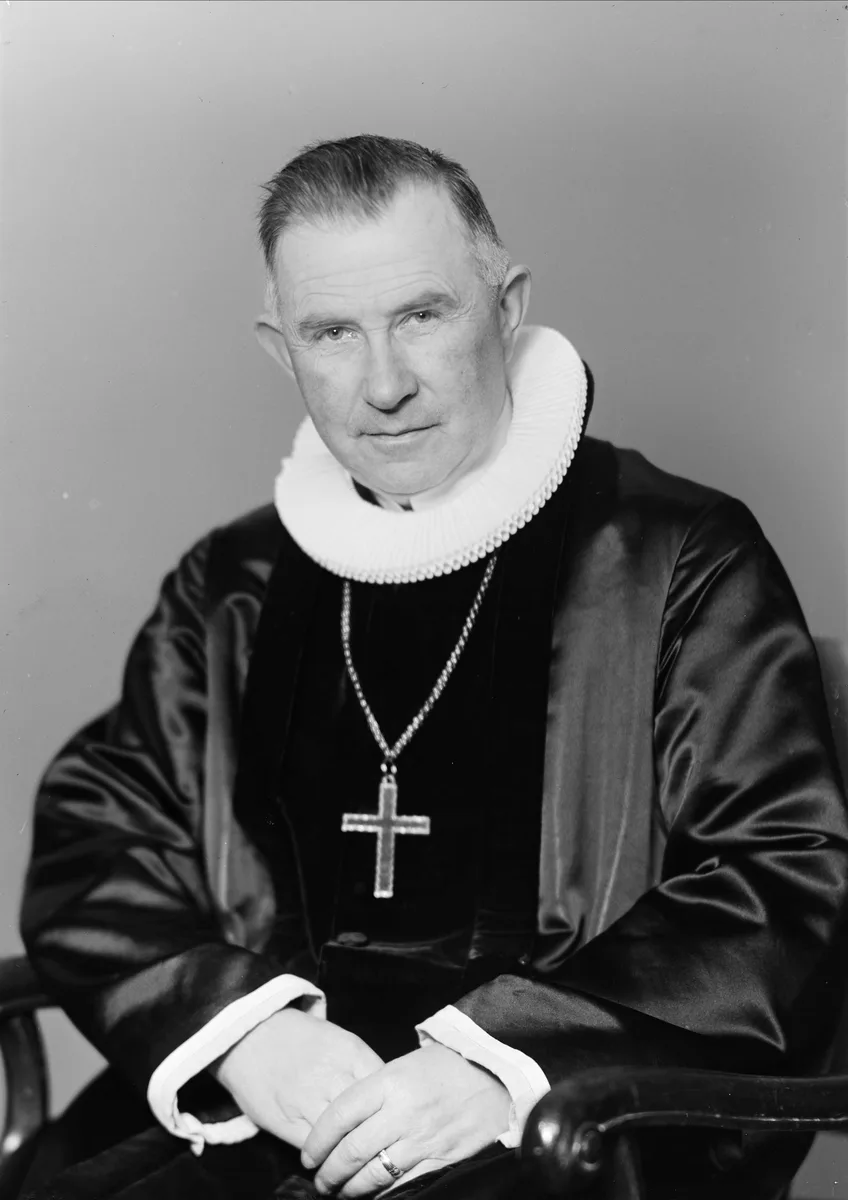 Ernest Rude / Oslo Museum, CC BY-SA 4.0 Bishop Eivind Berggrav led Norway's bishops in their joint resignation from state office on 24 February 1942 and co-signed Kirkens Grunn, read from most of the country's pulpits that Easter. The occupation authorities held him under house arrest for the rest of the war. Lutheran Bishop of Oslo (1884–1959), the senior Norwegian
ecclesiastical authority through the German occupation and
the central figure in the Norwegian church's resistance to
Nazification. As primus inter pares of the Norwegian
bishops, Berggrav led their joint resignation from state
administrative offices on 24 February 1942, refusing to
serve under Nasjonal Samling's reorganisation of the state
church. On Easter Sunday, 5 April 1942, he and the other
bishops issued Kirkens Grunn — The Foundation of the
Church — read that day from most of the country's
pulpits. The
Quisling regime arrested him; he spent the remainder of the
occupation in house arrest. After the war served as
president of the World Council of Churches and one of the
founders of the modern ecumenical movement.
, the Norwegian Lutheran bishops resign their state administrative offices on the twenty-fourth of February 1942, refusing to serve under Nasjonal Samling’s reorganization of the state church. On Easter Sunday, the fifth of April 1942, they issue Kirkens Grunn The Foundation of the Church — the declaration issued by
the Norwegian Lutheran bishops on Easter Sunday, 5 April
1942, refusing to serve under Nasjonal Samling's
reorganisation of the state church. Drafted under Bishop
Eivind Berggrav's leadership and ratified by the
collective episcopate after the bishops had jointly
resigned their state administrative offices on 24
February 1942. The declaration set out the theological
and constitutional grounds on which the Norwegian church
refused to participate in the Nazification of its
ministry. Read from pulpits across the country — most of
Norway's churches — on Easter Sunday 1942. The bishops were subsequently arrested or
placed under house arrest. The resistance held;
Quisling's church plan failed.
— which is read from pulpits across the country that day, most of Norway’s churches. Berggrav and most of the other bishops are arrested or placed under house arrest. The resistance holds. The Norwegian Resistance Museum at Akershus Fortress
Ernest Rude / Oslo Museum, CC BY-SA 4.0 Bishop Eivind Berggrav led Norway's bishops in their joint resignation from state office on 24 February 1942 and co-signed Kirkens Grunn, read from most of the country's pulpits that Easter. The occupation authorities held him under house arrest for the rest of the war. Lutheran Bishop of Oslo (1884–1959), the senior Norwegian
ecclesiastical authority through the German occupation and
the central figure in the Norwegian church's resistance to
Nazification. As primus inter pares of the Norwegian
bishops, Berggrav led their joint resignation from state
administrative offices on 24 February 1942, refusing to
serve under Nasjonal Samling's reorganisation of the state
church. On Easter Sunday, 5 April 1942, he and the other
bishops issued Kirkens Grunn — The Foundation of the
Church — read that day from most of the country's
pulpits. The
Quisling regime arrested him; he spent the remainder of the
occupation in house arrest. After the war served as
president of the World Council of Churches and one of the
founders of the modern ecumenical movement.
, the Norwegian Lutheran bishops resign their state administrative offices on the twenty-fourth of February 1942, refusing to serve under Nasjonal Samling’s reorganization of the state church. On Easter Sunday, the fifth of April 1942, they issue Kirkens Grunn The Foundation of the Church — the declaration issued by
the Norwegian Lutheran bishops on Easter Sunday, 5 April
1942, refusing to serve under Nasjonal Samling's
reorganisation of the state church. Drafted under Bishop
Eivind Berggrav's leadership and ratified by the
collective episcopate after the bishops had jointly
resigned their state administrative offices on 24
February 1942. The declaration set out the theological
and constitutional grounds on which the Norwegian church
refused to participate in the Nazification of its
ministry. Read from pulpits across the country — most of
Norway's churches — on Easter Sunday 1942. The bishops were subsequently arrested or
placed under house arrest. The resistance held;
Quisling's church plan failed.
— which is read from pulpits across the country that day, most of Norway’s churches. Berggrav and most of the other bishops are arrested or placed under house arrest. The resistance holds. The Norwegian Resistance Museum at Akershus Fortress 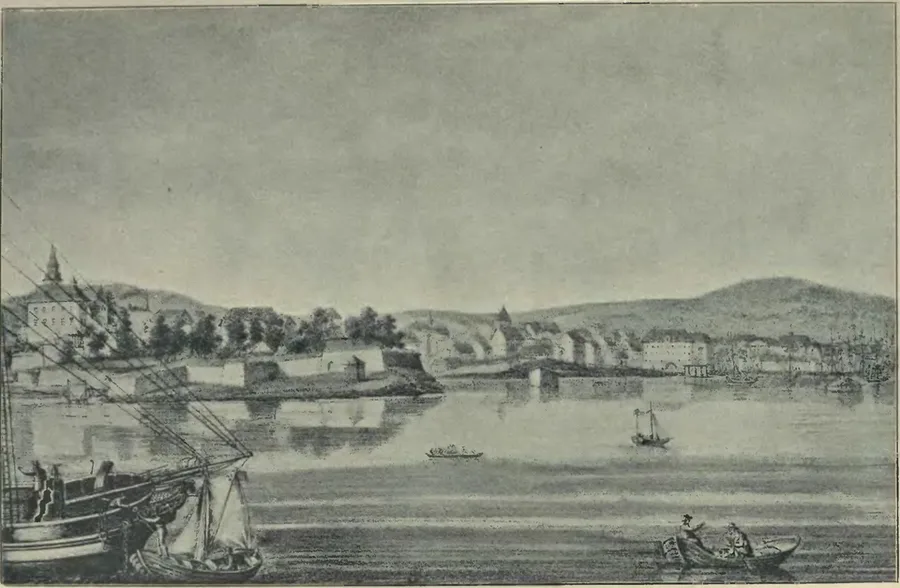 Peter Frederik Wergmann, Akershus Fortress (1831) Wergmann's 1831 view of Christiania harbor shows Akershus low on the point at center, the Danish crown's seat of authority in Norway from the late 1300s and the fortress the 1537 Reformation-era administration operated from. Medieval royal castle on a rocky promontory at the head of
the Oslofjord, begun by King Hákon V of Norway about 1299
shortly after he moved the royal residence permanently from
Bergen to Oslo. The castle commanded the seaward approach
to the medieval town and served as the royal seat of the
southeastern administration. From the late fourteenth century
onward — after the dynastic collapse following Olav IV's
death in 1387 — Akershus passed under Danish-appointed
governance and remained the seat of the Danish crown's
authority in Norway for the next four centuries. Today a
preserved fortress complex above central Oslo.
In this article Under the occupation the medieval fortress became a German
prison, and Norwegian resistance members were executed inside
its walls. After the liberation the roles reversed: Vidkun
Quisling was shot at Akershus in October 1945 following his
treason conviction. The fortress grounds now house Norway's
Resistance Museum, steps from where the wartime executions
took place.
On the trip The Day-2 e-bike tour rides through the Akershus Fortress
grounds — the first stop on the morning's loop through
central Oslo, with both groups together.
Also discussed in The Long Fall — the sudden loss of Norwegian nobility, the end of the kings, and half of Norway gone foreverThe 400-Year Night — when the Northern Lion lay dormantThe Reformation, 1537 — one church eradicated and another imposed in Oslo preserves the original documents and the equipment of the home-front organization Milorg, which by 1944 had armed and trained several tens of thousands of Norwegian volunteers and which contributed substantially to the orderly liberation of the country in May 1945.
Peter Frederik Wergmann, Akershus Fortress (1831) Wergmann's 1831 view of Christiania harbor shows Akershus low on the point at center, the Danish crown's seat of authority in Norway from the late 1300s and the fortress the 1537 Reformation-era administration operated from. Medieval royal castle on a rocky promontory at the head of
the Oslofjord, begun by King Hákon V of Norway about 1299
shortly after he moved the royal residence permanently from
Bergen to Oslo. The castle commanded the seaward approach
to the medieval town and served as the royal seat of the
southeastern administration. From the late fourteenth century
onward — after the dynastic collapse following Olav IV's
death in 1387 — Akershus passed under Danish-appointed
governance and remained the seat of the Danish crown's
authority in Norway for the next four centuries. Today a
preserved fortress complex above central Oslo.
In this article Under the occupation the medieval fortress became a German
prison, and Norwegian resistance members were executed inside
its walls. After the liberation the roles reversed: Vidkun
Quisling was shot at Akershus in October 1945 following his
treason conviction. The fortress grounds now house Norway's
Resistance Museum, steps from where the wartime executions
took place.
On the trip The Day-2 e-bike tour rides through the Akershus Fortress
grounds — the first stop on the morning's loop through
central Oslo, with both groups together.
Also discussed in The Long Fall — the sudden loss of Norwegian nobility, the end of the kings, and half of Norway gone foreverThe 400-Year Night — when the Northern Lion lay dormantThe Reformation, 1537 — one church eradicated and another imposed in Oslo preserves the original documents and the equipment of the home-front organization Milorg, which by 1944 had armed and trained several tens of thousands of Norwegian volunteers and which contributed substantially to the orderly liberation of the country in May 1945.
The civilian resistance also runs at the smaller scale of daily life. Norwegians pin paperclips to their lapels — binders, the small metal things that hold paper together — as a quiet sign of being bound against the occupation. The king’s monogram H7 appears in chalk on walls and in pencil on streetcar seats; the Quisling administration prosecutes the graffiti when it can catch the culprits. Members of Nasjonal Samling find themselves excluded from village funerals, refused service at shops, and met with the polite social freeze-out that small Norwegian communities reserve for those who have broken with them. The occupation runs on millions of these small choices alongside the larger ones.
Vemork
The single most consequential operational act of the Norwegian resistance is the sabotage of the German heavy-water production facility at Vemork 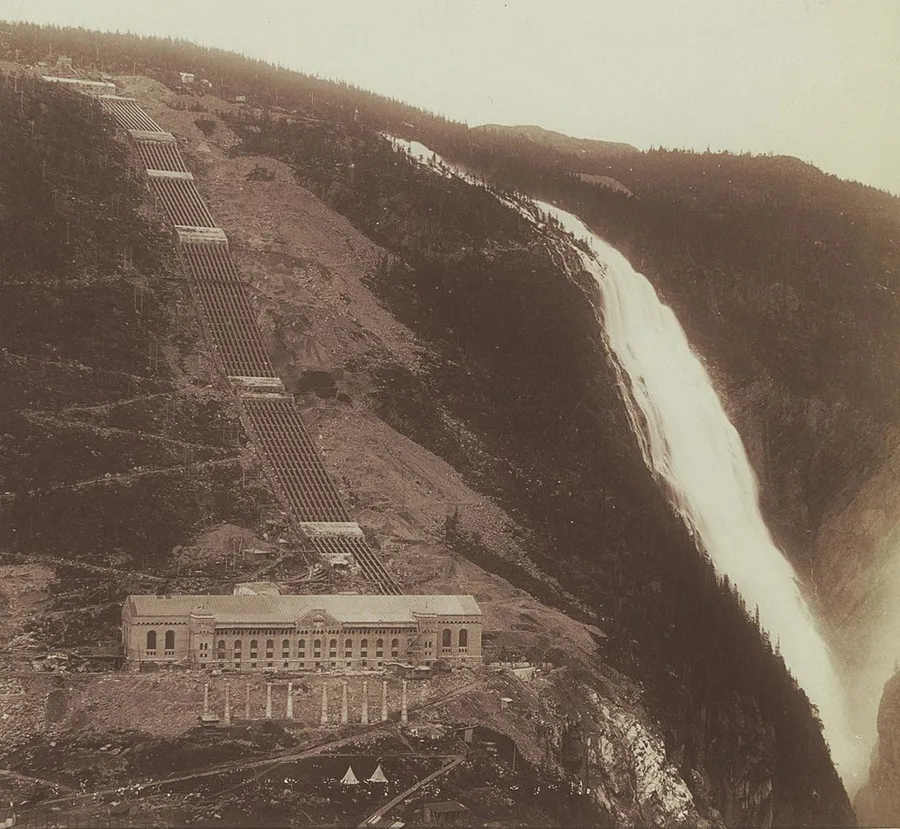 National Library of Norway, Sam Eyde Collection, public domain Vemork’s hydroelectric plant and its heavy-water byproduct made Rjukan a target of Germany’s wartime nuclear research. On the night of 27–28 February 1943 the Operation Gunnerside team crossed the gorge below and destroyed the electrolysis cells that made the heavy water — without a shot or a life lost. Hydroelectric power station and industrial complex on the
Måna river above Rjukan in Telemark, southern Norway.
Built before the First World War by Norsk Hydro and
operated for fertilizer production (synthetic ammonia
from atmospheric nitrogen, the Birkeland-Eyde process).
The associated electrolysis plant produced heavy water
(deuterium oxide) as a by-product. From 1940 the German
atomic-weapons research program at the Kaiser Wilhelm
Institute required Vemork's heavy water as a moderator in
early reactor designs. The Norwegian Operation Gunnerside
team sabotaged the heavy-water electrolysis cells on the
night of 27–28 February 1943 without firing a shot. Today
preserved as the Norwegian Industrial Workers' Museum,
inside the UNESCO Rjukan-Notodden World Heritage zone.
in Telemark
National Library of Norway, Sam Eyde Collection, public domain Vemork’s hydroelectric plant and its heavy-water byproduct made Rjukan a target of Germany’s wartime nuclear research. On the night of 27–28 February 1943 the Operation Gunnerside team crossed the gorge below and destroyed the electrolysis cells that made the heavy water — without a shot or a life lost. Hydroelectric power station and industrial complex on the
Måna river above Rjukan in Telemark, southern Norway.
Built before the First World War by Norsk Hydro and
operated for fertilizer production (synthetic ammonia
from atmospheric nitrogen, the Birkeland-Eyde process).
The associated electrolysis plant produced heavy water
(deuterium oxide) as a by-product. From 1940 the German
atomic-weapons research program at the Kaiser Wilhelm
Institute required Vemork's heavy water as a moderator in
early reactor designs. The Norwegian Operation Gunnerside
team sabotaged the heavy-water electrolysis cells on the
night of 27–28 February 1943 without firing a shot. Today
preserved as the Norwegian Industrial Workers' Museum,
inside the UNESCO Rjukan-Notodden World Heritage zone.
in Telemark 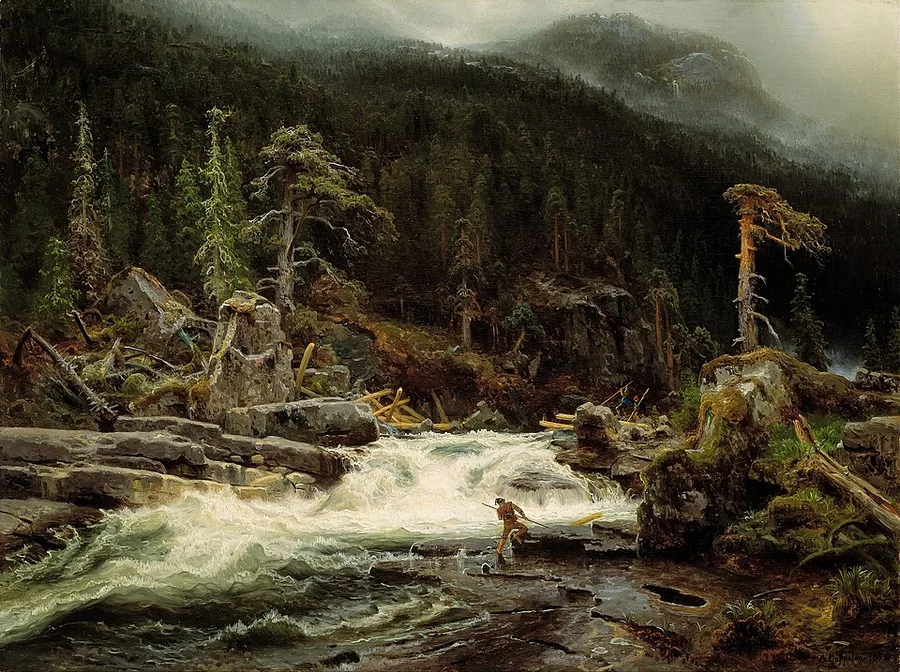 August Cappelen, Foss i nedre Telemark (1852), National Museum of Art, Architecture and Design August Cappelen's 1852 painting of a waterfall gorge in lower Telemark — dark forest closing over white water, log-drivers small at its edge. This is the upland valley country of the Norwegian interior, the kind of forest that has swallowed whole farms when their people vanished from the registers. Historic region and county in the inland-southern part of
Norway, between the southeastern coast and the central
Hardangervidda plateau. Home to Heddal Stave Church — the
largest of the twenty-eight surviving Norwegian stave churches,
standing nearly thirty metres tall — and to the heavy-water
production facility at Vemork whose sabotage by Norwegian
commandos in February 1943 disrupted the German atomic-weapons
programme. The name Telemark also gives the world the modern
ski-turn technique developed there in the nineteenth century.
In the folklore record Telemark is the deepest vein of all —
the landscape of the ballad collectors, the hardingfele
legends, and the lake serpent of Seljord.
Telemark Also discussed in A Catholic Norway — the faith that gave the kingdom its first institutions and the stave churchesThe Long Fall — the sudden loss of Norwegian nobility, the end of the kings, and half of Norway gone foreverFossegrimen — the waterfall fiddler who teaches you to playTroll — the monsters of the mountainsUtburd — the unbaptized child that will not restÅsgårdsreien — the storm that rides through the winter skyHuldra — the girl in the forest with a secretSjøormer — the serpents in the deep lakes and fjords on the night of the twenty-seventh and twenty-eighth of February 1943. Heavy water, deuterium oxide, is required in the German atomic-weapons research program at the Kaiser Wilhelm Institute as a moderator in early reactor designs. The Vemork hydroelectric plant, built before the war as part of the Norsk Hydro fertilizer operation, is producing several thousand pounds of heavy water per year for the German program. The British Special Operations Executive, working with Norwegian operatives, attempts a glider-borne raid on Vemork in November 1942 ( Operation Freshman
August Cappelen, Foss i nedre Telemark (1852), National Museum of Art, Architecture and Design August Cappelen's 1852 painting of a waterfall gorge in lower Telemark — dark forest closing over white water, log-drivers small at its edge. This is the upland valley country of the Norwegian interior, the kind of forest that has swallowed whole farms when their people vanished from the registers. Historic region and county in the inland-southern part of
Norway, between the southeastern coast and the central
Hardangervidda plateau. Home to Heddal Stave Church — the
largest of the twenty-eight surviving Norwegian stave churches,
standing nearly thirty metres tall — and to the heavy-water
production facility at Vemork whose sabotage by Norwegian
commandos in February 1943 disrupted the German atomic-weapons
programme. The name Telemark also gives the world the modern
ski-turn technique developed there in the nineteenth century.
In the folklore record Telemark is the deepest vein of all —
the landscape of the ballad collectors, the hardingfele
legends, and the lake serpent of Seljord.
Telemark Also discussed in A Catholic Norway — the faith that gave the kingdom its first institutions and the stave churchesThe Long Fall — the sudden loss of Norwegian nobility, the end of the kings, and half of Norway gone foreverFossegrimen — the waterfall fiddler who teaches you to playTroll — the monsters of the mountainsUtburd — the unbaptized child that will not restÅsgårdsreien — the storm that rides through the winter skyHuldra — the girl in the forest with a secretSjøormer — the serpents in the deep lakes and fjords on the night of the twenty-seventh and twenty-eighth of February 1943. Heavy water, deuterium oxide, is required in the German atomic-weapons research program at the Kaiser Wilhelm Institute as a moderator in early reactor designs. The Vemork hydroelectric plant, built before the war as part of the Norsk Hydro fertilizer operation, is producing several thousand pounds of heavy water per year for the German program. The British Special Operations Executive, working with Norwegian operatives, attempts a glider-borne raid on Vemork in November 1942 ( Operation Freshman 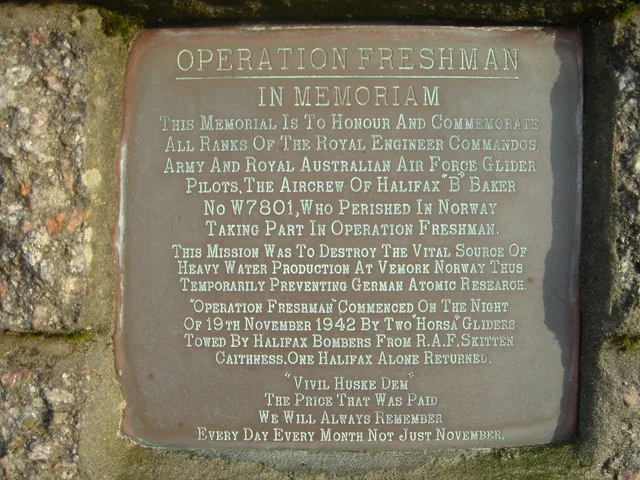 David Glass, CC BY-SA 2.0, via Geograph This plaque marks Skitten airfield, Scotland, from which the two Horsa gliders departed on 19 November 1942 — the failed raid whose forty-one dead made the following winter's Norwegian-led Gunnerside mission necessary. British military operation in November 1942, the first
British attempt to destroy the German heavy-water
production plant at Vemork. Two Horsa gliders carrying
thirty-four Royal Engineers, each towed by a Halifax
bomber, set out from RAF Wick toward landing zones on the
Hardangervidda plateau. Both gliders and one tug aircraft
crashed in bad weather, killing several men outright. The
survivors were captured and executed under Hitler's
October 1942 Kommandobefehl (commando order); forty-one
of the forty-eight men who took part were killed. The
failure made the Norwegian-led
Operation Gunnerside the next attempt; that operation
succeeded three months later. Operation Freshman is
remembered today as one of the costliest single failures
of the SOE's wartime sabotage campaign.
) which fails disastrously — both gliders and one tow aircraft crash, and forty-one of the forty-eight British airborne engineers and airmen are killed, several of the crash survivors executed by the Gestapo. The Norwegian successor operation, Operation Gunnerside
David Glass, CC BY-SA 2.0, via Geograph This plaque marks Skitten airfield, Scotland, from which the two Horsa gliders departed on 19 November 1942 — the failed raid whose forty-one dead made the following winter's Norwegian-led Gunnerside mission necessary. British military operation in November 1942, the first
British attempt to destroy the German heavy-water
production plant at Vemork. Two Horsa gliders carrying
thirty-four Royal Engineers, each towed by a Halifax
bomber, set out from RAF Wick toward landing zones on the
Hardangervidda plateau. Both gliders and one tug aircraft
crashed in bad weather, killing several men outright. The
survivors were captured and executed under Hitler's
October 1942 Kommandobefehl (commando order); forty-one
of the forty-eight men who took part were killed. The
failure made the Norwegian-led
Operation Gunnerside the next attempt; that operation
succeeded three months later. Operation Freshman is
remembered today as one of the costliest single failures
of the SOE's wartime sabotage campaign.
) which fails disastrously — both gliders and one tow aircraft crash, and forty-one of the forty-eight British airborne engineers and airmen are killed, several of the crash survivors executed by the Gestapo. The Norwegian successor operation, Operation Gunnerside 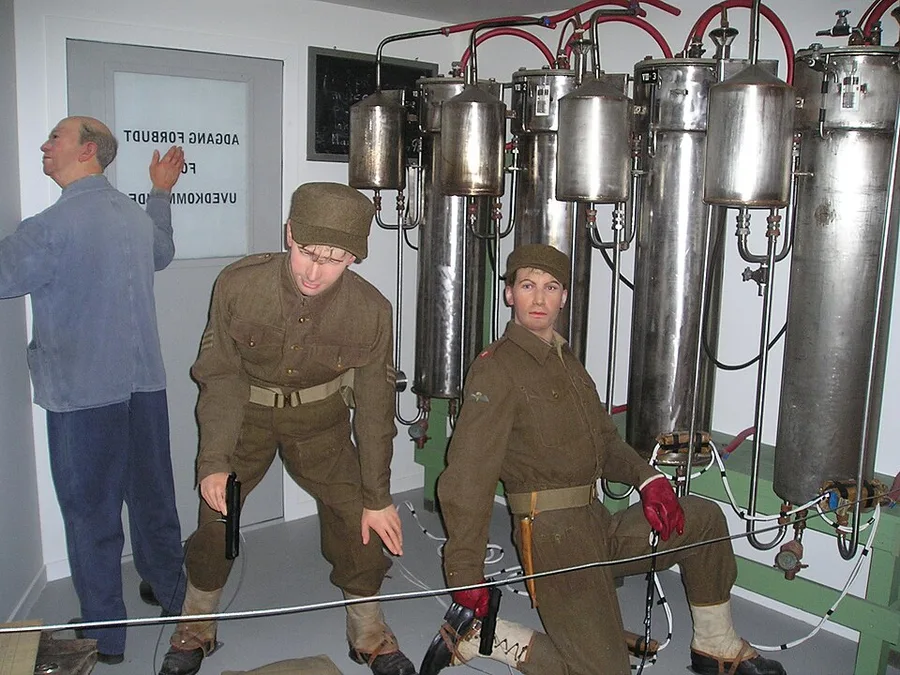 Photo: Hallvard Straume, public domain (self-released) A staged reconstruction of the nine-man Gunnerside team wiring charges to the heavy-water electrolysis cells at Vemork on the night of 27-28 February 1943 — no photograph exists of the sabotage itself, carried out in darkness without a shot fired. British Special Operations Executive sabotage operation
against the German heavy-water plant at Vemork in
Telemark, conducted by Norwegian SOE-trained operatives
on the night of 27–28 February 1943. Six Norwegians,
parachuted onto the Hardangervidda on 16 February and led
by Joachim Rønneberg of Ålesund, linked up with the
four-man Operation Grouse advance party that had been
operating in the mountains since October 1942. The
nine-man assault party skied to Vemork, climbed down a
six-hundred-foot gorge the Germans had assumed
impassable, slipped into the plant through a cable duct,
and detonated charges on the heavy-water electrolysis
cells without firing a shot. All nine escaped. The SOE's postwar assessment called it the most
successful sabotage operation of the war.
, parachutes six Norwegian SOE volunteers, all trained in Britain and led by Joachim Rønneberg
Photo: Hallvard Straume, public domain (self-released) A staged reconstruction of the nine-man Gunnerside team wiring charges to the heavy-water electrolysis cells at Vemork on the night of 27-28 February 1943 — no photograph exists of the sabotage itself, carried out in darkness without a shot fired. British Special Operations Executive sabotage operation
against the German heavy-water plant at Vemork in
Telemark, conducted by Norwegian SOE-trained operatives
on the night of 27–28 February 1943. Six Norwegians,
parachuted onto the Hardangervidda on 16 February and led
by Joachim Rønneberg of Ålesund, linked up with the
four-man Operation Grouse advance party that had been
operating in the mountains since October 1942. The
nine-man assault party skied to Vemork, climbed down a
six-hundred-foot gorge the Germans had assumed
impassable, slipped into the plant through a cable duct,
and detonated charges on the heavy-water electrolysis
cells without firing a shot. All nine escaped. The SOE's postwar assessment called it the most
successful sabotage operation of the war.
, parachutes six Norwegian SOE volunteers, all trained in Britain and led by Joachim Rønneberg 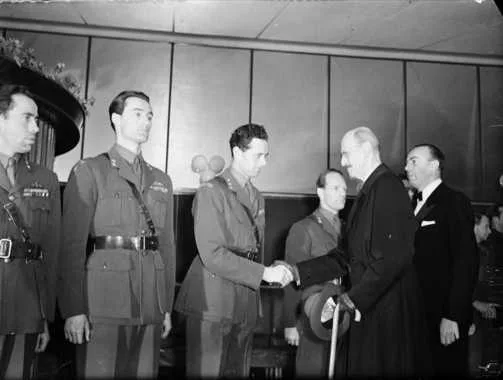 Leif Ørnelund / Oslo Museum via DigitaltMuseum, CC BY-SA 4.0 King Haakon VII greets Joachim Rønneberg and fellow Gunnerside saboteurs Knut Haukelid, Jens-Anton Poulsson, and Kasper Idland at the 1948 premiere of the film dramatizing their raid — the closest image Commons holds to a Rønneberg portrait. Norwegian resistance officer (1919–2018), born in Ålesund.
Recruited by the British Special Operations Executive in
1941; trained at SOE facilities in Britain. Led the six-man
Operation Gunnerside team that parachuted onto the
Hardangervidda plateau on 16 February 1943, linked up with
the four-man Operation Grouse advance party, and sabotaged
the German heavy-water production cells at Vemork on the
night of 27–28 February 1943 without firing a shot. All
nine of the assault party escaped; Rønneberg himself skied
some 400 kilometres to the Swedish border. The SOE's
postwar assessment called Vemork the most successful
sabotage operation of the war. Lived another seventy-five
years; died in 2018 at ninety-nine, the last of the
Gunnerside team to die.
of Ålesund, into the Hardangervidda
Leif Ørnelund / Oslo Museum via DigitaltMuseum, CC BY-SA 4.0 King Haakon VII greets Joachim Rønneberg and fellow Gunnerside saboteurs Knut Haukelid, Jens-Anton Poulsson, and Kasper Idland at the 1948 premiere of the film dramatizing their raid — the closest image Commons holds to a Rønneberg portrait. Norwegian resistance officer (1919–2018), born in Ålesund.
Recruited by the British Special Operations Executive in
1941; trained at SOE facilities in Britain. Led the six-man
Operation Gunnerside team that parachuted onto the
Hardangervidda plateau on 16 February 1943, linked up with
the four-man Operation Grouse advance party, and sabotaged
the German heavy-water production cells at Vemork on the
night of 27–28 February 1943 without firing a shot. All
nine of the assault party escaped; Rønneberg himself skied
some 400 kilometres to the Swedish border. The SOE's
postwar assessment called Vemork the most successful
sabotage operation of the war. Lived another seventy-five
years; died in 2018 at ninety-nine, the last of the
Gunnerside team to die.
of Ålesund, into the Hardangervidda  Johannes Flintoe (1822), Nasjonalmuseet, public domain Flintoe's 1822 sketch — inscribed as a snow-bridge crossing on Langfjeldet rather than the vidda itself — shows the same class of barren, snow-locked high-plateau terrain the Operation Gunnerside team used as cover after parachuting in, February 1943. The largest mountain plateau in northern Europe, covering
about 8,000 square kilometres across the highland between
Hardangerfjord, Numedal, and Telemark in central southern
Norway. Average elevation about 1,100 metres. A barren,
open landscape of moss, rock, and small lakes, snow-covered
most of the year. Through the medieval period and into the
modern era the plateau served as a summer pasture for the
surrounding valleys' livestock and a long-distance hiking
and reindeer-herding ground. The Norwegian Operation
Gunnerside team parachuted onto the plateau on 16 February
1943 and used its winter conditions and remoteness as the
base for the sabotage of the German heavy-water plant at
Vemork. Now Hardangervidda National Park (1981), Norway's
largest national park.
Also discussed in Public transit basics — trains, trams, boats, and buying tickets mountain plateau on the sixteenth of February 1943. They link up with the four Norwegians of the earlier Operation Grouse advance party that had been operating in the mountains since October 1942. The nine-man assault party — the six from Gunnerside and three from Grouse — skis to the Vemork plant on the night of February twenty-seventh, climbs down a six-hundred-foot gorge that the Germans had assumed to be impossible, crosses the half-frozen river at the bottom, and ascends the cliff on the opposite side, following the railway line to the plant and slipping into the building through a cable duct. They place charges on the heavy-water electrolysis cells in the basement of the plant, detonate them at thirty-second fuse, and withdraw without firing a shot. The Germans hear the explosion but cannot identify the attackers. All nine of the assault party escape. Five of them ski two hundred and fifty miles to the Swedish border. The others remain in Norway and continue resistance work. The destroyed heavy-water production capacity is repaired by August 1943, but a follow-up American bombing raid in November 1943 damages it again, and a final Norwegian operation in February 1944 sinks the ferry Hydro on Lake Tinnsjø
Johannes Flintoe (1822), Nasjonalmuseet, public domain Flintoe's 1822 sketch — inscribed as a snow-bridge crossing on Langfjeldet rather than the vidda itself — shows the same class of barren, snow-locked high-plateau terrain the Operation Gunnerside team used as cover after parachuting in, February 1943. The largest mountain plateau in northern Europe, covering
about 8,000 square kilometres across the highland between
Hardangerfjord, Numedal, and Telemark in central southern
Norway. Average elevation about 1,100 metres. A barren,
open landscape of moss, rock, and small lakes, snow-covered
most of the year. Through the medieval period and into the
modern era the plateau served as a summer pasture for the
surrounding valleys' livestock and a long-distance hiking
and reindeer-herding ground. The Norwegian Operation
Gunnerside team parachuted onto the plateau on 16 February
1943 and used its winter conditions and remoteness as the
base for the sabotage of the German heavy-water plant at
Vemork. Now Hardangervidda National Park (1981), Norway's
largest national park.
Also discussed in Public transit basics — trains, trams, boats, and buying tickets mountain plateau on the sixteenth of February 1943. They link up with the four Norwegians of the earlier Operation Grouse advance party that had been operating in the mountains since October 1942. The nine-man assault party — the six from Gunnerside and three from Grouse — skis to the Vemork plant on the night of February twenty-seventh, climbs down a six-hundred-foot gorge that the Germans had assumed to be impossible, crosses the half-frozen river at the bottom, and ascends the cliff on the opposite side, following the railway line to the plant and slipping into the building through a cable duct. They place charges on the heavy-water electrolysis cells in the basement of the plant, detonate them at thirty-second fuse, and withdraw without firing a shot. The Germans hear the explosion but cannot identify the attackers. All nine of the assault party escape. Five of them ski two hundred and fifty miles to the Swedish border. The others remain in Norway and continue resistance work. The destroyed heavy-water production capacity is repaired by August 1943, but a follow-up American bombing raid in November 1943 damages it again, and a final Norwegian operation in February 1944 sinks the ferry Hydro on Lake Tinnsjø  Anders Beer Wilse / National Library of Norway, public domain A Tinnsjo rail ferry of the same kind and route the SF Hydro ran between Mael and Tinnoset. The resistance sank the Hydro in these waters on 20 February 1944, carrying Germany's last heavy-water shipment out of Rjukan, at the cost of fourteen Norwegian civilian lives. Long narrow lake in Telemark in southern Norway, draining
from Rjukan and the Hardangervidda southward toward
Notodden. Maximum depth about 460 metres. Through the
Second World War the lake carried the rail-ferry Hydro
that linked the Vemork industrial complex by rail to the
southern Norwegian port network. On 20 February 1944, in
the final phase of the Norwegian heavy-water sabotage
campaign, the Norwegian resistance placed explosives in
the Hydro's hull and sank her in deep water as she
carried the last German heavy-water inventory south
toward Germany. Fourteen Norwegian civilians and four
German soldiers went down with the ship; the resistance
had no way to warn the passengers without giving away the
plan. The wreck and its barrels of heavy water remain on
the lake bed today.
carrying the remaining heavy-water inventory south to Germany. Fourteen Norwegian civilians and four German soldiers go down with the ship; the resistance had no way to warn the passengers without giving away the plan. The cumulative result is that the German atomic program never receives the heavy-water quantities its researchers requested. The SOE’s postwar assessment of the Vemork raid as the single most successful sabotage operation of the war captures its tactical brilliance. Whether the German atomic program could have succeeded under any conditions, given Heisenberg’s theoretical errors and the limited material commitment Berlin made to it, remains genuinely contested. The raid is the basis of the 1965 Anthony Mann film The Heroes of Telemark, which takes considerable Hollywood license, and the 2015 Norwegian television series Kampen om tungtvannet, which sits much closer to the documented record.
Anders Beer Wilse / National Library of Norway, public domain A Tinnsjo rail ferry of the same kind and route the SF Hydro ran between Mael and Tinnoset. The resistance sank the Hydro in these waters on 20 February 1944, carrying Germany's last heavy-water shipment out of Rjukan, at the cost of fourteen Norwegian civilian lives. Long narrow lake in Telemark in southern Norway, draining
from Rjukan and the Hardangervidda southward toward
Notodden. Maximum depth about 460 metres. Through the
Second World War the lake carried the rail-ferry Hydro
that linked the Vemork industrial complex by rail to the
southern Norwegian port network. On 20 February 1944, in
the final phase of the Norwegian heavy-water sabotage
campaign, the Norwegian resistance placed explosives in
the Hydro's hull and sank her in deep water as she
carried the last German heavy-water inventory south
toward Germany. Fourteen Norwegian civilians and four
German soldiers went down with the ship; the resistance
had no way to warn the passengers without giving away the
plan. The wreck and its barrels of heavy water remain on
the lake bed today.
carrying the remaining heavy-water inventory south to Germany. Fourteen Norwegian civilians and four German soldiers go down with the ship; the resistance had no way to warn the passengers without giving away the plan. The cumulative result is that the German atomic program never receives the heavy-water quantities its researchers requested. The SOE’s postwar assessment of the Vemork raid as the single most successful sabotage operation of the war captures its tactical brilliance. Whether the German atomic program could have succeeded under any conditions, given Heisenberg’s theoretical errors and the limited material commitment Berlin made to it, remains genuinely contested. The raid is the basis of the 1965 Anthony Mann film The Heroes of Telemark, which takes considerable Hollywood license, and the 2015 Norwegian television series Kampen om tungtvannet, which sits much closer to the documented record.
Lebensborn
The Lebensborn  Riksarkivet (National Archives of Norway), exterior of Fødehjemmet Klekken, from the "Krigsbarn (Lebensborn)" album The exterior of Fodehjemmet Klekken, one of the maternity homes the German-run Lebensborn program operated in occupied Norway, the largest such program outside Germany, without depicting any of the roughly ten to twelve thousand children born through it. Source of Life — Nazi-eugenic program founded by Heinrich
Himmler in 1935 to encourage births of children of
"racially valuable" parents and to facilitate adoption of
such children by SS families. The Norwegian Lebensborn
program was the largest national program outside Germany,
operating on the German occupation conviction that
Norwegians were the purest of the Germanic peoples and
that German-Norwegian children would strengthen the
future Aryan race. Between ten and twelve thousand
Norwegian children were born to Norwegian mothers and
German occupation soldiers between 1940 and 1945, many
in segregated Lebensborn-heim maternity facilities. The
program's administrative records survive the war and are
preserved at the Norwegian National Archives.
program in Norway is the most distinctive piece of Nazi racial policy applied to the country. The German occupation authorities, operating on the racial-eugenic conviction that Norwegians were the purest of the Germanic peoples and that German-Norwegian children would strengthen the future Aryan race, encourage and facilitate sexual relationships between German occupation soldiers and Norwegian women, build maternity homes called Lebensborn-heim where the resulting children are born and cared for in segregated facilities, and document the program in administrative records that survive the war. Between ten and twelve thousand Norwegian children are born to Norwegian mothers and German fathers between 1940 and 1945, the largest national Lebensborn program outside Germany itself. After the liberation in 1945 these children, called Tyskerbarn German-children — the children born to Norwegian
mothers and German occupation soldiers between 1940 and
1945, most under the formal Lebensborn program. Estimates
run between ten and twelve thousand. Their mothers were
known as tyskertøser — a slur on the order of "German
whores." After the liberation in 1945 the tyskerbarn
and their mothers faced decades of social and
institutional persecution within the Norwegian state,
including forced separations, institutional placements,
the persistent assumption that the children were
mentally inferior, and discrimination in housing,
employment, and schooling. The Norwegian state formally
apologised in Prime Minister Kjell Magne Bondevik's New
Year's Day address of 2000, with limited financial
compensation following thereafter.
or German-children in Norwegian, and their mothers, called tyskertøser — a slur on the order of “German whores” — face decades of social and institutional persecution within the Norwegian state, including forced separations, institutional placements, and the persistent assumption that the children are mentally inferior because of their fathers. The Norwegian state formally apologized to the tyskerbarn generation in 2000, in Prime Minister Kjell Magne Bondevik
Riksarkivet (National Archives of Norway), exterior of Fødehjemmet Klekken, from the "Krigsbarn (Lebensborn)" album The exterior of Fodehjemmet Klekken, one of the maternity homes the German-run Lebensborn program operated in occupied Norway, the largest such program outside Germany, without depicting any of the roughly ten to twelve thousand children born through it. Source of Life — Nazi-eugenic program founded by Heinrich
Himmler in 1935 to encourage births of children of
"racially valuable" parents and to facilitate adoption of
such children by SS families. The Norwegian Lebensborn
program was the largest national program outside Germany,
operating on the German occupation conviction that
Norwegians were the purest of the Germanic peoples and
that German-Norwegian children would strengthen the
future Aryan race. Between ten and twelve thousand
Norwegian children were born to Norwegian mothers and
German occupation soldiers between 1940 and 1945, many
in segregated Lebensborn-heim maternity facilities. The
program's administrative records survive the war and are
preserved at the Norwegian National Archives.
program in Norway is the most distinctive piece of Nazi racial policy applied to the country. The German occupation authorities, operating on the racial-eugenic conviction that Norwegians were the purest of the Germanic peoples and that German-Norwegian children would strengthen the future Aryan race, encourage and facilitate sexual relationships between German occupation soldiers and Norwegian women, build maternity homes called Lebensborn-heim where the resulting children are born and cared for in segregated facilities, and document the program in administrative records that survive the war. Between ten and twelve thousand Norwegian children are born to Norwegian mothers and German fathers between 1940 and 1945, the largest national Lebensborn program outside Germany itself. After the liberation in 1945 these children, called Tyskerbarn German-children — the children born to Norwegian
mothers and German occupation soldiers between 1940 and
1945, most under the formal Lebensborn program. Estimates
run between ten and twelve thousand. Their mothers were
known as tyskertøser — a slur on the order of "German
whores." After the liberation in 1945 the tyskerbarn
and their mothers faced decades of social and
institutional persecution within the Norwegian state,
including forced separations, institutional placements,
the persistent assumption that the children were
mentally inferior, and discrimination in housing,
employment, and schooling. The Norwegian state formally
apologised in Prime Minister Kjell Magne Bondevik's New
Year's Day address of 2000, with limited financial
compensation following thereafter.
or German-children in Norwegian, and their mothers, called tyskertøser — a slur on the order of “German whores” — face decades of social and institutional persecution within the Norwegian state, including forced separations, institutional placements, and the persistent assumption that the children are mentally inferior because of their fathers. The Norwegian state formally apologized to the tyskerbarn generation in 2000, in Prime Minister Kjell Magne Bondevik  Magnus Fröderberg / norden.org, Kjell Magne Bondevik (2004), CC BY 2.5 DK Kjell Magne Bondevik, Prime Minister of Norway, issued the state’s formal apology to the tyskerbarn — children born to Norwegian mothers and German soldiers under Lebensborn — in his 2000 New Year’s address, the first national acknowledgement of the persecution they faced after the war. Norwegian Lutheran pastor and Christian Democratic Party
politician (b. 1947), Prime Minister of Norway 1997–2000
and 2001–2005. Issued the Norwegian state's formal apology
to the tyskerbarn — the children born to Norwegian
mothers and German occupation soldiers under the Lebensborn
program — in his New Year's Day address of 2000, the first
national-level acknowledgement of the decades of social
and institutional persecution the tyskerbarn and their
mothers had faced after the war. The apology was followed
by limited financial compensation through the 2000s. One
of the principal Norwegian political voices on
reconciliation issues across the late twentieth and early
twenty-first centuries.
’s New Year’s Day address, and offered limited compensation thereafter. The story of the Lebensborn children is one of the most painful pieces of the Norwegian wartime inheritance.
Magnus Fröderberg / norden.org, Kjell Magne Bondevik (2004), CC BY 2.5 DK Kjell Magne Bondevik, Prime Minister of Norway, issued the state’s formal apology to the tyskerbarn — children born to Norwegian mothers and German soldiers under Lebensborn — in his 2000 New Year’s address, the first national acknowledgement of the persecution they faced after the war. Norwegian Lutheran pastor and Christian Democratic Party
politician (b. 1947), Prime Minister of Norway 1997–2000
and 2001–2005. Issued the Norwegian state's formal apology
to the tyskerbarn — the children born to Norwegian
mothers and German occupation soldiers under the Lebensborn
program — in his New Year's Day address of 2000, the first
national-level acknowledgement of the decades of social
and institutional persecution the tyskerbarn and their
mothers had faced after the war. The apology was followed
by limited financial compensation through the 2000s. One
of the principal Norwegian political voices on
reconciliation issues across the late twentieth and early
twenty-first centuries.
’s New Year’s Day address, and offered limited compensation thereafter. The story of the Lebensborn children is one of the most painful pieces of the Norwegian wartime inheritance.
The toll
The German occupation of Norway is among the longest of any Western European country. From the ninth of April 1940 to the eighth of May 1945, the country is under German military and civilian administration for five years and one month. The Norwegian merchant marine in Allied service, some thirty thousand sailors strong at its peak, loses approximately three thousand five hundred men killed during the war, the highest per-capita merchant marine loss of any Allied country. The Norwegian resistance suffers between one and two thousand fatalities. The German occupation forces in Norway are unusually heavy for a country of three million people, at a peak of approximately three hundred and fifty thousand troops, far exceeding the local resistance threat the country posed and reflecting the German strategic conviction that the British or American forces would attempt to land in Norway as a route into northern Germany. The occupation’s heaviest direct violence falls on northern Norway in the autumn of 1944, when the retreating German Twentieth Mountain Army applies a scorched-earth policy across Finnmark 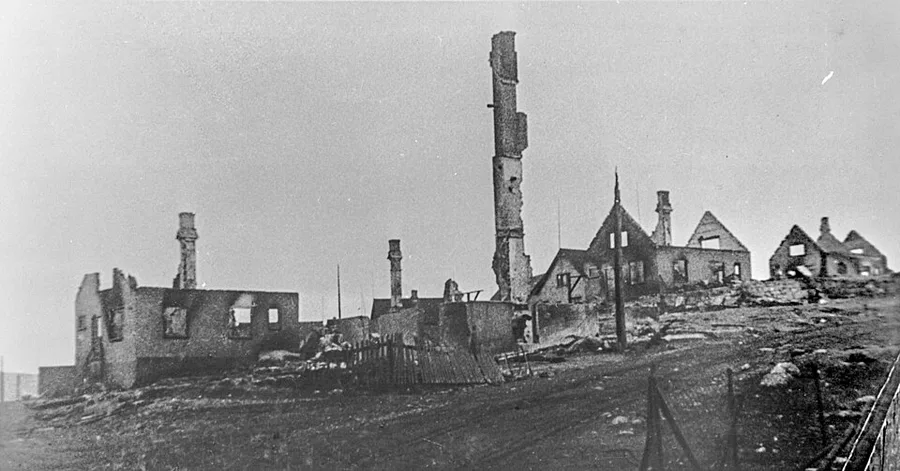 Riksarkivet (National Archives of Norway), Ruiner i Kirkenes, from the album "Evakueringen og frigjøringen av Finnmark" (1944–45) Kirkenes was one of the Finnmark towns the retreating German Twentieth Mountain Army burned to the ground in the 1944 scorched-earth campaign — the uniform postwar concrete architecture across the county traces directly back to devastation like this. Northernmost and easternmost county of Norway, on the
Barents Sea coast. About 48,000 square kilometres — the
largest Norwegian county by area, the smallest by
population at about 75,000. The traditional Sami
heartland — and the scene of Norway's fiercest witch
trials: 91 people were executed for sorcery between 1601
and 1692, centred on Vardø and Vadsø, most of them
Norwegian women, about eighteen of them Sámi. In the
autumn of 1944 the retreating German Twentieth Mountain
Army burned villages, fishing harbours, and farms across
Finnmark and northern Troms to deny the advancing Soviet
army shelter; roughly fifty thousand people were forcibly
evacuated south. The uniform concrete-and-prefab
architecture of the rebuilt towns is the visible trace of
that destruction.
Also discussed in Samene — the other people of Norway and northern Troms, burning villages, fishing harbors, and farms to deny the advancing Soviet army any usable shelter. Roughly fifty thousand Norwegians from the burned districts are forcibly evacuated south. Most of Finnmark is rebuilt after the war from concrete-and-prefabricated materials, which is why the architecture of the far north today looks more uniform and more post-1945 than the architecture of southern and central Norway.
Riksarkivet (National Archives of Norway), Ruiner i Kirkenes, from the album "Evakueringen og frigjøringen av Finnmark" (1944–45) Kirkenes was one of the Finnmark towns the retreating German Twentieth Mountain Army burned to the ground in the 1944 scorched-earth campaign — the uniform postwar concrete architecture across the county traces directly back to devastation like this. Northernmost and easternmost county of Norway, on the
Barents Sea coast. About 48,000 square kilometres — the
largest Norwegian county by area, the smallest by
population at about 75,000. The traditional Sami
heartland — and the scene of Norway's fiercest witch
trials: 91 people were executed for sorcery between 1601
and 1692, centred on Vardø and Vadsø, most of them
Norwegian women, about eighteen of them Sámi. In the
autumn of 1944 the retreating German Twentieth Mountain
Army burned villages, fishing harbours, and farms across
Finnmark and northern Troms to deny the advancing Soviet
army shelter; roughly fifty thousand people were forcibly
evacuated south. The uniform concrete-and-prefab
architecture of the rebuilt towns is the visible trace of
that destruction.
Also discussed in Samene — the other people of Norway and northern Troms, burning villages, fishing harbors, and farms to deny the advancing Soviet army any usable shelter. Roughly fifty thousand Norwegians from the burned districts are forcibly evacuated south. Most of Finnmark is rebuilt after the war from concrete-and-prefabricated materials, which is why the architecture of the far north today looks more uniform and more post-1945 than the architecture of southern and central Norway.
Liberation
Liberation comes peacefully on the eighth of May 1945. The German forces in Norway capitulate to the Allied military mission on the orders of Admiral Karl Dönitz 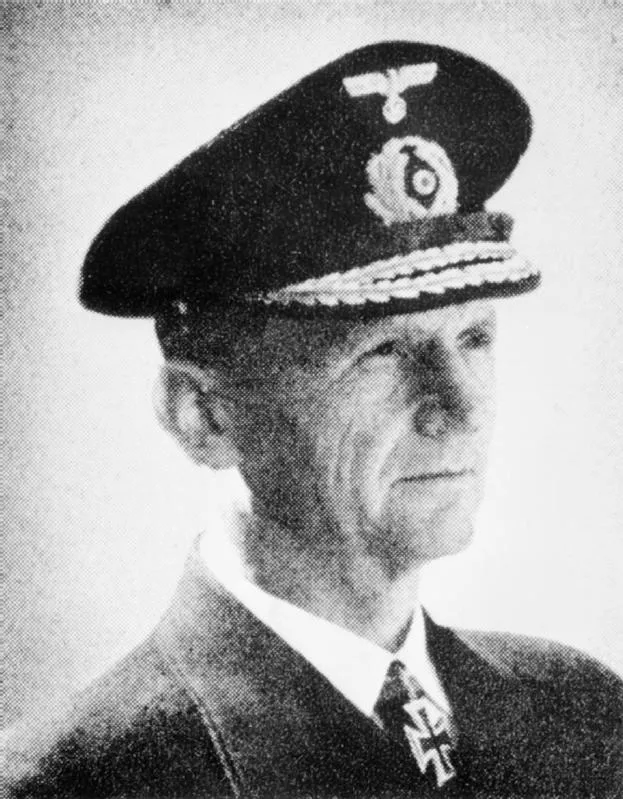 Royal Navy official photographer, Grossadmiral Karl Doenitz portrait, Imperial War Museums (A 14899) Karl Dönitz, Commander-in-Chief of the Kriegsmarine and Hitler's named successor as head of state, whose surrender order on 8 May 1945 brought the German capitulation in Norway that ended the five-year occupation. German naval officer (1891–1980); commander of the German
U-boat fleet 1939–1943 and Commander-in-Chief of the
Kriegsmarine from January 1943. Named by Hitler in his
political testament as Hitler's successor as President of
Germany. On Hitler's suicide on 30 April 1945, Dönitz
assumed the office and, from his headquarters at
Flensburg-Mürwik, ordered the conditional then
unconditional surrender of the German armed forces in early
May. The German forces in Norway capitulated to the Allied
military mission on his orders on 8 May 1945, ending the
five-year occupation. Tried at Nuremberg for crimes against
peace and war crimes; sentenced to ten years; released in
1956. The last person to formally hold the position of head
of the German state of the Nazi period.
, the German naval commander who has taken over the German state after Hitler’s suicide. Reichskommissar Josef Terboven, refusing to surrender, blows himself up with dynamite in a bunker at Skaugum on the same day. The Norwegian resistance, in conjunction with British and American officers, takes physical possession of the major German installations across the country over the following days without significant violence. Crown Prince Olav V
Royal Navy official photographer, Grossadmiral Karl Doenitz portrait, Imperial War Museums (A 14899) Karl Dönitz, Commander-in-Chief of the Kriegsmarine and Hitler's named successor as head of state, whose surrender order on 8 May 1945 brought the German capitulation in Norway that ended the five-year occupation. German naval officer (1891–1980); commander of the German
U-boat fleet 1939–1943 and Commander-in-Chief of the
Kriegsmarine from January 1943. Named by Hitler in his
political testament as Hitler's successor as President of
Germany. On Hitler's suicide on 30 April 1945, Dönitz
assumed the office and, from his headquarters at
Flensburg-Mürwik, ordered the conditional then
unconditional surrender of the German armed forces in early
May. The German forces in Norway capitulated to the Allied
military mission on his orders on 8 May 1945, ending the
five-year occupation. Tried at Nuremberg for crimes against
peace and war crimes; sentenced to ten years; released in
1956. The last person to formally hold the position of head
of the German state of the Nazi period.
, the German naval commander who has taken over the German state after Hitler’s suicide. Reichskommissar Josef Terboven, refusing to surrender, blows himself up with dynamite in a bunker at Skaugum on the same day. The Norwegian resistance, in conjunction with British and American officers, takes physical possession of the major German installations across the country over the following days without significant violence. Crown Prince Olav V 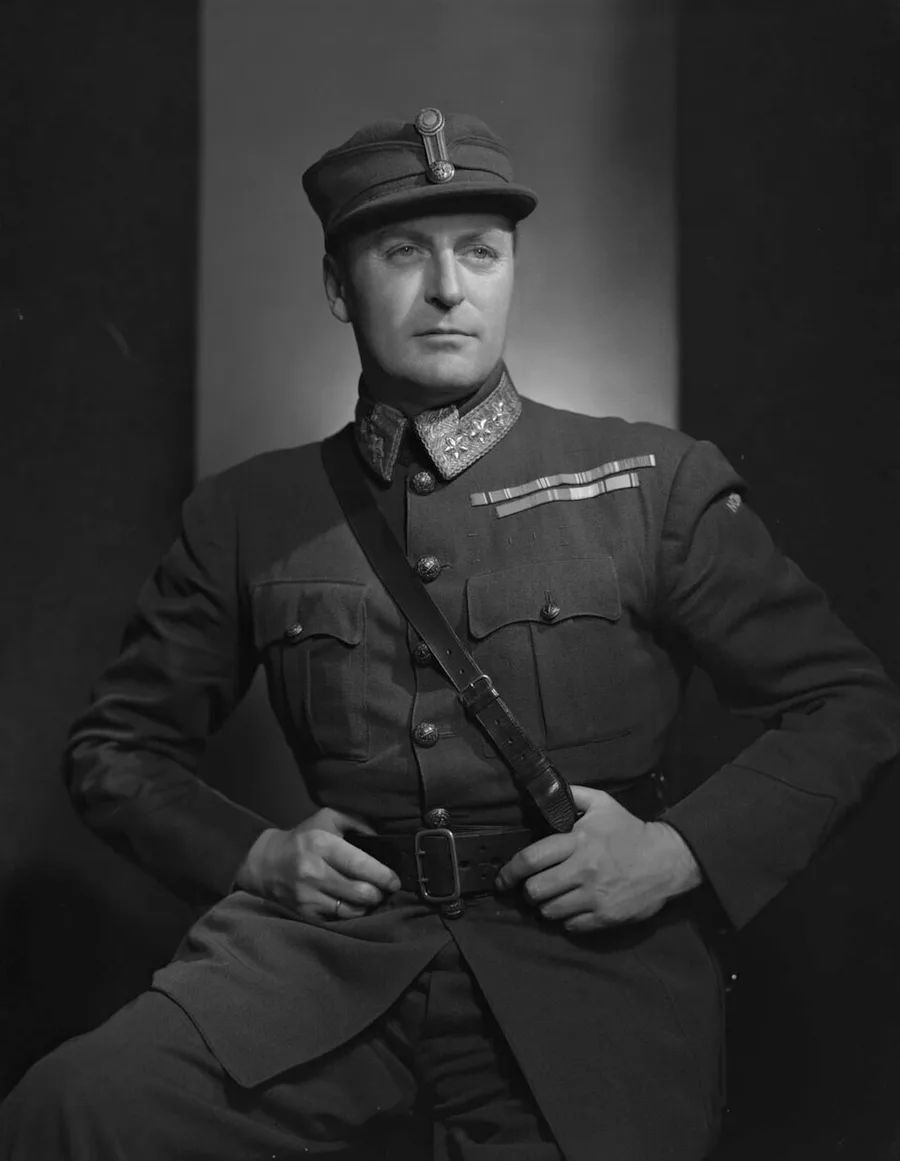 Yousuf Karsh, H.R.H. Crown Prince Olav of Norway (c. 1943), Library and Archives Canada Karsh's wartime London portrait of Crown Prince Olav in field uniform — the Sandringham-born infant of 1905, renamed for the saint-king, grown into the public face of the Norwegian resistance beside his father; from 1957 the *Folkekongen*, the People's King. King of Norway 1957–1991. Born Prince Alexander Edward Christian
Frederik in Sandringham, England, in 1903 to the future Haakon VII
and his British wife Princess Maud; renamed Olav on the family's
arrival in Norway in 1905, after the medieval patron saint of the
country. Crown Prince through the German occupation, during which
he served alongside his father as the public face of Norwegian
resistance from London. Acceded in 1957 on his father's death;
consecrated at Nidaros Cathedral in 1958 rather than crowned (the
coronation requirement had been removed in 1908). Bynamed
Folkekongen — the People's King — for his unaffected
approachability across thirty-four years on the throne.
Also discussed in The King Who Became a Saint — how the Nordmen came to Christ800,000 Norwegians Leave — the century that built a Second NorwayThe Quiet Revolution — how Norway won its independence without a war returns to Oslo on the thirteenth of May 1945 to organize the immediate transition, and King Haakon VII returns on the seventh of June 1945. He is met at the harbor at Oslo by a crowd of hundreds of thousands of Norwegians, an enormous fraction of the country’s population. The Storting reconvenes for the first time in five years on the fourteenth of June. The constitutional government resumes operation under the same constitution that had been in force on the eighth of April 1940.
Yousuf Karsh, H.R.H. Crown Prince Olav of Norway (c. 1943), Library and Archives Canada Karsh's wartime London portrait of Crown Prince Olav in field uniform — the Sandringham-born infant of 1905, renamed for the saint-king, grown into the public face of the Norwegian resistance beside his father; from 1957 the *Folkekongen*, the People's King. King of Norway 1957–1991. Born Prince Alexander Edward Christian
Frederik in Sandringham, England, in 1903 to the future Haakon VII
and his British wife Princess Maud; renamed Olav on the family's
arrival in Norway in 1905, after the medieval patron saint of the
country. Crown Prince through the German occupation, during which
he served alongside his father as the public face of Norwegian
resistance from London. Acceded in 1957 on his father's death;
consecrated at Nidaros Cathedral in 1958 rather than crowned (the
coronation requirement had been removed in 1908). Bynamed
Folkekongen — the People's King — for his unaffected
approachability across thirty-four years on the throne.
Also discussed in The King Who Became a Saint — how the Nordmen came to Christ800,000 Norwegians Leave — the century that built a Second NorwayThe Quiet Revolution — how Norway won its independence without a war returns to Oslo on the thirteenth of May 1945 to organize the immediate transition, and King Haakon VII returns on the seventh of June 1945. He is met at the harbor at Oslo by a crowd of hundreds of thousands of Norwegians, an enormous fraction of the country’s population. The Storting reconvenes for the first time in five years on the fourteenth of June. The constitutional government resumes operation under the same constitution that had been in force on the eighth of April 1940.
The purge
The postwar legal purge — the Landssvikoppgjøret 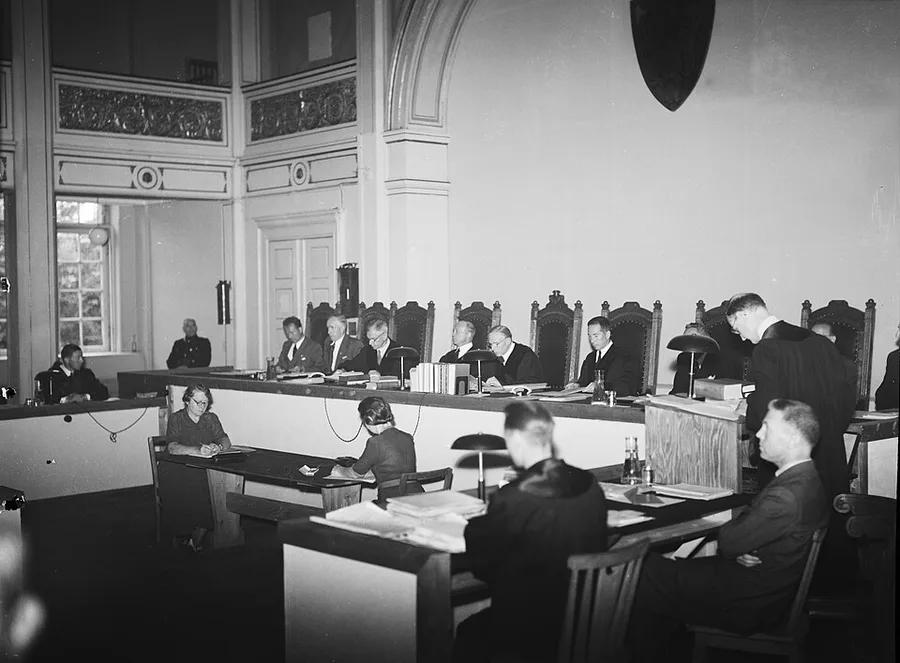 Henriksen & Steen, the Quisling trial, Eidsivating Court of Appeal, Oslo (20 Aug–10 Sep 1945), National Library of Norway The courtroom at Eidsivating Court of Appeal in Oslo during the trial of Vidkun Quisling, 20 August-10 September 1945. His was the most prominent of roughly 90,000 collaboration cases the landssvikoppgjoret prosecuted; he was sentenced to death here and executed six weeks later. The treason settlement — the Norwegian postwar legal
purge of wartime collaborators, 1945–1948. Approximately
ninety thousand Norwegians were prosecuted for
collaboration in the year and a half after the liberation,
about half of them under the catch-all charge of Nasjonal
Samling party membership. Roughly forty-six thousand were
convicted. Forty people were executed — thirty-seven
under Norwegian law, three more under Allied military
jurisdiction. The most prominent was Vidkun Quisling
himself, sentenced to death for treason, murder, and
theft on 10 September 1945 and executed by firing squad
at Akershus fortress on 24 October 1945. The
landssvikoppgjøret was one of the most extensive
postwar judicial reckonings in occupied Western Europe;
per capita it was the largest in Europe.
— is rapid and substantial. Approximately ninety thousand Norwegians are prosecuted for collaboration in the year and a half after the liberation. Roughly forty-six thousand are convicted. Forty people are executed in all — thirty-seven under Norwegian law, three more under Allied military jurisdiction. The most prominent is Vidkun Quisling himself, who is sentenced to death for treason, murder, and theft on the tenth of September 1945, and executed by firing squad at Akershus fortress on the twenty-fourth of October 1945, the same fortress used during the occupation to execute Norwegian resistance members. The Quisling name enters English as a common noun for a traitorous collaborator. The Norwegian word quisling has the same meaning in modern Norwegian and is used in ordinary speech. The wartime executions at Akershus are commemorated by simple plaques in the courtyard. The reckoning has limits, however. Knut Rød, the Statspolitiet officer who had commanded the November 1942 round-up of Jewish women and children in Oslo and Aker, is tried twice for war crimes — in 1946 and again on appeal in 1948 — and acquitted both times on the court’s reasoning that his role in the deportations had been necessary cover for clandestine resistance work. He returns to the Oslo police and serves on the force until his retirement.
Henriksen & Steen, the Quisling trial, Eidsivating Court of Appeal, Oslo (20 Aug–10 Sep 1945), National Library of Norway The courtroom at Eidsivating Court of Appeal in Oslo during the trial of Vidkun Quisling, 20 August-10 September 1945. His was the most prominent of roughly 90,000 collaboration cases the landssvikoppgjoret prosecuted; he was sentenced to death here and executed six weeks later. The treason settlement — the Norwegian postwar legal
purge of wartime collaborators, 1945–1948. Approximately
ninety thousand Norwegians were prosecuted for
collaboration in the year and a half after the liberation,
about half of them under the catch-all charge of Nasjonal
Samling party membership. Roughly forty-six thousand were
convicted. Forty people were executed — thirty-seven
under Norwegian law, three more under Allied military
jurisdiction. The most prominent was Vidkun Quisling
himself, sentenced to death for treason, murder, and
theft on 10 September 1945 and executed by firing squad
at Akershus fortress on 24 October 1945. The
landssvikoppgjøret was one of the most extensive
postwar judicial reckonings in occupied Western Europe;
per capita it was the largest in Europe.
— is rapid and substantial. Approximately ninety thousand Norwegians are prosecuted for collaboration in the year and a half after the liberation. Roughly forty-six thousand are convicted. Forty people are executed in all — thirty-seven under Norwegian law, three more under Allied military jurisdiction. The most prominent is Vidkun Quisling himself, who is sentenced to death for treason, murder, and theft on the tenth of September 1945, and executed by firing squad at Akershus fortress on the twenty-fourth of October 1945, the same fortress used during the occupation to execute Norwegian resistance members. The Quisling name enters English as a common noun for a traitorous collaborator. The Norwegian word quisling has the same meaning in modern Norwegian and is used in ordinary speech. The wartime executions at Akershus are commemorated by simple plaques in the courtyard. The reckoning has limits, however. Knut Rød, the Statspolitiet officer who had commanded the November 1942 round-up of Jewish women and children in Oslo and Aker, is tried twice for war crimes — in 1946 and again on appeal in 1948 — and acquitted both times on the court’s reasoning that his role in the deportations had been necessary cover for clandestine resistance work. He returns to the Oslo police and serves on the force until his retirement.
What the war made
The occupation defines a generation of Norwegian political experience. The country’s postwar foreign policy is built explicitly on the conviction that Norwegian neutrality of the 1930s had failed and that Norway must be embedded in a Western collective-security structure. Norway becomes a founding signatory of NATO in April 1949 and one of the alliance’s most reliable members through the entire Cold War. The country’s wartime experience of the German Holocaust contributes to one of the strongest postwar Norwegian commitments to refugee resettlement and to the international human-rights regime. Norwegian neutrality of the inter-war period is, after 1945, a closed chapter, and the new Norwegian foreign policy commits the country to its Western alliance permanently. Above Oslo at Holmenkollen, the Oslo Day 1 opens at Roseslottet — the open-air exhibition about the king's refusal this article turns on. Go to page → open-air exhibition, opened in 2020 on the eightieth anniversary of the German invasion, presents the constitutional foundations of the wartime resistance: the story of how a small country, occupied by overwhelming military force, kept its constitutional government in exile, kept its national integrity through institutional resistance, contributed materially to the Allied victory through sabotage and merchant marine service, suffered grievously through the occupation, and emerged with its constitution intact.
The seventh of June, 1945
Haakon VII returns to Oslo harbor on the seventh of June 1945, five years to the day after he has left. He is seventy-two years old. He has been king since 1905. The country he returns to is substantially the same country he has left.