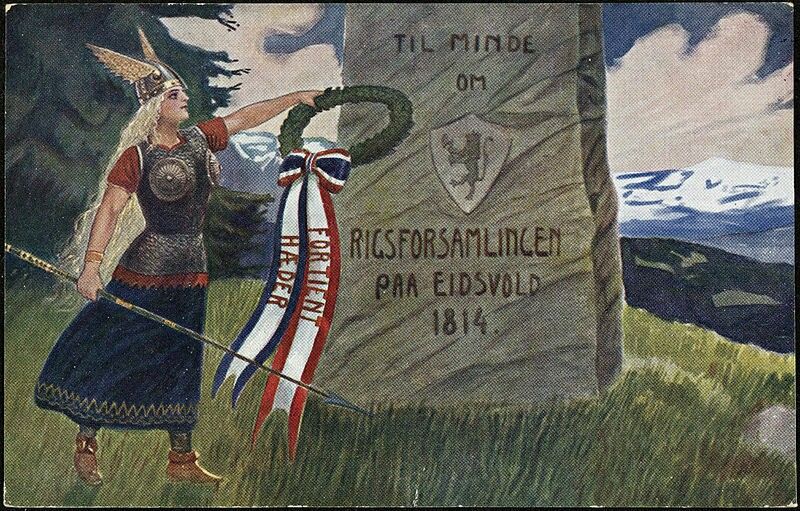
The Constitution That Saved a Nation — Five radical weeks at Eidsvoll, 1814
At Eidsvoll on the seventeenth of May 1814, one hundred and twelve men sign a constitution more radical than any other then in operation in Europe. They lose the war that summer to Sweden. The document survives anyway.
On the tenth of April 1814 one hundred and twelve men, elected by parish congregations and military regiments across Norway over the previous six weeks, arrive at the country estate of the Eidsvoll 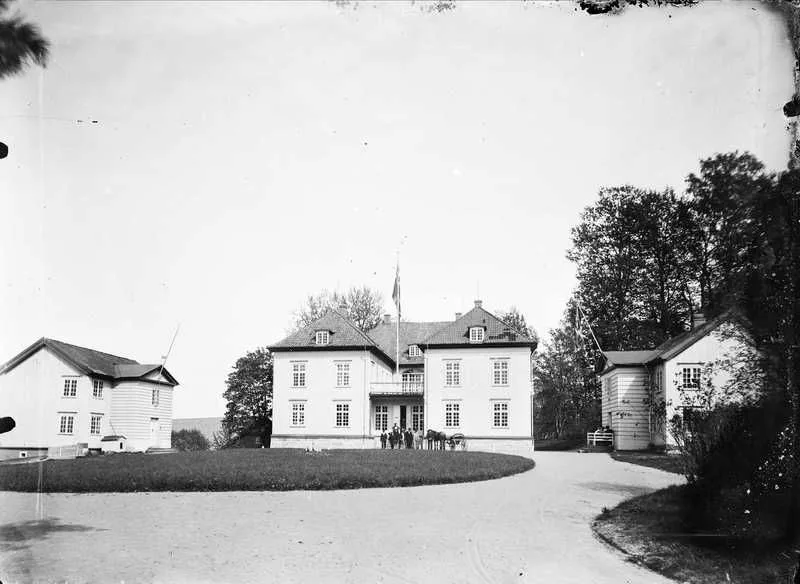 Unknown photographer, Eidsvollsbygningen (c. 1890), Oslo Museum, CC BY-SA 4.0 The white manor house at Eidsvoll where 112 delegates drafted and signed Norway's Constitution in 1814 — the building the whole constitutional story turns on. Municipality in Akershus county in southeastern Norway,
about seventy kilometres north of Oslo. Site of the
constitutional assembly that drafted and ratified the
Norwegian Constitution between 10 April and 20 May 1814.
The 112 delegates met at Eidsvollsbygningen, the country
house of the wealthy merchant and ironworks owner Carsten
Anker, who had offered the use of his estate at his own
expense. They signed the Constitution on 17 May 1814 —
Syttende mai, Norway's national day ever since — and
elected Prince Christian Frederik as king the same day.
The house is preserved as a national museum. Modern
Eidsvoll is also a stop on the main railway line north
from Oslo and the site of the country's principal
international airport (Oslo Gardermoen) ten kilometres south.
Also discussed in The 400-Year Night — when the Northern Lion lay dormantLutheran Norway and Pietism — a farmer named Hans Nielsen Hauge and a lay revival that could not be silencedThe Quiet Revolution — how Norway won its independence without a warTradisjoner — celebrations across the Norwegian yearPolitikk — the left, the right, and the Norwegian way north of Christiania
Unknown photographer, Eidsvollsbygningen (c. 1890), Oslo Museum, CC BY-SA 4.0 The white manor house at Eidsvoll where 112 delegates drafted and signed Norway's Constitution in 1814 — the building the whole constitutional story turns on. Municipality in Akershus county in southeastern Norway,
about seventy kilometres north of Oslo. Site of the
constitutional assembly that drafted and ratified the
Norwegian Constitution between 10 April and 20 May 1814.
The 112 delegates met at Eidsvollsbygningen, the country
house of the wealthy merchant and ironworks owner Carsten
Anker, who had offered the use of his estate at his own
expense. They signed the Constitution on 17 May 1814 —
Syttende mai, Norway's national day ever since — and
elected Prince Christian Frederik as king the same day.
The house is preserved as a national museum. Modern
Eidsvoll is also a stop on the main railway line north
from Oslo and the site of the country's principal
international airport (Oslo Gardermoen) ten kilometres south.
Also discussed in The 400-Year Night — when the Northern Lion lay dormantLutheran Norway and Pietism — a farmer named Hans Nielsen Hauge and a lay revival that could not be silencedThe Quiet Revolution — how Norway won its independence without a warTradisjoner — celebrations across the Norwegian yearPolitikk — the left, the right, and the Norwegian way north of Christiania 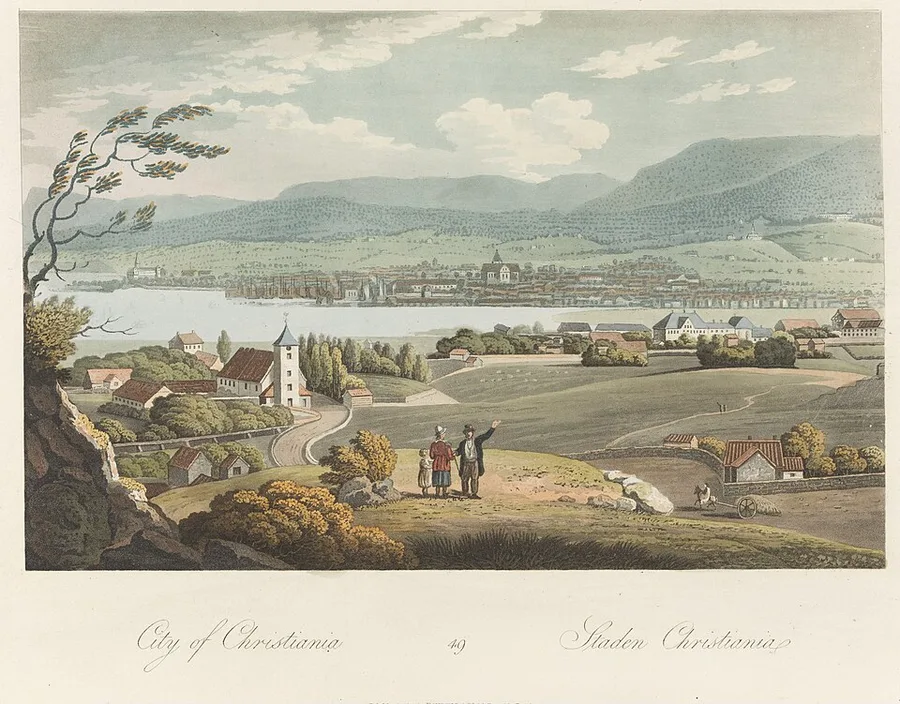 John William Edy, City of Christiania (1814), Boydell's Picturesque Scenery of Norway — National Museum of Art, Architecture and Design John William Edy's 1814 view of the small grid-planned capital across the water. This is the town King Christian IV laid out beneath Akershus after the 1624 fire razed medieval Oslo, and named for himself; its Kvadraturen grid survives today. Capital of Norway from 1624 to 1925 — the rebuilt town that
King Christian IV laid out west of the medieval Oslo after
the fire of August 1624 destroyed the old city. Christian
founded the new town on a grid plan beneath Akershus
fortress, named it for himself, and ordered the surviving
Oslo burghers to move into it. Christiania was the
capital's name through the four-hundred-year night, the
brief war of 1814, the constitutional Eidsvoll moment, the
ninety-one-year personal union with Sweden, and the first
two decades of fully independent Norway after 1905. In 1877
the spelling was modernised to Kristiania; in 1925 the
city formally returned to the medieval name Oslo. The
Kvadraturen district preserves Christian IV's grid intact
today.
On the trip Days 1–2 in Oslo bring both groups through Christiania —
Christian IV's seventeenth-century planned grid, still
visible today as the Kvadraturen district just below
Akershus fortress.
Also discussed in The 400-Year Night — when the Northern Lion lay dormantLutheran Norway and Pietism — a farmer named Hans Nielsen Hauge and a lay revival that could not be silenced800,000 Norwegians Leave — the century that built a Second NorwayThe Quiet Revolution — how Norway won its independence without a warWorld War II — the King’s “No” and the Nazis in NorwayNorske eventyr — the folk tales almost lost foreverStedssagn — local legends, told as warningsUtburd — the unbaptized child that will not rest and convene as the Eidsvoll Constituent Assembly
John William Edy, City of Christiania (1814), Boydell's Picturesque Scenery of Norway — National Museum of Art, Architecture and Design John William Edy's 1814 view of the small grid-planned capital across the water. This is the town King Christian IV laid out beneath Akershus after the 1624 fire razed medieval Oslo, and named for himself; its Kvadraturen grid survives today. Capital of Norway from 1624 to 1925 — the rebuilt town that
King Christian IV laid out west of the medieval Oslo after
the fire of August 1624 destroyed the old city. Christian
founded the new town on a grid plan beneath Akershus
fortress, named it for himself, and ordered the surviving
Oslo burghers to move into it. Christiania was the
capital's name through the four-hundred-year night, the
brief war of 1814, the constitutional Eidsvoll moment, the
ninety-one-year personal union with Sweden, and the first
two decades of fully independent Norway after 1905. In 1877
the spelling was modernised to Kristiania; in 1925 the
city formally returned to the medieval name Oslo. The
Kvadraturen district preserves Christian IV's grid intact
today.
On the trip Days 1–2 in Oslo bring both groups through Christiania —
Christian IV's seventeenth-century planned grid, still
visible today as the Kvadraturen district just below
Akershus fortress.
Also discussed in The 400-Year Night — when the Northern Lion lay dormantLutheran Norway and Pietism — a farmer named Hans Nielsen Hauge and a lay revival that could not be silenced800,000 Norwegians Leave — the century that built a Second NorwayThe Quiet Revolution — how Norway won its independence without a warWorld War II — the King’s “No” and the Nazis in NorwayNorske eventyr — the folk tales almost lost foreverStedssagn — local legends, told as warningsUtburd — the unbaptized child that will not rest and convene as the Eidsvoll Constituent Assembly 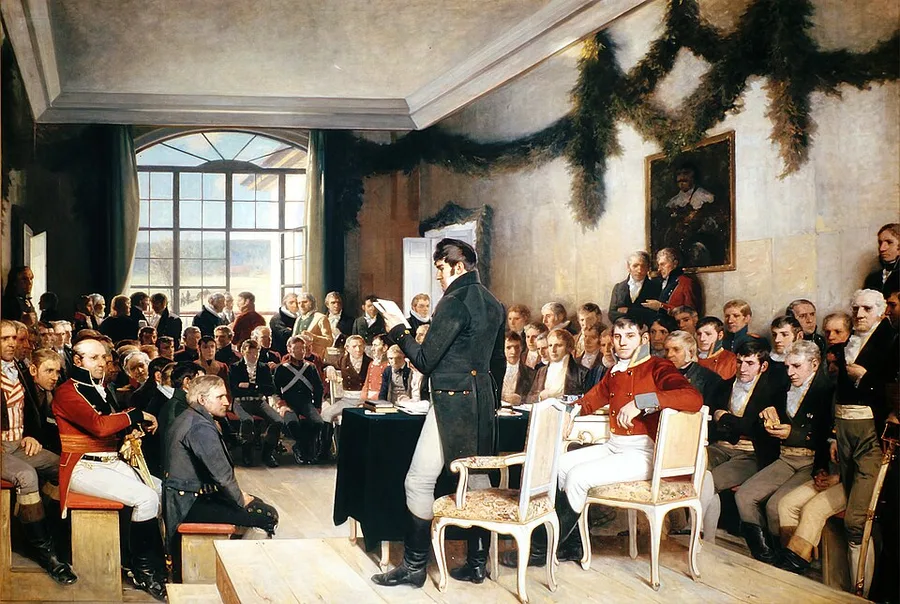 Oscar Wergeland, Eidsvold 1814 (1885), Archives of the Storting Wergeland's 1885 canvas restages the Assembly's final working day, 11 May 1814, when the delegates debated and adopted the constitution's last paragraph — the scene the Storting itself chose to hang behind its own speaker's podium. Riksforsamlingen — the Norwegian Constituent Assembly of
spring 1814. One hundred and twelve men, elected by parish
congregations and military regiments across Norway over a
six-week period in February and March 1814 on Christian
Frederik's call, convened at the Eidsvoll country estate
of the merchant Carsten Anker on 10 April 1814 and worked
for five weeks drafting and debating the constitutional
document. The Constitution was settled in final form on 16
May 1814 and dated and signed on 17 May, the day the
Assembly unanimously elected Christian Frederik king. The 112 signatures are preserved on the original
document, which is held in the National Archives of Norway
in Oslo. The Assembly's working table and chamber are
preserved at Eidsvollsbygningen as a national museum.
Also discussed in The Quiet Revolution — how Norway won its independence without a war . They have approximately five weeks to write a constitution before the surrounding political situation forecloses on them. The country is in formal crisis. Three months earlier, on the fourteenth of January, the Danish king Frederik VI of Denmark-Norway
Oscar Wergeland, Eidsvold 1814 (1885), Archives of the Storting Wergeland's 1885 canvas restages the Assembly's final working day, 11 May 1814, when the delegates debated and adopted the constitution's last paragraph — the scene the Storting itself chose to hang behind its own speaker's podium. Riksforsamlingen — the Norwegian Constituent Assembly of
spring 1814. One hundred and twelve men, elected by parish
congregations and military regiments across Norway over a
six-week period in February and March 1814 on Christian
Frederik's call, convened at the Eidsvoll country estate
of the merchant Carsten Anker on 10 April 1814 and worked
for five weeks drafting and debating the constitutional
document. The Constitution was settled in final form on 16
May 1814 and dated and signed on 17 May, the day the
Assembly unanimously elected Christian Frederik king. The 112 signatures are preserved on the original
document, which is held in the National Archives of Norway
in Oslo. The Assembly's working table and chamber are
preserved at Eidsvollsbygningen as a national museum.
Also discussed in The Quiet Revolution — how Norway won its independence without a war . They have approximately five weeks to write a constitution before the surrounding political situation forecloses on them. The country is in formal crisis. Three months earlier, on the fourteenth of January, the Danish king Frederik VI of Denmark-Norway 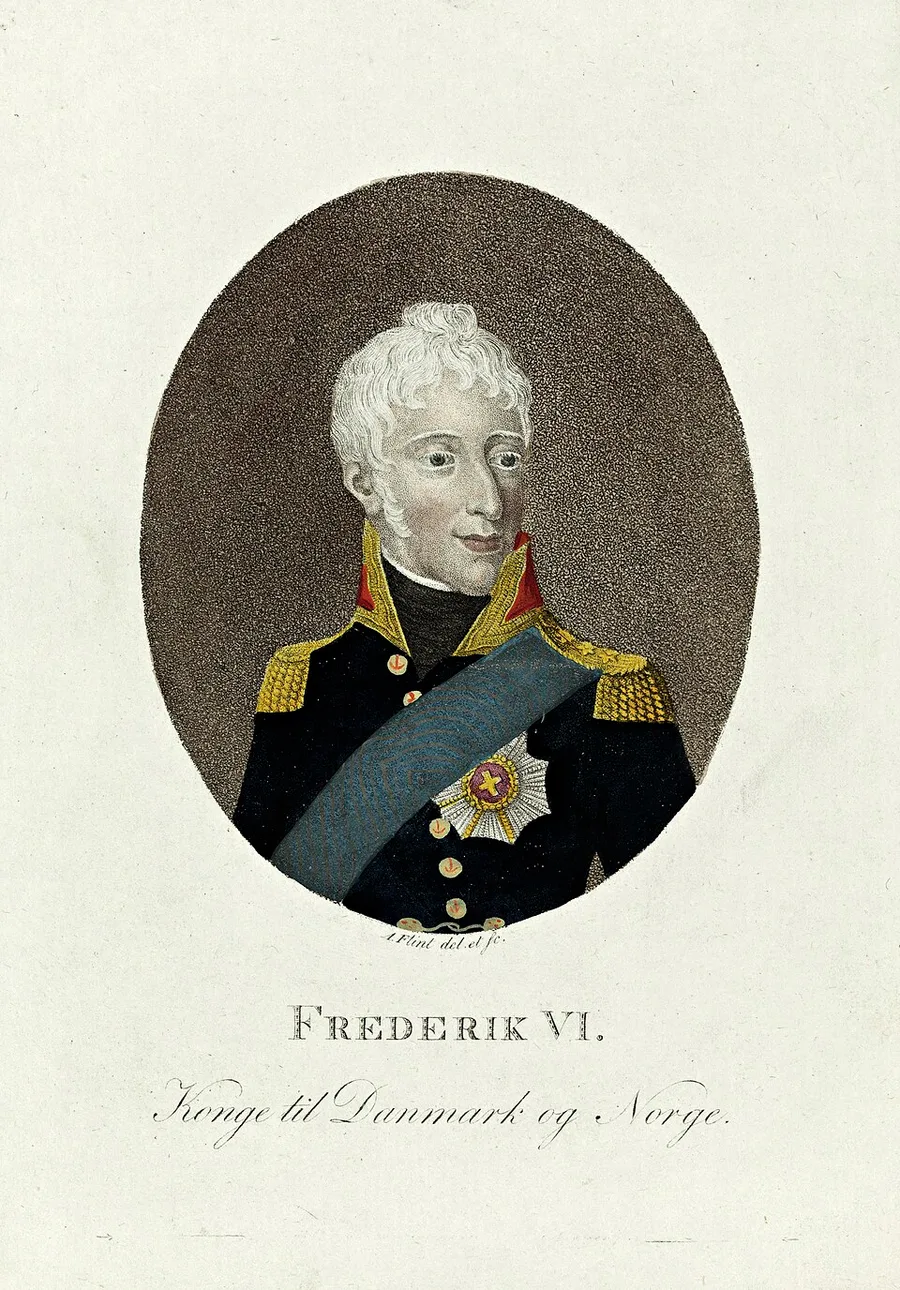 Andreas Flint, Frederik VI Konge til Danmark og Norge, National Library of Norway Frederik VI ruled Denmark-Norway through the Napoleonic Wars and signed away Norway to Sweden in the 1814 Treaty of Kiel — the engraving's caption still styles him 'Konge til Danmark og Norge,' the double title Kiel ended. King of Denmark and Norway (1768–1839), reigned 1808–1839
in Denmark; nominally co-ruler of Norway until the Treaty
of Kiel ceded the country to Sweden in January 1814. As
Crown Prince Regent from 1784 — his father Christian VII
being mentally incapable — he had run the kingdom in
practice for a quarter-century before formally inheriting
the throne. Sided with Napoleon after the British attacks
on Copenhagen of 1801 and 1807 stripped Denmark of its
fleet, a fateful alliance that cost him Norway when
Napoleon's defeat in 1814 forced the cession. Signed the
Treaty of Kiel on 14 January 1814. Reigned over a much-
reduced Denmark for another twenty-five years.
Also discussed in The 400-Year Night — when the Northern Lion lay dormant had signed the Kielfreden
Andreas Flint, Frederik VI Konge til Danmark og Norge, National Library of Norway Frederik VI ruled Denmark-Norway through the Napoleonic Wars and signed away Norway to Sweden in the 1814 Treaty of Kiel — the engraving's caption still styles him 'Konge til Danmark og Norge,' the double title Kiel ended. King of Denmark and Norway (1768–1839), reigned 1808–1839
in Denmark; nominally co-ruler of Norway until the Treaty
of Kiel ceded the country to Sweden in January 1814. As
Crown Prince Regent from 1784 — his father Christian VII
being mentally incapable — he had run the kingdom in
practice for a quarter-century before formally inheriting
the throne. Sided with Napoleon after the British attacks
on Copenhagen of 1801 and 1807 stripped Denmark of its
fleet, a fateful alliance that cost him Norway when
Napoleon's defeat in 1814 forced the cession. Signed the
Treaty of Kiel on 14 January 1814. Reigned over a much-
reduced Denmark for another twenty-five years.
Also discussed in The 400-Year Night — when the Northern Lion lay dormant had signed the Kielfreden 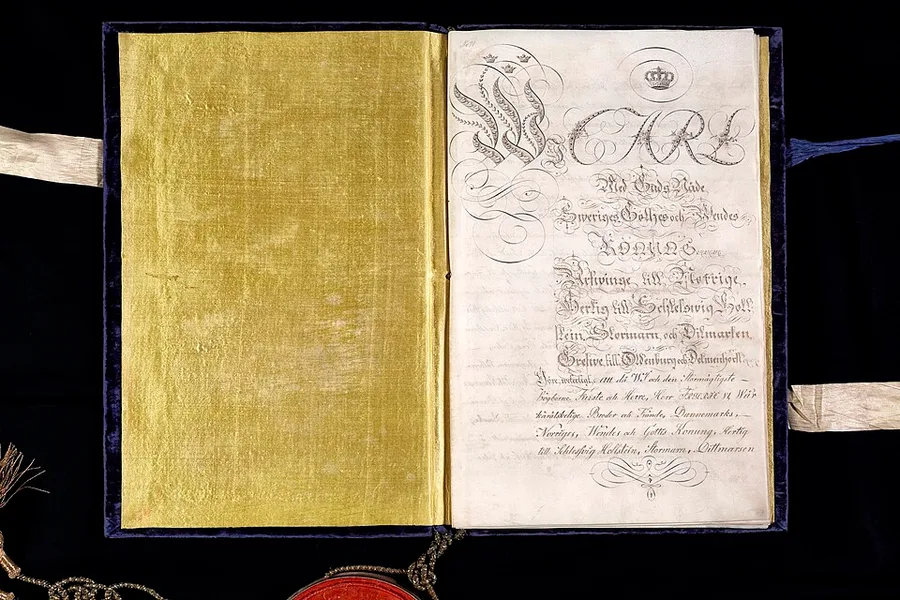 Photo: Tom Jersø, Kielertraktaten (1814), Rigsarkivet (Danish National Archives), CC BY-SA 2.0 This is the actual 14 January 1814 treaty document by which Frederik VI ceded the kingdom of Norway to the Swedish crown — the paper that closed four hundred and thirty-four years of Danish rule in a single stroke. The Peace of Kiel — the treaty signed on 14 January 1814
by which King Frederik VI of Denmark-Norway, his alliance
with Napoleon collapsed and a Swedish army advancing
through Holstein, ceded the Kingdom of Norway to the King
of Sweden in exchange for the remnants of Swedish
Pomerania. The cession excluded the old North Atlantic
dependencies — Greenland, Iceland, and the Faroes —
which remained Danish. The treaty closed the four-hundred-
and-thirty-four-year Danish period in Norwegian history.
Repudiated by the Norwegians within weeks: a constituent
assembly met at Eidsvoll the following April and signed an
independent constitution on 17 May 1814.
Also discussed in The 400-Year Night — when the Northern Lion lay dormant under British and Swedish pressure, ceding Norway to the Swedish crown in compensation for the Swedish loss of Finland to Russia. The Norwegian regent, Christian Frederik
Photo: Tom Jersø, Kielertraktaten (1814), Rigsarkivet (Danish National Archives), CC BY-SA 2.0 This is the actual 14 January 1814 treaty document by which Frederik VI ceded the kingdom of Norway to the Swedish crown — the paper that closed four hundred and thirty-four years of Danish rule in a single stroke. The Peace of Kiel — the treaty signed on 14 January 1814
by which King Frederik VI of Denmark-Norway, his alliance
with Napoleon collapsed and a Swedish army advancing
through Holstein, ceded the Kingdom of Norway to the King
of Sweden in exchange for the remnants of Swedish
Pomerania. The cession excluded the old North Atlantic
dependencies — Greenland, Iceland, and the Faroes —
which remained Danish. The treaty closed the four-hundred-
and-thirty-four-year Danish period in Norwegian history.
Repudiated by the Norwegians within weeks: a constituent
assembly met at Eidsvoll the following April and signed an
independent constitution on 17 May 1814.
Also discussed in The 400-Year Night — when the Northern Lion lay dormant under British and Swedish pressure, ceding Norway to the Swedish crown in compensation for the Swedish loss of Finland to Russia. The Norwegian regent, Christian Frederik 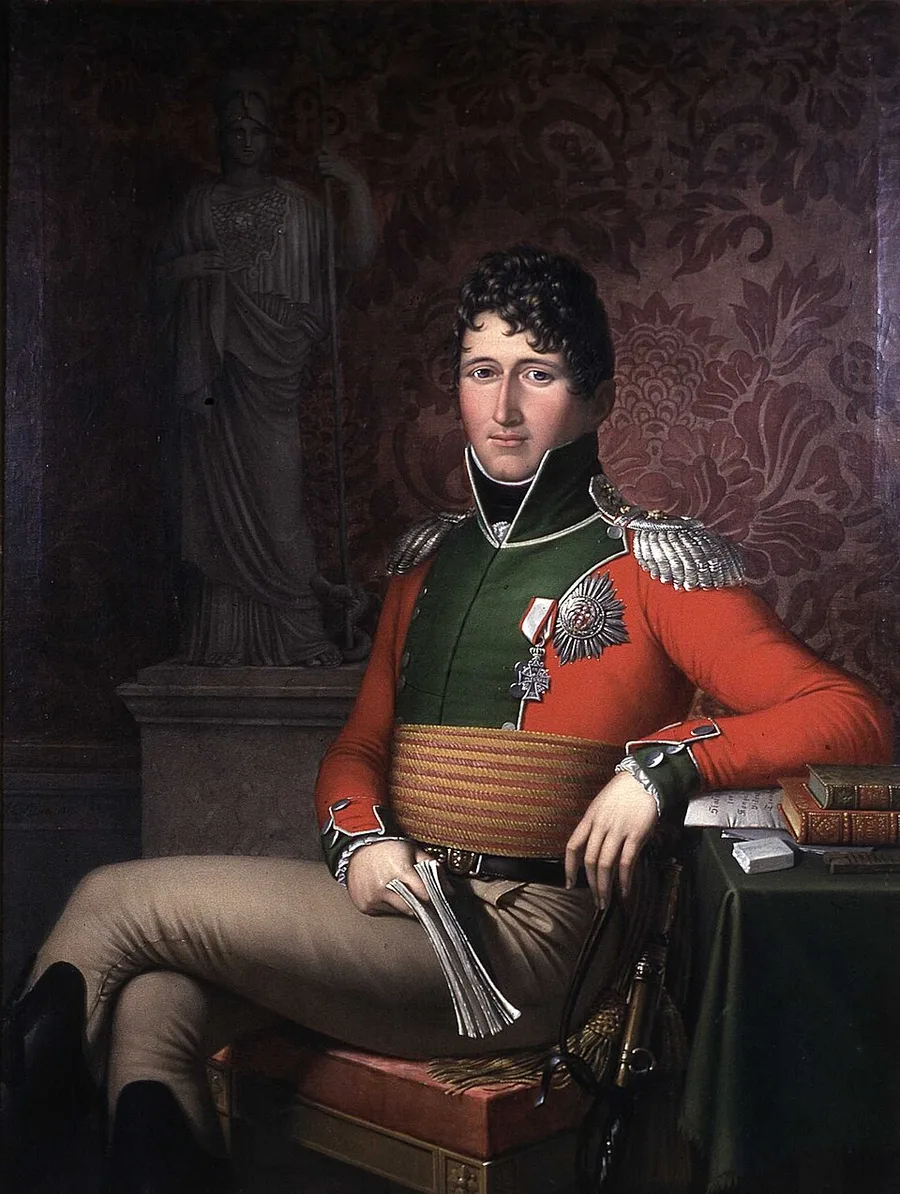 Johan Ludwig Lund, Christian Frederik (1813), Eidsvoll 1814 collection Lund painted him in 1813, papers in hand, the year before everything — the Danish heir presumptive who refused the Kiel cession on Norway's behalf, issued the call that produced Eidsvoll, was elected king on 17 May 1814, and abdicated that October under the Convention of Moss. King of Norway in 1814 and later King Christian VIII of
Denmark (1786–1848). First cousin of Frederik VI of
Denmark and heir presumptive to the Danish throne. Sent
to Norway in May 1813 as stadtholder on Frederik VI's
behalf, where he ran the country during the famine years
of the British blockade. After the Treaty of Kiel
(January 1814) ceded Norway to Sweden, he refused to
accept the cession on Norway's behalf and issued the call
that produced the Eidsvoll elections. Elected king of an
independent Norway by the Constituent Assembly on 17 May
1814; abdicated on 10 October 1814 under the Convention
of Moss terms. Returned to Denmark; succeeded Frederik VI
there as King Christian VIII on 3 December 1839, reigning
until his death in 1848.
, who is Frederick VI’s first cousin and the heir presumptive of Denmark, has refused to accept the cession on Norway’s behalf and has issued the call that produced the Eidsvoll elections. The Swedish crown prince Karl Johan
Johan Ludwig Lund, Christian Frederik (1813), Eidsvoll 1814 collection Lund painted him in 1813, papers in hand, the year before everything — the Danish heir presumptive who refused the Kiel cession on Norway's behalf, issued the call that produced Eidsvoll, was elected king on 17 May 1814, and abdicated that October under the Convention of Moss. King of Norway in 1814 and later King Christian VIII of
Denmark (1786–1848). First cousin of Frederik VI of
Denmark and heir presumptive to the Danish throne. Sent
to Norway in May 1813 as stadtholder on Frederik VI's
behalf, where he ran the country during the famine years
of the British blockade. After the Treaty of Kiel
(January 1814) ceded Norway to Sweden, he refused to
accept the cession on Norway's behalf and issued the call
that produced the Eidsvoll elections. Elected king of an
independent Norway by the Constituent Assembly on 17 May
1814; abdicated on 10 October 1814 under the Convention
of Moss terms. Returned to Denmark; succeeded Frederik VI
there as King Christian VIII on 3 December 1839, reigning
until his death in 1848.
, who is Frederick VI’s first cousin and the heir presumptive of Denmark, has refused to accept the cession on Norway’s behalf and has issued the call that produced the Eidsvoll elections. The Swedish crown prince Karl Johan 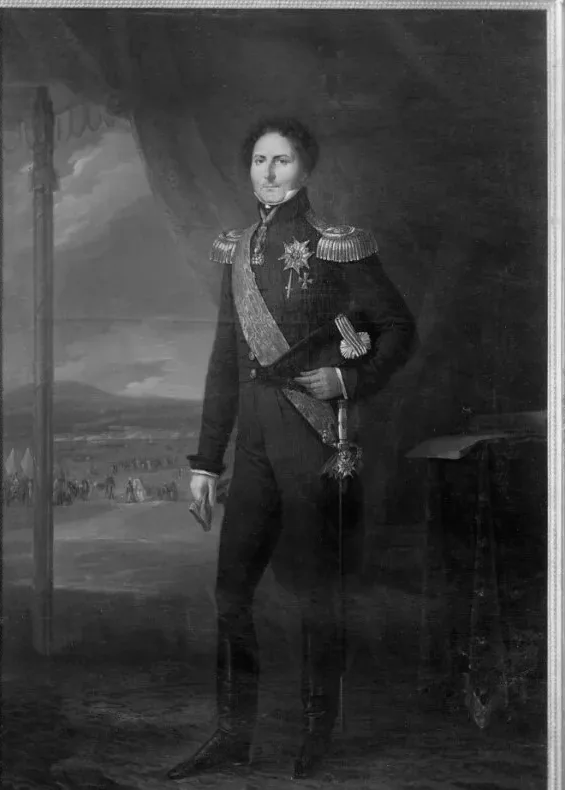 Fredric Westin, Karl XIV Johan, king of Sweden and Norway, Nationalmuseum (NMGrh 1943) Fredric Westin's state portrait of Karl XIV Johan, the former Napoleonic marshal who became king of Sweden and Norway after taking Norway from Denmark in 1814. King of Sweden and Norway (1763–1844), reigned 1818–1844.
Born Jean-Baptiste Bernadotte, the son of a French country
lawyer; rose through the French Revolutionary armies to
become one of Napoleon's marshals (1804) and Prince of
Pontecorvo (1806). Adopted in 1810 as heir to the childless
Swedish king Karl XIII, took the name Karl Johan, and ran
Swedish foreign policy as Crown Prince Regent. Joined the
Sixth Coalition against Napoleon and at the war's end
demanded Norway from Denmark as compensation. After the
brief Swedish-Norwegian war of summer 1814, accepted the
mild terms of the Convention of Moss that left Norway with
its own constitution, Storting, government, and church
under a shared crown. The Karl Johans gate boulevard in
central Oslo carries his name.
On the trip Day 2's e-bike tour rides the length of Karl Johans gate — the
central Oslo boulevard that carries his name — and passes the
Royal Palace begun as his Norwegian residence, with both groups
together in the capital.
Also discussed in The 400-Year Night — when the Northern Lion lay dormantThe Quiet Revolution — how Norway won its independence without a war , the former French marshal Jean-Baptiste Bernadotte, is preparing to enforce the treaty by arms. The British Royal Navy is blockading the Norwegian coast. The men at Eidsvoll are drafting a constitution under those circumstances.
Fredric Westin, Karl XIV Johan, king of Sweden and Norway, Nationalmuseum (NMGrh 1943) Fredric Westin's state portrait of Karl XIV Johan, the former Napoleonic marshal who became king of Sweden and Norway after taking Norway from Denmark in 1814. King of Sweden and Norway (1763–1844), reigned 1818–1844.
Born Jean-Baptiste Bernadotte, the son of a French country
lawyer; rose through the French Revolutionary armies to
become one of Napoleon's marshals (1804) and Prince of
Pontecorvo (1806). Adopted in 1810 as heir to the childless
Swedish king Karl XIII, took the name Karl Johan, and ran
Swedish foreign policy as Crown Prince Regent. Joined the
Sixth Coalition against Napoleon and at the war's end
demanded Norway from Denmark as compensation. After the
brief Swedish-Norwegian war of summer 1814, accepted the
mild terms of the Convention of Moss that left Norway with
its own constitution, Storting, government, and church
under a shared crown. The Karl Johans gate boulevard in
central Oslo carries his name.
On the trip Day 2's e-bike tour rides the length of Karl Johans gate — the
central Oslo boulevard that carries his name — and passes the
Royal Palace begun as his Norwegian residence, with both groups
together in the capital.
Also discussed in The 400-Year Night — when the Northern Lion lay dormantThe Quiet Revolution — how Norway won its independence without a war , the former French marshal Jean-Baptiste Bernadotte, is preparing to enforce the treaty by arms. The British Royal Navy is blockading the Norwegian coast. The men at Eidsvoll are drafting a constitution under those circumstances.
The document
They produce, in five weeks, a document that is among the most democratic constitutions in operation anywhere in Europe in 1814, drawing on the United States Constitution 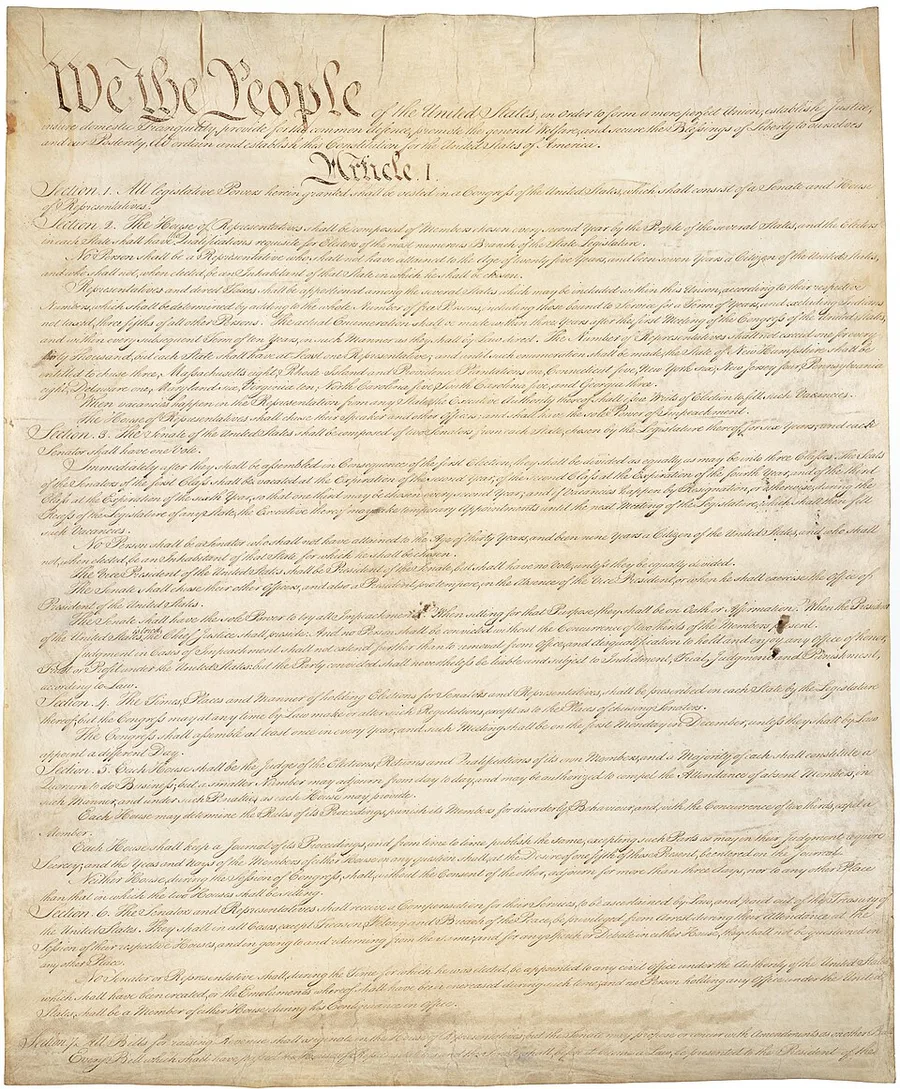 Constitutional Convention (1787), Constitution of the United States, page 1, US National Archives The actual parchment page the Philadelphia Convention signed in 1787 — the framework of separated powers and popular sovereignty the Eidsvoll delegates studied directly when drafting Norway's own constitution in 1814. The constitutional document of the United States, drafted
by the Philadelphia Convention in summer 1787, ratified by
the states between 1787 and 1788, and operating
continuously since 1789. Establishes a federal republic
with three separated branches — Congress, the executive
presidency, and the federal judiciary — and reserves
unenumerated powers to the states and the people. The
oldest written national constitution still in force in the
world. Its framework of popular sovereignty, separation of
powers, and bicameral legislature was the principal
international model for nineteenth-century constitutional
drafters across Europe and the Americas; the Eidsvoll
Constituent Assembly in 1814 drew on it explicitly when
shaping the Norwegian Constitution.
and the French Constitution of 1791
Constitutional Convention (1787), Constitution of the United States, page 1, US National Archives The actual parchment page the Philadelphia Convention signed in 1787 — the framework of separated powers and popular sovereignty the Eidsvoll delegates studied directly when drafting Norway's own constitution in 1814. The constitutional document of the United States, drafted
by the Philadelphia Convention in summer 1787, ratified by
the states between 1787 and 1788, and operating
continuously since 1789. Establishes a federal republic
with three separated branches — Congress, the executive
presidency, and the federal judiciary — and reserves
unenumerated powers to the states and the people. The
oldest written national constitution still in force in the
world. Its framework of popular sovereignty, separation of
powers, and bicameral legislature was the principal
international model for nineteenth-century constitutional
drafters across Europe and the Americas; the Eidsvoll
Constituent Assembly in 1814 drew on it explicitly when
shaping the Norwegian Constitution.
and the French Constitution of 1791 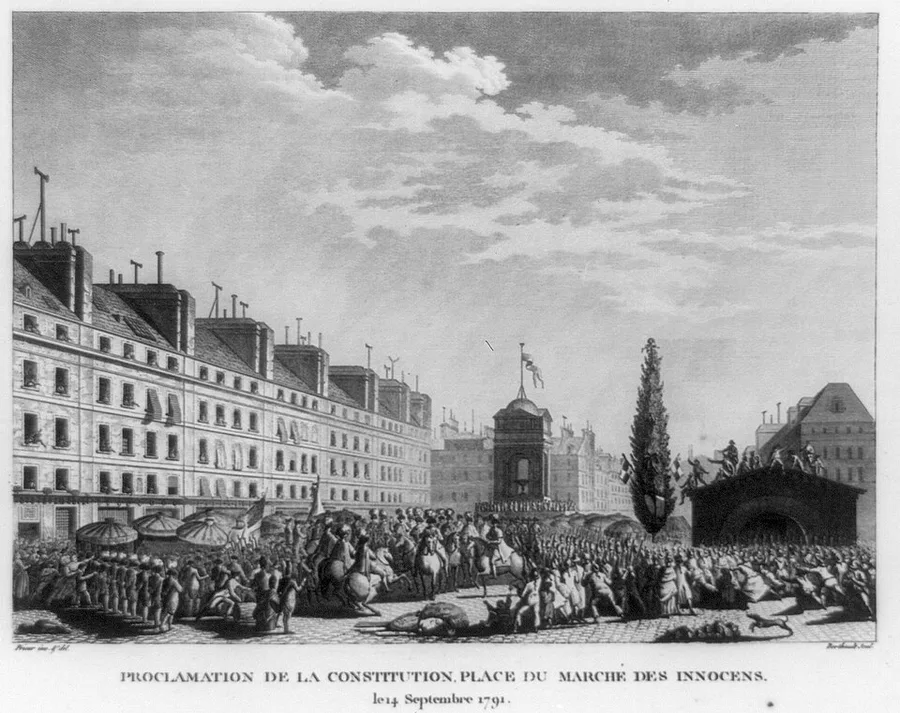 Pierre Gabriel Berthault, Proclamation de la Constitution (1791/1804 plate) An engraving of the 1791 constitution's public proclamation in a Paris market square — the short-lived constitutional monarchy the Eidsvoll delegates studied alongside the American model when drafting Norway's constitution in 1814. The first written constitution of France, adopted by the
National Constituent Assembly on 3 September 1791 and in
operation for less than a year before the August 1792
insurrection ended the constitutional monarchy. Established
a constitutional monarchy under Louis XVI, with sovereignty
vested formally in the nation, legislative authority vested
in a unicameral elected Legislative Assembly, and the
king's role reduced to executive functions and a
suspensive veto. Drew on the Declaration of the Rights of
Man and of the Citizen (August 1789) as its preamble. The
Eidsvoll Constituent Assembly drew on the 1791 constitution
alongside the United States Constitution of 1787 when
drafting the Norwegian Constitution in spring 1814.
. Grunnloven
Pierre Gabriel Berthault, Proclamation de la Constitution (1791/1804 plate) An engraving of the 1791 constitution's public proclamation in a Paris market square — the short-lived constitutional monarchy the Eidsvoll delegates studied alongside the American model when drafting Norway's constitution in 1814. The first written constitution of France, adopted by the
National Constituent Assembly on 3 September 1791 and in
operation for less than a year before the August 1792
insurrection ended the constitutional monarchy. Established
a constitutional monarchy under Louis XVI, with sovereignty
vested formally in the nation, legislative authority vested
in a unicameral elected Legislative Assembly, and the
king's role reduced to executive functions and a
suspensive veto. Drew on the Declaration of the Rights of
Man and of the Citizen (August 1789) as its preamble. The
Eidsvoll Constituent Assembly drew on the 1791 constitution
alongside the United States Constitution of 1787 when
drafting the Norwegian Constitution in spring 1814.
. Grunnloven 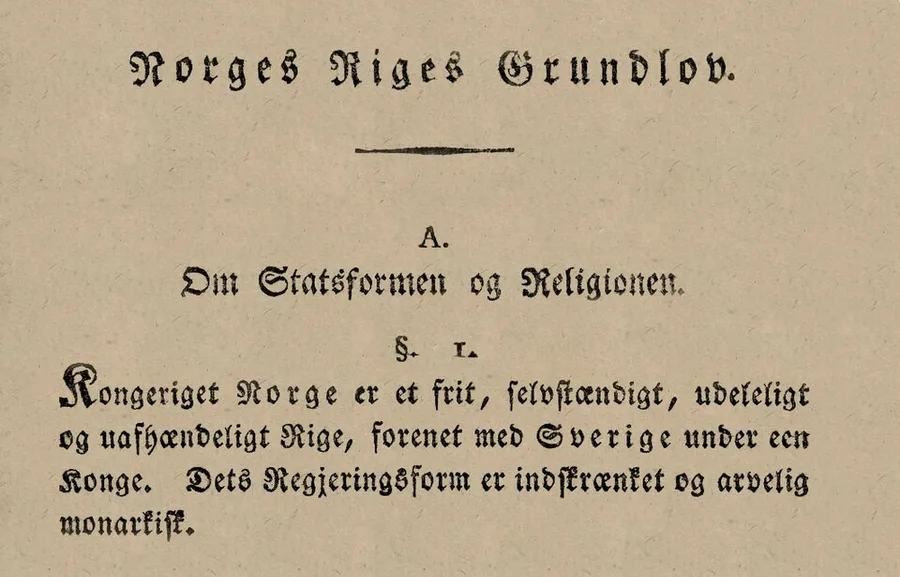 Norges Riges Grundlov §1, official printed edition (1814) The first article of Norway’s 1814 constitution as printed: the Kingdom of Norway is a free, independent, indivisible and inalienable realm. The November wording adds united with Sweden under one King — the compromise that preserved the constitution after the summer war. The Norwegian Constitution — drafted by the Eidsvoll
Constituent Assembly between 10 April and mid-May 1814,
settled in final form on 16 May and dated and signed on
17 May 1814: the founding text of the modern Norwegian
state. Grounded
explicitly in popular sovereignty; distributes governmental
authority across the three branches on the model of the
United States Constitution of 1787; establishes the
Storting as the principal legislature with a suspensive
veto for the king; guarantees freedom of expression,
public trial, and the prohibition of ex post facto law.
Adopted in a revised November 1814 form to fit the
Convention of Moss settlement and the Swedish union. As
of 2026 the second-oldest written constitution still in
force in the world after the US Constitution of 1787.
Also discussed in World War II — the King’s “No” and the Nazis in Norway is grounded explicitly in the doctrine of popular sovereignty and distributes governmental authority across three separate branches on the model of the United States Constitution. It establishes the elected Storting
Norges Riges Grundlov §1, official printed edition (1814) The first article of Norway’s 1814 constitution as printed: the Kingdom of Norway is a free, independent, indivisible and inalienable realm. The November wording adds united with Sweden under one King — the compromise that preserved the constitution after the summer war. The Norwegian Constitution — drafted by the Eidsvoll
Constituent Assembly between 10 April and mid-May 1814,
settled in final form on 16 May and dated and signed on
17 May 1814: the founding text of the modern Norwegian
state. Grounded
explicitly in popular sovereignty; distributes governmental
authority across the three branches on the model of the
United States Constitution of 1787; establishes the
Storting as the principal legislature with a suspensive
veto for the king; guarantees freedom of expression,
public trial, and the prohibition of ex post facto law.
Adopted in a revised November 1814 form to fit the
Convention of Moss settlement and the Swedish union. As
of 2026 the second-oldest written constitution still in
force in the world after the US Constitution of 1787.
Also discussed in World War II — the King’s “No” and the Nazis in Norway is grounded explicitly in the doctrine of popular sovereignty and distributes governmental authority across three separate branches on the model of the United States Constitution. It establishes the elected Storting 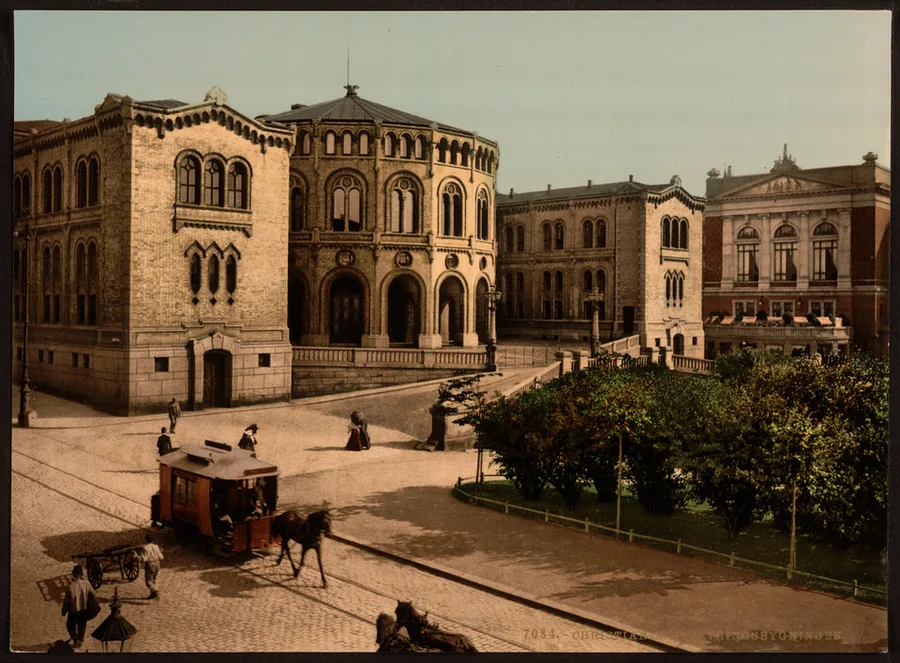 Detroit Publishing Company, Storthings Bygningen, Christiania, Norway (c. 1890-1900), Library of Congress / World Digital Library The Storting building in Kristiania (Oslo), Norway's parliament since the 1814 Constitution and the seat of the legislature that still governs the country. The Grand Assembly — the parliament of independent
Norway, established by the Eidsvoll Constitution of 17 May
1814 as the country's sovereign legislature. The name
Storting (Stór-Þing, the great assembly) deliberately
reaches back to the medieval Norwegian thing tradition,
asserting institutional continuity with the pre-Danish
Norwegian state. Under the 1814 constitution the Storting
divided into two chambers — Lagting and Odelsting —
for legislative purposes; the two-chamber arrangement was
abolished in 2009 and the Storting has been a single
chamber since. The current building, in central Oslo,
opened in 1866.
Also discussed in The 400-Year Night — when the Northern Lion lay dormantLutheran Norway and Pietism — a farmer named Hans Nielsen Hauge and a lay revival that could not be silencedThe Quiet Revolution — how Norway won its independence without a warThe 'Lucky Country' — the discovery that changed everythingWorld War II — the King’s “No” and the Nazis in NorwayAllemannsretten — the right to roamPolitikk — the left, the right, and the Norwegian way as the principal legislative body with control over taxation and the budget, while leaving the king a real executive: he appoints his own council, commands the army and navy, conducts foreign policy, and holds a suspensive veto over legislation that the Storting can override only by passing the same bill in three successive parliaments. Section 2 establishes the Evangelical-Lutheran religion as the religion of the state and bars Jewish settlement (until the constitutional amendment of 1851), Jesuit orders, and monastic orders from the realm. The document guarantees freedom of expression, the right to a public trial, and the prohibition of ex post facto law. The suffrage provisions extend the vote to all male Norwegian citizens over twenty-five who are either landowners, urban property owners, or civil servants, producing a voting franchise of roughly forty to forty-five percent of adult Norwegian men, the broadest in Europe at the time. On the seventeenth of May the assembly signs the constitution — its text settled in final form the day before — and unanimously elects Christian Frederik king of an independent Norway. He accepts the throne the same day.
Detroit Publishing Company, Storthings Bygningen, Christiania, Norway (c. 1890-1900), Library of Congress / World Digital Library The Storting building in Kristiania (Oslo), Norway's parliament since the 1814 Constitution and the seat of the legislature that still governs the country. The Grand Assembly — the parliament of independent
Norway, established by the Eidsvoll Constitution of 17 May
1814 as the country's sovereign legislature. The name
Storting (Stór-Þing, the great assembly) deliberately
reaches back to the medieval Norwegian thing tradition,
asserting institutional continuity with the pre-Danish
Norwegian state. Under the 1814 constitution the Storting
divided into two chambers — Lagting and Odelsting —
for legislative purposes; the two-chamber arrangement was
abolished in 2009 and the Storting has been a single
chamber since. The current building, in central Oslo,
opened in 1866.
Also discussed in The 400-Year Night — when the Northern Lion lay dormantLutheran Norway and Pietism — a farmer named Hans Nielsen Hauge and a lay revival that could not be silencedThe Quiet Revolution — how Norway won its independence without a warThe 'Lucky Country' — the discovery that changed everythingWorld War II — the King’s “No” and the Nazis in NorwayAllemannsretten — the right to roamPolitikk — the left, the right, and the Norwegian way as the principal legislative body with control over taxation and the budget, while leaving the king a real executive: he appoints his own council, commands the army and navy, conducts foreign policy, and holds a suspensive veto over legislation that the Storting can override only by passing the same bill in three successive parliaments. Section 2 establishes the Evangelical-Lutheran religion as the religion of the state and bars Jewish settlement (until the constitutional amendment of 1851), Jesuit orders, and monastic orders from the realm. The document guarantees freedom of expression, the right to a public trial, and the prohibition of ex post facto law. The suffrage provisions extend the vote to all male Norwegian citizens over twenty-five who are either landowners, urban property owners, or civil servants, producing a voting franchise of roughly forty to forty-five percent of adult Norwegian men, the broadest in Europe at the time. On the seventeenth of May the assembly signs the constitution — its text settled in final form the day before — and unanimously elects Christian Frederik king of an independent Norway. He accepts the throne the same day.
The summer war
The summer is the war. The Treaty of Kiel still stands. The Swedish crown still claims Norway. Karl Johan still has his army on the border. Swedish-Norwegian War of 1814 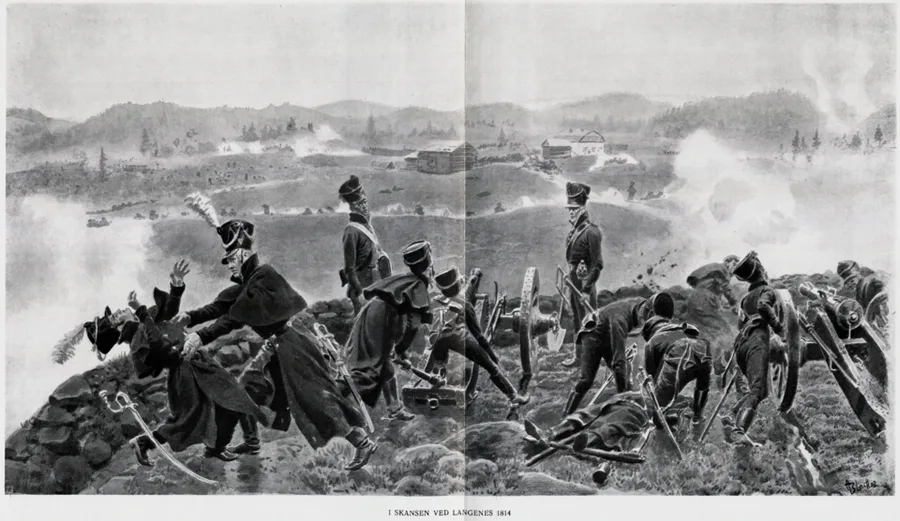 Andreas Bloch, I Skansen ved Langenes (1914) Andreas Bloch's illustration shows Norwegian troops holding an entrenchment at Langenes against a Swedish assault, one of the delaying actions the hastily raised Norwegian army fought in the Halden district during the brief summer war of 1814. Brief summer war (26 July – 14 August 1814) between
Swedish forces under Crown Prince Karl Johan and the army
of independent Norway under King Christian Frederik.
Karl Johan's army of roughly forty-five thousand men
crossed the eastern Norwegian border in multiple columns
to enforce the Treaty of Kiel; Norwegian forces, raised
hastily from the surviving Danish-Norwegian establishment,
fought a series of holding actions in the Halden and
Fredrikstad districts. The war was ended diplomatically
rather than militarily by the Convention of Moss on 14
August 1814 — Karl Johan's decision to accept the
Eidsvoll Constitution and the personal-union framework
produced the strangely mild settlement that established
the Norwegian-Swedish union.
with multiple columns crossing into eastern Norway. The Norwegian army, raised hastily from the still-loyal regiments of the old Danish-Norwegian establishment, fights a series of holding actions in the Halden
Andreas Bloch, I Skansen ved Langenes (1914) Andreas Bloch's illustration shows Norwegian troops holding an entrenchment at Langenes against a Swedish assault, one of the delaying actions the hastily raised Norwegian army fought in the Halden district during the brief summer war of 1814. Brief summer war (26 July – 14 August 1814) between
Swedish forces under Crown Prince Karl Johan and the army
of independent Norway under King Christian Frederik.
Karl Johan's army of roughly forty-five thousand men
crossed the eastern Norwegian border in multiple columns
to enforce the Treaty of Kiel; Norwegian forces, raised
hastily from the surviving Danish-Norwegian establishment,
fought a series of holding actions in the Halden and
Fredrikstad districts. The war was ended diplomatically
rather than militarily by the Convention of Moss on 14
August 1814 — Karl Johan's decision to accept the
Eidsvoll Constitution and the personal-union framework
produced the strangely mild settlement that established
the Norwegian-Swedish union.
with multiple columns crossing into eastern Norway. The Norwegian army, raised hastily from the still-loyal regiments of the old Danish-Norwegian establishment, fights a series of holding actions in the Halden 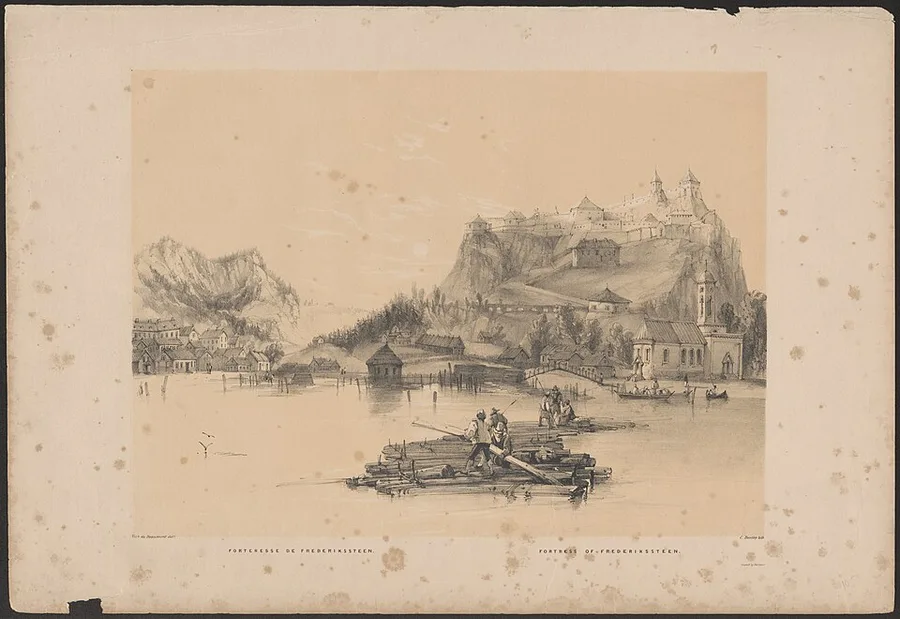 Unknown artist, Fredriksten Festning (Riksantikvaren archive) Fredriksten Fortress, shown here in a period lithograph above the Halden waterfront, anchored the Norwegian defense of the town during the 1814 war and was never taken by a Swedish army in six sieges. Border town in southeastern Norway, on the Iddefjord arm of
the Oslofjord facing Sweden across the narrowest of the
border crossings. Dominated by Fredriksten Fortress on the
ridge above the town — the seventeenth-century star fort
that, though besieged six times, was never captured by a
Swedish army. Site of the principal Norwegian holding
actions in the brief Swedish-Norwegian war of summer 1814,
when Karl Johan's army crossed into eastern Norway on 26
July and the Norwegian defenders fought a series of
delaying engagements through the Halden and Fredrikstad
districts before the Convention of Moss ended the war on
14 August. Modern Halden has about thirty thousand people
and hosts a major Norwegian nuclear-research reactor.
Also discussed in The Quiet Revolution — how Norway won its independence without a war and Fredrikstad districts, losing ground steadily but not catastrophically. The British navy continues to blockade. The great powers’ diplomatic pressure on the Swedish court is to settle quickly rather than press the campaign through to a Norwegian capitulation. On the fourteenth of August 1814, after roughly three weeks of fighting, the Mossekonvensjonen
Unknown artist, Fredriksten Festning (Riksantikvaren archive) Fredriksten Fortress, shown here in a period lithograph above the Halden waterfront, anchored the Norwegian defense of the town during the 1814 war and was never taken by a Swedish army in six sieges. Border town in southeastern Norway, on the Iddefjord arm of
the Oslofjord facing Sweden across the narrowest of the
border crossings. Dominated by Fredriksten Fortress on the
ridge above the town — the seventeenth-century star fort
that, though besieged six times, was never captured by a
Swedish army. Site of the principal Norwegian holding
actions in the brief Swedish-Norwegian war of summer 1814,
when Karl Johan's army crossed into eastern Norway on 26
July and the Norwegian defenders fought a series of
delaying engagements through the Halden and Fredrikstad
districts before the Convention of Moss ended the war on
14 August. Modern Halden has about thirty thousand people
and hosts a major Norwegian nuclear-research reactor.
Also discussed in The Quiet Revolution — how Norway won its independence without a war and Fredrikstad districts, losing ground steadily but not catastrophically. The British navy continues to blockade. The great powers’ diplomatic pressure on the Swedish court is to settle quickly rather than press the campaign through to a Norwegian capitulation. On the fourteenth of August 1814, after roughly three weeks of fighting, the Mossekonvensjonen 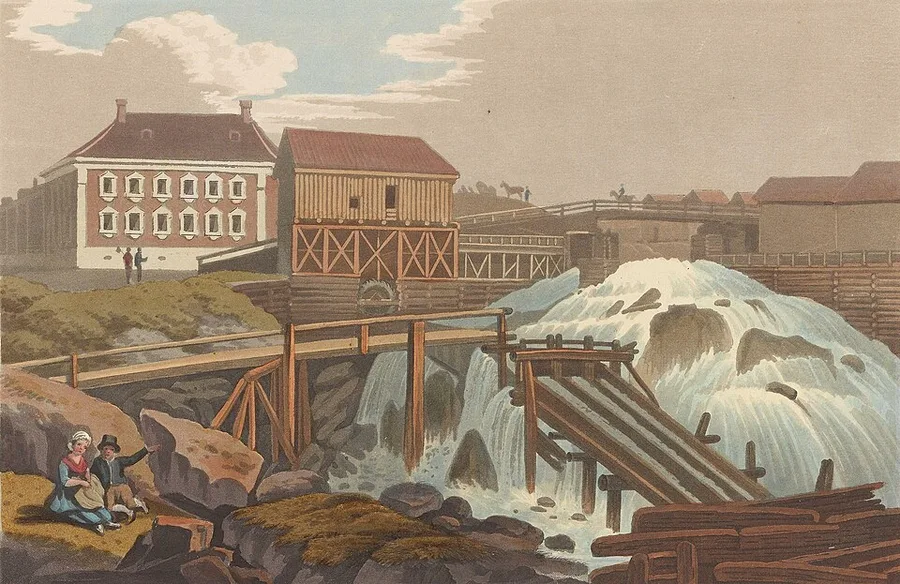 John William Edy, B. Ankers House at Moss, from Boydells Picturesque Scenery of Norway (National Museum) Bernt Anker's mansion at Moss, visible on the rise above the falls in this Edy print, is Konvensjonsgården — the house where Karl Johan's Swedish negotiators and Christian Frederik's Norwegian government signed the armistice on 14 August 1814. The Convention of Moss — the armistice signed at Moss
on 14 August 1814 between the Swedish forces of Crown
Prince Karl Johan and the Norwegian government of King
Christian Frederik, ending the brief summer war that had
followed Norway's rejection of the Treaty of Kiel. The
Convention's terms were strikingly mild: Norway entered a
personal union with Sweden, sharing the Swedish king but
retaining its Eidsvoll constitution, its Storting, its own
government, its own church, and its own administrative life
in Christiania. Karl Johan also accepted in principle the
Norwegian Constitution as the basis of government — a
concession that produced the remarkably durable
constitutional framework that lasted ninety-one years
until the peaceful dissolution of the union in 1905.
Also discussed in The 400-Year Night — when the Northern Lion lay dormantThe Quiet Revolution — how Norway won its independence without a war is signed between Christian Frederik and Karl Johan, ending the war on terms that nominally implement the Treaty of Kiel but that in practice preserve the Norwegian Constitution and the independent Norwegian parliamentary structure under a personal union with the Swedish crown.
John William Edy, B. Ankers House at Moss, from Boydells Picturesque Scenery of Norway (National Museum) Bernt Anker's mansion at Moss, visible on the rise above the falls in this Edy print, is Konvensjonsgården — the house where Karl Johan's Swedish negotiators and Christian Frederik's Norwegian government signed the armistice on 14 August 1814. The Convention of Moss — the armistice signed at Moss
on 14 August 1814 between the Swedish forces of Crown
Prince Karl Johan and the Norwegian government of King
Christian Frederik, ending the brief summer war that had
followed Norway's rejection of the Treaty of Kiel. The
Convention's terms were strikingly mild: Norway entered a
personal union with Sweden, sharing the Swedish king but
retaining its Eidsvoll constitution, its Storting, its own
government, its own church, and its own administrative life
in Christiania. Karl Johan also accepted in principle the
Norwegian Constitution as the basis of government — a
concession that produced the remarkably durable
constitutional framework that lasted ninety-one years
until the peaceful dissolution of the union in 1905.
Also discussed in The 400-Year Night — when the Northern Lion lay dormantThe Quiet Revolution — how Norway won its independence without a war is signed between Christian Frederik and Karl Johan, ending the war on terms that nominally implement the Treaty of Kiel but that in practice preserve the Norwegian Constitution and the independent Norwegian parliamentary structure under a personal union with the Swedish crown.
The settlement
The settlement is the strangest piece of European constitutional history of its century. Norway has lost the war militarily. By the formal terms, Norway must enter the Swedish kingdom. But the Norwegians, in the Convention of Moss and the subsequent revision of the constitution adopted on the fourth of November 1814, secure that the union is to be between Norway and Sweden under a common king, that Norway retains its constitution, its parliament, its laws, its currency, its army in peacetime, its administrative apparatus, and its civic identity as a separate kingdom, and that the only points of joint governance are the person of the monarch himself and the conduct of foreign affairs. Charles XIII of Sweden 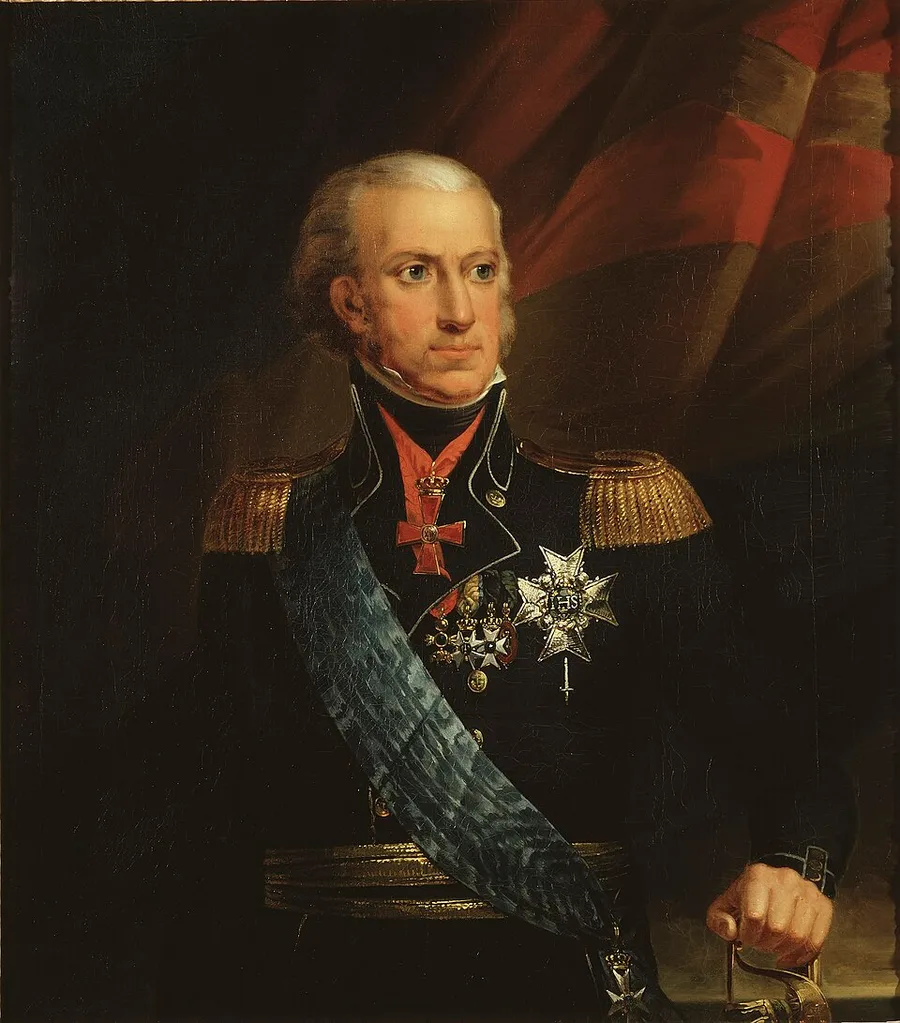 Carl Fredrik von Breda, Charles XIII of Sweden (before 1818) The elderly Charles XIII — Carl II of Norway — elected king by the Storting on 4 November 1814 under the Convention of Moss terms: a childless figurehead nearing seventy while his adopted heir Karl Johan ran the state. King of Sweden (1748–1818), reigned 1809–1818, and King of
Norway as Carl II from 4 November 1814 until his death.
Younger brother of Gustav III, uncle of the deposed Gustav
IV Adolf; elected to the Swedish throne by the Riksdag in
1809 after the coup that ended Gustav IV's reign and the
Russian conquest of Finland. Elderly, childless, and ailing
by the time of his accession, he served largely as a figure-
head while his adopted heir Crown Prince Karl Johan (Jean-
Baptiste Bernadotte) ran the state. Elected king of Norway
by the Storting on 4 November 1814 under the personal-union
terms of the Convention of Moss, formally founding the
ninety-one-year Swedish-Norwegian union. Died at Stockholm
on 5 February 1818; succeeded by Karl Johan.
, the elderly and childless Swedish king, is elected king of Norway by the Storting on the fourth of November 1814. Karl Johan, the crown prince, will become Carl III Johan of Norway (and Carl XIV Johan of Sweden) when Charles XIII dies in 1818. The new Norwegian-Swedish arrangement runs in this form for the next ninety-one years.
Carl Fredrik von Breda, Charles XIII of Sweden (before 1818) The elderly Charles XIII — Carl II of Norway — elected king by the Storting on 4 November 1814 under the Convention of Moss terms: a childless figurehead nearing seventy while his adopted heir Karl Johan ran the state. King of Sweden (1748–1818), reigned 1809–1818, and King of
Norway as Carl II from 4 November 1814 until his death.
Younger brother of Gustav III, uncle of the deposed Gustav
IV Adolf; elected to the Swedish throne by the Riksdag in
1809 after the coup that ended Gustav IV's reign and the
Russian conquest of Finland. Elderly, childless, and ailing
by the time of his accession, he served largely as a figure-
head while his adopted heir Crown Prince Karl Johan (Jean-
Baptiste Bernadotte) ran the state. Elected king of Norway
by the Storting on 4 November 1814 under the personal-union
terms of the Convention of Moss, formally founding the
ninety-one-year Swedish-Norwegian union. Died at Stockholm
on 5 February 1818; succeeded by Karl Johan.
, the elderly and childless Swedish king, is elected king of Norway by the Storting on the fourth of November 1814. Karl Johan, the crown prince, will become Carl III Johan of Norway (and Carl XIV Johan of Sweden) when Charles XIII dies in 1818. The new Norwegian-Swedish arrangement runs in this form for the next ninety-one years.
A constitution that survives
What the men at Eidsvoll have achieved is a constitutional document that survives in continuous operation from 1814 to the present and is, as of 2026, the second-oldest written constitution still in force in the world after the United States Constitution of 1787. The Norwegian Storting, the elected legislature established in the same 1814 document, has been continuously elected through every major European political upheaval of the past two centuries — meeting every third year until 1869 and annually since — with the single exception of the German occupation between 1940 and 1945. The Eidsvoll constitution outlasted the Napoleonic period, the revolutions of 1848 (Norway had none), the long nineteenth-century debate over the Swedish union, the 1905 dissolution of that union, the inter-war period, the Nazi occupation, the post-war social democratic restructuring, the oil age, and the modernization of Norwegian governance through the late twentieth century. It has been amended over three hundred times. Its core provisions, popular sovereignty, separation of powers, parliamentary supremacy, and the protected fundamental rights, are essentially what the Eidsvoll assembly wrote in 1814.
Syttende mai
The seventeenth of May, Syttende mai 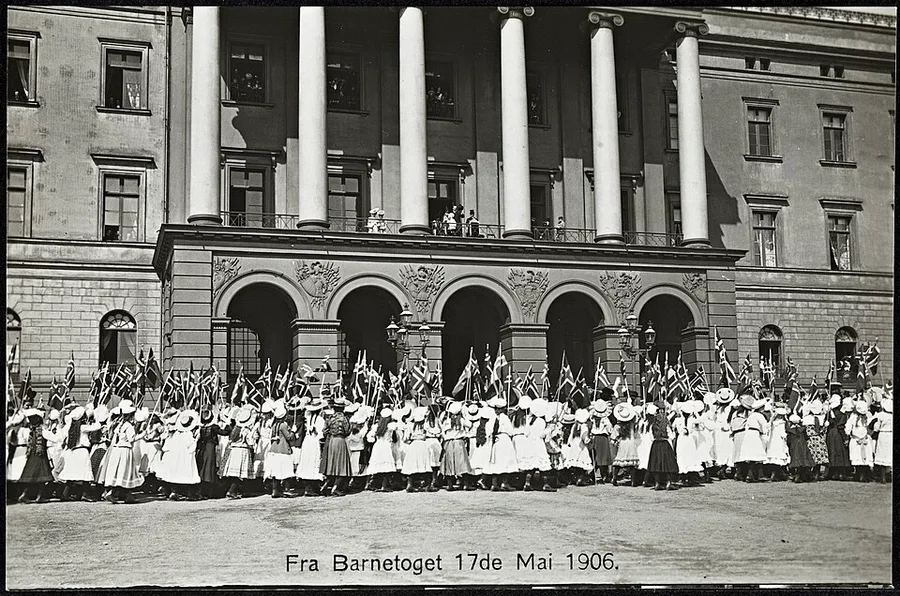 Unknown photographer, postcard (1906), National Library of Norway, via Flickr Commons Children with flags at the Royal Palace on 17 May 1906 — the date of the Eidsvoll signing, four generations on: by then the parade form had settled the constitution's day as a holiday of schoolchildren rather than soldiers. The seventeenth of May — Norway's national day,
celebrating the signing of the Eidsvoll Constitution on 17
May 1814. Marked across the country by children's parades
in every town carrying Norwegian flags, by speeches by
elected officials reading from the Constitution, by the
singing of Ja, vi elsker dette landet, by the wearing of
regional bunad folk dress, and by a general public
conviviality that is the loudest day of the Norwegian
year. The children's parade tradition began at Christiania
in 1870 (girls' participation following in 1889) at the
suggestion of Bjørnstjerne Bjørnson. Celebrated by every
Norwegian school and every Norwegian-American community
abroad, with Minnesota, Wisconsin, and Iowa communities
keeping the holiday vigorously.
Also discussed in 800,000 Norwegians Leave — the century that built a Second NorwayTradisjoner — celebrations across the Norwegian year , becomes immediately the great Norwegian national holiday. Through the 1820s the seventeenth of May is increasingly marked as a public holiday despite the Swedish crown’s preference that the date be left to lapse. King Carl Johan tries to discourage the celebration as a divisive nationalist holiday; in 1829, his troops disperse a celebrating crowd in Christiania in what becomes known as the Torgslaget
Unknown photographer, postcard (1906), National Library of Norway, via Flickr Commons Children with flags at the Royal Palace on 17 May 1906 — the date of the Eidsvoll signing, four generations on: by then the parade form had settled the constitution's day as a holiday of schoolchildren rather than soldiers. The seventeenth of May — Norway's national day,
celebrating the signing of the Eidsvoll Constitution on 17
May 1814. Marked across the country by children's parades
in every town carrying Norwegian flags, by speeches by
elected officials reading from the Constitution, by the
singing of Ja, vi elsker dette landet, by the wearing of
regional bunad folk dress, and by a general public
conviviality that is the loudest day of the Norwegian
year. The children's parade tradition began at Christiania
in 1870 (girls' participation following in 1889) at the
suggestion of Bjørnstjerne Bjørnson. Celebrated by every
Norwegian school and every Norwegian-American community
abroad, with Minnesota, Wisconsin, and Iowa communities
keeping the holiday vigorously.
Also discussed in 800,000 Norwegians Leave — the century that built a Second NorwayTradisjoner — celebrations across the Norwegian year , becomes immediately the great Norwegian national holiday. Through the 1820s the seventeenth of May is increasingly marked as a public holiday despite the Swedish crown’s preference that the date be left to lapse. King Carl Johan tries to discourage the celebration as a divisive nationalist holiday; in 1829, his troops disperse a celebrating crowd in Christiania in what becomes known as the Torgslaget 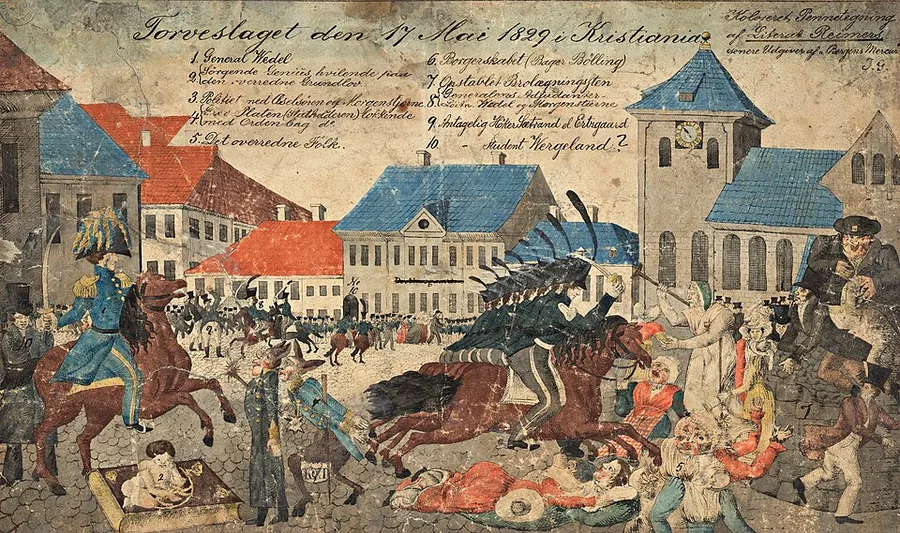 Hans E. Reimers, Torvslaget den 17. mai 1829 i Christiania, National Library of Norway Reimers's colored pen drawing, made the same year, shows Count von Platen's cavalry riding into the Stortorvet crowd on 17 May 1829 — the Torgslaget itself, the suppressed celebration that hardened 17 May into Norway's defiantly popular national day. The Battle of the Square — the suppression on 17 May
1829 of a 17 May celebration in Christiania's Stortorvet
square by mounted Swedish-Norwegian troops enforcing the
royal prohibition of the day. The crown had been
attempting through the
1820s to discourage 17 May as a divisive nationalist
commemoration separate from the dynastic celebration of
the union; the Christiania crowd defied the prohibition.
Henrik Wergeland, then a twenty-year-old student, was
among the lightly injured. The Torgslaget became one of
the precipitating events in the consolidation of 17 May
as the popular Norwegian national day in defiance of the
Swedish crown — by the 1830s the date was being celebrated
openly across the country.
. The Norwegians celebrate it anyway. By the 1870s the celebration has settled into the form it still takes today, a children’s parade through the streets of every Norwegian town (initiated in Christiania in 1870, with girls’ participation following in 1889) carrying the Norwegian flag, traditional dress (the Bunad
Hans E. Reimers, Torvslaget den 17. mai 1829 i Christiania, National Library of Norway Reimers's colored pen drawing, made the same year, shows Count von Platen's cavalry riding into the Stortorvet crowd on 17 May 1829 — the Torgslaget itself, the suppressed celebration that hardened 17 May into Norway's defiantly popular national day. The Battle of the Square — the suppression on 17 May
1829 of a 17 May celebration in Christiania's Stortorvet
square by mounted Swedish-Norwegian troops enforcing the
royal prohibition of the day. The crown had been
attempting through the
1820s to discourage 17 May as a divisive nationalist
commemoration separate from the dynastic celebration of
the union; the Christiania crowd defied the prohibition.
Henrik Wergeland, then a twenty-year-old student, was
among the lightly injured. The Torgslaget became one of
the precipitating events in the consolidation of 17 May
as the popular Norwegian national day in defiance of the
Swedish crown — by the 1830s the date was being celebrated
openly across the country.
. The Norwegians celebrate it anyway. By the 1870s the celebration has settled into the form it still takes today, a children’s parade through the streets of every Norwegian town (initiated in Christiania in 1870, with girls’ participation following in 1889) carrying the Norwegian flag, traditional dress (the Bunad 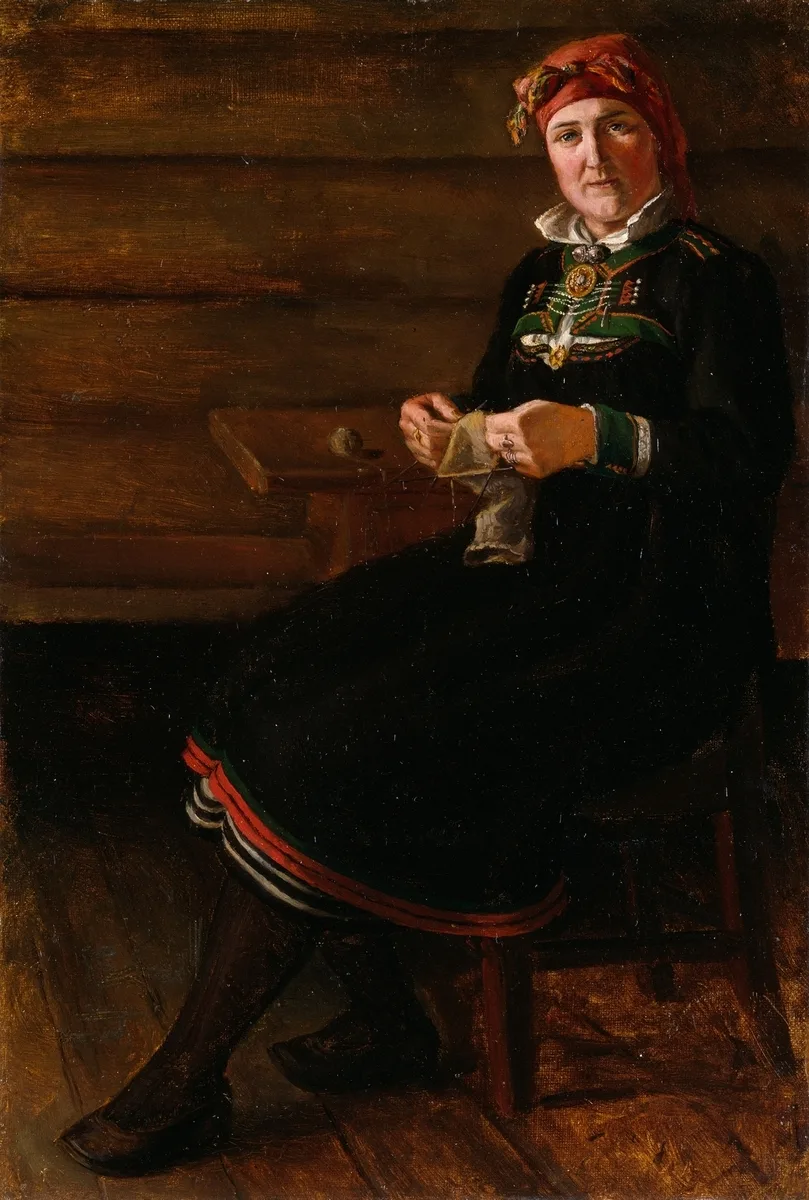 August Schneider, Sittende kvinne i Setesdals-bunad (1870), Nasjonalmuseet The Setesdal dress Schneider painted in 1870 was one regional variant among dozens; around 1900 Hulda Garborg and others systematized the parish-by-parish tradition into the modern bunad — the dress that comes out of the closets every seventeenth of May. Norwegian regional folk costume — the rural traditional
dress that survived the four-hundred-year Danish period
intact, parish by parish, fjord by fjord. Each Norwegian
region (and many individual valleys) has its own bunad,
varying in colour, embroidery pattern, silver brooch
(sølje), shawl, and apron. The modern bunad tradition was
systematised in the late nineteenth and early twentieth
centuries by the textile historian Hulda Garborg and
others, but the underlying garments are pre-modern. Worn
on 17 May, at weddings, at confirmations, and at other
formal national occasions. The persistence of the bunad is
one of the most visible single signs of how the regional
substrate of Norway outlasted the long Danish absorption.
Also discussed in The 400-Year Night — when the Northern Lion lay dormantLutheran Norway and Pietism — a farmer named Hans Nielsen Hauge and a lay revival that could not be silenced800,000 Norwegians Leave — the century that built a Second NorwayWorld War II — the King’s “No” and the Nazis in NorwayTradisjoner — celebrations across the Norwegian year system being systematized around 1900), public speeches for the day, school choirs singing Ja, vi elsker dette landet
August Schneider, Sittende kvinne i Setesdals-bunad (1870), Nasjonalmuseet The Setesdal dress Schneider painted in 1870 was one regional variant among dozens; around 1900 Hulda Garborg and others systematized the parish-by-parish tradition into the modern bunad — the dress that comes out of the closets every seventeenth of May. Norwegian regional folk costume — the rural traditional
dress that survived the four-hundred-year Danish period
intact, parish by parish, fjord by fjord. Each Norwegian
region (and many individual valleys) has its own bunad,
varying in colour, embroidery pattern, silver brooch
(sølje), shawl, and apron. The modern bunad tradition was
systematised in the late nineteenth and early twentieth
centuries by the textile historian Hulda Garborg and
others, but the underlying garments are pre-modern. Worn
on 17 May, at weddings, at confirmations, and at other
formal national occasions. The persistence of the bunad is
one of the most visible single signs of how the regional
substrate of Norway outlasted the long Danish absorption.
Also discussed in The 400-Year Night — when the Northern Lion lay dormantLutheran Norway and Pietism — a farmer named Hans Nielsen Hauge and a lay revival that could not be silenced800,000 Norwegians Leave — the century that built a Second NorwayWorld War II — the King’s “No” and the Nazis in NorwayTradisjoner — celebrations across the Norwegian year system being systematized around 1900), public speeches for the day, school choirs singing Ja, vi elsker dette landet 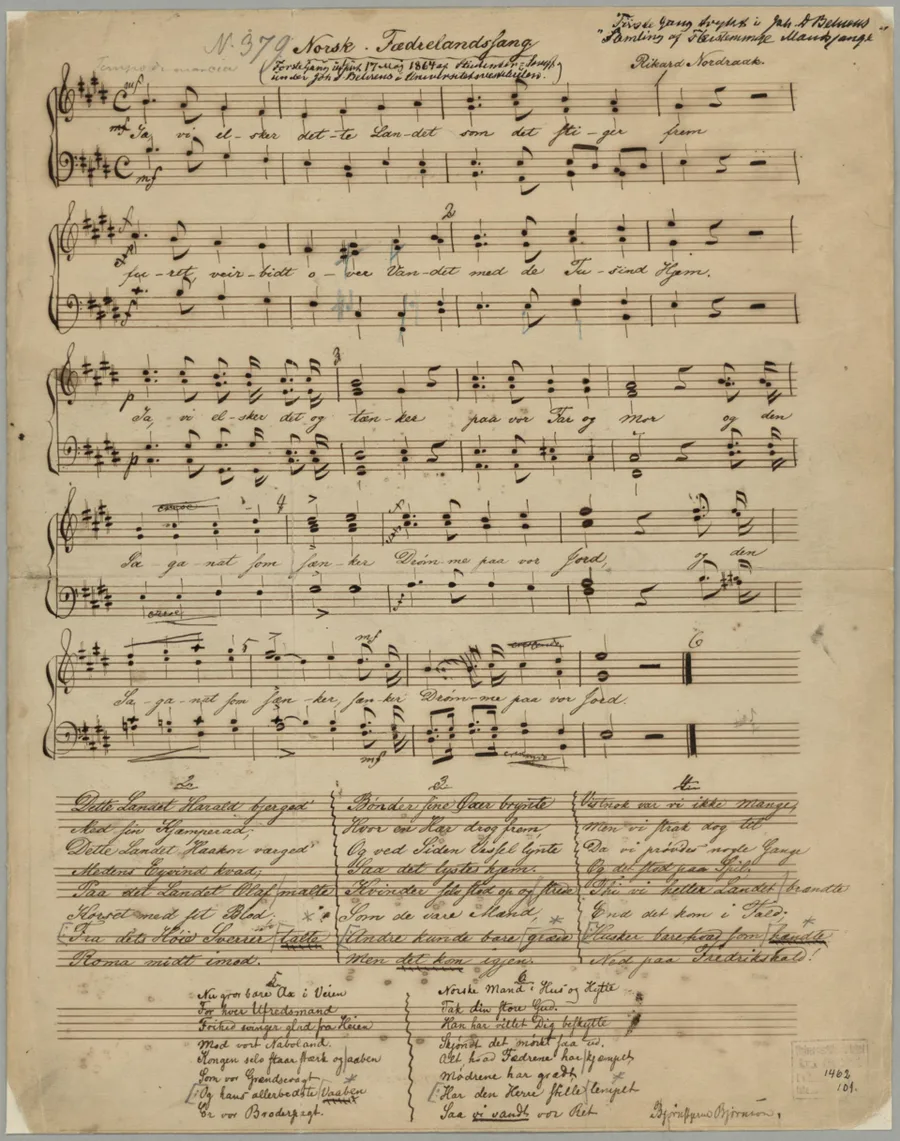 Rikard Nordraak, manuscript of Norsk Fædrelandssang (1864), National Library of Norway Nordraak's own fair copy of the melody he set to Bjørnson's 1859 words in 1864, still headed with the song's original title, Norsk Fædrelandssang, before it became known by its opening line, Ja, vi elsker dette landet. Yes, we love this country — the Norwegian national anthem.
Lyrics written by Bjørnstjerne Bjørnson in 1859 and revised
to their canonical form in 1869; melody composed by his
cousin Rikard Nordraak in 1864. The song was first
performed publicly at the fiftieth-anniversary
commemoration of the 1814 Constitution at the Eidsvoll
square in Christiania on 17 May 1864 — Karl Johans gate
marking the parade route — and became the unofficial
national anthem across the late nineteenth century. Sung
on every 17 May in every Norwegian school, town, and
Norwegian-American community abroad. Officially adopted
as the national anthem by the Storting on 11 December
2019, having served as the de facto anthem for the
preceding hundred and fifty years.
— Bjørnstjerne Bjørnson
Rikard Nordraak, manuscript of Norsk Fædrelandssang (1864), National Library of Norway Nordraak's own fair copy of the melody he set to Bjørnson's 1859 words in 1864, still headed with the song's original title, Norsk Fædrelandssang, before it became known by its opening line, Ja, vi elsker dette landet. Yes, we love this country — the Norwegian national anthem.
Lyrics written by Bjørnstjerne Bjørnson in 1859 and revised
to their canonical form in 1869; melody composed by his
cousin Rikard Nordraak in 1864. The song was first
performed publicly at the fiftieth-anniversary
commemoration of the 1814 Constitution at the Eidsvoll
square in Christiania on 17 May 1864 — Karl Johans gate
marking the parade route — and became the unofficial
national anthem across the late nineteenth century. Sung
on every 17 May in every Norwegian school, town, and
Norwegian-American community abroad. Officially adopted
as the national anthem by the Storting on 11 December
2019, having served as the de facto anthem for the
preceding hundred and fifty years.
— Bjørnstjerne Bjørnson 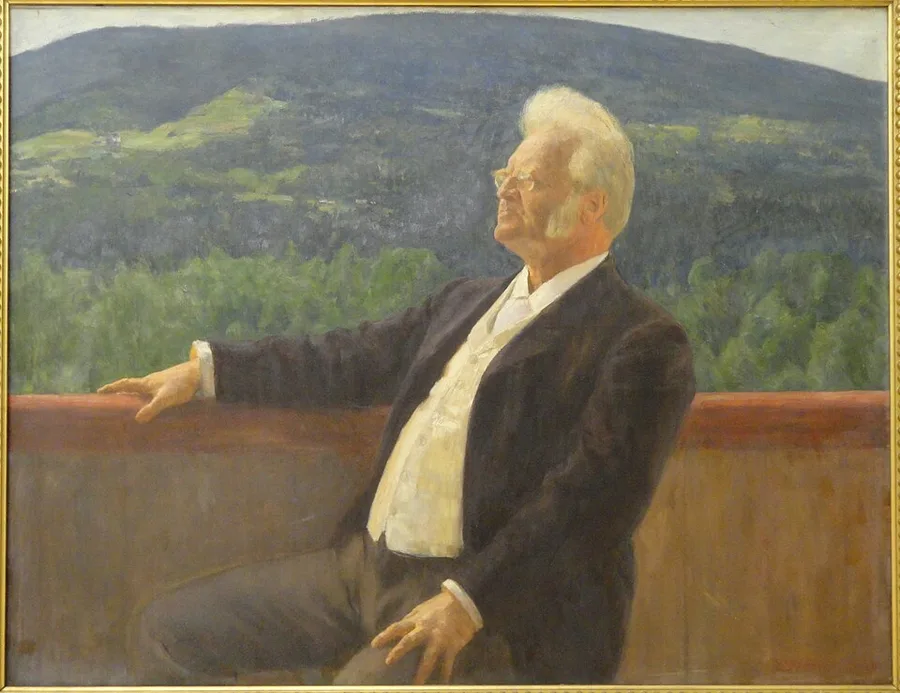 Erik Werenskiold, Portrait of Bjørnstjerne Bjørnson (1900), Statens Museum for Kunst Werenskiold's 1900 portrait of Bjørnson in old age — the writer whose 1859 lyrics became *Ja, vi elsker dette landet*, and who in 1870 proposed the children's parade that made 17 May a day of schoolchildren rather than soldiers. Norwegian writer, dramatist, and political journalist
(1832–1910). Born at Kvikne in Østerdalen; educated at
Christiania; one of the four great Norwegian writers of
the second half of the nineteenth century alongside Ibsen,
Lie, and Kielland. Wrote the lyrics of Ja, vi elsker
dette landet — Yes, we love this country — the
Norwegian national anthem, in 1859; the song was set to
music by his cousin Rikard Nordraak in 1864 and first
performed publicly at the fiftieth-anniversary
commemoration of the 1814 Constitution on 17 May 1864.
Awarded the Nobel Prize in Literature in 1903 — the first
Norwegian Nobel laureate. A central campaigner for
Norwegian independence from Sweden across the late
nineteenth century; lived to see the peaceful dissolution
of the union in 1905.
’s lyrics of 1859 set to Rikard Nordraak
Erik Werenskiold, Portrait of Bjørnstjerne Bjørnson (1900), Statens Museum for Kunst Werenskiold's 1900 portrait of Bjørnson in old age — the writer whose 1859 lyrics became *Ja, vi elsker dette landet*, and who in 1870 proposed the children's parade that made 17 May a day of schoolchildren rather than soldiers. Norwegian writer, dramatist, and political journalist
(1832–1910). Born at Kvikne in Østerdalen; educated at
Christiania; one of the four great Norwegian writers of
the second half of the nineteenth century alongside Ibsen,
Lie, and Kielland. Wrote the lyrics of Ja, vi elsker
dette landet — Yes, we love this country — the
Norwegian national anthem, in 1859; the song was set to
music by his cousin Rikard Nordraak in 1864 and first
performed publicly at the fiftieth-anniversary
commemoration of the 1814 Constitution on 17 May 1864.
Awarded the Nobel Prize in Literature in 1903 — the first
Norwegian Nobel laureate. A central campaigner for
Norwegian independence from Sweden across the late
nineteenth century; lived to see the peaceful dissolution
of the union in 1905.
’s lyrics of 1859 set to Rikard Nordraak 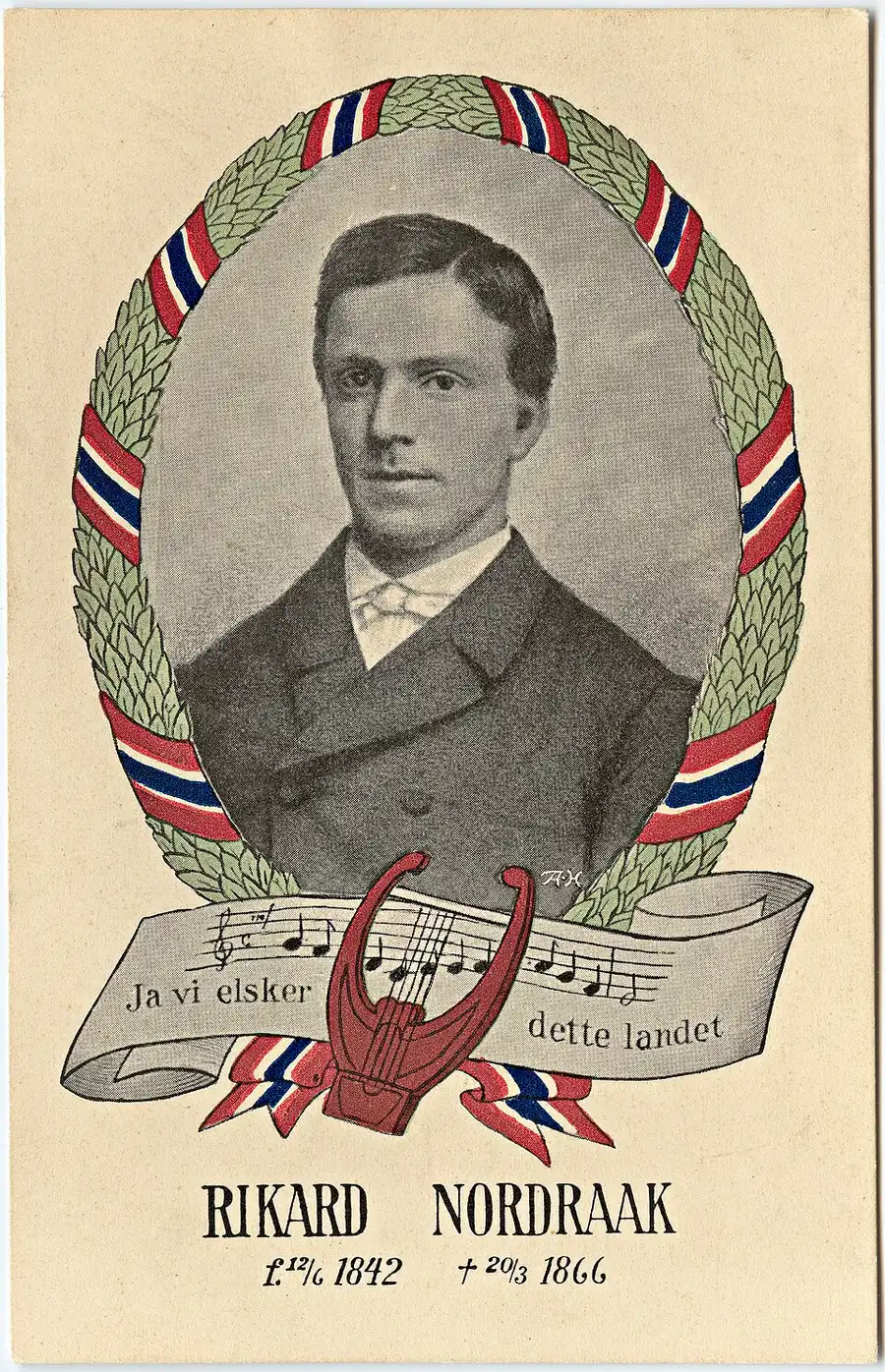 Nasjonalbiblioteket (National Library of Norway), postcard portrait, CC BY 2.0 Nordraak, shown here on a memorial postcard wreathed with the anthem's opening line, composed the melody of Ja, vi elsker dette landet in 1864 to his cousin Bjørnson's 1859 lyrics, first sung at the 1864 Eidsvoll jubilee. Norwegian composer (1842–1866). Born in Christiania to a
merchant family; trained in Copenhagen and Berlin. Composed
the melody of Ja, vi elsker dette landet in 1864 to his
cousin Bjørnstjerne Bjørnson's 1859 lyrics; the song was
first performed publicly at the fiftieth-anniversary
commemoration of the 1814 Constitution at the Eidsvoll
square in Christiania on 17 May 1864. Close friend and
collaborator of Edvard Grieg through their Copenhagen and
Berlin years. Died at twenty-three of tuberculosis in
Berlin on 20 March 1866, before he could establish a
larger compositional career. Grieg's Sørgemarsj over
Rikard Nordraak (Funeral March for Rikard Nordraak) was
composed in response and is one of Grieg's most personal
early works.
’s music and first performed on the seventeenth of May 1864 — and a general public conviviality that is the loudest day of the Norwegian year. The seventeenth of May is celebrated in 2026 by every Norwegian school and by every Norwegian community abroad, with Norwegian-American communities in Minnesota and Wisconsin and Iowa keeping the holiday in some cases more vigorously than the older Norwegian rural districts do.
Nasjonalbiblioteket (National Library of Norway), postcard portrait, CC BY 2.0 Nordraak, shown here on a memorial postcard wreathed with the anthem's opening line, composed the melody of Ja, vi elsker dette landet in 1864 to his cousin Bjørnson's 1859 lyrics, first sung at the 1864 Eidsvoll jubilee. Norwegian composer (1842–1866). Born in Christiania to a
merchant family; trained in Copenhagen and Berlin. Composed
the melody of Ja, vi elsker dette landet in 1864 to his
cousin Bjørnstjerne Bjørnson's 1859 lyrics; the song was
first performed publicly at the fiftieth-anniversary
commemoration of the 1814 Constitution at the Eidsvoll
square in Christiania on 17 May 1864. Close friend and
collaborator of Edvard Grieg through their Copenhagen and
Berlin years. Died at twenty-three of tuberculosis in
Berlin on 20 March 1866, before he could establish a
larger compositional career. Grieg's Sørgemarsj over
Rikard Nordraak (Funeral March for Rikard Nordraak) was
composed in response and is one of Grieg's most personal
early works.
’s music and first performed on the seventeenth of May 1864 — and a general public conviviality that is the loudest day of the Norwegian year. The seventeenth of May is celebrated in 2026 by every Norwegian school and by every Norwegian community abroad, with Norwegian-American communities in Minnesota and Wisconsin and Iowa keeping the holiday in some cases more vigorously than the older Norwegian rural districts do.
A country emerges
The structural significance of 1814 in Norwegian history is hard to overstate. The country that had been bound to the Danish crown for most of four centuries recovered its sovereignty in a single year, through a combination of unforeseen European geopolitical pressure, a willing royal regent, and a constituent assembly composed of men who had read enough Enlightenment political philosophy to know what to write. The constitution they wrote was not given to them by a foreign power. It was not imposed from above. It was drafted in five weeks, by Norwegians acting for Norway, under terms that no European observer in January 1814 would have predicted. The country that emerges in 1814 is not yet fully independent. The Swedish union remains until 1905. But the country emerges. The Firehundreårsnatten The four-hundred-year night — the Norwegian historiographical phrase for the long period of Danish rule, 1380–1814. Coined by Henrik Ibsen in Peer Gynt (1867) — placed in the mouth of Huhu, a satirical madhouse patient in Cairo mocking the romantic-nationalist mythology of Norway's lost language. The mythology then adopted the phrase in earnest, without the irony, and it has been Norwegian schoolroom common-sense ever since. The round number is itself a polemical flourish, not a measurement: the actual span is four hundred and thirty- four years. Modern historians of Denmark-Norway handle the period more carefully, but the phrase remains the schoolroom shorthand. , in any strict sense, ends at Eidsvoll. The recovery of full sovereignty will take another ninety-one years.
The men at Eidsvoll
The men at Eidsvoll are not heroes in the Romantic literary sense. They are an assembly of Norwegian provincial worthies, parish pastors, district judges, local merchants, military officers of the older Danish-Norwegian establishment, and a handful of younger men with university training in Copenhagen and Göttingen. They include Christian Magnus Falsen 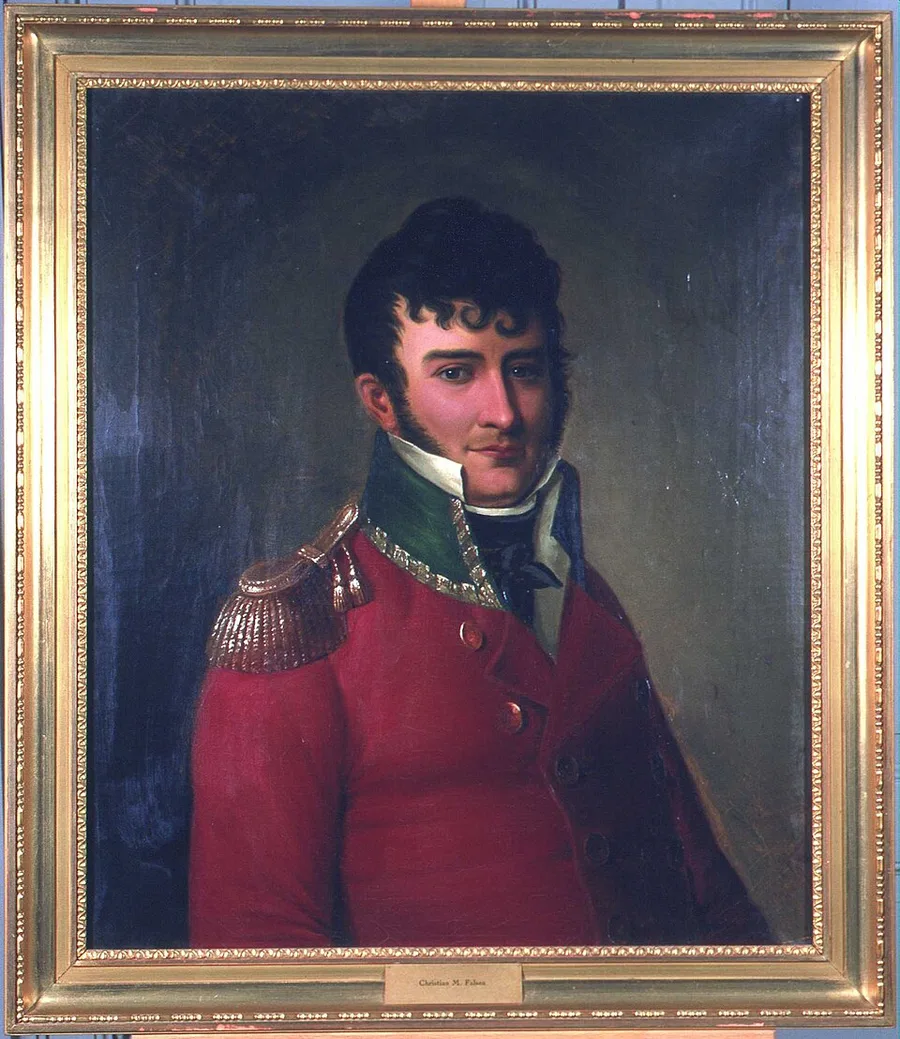 Christian Olsen (copy after unknown original), Christian Magnus Falsen, Eidsvoll 1814 collection Falsen chaired the committee that drafted the working text at Eidsvoll — a framework drawn from the American constitution of 1787 and the French constitution of 1791 — and earned the name father of the constitution. Norwegian jurist and constitutional drafter (1782–1830),
often called the father of the constitution. Born in
Christiania to a Danish-Norwegian judicial family; trained
at Copenhagen; served as district judge at Follo in the
years immediately before 1814. Elected as one of three
delegates from Follo to the Eidsvoll Constituent Assembly,
where he chaired the Constitutional Committee that drafted
the working text of the Norwegian Constitution. Drew
extensively on the United States Constitution of 1787 and
the French Constitution of 1791 to construct the document's
framework of popular sovereignty, separation of powers, and
Storting supremacy. Served subsequently as president of the
Storting and as Justice Minister in the personal-union
Norwegian government.
, who chairs the constitutional drafting committee and will later be called the father of the constitution. They include Nicolai Wergeland
Christian Olsen (copy after unknown original), Christian Magnus Falsen, Eidsvoll 1814 collection Falsen chaired the committee that drafted the working text at Eidsvoll — a framework drawn from the American constitution of 1787 and the French constitution of 1791 — and earned the name father of the constitution. Norwegian jurist and constitutional drafter (1782–1830),
often called the father of the constitution. Born in
Christiania to a Danish-Norwegian judicial family; trained
at Copenhagen; served as district judge at Follo in the
years immediately before 1814. Elected as one of three
delegates from Follo to the Eidsvoll Constituent Assembly,
where he chaired the Constitutional Committee that drafted
the working text of the Norwegian Constitution. Drew
extensively on the United States Constitution of 1787 and
the French Constitution of 1791 to construct the document's
framework of popular sovereignty, separation of powers, and
Storting supremacy. Served subsequently as president of the
Storting and as Justice Minister in the personal-union
Norwegian government.
, who chairs the constitutional drafting committee and will later be called the father of the constitution. They include Nicolai Wergeland 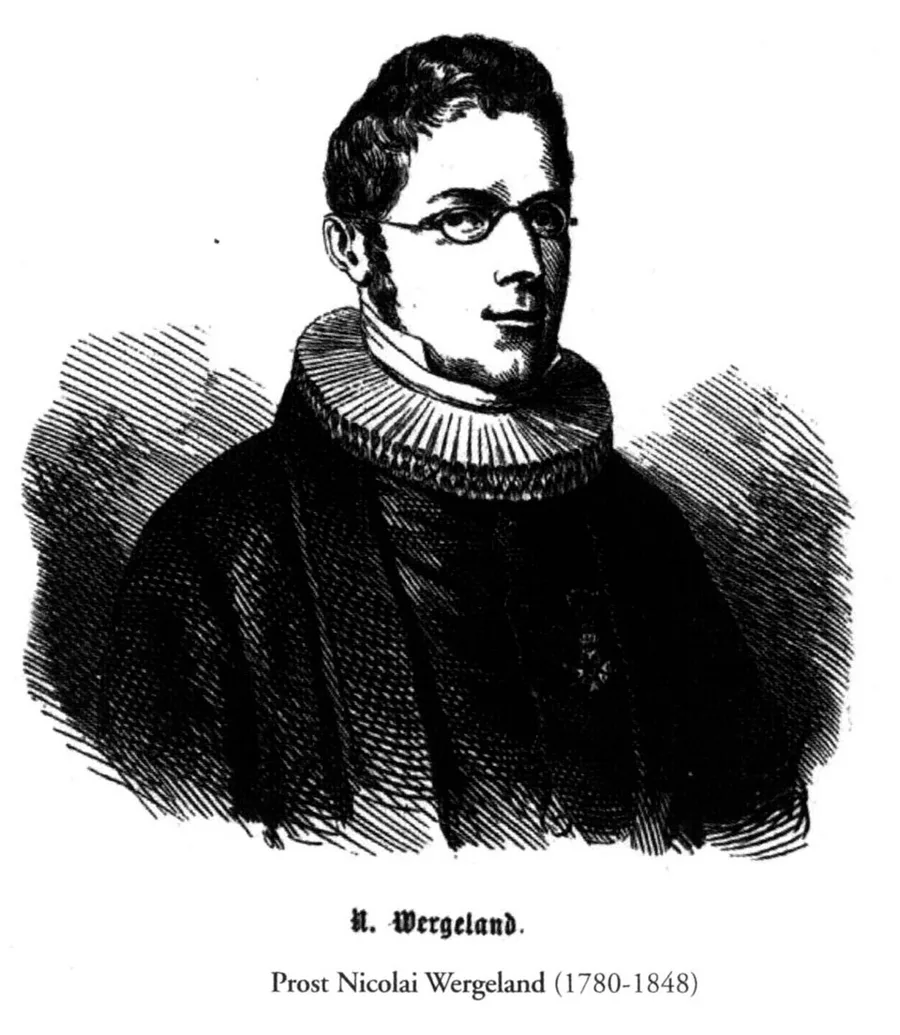 Unknown artist, Nicolai Wergeland (probably 1830–1860), via Eirik Sundli 1942 dissertation The clergyman's ruff marks the delegate class he stood for: parish pastor of Eidsvoll itself, sitting in the assembly that met in his own district, co-author of a constitutional draft circulated in April 1814 — and father of Henrik, who fought the §2 clause the fathers left behind. Norwegian Lutheran pastor, theologian, and political writer
(1780–1848). Trained at the University of Copenhagen;
parish pastor at Eidsvoll itself in the years immediately
before 1814 and one of the Constituent Assembly delegates
from the Eidsvoll district. Co-author of the constitutional
draft circulated to the Assembly in April 1814 and a
significant voice in the floor debates. His political
pamphlets of the 1810s — En sandfærdig Beretning om
Danmarks politiske Forbrydelser imod Kongeriget Norge (A
Truthful Account of Denmark's Political Crimes Against the
Kingdom of Norway, 1816) — became standard nineteenth-
century Norwegian patriotic literature. Father of the poet
Henrik Wergeland, the writer Camilla Collett, and the military
officer Oscar Wergeland.
, the father of the future polymath poet and patriot Henrik Wergeland
Unknown artist, Nicolai Wergeland (probably 1830–1860), via Eirik Sundli 1942 dissertation The clergyman's ruff marks the delegate class he stood for: parish pastor of Eidsvoll itself, sitting in the assembly that met in his own district, co-author of a constitutional draft circulated in April 1814 — and father of Henrik, who fought the §2 clause the fathers left behind. Norwegian Lutheran pastor, theologian, and political writer
(1780–1848). Trained at the University of Copenhagen;
parish pastor at Eidsvoll itself in the years immediately
before 1814 and one of the Constituent Assembly delegates
from the Eidsvoll district. Co-author of the constitutional
draft circulated to the Assembly in April 1814 and a
significant voice in the floor debates. His political
pamphlets of the 1810s — En sandfærdig Beretning om
Danmarks politiske Forbrydelser imod Kongeriget Norge (A
Truthful Account of Denmark's Political Crimes Against the
Kingdom of Norway, 1816) — became standard nineteenth-
century Norwegian patriotic literature. Father of the poet
Henrik Wergeland, the writer Camilla Collett, and the military
officer Oscar Wergeland.
, the father of the future polymath poet and patriot Henrik Wergeland 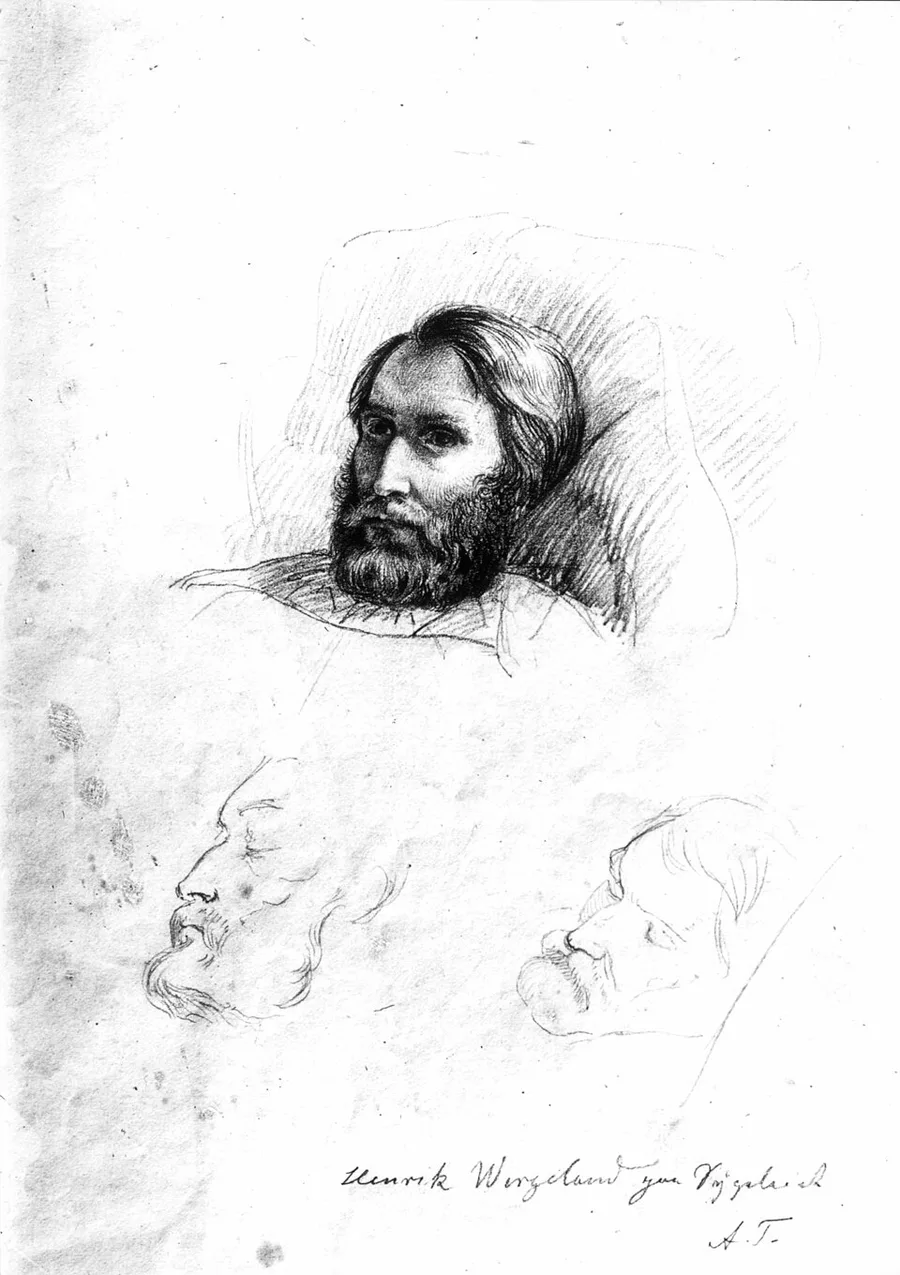 Adolph Tidemand, Portrait of Henrik Wergeland (1844), Norsk portrettarkiv, Riksantikvaren Tidemand's sheet is captioned "Henrik Wergeland paa Sygeleiet" — Wergeland on his sickbed, drawn in his final year — the Romantic-era poet who spent the 1830s and 1840s campaigning to remove Norway's constitutional ban on Jewish settlement, and died six years before it fell. Norwegian poet, dramatist, and political reformer (1808–1845),
the dominant literary figure of the first generation after the
1814 Constitution. Son of the Eidsvoll constitutional delegate
Nicolai Wergeland; brother of the writer Camilla Collett and
the officer Oscar Wergeland.
Pioneer of Norwegian Romantic poetry — his epic Skabelsen,
Mennesket og Messias (Creation, Man, and Messiah, 1830) is
among the founding works of modern Norwegian literature.
Through the 1830s and 1840s he campaigned
for the removal of Article 2 of the 1814
Constitution, which barred Jewish settlement in Norway. He
died in 1845 at thirty-seven, six years before
the campaign succeeded in 1851. Jewish congregations in Oslo
and Trondheim place flowers on his grave every year on the
anniversary of his death.
Also discussed in Lutheran Norway and Pietism — a farmer named Hans Nielsen Hauge and a lay revival that could not be silencedWorld War II — the King’s “No” and the Nazis in Norway , who will spend the last years of his short life campaigning to strike §2’s Jewish clause from the constitution his father had signed, and will die in 1845, six years before his cause prevails. They include the future Storting president Wilhelm Frimann Koren Christie
Adolph Tidemand, Portrait of Henrik Wergeland (1844), Norsk portrettarkiv, Riksantikvaren Tidemand's sheet is captioned "Henrik Wergeland paa Sygeleiet" — Wergeland on his sickbed, drawn in his final year — the Romantic-era poet who spent the 1830s and 1840s campaigning to remove Norway's constitutional ban on Jewish settlement, and died six years before it fell. Norwegian poet, dramatist, and political reformer (1808–1845),
the dominant literary figure of the first generation after the
1814 Constitution. Son of the Eidsvoll constitutional delegate
Nicolai Wergeland; brother of the writer Camilla Collett and
the officer Oscar Wergeland.
Pioneer of Norwegian Romantic poetry — his epic Skabelsen,
Mennesket og Messias (Creation, Man, and Messiah, 1830) is
among the founding works of modern Norwegian literature.
Through the 1830s and 1840s he campaigned
for the removal of Article 2 of the 1814
Constitution, which barred Jewish settlement in Norway. He
died in 1845 at thirty-seven, six years before
the campaign succeeded in 1851. Jewish congregations in Oslo
and Trondheim place flowers on his grave every year on the
anniversary of his death.
Also discussed in Lutheran Norway and Pietism — a farmer named Hans Nielsen Hauge and a lay revival that could not be silencedWorld War II — the King’s “No” and the Nazis in Norway , who will spend the last years of his short life campaigning to strike §2’s Jewish clause from the constitution his father had signed, and will die in 1845, six years before his cause prevails. They include the future Storting president Wilhelm Frimann Koren Christie 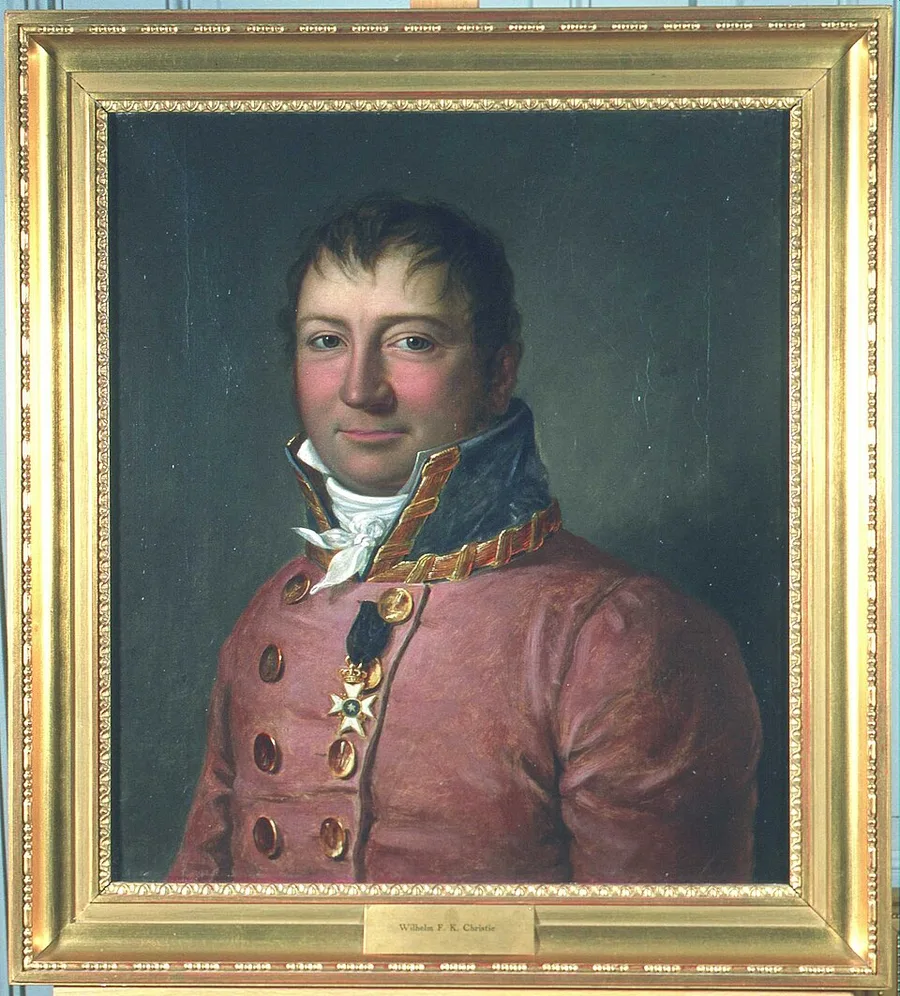 Jacob Munch, Wilhelm Frimann Koren Christie (1814), Eidsvoll 1814 collection Munch painted Christie in 1814 itself — the Bergen magistrate who kept the Assembly's protocol, became the Storting's first president that October, and presided over the November revision that fitted the Eidsvoll constitution to the Convention of Moss terms. Norwegian jurist, civil servant, and political leader
(1778–1849). Born in Kristiansund; trained at the
University of Copenhagen; served as district magistrate in
Bergen from 1808. Elected to the Eidsvoll Constituent
Assembly from Bergen city in April 1814, where he chaired
the secretariat of the Assembly and kept the official
protocol — the document that records the Assembly's
proceedings session by session. Elected first president of
the Storting at its first sitting on 7 October 1814 and
presided over the November 1814 amendments that adapted
the Eidsvoll Constitution to the Convention of Moss terms
and the Swedish union. Statue stands in front of the
Bergen Museum.
. They include Count Herman Wedel-Jarlsberg
Jacob Munch, Wilhelm Frimann Koren Christie (1814), Eidsvoll 1814 collection Munch painted Christie in 1814 itself — the Bergen magistrate who kept the Assembly's protocol, became the Storting's first president that October, and presided over the November revision that fitted the Eidsvoll constitution to the Convention of Moss terms. Norwegian jurist, civil servant, and political leader
(1778–1849). Born in Kristiansund; trained at the
University of Copenhagen; served as district magistrate in
Bergen from 1808. Elected to the Eidsvoll Constituent
Assembly from Bergen city in April 1814, where he chaired
the secretariat of the Assembly and kept the official
protocol — the document that records the Assembly's
proceedings session by session. Elected first president of
the Storting at its first sitting on 7 October 1814 and
presided over the November 1814 amendments that adapted
the Eidsvoll Constitution to the Convention of Moss terms
and the Swedish union. Statue stands in front of the
Bergen Museum.
. They include Count Herman Wedel-Jarlsberg 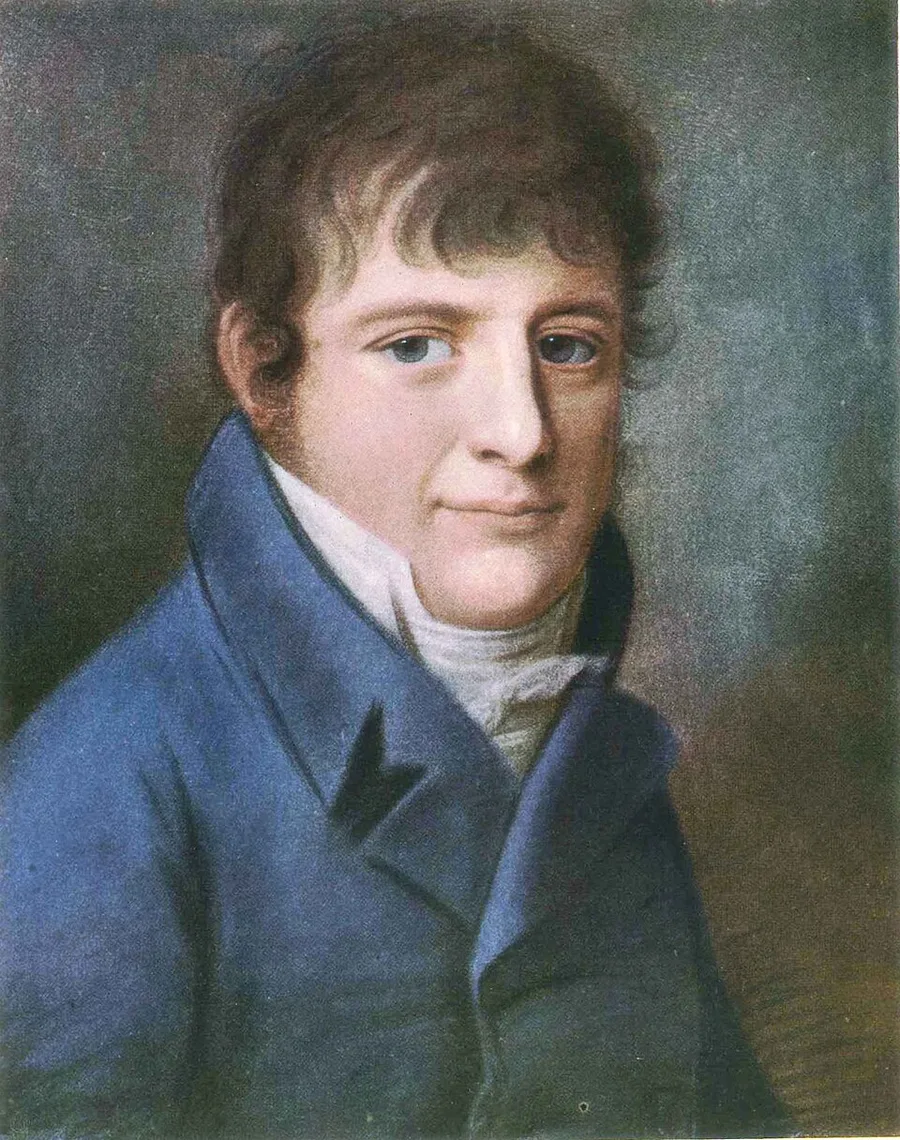 Christian Horneman, Herman Wedel Jarlsberg (1779–1840), via Lokalhistoriewiki Horneman's portrait is fittingly plain — no orders, no decorations — for the count who led the outvoted unionist minority at Eidsvoll and was substantially vindicated by the Convention of Moss that August; one of the few actual nobles in the room. Norwegian count, statesman, and political leader (1779–1840).
Born to the Wedel-Jarlsberg comital family, one of the
small number of Norwegian noble houses surviving from the
Danish period. Trained at Copenhagen and Oxford; held
Norwegian government office under the Danish crown before
1814. Elected to the Eidsvoll Constituent Assembly, where
he led the unionist faction that argued for early
acceptance of the Swedish personal-union terms — a minority
position outvoted on the floor in April–May 1814, but
substantially the one that the Convention of Moss in August
produced. Subsequently the leading Norwegian advocate of
cooperation with the Swedish crown across the early decades
of the union. Served as Finance Minister of independent
Norway 1814–1822 and as Governor of Norway 1836–1840.
, who leads the pro-union faction at Eidsvoll — a minority position outvoted on the floor, but substantially the one the summer war will produce. Almost none of the others are sons of an established Norwegian nobility, because such a class has not existed in Norway in any meaningful form for centuries. They are middle-class Norwegians of the early nineteenth century, doing what their position permitted them to do at a moment when the position permitted more than usual. They got the moment right.
Christian Horneman, Herman Wedel Jarlsberg (1779–1840), via Lokalhistoriewiki Horneman's portrait is fittingly plain — no orders, no decorations — for the count who led the outvoted unionist minority at Eidsvoll and was substantially vindicated by the Convention of Moss that August; one of the few actual nobles in the room. Norwegian count, statesman, and political leader (1779–1840).
Born to the Wedel-Jarlsberg comital family, one of the
small number of Norwegian noble houses surviving from the
Danish period. Trained at Copenhagen and Oxford; held
Norwegian government office under the Danish crown before
1814. Elected to the Eidsvoll Constituent Assembly, where
he led the unionist faction that argued for early
acceptance of the Swedish personal-union terms — a minority
position outvoted on the floor in April–May 1814, but
substantially the one that the Convention of Moss in August
produced. Subsequently the leading Norwegian advocate of
cooperation with the Swedish crown across the early decades
of the union. Served as Finance Minister of independent
Norway 1814–1822 and as Governor of Norway 1836–1840.
, who leads the pro-union faction at Eidsvoll — a minority position outvoted on the floor, but substantially the one the summer war will produce. Almost none of the others are sons of an established Norwegian nobility, because such a class has not existed in Norway in any meaningful form for centuries. They are middle-class Norwegians of the early nineteenth century, doing what their position permitted them to do at a moment when the position permitted more than usual. They got the moment right.
The precedent
The constitutional achievement of 1814 sets the precedent for everything that follows in Norwegian political life. The 1884 establishment of parliamentary government, in which the king’s ministers became accountable to the Storting rather than to the king, was a working-out of the constitutional principles the Eidsvoll assembly had written. The 1898 introduction of universal manhood suffrage was an extension of the 1814 voting principles. The 1913 introduction of universal women’s suffrage, making Norway the second country in Europe after Finland in 1906 to grant women the parliamentary vote, was a further extension of the same principles. The Unionsoppløsningen 1905 The Dissolution of the Union, 1905 — the orderly, bloodless end of the ninety-one-year personal union between Norway and Sweden. The crisis broke when Oscar II vetoed the Storting's separate-consular-service bill and the Michelsen government resigned. On 7 June 1905 the Storting, voting unanimously, declared the union dissolved on the constitutional ground that the king had failed to perform his functions and had therefore vacated the throne. Confirmed by Norwegian referendum 13 August 1905 (368,208 yes, 184 no). The Karlstad Agreement of 23 September 1905 formally dissolved the union; Oscar II renounced the throne 26 October. A second referendum 12–13 November chose monarchy over republic; Prince Carl of Denmark accepted as Haakon VII on 18 November 1905. Also discussed in The Quiet Revolution — how Norway won its independence without a war was conducted, on the Norwegian side, entirely under the 1814 Constitution and was framed there as a question of how the Constitution should be properly interpreted rather than as a revolution against it.
In 2026
The seventeenth of May 2026 is the two-hundred-and-twelfth anniversary of the Eidsvoll signing. The schools close. The children’s parades run through every Norwegian town. The bunad come out of the closets. The speeches for the day are given under the same Constitution, in only marginally amended form. The country that the Eidsvoll men founded by reading Enlightenment political theory in a country house north of Christiania in the spring of 1814 has not stopped, in any year since, celebrating the day they signed it.