Allemannsretten — The right to roam
A 1957 law gives every Norwegian and every visitor the right to walk, camp, ski, and pick berries on uncultivated land, no matter who owns it. The legal floor under friluftsliv.
Allemannsretten (literally “every-man’s right”) is the Norwegian right of public access to uncultivated land. On anyone’s forest, anyone’s mountain, anyone’s stretch of shoreline, a stranger may walk, ski, swim, sit, sleep a night under a tarp, pick berries, and drink from the stream. The owner’s permission is not required.
The right comes with limits, however — fire bans in summer, a 150-metre tent-distance requirement from any inhabited house, rules on what can and can’t be picked. But beneath the limits there is a spiritual sense of sharing the land that Norwegians have embedded in their culture.
What the 1957 act did
The statute is the Friluftsloven (the Outdoor Recreation Act), passed by Storting 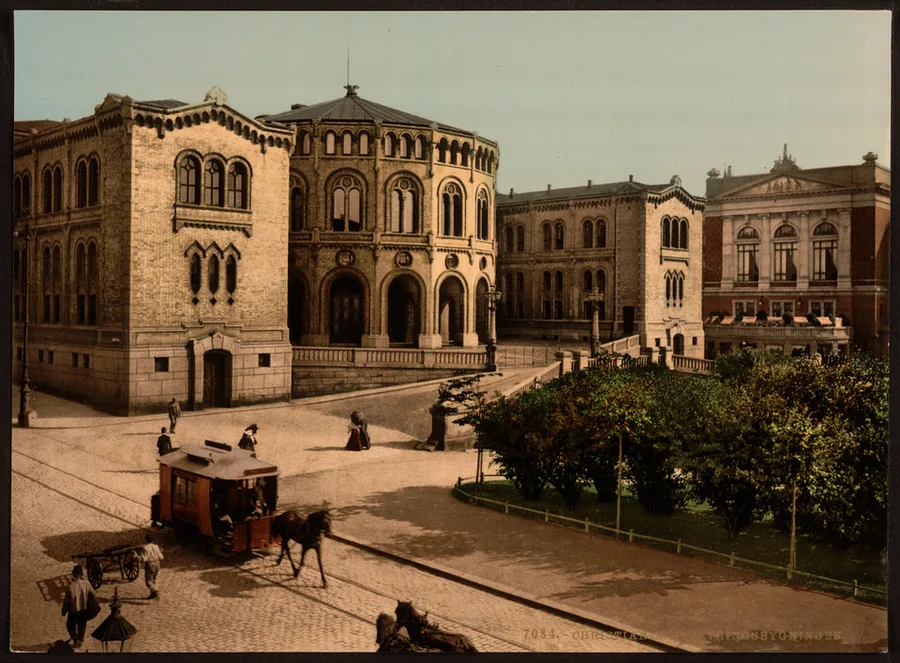 Detroit Publishing Company, Storthings Bygningen, Christiania, Norway (c. 1890-1900), Library of Congress / World Digital Library The Storting building in Kristiania (Oslo), Norway's parliament since the 1814 Constitution and the seat of the legislature that still governs the country. The Grand Assembly — the parliament of independent
Norway, established by the Eidsvoll Constitution of 17 May
1814 as the country's sovereign legislature. The name
Storting (Stór-Þing, the great assembly) deliberately
reaches back to the medieval Norwegian thing tradition,
asserting institutional continuity with the pre-Danish
Norwegian state. Under the 1814 constitution the Storting
divided into two chambers — Lagting and Odelsting —
for legislative purposes; the two-chamber arrangement was
abolished in 2009 and the Storting has been a single
chamber since. The current building, in central Oslo,
opened in 1866.
In this article The Storting passed the Friluftsloven here on 28 June 1957, writing the centuries-old roaming custom into statute. Also discussed in The 400-Year Night — when the Northern Lion lay dormantLutheran Norway and Pietism — a farmer named Hans Nielsen Hauge and a lay revival that could not be silencedThe Constitution That Saved a Nation — five radical weeks at Eidsvoll, 1814The Quiet Revolution — how Norway won its independence without a warThe 'Lucky Country' — the discovery that changed everythingWorld War II — the King’s “No” and the Nazis in NorwayPolitikk — the left, the right, and the Norwegian way on 28 June 1957. It was among the first laws of its kind in the world. What it did, technically, was less of a new invention and more of a ratification — the right had existed for centuries as customary law, traceable in form to Magnus VI Lagabøte
Detroit Publishing Company, Storthings Bygningen, Christiania, Norway (c. 1890-1900), Library of Congress / World Digital Library The Storting building in Kristiania (Oslo), Norway's parliament since the 1814 Constitution and the seat of the legislature that still governs the country. The Grand Assembly — the parliament of independent
Norway, established by the Eidsvoll Constitution of 17 May
1814 as the country's sovereign legislature. The name
Storting (Stór-Þing, the great assembly) deliberately
reaches back to the medieval Norwegian thing tradition,
asserting institutional continuity with the pre-Danish
Norwegian state. Under the 1814 constitution the Storting
divided into two chambers — Lagting and Odelsting —
for legislative purposes; the two-chamber arrangement was
abolished in 2009 and the Storting has been a single
chamber since. The current building, in central Oslo,
opened in 1866.
In this article The Storting passed the Friluftsloven here on 28 June 1957, writing the centuries-old roaming custom into statute. Also discussed in The 400-Year Night — when the Northern Lion lay dormantLutheran Norway and Pietism — a farmer named Hans Nielsen Hauge and a lay revival that could not be silencedThe Constitution That Saved a Nation — five radical weeks at Eidsvoll, 1814The Quiet Revolution — how Norway won its independence without a warThe 'Lucky Country' — the discovery that changed everythingWorld War II — the King’s “No” and the Nazis in NorwayPolitikk — the left, the right, and the Norwegian way on 28 June 1957. It was among the first laws of its kind in the world. What it did, technically, was less of a new invention and more of a ratification — the right had existed for centuries as customary law, traceable in form to Magnus VI Lagabøte 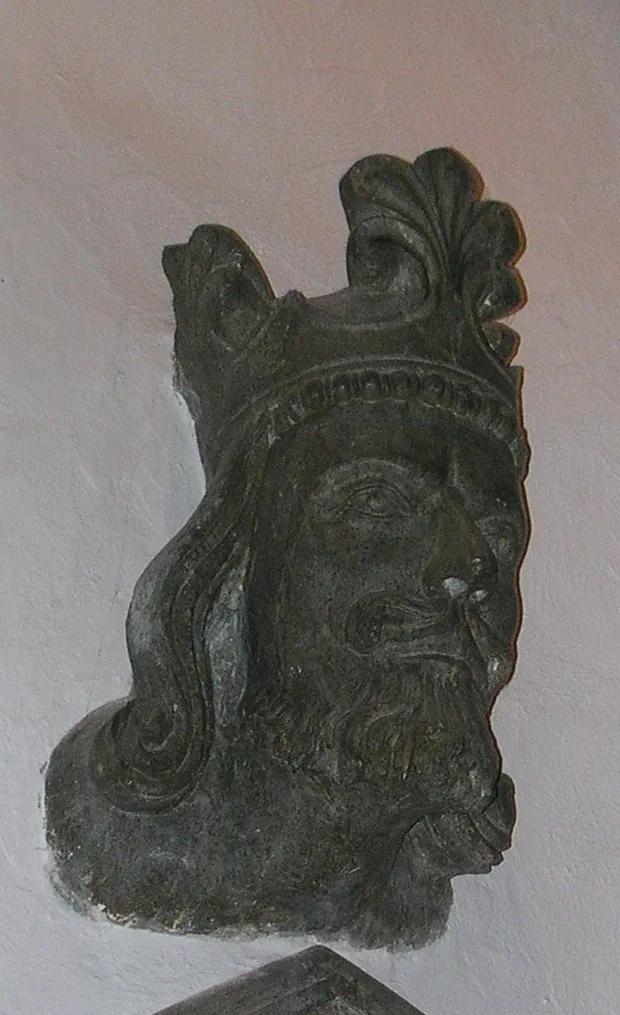 Stone head of Magnus VI Lagabøte (13th c.), Stavanger Cathedral; photo: Gunleiv Hadland (CC BY-SA 3.0) A crowned stone head carved in Stavanger Cathedral within living memory of the king — the nearest thing to a likeness of Magnus VI, the 'Law-mender' whose 1274 national code held as Norway's law for more than four hundred years. King of Norway 1263-1280, bynamed Lagabøte ("Law-mender") in
recognition of his promulgation in 1274 of the Landslov, the
Code of National Law that unified the four regional thing-law
traditions (Gulating, Frostating, Borgarting, Eidsivating) into
a single national code. The Landslov remained the law of Norway
for more than four hundred years and made Norway one of the first
European kingdoms with a unified national legal code.
Also discussed in Before There Was Norway — petty kingdoms at the edge of the worldThe Golden Age — a North Atlantic empire … reaching farther than you thinkThe Long Fall — the sudden loss of Norwegian nobility, the end of the kings, and half of Norway gone foreverThe Germans Who "Ruled" Bergen — the Hanseatic merchants on Bryggen WharfThe 400-Year Night — when the Northern Lion lay dormant Landslov (1274)
Stone head of Magnus VI Lagabøte (13th c.), Stavanger Cathedral; photo: Gunleiv Hadland (CC BY-SA 3.0) A crowned stone head carved in Stavanger Cathedral within living memory of the king — the nearest thing to a likeness of Magnus VI, the 'Law-mender' whose 1274 national code held as Norway's law for more than four hundred years. King of Norway 1263-1280, bynamed Lagabøte ("Law-mender") in
recognition of his promulgation in 1274 of the Landslov, the
Code of National Law that unified the four regional thing-law
traditions (Gulating, Frostating, Borgarting, Eidsivating) into
a single national code. The Landslov remained the law of Norway
for more than four hundred years and made Norway one of the first
European kingdoms with a unified national legal code.
Also discussed in Before There Was Norway — petty kingdoms at the edge of the worldThe Golden Age — a North Atlantic empire … reaching farther than you thinkThe Long Fall — the sudden loss of Norwegian nobility, the end of the kings, and half of Norway gone foreverThe Germans Who "Ruled" Bergen — the Hanseatic merchants on Bryggen WharfThe 400-Year Night — when the Northern Lion lay dormant Landslov (1274) 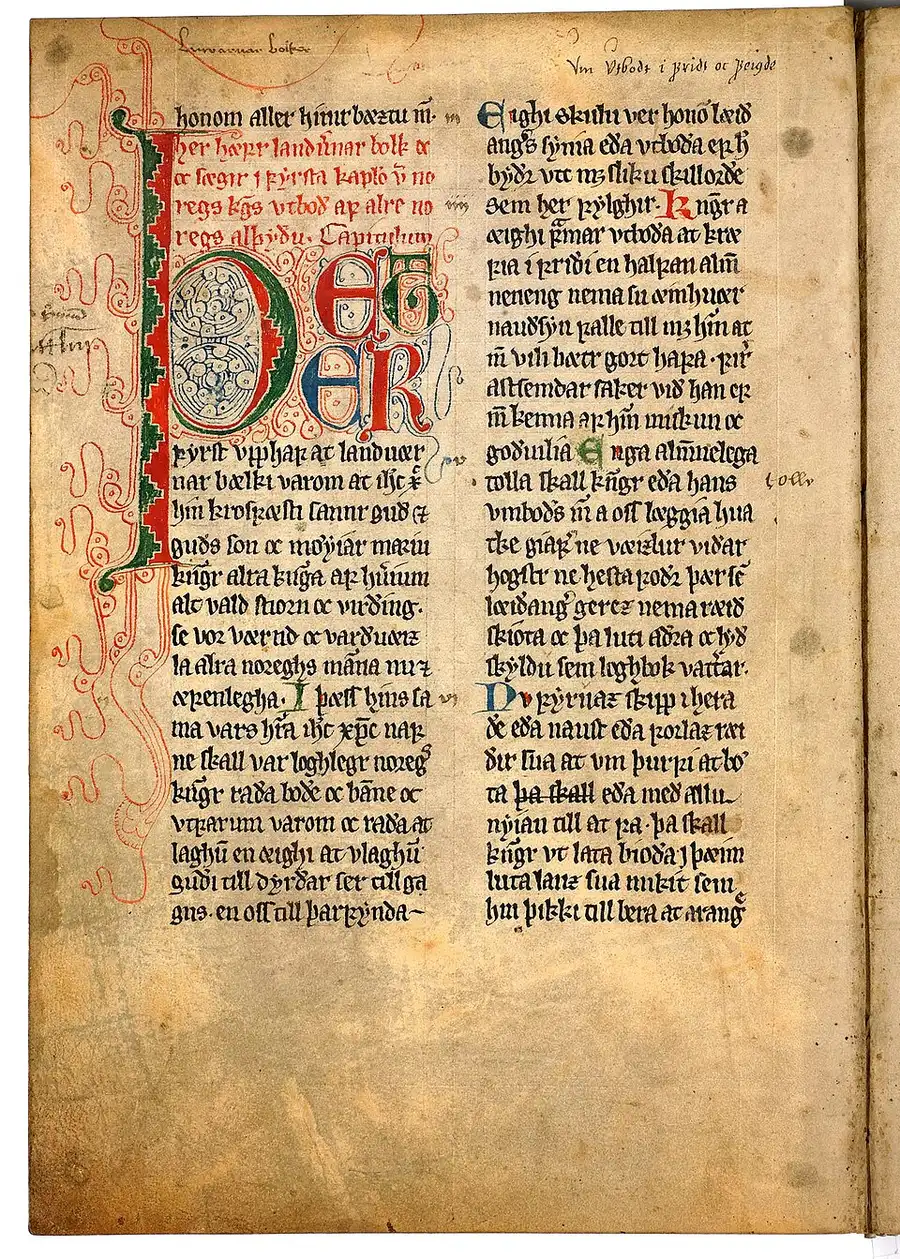 Magnus Lagabøtes landslov, AM 305 fol., fol. 10v (13th-14th c.), via Wikimedia Commons A page from a medieval handwritten copy of Magnus Lagabøte's 1274 law code, its two columns of Old Norse opening the land-defence section beneath a red, green, and blue interlace initial — the national law as scribes preserved it. Norwegian Magnus Lagabøtes landslov — the Code of National Law
promulgated by King Magnus VI Lagabøte in 1274. Unified the four
separate regional thing-law traditions (Gulating, Frostating,
Borgarting, Eidsivating) into a single code applying across the
whole Norwegian kingdom. Made Norway one of the first European
kingdoms with a unified national legal code, decades ahead of
similar developments in England or France. Remained the law of
Norway for more than four hundred years, until Christian V's
Norske Lov superseded it in 1687.
In this article The roaming custom the 1957 Friluftsloven ratified first appears in writing here — the Landslov is the modern statute's seven-century-old ancestor. Also discussed in Before There Was Norway — petty kingdoms at the edge of the worldThe Golden Age — a North Atlantic empire … reaching farther than you thinkThe 400-Year Night — when the Northern Lion lay dormant and probably older in practice. Norwegians had always walked across each other’s utmark (uncultivated outland). The 1957 act moved the custom inside the legal walls before postwar prosperity, fencing, and suburban expansion could erode it.
Magnus Lagabøtes landslov, AM 305 fol., fol. 10v (13th-14th c.), via Wikimedia Commons A page from a medieval handwritten copy of Magnus Lagabøte's 1274 law code, its two columns of Old Norse opening the land-defence section beneath a red, green, and blue interlace initial — the national law as scribes preserved it. Norwegian Magnus Lagabøtes landslov — the Code of National Law
promulgated by King Magnus VI Lagabøte in 1274. Unified the four
separate regional thing-law traditions (Gulating, Frostating,
Borgarting, Eidsivating) into a single code applying across the
whole Norwegian kingdom. Made Norway one of the first European
kingdoms with a unified national legal code, decades ahead of
similar developments in England or France. Remained the law of
Norway for more than four hundred years, until Christian V's
Norske Lov superseded it in 1687.
In this article The roaming custom the 1957 Friluftsloven ratified first appears in writing here — the Landslov is the modern statute's seven-century-old ancestor. Also discussed in Before There Was Norway — petty kingdoms at the edge of the worldThe Golden Age — a North Atlantic empire … reaching farther than you thinkThe 400-Year Night — when the Northern Lion lay dormant and probably older in practice. Norwegians had always walked across each other’s utmark (uncultivated outland). The 1957 act moved the custom inside the legal walls before postwar prosperity, fencing, and suburban expansion could erode it.
The act’s first section states its purpose flatly: to safeguard the public right of access to the countryside and to maintain outdoor recreation as a leisure activity that is healthy, environmentally sound, and gives a sense of well-being.
The line drawn in the law
The mechanism is a single distinction. The act separates all Norwegian land into two categories:
- Innmark — farmyards, gardens, tilled fields, pastures with growing crops, the close-in domestic ground. Private in the ordinary sense.
- Utmark — everything else. Shared.
Since most of Norway is mountain, forest, bog, and rough coast, most of Norway is utmark.
This is the inversion that surprises outsiders. In the American property regime, land is private unless specifically made public — a national park is carved out of the larger sea of private titles. In the Norwegian regime the relationship runs the other way. The wilderness is everyone’s because no one ever wrote it otherwise; what is fenced and private is what had to be argued for.
Why Norwegians treat it as foundational
The thin-soiled, hard-to-farm geography is part of the reason. A country in which only a few percent of the land is arable could not have organized itself around enclosure and the manorial title the way England did. Wood for the winter, fish from the river, berries off the bush, summer pasture for the cow — these had to be reachable. The customary law grew up around that necessity.
The reason it survives now is broader. Allemannsretten is the legal floor under friluftsliv, the open-air life. Take it away and Friluftsliv 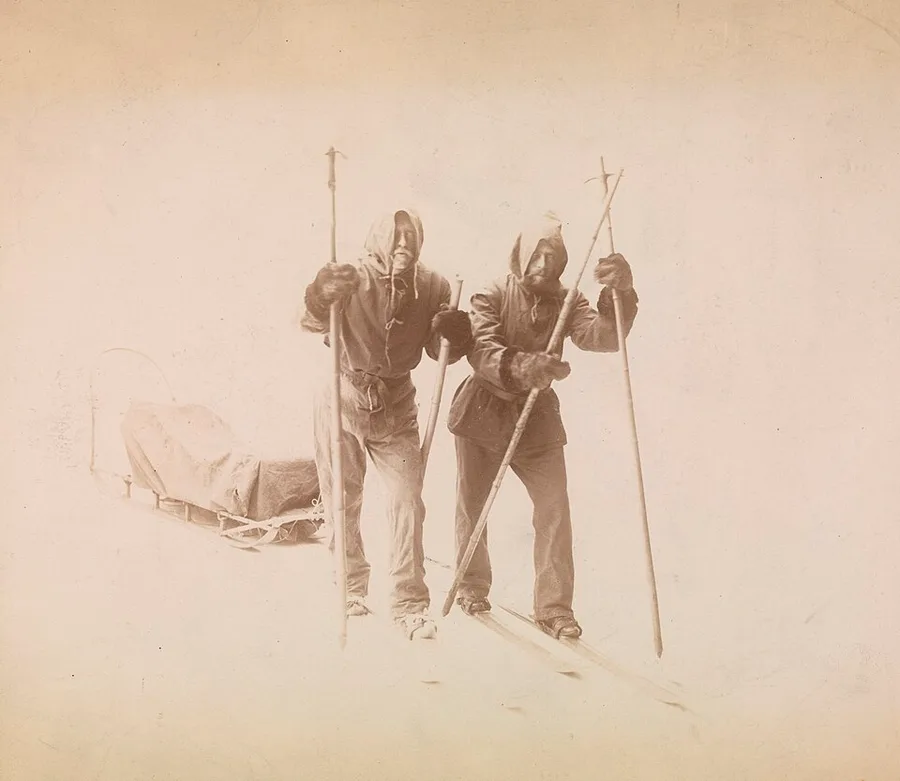 Ludwik Szaciński, Nansen and Sverdrup on skis (1889–90), Nasjonalbiblioteket Fridtjof Nansen, friluftsliv's most visible public advocate, poses on skis with Otto Sverdrup for a studio photograph reconstructing a scene from the 1888 Greenland crossing — the polar exploits that helped turn outdoor life on skis into a national ideal. Norwegian word for time spent outdoors as an ordinary condition of daily life rather than a hobby or a sport — literally "free-air life." Henrik Ibsen coined the term in his 1859 poem Paa Vidderne ("On the Heights"), using the phrase to describe mountain air as a condition for clear thought. The idea became a national project in the second half of the nineteenth century as Norway moved toward independence from Sweden (achieved 1905), with polar explorer Fridtjof Nansen its most visible public advocate. Den Norske Turistforening, founded in 1868, built the trail-and-cabin infrastructure that turned the idea into practice, and the Outdoor Recreation Act of 1957 (friluftsloven) later gave it a legal floor in the right to roam, allemannsretten. In this article Friluftsliv is what the 1957 statute exists to keep possible — with the right to roam in place, most of the country itself functions as the trail; without it, outdoor life shrinks to a permitted, fenced hobby. On the trip The ethos is underfoot rather than named outright on this itinerary: the funicular ascent of Mount Fløyen above Bergen, the quiet platform at Stegastein looking down the Aurlandsfjord, and the walked-over ground of the emptied farm-place at Kylloplass all put the family into the same outdoor-as-ordinary rhythm that friluftsliv describes, even without a hut or a marked trail in sight. Also discussed in Friluftsliv — the open-air life(*Draft)Kos — the warmth of being togetherSøndagstur — the Sunday walk collapses into the American version — the drive to the trailhead, the permit, the parking pass, the marked perimeter. Leave it in place and most of the country itself functions as the trail.
Norwegians wear the right lightly. Nobody explains the law unless asked. Nobody points out that a path leading from the road into someone’s pine forest is open to the walker by statute. It is treated as ordinary, which is how rights this old usually end up.