Lutheran Norway and Pietism — A farmer named Hans Nielsen Hauge and a lay revival that could not be silenced
The Norwegian state church had held a religious monopoly for two and a half centuries when, from inside it, a farmer named Hans Nielsen Hauge built the first and most influential mass lay movement in Norwegian history — at the cost of fourteen arrests and nine years in prison.
On the fifth of April 1796 — two days after his twenty-fifth birthday — a farmer’s son named Hans Nielsen Hauge 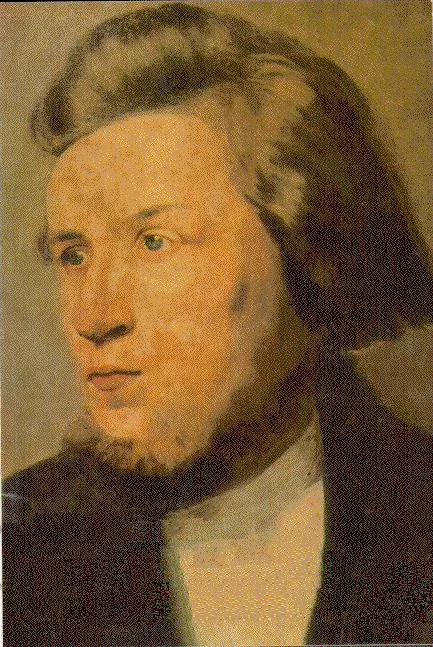 Unknown artist, Portrait of Hans Nielsen Hauge (Copenhagen, c. 1800) The only known original life portrait of Hauge, painted in Copenhagen around 1800 — the farmer's son in his late twenties, midway through the eight walking years in which he preached across Norway and was arrested again and again under the Konventikkelplakaten. Norwegian lay preacher, entrepreneur, and farmer (1771–
1824). The single most influential Norwegian religious
figure of the modern period. Underwent a conversion
experience on his family farm at Rolvsøy in Østfold on 5
April 1796 and spent the next eight years walking across
Norway, preaching and organising lay Christian gatherings
outside the official state church — illegal under the
Konventikkelplakaten of 1741. Arrested fourteen times
across his career; held in prison for roughly nine years
cumulatively — the long final detention, in the Christiania
town prison from 1804 to 1811, was settled at last in 1814
by a judgment reduced to a fine. His followers,
the Haugianere, founded businesses, mills, schools, and
printing presses across nineteenth-century Norway.
Also discussed in The Reformation, 1537 — one church eradicated and another imposed800,000 Norwegians Leave — the century that built a Second NorwayStatskirken — the state church and what's left of it was plowing a field at the family farm in Rolvsøy
Unknown artist, Portrait of Hans Nielsen Hauge (Copenhagen, c. 1800) The only known original life portrait of Hauge, painted in Copenhagen around 1800 — the farmer's son in his late twenties, midway through the eight walking years in which he preached across Norway and was arrested again and again under the Konventikkelplakaten. Norwegian lay preacher, entrepreneur, and farmer (1771–
1824). The single most influential Norwegian religious
figure of the modern period. Underwent a conversion
experience on his family farm at Rolvsøy in Østfold on 5
April 1796 and spent the next eight years walking across
Norway, preaching and organising lay Christian gatherings
outside the official state church — illegal under the
Konventikkelplakaten of 1741. Arrested fourteen times
across his career; held in prison for roughly nine years
cumulatively — the long final detention, in the Christiania
town prison from 1804 to 1811, was settled at last in 1814
by a judgment reduced to a fine. His followers,
the Haugianere, founded businesses, mills, schools, and
printing presses across nineteenth-century Norway.
Also discussed in The Reformation, 1537 — one church eradicated and another imposed800,000 Norwegians Leave — the century that built a Second NorwayStatskirken — the state church and what's left of it was plowing a field at the family farm in Rolvsøy 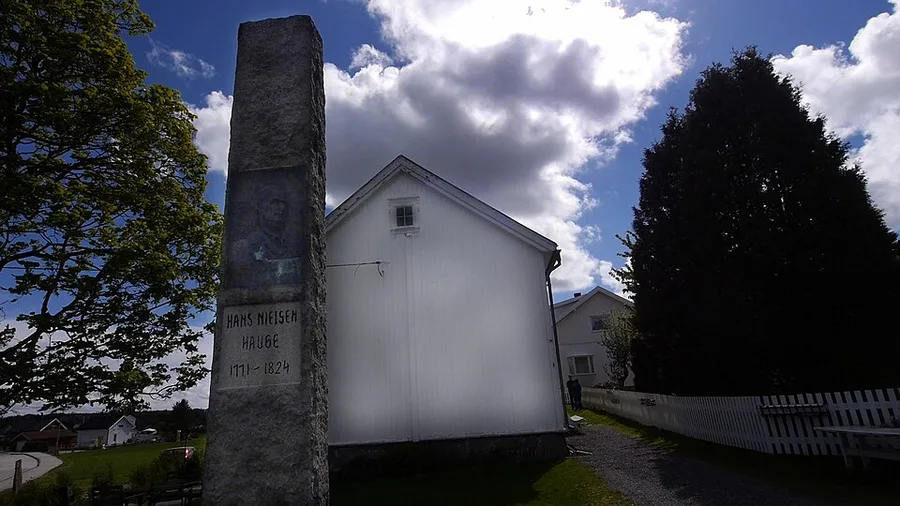 Timfrakes, Hans Nielsen Hauge Birth Home, Rolvsøy (2015), CC BY-SA 4.0 The memorial pillar and museum building at Hauge on Rolvsøy, where Hans Nielsen Hauge was born in 1771 — the farm kept as the memorial museum Hans Nielsen Hauges Minne, whose field was the site of his 5 April 1796 conversion while plowing. Rural district in southeastern Norway, in the old parish of
Tune in Østfold, today part of Fredrikstad municipality
about sixty miles south-southeast of Oslo. Birthplace of
Hans Nielsen Hauge (1771) and the site of his 5 April 1796
conversion experience while plowing the family farm. The
surrounding district carried the earliest concentration of
de vakte — the awakened — and remained a Haugean
heartland through the nineteenth century. The Hauge family
farm at Hauge gård is preserved today as Hans Nielsen
Hauges Minne, a memorial museum on the site of his
childhood home and conversion.
, the old parish of Tune some sixty miles south-southeast of present-day Oslo
Timfrakes, Hans Nielsen Hauge Birth Home, Rolvsøy (2015), CC BY-SA 4.0 The memorial pillar and museum building at Hauge on Rolvsøy, where Hans Nielsen Hauge was born in 1771 — the farm kept as the memorial museum Hans Nielsen Hauges Minne, whose field was the site of his 5 April 1796 conversion while plowing. Rural district in southeastern Norway, in the old parish of
Tune in Østfold, today part of Fredrikstad municipality
about sixty miles south-southeast of Oslo. Birthplace of
Hans Nielsen Hauge (1771) and the site of his 5 April 1796
conversion experience while plowing the family farm. The
surrounding district carried the earliest concentration of
de vakte — the awakened — and remained a Haugean
heartland through the nineteenth century. The Hauge family
farm at Hauge gård is preserved today as Hans Nielsen
Hauges Minne, a memorial museum on the site of his
childhood home and conversion.
, the old parish of Tune some sixty miles south-southeast of present-day Oslo 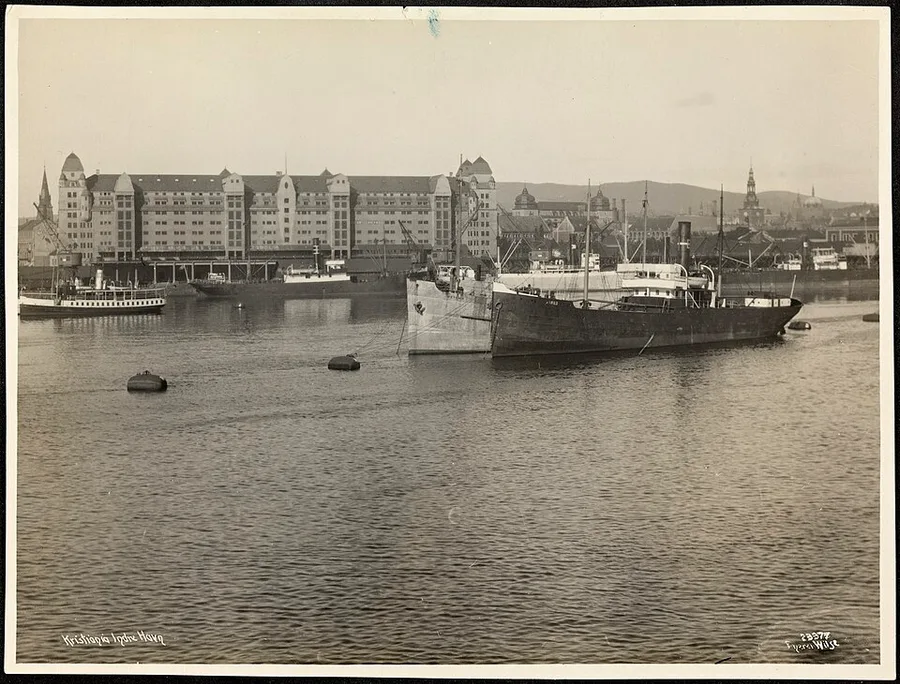 Anders Beer Wilse, Kristiania Indre Havn (1923), National Library of Norway Wilse's 1923 photograph of the inner harbor at Bjørvika, two years before Kristiania took back its old name Oslo — steamers at the quays beneath the spires of the city that grew from a medieval royal seat into Norway's capital. Capital of modern Norway, at the head of the Oslofjord on
the country's southeastern coast. Founded according to the
sagas by Harald Hardrada about 1049 and known through the
medieval period as a secondary royal seat behind Bergen and
Nidaros. Hákon V moved the royal residence permanently to
Oslo about 1300 and built Akershus Fortress to guard the
harbour. After a fire in 1624 the medieval town was
abandoned and Christian IV rebuilt the city to the west
under the new name Christiania (later Kristiania); the
name Oslo was restored in 1925. The original medieval
street pattern survives as the Gamlebyen district east of
the modern centre.
On the trip Days 1–2 belong to Oslo, with both groups together —
Roseslottet and the harbourside museums on Day 1, then the
Day-2 e-bike tour through Akershus Fortress, up Karl Johans
gate, and out to Vigeland Park.
Oslo Also discussed in The Long Fall — the sudden loss of Norwegian nobility, the end of the kings, and half of Norway gone foreverA Catholic Norway — the faith that gave the kingdom its first institutions and the stave churchesThe 400-Year Night — when the Northern Lion lay dormantThe Reformation, 1537 — one church eradicated and another imposedThe Constitution That Saved a Nation — five radical weeks at Eidsvoll, 1814800,000 Norwegians Leave — the century that built a Second NorwayThe Quiet Revolution — how Norway won its independence without a warWorld War II — the King’s “No” and the Nazis in NorwayAlcohol and Vinmonopolet — when and where to buy a drinkEveryday etiquette — quiet voices, wide space, no smiling🚨 Emergencies - important numbers, hospitals, and what you can doLanding in Norway — off the plane in Oslo, where to go, step by stepMoney — currency, cards, prices, and tipping . He was singing a Pietism
Anders Beer Wilse, Kristiania Indre Havn (1923), National Library of Norway Wilse's 1923 photograph of the inner harbor at Bjørvika, two years before Kristiania took back its old name Oslo — steamers at the quays beneath the spires of the city that grew from a medieval royal seat into Norway's capital. Capital of modern Norway, at the head of the Oslofjord on
the country's southeastern coast. Founded according to the
sagas by Harald Hardrada about 1049 and known through the
medieval period as a secondary royal seat behind Bergen and
Nidaros. Hákon V moved the royal residence permanently to
Oslo about 1300 and built Akershus Fortress to guard the
harbour. After a fire in 1624 the medieval town was
abandoned and Christian IV rebuilt the city to the west
under the new name Christiania (later Kristiania); the
name Oslo was restored in 1925. The original medieval
street pattern survives as the Gamlebyen district east of
the modern centre.
On the trip Days 1–2 belong to Oslo, with both groups together —
Roseslottet and the harbourside museums on Day 1, then the
Day-2 e-bike tour through Akershus Fortress, up Karl Johans
gate, and out to Vigeland Park.
Oslo Also discussed in The Long Fall — the sudden loss of Norwegian nobility, the end of the kings, and half of Norway gone foreverA Catholic Norway — the faith that gave the kingdom its first institutions and the stave churchesThe 400-Year Night — when the Northern Lion lay dormantThe Reformation, 1537 — one church eradicated and another imposedThe Constitution That Saved a Nation — five radical weeks at Eidsvoll, 1814800,000 Norwegians Leave — the century that built a Second NorwayThe Quiet Revolution — how Norway won its independence without a warWorld War II — the King’s “No” and the Nazis in NorwayAlcohol and Vinmonopolet — when and where to buy a drinkEveryday etiquette — quiet voices, wide space, no smiling🚨 Emergencies - important numbers, hospitals, and what you can doLanding in Norway — off the plane in Oslo, where to go, step by stepMoney — currency, cards, prices, and tipping . He was singing a Pietism 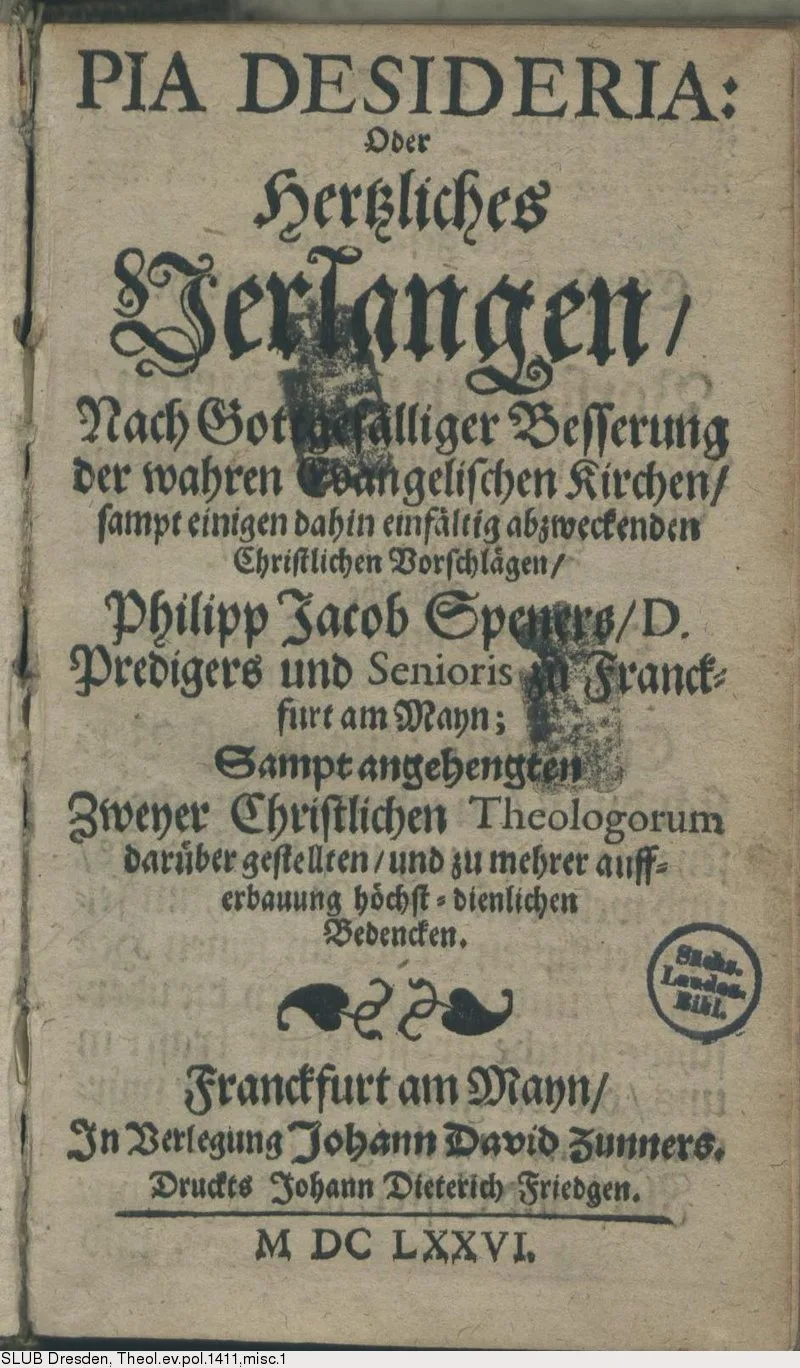 Title page, Pia Desideria (Frankfurt, 1676), Deutsches Textarchiv The title page of Spener's 1675/76 manifesto Pia Desideria, the founding document of Pietism, whose proposed reforms — lay Bible reading, the priesthood of all believers, devotion over doctrine — set the movement's programme in motion. Reform movement within Lutheranism that began in late-
seventeenth-century Germany and spread across Lutheran
Europe in the eighteenth and nineteenth centuries. Founded
by the pastor Philipp Jakob Spener — whose manifesto Pia
Desideria (1675) set its programme — and organised
institutionally by August Hermann Francke at the University
of Halle from the 1690s.
Where the established Lutheran church organised religious
life around right doctrine, the sacrament, and the parish,
Pietism placed its weight on personal conversion,
devotional reading at home, hymn-singing, the active role
of the laity, and the small lay gathering. Reached
Denmark-Norway under King Christian VI (r. 1730–1746) and
erupted as a popular lay movement at the turn of the
nineteenth century under Hans Nielsen Hauge.
Also discussed in Identitet — what it means to be NorwegianJanteloven — no one is better than anyone else hymn as he worked, the German devotional current of the previous century reaching the Norwegian farmer in the words he had in his mouth, when he was overcome. What he later described was a lifting of the mind to God beyond anything his own tongue could express, a direct conviction of the personal love of God and of his own calling to bear witness to it. He stopped plowing. He went home. Within two months he had written a short book about the experience, Betragtning over Verdens Daarlighed — Consideration of the World’s Folly — and had begun walking through the surrounding district, reading from it and preaching personal conversion to anyone who would listen.
Title page, Pia Desideria (Frankfurt, 1676), Deutsches Textarchiv The title page of Spener's 1675/76 manifesto Pia Desideria, the founding document of Pietism, whose proposed reforms — lay Bible reading, the priesthood of all believers, devotion over doctrine — set the movement's programme in motion. Reform movement within Lutheranism that began in late-
seventeenth-century Germany and spread across Lutheran
Europe in the eighteenth and nineteenth centuries. Founded
by the pastor Philipp Jakob Spener — whose manifesto Pia
Desideria (1675) set its programme — and organised
institutionally by August Hermann Francke at the University
of Halle from the 1690s.
Where the established Lutheran church organised religious
life around right doctrine, the sacrament, and the parish,
Pietism placed its weight on personal conversion,
devotional reading at home, hymn-singing, the active role
of the laity, and the small lay gathering. Reached
Denmark-Norway under King Christian VI (r. 1730–1746) and
erupted as a popular lay movement at the turn of the
nineteenth century under Hans Nielsen Hauge.
Also discussed in Identitet — what it means to be NorwegianJanteloven — no one is better than anyone else hymn as he worked, the German devotional current of the previous century reaching the Norwegian farmer in the words he had in his mouth, when he was overcome. What he later described was a lifting of the mind to God beyond anything his own tongue could express, a direct conviction of the personal love of God and of his own calling to bear witness to it. He stopped plowing. He went home. Within two months he had written a short book about the experience, Betragtning over Verdens Daarlighed — Consideration of the World’s Folly — and had begun walking through the surrounding district, reading from it and preaching personal conversion to anyone who would listen.
He had no theological training and had not been ordained. Under the law of the country, what he was doing was a crime. He was arrested for the first time within a year, and over his lifetime he would be arrested fourteen times and held in prison for roughly nine years. He never formally left the Lutheran church. The movement he built inside it became the first and most influential mass lay movement in Norwegian history, crossed the Atlantic in the emigrants’ luggage, and outlasted the state church that imprisoned him.
The state church Hauge confronted
The institution Hauge ran up against was the Den norske kirke 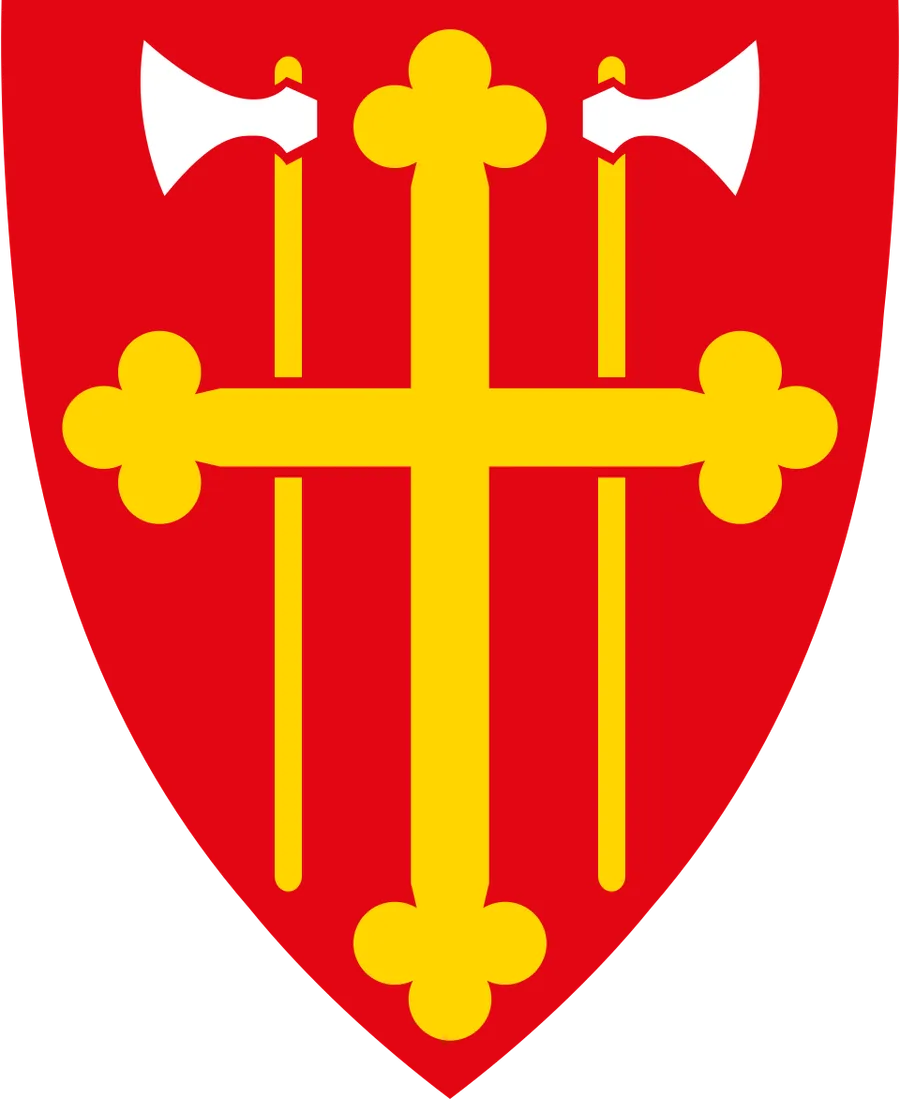 Church of Norway official coat of arms (kirken.no) The modern emblem of the institution the Kirkeordinansen of 1537 created: a gold cross over the two silver axes of Saint Olav on a red shield — the royal-Lutheran continuity the ordinance built when it made the church a state institution under the crown. The Church of Norway — the Lutheran state church
established by the Kirkeordinansen of 1537 as the religious
arm of the Danish-Norwegian crown. From 1537 every
Norwegian parish was administered by a state-appointed
Lutheran pastor financed through royal taxation; the
bishops (initially called superintendents) were appointed
by the king and their offices were branches of the royal
government. The arrangement operated essentially unchanged
for four hundred and eighty years through Danish rule, the
1814 constitutional transition, and the personal union with
Sweden, into the modern Norwegian state. A 2012
constitutional amendment ended the state religion, and on
1 January 2017 the church became a separate legal entity —
no longer the state church, still the national folk
church.
Also discussed in The Reformation, 1537 — one church eradicated and another imposedWorld War II — the King’s “No” and the Nazis in NorwayStatskirken — the state church and what's left of it , the Norwegian Lutheran establishment created by royal decree in 1537. From that year the church was a branch of the Danish royal government, and from 1814 a branch of the new Norwegian state. Its shape on the ground was the same throughout: the parish pastor was a state official, trained at the Danish university, paid from public funds, holding a civil rank alongside the schoolteacher and the tax collector. The parish register in which he recorded every baptism, marriage, burial, and confirmation was a legal document of the state, admissible in court and used in administrative proceedings. The bishop’s pastoral letters were read aloud in every church in his diocese on the Sunday assigned for them. The Lutheran liturgical year set the official calendar, and the service was conducted in Danish — the written language of church and state across the whole period.
Church of Norway official coat of arms (kirken.no) The modern emblem of the institution the Kirkeordinansen of 1537 created: a gold cross over the two silver axes of Saint Olav on a red shield — the royal-Lutheran continuity the ordinance built when it made the church a state institution under the crown. The Church of Norway — the Lutheran state church
established by the Kirkeordinansen of 1537 as the religious
arm of the Danish-Norwegian crown. From 1537 every
Norwegian parish was administered by a state-appointed
Lutheran pastor financed through royal taxation; the
bishops (initially called superintendents) were appointed
by the king and their offices were branches of the royal
government. The arrangement operated essentially unchanged
for four hundred and eighty years through Danish rule, the
1814 constitutional transition, and the personal union with
Sweden, into the modern Norwegian state. A 2012
constitutional amendment ended the state religion, and on
1 January 2017 the church became a separate legal entity —
no longer the state church, still the national folk
church.
Also discussed in The Reformation, 1537 — one church eradicated and another imposedWorld War II — the King’s “No” and the Nazis in NorwayStatskirken — the state church and what's left of it , the Norwegian Lutheran establishment created by royal decree in 1537. From that year the church was a branch of the Danish royal government, and from 1814 a branch of the new Norwegian state. Its shape on the ground was the same throughout: the parish pastor was a state official, trained at the Danish university, paid from public funds, holding a civil rank alongside the schoolteacher and the tax collector. The parish register in which he recorded every baptism, marriage, burial, and confirmation was a legal document of the state, admissible in court and used in administrative proceedings. The bishop’s pastoral letters were read aloud in every church in his diocese on the Sunday assigned for them. The Lutheran liturgical year set the official calendar, and the service was conducted in Danish — the written language of church and state across the whole period.
Membership was not a choice. Every Norwegian was baptised into the church as an infant, examined on the catechism, and confirmed as a teenager. Konfirmasjonsforordningen 1736 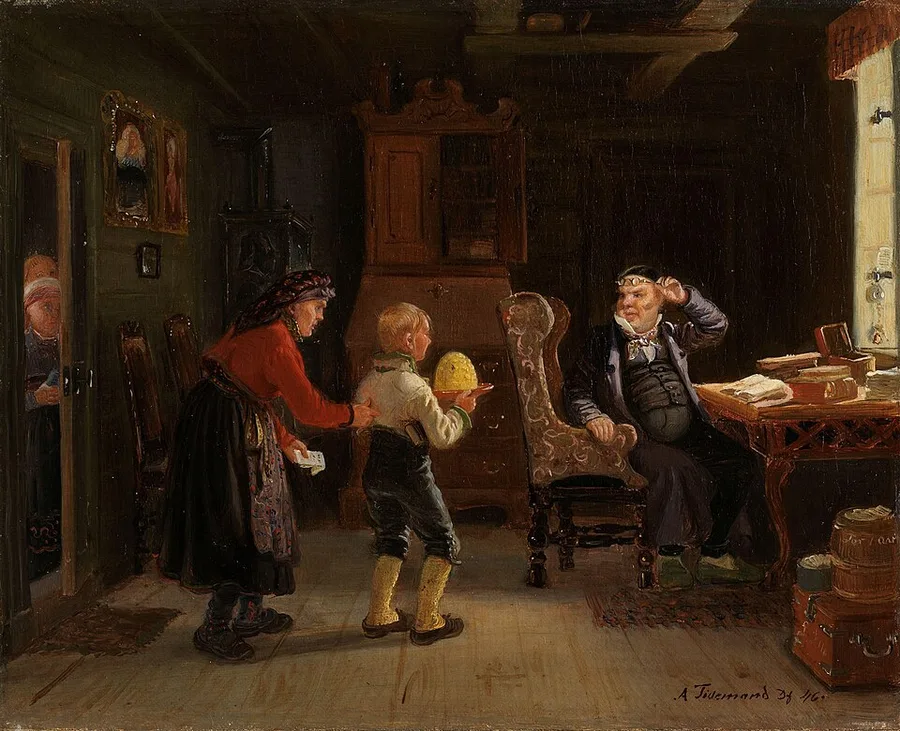 Adolph Tidemand, Anmeldelse til konfirmasjon (1846), Nasjonalmuseet Tidemand's 1846 painting shows a mother registering her son with the parish pastor ahead of the oral confirmation examination the 1736 ordinance required of every fourteen- or fifteen-year-old in Denmark-Norway. The Confirmation Decree of 1736 — the royal ordinance of
Christian VI of Denmark-Norway, dated 13 January 1736,
making Lutheran confirmation compulsory for every subject
of his kingdoms at fourteen or fifteen years old. The
ordinance specified the doctrinal instruction (Pontoppidan's
catechism, which followed in 1737), the public oral
examination by the parish pastor, and the civil
consequences of refusal — no marriage, no military service,
no apprenticeship, no inheritance, no work outside the
parish — for any adult who had not been confirmed. The
decree marked the institutional return of personal interior
faith to Danish-Norwegian Lutheran practice, two centuries
after the imposed Reformation, and shaped Scandinavian
religious culture for the next two centuries.
Also discussed in The Reformation, 1537 — one church eradicated and another imposed , was a precondition for adulthood: without it a young Norwegian could not marry, could not enter many trades, could not testify under oath. Universal schooling, introduced three years later in 1739, was justified by the need to prepare every child for confirmation — the catechism class was the original Norwegian classroom. To be Norwegian was to be Lutheran; the two facts were administered through the same parish office.
Adolph Tidemand, Anmeldelse til konfirmasjon (1846), Nasjonalmuseet Tidemand's 1846 painting shows a mother registering her son with the parish pastor ahead of the oral confirmation examination the 1736 ordinance required of every fourteen- or fifteen-year-old in Denmark-Norway. The Confirmation Decree of 1736 — the royal ordinance of
Christian VI of Denmark-Norway, dated 13 January 1736,
making Lutheran confirmation compulsory for every subject
of his kingdoms at fourteen or fifteen years old. The
ordinance specified the doctrinal instruction (Pontoppidan's
catechism, which followed in 1737), the public oral
examination by the parish pastor, and the civil
consequences of refusal — no marriage, no military service,
no apprenticeship, no inheritance, no work outside the
parish — for any adult who had not been confirmed. The
decree marked the institutional return of personal interior
faith to Danish-Norwegian Lutheran practice, two centuries
after the imposed Reformation, and shaped Scandinavian
religious culture for the next two centuries.
Also discussed in The Reformation, 1537 — one church eradicated and another imposed , was a precondition for adulthood: without it a young Norwegian could not marry, could not enter many trades, could not testify under oath. Universal schooling, introduced three years later in 1739, was justified by the need to prepare every child for confirmation — the catechism class was the original Norwegian classroom. To be Norwegian was to be Lutheran; the two facts were administered through the same parish office.
The church also held a legal monopoly. No other religion could operate inside the country. Catholic priests who attempted to organise were expelled — the law threatened worse. Quakers were prosecuted. The 1741 Konventikkelplakaten The Conventicle Ordinance — the royal decree of 13 January 1741 by Christian VI of Denmark-Norway regulating private religious gatherings within his kingdoms. The Ordinance permitted lay devotional meetings on the condition that the parish pastor supervised them; any unsupervised conventicle was a criminal act, punishable by fines and imprisonment. Originally framed as a Pietist instrument to channel lay devotion through the parish, the Ordinance became within a generation the chief legal tool for suppressing the lay revival it had been written to support. Hans Nielsen Hauge was arrested fourteen times under it. The crown vetoed the Storting's first two repeal passages in 1836 and 1839; on the third passage in 1842 the veto was exhausted and the Ordinance fell. Also discussed in 800,000 Norwegians Leave — the century that built a Second Norway — prohibited any religious gathering not supervised by the local parish pastor, which made an unlicensed prayer meeting in a farmhouse a criminal act. This was the law under which Hauge would be arrested again and again. The monopoly did not begin to lift until the Dissenter Act Dissenterloven — the Norwegian Storting act of 16 July 1845 permitting non-Lutheran Christian congregations to organise legally for the first time since the 1537 Reformation. The Act allowed Catholics, Quakers, Baptists, Methodists, and other Christian groups to establish congregations, conduct their own worship, baptise and bury their members, and educate their children — subject to registration with the state and the continued legal monopoly of the Den norske kirke over civil-rite functions. The Act did not extend to non-Christian religions; the constitutional ban on Jewish settlement remained in force until 1851. The first major legal loosening of the three-century Lutheran establishment. Also discussed in 800,000 Norwegians Leave — the century that built a Second Norway permitted non-Lutheran Christians to organise legal congregations, and the constitutional clause barring Jewish settlement was not removed until 1851.
Pietism and its journey north
The current that Hauge drew on had a long history before him. Pietism began as a reform movement inside Lutheranism in late-seventeenth-century Germany, in the writings of the pastor Philipp Jakob Spener 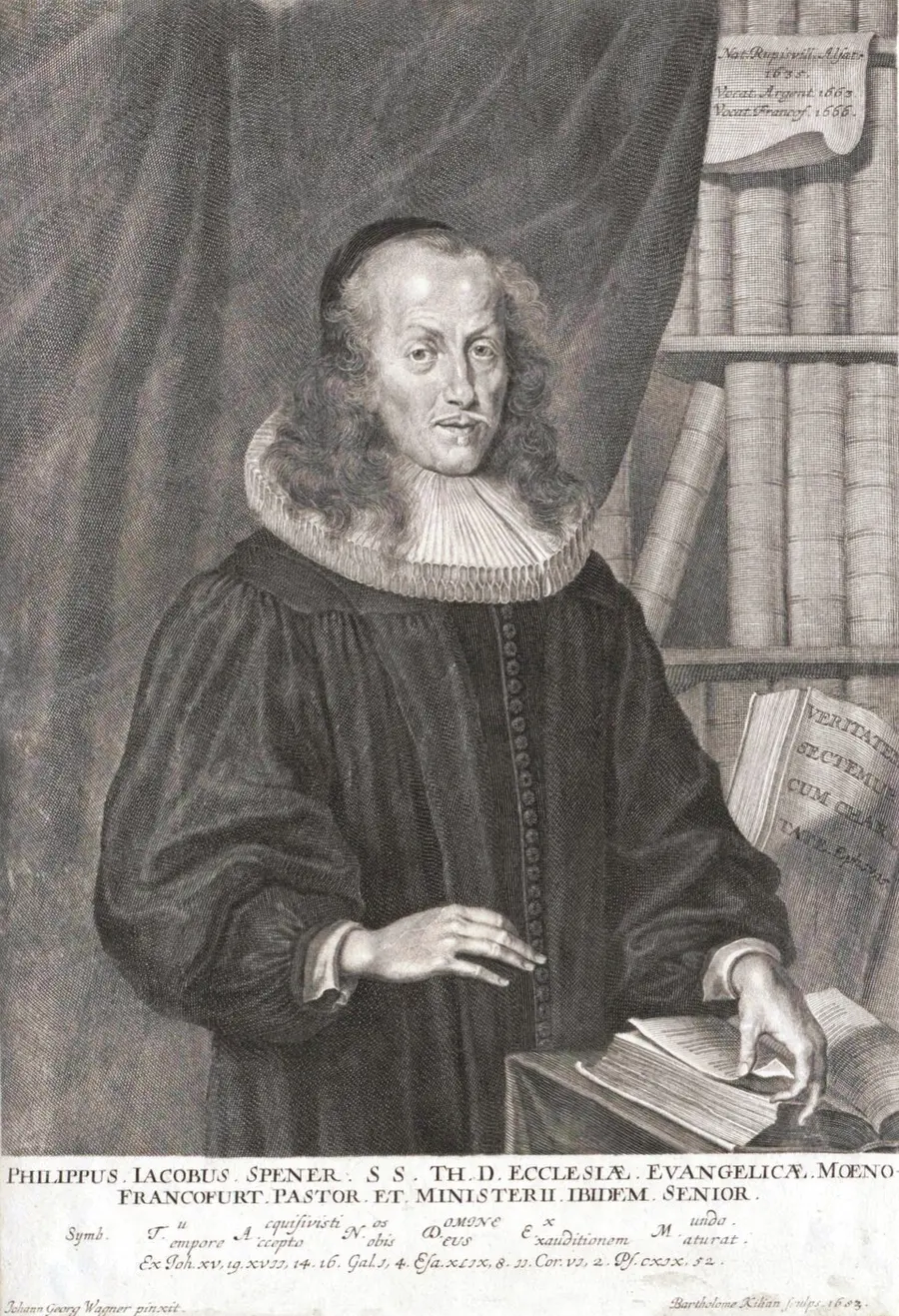 Bartholomäus Kilian, Portrait of Philipp Jacob Spener (1683) An engraved life portrait of Philipp Jakob Spener, the Frankfurt pastor whose 1675 Pia Desideria founded the Pietist movement that reshaped Lutheran practice in Denmark-Norway. German Lutheran theologian (1635–1705), founder of the
Pietist reform movement within Lutheranism. Born in Alsace
and trained at Strasbourg; spent his career as senior
pastor at Frankfurt am Main, court preacher at Dresden, and
finally consistorial provost at Berlin. His 1675 manifesto
Pia Desideria — Pious Desires — proposed six reforms to
the established Lutheran church: more extensive use of
scripture, the practical exercise of the priesthood of all
believers, the practice of Christianity as a daily life
rather than mere knowledge, restraint in religious
controversy, the reform of theological education toward
piety, and preaching aimed at conviction. Out of his
programme grew the Pietism that reshaped German and
Scandinavian Lutheran practice.
and the Halle
Bartholomäus Kilian, Portrait of Philipp Jacob Spener (1683) An engraved life portrait of Philipp Jakob Spener, the Frankfurt pastor whose 1675 Pia Desideria founded the Pietist movement that reshaped Lutheran practice in Denmark-Norway. German Lutheran theologian (1635–1705), founder of the
Pietist reform movement within Lutheranism. Born in Alsace
and trained at Strasbourg; spent his career as senior
pastor at Frankfurt am Main, court preacher at Dresden, and
finally consistorial provost at Berlin. His 1675 manifesto
Pia Desideria — Pious Desires — proposed six reforms to
the established Lutheran church: more extensive use of
scripture, the practical exercise of the priesthood of all
believers, the practice of Christianity as a daily life
rather than mere knowledge, restraint in religious
controversy, the reform of theological education toward
piety, and preaching aimed at conviction. Out of his
programme grew the Pietism that reshaped German and
Scandinavian Lutheran practice.
and the Halle 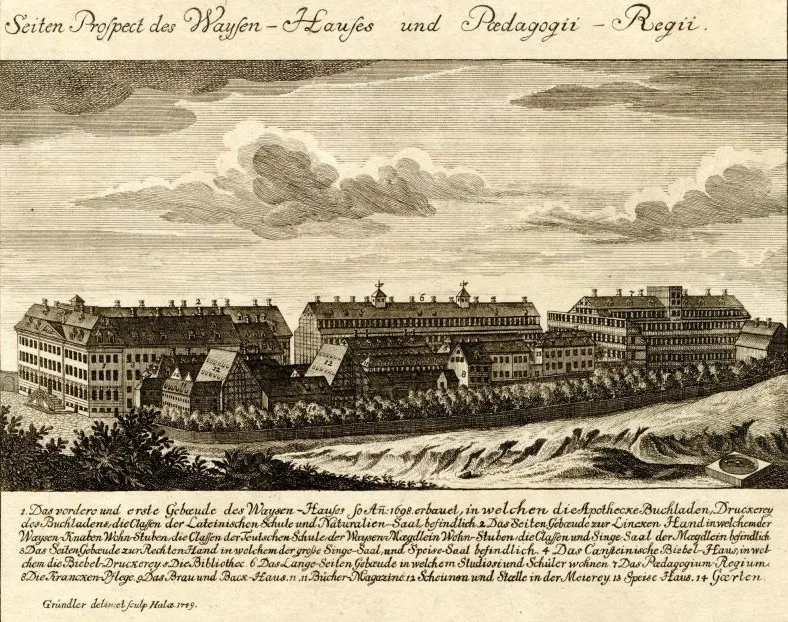 Gottfried August Gründler, Die Franckeschen Stiftungen zu Halle (1749) Gründler's 1749 engraving of Francke's orphanage-school-and-press complex at Halle, which trained the Pietist pastors and missionaries who carried the movement into Christian VI's Denmark-Norway. City on the Saale river in central Germany. Seat of the
University of Halle, founded 1694, which under August
Hermann Francke (chair from 1692) became the institutional
centre of German Pietism. Francke's complex of orphanages,
schools, pharmacy, and printing press — the Franckesche
Stiftungen, the Francke Foundations — operated from
Halle from 1698 onward as the headquarters of the
international Pietist movement. Halle-trained pastors and
missionaries carried the Pietist programme to Denmark-
Norway under Christian VI, to the Lutheran lands of central
Europe, and across the Atlantic to the German Lutheran
settlements of Pennsylvania. The University and the
Foundations remain in operation; the Francke complex is a
UNESCO World Heritage tentative-list site.
theologian August Hermann Francke
Gottfried August Gründler, Die Franckeschen Stiftungen zu Halle (1749) Gründler's 1749 engraving of Francke's orphanage-school-and-press complex at Halle, which trained the Pietist pastors and missionaries who carried the movement into Christian VI's Denmark-Norway. City on the Saale river in central Germany. Seat of the
University of Halle, founded 1694, which under August
Hermann Francke (chair from 1692) became the institutional
centre of German Pietism. Francke's complex of orphanages,
schools, pharmacy, and printing press — the Franckesche
Stiftungen, the Francke Foundations — operated from
Halle from 1698 onward as the headquarters of the
international Pietist movement. Halle-trained pastors and
missionaries carried the Pietist programme to Denmark-
Norway under Christian VI, to the Lutheran lands of central
Europe, and across the Atlantic to the German Lutheran
settlements of Pennsylvania. The University and the
Foundations remain in operation; the Francke complex is a
UNESCO World Heritage tentative-list site.
theologian August Hermann Francke 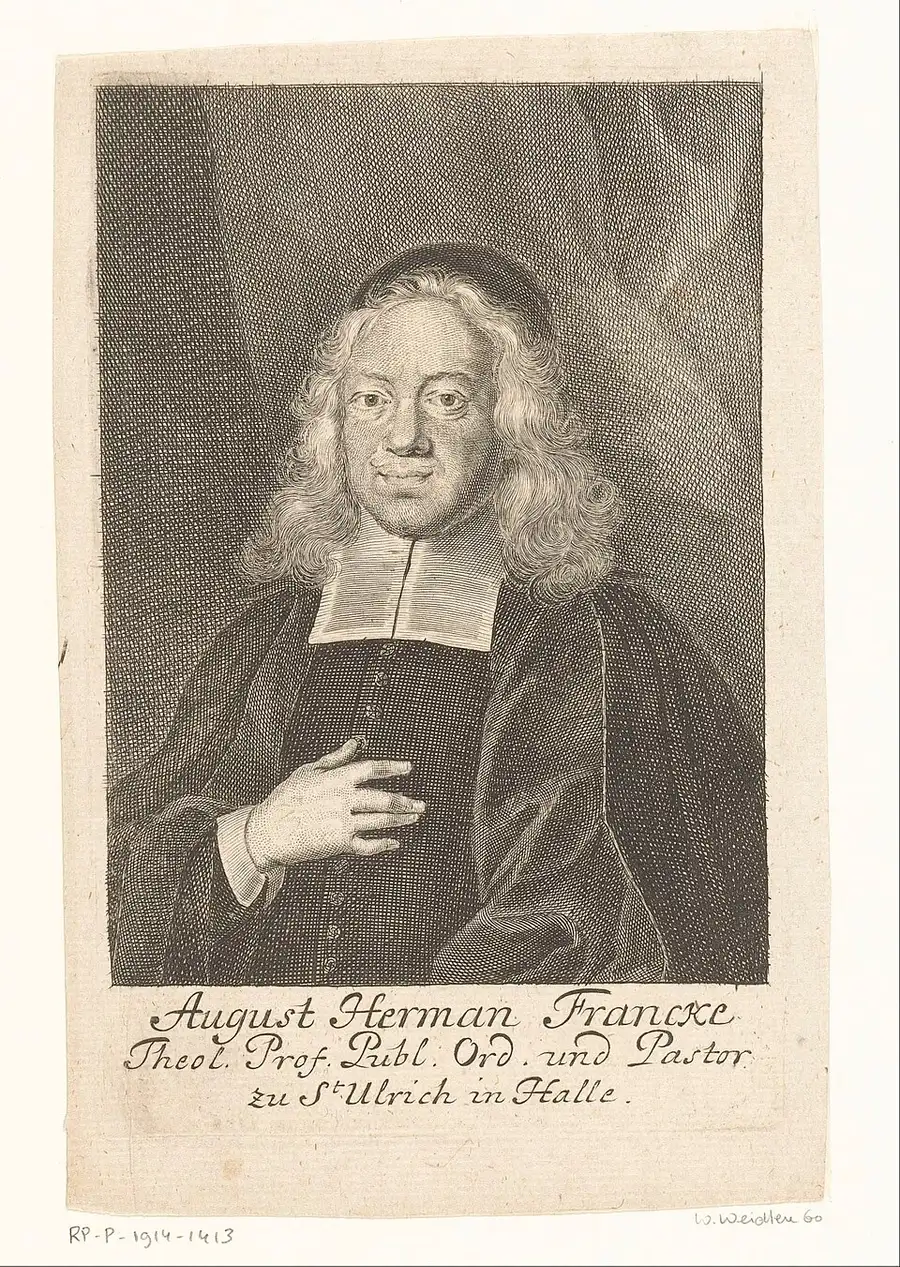 Martin Bernigeroth, Portret van August Hermann Francke (1724), Rijksmuseum A life portrait of August Hermann Francke, the Halle theologian who built the Francke Foundations into the organisational centre of German Pietism and trained the missionaries who carried it to Denmark-Norway. German Lutheran theologian (1663–1727), the principal
second-generation organiser of Pietism. Born in Lübeck;
underwent a dramatic conversion experience in 1687. Took
the chair of biblical languages at the new Pietist-founded
University of Halle in 1692 and remained there for thirty-
five years. Built at Halle the Franckesche Stiftungen —
the Francke Foundations — a complex of orphanages,
schools, a pharmacy, and a printing press that became the
organisational centre of German Pietism and the model for
Lutheran charitable institutions across northern Europe.
Halle-trained graduates carried the Pietist programme to
Denmark-Norway under Christian VI and to North America
through the Salzburger exiles of the 1730s.
. Where the established Lutheran church organised religious life around right doctrine, the sacrament, and the parish, Pietism placed its weight on personal conversion, devotional reading at home, hymn-singing, the active role of the laity, and the small lay gathering. It treated Christianity as something practised every day of the week and inside every household, not only on Sunday and inside the church. Its devotional instinct reached back through older Christian traditions of personal piety — the Imitatio Christi, the medieval lay devotions — that pre-dated the Reformation entirely.
Martin Bernigeroth, Portret van August Hermann Francke (1724), Rijksmuseum A life portrait of August Hermann Francke, the Halle theologian who built the Francke Foundations into the organisational centre of German Pietism and trained the missionaries who carried it to Denmark-Norway. German Lutheran theologian (1663–1727), the principal
second-generation organiser of Pietism. Born in Lübeck;
underwent a dramatic conversion experience in 1687. Took
the chair of biblical languages at the new Pietist-founded
University of Halle in 1692 and remained there for thirty-
five years. Built at Halle the Franckesche Stiftungen —
the Francke Foundations — a complex of orphanages,
schools, a pharmacy, and a printing press that became the
organisational centre of German Pietism and the model for
Lutheran charitable institutions across northern Europe.
Halle-trained graduates carried the Pietist programme to
Denmark-Norway under Christian VI and to North America
through the Salzburger exiles of the 1730s.
. Where the established Lutheran church organised religious life around right doctrine, the sacrament, and the parish, Pietism placed its weight on personal conversion, devotional reading at home, hymn-singing, the active role of the laity, and the small lay gathering. It treated Christianity as something practised every day of the week and inside every household, not only on Sunday and inside the church. Its devotional instinct reached back through older Christian traditions of personal piety — the Imitatio Christi, the medieval lay devotions — that pre-dated the Reformation entirely.
Pietism reached Denmark-Norway in the early eighteenth century and found royal favour under King Christian VI of Denmark-Norway 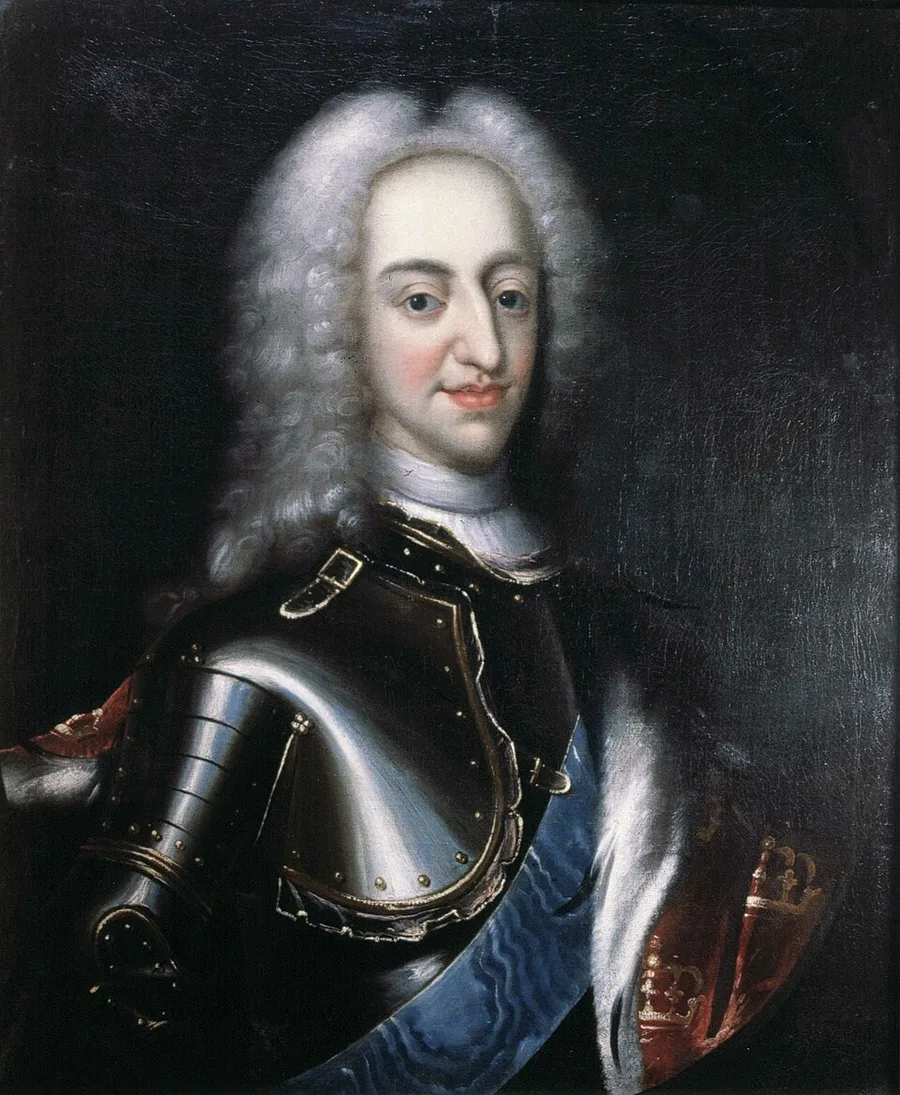 Anonymous, Portrait of Christian VI of Denmark (c. 1730-1740), Oslo Museum Christian VI, the Pietist king who made Lutheran confirmation compulsory nationwide in his 1736 decree, reshaping how ordinary Norwegians experienced faith two centuries after the Reformation was first imposed from above. King of Denmark and Norway (1699–1746), reigned 1730–1746.
A deeply Pietist king whose reign reshaped the religious
life of his realms in the direction of personal interior
faith — the second great transformation of Scandinavian
Lutheranism after Christian III's 1537 imposition. He made
Sunday church attendance compulsory in 1735, introduced
compulsory Lutheran confirmation in January 1736 (the
Konfirmasjonsforordningen), and supported the publication
of Erik Pontoppidan's Sandhed til Gudfrygtighed in 1737
as the standard Lutheran catechism for both halves of the
kingdom. Revived royal backing for the Greenland mission,
established the Latin school system in Norway, and ordered the deepest set
of religious-instruction reforms in eighteenth-century
Scandinavia.
Also discussed in The Reformation, 1537 — one church eradicated and another imposed , himself a committed Pietist, who reigned from 1730 to 1746. The compulsory confirmation of 1736 and the catechism that the Pietist court chaplain Erik Pontoppidan
Anonymous, Portrait of Christian VI of Denmark (c. 1730-1740), Oslo Museum Christian VI, the Pietist king who made Lutheran confirmation compulsory nationwide in his 1736 decree, reshaping how ordinary Norwegians experienced faith two centuries after the Reformation was first imposed from above. King of Denmark and Norway (1699–1746), reigned 1730–1746.
A deeply Pietist king whose reign reshaped the religious
life of his realms in the direction of personal interior
faith — the second great transformation of Scandinavian
Lutheranism after Christian III's 1537 imposition. He made
Sunday church attendance compulsory in 1735, introduced
compulsory Lutheran confirmation in January 1736 (the
Konfirmasjonsforordningen), and supported the publication
of Erik Pontoppidan's Sandhed til Gudfrygtighed in 1737
as the standard Lutheran catechism for both halves of the
kingdom. Revived royal backing for the Greenland mission,
established the Latin school system in Norway, and ordered the deepest set
of religious-instruction reforms in eighteenth-century
Scandinavia.
Also discussed in The Reformation, 1537 — one church eradicated and another imposed , himself a committed Pietist, who reigned from 1730 to 1746. The compulsory confirmation of 1736 and the catechism that the Pietist court chaplain Erik Pontoppidan 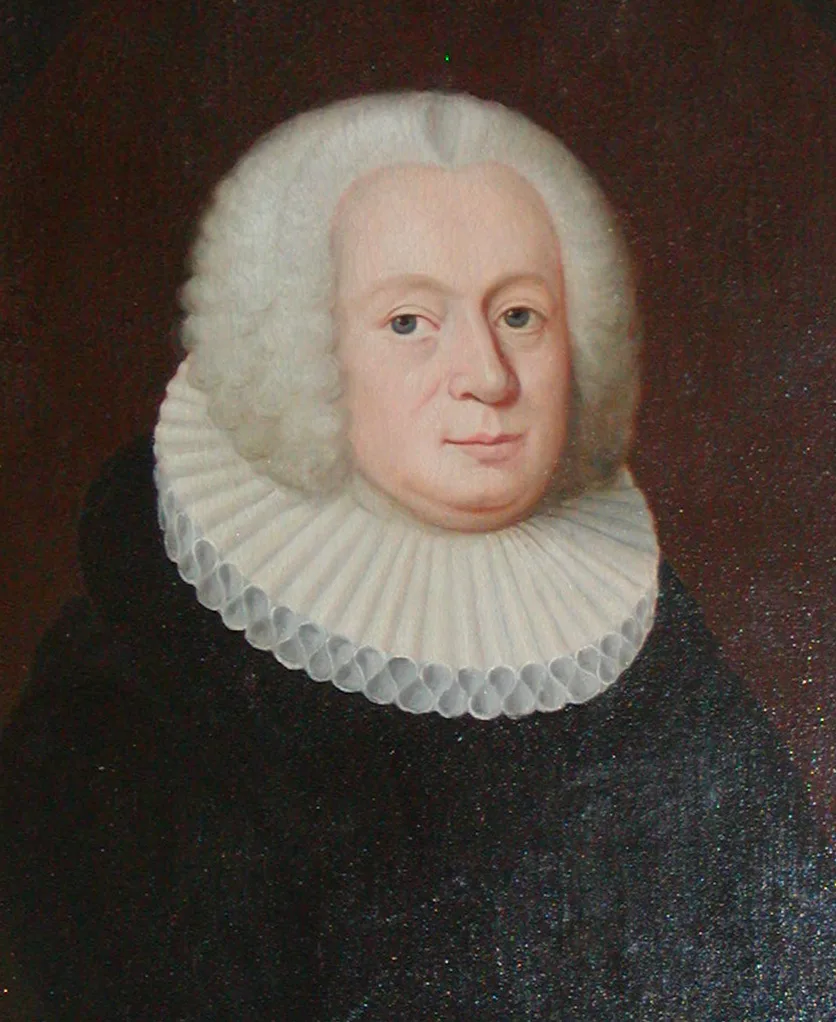 Unknown artist, portrait of Erik Pontoppidan (first half of the 1700s) Pontoppidan in the ruff of the Danish-Norwegian clergy — Christian VI's court chaplain, whose 1737 catechism *Sandhed til Gudfrygtighed* put its 759 questions into the memory of every Norwegian confirmand for well over a century, and who as Bishop of Bergen wrote the natural history that made the kraken famous. Danish-Norwegian Lutheran theologian, bishop, and natural
historian (1698–1764). Court preacher and personal chaplain
to King Christian VI from 1735, who commissioned him to
write the standard catechism that would accompany the new
compulsory confirmation: Sandhed til Gudfrygtighed —
Truth unto Godliness — published 1737 and the principal
instrument of Norwegian Lutheran religious education for
well over a century, into the late 1800s. Appointed Bishop
of Bergen 1747; in that
capacity wrote his two-volume Det første Forsøg paa
Norges naturlige Historie (1752–53), the standard
eighteenth-century natural history of Norway and the work
that first describes the kraken under that name. Later
vice-chancellor of the University of Copenhagen.
Also discussed in The Reformation, 1537 — one church eradicated and another imposedKraken — the island-sized beast, logged as factSjøormer — the serpents in the deep lakes and fjords wrote to support it — Sandhed til Gudfrygtighed, “Truth unto Godliness,” published in 1737 — were Pietist instruments, designed to make the inner appropriation of faith a stated duty of every Lutheran subject. So, at first, was the Conventicle Ordinance of 1741: it was framed to permit lay gatherings, on the condition that the parish pastor supervised them. Within a generation the same law had become the chief legal tool for suppressing the lay revival it had been written to channel. By the time Hauge began to preach in 1796, the instrument of Pietism had become the instrument used against it.
Unknown artist, portrait of Erik Pontoppidan (first half of the 1700s) Pontoppidan in the ruff of the Danish-Norwegian clergy — Christian VI's court chaplain, whose 1737 catechism *Sandhed til Gudfrygtighed* put its 759 questions into the memory of every Norwegian confirmand for well over a century, and who as Bishop of Bergen wrote the natural history that made the kraken famous. Danish-Norwegian Lutheran theologian, bishop, and natural
historian (1698–1764). Court preacher and personal chaplain
to King Christian VI from 1735, who commissioned him to
write the standard catechism that would accompany the new
compulsory confirmation: Sandhed til Gudfrygtighed —
Truth unto Godliness — published 1737 and the principal
instrument of Norwegian Lutheran religious education for
well over a century, into the late 1800s. Appointed Bishop
of Bergen 1747; in that
capacity wrote his two-volume Det første Forsøg paa
Norges naturlige Historie (1752–53), the standard
eighteenth-century natural history of Norway and the work
that first describes the kraken under that name. Later
vice-chancellor of the University of Copenhagen.
Also discussed in The Reformation, 1537 — one church eradicated and another imposedKraken — the island-sized beast, logged as factSjøormer — the serpents in the deep lakes and fjords wrote to support it — Sandhed til Gudfrygtighed, “Truth unto Godliness,” published in 1737 — were Pietist instruments, designed to make the inner appropriation of faith a stated duty of every Lutheran subject. So, at first, was the Conventicle Ordinance of 1741: it was framed to permit lay gatherings, on the condition that the parish pastor supervised them. Within a generation the same law had become the chief legal tool for suppressing the lay revival it had been written to channel. By the time Hauge began to preach in 1796, the instrument of Pietism had become the instrument used against it.
The Haugean revival
For the eight years he was able to travel freely, between 1796 and 1804, Hauge walked. He crossed Eastern Norway, the western fjords, the inland highlands, and Trøndelag 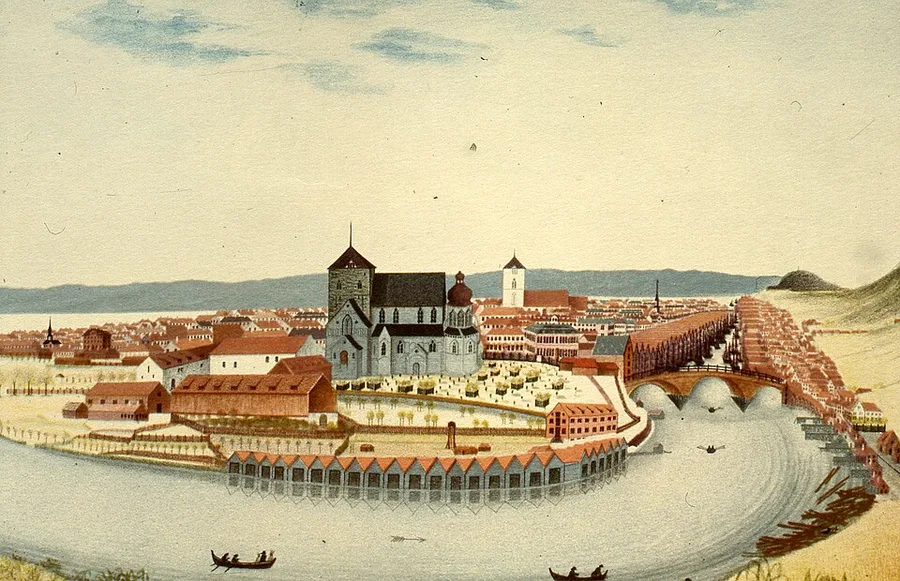 Johannes Aas, Prospect af Staden Trondhiem (1826), Municipal Archives of Trondheim (CC BY 2.0) An 1826 prospect of Trondheim, Nidaros Cathedral rising over the river bend. Founded by Olav Tryggvason as Nidaros in 997, the town became the seat of Norway's archbishopric in 1153 and the country's ecclesiastical capital. Region of central Norway around the Trondheim Fjord, north of Stadt
and south of Hålogaland. Its agriculturally rich Trondheim plain
is the second-largest area of arable land in the country and the
base of the medieval earls of Lade. Trondheim — founded by Olav
Tryggvason in 997 as Nidaros — became the seat of the Norwegian
archbishopric in 1153 and remains the country's third-largest city
and ecclesiastical capital.
On the trip Day 3-5 of the trip routes the Gråhårsklubben (the Oldsters) through
Trøndelag for the Slektsreisen heritage drive — Trondheim and the
Nidaros Cathedral on Day 3, then Stjørdal and Hegra, then on up
the Stjørdalen valley to Kylloplass.
Trøndelag (Trondheim) Also discussed in Before There Was Norway — petty kingdoms at the edge of the worldWorshiping Odin and Thor — the lived religion of pre-Christian NorwayThe King Who Became a Saint — how the Nordmen came to ChristThe Long Fall — the sudden loss of Norwegian nobility, the end of the kings, and half of Norway gone foreverDraugen — the drowned man who never came homeThe Hytte — a sacred pastime of modern Norway on foot and by boat, holding meetings in farm kitchens and barns, reading aloud from the Bible and from the books he was now writing at the rate of several a year, and leaving behind in farmhouse after farmhouse small groups of Haugean Movement
Johannes Aas, Prospect af Staden Trondhiem (1826), Municipal Archives of Trondheim (CC BY 2.0) An 1826 prospect of Trondheim, Nidaros Cathedral rising over the river bend. Founded by Olav Tryggvason as Nidaros in 997, the town became the seat of Norway's archbishopric in 1153 and the country's ecclesiastical capital. Region of central Norway around the Trondheim Fjord, north of Stadt
and south of Hålogaland. Its agriculturally rich Trondheim plain
is the second-largest area of arable land in the country and the
base of the medieval earls of Lade. Trondheim — founded by Olav
Tryggvason in 997 as Nidaros — became the seat of the Norwegian
archbishopric in 1153 and remains the country's third-largest city
and ecclesiastical capital.
On the trip Day 3-5 of the trip routes the Gråhårsklubben (the Oldsters) through
Trøndelag for the Slektsreisen heritage drive — Trondheim and the
Nidaros Cathedral on Day 3, then Stjørdal and Hegra, then on up
the Stjørdalen valley to Kylloplass.
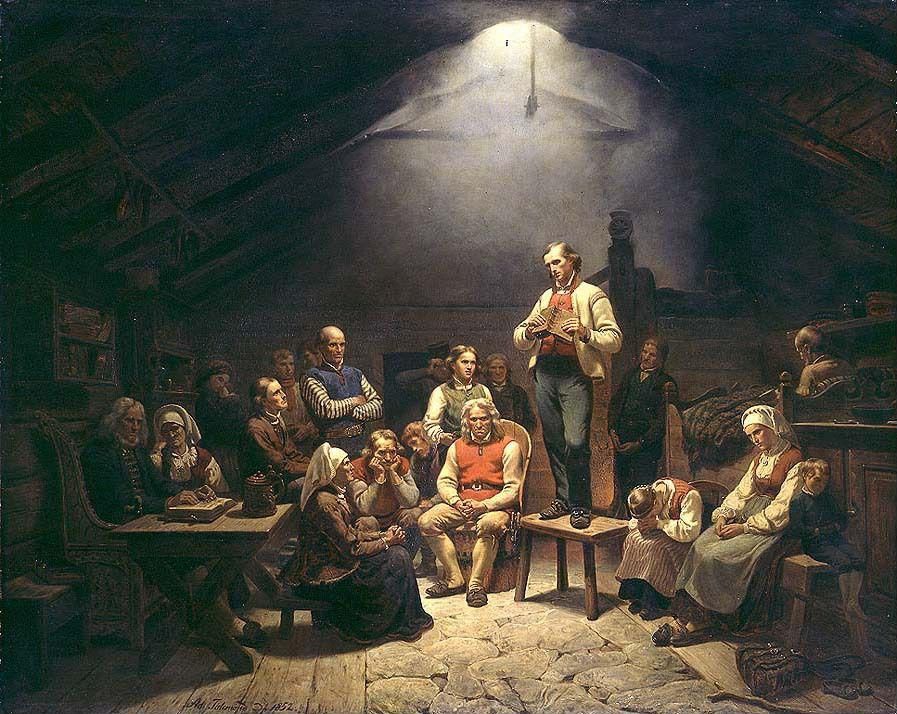
Trøndelag (Trondheim) Also discussed in Before There Was Norway — petty kingdoms at the edge of the worldWorshiping Odin and Thor — the lived religion of pre-Christian NorwayThe King Who Became a Saint — how the Nordmen came to ChristThe Long Fall — the sudden loss of Norwegian nobility, the end of the kings, and half of Norway gone foreverDraugen — the drowned man who never came homeThe Hytte — a sacred pastime of modern Norway on foot and by boat, holding meetings in farm kitchens and barns, reading aloud from the Bible and from the books he was now writing at the rate of several a year, and leaving behind in farmhouse after farmhouse small groups of Haugean Movement 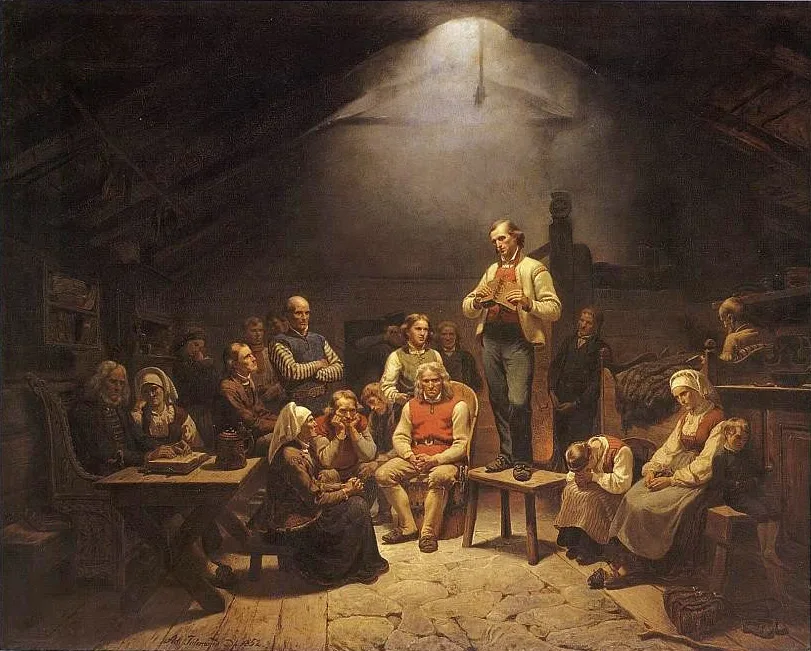 Adolph Tidemand, Haugianerne / Low Church Devotion (1852), Nasjonalmuseet Tidemand's Haugianerne — the lay preacher standing with open book in hand, a farm gathering pressed close under the loft's shaft of light — is the canonical image of the conventicle itself, the illegal farm-kitchen meeting form the movement was built from. The lay-Christian revival that emerged in Norway from Hans
Nielsen Hauge's preaching between 1796 and 1804 and
continued under his followers through the nineteenth
century. De vakte — the awakened — formed networks of
lay-led conventicles in farm kitchens, practising daily
devotional reading, household hymn-singing, and small-
group lay leadership. By Hauge's death (1824) the movement
had organised commercial undertakings — mills, paper-
works, salt-works, fisheries, shipyards, textile factories
— financed by capital pooled across the network. The
frugal, hard-working ethic that came out of this work fed
into Norway's cooperative and savings-bank traditions, and
the movement crossed the Atlantic with the emigrants.
Also discussed in 800,000 Norwegians Leave — the century that built a Second NorwayIdentitet — what it means to be Norwegian(*Draft)Dugnad — showing up to help — who went on meeting after he had moved on. By the early years of the nineteenth century, by one frequently cited estimate, roughly 100,000 of a national population of about 900,000 had read at least one of his books — perhaps one Norwegian in ten connected in some way to the network.
Adolph Tidemand, Haugianerne / Low Church Devotion (1852), Nasjonalmuseet Tidemand's Haugianerne — the lay preacher standing with open book in hand, a farm gathering pressed close under the loft's shaft of light — is the canonical image of the conventicle itself, the illegal farm-kitchen meeting form the movement was built from. The lay-Christian revival that emerged in Norway from Hans
Nielsen Hauge's preaching between 1796 and 1804 and
continued under his followers through the nineteenth
century. De vakte — the awakened — formed networks of
lay-led conventicles in farm kitchens, practising daily
devotional reading, household hymn-singing, and small-
group lay leadership. By Hauge's death (1824) the movement
had organised commercial undertakings — mills, paper-
works, salt-works, fisheries, shipyards, textile factories
— financed by capital pooled across the network. The
frugal, hard-working ethic that came out of this work fed
into Norway's cooperative and savings-bank traditions, and
the movement crossed the Atlantic with the emigrants.
Also discussed in 800,000 Norwegians Leave — the century that built a Second NorwayIdentitet — what it means to be Norwegian(*Draft)Dugnad — showing up to help — who went on meeting after he had moved on. By the early years of the nineteenth century, by one frequently cited estimate, roughly 100,000 of a national population of about 900,000 had read at least one of his books — perhaps one Norwegian in ten connected in some way to the network.
What Haugean practice looked like was concrete and domestic. A Haugean family read the Bible aloud after supper; the children learned hymns by heart; twice a week the neighbours gathered in one farmhouse or another to read, pray, and sing, often led by a layman or a laywoman the parish pastor had never licensed.
The movement was, at the same time, a quiet structural challenge to the state church. Hauge himself was a loyalist who supported the constitutional monarchy after 1814 and never preached against the clergy or their theology. But a lay preacher who claimed direct insight from his own Bible reading was, by implication, contesting the trained pastor’s monopoly on doctrine; a lay-led conventicle that met outside the parish pastor’s supervision was, by implication, contesting the parish system itself. The bishops mostly understood this, and their answer was to tolerate the movement at the official level while enforcing the Conventicle Ordinance through the local police where they could. The arrests of lay preachers continued until the Ordinance was finally repealed in 1842.
Three shapes of a Christian life
The medieval Catholic shape, which had held in Norway for five centuries before 1537, organised the believer’s life inside a sacramental view of the world. The seven sacraments marked its passages — baptism, confirmation, marriage as God’s presence in the union, confession as ongoing healing, the Eucharist at the centre, anointing for the sick, holy orders for the called — and beyond the sacraments themselves the physical world was held to be dense with God: fields blessed before planting, ships before launch, houses on the threshold; the bread and wine of the Mass genuinely Christ; the saint’s relic genuinely a touch-point; the holy water at the door a daily reminder that the line between ordinary matter and divine presence was thinner than it appeared.
Inside this view, the contemplative path was a real life option for any believer. The monastery was a working institution that any Norwegian could enter, with libraries, schools, and a daily round of prayer sounded from the bells of the religious houses over the surrounding district. Spiritual direction was an available practice, lectio divina a taught discipline, the writings of medieval mystics like Bridget of Sweden 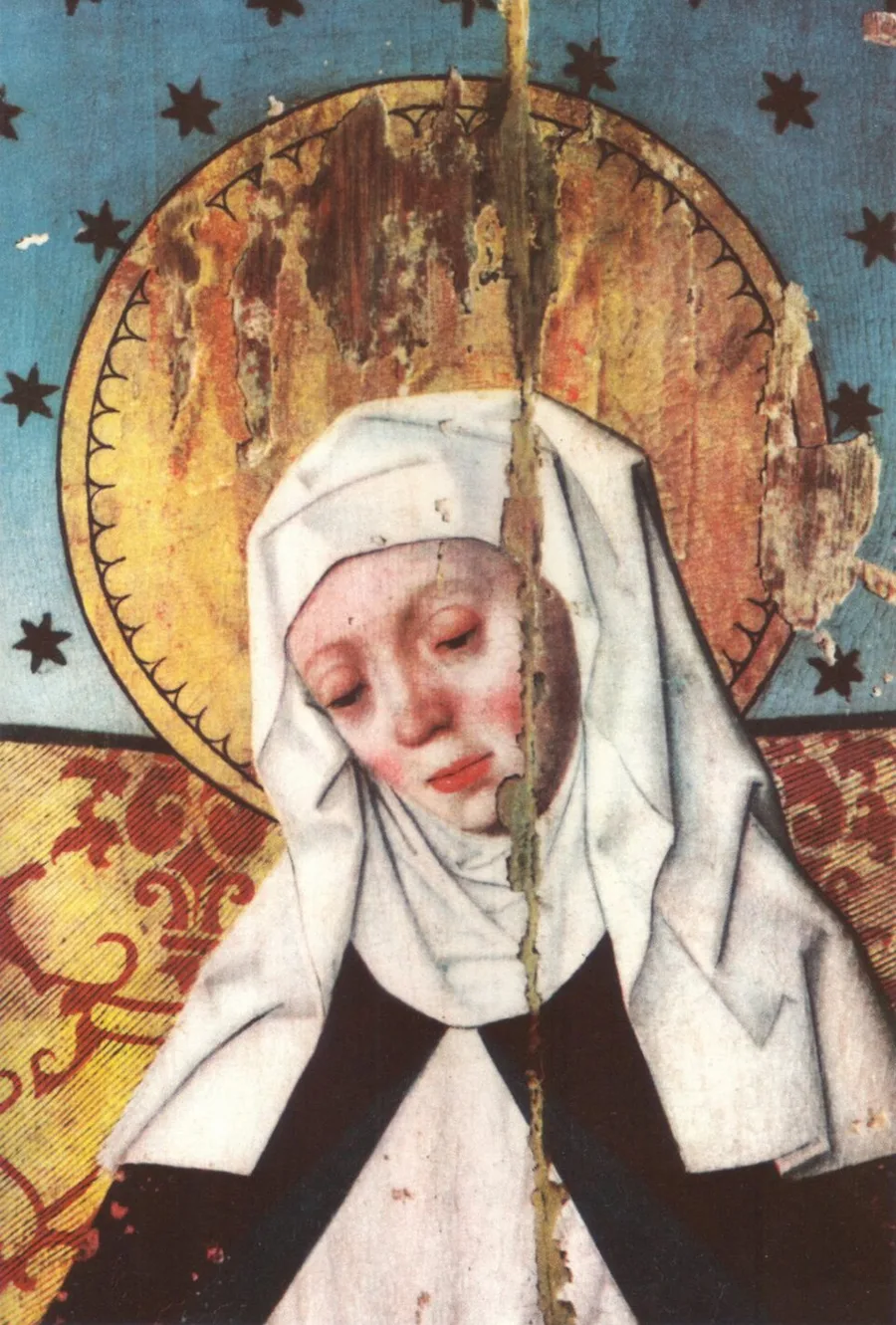 Hermann Rode, St Birgitta panel from the Salem church altarpiece, Södermanland (1480s) Birgitta in the white veil of her widowhood, painted for a Swedish church altarpiece a century after her death — the mystic whose Revelations were read across Catholic Scandinavia and whose order kept its Norwegian house at Munkeliv in Bergen from the 1420s. Swedish noblewoman, mystic, and church founder (c. 1303–1373).
Member of the Folkung nobility; mother of eight children
before her widowhood in 1344 turned her to a fully religious
life. Her Liber Caelestis Revelationum — Book of Heavenly
Revelations — recording the visions of Christ and the
Virgin Mary that began in childhood and continued throughout
her adult life, was widely read across medieval Scandinavia
and Europe. Founded the Bridgettine Order at Vadstena in
Sweden in 1346; the Order had a double Norwegian house at
Munkeliv in Bergen from the 1420s. Canonised by Pope Boniface
IX in 1391, named co-patron of Europe by John Paul II in
1999, and the most internationally influential single figure
in medieval Scandinavian Christianity.
read and copied across the period. The institutional ladder into spiritual depth was intact, and a person who wanted to give a life to prayer had a structure waiting for them.
Hermann Rode, St Birgitta panel from the Salem church altarpiece, Södermanland (1480s) Birgitta in the white veil of her widowhood, painted for a Swedish church altarpiece a century after her death — the mystic whose Revelations were read across Catholic Scandinavia and whose order kept its Norwegian house at Munkeliv in Bergen from the 1420s. Swedish noblewoman, mystic, and church founder (c. 1303–1373).
Member of the Folkung nobility; mother of eight children
before her widowhood in 1344 turned her to a fully religious
life. Her Liber Caelestis Revelationum — Book of Heavenly
Revelations — recording the visions of Christ and the
Virgin Mary that began in childhood and continued throughout
her adult life, was widely read across medieval Scandinavia
and Europe. Founded the Bridgettine Order at Vadstena in
Sweden in 1346; the Order had a double Norwegian house at
Munkeliv in Bergen from the 1420s. Canonised by Pope Boniface
IX in 1391, named co-patron of Europe by John Paul II in
1999, and the most internationally influential single figure
in medieval Scandinavian Christianity.
read and copied across the period. The institutional ladder into spiritual depth was intact, and a person who wanted to give a life to prayer had a structure waiting for them.
The believer was also held to belong to a larger spiritual family — what the early church had called the communio sanctorum, the communion of saints, named in the Apostles’ Creed and grounded in passages familiar to any reader of the New Testament. The Letter to the Hebrews described the faithful as “surrounded by so great a cloud of witnesses.” Revelation showed the elders before the throne with bowls of incense that “are the prayers of the saints.” On the cross, Jesus had said to his mother and to the beloved disciple, “Behold your son,” “Behold your mother,” and the early Christian reading of those words established Mary as the maternal figure of his disciples and of the faith that grew from them. The medieval Norwegian was, in this view, part of one spiritual family that included the faithful on earth — the church militant — and the faithful glorified in heaven, the church triumphant, with the saints standing as elder brothers and sisters who had walked the road and now stood in the presence of God. The saints were known by trade, danger, and locality so that every person had one near at hand: Olav for the kingdom, Sunniva for the western coast, particular saints for the sailor and the woman in childbirth and the carpenter and the dying. The Lutheran reform retained the church militant and the church triumphant as concepts, but dropped the practice of asking the dead saints’ prayers, the per-trade and per-locality granularity that gave each ordinary believer a patron nearby, and the maternal figure of Mary in the imaginative geography of faith. What today feels native to most modern Protestants was, at the time, a change from fifteen centuries of Christian practice that had carried these forward since the early church.
The state Lutheran shape that replaced it concentrated religious life on the Word. The sermon stood at the centre of the Sunday service; the two sacraments the reform retained, baptism and communion, marked its boundaries; the pastor was the working theologian of the parish, the single trained interpreter of scripture for a district, speaking and reading in Danish. The monasteries closed and their daily round of prayer ended; the institutional structures that had carried the contemplative life were not rebuilt under the new arrangement. What the medieval Norwegian had known as a faith of many sacramental thresholds, a populated spiritual family across heaven and earth, and a physical world dense with God’s presence became, for most Norwegians, a faith of one mediator, two sacraments, the Word read aloud and preached on, and the catechism memorised.
The catechism in that arrangement did serious work. By the design of the Pietist crown that pressed it on Norway, every teenager memorised Pontoppidan’s seven hundred and fifty-nine questions and answers and was examined on them by the parish pastor before confirmation. The household carried the year-round form: morning and evening prayers, the family Bible on the kitchen table, the long Sunday sermon book — the postille — read aloud through the week, the hymns of Kingo and Brorson learned by heart so that a person’s own theology lived in the body as song. Confirmation became the single great threshold of the new shape, the public rite of passage that the medieval seven sacraments had distributed across a life. None of this was a small spiritual provision. And the literate, Bible-reading Norwegian farmer it produced was, within two generations, the person who could hear Hans Nielsen Hauge and recognise what he was saying. The state-church program had manufactured, without intending to, the lay reader of its own opposition.
The Haugean shape was the third, and it was built by hand inside the second. From inside the conviction of the personal love of God that overtook him in the Østfold field in 1796, Hauge picked the open Bible up off the kitchen table and put it at the centre of religious life. The trained pastor was no longer the indispensable interpreter; any farmer or fisherman could read the text, and any awakened layman or laywoman could speak from it. The conventicle around the farmhouse table became the religious unit; the household became the place of daily devotion; “the awakened” were a community that knew one another across the country and supported one another through hard seasons.
What that shape entailed in practice was unusual for the time. Hauge appointed women as preachers and lay leaders — Sara Oust 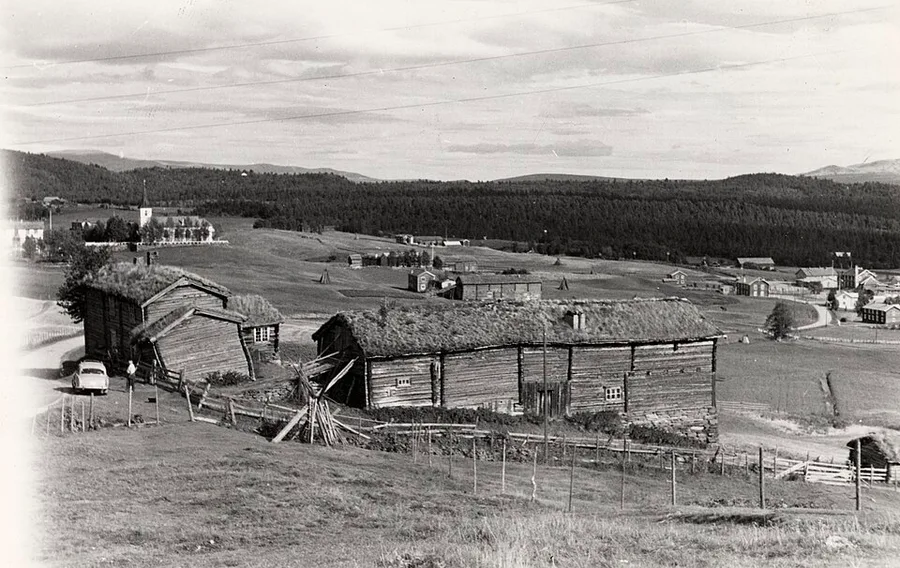 Halvor Vreim, Oustad Søndre, Vingelen, Tolga (1959), Riksantikvaren No portrait of Sara Oust exists. This is the southern holding of the Oustad — locally Ousta — farm in Vingelen, the mountain hamlet where she was born and whose farm name she carried, photographed for the state heritage survey in 1959. Norwegian lay preacher (1778–1822), often described as
Norway's first woman preacher. Born on the Ousta farm in
Vingelen, in Tolga parish in Nord-Østerdalen; drawn into
Hans Nielsen Hauge's movement in 1799 through Haugean
workers at the Røros copper works, and travelling as an
itinerant preacher that same year — extremely unusual in
early-nineteenth-century Norway, where neither the state
church nor the surrounding civil law contemplated public
religious office for women. Hauge backed her and other
women as travelling preachers and lay leaders within
the awakened network; he held that the priesthood of all
believers extended to women alongside men. Sara Oust
preached across Trøndelag from 1799 to 1805, then led the
Haugean circle of Nord-Østerdalen from Vingelen until her
death in 1822.
, who began traveling around 1799, is often counted the first woman preacher in Norway — and granted them a public religious role that early-nineteenth-century Norway did not otherwise offer. The Haugeans also organised themselves commercially. Flour mills, paper-works, salt-works, fisheries, shipyards, brickyards, small textile factories from Trøndelag to the southern coast were financed by capital pooled across the network and reinvested rather than spent on display. The frugal, communal, hard-working, ostentation-averse commercial ethic that ran out of this work outlasted explicit Haugean membership and fed into the country’s cooperative and savings-bank traditions — one of the longer downstream consequences in the whole story of Norwegian religious life. All of it remained inside a Lutheran-Pietist register: the two sacraments held, Pontoppidan’s catechism held, the parish system the conventicles met past was the parish system they were buried in. The personal-conversion register, the lay preacher, and the small communal gathering were new in Norwegian religious life — not a recovery of the medieval shape. The sacramental world of the medieval shape and its institutional contemplative tradition stayed gone.
Halvor Vreim, Oustad Søndre, Vingelen, Tolga (1959), Riksantikvaren No portrait of Sara Oust exists. This is the southern holding of the Oustad — locally Ousta — farm in Vingelen, the mountain hamlet where she was born and whose farm name she carried, photographed for the state heritage survey in 1959. Norwegian lay preacher (1778–1822), often described as
Norway's first woman preacher. Born on the Ousta farm in
Vingelen, in Tolga parish in Nord-Østerdalen; drawn into
Hans Nielsen Hauge's movement in 1799 through Haugean
workers at the Røros copper works, and travelling as an
itinerant preacher that same year — extremely unusual in
early-nineteenth-century Norway, where neither the state
church nor the surrounding civil law contemplated public
religious office for women. Hauge backed her and other
women as travelling preachers and lay leaders within
the awakened network; he held that the priesthood of all
believers extended to women alongside men. Sara Oust
preached across Trøndelag from 1799 to 1805, then led the
Haugean circle of Nord-Østerdalen from Vingelen until her
death in 1822.
, who began traveling around 1799, is often counted the first woman preacher in Norway — and granted them a public religious role that early-nineteenth-century Norway did not otherwise offer. The Haugeans also organised themselves commercially. Flour mills, paper-works, salt-works, fisheries, shipyards, brickyards, small textile factories from Trøndelag to the southern coast were financed by capital pooled across the network and reinvested rather than spent on display. The frugal, communal, hard-working, ostentation-averse commercial ethic that ran out of this work outlasted explicit Haugean membership and fed into the country’s cooperative and savings-bank traditions — one of the longer downstream consequences in the whole story of Norwegian religious life. All of it remained inside a Lutheran-Pietist register: the two sacraments held, Pontoppidan’s catechism held, the parish system the conventicles met past was the parish system they were buried in. The personal-conversion register, the lay preacher, and the small communal gathering were new in Norwegian religious life — not a recovery of the medieval shape. The sacramental world of the medieval shape and its institutional contemplative tradition stayed gone.
The state church loosens
The institutional arrangement Hauge had spent his career operating inside gave ground slowly across the nineteenth and twentieth centuries. The repeal of the Conventicle Ordinance came after three successive Storting 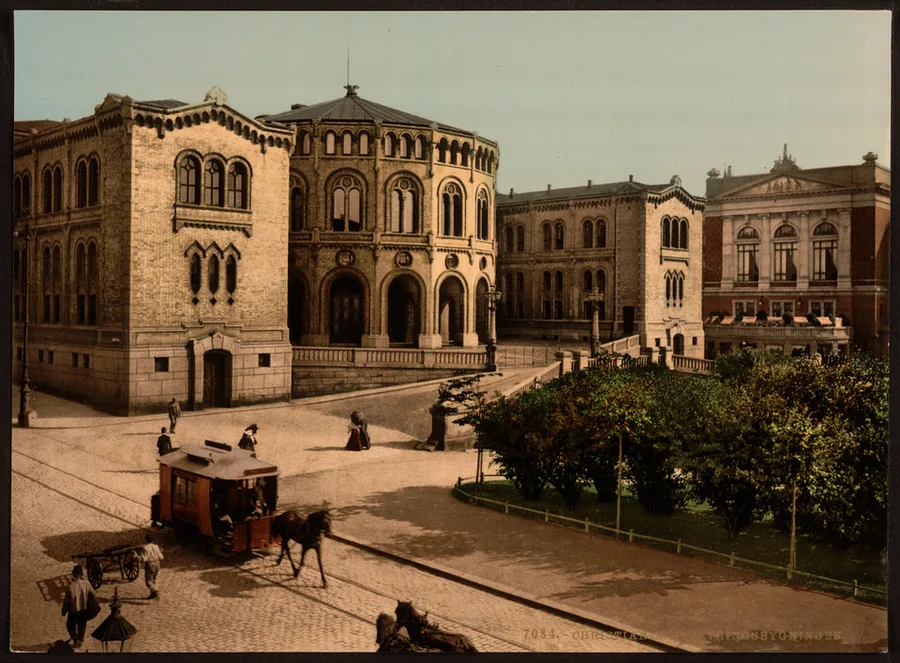 Detroit Publishing Company, Storthings Bygningen, Christiania, Norway (c. 1890-1900), Library of Congress / World Digital Library The Storting building in Kristiania (Oslo), Norway's parliament since the 1814 Constitution and the seat of the legislature that still governs the country. The Grand Assembly — the parliament of independent
Norway, established by the Eidsvoll Constitution of 17 May
1814 as the country's sovereign legislature. The name
Storting (Stór-Þing, the great assembly) deliberately
reaches back to the medieval Norwegian thing tradition,
asserting institutional continuity with the pre-Danish
Norwegian state. Under the 1814 constitution the Storting
divided into two chambers — Lagting and Odelsting —
for legislative purposes; the two-chamber arrangement was
abolished in 2009 and the Storting has been a single
chamber since. The current building, in central Oslo,
opened in 1866.
Also discussed in The 400-Year Night — when the Northern Lion lay dormantThe Constitution That Saved a Nation — five radical weeks at Eidsvoll, 1814The Quiet Revolution — how Norway won its independence without a warThe 'Lucky Country' — the discovery that changed everythingWorld War II — the King’s “No” and the Nazis in NorwayAllemannsretten — the right to roamPolitikk — the left, the right, and the Norwegian way passages exhausted the crown’s veto. The Dissenter Act of 1845 permitted, for the first time since the Reformation, non-Lutheran Christians to organise legal congregations. The constitutional ban on Jewish settlement was removed in 1851, after a campaign led by the poet Henrik Wergeland
Detroit Publishing Company, Storthings Bygningen, Christiania, Norway (c. 1890-1900), Library of Congress / World Digital Library The Storting building in Kristiania (Oslo), Norway's parliament since the 1814 Constitution and the seat of the legislature that still governs the country. The Grand Assembly — the parliament of independent
Norway, established by the Eidsvoll Constitution of 17 May
1814 as the country's sovereign legislature. The name
Storting (Stór-Þing, the great assembly) deliberately
reaches back to the medieval Norwegian thing tradition,
asserting institutional continuity with the pre-Danish
Norwegian state. Under the 1814 constitution the Storting
divided into two chambers — Lagting and Odelsting —
for legislative purposes; the two-chamber arrangement was
abolished in 2009 and the Storting has been a single
chamber since. The current building, in central Oslo,
opened in 1866.
Also discussed in The 400-Year Night — when the Northern Lion lay dormantThe Constitution That Saved a Nation — five radical weeks at Eidsvoll, 1814The Quiet Revolution — how Norway won its independence without a warThe 'Lucky Country' — the discovery that changed everythingWorld War II — the King’s “No” and the Nazis in NorwayAllemannsretten — the right to roamPolitikk — the left, the right, and the Norwegian way passages exhausted the crown’s veto. The Dissenter Act of 1845 permitted, for the first time since the Reformation, non-Lutheran Christians to organise legal congregations. The constitutional ban on Jewish settlement was removed in 1851, after a campaign led by the poet Henrik Wergeland 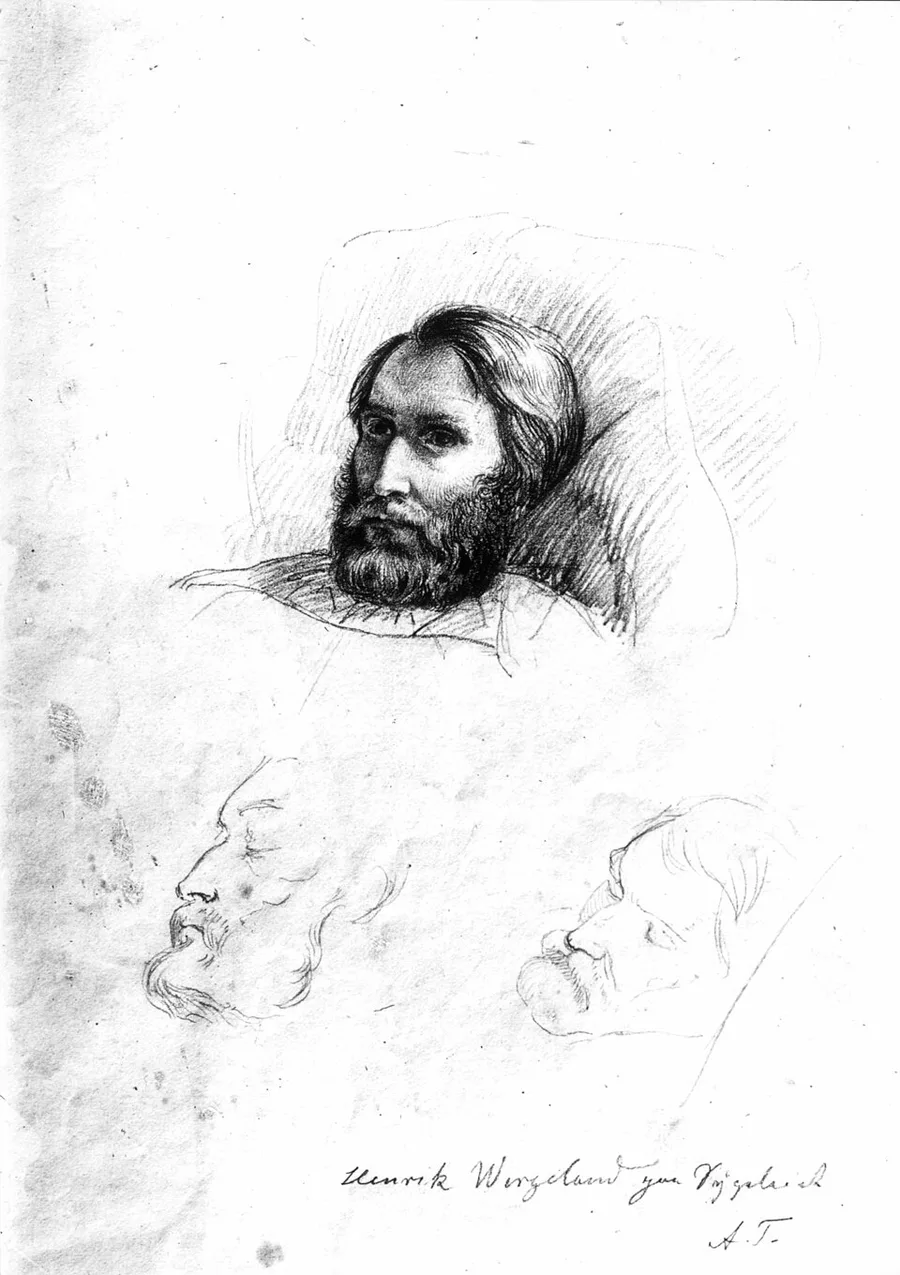 Adolph Tidemand, Portrait of Henrik Wergeland (1844), Norsk portrettarkiv, Riksantikvaren Tidemand's sheet is captioned "Henrik Wergeland paa Sygeleiet" — Wergeland on his sickbed, drawn in his final year — the Romantic-era poet who spent the 1830s and 1840s campaigning to remove Norway's constitutional ban on Jewish settlement, and died six years before it fell. Norwegian poet, dramatist, and political reformer (1808–1845),
the dominant literary figure of the first generation after the
1814 Constitution. Son of the Eidsvoll constitutional delegate
Nicolai Wergeland; brother of the writer Camilla Collett and
the officer Oscar Wergeland.
Pioneer of Norwegian Romantic poetry — his epic Skabelsen,
Mennesket og Messias (Creation, Man, and Messiah, 1830) is
among the founding works of modern Norwegian literature.
Through the 1830s and 1840s he campaigned
for the removal of Article 2 of the 1814
Constitution, which barred Jewish settlement in Norway. He
died in 1845 at thirty-seven, six years before
the campaign succeeded in 1851. Jewish congregations in Oslo
and Trondheim place flowers on his grave every year on the
anniversary of his death.
Also discussed in The Constitution That Saved a Nation — five radical weeks at Eidsvoll, 1814World War II — the King’s “No” and the Nazis in Norway — who died in 1845, six years before the campaign succeeded. Monastic orders were permitted again in 1897; the Jesuit clause held until 1956.
Adolph Tidemand, Portrait of Henrik Wergeland (1844), Norsk portrettarkiv, Riksantikvaren Tidemand's sheet is captioned "Henrik Wergeland paa Sygeleiet" — Wergeland on his sickbed, drawn in his final year — the Romantic-era poet who spent the 1830s and 1840s campaigning to remove Norway's constitutional ban on Jewish settlement, and died six years before it fell. Norwegian poet, dramatist, and political reformer (1808–1845),
the dominant literary figure of the first generation after the
1814 Constitution. Son of the Eidsvoll constitutional delegate
Nicolai Wergeland; brother of the writer Camilla Collett and
the officer Oscar Wergeland.
Pioneer of Norwegian Romantic poetry — his epic Skabelsen,
Mennesket og Messias (Creation, Man, and Messiah, 1830) is
among the founding works of modern Norwegian literature.
Through the 1830s and 1840s he campaigned
for the removal of Article 2 of the 1814
Constitution, which barred Jewish settlement in Norway. He
died in 1845 at thirty-seven, six years before
the campaign succeeded in 1851. Jewish congregations in Oslo
and Trondheim place flowers on his grave every year on the
anniversary of his death.
Also discussed in The Constitution That Saved a Nation — five radical weeks at Eidsvoll, 1814World War II — the King’s “No” and the Nazis in Norway — who died in 1845, six years before the campaign succeeded. Monastic orders were permitted again in 1897; the Jesuit clause held until 1956.
The state-church link itself proved harder to undo. A 1920 reform placed parish councils in lay hands. A General Synod, the Kirkemøtet, was established in 1984 as the church’s highest internal authority. A 2012 constitutional amendment ended the formal designation of Lutheranism as the state religion and lifted the requirement that more than half the king’s council belong to the church. On the first of January 2017 the Church of Norway became a legal entity independent of the state for the first time since 1537: pastors ceased to be state employees and the church took over its own governance — the appointment of bishops had already passed from the king to the church’s own bodies in 2012. The five-hundred-year arrangement ended by an act of parliament, without ceremony.
What remains
The through-line from Hauge into modern Norway runs through what Norwegians call the Bedehus 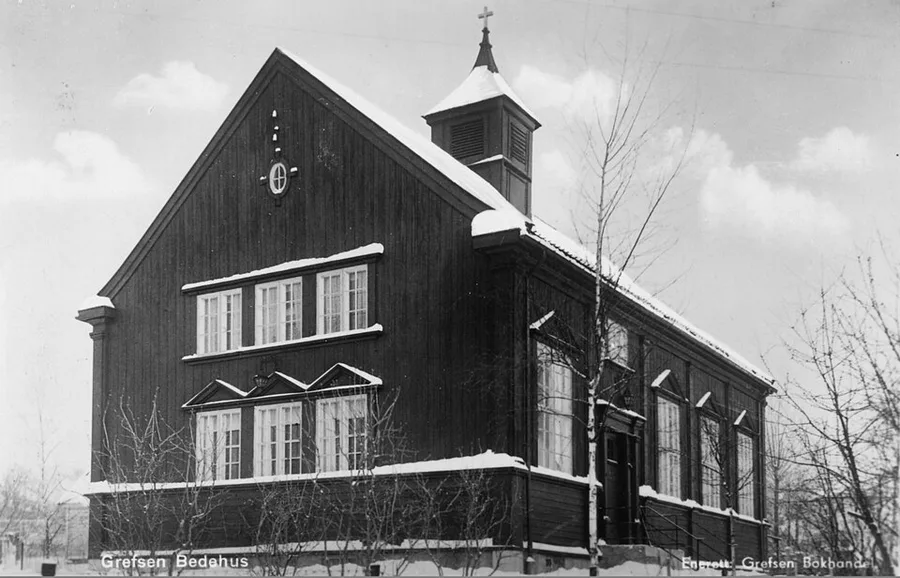 Grefsen Bokhandel, Grefsen bedehus (c. 1950), Oslo Museum, accession OB.F11580d A mid-century photograph of Grefsen bedehus, the plain timber prayer house the lay conventicle tradition raised in the open once the 1842 repeal of the Conventicle Ordinance let it build in public. Prayer house — the simple wooden meeting hall built by
lay Norwegian Christians as a venue for the conventicle-
style gatherings the Haugean revival had developed inside
the state church. After the 1842 repeal of the Conventicle
Ordinance the buildings appeared in the open. Bedehus
are typically modest gable-roofed timber structures with
one large meeting hall, a small kitchen, plain pews, and
no consecrated altar — distinct from the parish church
both architecturally and theologically. By the early
twentieth century several thousand had been built across
Norway, concentrated in the southern and western coastal
regions of Bibelbeltet. The Inner Mission Society
(founded 1868) knit them into national lay networks; many
remain in active use today.
. Once the legal restrictions on lay gatherings finally lifted in the middle of the nineteenth century, the tradition came into the open and built thousands of small wooden meeting halls in the villages and along the coast. The Inner Mission Society
Grefsen Bokhandel, Grefsen bedehus (c. 1950), Oslo Museum, accession OB.F11580d A mid-century photograph of Grefsen bedehus, the plain timber prayer house the lay conventicle tradition raised in the open once the 1842 repeal of the Conventicle Ordinance let it build in public. Prayer house — the simple wooden meeting hall built by
lay Norwegian Christians as a venue for the conventicle-
style gatherings the Haugean revival had developed inside
the state church. After the 1842 repeal of the Conventicle
Ordinance the buildings appeared in the open. Bedehus
are typically modest gable-roofed timber structures with
one large meeting hall, a small kitchen, plain pews, and
no consecrated altar — distinct from the parish church
both architecturally and theologically. By the early
twentieth century several thousand had been built across
Norway, concentrated in the southern and western coastal
regions of Bibelbeltet. The Inner Mission Society
(founded 1868) knit them into national lay networks; many
remain in active use today.
. Once the legal restrictions on lay gatherings finally lifted in the middle of the nineteenth century, the tradition came into the open and built thousands of small wooden meeting halls in the villages and along the coast. The Inner Mission Society 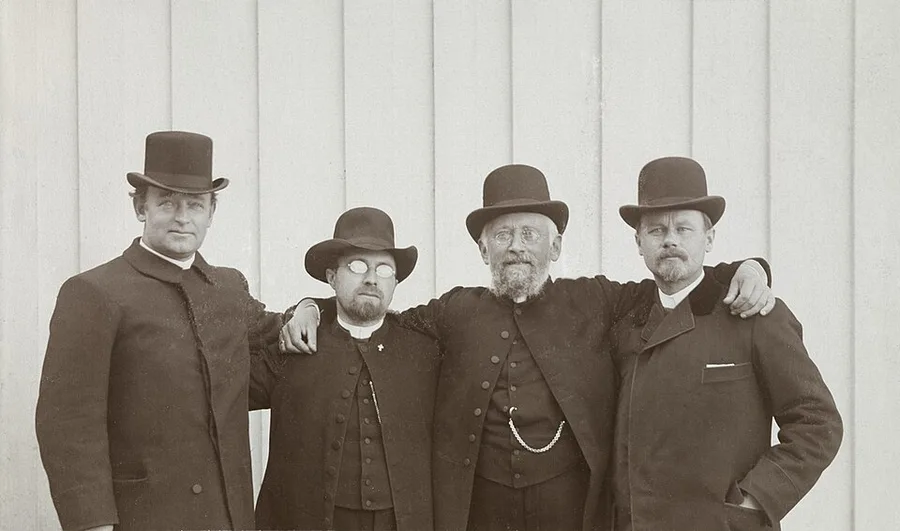 Oscar Hvalbye, Prester i Kristiania Indremisjon (1904), Oslo Museum / oslobilder.no Hvalbye's 1904 photograph shows priests of the Kristiania Indremisjon — the city mission founded in 1855, a separate organisation from the national Indremisjonsselskap of 1868 — one face of the institutional world the once-illegal lay impulse had grown into by 1900. Det norske lutherske Indremisjonsselskap — the principal
national lay-Christian organisation in nineteenth- and
twentieth-century Norway. Founded 1868 by lay leaders out
of the Haugean revival tradition to consolidate the
scattered local conventicles and bedehus communities into
a national network. Operated traveling lay preachers,
Sunday schools, summer camps, Bible distribution, and
domestic mission work across the country, complementing
(rather than competing with) the parish ministry of the
state Lutheran church. At its mid-twentieth-century peak
ran more than nine hundred local associations. Merged in
2001 with the Norwegian Santal Mission to form
Normisjon. The single most durable institutional outcome
of the Haugean awakening inside Norwegian Lutheran
practice.
, founded in 1868, knit them into a national lay movement that at its mid-twentieth-century peak ran more than nine hundred local associations. The southern coast — Sørlandet
Oscar Hvalbye, Prester i Kristiania Indremisjon (1904), Oslo Museum / oslobilder.no Hvalbye's 1904 photograph shows priests of the Kristiania Indremisjon — the city mission founded in 1855, a separate organisation from the national Indremisjonsselskap of 1868 — one face of the institutional world the once-illegal lay impulse had grown into by 1900. Det norske lutherske Indremisjonsselskap — the principal
national lay-Christian organisation in nineteenth- and
twentieth-century Norway. Founded 1868 by lay leaders out
of the Haugean revival tradition to consolidate the
scattered local conventicles and bedehus communities into
a national network. Operated traveling lay preachers,
Sunday schools, summer camps, Bible distribution, and
domestic mission work across the country, complementing
(rather than competing with) the parish ministry of the
state Lutheran church. At its mid-twentieth-century peak
ran more than nine hundred local associations. Merged in
2001 with the Norwegian Santal Mission to form
Normisjon. The single most durable institutional outcome
of the Haugean awakening inside Norwegian Lutheran
practice.
, founded in 1868, knit them into a national lay movement that at its mid-twentieth-century peak ran more than nine hundred local associations. The southern coast — Sørlandet 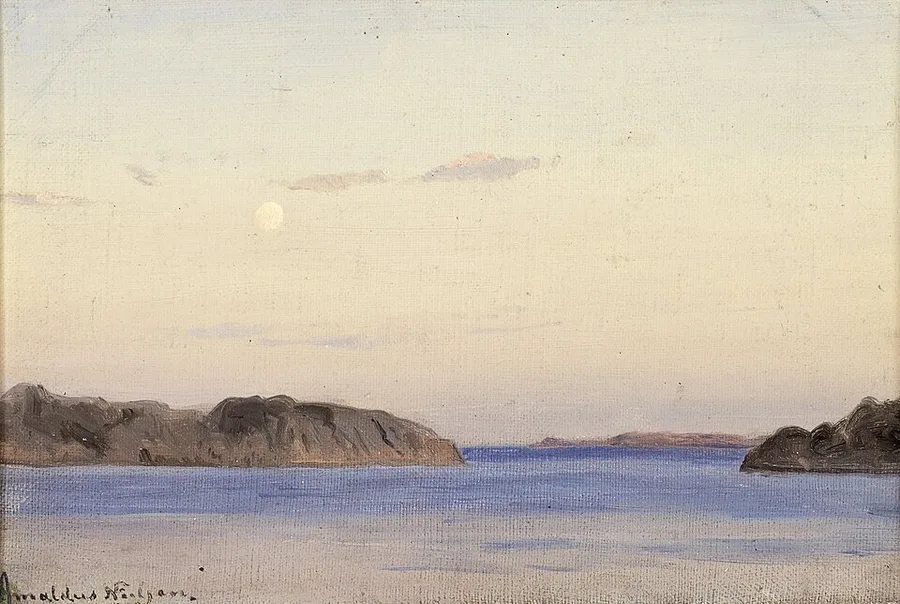 Amaldus Nielsen, Fra skjærgården ved Ny-Hellesund Nielsen's coastal painting of the Sørlandet skerries, the low rocky shoreline of Norway's southern 'Bible Belt' region shaped by nineteenth-century Pietist lay-Christianity. The southern land — the southern coastal region of Norway,
running roughly from the Telemark coast to Lindesnes (the
country's southernmost point) and east to Risør. Comprises
the modern counties of Agder. Historically a region of
small fishing and shipping towns, sawmill timber export,
and dense parish life. Together with stretches of the
western coast around Stavanger and Bergen, Sørlandet is
what Norwegians call Bibelbeltet — the Bible Belt — the
region of the country in which Pietist lay-Christianity took
the deepest root through the nineteenth century and where
the bedehus prayer-house culture is still most visibly
active. Higher church-attendance rates, more conservative
social attitudes, and more numerous lay-Christian
organisations than the Norwegian average.
— and stretches of the western coast are still called Bibelbeltet The Bible Belt — the Norwegian regions in which lay-
Pietist Christianity took the deepest root through the
nineteenth century and where the bedehus prayer-house
culture is still most visibly active today. Comprises
southern Norway (Sørlandet: the Agder counties),
stretches of the western coast around Stavanger,
Haugesund, and parts of the Bergen district, and pockets
of the inland eastern valleys. The region is marked by
higher church-attendance rates, more numerous lay-
Christian organisations, and a stronger conservative-
confessional Christian-Democratic electoral vote. The
pattern descends directly from the early-nineteenth-
century Haugean awakening and the bedehus tradition that
followed the 1842 repeal of the Conventicle Ordinance.
, with a more visibly active prayer-house culture and a higher rate of practice than the rest of the country. Haugean piety also crossed the Atlantic with the emigrants and became the dominant strain of Norwegian-American Lutheran life, carried by lay preachers like Elling Eielsen
Amaldus Nielsen, Fra skjærgården ved Ny-Hellesund Nielsen's coastal painting of the Sørlandet skerries, the low rocky shoreline of Norway's southern 'Bible Belt' region shaped by nineteenth-century Pietist lay-Christianity. The southern land — the southern coastal region of Norway,
running roughly from the Telemark coast to Lindesnes (the
country's southernmost point) and east to Risør. Comprises
the modern counties of Agder. Historically a region of
small fishing and shipping towns, sawmill timber export,
and dense parish life. Together with stretches of the
western coast around Stavanger and Bergen, Sørlandet is
what Norwegians call Bibelbeltet — the Bible Belt — the
region of the country in which Pietist lay-Christianity took
the deepest root through the nineteenth century and where
the bedehus prayer-house culture is still most visibly
active. Higher church-attendance rates, more conservative
social attitudes, and more numerous lay-Christian
organisations than the Norwegian average.
— and stretches of the western coast are still called Bibelbeltet The Bible Belt — the Norwegian regions in which lay-
Pietist Christianity took the deepest root through the
nineteenth century and where the bedehus prayer-house
culture is still most visibly active today. Comprises
southern Norway (Sørlandet: the Agder counties),
stretches of the western coast around Stavanger,
Haugesund, and parts of the Bergen district, and pockets
of the inland eastern valleys. The region is marked by
higher church-attendance rates, more numerous lay-
Christian organisations, and a stronger conservative-
confessional Christian-Democratic electoral vote. The
pattern descends directly from the early-nineteenth-
century Haugean awakening and the bedehus tradition that
followed the 1842 repeal of the Conventicle Ordinance.
, with a more visibly active prayer-house culture and a higher rate of practice than the rest of the country. Haugean piety also crossed the Atlantic with the emigrants and became the dominant strain of Norwegian-American Lutheran life, carried by lay preachers like Elling Eielsen 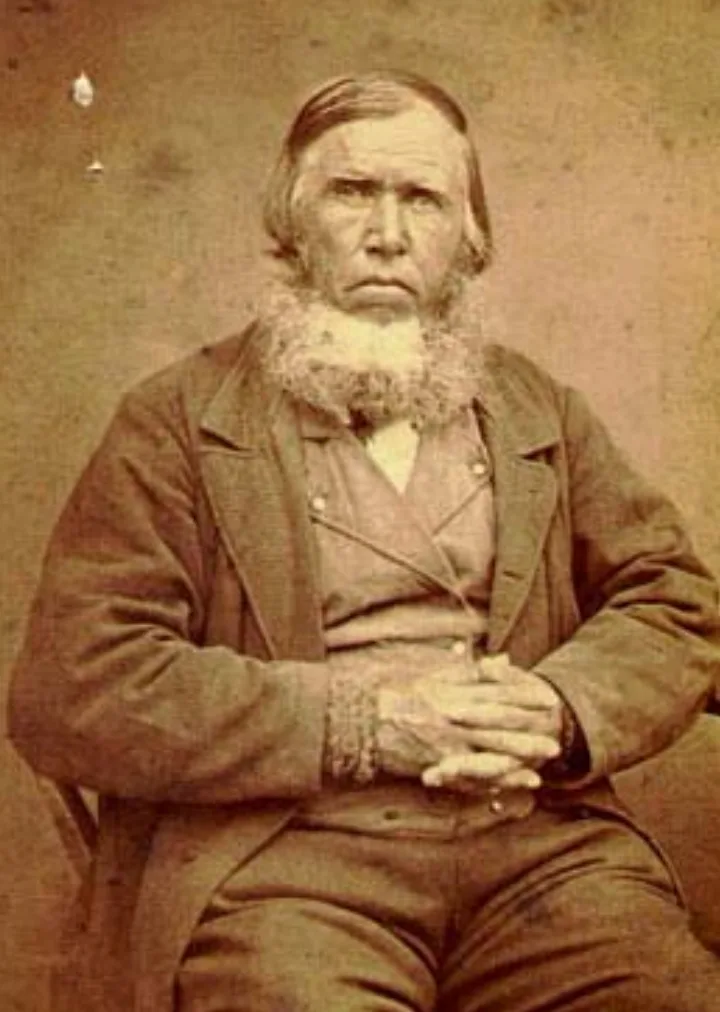 Elling Eielsen, portrait, Store norske leksikon (snl.no) A portrait of Elling Eielsen, the Voss-born lay preacher who carried Haugean Lutheranism to Norwegian immigrants in the American Midwest and founded the Eielsen Synod in 1846, the first Norwegian-American Lutheran body. Norwegian-American lay preacher and Lutheran church founder
(1804–1883). Born in Voss in western Norway; emigrated to
the United States in 1839 to organise Norwegian-immigrant
religious life along Haugean principles. Walked through the
upper Midwest holding revival meetings in immigrant
settlements from Illinois to Wisconsin and Iowa through the
1840s. In 1846 he organised the Eielsen Synod, the first
Norwegian-American Lutheran body, at Jefferson Prairie,
Wisconsin — a lay-led, anti-formalist Pietist organisation
that fed into the later Hauge Synod (1876) and ultimately
into the Evangelical Lutheran Church in America. The single
most important figure in carrying Haugean Lutheranism across
the Atlantic and embedding it in the religious life of the
Norwegian-American Midwest.
into the immigrant settlements of the upper Midwest and organised into the Hauge and Eielsen synods that fed into today’s American Lutheran bodies.
Elling Eielsen, portrait, Store norske leksikon (snl.no) A portrait of Elling Eielsen, the Voss-born lay preacher who carried Haugean Lutheranism to Norwegian immigrants in the American Midwest and founded the Eielsen Synod in 1846, the first Norwegian-American Lutheran body. Norwegian-American lay preacher and Lutheran church founder
(1804–1883). Born in Voss in western Norway; emigrated to
the United States in 1839 to organise Norwegian-immigrant
religious life along Haugean principles. Walked through the
upper Midwest holding revival meetings in immigrant
settlements from Illinois to Wisconsin and Iowa through the
1840s. In 1846 he organised the Eielsen Synod, the first
Norwegian-American Lutheran body, at Jefferson Prairie,
Wisconsin — a lay-led, anti-formalist Pietist organisation
that fed into the later Hauge Synod (1876) and ultimately
into the Evangelical Lutheran Church in America. The single
most important figure in carrying Haugean Lutheranism across
the Atlantic and embedding it in the religious life of the
Norwegian-American Midwest.
into the immigrant settlements of the upper Midwest and organised into the Hauge and Eielsen synods that fed into today’s American Lutheran bodies.
Inside Norway, the visible religious landscape now is the result of a long de-emphasis. Roughly six in ten Norwegians remain registered members of the Church of Norway, a figure declining steadily since the mid-1990s. Most are baptised as infants, confirmed at fifteen in a service marked by a hand-stitched Bunad  August Schneider, Sittende kvinne i Setesdals-bunad (1870), Nasjonalmuseet Schneider's 1870 painting of a woman in Setesdal folk dress documents one of the regional bunad variants — the parish-by-parish, valley-by-valley costume tradition that survived the Danish period intact. Norwegian regional folk costume — the rural traditional
dress that survived the four-hundred-year Danish period
intact, parish by parish, fjord by fjord. Each Norwegian
region (and many individual valleys) has its own bunad,
varying in colour, embroidery pattern, silver brooch
(sølje), shawl, and apron. The modern bunad tradition was
systematised in the late nineteenth and early twentieth
centuries by the textile historian Hulda Garborg and
others, but the underlying garments are pre-modern. Worn
on 17 May, at weddings, at confirmations, and at other
formal national occasions. The persistence of the bunad is
one of the most visible single signs of how the regional
substrate of Norway outlasted the long Danish absorption.
Also discussed in The 400-Year Night — when the Northern Lion lay dormantThe Constitution That Saved a Nation — five radical weeks at Eidsvoll, 1814800,000 Norwegians Leave — the century that built a Second NorwayWorld War II — the King’s “No” and the Nazis in NorwayTradisjoner — celebrations across the Norwegian year and a family gathering, married in the same church, and buried in its cemetery — and rarely enter the building between those occasions. Sociologists of religion call this pattern Folkekirke
August Schneider, Sittende kvinne i Setesdals-bunad (1870), Nasjonalmuseet Schneider's 1870 painting of a woman in Setesdal folk dress documents one of the regional bunad variants — the parish-by-parish, valley-by-valley costume tradition that survived the Danish period intact. Norwegian regional folk costume — the rural traditional
dress that survived the four-hundred-year Danish period
intact, parish by parish, fjord by fjord. Each Norwegian
region (and many individual valleys) has its own bunad,
varying in colour, embroidery pattern, silver brooch
(sølje), shawl, and apron. The modern bunad tradition was
systematised in the late nineteenth and early twentieth
centuries by the textile historian Hulda Garborg and
others, but the underlying garments are pre-modern. Worn
on 17 May, at weddings, at confirmations, and at other
formal national occasions. The persistence of the bunad is
one of the most visible single signs of how the regional
substrate of Norway outlasted the long Danish absorption.
Also discussed in The 400-Year Night — when the Northern Lion lay dormantThe Constitution That Saved a Nation — five radical weeks at Eidsvoll, 1814800,000 Norwegians Leave — the century that built a Second NorwayWorld War II — the King’s “No” and the Nazis in NorwayTradisjoner — celebrations across the Norwegian year and a family gathering, married in the same church, and buried in its cemetery — and rarely enter the building between those occasions. Sociologists of religion call this pattern Folkekirke  Adolph Tidemand, Overhøring i en bygdekirke (1847), Lillehammer Kunstmuseum Tidemand's 1847 painting of a parish catechism examination shows the ordinary state-church life folkekirke describes as sociological pattern, rather than lay revival. Folk church — the modern sociological category Norwegian
scholars use to describe the dominant religious pattern in
twenty-first-century Norway: a Lutheran church to which
roughly six in ten Norwegians remain registered members,
whose buildings and ministry mark the central life-cycle
events of most families (baptism, confirmation, marriage,
funeral), but in which weekly active practice is low.
Sociologists of religion describe the pattern as belonging
without believing — the church as a cultural-life-cycle
institution most Norwegians keep at arm's length and take
for granted at once. A 2012 constitutional
amendment ended the state religion; a Church Act amendment
in force 1 January 2017 completed it, making the Church of
Norway a folkekirke in law as well as sociology.
Also discussed in Statskirken — the state church and what's left of it : the church as a cultural-life-cycle institution that most Norwegians keep at arm’s length and take for granted at the same time. The egalitarian reflex against display and hierarchy that runs through modern Norwegian life — the suspicion of anyone who thinks himself special — is partly older than the conventicles and partly made in them, where a farmer and a fisherman read the same Bible and each claimed the same right to interpret it.
Adolph Tidemand, Overhøring i en bygdekirke (1847), Lillehammer Kunstmuseum Tidemand's 1847 painting of a parish catechism examination shows the ordinary state-church life folkekirke describes as sociological pattern, rather than lay revival. Folk church — the modern sociological category Norwegian
scholars use to describe the dominant religious pattern in
twenty-first-century Norway: a Lutheran church to which
roughly six in ten Norwegians remain registered members,
whose buildings and ministry mark the central life-cycle
events of most families (baptism, confirmation, marriage,
funeral), but in which weekly active practice is low.
Sociologists of religion describe the pattern as belonging
without believing — the church as a cultural-life-cycle
institution most Norwegians keep at arm's length and take
for granted at once. A 2012 constitutional
amendment ended the state religion; a Church Act amendment
in force 1 January 2017 completed it, making the Church of
Norway a folkekirke in law as well as sociology.
Also discussed in Statskirken — the state church and what's left of it : the church as a cultural-life-cycle institution that most Norwegians keep at arm’s length and take for granted at the same time. The egalitarian reflex against display and hierarchy that runs through modern Norwegian life — the suspicion of anyone who thinks himself special — is partly older than the conventicles and partly made in them, where a farmer and a fisherman read the same Bible and each claimed the same right to interpret it.
The most American thing in Norwegian religious history of the last two centuries — lay-led, voluntarist, revival-minded, building its own institutions — is the Haugean Movement Adolph Tidemand, Haugianerne / Low Church Devotion (1852), Nasjonalmuseet Tidemand's Haugianerne — the lay preacher standing with open book in hand, a farm gathering pressed close under the loft's shaft of light — is the canonical image of the conventicle itself, the illegal farm-kitchen meeting form the movement was built from. The lay-Christian revival that emerged in Norway from Hans
Nielsen Hauge's preaching between 1796 and 1804 and
continued under his followers through the nineteenth
century. De vakte — the awakened — formed networks of
lay-led conventicles in farm kitchens, practising daily
devotional reading, household hymn-singing, and small-
group lay leadership. By Hauge's death (1824) the movement
had organised commercial undertakings — mills, paper-
works, salt-works, fisheries, shipyards, textile factories
— financed by capital pooled across the network. The
frugal, hard-working ethic that came out of this work fed
into Norway's cooperative and savings-bank traditions, and
the movement crossed the Atlantic with the emigrants.
Also discussed in 800,000 Norwegians Leave — the century that built a Second NorwayIdentitet — what it means to be Norwegian(*Draft)Dugnad — showing up to help . The most Norwegian thing about it is that it never formally left the state church it had spent a century reaching past. Hans Nielsen Hauge died on the twenty-ninth of March 1824 at his estate Bredtvedt outside Christiania 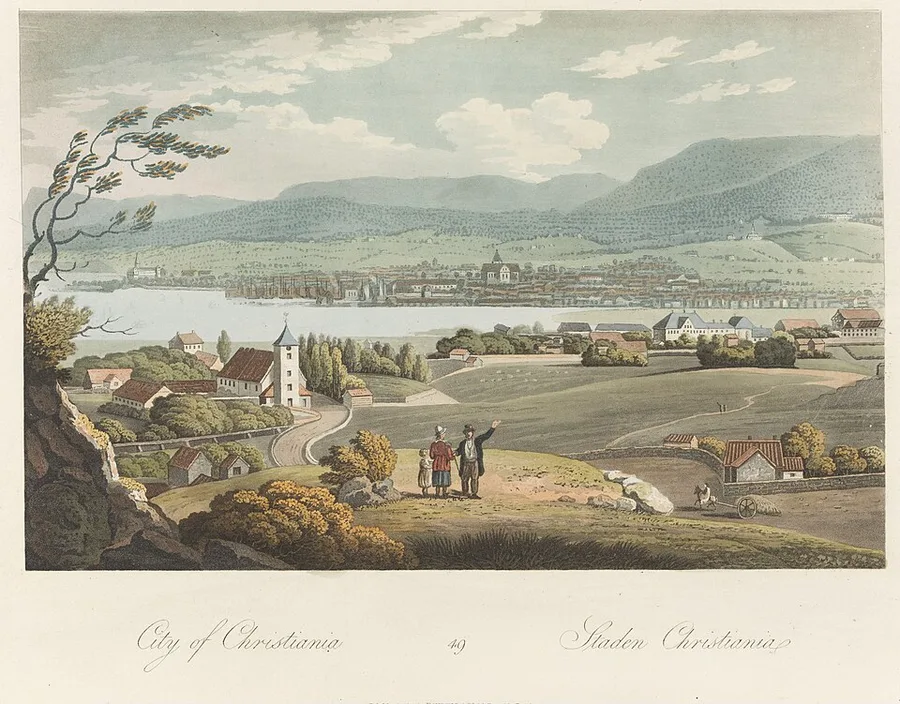 John William Edy, City of Christiania (1814), Boydell's Picturesque Scenery of Norway — National Museum of Art, Architecture and Design John William Edy's 1814 view of the small grid-planned capital across the water. This is the town King Christian IV laid out beneath Akershus after the 1624 fire razed medieval Oslo, and named for himself; its Kvadraturen grid survives today. Capital of Norway from 1624 to 1925 — the rebuilt town that
King Christian IV laid out west of the medieval Oslo after
the fire of August 1624 destroyed the old city. Christian
founded the new town on a grid plan beneath Akershus
fortress, named it for himself, and ordered the surviving
Oslo burghers to move into it. Christiania was the
capital's name through the four-hundred-year night, the
brief war of 1814, the constitutional Eidsvoll moment, the
ninety-one-year personal union with Sweden, and the first
two decades of fully independent Norway after 1905. In 1877
the spelling was modernised to Kristiania; in 1925 the
city formally returned to the medieval name Oslo. The
Kvadraturen district preserves Christian IV's grid intact
today.
On the trip Days 1–2 in Oslo bring both groups through Christiania —
Christian IV's seventeenth-century planned grid, still
visible today as the Kvadraturen district just below
Akershus fortress.
Also discussed in The 400-Year Night — when the Northern Lion lay dormantThe Constitution That Saved a Nation — five radical weeks at Eidsvoll, 1814800,000 Norwegians Leave — the century that built a Second NorwayThe Quiet Revolution — how Norway won its independence without a warWorld War II — the King’s “No” and the Nazis in NorwayNorske eventyr — the folk tales almost lost foreverStedssagn — local legends, told as warningsUtburd — the unbaptized child that will not rest , his health broken by the years in prison. He was buried in the cemetery of Gamle Aker Church
John William Edy, City of Christiania (1814), Boydell's Picturesque Scenery of Norway — National Museum of Art, Architecture and Design John William Edy's 1814 view of the small grid-planned capital across the water. This is the town King Christian IV laid out beneath Akershus after the 1624 fire razed medieval Oslo, and named for himself; its Kvadraturen grid survives today. Capital of Norway from 1624 to 1925 — the rebuilt town that
King Christian IV laid out west of the medieval Oslo after
the fire of August 1624 destroyed the old city. Christian
founded the new town on a grid plan beneath Akershus
fortress, named it for himself, and ordered the surviving
Oslo burghers to move into it. Christiania was the
capital's name through the four-hundred-year night, the
brief war of 1814, the constitutional Eidsvoll moment, the
ninety-one-year personal union with Sweden, and the first
two decades of fully independent Norway after 1905. In 1877
the spelling was modernised to Kristiania; in 1925 the
city formally returned to the medieval name Oslo. The
Kvadraturen district preserves Christian IV's grid intact
today.
On the trip Days 1–2 in Oslo bring both groups through Christiania —
Christian IV's seventeenth-century planned grid, still
visible today as the Kvadraturen district just below
Akershus fortress.
Also discussed in The 400-Year Night — when the Northern Lion lay dormantThe Constitution That Saved a Nation — five radical weeks at Eidsvoll, 1814800,000 Norwegians Leave — the century that built a Second NorwayThe Quiet Revolution — how Norway won its independence without a warWorld War II — the King’s “No” and the Nazis in NorwayNorske eventyr — the folk tales almost lost foreverStedssagn — local legends, told as warningsUtburd — the unbaptized child that will not rest , his health broken by the years in prison. He was buried in the cemetery of Gamle Aker Church 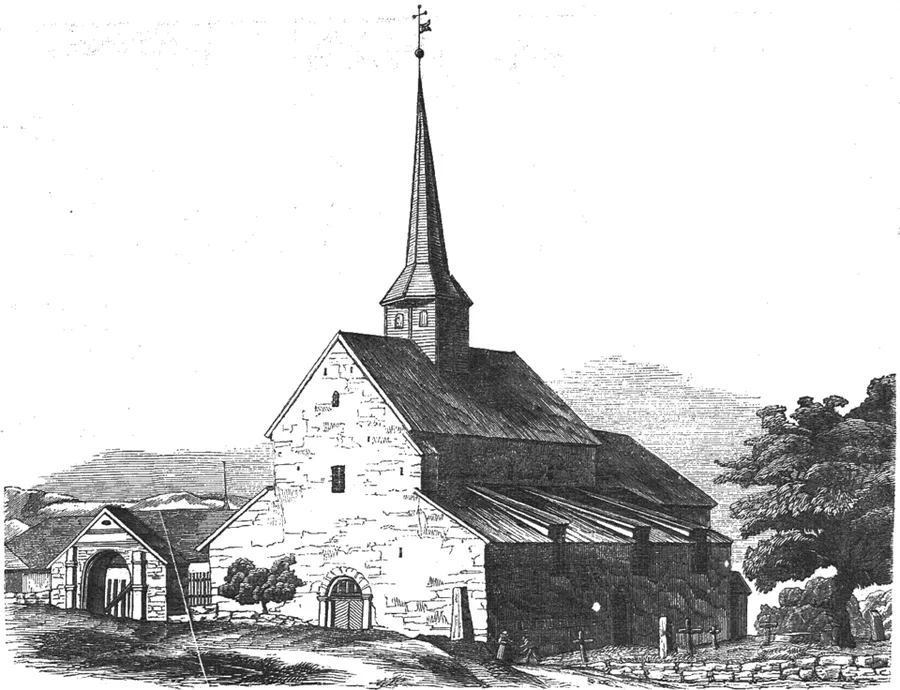 Aker Kirke, Illustreret Nyhedsblad no. 15 (10 January 1852) The 1852 engraving shows the church before its restoration — whitewashed, wooden-spired, the churchyard crowded with crosses: the ground where Hans Nielsen Hauge was buried in 1824 under a stone naming him a brother in Christ. Old Aker Church — the oldest standing building in Oslo, a
Romanesque stone church on the Akersberg ridge about a
kilometre north of the medieval city. Built between the
late eleventh century and the mid-1100s, with three-aisled
basilica plan and the characteristic round-arched stonework
of early Norwegian stone masonry. Survived the medieval
fires, the Reformation, and the centuries of disuse that
followed; restored progressively from the 1850s onward. In
use as a Lutheran parish church and a wedding and concert
venue today. In its cemetery is buried Hans Nielsen Hauge
(d. 29 March 1824), under a stone naming him a brother in
Christ — the state church he had walked against the church
that buried him.
On the trip Days 1–2 put both groups in Oslo, whose oldest building
this is — Gamle Aker Church stands on its ridge north of
the centre, in the churchyard where Hans Nielsen Hauge is
buried.
in Oslo, under a stone that names him a brother in Christ. The state church he had walked against was the church that buried him. The Conventicle Ordinance he had defied was repealed eighteen years later. The church he had built his movement inside disestablished itself a hundred and ninety-three years after his death — and the meetings he had started in barns and farm kitchens are still held, in many parts of the country, by descendants of the people who first attended them.
Aker Kirke, Illustreret Nyhedsblad no. 15 (10 January 1852) The 1852 engraving shows the church before its restoration — whitewashed, wooden-spired, the churchyard crowded with crosses: the ground where Hans Nielsen Hauge was buried in 1824 under a stone naming him a brother in Christ. Old Aker Church — the oldest standing building in Oslo, a
Romanesque stone church on the Akersberg ridge about a
kilometre north of the medieval city. Built between the
late eleventh century and the mid-1100s, with three-aisled
basilica plan and the characteristic round-arched stonework
of early Norwegian stone masonry. Survived the medieval
fires, the Reformation, and the centuries of disuse that
followed; restored progressively from the 1850s onward. In
use as a Lutheran parish church and a wedding and concert
venue today. In its cemetery is buried Hans Nielsen Hauge
(d. 29 March 1824), under a stone naming him a brother in
Christ — the state church he had walked against the church
that buried him.
On the trip Days 1–2 put both groups in Oslo, whose oldest building
this is — Gamle Aker Church stands on its ridge north of
the centre, in the churchyard where Hans Nielsen Hauge is
buried.
in Oslo, under a stone that names him a brother in Christ. The state church he had walked against was the church that buried him. The Conventicle Ordinance he had defied was repealed eighteen years later. The church he had built his movement inside disestablished itself a hundred and ninety-three years after his death — and the meetings he had started in barns and farm kitchens are still held, in many parts of the country, by descendants of the people who first attended them.
Sources & further reading
Primary sources
- Hans Nielsen Hauge, Betragtning over Verdens Daarlighed (1796) and the body of devotional books, letters, and tracts he wrote and circulated between 1796 and the 1810s. The founding texts of the Haugean movement, many first circulated in handwritten copies among the lay-reader network.
- Konventikkelplakaten (the Conventicle Ordinance), 13 January 1741. The royal ordinance regulating lay religious gatherings under which Hauge was repeatedly arrested; repealed 1842.
- Erik Pontoppidan, Sandhed til Gudfrygtighed (1737). The state-Pietist catechism that shaped Norwegian religious instruction for roughly two centuries.
Modern scholarship
- Andreas Aarflot, Hans Nielsen Hauge: His Life and Message (Augsburg, 1979). The standard English-language biography.
- Dag Kullerud, Hans Nielsen Hauge: Mannen som vekket Norge (Forum, 1996). The standard modern Norwegian biography.
- Sigbjørn Ravnåsen, Ånd og hånd: Hans Nielsen Hauges etikk for ledelse og næringsliv (Luther forlag, 2002). On Hauge’s economic activity and its long downstream influence.
- Bjørg Seland, Religion på det frie marked: Folkelig pietisme og bedehuskultur (Høyskoleforlaget, 2006). On the longer arc of Norwegian lay-revival culture.
- Bernt T. Oftestad, Tarald Rasmussen, and Jan Schumacher, Norsk kirkehistorie, 3rd ed. (Universitetsforlaget, 2005). The standard one-volume Norwegian church history.
- W. R. Ward, The Protestant Evangelical Awakening (Cambridge University Press, 1992). On Pietism’s German origins and its spread across northern Europe.
- Odd S. Lovoll, The Promise of America: A History of the Norwegian-American People, rev. ed. (University of Minnesota Press, 1999). On the Norwegian-American religious extension.
- Inger Furseth and Pål Repstad, An Introduction to the Sociology of Religion (Ashgate, 2006), and Pål Repstad, Religiøse trender i Norge (Universitetsforlaget, 2020). On contemporary Norwegian religiosity.
Reference
- Store norske leksikon (snl.no). See in particular Hans Nielsen Hauge, Konventikkelplakaten, pietisme, Dissenterloven, Den norske kirke, and Det norske lutherske Indremisjonsselskap.
- Library of Congress, “Norway: State and Church Separate After 500 Years” (3 February 2017), https://www.loc.gov/item/global-legal-monitor/2017-02-03/norway-state-and-church-separate-after-500-years/.
Visit
- Gamle Aker Church, Oslo. The oldest standing building in the city, a stone church from around 1150, in whose cemetery Hans Nielsen Hauge is buried. Open to visitors.
- Hans Nielsen Hauges Minne, Rolvsøy, Fredrikstad. The memorial museum at the farm in Rolvsøy where Hauge grew up and underwent his 1796 conversion, in the old parish of Tune in Østfold.
- Norsk Folkemuseum, Oslo. The open-air folk museum at Bygdøy preserves a bedehus and farmhouse interiors of the kind in which the Haugean conventicles met, alongside a medieval stave church.
- Eidsvollsbygningen, Eidsvoll. The 1814 constitutional assembly that Hauge’s generation of lay Christians lived to see; the constitution it produced retained the Lutheran establishment that the next century slowly loosened.