Worshiping Odin and Thor — The lived religion of pre-Christian Norway
The daily-life religion of pre-Christian Norse society. The ritual year, the chieftain-priest at the hov, the offering at the byre, the Mjölnir around the farmer's neck, and a conversion that broke the public cult and left the private one intact.
The Norse gods come down to us through the myths: a world-tree with nine realms in its branches, a wolf who will swallow the sun, the one-eyed god hanging nine nights from that tree to win the Runes 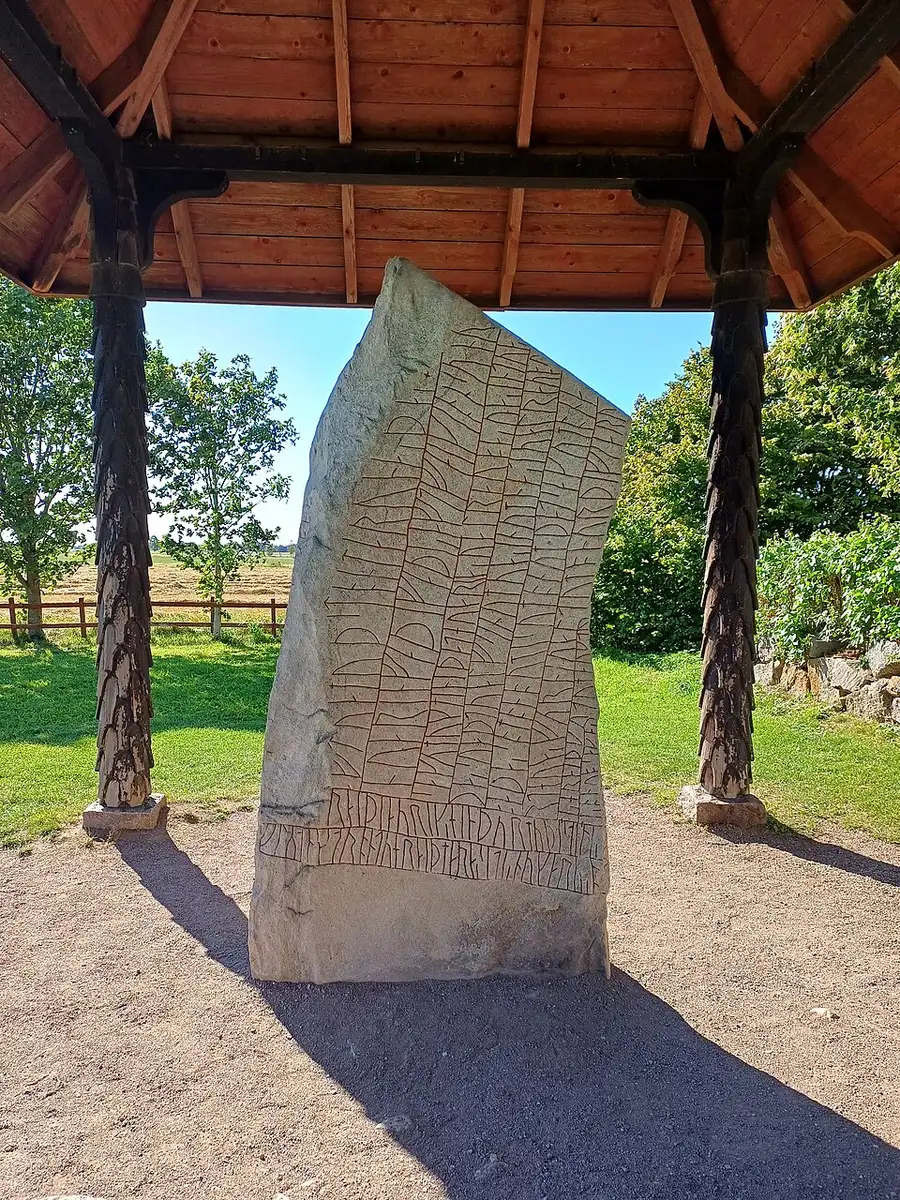 Photo: L'imaginaire, Rök runestone, Östergötland, Sweden, CC0 The Rök stone carries the longest known runic inscription on stone — the single most-recognized surviving example of the runes the card describes Odin winning by hanging nine nights on Yggdrasil, and their everyday use for healing, warding, and safe travel. The angular alphabet of the pre-Christian Germanic and Norse
peoples — the Elder Futhark (24 characters) from c. 150 CE,
succeeded by the simpler Younger Futhark (16 characters) from
c. 700 in Scandinavia. In Norse mythology Odin won the runes by
hanging nine nights from Yggdrasil, pierced by his own spear; in
daily Norse religion the runes were cut for healing, warding,
safe travel, and love-charms — on combs, knife-hafts, doorposts,
loom-weights, fishing-boat prows. The largest surviving body of
rune-stones (around three thousand) is in Sweden; Norway has
several hundred. The runic script gradually gave way to the
Latin alphabet across the medieval period, persisting in folk-
practice as the rune-stick well into the early modern era.
, a hall where the slain feast until the end of the world. Almost none of it is what a Norwegian actually lived.
Photo: L'imaginaire, Rök runestone, Östergötland, Sweden, CC0 The Rök stone carries the longest known runic inscription on stone — the single most-recognized surviving example of the runes the card describes Odin winning by hanging nine nights on Yggdrasil, and their everyday use for healing, warding, and safe travel. The angular alphabet of the pre-Christian Germanic and Norse
peoples — the Elder Futhark (24 characters) from c. 150 CE,
succeeded by the simpler Younger Futhark (16 characters) from
c. 700 in Scandinavia. In Norse mythology Odin won the runes by
hanging nine nights from Yggdrasil, pierced by his own spear; in
daily Norse religion the runes were cut for healing, warding,
safe travel, and love-charms — on combs, knife-hafts, doorposts,
loom-weights, fishing-boat prows. The largest surviving body of
rune-stones (around three thousand) is in Sweden; Norway has
several hundred. The runic script gradually gave way to the
Latin alphabet across the medieval period, persisting in folk-
practice as the rune-stick well into the early modern era.
, a hall where the slain feast until the end of the world. Almost none of it is what a Norwegian actually lived.
Pre-Christian Norse religion was lived rather than believed. It had no holy book, no creed to recite, no doctrine to dispute. It had a calendar, a chieftain who led the rites, two kinds of sacred place, and one defining act: a meal shared between a community and its gods, held at the hinges of the farming year, the way a field is ploughed every spring. The gods took their portion through fire. The household took its portion at the table. There was no priesthood standing between them.
It reached every joint of a life — birth, naming, marriage, and death — and ran through the daily turning of a farm: the luck of the byre, the yield of the field, the safety of a sea-going son. This was the religion of the Norse-speaking farms of the south and the western coast. The The Sámi 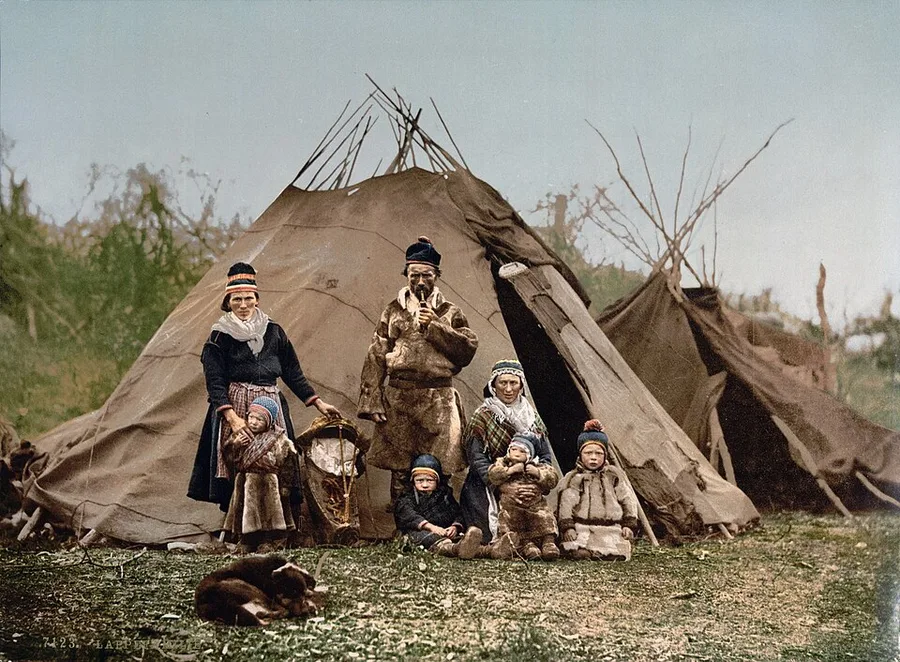 Unknown photographer, Saami Family (c. 1896, Kanstadfjord near Lødingen), Library of Congress A hand-tinted photochrom of a Sámi family in gákti dress outside their lávvu tents, around 1896. A late photograph of a very old fact: alongside and north of Norse Norway, the Sámi have always been a parallel people, with their own languages, livelihoods, and religious world. The Indigenous people of Sápmi, the cultural region across the
northern interior of present-day Norway, Sweden, Finland, and the
Russian Kola Peninsula. Sámi languages belong to the Uralic family,
unrelated to Norse. A distinctly Sámi material culture is visible
in the archaeological record from about 500 BCE. The traditional
Sámi economy ran on hunting, fishing, and trapping, with
semi-domesticated reindeer used for transport long before the
large-scale reindeer pastoralism of later centuries. Sámi religious
life centred on the noaidi (ritual specialist), the goavddis
(painted ritual drum), and the sieidi (sacred natural places).
Modern Sámi political representation runs through the Sámi
parliaments in Norway, Sweden, and Finland.
Also discussed in Samene — the other people of NorwayBefore There Was Norway — petty kingdoms at the edge of the worldThe Reformation, 1537 — one church eradicated and another imposedWorld War II — the King’s “No” and the Nazis in NorwayPolitikk — the left, the right, and the Norwegian way of the interior north kept a tradition of their own.
Unknown photographer, Saami Family (c. 1896, Kanstadfjord near Lødingen), Library of Congress A hand-tinted photochrom of a Sámi family in gákti dress outside their lávvu tents, around 1896. A late photograph of a very old fact: alongside and north of Norse Norway, the Sámi have always been a parallel people, with their own languages, livelihoods, and religious world. The Indigenous people of Sápmi, the cultural region across the
northern interior of present-day Norway, Sweden, Finland, and the
Russian Kola Peninsula. Sámi languages belong to the Uralic family,
unrelated to Norse. A distinctly Sámi material culture is visible
in the archaeological record from about 500 BCE. The traditional
Sámi economy ran on hunting, fishing, and trapping, with
semi-domesticated reindeer used for transport long before the
large-scale reindeer pastoralism of later centuries. Sámi religious
life centred on the noaidi (ritual specialist), the goavddis
(painted ritual drum), and the sieidi (sacred natural places).
Modern Sámi political representation runs through the Sámi
parliaments in Norway, Sweden, and Finland.
Also discussed in Samene — the other people of NorwayBefore There Was Norway — petty kingdoms at the edge of the worldThe Reformation, 1537 — one church eradicated and another imposedWorld War II — the King’s “No” and the Nazis in NorwayPolitikk — the left, the right, and the Norwegian way of the interior north kept a tradition of their own.
Gods in their working roles
The pantheon was large, and the mythology around it — the war of the The Æsir 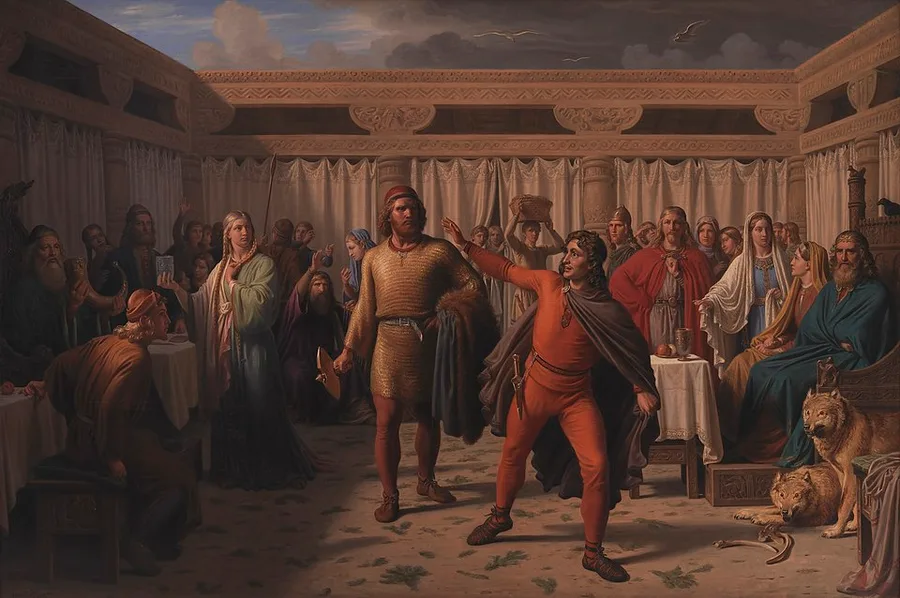 Constantin Hansen, Ægirs gæstebud (1857), Statens Museum for Kunst, Copenhagen Hansen painted the whole pantheon at a feast in the sea-giant Ægir's hall — the assembled Æsir, Loki in red rising mid-quarrel — one banquet scene standing in for the war-and-wisdom gods this card names. The principal pantheon of Norse mythology — the gods associated with
power, war, wisdom, and order. Includes Odin, Thor, Tyr, Heimdall,
Baldr, Loki, and others. Lived in Asgard, the citadel at the top
of the world-tree Yggdrasil, connected to Midgard (the world of men)
by the rainbow bridge Bifröst. The Æsir fought a primordial war with
the rival Vanir pantheon; the two groups eventually made peace,
with key Vanir gods (Frey, Freyja, Njörðr) taken into the Æsir
pantheon as hostages of the settlement.
Also discussed in Nordisk Mytologi — Odin, the giants, and Ragnarok and the The Vanir
Constantin Hansen, Ægirs gæstebud (1857), Statens Museum for Kunst, Copenhagen Hansen painted the whole pantheon at a feast in the sea-giant Ægir's hall — the assembled Æsir, Loki in red rising mid-quarrel — one banquet scene standing in for the war-and-wisdom gods this card names. The principal pantheon of Norse mythology — the gods associated with
power, war, wisdom, and order. Includes Odin, Thor, Tyr, Heimdall,
Baldr, Loki, and others. Lived in Asgard, the citadel at the top
of the world-tree Yggdrasil, connected to Midgard (the world of men)
by the rainbow bridge Bifröst. The Æsir fought a primordial war with
the rival Vanir pantheon; the two groups eventually made peace,
with key Vanir gods (Frey, Freyja, Njörðr) taken into the Æsir
pantheon as hostages of the settlement.
Also discussed in Nordisk Mytologi — Odin, the giants, and Ragnarok and the The Vanir 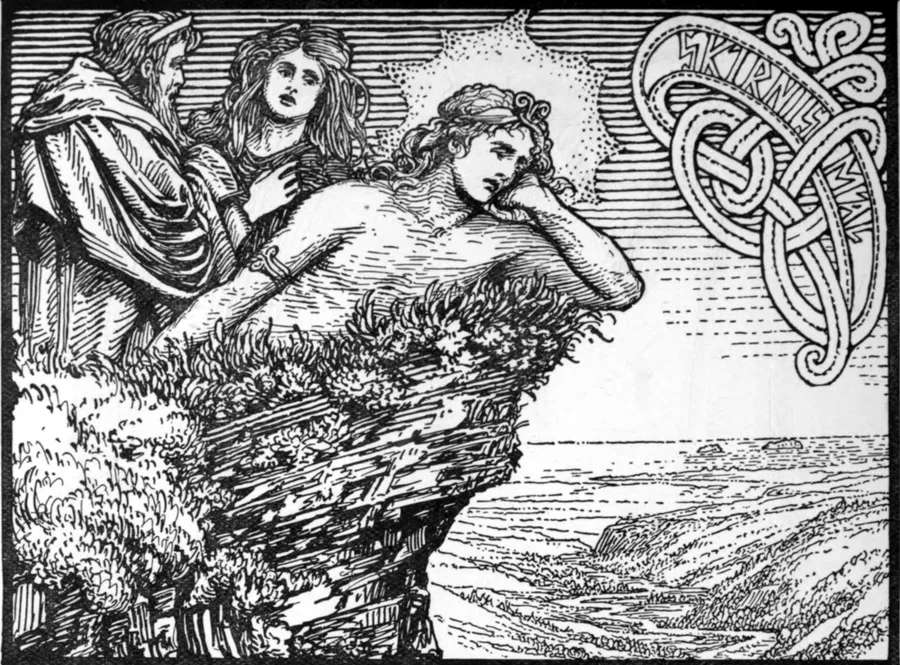 W.G. Collingwood, The Lovesickness of Frey (1908), from The Elder or Poetic Edda Frey — chief of the Vanir, the fertility gods — slumped lovesick after glimpsing the giantess Gerd from Odin's high seat, in W.G. Collingwood's 1908 plate for the Eddic poem Skírnismál. The second pantheon of Norse mythology — gods associated with
fertility, prosperity, magic, and the sea, in some sense older or
more chthonic than the Æsir. The leading Vanir were Njörðr (god of
the sea and wind), his children Frey (god of harvest and peace) and
Freyja (goddess of love and seiðr). A primordial war between Æsir
and Vanir ended in peace and the exchange of hostages; Njörðr, Frey,
and Freyja came to live among the Æsir and are usually counted with
them in later Norse tradition. The Vanir's distinctness from the
Æsir is one of the more debated questions in modern study of Norse
religion.
Also discussed in Nordisk Mytologi — Odin, the giants, and Ragnarok , Ragnarok
W.G. Collingwood, The Lovesickness of Frey (1908), from The Elder or Poetic Edda Frey — chief of the Vanir, the fertility gods — slumped lovesick after glimpsing the giantess Gerd from Odin's high seat, in W.G. Collingwood's 1908 plate for the Eddic poem Skírnismál. The second pantheon of Norse mythology — gods associated with
fertility, prosperity, magic, and the sea, in some sense older or
more chthonic than the Æsir. The leading Vanir were Njörðr (god of
the sea and wind), his children Frey (god of harvest and peace) and
Freyja (goddess of love and seiðr). A primordial war between Æsir
and Vanir ended in peace and the exchange of hostages; Njörðr, Frey,
and Freyja came to live among the Æsir and are usually counted with
them in later Norse tradition. The Vanir's distinctness from the
Æsir is one of the more debated questions in modern study of Norse
religion.
Also discussed in Nordisk Mytologi — Odin, the giants, and Ragnarok , Ragnarok 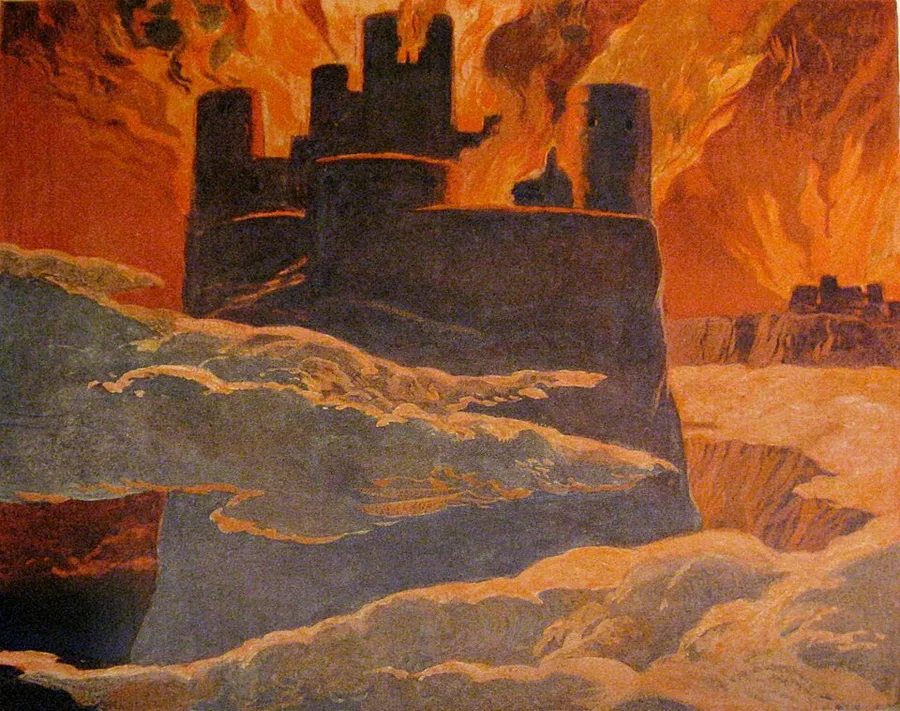 Emil Doepler, Ragnarök (c. 1905), from Walhall, die Götterwelt der Germanen Emil Doepler's Ragnarök plate of around 1905 — a stronghold swallowed in flame above rolling smoke, the world-fire of the final battle in which most of the Norse gods fall and the world burns before rising anew. The end of the world in Norse mythology — Ragnarǫk, "the doom
(or twilight) of the gods." A final battle in which the world-
serpent Jörmungandr, the wolf Fenrir, the fire-giant Surtr, the
forces of the jötnar, and Loki break free of their constraints
and meet the Æsir in open battle. Most of the major gods are
killed: Odin by Fenrir, Thor by Jörmungandr (and the serpent by
Thor in the same exchange), Frey by Surtr's flaming sword. The
world burns and sinks into the sea, then rises again, and a small
remnant of gods and humans repopulates it. The central narrative
of pre-Christian Norse religious imagination, distinct from the
Christian apocalypse it superficially resembles in being a battle
the gods are going to lose.
Also discussed in Nordisk Mytologi — Odin, the giants, and Ragnarok , the world that rises after — had a rich life of its own. On the farm the gods appeared in a narrower role. Each had a job.
Emil Doepler, Ragnarök (c. 1905), from Walhall, die Götterwelt der Germanen Emil Doepler's Ragnarök plate of around 1905 — a stronghold swallowed in flame above rolling smoke, the world-fire of the final battle in which most of the Norse gods fall and the world burns before rising anew. The end of the world in Norse mythology — Ragnarǫk, "the doom
(or twilight) of the gods." A final battle in which the world-
serpent Jörmungandr, the wolf Fenrir, the fire-giant Surtr, the
forces of the jötnar, and Loki break free of their constraints
and meet the Æsir in open battle. Most of the major gods are
killed: Odin by Fenrir, Thor by Jörmungandr (and the serpent by
Thor in the same exchange), Frey by Surtr's flaming sword. The
world burns and sinks into the sea, then rises again, and a small
remnant of gods and humans repopulates it. The central narrative
of pre-Christian Norse religious imagination, distinct from the
Christian apocalypse it superficially resembles in being a battle
the gods are going to lose.
Also discussed in Nordisk Mytologi — Odin, the giants, and Ragnarok , the world that rises after — had a rich life of its own. On the farm the gods appeared in a narrower role. Each had a job.
Thor 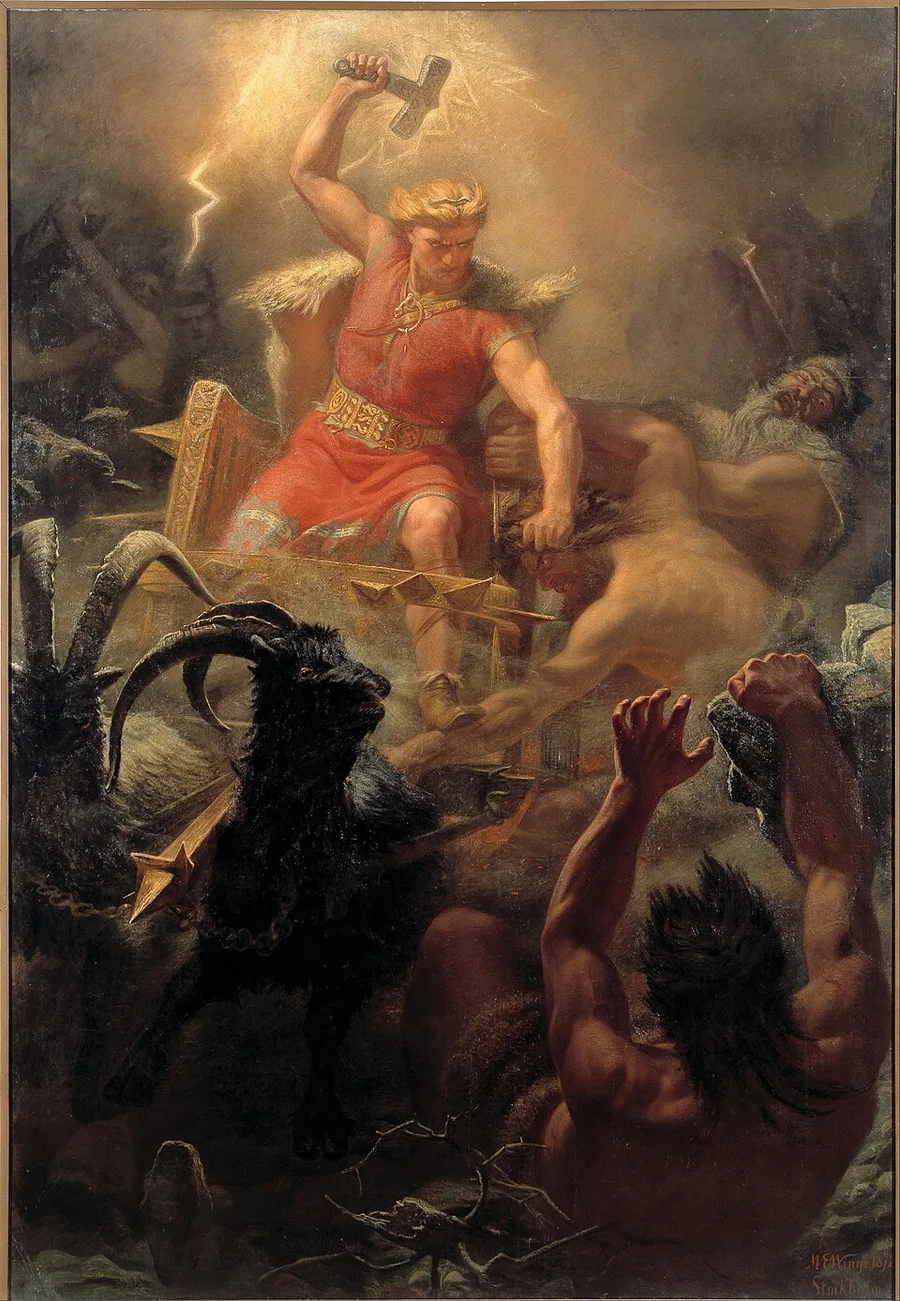 Mårten Eskil Winge, Tors strid med jättarna (1872), Nationalmuseum, Stockholm — Google Art Project scan Winge paints Thor at his defining work — riding his goat-drawn chariot through the storm, swinging the hammer Mjölnir at the fleeing giants he holds back from the cultivated world of gods and farmers. Norse god of thunder, storms, oaths, marriages, and the ordinary
protection of the cultivated world against the wild one. Son of
Odin and the giantess Jörð (Earth). Wielded the hammer Mjölnir,
which he used to defend Asgard and Midgard from the jötnar
(giants). On the farm Thor was the everyman's god — the protector
of the sick cow, the cracked ploughshare, the safety of a sea-going
son. Small hammer amulets recovered from graves and hoards across
the Norse world scaled that protection down to the single person
who wore one. The English word Thursday (Thor's day) preserves
his weekly observance.
Also discussed in Nordisk Mytologi — Odin, the giants, and RagnarokJulebukk — the masked goat of midwinter was the god of ordinary protection. He held the cultivated world against the wild one. Storms answered to him, and so did boundaries, oaths, marriages, and the small disasters that could undo a household — a sick cow, a cracked ploughshare, a thunderhead standing over the unmown hay. He carried the hammer Mjölnir
Mårten Eskil Winge, Tors strid med jättarna (1872), Nationalmuseum, Stockholm — Google Art Project scan Winge paints Thor at his defining work — riding his goat-drawn chariot through the storm, swinging the hammer Mjölnir at the fleeing giants he holds back from the cultivated world of gods and farmers. Norse god of thunder, storms, oaths, marriages, and the ordinary
protection of the cultivated world against the wild one. Son of
Odin and the giantess Jörð (Earth). Wielded the hammer Mjölnir,
which he used to defend Asgard and Midgard from the jötnar
(giants). On the farm Thor was the everyman's god — the protector
of the sick cow, the cracked ploughshare, the safety of a sea-going
son. Small hammer amulets recovered from graves and hoards across
the Norse world scaled that protection down to the single person
who wore one. The English word Thursday (Thor's day) preserves
his weekly observance.
Also discussed in Nordisk Mytologi — Odin, the giants, and RagnarokJulebukk — the masked goat of midwinter was the god of ordinary protection. He held the cultivated world against the wild one. Storms answered to him, and so did boundaries, oaths, marriages, and the small disasters that could undo a household — a sick cow, a cracked ploughshare, a thunderhead standing over the unmown hay. He carried the hammer Mjölnir 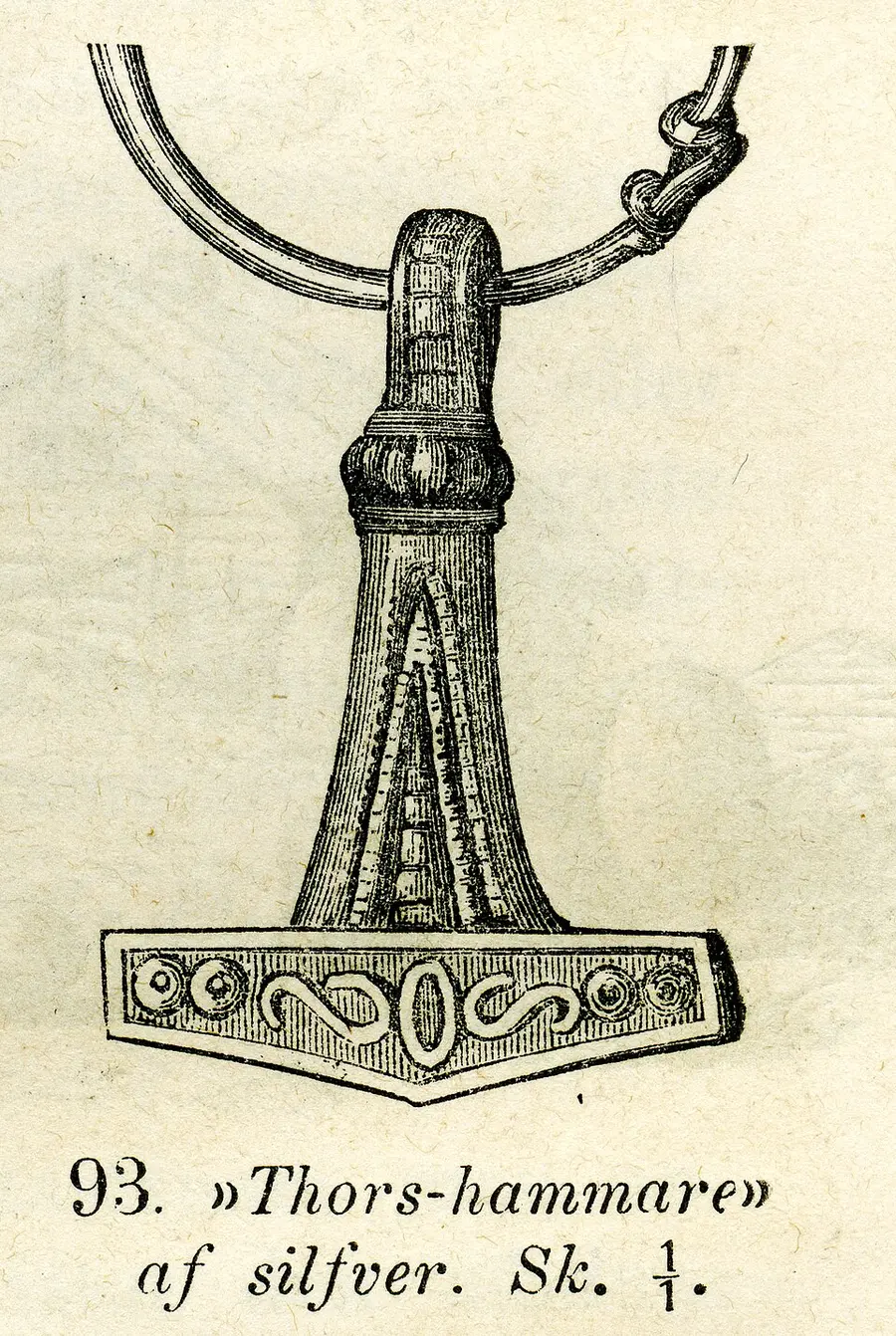 Oscar Montelius, silver Thor's-hammer amulet from Skåne, engraving (1873) An 1873 engraving of a silver Thor's-hammer pendant from Skåne, a raptor's head at its loop — the everyday amulet form of the hammer, worn at the throat for protection and the commonest religious object in the Norse record. Thor's hammer. The mythological weapon Thor wielded against the
jötnar, the giants; struck with such force that it produced
thunder, and always returned to his hand when thrown. In daily
Norse religion Mjölnir lived as a small iron or silver amulet —
the hammer-shape pendant worn at the throats of children, women,
and men of every rank. The Mjölnir pendant was protection rather
than decoration: a household-scale piece of Thor's covering for
the ordinary disasters that could undo a farm. The commonest
religious object in the entire Norse archaeological record, with
thousands of surviving examples from across Scandinavia and the
Norse settlements.
Also discussed in Nordisk Mytologi — Odin, the giants, and Ragnarok , and small iron and silver pendants in its shape were worn by men, women, and children of every rank. Mjölnir was the farmer’s god.
Oscar Montelius, silver Thor's-hammer amulet from Skåne, engraving (1873) An 1873 engraving of a silver Thor's-hammer pendant from Skåne, a raptor's head at its loop — the everyday amulet form of the hammer, worn at the throat for protection and the commonest religious object in the Norse record. Thor's hammer. The mythological weapon Thor wielded against the
jötnar, the giants; struck with such force that it produced
thunder, and always returned to his hand when thrown. In daily
Norse religion Mjölnir lived as a small iron or silver amulet —
the hammer-shape pendant worn at the throats of children, women,
and men of every rank. The Mjölnir pendant was protection rather
than decoration: a household-scale piece of Thor's covering for
the ordinary disasters that could undo a farm. The commonest
religious object in the entire Norse archaeological record, with
thousands of surviving examples from across Scandinavia and the
Norse settlements.
Also discussed in Nordisk Mytologi — Odin, the giants, and Ragnarok , and small iron and silver pendants in its shape were worn by men, women, and children of every rank. Mjölnir was the farmer’s god.
Frey 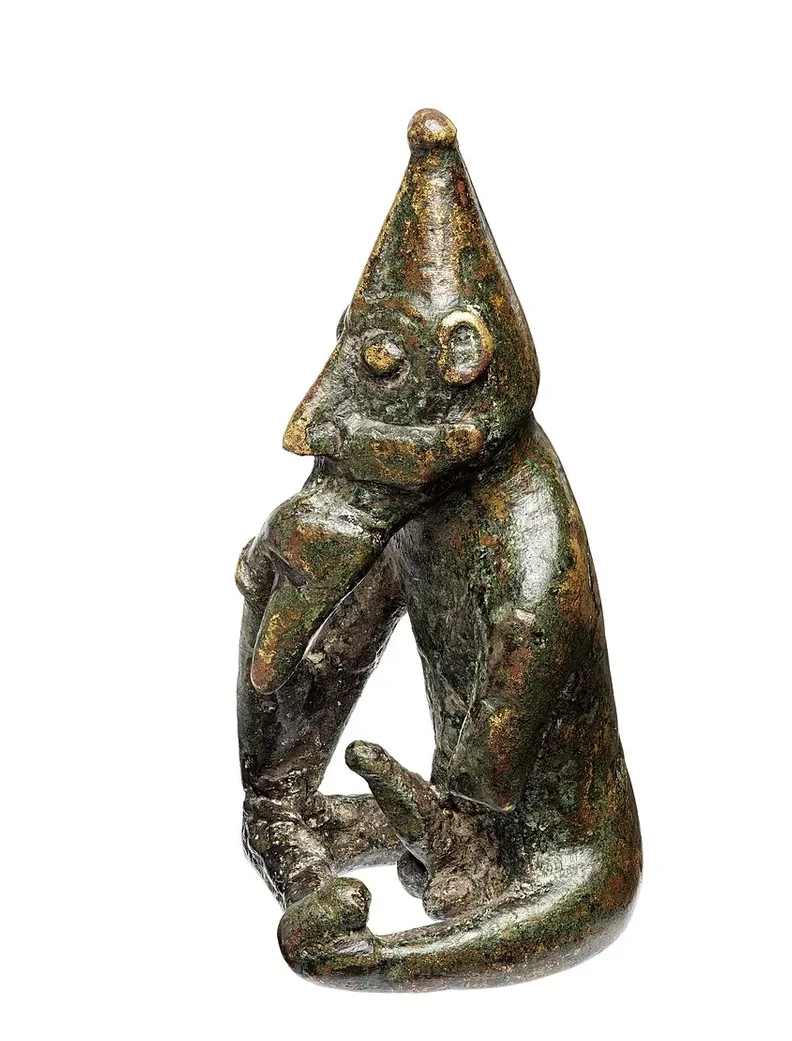 Rällinge Freyr statuette (Viking Age), photo: Ola Myrin, Historiska museet/SHM (CC BY 4.0) A small Viking Age bronze from Rällinge in Sweden — a seated, cross-legged figure in a pointed cap, long read as the fertility god Freyr and standing in for a deity no portrait records. Old Norse god (Old Norse Freyr, "lord") of fertility, prosperity,
fair weather, peace, and good harvest, brother of Freyja and one of
the principal Vanir deities incorporated into the Æsir pantheon.
The Yngling dynasty of Vestfold claimed direct descent from Frey
through the line traced in Ynglingatal; the claim was a religious
legitimation of the dynasty's right to rule.
Also discussed in Before There Was Norway — petty kingdoms at the edge of the worldNordisk Mytologi — Odin, the giants, and Ragnarok was the god of the harvest, of fertility, peace, and a good year. He was strongest in the south and the farming districts, weakest in the warband halls of the north. His sister Freyja
Rällinge Freyr statuette (Viking Age), photo: Ola Myrin, Historiska museet/SHM (CC BY 4.0) A small Viking Age bronze from Rällinge in Sweden — a seated, cross-legged figure in a pointed cap, long read as the fertility god Freyr and standing in for a deity no portrait records. Old Norse god (Old Norse Freyr, "lord") of fertility, prosperity,
fair weather, peace, and good harvest, brother of Freyja and one of
the principal Vanir deities incorporated into the Æsir pantheon.
The Yngling dynasty of Vestfold claimed direct descent from Frey
through the line traced in Ynglingatal; the claim was a religious
legitimation of the dynasty's right to rule.
Also discussed in Before There Was Norway — petty kingdoms at the edge of the worldNordisk Mytologi — Odin, the giants, and Ragnarok was the god of the harvest, of fertility, peace, and a good year. He was strongest in the south and the farming districts, weakest in the warband halls of the north. His sister Freyja 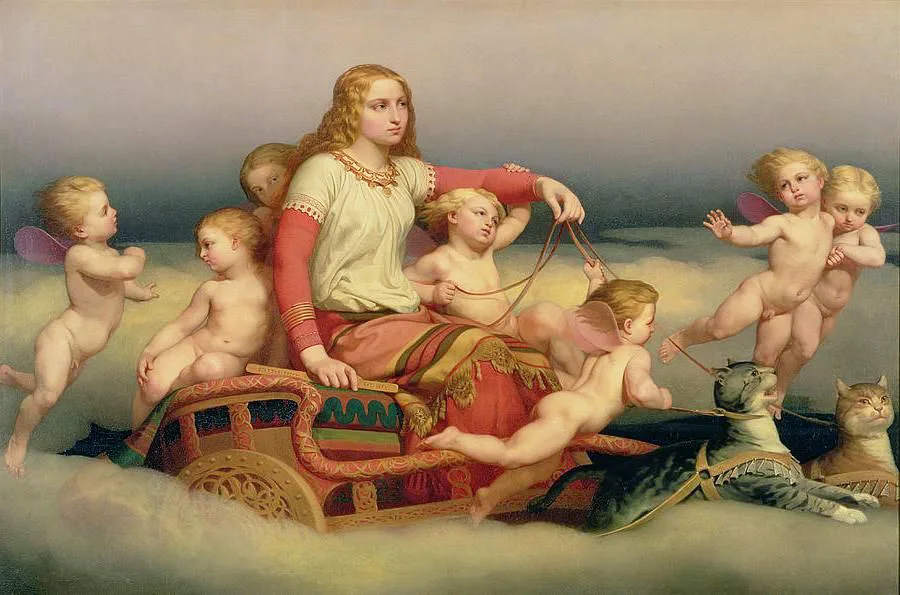 Nils Blommér, Freja sökande sin make (1852), Nationalmuseum, Stockholm Nils Blommér's 1852 imagining of Freyja crossing the night sky in the chariot drawn by two cats that Norse tradition gave her, trailed by small winged spirits. Norse goddess of love, fertility, beauty, gold, and the magic of
seiðr; sister of Frey and a leading member of the Vanir.
Travelled in a chariot drawn by two cats and possessed the
feather-cloak that allowed wearers to fly in falcon shape. In the
battle-afterlife she received half of those who died well — the
other half going to Odin's Valhalla — and brought them to her own
hall, Folkvang ("Field of the Host"). Norse tradition held that
she taught the seiðr magic to Odin himself; the woman-bound craft
of the völva was understood as her gift.
Also discussed in Nordisk Mytologi — Odin, the giants, and Ragnarok was the goddess of love and of magic, and she took half the battle-dead. Where Thor protected, Frey provided.
Nils Blommér, Freja sökande sin make (1852), Nationalmuseum, Stockholm Nils Blommér's 1852 imagining of Freyja crossing the night sky in the chariot drawn by two cats that Norse tradition gave her, trailed by small winged spirits. Norse goddess of love, fertility, beauty, gold, and the magic of
seiðr; sister of Frey and a leading member of the Vanir.
Travelled in a chariot drawn by two cats and possessed the
feather-cloak that allowed wearers to fly in falcon shape. In the
battle-afterlife she received half of those who died well — the
other half going to Odin's Valhalla — and brought them to her own
hall, Folkvang ("Field of the Host"). Norse tradition held that
she taught the seiðr magic to Odin himself; the woman-bound craft
of the völva was understood as her gift.
Also discussed in Nordisk Mytologi — Odin, the giants, and Ragnarok was the goddess of love and of magic, and she took half the battle-dead. Where Thor protected, Frey provided.
Odin 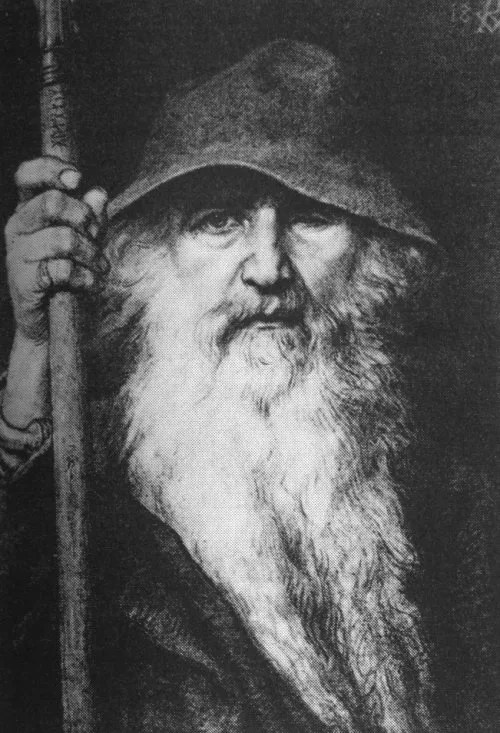 Georg von Rosen, Oden som vandringsman (1886), illustration for the 1893 Swedish Edda edition Von Rosen's wandering Odin, the broad hat pulled down over the traded eye — the god who paid for wisdom and power in his own body. That is the Odin of chieftains and skalds: the god an oath-swearing warlord invoked, not the everyday protector a farmer wore at his neck. Chief of the Æsir in Norse mythology. The god of chieftains, poets,
warriors, wisdom, magic, and the runes. He gave one of his eyes for
a drink from Mímir's well of wisdom and hanged nine nights and days
from the world-tree Yggdrasil — pierced by his own spear — to win
the secret of the runes. Half of those who died well in battle came
to his hall, Valhalla; the other half went to Freyja's hall, Folkvang.
In farm religion Odin was the god of the warband elite — the
chieftain weighing his odds, the skald who served him — not the
god of ordinary protection. Mjölnir hung at the farmer's neck;
the Odin-oath belonged in the chieftain's mouth.
Also discussed in Nordisk Mytologi — Odin, the giants, and RagnarokÅsgårdsreien — the storm that rides through the winter sky was the god of chieftains and poets, of the cunning that turned a leader into a king. He was not the everyman’s god. The man who prayed to Odin was the man who could afford to lose half his retainers in a season — the chieftain weighing his odds, the skald who served him, the warband elite at the centre of the hall. He was also a god of bargains paid with one’s own body. He had given an eye for a drink from the well of wisdom and hanged nine nights from the Yggdrasil
Georg von Rosen, Oden som vandringsman (1886), illustration for the 1893 Swedish Edda edition Von Rosen's wandering Odin, the broad hat pulled down over the traded eye — the god who paid for wisdom and power in his own body. That is the Odin of chieftains and skalds: the god an oath-swearing warlord invoked, not the everyday protector a farmer wore at his neck. Chief of the Æsir in Norse mythology. The god of chieftains, poets,
warriors, wisdom, magic, and the runes. He gave one of his eyes for
a drink from Mímir's well of wisdom and hanged nine nights and days
from the world-tree Yggdrasil — pierced by his own spear — to win
the secret of the runes. Half of those who died well in battle came
to his hall, Valhalla; the other half went to Freyja's hall, Folkvang.
In farm religion Odin was the god of the warband elite — the
chieftain weighing his odds, the skald who served him — not the
god of ordinary protection. Mjölnir hung at the farmer's neck;
the Odin-oath belonged in the chieftain's mouth.
Also discussed in Nordisk Mytologi — Odin, the giants, and RagnarokÅsgårdsreien — the storm that rides through the winter sky was the god of chieftains and poets, of the cunning that turned a leader into a king. He was not the everyman’s god. The man who prayed to Odin was the man who could afford to lose half his retainers in a season — the chieftain weighing his odds, the skald who served him, the warband elite at the centre of the hall. He was also a god of bargains paid with one’s own body. He had given an eye for a drink from the well of wisdom and hanged nine nights from the Yggdrasil 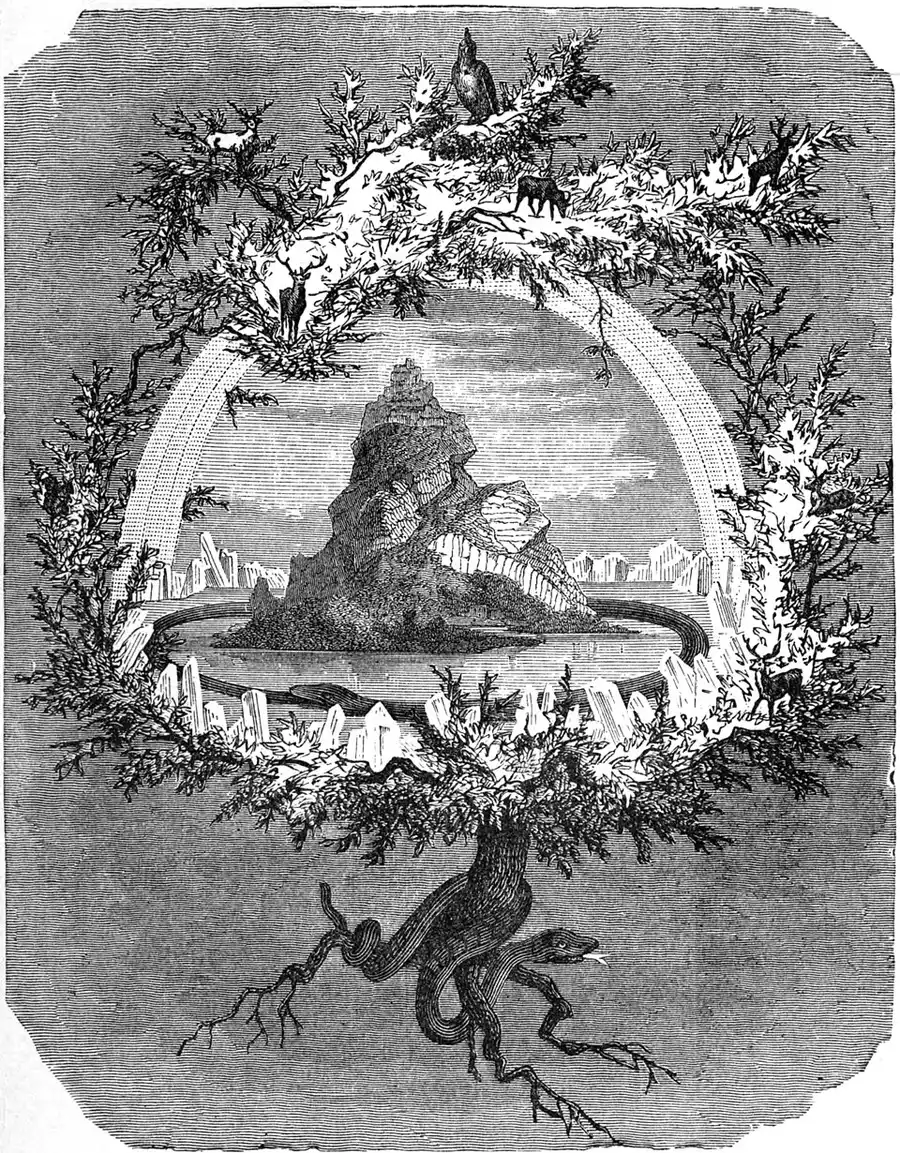 Friedrich Wilhelm Heine, The Ash Yggdrasil (1886), from Wilhelm Wägner's Nordisch-germanische Götter und Helden Friedrich Wilhelm Heine's 1886 engraving of the world-ash Yggdrasil, its crown enclosing the ringed world with an eagle above, harts browsing the branches and the serpent Níðhöggr gnawing at its roots — the tree that binds the nine Norse worlds. The world-tree of Norse cosmology — a vast ash tree (or in some
accounts an evergreen) whose branches and roots reach through and
hold together the nine worlds of Norse cosmos. The Æsir met at
Yggdrasil's foot in daily council; Odin hanged himself from one
of its branches for nine nights to win the secret of the runes;
the dragon Níðhöggr gnawed at its lowest root, and the squirrel
Ratatoskr ran the trunk carrying insults between the eagle at the
crown and Níðhöggr below. The name probably means "Odin's horse"
— Yggr is one of Odin's titles, and a gallows in skaldic verse
is a "horse" — referring to Odin's self-hanging.
Also discussed in Nordisk Mytologi — Odin, the giants, and Ragnarok to win the runes; the men who took his oath knew they were pledging to a god who himself paid for what he asked. Mjölnir hung at the farmer’s neck. The Odin-oath belonged in the chieftain’s mouth.
Friedrich Wilhelm Heine, The Ash Yggdrasil (1886), from Wilhelm Wägner's Nordisch-germanische Götter und Helden Friedrich Wilhelm Heine's 1886 engraving of the world-ash Yggdrasil, its crown enclosing the ringed world with an eagle above, harts browsing the branches and the serpent Níðhöggr gnawing at its roots — the tree that binds the nine Norse worlds. The world-tree of Norse cosmology — a vast ash tree (or in some
accounts an evergreen) whose branches and roots reach through and
hold together the nine worlds of Norse cosmos. The Æsir met at
Yggdrasil's foot in daily council; Odin hanged himself from one
of its branches for nine nights to win the secret of the runes;
the dragon Níðhöggr gnawed at its lowest root, and the squirrel
Ratatoskr ran the trunk carrying insults between the eagle at the
crown and Níðhöggr below. The name probably means "Odin's horse"
— Yggr is one of Odin's titles, and a gallows in skaldic verse
is a "horse" — referring to Odin's self-hanging.
Also discussed in Nordisk Mytologi — Odin, the giants, and Ragnarok to win the runes; the men who took his oath knew they were pledging to a god who himself paid for what he asked. Mjölnir hung at the farmer’s neck. The Odin-oath belonged in the chieftain’s mouth.
The shape of the year
The religion ran on a calendar. Three great public Blót 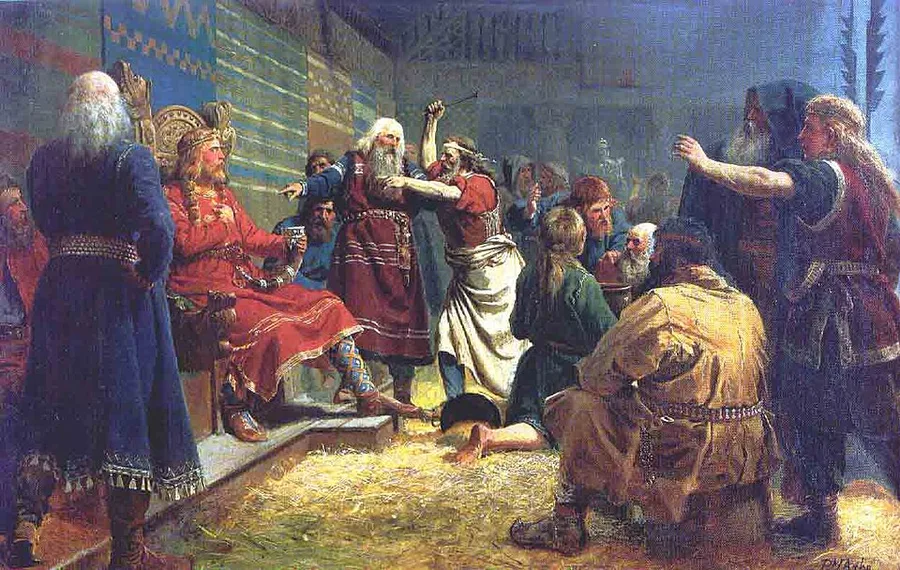 Peter Nicolai Arbo, Håkon den Gode og bøndene ved blotet på Mære (1860) Peter Nicolai Arbo's 1860 scene of the midwinter sacrifice at Mære, where Trøndelag farmers press the Christian-raised King Håkon to take part in the heathen feast — a saga moment dramatizing the blót at its most fraught. The central religious act of pre-Christian Norse society. A blót
was a sacrifice — typically of an animal — followed by a communal
feast that bound the household to its gods for the season ahead.
The shape held across rituals: an animal killed, the blood caught
and used to redden the altar and the worshippers (rjóða, "to
redden"), the meat boiled and shared between the gods (through the
flames) and the people (at the table), the drinking horn passed
with each draught dedicated to a god or to the dead. There was no
liturgy in the medieval-church sense — no book, no creed — just
the form the household had always done at that turn of the year.
Also discussed in The King Who Became a Saint — how the Nordmen came to ChristNordisk Mytologi — Odin, the giants, and Ragnarok marked the turns of the year, each timed to a moment in the working and political life of the community.
Peter Nicolai Arbo, Håkon den Gode og bøndene ved blotet på Mære (1860) Peter Nicolai Arbo's 1860 scene of the midwinter sacrifice at Mære, where Trøndelag farmers press the Christian-raised King Håkon to take part in the heathen feast — a saga moment dramatizing the blót at its most fraught. The central religious act of pre-Christian Norse society. A blót
was a sacrifice — typically of an animal — followed by a communal
feast that bound the household to its gods for the season ahead.
The shape held across rituals: an animal killed, the blood caught
and used to redden the altar and the worshippers (rjóða, "to
redden"), the meat boiled and shared between the gods (through the
flames) and the people (at the table), the drinking horn passed
with each draught dedicated to a god or to the dead. There was no
liturgy in the medieval-church sense — no book, no creed — just
the form the household had always done at that turn of the year.
Also discussed in The King Who Became a Saint — how the Nordmen came to ChristNordisk Mytologi — Odin, the giants, and Ragnarok marked the turns of the year, each timed to a moment in the working and political life of the community.
The Jól-blót 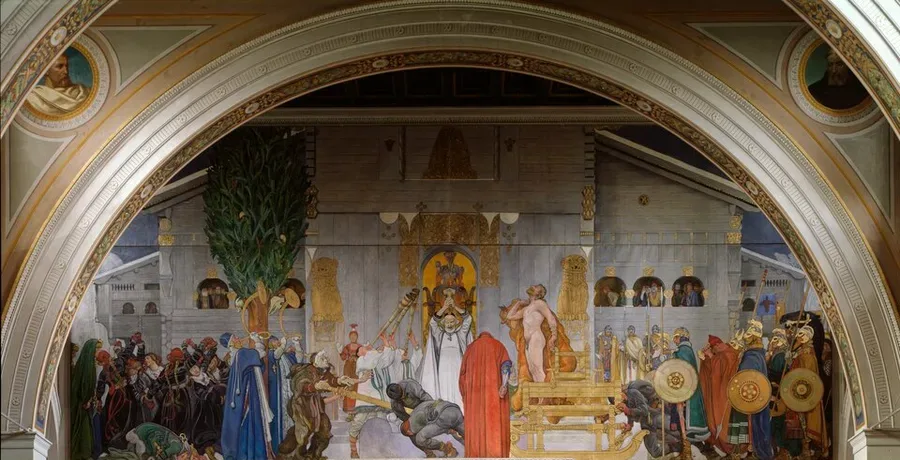 Carl Larsson, Midvinterblot (1915), Nationalmuseum, Stockholm Larsson's Midvinterblot depicts the legendary sacrifice of a Swedish king at Uppsala's midwinter feast, from the Ynglinga saga tradition — the single most famous painted image bearing the name 'midwinter blót,' raising the jól-blót's household sacrifice to its most extreme, mythic form. The midwinter blót — the largest of the three great Norse public
sacrifices, held at midwinter night, which in the old reckoning
fell nearer what is now mid-January than late December, and
running three nights. Opened with the slaughter of the sonargöltr (the
yule-boar), on whose bristles the men of the household swore their
oaths for the year to come. Ale and mead went round in formal
toasts — a remembrance-cup (minni) for the household's dead, a
cup to Frey for a prosperous year, a cup to Thor for safety through
the dark of winter. The chieftain kept open hall for everyone who
lived on his land. The modern Norwegian midwinter feast, Jul,
preserves the older shape — the nights of feasting, the great
toasts, the porridge bowl set out on the barn threshold.
at midwinter — held, before a Christianizing king aligned the feast with Christmas, closer to what is now mid-January — was the largest. It opened with the killing of the Sonargöltr
Carl Larsson, Midvinterblot (1915), Nationalmuseum, Stockholm Larsson's Midvinterblot depicts the legendary sacrifice of a Swedish king at Uppsala's midwinter feast, from the Ynglinga saga tradition — the single most famous painted image bearing the name 'midwinter blót,' raising the jól-blót's household sacrifice to its most extreme, mythic form. The midwinter blót — the largest of the three great Norse public
sacrifices, held at midwinter night, which in the old reckoning
fell nearer what is now mid-January than late December, and
running three nights. Opened with the slaughter of the sonargöltr (the
yule-boar), on whose bristles the men of the household swore their
oaths for the year to come. Ale and mead went round in formal
toasts — a remembrance-cup (minni) for the household's dead, a
cup to Frey for a prosperous year, a cup to Thor for safety through
the dark of winter. The chieftain kept open hall for everyone who
lived on his land. The modern Norwegian midwinter feast, Jul,
preserves the older shape — the nights of feasting, the great
toasts, the porridge bowl set out on the barn threshold.
at midwinter — held, before a Christianizing king aligned the feast with Christmas, closer to what is now mid-January — was the largest. It opened with the killing of the Sonargöltr 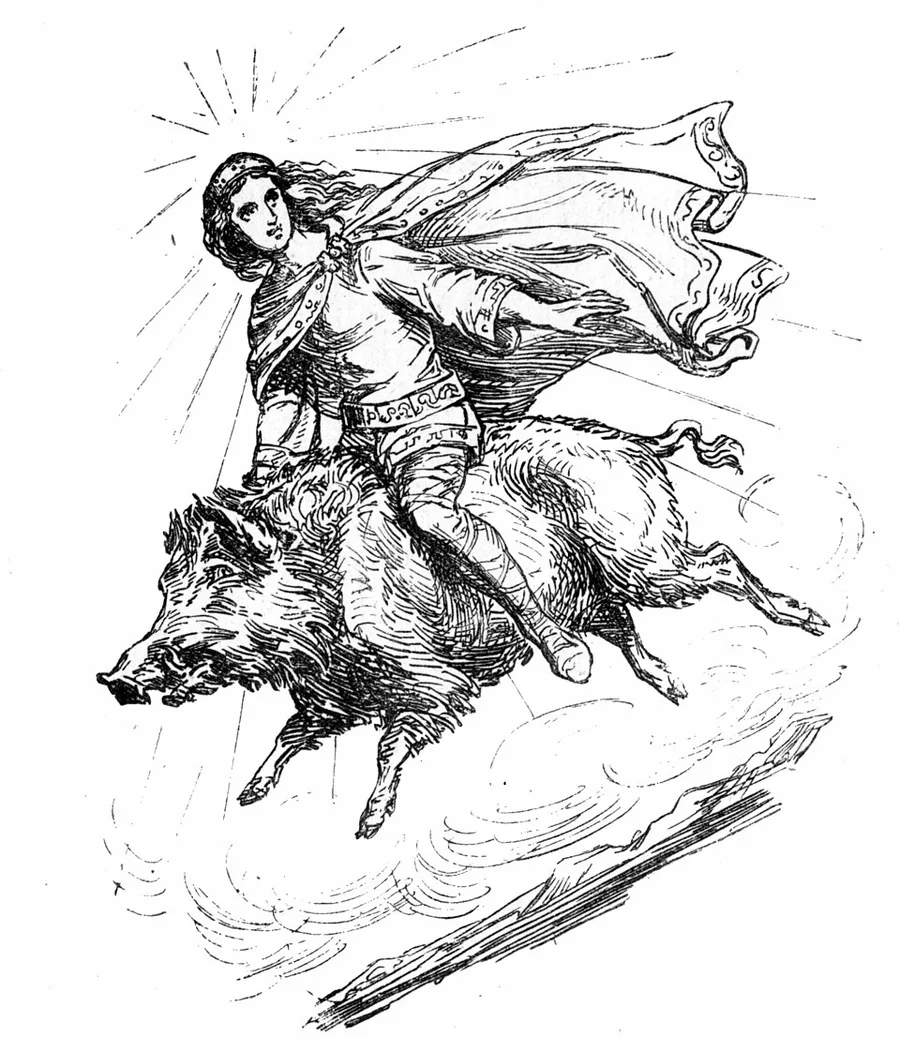 Ludwig Pietsch, Freyr riding Gullinbursti (1865) No image survives of an actual sonargöltr; Norse tradition ties the sacrificial Yule boar to Freyr's own golden-bristled boar Gullinbursti, shown here — the mythic boar behind the animal the men of the household swore their oaths upon. The yule-boar of the Norse jól-blót — the boar slaughtered to open
the midwinter feast. On the boar's bristles the men of the
household swore their oaths for the year to come, an act preserved
in saga tradition as the heitstrenging, the formal pledging of
deeds to be done. The modern Norwegian Christmas ham is often
traced back to the sonargöltr — the same ceremonial centre-of-the-
feast in Christian dress, with the oath-swearing function dropped
and only the food remaining.
, the yule-boar, on whose bristles the men of the household swore their oaths for the year to come. The feast ran three nights, and longer where the ale held out. Ale and mead went round in formal toasts — a minni, a remembrance-cup, for the household’s dead; a cup to Njörðr and a cup to Frey for a good year and peace. Neighbours visited. Quarrels were laid aside. The chieftain kept open hall for everyone who lived on his land.
Ludwig Pietsch, Freyr riding Gullinbursti (1865) No image survives of an actual sonargöltr; Norse tradition ties the sacrificial Yule boar to Freyr's own golden-bristled boar Gullinbursti, shown here — the mythic boar behind the animal the men of the household swore their oaths upon. The yule-boar of the Norse jól-blót — the boar slaughtered to open
the midwinter feast. On the boar's bristles the men of the
household swore their oaths for the year to come, an act preserved
in saga tradition as the heitstrenging, the formal pledging of
deeds to be done. The modern Norwegian Christmas ham is often
traced back to the sonargöltr — the same ceremonial centre-of-the-
feast in Christian dress, with the oath-swearing function dropped
and only the food remaining.
, the yule-boar, on whose bristles the men of the household swore their oaths for the year to come. The feast ran three nights, and longer where the ale held out. Ale and mead went round in formal toasts — a minni, a remembrance-cup, for the household’s dead; a cup to Njörðr and a cup to Frey for a good year and peace. Neighbours visited. Quarrels were laid aside. The chieftain kept open hall for everyone who lived on his land.
The Sigr-blót The early-summer Norse public blót, sacrificed for sigr (victory) in whatever the household's sons were about to go out and do — a fleet of longships, a trading voyage to England, a season on the high mountain pastures. The men left the next morning. The sigr-blót sits at the opening of the working summer the way the jól-blót sits at the year's hinge and the haust-blót closes it. , in early summer, was sacrificed for victory — sigr — in whatever the household’s sons were about to go out and do: a fleet of longships, a trading voyage to England, a season on the high mountain pastures. They left the next morning.
The Haust-blót 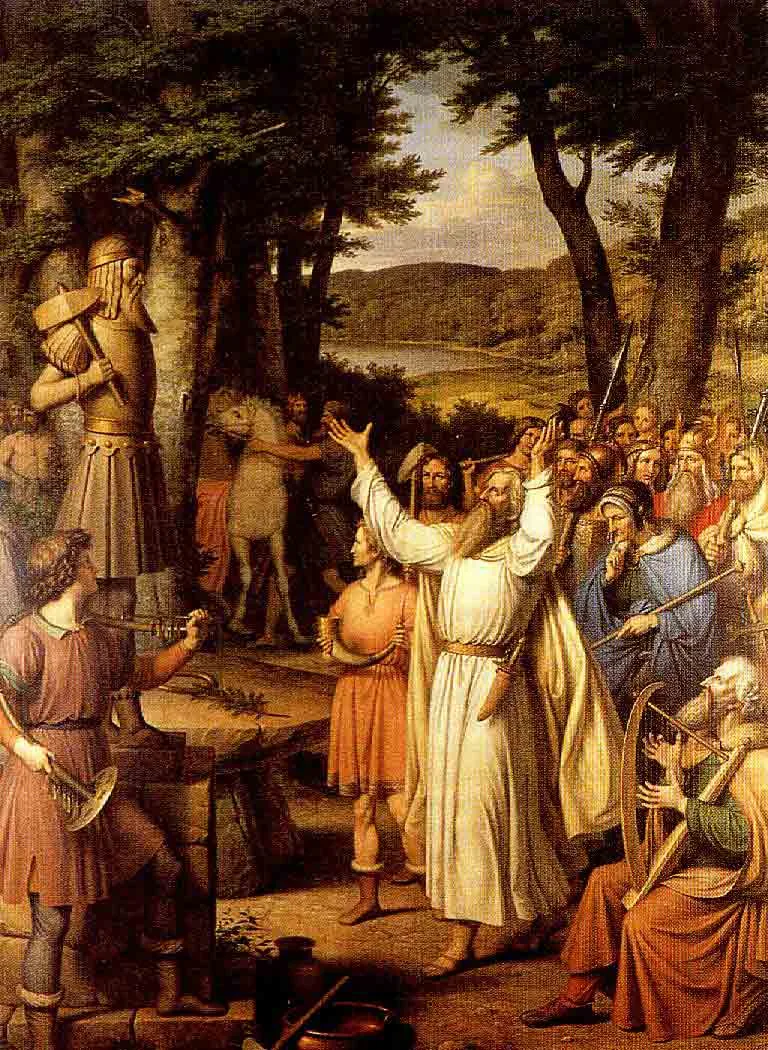 Johan Ludwig Lund, A Sacrifice to Thor (early 1800s) J. L. Lund's early-1800s painting of a public sacrifice to Thor pictures the kind of communal blót the haust-blót was — an animal offered and shared in thanks for the harvest as the winter nights, vetrnætur, closed in. The autumn Norse public blót, held at the start of winter in
mid-October. Gave thanks for the harvest gathered in and asked
mercy of the winter coming on. Marked the vetrnætur (winter
nights), when the long half of the year began. Cattle were
slaughtered for the stores; the household drew in to the indoor
hall. The haust-blót was the close of the working summer and the
beginning of the long indoor season the jól-blót would crown
twelve weeks later.
, at the start of winter in mid-October, gave thanks for the harvest gathered in and asked mercy of the winter coming on. It marked the vetrnætur, the winter nights, when the long half of the year began. Cattle were slaughtered for the stores. The household drew in to the indoor hall.
Johan Ludwig Lund, A Sacrifice to Thor (early 1800s) J. L. Lund's early-1800s painting of a public sacrifice to Thor pictures the kind of communal blót the haust-blót was — an animal offered and shared in thanks for the harvest as the winter nights, vetrnætur, closed in. The autumn Norse public blót, held at the start of winter in
mid-October. Gave thanks for the harvest gathered in and asked
mercy of the winter coming on. Marked the vetrnætur (winter
nights), when the long half of the year began. Cattle were
slaughtered for the stores; the household drew in to the indoor
hall. The haust-blót was the close of the working summer and the
beginning of the long indoor season the jól-blót would crown
twelve weeks later.
, at the start of winter in mid-October, gave thanks for the harvest gathered in and asked mercy of the winter coming on. It marked the vetrnætur, the winter nights, when the long half of the year began. Cattle were slaughtered for the stores. The household drew in to the indoor hall.
Two more blóts ran in private, and the record catches them only in glimpses. The Dísablót 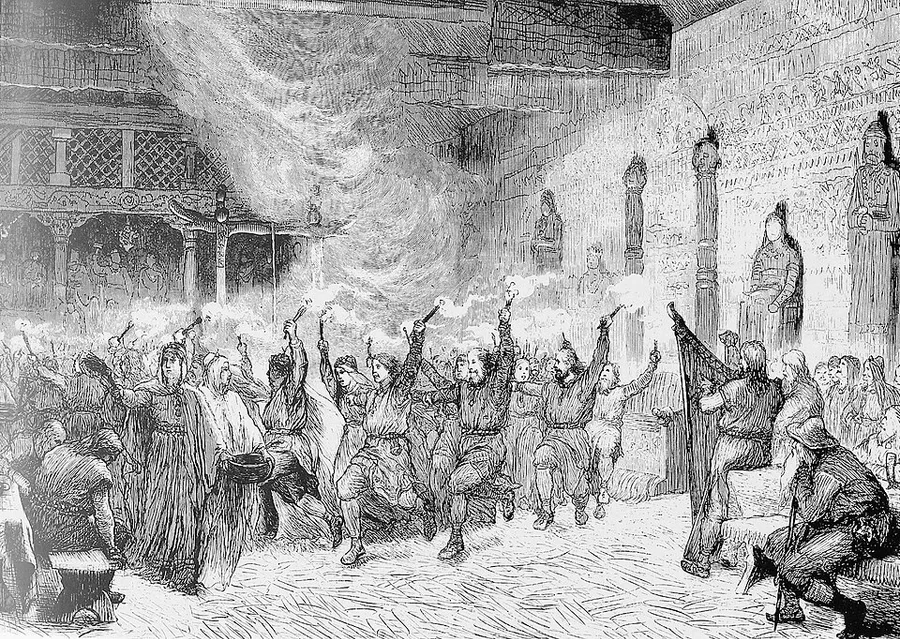 August Malmström, Disarblot (before 1901); repr. Alf Henrikson, Ända från Vendelkråka (1985) Malmström's Disarblot pictures the very rite this card names — the household sacrifice held for the dísir, the female guardian-spirits of the family line, with the women of the house taking the central ritual role Snorri and the sagas assign them. Norse private blót held for the dísir, the female guardian-spirits
of a family line. Usually held at the start of winter and run
inside the household — often in the women's end of the longhouse,
with the women of the family taking the central ritual role. Less
publicly attested than the great seasonal blóts because by its
nature it was the household's own quiet rite, the surviving record
of it is fragmentary.
was held for the Dísir
August Malmström, Disarblot (before 1901); repr. Alf Henrikson, Ända från Vendelkråka (1985) Malmström's Disarblot pictures the very rite this card names — the household sacrifice held for the dísir, the female guardian-spirits of the family line, with the women of the house taking the central ritual role Snorri and the sagas assign them. Norse private blót held for the dísir, the female guardian-spirits
of a family line. Usually held at the start of winter and run
inside the household — often in the women's end of the longhouse,
with the women of the family taking the central ritual role. Less
publicly attested than the great seasonal blóts because by its
nature it was the household's own quiet rite, the surviving record
of it is fragmentary.
was held for the Dísir 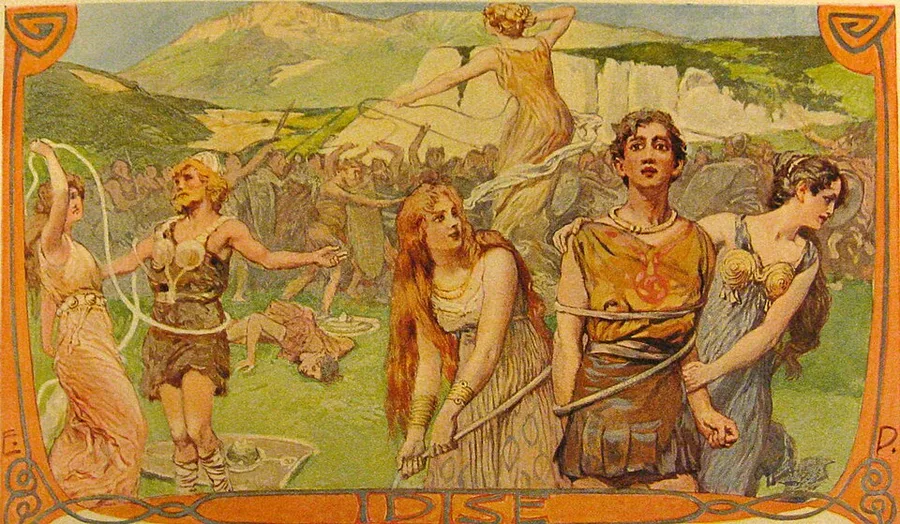 Emil Doepler, Idise, from Walhall: die Götterwelt der Germanen (c. 1905) No Norse artist drew the dísir, so a continental cousin stands in: Doepler's Idise pictures the guardian-women of the Old High German Merseburg charm, binding and loosing warriors in battle. The *idisi* are the dísir's closest continental kin — protective female powers watching over the family line. The female guardian-spirits of a family line in Norse religion —
ancestral figures, neither quite goddesses nor quite ghosts, who
watched over the household's women across generations. The
dísablót was held for them, run by the women of the household
itself in the women's end of the longhouse. The dísir blurred at
the edges with the fylgjur (the personal accompanying spirits)
and with the Valkyries; the precise boundaries are debated and
may have varied by region.
, the female guardian-spirits of a family line, usually at the start of winter and often in the women’s end of the longhouse. The Álfablót Norse private blót held for the elves (álfar) in autumn, behind
a closed door, with strangers kept off the farm while it lasted.
The sharpest surviving account is in the skaldic poem
Austrfararvísur by the Norwegian Sigvatr Þórðarson, who in
around 1019 was turned from one farm after another in
Västergötland because the houses were holding álfablót and would
let no stranger in for the night.
was held for the elves in autumn, behind a closed door, with strangers kept off the farm while it lasted. These were the quiet rites, and the women of the household ran them. The sharpest surviving account of the álfablót comes not from Norway or Iceland but from Sweden: a Norwegian king’s poet, Sigvatr Þórðarson
Emil Doepler, Idise, from Walhall: die Götterwelt der Germanen (c. 1905) No Norse artist drew the dísir, so a continental cousin stands in: Doepler's Idise pictures the guardian-women of the Old High German Merseburg charm, binding and loosing warriors in battle. The *idisi* are the dísir's closest continental kin — protective female powers watching over the family line. The female guardian-spirits of a family line in Norse religion —
ancestral figures, neither quite goddesses nor quite ghosts, who
watched over the household's women across generations. The
dísablót was held for them, run by the women of the household
itself in the women's end of the longhouse. The dísir blurred at
the edges with the fylgjur (the personal accompanying spirits)
and with the Valkyries; the precise boundaries are debated and
may have varied by region.
, the female guardian-spirits of a family line, usually at the start of winter and often in the women’s end of the longhouse. The Álfablót Norse private blót held for the elves (álfar) in autumn, behind
a closed door, with strangers kept off the farm while it lasted.
The sharpest surviving account is in the skaldic poem
Austrfararvísur by the Norwegian Sigvatr Þórðarson, who in
around 1019 was turned from one farm after another in
Västergötland because the houses were holding álfablót and would
let no stranger in for the night.
was held for the elves in autumn, behind a closed door, with strangers kept off the farm while it lasted. These were the quiet rites, and the women of the household ran them. The sharpest surviving account of the álfablót comes not from Norway or Iceland but from Sweden: a Norwegian king’s poet, Sigvatr Þórðarson 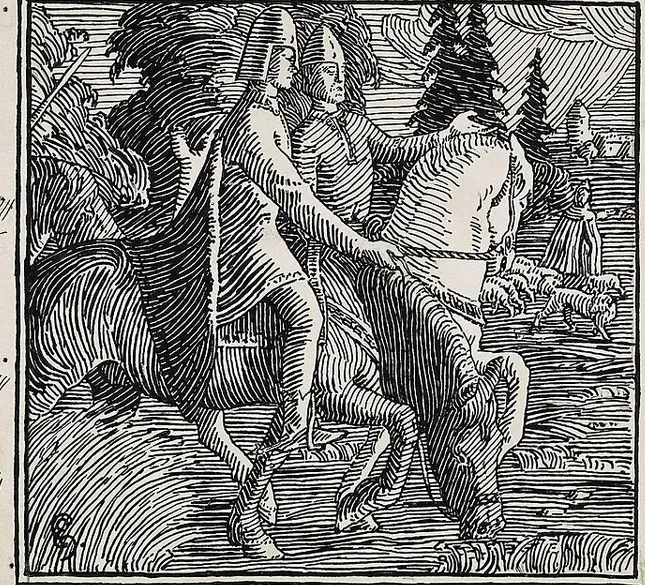 Halfdan Egedius, Sigvat kveder for følget sitt på ferden til Skara, Heimskringla (1899 edition), Nasjonalmuseet Egedius shows Sigvatr Þórðarson reciting to his party on the road to Skara, the chief town of Västergötland — the very journey the card credits with his Austrfararvísur, the closest surviving eyewitness account of the private álfablót. Icelandic-Norwegian skald (c. 995–c. 1045) and court poet to King
Olav II Haraldsson (Saint Olav) of Norway. The most prolific
skaldic poet whose work survives — over a hundred and fifty
half-stanzas attributed to him in the corpus. His Austrfararvísur
("Verses on a Journey East"), composed around 1019 during a
diplomatic mission to Sweden, contains the famous account of
being turned away from a series of Västergötland farms because
the houses were holding álfablót — the closest surviving
eyewitness to the private rite.
, riding through Västergötland
Halfdan Egedius, Sigvat kveder for følget sitt på ferden til Skara, Heimskringla (1899 edition), Nasjonalmuseet Egedius shows Sigvatr Þórðarson reciting to his party on the road to Skara, the chief town of Västergötland — the very journey the card credits with his Austrfararvísur, the closest surviving eyewitness account of the private álfablót. Icelandic-Norwegian skald (c. 995–c. 1045) and court poet to King
Olav II Haraldsson (Saint Olav) of Norway. The most prolific
skaldic poet whose work survives — over a hundred and fifty
half-stanzas attributed to him in the corpus. His Austrfararvísur
("Verses on a Journey East"), composed around 1019 during a
diplomatic mission to Sweden, contains the famous account of
being turned away from a series of Västergötland farms because
the houses were holding álfablót — the closest surviving
eyewitness to the private rite.
, riding through Västergötland 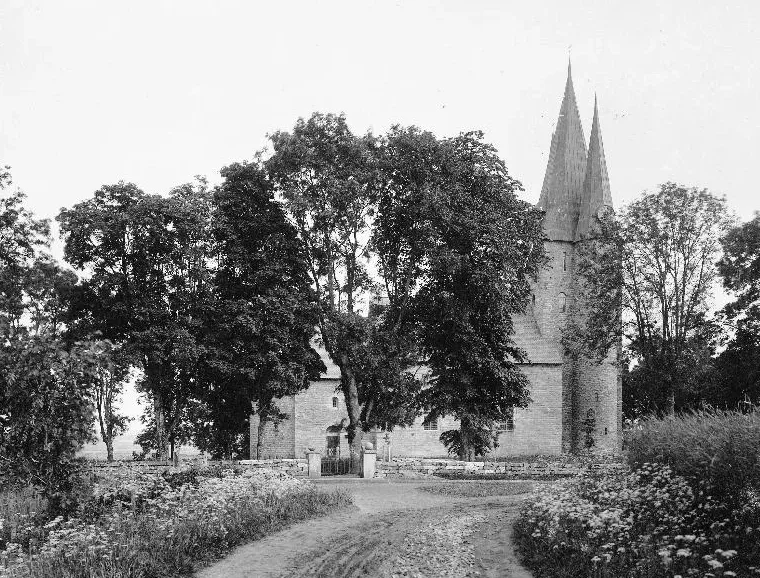 Photographer unknown, Husaby church from the north (c. 1900), Riksantikvarieämbetet (KMB) Husaby church, photographed around 1900, stands where Olof Skötkonung — Sweden's first Christian king — is said to have been baptized; in this same Västergötland countryside Sigvatr found farm after farm still holding álfablót around 1019. Historical region of southwestern Sweden, today part of Västra
Götaland County. Significant in the religious history of
Scandinavia as one of the last regions to abandon the public
pre-Christian rites: Sigvatr Þórðarson's Austrfararvísur records
being turned from one Västergötland farm after another in around
1019 because the houses were holding álfablót — the rite the
Christian king Olav of Norway had recently outlawed at home but
that ran on undisturbed inside the Swedish farming districts for
another century.
around 1019, was turned from one farm after another because the house was holding álfablót and would let no stranger in for the night.
Photographer unknown, Husaby church from the north (c. 1900), Riksantikvarieämbetet (KMB) Husaby church, photographed around 1900, stands where Olof Skötkonung — Sweden's first Christian king — is said to have been baptized; in this same Västergötland countryside Sigvatr found farm after farm still holding álfablót around 1019. Historical region of southwestern Sweden, today part of Västra
Götaland County. Significant in the religious history of
Scandinavia as one of the last regions to abandon the public
pre-Christian rites: Sigvatr Þórðarson's Austrfararvísur records
being turned from one Västergötland farm after another in around
1019 because the houses were holding álfablót — the rite the
Christian king Olav of Norway had recently outlawed at home but
that ran on undisturbed inside the Swedish farming districts for
another century.
around 1019, was turned from one farm after another because the house was holding álfablót and would let no stranger in for the night.
What happened at a blót
The shape of the rite held across all three. An animal was killed — at the great blóts a horse, an ox, or the boar; at smaller ones a pig or a sheep. The blood was caught in a vessel. The chieftain, acting now as Goði 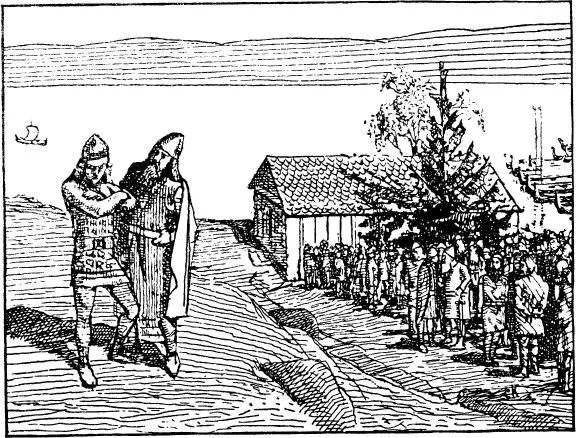 Christian Krohg, illustration for Hákonar saga góða, Heimskringla folk edition (J.M. Stenersen & Co, 1899) Krohg draws Sigurd Jarl of Lade — the great Trøndelag chieftain who hosted and led the blót at his own hall — talking his Christian-raised king into taking part. It is the goði's dual role in one image: political broker and ritual leader at once. The Norse chieftain in his priestly aspect — goði (plural goðar).
The same man who judged a land-quarrel at the assembly led the blót;
the same household that paid him its rent ate at his feast. This
was the structural fact of the whole pre-Christian Norse religion:
no separate priesthood, no church set against a king, no holy
institution holding lands of its own. The chieftain's authority
was sacred because he was the chieftain. In Iceland the goði
became the formal local office of religious-and-political authority
organising districts within the Alþing system, surviving as a
political position even after Christianisation in 1000.
, took the Hlautteinn The sacrificial twig used at a Norse blót: the goði dipped it in
the blood (hlaut) caught from the slaughtered animal and used
it to redden the altar, the walls of the hall, and the people
standing there. The Old Norse for the act was rjóða, "to redden."
The reddening bound the household to the gods for the season
ahead. The hlautteinn was kept between blóts and used again at
the next one — a single ritual object reused across generations.
, a twig kept for the purpose, and reddened the altar with it, and the walls of the hall, and the people standing there. The Old Norse for the act was rjóða, to redden. The reddening bound the household to the gods for the season ahead.
Christian Krohg, illustration for Hákonar saga góða, Heimskringla folk edition (J.M. Stenersen & Co, 1899) Krohg draws Sigurd Jarl of Lade — the great Trøndelag chieftain who hosted and led the blót at his own hall — talking his Christian-raised king into taking part. It is the goði's dual role in one image: political broker and ritual leader at once. The Norse chieftain in his priestly aspect — goði (plural goðar).
The same man who judged a land-quarrel at the assembly led the blót;
the same household that paid him its rent ate at his feast. This
was the structural fact of the whole pre-Christian Norse religion:
no separate priesthood, no church set against a king, no holy
institution holding lands of its own. The chieftain's authority
was sacred because he was the chieftain. In Iceland the goði
became the formal local office of religious-and-political authority
organising districts within the Alþing system, surviving as a
political position even after Christianisation in 1000.
, took the Hlautteinn The sacrificial twig used at a Norse blót: the goði dipped it in
the blood (hlaut) caught from the slaughtered animal and used
it to redden the altar, the walls of the hall, and the people
standing there. The Old Norse for the act was rjóða, "to redden."
The reddening bound the household to the gods for the season
ahead. The hlautteinn was kept between blóts and used again at
the next one — a single ritual object reused across generations.
, a twig kept for the purpose, and reddened the altar with it, and the walls of the hall, and the people standing there. The Old Norse for the act was rjóða, to redden. The reddening bound the household to the gods for the season ahead.
The meat went into the cauldron over the long-fire. The gods had their share through the flames — the best cuts burned to send the smoke up to them. The rest fed everyone present, in a feast that might run for days. The drinking was formal. A horn went round, and each draught was dedicated, to a god or to the dead, and the man who drank had to speak before he drank: to remember, to pledge, to boast, to praise. Whatever he said over the cup in his hand was a debt, witnessed by his people and his gods. The blót was a sacrifice and a feast and a memorial and the signing of a contract, all at once.
There was no liturgy in it, in the medieval-church sense, and no book. The goði knew the form because his father had known it. The form was simply what the household had always done at that turn of the year — and it would not have occurred to anyone in the hall that a religion might need anything else.
The hov, the hörgr, and the man who ran them
Norse religion built no temples in the Mediterranean sense — no permanent house of cult with a paid clergy inside it who did nothing else. There were two kinds of sacred place instead, and one man who served both.
The Hörgr The Norse open-air altar: a heap or platform of stones, sometimes only a single slab set on rising ground. It might be a great structure on a holy hill or a small one in the corner of a field. What was offered there was offered under the open sky. Norse religion's holiness was not confined to built structures, however — a grove, a spring, a waterfall, a particular tree or boulder on the land could be sacred in the same way, fenced from ordinary use and left alone. was an open-air altar: a heap or platform of stones, sometimes only a single slab set on rising ground. It might be a great structure on a holy hill or a small one in the corner of a field. What was offered there was offered under the open sky. And holiness was not confined to built things — a grove, a spring, a waterfall, a particular tree or boulder on the land could be sacred in the same way, fenced from ordinary use and left alone.
The Hov 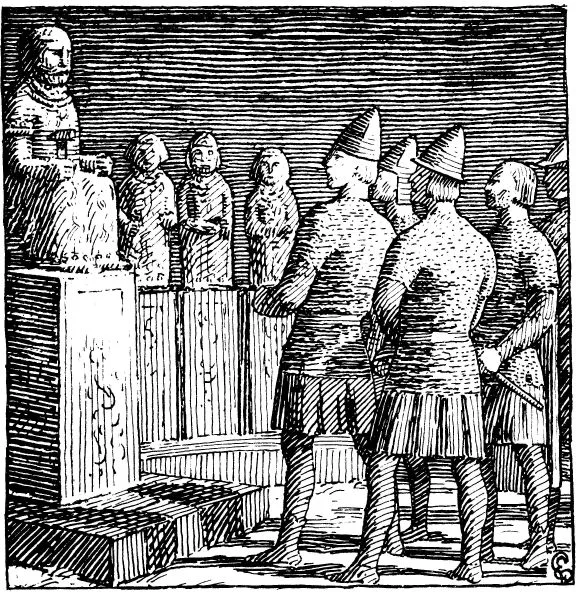 Halfdan Egedius, illustration for Óláfs saga Tryggvasonar, Heimskringla folk edition (J.M. Stenersen & Co, 1899) Egedius's illustration of Olav Tryggvason inside 'Thor's hov' pictures the building type this card describes — the timber hall doubling as cult-house, the god's image set at the high seat — at the very moment Snorri's saga has Olav confront it at Mære. The Norse indoor cult-house — a timber building, often the
chieftain's own longhouse serving double duty as the cult-house
of the district. Benches down its length, a fire down its centre,
the images of the gods set at the high seat. Floor deposits
thickening over the generations with animal bone and broken
cooking-ware are the archaeologist's signature of the place.
The clearest case excavated in Norway lies under the medieval
church at Mære, in Trøndelag, where the floor of the older timber
hall still holds a scatter of gullgubber. The hov was a hall,
not a temple in the Mediterranean sense — no paid clergy lived
inside it doing nothing else.
Also discussed in The King Who Became a Saint — how the Nordmen came to Christ was the indoor hall, a timber building, often the chieftain’s own longhouse serving double duty as the cult-house of the district. It had benches down its length, a fire down its centre, the images of the gods at the high seat, and a floor that thickened over the generations with animal bone and broken cooking-ware — the leavings of feast after feast, which the archaeologist reads now as the signature of the place. The clearest case excavated in Norway lies under the medieval church at Mære
Halfdan Egedius, illustration for Óláfs saga Tryggvasonar, Heimskringla folk edition (J.M. Stenersen & Co, 1899) Egedius's illustration of Olav Tryggvason inside 'Thor's hov' pictures the building type this card describes — the timber hall doubling as cult-house, the god's image set at the high seat — at the very moment Snorri's saga has Olav confront it at Mære. The Norse indoor cult-house — a timber building, often the
chieftain's own longhouse serving double duty as the cult-house
of the district. Benches down its length, a fire down its centre,
the images of the gods set at the high seat. Floor deposits
thickening over the generations with animal bone and broken
cooking-ware are the archaeologist's signature of the place.
The clearest case excavated in Norway lies under the medieval
church at Mære, in Trøndelag, where the floor of the older timber
hall still holds a scatter of gullgubber. The hov was a hall,
not a temple in the Mediterranean sense — no paid clergy lived
inside it doing nothing else.
Also discussed in The King Who Became a Saint — how the Nordmen came to Christ was the indoor hall, a timber building, often the chieftain’s own longhouse serving double duty as the cult-house of the district. It had benches down its length, a fire down its centre, the images of the gods at the high seat, and a floor that thickened over the generations with animal bone and broken cooking-ware — the leavings of feast after feast, which the archaeologist reads now as the signature of the place. The clearest case excavated in Norway lies under the medieval church at Mære 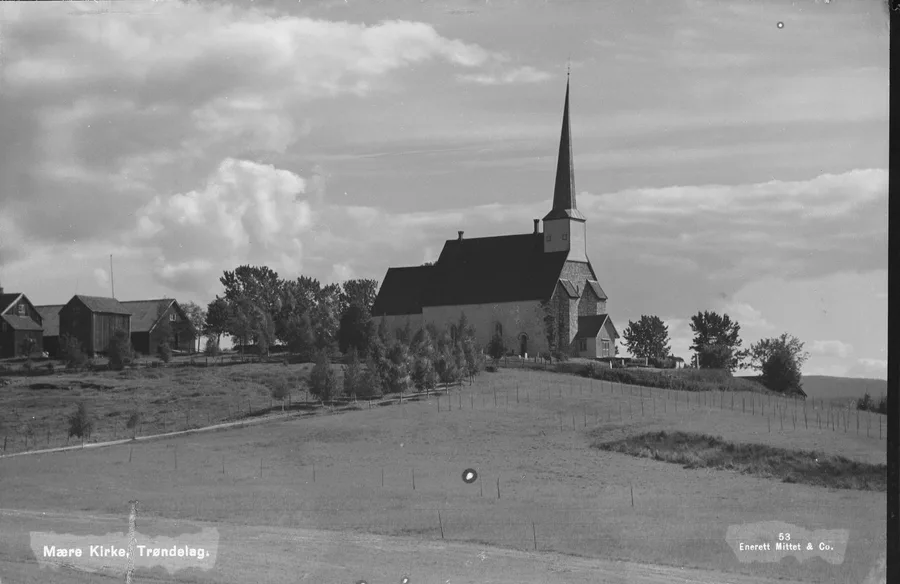 Mittet & Co., Mære Kirke, Trøndelag (early 20th c.), National Library of Norway The medieval church photographed on its knoll — the mound where Hans-Emil Lidén's 1960s excavation found the timber hov and the scatter of gullgubber gold foils beneath the floor: the clearest case in Norway of cult-ground reused rather than abandoned. Village in Sparbu, Steinkjer Municipality, Trøndelag — the clearest
excavated case in Norway of a pre-Christian Norse cult site reused
rather than abandoned at the conversion. The medieval Mære Church
(built c. 1150–1200) stands on the foundations of a timber hov
excavated by Hans-Emil Lidén in the 1960s, whose floor deposits
held a scatter of gullgubber gold foils — the diagnostic
signature of a late-Iron-Age cult location. Saga tradition places
Olav Tryggvason's confrontation with the chieftain Járn-Skeggi at
the Mære blót around 997.
Mære, Trøndelag , in Trøndelag
Mittet & Co., Mære Kirke, Trøndelag (early 20th c.), National Library of Norway The medieval church photographed on its knoll — the mound where Hans-Emil Lidén's 1960s excavation found the timber hov and the scatter of gullgubber gold foils beneath the floor: the clearest case in Norway of cult-ground reused rather than abandoned. Village in Sparbu, Steinkjer Municipality, Trøndelag — the clearest
excavated case in Norway of a pre-Christian Norse cult site reused
rather than abandoned at the conversion. The medieval Mære Church
(built c. 1150–1200) stands on the foundations of a timber hov
excavated by Hans-Emil Lidén in the 1960s, whose floor deposits
held a scatter of gullgubber gold foils — the diagnostic
signature of a late-Iron-Age cult location. Saga tradition places
Olav Tryggvason's confrontation with the chieftain Járn-Skeggi at
the Mære blót around 997.
Mære, Trøndelag , in Trøndelag 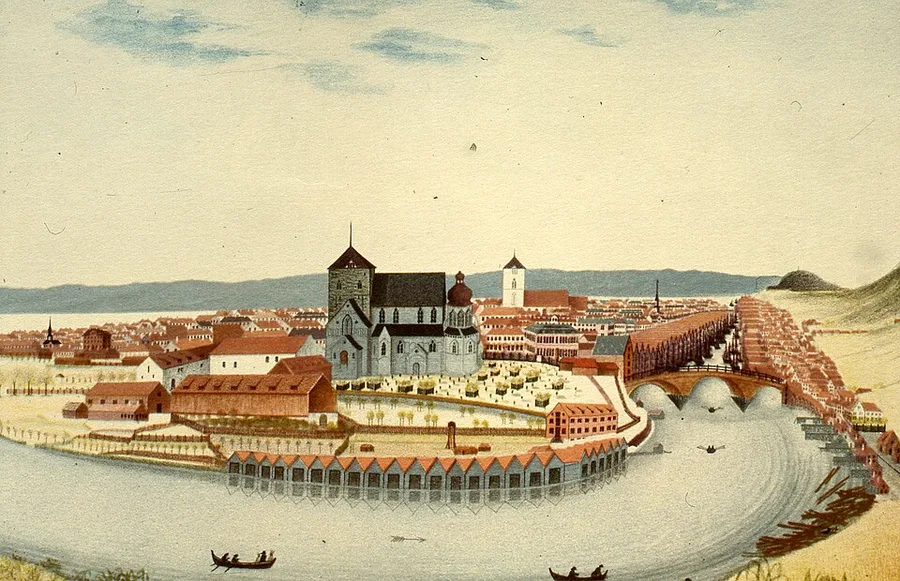 Johannes Aas, Prospect af Staden Trondhiem (1826), Municipal Archives of Trondheim (CC BY 2.0) An 1826 prospect of Trondheim, Nidaros Cathedral rising over the river bend. Founded by Olav Tryggvason as Nidaros in 997, the town became the seat of Norway's archbishopric in 1153 and the country's ecclesiastical capital. Region of central Norway around the Trondheim Fjord, north of Stadt
and south of Hålogaland. Its agriculturally rich Trondheim plain
is the second-largest area of arable land in the country and the
base of the medieval earls of Lade. Trondheim — founded by Olav
Tryggvason in 997 as Nidaros — became the seat of the Norwegian
archbishopric in 1153 and remains the country's third-largest city
and ecclesiastical capital.
On the trip Day 3-5 of the trip routes the Gråhårsklubben (the Oldsters) through
Trøndelag for the Slektsreisen heritage drive — Trondheim and the
Nidaros Cathedral on Day 3, then Stjørdal and Hegra, then on up
the Stjørdalen valley to Kylloplass.
Trøndelag (Trondheim) Also discussed in Before There Was Norway — petty kingdoms at the edge of the worldThe King Who Became a Saint — how the Nordmen came to ChristThe Long Fall — the sudden loss of Norwegian nobility, the end of the kings, and half of Norway gone foreverLutheran Norway and Pietism — a farmer named Hans Nielsen Hauge and a lay revival that could not be silencedDraugen — the drowned man who never came homeThe Hytte — a sacred pastime of modern Norway , where the floor of the older timber hall still holds a scatter of Gullgubber
Johannes Aas, Prospect af Staden Trondhiem (1826), Municipal Archives of Trondheim (CC BY 2.0) An 1826 prospect of Trondheim, Nidaros Cathedral rising over the river bend. Founded by Olav Tryggvason as Nidaros in 997, the town became the seat of Norway's archbishopric in 1153 and the country's ecclesiastical capital. Region of central Norway around the Trondheim Fjord, north of Stadt
and south of Hålogaland. Its agriculturally rich Trondheim plain
is the second-largest area of arable land in the country and the
base of the medieval earls of Lade. Trondheim — founded by Olav
Tryggvason in 997 as Nidaros — became the seat of the Norwegian
archbishopric in 1153 and remains the country's third-largest city
and ecclesiastical capital.
On the trip Day 3-5 of the trip routes the Gråhårsklubben (the Oldsters) through
Trøndelag for the Slektsreisen heritage drive — Trondheim and the
Nidaros Cathedral on Day 3, then Stjørdal and Hegra, then on up
the Stjørdalen valley to Kylloplass.
Trøndelag (Trondheim) Also discussed in Before There Was Norway — petty kingdoms at the edge of the worldThe King Who Became a Saint — how the Nordmen came to ChristThe Long Fall — the sudden loss of Norwegian nobility, the end of the kings, and half of Norway gone foreverLutheran Norway and Pietism — a farmer named Hans Nielsen Hauge and a lay revival that could not be silencedDraugen — the drowned man who never came homeThe Hytte — a sacred pastime of modern Norway , where the floor of the older timber hall still holds a scatter of Gullgubber 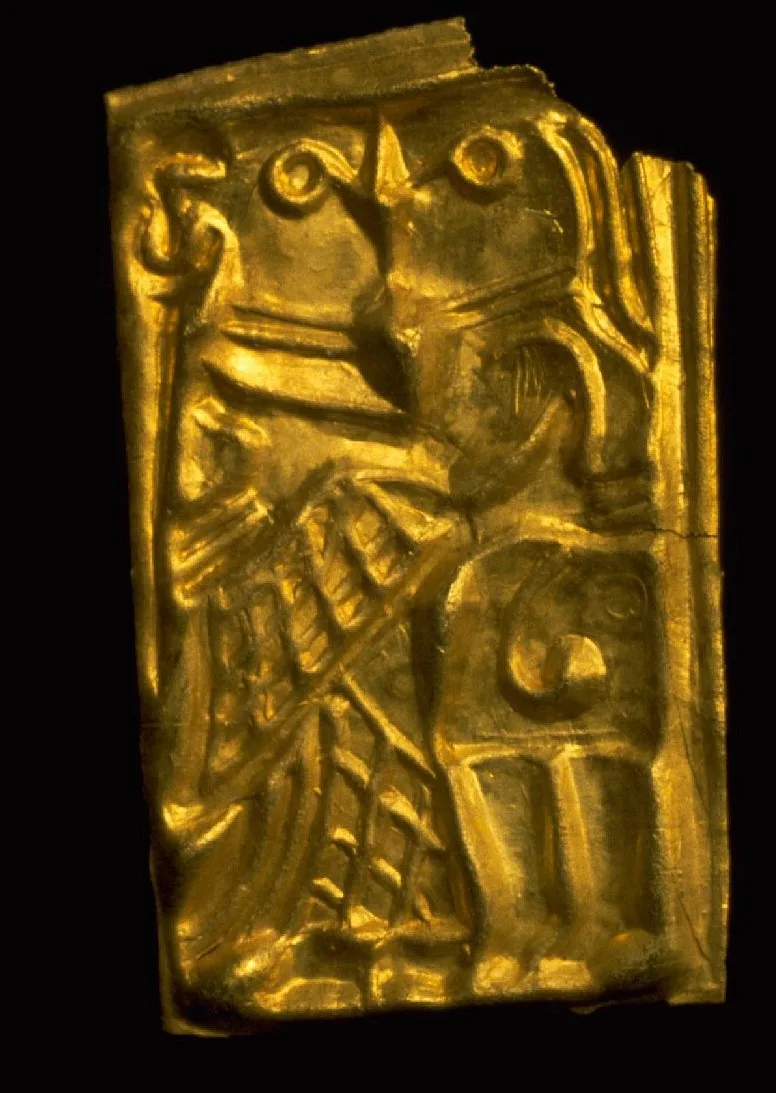 The Swedish History Museum, Cheek to cheek (2011), Flickr, CC BY 2.0 A gullgubbe gold foil stamped with an embracing couple — the commonest surviving motif on the tiny offerings scattered across the floors of Norse cult-houses like the one excavated under the church at Mære. Tiny gold foils — typically a square centimetre or less — stamped
with images of figures, most often a man and woman embracing,
scattered across the floors of Norse cult-houses (hov) of the
Iron Age and Migration Period. The gullgubber are interpreted as
ritual offerings, likely connected with the worship of Frey and
Freyja or with marriage and the fertility of households. About
three thousand are known across Scandinavia, with substantial
finds at the Mære cult-site under the medieval church in
Trøndelag — one of the clearest archaeological signatures of a
pre-Christian cult location.
: tiny gold foils stamped with a man and woman embracing, the mark of a late-Iron-Age cult site.
The Swedish History Museum, Cheek to cheek (2011), Flickr, CC BY 2.0 A gullgubbe gold foil stamped with an embracing couple — the commonest surviving motif on the tiny offerings scattered across the floors of Norse cult-houses like the one excavated under the church at Mære. Tiny gold foils — typically a square centimetre or less — stamped
with images of figures, most often a man and woman embracing,
scattered across the floors of Norse cult-houses (hov) of the
Iron Age and Migration Period. The gullgubber are interpreted as
ritual offerings, likely connected with the worship of Frey and
Freyja or with marriage and the fertility of households. About
three thousand are known across Scandinavia, with substantial
finds at the Mære cult-site under the medieval church in
Trøndelag — one of the clearest archaeological signatures of a
pre-Christian cult location.
: tiny gold foils stamped with a man and woman embracing, the mark of a late-Iron-Age cult site.
The man who served both was the goði. He was the chieftain in his priestly aspect. The same man who judged a land-quarrel at the assembly led the blót; the same household that paid him its rent ate at his feast. This was the structural fact of the whole religion — no separate priesthood, no church set against a king, no holy institution holding lands of its own. The chieftain’s authority was sacred because he was the chieftain. The faith was political because the office was. When Christianity came, it came carried by a king, and it brought a kind of authority the old order had no word for.
Religion at the threshold
The great seasonal blót was the least of it, in sheer quantity. Most of the religion was the small daily and weekly turning of a farm — at the doorway, the hearth, the byre, the field.
The Öndvegissúlur 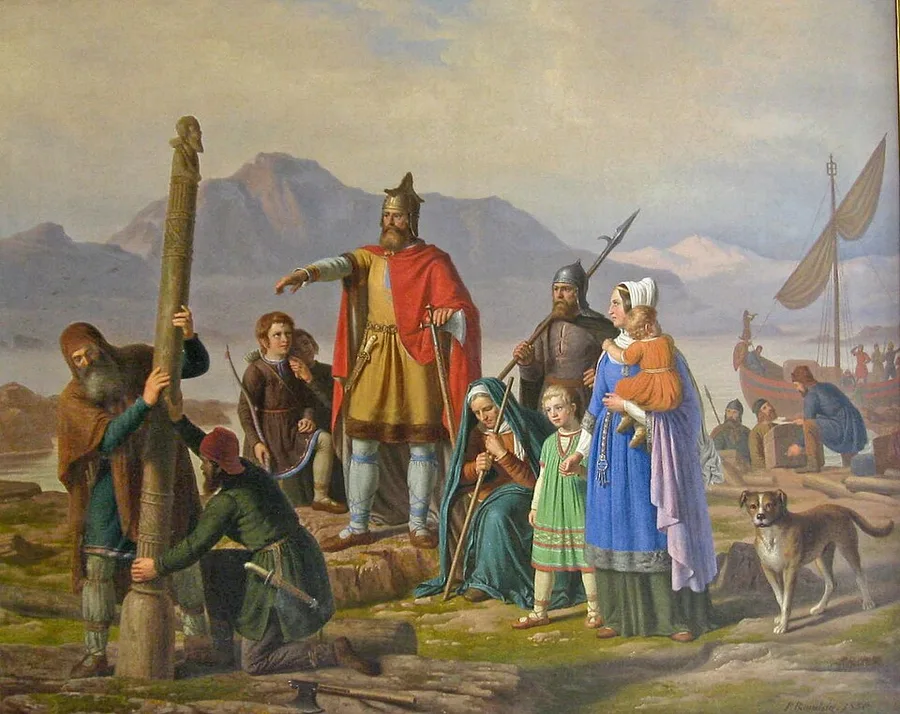 Johan Peter Raadsig, Ingolf tager Island i besiddelse (1850) Raadsig's 1850 painting shows Ingólfr Arnarson directing his men to raise his high-seat pillars at Reykjavík — the exact öndvegissúlur custom the card describes, where a settler threw the pillars overboard and built where the sea washed them ashore. The high-seat pillars at the inner end of a Norse longhouse —
paired wooden posts carved with the image of a household god, most
often Thor. The öndvegissúlur were the visible heart of a family's
religious life: the throne of the household-as-cult-site. A man
sailing to settle Iceland in the late ninth century would throw
his pillars overboard within sight of land and raise his new house
wherever the sea brought them ashore — a divinely placed
homestead, with the family's hearth where Thor (or whichever god
the pillars carried) had chosen for it.
, the high-seat pillars at the inner end of the hall, were holy objects, carved with the image of a household god, most often Thor. They were the visible heart of a family’s religious life. A man sailing to settle Iceland
Johan Peter Raadsig, Ingolf tager Island i besiddelse (1850) Raadsig's 1850 painting shows Ingólfr Arnarson directing his men to raise his high-seat pillars at Reykjavík — the exact öndvegissúlur custom the card describes, where a settler threw the pillars overboard and built where the sea washed them ashore. The high-seat pillars at the inner end of a Norse longhouse —
paired wooden posts carved with the image of a household god, most
often Thor. The öndvegissúlur were the visible heart of a family's
religious life: the throne of the household-as-cult-site. A man
sailing to settle Iceland in the late ninth century would throw
his pillars overboard within sight of land and raise his new house
wherever the sea brought them ashore — a divinely placed
homestead, with the family's hearth where Thor (or whichever god
the pillars carried) had chosen for it.
, the high-seat pillars at the inner end of the hall, were holy objects, carved with the image of a household god, most often Thor. They were the visible heart of a family’s religious life. A man sailing to settle Iceland 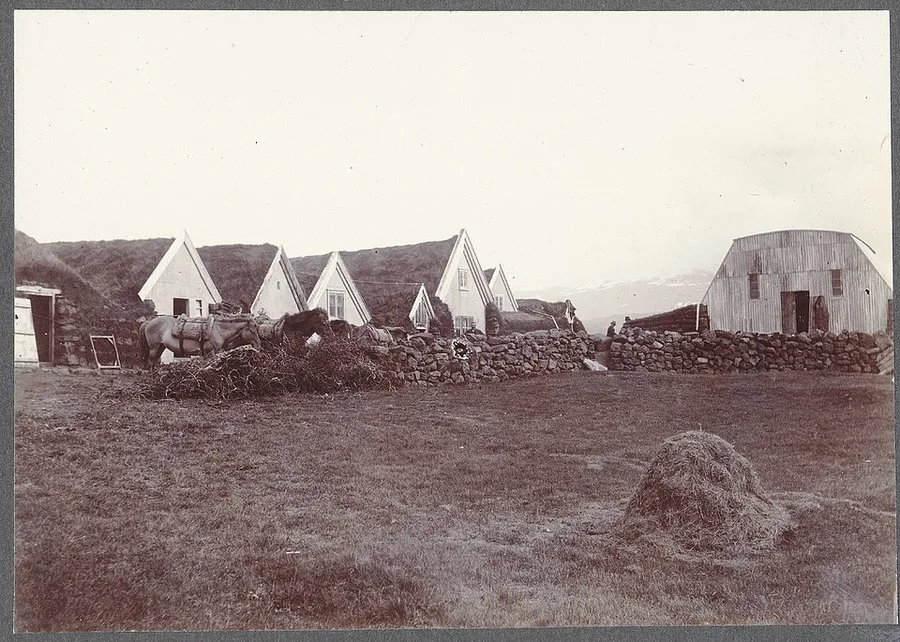 Frederick W. W. Howell, Galtalækur and Hekla (c. 1900), Fiske Icelandic Collection, Cornell University Library A turf-walled farm under Hekla, photographed about 1900 — Iceland as the settlers from Norway made it: a country of farms without a king or towns, governed by the annual open-air Alþing and remembered in the sagas their descendants wrote. The North Atlantic island settled from Norway in the ninth and
tenth centuries by chieftains and their followings who refused to
accept Harald Fairhair's authority on the Norwegian mainland and
emigrated rather than submit. They built a country without a king,
governed by an annual open-air assembly at Þingvellir called the
Alþing — the oldest parliament in the world by date of founding. Three centuries after the migration, their descendants
(notably Snorri Sturluson) composed the prose sagas that became
almost the only literary memory of the Norwegian petty kingdoms.
Also discussed in Before There Was Norway — petty kingdoms at the edge of the worldThe Viking Age — longships, legends, and the first "Norway"The King Who Became a Saint — how the Nordmen came to ChristA Catholic Norway — the faith that gave the kingdom its first institutions and the stave churchesThe Golden Age — a North Atlantic empire … reaching farther than you thinkThe 400-Year Night — when the Northern Lion lay dormant would throw his pillars over the side within sight of land and raise his new house wherever the sea brought them ashore.
Frederick W. W. Howell, Galtalækur and Hekla (c. 1900), Fiske Icelandic Collection, Cornell University Library A turf-walled farm under Hekla, photographed about 1900 — Iceland as the settlers from Norway made it: a country of farms without a king or towns, governed by the annual open-air Alþing and remembered in the sagas their descendants wrote. The North Atlantic island settled from Norway in the ninth and
tenth centuries by chieftains and their followings who refused to
accept Harald Fairhair's authority on the Norwegian mainland and
emigrated rather than submit. They built a country without a king,
governed by an annual open-air assembly at Þingvellir called the
Alþing — the oldest parliament in the world by date of founding. Three centuries after the migration, their descendants
(notably Snorri Sturluson) composed the prose sagas that became
almost the only literary memory of the Norwegian petty kingdoms.
Also discussed in Before There Was Norway — petty kingdoms at the edge of the worldThe Viking Age — longships, legends, and the first "Norway"The King Who Became a Saint — how the Nordmen came to ChristA Catholic Norway — the faith that gave the kingdom its first institutions and the stave churchesThe Golden Age — a North Atlantic empire … reaching farther than you thinkThe 400-Year Night — when the Northern Lion lay dormant would throw his pillars over the side within sight of land and raise his new house wherever the sea brought them ashore.
The household was never alone in its buildings. The hearth-fire, kept always alight, was the family’s tie to its dead: bread baked at it carried a share for the ancestors, and a cup tipped at its edge was a cup for them. The barn and the byre had their own resident — a small unseen helper who worked with the household if it fed him and against it if it forgot. A bowl of porridge with a knob of butter, set on the barn threshold at midwinter, was his due. The custom would outlast by a thousand years the gods who oversaw it.
A Norwegian farmstead in this religion was a populated place even when it looked empty: a hall with its ancestors by the fire, a barn with its helper at the door, a grove with whatever it was that men and women shaded their voices for when they passed beneath it. To live there was to be inside a company that was mostly unseen, and to live well was to keep that company fed.
Mjölnir amulets, little hammers of iron or silver, hung at the throats of children and women and men of every rank. They are the commonest religious object in the whole Norse archaeological record. They were not ornaments, and not badges of rank. They were protection.
Runes were cut for the same end — on a comb, a knife-haft, a doorpost, the stem of a fishing-boat, the loom-weights a woman worked at. The runes were the secret Odin had hung nine nights to win, and the household put them to work for healing, for warding, for safe travel. A protective stave scored under a child’s cradle was as much the religion as the great blót was.
Birth, marriage, and the burial mound
A child got its name at the Ausa vatni The Norse water-pouring naming rite. The father sprinkled the newborn with water and spoke the name aloud — only then was it a person and only then could the household no longer set it out to die. The pattern of water-and-a-name ran so deep in pre-Christian Scandinavia that when Christian baptism arrived a century or two later, part of why it took was that its outward shape was already familiar. The Norwegian phrase for baptism — å døpe — and the whole shape of the church font rite landed onto a community that already knew how a child was named. , the water-pouring: the father sprinkled the newborn with water and spoke the name aloud. Only then was it a person — only then could the household no longer set it out to die. The pattern of water and a name ran so deep in Scandinavia that when Christian baptism arrived a century or two later, part of why it took was that its outward shape was already familiar.
A marriage was a bride-price agreed at the assembly, a public trading of gifts, a feast, and the laying of Thor’s hammer in the bride’s lap for fertility and the keeping of the bond. The cup went round; the toast was made; the witnesses spoke their piece. It was communal, contractual, and set plainly under Thor’s hand.
Burial varied. The older centuries leaned to cremation, the body burned and the ashes laid under a mound; the later ones turned to laying the whole body in a chamber beneath the earth. Either way, goods went down scaled to the dead one’s standing — a farmer with his sickle and his whetstone, a chieftain with sword and shield, often a slaughtered horse, and at the very top a whole ship. At the grandest funerals a slave might be killed to go into the ground with the master; a handful of Norwegian graves hold a second body laid in beside the first, beheaded. The mound stood afterward on the farm’s own land. The dead were not gone from it. They lay under the mound, and the household tended them — bread, ale, a cut from the blót — for as long as the family kept the ground.
Where the dead actually went
Modern storytelling has flattened the Norse afterlife to a single picture: everyone, fallen in battle or dead in bed, marching up to Valhalla. The real scheme was sharper.
Valhalla 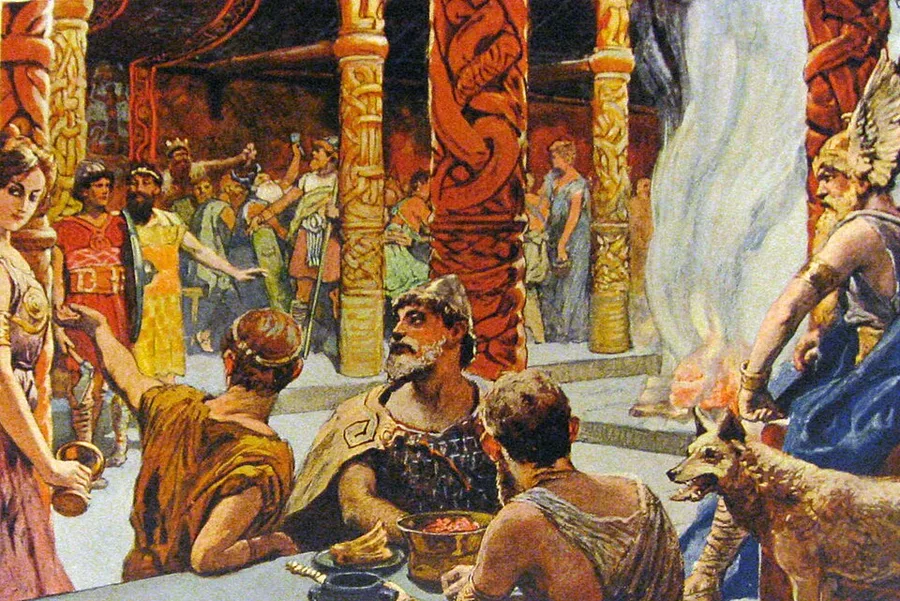 Emil Doepler, Walhall (c. 1905), from Walhall, die Götterwelt der Germanen Emil Doepler's early-1900s vision of Valhalla — Odin's shield-hung hall of the slain, where the warriors chosen from the battlefield feast between carved pillars while awaiting the last battle of Ragnarok. Odin's hall in Asgard — Valhǫll, "hall of the slain." The
destination of half of those who fell well in battle (the other
half went to Freyja's Folkvang). The Valkyries chose the dead and
brought them there; the fallen feasted nightly on the meat of the
ever-renewing boar Sæhrímnir and the mead of the goat Heiðrún,
and trained by day for the final battle of Ragnarok. Valhalla
was for the war-elite; ordinary dead went to Hel.
Also discussed in Nordisk Mytologi — Odin, the giants, and Ragnarok was for the war-elite, and only them. In the poems, Freyja chose half the battle-slain for her own hall, Folkvang
Emil Doepler, Walhall (c. 1905), from Walhall, die Götterwelt der Germanen Emil Doepler's early-1900s vision of Valhalla — Odin's shield-hung hall of the slain, where the warriors chosen from the battlefield feast between carved pillars while awaiting the last battle of Ragnarok. Odin's hall in Asgard — Valhǫll, "hall of the slain." The
destination of half of those who fell well in battle (the other
half went to Freyja's Folkvang). The Valkyries chose the dead and
brought them there; the fallen feasted nightly on the meat of the
ever-renewing boar Sæhrímnir and the mead of the goat Heiðrún,
and trained by day for the final battle of Ragnarok. Valhalla
was for the war-elite; ordinary dead went to Hel.
Also discussed in Nordisk Mytologi — Odin, the giants, and Ragnarok was for the war-elite, and only them. In the poems, Freyja chose half the battle-slain for her own hall, Folkvang 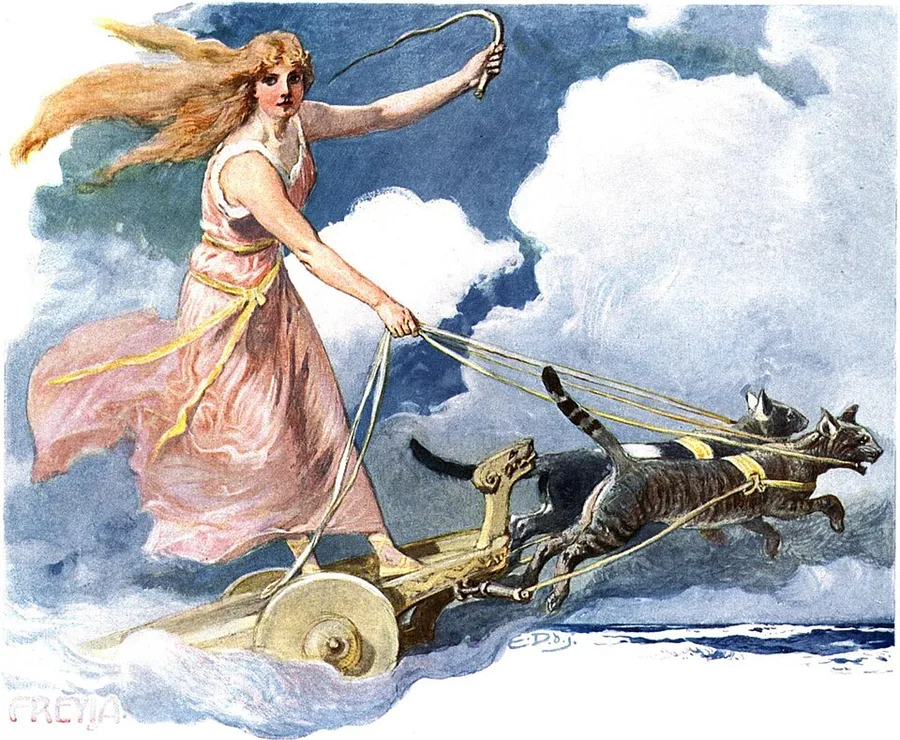 Emil Doepler, Freyja (c. 1905), from Walhall, die Götterwelt der Germanen Fólkvangr has no depiction of its own, so its mistress stands for it: Doepler draws Freyja driving her cat-drawn chariot — the goddess whose 'field of the host' received half the battle-slain, the counterweight to Odin's Valhalla. Freyja's hall in Asgard — "field of the host." The destination of
half of those who fell well in battle (the other half went to
Odin's Valhalla). The lopsided geometry of the Norse battle-
afterlife — two halls, two gods, the dead divided between them —
is one of the more distinctive features of the religion's
imagination and a constant reminder that Odin shared the war-dead
with Freyja rather than receiving them all himself.
, and the Valkyries
Emil Doepler, Freyja (c. 1905), from Walhall, die Götterwelt der Germanen Fólkvangr has no depiction of its own, so its mistress stands for it: Doepler draws Freyja driving her cat-drawn chariot — the goddess whose 'field of the host' received half the battle-slain, the counterweight to Odin's Valhalla. Freyja's hall in Asgard — "field of the host." The destination of
half of those who fell well in battle (the other half went to
Odin's Valhalla). The lopsided geometry of the Norse battle-
afterlife — two halls, two gods, the dead divided between them —
is one of the more distinctive features of the religion's
imagination and a constant reminder that Odin shared the war-dead
with Freyja rather than receiving them all himself.
, and the Valkyries 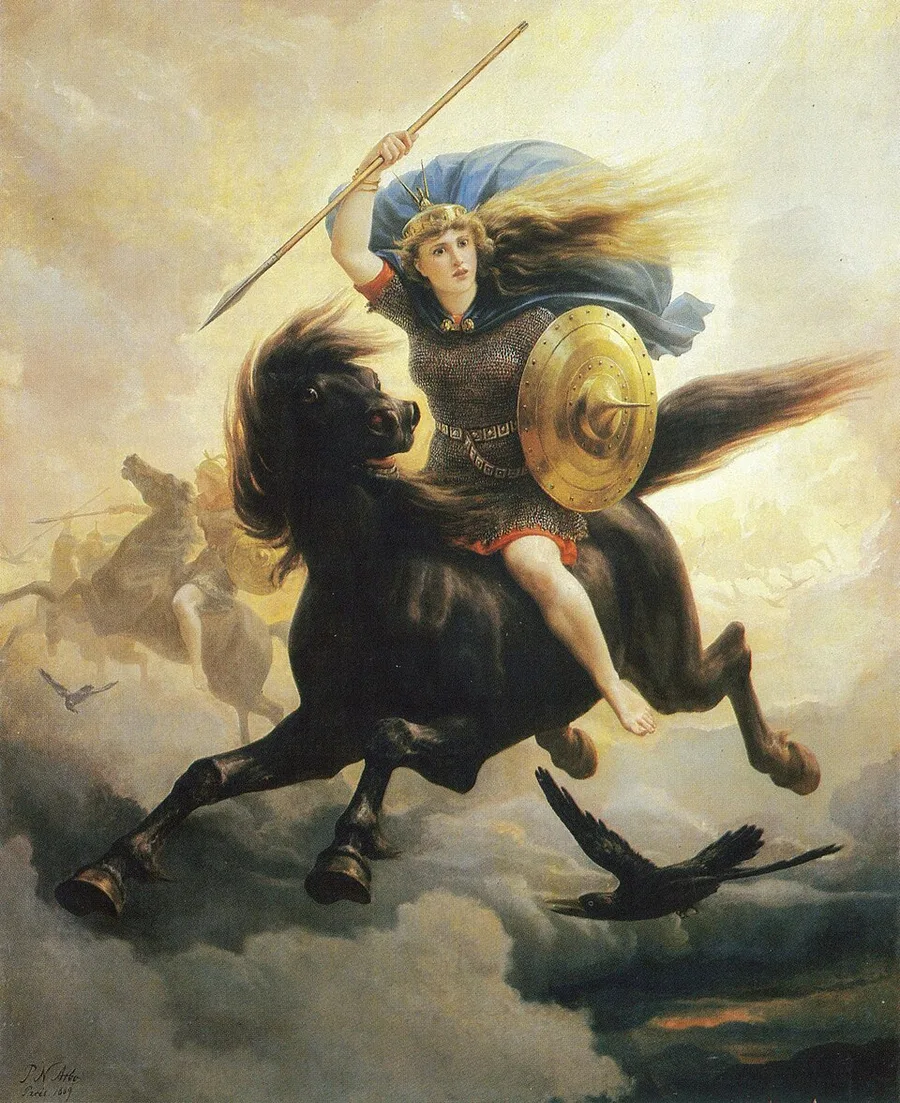 Peter Nicolai Arbo, Valkyrjen (1869), Nasjonalmuseet, Oslo (NG.M.00259) Peter Nicolai Arbo's 1869 Valkyrjen sends a mailed, spear-bearing rider galloping through a darkened sky, a raven below — Odin's chooser of the slain, who carried half the battle-dead to Valhalla. Female battlefield spirits in Norse mythology — valkyrjur,
"choosers of the slain." Sent by Odin to determine who would die
in a battle and who would live, and to bring half of the dead to
Valhalla (the other half went to Freyja's Folkvang). The
Valkyries were not gentle psychopomps but warlike presences in
their own right; some sagas treat them as semi-divine warrior-
women rather than emanations of Odin's will, and the figure
blurs at the edges with that of the human shield-maiden in
Norse imagination.
Also discussed in Nordisk Mytologi — Odin, the giants, and Ragnarok brought the other half to Odin’s; both halls were for fighters who had fallen well, and both were mustering against the last battle of the world.
Peter Nicolai Arbo, Valkyrjen (1869), Nasjonalmuseet, Oslo (NG.M.00259) Peter Nicolai Arbo's 1869 Valkyrjen sends a mailed, spear-bearing rider galloping through a darkened sky, a raven below — Odin's chooser of the slain, who carried half the battle-dead to Valhalla. Female battlefield spirits in Norse mythology — valkyrjur,
"choosers of the slain." Sent by Odin to determine who would die
in a battle and who would live, and to bring half of the dead to
Valhalla (the other half went to Freyja's Folkvang). The
Valkyries were not gentle psychopomps but warlike presences in
their own right; some sagas treat them as semi-divine warrior-
women rather than emanations of Odin's will, and the figure
blurs at the edges with that of the human shield-maiden in
Norse imagination.
Also discussed in Nordisk Mytologi — Odin, the giants, and Ragnarok brought the other half to Odin’s; both halls were for fighters who had fallen well, and both were mustering against the last battle of the world.
Everyone else went to Hel 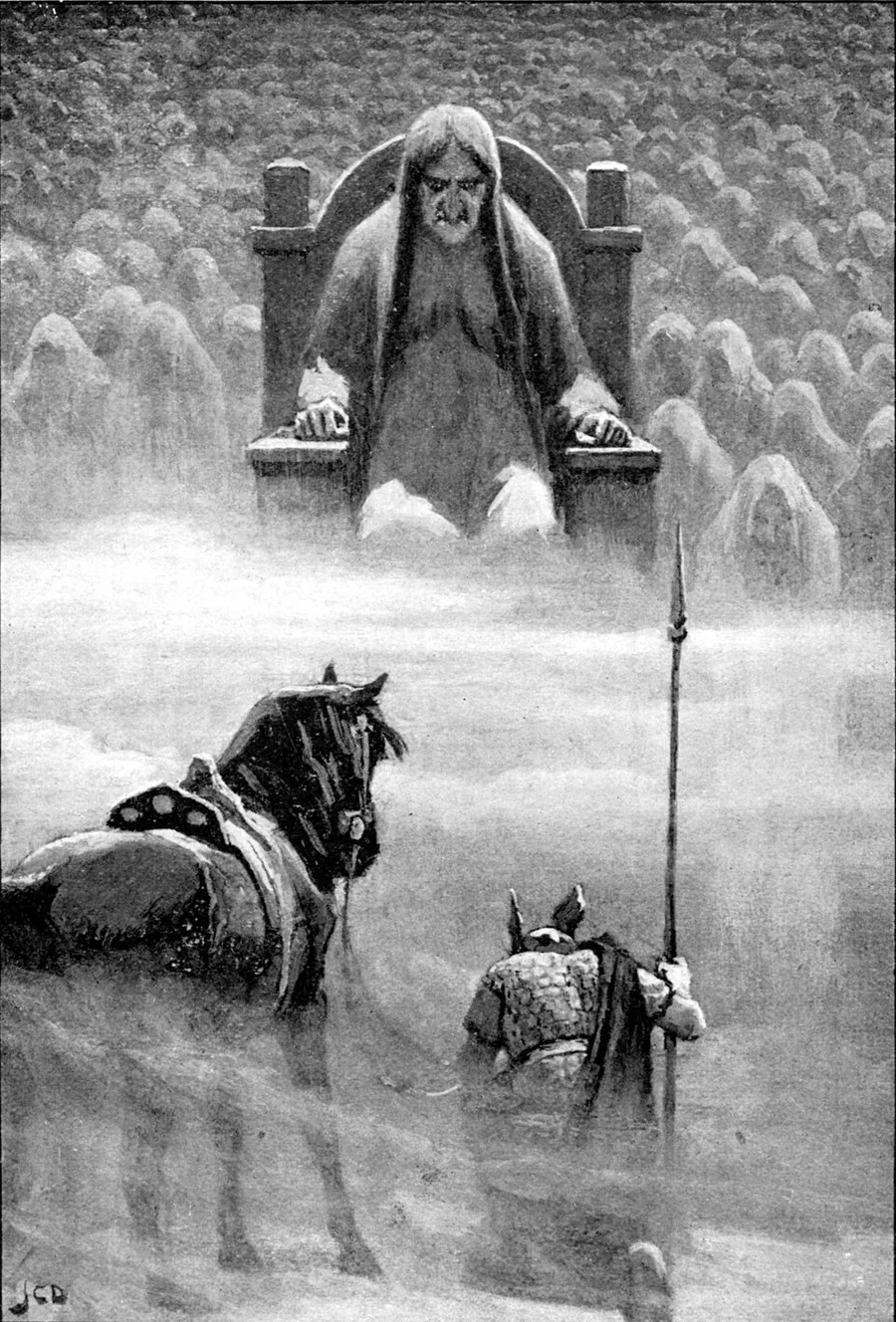 John Charles Dollman, Hermod before Hela (1909), from H. A. Guerber's Myths of the Norsemen Dollman pictures the goddess Hel enthroned in her misty realm with the crowding dead behind her, a messenger kneeling before her — the underworld where the Norse believed most people went, those who died of sickness or age rather than in battle. The Norse realm of the ordinary dead — most people who died went
there. Hel was not the Christian hell: no fire, no punishment,
no moral verdict. The farmer carried off by fever, the woman dead
in childbirth, the child that never saw a second year, the slave,
the grandmother by the fire — all went to Hel, and so did chieftains
who died in their beds rather than on a battlefield. The realm was
ruled by the goddess of the same name (Hel, daughter of Loki). The
Norse afterlife sorted by how you died, not by how you lived —
a distinction that confused Christian missionaries and still confuses
modern storytellers, who flatten the system into a single
battlefield-to-Valhalla pipeline.
Also discussed in Nordisk Mytologi — Odin, the giants, and Ragnarok — the farmer carried off by fever in his eightieth winter, the woman dead in childbirth, the child that never saw a second year, the slave, the grandmother by the fire. Hel was not the Christian hell. No fire, no punishment. It was simply the realm of the dead, where ordinary dying led. The chieftain who died in his bed went there too. The afterlife sorted you by how you died, not by how you had lived.
John Charles Dollman, Hermod before Hela (1909), from H. A. Guerber's Myths of the Norsemen Dollman pictures the goddess Hel enthroned in her misty realm with the crowding dead behind her, a messenger kneeling before her — the underworld where the Norse believed most people went, those who died of sickness or age rather than in battle. The Norse realm of the ordinary dead — most people who died went
there. Hel was not the Christian hell: no fire, no punishment,
no moral verdict. The farmer carried off by fever, the woman dead
in childbirth, the child that never saw a second year, the slave,
the grandmother by the fire — all went to Hel, and so did chieftains
who died in their beds rather than on a battlefield. The realm was
ruled by the goddess of the same name (Hel, daughter of Loki). The
Norse afterlife sorted by how you died, not by how you lived —
a distinction that confused Christian missionaries and still confuses
modern storytellers, who flatten the system into a single
battlefield-to-Valhalla pipeline.
Also discussed in Nordisk Mytologi — Odin, the giants, and Ragnarok — the farmer carried off by fever in his eightieth winter, the woman dead in childbirth, the child that never saw a second year, the slave, the grandmother by the fire. Hel was not the Christian hell. No fire, no punishment. It was simply the realm of the dead, where ordinary dying led. The chieftain who died in his bed went there too. The afterlife sorted you by how you died, not by how you had lived.
There was no salvation to earn here, no damnation to fear, no soul standing alone before a god to answer for itself. The good man dead of fever had nothing to dread on the far side. He went where his people had gone before him. They were waiting under the mound, and his children would tend his bones in their turn. The religion held its people not by promising what came after but by giving them their place inside what was already there.
The seer-women
Beside the goði and the household rites ran a second kind of specialist, the one the sagas call the Völva 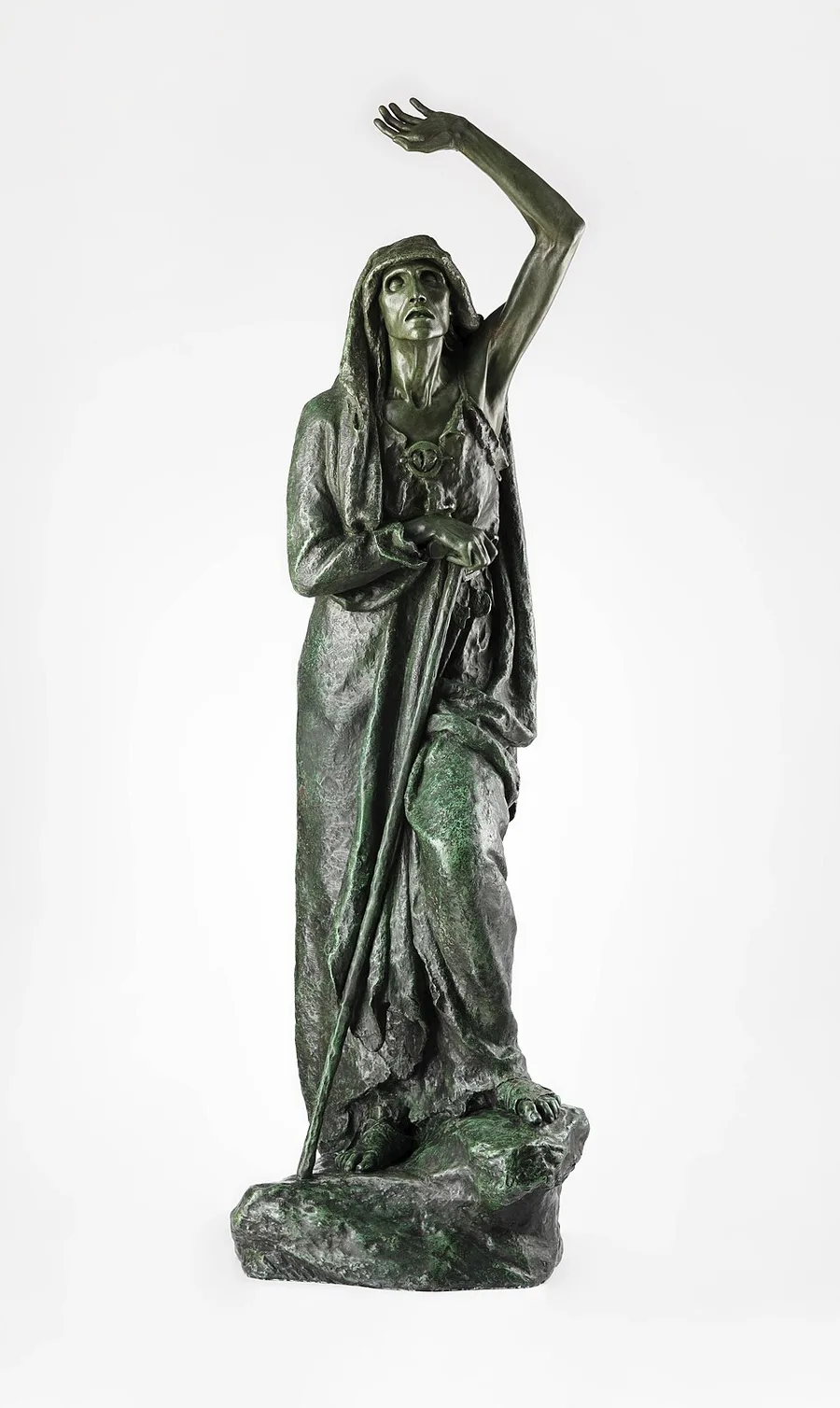 Søren Lexow-Hansen, Vala, The Norse Seeress (1883–86), Nasjonalmuseet Lexow-Hansen's bronze statue portrays the völva herself — the dark-mantled travelling seeress the card describes, staff in hand, arm raised in an invocatory gesture, who came when sent for and worked prophecy and healing at the farms she visited. The Norse seer-woman, the principal magical specialist of
pre-Christian Norse society. The völva travelled — came when she
was sent for, did the work she was asked for, ate at the high
seat, and moved on. She wore a dark mantle and carried the staff
(völr) that gave her her name. Her trade was prophecy,
weather-working, healing, and the turning-aside of harm — the
seiðr magic Freyja was said to have taught even to Odin. The
völva outlived the religion that framed her: she was still being
sent for on remote farms up the inland valleys long after the
last chieftain had stopped keeping the public blót.
. She was a woman who worked Seiðr
Søren Lexow-Hansen, Vala, The Norse Seeress (1883–86), Nasjonalmuseet Lexow-Hansen's bronze statue portrays the völva herself — the dark-mantled travelling seeress the card describes, staff in hand, arm raised in an invocatory gesture, who came when sent for and worked prophecy and healing at the farms she visited. The Norse seer-woman, the principal magical specialist of
pre-Christian Norse society. The völva travelled — came when she
was sent for, did the work she was asked for, ate at the high
seat, and moved on. She wore a dark mantle and carried the staff
(völr) that gave her her name. Her trade was prophecy,
weather-working, healing, and the turning-aside of harm — the
seiðr magic Freyja was said to have taught even to Odin. The
völva outlived the religion that framed her: she was still being
sent for on remote farms up the inland valleys long after the
last chieftain had stopped keeping the public blót.
. She was a woman who worked Seiðr 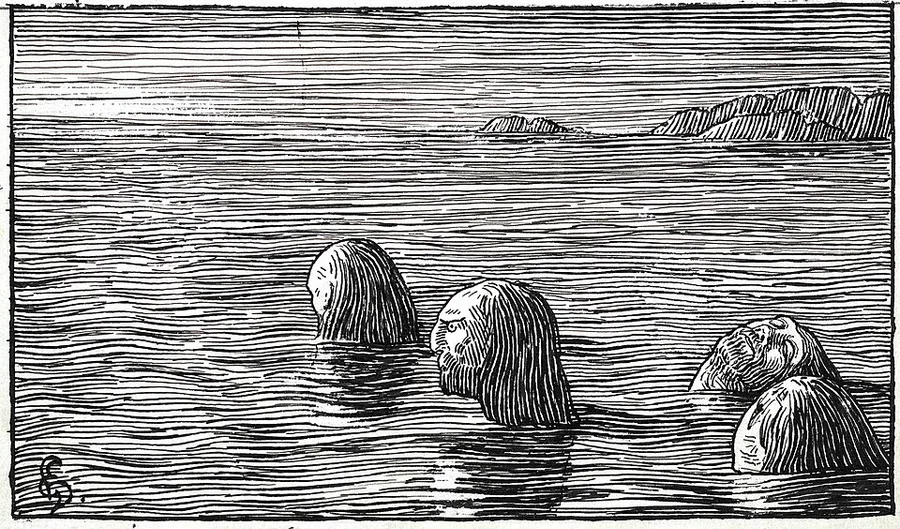 Halfdan Egedius, illustration for Óláfs saga Tryggvasonar, Heimskringla (J.M. Stenersen & Co, 1899 edition) Egedius's illustration shows the saga's seid-men trapped on the skerry Skratteskjær, heads just above the rising tide that drowned them — the fate of the rare named male practitioners of the seiðr the card describes as scandalous work for a man. The principal magical-divinatory craft of Norse religion, with no
real counterpart elsewhere in medieval Europe. Practitioners
(especially the wandering völva) used seiðr for prophecy,
weather-working, healing, the turning-aside of harm, and the
cursing of enemies. Seiðr belonged to women and to the goddess
Freyja, who was said to have taught it even to Odin; a man who
worked it drew social suspicion (the saga term for a male
seiðr-worker was ergi, carrying connotations of effeminacy and
shame). The line between the völva's craft and the ordinary
household charm was thin: a farmwife working a rune into a length
of cloth was doing in little what the völva did at large.
, a craft of magic and divination with no real counterpart elsewhere in medieval Europe. She travelled. She came when she was sent for, did the work she was asked for, ate at the high seat, and moved on. She wore a dark mantle and carried the staff — the völr — that gave her her name. Prophecy, weather-working, healing, the turning-aside of harm: that was her trade.
Halfdan Egedius, illustration for Óláfs saga Tryggvasonar, Heimskringla (J.M. Stenersen & Co, 1899 edition) Egedius's illustration shows the saga's seid-men trapped on the skerry Skratteskjær, heads just above the rising tide that drowned them — the fate of the rare named male practitioners of the seiðr the card describes as scandalous work for a man. The principal magical-divinatory craft of Norse religion, with no
real counterpart elsewhere in medieval Europe. Practitioners
(especially the wandering völva) used seiðr for prophecy,
weather-working, healing, the turning-aside of harm, and the
cursing of enemies. Seiðr belonged to women and to the goddess
Freyja, who was said to have taught it even to Odin; a man who
worked it drew social suspicion (the saga term for a male
seiðr-worker was ergi, carrying connotations of effeminacy and
shame). The line between the völva's craft and the ordinary
household charm was thin: a farmwife working a rune into a length
of cloth was doing in little what the völva did at large.
, a craft of magic and divination with no real counterpart elsewhere in medieval Europe. She travelled. She came when she was sent for, did the work she was asked for, ate at the high seat, and moved on. She wore a dark mantle and carried the staff — the völr — that gave her her name. Prophecy, weather-working, healing, the turning-aside of harm: that was her trade.
Seiðr belonged to women, and to Freyja, who was said to have taught it even to Odin; a man who worked it drew suspicion. The line between the völva’s craft and the ordinary household charm was thin. A farmwife working a rune into a length of cloth was doing in little what the völva did at large.
The völva outlived the religion that framed her. She was still being sent for, on remote farms up the inland valleys, long after the last chieftain had stopped keeping the public blót.
What ended the religion
The end, when it came officially, came by force of politics. Around 995 a chieftain’s son named Olav Tryggvason 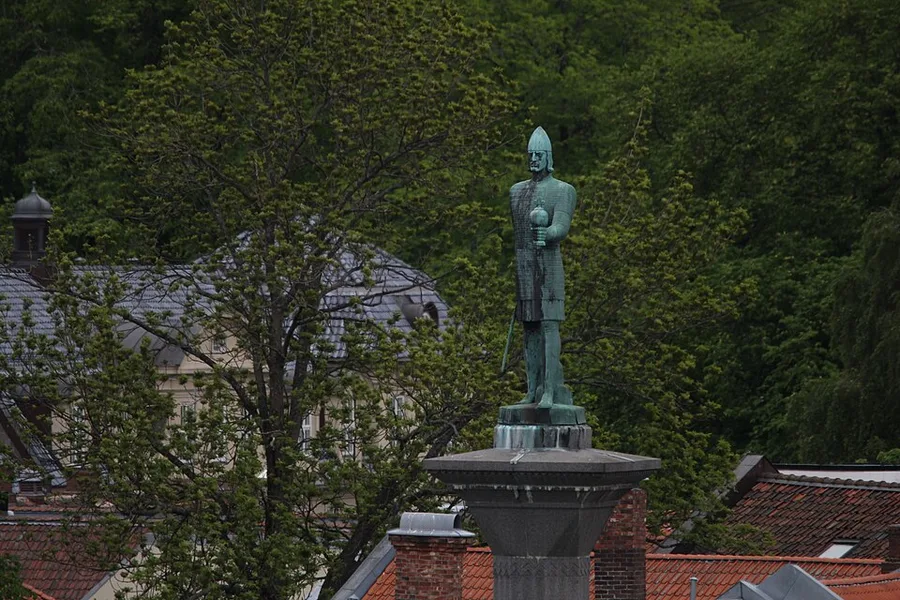 Wilhelm Rasmussen, Olav Tryggvason monument (1921), Torvet, Trondheim; photo Vegard Ottervig (CC BY-SA 3.0) Olav Tryggvason founded Nidaros (Trondheim) in 997 and forced through the Christianization this article describes. Wilhelm Rasmussen's 1921 column-top statue crowns the city's main square — the king cast as the sword-bearing Viking convert of the sagas. King of Norway 995–1000, the first Christianising king of the
country. Spent his youth as a Viking raider in the Baltic and the
British Isles; baptised in England in 994. Returned to Norway in
995 with a small fleet and seized the throne, then pushed the
conversion district by district — in some places by negotiation,
in others by force. The most-remembered confrontation was at the
Mære hov in Trøndelag around 997, where saga tradition has him
smashing the god-images and killing the chief Iron-Beard
(Járn-Skeggi). Founded Trondheim as Nidaros in 997. Killed at the
sea-battle of Svolder in 1000 by a coalition of Norwegian and
Swedish enemies; his cousin Olav Haraldsson (later Saint Olav)
completed the Christianisation a generation later.
Also discussed in The King Who Became a Saint — how the Nordmen came to Christ came back from England to Norway — baptised abroad, the crown in his sights, the new faith in his baggage. He worked through the country district by district. In some, the chieftains turned Christian without a fight: their war-bands had met Christianity already, on raids and trading runs, and taken some of it home. In others — above all the inner Trøndelag, the farming country the hov at Mære anchored — he met refusal.
Wilhelm Rasmussen, Olav Tryggvason monument (1921), Torvet, Trondheim; photo Vegard Ottervig (CC BY-SA 3.0) Olav Tryggvason founded Nidaros (Trondheim) in 997 and forced through the Christianization this article describes. Wilhelm Rasmussen's 1921 column-top statue crowns the city's main square — the king cast as the sword-bearing Viking convert of the sagas. King of Norway 995–1000, the first Christianising king of the
country. Spent his youth as a Viking raider in the Baltic and the
British Isles; baptised in England in 994. Returned to Norway in
995 with a small fleet and seized the throne, then pushed the
conversion district by district — in some places by negotiation,
in others by force. The most-remembered confrontation was at the
Mære hov in Trøndelag around 997, where saga tradition has him
smashing the god-images and killing the chief Iron-Beard
(Járn-Skeggi). Founded Trondheim as Nidaros in 997. Killed at the
sea-battle of Svolder in 1000 by a coalition of Norwegian and
Swedish enemies; his cousin Olav Haraldsson (later Saint Olav)
completed the Christianisation a generation later.
Also discussed in The King Who Became a Saint — how the Nordmen came to Christ came back from England to Norway — baptised abroad, the crown in his sights, the new faith in his baggage. He worked through the country district by district. In some, the chieftains turned Christian without a fight: their war-bands had met Christianity already, on raids and trading runs, and taken some of it home. In others — above all the inner Trøndelag, the farming country the hov at Mære anchored — he met refusal.
The Frostating 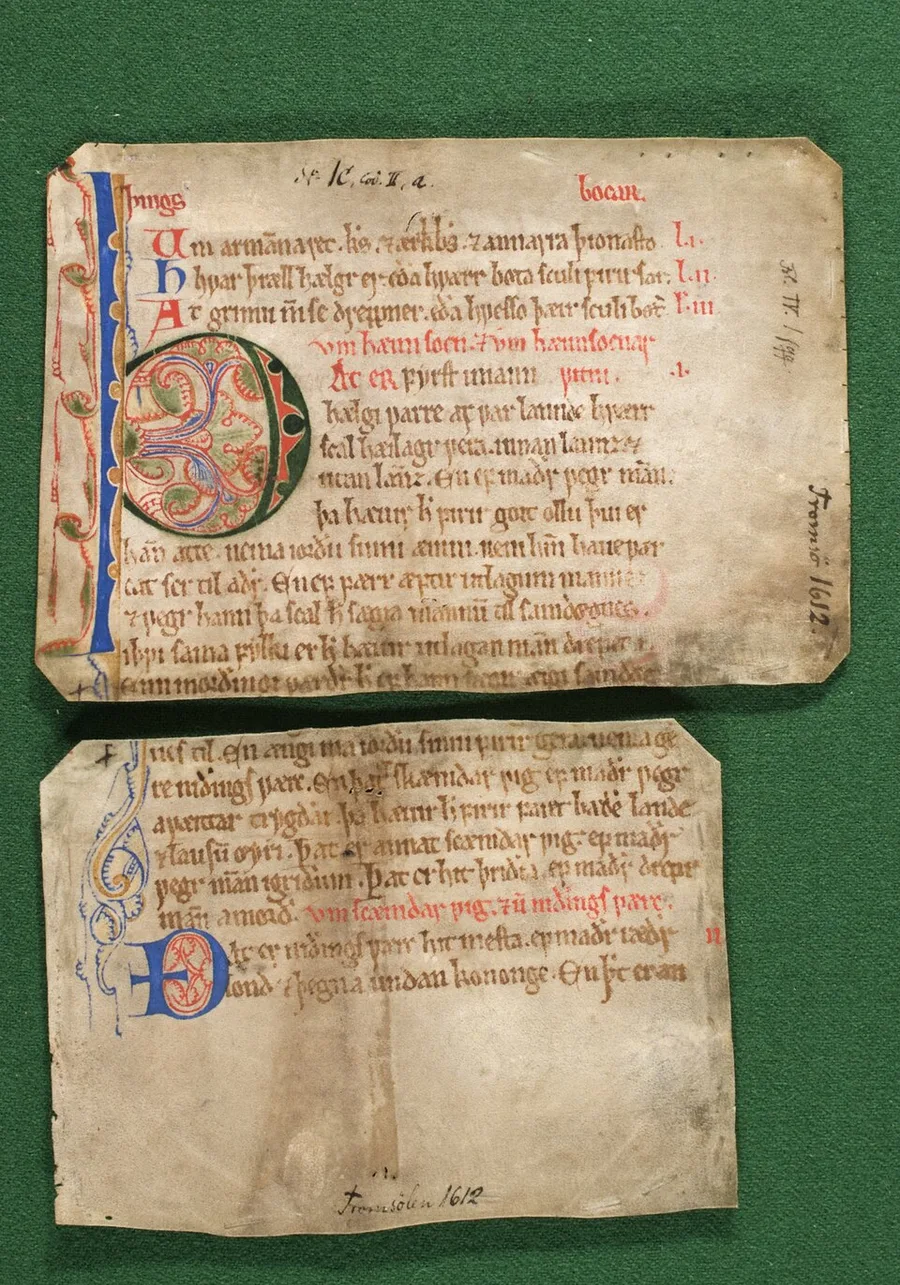 Frostatingslova fragment (c. 1260), National Archives of Norway (Riksarkivet), CC BY-SA 4.0 Two parchment leaves of the Frostatingslova, c. 1260 — the written law code of the central-Norway thing assembly that met at Frosta on the Trondheim Fjord, its customary law far older than the ink. The regional thing-law assembly of central Norway, meeting at
Frosta on the Trondheim Fjord. Jurisdiction covered Trøndelag and
the surrounding northern districts. Its codification, the
Frostatingslova, dates to the twelfth century in its surviving
form but preserves substantially older customary law. Rolled into
Magnus Lagabøte's Landslov of 1274. The modern Frostating Court
of Appeal in Trondheim carries the name.
Also discussed in Before There Was Norway — petty kingdoms at the edge of the worldThe King Who Became a Saint — how the Nordmen came to ChristA Catholic Norway — the faith that gave the kingdom its first institutions and the stave churchesThe Golden Age — a North Atlantic empire … reaching farther than you think , the regional assembly of the Trøndelag farmers, threw back his demand for a general baptism and made him bargain. The sagas put his coming to the Mære blót at around 997, where he faced down the chief Járn-Skeggi
Frostatingslova fragment (c. 1260), National Archives of Norway (Riksarkivet), CC BY-SA 4.0 Two parchment leaves of the Frostatingslova, c. 1260 — the written law code of the central-Norway thing assembly that met at Frosta on the Trondheim Fjord, its customary law far older than the ink. The regional thing-law assembly of central Norway, meeting at
Frosta on the Trondheim Fjord. Jurisdiction covered Trøndelag and
the surrounding northern districts. Its codification, the
Frostatingslova, dates to the twelfth century in its surviving
form but preserves substantially older customary law. Rolled into
Magnus Lagabøte's Landslov of 1274. The modern Frostating Court
of Appeal in Trondheim carries the name.
Also discussed in Before There Was Norway — petty kingdoms at the edge of the worldThe King Who Became a Saint — how the Nordmen came to ChristA Catholic Norway — the faith that gave the kingdom its first institutions and the stave churchesThe Golden Age — a North Atlantic empire … reaching farther than you think , the regional assembly of the Trøndelag farmers, threw back his demand for a general baptism and made him bargain. The sagas put his coming to the Mære blót at around 997, where he faced down the chief Járn-Skeggi 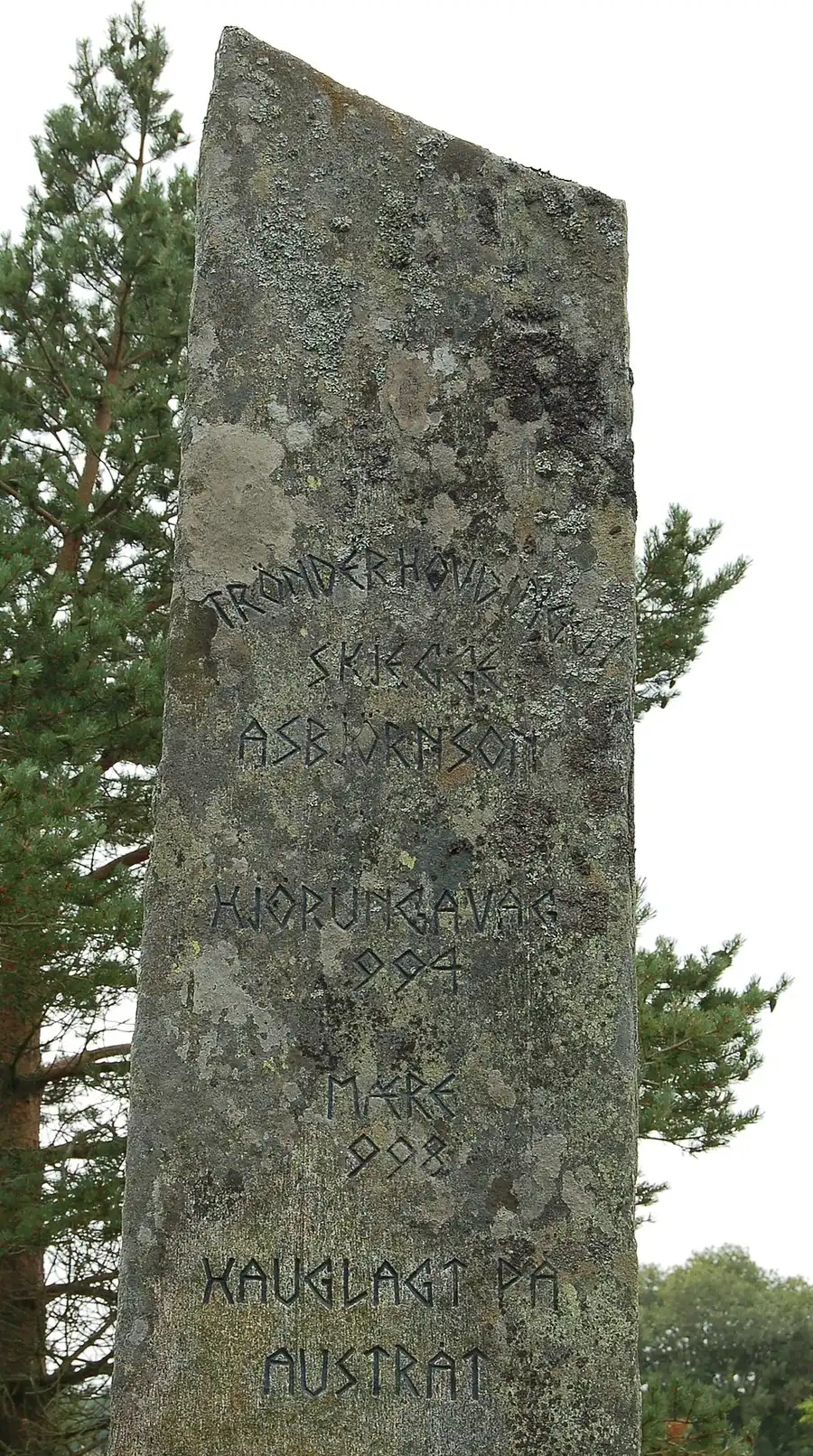 Photo: Arnstein Rønning, 2008 (CC BY-SA 3.0), memorial bauta at Ørland No period likeness of Iron-Beard exists. This stone, raised around 1980 at Ørland — the Yrjar of the sagas — carries his name, his battles and his mound-burial at Austrått, in the district where Snorri says his body was carried home after Olav's men cut him down at the Mære hov. Iron-Beard — Járn-Skeggi, the chief Trøndelag chieftain who
resisted Olav Tryggvason's forced conversion of the inner
Trøndelag farming country around 997. Snorri's Heimskringla has
Olav coming to the Mære blót, smashing the god-images at the
hov, and killing Iron-Beard in the confrontation. How much of the
detail is saga and how much is history is debated; the refusal it
remembers — the Frostating's hard-fought rejection of a general
Christianisation by royal command — was real, and the line of
resistance ran through the kind of chieftain Iron-Beard represented.
— at the hov, smashed the god-images, and killed the man. Half of that is saga and half is history. The refusal it remembers was real.
Photo: Arnstein Rønning, 2008 (CC BY-SA 3.0), memorial bauta at Ørland No period likeness of Iron-Beard exists. This stone, raised around 1980 at Ørland — the Yrjar of the sagas — carries his name, his battles and his mound-burial at Austrått, in the district where Snorri says his body was carried home after Olav's men cut him down at the Mære hov. Iron-Beard — Járn-Skeggi, the chief Trøndelag chieftain who
resisted Olav Tryggvason's forced conversion of the inner
Trøndelag farming country around 997. Snorri's Heimskringla has
Olav coming to the Mære blót, smashing the god-images at the
hov, and killing Iron-Beard in the confrontation. How much of the
detail is saga and how much is history is debated; the refusal it
remembers — the Frostating's hard-fought rejection of a general
Christianisation by royal command — was real, and the line of
resistance ran through the kind of chieftain Iron-Beard represented.
— at the hov, smashed the god-images, and killed the man. Half of that is saga and half is history. The refusal it remembers was real.
What came with the cross was more than a new god to put in the old gods’ place. It was a different idea of what a religion was: a holy book to study, a creed to assent to, a priesthood with its own authority set apart from kings, a heaven to be earned and a hell to be feared, and above all a moral verdict on every soul. The old gods had wanted feasts and oaths sworn at them. The new one wanted belief.
The slower truth was that converting the public hov did not convert the household barn. The Frostating’s farmers swore the oath their king required of them, went home, and carried on as they always had. The hov at Mære became a church, raised on the same ground where the gullgubber lay buried; the family that had owned the hov went on living on the same farm. The son baptised his own newborn at the new font — and his wife set the porridge-bowl on the byre threshold the same midwinter night her grandmother had. In the inland valleys the private blót ran on for more than a hundred years past the official conversion, and where the king’s arm was shortest, longer still.
The kingdom Olav Tryggvason left half-converted would be made firmly Christian a generation later, by Saint Olav 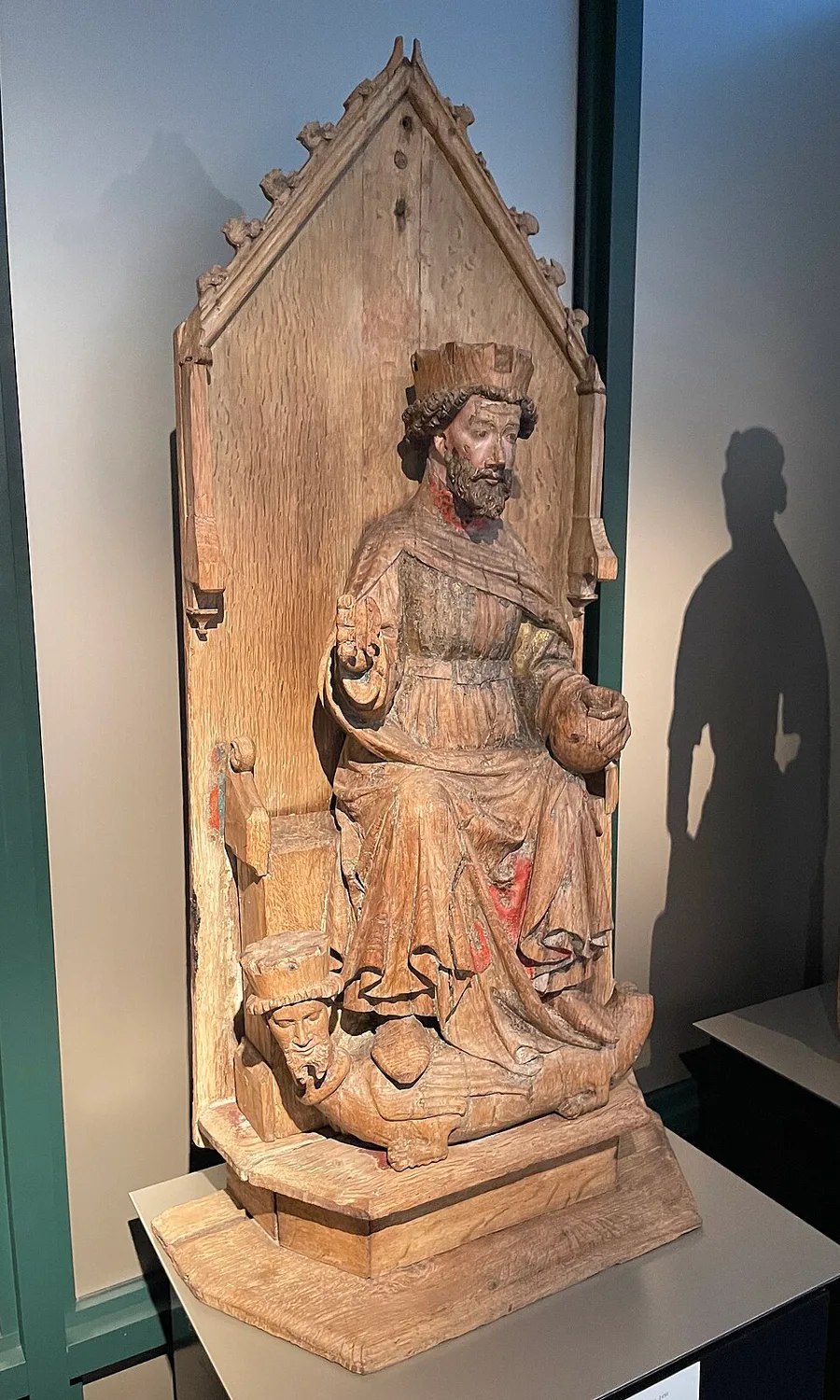 Saint Olav from Austevoll church (c. 1450), University Museum of Bergen; photo Wolfmann, Wikimedia Commons, CC BY-SA 4.0 Olav as medieval Norway saw him: the eternal king crowned and enthroned, trampling a dragon whose crowned human head stands for the heathendom he overcame. Carved around 1450 for Austevoll church south of Bergen — one of the polychrome Olav figures that stood in churches across Norway before the Reformation. Olav Haraldsson, king of Norway 1015–1028, killed at the Battle
of Stiklestad on 29 July 1030 and canonized one year and five days
later by his English bishop Grimkell. Rex Perpetuus Norvegiae —
the Eternal King of Norway. His shrine at Nidaros became the
northernmost pilgrimage destination in medieval Christendom and
the binding narrative of a converted country. The Norwegian Lion
on the modern coat of arms — a golden lion bearing a golden axe
on a red shield — is Saint Olav's iconography.
In this article Olav Haraldsson's missionary work intensified the late-tenth-
century conversion-by-coercion pattern that had begun under his
namesake Olav Tryggvason. He inherited the campaign and made
its institutional architecture last.
On the trip The Gråhårsklubben (the Oldsters) visit Nidaros Cathedral on
Tuesday 28 July 2026 — the day before the 996th anniversary of
the Battle of Stiklestad. The Olafskrinet was broken up at the
1537 Reformation and the body buried somewhere inside the
cathedral in a spot no medieval source preserved. The building
is what the nine-and-a-half centuries of devotion built. The
pilgrim road, the Pilegrimsleden, runs past the cathedral's
south door — the same door the medieval pilgrims walked through.
Nidaros Cathedral, Trondheim Also discussed in The King Who Became a Saint — how the Nordmen came to ChristThe Viking Age — longships, legends, and the first "Norway"A Catholic Norway — the faith that gave the kingdom its first institutions and the stave churchesThe Reformation, 1537 — one church eradicated and another imposedLutheran Norway and Pietism — a farmer named Hans Nielsen Hauge and a lay revival that could not be silencedThe Crusades?!!!! — sixty ships from Bergen, bound for the Holy LandThe 400-Year Night — when the Northern Lion lay dormantThe Quiet Revolution — how Norway won its independence without a warWorld War II — the King’s “No” and the Nazis in Norway , whose death in battle became the cornerstone of medieval Christian Norway.
Saint Olav from Austevoll church (c. 1450), University Museum of Bergen; photo Wolfmann, Wikimedia Commons, CC BY-SA 4.0 Olav as medieval Norway saw him: the eternal king crowned and enthroned, trampling a dragon whose crowned human head stands for the heathendom he overcame. Carved around 1450 for Austevoll church south of Bergen — one of the polychrome Olav figures that stood in churches across Norway before the Reformation. Olav Haraldsson, king of Norway 1015–1028, killed at the Battle
of Stiklestad on 29 July 1030 and canonized one year and five days
later by his English bishop Grimkell. Rex Perpetuus Norvegiae —
the Eternal King of Norway. His shrine at Nidaros became the
northernmost pilgrimage destination in medieval Christendom and
the binding narrative of a converted country. The Norwegian Lion
on the modern coat of arms — a golden lion bearing a golden axe
on a red shield — is Saint Olav's iconography.
In this article Olav Haraldsson's missionary work intensified the late-tenth-
century conversion-by-coercion pattern that had begun under his
namesake Olav Tryggvason. He inherited the campaign and made
its institutional architecture last.
On the trip The Gråhårsklubben (the Oldsters) visit Nidaros Cathedral on
Tuesday 28 July 2026 — the day before the 996th anniversary of
the Battle of Stiklestad. The Olafskrinet was broken up at the
1537 Reformation and the body buried somewhere inside the
cathedral in a spot no medieval source preserved. The building
is what the nine-and-a-half centuries of devotion built. The
pilgrim road, the Pilegrimsleden, runs past the cathedral's
south door — the same door the medieval pilgrims walked through.
Nidaros Cathedral, Trondheim Also discussed in The King Who Became a Saint — how the Nordmen came to ChristThe Viking Age — longships, legends, and the first "Norway"A Catholic Norway — the faith that gave the kingdom its first institutions and the stave churchesThe Reformation, 1537 — one church eradicated and another imposedLutheran Norway and Pietism — a farmer named Hans Nielsen Hauge and a lay revival that could not be silencedThe Crusades?!!!! — sixty ships from Bergen, bound for the Holy LandThe 400-Year Night — when the Northern Lion lay dormantThe Quiet Revolution — how Norway won its independence without a warWorld War II — the King’s “No” and the Nazis in Norway , whose death in battle became the cornerstone of medieval Christian Norway.
What stayed
The kings broke the public religion. The household one they did not touch. Across the Norwegian countryside, through the Catholic centuries and the Lutheran centuries and into living memory, the older pattern kept turning under the new.
The midwinter feast that the Norwegian Jul 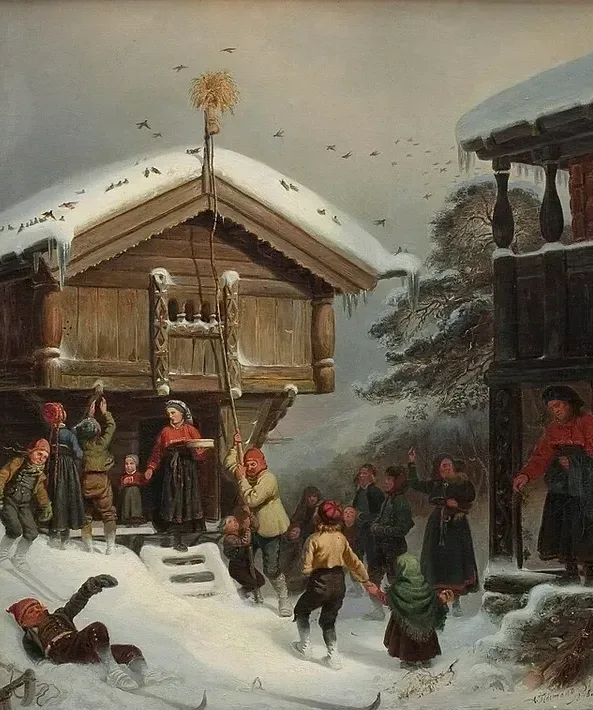 Adolph Tidemand, Norsk juleskik (1846), Trondheim kunstmuseum Adolph Tidemand paints a Norwegian farmyard at Christmas — the julenek sheaf raised for the birds, children on skis — the midwinter feast whose forms carry a pre-Christian inheritance from the Norse jól. The Norwegian (and broadly Scandinavian) midwinter feast — the
modern Christmas, but with a pre-Christian inheritance from the
Norse jól-blót still visible in its structure. The long run of
nights, the great toasts, the porridge bowl set out on the barn
threshold for the unseen one who lives on the farm, the julebukk
(Yule goat) surviving now in a children's costume-walk, the
Swedish Christmas ham traditionally traced back to the
sonargöltr (yule-boar). The Norwegian Jul is the clearest
practical example of how the household religion survived the
official conversion — the form remained, the gods at its centre
changed.
Also discussed in Julebukk — the masked goat of midwinterÅsgårdsreien — the storm that rides through the winter skyTradisjoner — celebrations across the Norwegian year still keeps — the long run of nights, the great toasts, the bowl of Julegrøt
Adolph Tidemand, Norsk juleskik (1846), Trondheim kunstmuseum Adolph Tidemand paints a Norwegian farmyard at Christmas — the julenek sheaf raised for the birds, children on skis — the midwinter feast whose forms carry a pre-Christian inheritance from the Norse jól. The Norwegian (and broadly Scandinavian) midwinter feast — the
modern Christmas, but with a pre-Christian inheritance from the
Norse jól-blót still visible in its structure. The long run of
nights, the great toasts, the porridge bowl set out on the barn
threshold for the unseen one who lives on the farm, the julebukk
(Yule goat) surviving now in a children's costume-walk, the
Swedish Christmas ham traditionally traced back to the
sonargöltr (yule-boar). The Norwegian Jul is the clearest
practical example of how the household religion survived the
official conversion — the form remained, the gods at its centre
changed.
Also discussed in Julebukk — the masked goat of midwinterÅsgårdsreien — the storm that rides through the winter skyTradisjoner — celebrations across the Norwegian year still keeps — the long run of nights, the great toasts, the bowl of Julegrøt 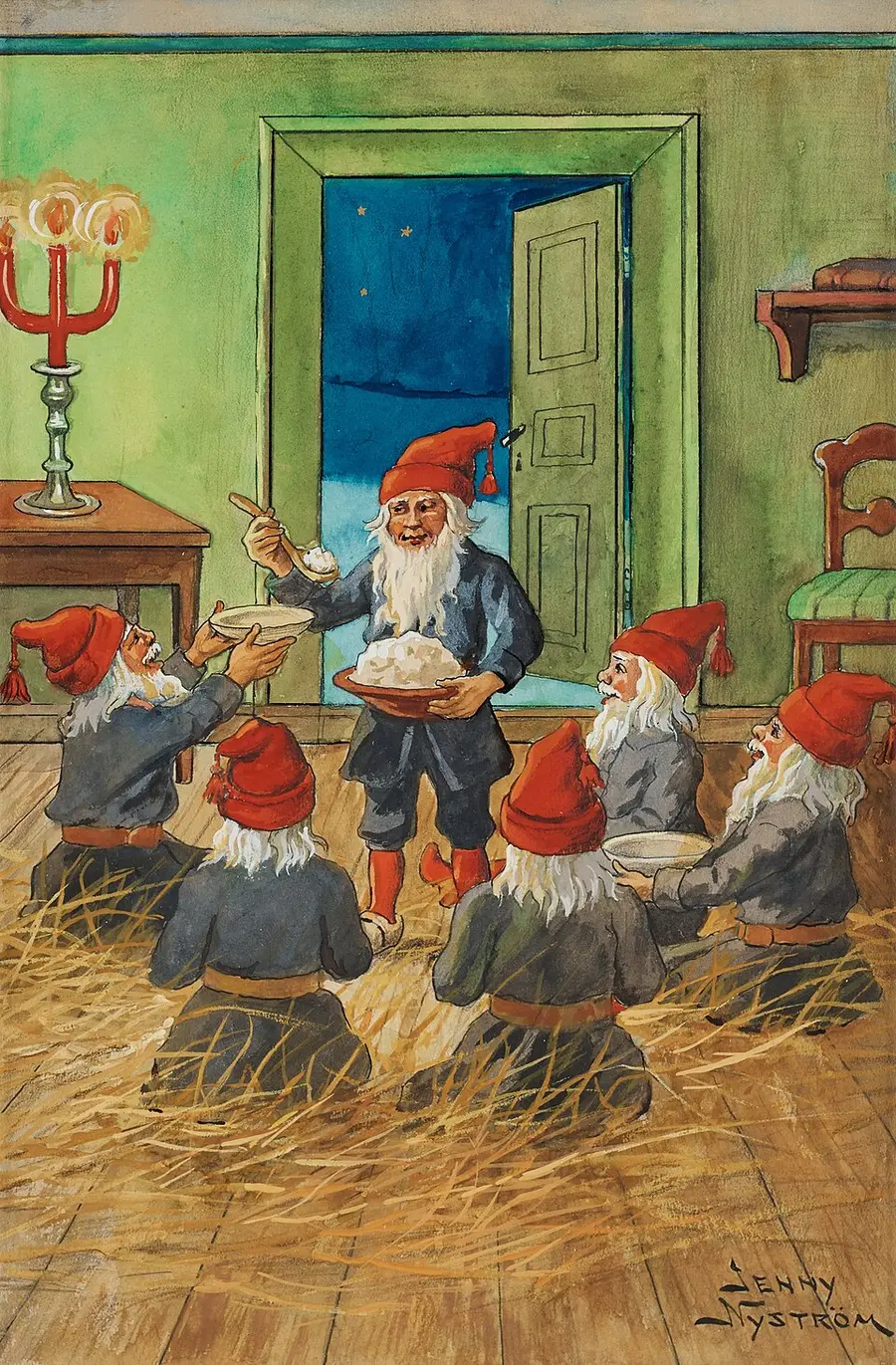 Jenny Nyström, Grötstunden (watercolor, before 1947) Jenny Nyström's tomte ladling out the Christmas porridge — the very treat set on the barn threshold on Christmas Eve for the nisse, the farm's small unseen helper. Yule porridge — the porridge of the Norwegian Christmas. On the
modern julaften (Christmas Eve) table it is rice porridge,
risengrynsgrøt, with cinnamon, sugar, and a pat of butter; the
older farm offering was cream porridge — fløtegrøt or
rømmegrøt — and that is what the bowl set out on the barn
threshold on Christmas Eve night held for the nisse, the small
unseen helper who lives on the farm.
The custom descends, in part, from the pre-Christian household
practice of feeding the helper-spirit of the byre at midwinter; in
some Norwegian valleys the bowl-on-the-threshold still goes out, a
thousand-year-old domestic religious habit kept by households that
may not consciously remember why.
Also discussed in Nisse — the short-tempered spirit of the farm (Yule porridge) set out for the unseen one who lives on the farm, the Julebukk
Jenny Nyström, Grötstunden (watercolor, before 1947) Jenny Nyström's tomte ladling out the Christmas porridge — the very treat set on the barn threshold on Christmas Eve for the nisse, the farm's small unseen helper. Yule porridge — the porridge of the Norwegian Christmas. On the
modern julaften (Christmas Eve) table it is rice porridge,
risengrynsgrøt, with cinnamon, sugar, and a pat of butter; the
older farm offering was cream porridge — fløtegrøt or
rømmegrøt — and that is what the bowl set out on the barn
threshold on Christmas Eve night held for the nisse, the small
unseen helper who lives on the farm.
The custom descends, in part, from the pre-Christian household
practice of feeding the helper-spirit of the byre at midwinter; in
some Norwegian valleys the bowl-on-the-threshold still goes out, a
thousand-year-old domestic religious habit kept by households that
may not consciously remember why.
Also discussed in Nisse — the short-tempered spirit of the farm (Yule porridge) set out for the unseen one who lives on the farm, the Julebukk 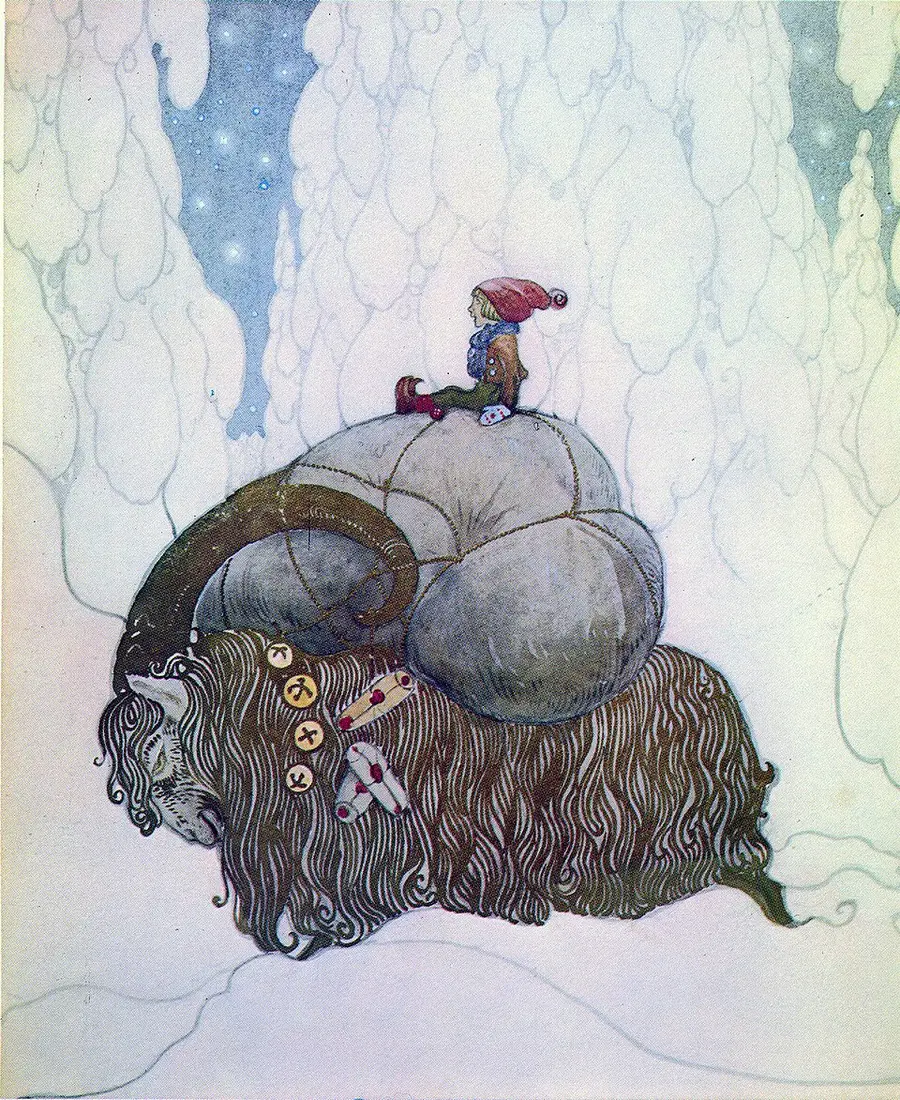 John Bauer, Julbocken (1912) John Bauer's 1912 Julbocken shows a legendary Yule goat of Swedish folklore with a tomte riding it — the card cites the julbock line of tradition (including the modern straw Yule-goat figure) as the surviving form of the same midwinter goat-figure the Norwegian julebukk costume-walk descends from. The Yule goat — a Norwegian Christmas figure descended from
pre-Christian midwinter custom. In its modern form, å gå
julebukk is a children's costume-walk: groups of children dress
up around Christmas, knock on neighbours' doors, sing, and receive
sweets — broadly parallel to North American Halloween but
unconnected to it. The deeper origin is in the goat-skin costume
worn at midwinter rituals across pre-Christian Scandinavia, and
in the broader Yule-goat figure that survives in modern Swedish
Christmas tradition as the straw goat (julbock) standing
beside the tree.
Also discussed in Julebukk — the masked goat of midwinter (the Yule goat) who survives now in a children’s costume-walk — looks like the old jól-blót in Christian dress. How much is unbroken descent and how much is later revival, the folklorists argue over. The Christmas ham is often traced back to the sonargöltr, the yule-boar. In some valleys the porridge still goes out to the barn on Christmas Eve. What lived on was the older kind of religion — not a belief professed, but a practice kept.
John Bauer, Julbocken (1912) John Bauer's 1912 Julbocken shows a legendary Yule goat of Swedish folklore with a tomte riding it — the card cites the julbock line of tradition (including the modern straw Yule-goat figure) as the surviving form of the same midwinter goat-figure the Norwegian julebukk costume-walk descends from. The Yule goat — a Norwegian Christmas figure descended from
pre-Christian midwinter custom. In its modern form, å gå
julebukk is a children's costume-walk: groups of children dress
up around Christmas, knock on neighbours' doors, sing, and receive
sweets — broadly parallel to North American Halloween but
unconnected to it. The deeper origin is in the goat-skin costume
worn at midwinter rituals across pre-Christian Scandinavia, and
in the broader Yule-goat figure that survives in modern Swedish
Christmas tradition as the straw goat (julbock) standing
beside the tree.
Also discussed in Julebukk — the masked goat of midwinter (the Yule goat) who survives now in a children’s costume-walk — looks like the old jól-blót in Christian dress. How much is unbroken descent and how much is later revival, the folklorists argue over. The Christmas ham is often traced back to the sonargöltr, the yule-boar. In some valleys the porridge still goes out to the barn on Christmas Eve. What lived on was the older kind of religion — not a belief professed, but a practice kept.
The gods’ names are written into the country itself — Hov; Helgøya, the holy island; Frøysland, Frey’s land; Torsnes, Thor’s headland; Onsøy, Odin’s island; Torshov, now a quarter of Oslo. The people who gave those names are gone. The names are not.
The ausa vatni lives on as the shape of Christian baptism: a child wetted with water and given its name, the parents answering for it until it can answer for itself. The wedding feast lives on as the country wedding. The grave-mound lives on in the churchyards, where a family’s plot is still a known and tended thing.
And the older spirits — the helper in the barn, the woman in the waterfall, the man in the mound, the half-seen figure on the forest road at dusk — live on in the folklore that has run beside Christianity for a thousand years, a thread beneath the changing of the faith above it.
The public worship of Odin and Thor ended a thousand years ago. The household religion that lived underneath it has never quite ended at all.
Sources & further reading
Primary sources
- The Poetic Edda
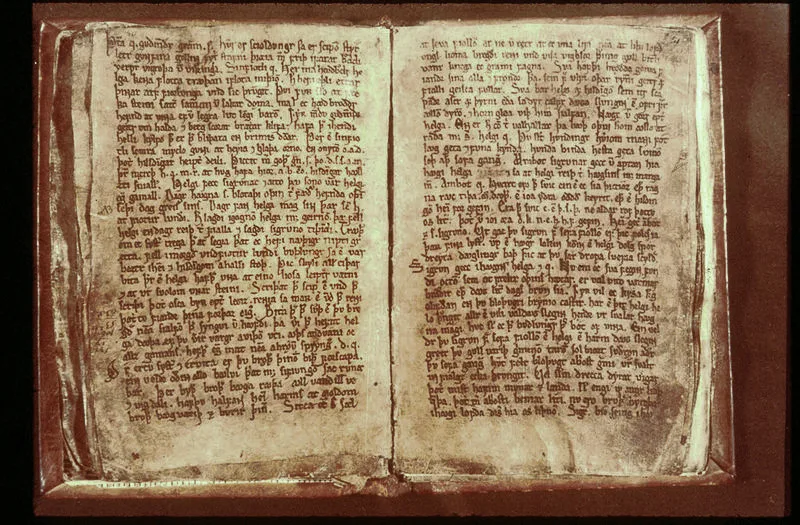 Codex Regius of the Eddaic Poems (GKS 2365 4to, c. 1270), Icelandic manuscript The Codex Regius itself, open on its dark vellum — the single late-thirteenth-century Icelandic manuscript that preserves most of the Poetic Edda's mythological and heroic poems, and with them much of what survives of Norse myth. The collection of Old Norse mythological and heroic poems preserved
chiefly in the late-thirteenth-century Icelandic manuscript Codex
Regius (GKS 2365 4to) and supplementary fragments. Contains the
Völuspá ("Prophecy of the Seeress"), the Hávamál (Odin's
sayings), the Lokasenna (Loki's flyting at the gods' feast), the
Þrymskviða (Thor's recovery of his hammer), and the Sigurd-cycle
heroic poems. Together with Snorri Sturluson's separately
thirteenth-century Prose Edda, the principal source for almost
all surviving knowledge of pre-Christian Norse mythological imagery.
Also discussed in Nordisk Mytologi — Odin, the giants, and Ragnarok , trans. Carolyne Larrington, 2nd ed. (Oxford University Press, 2014). The standard English translation of the Eddic mythological poems and the principal early-medieval source for Norse religious imagery.
Codex Regius of the Eddaic Poems (GKS 2365 4to, c. 1270), Icelandic manuscript The Codex Regius itself, open on its dark vellum — the single late-thirteenth-century Icelandic manuscript that preserves most of the Poetic Edda's mythological and heroic poems, and with them much of what survives of Norse myth. The collection of Old Norse mythological and heroic poems preserved
chiefly in the late-thirteenth-century Icelandic manuscript Codex
Regius (GKS 2365 4to) and supplementary fragments. Contains the
Völuspá ("Prophecy of the Seeress"), the Hávamál (Odin's
sayings), the Lokasenna (Loki's flyting at the gods' feast), the
Þrymskviða (Thor's recovery of his hammer), and the Sigurd-cycle
heroic poems. Together with Snorri Sturluson's separately
thirteenth-century Prose Edda, the principal source for almost
all surviving knowledge of pre-Christian Norse mythological imagery.
Also discussed in Nordisk Mytologi — Odin, the giants, and Ragnarok , trans. Carolyne Larrington, 2nd ed. (Oxford University Press, 2014). The standard English translation of the Eddic mythological poems and the principal early-medieval source for Norse religious imagery. - Snorri Sturluson
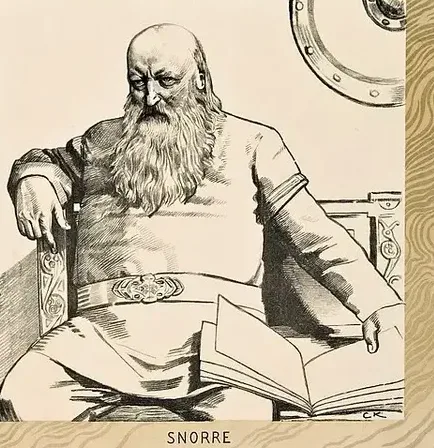 Christian Krohg, Snorre Sturlason (1899), from Norges Kongesagaer; scan: National Library of Norway Christian Krohg's portrait of Snorri from the 1899 folk edition of Heimskringla — the historian seated with a great open book across his knees. No contemporary likeness of Snorri exists; Krohg's drawing is the face Norway gave its most important medieval source. Thirteenth-century Icelandic chieftain, poet, and historian.
Composed the Heimskringla and the Prose Edda in the 1220s
from oral tradition and skaldic verse — three hundred years after
the Viking-age events he describes. The single richest source for
Norway's pre-conversion centuries and also the most aware
Christian-Icelandic editor of them. Modern scholarship accepts
what other sources independently confirm and treats his richest
expansions as the work of a poet writing about a kingdom he had
never seen. Assassinated at Reykholt on 23 September 1241 by
agents of King Hákon IV after a falling-out at court.
In this article Snorri's Prose Edda (c. 1222) is the single most extensive
surviving Norse mythological corpus — preserved by a Christian
Icelander writing about a religion that had stopped being
publicly practiced some two centuries before him.
Also discussed in The Viking Age — longships, legends, and the first "Norway"Before There Was Norway — petty kingdoms at the edge of the worldThe King Who Became a Saint — how the Nordmen came to ChristA Catholic Norway — the faith that gave the kingdom its first institutions and the stave churchesThe Golden Age — a North Atlantic empire … reaching farther than you thinkThe Crusades?!!!! — sixty ships from Bergen, bound for the Holy LandNordisk Mytologi — Odin, the giants, and Ragnarok , Heimskringla
Christian Krohg, Snorre Sturlason (1899), from Norges Kongesagaer; scan: National Library of Norway Christian Krohg's portrait of Snorri from the 1899 folk edition of Heimskringla — the historian seated with a great open book across his knees. No contemporary likeness of Snorri exists; Krohg's drawing is the face Norway gave its most important medieval source. Thirteenth-century Icelandic chieftain, poet, and historian.
Composed the Heimskringla and the Prose Edda in the 1220s
from oral tradition and skaldic verse — three hundred years after
the Viking-age events he describes. The single richest source for
Norway's pre-conversion centuries and also the most aware
Christian-Icelandic editor of them. Modern scholarship accepts
what other sources independently confirm and treats his richest
expansions as the work of a poet writing about a kingdom he had
never seen. Assassinated at Reykholt on 23 September 1241 by
agents of King Hákon IV after a falling-out at court.
In this article Snorri's Prose Edda (c. 1222) is the single most extensive
surviving Norse mythological corpus — preserved by a Christian
Icelander writing about a religion that had stopped being
publicly practiced some two centuries before him.
Also discussed in The Viking Age — longships, legends, and the first "Norway"Before There Was Norway — petty kingdoms at the edge of the worldThe King Who Became a Saint — how the Nordmen came to ChristA Catholic Norway — the faith that gave the kingdom its first institutions and the stave churchesThe Golden Age — a North Atlantic empire … reaching farther than you thinkThe Crusades?!!!! — sixty ships from Bergen, bound for the Holy LandNordisk Mytologi — Odin, the giants, and Ragnarok , Heimskringla 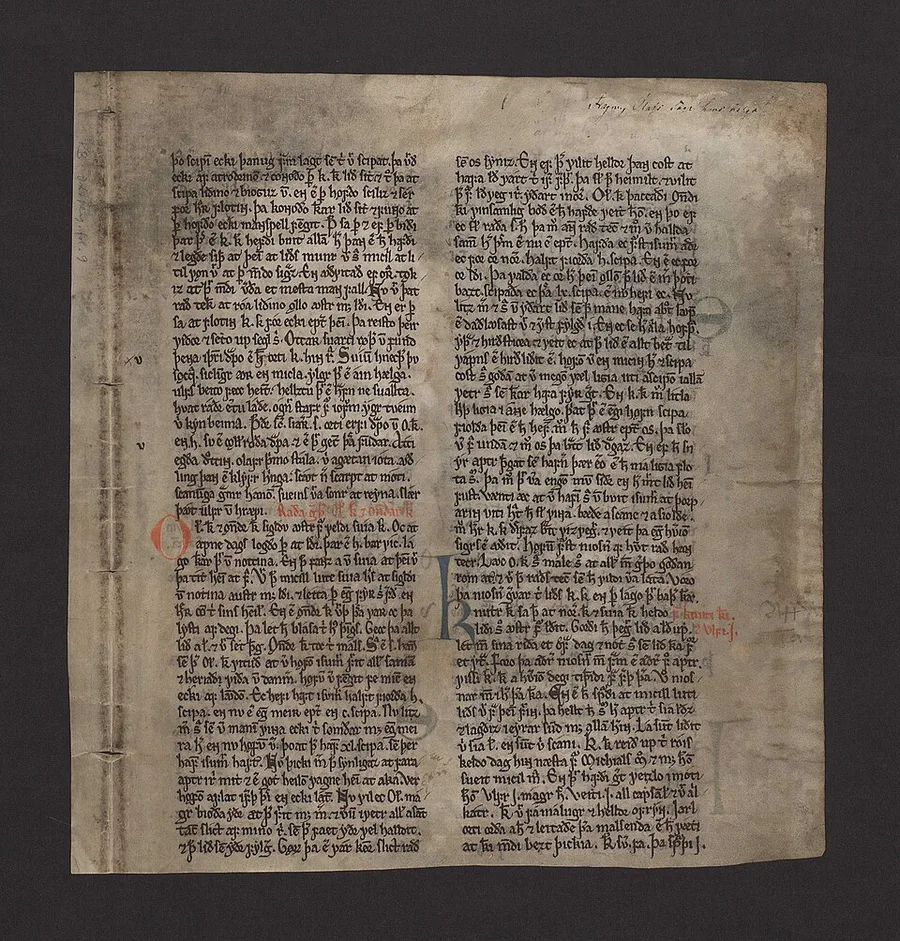 Kringlublaðið (the Kringla leaf), Lbs fragm 82, c. 1260 — National and University Library of Iceland This single surviving vellum leaf is all that remains of the original Kringla manuscript — the best medieval copy of Heimskringla — after the rest burned in Copenhagen's 1728 fire. Snorri Sturluson's prose history of the kings of Norway, composed
in the 1220s. Sixteen sagas running from the semi-mythical Yngling
line through to the late twelfth century. The single most extensive
medieval source for Norway's Viking and Christianization centuries
— trusted on the broad shape of political history, questioned in
the literary expansions, and written by a Christian Icelander
three hundred years after the events.
In this article The opening Ynglinga saga of the Heimskringla derives the
Norse royal genealogy from the gods themselves — Odin, Frey,
Njörd — treated as ancient kings who were later mistakenly
deified. The classic medieval Christian rationalization of
pre-Christian Norse religion.
Also discussed in The Viking Age — longships, legends, and the first "Norway"The King Who Became a Saint — how the Nordmen came to ChristA Catholic Norway — the faith that gave the kingdom its first institutions and the stave churchesThe Golden Age — a North Atlantic empire … reaching farther than you thinkThe Crusades?!!!! — sixty ships from Bergen, bound for the Holy Land , trans. Lee M. Hollander (University of Texas Press, 1964). The thirteenth-century Icelandic saga history; the source for the Olav Tryggvason and Iron-Beard episodes at Mære.
Kringlublaðið (the Kringla leaf), Lbs fragm 82, c. 1260 — National and University Library of Iceland This single surviving vellum leaf is all that remains of the original Kringla manuscript — the best medieval copy of Heimskringla — after the rest burned in Copenhagen's 1728 fire. Snorri Sturluson's prose history of the kings of Norway, composed
in the 1220s. Sixteen sagas running from the semi-mythical Yngling
line through to the late twelfth century. The single most extensive
medieval source for Norway's Viking and Christianization centuries
— trusted on the broad shape of political history, questioned in
the literary expansions, and written by a Christian Icelander
three hundred years after the events.
In this article The opening Ynglinga saga of the Heimskringla derives the
Norse royal genealogy from the gods themselves — Odin, Frey,
Njörd — treated as ancient kings who were later mistakenly
deified. The classic medieval Christian rationalization of
pre-Christian Norse religion.
Also discussed in The Viking Age — longships, legends, and the first "Norway"The King Who Became a Saint — how the Nordmen came to ChristA Catholic Norway — the faith that gave the kingdom its first institutions and the stave churchesThe Golden Age — a North Atlantic empire … reaching farther than you thinkThe Crusades?!!!! — sixty ships from Bergen, bound for the Holy Land , trans. Lee M. Hollander (University of Texas Press, 1964). The thirteenth-century Icelandic saga history; the source for the Olav Tryggvason and Iron-Beard episodes at Mære. - Snorri Sturluson, The Prose Edda
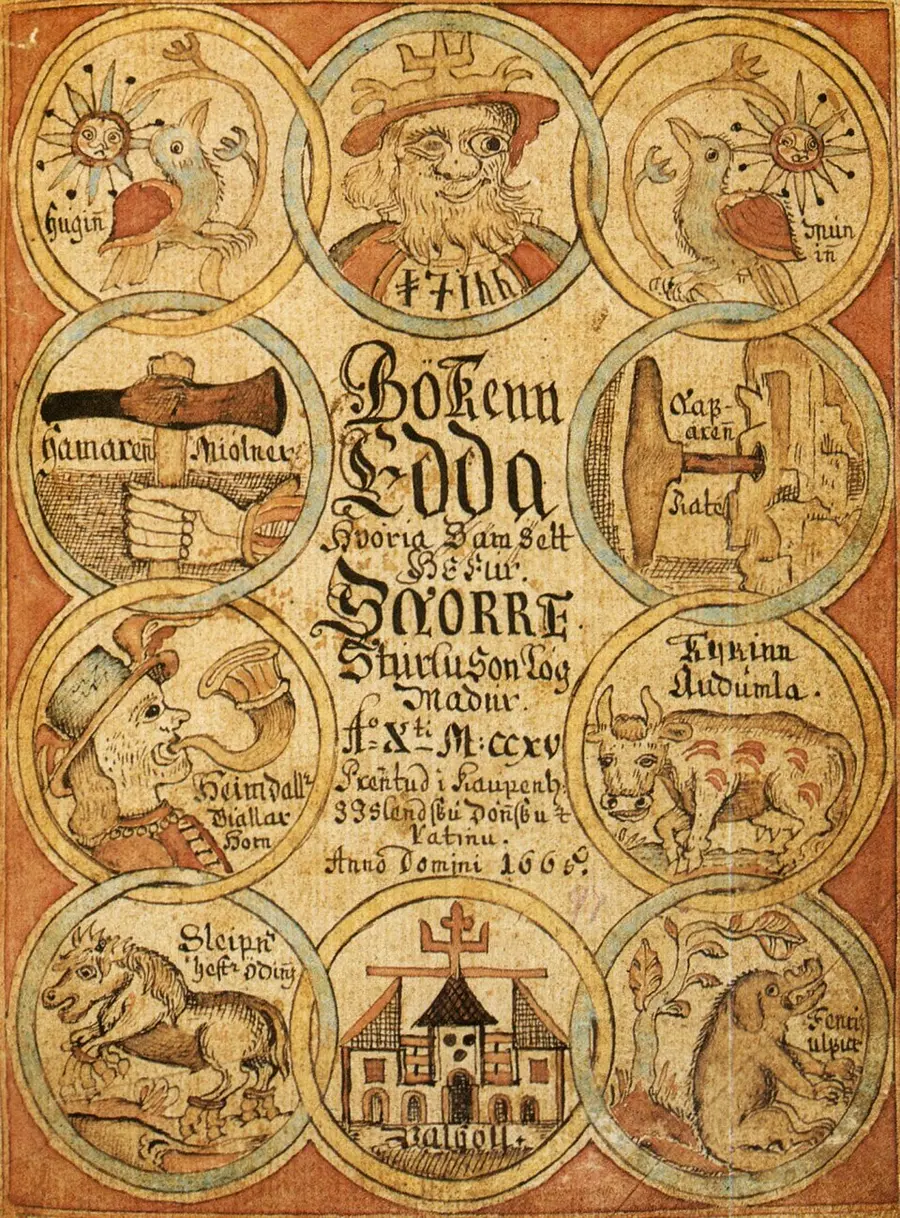 Title page of the Prose Edda manuscript NKS 1867 4to (Ólafur Brynjúlfsson, 1760), Royal Danish Library The hand-lettered title page of a 1760 Icelandic copy of the Prose Edda, ringed with naive ink medallions of Odin, the hammer Mjölnir, Heimdall's horn, the eight-legged Sleipnir and the wolf Fenrir — the mythology the book sets down. Thirteenth-century Old Norse handbook of mythological and skaldic
lore, composed by Snorri Sturluson in Iceland around 1220 as a
systematic guide for poets working in the skaldic tradition. Four
parts: a prologue (largely Snorri's Christian framing), the
Gylfaginning (the mythology presented as the questioning of King
Gylfi by three disguised gods), the Skáldskaparmál (the dictionary
of skaldic kennings, with extended mythological narratives behind
each), and the Háttatal (Snorri's own demonstration poem in
every skaldic metre). Together with the Poetic Edda, the principal
surviving source for Norse mythology.
Also discussed in Nordisk Mytologi — Odin, the giants, and Ragnarok , trans. Anthony Faulkes (London: Everyman, 1995). Snorri’s separate thirteenth-century handbook of Norse mythological lore.
Title page of the Prose Edda manuscript NKS 1867 4to (Ólafur Brynjúlfsson, 1760), Royal Danish Library The hand-lettered title page of a 1760 Icelandic copy of the Prose Edda, ringed with naive ink medallions of Odin, the hammer Mjölnir, Heimdall's horn, the eight-legged Sleipnir and the wolf Fenrir — the mythology the book sets down. Thirteenth-century Old Norse handbook of mythological and skaldic
lore, composed by Snorri Sturluson in Iceland around 1220 as a
systematic guide for poets working in the skaldic tradition. Four
parts: a prologue (largely Snorri's Christian framing), the
Gylfaginning (the mythology presented as the questioning of King
Gylfi by three disguised gods), the Skáldskaparmál (the dictionary
of skaldic kennings, with extended mythological narratives behind
each), and the Háttatal (Snorri's own demonstration poem in
every skaldic metre). Together with the Poetic Edda, the principal
surviving source for Norse mythology.
Also discussed in Nordisk Mytologi — Odin, the giants, and Ragnarok , trans. Anthony Faulkes (London: Everyman, 1995). Snorri’s separate thirteenth-century handbook of Norse mythological lore. - Sigvatr Þórðarson, Austrfararvísur "Verses on a Journey East" — a skaldic travel-poem composed by Sigvatr Þórðarson around 1019, recounting a diplomatic mission he had undertaken to Sweden on behalf of King Olav II Haraldsson of Norway. The poem's surviving stanzas are the closest contemporary eyewitness to the private álfablót rite: Sigvatr describes being turned from one farm after another in Västergötland because the households were holding the rite and would let no stranger in for the night. Preserved in fragments quoted in Snorri Sturluson's Heimskringla. (“Verses on a Journey East”), c. 1019. The skaldic travel-poem whose stanzas on being turned away from Swedish farms are the closest surviving eyewitness to the álfablót.
- Adam of Bremen, History of the Archbishops of Hamburg-Bremen (Gesta Hammaburgensis ecclesiae pontificum), trans. Francis J. Tschan (Columbia University Press, 1959). Book IV’s account of the cult site at Old Uppsala is the most-cited contemporary description of a Norse blót.
Modern scholarship
- John Lindow, Norse Mythology: A Guide to the Gods, Heroes, Rituals, and Beliefs (Oxford University Press, 2001). The standard scholarly reference handbook in English.
- Neil Price, The Viking Way: Magic and Mind in Late Iron Age Scandinavia, 2nd ed. (Oxford: Oxbow, 2019). The leading modern study of Norse ritual, magical practice, and the role of the völva.
- Anders Winroth, The Conversion of Scandinavia: Vikings, Merchants, and Missionaries in the Remaking of Northern Europe (Yale University Press, 2012). The modern synthesis on how Christianity came to Scandinavia.
- Gro Steinsland, Norrøn religion: Myter, riter, samfunn (Oslo: Pax, 2005). The standard Norwegian-language survey of pre-Christian religion.
- Olof Sundqvist, An Arena for Higher Powers: Ceremonial Buildings and Religious Strategies for Rulership in Late Iron Age Scandinavia (Leiden: Brill, 2016). The principal modern study of the hov and the ruler-cult.
- Hans-Emil Lidén, “From Pagan Sanctuary to Christian Church: The Excavation of Mære Church in Trøndelag,” Norwegian Archaeological Review 2 (1969): 3–32. The publication of the Mære excavation that established the cult-site continuity into the Christian church.
Reference
- Store norske leksikon (snl.no). The Norwegian-language peer-reviewed encyclopedia. See in particular the entries on norrøn religion, blot, hov, god (the office), dísablót, álvablót, and seid.
Visit
- Mære Mittet & Co., Mære Kirke, Trøndelag (early 20th c.), National Library of Norway The medieval church photographed on its knoll — the mound where Hans-Emil Lidén's 1960s excavation found the timber hov and the scatter of gullgubber gold foils beneath the floor: the clearest case in Norway of cult-ground reused rather than abandoned. Village in Sparbu, Steinkjer Municipality, Trøndelag — the clearest
excavated case in Norway of a pre-Christian Norse cult site reused
rather than abandoned at the conversion. The medieval Mære Church
(built c. 1150–1200) stands on the foundations of a timber hov
excavated by Hans-Emil Lidén in the 1960s, whose floor deposits
held a scatter of gullgubber gold foils — the diagnostic
signature of a late-Iron-Age cult location. Saga tradition places
Olav Tryggvason's confrontation with the chieftain Járn-Skeggi at
the Mære blót around 997.
Mære, Trøndelag , Sparbu in Trøndelag. Visible from the E6 highway. The medieval stone church stands on the foundations excavated by Hans-Emil Lidén in the 1960s, directly above the cult deposit. The clearest single case in Norway of a sacred site reused across the conversion.
- Historical Museum (Oslo)
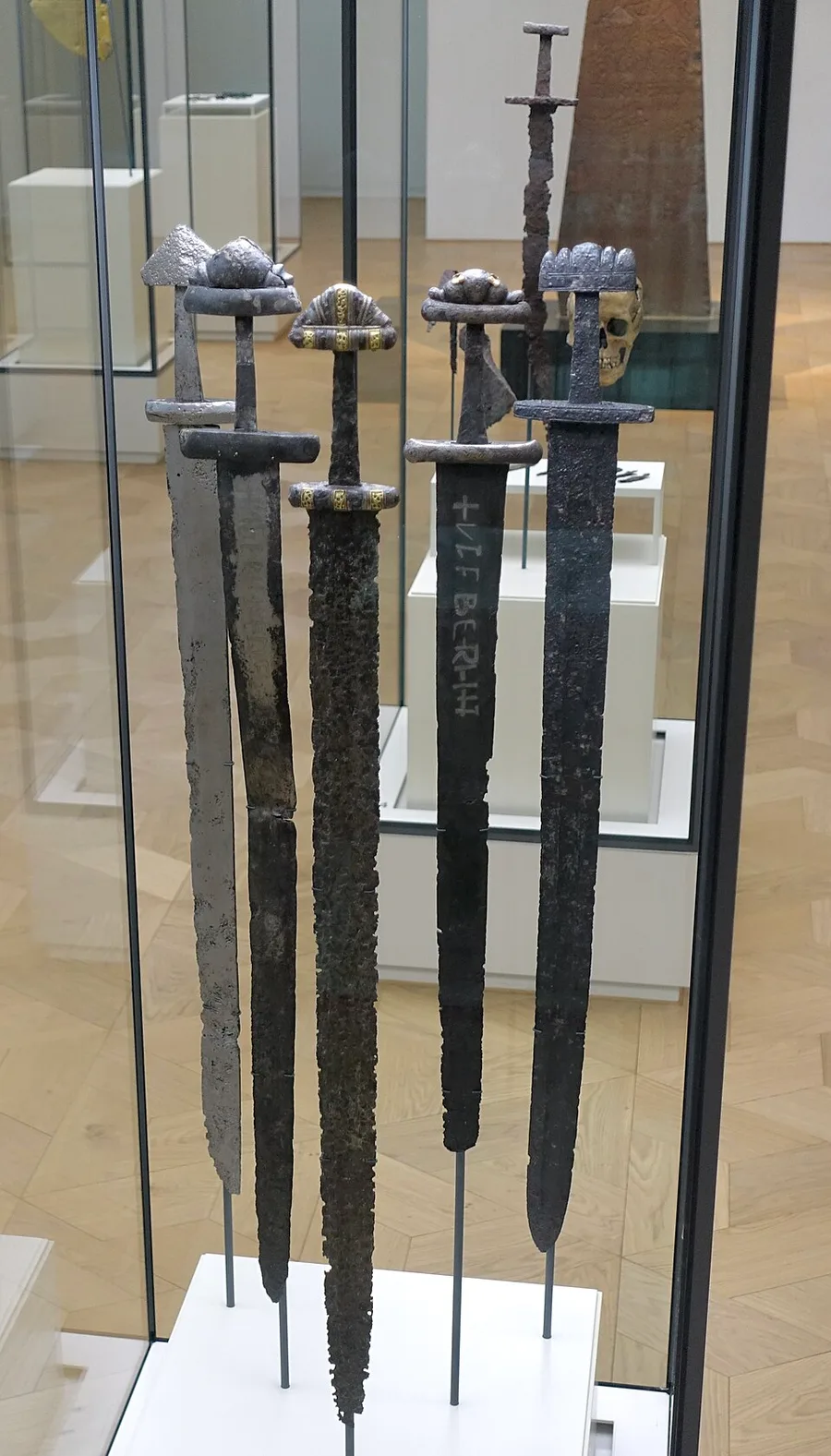 Wolfmann, Viking-Age swords in the VÍKINGR exhibition, Historical Museum, Oslo (2020), Wikimedia Commons, CC BY-SA 4.0 Viking-Age swords from Telemark, Nordland, and Hedmark are among eleven on display together in the museum's VÍKINGR exhibition; this frame captures five of them, including one blade inlaid ULFBERHT — the rotating showcase now more prominent while the Bygdøy ship museum rebuilds. The University of Oslo's archaeological and ethnographic museum in
central Oslo, near the Royal Palace. Houses Norway's principal
collection of pre-Reformation artefacts, including medieval
altarpieces from the country's wooden churches and the rotating
VÍKINGR exhibition of Viking-Age material — particularly important
while the Museum of the Viking Age on Bygdøy is closed for rebuild.
Historical Museum, central Oslo Also discussed in The Viking Age — longships, legends, and the first "Norway" (the Historical Museum), Frederiks gate 2, Oslo. The VÍKINGR exhibition and the Iron-Age collections hold Mjölnir pendants, gullgubber gold foils, rune-stones, and the small everyday objects through which Norse religion is read archaeologically.
Wolfmann, Viking-Age swords in the VÍKINGR exhibition, Historical Museum, Oslo (2020), Wikimedia Commons, CC BY-SA 4.0 Viking-Age swords from Telemark, Nordland, and Hedmark are among eleven on display together in the museum's VÍKINGR exhibition; this frame captures five of them, including one blade inlaid ULFBERHT — the rotating showcase now more prominent while the Bygdøy ship museum rebuilds. The University of Oslo's archaeological and ethnographic museum in
central Oslo, near the Royal Palace. Houses Norway's principal
collection of pre-Reformation artefacts, including medieval
altarpieces from the country's wooden churches and the rotating
VÍKINGR exhibition of Viking-Age material — particularly important
while the Museum of the Viking Age on Bygdøy is closed for rebuild.
Historical Museum, central Oslo Also discussed in The Viking Age — longships, legends, and the first "Norway" (the Historical Museum), Frederiks gate 2, Oslo. The VÍKINGR exhibition and the Iron-Age collections hold Mjölnir pendants, gullgubber gold foils, rune-stones, and the small everyday objects through which Norse religion is read archaeologically. - Lofotr Viking Museum
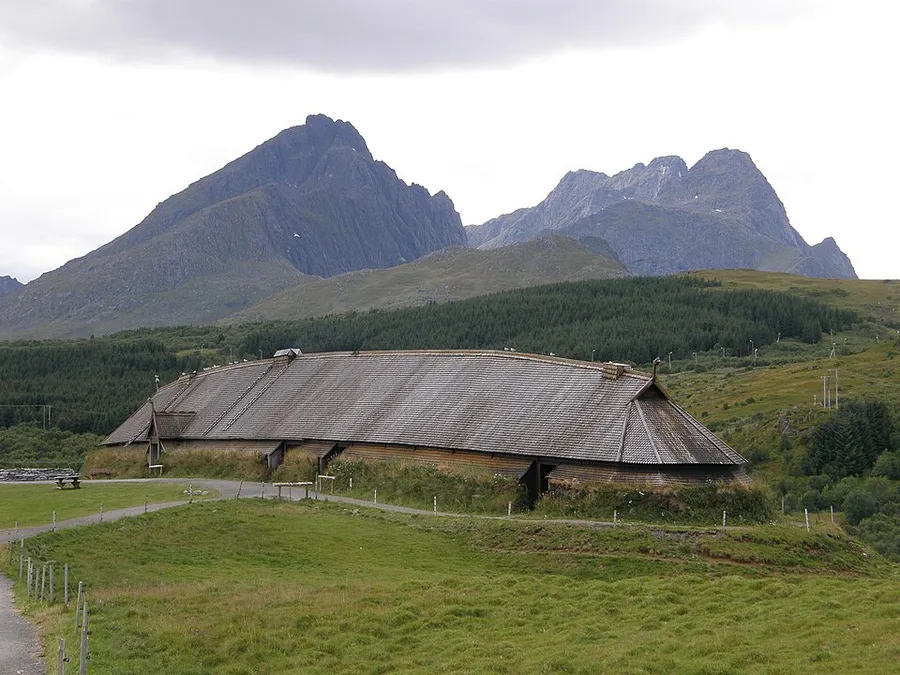 Paul Berzinn, reconstructed Viking longhouse, Lofotr Viking Museum, Borg (2008), Wikimedia Commons, CC BY-SA 3.0 The reconstructed chieftain's longhouse at Borg in Lofoten, raised full-scale on the excavated footprint of the largest known Viking-Age building anywhere — eighty-three metres of hall under one roof beneath the island peaks. The closest a visitor gets to standing inside a chieftain's hall. Open-air museum at Borg on the island of Vestvågøy in the Lofoten
archipelago, opened in 1995. Built around the excavated foundations
of the largest known Viking-Age building anywhere — an eighty-three-
metre chieftain's longhouse — the museum reconstructs the longhouse
on its original footprint and presents the daily life of a
high-ranking Viking-Age household at the northern edge of the Norse
world. Includes a working forge, costumed interpreters, and a
reproduction longship.
Lofotr Viking Museum, Borg Also discussed in The Viking Age — longships, legends, and the first "Norway" , Borg in Lofoten. The reconstructed chieftain’s longhouse is the largest of its kind in northern Europe and the closest available walk-through experience of the kind of hov-and-hall described above.
Paul Berzinn, reconstructed Viking longhouse, Lofotr Viking Museum, Borg (2008), Wikimedia Commons, CC BY-SA 3.0 The reconstructed chieftain's longhouse at Borg in Lofoten, raised full-scale on the excavated footprint of the largest known Viking-Age building anywhere — eighty-three metres of hall under one roof beneath the island peaks. The closest a visitor gets to standing inside a chieftain's hall. Open-air museum at Borg on the island of Vestvågøy in the Lofoten
archipelago, opened in 1995. Built around the excavated foundations
of the largest known Viking-Age building anywhere — an eighty-three-
metre chieftain's longhouse — the museum reconstructs the longhouse
on its original footprint and presents the daily life of a
high-ranking Viking-Age household at the northern edge of the Norse
world. Includes a working forge, costumed interpreters, and a
reproduction longship.
Lofotr Viking Museum, Borg Also discussed in The Viking Age — longships, legends, and the first "Norway" , Borg in Lofoten. The reconstructed chieftain’s longhouse is the largest of its kind in northern Europe and the closest available walk-through experience of the kind of hov-and-hall described above.