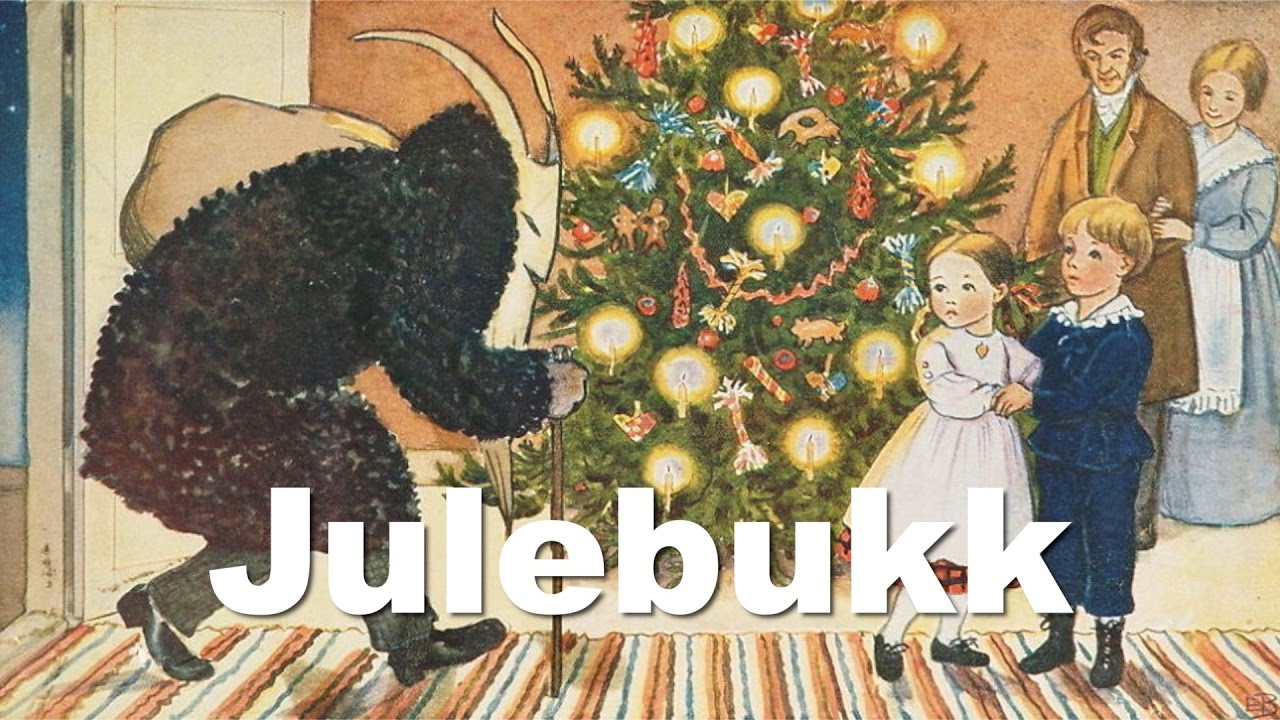
Julebukk — The masked goat of midwinter
The Yule goat — a horned midwinter figure with pre-Christian bones, once paraded farm to farm by masked young people demanding food and drink. Now the straw goat on the Christmas tree, and, in Norway and the Norwegian-American Midwest, costumed children singing for treats.
The julebukk — the Yule goat — is one of the strangest survivors in the Scandinavian Christmas: a horned figure with pre-Christian bones that spent centuries as midwinter’s resident monster before it dwindled into the straw ornament on a Christmas tree.
The horns are the old part. They may echo the two goats that pulled Thor 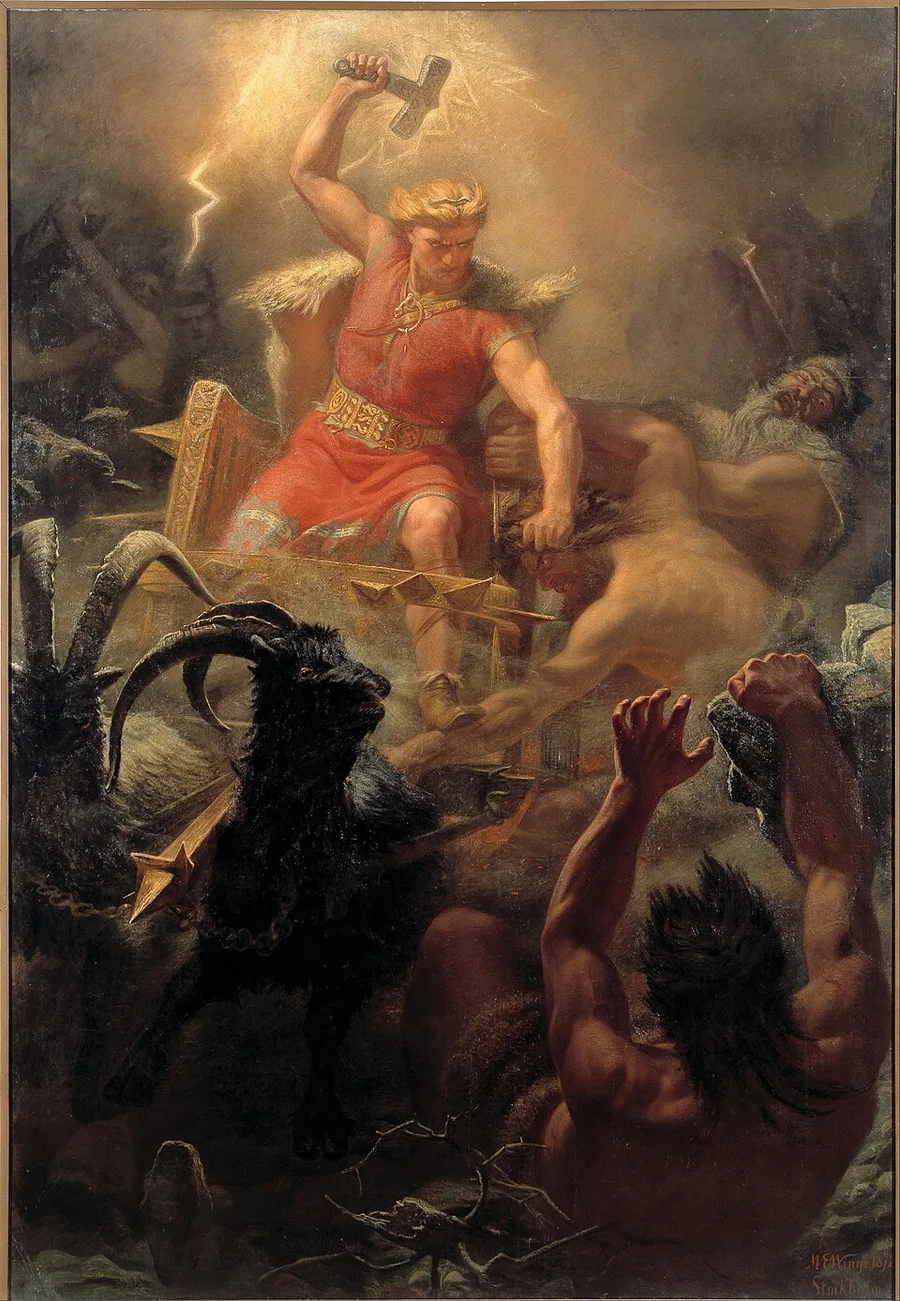 Mårten Eskil Winge, Tors strid med jättarna (1872), Nationalmuseum, Stockholm — Google Art Project scan Winge paints Thor at his defining work — riding his goat-drawn chariot through the storm, swinging the hammer Mjölnir at the fleeing giants he holds back from the cultivated world of gods and farmers. Norse god of thunder, storms, oaths, marriages, and the ordinary
protection of the cultivated world against the wild one. Son of
Odin and the giantess Jörð (Earth). Wielded the hammer Mjölnir,
which he used to defend Asgard and Midgard from the jötnar
(giants). On the farm Thor was the everyman's god — the protector
of the sick cow, the cracked ploughshare, the safety of a sea-going
son. Small hammer amulets recovered from graves and hoards across
the Norse world scaled that protection down to the single person
who wore one. The English word Thursday (Thor's day) preserves
his weekly observance.
Also discussed in Worshiping Odin and Thor — the lived religion of pre-Christian NorwayNordisk Mytologi — Odin, the giants, and Ragnarok ’s chariot across the sky — Tanngrisnir and Tanngnjóstr, which the god could slaughter and eat at night and find alive and whole again in the morning: a midwinter image of death and return at the darkest turn of the year. Whatever its exact descent, the goat belonged to the old feast of Jul
Mårten Eskil Winge, Tors strid med jättarna (1872), Nationalmuseum, Stockholm — Google Art Project scan Winge paints Thor at his defining work — riding his goat-drawn chariot through the storm, swinging the hammer Mjölnir at the fleeing giants he holds back from the cultivated world of gods and farmers. Norse god of thunder, storms, oaths, marriages, and the ordinary
protection of the cultivated world against the wild one. Son of
Odin and the giantess Jörð (Earth). Wielded the hammer Mjölnir,
which he used to defend Asgard and Midgard from the jötnar
(giants). On the farm Thor was the everyman's god — the protector
of the sick cow, the cracked ploughshare, the safety of a sea-going
son. Small hammer amulets recovered from graves and hoards across
the Norse world scaled that protection down to the single person
who wore one. The English word Thursday (Thor's day) preserves
his weekly observance.
Also discussed in Worshiping Odin and Thor — the lived religion of pre-Christian NorwayNordisk Mytologi — Odin, the giants, and Ragnarok ’s chariot across the sky — Tanngrisnir and Tanngnjóstr, which the god could slaughter and eat at night and find alive and whole again in the morning: a midwinter image of death and return at the darkest turn of the year. Whatever its exact descent, the goat belonged to the old feast of Jul 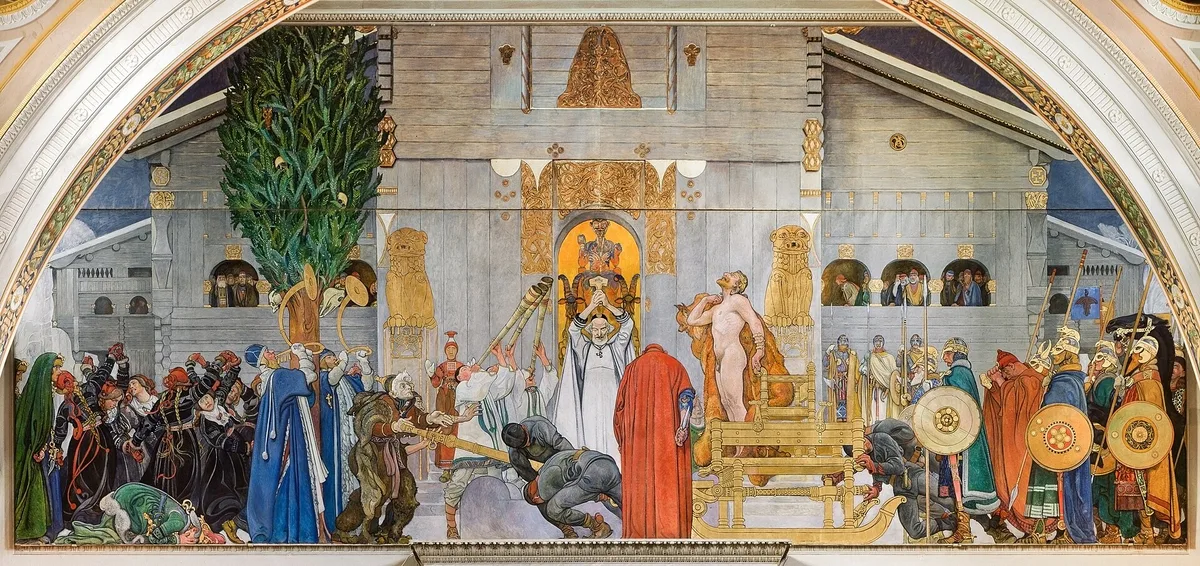 Carl Larsson, Midvinterblot (1915), Nationalmuseum, Stockholm Larsson's Midvinterblot imagines the legend of the Swedish king Domalde offered to the gods at Old Uppsala's midwinter feast — a scene from saga, not history. This is the jól-blót register the julebukk descends from: the midwinter sacrifice tamed, over centuries, into a goat costume at the farmhouse door. The Norwegian (and broadly Scandinavian) midwinter feast — the
modern Christmas, but with a pre-Christian inheritance from the
Norse jól-blót still visible in its structure. The long run of
nights, the great toasts, the porridge bowl set out on the barn
threshold for the unseen one who lives on the farm, the julebukk
(Yule goat) surviving now in a children's costume-walk, the
Swedish Christmas ham traditionally traced back to the
sonargöltr (yule-boar). The Norwegian Jul is the clearest
practical example of how the household religion survived the
official conversion — the form remained, the gods at its centre
changed.
Also discussed in Worshiping Odin and Thor — the lived religion of pre-Christian NorwayÅsgårdsreien — the storm that rides through the winter skyTradisjoner — celebrations across the Norwegian year long before the church arrived to share the season with it.
Carl Larsson, Midvinterblot (1915), Nationalmuseum, Stockholm Larsson's Midvinterblot imagines the legend of the Swedish king Domalde offered to the gods at Old Uppsala's midwinter feast — a scene from saga, not history. This is the jól-blót register the julebukk descends from: the midwinter sacrifice tamed, over centuries, into a goat costume at the farmhouse door. The Norwegian (and broadly Scandinavian) midwinter feast — the
modern Christmas, but with a pre-Christian inheritance from the
Norse jól-blót still visible in its structure. The long run of
nights, the great toasts, the porridge bowl set out on the barn
threshold for the unseen one who lives on the farm, the julebukk
(Yule goat) surviving now in a children's costume-walk, the
Swedish Christmas ham traditionally traced back to the
sonargöltr (yule-boar). The Norwegian Jul is the clearest
practical example of how the household religion survived the
official conversion — the form remained, the gods at its centre
changed.
Also discussed in Worshiping Odin and Thor — the lived religion of pre-Christian NorwayÅsgårdsreien — the storm that rides through the winter skyTradisjoner — celebrations across the Norwegian year long before the church arrived to share the season with it.
In its living form it came to the door. Between Christmas and New Year — through romjula, when the boundary was thought to thin — young people went julebukking: masked, turned inside-out in sheepskins, sometimes carrying a carved goat’s head on a pole, going farm to farm, performing, and demanding drink and Christmas food. The bukk was not a gift-bringer. It was a thing out of the dark that had to be fed and sent on, and it frightened the children on purpose.
The custom outlived what it once meant. It survives in pockets of Norway, and among Norwegian-Americans in the Upper Midwest, softened into costumed children going house to house singing for treats — trick-or-treating’s northern cousin, kept at Christmas instead of Halloween. The straw goat on a Norwegian Christmas tree is the same animal, miniaturized and declawed; so is Gävlebocken 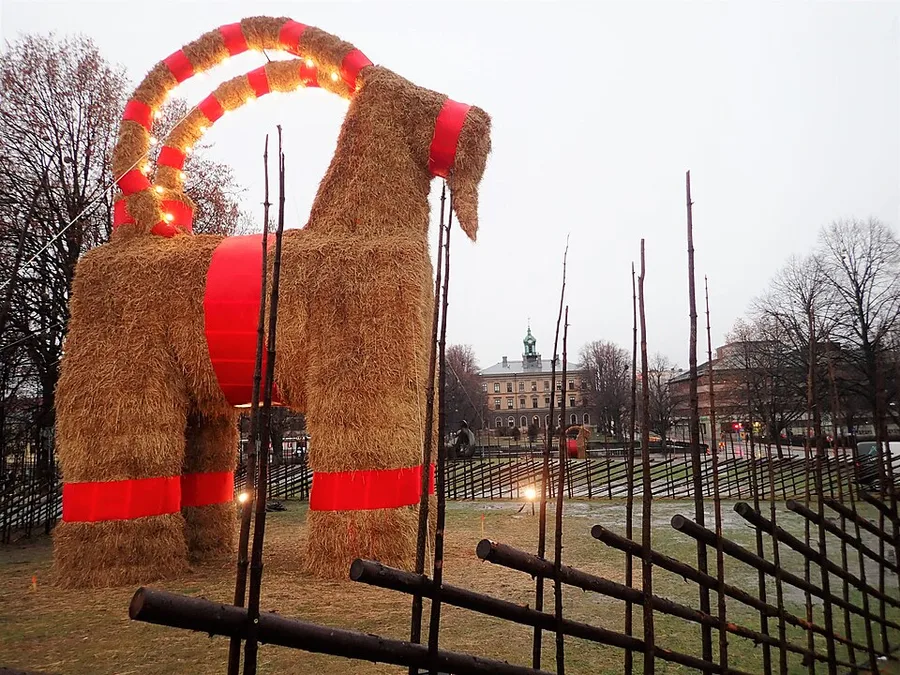 Photo: Sinikka Halme, Gävle goat 2019, CC BY-SA 4.0 The giant straw Yule goat on Gävle's Slottstorget, fenced and lit for Advent. Its fame is its fate: raised every year since 1966, it has been burned or wrecked — most often by arson — in most of its seasons, despite guards, cameras, and flame-proofing. The Gävle goat — a straw julbock, the Swedish Yule
goat, built at monument scale: some thirteen metres of
straw on a timber frame, raised on Slottstorget in Gävle,
Sweden, at the start of Advent every year since 1966. It
is the same midwinter goat that went door to door in
Norway as the julebukk, grown from tree ornament to town
landmark. Its fame is its fate: the first goat burned on
New Year's Eve 1966, and by the 2025 season the goat had
been destroyed or damaged in 43 of its 60 years — most
often by arson — despite guards, fences, cameras, and
flame-proofing. English bookmakers have taken odds on its
survival since 1988. It last burned in December 2021. The
2025 goat escaped arson only to be blown flat by the storm
Johannes on 27 December — the first goat ever felled by
weather.
the Swedish town of Gävle raises every December, and that vandals — most often arsonists — have brought down more years than not since it first went up in 1966. The monster is domesticated now. It stands where the monster used to stand.
Photo: Sinikka Halme, Gävle goat 2019, CC BY-SA 4.0 The giant straw Yule goat on Gävle's Slottstorget, fenced and lit for Advent. Its fame is its fate: raised every year since 1966, it has been burned or wrecked — most often by arson — in most of its seasons, despite guards, cameras, and flame-proofing. The Gävle goat — a straw julbock, the Swedish Yule
goat, built at monument scale: some thirteen metres of
straw on a timber frame, raised on Slottstorget in Gävle,
Sweden, at the start of Advent every year since 1966. It
is the same midwinter goat that went door to door in
Norway as the julebukk, grown from tree ornament to town
landmark. Its fame is its fate: the first goat burned on
New Year's Eve 1966, and by the 2025 season the goat had
been destroyed or damaged in 43 of its 60 years — most
often by arson — despite guards, fences, cameras, and
flame-proofing. English bookmakers have taken odds on its
survival since 1988. It last burned in December 2021. The
2025 goat escaped arson only to be blown flat by the storm
Johannes on 27 December — the first goat ever felled by
weather.
the Swedish town of Gävle raises every December, and that vandals — most often arsonists — have brought down more years than not since it first went up in 1966. The monster is domesticated now. It stands where the monster used to stand.