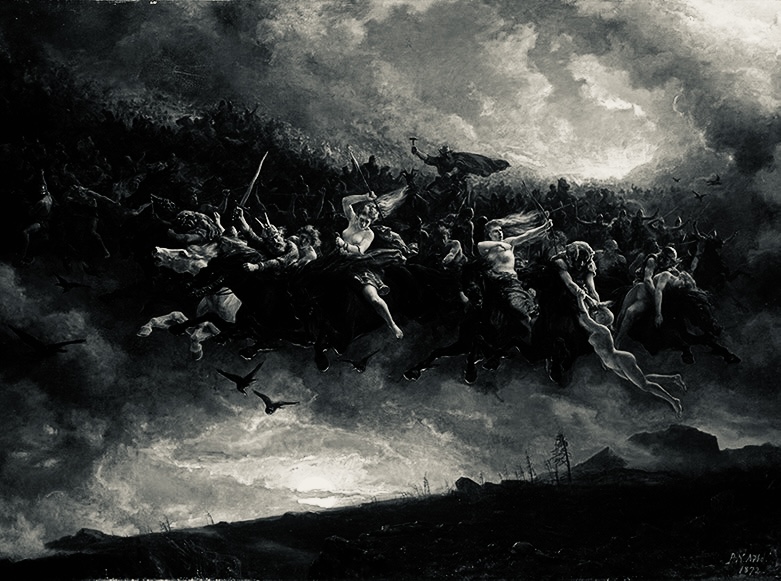
Åsgårdsreien — The storm that rides through the winter sky
A host of the unquiet dead — criminals, suicides, the unbaptized — that thunders across the sky on the darkest nights of yule, drinks your Christmas ale and borrows your horses. Hear the hooves and you throw yourself face-down in the snow.
Through the long nights of Jul 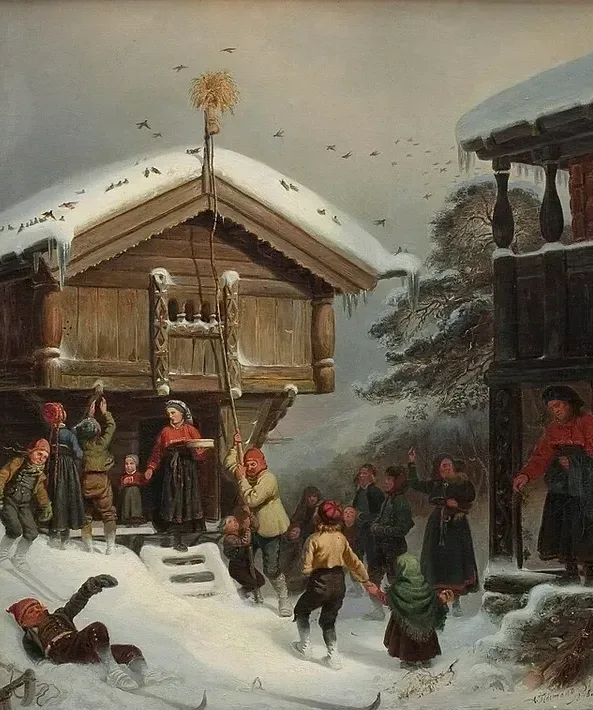 Adolph Tidemand, Norsk juleskik (1846), Trondheim kunstmuseum Tidemand's daylight farmyard jul — the julenek raised for the birds, the household out on the storehouse steps. This is the feast the tar crosses defended: for the twelve nights the barn doors carry the mark, and the Oskoreia keeps to the dark outside. The Norwegian (and broadly Scandinavian) midwinter feast — the
modern Christmas, but with a pre-Christian inheritance from the
Norse jól-blót still visible in its structure. The long run of
nights, the great toasts, the porridge bowl set out on the barn
threshold for the unseen one who lives on the farm, the julebukk
(Yule goat) surviving now in a children's costume-walk, the
Swedish Christmas ham traditionally traced back to the
sonargöltr (yule-boar). The Norwegian Jul is the clearest
practical example of how the household religion survived the
official conversion — the form remained, the gods at its centre
changed.
Also discussed in Worshiping Odin and Thor — the lived religion of pre-Christian NorwayJulebukk — the masked goat of midwinterTradisjoner — celebrations across the Norwegian year , Norwegians painted tar crosses on the doors of every barn, byre, and beer cellar — because the Oskoreia was riding, and a household that forgot paid for it.
Adolph Tidemand, Norsk juleskik (1846), Trondheim kunstmuseum Tidemand's daylight farmyard jul — the julenek raised for the birds, the household out on the storehouse steps. This is the feast the tar crosses defended: for the twelve nights the barn doors carry the mark, and the Oskoreia keeps to the dark outside. The Norwegian (and broadly Scandinavian) midwinter feast — the
modern Christmas, but with a pre-Christian inheritance from the
Norse jól-blót still visible in its structure. The long run of
nights, the great toasts, the porridge bowl set out on the barn
threshold for the unseen one who lives on the farm, the julebukk
(Yule goat) surviving now in a children's costume-walk, the
Swedish Christmas ham traditionally traced back to the
sonargöltr (yule-boar). The Norwegian Jul is the clearest
practical example of how the household religion survived the
official conversion — the form remained, the gods at its centre
changed.
Also discussed in Worshiping Odin and Thor — the lived religion of pre-Christian NorwayJulebukk — the masked goat of midwinterTradisjoner — celebrations across the Norwegian year , Norwegians painted tar crosses on the doors of every barn, byre, and beer cellar — because the Oskoreia was riding, and a household that forgot paid for it.
Oskoreia means, by one reading, roughly the terrifying ride: a host of the unquiet dead that swept across the sky on the darkest nights of the year, from Lussinatt on the thirteenth of December through Epiphany. The riders were the ones the churchyard could not settle — executed criminals, suicides, the unbaptized, drunkards, killers — and their horses were black and breathed fire. (The name most people use now, Åsgårdsreien, the ride out of Asgard led by Odin 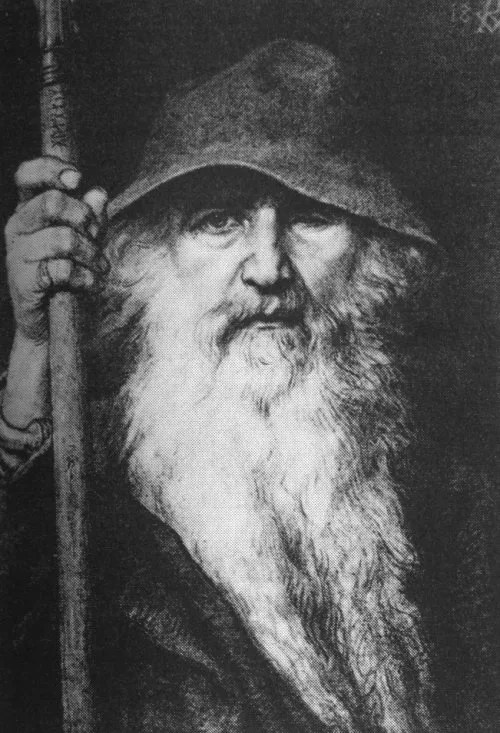 Georg von Rosen, Oden som vandringsman (1886), illustration for the 1893 Swedish Edda edition Von Rosen's wandering Odin, painted in 1886 — the renaming century's own image of the god: this is the Odin the Romantics heard in the old word Oskoreia and installed at the head of the farmers' ride when Åsgårdsreien got its name. Chief of the Æsir in Norse mythology. The god of chieftains, poets,
warriors, wisdom, magic, and the runes. He gave one of his eyes for
a drink from Mímir's well of wisdom and hanged nine nights and days
from the world-tree Yggdrasil — pierced by his own spear — to win
the secret of the runes. Half of those who died well in battle came
to his hall, Valhalla; the other half went to Freyja's hall, Folkvang.
In farm religion Odin was the god of the warband elite — the
chieftain weighing his odds, the skald who served him — not the
god of ordinary protection. Mjölnir hung at the farmer's neck;
the Odin-oath belonged in the chieftain's mouth.
Also discussed in Worshiping Odin and Thor — the lived religion of pre-Christian NorwayNordisk Mytologi — Odin, the giants, and Ragnarok , is the newer reading: “Asgard” had already crept into the old word in some valleys — Andreas Faye recorded the folk name as early as 1833 — and the nineteenth-century Romantics seized on it and handed the host to a god. The farmers who actually feared it never put one at its head.)
Georg von Rosen, Oden som vandringsman (1886), illustration for the 1893 Swedish Edda edition Von Rosen's wandering Odin, painted in 1886 — the renaming century's own image of the god: this is the Odin the Romantics heard in the old word Oskoreia and installed at the head of the farmers' ride when Åsgårdsreien got its name. Chief of the Æsir in Norse mythology. The god of chieftains, poets,
warriors, wisdom, magic, and the runes. He gave one of his eyes for
a drink from Mímir's well of wisdom and hanged nine nights and days
from the world-tree Yggdrasil — pierced by his own spear — to win
the secret of the runes. Half of those who died well in battle came
to his hall, Valhalla; the other half went to Freyja's hall, Folkvang.
In farm religion Odin was the god of the warband elite — the
chieftain weighing his odds, the skald who served him — not the
god of ordinary protection. Mjölnir hung at the farmer's neck;
the Odin-oath belonged in the chieftain's mouth.
Also discussed in Worshiping Odin and Thor — the lived religion of pre-Christian NorwayNordisk Mytologi — Odin, the giants, and Ragnarok , is the newer reading: “Asgard” had already crept into the old word in some valleys — Andreas Faye recorded the folk name as early as 1833 — and the nineteenth-century Romantics seized on it and handed the host to a god. The farmers who actually feared it never put one at its head.)
You could not fight the host; you could only hide from it. A man who heard the hooves come over the ridge threw himself face-down in the snow, lower than a horse’s belly, and did not look up. The buildings were guarded with the tar crosses, the people by staying indoors and keeping still.
Mostly, the Oskoreia took. It raided the farms it crossed — drank the Christmas ale dry, emptied the larder, and borrowed the horses, riding them across the sky and leaving them foundered and sweat-dark in the stalls by morning. The story told most often turns on a man who forgot the cross on his beer-cellar door. On Christmas morning a stranger thanked him for the ale; the man said he had given none. You slept, the stranger told him, while we drank your cask dry and filled it back with horse’s blood — and the man remembered then being dragged across the night sky until dawn. People left ale and food out to be spared exactly this.
The host’s leader changed with the valley. In Telemark 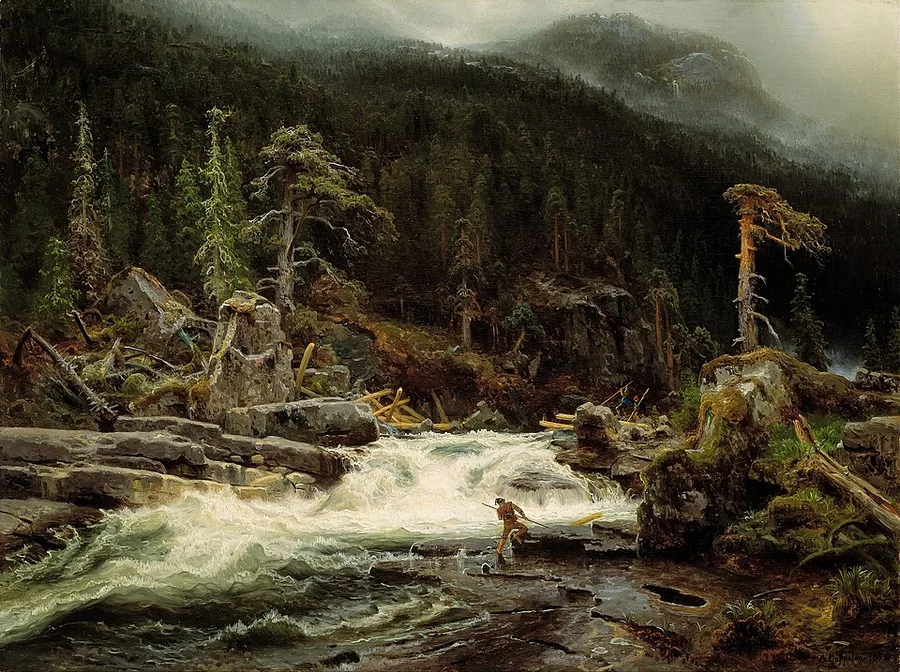 August Cappelen, Foss i nedre Telemark (1852), National Museum of Art, Architecture and Design August Cappelen's 1852 waterfall gorge in lower Telemark. These are the upland valleys the ballad hands the ride to: in Telemark and Setesdal the host rode behind Guro Rysserova — Guro Horse-Tail — on her black mare, and Sigurd Svein, offered the choice, chose the ride over heaven. Historic region and county in the inland-southern part of
Norway, between the southeastern coast and the central
Hardangervidda plateau. Home to Heddal Stave Church — the
largest of the twenty-eight surviving Norwegian stave churches,
standing nearly thirty metres tall — and to the heavy-water
production facility at Vemork whose sabotage by Norwegian
commandos in February 1943 disrupted the German atomic-weapons
programme. The name Telemark also gives the world the modern
ski-turn technique developed there in the nineteenth century.
In the folklore record Telemark is the deepest vein of all —
the landscape of the ballad collectors, the hardingfele
legends, and the lake serpent of Seljord.
Telemark Also discussed in A Catholic Norway — the faith that gave the kingdom its first institutions and the stave churchesWorld War II — the King’s “No” and the Nazis in NorwayThe Long Fall — the sudden loss of Norwegian nobility, the end of the kings, and half of Norway gone foreverFossegrimen — the waterfall fiddler who teaches you to playTroll — the monsters of the mountainsUtburd — the unbaptized child that will not restHuldra — the girl in the forest with a secretSjøormer — the serpents in the deep lakes and fjords and Setesdal it rode behind Guro Rysserova — Guro Horse-Tail — on her black mare, and the ballad tells of Sigurd Svein, whom she meets and asks whether he would be foremost in the ride or lowest in heaven; he chooses the ride. The pastor Magnus Brostrup Landstad wrote the ballad down in Seljord
August Cappelen, Foss i nedre Telemark (1852), National Museum of Art, Architecture and Design August Cappelen's 1852 waterfall gorge in lower Telemark. These are the upland valleys the ballad hands the ride to: in Telemark and Setesdal the host rode behind Guro Rysserova — Guro Horse-Tail — on her black mare, and Sigurd Svein, offered the choice, chose the ride over heaven. Historic region and county in the inland-southern part of
Norway, between the southeastern coast and the central
Hardangervidda plateau. Home to Heddal Stave Church — the
largest of the twenty-eight surviving Norwegian stave churches,
standing nearly thirty metres tall — and to the heavy-water
production facility at Vemork whose sabotage by Norwegian
commandos in February 1943 disrupted the German atomic-weapons
programme. The name Telemark also gives the world the modern
ski-turn technique developed there in the nineteenth century.
In the folklore record Telemark is the deepest vein of all —
the landscape of the ballad collectors, the hardingfele
legends, and the lake serpent of Seljord.
Telemark Also discussed in A Catholic Norway — the faith that gave the kingdom its first institutions and the stave churchesWorld War II — the King’s “No” and the Nazis in NorwayThe Long Fall — the sudden loss of Norwegian nobility, the end of the kings, and half of Norway gone foreverFossegrimen — the waterfall fiddler who teaches you to playTroll — the monsters of the mountainsUtburd — the unbaptized child that will not restHuldra — the girl in the forest with a secretSjøormer — the serpents in the deep lakes and fjords and Setesdal it rode behind Guro Rysserova — Guro Horse-Tail — on her black mare, and the ballad tells of Sigurd Svein, whom she meets and asks whether he would be foremost in the ride or lowest in heaven; he chooses the ride. The pastor Magnus Brostrup Landstad wrote the ballad down in Seljord 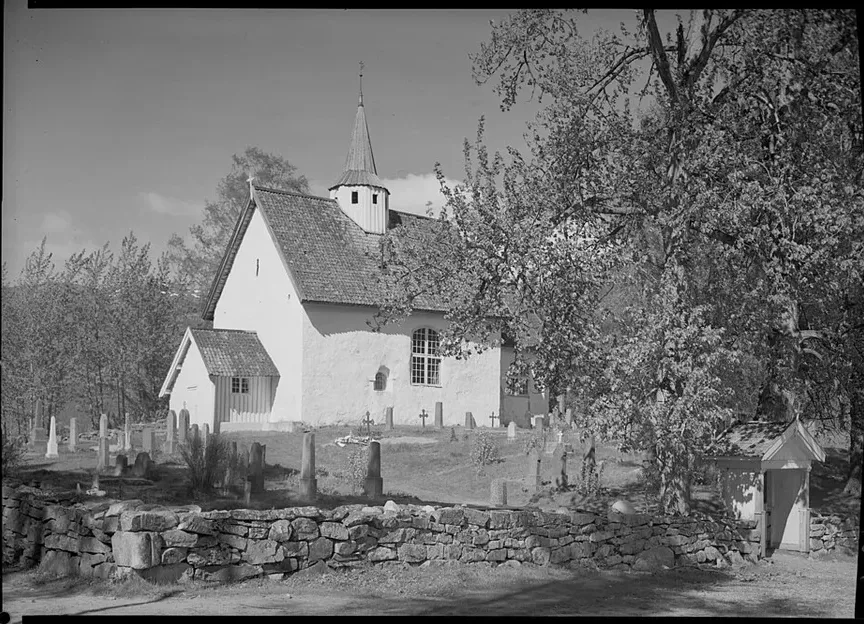 Unknown photographer, Seljord kirke (c. 1935–1950), Mittet collection, National Library of Norway The whitewashed medieval church at Seljord, Magnus Brostrup Landstad's parish from 1839 to 1848 — here the pastor writes down the ballad that sets Guro Rysserova on her black mare at the head of the ride. Village and municipality in Telemark, on lake
Seljordsvatnet — a parish unusually rich in recorded
folklore. The lake serpent, Seljordsormen, entered the
written record in 1750, when Gunleik Andersson Verpe of Bø
reported it overturned one of his boats; the priest Hans
Jacob Wille described it in his 1786 Beskrivelse over
Sillejords Præstegield. In 1989 the municipality took the
serpent, gold on red, as its coat of arms; a sonar
expedition in August 2000 found nothing it could identify.
The medieval stone church (c. 1150–1180) carries the legend
that seven huldra tails — invisible to a Christian eye —
hang inside, fallen from huldra brides wed there. Magnus
Brostrup Landstad, parish priest 1839–1848, and Olea Crøger
gathered most of the ballads in Norske Folkeviser (1853)
here.
Seljord, Telemark Also discussed in Sjøormer — the serpents in the deep lakes and fjordsHuldra — the girl in the forest with a secret in the 1840s. The thirteenth of December carried its own terror in Lussi, a hag who led her own ride and came down the chimney of any house behind on its yule work.
Unknown photographer, Seljord kirke (c. 1935–1950), Mittet collection, National Library of Norway The whitewashed medieval church at Seljord, Magnus Brostrup Landstad's parish from 1839 to 1848 — here the pastor writes down the ballad that sets Guro Rysserova on her black mare at the head of the ride. Village and municipality in Telemark, on lake
Seljordsvatnet — a parish unusually rich in recorded
folklore. The lake serpent, Seljordsormen, entered the
written record in 1750, when Gunleik Andersson Verpe of Bø
reported it overturned one of his boats; the priest Hans
Jacob Wille described it in his 1786 Beskrivelse over
Sillejords Præstegield. In 1989 the municipality took the
serpent, gold on red, as its coat of arms; a sonar
expedition in August 2000 found nothing it could identify.
The medieval stone church (c. 1150–1180) carries the legend
that seven huldra tails — invisible to a Christian eye —
hang inside, fallen from huldra brides wed there. Magnus
Brostrup Landstad, parish priest 1839–1848, and Olea Crøger
gathered most of the ballads in Norske Folkeviser (1853)
here.
Seljord, Telemark Also discussed in Sjøormer — the serpents in the deep lakes and fjordsHuldra — the girl in the forest with a secret in the 1840s. The thirteenth of December carried its own terror in Lussi, a hag who led her own ride and came down the chimney of any house behind on its yule work.
Peter Nicolai Arbo 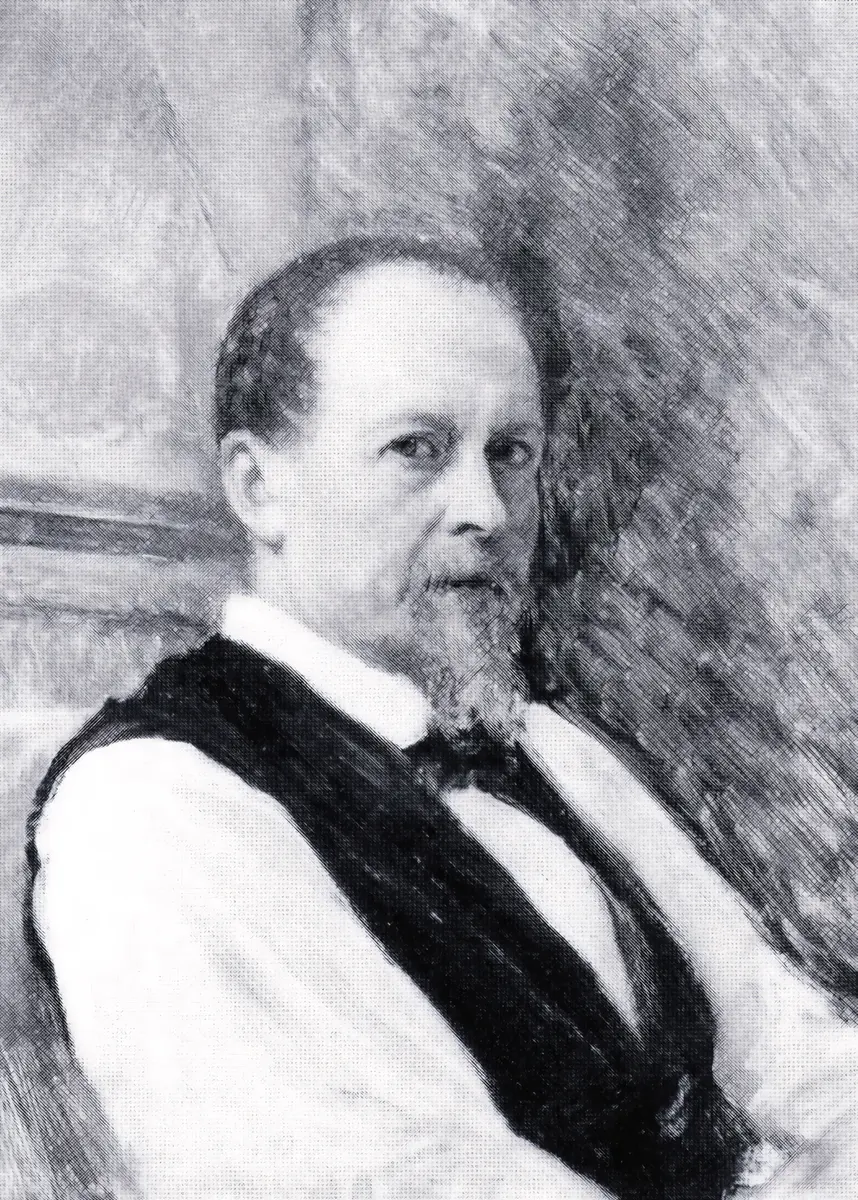 Peter Nicolai Arbo, Selvportrett (Drammen byleksikon / Drammen kommune) Arbo himself — the Drammen-raised history painter whose best-known canvas, the 1872 Åsgårdsreien, is the night-riding host at the head of this page; here the man who filled that sky meets the viewer's eye instead. Norwegian history painter (1831–1892), raised at Gulskogen
manor in Drammen and trained at the academy in Düsseldorf,
who specialized in large narrative canvases from Norse
mythology and Norwegian history. Valkyrien (1869) sends
a lone armored battle-maiden on a black horse across a
storm sky; Åsgårdsreien (1872), his best-known work,
painted in Paris after Johan Sebastian Welhaven's 1844
poem, fills the night with the airborne host — black
horses, ravens, spear-bearing riders. Both hang in the
Nasjonalmuseet in Oslo, where the 1872 canvas carries the
English title The Wild Hunt of Odin.
painted the hunt in 1872, after Welhaven’s poem Asgaardsreien, and titled the canvas Åsgårdsreien — the Asgard reading the farmers themselves had never used. It hangs in the Nasjonalmuseet in Oslo, catalogued in English as The Wild Hunt of Odin.
Peter Nicolai Arbo, Selvportrett (Drammen byleksikon / Drammen kommune) Arbo himself — the Drammen-raised history painter whose best-known canvas, the 1872 Åsgårdsreien, is the night-riding host at the head of this page; here the man who filled that sky meets the viewer's eye instead. Norwegian history painter (1831–1892), raised at Gulskogen
manor in Drammen and trained at the academy in Düsseldorf,
who specialized in large narrative canvases from Norse
mythology and Norwegian history. Valkyrien (1869) sends
a lone armored battle-maiden on a black horse across a
storm sky; Åsgårdsreien (1872), his best-known work,
painted in Paris after Johan Sebastian Welhaven's 1844
poem, fills the night with the airborne host — black
horses, ravens, spear-bearing riders. Both hang in the
Nasjonalmuseet in Oslo, where the 1872 canvas carries the
English title The Wild Hunt of Odin.
painted the hunt in 1872, after Welhaven’s poem Asgaardsreien, and titled the canvas Åsgårdsreien — the Asgard reading the farmers themselves had never used. It hangs in the Nasjonalmuseet in Oslo, catalogued in English as The Wild Hunt of Odin.