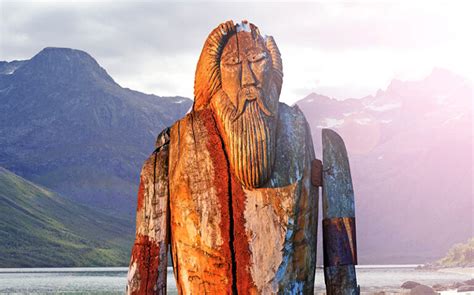
Nordisk Mytologi — Odin, the giants, and Ragnarok
The full map of Norse mythology — the two Icelandic books that saved it, the world-tree and its nine worlds, Odin and Thor and Loki, the one long story that runs from creation to Ragnarok, and what belief actually looked like on the farms that held it.
Two books from Iceland
The stories survive because Iceland wrote them down. Around 1220, roughly two centuries after the old religion had ended, the Icelandic chieftain and poet Snorri Sturluson 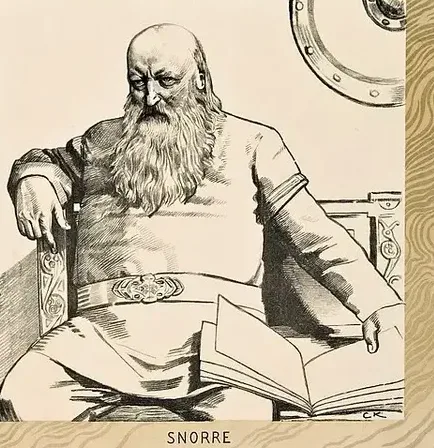 Christian Krohg, Snorre Sturlason (1899), from Norges Kongesagaer; scan: National Library of Norway Christian Krohg's portrait of Snorri from the 1899 folk edition of Heimskringla — the historian seated with a great open book across his knees. No contemporary likeness of Snorri exists; Krohg's drawing is the face Norway gave its most important medieval source. Thirteenth-century Icelandic chieftain, poet, and historian.
Composed the Heimskringla and the Prose Edda in the 1220s
from oral tradition and skaldic verse — three hundred years after
the Viking-age events he describes. The single richest source for
Norway's pre-conversion centuries and also the most aware
Christian-Icelandic editor of them. Modern scholarship accepts
what other sources independently confirm and treats his richest
expansions as the work of a poet writing about a kingdom he had
never seen. Assassinated at Reykholt on 23 September 1241 by
agents of King Hákon IV after a falling-out at court.
In this article Snorri's Prose Edda (c. 1220) is the handbook most of this
article's myths come through — compiled so that young poets
would still understand the references the old poetry ran on.
He wrote as a Christian two centuries after the old religion
ended, and scholars still argue over which details are ancient
and which are Snorri tidying up.
Also discussed in The Viking Age — longships, legends, and the first "Norway"Before There Was Norway — petty kingdoms at the edge of the worldWorshiping Odin and Thor — the lived religion of pre-Christian NorwayThe King Who Became a Saint — how the Nordmen came to ChristA Catholic Norway — the faith that gave the kingdom its first institutions and the stave churchesThe Golden Age — a North Atlantic empire … reaching farther than you thinkThe Crusades?!!!! — sixty ships from Bergen, bound for the Holy Land compiled the The Prose Edda
Christian Krohg, Snorre Sturlason (1899), from Norges Kongesagaer; scan: National Library of Norway Christian Krohg's portrait of Snorri from the 1899 folk edition of Heimskringla — the historian seated with a great open book across his knees. No contemporary likeness of Snorri exists; Krohg's drawing is the face Norway gave its most important medieval source. Thirteenth-century Icelandic chieftain, poet, and historian.
Composed the Heimskringla and the Prose Edda in the 1220s
from oral tradition and skaldic verse — three hundred years after
the Viking-age events he describes. The single richest source for
Norway's pre-conversion centuries and also the most aware
Christian-Icelandic editor of them. Modern scholarship accepts
what other sources independently confirm and treats his richest
expansions as the work of a poet writing about a kingdom he had
never seen. Assassinated at Reykholt on 23 September 1241 by
agents of King Hákon IV after a falling-out at court.
In this article Snorri's Prose Edda (c. 1220) is the handbook most of this
article's myths come through — compiled so that young poets
would still understand the references the old poetry ran on.
He wrote as a Christian two centuries after the old religion
ended, and scholars still argue over which details are ancient
and which are Snorri tidying up.
Also discussed in The Viking Age — longships, legends, and the first "Norway"Before There Was Norway — petty kingdoms at the edge of the worldWorshiping Odin and Thor — the lived religion of pre-Christian NorwayThe King Who Became a Saint — how the Nordmen came to ChristA Catholic Norway — the faith that gave the kingdom its first institutions and the stave churchesThe Golden Age — a North Atlantic empire … reaching farther than you thinkThe Crusades?!!!! — sixty ships from Bergen, bound for the Holy Land compiled the The Prose Edda 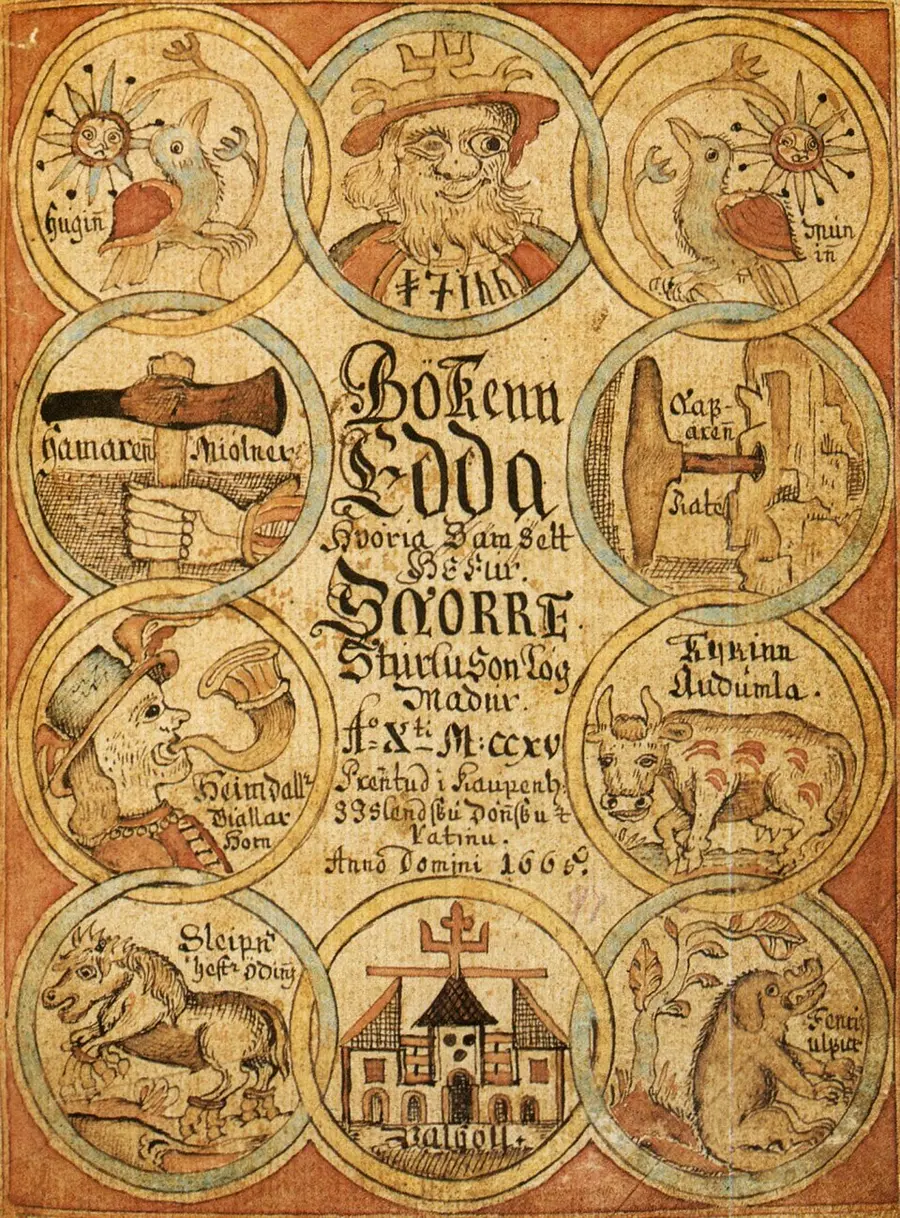 Title page of the Prose Edda manuscript NKS 1867 4to (Ólafur Brynjúlfsson, 1760), Royal Danish Library The hand-lettered title page of a 1760 Icelandic copy of the Prose Edda, ringed with naive ink medallions of Odin, the hammer Mjölnir, Heimdall's horn, the eight-legged Sleipnir and the wolf Fenrir — the mythology the book sets down. Thirteenth-century Old Norse handbook of mythological and skaldic
lore, composed by Snorri Sturluson in Iceland around 1220 as a
systematic guide for poets working in the skaldic tradition. Four
parts: a prologue (largely Snorri's Christian framing), the
Gylfaginning (the mythology presented as the questioning of King
Gylfi by three disguised gods), the Skáldskaparmál (the dictionary
of skaldic kennings, with extended mythological narratives behind
each), and the Háttatal (Snorri's own demonstration poem in
every skaldic metre). Together with the Poetic Edda, the principal
surviving source for Norse mythology.
Also discussed in Worshiping Odin and Thor — the lived religion of pre-Christian Norway — a handbook of the myths, composed so that young poets would still understand the references the old poetry ran on. Fifty years on, an anonymous Icelandic manuscript preserved the poems themselves — the collection now called the The Poetic Edda
Title page of the Prose Edda manuscript NKS 1867 4to (Ólafur Brynjúlfsson, 1760), Royal Danish Library The hand-lettered title page of a 1760 Icelandic copy of the Prose Edda, ringed with naive ink medallions of Odin, the hammer Mjölnir, Heimdall's horn, the eight-legged Sleipnir and the wolf Fenrir — the mythology the book sets down. Thirteenth-century Old Norse handbook of mythological and skaldic
lore, composed by Snorri Sturluson in Iceland around 1220 as a
systematic guide for poets working in the skaldic tradition. Four
parts: a prologue (largely Snorri's Christian framing), the
Gylfaginning (the mythology presented as the questioning of King
Gylfi by three disguised gods), the Skáldskaparmál (the dictionary
of skaldic kennings, with extended mythological narratives behind
each), and the Háttatal (Snorri's own demonstration poem in
every skaldic metre). Together with the Poetic Edda, the principal
surviving source for Norse mythology.
Also discussed in Worshiping Odin and Thor — the lived religion of pre-Christian Norway — a handbook of the myths, composed so that young poets would still understand the references the old poetry ran on. Fifty years on, an anonymous Icelandic manuscript preserved the poems themselves — the collection now called the The Poetic Edda 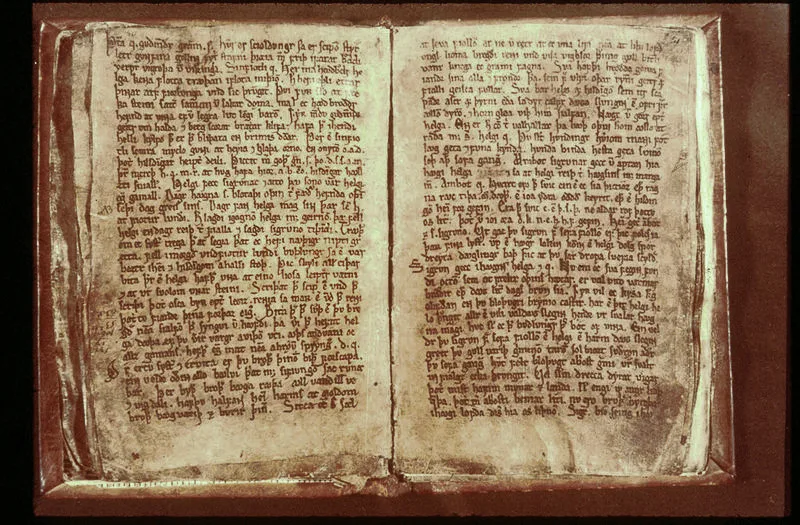 Codex Regius of the Eddaic Poems (GKS 2365 4to, c. 1270), Icelandic manuscript The Codex Regius itself, open on its dark vellum — the single late-thirteenth-century Icelandic manuscript that preserves most of the Poetic Edda's mythological and heroic poems, and with them much of what survives of Norse myth. The collection of Old Norse mythological and heroic poems preserved
chiefly in the late-thirteenth-century Icelandic manuscript Codex
Regius (GKS 2365 4to) and supplementary fragments. Contains the
Völuspá ("Prophecy of the Seeress"), the Hávamál (Odin's
sayings), the Lokasenna (Loki's flyting at the gods' feast), the
Þrymskviða (Thor's recovery of his hammer), and the Sigurd-cycle
heroic poems. Together with Snorri Sturluson's separately
thirteenth-century Prose Edda, the principal source for almost
all surviving knowledge of pre-Christian Norse mythological imagery.
Also discussed in Worshiping Odin and Thor — the lived religion of pre-Christian Norway , with the great mythological poems at its head: Voluspá, the seeress’s prophecy that tells the whole story of the world from creation to destruction, and Hávamál, the “sayings of the High One,” a long string of advice and wisdom put in Odin’s mouth.
Codex Regius of the Eddaic Poems (GKS 2365 4to, c. 1270), Icelandic manuscript The Codex Regius itself, open on its dark vellum — the single late-thirteenth-century Icelandic manuscript that preserves most of the Poetic Edda's mythological and heroic poems, and with them much of what survives of Norse myth. The collection of Old Norse mythological and heroic poems preserved
chiefly in the late-thirteenth-century Icelandic manuscript Codex
Regius (GKS 2365 4to) and supplementary fragments. Contains the
Völuspá ("Prophecy of the Seeress"), the Hávamál (Odin's
sayings), the Lokasenna (Loki's flyting at the gods' feast), the
Þrymskviða (Thor's recovery of his hammer), and the Sigurd-cycle
heroic poems. Together with Snorri Sturluson's separately
thirteenth-century Prose Edda, the principal source for almost
all surviving knowledge of pre-Christian Norse mythological imagery.
Also discussed in Worshiping Odin and Thor — the lived religion of pre-Christian Norway , with the great mythological poems at its head: Voluspá, the seeress’s prophecy that tells the whole story of the world from creation to destruction, and Hávamál, the “sayings of the High One,” a long string of advice and wisdom put in Odin’s mouth.
Those two books, plus the fragments quoted in older court poetry, are very nearly everything. There is no Norse bible, no surviving priesthood, no unbroken tradition — and the men who wrote the myths down were Christians describing their great-great-grandparents’ religion. What survives is the shape of the thing as the thirteenth century remembered it, and scholars argue endlessly about which details are ancient and which are Snorri tidying up. The shape itself, though, is vivid and coherent.
The shape of the world
In the beginning there is a gap — Ginnungagap, the yawning emptiness, with a world of ice on one side and a world of fire on the other. Where they meet, the first being condenses out of the melting frost: the giant Ymir, ancestor of all giants. Odin and his two brothers kill Ymir and build the world out of his body — the earth from his flesh, the sea from his blood, the mountains from his bones, the sky from the dome of his skull. The world, in this mythology, is made of a dismembered giant. It begins in violence and it is borrowed.
Through the middle of everything grows the world-tree, Yggdrasil 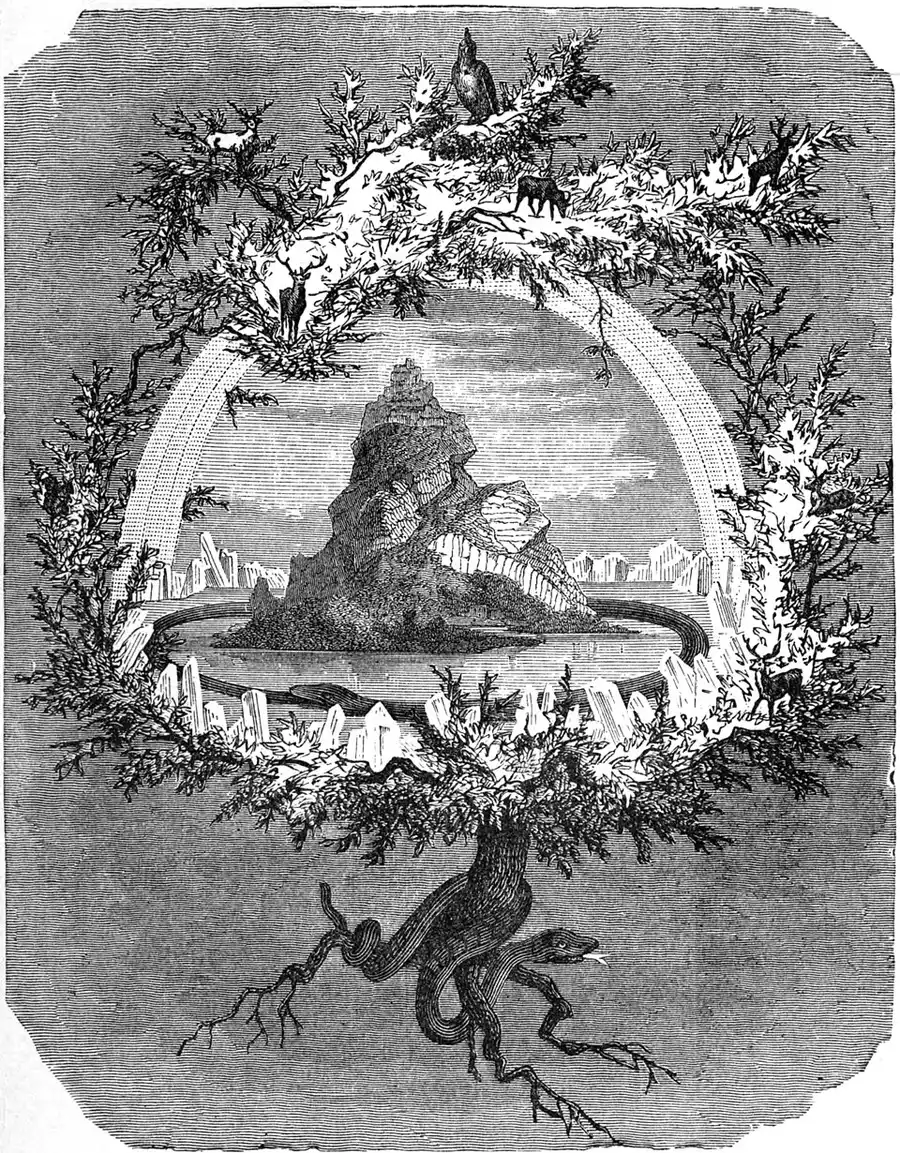 Friedrich Wilhelm Heine, The Ash Yggdrasil (1886), from Wilhelm Wägner's Nordisch-germanische Götter und Helden Friedrich Wilhelm Heine's 1886 engraving of the world-ash Yggdrasil, its crown enclosing the ringed world with an eagle above, harts browsing the branches and the serpent Níðhöggr gnawing at its roots — the tree that binds the nine Norse worlds. The world-tree of Norse cosmology — a vast ash tree (or in some
accounts an evergreen) whose branches and roots reach through and
hold together the nine worlds of Norse cosmos. The Æsir met at
Yggdrasil's foot in daily council; Odin hanged himself from one
of its branches for nine nights to win the secret of the runes;
the dragon Níðhöggr gnawed at its lowest root, and the squirrel
Ratatoskr ran the trunk carrying insults between the eagle at the
crown and Níðhöggr below. The name probably means "Odin's horse"
— Yggr is one of Odin's titles, and a gallows in skaldic verse
is a "horse" — referring to Odin's self-hanging.
Also discussed in Worshiping Odin and Thor — the lived religion of pre-Christian Norway , an ash so large that its branches hold up the sky. Nine worlds hang in its structure. Three matter most: Åsgard, the fortified home of the gods; Midgard, the “middle yard” where humans live, ringed by an ocean with a serpent lying in it; and Hel
Friedrich Wilhelm Heine, The Ash Yggdrasil (1886), from Wilhelm Wägner's Nordisch-germanische Götter und Helden Friedrich Wilhelm Heine's 1886 engraving of the world-ash Yggdrasil, its crown enclosing the ringed world with an eagle above, harts browsing the branches and the serpent Níðhöggr gnawing at its roots — the tree that binds the nine Norse worlds. The world-tree of Norse cosmology — a vast ash tree (or in some
accounts an evergreen) whose branches and roots reach through and
hold together the nine worlds of Norse cosmos. The Æsir met at
Yggdrasil's foot in daily council; Odin hanged himself from one
of its branches for nine nights to win the secret of the runes;
the dragon Níðhöggr gnawed at its lowest root, and the squirrel
Ratatoskr ran the trunk carrying insults between the eagle at the
crown and Níðhöggr below. The name probably means "Odin's horse"
— Yggr is one of Odin's titles, and a gallows in skaldic verse
is a "horse" — referring to Odin's self-hanging.
Also discussed in Worshiping Odin and Thor — the lived religion of pre-Christian Norway , an ash so large that its branches hold up the sky. Nine worlds hang in its structure. Three matter most: Åsgard, the fortified home of the gods; Midgard, the “middle yard” where humans live, ringed by an ocean with a serpent lying in it; and Hel 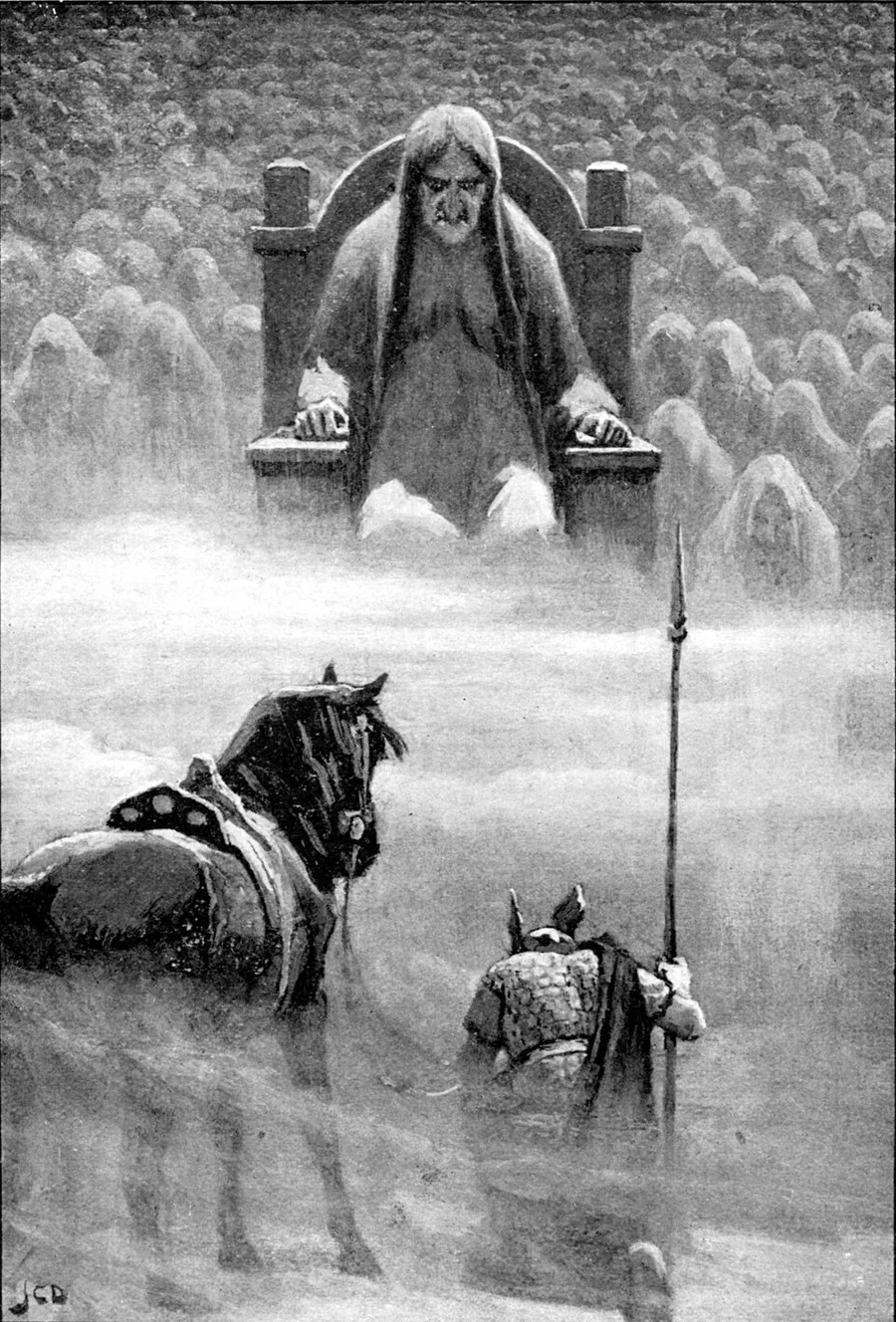 John Charles Dollman, Hermod before Hela (1909), from H. A. Guerber's Myths of the Norsemen Dollman pictures the goddess Hel enthroned in her misty realm with the crowding dead behind her, a messenger kneeling before her — the underworld where the Norse believed most people went, those who died of sickness or age rather than in battle. The Norse realm of the ordinary dead — most people who died went
there. Hel was not the Christian hell: no fire, no punishment,
no moral verdict. The farmer carried off by fever, the woman dead
in childbirth, the child that never saw a second year, the slave,
the grandmother by the fire — all went to Hel, and so did chieftains
who died in their beds rather than on a battlefield. The realm was
ruled by the goddess of the same name (Hel, daughter of Loki). The
Norse afterlife sorted by how you died, not by how you lived —
a distinction that confused Christian missionaries and still confuses
modern storytellers, who flatten the system into a single
battlefield-to-Valhalla pipeline.
Also discussed in Worshiping Odin and Thor — the lived religion of pre-Christian Norway , ruled by a half-blue woman named Hel, whose name Christianity later borrowed for its own destination. The others belong to the giants (Jotunheim — the name, as Jotunheimen, now sits on Norway’s highest mountain range), the elves, the dwarves, the fire-beings, and the ice. A rainbow bridge, Bifrost, connects the gods’ world to the human one, with the watchman god Heimdall
John Charles Dollman, Hermod before Hela (1909), from H. A. Guerber's Myths of the Norsemen Dollman pictures the goddess Hel enthroned in her misty realm with the crowding dead behind her, a messenger kneeling before her — the underworld where the Norse believed most people went, those who died of sickness or age rather than in battle. The Norse realm of the ordinary dead — most people who died went
there. Hel was not the Christian hell: no fire, no punishment,
no moral verdict. The farmer carried off by fever, the woman dead
in childbirth, the child that never saw a second year, the slave,
the grandmother by the fire — all went to Hel, and so did chieftains
who died in their beds rather than on a battlefield. The realm was
ruled by the goddess of the same name (Hel, daughter of Loki). The
Norse afterlife sorted by how you died, not by how you lived —
a distinction that confused Christian missionaries and still confuses
modern storytellers, who flatten the system into a single
battlefield-to-Valhalla pipeline.
Also discussed in Worshiping Odin and Thor — the lived religion of pre-Christian Norway , ruled by a half-blue woman named Hel, whose name Christianity later borrowed for its own destination. The others belong to the giants (Jotunheim — the name, as Jotunheimen, now sits on Norway’s highest mountain range), the elves, the dwarves, the fire-beings, and the ice. A rainbow bridge, Bifrost, connects the gods’ world to the human one, with the watchman god Heimdall 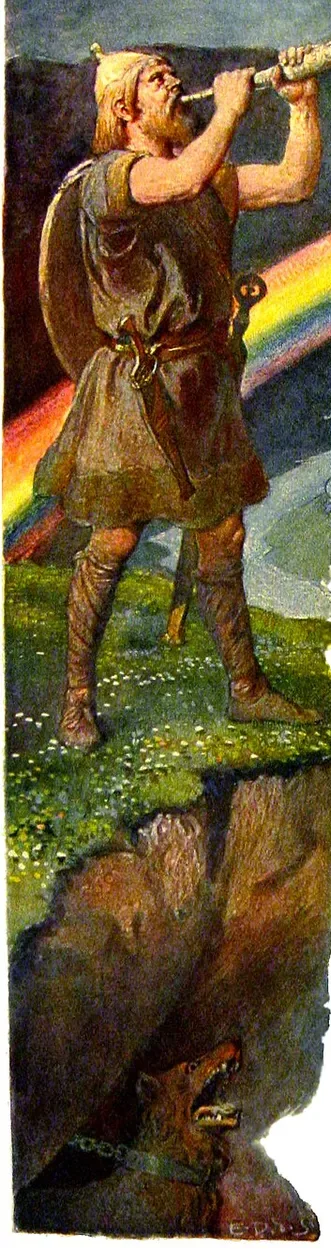 Emil Doepler, Heimdall an der Himmelsbrücke (c. 1905), from Walhall, die Götterwelt der Germanen Doepler's plate runs tall as a watchtower: Heimdall sounds the Gjallarhorn on the green clifftop where Bifrost lands, and far below, chained in the dark at the cliff-foot, a beast howls upward — the watchman above and the thing watched for underneath, stacked in one narrow frame. Watchman of the gods in Norse mythology, stationed at
Himinbjörg, where the rainbow bridge Bifrost meets Asgard.
Snorri's Gylfaginning (c. 1220s) gives him the watchman's
attributes: born of nine mothers, all sisters; needing less
sleep than a bird; seeing a hundred leagues by night as well
as by day; hearing the grass grow on the earth and the wool
on sheep. He keeps Gjallarhorn, the horn whose blast announces
the coming of Ragnarok. The opening of Völuspá calls
humankind "the greater and lesser kindreds of Heimdall," and
the prose introduction to the Eddic Rígsþula names him as
Ríg, the wandering god who fathers the three social orders —
thrall, freeman, and jarl.
standing guard at the top.
Emil Doepler, Heimdall an der Himmelsbrücke (c. 1905), from Walhall, die Götterwelt der Germanen Doepler's plate runs tall as a watchtower: Heimdall sounds the Gjallarhorn on the green clifftop where Bifrost lands, and far below, chained in the dark at the cliff-foot, a beast howls upward — the watchman above and the thing watched for underneath, stacked in one narrow frame. Watchman of the gods in Norse mythology, stationed at
Himinbjörg, where the rainbow bridge Bifrost meets Asgard.
Snorri's Gylfaginning (c. 1220s) gives him the watchman's
attributes: born of nine mothers, all sisters; needing less
sleep than a bird; seeing a hundred leagues by night as well
as by day; hearing the grass grow on the earth and the wool
on sheep. He keeps Gjallarhorn, the horn whose blast announces
the coming of Ragnarok. The opening of Völuspá calls
humankind "the greater and lesser kindreds of Heimdall," and
the prose introduction to the Eddic Rígsþula names him as
Ríg, the wandering god who fathers the three social orders —
thrall, freeman, and jarl.
standing guard at the top.
At the roots of the tree sit three women called the Norns, spinning the fate of every living thing. This is the mythology’s deepest assumption: fate is fixed, and not even the gods are exempt. A dragon gnaws the tree’s root from below, a squirrel runs up and down the trunk carrying insults between the dragon and the eagle at the top, and the tree — like everything in this cosmos — is slowly dying even as it holds the worlds up.
The gods
There are two families of gods. The The Æsir 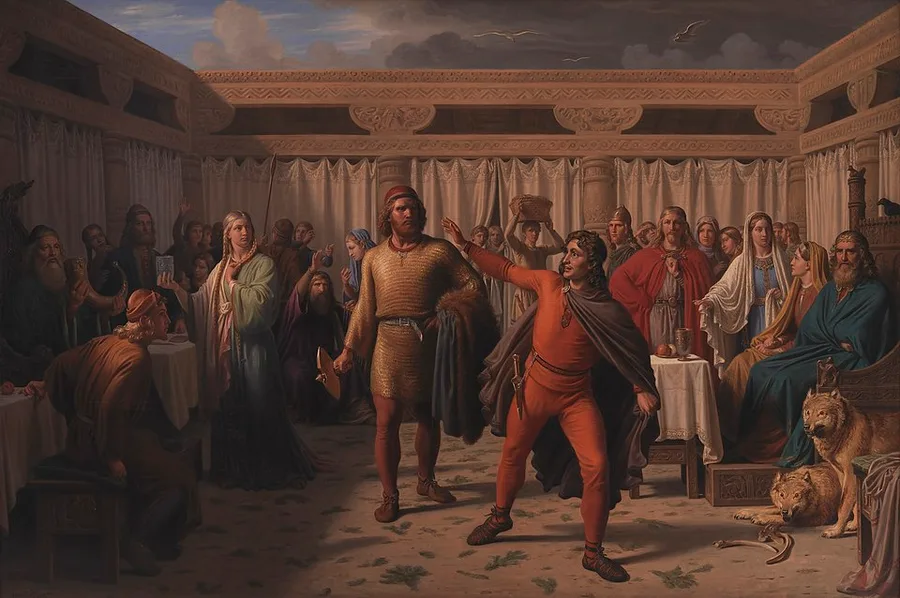 Constantin Hansen, Ægirs gæstebud (1857), Statens Museum for Kunst, Copenhagen Hansen painted the whole pantheon at a feast in the sea-giant Ægir's hall — the assembled Æsir, Loki in red rising mid-quarrel — one banquet scene standing in for the war-and-wisdom gods this card names. The principal pantheon of Norse mythology — the gods associated with
power, war, wisdom, and order. Includes Odin, Thor, Tyr, Heimdall,
Baldr, Loki, and others. Lived in Asgard, the citadel at the top
of the world-tree Yggdrasil, connected to Midgard (the world of men)
by the rainbow bridge Bifröst. The Æsir fought a primordial war with
the rival Vanir pantheon; the two groups eventually made peace,
with key Vanir gods (Frey, Freyja, Njörðr) taken into the Æsir
pantheon as hostages of the settlement.
Also discussed in Worshiping Odin and Thor — the lived religion of pre-Christian Norway — Odin’s family — are gods of war, rule, and sky. The The Vanir
Constantin Hansen, Ægirs gæstebud (1857), Statens Museum for Kunst, Copenhagen Hansen painted the whole pantheon at a feast in the sea-giant Ægir's hall — the assembled Æsir, Loki in red rising mid-quarrel — one banquet scene standing in for the war-and-wisdom gods this card names. The principal pantheon of Norse mythology — the gods associated with
power, war, wisdom, and order. Includes Odin, Thor, Tyr, Heimdall,
Baldr, Loki, and others. Lived in Asgard, the citadel at the top
of the world-tree Yggdrasil, connected to Midgard (the world of men)
by the rainbow bridge Bifröst. The Æsir fought a primordial war with
the rival Vanir pantheon; the two groups eventually made peace,
with key Vanir gods (Frey, Freyja, Njörðr) taken into the Æsir
pantheon as hostages of the settlement.
Also discussed in Worshiping Odin and Thor — the lived religion of pre-Christian Norway — Odin’s family — are gods of war, rule, and sky. The The Vanir 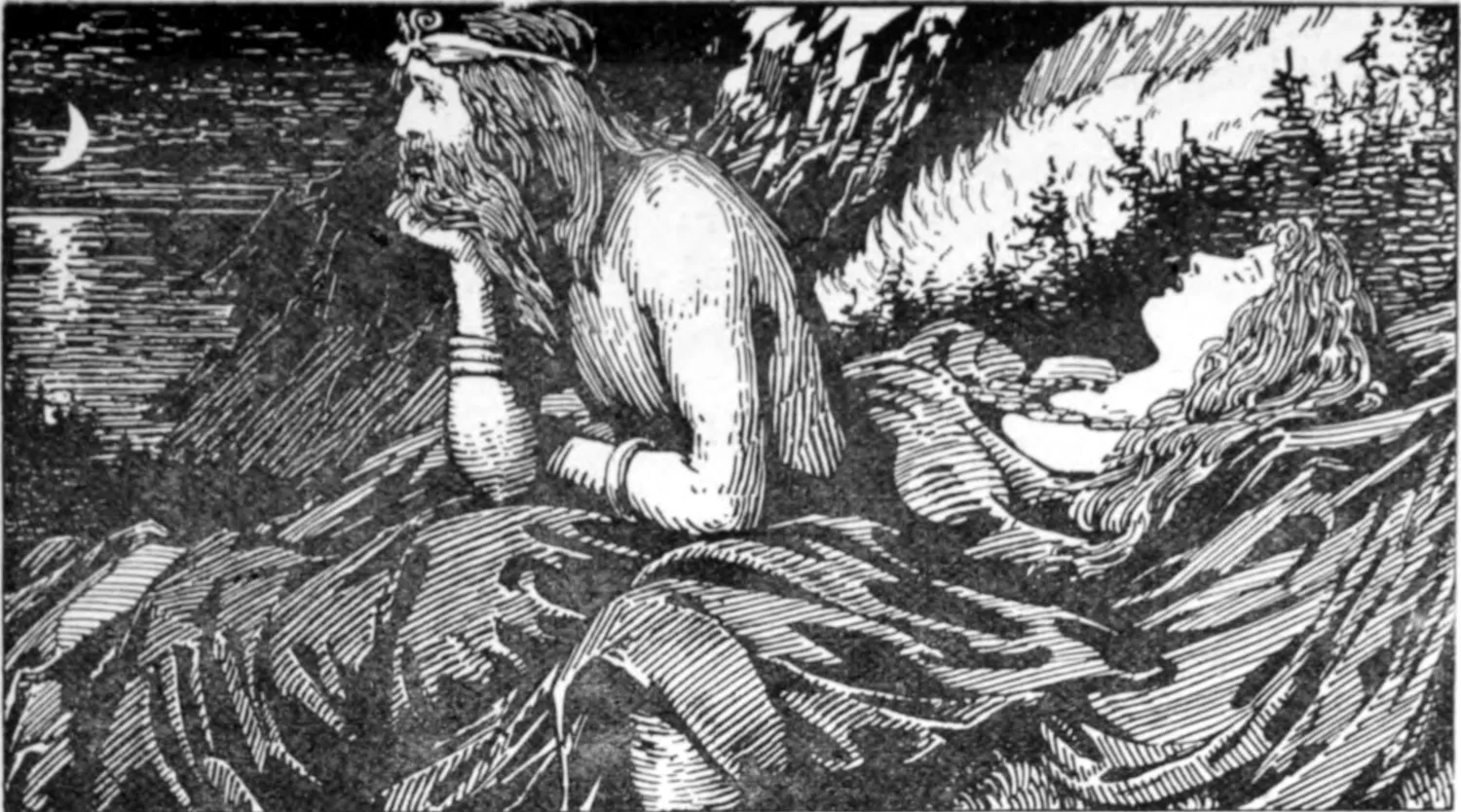 W.G. Collingwood, Njörd's desire of the Sea (1908), from The Elder or Poetic Edda Njörðr, eldest of the Vanir, aching for the sea while his giantess wife Skadi longs for her mountains — the mismatched marriage the myth uses to measure the distance between coast and fell. Collingwood drew it for the 1908 Elder Edda. The second pantheon of Norse mythology — gods associated with
fertility, prosperity, magic, and the sea, in some sense older or
more chthonic than the Æsir. The leading Vanir were Njörðr (god of
the sea and wind), his children Frey (god of harvest and peace) and
Freyja (goddess of love and seiðr). A primordial war between Æsir
and Vanir ended in peace and the exchange of hostages; Njörðr, Frey,
and Freyja came to live among the Æsir and are usually counted with
them in later Norse tradition. The Vanir's distinctness from the
Æsir is one of the more debated questions in modern study of Norse
religion.
Also discussed in Worshiping Odin and Thor — the lived religion of pre-Christian Norway are older powers of fertility, sea, and harvest. In the deep past of the mythology the two families fight a war, settle it with a truce, and exchange hostages — which is how the fertility gods Njord, Frey, and Freyja come to live in Åsgard. Even the gods’ own history begins with a war nobody wins.
W.G. Collingwood, Njörd's desire of the Sea (1908), from The Elder or Poetic Edda Njörðr, eldest of the Vanir, aching for the sea while his giantess wife Skadi longs for her mountains — the mismatched marriage the myth uses to measure the distance between coast and fell. Collingwood drew it for the 1908 Elder Edda. The second pantheon of Norse mythology — gods associated with
fertility, prosperity, magic, and the sea, in some sense older or
more chthonic than the Æsir. The leading Vanir were Njörðr (god of
the sea and wind), his children Frey (god of harvest and peace) and
Freyja (goddess of love and seiðr). A primordial war between Æsir
and Vanir ended in peace and the exchange of hostages; Njörðr, Frey,
and Freyja came to live among the Æsir and are usually counted with
them in later Norse tradition. The Vanir's distinctness from the
Æsir is one of the more debated questions in modern study of Norse
religion.
Also discussed in Worshiping Odin and Thor — the lived religion of pre-Christian Norway are older powers of fertility, sea, and harvest. In the deep past of the mythology the two families fight a war, settle it with a truce, and exchange hostages — which is how the fertility gods Njord, Frey, and Freyja come to live in Åsgard. Even the gods’ own history begins with a war nobody wins.
Odin 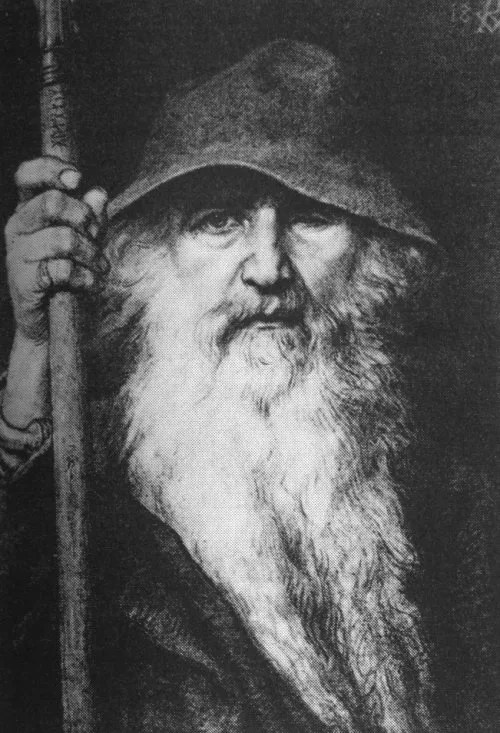 Georg von Rosen, Oden som vandringsman (1886), illustration for the 1893 Swedish Edda edition Georg von Rosen's 1886 Odin the Wanderer — the chief of the gods shown not enthroned but as a grey-bearded old traveller in a broad hat, the disguise he wears to roam among mortals. Chief of the Æsir in Norse mythology. The god of chieftains, poets,
warriors, wisdom, magic, and the runes. He gave one of his eyes for
a drink from Mímir's well of wisdom and hanged nine nights and days
from the world-tree Yggdrasil — pierced by his own spear — to win
the secret of the runes. Half of those who died well in battle came
to his hall, Valhalla; the other half went to Freyja's hall, Folkvang.
In farm religion Odin was the god of the warband elite — the
chieftain weighing his odds, the skald who served him — not the
god of ordinary protection. Mjölnir hung at the farmer's neck;
the Odin-oath belonged in the chieftain's mouth.
Also discussed in Worshiping Odin and Thor — the lived religion of pre-Christian NorwayÅsgårdsreien — the storm that rides through the winter sky is the Allfather, and he is not a kindly god. He is the god of war, poetry, magic, and the hanged — one-eyed, because he traded the other eye for a single drink from the well of wisdom; scarred, because he hanged himself nine nights on the world-tree, a sacrifice of himself to himself, to seize the secret of the runes. Two ravens, Hugin and Munin — Thought and Memory — fly out over the world every day and report back to him. He rides an eight-legged horse, walks among humans disguised as a one-eyed wanderer in a broad hat, and is obsessed with one thing above all: gathering knowledge about the end of the world, and warriors to fight beside him when it comes. His shield-maidens, the Valkyries
Georg von Rosen, Oden som vandringsman (1886), illustration for the 1893 Swedish Edda edition Georg von Rosen's 1886 Odin the Wanderer — the chief of the gods shown not enthroned but as a grey-bearded old traveller in a broad hat, the disguise he wears to roam among mortals. Chief of the Æsir in Norse mythology. The god of chieftains, poets,
warriors, wisdom, magic, and the runes. He gave one of his eyes for
a drink from Mímir's well of wisdom and hanged nine nights and days
from the world-tree Yggdrasil — pierced by his own spear — to win
the secret of the runes. Half of those who died well in battle came
to his hall, Valhalla; the other half went to Freyja's hall, Folkvang.
In farm religion Odin was the god of the warband elite — the
chieftain weighing his odds, the skald who served him — not the
god of ordinary protection. Mjölnir hung at the farmer's neck;
the Odin-oath belonged in the chieftain's mouth.
Also discussed in Worshiping Odin and Thor — the lived religion of pre-Christian NorwayÅsgårdsreien — the storm that rides through the winter sky is the Allfather, and he is not a kindly god. He is the god of war, poetry, magic, and the hanged — one-eyed, because he traded the other eye for a single drink from the well of wisdom; scarred, because he hanged himself nine nights on the world-tree, a sacrifice of himself to himself, to seize the secret of the runes. Two ravens, Hugin and Munin — Thought and Memory — fly out over the world every day and report back to him. He rides an eight-legged horse, walks among humans disguised as a one-eyed wanderer in a broad hat, and is obsessed with one thing above all: gathering knowledge about the end of the world, and warriors to fight beside him when it comes. His shield-maidens, the Valkyries 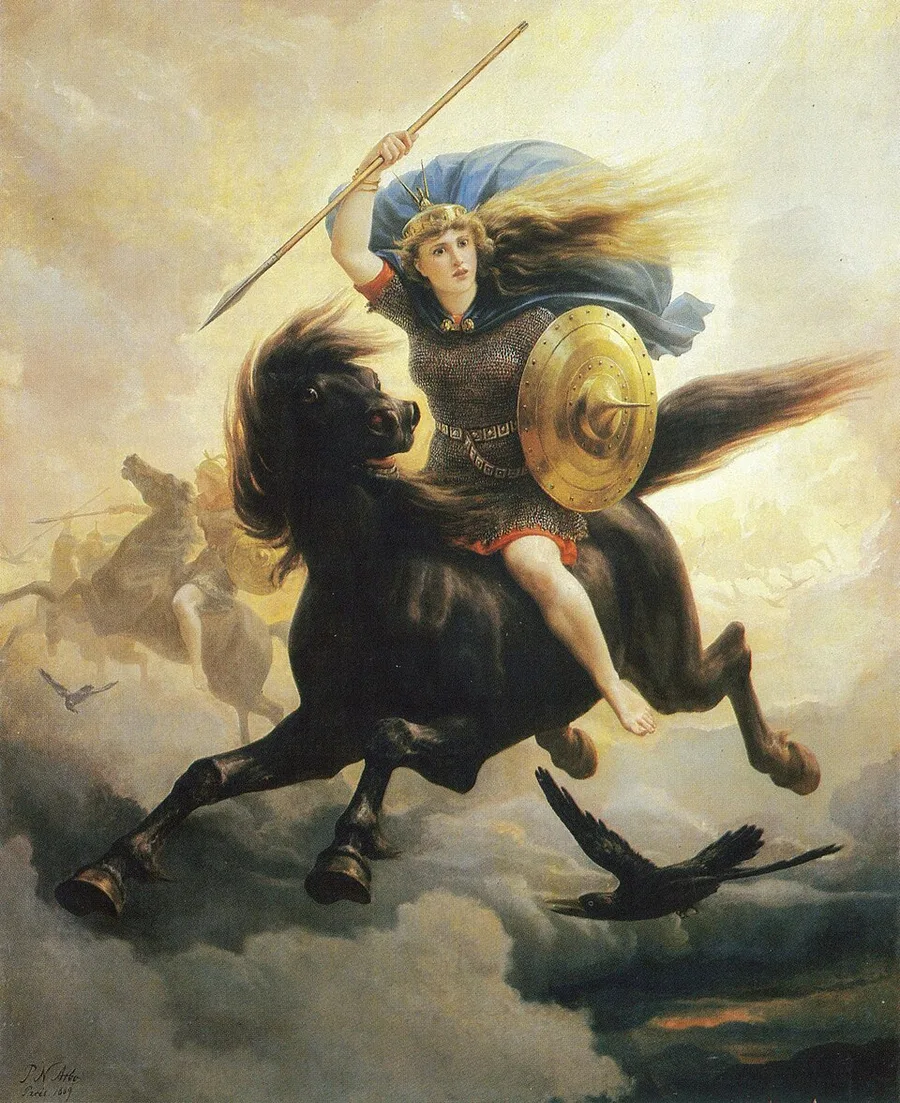 Peter Nicolai Arbo, Valkyrjen (1869), Nasjonalmuseet, Oslo (NG.M.00259) Peter Nicolai Arbo's 1869 Valkyrjen sends a mailed, spear-bearing rider galloping through a darkened sky, a raven below — Odin's chooser of the slain, who carried half the battle-dead to Valhalla. Female battlefield spirits in Norse mythology — valkyrjur,
"choosers of the slain." Sent by Odin to determine who would die
in a battle and who would live, and to bring half of the dead to
Valhalla (the other half went to Freyja's Folkvang). The
Valkyries were not gentle psychopomps but warlike presences in
their own right; some sagas treat them as semi-divine warrior-
women rather than emanations of Odin's will, and the figure
blurs at the edges with that of the human shield-maiden in
Norse imagination.
Also discussed in Worshiping Odin and Thor — the lived religion of pre-Christian Norway , choose the best of the battle-dead and carry them to his hall, Valhalla
Peter Nicolai Arbo, Valkyrjen (1869), Nasjonalmuseet, Oslo (NG.M.00259) Peter Nicolai Arbo's 1869 Valkyrjen sends a mailed, spear-bearing rider galloping through a darkened sky, a raven below — Odin's chooser of the slain, who carried half the battle-dead to Valhalla. Female battlefield spirits in Norse mythology — valkyrjur,
"choosers of the slain." Sent by Odin to determine who would die
in a battle and who would live, and to bring half of the dead to
Valhalla (the other half went to Freyja's Folkvang). The
Valkyries were not gentle psychopomps but warlike presences in
their own right; some sagas treat them as semi-divine warrior-
women rather than emanations of Odin's will, and the figure
blurs at the edges with that of the human shield-maiden in
Norse imagination.
Also discussed in Worshiping Odin and Thor — the lived religion of pre-Christian Norway , choose the best of the battle-dead and carry them to his hall, Valhalla 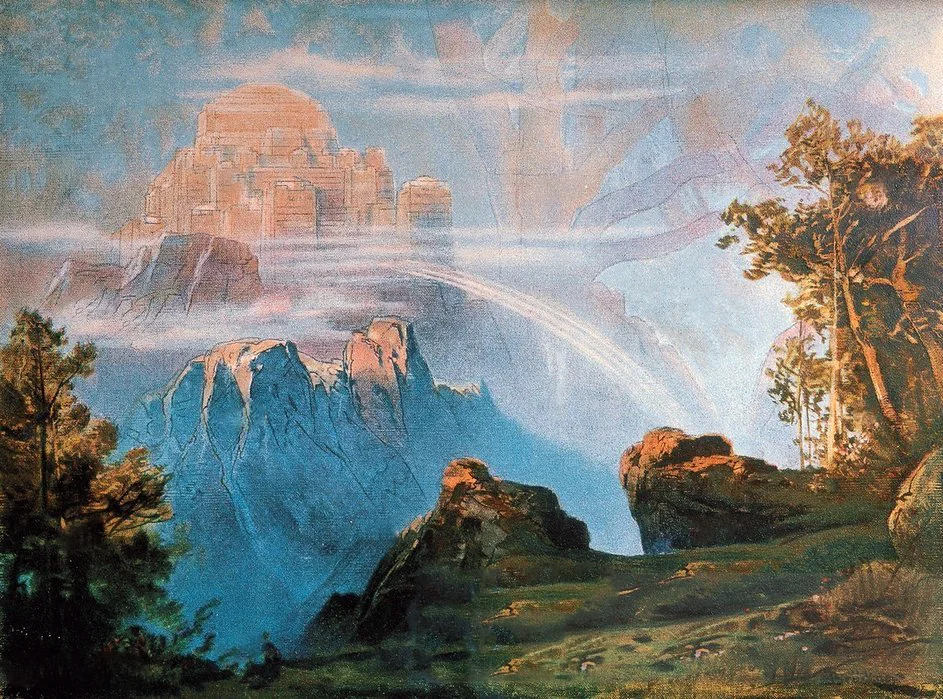 Max Brückner, Walhall (1896), scenery design for Wagner's Ring The hall of the slain as the nineteenth century staged it — Brückner painted Valhalla in the clouds, Bifröst arcing up to its gate, as scenery for Wagner's Ring at Bayreuth: the operatic afterlife of a hall the sagas describe plainly, roofed with shields. Odin's hall in Asgard — Valhǫll, "hall of the slain." The
destination of half of those who fell well in battle (the other
half went to Freyja's Folkvang). The Valkyries chose the dead and
brought them there; the fallen feasted nightly on the meat of the
ever-renewing boar Sæhrímnir and the mead of the goat Heiðrún,
and trained by day for the final battle of Ragnarok. Valhalla
was for the war-elite; ordinary dead went to Hel.
Also discussed in Worshiping Odin and Thor — the lived religion of pre-Christian Norway , where they fight all day and feast all night in training for the last battle.
Max Brückner, Walhall (1896), scenery design for Wagner's Ring The hall of the slain as the nineteenth century staged it — Brückner painted Valhalla in the clouds, Bifröst arcing up to its gate, as scenery for Wagner's Ring at Bayreuth: the operatic afterlife of a hall the sagas describe plainly, roofed with shields. Odin's hall in Asgard — Valhǫll, "hall of the slain." The
destination of half of those who fell well in battle (the other
half went to Freyja's Folkvang). The Valkyries chose the dead and
brought them there; the fallen feasted nightly on the meat of the
ever-renewing boar Sæhrímnir and the mead of the goat Heiðrún,
and trained by day for the final battle of Ragnarok. Valhalla
was for the war-elite; ordinary dead went to Hel.
Also discussed in Worshiping Odin and Thor — the lived religion of pre-Christian Norway , where they fight all day and feast all night in training for the last battle.
Thor 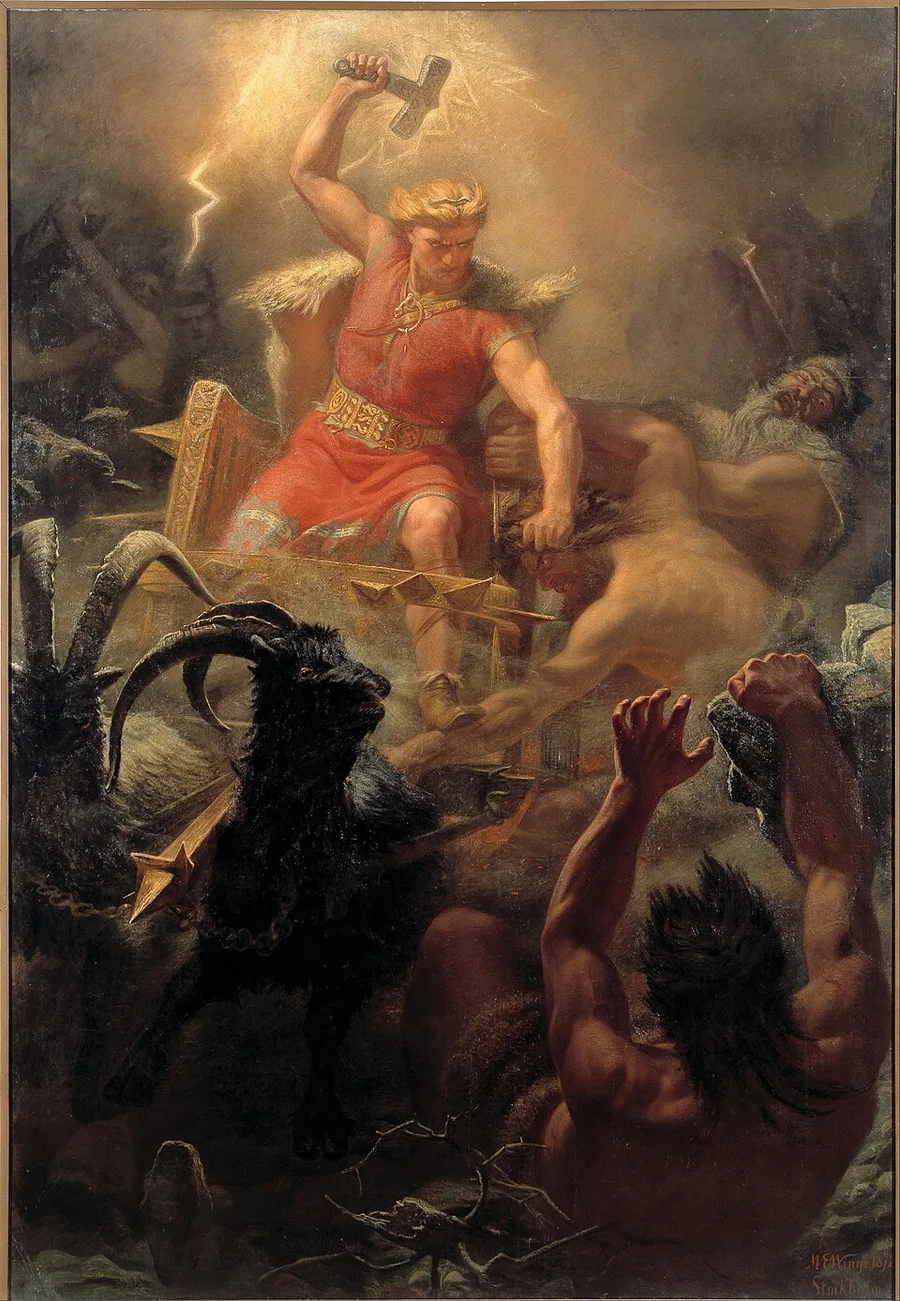 Mårten Eskil Winge, Tors strid med jättarna (1872), Nationalmuseum, Stockholm — Google Art Project scan Winge paints Thor at his defining work — riding his goat-drawn chariot through the storm, swinging the hammer Mjölnir at the fleeing giants he holds back from the cultivated world of gods and farmers. Norse god of thunder, storms, oaths, marriages, and the ordinary
protection of the cultivated world against the wild one. Son of
Odin and the giantess Jörð (Earth). Wielded the hammer Mjölnir,
which he used to defend Asgard and Midgard from the jötnar
(giants). On the farm Thor was the everyman's god — the protector
of the sick cow, the cracked ploughshare, the safety of a sea-going
son. Small hammer amulets recovered from graves and hoards across
the Norse world scaled that protection down to the single person
who wore one. The English word Thursday (Thor's day) preserves
his weekly observance.
Also discussed in Worshiping Odin and Thor — the lived religion of pre-Christian NorwayJulebukk — the masked goat of midwinter is the one the ordinary people loved. Red-bearded, enormous, quick-tempered and not overly bright, he is the thunder god who drives a chariot pulled by two goats and defends the human world with his hammer, Mjölnir
Mårten Eskil Winge, Tors strid med jättarna (1872), Nationalmuseum, Stockholm — Google Art Project scan Winge paints Thor at his defining work — riding his goat-drawn chariot through the storm, swinging the hammer Mjölnir at the fleeing giants he holds back from the cultivated world of gods and farmers. Norse god of thunder, storms, oaths, marriages, and the ordinary
protection of the cultivated world against the wild one. Son of
Odin and the giantess Jörð (Earth). Wielded the hammer Mjölnir,
which he used to defend Asgard and Midgard from the jötnar
(giants). On the farm Thor was the everyman's god — the protector
of the sick cow, the cracked ploughshare, the safety of a sea-going
son. Small hammer amulets recovered from graves and hoards across
the Norse world scaled that protection down to the single person
who wore one. The English word Thursday (Thor's day) preserves
his weekly observance.
Also discussed in Worshiping Odin and Thor — the lived religion of pre-Christian NorwayJulebukk — the masked goat of midwinter is the one the ordinary people loved. Red-bearded, enormous, quick-tempered and not overly bright, he is the thunder god who drives a chariot pulled by two goats and defends the human world with his hammer, Mjölnir 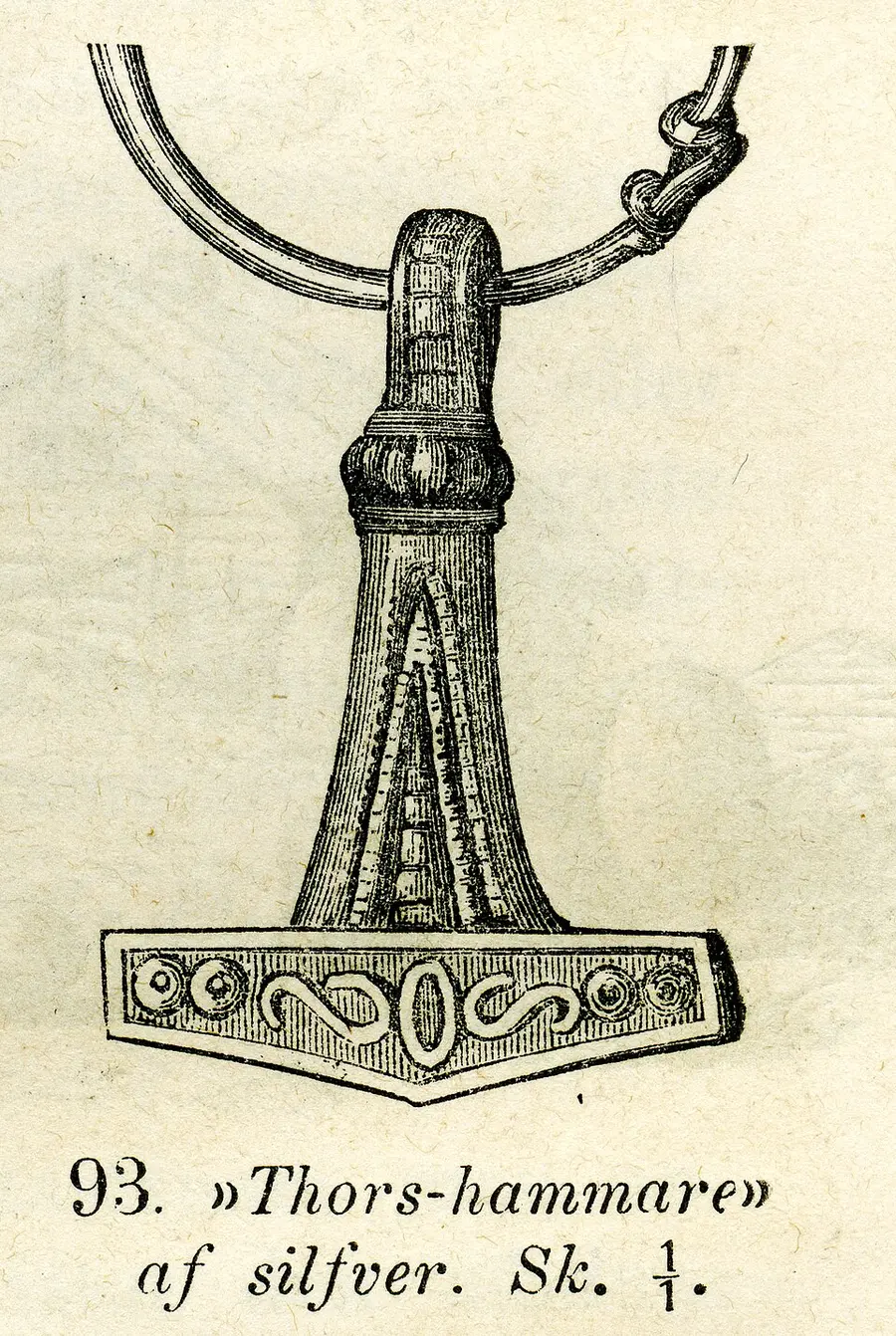 Oscar Montelius, silver Thor's-hammer amulet from Skåne, engraving (1873) An 1873 engraving of a silver Thor's-hammer pendant from Skåne, a raptor's head at its loop — the everyday amulet form of the hammer, worn at the throat for protection and the commonest religious object in the Norse record. Thor's hammer. The mythological weapon Thor wielded against the
jötnar, the giants; struck with such force that it produced
thunder, and always returned to his hand when thrown. In daily
Norse religion Mjölnir lived as a small iron or silver amulet —
the hammer-shape pendant worn at the throats of children, women,
and men of every rank. The Mjölnir pendant was protection rather
than decoration: a household-scale piece of Thor's covering for
the ordinary disasters that could undo a farm. The commonest
religious object in the entire Norse archaeological record, with
thousands of surviving examples from across Scandinavia and the
Norse settlements.
Also discussed in Worshiping Odin and Thor — the lived religion of pre-Christian Norway — the hammer that always hits and always returns. Where Odin is the god of kings and poets, Thor is the god of farmers and sailors: the protector, the weather, the one whose small hammer amulets turn up in Viking-Age graves across Scandinavia the way crosses turn up in Christian ones. His great enemy is The Midgard serpent
Oscar Montelius, silver Thor's-hammer amulet from Skåne, engraving (1873) An 1873 engraving of a silver Thor's-hammer pendant from Skåne, a raptor's head at its loop — the everyday amulet form of the hammer, worn at the throat for protection and the commonest religious object in the Norse record. Thor's hammer. The mythological weapon Thor wielded against the
jötnar, the giants; struck with such force that it produced
thunder, and always returned to his hand when thrown. In daily
Norse religion Mjölnir lived as a small iron or silver amulet —
the hammer-shape pendant worn at the throats of children, women,
and men of every rank. The Mjölnir pendant was protection rather
than decoration: a household-scale piece of Thor's covering for
the ordinary disasters that could undo a farm. The commonest
religious object in the entire Norse archaeological record, with
thousands of surviving examples from across Scandinavia and the
Norse settlements.
Also discussed in Worshiping Odin and Thor — the lived religion of pre-Christian Norway — the hammer that always hits and always returns. Where Odin is the god of kings and poets, Thor is the god of farmers and sailors: the protector, the weather, the one whose small hammer amulets turn up in Viking-Age graves across Scandinavia the way crosses turn up in Christian ones. His great enemy is The Midgard serpent 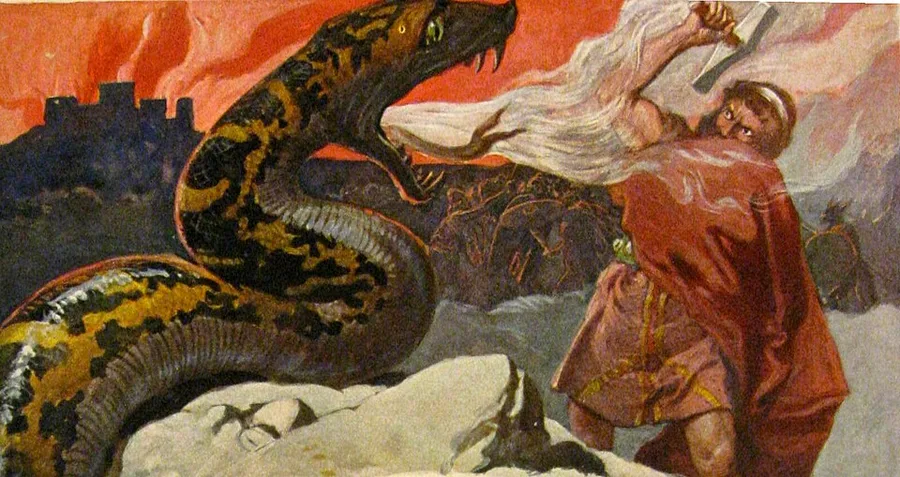 Emil Doepler, Thor und die Midgardsschlange (c. 1905), from Walhall, die Götterwelt der Germanen Emil Doepler's c. 1905 plate of Thor, hammer raised, meeting the rearing world-serpent Jörmungandr — the coiled sea-monster that rings the human world and that the thunder-god both hooks in the myth and dies killing at Ragnarok. Jörmungandr, the world-serpent of Norse mythology — a child of
Loki hurled by Odin into the ocean that rings Midgard, where
it grew until it circled the whole human world and bit its own
tail. Thor hooked it once: fishing with the giant Hymir, he
baited a strong line with the head of Hymir's largest ox,
rowed out past the giant's protest, and drew the serpent to
the gunwale — and as he raised the hammer, the terrified Hymir
cut the line. The scene is older than the Eddas: Bragi
Boddason's ninth-century Ragnarsdrápa already paints it, and
it returns in the Eddic Hymiskviða and in Snorri's
Gylfaginning. At Ragnarok serpent and thunder-god kill each
other — Thor strikes it down, walks nine steps, and falls
dead of its venom.
, the world-circling snake in the ocean, and their final meeting is already scheduled.
Emil Doepler, Thor und die Midgardsschlange (c. 1905), from Walhall, die Götterwelt der Germanen Emil Doepler's c. 1905 plate of Thor, hammer raised, meeting the rearing world-serpent Jörmungandr — the coiled sea-monster that rings the human world and that the thunder-god both hooks in the myth and dies killing at Ragnarok. Jörmungandr, the world-serpent of Norse mythology — a child of
Loki hurled by Odin into the ocean that rings Midgard, where
it grew until it circled the whole human world and bit its own
tail. Thor hooked it once: fishing with the giant Hymir, he
baited a strong line with the head of Hymir's largest ox,
rowed out past the giant's protest, and drew the serpent to
the gunwale — and as he raised the hammer, the terrified Hymir
cut the line. The scene is older than the Eddas: Bragi
Boddason's ninth-century Ragnarsdrápa already paints it, and
it returns in the Eddic Hymiskviða and in Snorri's
Gylfaginning. At Ragnarok serpent and thunder-god kill each
other — Thor strikes it down, walks nine steps, and falls
dead of its venom.
, the world-circling snake in the ocean, and their final meeting is already scheduled.
Loki 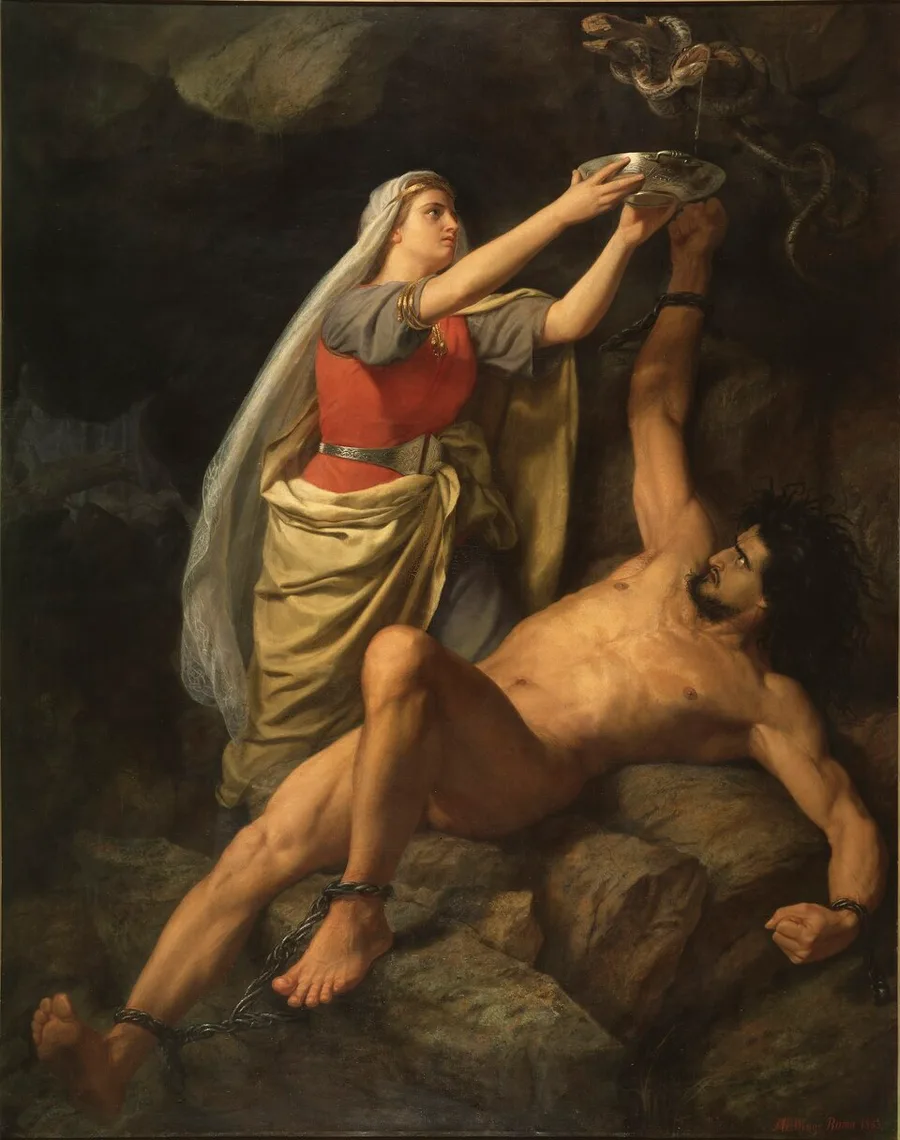 Mårten Eskil Winge, Loke och Sigyn (1863), Nationalmuseum, Stockholm (NM 18041) Winge painted Loki's punishment — the trickster chained in a cave beneath a venom-dripping serpent while his wife Sigyn holds a bowl to catch the drops, where he lies bound until Ragnarok. The trickster of Norse mythology — a giant's son by birth,
Odin's sworn blood-brother by oath, at home among the gods
and loyal to no one. Snorri's Prose Edda (c. 1220s) made
him the engine of the myths' trouble: by the giantess
Angrboda he fathered the wolf Fenrir, the Midgard serpent,
and Hel, queen of the dead; in a mare's shape he himself
bore Sleipnir, Odin's eight-legged horse. His deepest
malice was Balder's death — the mistletoe dart he placed
in the blind god Hod's hand. For it the gods bound him in
a cave beneath a serpent dripping venom, where he lies
until Ragnarok, when he breaks free and comes against his
former companions with the host of the dead — in the
Völuspá's telling, steering their ship in from the east.
is the problem. Neither fully god nor fully giant, he lives among the gods as Odin’s blood-brother — clever where they are strong, the one who causes most of the trouble and then gets dragged back to fix it. The gods keep him around because his tricks work. The price arrives slowly: Loki fathers three monsters — the wolf Fenrir
Mårten Eskil Winge, Loke och Sigyn (1863), Nationalmuseum, Stockholm (NM 18041) Winge painted Loki's punishment — the trickster chained in a cave beneath a venom-dripping serpent while his wife Sigyn holds a bowl to catch the drops, where he lies bound until Ragnarok. The trickster of Norse mythology — a giant's son by birth,
Odin's sworn blood-brother by oath, at home among the gods
and loyal to no one. Snorri's Prose Edda (c. 1220s) made
him the engine of the myths' trouble: by the giantess
Angrboda he fathered the wolf Fenrir, the Midgard serpent,
and Hel, queen of the dead; in a mare's shape he himself
bore Sleipnir, Odin's eight-legged horse. His deepest
malice was Balder's death — the mistletoe dart he placed
in the blind god Hod's hand. For it the gods bound him in
a cave beneath a serpent dripping venom, where he lies
until Ragnarok, when he breaks free and comes against his
former companions with the host of the dead — in the
Völuspá's telling, steering their ship in from the east.
is the problem. Neither fully god nor fully giant, he lives among the gods as Odin’s blood-brother — clever where they are strong, the one who causes most of the trouble and then gets dragged back to fix it. The gods keep him around because his tricks work. The price arrives slowly: Loki fathers three monsters — the wolf Fenrir 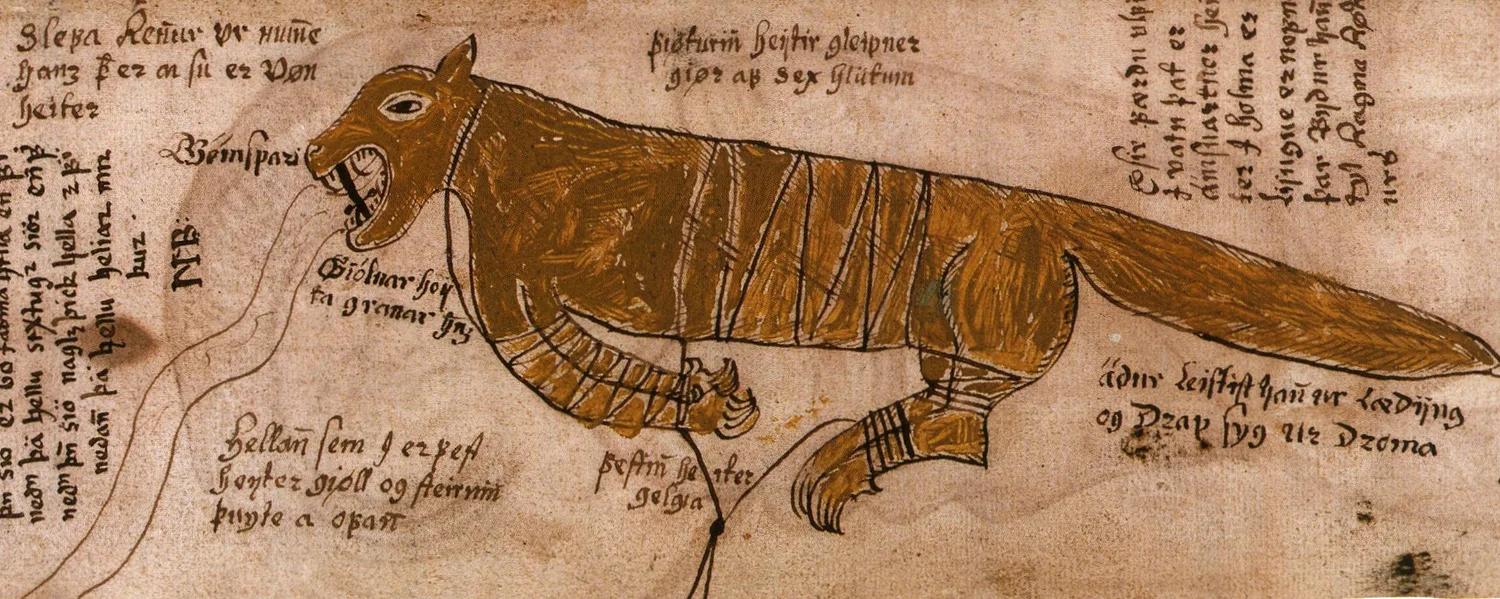 Fenrir bound, from AM 738 4to (Iceland, 1680), Árni Magnússon Institute An Icelandic scribe's Fenrir, drawn four and a half centuries after Snorri wrote the binding down — the wolf held fast by the silk-smooth fetter, the sword the gods set to prop his jaws, and the slaver running out as the river Ván: the trick's aftermath, waiting for Ragnarok. The great wolf of Norse mythology, son of Loki and the
giantess Angrboda, raised in Asgard among the gods who had
heard the prophecies against him. In Snorri's Gylfaginning
(c. 1220s) the wolf snapped two iron fetters as if in play;
the third, the dwarf-made Gleipnir, was smooth as a silk
ribbon and woven of six impossible things — the sound of a
cat's footfall, the beard of a woman, the roots of a mountain,
the sinews of a bear, the breath of a fish, and the spittle
of a bird. Tyr placed his right hand in the wolf's mouth as a
pledge and lost it when the binding held. At Ragnarok Fenrir
breaks free, swallows Odin, and is killed by Odin's son Vidar,
who tears the wolf's jaws apart.
, the Midgard serpent, and Hel, the queen of the dead — and each is bound or banished, and none of the bindings will hold forever.
Fenrir bound, from AM 738 4to (Iceland, 1680), Árni Magnússon Institute An Icelandic scribe's Fenrir, drawn four and a half centuries after Snorri wrote the binding down — the wolf held fast by the silk-smooth fetter, the sword the gods set to prop his jaws, and the slaver running out as the river Ván: the trick's aftermath, waiting for Ragnarok. The great wolf of Norse mythology, son of Loki and the
giantess Angrboda, raised in Asgard among the gods who had
heard the prophecies against him. In Snorri's Gylfaginning
(c. 1220s) the wolf snapped two iron fetters as if in play;
the third, the dwarf-made Gleipnir, was smooth as a silk
ribbon and woven of six impossible things — the sound of a
cat's footfall, the beard of a woman, the roots of a mountain,
the sinews of a bear, the breath of a fish, and the spittle
of a bird. Tyr placed his right hand in the wolf's mouth as a
pledge and lost it when the binding held. At Ragnarok Fenrir
breaks free, swallows Odin, and is killed by Odin's son Vidar,
who tears the wolf's jaws apart.
, the Midgard serpent, and Hel, the queen of the dead — and each is bound or banished, and none of the bindings will hold forever.
Around these three stands the rest of the family: Frigg 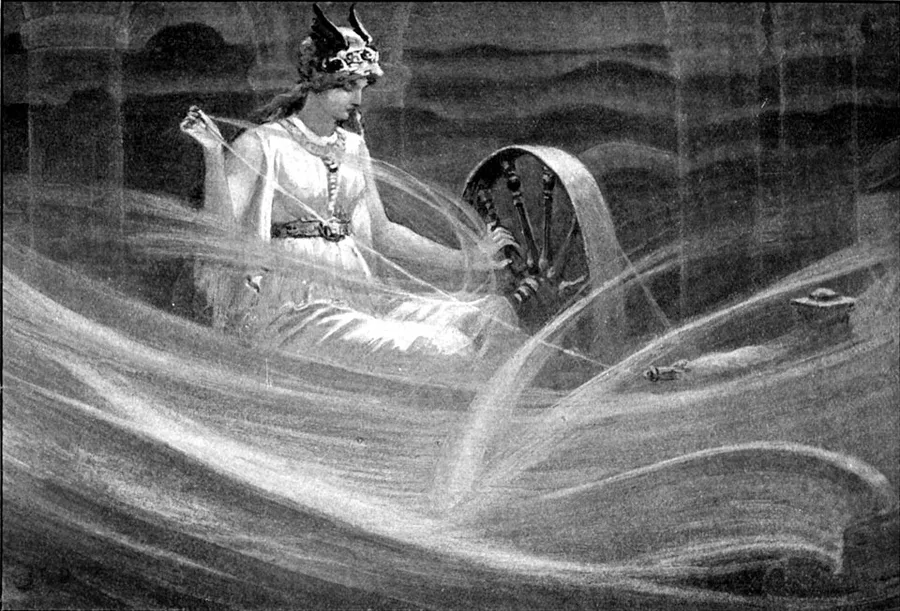 John Charles Dollman, Frigga Spinning the Clouds (1909), from H. A. Guerber, Myths of the Norsemen John Charles Dollman imagines the goddess spinning cloud-wool into thread at a wheel in the sky — a 1909 allegory of Odin's wife, foremost of the goddesses, who was said to know every fate and tell none of it. Odin's wife and, in Snorri's Prose Edda (c. 1220s), the
foremost of the goddesses — the ásynjur. The Eddic poem
Lokasenna gave her the trait the whole tradition
repeats: she knew the fate of every being and told none of
it. Her love for her son Balder frames the mythology's
central tragedy — she took an oath from fire, water, iron,
stone, every beast and every sickness that none would harm
him, passing over only the mistletoe, too young and soft
to swear. Medieval and modern writers often ran her
together with Freyja; the two share old roots and
overlapping domains, but the Eddas keep the wife of Odin
and the Vanir goddess distinct.
, Odin’s wife, who knows every fate and tells none of them; Freyja
John Charles Dollman, Frigga Spinning the Clouds (1909), from H. A. Guerber, Myths of the Norsemen John Charles Dollman imagines the goddess spinning cloud-wool into thread at a wheel in the sky — a 1909 allegory of Odin's wife, foremost of the goddesses, who was said to know every fate and tell none of it. Odin's wife and, in Snorri's Prose Edda (c. 1220s), the
foremost of the goddesses — the ásynjur. The Eddic poem
Lokasenna gave her the trait the whole tradition
repeats: she knew the fate of every being and told none of
it. Her love for her son Balder frames the mythology's
central tragedy — she took an oath from fire, water, iron,
stone, every beast and every sickness that none would harm
him, passing over only the mistletoe, too young and soft
to swear. Medieval and modern writers often ran her
together with Freyja; the two share old roots and
overlapping domains, but the Eddas keep the wife of Odin
and the Vanir goddess distinct.
, Odin’s wife, who knows every fate and tells none of them; Freyja 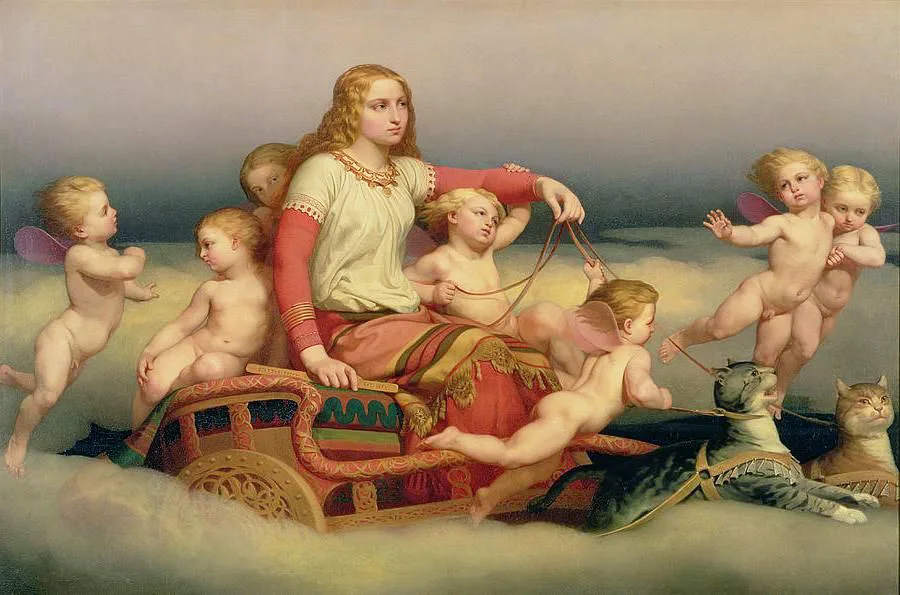 Nils Blommér, Freja sökande sin make (1852), Nationalmuseum, Stockholm Nils Blommér's 1852 imagining of Freyja crossing the night sky in the chariot drawn by two cats that Norse tradition gave her, trailed by small winged spirits. Norse goddess of love, fertility, beauty, gold, and the magic of
seiðr; sister of Frey and a leading member of the Vanir.
Travelled in a chariot drawn by two cats and possessed the
feather-cloak that allowed wearers to fly in falcon shape. In the
battle-afterlife she received half of those who died well — the
other half going to Odin's Valhalla — and brought them to her own
hall, Folkvang ("Field of the Host"). Norse tradition held that
she taught the seiðr magic to Odin himself; the woman-bound craft
of the völva was understood as her gift.
Also discussed in Worshiping Odin and Thor — the lived religion of pre-Christian Norway , goddess of love, war, and magic, who receives half the battle-dead in her own hall and drives a chariot pulled by cats; and her brother Frey
Nils Blommér, Freja sökande sin make (1852), Nationalmuseum, Stockholm Nils Blommér's 1852 imagining of Freyja crossing the night sky in the chariot drawn by two cats that Norse tradition gave her, trailed by small winged spirits. Norse goddess of love, fertility, beauty, gold, and the magic of
seiðr; sister of Frey and a leading member of the Vanir.
Travelled in a chariot drawn by two cats and possessed the
feather-cloak that allowed wearers to fly in falcon shape. In the
battle-afterlife she received half of those who died well — the
other half going to Odin's Valhalla — and brought them to her own
hall, Folkvang ("Field of the Host"). Norse tradition held that
she taught the seiðr magic to Odin himself; the woman-bound craft
of the völva was understood as her gift.
Also discussed in Worshiping Odin and Thor — the lived religion of pre-Christian Norway , goddess of love, war, and magic, who receives half the battle-dead in her own hall and drives a chariot pulled by cats; and her brother Frey 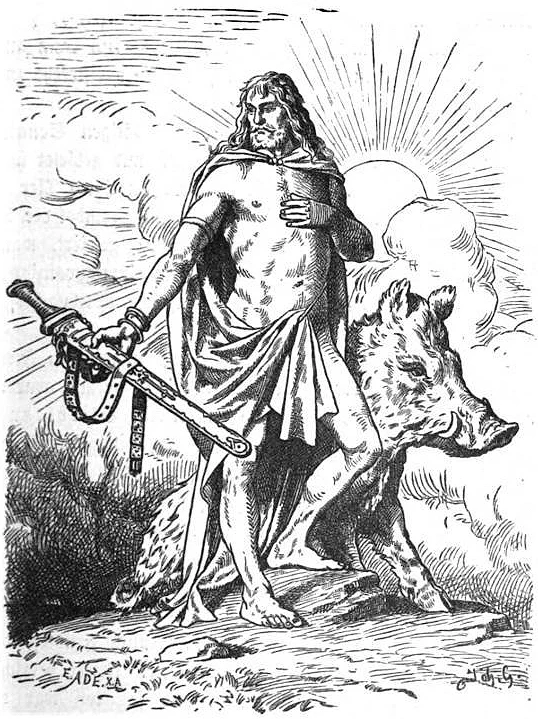 Johannes Gehrts, Freyr (published 1901), wood engraving by Eduard Ade Frey with the two attributes his myth keeps returning to — the sword he gives away for love of the giantess Gerd, a bargain that leaves him weaponless at Ragnarok, and the gold-bristled boar Gullinbursti the dwarves forged for him. Old Norse god (Old Norse Freyr, "lord") of fertility, prosperity,
fair weather, peace, and good harvest, brother of Freyja and one of
the principal Vanir deities incorporated into the Æsir pantheon.
The Yngling dynasty of Vestfold claimed direct descent from Frey
through the line traced in Ynglingatal; the claim was a religious
legitimation of the dynasty's right to rule.
Also discussed in Before There Was Norway — petty kingdoms at the edge of the worldWorshiping Odin and Thor — the lived religion of pre-Christian Norway , god of harvest and fertility, to whom farmers sacrificed for a good year. Then Balder
Johannes Gehrts, Freyr (published 1901), wood engraving by Eduard Ade Frey with the two attributes his myth keeps returning to — the sword he gives away for love of the giantess Gerd, a bargain that leaves him weaponless at Ragnarok, and the gold-bristled boar Gullinbursti the dwarves forged for him. Old Norse god (Old Norse Freyr, "lord") of fertility, prosperity,
fair weather, peace, and good harvest, brother of Freyja and one of
the principal Vanir deities incorporated into the Æsir pantheon.
The Yngling dynasty of Vestfold claimed direct descent from Frey
through the line traced in Ynglingatal; the claim was a religious
legitimation of the dynasty's right to rule.
Also discussed in Before There Was Norway — petty kingdoms at the edge of the worldWorshiping Odin and Thor — the lived religion of pre-Christian Norway , god of harvest and fertility, to whom farmers sacrificed for a good year. Then Balder 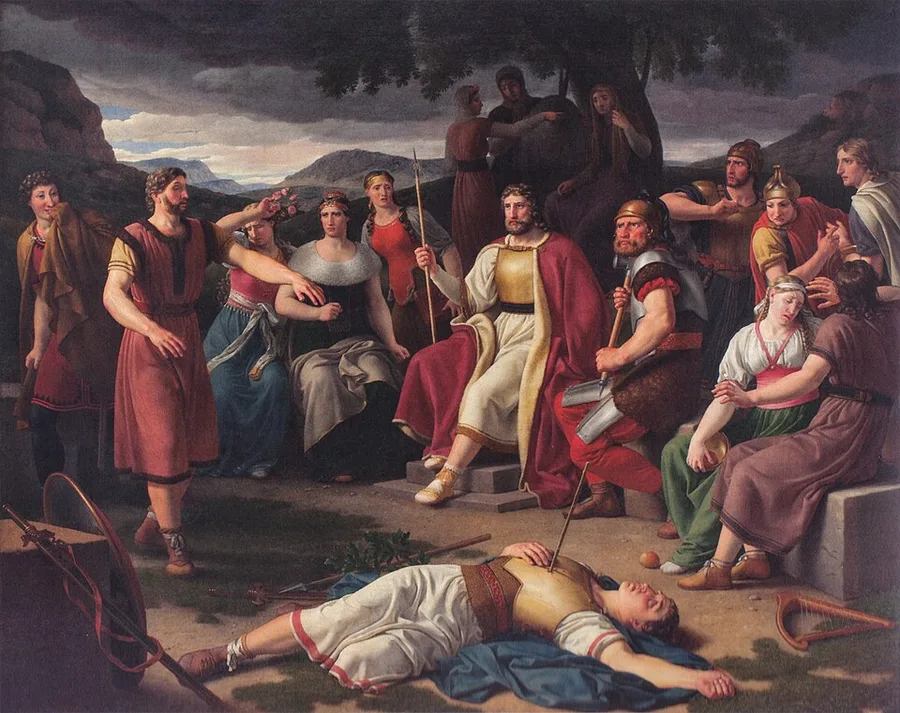 C. W. Eckersberg, Balders død (1817), Royal Danish Academy of Fine Arts, Copenhagen Balder has no portrait; his whole myth is his death. C. W. Eckersberg's 1817 canvas paints that moment — the gods gathered in grief, the mistletoe dart his blind brother threw still standing in his chest. The bright god — in Snorri's Prose Edda (c. 1220s) the
fairest, wisest, and most beloved of the Æsir, son of Odin
and Frigg. His whole story is his death: made invulnerable
by his mother's oath-taking, he fell to a mistletoe dart
thrown by his blind brother Hod with Loki guiding the aim.
Hel agreed to release him if every thing in the world wept
for him; everything did except one giantess in a cave,
Thokk — understood to be Loki in disguise — and Balder
stayed among the dead. Voluspá, the seeress's prophecy
in the Poetic Edda, grants him the mythology's one
consolation: after Ragnarok he returns to the risen green
earth, where the unsown fields bear.
, the bright one, the most beloved of the gods, whose whole story is his death; one-handed Tyr
C. W. Eckersberg, Balders død (1817), Royal Danish Academy of Fine Arts, Copenhagen Balder has no portrait; his whole myth is his death. C. W. Eckersberg's 1817 canvas paints that moment — the gods gathered in grief, the mistletoe dart his blind brother threw still standing in his chest. The bright god — in Snorri's Prose Edda (c. 1220s) the
fairest, wisest, and most beloved of the Æsir, son of Odin
and Frigg. His whole story is his death: made invulnerable
by his mother's oath-taking, he fell to a mistletoe dart
thrown by his blind brother Hod with Loki guiding the aim.
Hel agreed to release him if every thing in the world wept
for him; everything did except one giantess in a cave,
Thokk — understood to be Loki in disguise — and Balder
stayed among the dead. Voluspá, the seeress's prophecy
in the Poetic Edda, grants him the mythology's one
consolation: after Ragnarok he returns to the risen green
earth, where the unsown fields bear.
, the bright one, the most beloved of the gods, whose whole story is his death; one-handed Tyr 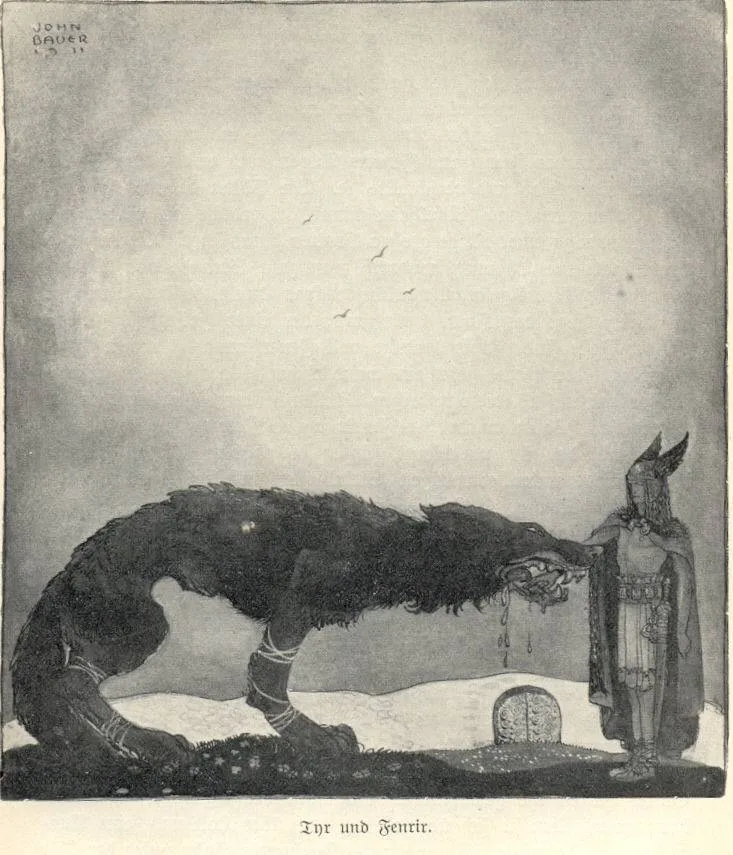 John Bauer, Týr and Fenrir (1911), from Viktor Rydberg, Fädernas gudasaga Bauer catches the moment that cost the god his hand: Tyr stands his ground as the wolf Fenrir clamps down on the right hand he laid in its jaws as a pledge of good faith, knowing the gods meant to break it. The one-handed god of Norse mythology — the god of the
pledged oath, of law, and of courage in battle; Snorri's
Prose Edda (c. 1220s) calls him the boldest of the Æsir.
When the gods tricked the wolf Fenrir into the unbreakable
silken fetter Gleipnir, the wolf demanded a pledge of good
faith, and Tyr alone laid his right hand in its mouth —
knowing, as all the gods knew, that the promise would be
broken. The wolf bit the hand off at the wrist; Tyr paid
the price of the gods' word. His name is among the oldest
in the pantheon: from Proto-Germanic Tīwaz, cognate with
Latin deus, "god" — a name that survives in the weekday,
English Tuesday and Norwegian tirsdag, Tyr's day.
, who put his right hand in the wolf Fenrir’s mouth as a pledge the gods knew they would break — the mythology’s picture of what an oath costs; and Heimdall on the bridge, holding the horn that will announce the end. Facing them all are the giants — Jotner (the giants)
John Bauer, Týr and Fenrir (1911), from Viktor Rydberg, Fädernas gudasaga Bauer catches the moment that cost the god his hand: Tyr stands his ground as the wolf Fenrir clamps down on the right hand he laid in its jaws as a pledge of good faith, knowing the gods meant to break it. The one-handed god of Norse mythology — the god of the
pledged oath, of law, and of courage in battle; Snorri's
Prose Edda (c. 1220s) calls him the boldest of the Æsir.
When the gods tricked the wolf Fenrir into the unbreakable
silken fetter Gleipnir, the wolf demanded a pledge of good
faith, and Tyr alone laid his right hand in its mouth —
knowing, as all the gods knew, that the promise would be
broken. The wolf bit the hand off at the wrist; Tyr paid
the price of the gods' word. His name is among the oldest
in the pantheon: from Proto-Germanic Tīwaz, cognate with
Latin deus, "god" — a name that survives in the weekday,
English Tuesday and Norwegian tirsdag, Tyr's day.
, who put his right hand in the wolf Fenrir’s mouth as a pledge the gods knew they would break — the mythology’s picture of what an oath costs; and Heimdall on the bridge, holding the horn that will announce the end. Facing them all are the giants — Jotner (the giants) 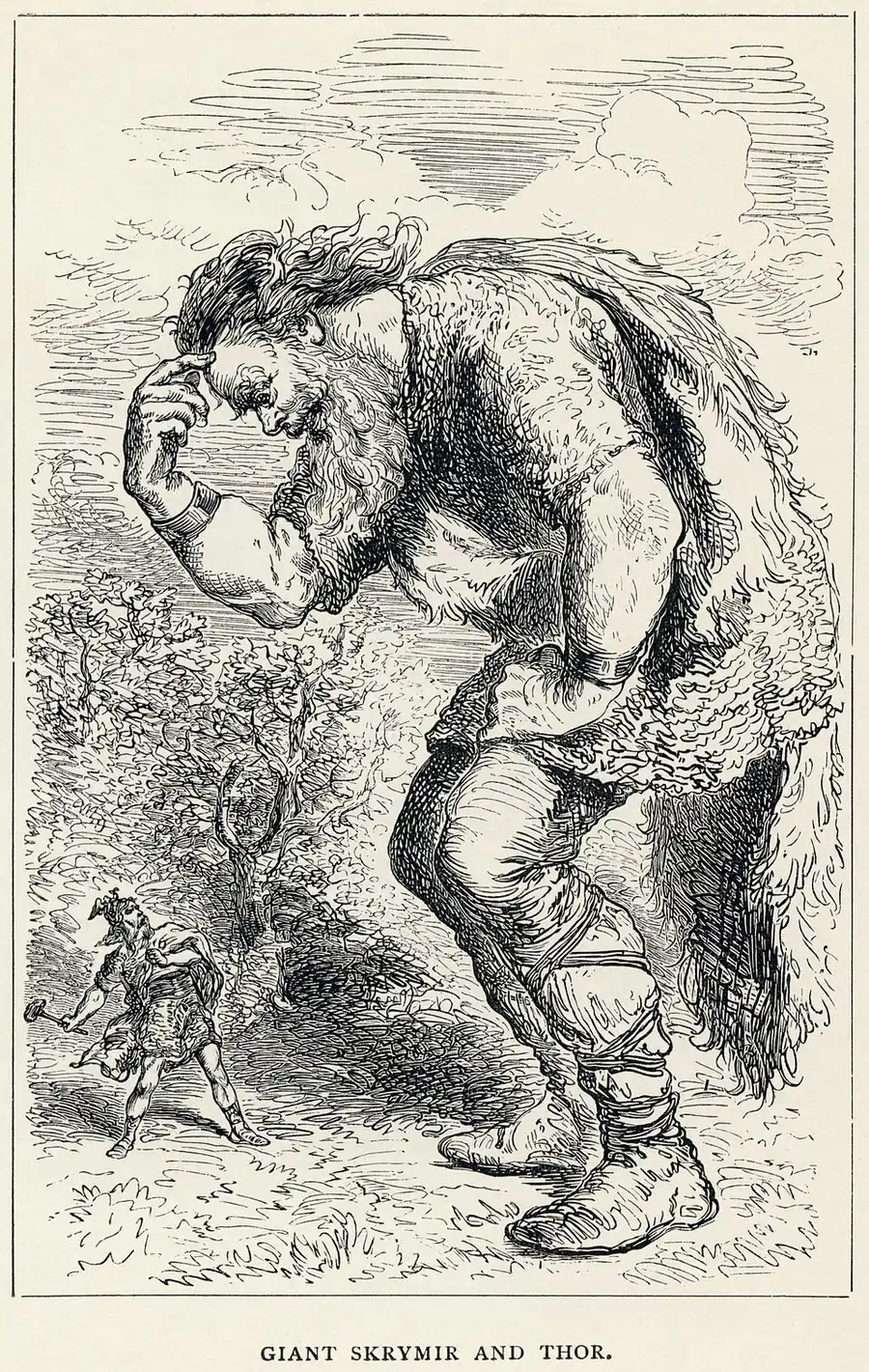 Louis Huard, The Giant Skrymir and Thor (1900 ed.), from A. & E. Keary, The Heroes of Asgard Louis Huard's illustration of the giant Skrymir asleep like a hillside while a tiny Thor stands over him, hammer raised — the jotner of Norse myth were mountain-scaled powers the gods could rarely simply overpower. The giants of Norse mythology — Norwegian jotner, Old Norse
jötnar — the powers of mountain, storm, sea, and chaos,
dwelling in Jotunheim at the world's outer edge. They were
never a simple enemy army: the gods married giants (Frey won
the giantess Gerd, Njord wed Skadi), drank in the sea-giant
Ægir's hall, and out-riddled them — in the Eddic
Vafþrúðnismál Odin defeated the giant Vafthrudnir in a
contest of wisdom — and half the pantheon carried giant blood:
Odin's mother was the giantess Bestla, Thor's was Jord, the
earth herself, a giant's daughter in Snorri's reckoning. The
world itself was built from the body of the slain frost-giant
Ymir. The word outlived the religion: the valley-striding
jutul of later Norwegian folklore keeps the old name.
— the powers of mountain, storm, and chaos. The relationship is not simple war: the gods marry giants, drink with giants, and out-riddle giants, and half the pantheon has giant blood. The giants are less an enemy army than the wild world itself, held at arm’s length and never farther.
Louis Huard, The Giant Skrymir and Thor (1900 ed.), from A. & E. Keary, The Heroes of Asgard Louis Huard's illustration of the giant Skrymir asleep like a hillside while a tiny Thor stands over him, hammer raised — the jotner of Norse myth were mountain-scaled powers the gods could rarely simply overpower. The giants of Norse mythology — Norwegian jotner, Old Norse
jötnar — the powers of mountain, storm, sea, and chaos,
dwelling in Jotunheim at the world's outer edge. They were
never a simple enemy army: the gods married giants (Frey won
the giantess Gerd, Njord wed Skadi), drank in the sea-giant
Ægir's hall, and out-riddled them — in the Eddic
Vafþrúðnismál Odin defeated the giant Vafthrudnir in a
contest of wisdom — and half the pantheon carried giant blood:
Odin's mother was the giantess Bestla, Thor's was Jord, the
earth herself, a giant's daughter in Snorri's reckoning. The
world itself was built from the body of the slain frost-giant
Ymir. The word outlived the religion: the valley-striding
jutul of later Norwegian folklore keeps the old name.
— the powers of mountain, storm, and chaos. The relationship is not simple war: the gods marry giants, drink with giants, and out-riddle giants, and half the pantheon has giant blood. The giants are less an enemy army than the wild world itself, held at arm’s length and never farther.
One long story, and it ends
What makes Norse mythology unusual is that it is not a loose heap of tales. It is one long story with a beginning, a middle, and — almost uniquely among the world’s mythologies — a scheduled ending that the gods themselves know about in advance.
The middle of the story turns on the death of Balder. The bright god dreams of his own death; his mother Frigg extracts an oath from every thing in the world — fire, water, iron, stone, every sickness, every beast — that it will not harm him, and the gods make a game of throwing weapons at the one being who cannot be hurt. Loki, disguised, learns that one plant was skipped: the mistletoe, too young and soft to swear. He carves a dart of it and guides the hand of Balder’s blind brother. The best of the gods falls dead in the middle of the game. Hel offers to release him if every thing in the world will weep for him, and every thing does — except one old giantess in a cave, who refuses, and who is generally understood to be Loki again. For that, the gods bind Loki in a cave with a serpent dripping venom onto his face until the end of the world — which his punishment now guarantees, because the bound wolf, the serpent in the sea, and Loki himself will all break free on the same day.
That day is Ragnarok 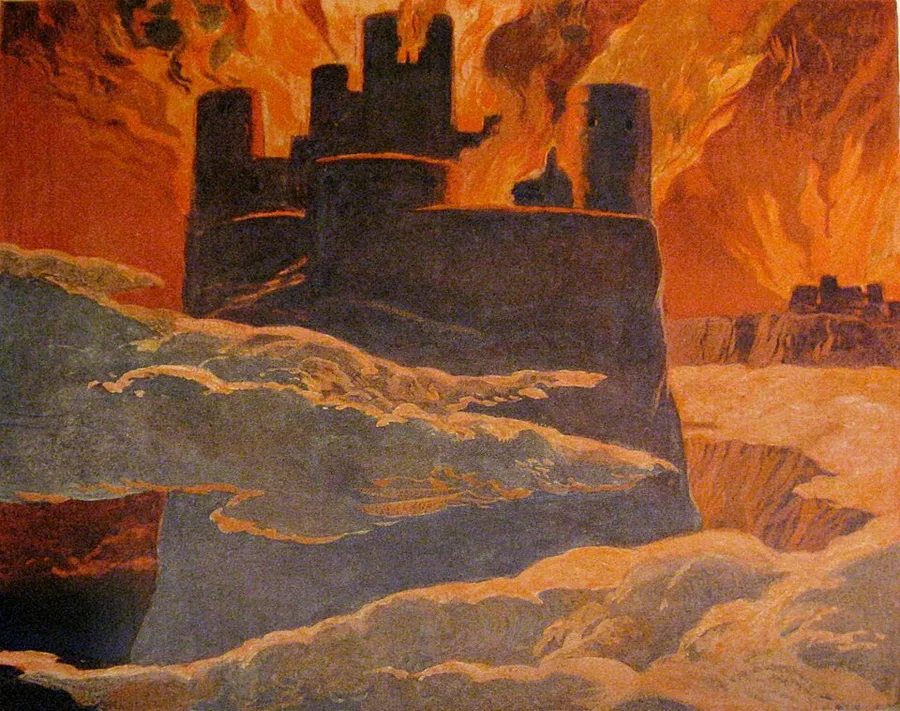 Emil Doepler, Ragnarök (c. 1905), from Walhall, die Götterwelt der Germanen Emil Doepler's Ragnarök plate of around 1905 — a stronghold swallowed in flame above rolling smoke, the world-fire of the final battle in which most of the Norse gods fall and the world burns before rising anew. The end of the world in Norse mythology — Ragnarǫk, "the doom
(or twilight) of the gods." A final battle in which the world-
serpent Jörmungandr, the wolf Fenrir, the fire-giant Surtr, the
forces of the jötnar, and Loki break free of their constraints
and meet the Æsir in open battle. Most of the major gods are
killed: Odin by Fenrir, Thor by Jörmungandr (and the serpent by
Thor in the same exchange), Frey by Surtr's flaming sword. The
world burns and sinks into the sea, then rises again, and a small
remnant of gods and humans repopulates it. The central narrative
of pre-Christian Norse religious imagination, distinct from the
Christian apocalypse it superficially resembles in being a battle
the gods are going to lose.
Also discussed in Worshiping Odin and Thor — the lived religion of pre-Christian Norway — the doom of the gods. Three winters come with no summer between them. Heimdall’s horn sounds. The wolf swallows the sun, and its brother swallows the moon. A ship made of dead men’s fingernails slips its moorings, Loki comes on with the host of the dead, the fire-giant Surt marches with a burning sword, and the gods arm for the battle they have always known they lose. Odin is swallowed by the wolf Fenrir. Thor kills the Midgard serpent and walks nine steps before its venom kills him. Surt’s fire takes the rest, and the sea closes over the burned world.
Emil Doepler, Ragnarök (c. 1905), from Walhall, die Götterwelt der Germanen Emil Doepler's Ragnarök plate of around 1905 — a stronghold swallowed in flame above rolling smoke, the world-fire of the final battle in which most of the Norse gods fall and the world burns before rising anew. The end of the world in Norse mythology — Ragnarǫk, "the doom
(or twilight) of the gods." A final battle in which the world-
serpent Jörmungandr, the wolf Fenrir, the fire-giant Surtr, the
forces of the jötnar, and Loki break free of their constraints
and meet the Æsir in open battle. Most of the major gods are
killed: Odin by Fenrir, Thor by Jörmungandr (and the serpent by
Thor in the same exchange), Frey by Surtr's flaming sword. The
world burns and sinks into the sea, then rises again, and a small
remnant of gods and humans repopulates it. The central narrative
of pre-Christian Norse religious imagination, distinct from the
Christian apocalypse it superficially resembles in being a battle
the gods are going to lose.
Also discussed in Worshiping Odin and Thor — the lived religion of pre-Christian Norway — the doom of the gods. Three winters come with no summer between them. Heimdall’s horn sounds. The wolf swallows the sun, and its brother swallows the moon. A ship made of dead men’s fingernails slips its moorings, Loki comes on with the host of the dead, the fire-giant Surt marches with a burning sword, and the gods arm for the battle they have always known they lose. Odin is swallowed by the wolf Fenrir. Thor kills the Midgard serpent and walks nine steps before its venom kills him. Surt’s fire takes the rest, and the sea closes over the burned world.
And then — this is the part the doom-and-gloom reputation leaves out — the earth rises out of the sea again, green. Balder comes back from the dead. A handful of young gods survive, two humans who sheltered in the world-tree step out to repeople the earth, and a new sun, daughter of the old one, takes her mother’s road across the sky. The story ends the way the Norwegian year ends: total darkness, then, improbably, spring.
The people who believed it
For the Norwegians who actually held this faith — roughly up to the decades around the year 1000 — none of it was a book. There was no scripture, no creed, no professional priesthood, and no word for “religion”; the closest term, forn sed, means simply the old custom. Belief was something a farm did rather than something a person professed: sacrificial feasts — Blót 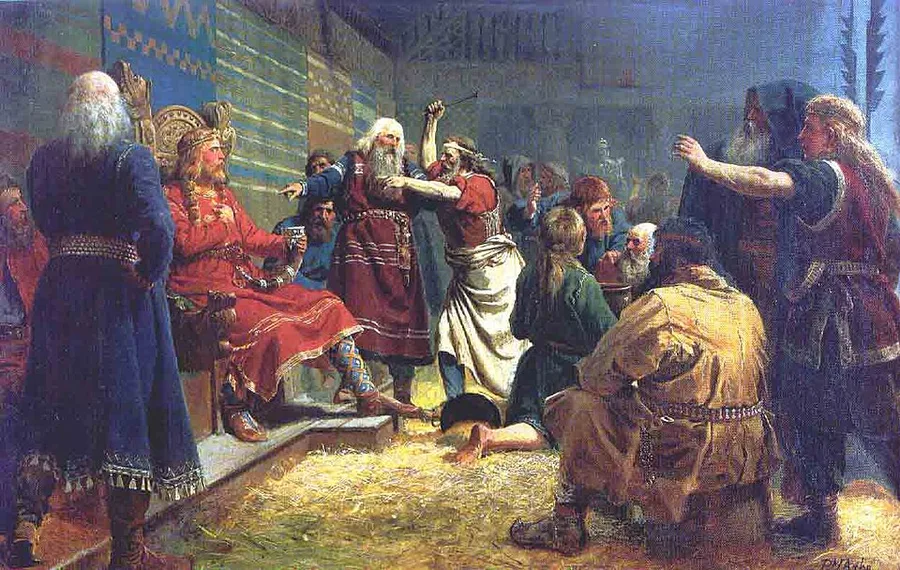 Peter Nicolai Arbo, Håkon den Gode og bøndene ved blotet på Mære (1860) Arbo stages the saga's most dramatic blót — Trøndelag farmers pressing King Håkon at the Mære midwinter feast. Behind the royal drama sits the plain form: an animal killed, the blood reddening altar and worshippers, the meat shared between gods and household, the horn passed with each draught dedicated. The central religious act of pre-Christian Norse society. A blót
was a sacrifice — typically of an animal — followed by a communal
feast that bound the household to its gods for the season ahead.
The shape held across rituals: an animal killed, the blood caught
and used to redden the altar and the worshippers (rjóða, "to
redden"), the meat boiled and shared between the gods (through the
flames) and the people (at the table), the drinking horn passed
with each draught dedicated to a god or to the dead. There was no
liturgy in the medieval-church sense — no book, no creed — just
the form the household had always done at that turn of the year.
Also discussed in Worshiping Odin and Thor — the lived religion of pre-Christian NorwayThe King Who Became a Saint — how the Nordmen came to Christ — at the turning points of the year; toasts drunk to Odin for victory and to Frey for a good harvest; the local chieftain presiding in his own hall; small carved figures and hammer amulets carried for protection; oaths sworn on holy rings. Different districts leaned toward different gods — the map of old place-names shows whole belts of the country that favored Thor, or Frey, or Ull, a god so old that little survives of him but his name on the land.
Peter Nicolai Arbo, Håkon den Gode og bøndene ved blotet på Mære (1860) Arbo stages the saga's most dramatic blót — Trøndelag farmers pressing King Håkon at the Mære midwinter feast. Behind the royal drama sits the plain form: an animal killed, the blood reddening altar and worshippers, the meat shared between gods and household, the horn passed with each draught dedicated. The central religious act of pre-Christian Norse society. A blót
was a sacrifice — typically of an animal — followed by a communal
feast that bound the household to its gods for the season ahead.
The shape held across rituals: an animal killed, the blood caught
and used to redden the altar and the worshippers (rjóða, "to
redden"), the meat boiled and shared between the gods (through the
flames) and the people (at the table), the drinking horn passed
with each draught dedicated to a god or to the dead. There was no
liturgy in the medieval-church sense — no book, no creed — just
the form the household had always done at that turn of the year.
Also discussed in Worshiping Odin and Thor — the lived religion of pre-Christian NorwayThe King Who Became a Saint — how the Nordmen came to Christ — at the turning points of the year; toasts drunk to Odin for victory and to Frey for a good harvest; the local chieftain presiding in his own hall; small carved figures and hammer amulets carried for protection; oaths sworn on holy rings. Different districts leaned toward different gods — the map of old place-names shows whole belts of the country that favored Thor, or Frey, or Ull, a god so old that little survives of him but his name on the land.
Underneath the practice sat the fatalism the myths teach. If the Norns have already spun the day of your death, then fear adds nothing and courage costs nothing extra — what remains in your control is the manner of your conduct, and the only thing that outlasts you is your reputation. Hávamál says it in the lines every Norwegian still meets at school: cattle die, kin die, you yourself will die — one thing never dies, the judgment on each one dead. Death itself was not a single destination: the chosen battle-dead went to Odin and Freyja, the drowned belonged to the sea, and most people went into the burial mound and onward to Hel’s gray country, which was not a punishment — just the quiet continuation of everyone ordinary. The great ship burials, and the graves stocked with tools, horses, and food, are that belief in physical form: the dead were travelers who would need their things.
It was also a faith with no jealousy in it. Nothing in the old custom forbade adding one more god, which is why the first Christian missionaries found Norwegians perfectly willing to accept Christ — as one power among many. The demand that they drop the others was the shocking part, and the kings enforced it with the sword across two bloody generations. The public cult ended around the year 1000; what could not be enforced away seeped downward instead, and much of the hidden-folk world of later Norwegian folklore — the beings under the hill, the offerings left at trees and stones — is the old faith’s furniture living on in the farmhouse dark, centuries after its gods were evicted.
What Norwegians kept
In Norway today the myths occupy the shelf Greek mythology occupies for an American schoolchild. They are taught as heritage and story, not as religion — every Norwegian child meets Yggdrasil, Odin’s ravens, and Thor’s goats in the early grades — and the place-names keep the gods on the map ten centuries after the last sacrifice. The language holds them too: ragnarok still stands in the Norwegian dictionary as a plain word for catastrophe and destruction, no theology attached.
Marvel’s Thor put a Norse god at the center of the world’s biggest film franchise — to Norwegian amusement, since the Thor of the Edda is a red-bearded farmer’s god with a temper, not a blond prince. Norwegian black metal took the mythology in a darker direction in the 1990s, the Vikings television generation arrived after that, and a small revival movement even practices a reconstructed version of the old faith, legally registered as a religious community — a curiosity in Norway itself, where the myths are loved almost entirely as literature.
What Norwegians actually retained is a temperament. The mythology’s signature idea — that the gods themselves fight on knowing the ending is bad, because fighting well matters more than winning — never needed belief to survive. It settled into the culture as a stance: stoic, weather-facing, unsentimental about outcomes. The gods left the religion and stayed in the character.