Trondheim
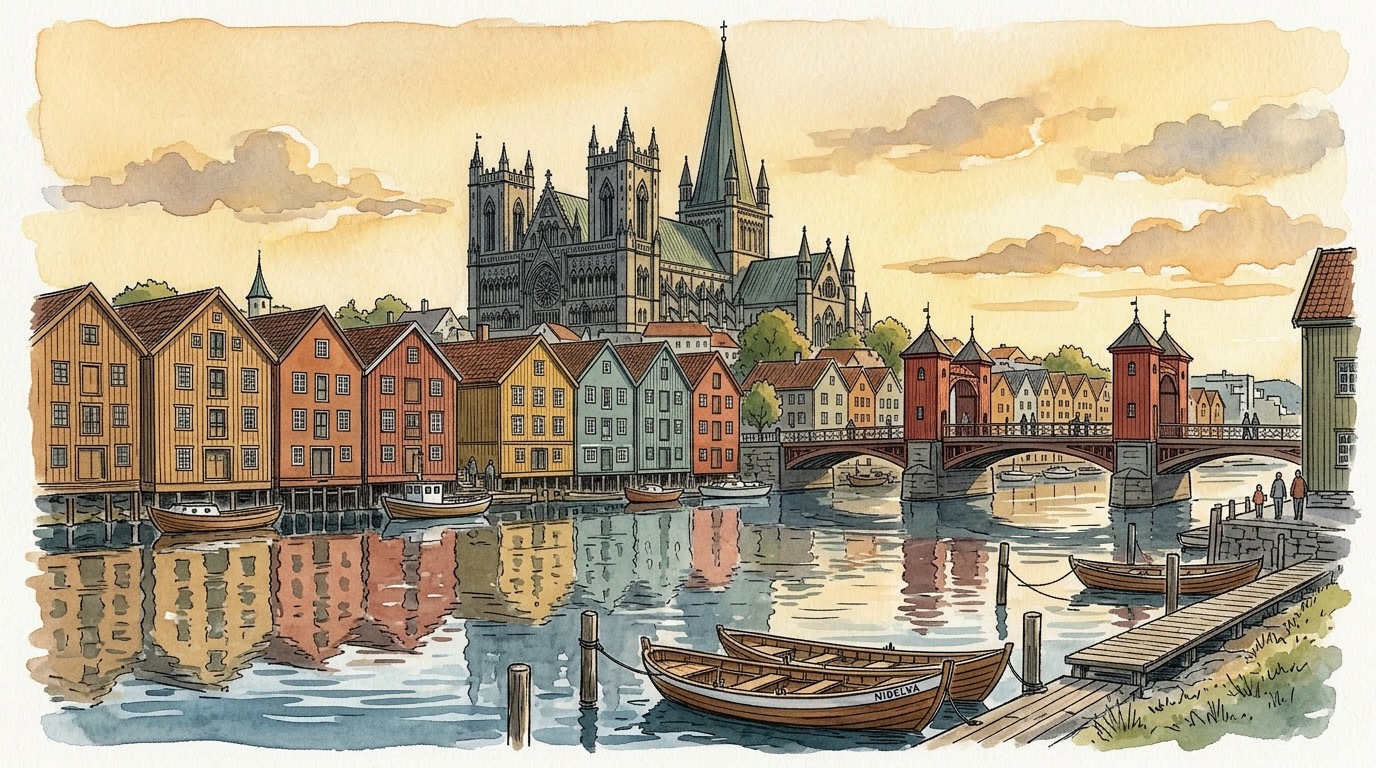
Norway's medieval capital — Nidaros Cathedral, Bakklandet's wooden old quarter, and the Trøndelag farming country east of the city.
Why this place
While the Ungdommene (the Youngsters) head west into fjord country, the Gråhårsklubben (the Oldsters) drive north — about seven hours up the E6 highway from Oslo — into the Trøndelag half of the trip. Trondheim is the regional anchor; the smaller visits are out beyond it.
What happens here
The hotel sits on the Nidelva river that gives the famous Nidaros Cathedral its name — two nights, Tuesday and Wednesday. Day 3 is the long drive itself: about seven hours up the E6 from Oslo, arriving in time for dinner on the Nidelva. Day 4 is the heritage day out into the Stjørdal valley — the parish churches at Værnes and Hegra, then upvalley to Kylloplass, the small holding. The day is unhurried; most of it is spent walking ground rather than seeing sights. Day 5 is the long drive south down the E6 to Lillehammer for the reunion.
Trondheim itself is the day-base rather than a sightseeing stop on this trip. The city landmarks worth a walk between meals:
- Nidaros Cathedral (Nidarosdomen) — the northernmost gothic cathedral in the world, built over the burial place of King Olav II and the destination of pilgrims walking from across northern Europe in the centuries before the Reformation. Several medieval Norwegian kings were buried here, and a memorial inside the cathedral honours them.
- Bakklandet — the surviving wooden old quarter on the eastern bank of the Nidelva river, painted in faded ochres and reds.
- Stiftsgården — the largest wooden royal residence in Northern Europe.
The two nights fall during Olavsfestdagene (the St. Olav Festival, 28 July – 3 August 2026), Trondheim’s big church-and-culture festival built around Olsok on 29 July and centred on Nidaros Cathedral and the old Archbishop’s Palace — worth knowing both for the atmosphere and because the cathedral precinct will be busy and partly given over to festival events on the days the family is in town.
Background
Trondheim was founded in 997 by King Olav Tryggvason and was the seat of the medieval Norwegian kingdom for the next two and a half centuries. The cathedral marks the spot where his successor, King Olav II — Olav the Holy — was buried after falling at the Battle of Stiklestad in 1030; a year later his body was enshrined as a saint, and the burial site became the most important pilgrimage destination in Northern Europe before the Reformation cut Scandinavia off from the Catholic pilgrimage circuit.
The region — Trøndelag — is the wider farming country east and north of the city. Stjørdal, Hegra, and Kylloplass are all within it, strung up the Stjørdalselva river east of Trondheim Airport. Parish life here goes back centuries; the small plasser — clearings worked from forest across generations — are the typical settlement pattern of the inland valleys.
Trondheim is the day base for reaching them — the medieval churches at Værnes and Hegra a half-hour east, and the long-emptied clearing-farm at Kylloplass further up the valley.
In Trondheim
Eat · Buy · Do
A short list of places to taste, things to bring home, and things to see.
Learn more
Journals from Trondheim
No posts yet. During the trip, journal entries and photos from Trondheim will appear here.