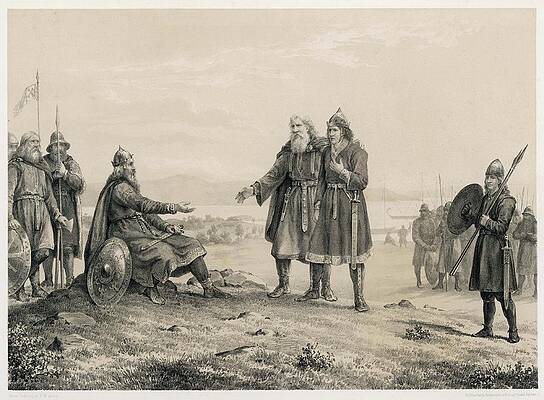
Before There Was Norway — Petty kingdoms at the edge of the world
In the winter of around 860, Halfdan the Black goes through the ice and drowns. His ten-year-old son inherits one small kingdom among perhaps a dozen along the coast — and over the next twenty years pulls them into the country that has been preparing to exist for centuries.
In the winter of around 860, the most ambitious king in southeastern Norway goes through the ice and drowns. His name is Halfdan the Black 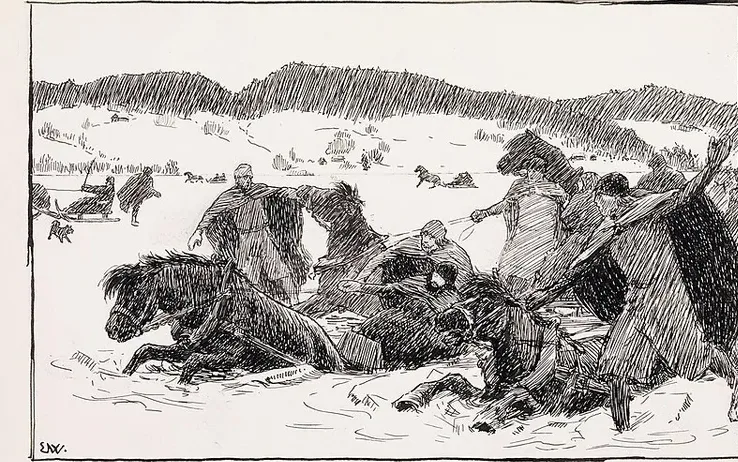 Erik Werenskiold, Halvdan Svarte drukner i Røykenvik (1895–1899), Nasjonalmuseet Horses and sledge plunge through the breaking spring ice at Røykenvik in Werenskiold's drawing — the drowning around 860 that killed Halfdan the Black and passed the throne to his ten-year-old son, the future Harald Fairhair. Mid-ninth-century king of the small southeastern Norwegian kingdom
of Vestfold; father of Harald Fairhair. Across two decades he absorbed
smaller petty kingdoms by treaty and sword. He drowned around 860
when he went through the ice of a frozen lake — probably accidentally,
though Snorri's sagas hint at darker possibilities. His ten-year-old
son inherited the throne and would, over the next twenty years,
consolidate the country into something resembling a unified Norway.
. He has ruled the small kingdom of Vestfold
Erik Werenskiold, Halvdan Svarte drukner i Røykenvik (1895–1899), Nasjonalmuseet Horses and sledge plunge through the breaking spring ice at Røykenvik in Werenskiold's drawing — the drowning around 860 that killed Halfdan the Black and passed the throne to his ten-year-old son, the future Harald Fairhair. Mid-ninth-century king of the small southeastern Norwegian kingdom
of Vestfold; father of Harald Fairhair. Across two decades he absorbed
smaller petty kingdoms by treaty and sword. He drowned around 860
when he went through the ice of a frozen lake — probably accidentally,
though Snorri's sagas hint at darker possibilities. His ten-year-old
son inherited the throne and would, over the next twenty years,
consolidate the country into something resembling a unified Norway.
. He has ruled the small kingdom of Vestfold 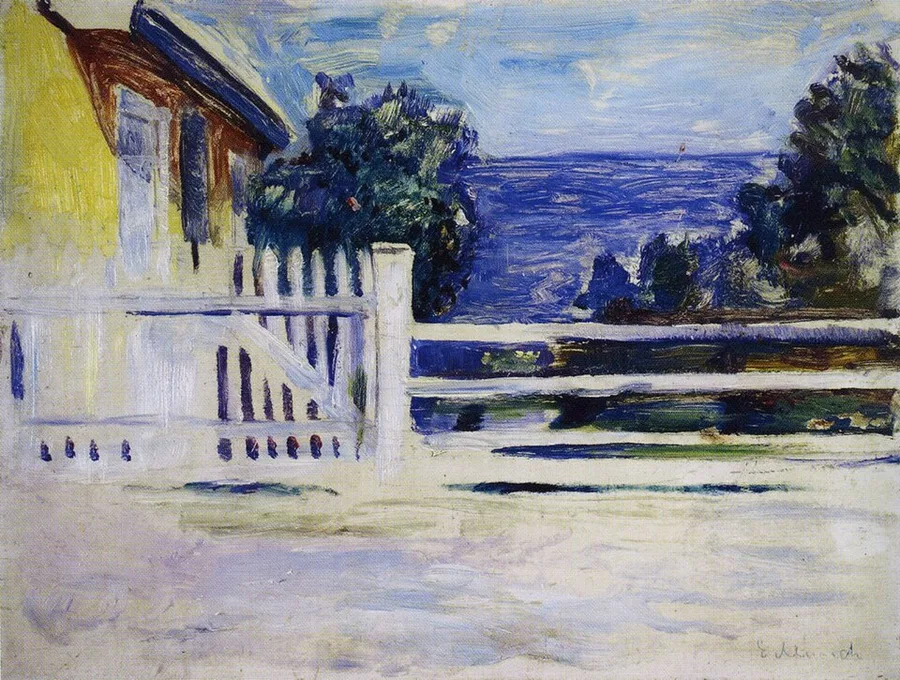 Edvard Munch, Summer in Asgardstrand (1889), Woll 185, private collection Munch's summer shore at Åsgårdstrand — the same Vestfold fjord shore the Yngling kings ruled from their halls at Borre, painted a millennium later. The quiet seaside town sits on the coast of what was the richest of the petty kingdoms. Coastal region on the western shore of the Oslofjord in southeastern
Norway, the richest of the petty-kingdom-era Norwegian polities.
Controlled the trade routes through the Skagerrak between the North
Sea and the Baltic; the wealth in its royal mounds at Borre marks it
as the dominant southern Norwegian power of the seventh through
ninth centuries. The Yngling dynasty held the throne here. Modern
Vestfold is the county containing Tønsberg, Sandefjord, and the
Borre Mound Cemetery archaeological site.
Vestfold Also discussed in The Viking Age — longships, legends, and the first "Norway"The King Who Became a Saint — how the Nordmen came to ChristA Catholic Norway — the faith that gave the kingdom its first institutions and the stave churches on the western shore of what is now the Oslofjord
Edvard Munch, Summer in Asgardstrand (1889), Woll 185, private collection Munch's summer shore at Åsgårdstrand — the same Vestfold fjord shore the Yngling kings ruled from their halls at Borre, painted a millennium later. The quiet seaside town sits on the coast of what was the richest of the petty kingdoms. Coastal region on the western shore of the Oslofjord in southeastern
Norway, the richest of the petty-kingdom-era Norwegian polities.
Controlled the trade routes through the Skagerrak between the North
Sea and the Baltic; the wealth in its royal mounds at Borre marks it
as the dominant southern Norwegian power of the seventh through
ninth centuries. The Yngling dynasty held the throne here. Modern
Vestfold is the county containing Tønsberg, Sandefjord, and the
Borre Mound Cemetery archaeological site.
Vestfold Also discussed in The Viking Age — longships, legends, and the first "Norway"The King Who Became a Saint — how the Nordmen came to ChristA Catholic Norway — the faith that gave the kingdom its first institutions and the stave churches on the western shore of what is now the Oslofjord 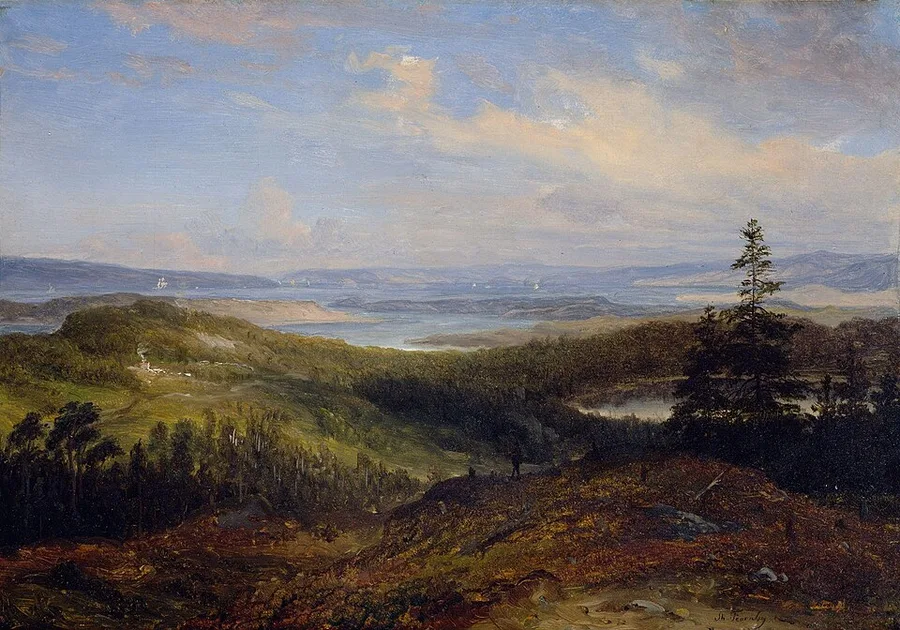 Thomas Fearnley, Utsikt over Oslofjorden (1839), Nasjonalmuseet Thomas Fearnley's serene 1839 view of the fjord. Its narrow Drøbak passage turned deadly in April 1940, when the guns of Oscarsborg fortress sank the German cruiser Blücher here on the morning of the invasion, delaying the advance long enough for the royal family and government to flee the capital. The hundred-kilometre fjord cutting north into southeastern Norway
from the Skagerrak to the present-day capital Oslo. In the
petty-kingdom era its western shore was Vestfold and its eastern
shore Østfold; the fjord controlled access to the Baltic trade
routes. The royal family fled south through it in April 1940 when
the Germans attacked Oslo, and the fortress at Oscarsborg sank the
German cruiser Blücher at its narrow Drøbak passage on the morning
of the invasion.
Oslofjord Also discussed in World War II — the King’s “No” and the Nazis in NorwayThe Golden Age — a North Atlantic empire … reaching farther than you think , and across twenty years he has pushed his authority outward by treaty when he could and by sword when he could not. The frozen-lake death is probably accidental, though the saga sources hint at darker possibilities. His ten-year-old son Harald Fairhair
Thomas Fearnley, Utsikt over Oslofjorden (1839), Nasjonalmuseet Thomas Fearnley's serene 1839 view of the fjord. Its narrow Drøbak passage turned deadly in April 1940, when the guns of Oscarsborg fortress sank the German cruiser Blücher here on the morning of the invasion, delaying the advance long enough for the royal family and government to flee the capital. The hundred-kilometre fjord cutting north into southeastern Norway
from the Skagerrak to the present-day capital Oslo. In the
petty-kingdom era its western shore was Vestfold and its eastern
shore Østfold; the fjord controlled access to the Baltic trade
routes. The royal family fled south through it in April 1940 when
the Germans attacked Oslo, and the fortress at Oscarsborg sank the
German cruiser Blücher at its narrow Drøbak passage on the morning
of the invasion.
Oslofjord Also discussed in World War II — the King’s “No” and the Nazis in NorwayThe Golden Age — a North Atlantic empire … reaching farther than you think , and across twenty years he has pushed his authority outward by treaty when he could and by sword when he could not. The frozen-lake death is probably accidental, though the saga sources hint at darker possibilities. His ten-year-old son Harald Fairhair 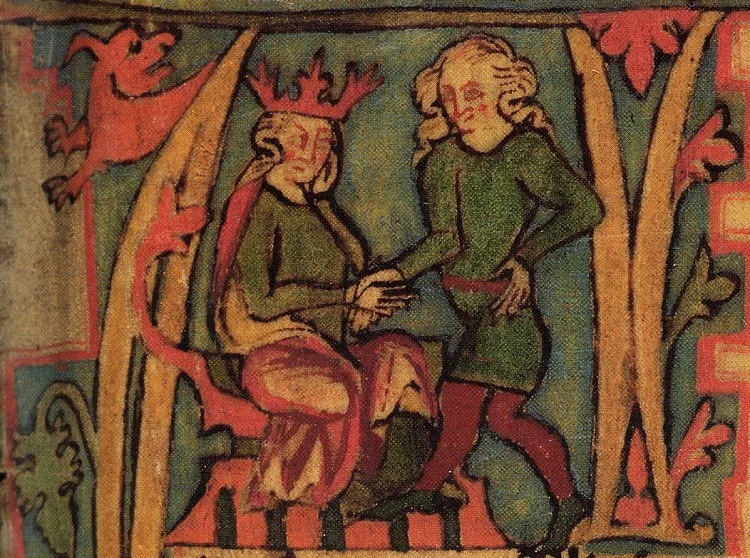 Flateyjarbók illumination, Harald Fairhair receives the kingdom (c. 1387–1394), Árni Magnússon Institute A page from the medieval saga manuscript Flateyjarbók, painted around 1390 — Harald crowned and enthroned, receiving the kingdom out of his father's line, some five centuries after he actually lived. Traditionally remembered as the first king of a unified Norway,
reigning ca. 872 to ca. 933. Inherited the small kingdom of Vestfold
at ten on the death of his father Halfdan the Black; over two decades
subdued the petty kingdoms of the western coast, climaxing at the
sea-battle of Hafrsfjord. His court poet's Haraldskvæði calls him
lúfa ("shock-head"); Hárfagri ("Fairhair") appears in verse of
debated authenticity attributed to his skalds, and is first securely
attested in twelfth-century prose (Íslendingabók). The famous
oath not to cut his hair until he had subjected every petty king is
later saga construction. His actual authority stopped short of the Arctic
north and the inland mountains, but he established the durable idea
of a single Norwegian crown.
Also discussed in The Viking Age — longships, legends, and the first "Norway"The Long Fall — the sudden loss of Norwegian nobility, the end of the kings, and half of Norway gone foreverThe Golden Age — a North Atlantic empire … reaching farther than you think inherits a throne that is, by the standards of the country he will eventually rule, very small: a single fjord-side kingdom in the southeastern corner of a coast divided among perhaps a dozen others.
Flateyjarbók illumination, Harald Fairhair receives the kingdom (c. 1387–1394), Árni Magnússon Institute A page from the medieval saga manuscript Flateyjarbók, painted around 1390 — Harald crowned and enthroned, receiving the kingdom out of his father's line, some five centuries after he actually lived. Traditionally remembered as the first king of a unified Norway,
reigning ca. 872 to ca. 933. Inherited the small kingdom of Vestfold
at ten on the death of his father Halfdan the Black; over two decades
subdued the petty kingdoms of the western coast, climaxing at the
sea-battle of Hafrsfjord. His court poet's Haraldskvæði calls him
lúfa ("shock-head"); Hárfagri ("Fairhair") appears in verse of
debated authenticity attributed to his skalds, and is first securely
attested in twelfth-century prose (Íslendingabók). The famous
oath not to cut his hair until he had subjected every petty king is
later saga construction. His actual authority stopped short of the Arctic
north and the inland mountains, but he established the durable idea
of a single Norwegian crown.
Also discussed in The Viking Age — longships, legends, and the first "Norway"The Long Fall — the sudden loss of Norwegian nobility, the end of the kings, and half of Norway gone foreverThe Golden Age — a North Atlantic empire … reaching farther than you think inherits a throne that is, by the standards of the country he will eventually rule, very small: a single fjord-side kingdom in the southeastern corner of a coast divided among perhaps a dozen others.
A coastline of small thrones
The country he inherits is not yet a country. It is a clamour of small thrones, and there is no political reason a single Norwegian kingdom should ever have emerged. The land is almost designed to resist consolidation. A coastline mountainous along its entire length, cut by fjords that reach inland for tens or hundreds of kilometers, walled from Sweden by a continuous mountain spine called the Kjølen 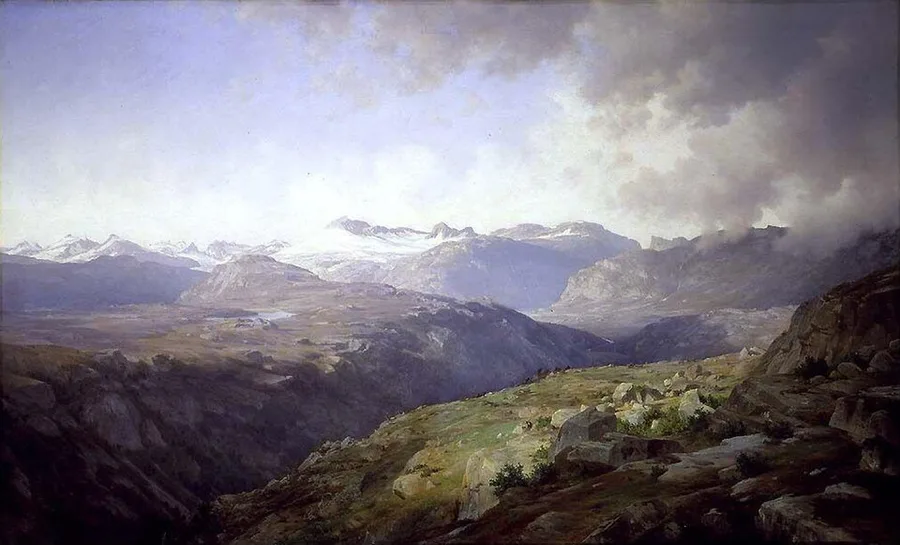 Johan Fredrik Eckersberg, Fra Jotunheimen (1866), Nasjonalmuseet Eckersberg's high peaks of Jotunheimen stand for the whole Kjølen — the mountain spine along the Norwegian-Swedish border that walled Norway off well enough for a separate kingdom to form on the western side of the range. The Scandinavian Mountains, the continuous mountain spine running
the length of the Norwegian-Swedish border from the Skagerrak in
the south to the Arctic in the north. The Norwegian name
Kjølen means "the keel" — the country's geographic backbone. The
range walls Norway off from Sweden as effectively as a national
border and was the principal reason a unified Norwegian polity
could emerge separately from the wider Scandinavian region.
, “the keel,” that closes off the inland east as effectively as a national border. Between each fjord and the next, between each valley and the next, the geography makes local life self-contained. A community on the inner Sognefjord
Johan Fredrik Eckersberg, Fra Jotunheimen (1866), Nasjonalmuseet Eckersberg's high peaks of Jotunheimen stand for the whole Kjølen — the mountain spine along the Norwegian-Swedish border that walled Norway off well enough for a separate kingdom to form on the western side of the range. The Scandinavian Mountains, the continuous mountain spine running
the length of the Norwegian-Swedish border from the Skagerrak in
the south to the Arctic in the north. The Norwegian name
Kjølen means "the keel" — the country's geographic backbone. The
range walls Norway off from Sweden as effectively as a national
border and was the principal reason a unified Norwegian polity
could emerge separately from the wider Scandinavian region.
, “the keel,” that closes off the inland east as effectively as a national border. Between each fjord and the next, between each valley and the next, the geography makes local life self-contained. A community on the inner Sognefjord 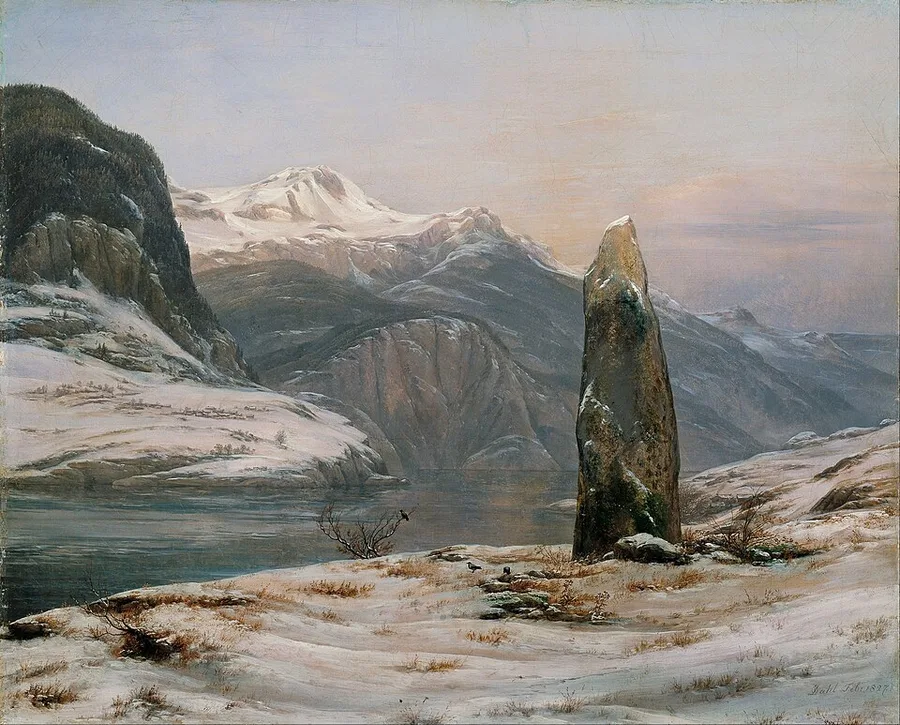 Johan Christian Dahl, Vinter ved Sognefjorden (1827), Nasjonalmuseet J.C. Dahl's Vinter ved Sognefjorden (1827) — an ancient standing stone (bautastein) dark against the frozen shore, the still fjord and pale mountains behind. Dahl put an iron-age monument in the foreground of Norway's longest fjord: water and stone from the centuries when Sogn was a kingdom of its own. Norway's longest and deepest fjord, reaching two hundred and five
kilometres inland from the western coast north of Bergen — the
second-longest fjord in the world after Scoresby Sund in Greenland. In the
petty-kingdom era it was the spine of the small Norwegian kingdom
of Sogn. Its inner branches include the Aurlandsfjord and the
Nærøyfjord — the latter a UNESCO World Heritage site. Communities along the Sognefjord
historically had more regular contact with distant coastal trading
partners than with neighbours one valley over — the geography that
shaped why Norway's petty kingdoms organised by waterway rather than
by overland adjacency.
Sognefjord Also discussed in A Catholic Norway — the faith that gave the kingdom its first institutions and the stave churches800,000 Norwegians Leave — the century that built a Second Norway can have more regular contact with a Faroese fishing fleet than with the next valley over, because the next valley means a mountain crossing the open sea does not.
Johan Christian Dahl, Vinter ved Sognefjorden (1827), Nasjonalmuseet J.C. Dahl's Vinter ved Sognefjorden (1827) — an ancient standing stone (bautastein) dark against the frozen shore, the still fjord and pale mountains behind. Dahl put an iron-age monument in the foreground of Norway's longest fjord: water and stone from the centuries when Sogn was a kingdom of its own. Norway's longest and deepest fjord, reaching two hundred and five
kilometres inland from the western coast north of Bergen — the
second-longest fjord in the world after Scoresby Sund in Greenland. In the
petty-kingdom era it was the spine of the small Norwegian kingdom
of Sogn. Its inner branches include the Aurlandsfjord and the
Nærøyfjord — the latter a UNESCO World Heritage site. Communities along the Sognefjord
historically had more regular contact with distant coastal trading
partners than with neighbours one valley over — the geography that
shaped why Norway's petty kingdoms organised by waterway rather than
by overland adjacency.
Sognefjord Also discussed in A Catholic Norway — the faith that gave the kingdom its first institutions and the stave churches800,000 Norwegians Leave — the century that built a Second Norway can have more regular contact with a Faroese fishing fleet than with the next valley over, because the next valley means a mountain crossing the open sea does not.
The boat, in this country, is the road. The mountains divide neighboring districts so completely that adjacent communities often have less contact with each other than with distant trading partners reached by water. The political consequence is that the coast organizes itself, across the late iron age and into the early medieval period, not as one country but as a sequence of small ones.
The Migration Period
The small kingdoms have not materialized from nothing. Across the centuries historians call the Migration Period 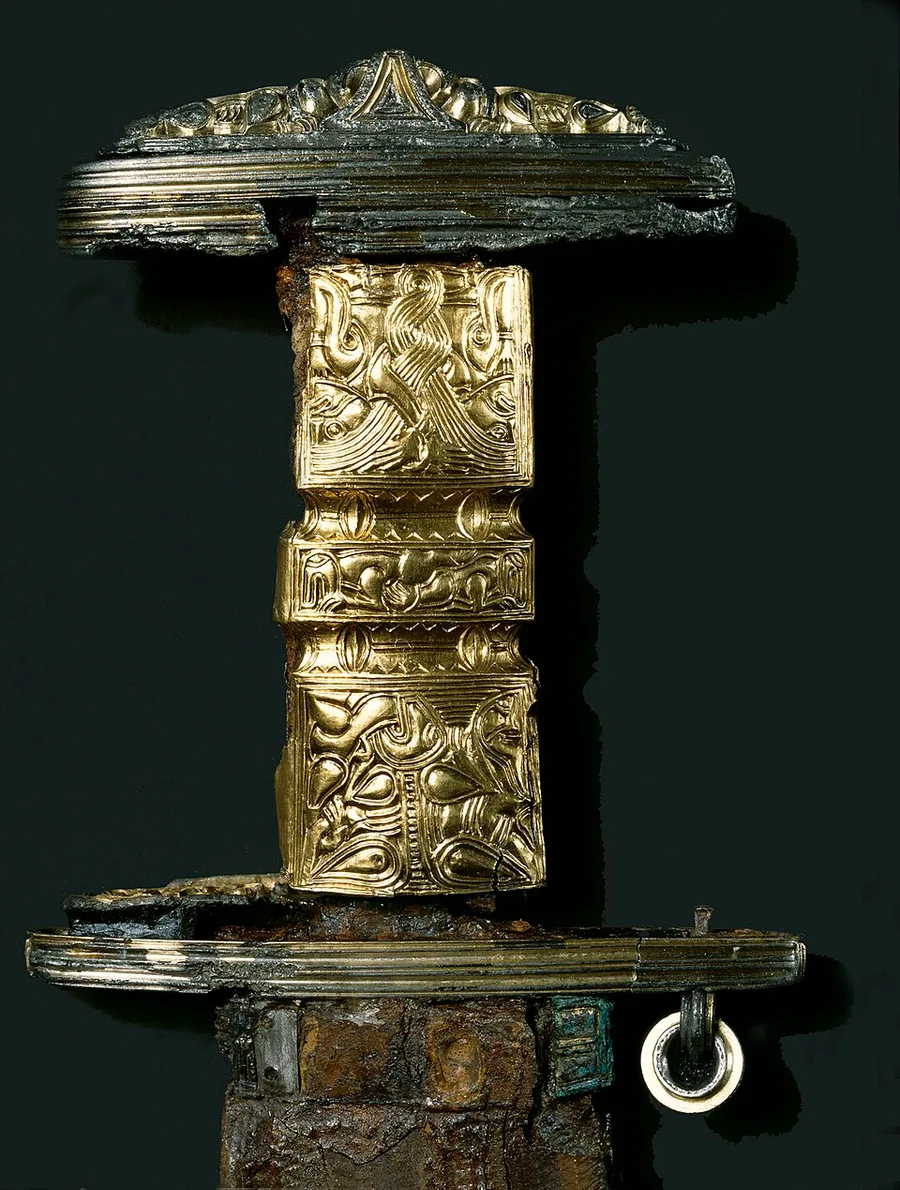 Snartemo sword hilt (c. 500 CE), photo: Museum of Cultural History, University of Oslo (CC BY-SA 4.0) The gold-worked hilt of the Snartemo sword, from a chieftain's grave of around 500 CE — the kind of accumulating wealth that marked Norway's fjord-coast leaders in the Migration Period, as Rome collapsed and Europe's peoples shifted. The historical period from roughly 375 to 568 CE during which
populations across northern Europe shifted dramatically in response
to the collapse of the western Roman Empire and the long Germanic
movements that followed — Goths, Vandals, Lombards, Franks, and
others reorganising the continent's tribal and political map. In
Norway it shows up as abandoned farms, newly cleared districts,
and the accumulating wealth of fjord-coast chieftains who were by
the period's end calling themselves kings. The Norwegian term is
Folkevandringstida.
, roughly 375 to 568, populations across northern Europe shift in response to the collapse of the western Roman Empire and the long Germanic movements that follow. Norway feels it too: some farms are abandoned, new districts are cleared, and across the wealthier fjords a class of chieftains has been accumulating wealth from continental trade for centuries. Roman bronze and glass appear in the richer Norwegian iron-age burials, alongside brooches modeled on continental fashion and swords from forges that have never seen the Arctic. This is proof of a trade route that runs north through the Germanic territories and reaches the Norwegian coast even though Rome itself never held a lasting frontier beyond the Rhine, let alone reached the north. By the time the Migration Period closes, the chieftains who can control enough productive farmland and enough loyal Hird
Snartemo sword hilt (c. 500 CE), photo: Museum of Cultural History, University of Oslo (CC BY-SA 4.0) The gold-worked hilt of the Snartemo sword, from a chieftain's grave of around 500 CE — the kind of accumulating wealth that marked Norway's fjord-coast leaders in the Migration Period, as Rome collapsed and Europe's peoples shifted. The historical period from roughly 375 to 568 CE during which
populations across northern Europe shifted dramatically in response
to the collapse of the western Roman Empire and the long Germanic
movements that followed — Goths, Vandals, Lombards, Franks, and
others reorganising the continent's tribal and political map. In
Norway it shows up as abandoned farms, newly cleared districts,
and the accumulating wealth of fjord-coast chieftains who were by
the period's end calling themselves kings. The Norwegian term is
Folkevandringstida.
, roughly 375 to 568, populations across northern Europe shift in response to the collapse of the western Roman Empire and the long Germanic movements that follow. Norway feels it too: some farms are abandoned, new districts are cleared, and across the wealthier fjords a class of chieftains has been accumulating wealth from continental trade for centuries. Roman bronze and glass appear in the richer Norwegian iron-age burials, alongside brooches modeled on continental fashion and swords from forges that have never seen the Arctic. This is proof of a trade route that runs north through the Germanic territories and reaches the Norwegian coast even though Rome itself never held a lasting frontier beyond the Rhine, let alone reached the north. By the time the Migration Period closes, the chieftains who can control enough productive farmland and enough loyal Hird 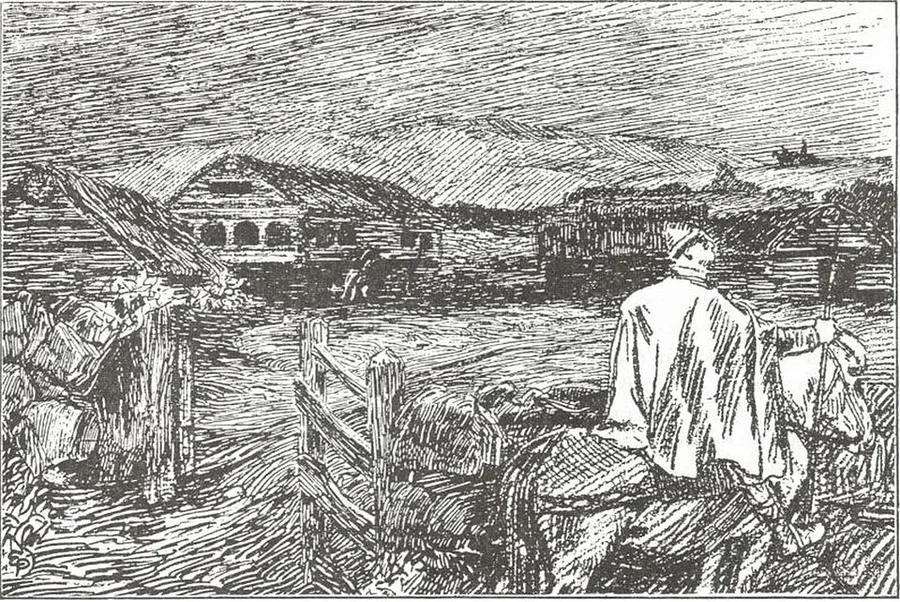 Eilif Peterssen, illustration for Magnus Blindes og Harald Gilles saga, Heimskringla (J.M. Stenersen & Co, 1899 edition) Eilif Peterssen's plate from the 1899 Heimskringla folk edition — the king's mounted watchmen (hestevakt) on the farm roads at dusk. The household retinue at its everyday work of guarding the king's ground: the unglamorous side of the sworn warband that lived at his hall. Old Norse hirð — the personal armed retinue of a king or jarl,
the household warriors who lived at the king's hall, ate at his
table, and fought as his core force in war. The size and quality
of a king's hird was a direct measure of his political power.
The Norwegian hird formalised across the medieval period; by the
thirteenth century it had acquired continental-style subdivisions
(kertilsveinr squires, hirðmenn men-at-arms, skutilsveinr
knights). The Old English cognate húscarl enters English as
housecarl.
Also discussed in The Viking Age — longships, legends, and the first "Norway" are calling themselves kings. The first written witness to the result comes by way of Constantinople
Eilif Peterssen, illustration for Magnus Blindes og Harald Gilles saga, Heimskringla (J.M. Stenersen & Co, 1899 edition) Eilif Peterssen's plate from the 1899 Heimskringla folk edition — the king's mounted watchmen (hestevakt) on the farm roads at dusk. The household retinue at its everyday work of guarding the king's ground: the unglamorous side of the sworn warband that lived at his hall. Old Norse hirð — the personal armed retinue of a king or jarl,
the household warriors who lived at the king's hall, ate at his
table, and fought as his core force in war. The size and quality
of a king's hird was a direct measure of his political power.
The Norwegian hird formalised across the medieval period; by the
thirteenth century it had acquired continental-style subdivisions
(kertilsveinr squires, hirðmenn men-at-arms, skutilsveinr
knights). The Old English cognate húscarl enters English as
housecarl.
Also discussed in The Viking Age — longships, legends, and the first "Norway" are calling themselves kings. The first written witness to the result comes by way of Constantinople 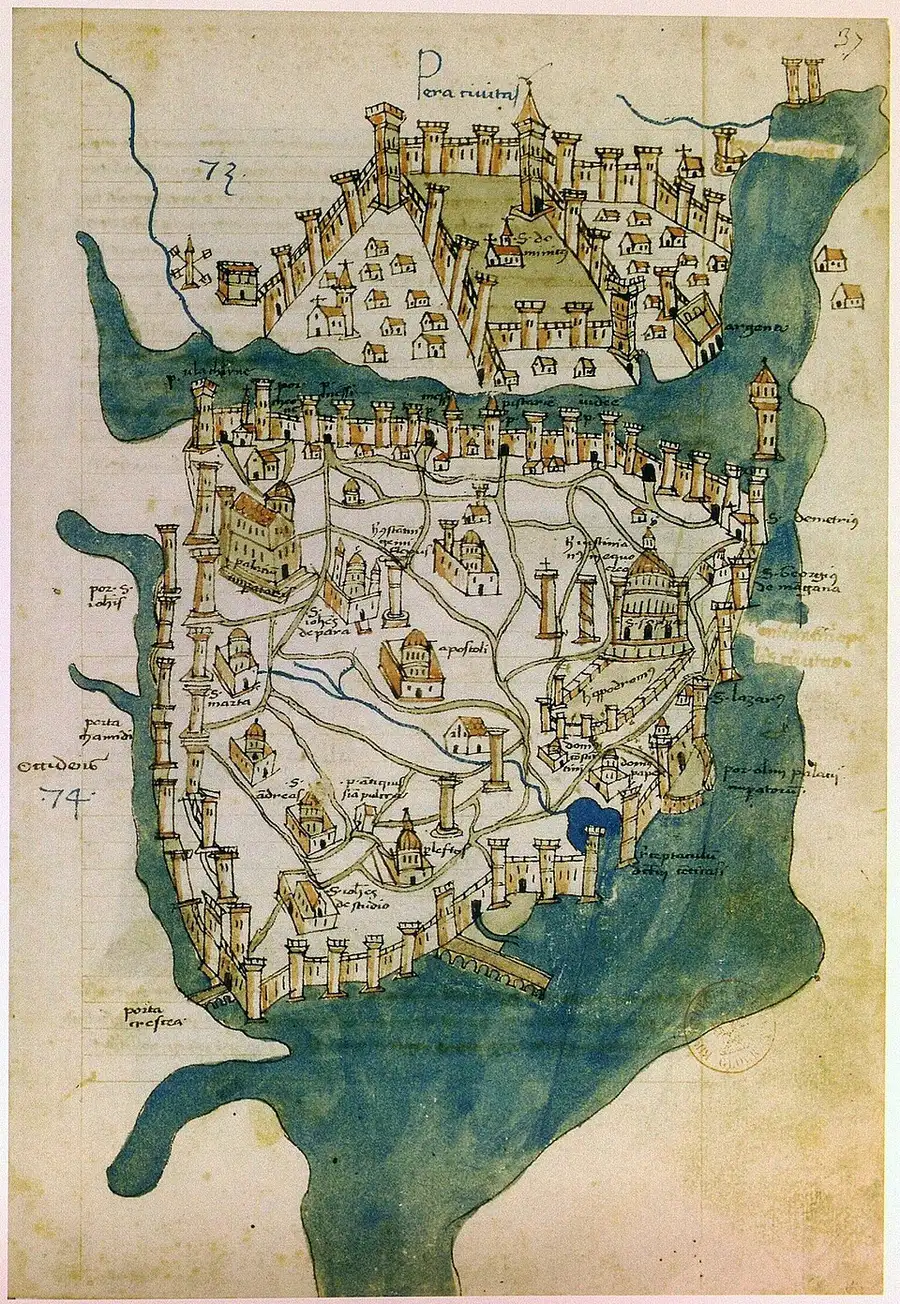 Cristoforo Buondelmonti, Map of Constantinople from the Liber Insularum Archipelagi (before 1430), Bibliothèque nationale de France A fifteenth-century map of the walled city on the Bosphorus, drawn with Hagia Sophia and the Hippodrome among its towers — the Byzantine capital where the Gothic historian Jordanes wrote the first account of the Norwegian petty-kingdom world. Capital of the Eastern Roman (later Byzantine) Empire, on the
Bosphorus where the Black Sea meets the Mediterranean. Founded by
the Roman emperor Constantine in 324 CE on the site of the older
Greek colony of Byzantion and dedicated as the city of Constantinople
on 11 May 330. Capital of the Eastern empire from 395 until its fall
to the Ottoman Turks in 1453; officially renamed Istanbul under
the Turkish Republic in 1930. The Gothic historian Jordanes wrote
the Getica, the first written account of the Norwegian
petty-kingdom world, while working in the city in 551 CE. Norse
mercenaries (the Varangians) later served there as the Byzantine
emperor's elite imperial guard.
Also discussed in The Viking Age — longships, legends, and the first "Norway"The Crusades?!!!! — sixty ships from Bergen, bound for the Holy Land : in 551, the historian Jordanes
Cristoforo Buondelmonti, Map of Constantinople from the Liber Insularum Archipelagi (before 1430), Bibliothèque nationale de France A fifteenth-century map of the walled city on the Bosphorus, drawn with Hagia Sophia and the Hippodrome among its towers — the Byzantine capital where the Gothic historian Jordanes wrote the first account of the Norwegian petty-kingdom world. Capital of the Eastern Roman (later Byzantine) Empire, on the
Bosphorus where the Black Sea meets the Mediterranean. Founded by
the Roman emperor Constantine in 324 CE on the site of the older
Greek colony of Byzantion and dedicated as the city of Constantinople
on 11 May 330. Capital of the Eastern empire from 395 until its fall
to the Ottoman Turks in 1453; officially renamed Istanbul under
the Turkish Republic in 1930. The Gothic historian Jordanes wrote
the Getica, the first written account of the Norwegian
petty-kingdom world, while working in the city in 551 CE. Norse
mercenaries (the Varangians) later served there as the Byzantine
emperor's elite imperial guard.
Also discussed in The Viking Age — longships, legends, and the first "Norway"The Crusades?!!!! — sixty ships from Bergen, bound for the Holy Land : in 551, the historian Jordanes 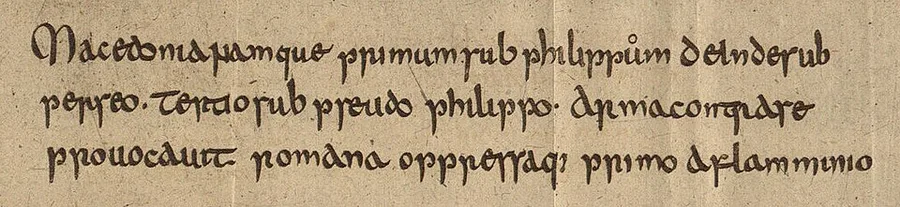 Friedrich Wilken, script specimen of Codex Heidelbergensis Pal. lat. 921 (Jordanes), Heidelberg 1817 No portrait of Jordanes exists. These lines were copied in facsimile from the Heidelberg codex of his Gothic history and engraved in 1817, six decades before the manuscript burned in 1880 — the work whose preamble on Scandza first names the peoples of pre-Norway. Sixth-century historian of Gothic origin, working in the late-Roman
East at Constantinople. His Latin Getica (completed 551 CE) is a
history of the Goths whose geographical preamble names a list of
peoples inhabiting Scandza — the great northern island Mediterranean
geographers had vaguely known of for centuries. Several of his tribe
names line up readably onto the map of what was then becoming
pre-Norway; his preamble is the first written witness to the
Norwegian petty-kingdom world.
, a The Goths
Friedrich Wilken, script specimen of Codex Heidelbergensis Pal. lat. 921 (Jordanes), Heidelberg 1817 No portrait of Jordanes exists. These lines were copied in facsimile from the Heidelberg codex of his Gothic history and engraved in 1817, six decades before the manuscript burned in 1880 — the work whose preamble on Scandza first names the peoples of pre-Norway. Sixth-century historian of Gothic origin, working in the late-Roman
East at Constantinople. His Latin Getica (completed 551 CE) is a
history of the Goths whose geographical preamble names a list of
peoples inhabiting Scandza — the great northern island Mediterranean
geographers had vaguely known of for centuries. Several of his tribe
names line up readably onto the map of what was then becoming
pre-Norway; his preamble is the first written witness to the
Norwegian petty-kingdom world.
, a The Goths 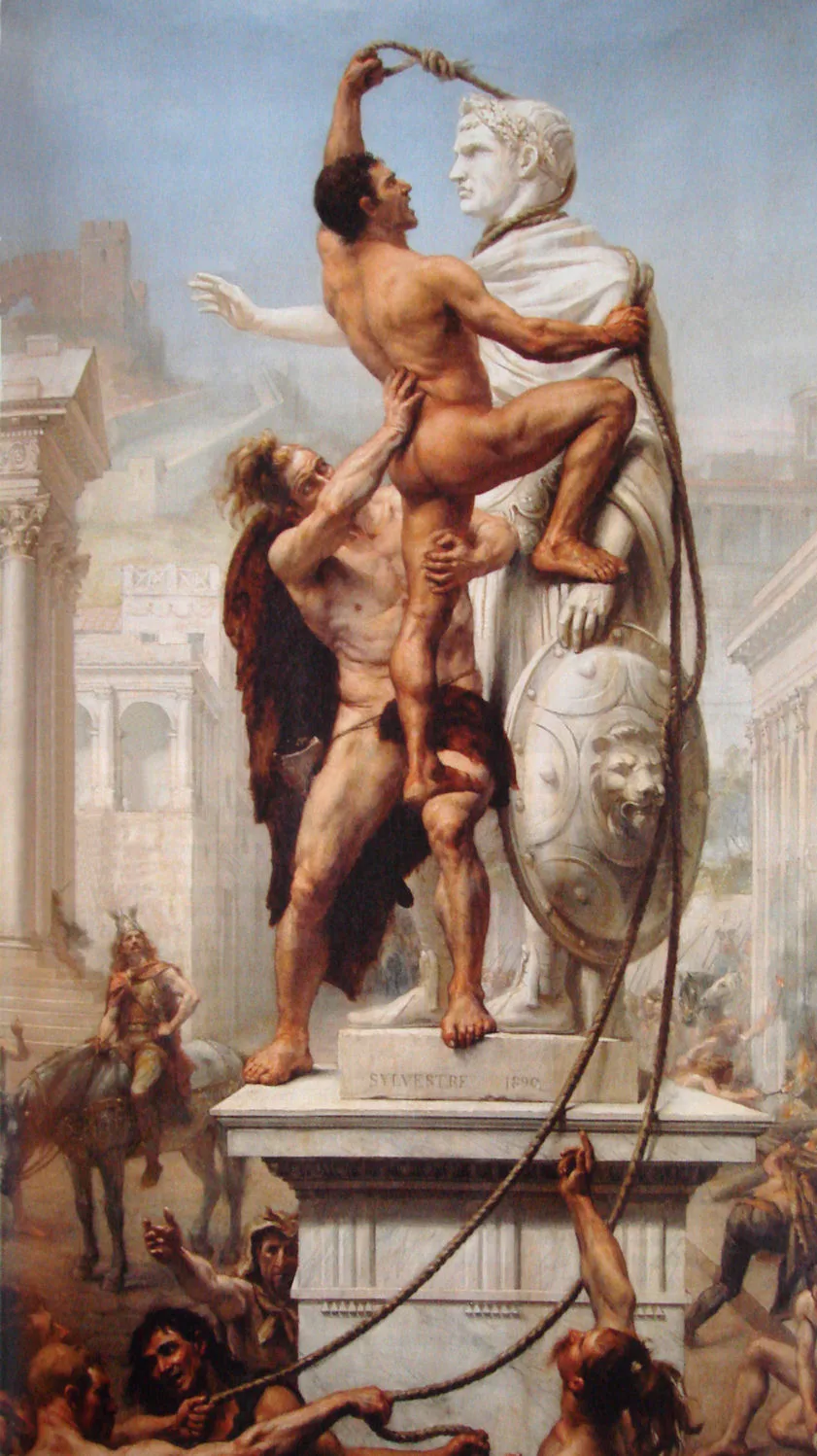 Joseph-Noël Sylvestre, Le Sac de Rome par les barbares en 410 (1890), Musée Paul Valéry, Sète The Goths' most famous act, and the shock that announced Rome's unravelling: in 410 the Visigoths under Alaric sacked the city. Sylvestre painted them hauling down a colossal imperial statue. East Germanic people prominent in the late Roman and early-medieval
periods. From their original homeland — long thought to lie along
the southern Baltic but origins are debated — the Goths migrated
south through the Roman provinces during the Migration Period, split
into Visigoths and Ostrogoths, sacked Rome in 410 (Visigoths under
Alaric), and founded kingdoms in Italy and the Iberian peninsula
that lasted into the seventh and eighth centuries. The Gothic
historian Jordanes, working in Constantinople in 551, wrote the
Getica, the first historical text to mention the peoples of
Scandza (Scandinavia) by name.
working in the late-Roman East, finishes his Getica
Joseph-Noël Sylvestre, Le Sac de Rome par les barbares en 410 (1890), Musée Paul Valéry, Sète The Goths' most famous act, and the shock that announced Rome's unravelling: in 410 the Visigoths under Alaric sacked the city. Sylvestre painted them hauling down a colossal imperial statue. East Germanic people prominent in the late Roman and early-medieval
periods. From their original homeland — long thought to lie along
the southern Baltic but origins are debated — the Goths migrated
south through the Roman provinces during the Migration Period, split
into Visigoths and Ostrogoths, sacked Rome in 410 (Visigoths under
Alaric), and founded kingdoms in Italy and the Iberian peninsula
that lasted into the seventh and eighth centuries. The Gothic
historian Jordanes, working in Constantinople in 551, wrote the
Getica, the first historical text to mention the peoples of
Scandza (Scandinavia) by name.
working in the late-Roman East, finishes his Getica 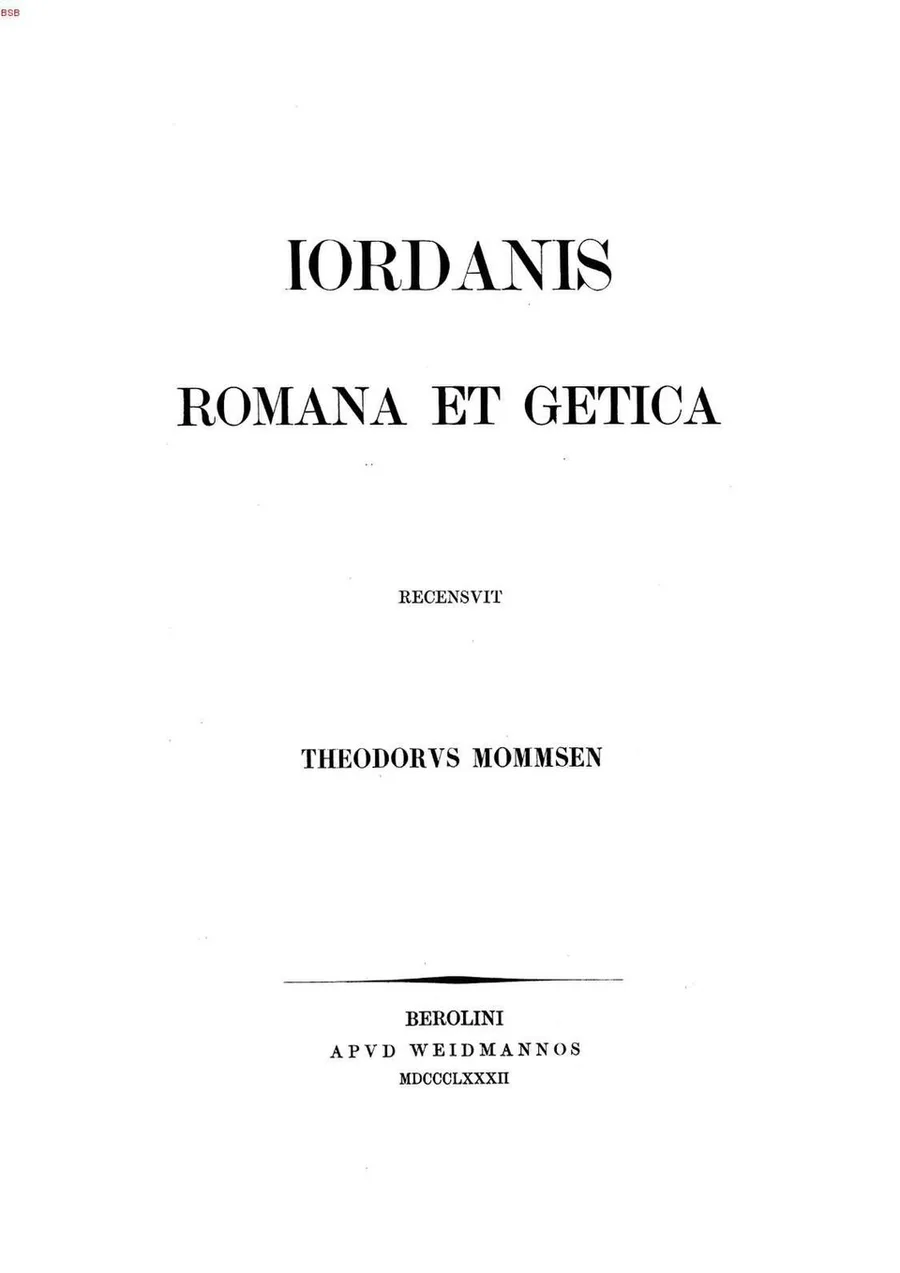 Title page, Iordanis Romana et Getica, ed. Th. Mommsen (Berlin, 1882), Monumenta Germaniae Historica AA 5,1 The title page of the standard 1882 scholarly edition of Jordanes's sixth-century history — the book whose account of Scandza gives us the earliest written naming of the peoples of the Norwegian world. De origine actibusque Getarum ("On the Origin and Deeds of the
Goths"), a Latin history of the Goths completed by Jordanes in
Constantinople in 551 CE. Its geographical preamble describes
Scandza — the great northern island of classical geography —
and names a list of peoples inhabiting it, several of whose tribe
names line up readably onto the map of what was becoming pre-Norway.
The Getica is the earliest surviving written witness to the
Norwegian world.
, a Latin history of the Goths whose geographical preamble names a list of peoples inhabiting Scandza
Title page, Iordanis Romana et Getica, ed. Th. Mommsen (Berlin, 1882), Monumenta Germaniae Historica AA 5,1 The title page of the standard 1882 scholarly edition of Jordanes's sixth-century history — the book whose account of Scandza gives us the earliest written naming of the peoples of the Norwegian world. De origine actibusque Getarum ("On the Origin and Deeds of the
Goths"), a Latin history of the Goths completed by Jordanes in
Constantinople in 551 CE. Its geographical preamble describes
Scandza — the great northern island of classical geography —
and names a list of peoples inhabiting it, several of whose tribe
names line up readably onto the map of what was becoming pre-Norway.
The Getica is the earliest surviving written witness to the
Norwegian world.
, a Latin history of the Goths whose geographical preamble names a list of peoples inhabiting Scandza 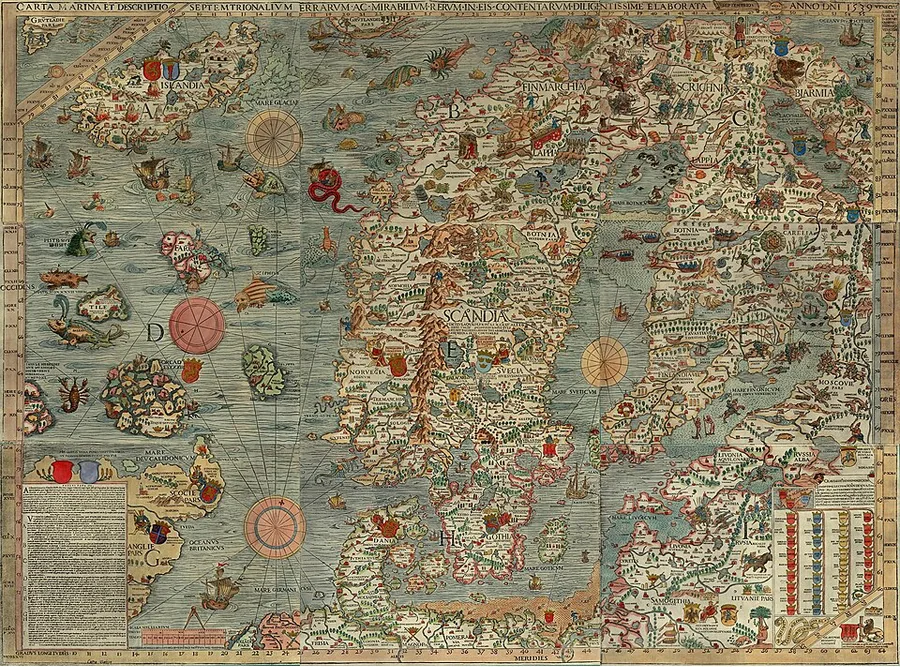 Olaus Magnus, Carta Marina (1539), via Wikimedia Commons Olaus Magnus's 1539 Carta Marina, one of the first detailed maps of the North — Scandinavia drawn as a vast near-island bristling with mountains and place-names, the shape classical geographers had called Scandza. The classical and early-medieval Mediterranean name for Scandinavia,
imagined as a great northern island somewhere beyond the known
world. Used by Roman and Eastern Roman geographers from Pliny
through Jordanes; the philological source of the modern name
"Scandinavia." In Jordanes's Getica (551 CE) the geographical
preamble names a list of peoples inhabiting Scandza, several of
whose tribe names line up readably onto the map of what was then
becoming pre-Norway.
— the great northern island that Mediterranean geographers have vaguely known about for centuries — and several of his tribe names line up readably onto the map of what is by then becoming pre-Norway.
Olaus Magnus, Carta Marina (1539), via Wikimedia Commons Olaus Magnus's 1539 Carta Marina, one of the first detailed maps of the North — Scandinavia drawn as a vast near-island bristling with mountains and place-names, the shape classical geographers had called Scandza. The classical and early-medieval Mediterranean name for Scandinavia,
imagined as a great northern island somewhere beyond the known
world. Used by Roman and Eastern Roman geographers from Pliny
through Jordanes; the philological source of the modern name
"Scandinavia." In Jordanes's Getica (551 CE) the geographical
preamble names a list of peoples inhabiting Scandza, several of
whose tribe names line up readably onto the map of what was then
becoming pre-Norway.
— the great northern island that Mediterranean geographers have vaguely known about for centuries — and several of his tribe names line up readably onto the map of what is by then becoming pre-Norway.
The kingdoms by name
By the seventh and eighth centuries the regional kingdoms have names, many of them the same names the country still uses for its modern counties. The richest sits in the southeast, around the Oslofjord and its mouth. Vestfold, on the western shore of the fjord, controls the trade routes through the Skagerrak 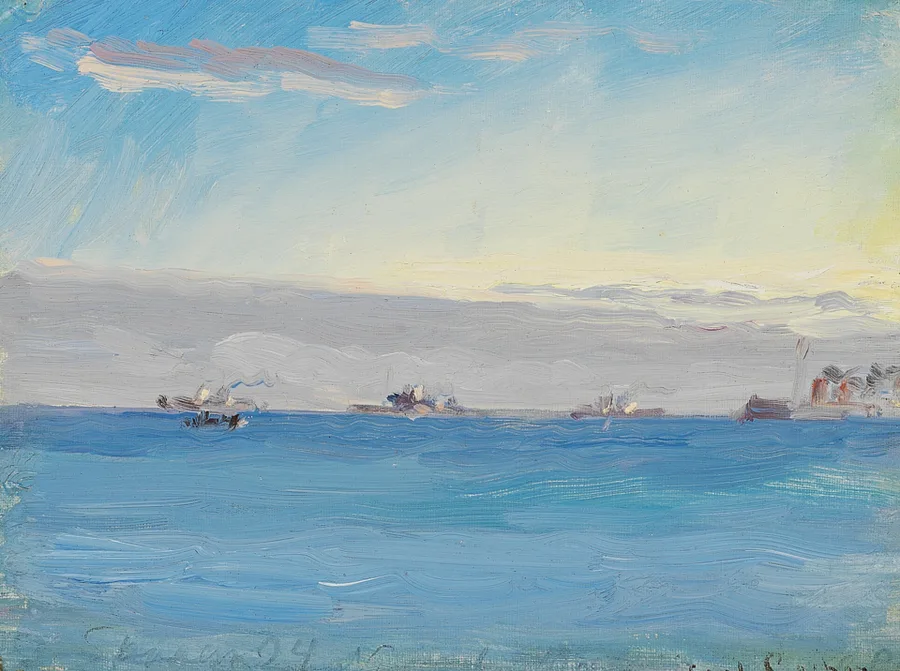 Carl Locher, Marine ud for Skagen Nordstrand (1894), via Wikimedia Commons Carl Locher's 1894 sketch of the open Skagerrak off Skagen, steamers trailing smoke along the sea lane. The traffic is nineteenth-century, the artery ancient: whoever held the strait's Norwegian shore taxed the goods moving between the North Sea and the Baltic — the wealth of the Vestfold kings. The strait between southern Norway, the western coast of Sweden, and
the northern tip of Denmark's Jutland peninsula, connecting the
North Sea to the Baltic via the Kattegat. The central maritime
trade artery of northern Europe across the iron age and the
petty-kingdom centuries. Whoever controlled the southern Norwegian
coast controlled the goods moving through the Skagerrak — which is
why the Vestfold kings on its northern shore were the dominant
southern Norwegian power of the period.
, the strait between the North Sea and the Kattegat that opens the sea road toward the Baltic, and the goods that move on them. Its kings bury their dead at Borre
Carl Locher, Marine ud for Skagen Nordstrand (1894), via Wikimedia Commons Carl Locher's 1894 sketch of the open Skagerrak off Skagen, steamers trailing smoke along the sea lane. The traffic is nineteenth-century, the artery ancient: whoever held the strait's Norwegian shore taxed the goods moving between the North Sea and the Baltic — the wealth of the Vestfold kings. The strait between southern Norway, the western coast of Sweden, and
the northern tip of Denmark's Jutland peninsula, connecting the
North Sea to the Baltic via the Kattegat. The central maritime
trade artery of northern Europe across the iron age and the
petty-kingdom centuries. Whoever controlled the southern Norwegian
coast controlled the goods moving through the Skagerrak — which is
why the Vestfold kings on its northern shore were the dominant
southern Norwegian power of the period.
, the strait between the North Sea and the Kattegat that opens the sea road toward the Baltic, and the goods that move on them. Its kings bury their dead at Borre 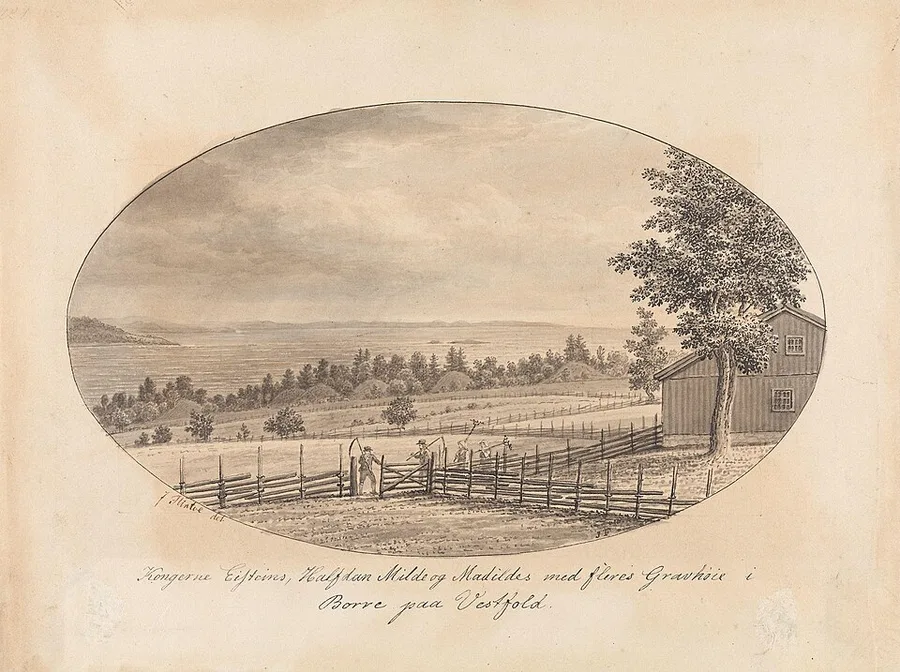 Johannes Flintoe, Gravhöie i Borre paa Vestfold (1834–38), Nasjonalmuseet, Oslo Flintoe drew the Borre mounds in the 1830s and titled them as the graves of the saga-kings Eystein and Halfdan the Mild — the Yngling royal cemetery as Norway's romantics knew it, some fifteen years before the 1852 ship find. Royal burial complex on the western shore of the Oslofjord in
Horten Municipality, north of present-day Tønsberg in Vestfold.
Seven large burial mounds and twenty-one smaller cairns mark the
cemetery of the Yngling dynasty across the eighth and ninth
centuries — the largest concentration of royal burial mounds in
northern Europe. The first Viking ship ever excavated was unearthed
here in 1852. The site is preserved as the Borre Mound Cemetery
with the Midgard Vikingsenter museum on the grounds.
Borre, Vestfold in a cluster of large royal mounds that still stand on the fjord’s western shore, and the wealth in those graves marks Vestfold as the dominant southern Norwegian power of its period. The ruling family is the Yngling dynasty
Johannes Flintoe, Gravhöie i Borre paa Vestfold (1834–38), Nasjonalmuseet, Oslo Flintoe drew the Borre mounds in the 1830s and titled them as the graves of the saga-kings Eystein and Halfdan the Mild — the Yngling royal cemetery as Norway's romantics knew it, some fifteen years before the 1852 ship find. Royal burial complex on the western shore of the Oslofjord in
Horten Municipality, north of present-day Tønsberg in Vestfold.
Seven large burial mounds and twenty-one smaller cairns mark the
cemetery of the Yngling dynasty across the eighth and ninth
centuries — the largest concentration of royal burial mounds in
northern Europe. The first Viking ship ever excavated was unearthed
here in 1852. The site is preserved as the Borre Mound Cemetery
with the Midgard Vikingsenter museum on the grounds.
Borre, Vestfold in a cluster of large royal mounds that still stand on the fjord’s western shore, and the wealth in those graves marks Vestfold as the dominant southern Norwegian power of its period. The ruling family is the Yngling dynasty 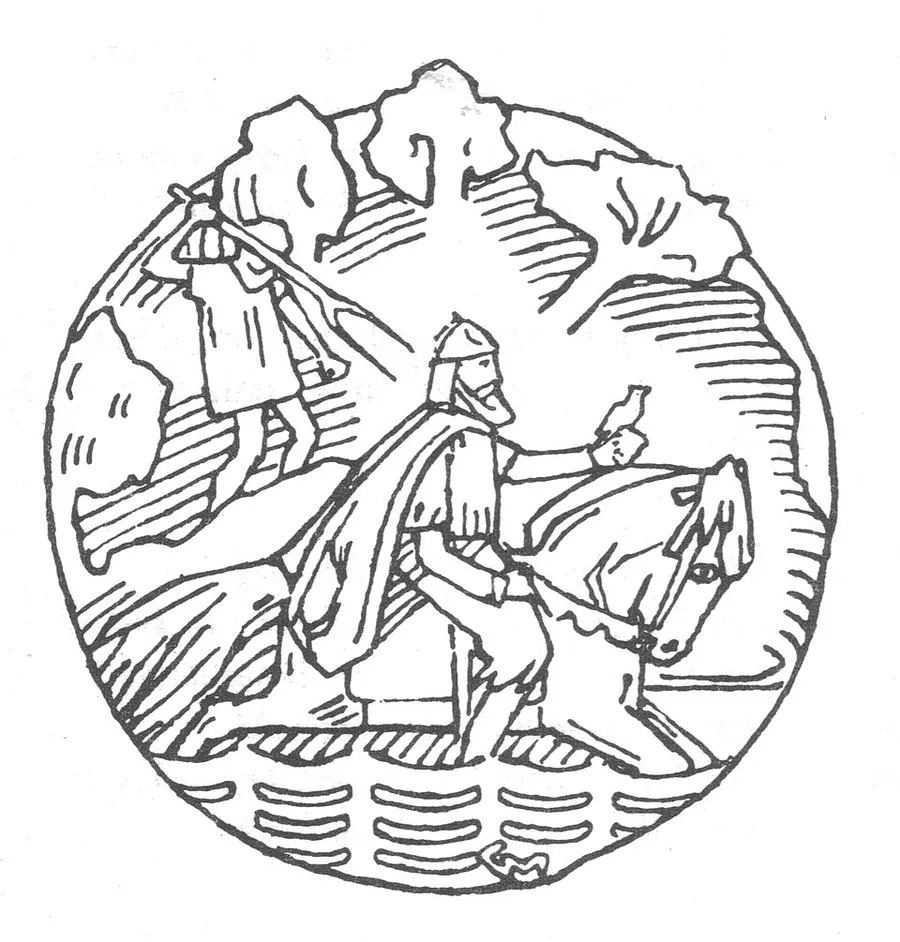 Gerhard Munthe, Ynglinge-saga vignette: King Dag the Wise (c. 1896), Snorre 1899 edition Gerhard Munthe's 1899 vignette of King Dag the Wise riding with his counsel-giving sparrow on his hand — one of the legendary Yngling kings whose saga-poem traced the Vestfold dynasty's descent back to the god Frey. The ruling family of the petty kingdom of Vestfold across the
eighth and ninth centuries. The dynasty traced its descent through
the skaldic genealogical poem Ynglingatal back through a sequence
of Swedish kings to the god Frey — a religious legitimation of
rule rather than a historically reliable lineage. The dynasty
itself is real and produced Halfdan the Black and Harald Fairhair,
the consolidator who founded the unified Norwegian crown.
, which traces its descent through the late-ninth-century poem Ynglingatal
Gerhard Munthe, Ynglinge-saga vignette: King Dag the Wise (c. 1896), Snorre 1899 edition Gerhard Munthe's 1899 vignette of King Dag the Wise riding with his counsel-giving sparrow on his hand — one of the legendary Yngling kings whose saga-poem traced the Vestfold dynasty's descent back to the god Frey. The ruling family of the petty kingdom of Vestfold across the
eighth and ninth centuries. The dynasty traced its descent through
the skaldic genealogical poem Ynglingatal back through a sequence
of Swedish kings to the god Frey — a religious legitimation of
rule rather than a historically reliable lineage. The dynasty
itself is real and produced Halfdan the Black and Harald Fairhair,
the consolidator who founded the unified Norwegian crown.
, which traces its descent through the late-ninth-century poem Ynglingatal 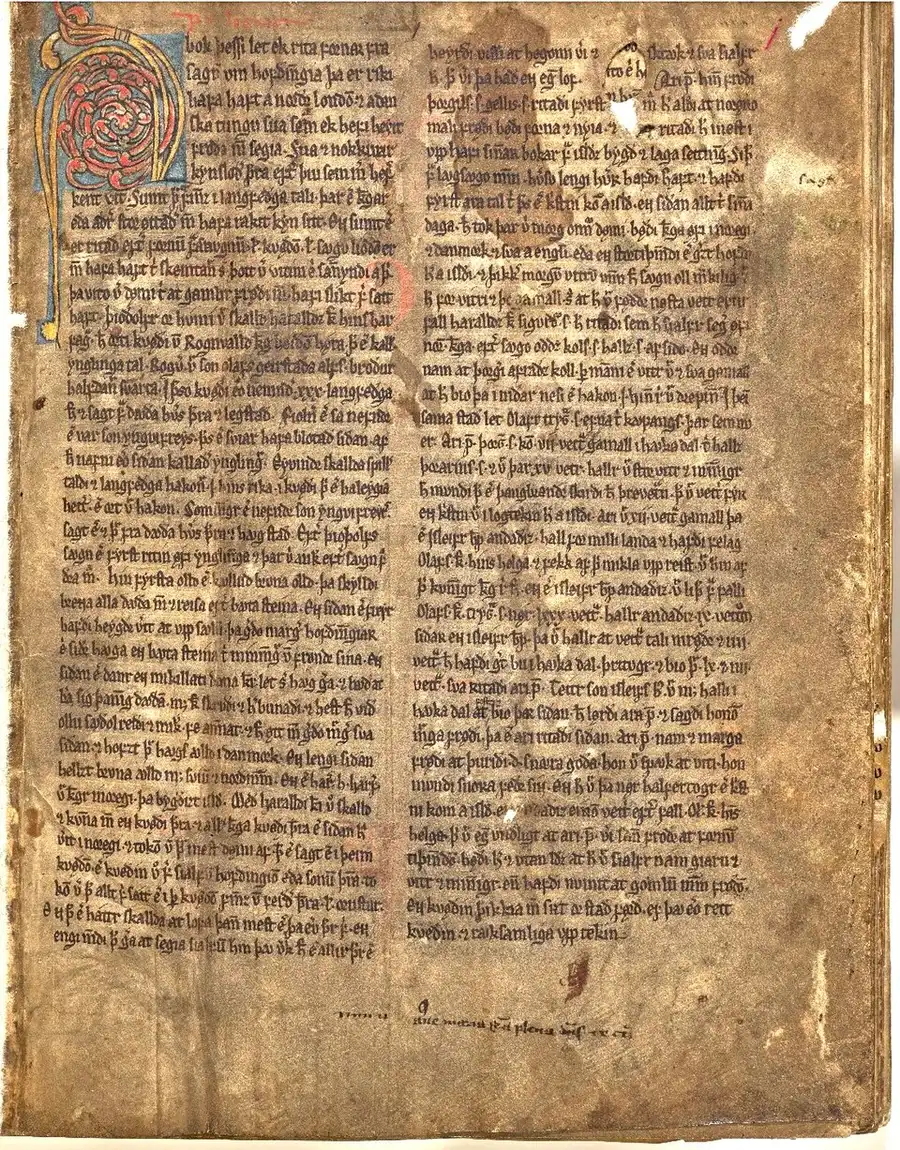 Codex Frisianus (AM 45 fol., c. 1300), first page; photo CC0 via Wikimedia Commons Ynglingatal survives only inside Snorri's Heimskringla, and this first leaf of the Codex Frisianus (c. 1300) carries the prologue that names Þjóðólfr of Hvinir and his poem — the words "ynglinga tal" stand legible partway down the first column. Late-ninth-century skaldic genealogical poem, traditionally
attributed to Þjóðólfr of Hvinir. Traces the descent of the Vestfold
Yngling dynasty through a sequence of Swedish kings back to the god
Frey. Preserved in fragments quoted in Snorri Sturluson's
Heimskringla (specifically in Ynglinga saga, which Snorri built
around it). The poem's form is a death-catalogue: stanza by stanza
it counts off king after king by the manner of his dying — Agni
hanged by Queen Skjálf with the cord of his own gold neck-ring,
Vanlandi trodden to death in his sleep by a mara. A royal pedigree
kept as a ledger of deaths is how a night-creature comes to stand
in a genealogy of kings.
Also discussed in Mare — the creature behind the word nightmare , attributed to the Skald
Codex Frisianus (AM 45 fol., c. 1300), first page; photo CC0 via Wikimedia Commons Ynglingatal survives only inside Snorri's Heimskringla, and this first leaf of the Codex Frisianus (c. 1300) carries the prologue that names Þjóðólfr of Hvinir and his poem — the words "ynglinga tal" stand legible partway down the first column. Late-ninth-century skaldic genealogical poem, traditionally
attributed to Þjóðólfr of Hvinir. Traces the descent of the Vestfold
Yngling dynasty through a sequence of Swedish kings back to the god
Frey. Preserved in fragments quoted in Snorri Sturluson's
Heimskringla (specifically in Ynglinga saga, which Snorri built
around it). The poem's form is a death-catalogue: stanza by stanza
it counts off king after king by the manner of his dying — Agni
hanged by Queen Skjálf with the cord of his own gold neck-ring,
Vanlandi trodden to death in his sleep by a mara. A royal pedigree
kept as a ledger of deaths is how a night-creature comes to stand
in a genealogy of kings.
Also discussed in Mare — the creature behind the word nightmare , attributed to the Skald 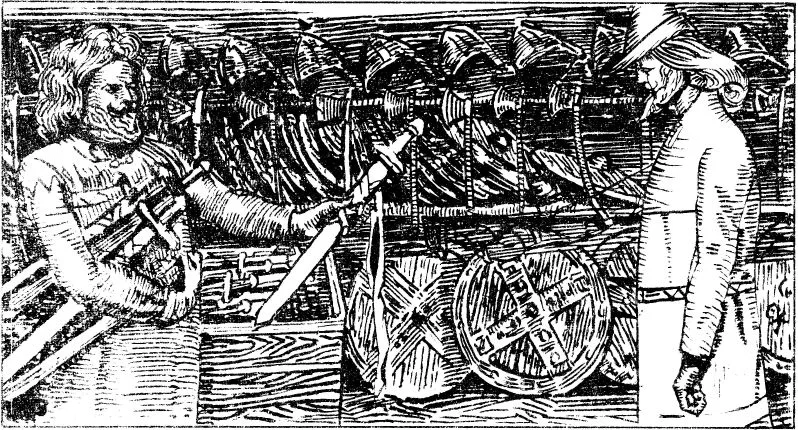 Christian Krohg, illustration for Óláfs saga helga, in Snorri Sturluson's Heimskringla (J.M. Stenersen & Co, 1899 edition) Krohg drew King Olav rewarding the skald Sigvatr Þórðarson with a sword — the kind of royal patronage, gift, and personal proximity to the throne that made court poetry the most prestigious literary craft of the Viking Age. Old Norse court poet. Skalds composed verse on behalf of kings and
earls — praise-poems (drápur), genealogies (like Þjóðólfr's
Ynglingatal), and memorial verse for the dead — and the most
prized were attached to royal courts. The skaldic tradition is
metrically intricate (the dróttkvætt metre is one of the most
technically demanding in any European literary tradition) and the
poems preserved alongside the prose sagas are some of the very few
contemporary sources for Viking-age and pre-Viking-age Norwegian
political history.
Also discussed in The Viking Age — longships, legends, and the first "Norway" Þjóðólfr of Hvinir
Christian Krohg, illustration for Óláfs saga helga, in Snorri Sturluson's Heimskringla (J.M. Stenersen & Co, 1899 edition) Krohg drew King Olav rewarding the skald Sigvatr Þórðarson with a sword — the kind of royal patronage, gift, and personal proximity to the throne that made court poetry the most prestigious literary craft of the Viking Age. Old Norse court poet. Skalds composed verse on behalf of kings and
earls — praise-poems (drápur), genealogies (like Þjóðólfr's
Ynglingatal), and memorial verse for the dead — and the most
prized were attached to royal courts. The skaldic tradition is
metrically intricate (the dróttkvætt metre is one of the most
technically demanding in any European literary tradition) and the
poems preserved alongside the prose sagas are some of the very few
contemporary sources for Viking-age and pre-Viking-age Norwegian
political history.
Also discussed in The Viking Age — longships, legends, and the first "Norway" Þjóðólfr of Hvinir 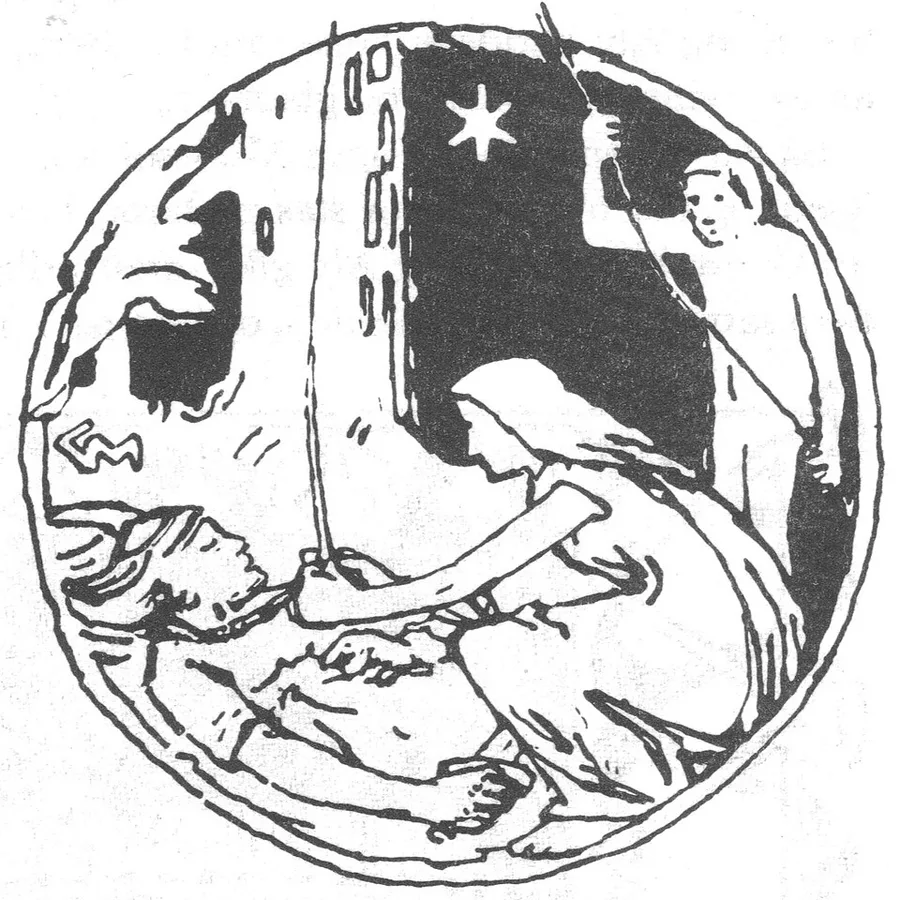 Gerhard Munthe, Ynglinge-saga vignette: Skjálf and King Agni, in Snorre Sturlason: Kongesagaer, J.M. Stenersen & Co, 1899 No portrait of the skald survives. This Munthe vignette from the 1899 Snorre edition shows one of the king-deaths Þjóðólfr's Ynglingatal counts off stanza by stanza: Queen Skjálf hangs King Agni with a cord knotted to his own gold neck-ring. Late-ninth-century Norwegian skald, court poet probably of Harald
Fairhair. Traditionally attributed as the composer of Ynglingatal,
the skaldic genealogical poem tracing the Vestfold Yngling kings
back through a sequence of Swedish predecessors to the god Frey.
How much of the genealogy is historical and how much is
legitimating mythology is debated; the poem itself is genuine and
one of the earliest surviving skaldic compositions.
Also discussed in Mare — the creature behind the word nightmare , back through a sequence of Swedish kings to the god Frey
Gerhard Munthe, Ynglinge-saga vignette: Skjálf and King Agni, in Snorre Sturlason: Kongesagaer, J.M. Stenersen & Co, 1899 No portrait of the skald survives. This Munthe vignette from the 1899 Snorre edition shows one of the king-deaths Þjóðólfr's Ynglingatal counts off stanza by stanza: Queen Skjálf hangs King Agni with a cord knotted to his own gold neck-ring. Late-ninth-century Norwegian skald, court poet probably of Harald
Fairhair. Traditionally attributed as the composer of Ynglingatal,
the skaldic genealogical poem tracing the Vestfold Yngling kings
back through a sequence of Swedish predecessors to the god Frey.
How much of the genealogy is historical and how much is
legitimating mythology is debated; the poem itself is genuine and
one of the earliest surviving skaldic compositions.
Also discussed in Mare — the creature behind the word nightmare , back through a sequence of Swedish kings to the god Frey 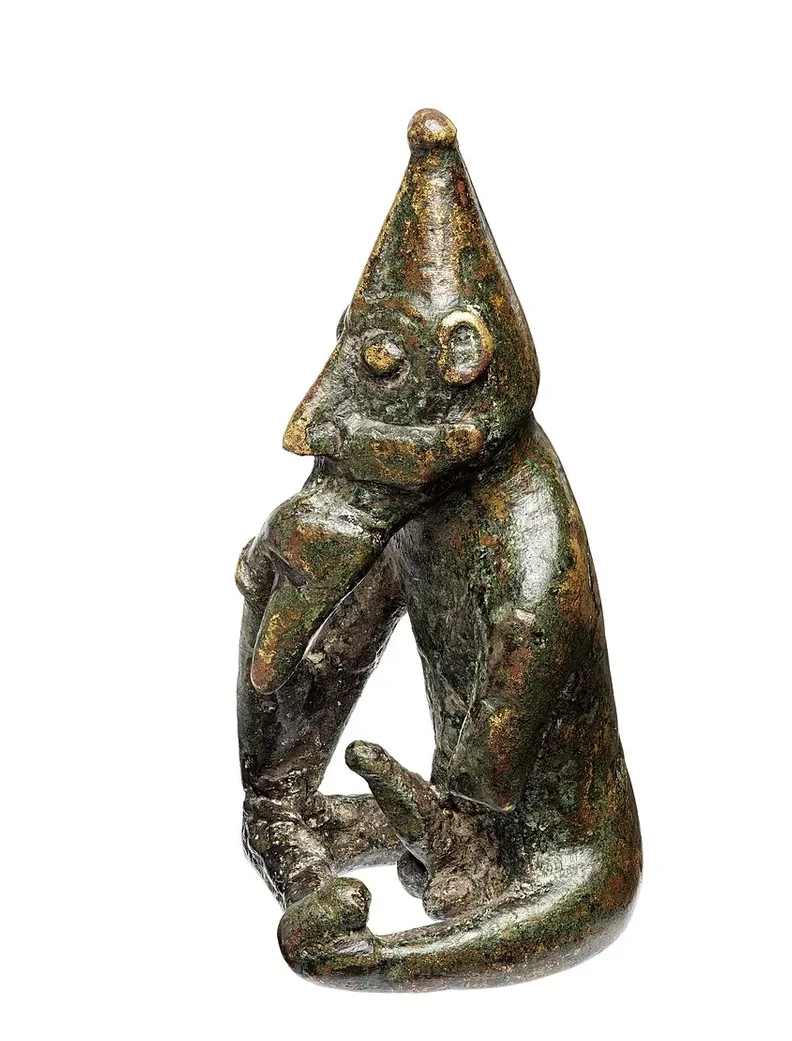 Rällinge Freyr statuette (Viking Age), photo: Ola Myrin, Historiska museet/SHM (CC BY 4.0) A small Viking Age bronze from Rällinge in Sweden — a seated, cross-legged figure in a pointed cap, long read as the fertility god Freyr and standing in for a deity no portrait records. Old Norse god (Old Norse Freyr, "lord") of fertility, prosperity,
fair weather, peace, and good harvest, brother of Freyja and one of
the principal Vanir deities incorporated into the Æsir pantheon.
The Yngling dynasty of Vestfold claimed direct descent from Frey
through the line traced in Ynglingatal; the claim was a religious
legitimation of the dynasty's right to rule.
Also discussed in Worshiping Odin and Thor — the lived religion of pre-Christian NorwayNordisk Mytologi — Odin, the giants, and Ragnarok . How much of that genealogy is historically reliable is debated; the dynasty itself is real and holds the throne in Vestfold across the eighth and ninth centuries.
Rällinge Freyr statuette (Viking Age), photo: Ola Myrin, Historiska museet/SHM (CC BY 4.0) A small Viking Age bronze from Rällinge in Sweden — a seated, cross-legged figure in a pointed cap, long read as the fertility god Freyr and standing in for a deity no portrait records. Old Norse god (Old Norse Freyr, "lord") of fertility, prosperity,
fair weather, peace, and good harvest, brother of Freyja and one of
the principal Vanir deities incorporated into the Æsir pantheon.
The Yngling dynasty of Vestfold claimed direct descent from Frey
through the line traced in Ynglingatal; the claim was a religious
legitimation of the dynasty's right to rule.
Also discussed in Worshiping Odin and Thor — the lived religion of pre-Christian NorwayNordisk Mytologi — Odin, the giants, and Ragnarok . How much of that genealogy is historically reliable is debated; the dynasty itself is real and holds the throne in Vestfold across the eighth and ninth centuries.
Further south and west sit the other named kingdoms. Agder 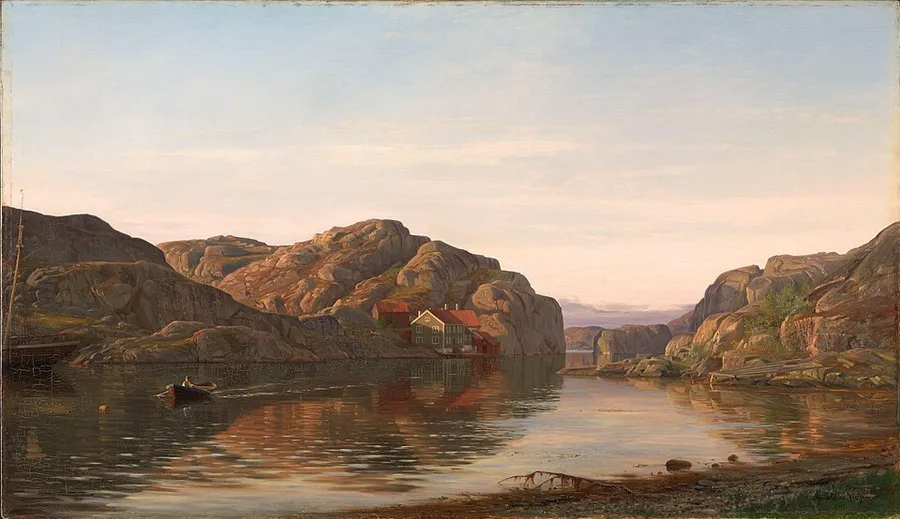 Amaldus Nielsen, Morning in Ny-Hellesund (1885), Nasjonalmuseet, NG.M.00326 Amaldus Nielsen's Morning in Ny-Hellesund (1885) — dawn on the bare skerries of the Agder coast, a rowing boat crossing the still sound. Nielsen painted the south-coast waters he grew up on; a thousand years earlier this Skagerrak-facing shore was a small kingdom of its own. Region on the southern coast of Norway, west of the Skagerrak.
In the petty-kingdom era a single smaller kingdom; under
twentieth-century administrative reform divided into Aust-Agder
(East) and Vest-Agder (West), then reunified in 2020. Its principal
modern city is Kristiansand.
Agder and Rogaland
Amaldus Nielsen, Morning in Ny-Hellesund (1885), Nasjonalmuseet, NG.M.00326 Amaldus Nielsen's Morning in Ny-Hellesund (1885) — dawn on the bare skerries of the Agder coast, a rowing boat crossing the still sound. Nielsen painted the south-coast waters he grew up on; a thousand years earlier this Skagerrak-facing shore was a small kingdom of its own. Region on the southern coast of Norway, west of the Skagerrak.
In the petty-kingdom era a single smaller kingdom; under
twentieth-century administrative reform divided into Aust-Agder
(East) and Vest-Agder (West), then reunified in 2020. Its principal
modern city is Kristiansand.
Agder and Rogaland 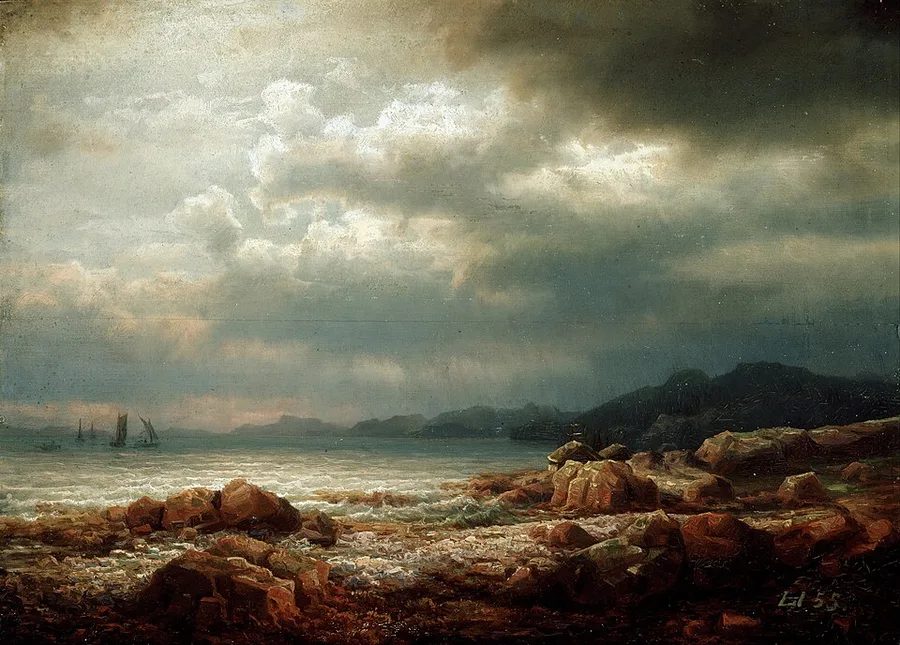 Lars Hertervig, Coastal Landscape (1855), Nasjonalmuseet / Google Art Project Lars Hertervig's storm-lit coastal landscape of 1855 — the painter's native Rogaland shore, sails out on the grey water beyond the surf. The southwestern coast bred a maritime petty kingdom whose story climaxes at Hafrsfjord, on this same stretch of sea. Region on the southwestern coast of Norway, centred on the
agriculturally productive Jæren plain — the largest single stretch
of arable land in the country. Modern Rogaland contains Stavanger,
the petroleum capital of Norway, and Hafrsfjord, the traditional
site of Harald Fairhair's consolidating sea-battle around 880.
Rogaland line the southern coast, the latter centered on the agriculturally productive Jæren
Lars Hertervig, Coastal Landscape (1855), Nasjonalmuseet / Google Art Project Lars Hertervig's storm-lit coastal landscape of 1855 — the painter's native Rogaland shore, sails out on the grey water beyond the surf. The southwestern coast bred a maritime petty kingdom whose story climaxes at Hafrsfjord, on this same stretch of sea. Region on the southwestern coast of Norway, centred on the
agriculturally productive Jæren plain — the largest single stretch
of arable land in the country. Modern Rogaland contains Stavanger,
the petroleum capital of Norway, and Hafrsfjord, the traditional
site of Harald Fairhair's consolidating sea-battle around 880.
Rogaland line the southern coast, the latter centered on the agriculturally productive Jæren 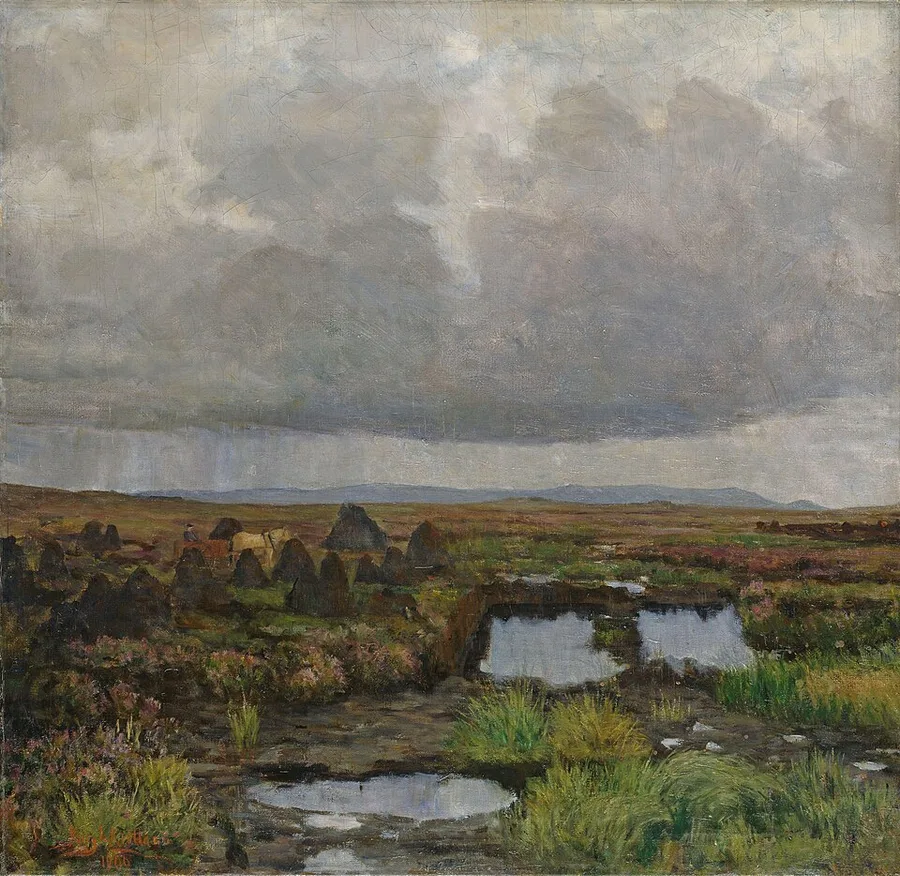 Kitty Kielland, Peat Bog on Jæren / Torvmyr på Jæren (1900), Nasjonalmuseet Kitty Kielland's Torvmyr på Jæren (1900) — peat stacks and bog pools on the flat open lowland south of Stavanger, painted before modern drainage turned much of it to field. The flatness is the point: Jæren is Norway's largest stretch of arable land, the grain-and-cattle wealth beneath Rogaland's power. The flat coastal agricultural plain south of Stavanger in Rogaland —
the largest single stretch of flat lowland in Norway, around seven
hundred square kilometres. The wealth of the Rogaland petty-kingdom
rested on Jæren's grain and cattle production; modern Jæren
remains one of the country's principal food-producing regions.
Jæren plain, the largest single stretch of arable land in the country. Up the western coast come the maritime kingdoms: Hordaland
Kitty Kielland, Peat Bog on Jæren / Torvmyr på Jæren (1900), Nasjonalmuseet Kitty Kielland's Torvmyr på Jæren (1900) — peat stacks and bog pools on the flat open lowland south of Stavanger, painted before modern drainage turned much of it to field. The flatness is the point: Jæren is Norway's largest stretch of arable land, the grain-and-cattle wealth beneath Rogaland's power. The flat coastal agricultural plain south of Stavanger in Rogaland —
the largest single stretch of flat lowland in Norway, around seven
hundred square kilometres. The wealth of the Rogaland petty-kingdom
rested on Jæren's grain and cattle production; modern Jæren
remains one of the country's principal food-producing regions.
Jæren plain, the largest single stretch of arable land in the country. Up the western coast come the maritime kingdoms: Hordaland 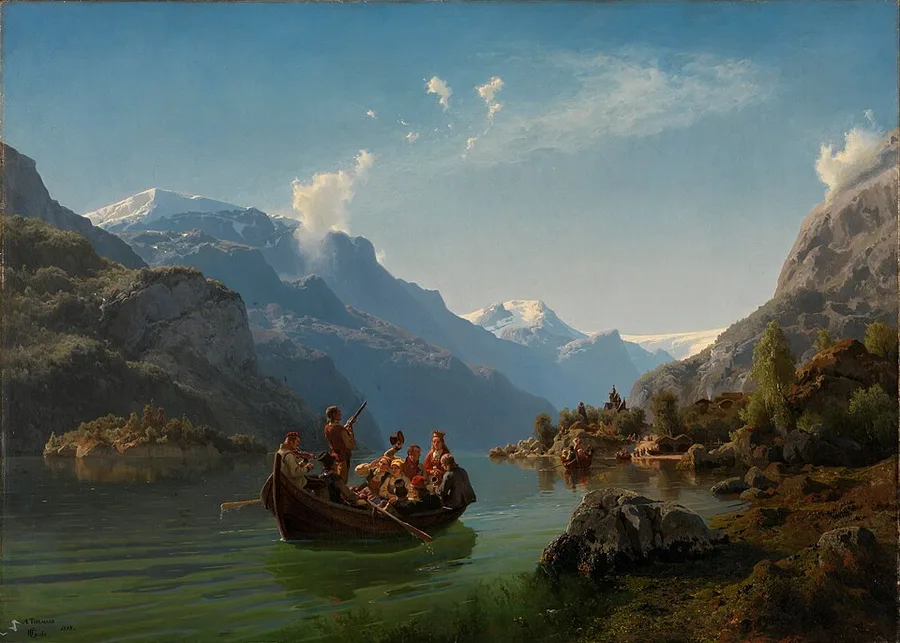 Adolph Tidemand & Hans Gude, Brudeferd i Hardanger (1848), Nasjonalmuseet / Google Art Project Tidemand and Gude's celebrated 1848 Brudeferd i Hardanger — a bridal party rowed across the still Hardangerfjord in festive dress — became the defining image of the fjord country of Hordaland, the region centred on Bergen. Region on the western coast of Norway centred on what is now Bergen.
In the petty-kingdom era a smaller maritime kingdom; from the high
medieval period the dominant Norwegian commercial region through
the Hanseatic period at Bryggen. Folded with adjacent Sogn og
Fjordane into the modern county of Vestland in 2020.
Hordaland (Bergen region) Also discussed in The Viking Age — longships, legends, and the first "Norway" around what is now Bergen
Adolph Tidemand & Hans Gude, Brudeferd i Hardanger (1848), Nasjonalmuseet / Google Art Project Tidemand and Gude's celebrated 1848 Brudeferd i Hardanger — a bridal party rowed across the still Hardangerfjord in festive dress — became the defining image of the fjord country of Hordaland, the region centred on Bergen. Region on the western coast of Norway centred on what is now Bergen.
In the petty-kingdom era a smaller maritime kingdom; from the high
medieval period the dominant Norwegian commercial region through
the Hanseatic period at Bryggen. Folded with adjacent Sogn og
Fjordane into the modern county of Vestland in 2020.
Hordaland (Bergen region) Also discussed in The Viking Age — longships, legends, and the first "Norway" around what is now Bergen 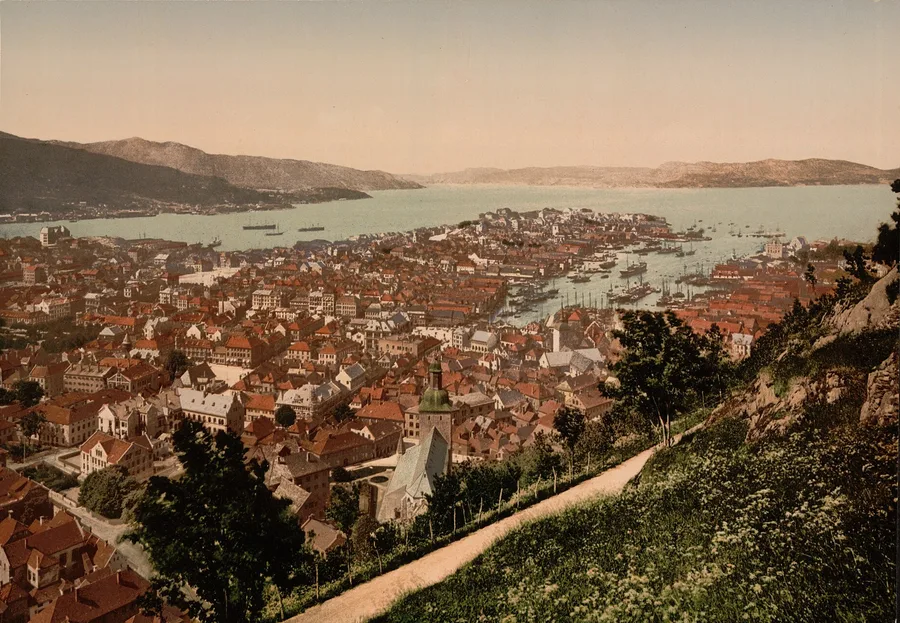 Photochrom print, General view from Fjeldveien, Bergen (c. 1890–1900), Library of Congress Bergen in the 1890s from the Fjellveien path on Fløyfjellet — the whole city between its mountains, Vågen harbour still crowded with sailing ships at its heart. For four centuries Norway's largest city, and the wharf through which the entire western export economy ran. Norway's western trading capital, founded around 1070 on the
inner Byfjorden. For four centuries the largest city in the
country and the wharf through which the entire western export
economy ran — dried cod from the Lofoten fisheries, stockpiled
and traded by the Hanseatic merchants at Bryggen from 1360 to
1754. Norway's commercial and intellectual heart through the
Hanseatic period; overtaken in size by Christiania (Oslo) in the
1830s. The painted wooden Bryggen wharf is on the UNESCO World
Heritage list and substantially what it was in the late
seventeenth century.
On the trip The Ungdommene (the Youngsters) reach Bergen late on Day 3
via the Norway-in-a-Nutshell train-and-ferry route from
Oslo. On the Day 4 morning they walk Bryggen and ride the
funicular up Mount Fløyen before flying back to Oslo and driving
on to Lillehammer that evening — a day ahead of the Gråhårsklubben
(the Oldsters), who spend the split days north in Trondheim and
the heritage country of Stjørdal, Hegra, and Kylloplass and come
south on Day 5.
Bergen Also discussed in The Germans Who "Ruled" Bergen — the Hanseatic merchants on Bryggen WharfThe King Who Became a Saint — how the Nordmen came to ChristA Catholic Norway — the faith that gave the kingdom its first institutions and the stave churchesThe Long Fall — the sudden loss of Norwegian nobility, the end of the kings, and half of Norway gone foreverThe Golden Age — a North Atlantic empire … reaching farther than you thinkThe 400-Year Night — when the Northern Lion lay dormantThe Crusades?!!!! — sixty ships from Bergen, bound for the Holy LandThe Reformation, 1537 — one church eradicated and another imposedWorld War II — the King’s “No” and the Nazis in NorwayKraken — the island-sized beast, logged as factSjøormer — the serpents in the deep lakes and fjordsPesta — an old woman walking from farm to farmFossegrimen — the waterfall fiddler who teaches you to playAlcohol and Vinmonopolet — when and where to buy a drinkEveryday etiquette — quiet voices, wide space, no smilingFood and dining customs — having patience, free water, brunost on everything🚨 Emergencies - important numbers, hospitals, and what you can doLanguage basics — just enough Norwegian to be politeWhat to wear — the layering system, on the ground ; Sogn
Photochrom print, General view from Fjeldveien, Bergen (c. 1890–1900), Library of Congress Bergen in the 1890s from the Fjellveien path on Fløyfjellet — the whole city between its mountains, Vågen harbour still crowded with sailing ships at its heart. For four centuries Norway's largest city, and the wharf through which the entire western export economy ran. Norway's western trading capital, founded around 1070 on the
inner Byfjorden. For four centuries the largest city in the
country and the wharf through which the entire western export
economy ran — dried cod from the Lofoten fisheries, stockpiled
and traded by the Hanseatic merchants at Bryggen from 1360 to
1754. Norway's commercial and intellectual heart through the
Hanseatic period; overtaken in size by Christiania (Oslo) in the
1830s. The painted wooden Bryggen wharf is on the UNESCO World
Heritage list and substantially what it was in the late
seventeenth century.
On the trip The Ungdommene (the Youngsters) reach Bergen late on Day 3
via the Norway-in-a-Nutshell train-and-ferry route from
Oslo. On the Day 4 morning they walk Bryggen and ride the
funicular up Mount Fløyen before flying back to Oslo and driving
on to Lillehammer that evening — a day ahead of the Gråhårsklubben
(the Oldsters), who spend the split days north in Trondheim and
the heritage country of Stjørdal, Hegra, and Kylloplass and come
south on Day 5.
Bergen Also discussed in The Germans Who "Ruled" Bergen — the Hanseatic merchants on Bryggen WharfThe King Who Became a Saint — how the Nordmen came to ChristA Catholic Norway — the faith that gave the kingdom its first institutions and the stave churchesThe Long Fall — the sudden loss of Norwegian nobility, the end of the kings, and half of Norway gone foreverThe Golden Age — a North Atlantic empire … reaching farther than you thinkThe 400-Year Night — when the Northern Lion lay dormantThe Crusades?!!!! — sixty ships from Bergen, bound for the Holy LandThe Reformation, 1537 — one church eradicated and another imposedWorld War II — the King’s “No” and the Nazis in NorwayKraken — the island-sized beast, logged as factSjøormer — the serpents in the deep lakes and fjordsPesta — an old woman walking from farm to farmFossegrimen — the waterfall fiddler who teaches you to playAlcohol and Vinmonopolet — when and where to buy a drinkEveryday etiquette — quiet voices, wide space, no smilingFood and dining customs — having patience, free water, brunost on everything🚨 Emergencies - important numbers, hospitals, and what you can doLanguage basics — just enough Norwegian to be politeWhat to wear — the layering system, on the ground ; Sogn 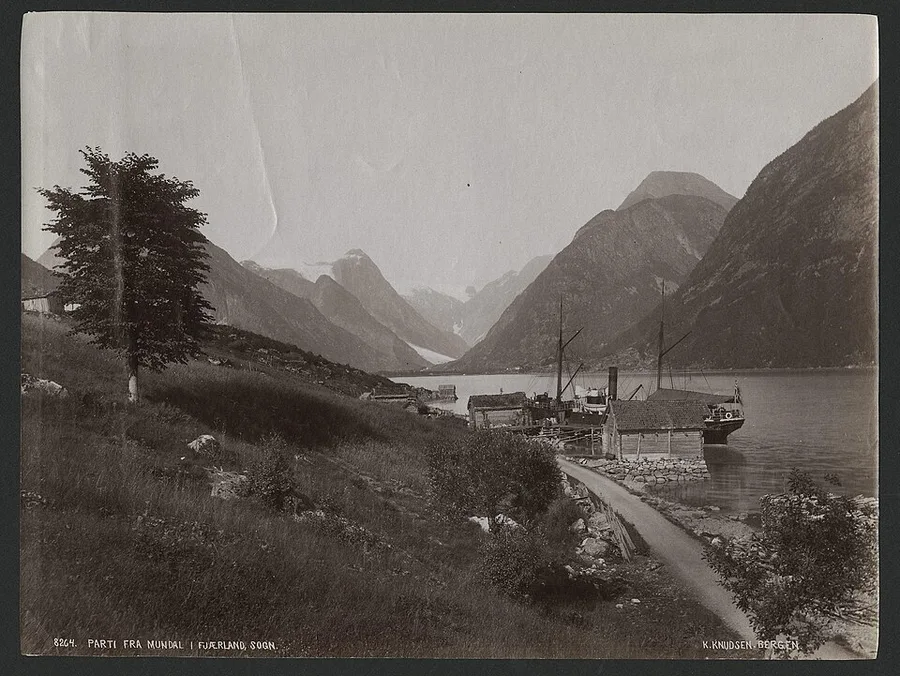 Knud Knudsen, Parti fra Mundal i Fjærland, Sogn (1885), Nasjonalmuseet (NMK.2006.5108) Knud Knudsen's 1885 photograph of Mundal in Fjærland, a village on a Sognefjord arm with the steamer at its pier. Reached by water, supplied by water — the picture quietly restates the rule the fjord kingdoms lived by: the boat, in this country, is the road. Region on the western coast of Norway around the long inland
Sognefjord. In the petty-kingdom era a small maritime kingdom whose
wealth came from coastal trade and harbour control rather than
agriculture. The Sogn name survives in modern usage; the region was
folded into the larger administrative county of Vestland in 2020.
On the trip Day 3 carries the Ungdommene (the Youngsters) into Sogn —
the Flåm railway, the Stegastein overlook, and the
Nærøyfjord cruise all lie within the old Sogn district.
Sogn Also discussed in 800,000 Norwegians Leave — the century that built a Second Norway around the long inner fjord that still bears its name; Fjordane
Knud Knudsen, Parti fra Mundal i Fjærland, Sogn (1885), Nasjonalmuseet (NMK.2006.5108) Knud Knudsen's 1885 photograph of Mundal in Fjærland, a village on a Sognefjord arm with the steamer at its pier. Reached by water, supplied by water — the picture quietly restates the rule the fjord kingdoms lived by: the boat, in this country, is the road. Region on the western coast of Norway around the long inland
Sognefjord. In the petty-kingdom era a small maritime kingdom whose
wealth came from coastal trade and harbour control rather than
agriculture. The Sogn name survives in modern usage; the region was
folded into the larger administrative county of Vestland in 2020.
On the trip Day 3 carries the Ungdommene (the Youngsters) into Sogn —
the Flåm railway, the Stegastein overlook, and the
Nærøyfjord cruise all lie within the old Sogn district.
Sogn Also discussed in 800,000 Norwegians Leave — the century that built a Second Norway around the long inner fjord that still bears its name; Fjordane 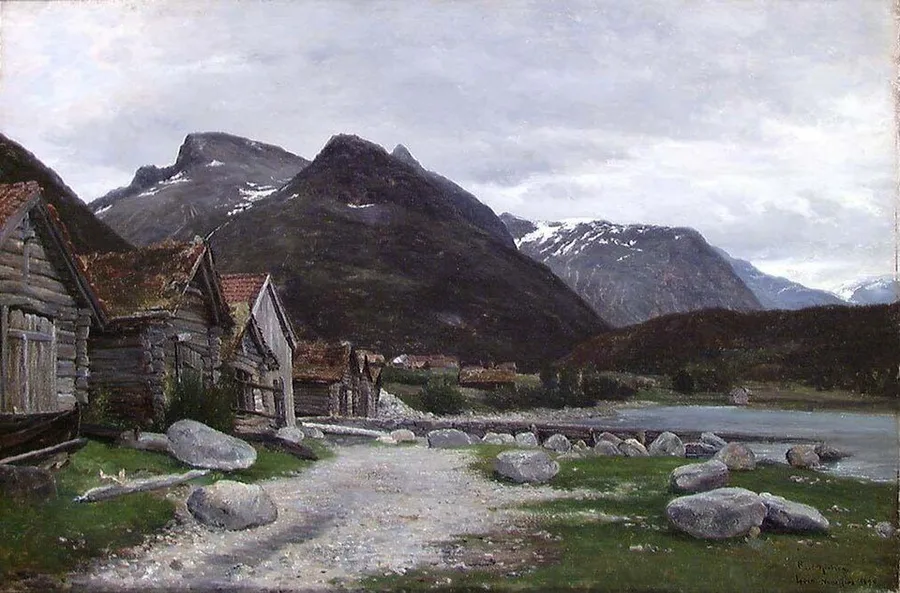 Carl Nielsen, View of Loen in Nordfjord (1894), Nasjonalmuseet, NG.M.03446 Carl Nielsen's 1894 view of Loen in Nordfjord — log farm buildings on a stony track above the fjord arm, mountains closing in behind. Fjordane's short coastal fjords each held a pocket of settlement like this; strung together by boat, they made a small maritime kingdom. Region on the western coast of Norway directly north of Sogn,
organised around several short coastal fjords. In the petty-kingdom
era a small maritime kingdom; later combined with Sogn into Sogn
og Fjordane and folded into the modern administrative county of
Vestland in 2020.
Fjordane north of Sogn; Sunnmøre
Carl Nielsen, View of Loen in Nordfjord (1894), Nasjonalmuseet, NG.M.03446 Carl Nielsen's 1894 view of Loen in Nordfjord — log farm buildings on a stony track above the fjord arm, mountains closing in behind. Fjordane's short coastal fjords each held a pocket of settlement like this; strung together by boat, they made a small maritime kingdom. Region on the western coast of Norway directly north of Sogn,
organised around several short coastal fjords. In the petty-kingdom
era a small maritime kingdom; later combined with Sogn into Sogn
og Fjordane and folded into the modern administrative county of
Vestland in 2020.
Fjordane north of Sogn; Sunnmøre 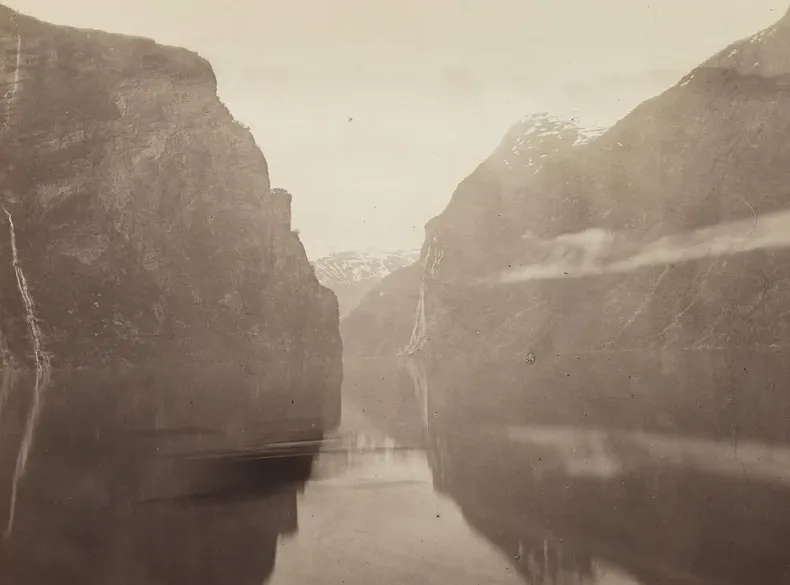 Knud Knudsen, Parti fra Geiranger, Sondmore (1864-1889), National Library of Norway Knud Knudsen's nineteenth-century photograph of the Geirangerfjord — sheer walls, threads of waterfall, mirror-still water. Sunnmøre's interior stands this vertical; its petty kingdom lived off the sea instead, on fishing and coastal trade just south of the Stadt headland. Region on the northwestern Norwegian coast, the southernmost of
the three traditional districts of the modern county of Møre og
Romsdal, sitting just south of the Stadt headland. In the
petty-kingdom era a small maritime kingdom whose wealth came from
coastal trade and fishing rather than agriculture. The principal
modern town is Ålesund, rebuilt in Art Nouveau style after a
devastating fire in 1904.
Sunnmøre Also discussed in The 400-Year Night — when the Northern Lion lay dormant and Romsdal
Knud Knudsen, Parti fra Geiranger, Sondmore (1864-1889), National Library of Norway Knud Knudsen's nineteenth-century photograph of the Geirangerfjord — sheer walls, threads of waterfall, mirror-still water. Sunnmøre's interior stands this vertical; its petty kingdom lived off the sea instead, on fishing and coastal trade just south of the Stadt headland. Region on the northwestern Norwegian coast, the southernmost of
the three traditional districts of the modern county of Møre og
Romsdal, sitting just south of the Stadt headland. In the
petty-kingdom era a small maritime kingdom whose wealth came from
coastal trade and fishing rather than agriculture. The principal
modern town is Ålesund, rebuilt in Art Nouveau style after a
devastating fire in 1904.
Sunnmøre Also discussed in The 400-Year Night — when the Northern Lion lay dormant and Romsdal 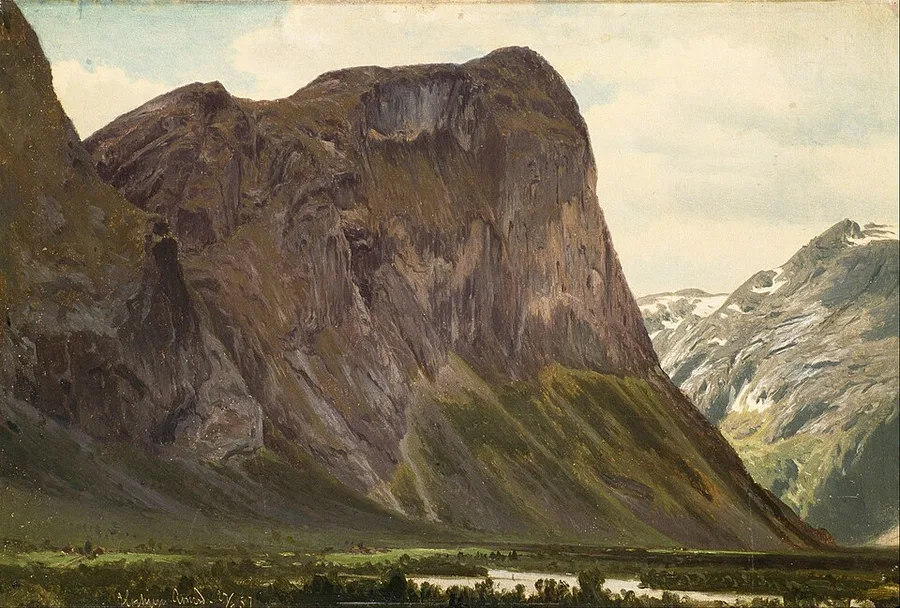 Johan Fredrik Eckersberg, From Horgheim in Romsdal (1857), Nasjonalmuseet Johan Fredrik Eckersberg's 1857 view from Horgheim — the Romsdal valley wall rising sheer from the flat floor, the Rauma winding below. The narrow farmable strip between rock and water is what a mid-coast petty kingdom had to work with. Region on the northwestern Norwegian coast, the middle of the three
traditional districts of the modern county of Møre og Romsdal,
centred on the Romsdal valley and the long Romsdalsfjord. In the
petty-kingdom era a small maritime kingdom; the principal modern
town is Molde.
Romsdal further up the coast. These western kingdoms are smaller than Vestfold but tightly tied to the open sea, and the wealth of their chieftains comes more from fishing, coastal trade, and control of harbours than from agricultural land.
Johan Fredrik Eckersberg, From Horgheim in Romsdal (1857), Nasjonalmuseet Johan Fredrik Eckersberg's 1857 view from Horgheim — the Romsdal valley wall rising sheer from the flat floor, the Rauma winding below. The narrow farmable strip between rock and water is what a mid-coast petty kingdom had to work with. Region on the northwestern Norwegian coast, the middle of the three
traditional districts of the modern county of Møre og Romsdal,
centred on the Romsdal valley and the long Romsdalsfjord. In the
petty-kingdom era a small maritime kingdom; the principal modern
town is Molde.
Romsdal further up the coast. These western kingdoms are smaller than Vestfold but tightly tied to the open sea, and the wealth of their chieftains comes more from fishing, coastal trade, and control of harbours than from agricultural land.
Past the headland of Stadt 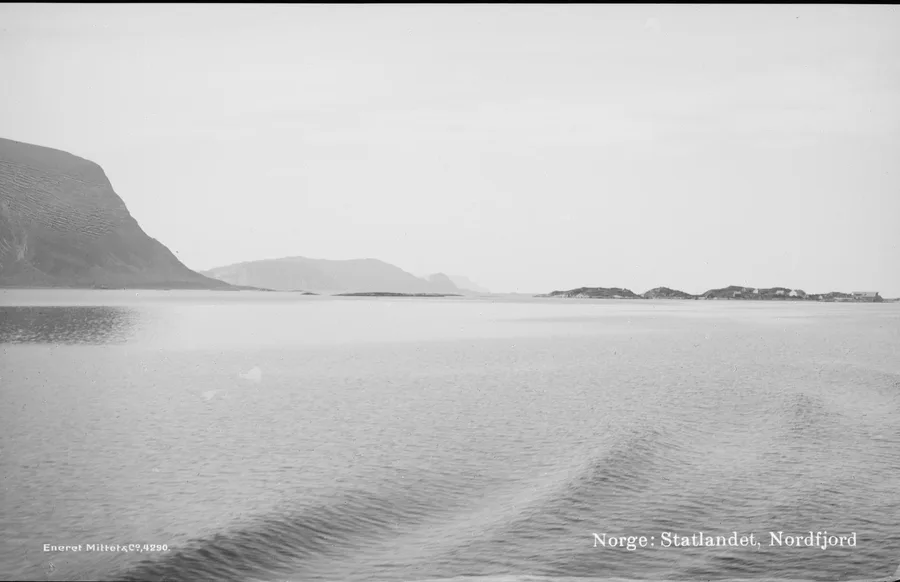 Mittet & Co., Norge, Statlandet, Nordfjord (c. 1900), National Library of Norway Taken from the deck of a coastal steamer around 1900: the Stadt headland shoulders out of the sea exactly as generations of sailors met it — the most exposed rounding on the Norwegian coast, where the open Atlantic meets the mountain winds without break. The headland on the western coast of Norway between Møre og Romsdal
and the Nordfjord region, traditionally regarded as the dividing
line between southern and northern Norway. The most exposed
navigational point on the Norwegian coastline; rounding Stadt is
considered one of the most dangerous stretches of European coastal
sailing because the open Atlantic meets the mountain wind funnels
without break. Modern Stadlandet is in Stad municipality.
Stadt (Stadlandet) , which traditionally marks the divide between southern and northern Norway, the dominant power is the kingdom of Trøndelag
Mittet & Co., Norge, Statlandet, Nordfjord (c. 1900), National Library of Norway Taken from the deck of a coastal steamer around 1900: the Stadt headland shoulders out of the sea exactly as generations of sailors met it — the most exposed rounding on the Norwegian coast, where the open Atlantic meets the mountain winds without break. The headland on the western coast of Norway between Møre og Romsdal
and the Nordfjord region, traditionally regarded as the dividing
line between southern and northern Norway. The most exposed
navigational point on the Norwegian coastline; rounding Stadt is
considered one of the most dangerous stretches of European coastal
sailing because the open Atlantic meets the mountain wind funnels
without break. Modern Stadlandet is in Stad municipality.
Stadt (Stadlandet) , which traditionally marks the divide between southern and northern Norway, the dominant power is the kingdom of Trøndelag 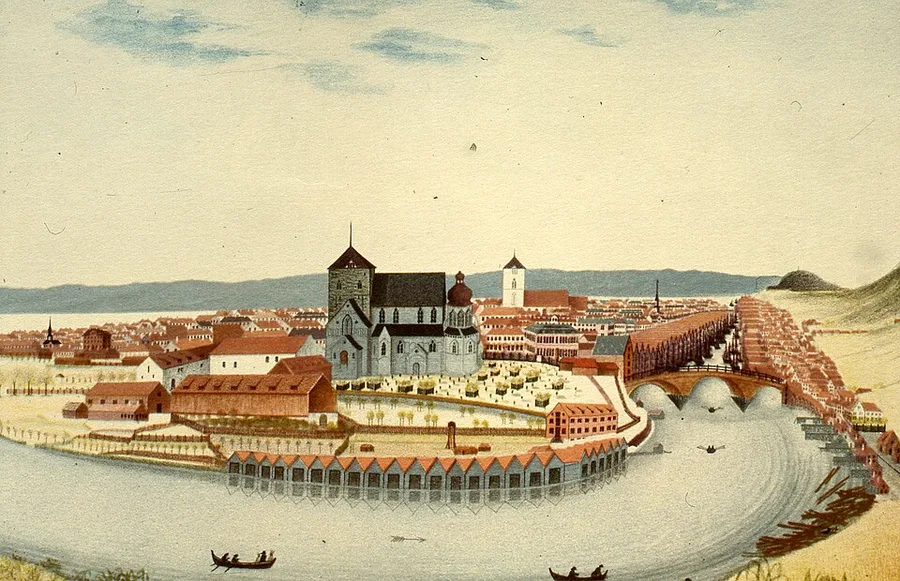 Johannes Aas, Prospect af Staden Trondhiem (1826), Municipal Archives of Trondheim (CC BY 2.0) An 1826 prospect of Trondheim, Nidaros Cathedral rising over the river bend. Founded by Olav Tryggvason as Nidaros in 997, the town became the seat of Norway's archbishopric in 1153 and the country's ecclesiastical capital. Region of central Norway around the Trondheim Fjord, north of Stadt
and south of Hålogaland. Its agriculturally rich Trondheim plain
is the second-largest area of arable land in the country and the
base of the medieval earls of Lade. Trondheim — founded by Olav
Tryggvason in 997 as Nidaros — became the seat of the Norwegian
archbishopric in 1153 and remains the country's third-largest city
and ecclesiastical capital.
On the trip Day 3-5 of the trip routes the Gråhårsklubben (the Oldsters) through
Trøndelag for the Slektsreisen heritage drive — Trondheim and the
Nidaros Cathedral on Day 3, then Stjørdal and Hegra, then on up
the Stjørdalen valley to Kylloplass.
Trøndelag (Trondheim) Also discussed in Worshiping Odin and Thor — the lived religion of pre-Christian NorwayThe King Who Became a Saint — how the Nordmen came to ChristThe Long Fall — the sudden loss of Norwegian nobility, the end of the kings, and half of Norway gone foreverLutheran Norway and Pietism — a farmer named Hans Nielsen Hauge and a lay revival that could not be silencedDraugen — the drowned man who never came homeThe Hytte — a sacred pastime of modern Norway and the Earl of Lade
Johannes Aas, Prospect af Staden Trondhiem (1826), Municipal Archives of Trondheim (CC BY 2.0) An 1826 prospect of Trondheim, Nidaros Cathedral rising over the river bend. Founded by Olav Tryggvason as Nidaros in 997, the town became the seat of Norway's archbishopric in 1153 and the country's ecclesiastical capital. Region of central Norway around the Trondheim Fjord, north of Stadt
and south of Hålogaland. Its agriculturally rich Trondheim plain
is the second-largest area of arable land in the country and the
base of the medieval earls of Lade. Trondheim — founded by Olav
Tryggvason in 997 as Nidaros — became the seat of the Norwegian
archbishopric in 1153 and remains the country's third-largest city
and ecclesiastical capital.
On the trip Day 3-5 of the trip routes the Gråhårsklubben (the Oldsters) through
Trøndelag for the Slektsreisen heritage drive — Trondheim and the
Nidaros Cathedral on Day 3, then Stjørdal and Hegra, then on up
the Stjørdalen valley to Kylloplass.
Trøndelag (Trondheim) Also discussed in Worshiping Odin and Thor — the lived religion of pre-Christian NorwayThe King Who Became a Saint — how the Nordmen came to ChristThe Long Fall — the sudden loss of Norwegian nobility, the end of the kings, and half of Norway gone foreverLutheran Norway and Pietism — a farmer named Hans Nielsen Hauge and a lay revival that could not be silencedDraugen — the drowned man who never came homeThe Hytte — a sacred pastime of modern Norway and the Earl of Lade 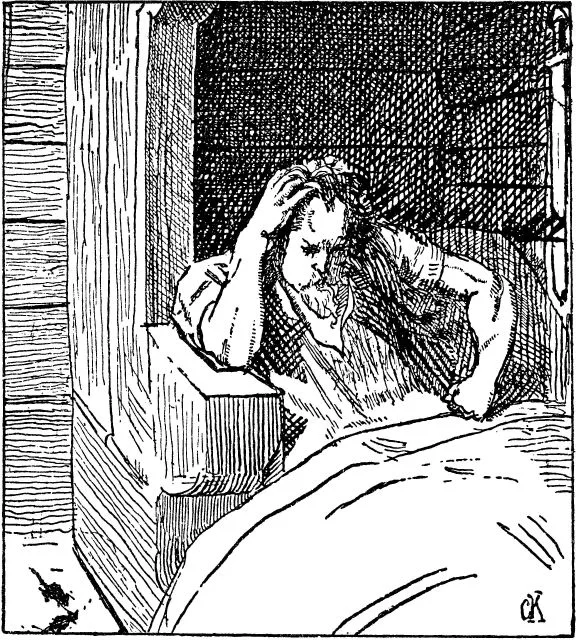 Christian Krohg, Håkon jarl, illustration for Olav Tryggvasons saga, Heimskringla folk edition (J.M. Stenersen & Co, 1899) Christian Krohg's 1899 Heimskringla illustration of Håkon jarl brooding in the dark — the mightiest of the Lade earls, whose dynasty ran Trøndelag as a rival to the Norwegian crown for two centuries. The Lade dynasty held the rich Trøndelag farmland from its seat
on the inner Trondheim Fjord — for two centuries the principal
rival to the Fairhair-line Norwegian crown. From Hákon Sigurdsson
(Hákon Jarl, d. 995) through Eirik Hákonsson (d. ~1023), the Lade
earls ran central Norway as their own polity, sometimes acclaimed
king, sometimes regent under a foreign overlord, always in tension
with the southern royal court. Their seat at Lade is now a quiet
residential district on the inner Trondheim Fjord.
Lade peninsula, Trondheim Fjord Also discussed in The Viking Age — longships, legends, and the first "Norway"The King Who Became a Saint — how the Nordmen came to Christ . The Lade family holds the title of Jarl Old Norse for "earl" — a nobleman ranking just below a king. In the
pre-unification and Viking-age Norwegian polities a jarl typically
governed a region under a king's nominal overlordship; in the case
of the earls of Lade in Trøndelag, the jarl's political authority
was equivalent to a king's and the title difference was largely
formal. The English word earl is a direct borrowing of jarl
via Old English eorl.
, “earl,” rather than Konungr Old Norse for "king" — the title of a sovereign ruler in
pre-unification and medieval Scandinavia. Cognate with English
king, German König, and modern Norwegian konge. In the
petty-kingdom era a konungr held authority over a single fjord
or valley district, served as war leader and religious officiant,
and ruled alongside the regional thing. The Vestfold konungr
Harald Fairhair would, after the Battle of Hafrsfjord, become the
first konungr claimed (by later saga tradition) to rule over all
of Norway.
, “king,” but their political authority is equivalent to a southern king’s, and their holdings on the Trondheim
Christian Krohg, Håkon jarl, illustration for Olav Tryggvasons saga, Heimskringla folk edition (J.M. Stenersen & Co, 1899) Christian Krohg's 1899 Heimskringla illustration of Håkon jarl brooding in the dark — the mightiest of the Lade earls, whose dynasty ran Trøndelag as a rival to the Norwegian crown for two centuries. The Lade dynasty held the rich Trøndelag farmland from its seat
on the inner Trondheim Fjord — for two centuries the principal
rival to the Fairhair-line Norwegian crown. From Hákon Sigurdsson
(Hákon Jarl, d. 995) through Eirik Hákonsson (d. ~1023), the Lade
earls ran central Norway as their own polity, sometimes acclaimed
king, sometimes regent under a foreign overlord, always in tension
with the southern royal court. Their seat at Lade is now a quiet
residential district on the inner Trondheim Fjord.
Lade peninsula, Trondheim Fjord Also discussed in The Viking Age — longships, legends, and the first "Norway"The King Who Became a Saint — how the Nordmen came to Christ . The Lade family holds the title of Jarl Old Norse for "earl" — a nobleman ranking just below a king. In the
pre-unification and Viking-age Norwegian polities a jarl typically
governed a region under a king's nominal overlordship; in the case
of the earls of Lade in Trøndelag, the jarl's political authority
was equivalent to a king's and the title difference was largely
formal. The English word earl is a direct borrowing of jarl
via Old English eorl.
, “earl,” rather than Konungr Old Norse for "king" — the title of a sovereign ruler in
pre-unification and medieval Scandinavia. Cognate with English
king, German König, and modern Norwegian konge. In the
petty-kingdom era a konungr held authority over a single fjord
or valley district, served as war leader and religious officiant,
and ruled alongside the regional thing. The Vestfold konungr
Harald Fairhair would, after the Battle of Hafrsfjord, become the
first konungr claimed (by later saga tradition) to rule over all
of Norway.
, “king,” but their political authority is equivalent to a southern king’s, and their holdings on the Trondheim 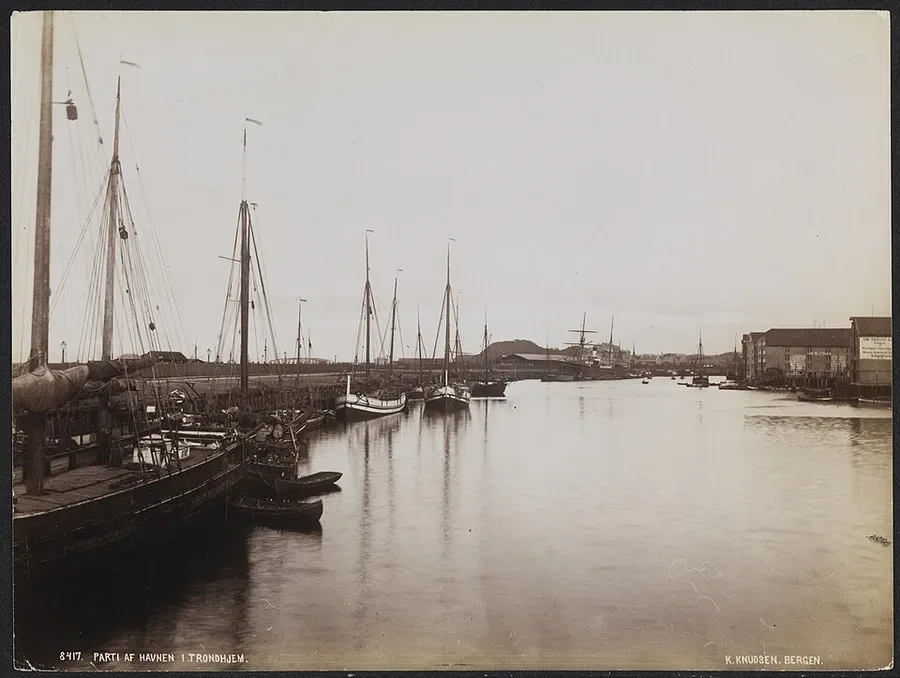 Knud Knudsen, Parti af Havnen i Trondhjem (1888-1894), National Library of Norway Knud Knudsen's photograph of Trondheim harbour in the early 1890s. Founded by Olav Tryggvason in 997 as Nidaros, the city was Norway's medieval capital and the seat of the archbishopric and the Olav cult that anchored the country's Christianity. Norway's third-largest city, founded by Olav Tryggvason in 997 as
Nidaros at the mouth of the Nid River on the inner Trondheim
Fjord. Capital of the Norwegian kingdom for much of the medieval
period; seat of the Norwegian archbishopric from 1153 and of the
Olav cult that anchored medieval Norwegian Christianity. Renamed
Trondheim in 1931 — after a controversial one-year spell
officially named Nidaros from 1930 — replacing the Danish-era
spelling Trondhjem and reviving the medieval Old Norse district
name (Þrándheimr). About two hundred thousand people in the municipality
today. Home to Nidaros Cathedral, NTNU (the Norwegian University
of Science and Technology), and the Trondheim Fjord harbour.
On the trip Day 3 of the trip routes the Gråhårsklubben (the Oldsters) through
Trondheim. The visit centres on Nidaros Cathedral — the building
the Olav devotion raised, and the architectural inheritance of
Bishop Grimkell's pronouncement on a summer day in 1031.
Trondheim Also discussed in The King Who Became a Saint — how the Nordmen came to ChristA Catholic Norway — the faith that gave the kingdom its first institutions and the stave churchesThe Crusades?!!!! — sixty ships from Bergen, bound for the Holy LandThe Golden Age — a North Atlantic empire … reaching farther than you thinkThe Long Fall — the sudden loss of Norwegian nobility, the end of the kings, and half of Norway gone foreverThe 400-Year Night — when the Northern Lion lay dormantThe Reformation, 1537 — one church eradicated and another imposedLutheran Norway and Pietism — a farmer named Hans Nielsen Hauge and a lay revival that could not be silencedWorld War II — the King’s “No” and the Nazis in NorwayDriving in Norway — tolls, ferries, and a near-zero alcohol limitEveryday etiquette — quiet voices, wide space, no smiling🚨 Emergencies - important numbers, hospitals, and what you can doLanguage basics — just enough Norwegian to be polite plain — the second-largest area of good agricultural land in the country — are larger than most southern kingdoms put together. North of Trøndelag stretches Hålogaland
Knud Knudsen, Parti af Havnen i Trondhjem (1888-1894), National Library of Norway Knud Knudsen's photograph of Trondheim harbour in the early 1890s. Founded by Olav Tryggvason in 997 as Nidaros, the city was Norway's medieval capital and the seat of the archbishopric and the Olav cult that anchored the country's Christianity. Norway's third-largest city, founded by Olav Tryggvason in 997 as
Nidaros at the mouth of the Nid River on the inner Trondheim
Fjord. Capital of the Norwegian kingdom for much of the medieval
period; seat of the Norwegian archbishopric from 1153 and of the
Olav cult that anchored medieval Norwegian Christianity. Renamed
Trondheim in 1931 — after a controversial one-year spell
officially named Nidaros from 1930 — replacing the Danish-era
spelling Trondhjem and reviving the medieval Old Norse district
name (Þrándheimr). About two hundred thousand people in the municipality
today. Home to Nidaros Cathedral, NTNU (the Norwegian University
of Science and Technology), and the Trondheim Fjord harbour.
On the trip Day 3 of the trip routes the Gråhårsklubben (the Oldsters) through
Trondheim. The visit centres on Nidaros Cathedral — the building
the Olav devotion raised, and the architectural inheritance of
Bishop Grimkell's pronouncement on a summer day in 1031.
Trondheim Also discussed in The King Who Became a Saint — how the Nordmen came to ChristA Catholic Norway — the faith that gave the kingdom its first institutions and the stave churchesThe Crusades?!!!! — sixty ships from Bergen, bound for the Holy LandThe Golden Age — a North Atlantic empire … reaching farther than you thinkThe Long Fall — the sudden loss of Norwegian nobility, the end of the kings, and half of Norway gone foreverThe 400-Year Night — when the Northern Lion lay dormantThe Reformation, 1537 — one church eradicated and another imposedLutheran Norway and Pietism — a farmer named Hans Nielsen Hauge and a lay revival that could not be silencedWorld War II — the King’s “No” and the Nazis in NorwayDriving in Norway — tolls, ferries, and a near-zero alcohol limitEveryday etiquette — quiet voices, wide space, no smiling🚨 Emergencies - important numbers, hospitals, and what you can doLanguage basics — just enough Norwegian to be polite plain — the second-largest area of good agricultural land in the country — are larger than most southern kingdoms put together. North of Trøndelag stretches Hålogaland 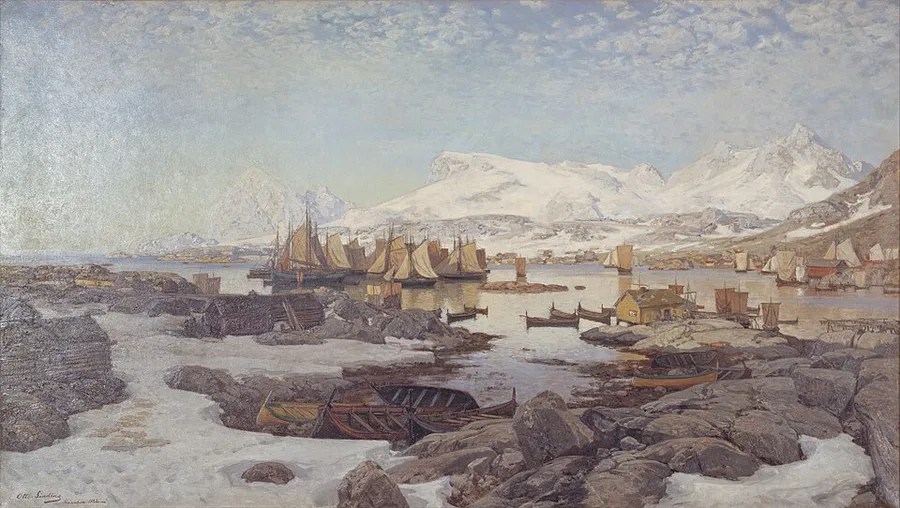 Otto Sinding, En forårsdag i Lofoten (1882), Statens Museum for Kunst Otto Sinding's 1882 spring scene from Lofoten — boats and fish-drying racks along the working shore — pictures the coast of old Hålogaland, the northern region whose kings grew wealthy on Arctic trade. The northern Norwegian region running from modern Nordland into
the Arctic. In the petty-kingdom era its kings grew wealthy on
walrus ivory from the Arctic, furs from the inland forests, and
tribute paid by the Sámi peoples of the interior. The Hålogaland
magnate Ohthere, whose c. 890 account given at King Alfred's court
is the earliest detailed geographic description of Norway,
controlled this trade. The Hålogaland name has dropped from
contemporary administrative usage but persists in geographic and
ecclesiastical contexts (the Hålogaland Court of Appeal, the
Hålogaland Lutheran diocese).
Hålogaland (Nordland) , which runs from modern Nordland
Otto Sinding, En forårsdag i Lofoten (1882), Statens Museum for Kunst Otto Sinding's 1882 spring scene from Lofoten — boats and fish-drying racks along the working shore — pictures the coast of old Hålogaland, the northern region whose kings grew wealthy on Arctic trade. The northern Norwegian region running from modern Nordland into
the Arctic. In the petty-kingdom era its kings grew wealthy on
walrus ivory from the Arctic, furs from the inland forests, and
tribute paid by the Sámi peoples of the interior. The Hålogaland
magnate Ohthere, whose c. 890 account given at King Alfred's court
is the earliest detailed geographic description of Norway,
controlled this trade. The Hålogaland name has dropped from
contemporary administrative usage but persists in geographic and
ecclesiastical contexts (the Hålogaland Court of Appeal, the
Hålogaland Lutheran diocese).
Hålogaland (Nordland) , which runs from modern Nordland 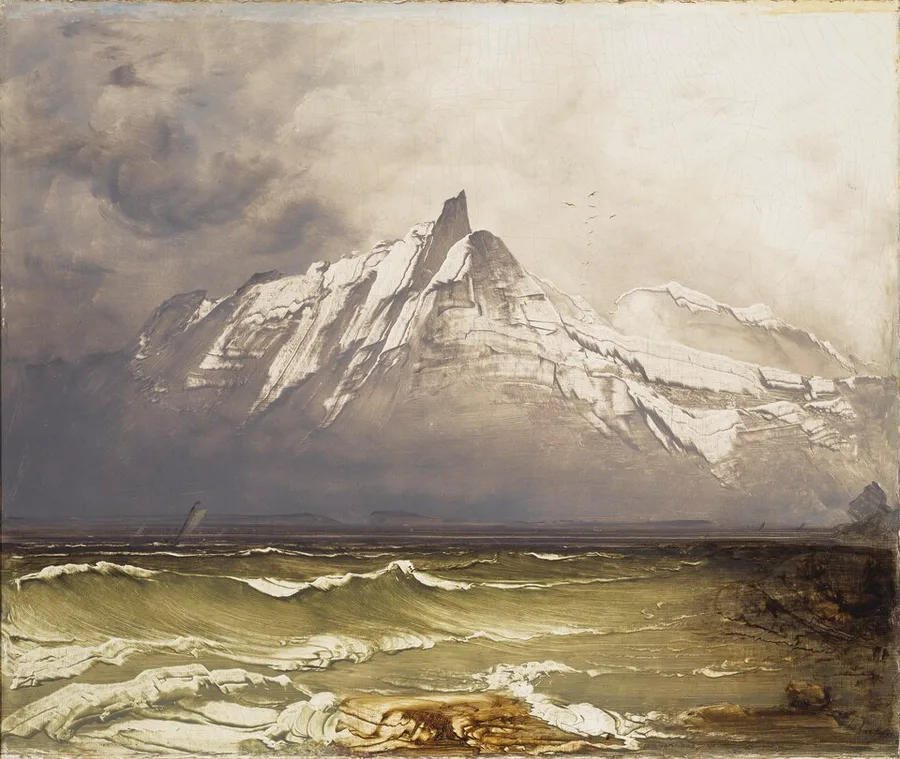 Peder Balke, Fra Nordland, Nationalmuseum (Stockholm) Balke sailed this coast in 1832 and painted it from memory for the rest of his life: the Nordland of sheer peaks meeting open sea — southern Hålogaland in the petty-kingdom centuries, the water its fishing wealth came from. Northern Norwegian county running from south of the Arctic Circle
to the border with Troms og Finnmark in the north. In the
petty-kingdom era the southern part of Hålogaland; today one of the
largest Norwegian counties by area but among the most thinly
populated, the long-coastal heartland of cod fishing and the home
of the Lofoten archipelago. Principal city: Bodø.
Nordland Also discussed in Draugen — the drowned man who never came home into the Arctic Sea. Its kings grow wealthy on walrus ivory traded from the far north, on furs taken from the inland forests, and on tribute paid by the The Sámi
Peder Balke, Fra Nordland, Nationalmuseum (Stockholm) Balke sailed this coast in 1832 and painted it from memory for the rest of his life: the Nordland of sheer peaks meeting open sea — southern Hålogaland in the petty-kingdom centuries, the water its fishing wealth came from. Northern Norwegian county running from south of the Arctic Circle
to the border with Troms og Finnmark in the north. In the
petty-kingdom era the southern part of Hålogaland; today one of the
largest Norwegian counties by area but among the most thinly
populated, the long-coastal heartland of cod fishing and the home
of the Lofoten archipelago. Principal city: Bodø.
Nordland Also discussed in Draugen — the drowned man who never came home into the Arctic Sea. Its kings grow wealthy on walrus ivory traded from the far north, on furs taken from the inland forests, and on tribute paid by the The Sámi 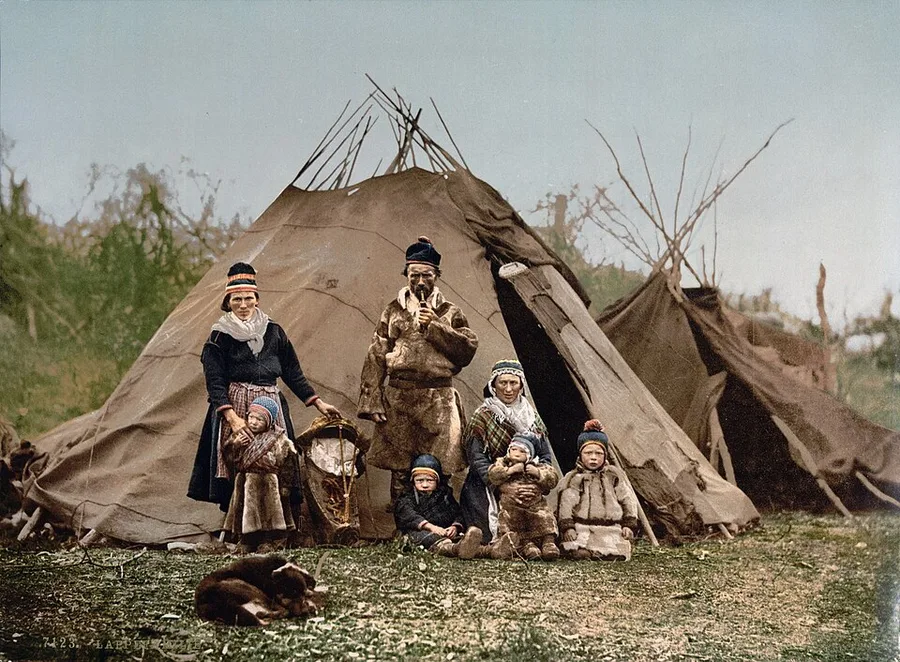 Unknown photographer, Saami Family (c. 1896, Kanstadfjord near Lødingen), Library of Congress A hand-tinted photochrom of a Sámi family in gákti dress outside their lávvu tents, around 1896. A late photograph of a very old fact: alongside and north of Norse Norway, the Sámi have always been a parallel people, with their own languages, livelihoods, and religious world. The Indigenous people of Sápmi, the cultural region across the
northern interior of present-day Norway, Sweden, Finland, and the
Russian Kola Peninsula. Sámi languages belong to the Uralic family,
unrelated to Norse. A distinctly Sámi material culture is visible
in the archaeological record from about 500 BCE. The traditional
Sámi economy ran on hunting, fishing, and trapping, with
semi-domesticated reindeer used for transport long before the
large-scale reindeer pastoralism of later centuries. Sámi religious
life centred on the noaidi (ritual specialist), the goavddis
(painted ritual drum), and the sieidi (sacred natural places).
Modern Sámi political representation runs through the Sámi
parliaments in Norway, Sweden, and Finland.
Also discussed in Samene — the other people of NorwayWorshiping Odin and Thor — the lived religion of pre-Christian NorwayThe Reformation, 1537 — one church eradicated and another imposedWorld War II — the King’s “No” and the Nazis in NorwayPolitikk — the left, the right, and the Norwegian way of the interior. The trade is attested by the Hålogaland magnate Ohthere of Hålogaland
Unknown photographer, Saami Family (c. 1896, Kanstadfjord near Lødingen), Library of Congress A hand-tinted photochrom of a Sámi family in gákti dress outside their lávvu tents, around 1896. A late photograph of a very old fact: alongside and north of Norse Norway, the Sámi have always been a parallel people, with their own languages, livelihoods, and religious world. The Indigenous people of Sápmi, the cultural region across the
northern interior of present-day Norway, Sweden, Finland, and the
Russian Kola Peninsula. Sámi languages belong to the Uralic family,
unrelated to Norse. A distinctly Sámi material culture is visible
in the archaeological record from about 500 BCE. The traditional
Sámi economy ran on hunting, fishing, and trapping, with
semi-domesticated reindeer used for transport long before the
large-scale reindeer pastoralism of later centuries. Sámi religious
life centred on the noaidi (ritual specialist), the goavddis
(painted ritual drum), and the sieidi (sacred natural places).
Modern Sámi political representation runs through the Sámi
parliaments in Norway, Sweden, and Finland.
Also discussed in Samene — the other people of NorwayWorshiping Odin and Thor — the lived religion of pre-Christian NorwayThe Reformation, 1537 — one church eradicated and another imposedWorld War II — the King’s “No” and the Nazis in NorwayPolitikk — the left, the right, and the Norwegian way of the interior. The trade is attested by the Hålogaland magnate Ohthere of Hålogaland 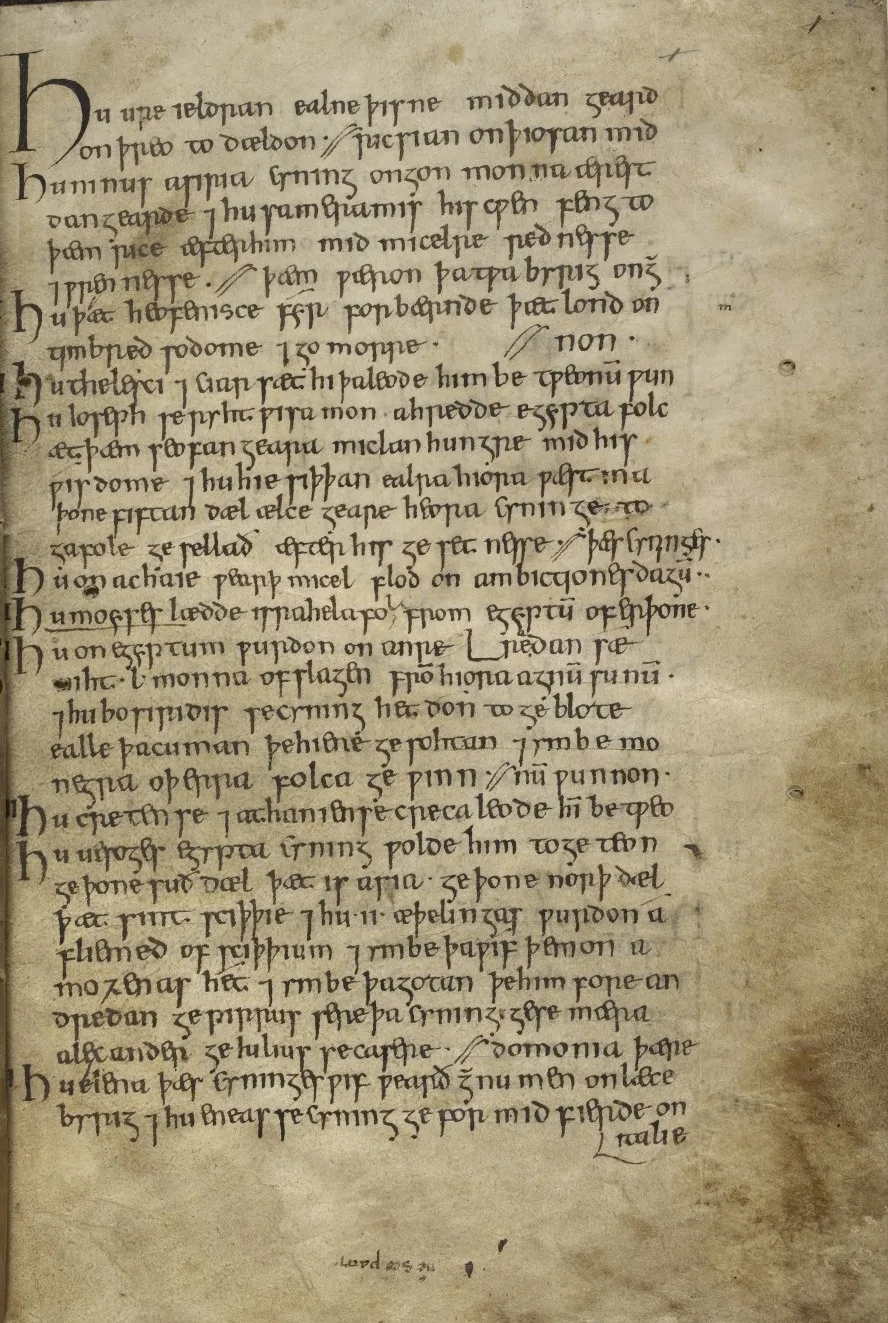 Tollemache Orosius, British Library Add MS 47967, fol. 2r (c. 892-925) Ohthere's report to King Alfred survives only here — in the Old English Orosius made in Alfred's Wessex, the manuscript that records the earliest written description of 'Norðweg,' the north-way that named Norway. Late-ninth-century Norse merchant and chieftain from Hålogaland in
northern Norway. Visited the court of King Alfred the Great in
Wessex around 890 CE and gave an oral account of his homeland —
the coast, the trade in walrus ivory and furs, the Sámi tribute
economy, the sailing routes — that Alfred had recorded in the Old
English translation of Orosius. Ohthere's account is one of the
very few contemporary written sources for any of the petty-kingdom
Norwegian world.
Also discussed in Samene — the other people of Norway , whose late-ninth-century account given to King Alfred the Great
Tollemache Orosius, British Library Add MS 47967, fol. 2r (c. 892-925) Ohthere's report to King Alfred survives only here — in the Old English Orosius made in Alfred's Wessex, the manuscript that records the earliest written description of 'Norðweg,' the north-way that named Norway. Late-ninth-century Norse merchant and chieftain from Hålogaland in
northern Norway. Visited the court of King Alfred the Great in
Wessex around 890 CE and gave an oral account of his homeland —
the coast, the trade in walrus ivory and furs, the Sámi tribute
economy, the sailing routes — that Alfred had recorded in the Old
English translation of Orosius. Ohthere's account is one of the
very few contemporary written sources for any of the petty-kingdom
Norwegian world.
Also discussed in Samene — the other people of Norway , whose late-ninth-century account given to King Alfred the Great 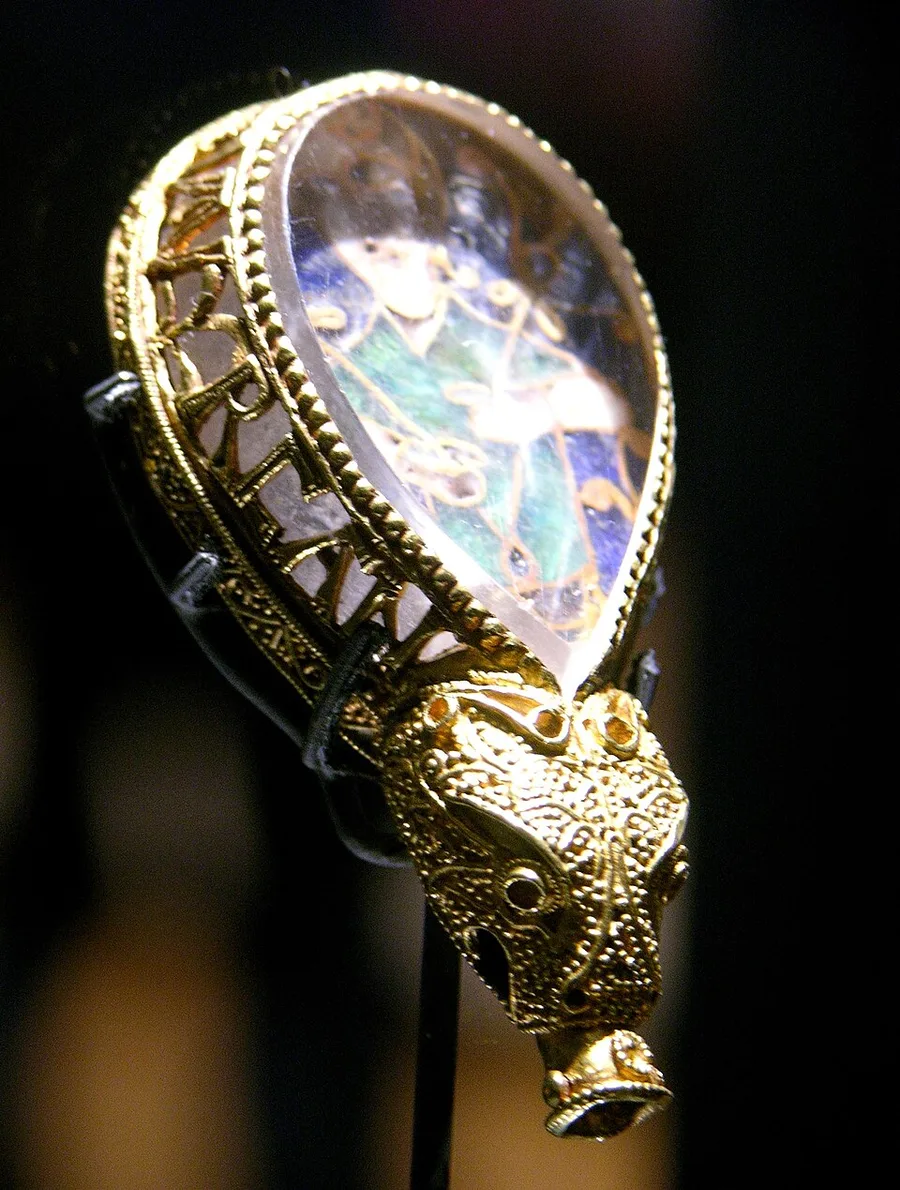 The Alfred Jewel (late 9th century), Ashmolean Museum, Oxford; photo: Giles Watson (CC BY-SA 2.0) No portrait of Alfred survives, so the card shows an object from his own court instead — the Alfred Jewel, its gold rim reading ÆLFRED MEC HEHT GEWYRCAN, 'Alfred ordered me made.' King of the West Saxons (Wessex) 871-899; the only English monarch
ever bynamed "the Great." Held off the Viking Great Heathen Army's
conquest of southern England in the 870s and 880s, established a
scholarly court at Winchester, and commissioned a series of Old
English translations of Latin texts — including the Orosius that
preserves Ohthere of Hålogaland's late-ninth-century geographic
account of Norway. Through Alfred's court the Norwegian petty
kingdoms get their earliest detailed mention in surviving European
literature.
at the West Saxon court is one of the very few contemporary written sources for any of it. The country is, in its first written description of itself, a coastline of small thrones.
The Alfred Jewel (late 9th century), Ashmolean Museum, Oxford; photo: Giles Watson (CC BY-SA 2.0) No portrait of Alfred survives, so the card shows an object from his own court instead — the Alfred Jewel, its gold rim reading ÆLFRED MEC HEHT GEWYRCAN, 'Alfred ordered me made.' King of the West Saxons (Wessex) 871-899; the only English monarch
ever bynamed "the Great." Held off the Viking Great Heathen Army's
conquest of southern England in the 870s and 880s, established a
scholarly court at Winchester, and commissioned a series of Old
English translations of Latin texts — including the Orosius that
preserves Ohthere of Hålogaland's late-ninth-century geographic
account of Norway. Through Alfred's court the Norwegian petty
kingdoms get their earliest detailed mention in surviving European
literature.
at the West Saxon court is one of the very few contemporary written sources for any of it. The country is, in its first written description of itself, a coastline of small thrones.
The þing
Within each kingdom, the political structure is less centralized than the word “kingdom” might suggest. The king himself, or jarl in the Trøndelag case, is a war leader and a religious officiant: he leads men into battle, performs the seasonal sacrifices at the local pagan shrines, arbitrates disputes among his chieftains, and collects tribute in commodity from the farmsteads under his authority. He does not, in any modern sense, govern. The actual legal life of his kingdom is conducted at the Thing (þing) 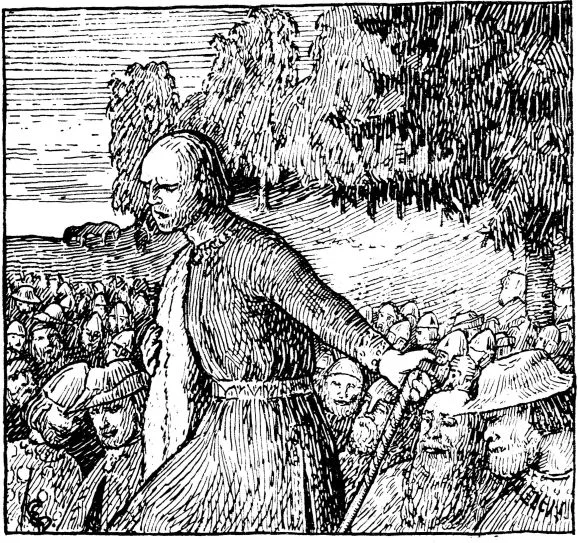 Halfdan Egedius, Tinget i Rogaland (1897), Snorre 1899 edition Halfdan Egedius's Heimskringla drawing of a thing in Rogaland — one farmer risen head and shoulders above the assembly to argue his case, the open-air gathering of free men where medieval Norway settled disputes and tested its kings. The regional open-air assembly of free men in pre-unification and
medieval Norway — Old Norse þing. Held annually or seasonally
at fixed traditional locations, the thing settled disputes,
ratified new laws, and tested the king's authority. Free men
attended in person and could argue cases on their own behalf or
be represented by lögmenn, the law-speakers. The thing could
ratify the king's policies or reject them and could withhold consent
from a king who had become unpopular. The Norwegian rural population
expected to participate in its own legal life — an expectation that
shaped Norwegian political culture for the next thousand years and
is visible today in the country's high voter turnout and consensus-
driven politics.
, the regional open-air assembly of free men, held annually or seasonally at a fixed and traditional location, where disputes are settled, new laws are ratified, and the king’s authority is tested.
Halfdan Egedius, Tinget i Rogaland (1897), Snorre 1899 edition Halfdan Egedius's Heimskringla drawing of a thing in Rogaland — one farmer risen head and shoulders above the assembly to argue his case, the open-air gathering of free men where medieval Norway settled disputes and tested its kings. The regional open-air assembly of free men in pre-unification and
medieval Norway — Old Norse þing. Held annually or seasonally
at fixed traditional locations, the thing settled disputes,
ratified new laws, and tested the king's authority. Free men
attended in person and could argue cases on their own behalf or
be represented by lögmenn, the law-speakers. The thing could
ratify the king's policies or reject them and could withhold consent
from a king who had become unpopular. The Norwegian rural population
expected to participate in its own legal life — an expectation that
shaped Norwegian political culture for the next thousand years and
is visible today in the country's high voter turnout and consensus-
driven politics.
, the regional open-air assembly of free men, held annually or seasonally at a fixed and traditional location, where disputes are settled, new laws are ratified, and the king’s authority is tested.
Free men attend in person. They argue cases on their own behalf or are represented by Lögmenn 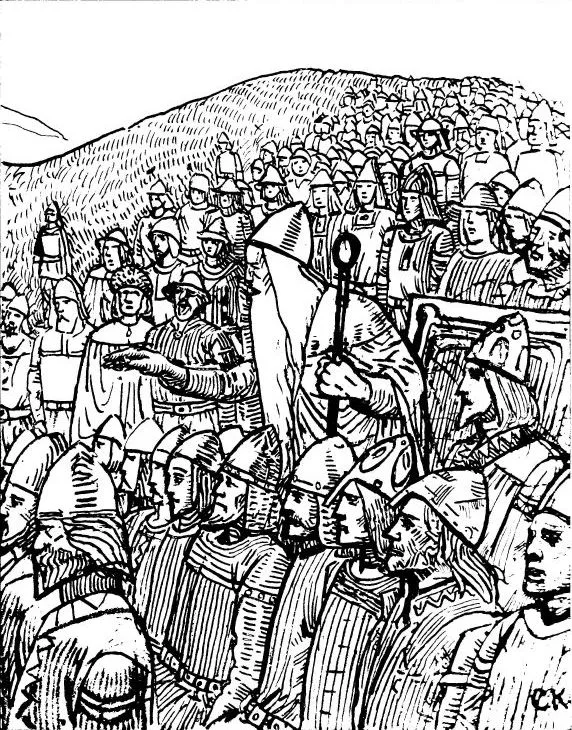 Christian Krohg, Torgny lagmann på Uppsalating, Heimskringla 1899 edition (J.M. Stenersen & Co) Torgny the Lawspeaker rising with his staff above the helmeted freemen at Uppsala — Christian Krohg's drawing of the most famous of the lögmenn, the specialists who held the customary law in memory and recited it at the thing. Old Norse for "law-men" or "law-speakers" (singular lögmaðr). The
legal specialists of the pre-unification and medieval Norwegian
thing assemblies. Before written codification, the lögmenn
memorised the customary law and could recite the relevant provisions
on request during a thing proceeding. They served as advocates for
litigants, advisors to the assembled freemen, and the institutional
memory of the legal tradition. The Icelandic Alþing had its own
lögmaðr who recited a third of the law each year, completing the
cycle in three years. Modern Norwegian uses lagmann for an
appellate-court judge.
, the law-speakers who know the customary law by memory and can recite it on request. The þing can ratify the king’s policies or reject them. It can withhold consent from a king who has become unpopular, and later sagas preserve cases of this happening, though the seventh- and eighth-century record is too thin to confirm any specific deposition. Four broad regional law-traditions grow out of these assemblies: the Gulating
Christian Krohg, Torgny lagmann på Uppsalating, Heimskringla 1899 edition (J.M. Stenersen & Co) Torgny the Lawspeaker rising with his staff above the helmeted freemen at Uppsala — Christian Krohg's drawing of the most famous of the lögmenn, the specialists who held the customary law in memory and recited it at the thing. Old Norse for "law-men" or "law-speakers" (singular lögmaðr). The
legal specialists of the pre-unification and medieval Norwegian
thing assemblies. Before written codification, the lögmenn
memorised the customary law and could recite the relevant provisions
on request during a thing proceeding. They served as advocates for
litigants, advisors to the assembled freemen, and the institutional
memory of the legal tradition. The Icelandic Alþing had its own
lögmaðr who recited a third of the law each year, completing the
cycle in three years. Modern Norwegian uses lagmann for an
appellate-court judge.
, the law-speakers who know the customary law by memory and can recite it on request. The þing can ratify the king’s policies or reject them. It can withhold consent from a king who has become unpopular, and later sagas preserve cases of this happening, though the seventh- and eighth-century record is too thin to confirm any specific deposition. Four broad regional law-traditions grow out of these assemblies: the Gulating 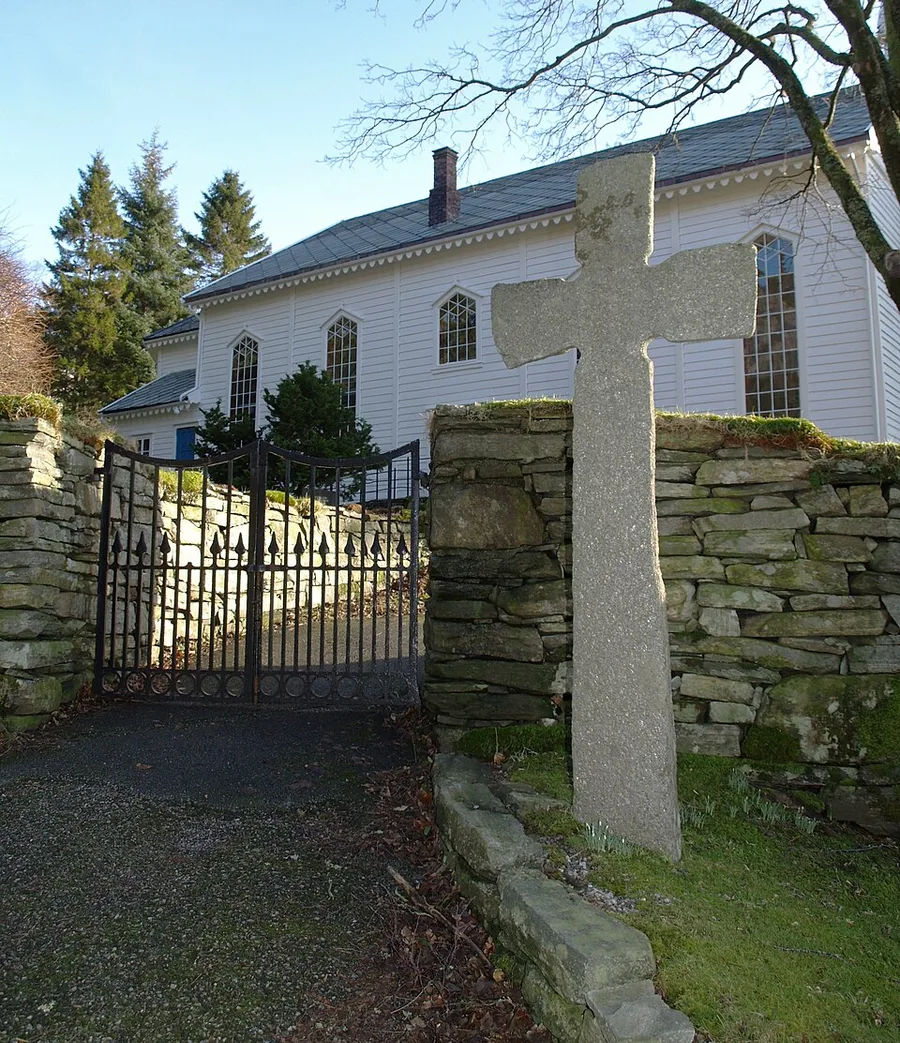 Jeblad, Steinkorset ved porten til Eivindvik kirke (2008), Wikimedia Commons, CC BY-SA 3.0 The early-medieval stone cross at Eivindvik, by the church gate at Gulen. The law assemblies raised no buildings that survive; this weathered cross, standing near the Gulating's traditional meeting ground, is what still marks the shore where western Norway's freemen gathered. The regional thing-law assembly of southwestern Norway, meeting
traditionally at Gulen in present-day Sogn og Fjordane. One of the
four great medieval Norwegian regional law traditions; its
jurisdiction covered the western coast from Agder to Sunnmøre and
produced the Gulatingslova, recorded in writing by the twelfth
century. The Gulating tradition was rolled into Magnus Lagabøte's
Landslov of 1274. The modern Gulating Court of Appeal in Bergen
inherits the name.
Also discussed in The King Who Became a Saint — how the Nordmen came to ChristA Catholic Norway — the faith that gave the kingdom its first institutions and the stave churchesThe Golden Age — a North Atlantic empire … reaching farther than you think in the southwestern districts, the Frostating
Jeblad, Steinkorset ved porten til Eivindvik kirke (2008), Wikimedia Commons, CC BY-SA 3.0 The early-medieval stone cross at Eivindvik, by the church gate at Gulen. The law assemblies raised no buildings that survive; this weathered cross, standing near the Gulating's traditional meeting ground, is what still marks the shore where western Norway's freemen gathered. The regional thing-law assembly of southwestern Norway, meeting
traditionally at Gulen in present-day Sogn og Fjordane. One of the
four great medieval Norwegian regional law traditions; its
jurisdiction covered the western coast from Agder to Sunnmøre and
produced the Gulatingslova, recorded in writing by the twelfth
century. The Gulating tradition was rolled into Magnus Lagabøte's
Landslov of 1274. The modern Gulating Court of Appeal in Bergen
inherits the name.
Also discussed in The King Who Became a Saint — how the Nordmen came to ChristA Catholic Norway — the faith that gave the kingdom its first institutions and the stave churchesThe Golden Age — a North Atlantic empire … reaching farther than you think in the southwestern districts, the Frostating 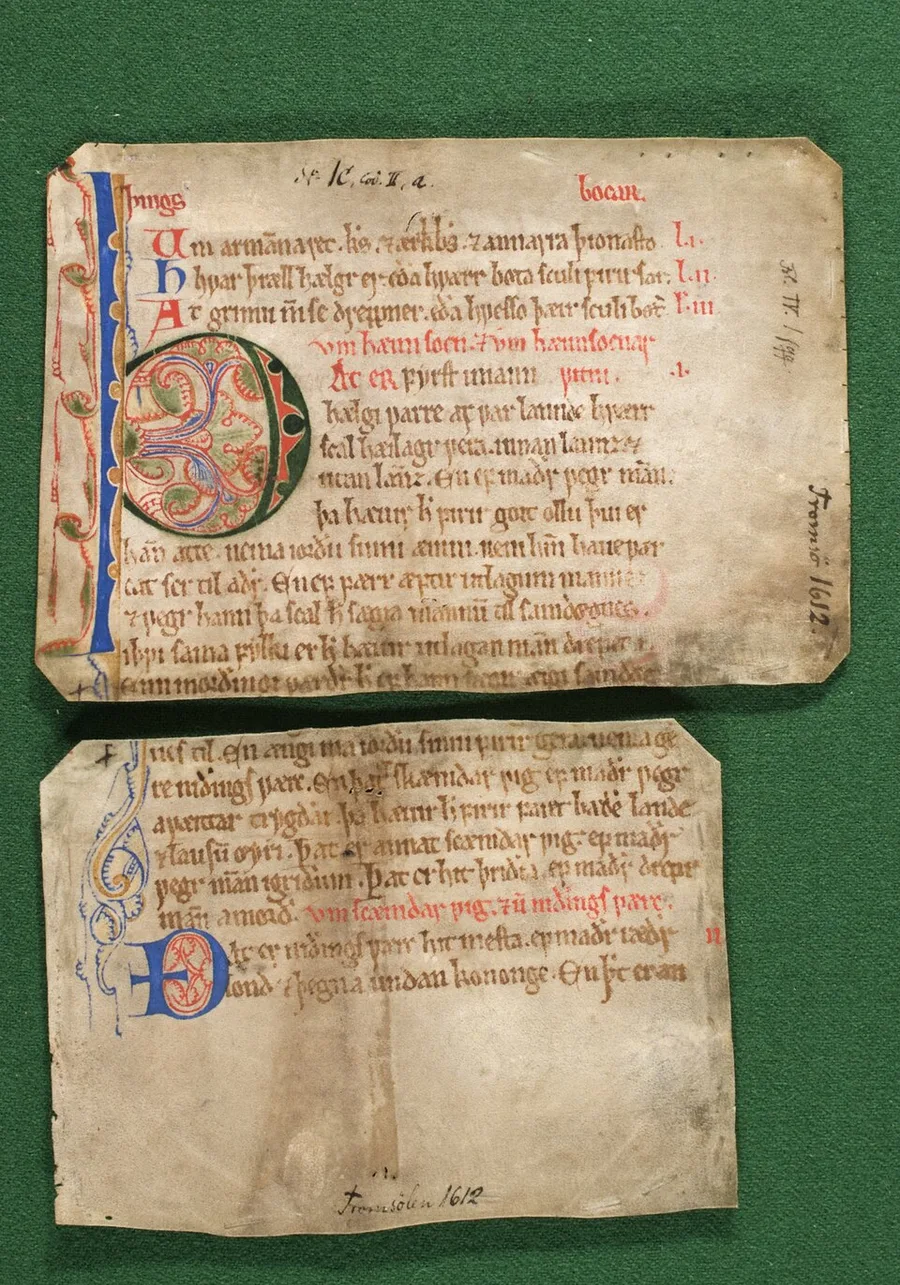 Frostatingslova fragment (c. 1260), National Archives of Norway (Riksarkivet), CC BY-SA 4.0 Two parchment leaves of the Frostatingslova, c. 1260 — the written law code of the central-Norway thing assembly that met at Frosta on the Trondheim Fjord, its customary law far older than the ink. The regional thing-law assembly of central Norway, meeting at
Frosta on the Trondheim Fjord. Jurisdiction covered Trøndelag and
the surrounding northern districts. Its codification, the
Frostatingslova, dates to the twelfth century in its surviving
form but preserves substantially older customary law. Rolled into
Magnus Lagabøte's Landslov of 1274. The modern Frostating Court
of Appeal in Trondheim carries the name.
Also discussed in Worshiping Odin and Thor — the lived religion of pre-Christian NorwayThe King Who Became a Saint — how the Nordmen came to ChristA Catholic Norway — the faith that gave the kingdom its first institutions and the stave churchesThe Golden Age — a North Atlantic empire … reaching farther than you think in central Norway, the Borgarting
Frostatingslova fragment (c. 1260), National Archives of Norway (Riksarkivet), CC BY-SA 4.0 Two parchment leaves of the Frostatingslova, c. 1260 — the written law code of the central-Norway thing assembly that met at Frosta on the Trondheim Fjord, its customary law far older than the ink. The regional thing-law assembly of central Norway, meeting at
Frosta on the Trondheim Fjord. Jurisdiction covered Trøndelag and
the surrounding northern districts. Its codification, the
Frostatingslova, dates to the twelfth century in its surviving
form but preserves substantially older customary law. Rolled into
Magnus Lagabøte's Landslov of 1274. The modern Frostating Court
of Appeal in Trondheim carries the name.
Also discussed in Worshiping Odin and Thor — the lived religion of pre-Christian NorwayThe King Who Became a Saint — how the Nordmen came to ChristA Catholic Norway — the faith that gave the kingdom its first institutions and the stave churchesThe Golden Age — a North Atlantic empire … reaching farther than you think in central Norway, the Borgarting 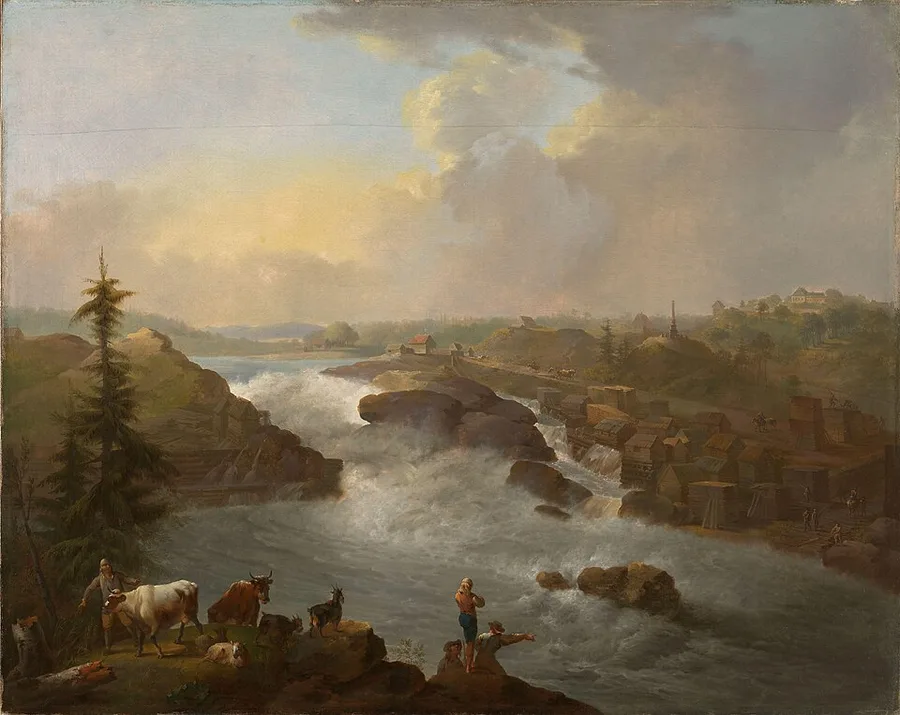 Christian August Lorentzen, The Waterfall Sarpsfossen (1795), Nasjonalmuseet Sarpsfossen, the great falls at Borg — the place that named the assembly. The Borgarting's thing-men met at the town King Olaf Haraldsson founded beside this waterfall in 1016; Lorentzen painted the falls as the sawmill town of the Danish era had grown around them. The regional thing-law assembly of southeastern Norway, meeting
at Borg (modern Sarpsborg). Jurisdiction covered the southeast
including Vestfold and Østfold. Its surviving Borgartingslova
preserves the regional legal tradition of the southeastern petty
kingdoms; rolled into Magnus Lagabøte's Landslov of 1274. The
modern Borgarting Court of Appeal in Oslo carries the name.
Also discussed in A Catholic Norway — the faith that gave the kingdom its first institutions and the stave churchesThe Golden Age — a North Atlantic empire … reaching farther than you think in the southeast around Vestfold, and the Eidsivating
Christian August Lorentzen, The Waterfall Sarpsfossen (1795), Nasjonalmuseet Sarpsfossen, the great falls at Borg — the place that named the assembly. The Borgarting's thing-men met at the town King Olaf Haraldsson founded beside this waterfall in 1016; Lorentzen painted the falls as the sawmill town of the Danish era had grown around them. The regional thing-law assembly of southeastern Norway, meeting
at Borg (modern Sarpsborg). Jurisdiction covered the southeast
including Vestfold and Østfold. Its surviving Borgartingslova
preserves the regional legal tradition of the southeastern petty
kingdoms; rolled into Magnus Lagabøte's Landslov of 1274. The
modern Borgarting Court of Appeal in Oslo carries the name.
Also discussed in A Catholic Norway — the faith that gave the kingdom its first institutions and the stave churchesThe Golden Age — a North Atlantic empire … reaching farther than you think in the southeast around Vestfold, and the Eidsivating 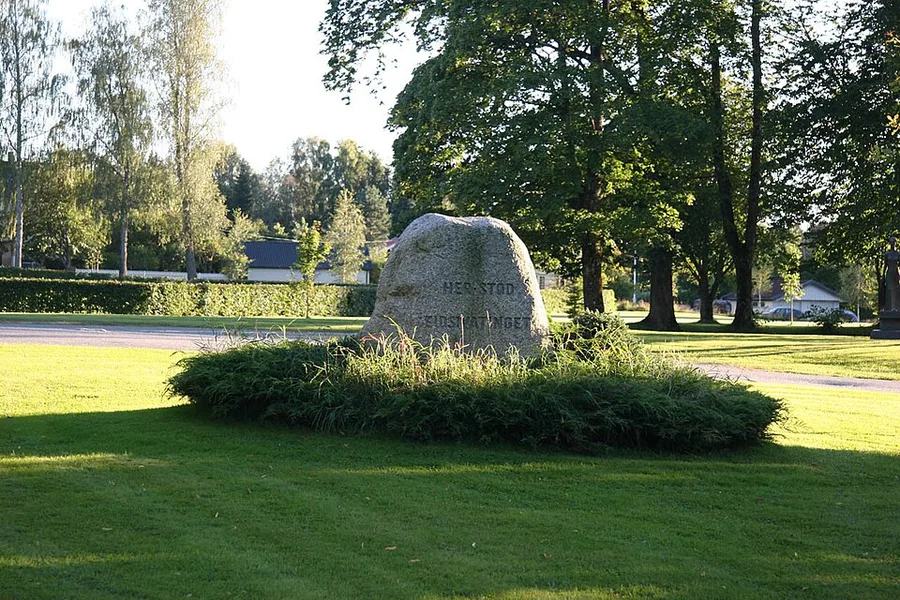 Photo: Harry Wad, Eidsivating memorial stone at Eidsvoll (2007), CC BY 2.5 A memorial stone at Eidsvoll reading 'Her stod Eidsivatinget' — 'here stood the Eidsivating' — planted on the ground where the inland district's law-assembly once gathered, since nothing of the meeting itself survives. The regional thing-law assembly of the inland east of Norway,
meeting traditionally at Eidsvoll — the same Eidsvoll where, eight
centuries later, the Norwegian Constitution was written and signed
in 1814. Jurisdiction covered the inland districts of Hedmark,
Romerike, and the surrounding interior. Its Eidsivatingslova
was rolled into Magnus Lagabøte's Landslov of 1274. The modern
Eidsivating Court of Appeal carries the name; its seat is at
Hamar.
Also discussed in A Catholic Norway — the faith that gave the kingdom its first institutions and the stave churchesThe Golden Age — a North Atlantic empire … reaching farther than you think in the inland east. These will eventually, four centuries later, be unified by Magnus VI Lagabøte
Photo: Harry Wad, Eidsivating memorial stone at Eidsvoll (2007), CC BY 2.5 A memorial stone at Eidsvoll reading 'Her stod Eidsivatinget' — 'here stood the Eidsivating' — planted on the ground where the inland district's law-assembly once gathered, since nothing of the meeting itself survives. The regional thing-law assembly of the inland east of Norway,
meeting traditionally at Eidsvoll — the same Eidsvoll where, eight
centuries later, the Norwegian Constitution was written and signed
in 1814. Jurisdiction covered the inland districts of Hedmark,
Romerike, and the surrounding interior. Its Eidsivatingslova
was rolled into Magnus Lagabøte's Landslov of 1274. The modern
Eidsivating Court of Appeal carries the name; its seat is at
Hamar.
Also discussed in A Catholic Norway — the faith that gave the kingdom its first institutions and the stave churchesThe Golden Age — a North Atlantic empire … reaching farther than you think in the inland east. These will eventually, four centuries later, be unified by Magnus VI Lagabøte 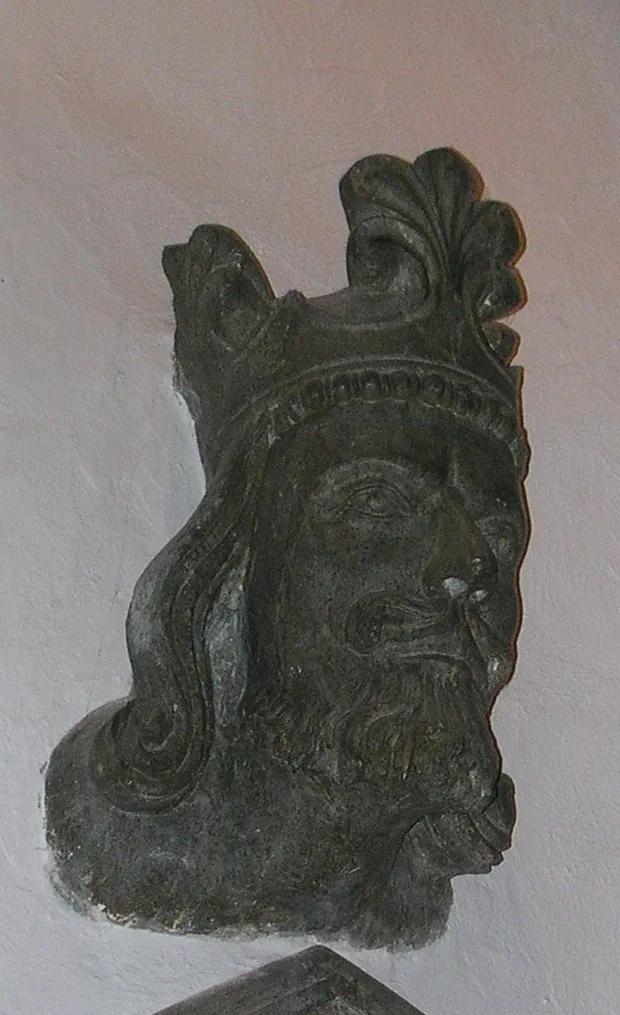 Stone head of Magnus VI Lagabøte (13th c.), Stavanger Cathedral; photo: Gunleiv Hadland (CC BY-SA 3.0) A crowned stone head carved in Stavanger Cathedral within living memory of the king — the nearest thing to a likeness of Magnus VI, the 'Law-mender' whose 1274 national code held as Norway's law for more than four hundred years. King of Norway 1263-1280, bynamed Lagabøte ("Law-mender") in
recognition of his promulgation in 1274 of the Landslov, the
Code of National Law that unified the four regional thing-law
traditions (Gulating, Frostating, Borgarting, Eidsivating) into
a single national code. The Landslov remained the law of Norway
for more than four hundred years and made Norway one of the first
European kingdoms with a unified national legal code.
Also discussed in The Golden Age — a North Atlantic empire … reaching farther than you thinkThe Long Fall — the sudden loss of Norwegian nobility, the end of the kings, and half of Norway gone foreverThe Germans Who "Ruled" Bergen — the Hanseatic merchants on Bryggen WharfThe 400-Year Night — when the Northern Lion lay dormantAllemannsretten — the right to roam ’s Landslov (1274)
Stone head of Magnus VI Lagabøte (13th c.), Stavanger Cathedral; photo: Gunleiv Hadland (CC BY-SA 3.0) A crowned stone head carved in Stavanger Cathedral within living memory of the king — the nearest thing to a likeness of Magnus VI, the 'Law-mender' whose 1274 national code held as Norway's law for more than four hundred years. King of Norway 1263-1280, bynamed Lagabøte ("Law-mender") in
recognition of his promulgation in 1274 of the Landslov, the
Code of National Law that unified the four regional thing-law
traditions (Gulating, Frostating, Borgarting, Eidsivating) into
a single national code. The Landslov remained the law of Norway
for more than four hundred years and made Norway one of the first
European kingdoms with a unified national legal code.
Also discussed in The Golden Age — a North Atlantic empire … reaching farther than you thinkThe Long Fall — the sudden loss of Norwegian nobility, the end of the kings, and half of Norway gone foreverThe Germans Who "Ruled" Bergen — the Hanseatic merchants on Bryggen WharfThe 400-Year Night — when the Northern Lion lay dormantAllemannsretten — the right to roam ’s Landslov (1274) 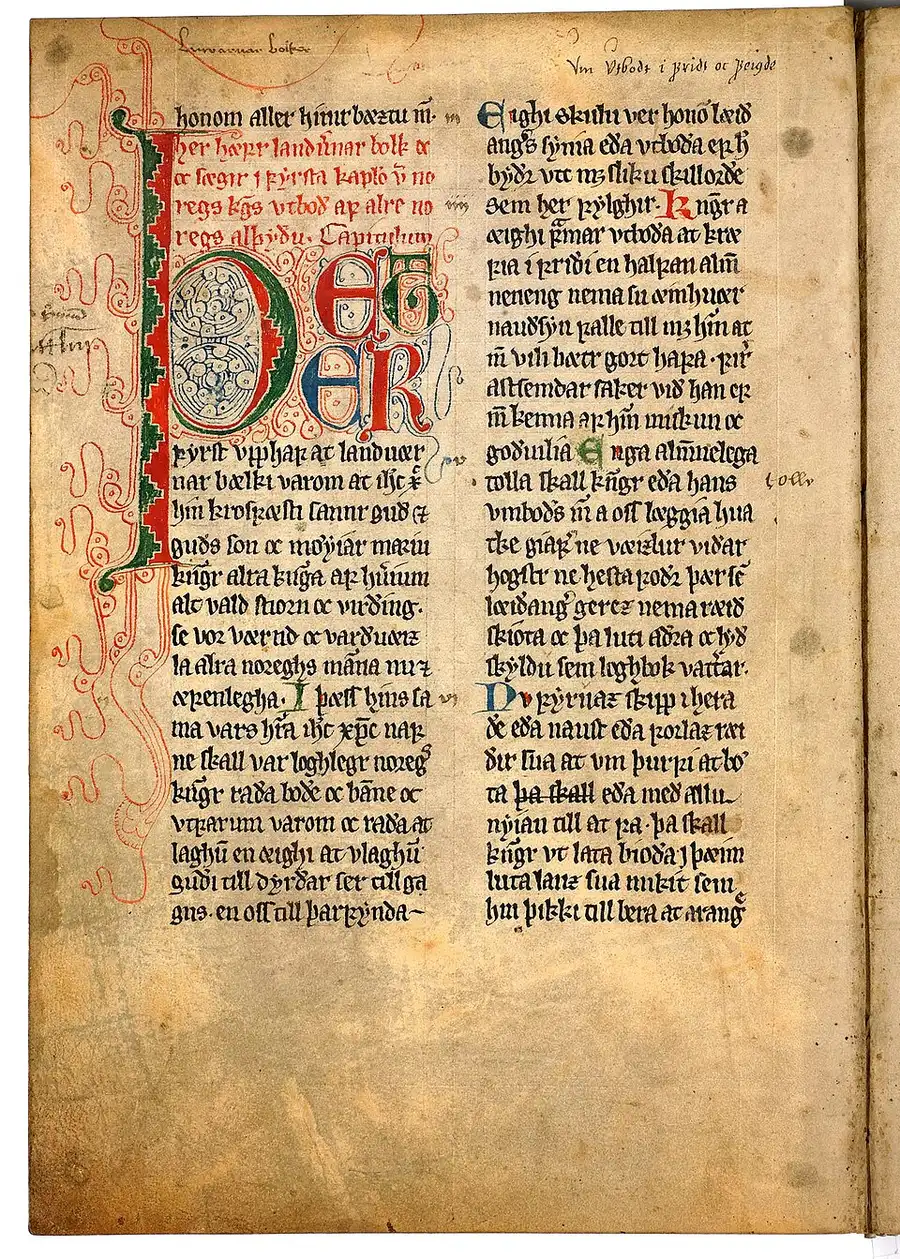 Magnus Lagabøtes landslov, AM 305 fol., fol. 10v (13th-14th c.), via Wikimedia Commons A page from a medieval handwritten copy of Magnus Lagabøte's 1274 law code, its two columns of Old Norse opening the land-defence section beneath a red, green, and blue interlace initial — the national law as scribes preserved it. Norwegian Magnus Lagabøtes landslov — the Code of National Law
promulgated by King Magnus VI Lagabøte in 1274. Unified the four
separate regional thing-law traditions (Gulating, Frostating,
Borgarting, Eidsivating) into a single code applying across the
whole Norwegian kingdom. Made Norway one of the first European
kingdoms with a unified national legal code, decades ahead of
similar developments in England or France. Remained the law of
Norway for more than four hundred years, until Christian V's
Norske Lov superseded it in 1687.
Also discussed in The Golden Age — a North Atlantic empire … reaching farther than you thinkThe 400-Year Night — when the Northern Lion lay dormantAllemannsretten — the right to roam of 1274 into a single national law. They take formal shape only in the tenth and eleventh centuries, but their roots are the local legal traditions of separate kingdoms, and the political grammar of king-plus-þing, of war leader plus assembly of free men, is common to all of them. The Norwegian rural population learns, across the iron age and the petty-kingdom centuries, to expect to participate in its own legal life. The expectation never goes away.
Magnus Lagabøtes landslov, AM 305 fol., fol. 10v (13th-14th c.), via Wikimedia Commons A page from a medieval handwritten copy of Magnus Lagabøte's 1274 law code, its two columns of Old Norse opening the land-defence section beneath a red, green, and blue interlace initial — the national law as scribes preserved it. Norwegian Magnus Lagabøtes landslov — the Code of National Law
promulgated by King Magnus VI Lagabøte in 1274. Unified the four
separate regional thing-law traditions (Gulating, Frostating,
Borgarting, Eidsivating) into a single code applying across the
whole Norwegian kingdom. Made Norway one of the first European
kingdoms with a unified national legal code, decades ahead of
similar developments in England or France. Remained the law of
Norway for more than four hundred years, until Christian V's
Norske Lov superseded it in 1687.
Also discussed in The Golden Age — a North Atlantic empire … reaching farther than you thinkThe 400-Year Night — when the Northern Lion lay dormantAllemannsretten — the right to roam of 1274 into a single national law. They take formal shape only in the tenth and eleventh centuries, but their roots are the local legal traditions of separate kingdoms, and the political grammar of king-plus-þing, of war leader plus assembly of free men, is common to all of them. The Norwegian rural population learns, across the iron age and the petty-kingdom centuries, to expect to participate in its own legal life. The expectation never goes away.
The Sámi alongside
One major qualification: the peoples of these coastal kingdoms live along the coast and in the southern interior, and are the ancestors of Norway’s Norse-speaking majority. Through every one of these centuries, for at least two and a half thousand years, the inland highlands of the north are home to a different people. The Sámi are the Indigenous population of Sápmi  Sophus Tromholt, Fra sandets regioner i Koutokæino (1882–83), Norsk Folkemuseum Tromholt photographed the sand country along the Kautokeino river in 1882–83 — open, treeless, river-veined land in the heart of Sápmi, the borderless interior the Sámi have held for at least two and a half thousand years. The cultural region of the Sámi Indigenous people, stretching across
the northern interior of present-day Norway, Sweden, Finland, and
the Russian Kola Peninsula. Sápmi has no political boundary but has
been the homeland of the Sámi for at least two and a half thousand
years. Its languages belong to the Uralic family and are unrelated
to Norse. The Sámi parliaments of Norway, Sweden, and Finland —
each representing the Sámi within their respective national systems —
meet at Karasjok, Kiruna, and Inari respectively.
Also discussed in Samene — the other people of NorwayThe Reformation, 1537 — one church eradicated and another imposed , the cultural region that stretches across the northern interior of present-day Norway, Sweden, Finland, and the Russian Kola Peninsula. Their languages belong to the Uralic family and are unrelated to Norse. A distinctly Sámi material culture is visible in the archaeological record from about 500 BCE, with deeper continuity reaching back to the same post-glacial hunters from whom the coastal populations also descend.
Sophus Tromholt, Fra sandets regioner i Koutokæino (1882–83), Norsk Folkemuseum Tromholt photographed the sand country along the Kautokeino river in 1882–83 — open, treeless, river-veined land in the heart of Sápmi, the borderless interior the Sámi have held for at least two and a half thousand years. The cultural region of the Sámi Indigenous people, stretching across
the northern interior of present-day Norway, Sweden, Finland, and
the Russian Kola Peninsula. Sápmi has no political boundary but has
been the homeland of the Sámi for at least two and a half thousand
years. Its languages belong to the Uralic family and are unrelated
to Norse. The Sámi parliaments of Norway, Sweden, and Finland —
each representing the Sámi within their respective national systems —
meet at Karasjok, Kiruna, and Inari respectively.
Also discussed in Samene — the other people of NorwayThe Reformation, 1537 — one church eradicated and another imposed , the cultural region that stretches across the northern interior of present-day Norway, Sweden, Finland, and the Russian Kola Peninsula. Their languages belong to the Uralic family and are unrelated to Norse. A distinctly Sámi material culture is visible in the archaeological record from about 500 BCE, with deeper continuity reaching back to the same post-glacial hunters from whom the coastal populations also descend.
The two peoples develop in parallel. The coastal Norse build an economy of cattle, fishing, and grain. The Sámi inland build one of hunting, fishing, and trapping, with semi-domesticated reindeer used for transport long before the large-scale reindeer pastoralism that crystallizes in the medieval and early-modern centuries. The Sámi have their own religion, centered on the Noaidi 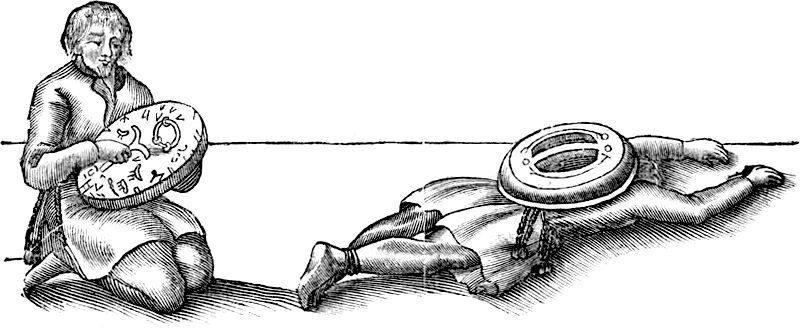 Johannes Schefferus, Lapponia (1673), engraving of a noaidi with drum A 1673 engraving from Schefferus's Lapponia — a Sámi noaidi lying in trance with his painted drum, a companion kneeling nearby — one of the few old depictions of the shaman-officiant whose drums Lutheran missionaries later burned. The Sámi ritual specialist — shaman, in the comparative-religion
vocabulary that Western anthropology applied to similar figures
across Eurasia. The noaidi was the religious officiant of the
pre-Christian Sámi community, responsible for divination, healing,
and communication with the spirits of the land and the dead. The
noaidi's principal instrument was the goavddis, the painted drum
whose surface diagrammed an entire spiritual cosmology. The
practice was systematically persecuted by Norwegian and Swedish
Lutheran missionaries through the seventeenth and eighteenth
centuries; many drums were burned, the recorded knowledge lost.
The tradition survives in fragments in modern Sámi cultural and
religious revival.
Also discussed in Samene — the other people of NorwayThe Reformation, 1537 — one church eradicated and another imposed , the ritual specialist, and on the Goavddis
Johannes Schefferus, Lapponia (1673), engraving of a noaidi with drum A 1673 engraving from Schefferus's Lapponia — a Sámi noaidi lying in trance with his painted drum, a companion kneeling nearby — one of the few old depictions of the shaman-officiant whose drums Lutheran missionaries later burned. The Sámi ritual specialist — shaman, in the comparative-religion
vocabulary that Western anthropology applied to similar figures
across Eurasia. The noaidi was the religious officiant of the
pre-Christian Sámi community, responsible for divination, healing,
and communication with the spirits of the land and the dead. The
noaidi's principal instrument was the goavddis, the painted drum
whose surface diagrammed an entire spiritual cosmology. The
practice was systematically persecuted by Norwegian and Swedish
Lutheran missionaries through the seventeenth and eighteenth
centuries; many drums were burned, the recorded knowledge lost.
The tradition survives in fragments in modern Sámi cultural and
religious revival.
Also discussed in Samene — the other people of NorwayThe Reformation, 1537 — one church eradicated and another imposed , the ritual specialist, and on the Goavddis 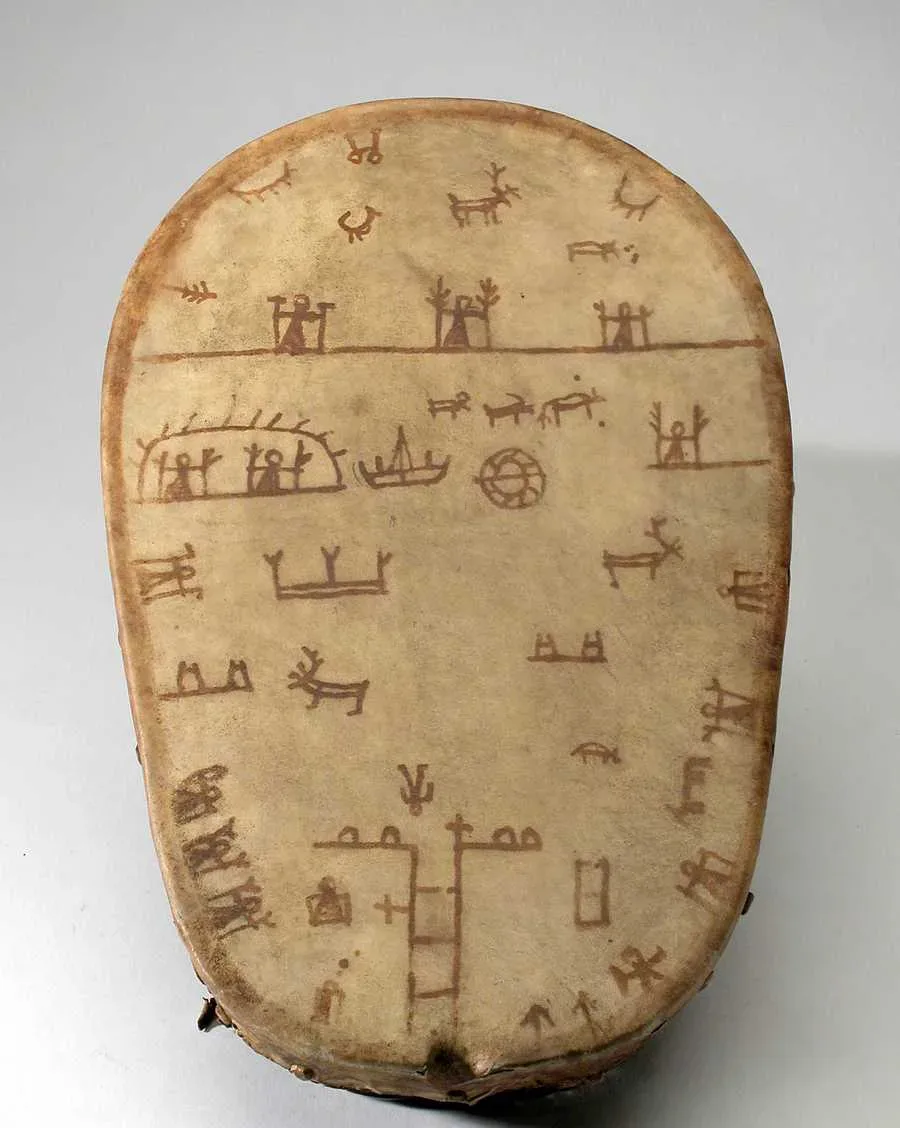 Sámi bowl drum from Lule Lappmark (NM.0228846), photo Nordiska museet via DigitaltMuseum, CC BY-SA 3.0 Rows of gods, animals and landscapes painted on the reindeer-hide head map the Sámi spiritual world; the noaidi read a pointer's drift across them as divination. One of roughly seventy such drums to outlast the Lutheran mission burnings. The Sámi ritual drum (the noaidi's drum), Sámi goavddis (the
Northern Sámi term; meavrresgárri in some other Sámi languages).
An oval or bowl-shaped wooden frame stretched with reindeer hide
and painted with figures from the Sámi cosmology — gods, animals,
landscapes, the world tree — that diagrammed the spiritual world.
The noaidi struck the drum and read the movements of a brass or
bone pointer across the painted surface as divination. The drums
were systematically confiscated and burned during the seventeenth-
and eighteenth-century Lutheran missions to Sápmi; only about
seventy historical drums survive worldwide.
Also discussed in Samene — the other people of Norway , the painted drum that serves as the technology of an entire spiritual cosmology. They have their own sacred places: Sieidi
Sámi bowl drum from Lule Lappmark (NM.0228846), photo Nordiska museet via DigitaltMuseum, CC BY-SA 3.0 Rows of gods, animals and landscapes painted on the reindeer-hide head map the Sámi spiritual world; the noaidi read a pointer's drift across them as divination. One of roughly seventy such drums to outlast the Lutheran mission burnings. The Sámi ritual drum (the noaidi's drum), Sámi goavddis (the
Northern Sámi term; meavrresgárri in some other Sámi languages).
An oval or bowl-shaped wooden frame stretched with reindeer hide
and painted with figures from the Sámi cosmology — gods, animals,
landscapes, the world tree — that diagrammed the spiritual world.
The noaidi struck the drum and read the movements of a brass or
bone pointer across the painted surface as divination. The drums
were systematically confiscated and burned during the seventeenth-
and eighteenth-century Lutheran missions to Sápmi; only about
seventy historical drums survive worldwide.
Also discussed in Samene — the other people of Norway , the painted drum that serves as the technology of an entire spiritual cosmology. They have their own sacred places: Sieidi 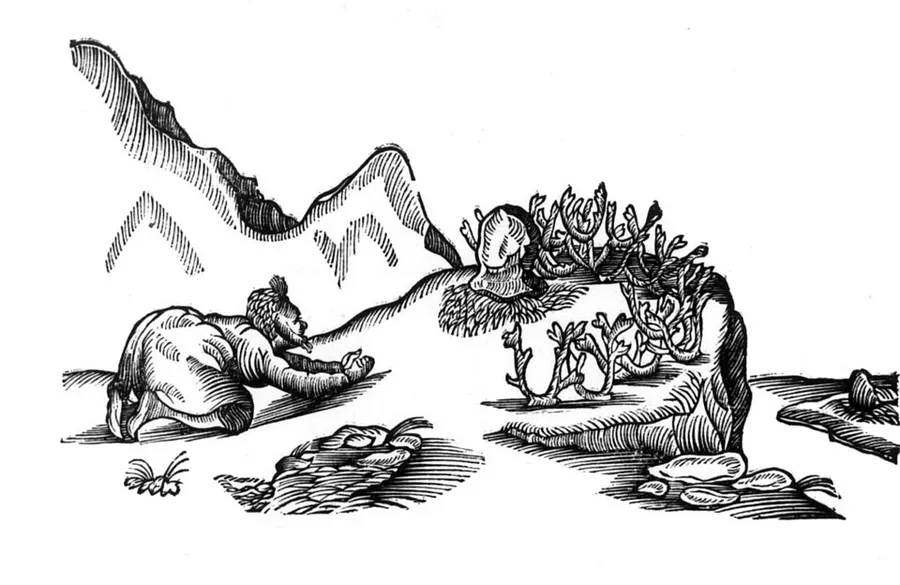 Johannes Schefferus, offering at a sieidi, from Lapponia (1673), via Norsk Folkemuseum / Wikimedia Commons A 1673 engraving from Schefferus's Lapponia — a worshipper prostrate before the sacred stones, reindeer antlers heaped as offerings — one of the earliest outside depictions of a sieidi, the Sámi holy sites the Lutheran missions later targeted. A Sámi sacred place — a specific stone, spring, rock formation, or
natural feature where offerings are left and a continuing relationship
with the land is kept up. Sieidis dot the Sámi landscape across
Sápmi; the offerings (small carved figures, antlers, coins, food,
metal objects) accumulate over generations as a record of the
community's relationship with that particular place. Like the
goavddis drums, the sieidis were targets of Lutheran missionary
destruction in the seventeenth and eighteenth centuries; some
survive in archaeological context, others remain ritually active.
Also discussed in Samene — the other people of Norway , specific stones or springs or rock formations where offerings are left and a relationship with the land is kept up. The boundary between Norse coast and Sámi interior is porous rather than legal: the northernmost Norwegian petty kingdoms draw much of their wealth from Sámi trade and tribute, and the Hålogaland magnates are rich men because the Sámi are their neighbors. The Sámi are not a vanished prehistoric people. They are still here, with their own parliament at Karasjok
Johannes Schefferus, offering at a sieidi, from Lapponia (1673), via Norsk Folkemuseum / Wikimedia Commons A 1673 engraving from Schefferus's Lapponia — a worshipper prostrate before the sacred stones, reindeer antlers heaped as offerings — one of the earliest outside depictions of a sieidi, the Sámi holy sites the Lutheran missions later targeted. A Sámi sacred place — a specific stone, spring, rock formation, or
natural feature where offerings are left and a continuing relationship
with the land is kept up. Sieidis dot the Sámi landscape across
Sápmi; the offerings (small carved figures, antlers, coins, food,
metal objects) accumulate over generations as a record of the
community's relationship with that particular place. Like the
goavddis drums, the sieidis were targets of Lutheran missionary
destruction in the seventeenth and eighteenth centuries; some
survive in archaeological context, others remain ritually active.
Also discussed in Samene — the other people of Norway , specific stones or springs or rock formations where offerings are left and a relationship with the land is kept up. The boundary between Norse coast and Sámi interior is porous rather than legal: the northernmost Norwegian petty kingdoms draw much of their wealth from Sámi trade and tribute, and the Hålogaland magnates are rich men because the Sámi are their neighbors. The Sámi are not a vanished prehistoric people. They are still here, with their own parliament at Karasjok 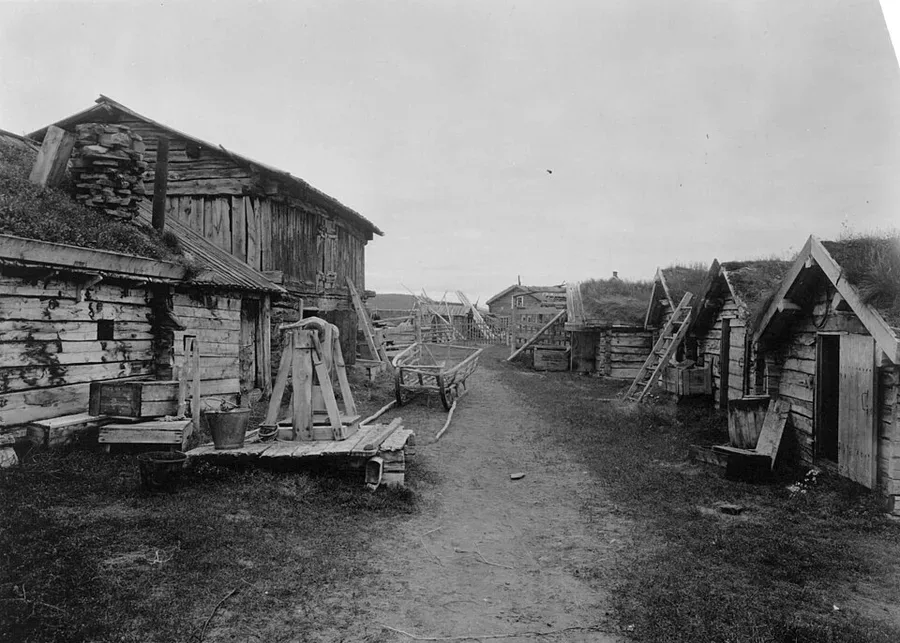 Anders Beer Wilse, Karasjok (1933), Norsk Folkemuseum Wilse's 1933 view of turf-roofed timber houses along the village road. This inland Finnmark town is the seat of the Sami Parliament, opened in 1989; its lavvu-shaped assembly building, raised in 2000, rises decades after this photograph was taken. Town in the inland Finnmark plateau of far northern Norway, on the
Karasjok River. The Sámi name is Kárášjohka. Seat of the
Sámediggi — the Sámi Parliament of Norway, opened in 1989 — which
represents the Sámi people in the Norwegian political system. The
Sámi Parliament building, designed by Stein Halvorsen and Christian
Sundby and opened in 2000, takes the shape of a lavvu, the
traditional Sámi tent.
Karasjok / Kárášjohka and their own languages taught in schools. The country Harald will consolidate around 880 is already, at its formation, a shared land: the western coast under one emerging Norwegian crown, the northern interior under a people who have been there before anyone called the place Norway, and who are there still.
Anders Beer Wilse, Karasjok (1933), Norsk Folkemuseum Wilse's 1933 view of turf-roofed timber houses along the village road. This inland Finnmark town is the seat of the Sami Parliament, opened in 1989; its lavvu-shaped assembly building, raised in 2000, rises decades after this photograph was taken. Town in the inland Finnmark plateau of far northern Norway, on the
Karasjok River. The Sámi name is Kárášjohka. Seat of the
Sámediggi — the Sámi Parliament of Norway, opened in 1989 — which
represents the Sámi people in the Norwegian political system. The
Sámi Parliament building, designed by Stein Halvorsen and Christian
Sundby and opened in 2000, takes the shape of a lavvu, the
traditional Sámi tent.
Karasjok / Kárášjohka and their own languages taught in schools. The country Harald will consolidate around 880 is already, at its formation, a shared land: the western coast under one emerging Norwegian crown, the northern interior under a people who have been there before anyone called the place Norway, and who are there still.
Halfdan, Harald, Hafrsfjord
The decisive consolidation begins with the king who drowned in the frozen lake. Halfdan the Black, king of Vestfold, is one of the most aggressive consolidators of the Petty kings 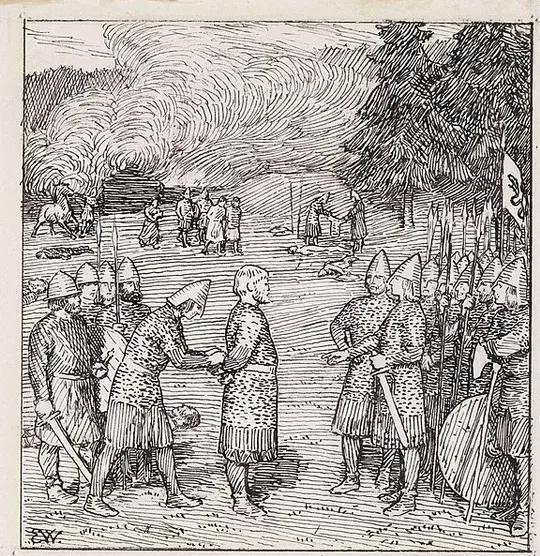 Erik Werenskiold, Den fangne kong Gryting føres fram for kong Harald (1899), Nasjonalmuseet Werenskiold drew a captured petty king — Gryting led bound before Harald Fairhair, a farm burning across the field — the moment the small fjord-and-valley kingdoms fell to unification. The small-kingdom rulers of pre-unification Norway, smákonungar
in Old Norse. From roughly the sixth century through the late ninth,
the Norwegian coast was organised not as one country but as perhaps
a dozen small thrones, each controlling a fjord or valley district.
A petty king was a war leader and religious officiant who led men
into battle, performed seasonal sacrifices, arbitrated disputes
among his chieftains, and collected tribute in commodity from the
farmsteads under his authority — but who governed alongside the
regional thing, the assembly of free men. Harald Fairhair's
consolidation around 880 broke the petty-kingdom system in the
west and south; the inland and northern remnants persisted longer.
Also discussed in The Viking Age — longships, legends, and the first "Norway" period; across his reign in the 850s he absorbs several smaller kingdoms in the southeast, pushes his authority into Hedmark
Erik Werenskiold, Den fangne kong Gryting føres fram for kong Harald (1899), Nasjonalmuseet Werenskiold drew a captured petty king — Gryting led bound before Harald Fairhair, a farm burning across the field — the moment the small fjord-and-valley kingdoms fell to unification. The small-kingdom rulers of pre-unification Norway, smákonungar
in Old Norse. From roughly the sixth century through the late ninth,
the Norwegian coast was organised not as one country but as perhaps
a dozen small thrones, each controlling a fjord or valley district.
A petty king was a war leader and religious officiant who led men
into battle, performed seasonal sacrifices, arbitrated disputes
among his chieftains, and collected tribute in commodity from the
farmsteads under his authority — but who governed alongside the
regional thing, the assembly of free men. Harald Fairhair's
consolidation around 880 broke the petty-kingdom system in the
west and south; the inland and northern remnants persisted longer.
Also discussed in The Viking Age — longships, legends, and the first "Norway" period; across his reign in the 850s he absorbs several smaller kingdoms in the southeast, pushes his authority into Hedmark 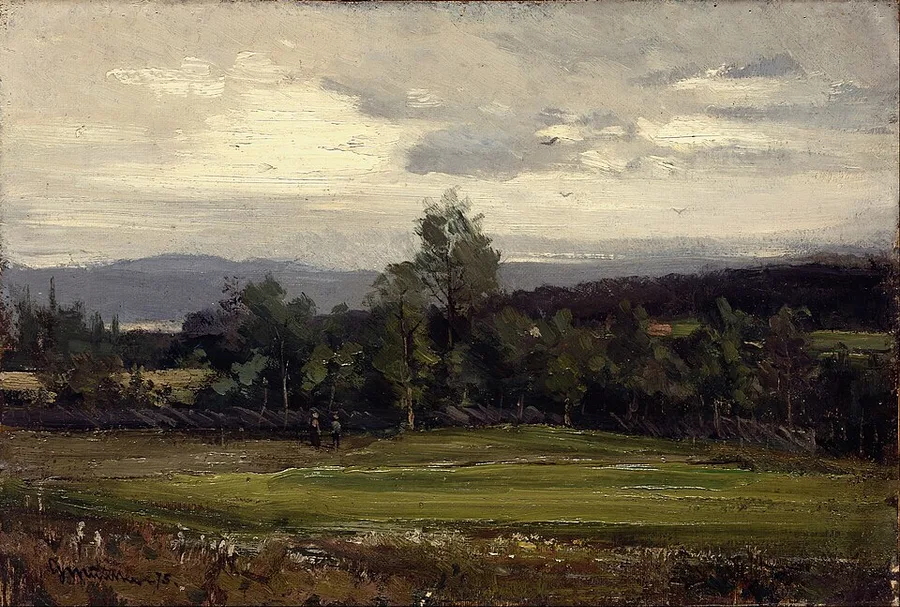 Gerhard Munthe, Fields at Hedmark in Summer (1875), Nasjonalmuseet / Google Art Project Gerhard Munthe's Fields at Hedmark in Summer (1875) — broad grain country rolling away east of Lake Mjøsa. This is the inland farm wealth that pulled Halfdan the Black's ambition up from the coastal kingdoms in the 850s. Inland region of southeastern Norway, east of the Mjøsa lake and
the Romerike plain, traditionally one of the agriculturally important
areas of the petty-kingdom inland. Halfdan the Black pushed his
Vestfold authority into Hedmark in the 850s. The region was folded
into the larger administrative county of Innlandet in 2020; the
Hedmark name persists in local usage.
Hedmark and Romerike
Gerhard Munthe, Fields at Hedmark in Summer (1875), Nasjonalmuseet / Google Art Project Gerhard Munthe's Fields at Hedmark in Summer (1875) — broad grain country rolling away east of Lake Mjøsa. This is the inland farm wealth that pulled Halfdan the Black's ambition up from the coastal kingdoms in the 850s. Inland region of southeastern Norway, east of the Mjøsa lake and
the Romerike plain, traditionally one of the agriculturally important
areas of the petty-kingdom inland. Halfdan the Black pushed his
Vestfold authority into Hedmark in the 850s. The region was folded
into the larger administrative county of Innlandet in 2020; the
Hedmark name persists in local usage.
Hedmark and Romerike 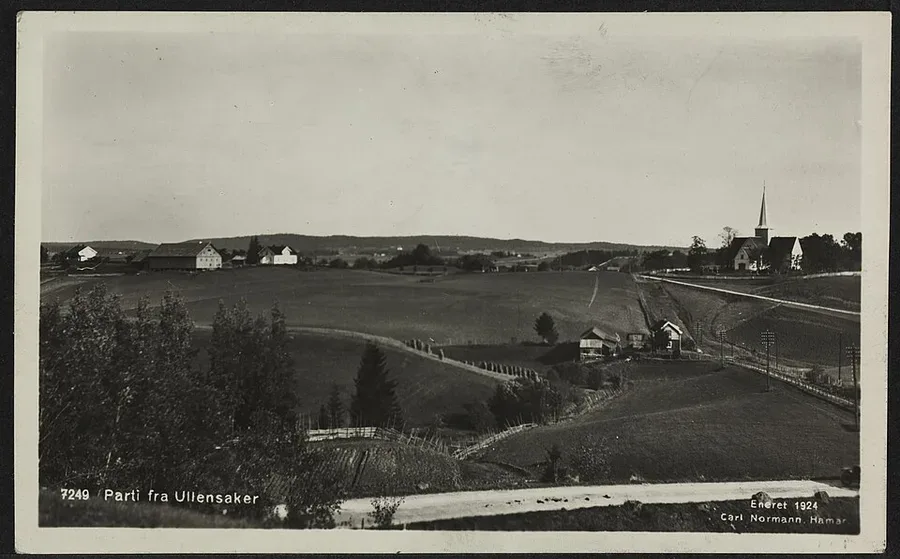 Carl Normann, Parti fra Ullensaker (1924), National Library of Norway A 1924 photograph of Romerike farmland at Ullensaker — open fields, farm buildings, a white church spire on the plain northeast of Oslo. Fought-over ground in the petty-kingdom era; the same flats now hold Oslo's Gardermoen airport. The agricultural plain northeast of present-day Oslo, between the
Oslofjord and Hedmark. In the petty-kingdom era a key inland region
fought over by competing crowns; Halfdan the Black extended his
authority here in the 850s. Modern Romerike is the area around Oslo
Gardermoen Airport and the towns of Lillestrøm and Jessheim.
Romerike , and is preparing further campaigns when he goes through the ice around 860. His ten-year-old son inherits the throne under guardianship.
Carl Normann, Parti fra Ullensaker (1924), National Library of Norway A 1924 photograph of Romerike farmland at Ullensaker — open fields, farm buildings, a white church spire on the plain northeast of Oslo. Fought-over ground in the petty-kingdom era; the same flats now hold Oslo's Gardermoen airport. The agricultural plain northeast of present-day Oslo, between the
Oslofjord and Hedmark. In the petty-kingdom era a key inland region
fought over by competing crowns; Halfdan the Black extended his
authority here in the 850s. Modern Romerike is the area around Oslo
Gardermoen Airport and the towns of Lillestrøm and Jessheim.
Romerike , and is preparing further campaigns when he goes through the ice around 860. His ten-year-old son inherits the throne under guardianship.
Over the following two decades, the boy wages a campaign of conquest along the western coast. Saga tradition, written down by Snorri Sturluson 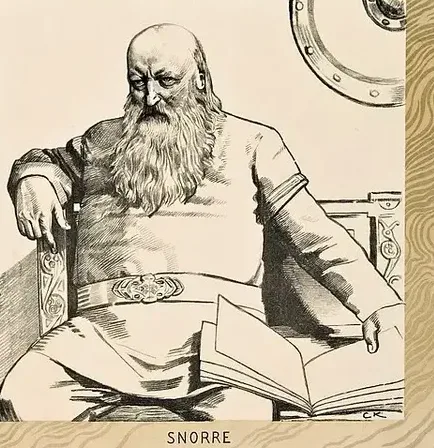 Christian Krohg, Snorre Sturlason (1899), from Norges Kongesagaer; scan: National Library of Norway Christian Krohg's portrait of Snorri from the 1899 folk edition of Heimskringla — the historian seated with a great open book across his knees. No contemporary likeness of Snorri exists; Krohg's drawing is the face Norway gave its most important medieval source. Thirteenth-century Icelandic chieftain, poet, and historian.
Composed the Heimskringla and the Prose Edda in the 1220s
from oral tradition and skaldic verse — three hundred years after
the Viking-age events he describes. The single richest source for
Norway's pre-conversion centuries and also the most aware
Christian-Icelandic editor of them. Modern scholarship accepts
what other sources independently confirm and treats his richest
expansions as the work of a poet writing about a kingdom he had
never seen. Assassinated at Reykholt on 23 September 1241 by
agents of King Hákon IV after a falling-out at court.
In this article Snorri's Heimskringla preserves the Yngling genealogies of
the Vestfold kings and the full saga telling of Harald's rise —
Gyda's challenge, the uncut hair, the climax at Hafrsfjord —
composed three centuries after the events, and weighed in this
article against the one contemporary witness, Hornklofi's verse.
Also discussed in The Viking Age — longships, legends, and the first "Norway"Worshiping Odin and Thor — the lived religion of pre-Christian NorwayThe King Who Became a Saint — how the Nordmen came to ChristA Catholic Norway — the faith that gave the kingdom its first institutions and the stave churchesThe Golden Age — a North Atlantic empire … reaching farther than you thinkThe Crusades?!!!! — sixty ships from Bergen, bound for the Holy LandNordisk Mytologi — Odin, the giants, and Ragnarok around 1230, three and a half centuries after the events, sets the climax at the Battle of Hafrsfjord
Christian Krohg, Snorre Sturlason (1899), from Norges Kongesagaer; scan: National Library of Norway Christian Krohg's portrait of Snorri from the 1899 folk edition of Heimskringla — the historian seated with a great open book across his knees. No contemporary likeness of Snorri exists; Krohg's drawing is the face Norway gave its most important medieval source. Thirteenth-century Icelandic chieftain, poet, and historian.
Composed the Heimskringla and the Prose Edda in the 1220s
from oral tradition and skaldic verse — three hundred years after
the Viking-age events he describes. The single richest source for
Norway's pre-conversion centuries and also the most aware
Christian-Icelandic editor of them. Modern scholarship accepts
what other sources independently confirm and treats his richest
expansions as the work of a poet writing about a kingdom he had
never seen. Assassinated at Reykholt on 23 September 1241 by
agents of King Hákon IV after a falling-out at court.
In this article Snorri's Heimskringla preserves the Yngling genealogies of
the Vestfold kings and the full saga telling of Harald's rise —
Gyda's challenge, the uncut hair, the climax at Hafrsfjord —
composed three centuries after the events, and weighed in this
article against the one contemporary witness, Hornklofi's verse.
Also discussed in The Viking Age — longships, legends, and the first "Norway"Worshiping Odin and Thor — the lived religion of pre-Christian NorwayThe King Who Became a Saint — how the Nordmen came to ChristA Catholic Norway — the faith that gave the kingdom its first institutions and the stave churchesThe Golden Age — a North Atlantic empire … reaching farther than you thinkThe Crusades?!!!! — sixty ships from Bergen, bound for the Holy LandNordisk Mytologi — Odin, the giants, and Ragnarok around 1230, three and a half centuries after the events, sets the climax at the Battle of Hafrsfjord 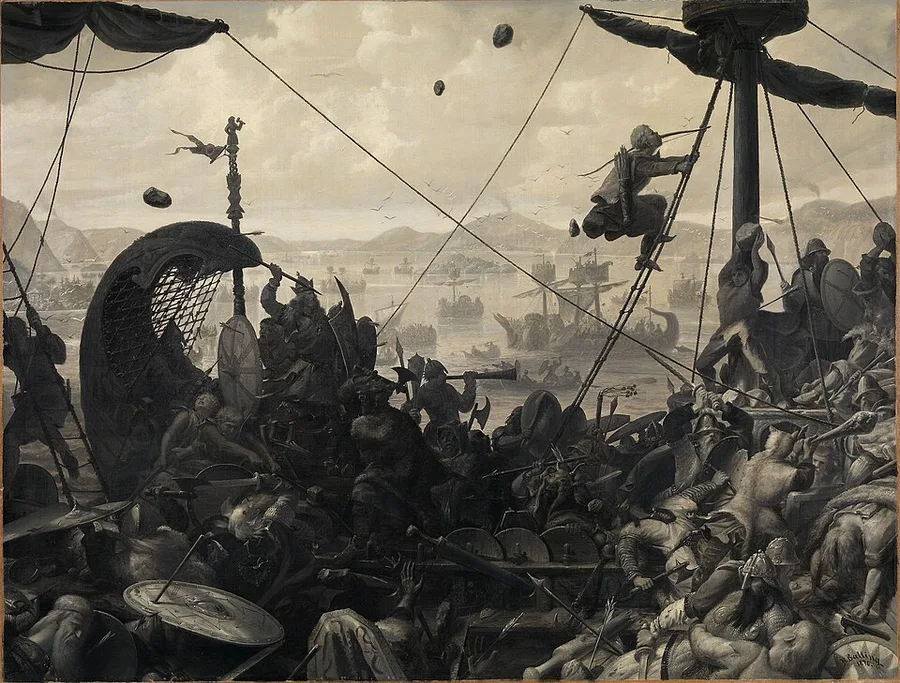 Ole Peter Hansen Balling, Harald Fairhair in the Battle of Hafrsfjord (1870), Nasjonalmuseet, NG.M.03750 Balling painted the sea-fight itself — men clashing across grappled longship decks as stones fly over a crowded fjord — the battle saga tradition treats as the climax of Harald Fairhair's conquest of the western coast. The sea-battle in the Hafrsfjord near present-day Stavanger that
saga tradition treats as the climactic engagement of Harald Fairhair's
consolidation of the western Norwegian coast. The traditional date
of 872 is a nineteenth-century back-calculation from Snorri's
chronology; modern Norwegian scholarship places the battle in the
880s. Harald's coalition defeated an alliance of the petty kings of
the western coast who had combined against him. The traditional
site is marked by the Sverd i fjell monument — three giant bronze
swords driven into the bedrock — on the eastern shore of the fjord.
Also discussed in The Viking Age — longships, legends, and the first "Norway" near what is now Stavanger
Ole Peter Hansen Balling, Harald Fairhair in the Battle of Hafrsfjord (1870), Nasjonalmuseet, NG.M.03750 Balling painted the sea-fight itself — men clashing across grappled longship decks as stones fly over a crowded fjord — the battle saga tradition treats as the climax of Harald Fairhair's conquest of the western coast. The sea-battle in the Hafrsfjord near present-day Stavanger that
saga tradition treats as the climactic engagement of Harald Fairhair's
consolidation of the western Norwegian coast. The traditional date
of 872 is a nineteenth-century back-calculation from Snorri's
chronology; modern Norwegian scholarship places the battle in the
880s. Harald's coalition defeated an alliance of the petty kings of
the western coast who had combined against him. The traditional
site is marked by the Sverd i fjell monument — three giant bronze
swords driven into the bedrock — on the eastern shore of the fjord.
Also discussed in The Viking Age — longships, legends, and the first "Norway" near what is now Stavanger 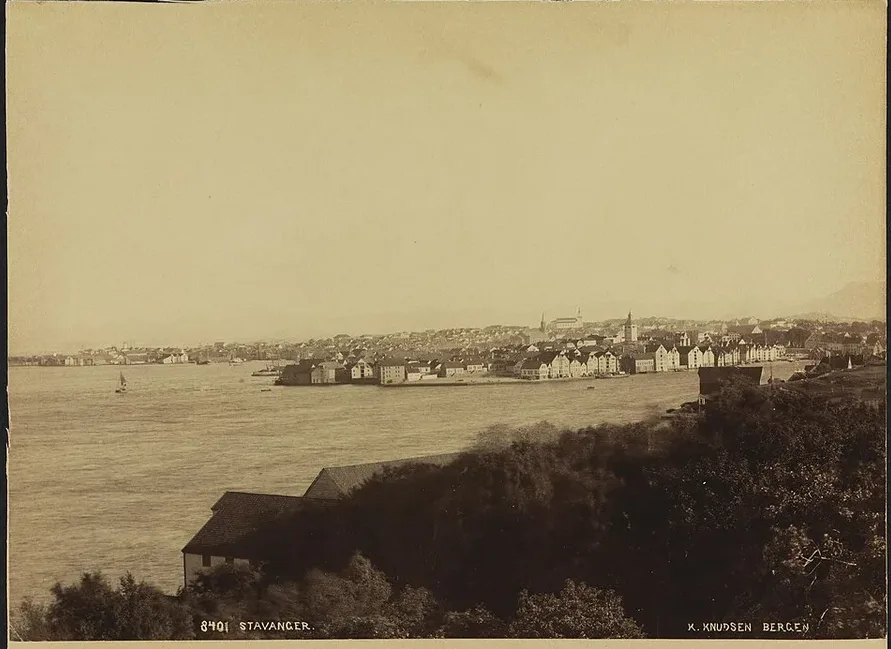 Knud Knudsen, Stavanger (1888-1894), National Library of Norway Stavanger in the late 1880s — the low wooden harbour town, church towers on the skyline, that the emigrant ships had been sailing from for two generations by the time Knudsen photographed it. City on the southwestern Norwegian coast in Rogaland; modern
Norway's fourth-largest city and the operational capital of the
Norwegian petroleum economy since the 1970s. The traditional site
of the sea-battle of Hafrsfjord that completed Harald Fairhair's
consolidation lies at the city's southwestern edge, marked by the
Sverd i fjell monument. The Norwegian Petroleum Directorate, the
safety regulator (Havtil), and Equinor (formerly Statoil) are all
headquartered in or around the city. Population around one hundred
and forty thousand in the municipality; metropolitan area roughly
twice that.
Stavanger Also discussed in The Viking Age — longships, legends, and the first "Norway"A Catholic Norway — the faith that gave the kingdom its first institutions and the stave churchesThe 400-Year Night — when the Northern Lion lay dormantThe 'Lucky Country' — the discovery that changed everything800,000 Norwegians Leave — the century that built a Second NorwayWorld War II — the King’s “No” and the Nazis in Norway , and gives Harald a famous backstory: he has sworn an oath not to cut his hair until he has subjected every petty king of the Norwegian coast, and at a feast at Earl Rognvald’s in Møre after Hafrsfjord
Knud Knudsen, Stavanger (1888-1894), National Library of Norway Stavanger in the late 1880s — the low wooden harbour town, church towers on the skyline, that the emigrant ships had been sailing from for two generations by the time Knudsen photographed it. City on the southwestern Norwegian coast in Rogaland; modern
Norway's fourth-largest city and the operational capital of the
Norwegian petroleum economy since the 1970s. The traditional site
of the sea-battle of Hafrsfjord that completed Harald Fairhair's
consolidation lies at the city's southwestern edge, marked by the
Sverd i fjell monument. The Norwegian Petroleum Directorate, the
safety regulator (Havtil), and Equinor (formerly Statoil) are all
headquartered in or around the city. Population around one hundred
and forty thousand in the municipality; metropolitan area roughly
twice that.
Stavanger Also discussed in The Viking Age — longships, legends, and the first "Norway"A Catholic Norway — the faith that gave the kingdom its first institutions and the stave churchesThe 400-Year Night — when the Northern Lion lay dormantThe 'Lucky Country' — the discovery that changed everything800,000 Norwegians Leave — the century that built a Second NorwayWorld War II — the King’s “No” and the Nazis in Norway , and gives Harald a famous backstory: he has sworn an oath not to cut his hair until he has subjected every petty king of the Norwegian coast, and at a feast at Earl Rognvald’s in Møre after Hafrsfjord 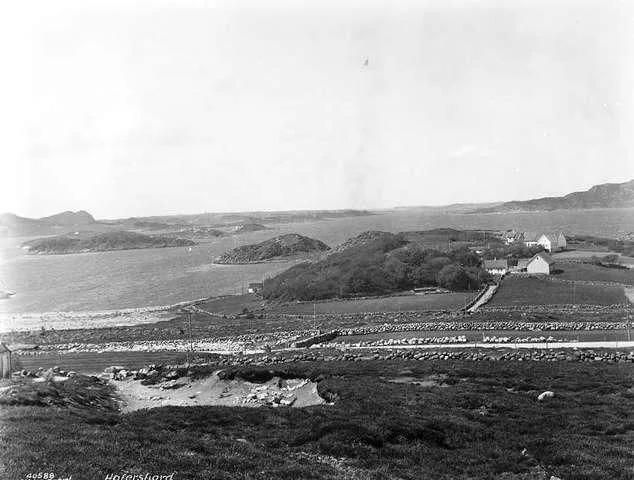 Anders Beer Wilse, Hafrsfjord (1934), Galleri Nor / Norsk Folkemuseum Wilse's 1934 photograph of the calm, shallow fjord southwest of Stavanger. Saga tradition places the sea-battle that completed Harald Fairhair's unification of western Norway in these waters, the shore now marked by the three great swords of Sverd i fjell. Shallow fjord at the southwestern edge of present-day Stavanger,
in Rogaland. Saga tradition places the sea-battle that completed
Harald Fairhair's consolidation of the western Norwegian coast in
this fjord — traditionally dated 872 (a nineteenth-century
back-calculation from Snorri's chronology) but placed by modern
scholarship in the 880s. The traditional battle site is marked by
the Sverd i fjell monument, three giant bronze swords driven into
bedrock on the eastern shore.
Hafrsfjord, Stavanger Also discussed in The Viking Age — longships, legends, and the first "Norway" , the earl finally cuts the matted ten-year growth and gives him the byname Hárfagri, “Fairhair.” Modern scholarship treats most of this as later literary construction. The traditional date of 872 is a nineteenth-century back-calculation from Snorri’s chronology, fixed in popular memory by the country’s millennial celebration in 1872; modern Norwegian scholarship places Hafrsfjord in the 880s. The hair oath is probably an invention. In the contemporary court poetry Harald is not yet “Fairhair” at all — Þorbjörn Hornklofi
Anders Beer Wilse, Hafrsfjord (1934), Galleri Nor / Norsk Folkemuseum Wilse's 1934 photograph of the calm, shallow fjord southwest of Stavanger. Saga tradition places the sea-battle that completed Harald Fairhair's unification of western Norway in these waters, the shore now marked by the three great swords of Sverd i fjell. Shallow fjord at the southwestern edge of present-day Stavanger,
in Rogaland. Saga tradition places the sea-battle that completed
Harald Fairhair's consolidation of the western Norwegian coast in
this fjord — traditionally dated 872 (a nineteenth-century
back-calculation from Snorri's chronology) but placed by modern
scholarship in the 880s. The traditional battle site is marked by
the Sverd i fjell monument, three giant bronze swords driven into
bedrock on the eastern shore.
Hafrsfjord, Stavanger Also discussed in The Viking Age — longships, legends, and the first "Norway" , the earl finally cuts the matted ten-year growth and gives him the byname Hárfagri, “Fairhair.” Modern scholarship treats most of this as later literary construction. The traditional date of 872 is a nineteenth-century back-calculation from Snorri’s chronology, fixed in popular memory by the country’s millennial celebration in 1872; modern Norwegian scholarship places Hafrsfjord in the 880s. The hair oath is probably an invention. In the contemporary court poetry Harald is not yet “Fairhair” at all — Þorbjörn Hornklofi 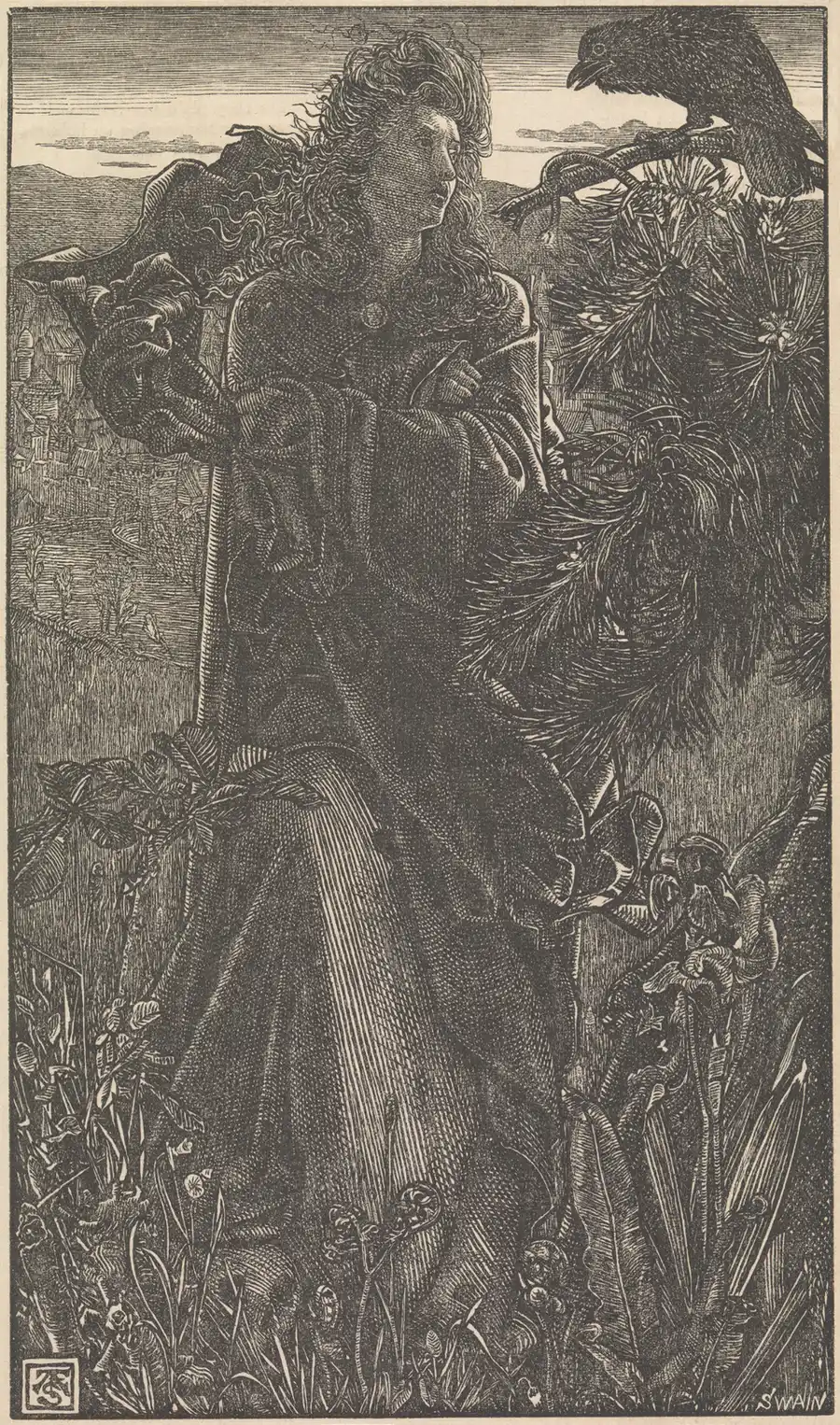 Frederick Sandys (engr. Joseph Swain), Valkyrie and Raven, Once a Week, 1862, National Gallery of Victoria Hornklofi cast his praise-poem Haraldskvæði as a conversation between a raven fresh from battle and a valkyrie who questions it about Harald's deeds; Sandys drew the poem's two speakers for an 1862 English translation of the verses. Late-ninth-century Norwegian skald, court poet of Harald Fairhair.
Composed Haraldskvæði, a praise-poem to the king written within
living memory of the events it describes — including the sea-battle
of Hafrsfjord — and one of the very few contemporary skaldic
sources for any part of Harald's reign. Hornklofi's verse calls
the king lúfa ("shock-head"); the byname Hárfagri ("Fairhair")
appears in other verse attributed to Harald's skalds, but those
stanzas' authenticity is debated, and the name's earliest securely
datable attestation is twelfth-century prose.
’s Haraldskvæði Late-ninth-century Old Norse praise-poem to Harald Fairhair,
composed by his court skald Þorbjörn Hornklofi within living memory
of the events it describes. The poem celebrates Harald's victory
at the sea-battle of Hafrsfjord and calls the king lúfa
("shock-head"); the byname Hárfagri ("Fairhair") appears in
other verse attributed to Harald's skalds, but those stanzas'
authenticity is debated, and the name's earliest securely datable
attestation is twelfth-century prose. The poem survives in
fragments preserved in later prose sagas.
, composed within living memory of the events, calls him lúfa, “Shaggy-locks.” The byname Hárfagri is younger: verse attributed to Harald’s own skalds does use it, but the stanzas’ authenticity is debated, and its earliest securely datable attestation is Ari Þorgilsson’s Íslendingabók
Frederick Sandys (engr. Joseph Swain), Valkyrie and Raven, Once a Week, 1862, National Gallery of Victoria Hornklofi cast his praise-poem Haraldskvæði as a conversation between a raven fresh from battle and a valkyrie who questions it about Harald's deeds; Sandys drew the poem's two speakers for an 1862 English translation of the verses. Late-ninth-century Norwegian skald, court poet of Harald Fairhair.
Composed Haraldskvæði, a praise-poem to the king written within
living memory of the events it describes — including the sea-battle
of Hafrsfjord — and one of the very few contemporary skaldic
sources for any part of Harald's reign. Hornklofi's verse calls
the king lúfa ("shock-head"); the byname Hárfagri ("Fairhair")
appears in other verse attributed to Harald's skalds, but those
stanzas' authenticity is debated, and the name's earliest securely
datable attestation is twelfth-century prose.
’s Haraldskvæði Late-ninth-century Old Norse praise-poem to Harald Fairhair,
composed by his court skald Þorbjörn Hornklofi within living memory
of the events it describes. The poem celebrates Harald's victory
at the sea-battle of Hafrsfjord and calls the king lúfa
("shock-head"); the byname Hárfagri ("Fairhair") appears in
other verse attributed to Harald's skalds, but those stanzas'
authenticity is debated, and the name's earliest securely datable
attestation is twelfth-century prose. The poem survives in
fragments preserved in later prose sagas.
, composed within living memory of the events, calls him lúfa, “Shaggy-locks.” The byname Hárfagri is younger: verse attributed to Harald’s own skalds does use it, but the stanzas’ authenticity is debated, and its earliest securely datable attestation is Ari Þorgilsson’s Íslendingabók 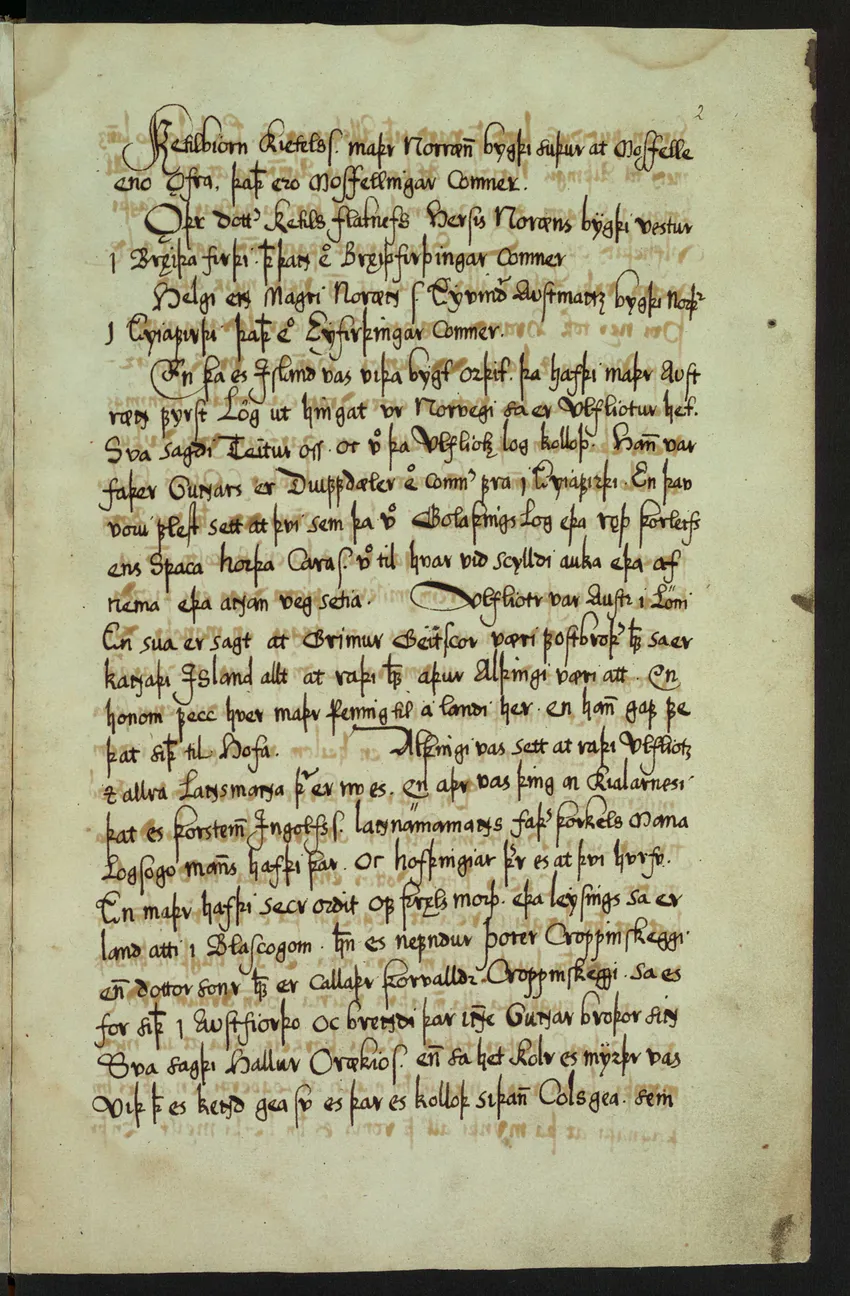 Íslendingabók, AM 113 a fol. (1651 copy), Árni Magnússon Institute A page from the 1651 copy that preserves Ari the Learned's lost twelfth-century Book of the Icelanders — the manuscript carrying the earliest written account of Harald Fairhair's unification of Norway. The Book of the Icelanders — Ari Þorgilsson's concise history
of Iceland, written c. 1122–1133 and the oldest surviving
narrative work in the Old Norse vernacular. Ari the Learned
(1067/68–1148), a priest of Snæfellsnes, wrote at the request
of the bishops of Skálholt, naming his informants and weighing
their memory — the settlement from Norway, the founding of the
Althing, the conversion of 1000, the first bishops. Its opening
chapter carries the earliest surviving attestation of Harald
Fairhair's unification of Norway, written two and a half
centuries after the events. The medieval original is lost; the
text survives in two copies made by the priest Jón Erlendsson
in the 1650s (AM 113 a and b fol.).
, written in the early twelfth century, some two and a half centuries after Hafrsfjord. What the early skalds never give him, though, is a geographical title. He is konungr in their verse, but never king of all Norway. The full geographical claim is a later construction, set in by the saga writers in the centuries after the consolidation had been remembered as more complete than it actually was.
Íslendingabók, AM 113 a fol. (1651 copy), Árni Magnússon Institute A page from the 1651 copy that preserves Ari the Learned's lost twelfth-century Book of the Icelanders — the manuscript carrying the earliest written account of Harald Fairhair's unification of Norway. The Book of the Icelanders — Ari Þorgilsson's concise history
of Iceland, written c. 1122–1133 and the oldest surviving
narrative work in the Old Norse vernacular. Ari the Learned
(1067/68–1148), a priest of Snæfellsnes, wrote at the request
of the bishops of Skálholt, naming his informants and weighing
their memory — the settlement from Norway, the founding of the
Althing, the conversion of 1000, the first bishops. Its opening
chapter carries the earliest surviving attestation of Harald
Fairhair's unification of Norway, written two and a half
centuries after the events. The medieval original is lost; the
text survives in two copies made by the priest Jón Erlendsson
in the 1650s (AM 113 a and b fol.).
, written in the early twelfth century, some two and a half centuries after Hafrsfjord. What the early skalds never give him, though, is a geographical title. He is konungr in their verse, but never king of all Norway. The full geographical claim is a later construction, set in by the saga writers in the centuries after the consolidation had been remembered as more complete than it actually was.
How much of the modern country he actually controls is debated. His authority probably reaches along the western coast and across the southern interior but stops short of the Arctic north and the inland mountains. The earls of Lade, controlling the agricultural plain of Trøndelag, will fight Harald’s heirs for influence over the throne for the better part of the next century. The full administrative consolidation of Norway, what modern Norwegian scholarship calls the Rikssamling 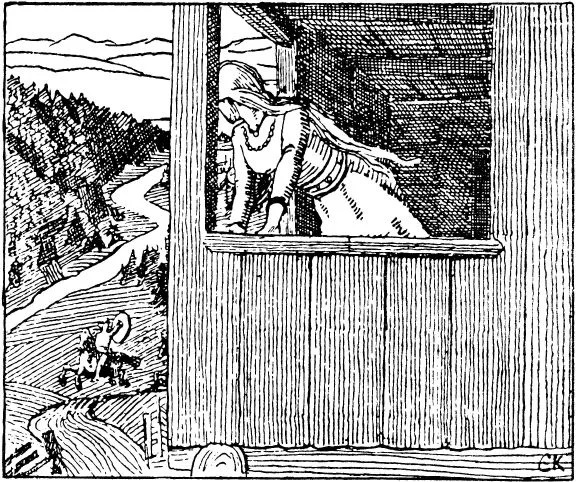 Christian Krohg, Kong Haralds sendemenn kjem andre gongen til Gyda, Heimskringla 1899 edition (J.M. Stenersen & Co) Snorri's saga makes the whole unification begin here — with Harald's messengers returning from Gyda, who had refused to marry him until he ruled all of Norway. The vow her answer provoked is the realm-gathering itself. Norwegian for "realm-gathering" — the long process of unifying the
Norwegian petty kingdoms into a single national polity. Traditionally
dated to Harald Fairhair's consolidation around 880, modern Norwegian
scholarship treats the rikssamling as a process running from
Halfdan the Black in the mid-ninth century through the kings of the
twelfth century, not a single event. What Harald established in his
lifetime was the durable idea of a single Norwegian crown; the full
administrative consolidation took another three hundred years to
complete.
, the “realm-gathering,” is not completed until well into the twelfth century, under kings who come generations after Harald. What Harald does establish, more limited but more durable, is the idea of a single Norwegian crown.
Christian Krohg, Kong Haralds sendemenn kjem andre gongen til Gyda, Heimskringla 1899 edition (J.M. Stenersen & Co) Snorri's saga makes the whole unification begin here — with Harald's messengers returning from Gyda, who had refused to marry him until he ruled all of Norway. The vow her answer provoked is the realm-gathering itself. Norwegian for "realm-gathering" — the long process of unifying the
Norwegian petty kingdoms into a single national polity. Traditionally
dated to Harald Fairhair's consolidation around 880, modern Norwegian
scholarship treats the rikssamling as a process running from
Halfdan the Black in the mid-ninth century through the kings of the
twelfth century, not a single event. What Harald established in his
lifetime was the durable idea of a single Norwegian crown; the full
administrative consolidation took another three hundred years to
complete.
, the “realm-gathering,” is not completed until well into the twelfth century, under kings who come generations after Harald. What Harald does establish, more limited but more durable, is the idea of a single Norwegian crown.
Many of the chieftains who refuse to accept his authority emigrate rather than submit. Their destination is Iceland  Frederick W. W. Howell, Galtalækur and Hekla (c. 1900), Fiske Icelandic Collection, Cornell University Library A turf-walled farm under Hekla, photographed about 1900 — Iceland as the settlers from Norway made it: a country of farms without a king or towns, governed by the annual open-air Alþing and remembered in the sagas their descendants wrote. The North Atlantic island settled from Norway in the ninth and
tenth centuries by chieftains and their followings who refused to
accept Harald Fairhair's authority on the Norwegian mainland and
emigrated rather than submit. They built a country without a king,
governed by an annual open-air assembly at Þingvellir called the
Alþing — the oldest parliament in the world by date of founding. Three centuries after the migration, their descendants
(notably Snorri Sturluson) composed the prose sagas that became
almost the only literary memory of the Norwegian petty kingdoms.
Also discussed in The Viking Age — longships, legends, and the first "Norway"Worshiping Odin and Thor — the lived religion of pre-Christian NorwayThe King Who Became a Saint — how the Nordmen came to ChristA Catholic Norway — the faith that gave the kingdom its first institutions and the stave churchesThe Golden Age — a North Atlantic empire … reaching farther than you thinkThe 400-Year Night — when the Northern Lion lay dormant , where they and their descendants build a country without a king, governed by an annual open-air assembly at Þingvellir
Frederick W. W. Howell, Galtalækur and Hekla (c. 1900), Fiske Icelandic Collection, Cornell University Library A turf-walled farm under Hekla, photographed about 1900 — Iceland as the settlers from Norway made it: a country of farms without a king or towns, governed by the annual open-air Alþing and remembered in the sagas their descendants wrote. The North Atlantic island settled from Norway in the ninth and
tenth centuries by chieftains and their followings who refused to
accept Harald Fairhair's authority on the Norwegian mainland and
emigrated rather than submit. They built a country without a king,
governed by an annual open-air assembly at Þingvellir called the
Alþing — the oldest parliament in the world by date of founding. Three centuries after the migration, their descendants
(notably Snorri Sturluson) composed the prose sagas that became
almost the only literary memory of the Norwegian petty kingdoms.
Also discussed in The Viking Age — longships, legends, and the first "Norway"Worshiping Odin and Thor — the lived religion of pre-Christian NorwayThe King Who Became a Saint — how the Nordmen came to ChristA Catholic Norway — the faith that gave the kingdom its first institutions and the stave churchesThe Golden Age — a North Atlantic empire … reaching farther than you thinkThe 400-Year Night — when the Northern Lion lay dormant , where they and their descendants build a country without a king, governed by an annual open-air assembly at Þingvellir  Thorarinn B. Thorlaksson, Thingvellir (1900) Þórarinn B. Þorláksson's 1900 view of the quiet Þingvellir plain. This is where Iceland's Alþing assembly was founded in 930 — free farmers and chieftains gathering yearly for law and judgment — on the rift where the North American and Eurasian plates pull apart. The plain of the thing — the open-air assembly site about forty
kilometres northeast of Reykjavík where the Icelandic Alþing was
founded in 930 CE. Iceland's law-speakers, free farmers, and chieftains
met here annually for two weeks of legal proceedings, dispute
resolution, and announcements of new law. The site sits on the
geological rift where the North American and Eurasian tectonic
plates pull apart. Now Þingvellir National Park, a UNESCO World
Heritage site.
Also discussed in The Viking Age — longships, legends, and the first "Norway" called the Alþing
Thorarinn B. Thorlaksson, Thingvellir (1900) Þórarinn B. Þorláksson's 1900 view of the quiet Þingvellir plain. This is where Iceland's Alþing assembly was founded in 930 — free farmers and chieftains gathering yearly for law and judgment — on the rift where the North American and Eurasian plates pull apart. The plain of the thing — the open-air assembly site about forty
kilometres northeast of Reykjavík where the Icelandic Alþing was
founded in 930 CE. Iceland's law-speakers, free farmers, and chieftains
met here annually for two weeks of legal proceedings, dispute
resolution, and announcements of new law. The site sits on the
geological rift where the North American and Eurasian tectonic
plates pull apart. Now Þingvellir National Park, a UNESCO World
Heritage site.
Also discussed in The Viking Age — longships, legends, and the first "Norway" called the Alþing 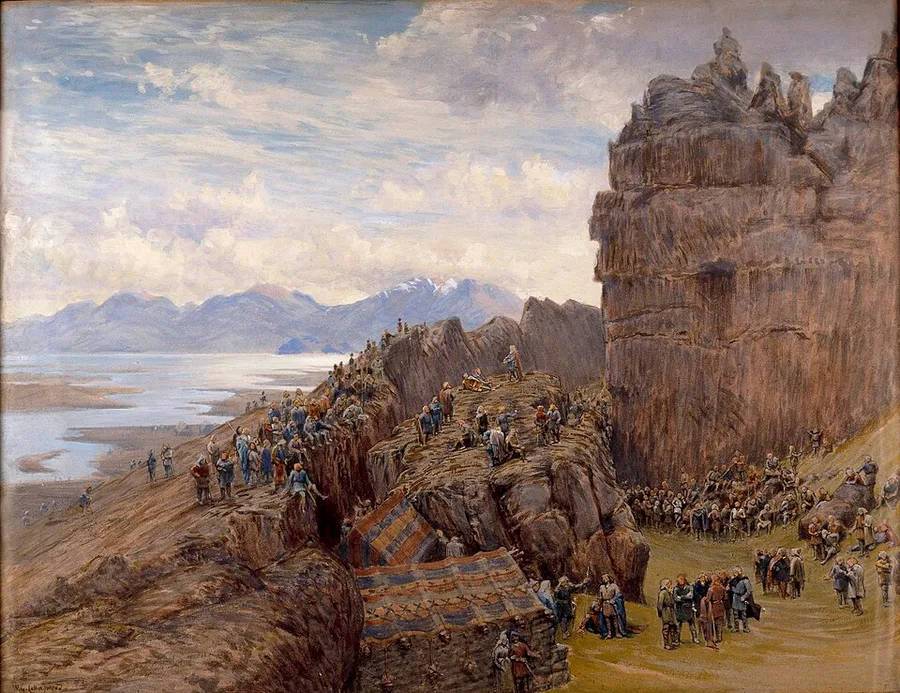 W. G. Collingwood, The Althing in session (c. 1897), The Trustees of the British Museum W.G. Collingwood's 1897 reconstruction of the Icelandic Alþing in session at Þingvellir — chieftains ranged along the rift's rock ledges above the tented booths, picturing the open-air parliament that governed the Commonwealth for three centuries. The annual open-air assembly of the Icelandic Commonwealth,
founded at Þingvellir in 930 CE by the descendants of the Norwegian
chieftains who had emigrated rather than submit to Harald Fairhair's
consolidation. The Alþing met for two weeks each summer, conducted
Iceland's legal business, and operated without a king for over
three centuries — the longest-running stateless polity in medieval
Europe. Reconstituted in 1845 as a consultative body and given
legislative powers in 1874 with Iceland's first constitution. The
modern Icelandic parliament still bears the name Alþingi and is
the oldest continuously named parliament in the world.
Also discussed in The Viking Age — longships, legends, and the first "Norway" . Three centuries later, their descendants will compose the prose sagas that become almost the only memory of the Norwegian petty kingdoms and the country Harald has consolidated out of them.
W. G. Collingwood, The Althing in session (c. 1897), The Trustees of the British Museum W.G. Collingwood's 1897 reconstruction of the Icelandic Alþing in session at Þingvellir — chieftains ranged along the rift's rock ledges above the tented booths, picturing the open-air parliament that governed the Commonwealth for three centuries. The annual open-air assembly of the Icelandic Commonwealth,
founded at Þingvellir in 930 CE by the descendants of the Norwegian
chieftains who had emigrated rather than submit to Harald Fairhair's
consolidation. The Alþing met for two weeks each summer, conducted
Iceland's legal business, and operated without a king for over
three centuries — the longest-running stateless polity in medieval
Europe. Reconstituted in 1845 as a consultative body and given
legislative powers in 1874 with Iceland's first constitution. The
modern Icelandic parliament still bears the name Alþingi and is
the oldest continuously named parliament in the world.
Also discussed in The Viking Age — longships, legends, and the first "Norway" . Three centuries later, their descendants will compose the prose sagas that become almost the only memory of the Norwegian petty kingdoms and the country Harald has consolidated out of them.
What is still here
The country still carries the inheritance. Most of the regional names — Vestfold, Sogn, Trøndelag, Agder, Rogaland — survive on the modern map, traceable back through a thousand years of regional usage to the same valleys they originally described. Some have been folded into newer administrative units under recent county reforms, but the older names persist in everyday speech, in dialect, in folk identity. The four medieval law-codes, descended from the regional þing traditions of the petty kingdoms, are unified into the Landslov of 1274 and remain the law of Norway for more than four hundred years. The royal mounds at Borre still hold their Vestfold kings. The Sámi parliament sits at Karasjok in the far north. And the country has even kept the name the Hålogaland sea-trader Ohthere used for it at King Alfred’s court around 890: Norðweg 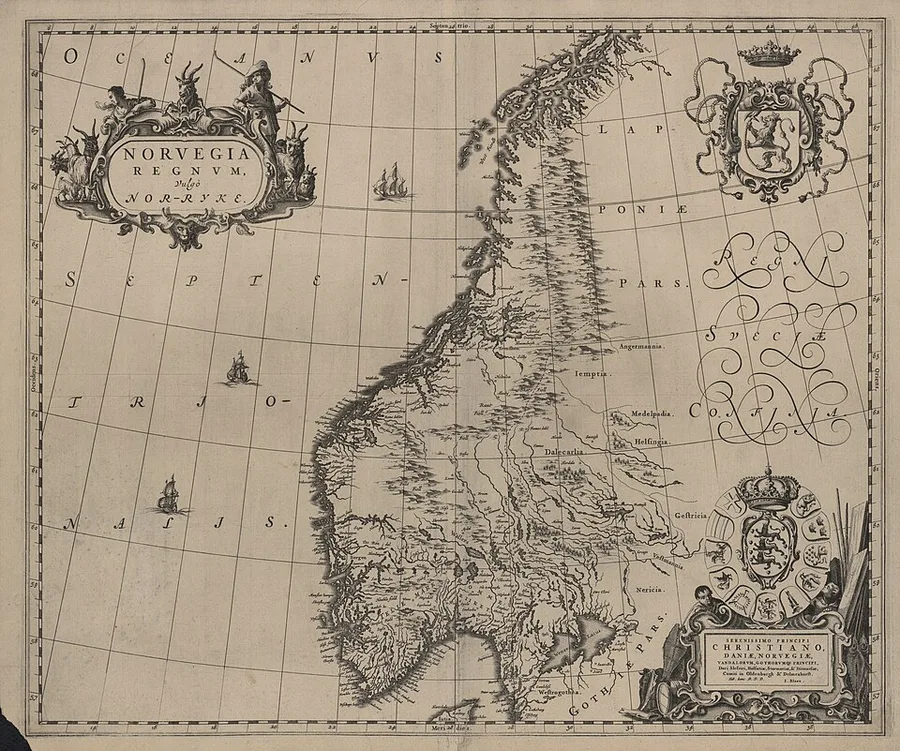 Joan Blaeu, Norvegia Regnum (before 1659), National Library of Norway Joan Blaeu's seventeenth-century map traces Norway along its whole fjord-cut coast — a picture of the northern sailing passage, Norðweg, the 'way north' that gave the country its name before it was ever one country. "The northern way" — the sailing route up the Norwegian coast
that gave the country its name. The attested form Norðweg is
Old English: the earliest surviving written use of the term is
in Ohthere of Hålogaland's c. 890 account given at King Alfred's
court, preserved in the Old English Orosius. The Old Norse form
is Norðvegr, contracting to Nóregr. The word names the road
rather than a land: the coastal sailing passage that linked the
petty kingdoms before it linked the unified country. Modern
Norwegian Norge and English Norway both descend from it.
, “the northern way,” the road its coastal kingdoms had always lived on, the road that finally tied them into one country.
Joan Blaeu, Norvegia Regnum (before 1659), National Library of Norway Joan Blaeu's seventeenth-century map traces Norway along its whole fjord-cut coast — a picture of the northern sailing passage, Norðweg, the 'way north' that gave the country its name before it was ever one country. "The northern way" — the sailing route up the Norwegian coast
that gave the country its name. The attested form Norðweg is
Old English: the earliest surviving written use of the term is
in Ohthere of Hålogaland's c. 890 account given at King Alfred's
court, preserved in the Old English Orosius. The Old Norse form
is Norðvegr, contracting to Nóregr. The word names the road
rather than a land: the coastal sailing passage that linked the
petty kingdoms before it linked the unified country. Modern
Norwegian Norge and English Norway both descend from it.
, “the northern way,” the road its coastal kingdoms had always lived on, the road that finally tied them into one country.
The unifying kings claim the country. The country is older than they are.
Sources & further reading
Primary sources
- Snorri Sturluson, Heimskringla (c. 1225–1235), particularly Ynglinga saga and Hálfdanar saga svarta.
- Jordanes, Getica (551 CE), geographical preamble describing Scandza.
- Ynglingatal, late-ninth-century skaldic genealogy attributed to Þjóðólfr of Hvinir.
- Haraldskvæði, contemporary praise-poem to Harald attributed to Þorbjörn Hornklofi.
- Ohthere of Hålogaland’s c. 890 account given at King Alfred’s court, preserved in the Old English Orosius.
Modern scholarship
- Sverre Bagge, From Viking Stronghold to Christian Kingdom: State Formation in Norway, c. 900–1350 (Copenhagen: Museum Tusculanum Press, 2010).
- Knut Helle, Norge blir en stat: 1130–1319, 2nd edition (Oslo: Universitetsforlaget, 1995).
- Claus Krag, Vikingtid og rikssamling: 800–1130 (Oslo: Aschehoug, 1995).
- Jón Viðar Sigurðsson, Norsk historie 800–1300: frå høvdingmakt til konge- og kyrkjemakt (Oslo: Det Norske Samlaget, 1999).
Reference
- Store norske leksikon (snl.no), entries on Halfdan Svarte, Harald 1 Hårfagre, slaget ved Hafrsfjord, Yngling-ætten, samer, småkongedømmer, and Landsloven av 1274.
Visit
- The Borre Mound Cemetery, Vestfold — the Yngling royal mounds, with the Midgard Vikingsenter museum at the site.
- Sverd i fjell
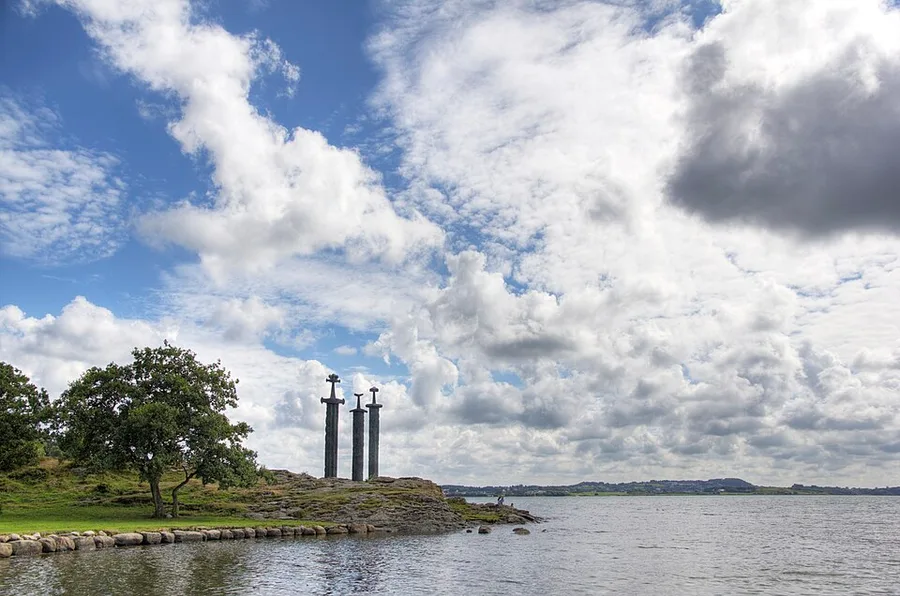 Photo: TomasEE (2013), Sverd i fjell, Hafrsfjord — CC BY 3.0 via Wikimedia Commons Fritz Røed's 1983 monument on Hafrsfjord: three bronze swords, each about ten metres, driven point-down into the bedrock. They mark the traditional site of Harald Fairhair's unifying sea-battle — the tallest sword for Harald, the other two for the petty kings he defeated. Norwegian for "swords in mountain" — a 1983 sculpture by Fritz Røed
on the eastern shore of Hafrsfjord near Stavanger, marking the
traditional site of Harald Fairhair's consolidating sea-battle.
Three giant bronze swords, each about ten metres tall, are driven
point-down into the bedrock; one represents Harald, the other two
represent the defeated petty kings. The monument commemorates both
the battle itself and the country's unification under a single
crown. One of Stavanger's principal landmarks.
Sverd i fjell, Hafrsfjord Also discussed in The Viking Age — longships, legends, and the first "Norway" , Hafrsfjord, Stavanger — the three-sword monument marking the traditional site of the battle.
Photo: TomasEE (2013), Sverd i fjell, Hafrsfjord — CC BY 3.0 via Wikimedia Commons Fritz Røed's 1983 monument on Hafrsfjord: three bronze swords, each about ten metres, driven point-down into the bedrock. They mark the traditional site of Harald Fairhair's unifying sea-battle — the tallest sword for Harald, the other two for the petty kings he defeated. Norwegian for "swords in mountain" — a 1983 sculpture by Fritz Røed
on the eastern shore of Hafrsfjord near Stavanger, marking the
traditional site of Harald Fairhair's consolidating sea-battle.
Three giant bronze swords, each about ten metres tall, are driven
point-down into the bedrock; one represents Harald, the other two
represent the defeated petty kings. The monument commemorates both
the battle itself and the country's unification under a single
crown. One of Stavanger's principal landmarks.
Sverd i fjell, Hafrsfjord Also discussed in The Viking Age — longships, legends, and the first "Norway" , Hafrsfjord, Stavanger — the three-sword monument marking the traditional site of the battle.