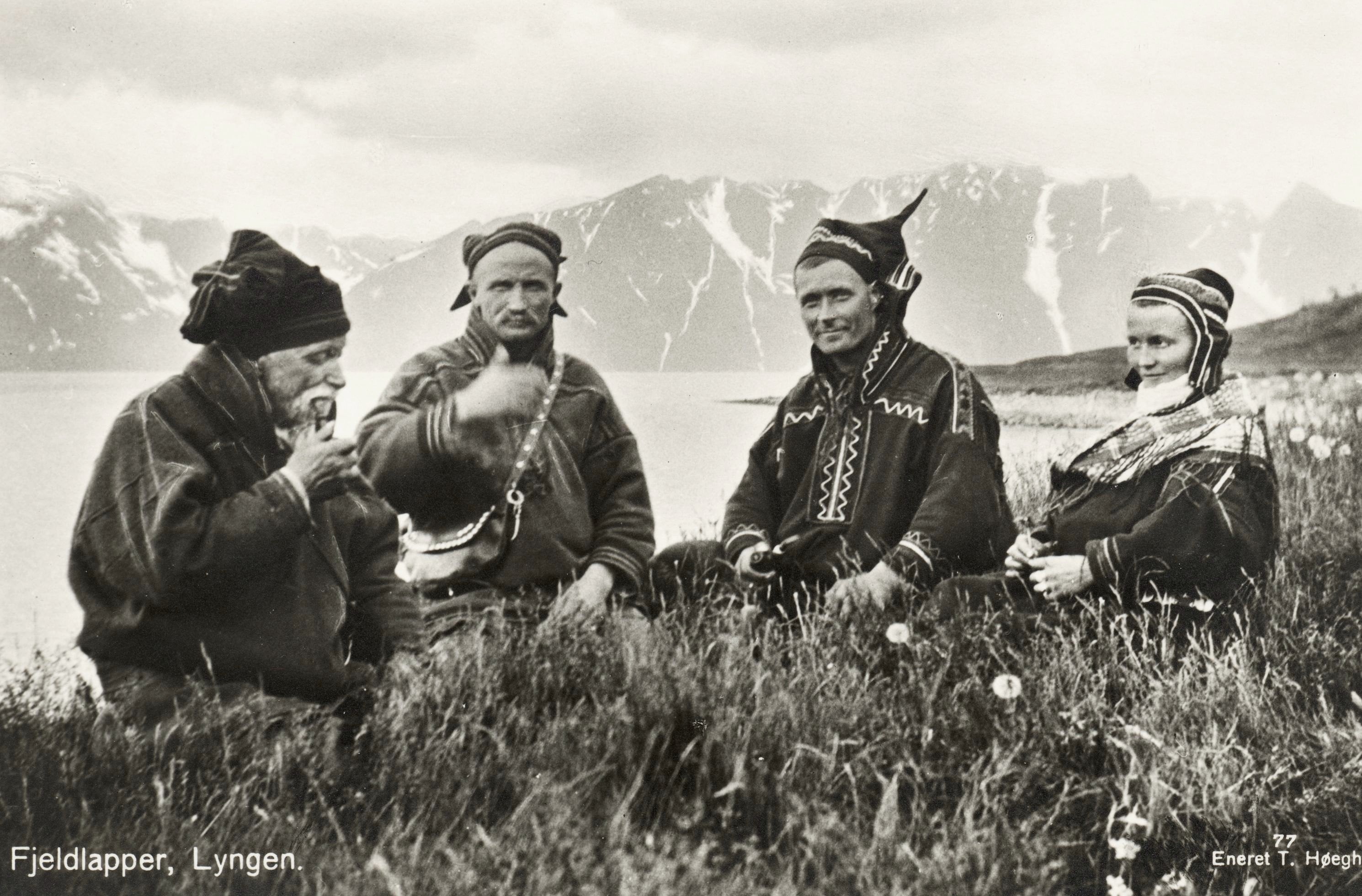
Samene — The other people of Norway
Norway's indigenous people, in the north for thousands of years. Pre-Christian drum-led shamanism, the 18th-century state mission that burned the drums, the century of forced Norwegianization, and the modern recovery — Sápmi as a country within a country.
The southern, coastal, Lutheran Norway most outsiders picture is not the whole country. For thousands of years the north has also belonged to another people, with their own languages, their own religion, and their own way of life. They are the Sámi, and their story does not fit the Norse-kingdom-becomes-Christian-nation arc that gets romanticized.
Sápmi
The Sámi homeland is called Sápmi 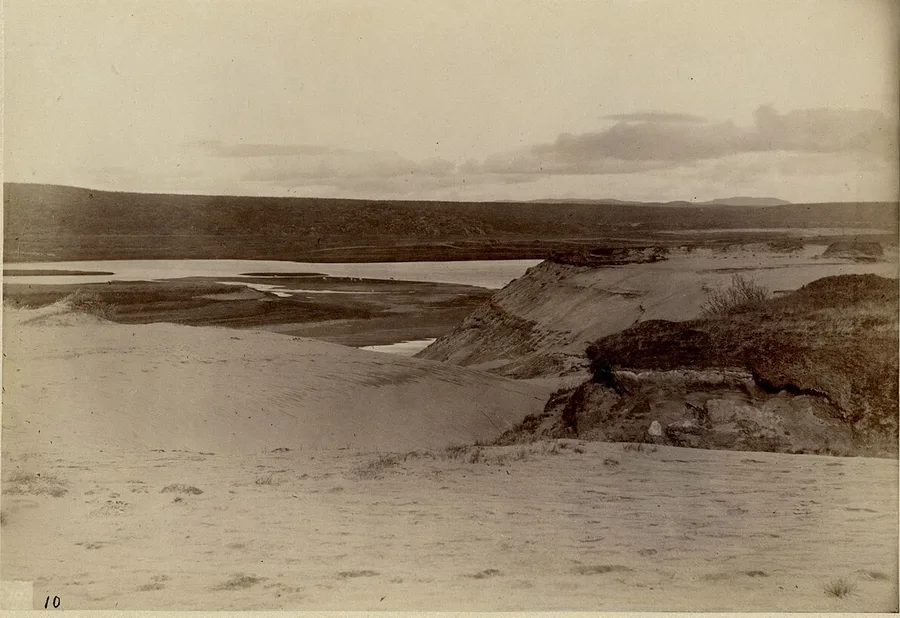 Sophus Tromholt, Fra sandets regioner i Koutokæino (1882–83), Norsk Folkemuseum Tromholt photographed the sand country along the Kautokeino river in 1882–83 — open, treeless, river-veined land in the heart of Sápmi, the borderless interior the Sámi have held for at least two and a half thousand years. The cultural region of the Sámi Indigenous people, stretching across
the northern interior of present-day Norway, Sweden, Finland, and
the Russian Kola Peninsula. Sápmi has no political boundary but has
been the homeland of the Sámi for at least two and a half thousand
years. Its languages belong to the Uralic family and are unrelated
to Norse. The Sámi parliaments of Norway, Sweden, and Finland —
each representing the Sámi within their respective national systems —
meet at Karasjok, Kiruna, and Inari respectively.
Also discussed in Before There Was Norway — petty kingdoms at the edge of the worldThe Reformation, 1537 — one church eradicated and another imposed , and it does not respect the borders drawn on modern maps. It stretches across the north of four countries — Norway, Sweden, Finland, and Russia, where it reaches across the Kola Peninsula — a single cultural region that became divided by territory lines the Sámi did not draw. The Sámi languages belong to the Uralic family, related to Finnish and distant from Norwegian; there is not one Sámi language but several, some of them now severely endangered. The traditional economy was built on the land directly: fishing, hunting, and trapping, and — from the early modern centuries — the large-scale reindeer herding that became its emblem, an economy of movement across a hard northern landscape.
Sophus Tromholt, Fra sandets regioner i Koutokæino (1882–83), Norsk Folkemuseum Tromholt photographed the sand country along the Kautokeino river in 1882–83 — open, treeless, river-veined land in the heart of Sápmi, the borderless interior the Sámi have held for at least two and a half thousand years. The cultural region of the Sámi Indigenous people, stretching across
the northern interior of present-day Norway, Sweden, Finland, and
the Russian Kola Peninsula. Sápmi has no political boundary but has
been the homeland of the Sámi for at least two and a half thousand
years. Its languages belong to the Uralic family and are unrelated
to Norse. The Sámi parliaments of Norway, Sweden, and Finland —
each representing the Sámi within their respective national systems —
meet at Karasjok, Kiruna, and Inari respectively.
Also discussed in Before There Was Norway — petty kingdoms at the edge of the worldThe Reformation, 1537 — one church eradicated and another imposed , and it does not respect the borders drawn on modern maps. It stretches across the north of four countries — Norway, Sweden, Finland, and Russia, where it reaches across the Kola Peninsula — a single cultural region that became divided by territory lines the Sámi did not draw. The Sámi languages belong to the Uralic family, related to Finnish and distant from Norwegian; there is not one Sámi language but several, some of them now severely endangered. The traditional economy was built on the land directly: fishing, hunting, and trapping, and — from the early modern centuries — the large-scale reindeer herding that became its emblem, an economy of movement across a hard northern landscape.
The Norse and the Sámi have been neighbors on overlapping ground for thousands of years — the Norse holding the coast and the southern farmland, the Sámi holding the interior, the highlands, and the far north. The medieval Norse sources know them, under the old name Finnar; Ohthere of Hålogaland 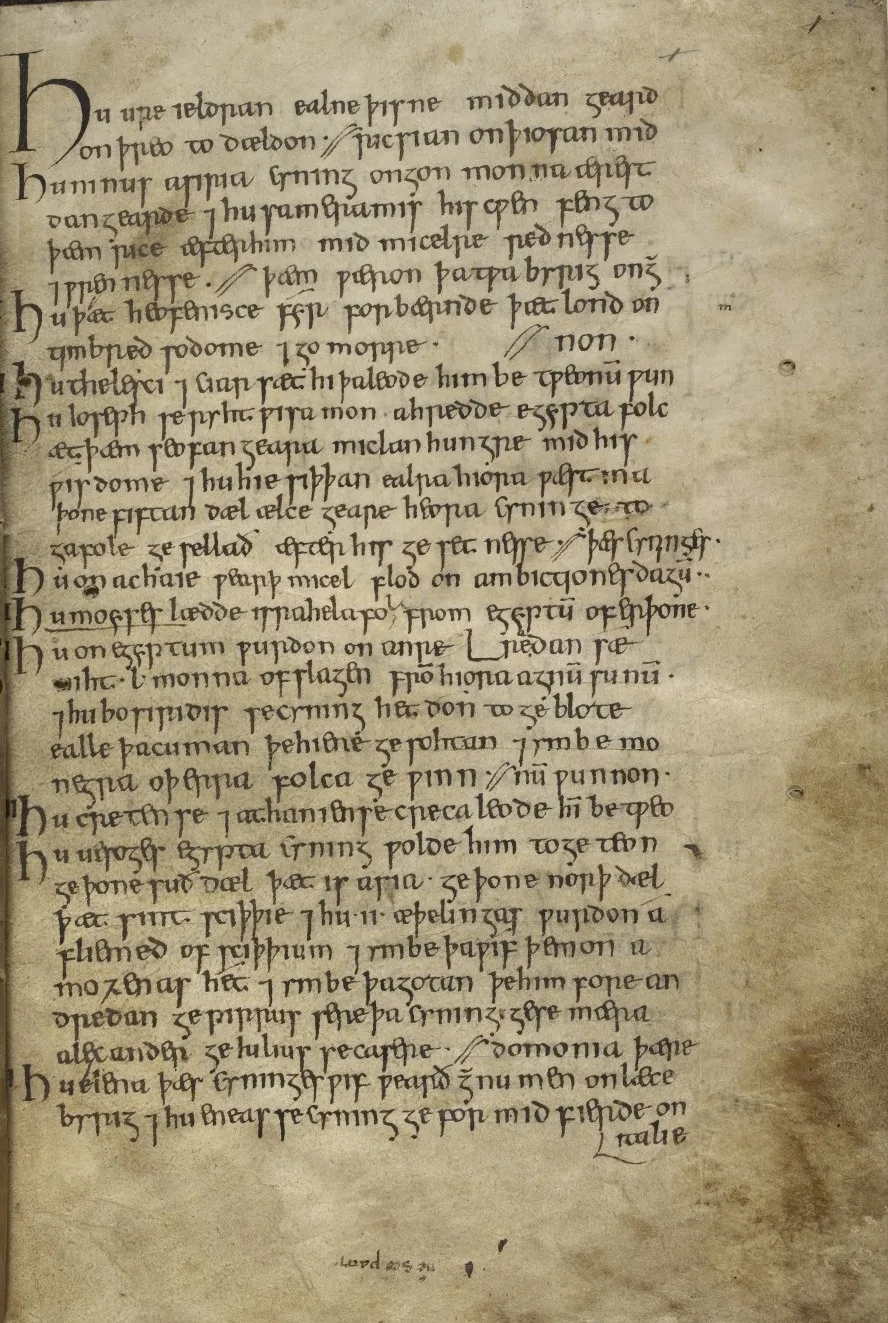 Tollemache Orosius, British Library Add MS 47967, fol. 2r (c. 892-925) Ohthere's report to King Alfred survives only in this Old English manuscript — the account that describes, from the Norse side, the tribute economy in furs, hides, feathers, and whalebone that bound Norse chieftains to the Sámi centuries before any state or mission arrived. Late-ninth-century Norse merchant and chieftain from Hålogaland in
northern Norway. Visited the court of King Alfred the Great in
Wessex around 890 CE and gave an oral account of his homeland —
the coast, the trade in walrus ivory and furs, the Sámi tribute
economy, the sailing routes — that Alfred had recorded in the Old
English translation of Orosius. Ohthere's account is one of the
very few contemporary written sources for any of the petty-kingdom
Norwegian world.
Also discussed in Before There Was Norway — petty kingdoms at the edge of the world , describing his country to the English king Alfred around 890, mentions the tribute his Sámi neighbors paid him in furs, feathers, and ship-rope of hide. For most of that long coexistence the relationship was trade and tribute, not conquest. What changed it was religion, and then the state.
Tollemache Orosius, British Library Add MS 47967, fol. 2r (c. 892-925) Ohthere's report to King Alfred survives only in this Old English manuscript — the account that describes, from the Norse side, the tribute economy in furs, hides, feathers, and whalebone that bound Norse chieftains to the Sámi centuries before any state or mission arrived. Late-ninth-century Norse merchant and chieftain from Hålogaland in
northern Norway. Visited the court of King Alfred the Great in
Wessex around 890 CE and gave an oral account of his homeland —
the coast, the trade in walrus ivory and furs, the Sámi tribute
economy, the sailing routes — that Alfred had recorded in the Old
English translation of Orosius. Ohthere's account is one of the
very few contemporary written sources for any of the petty-kingdom
Norwegian world.
Also discussed in Before There Was Norway — petty kingdoms at the edge of the world , describing his country to the English king Alfred around 890, mentions the tribute his Sámi neighbors paid him in furs, feathers, and ship-rope of hide. For most of that long coexistence the relationship was trade and tribute, not conquest. What changed it was religion, and then the state.
The drum and the noaidi
Before the missionaries, the Sámi had a religion entirely their own — and entirely unlike Norse paganism. It was animist: the land itself was alive and inhabited, and certain places in it — particular stones, springs, mountains, rock formations — were Sieidi 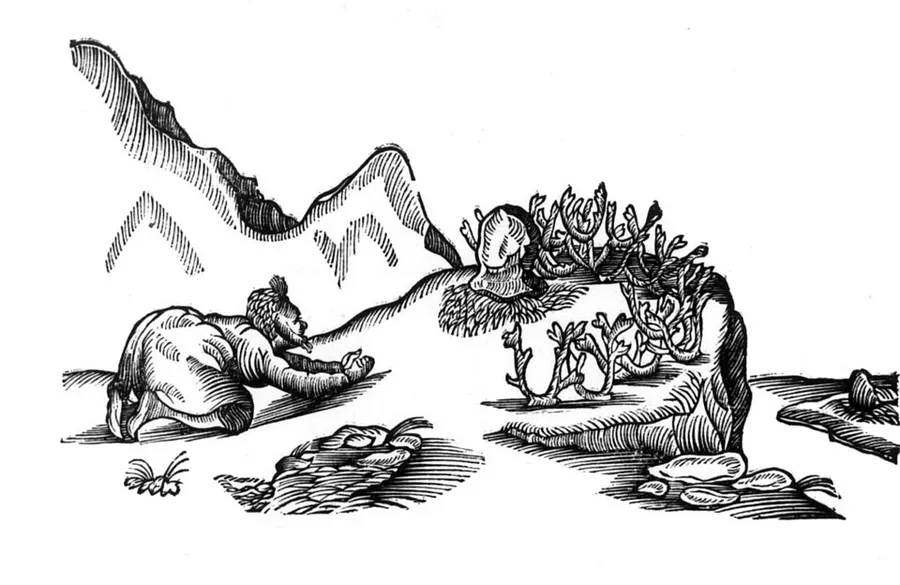 Johannes Schefferus, offering at a sieidi, from Lapponia (1673), via Norsk Folkemuseum / Wikimedia Commons A worshipper prostrate before the sacred stones in a 1673 engraving from Schefferus's Lapponia — an outsider's early record of the offerings that accumulate at a sieidi over generations, a community's running ledger with one particular place. A Sámi sacred place — a specific stone, spring, rock formation, or
natural feature where offerings are left and a continuing relationship
with the land is kept up. Sieidis dot the Sámi landscape across
Sápmi; the offerings (small carved figures, antlers, coins, food,
metal objects) accumulate over generations as a record of the
community's relationship with that particular place. Like the
goavddis drums, the sieidis were targets of Lutheran missionary
destruction in the seventeenth and eighteenth centuries; some
survive in archaeological context, others remain ritually active.
Also discussed in Before There Was Norway — petty kingdoms at the edge of the world , sacred sites where offerings were left and a relationship with the powers of the natural world was kept up. The Sámi religious world was a negotiation with the living landscape, conducted at specific holy places, across the whole of Sápmi.
Johannes Schefferus, offering at a sieidi, from Lapponia (1673), via Norsk Folkemuseum / Wikimedia Commons A worshipper prostrate before the sacred stones in a 1673 engraving from Schefferus's Lapponia — an outsider's early record of the offerings that accumulate at a sieidi over generations, a community's running ledger with one particular place. A Sámi sacred place — a specific stone, spring, rock formation, or
natural feature where offerings are left and a continuing relationship
with the land is kept up. Sieidis dot the Sámi landscape across
Sápmi; the offerings (small carved figures, antlers, coins, food,
metal objects) accumulate over generations as a record of the
community's relationship with that particular place. Like the
goavddis drums, the sieidis were targets of Lutheran missionary
destruction in the seventeenth and eighteenth centuries; some
survive in archaeological context, others remain ritually active.
Also discussed in Before There Was Norway — petty kingdoms at the edge of the world , sacred sites where offerings were left and a relationship with the powers of the natural world was kept up. The Sámi religious world was a negotiation with the living landscape, conducted at specific holy places, across the whole of Sápmi.
At the center of Sámi religious practice stood the Noaidi 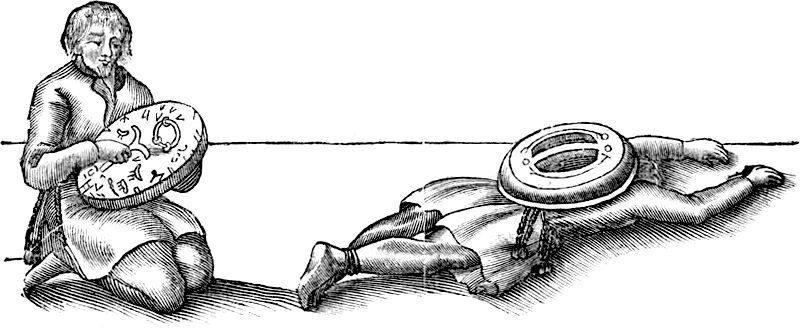 Johannes Schefferus, Lapponia (1673), engraving of a noaidi with drum A 1673 engraving from Schefferus's Lapponia — a Sámi noaidi lying in trance with his painted drum, a companion kneeling nearby — one of the few old depictions of the shaman-officiant whose drums Lutheran missionaries later burned. The Sámi ritual specialist — shaman, in the comparative-religion
vocabulary that Western anthropology applied to similar figures
across Eurasia. The noaidi was the religious officiant of the
pre-Christian Sámi community, responsible for divination, healing,
and communication with the spirits of the land and the dead. The
noaidi's principal instrument was the goavddis, the painted drum
whose surface diagrammed an entire spiritual cosmology. The
practice was systematically persecuted by Norwegian and Swedish
Lutheran missionaries through the seventeenth and eighteenth
centuries; many drums were burned, the recorded knowledge lost.
The tradition survives in fragments in modern Sámi cultural and
religious revival.
Also discussed in Before There Was Norway — petty kingdoms at the edge of the worldThe Reformation, 1537 — one church eradicated and another imposed — the ritual specialist, healer, and seer — and the noaidi’s central instrument was the drum. The Sámi drum, the Goavddis
Johannes Schefferus, Lapponia (1673), engraving of a noaidi with drum A 1673 engraving from Schefferus's Lapponia — a Sámi noaidi lying in trance with his painted drum, a companion kneeling nearby — one of the few old depictions of the shaman-officiant whose drums Lutheran missionaries later burned. The Sámi ritual specialist — shaman, in the comparative-religion
vocabulary that Western anthropology applied to similar figures
across Eurasia. The noaidi was the religious officiant of the
pre-Christian Sámi community, responsible for divination, healing,
and communication with the spirits of the land and the dead. The
noaidi's principal instrument was the goavddis, the painted drum
whose surface diagrammed an entire spiritual cosmology. The
practice was systematically persecuted by Norwegian and Swedish
Lutheran missionaries through the seventeenth and eighteenth
centuries; many drums were burned, the recorded knowledge lost.
The tradition survives in fragments in modern Sámi cultural and
religious revival.
Also discussed in Before There Was Norway — petty kingdoms at the edge of the worldThe Reformation, 1537 — one church eradicated and another imposed — the ritual specialist, healer, and seer — and the noaidi’s central instrument was the drum. The Sámi drum, the Goavddis 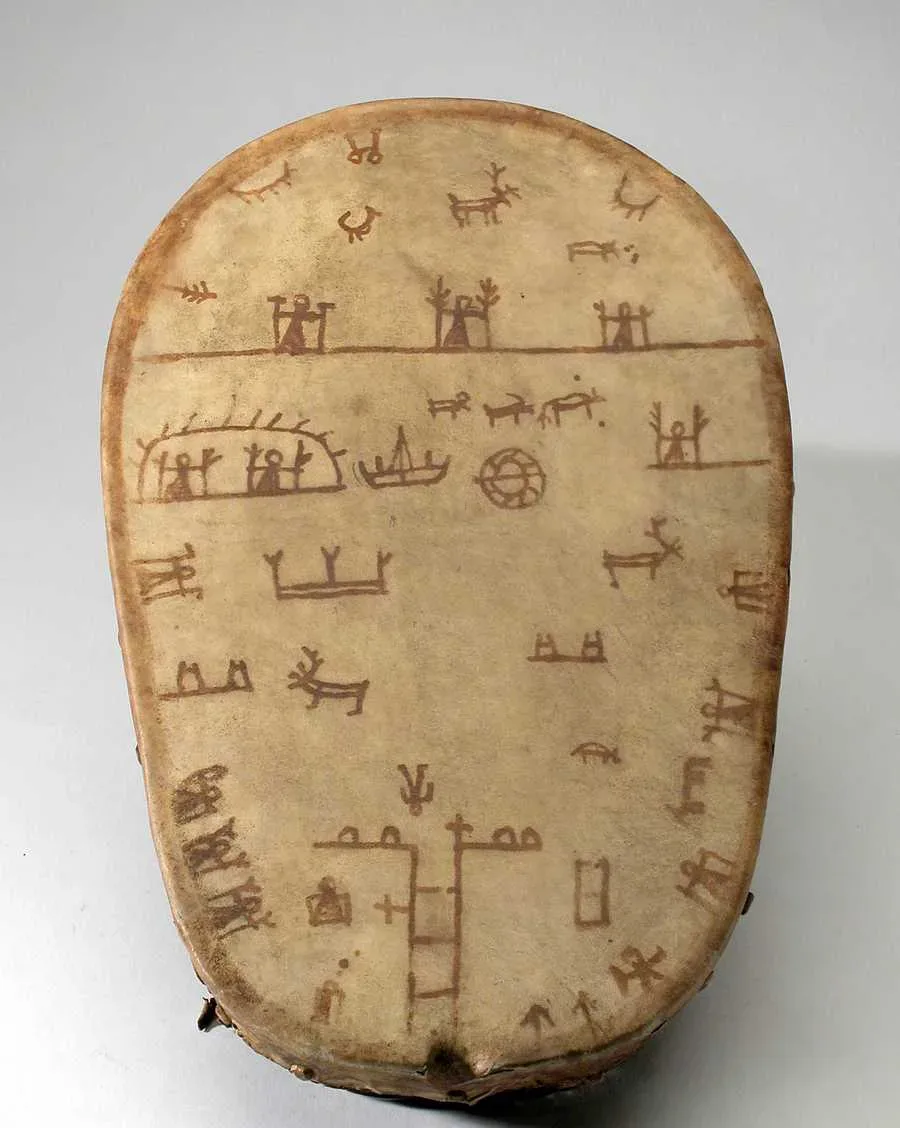 Sámi bowl drum from Lule Lappmark (NM.0228846), photo Nordiska museet via DigitaltMuseum, CC BY-SA 3.0 The painted head seen from above — registers of gods, reindeer, boats, and the world tree across the hide. The noaidi struck the drum and read where the pointer drifted among the figures: a map consulted, not an instrument played. The Sámi ritual drum (the noaidi's drum), Sámi goavddis (the
Northern Sámi term; meavrresgárri in some other Sámi languages).
An oval or bowl-shaped wooden frame stretched with reindeer hide
and painted with figures from the Sámi cosmology — gods, animals,
landscapes, the world tree — that diagrammed the spiritual world.
The noaidi struck the drum and read the movements of a brass or
bone pointer across the painted surface as divination. The drums
were systematically confiscated and burned during the seventeenth-
and eighteenth-century Lutheran missions to Sápmi; only about
seventy historical drums survive worldwide.
Also discussed in Before There Was Norway — petty kingdoms at the edge of the world , was an extraordinary object: a frame or bowl of wood headed with stretched reindeer hide, and the hide painted, in red, with a cosmological map — the upper world, the middle world, the world of the dead — and the figures that moved among them, the sun, the gods, the reindeer, the ancestors. The noaidi drummed to enter trance, and in trance traveled between the layers of that painted world — to heal, to find what was lost, to see what was distant. The drum was never mere decoration, and no one played it for music. It was the working instrument of an entire religion — the map by which the noaidi navigated the world it painted.
Sámi bowl drum from Lule Lappmark (NM.0228846), photo Nordiska museet via DigitaltMuseum, CC BY-SA 3.0 The painted head seen from above — registers of gods, reindeer, boats, and the world tree across the hide. The noaidi struck the drum and read where the pointer drifted among the figures: a map consulted, not an instrument played. The Sámi ritual drum (the noaidi's drum), Sámi goavddis (the
Northern Sámi term; meavrresgárri in some other Sámi languages).
An oval or bowl-shaped wooden frame stretched with reindeer hide
and painted with figures from the Sámi cosmology — gods, animals,
landscapes, the world tree — that diagrammed the spiritual world.
The noaidi struck the drum and read the movements of a brass or
bone pointer across the painted surface as divination. The drums
were systematically confiscated and burned during the seventeenth-
and eighteenth-century Lutheran missions to Sápmi; only about
seventy historical drums survive worldwide.
Also discussed in Before There Was Norway — petty kingdoms at the edge of the world , was an extraordinary object: a frame or bowl of wood headed with stretched reindeer hide, and the hide painted, in red, with a cosmological map — the upper world, the middle world, the world of the dead — and the figures that moved among them, the sun, the gods, the reindeer, the ancestors. The noaidi drummed to enter trance, and in trance traveled between the layers of that painted world — to heal, to find what was lost, to see what was distant. The drum was never mere decoration, and no one played it for music. It was the working instrument of an entire religion — the map by which the noaidi navigated the world it painted.
To burn a Sámi drum was not to confiscate a curio. It was to burn a sacred text.
The mission
The Christianization of the Sámi came late, and it came as state policy. Norway’s south had been Christian for centuries while Sámi religious practice continued in the north largely undisturbed. Sápmi even had Christian missionaries as early as the Roman Catholic Middle Ages, and the Christian faith coexisted with the traditional Sámi shamanism throughout that era. In 1389 a Sámi woman named Margareta — the first named Sámi woman anywhere in the historical record — traveled south to campaign for a mission to her own people, and won a letter of support from Queen Margaret herself. Nonetheless, that changed decisively in the decades around 1700, when the Danish-Norwegian crown turned its attention — and its own missionaries — to Sápmi.
The central figure is Thomas von Westen 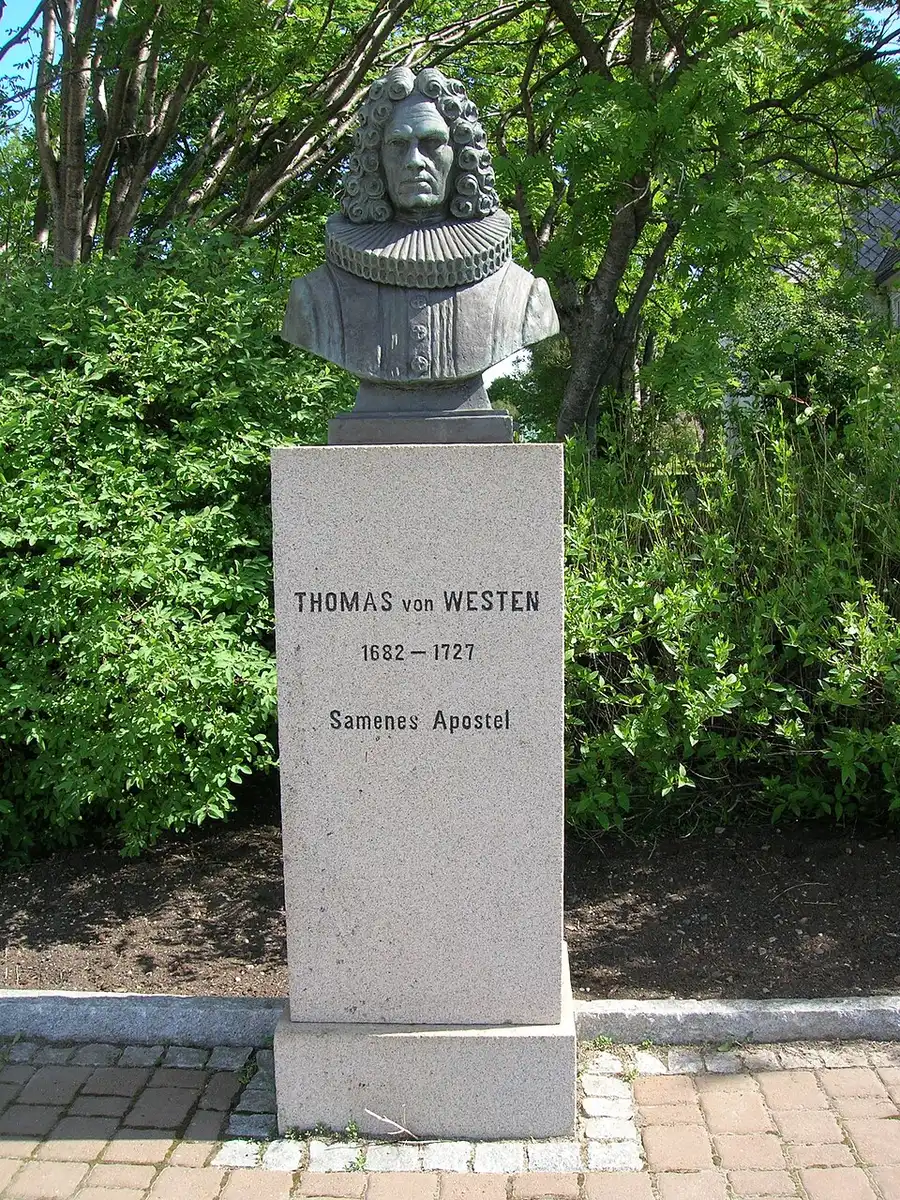 Photograph by Sandivas, Bust of Thomas von Westen, outside Mo church, Mo i Rana, CC BY-SA 3.0 The commemorative bust outside Mo church honors the priest Norwegian tradition calls the Apostle of the Sami; no contemporary portrait of Thomas von Westen survives at usable resolution, so the monument stands in for the man. Norwegian Lutheran priest and missionary (1682–1727).
Appointed in 1716 by King Frederik IV as head of the
Finne-missionen — the official mission to the Sami of
northern Norway. Across the next decade he conducted three
large missionary journeys through Finnmark, Troms,
Nordland, and the inland Sami districts of southern Norway,
learning Sami and ordering the confiscation and burning of
the noaidi drums and other sacred objects he encountered.
Much of the Sami material his mission collected burned in
the Copenhagen fire of 1728.
Buried in the choir of Nidaros Cathedral, under an epitaph
the Sami Mission raised in 1927. Often called the Apostle
of the Sami; in modern Sami historiography he is treated
as the principal agent of the violent Christianisation of
Sami religion.
On the trip Thomas von Westen lies buried in the choir of Nidaros Cathedral, beneath an epitaph the Norwegian Sami Mission raised in 1927, two centuries after his death — inside the cathedral the Gråhårsklubben (the Oldsters) visit on the evening of Day 3. Also discussed in The Reformation, 1537 — one church eradicated and another imposed (1682–1727), a Trondheim clergyman — buried in the choir of Nidaros Cathedral — remembered, depending on who is doing the remembering, as either the devoted “Apostle to the Sámi” or as the architect of a cultural catastrophe. He is genuinely both. From 1716 von Westen led the Sámi mission, traveling north into Finnmark
Photograph by Sandivas, Bust of Thomas von Westen, outside Mo church, Mo i Rana, CC BY-SA 3.0 The commemorative bust outside Mo church honors the priest Norwegian tradition calls the Apostle of the Sami; no contemporary portrait of Thomas von Westen survives at usable resolution, so the monument stands in for the man. Norwegian Lutheran priest and missionary (1682–1727).
Appointed in 1716 by King Frederik IV as head of the
Finne-missionen — the official mission to the Sami of
northern Norway. Across the next decade he conducted three
large missionary journeys through Finnmark, Troms,
Nordland, and the inland Sami districts of southern Norway,
learning Sami and ordering the confiscation and burning of
the noaidi drums and other sacred objects he encountered.
Much of the Sami material his mission collected burned in
the Copenhagen fire of 1728.
Buried in the choir of Nidaros Cathedral, under an epitaph
the Sami Mission raised in 1927. Often called the Apostle
of the Sami; in modern Sami historiography he is treated
as the principal agent of the violent Christianisation of
Sami religion.
On the trip Thomas von Westen lies buried in the choir of Nidaros Cathedral, beneath an epitaph the Norwegian Sami Mission raised in 1927, two centuries after his death — inside the cathedral the Gråhårsklubben (the Oldsters) visit on the evening of Day 3. Also discussed in The Reformation, 1537 — one church eradicated and another imposed (1682–1727), a Trondheim clergyman — buried in the choir of Nidaros Cathedral — remembered, depending on who is doing the remembering, as either the devoted “Apostle to the Sámi” or as the architect of a cultural catastrophe. He is genuinely both. From 1716 von Westen led the Sámi mission, traveling north into Finnmark 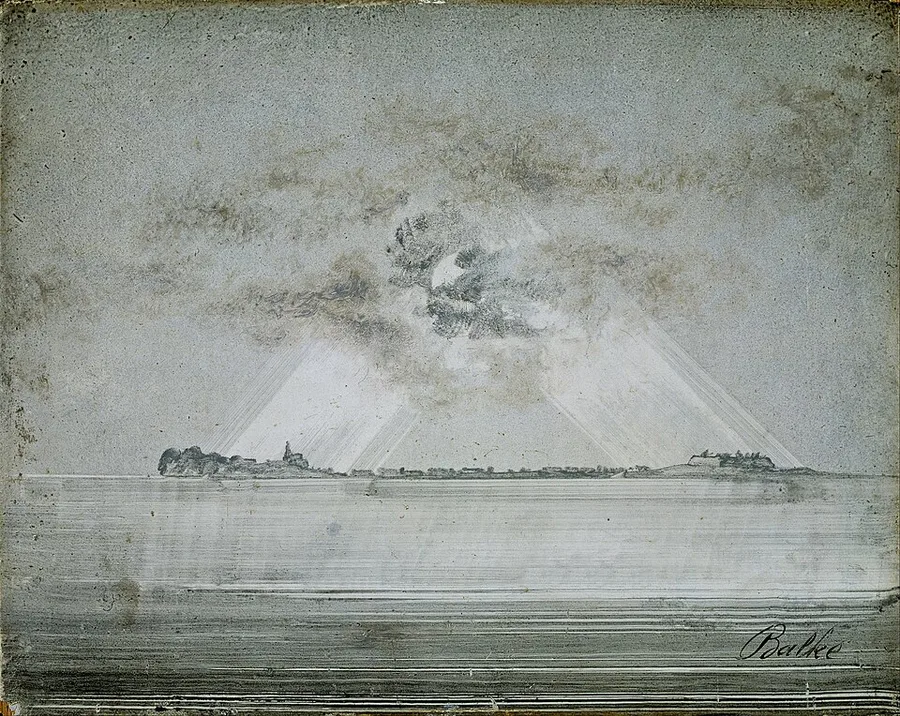 Peder Balke, Vardøhus festning (ca. 1870), Nasjonalmuseet Balke's Vardø, painted from the memory of his 1832 voyage along this coast: the far-northern island town whose court ran the fiercest of the Finnmark witch trials — 91 people executed for sorcery between 1601 and 1692, Sámi among them. Northernmost and easternmost county of Norway, on the
Barents Sea coast. About 48,000 square kilometres — the
largest Norwegian county by area, the smallest by
population at about 75,000. The traditional Sami
heartland — and the scene of Norway's fiercest witch
trials: 91 people were executed for sorcery between 1601
and 1692, centred on Vardø and Vadsø, most of them
Norwegian women, about eighteen of them Sámi. In the
autumn of 1944 the retreating German Twentieth Mountain
Army burned villages, fishing harbours, and farms across
Finnmark and northern Troms to deny the advancing Soviet
army shelter; roughly fifty thousand people were forcibly
evacuated south. The uniform concrete-and-prefab
architecture of the rebuilt towns is the visible trace of
that destruction.
Also discussed in World War II — the King’s “No” and the Nazis in Norway , and by the standards of his moment he was unusually serious about it — he worked to learn the language, pressed for catechisms and schooling in Sámi rather than only in Danish. He also drove the campaign that confiscated and burned Sámi drums by the hundred, identified and destroyed sieidi sites, and ran a state-backed system that paid Sámi informers to reveal where the old religion was still practiced. The sincerity and the destruction were not in tension in his own mind. They were the same project.
Peder Balke, Vardøhus festning (ca. 1870), Nasjonalmuseet Balke's Vardø, painted from the memory of his 1832 voyage along this coast: the far-northern island town whose court ran the fiercest of the Finnmark witch trials — 91 people executed for sorcery between 1601 and 1692, Sámi among them. Northernmost and easternmost county of Norway, on the
Barents Sea coast. About 48,000 square kilometres — the
largest Norwegian county by area, the smallest by
population at about 75,000. The traditional Sami
heartland — and the scene of Norway's fiercest witch
trials: 91 people were executed for sorcery between 1601
and 1692, centred on Vardø and Vadsø, most of them
Norwegian women, about eighteen of them Sámi. In the
autumn of 1944 the retreating German Twentieth Mountain
Army burned villages, fishing harbours, and farms across
Finnmark and northern Troms to deny the advancing Soviet
army shelter; roughly fifty thousand people were forcibly
evacuated south. The uniform concrete-and-prefab
architecture of the rebuilt towns is the visible trace of
that destruction.
Also discussed in World War II — the King’s “No” and the Nazis in Norway , and by the standards of his moment he was unusually serious about it — he worked to learn the language, pressed for catechisms and schooling in Sámi rather than only in Danish. He also drove the campaign that confiscated and burned Sámi drums by the hundred, identified and destroyed sieidi sites, and ran a state-backed system that paid Sámi informers to reveal where the old religion was still practiced. The sincerity and the destruction were not in tension in his own mind. They were the same project.
The harder edge of the encounter shows in the courts. In the same broad period, Sámi religious specialists were caught up in the witch trials that the early-modern Danish-Norwegian state ran with particular ferocity in the far north — the Finnmark trials, which sent ninety-one people to the stake or the block between 1601 and 1692, most of them Norwegian women, about eighteen of them Sámi. The clearest single case is the noaidi Anders Poulsen, brought before the court at Vadsø in 1692 and accused of witchcraft. At his trial he did something remarkable: he produced his drum and explained, plainly, what it was for — easing the pain of women in childbirth, finding stolen goods, driving off harm. He never heard a verdict. Before the court finished, he was killed in custody — struck down with an axe by a man who had lost his senses. His drum was shipped to Copenhagen, into a royal collection. It came back to Sápmi on loan in 1979, and Denmark did not hand over ownership until 2022 — three hundred and thirty years after the trial.
Norwegianization
The eighteenth-century mission attacked the religion. The policy that followed, across roughly a century from the mid-1800s into the 1960s, attacked the whole culture, and it had a name: fornorsking — Norwegianization. It was deliberate, official, and sustained. The Sámi language was banned as a language of instruction in schools and, in places, banned in the schoolyard. Sámi children were placed in Norwegian-language boarding schools, away from their families and their language. Sámi land rights were eroded, traditional dress and the joik — the Sámi song-form — discouraged, Sámi names pressed toward Norwegian forms. The goal, stated without much disguise, was to dissolve the Sámi into the Norwegian majority — to make the difference disappear within a generation or two.
It did not entirely work, but it did enormous damage, and the damage is not safely in the past. There are Sámi alive now who were punished as children for speaking their own language, families in which the language skipped a generation because a parent judged it safer not to pass it on. A culture can survive a policy like that, and Sámi culture did, but it did not survive it unmarked.
Through all of it, Christianity among the Sámi took its own particular shape. The dominant form became Læstadianism, the revival movement founded by the Swedish-Sámi Lutheran pastor Lars Levi Læstadius in the mid-nineteenth century — austere, intensely emotional, lay-led, and deeply woven into Sámi community life. Læstadian Christianity is not the old drum religion, and it is not quite the Norwegian state church that produced it. It is something the Sámi made their own.
The recovery
The turn came late in the twentieth century, and it is still underway. From the 1980s onward, Sámi language rights were restored in law and in schooling. In 1989 Norway opened the Sametinget (Sámi Parliament) 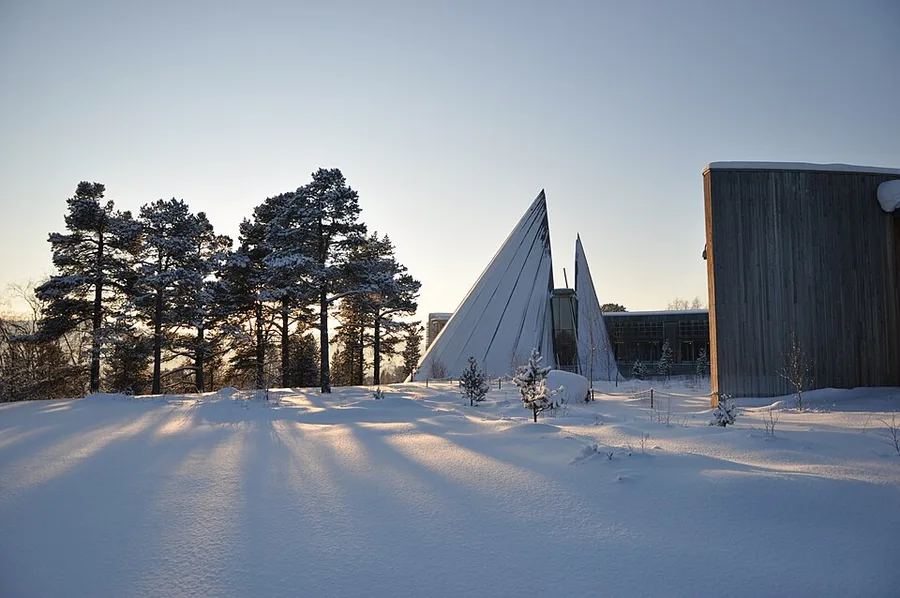 HanneHolmgren, Sametinget i Karasjok, CC BY-SA 3.0, via Wikimedia Commons The Sametinget plenary assembly hall in Karasjok — the distinctive curved timber-and-glass building housing the elected Sámi Parliament the card describes. Norway's elected representative body for Sámi affairs, known in Norwegian as Sametinget and in North Sámi as Sámediggi. Its first session opened on 9 October 1989, opened by King Olav V, at Karasjok (Kárášjohka) in Finnmark — the outcome of a process the Alta conflict of the 1970s–80s (opposition to damming the Alta and Kautokeino watercourses) forced onto the Norwegian state. Thirty-nine representatives are elected from seven constituencies to serve four-year terms. The Sámediggi administers Sámi language, education, and cultural funding and is consulted on land and resource questions affecting Sámi interests, but it operates within the Norwegian constitutional order rather than as a sovereign legislature — a formal instrument of Sámi self-governance, not independence. Karasjok / Kárášjohka Also discussed in Politikk — the left, the right, and the Norwegian way — the Sámi Parliament — giving the Sámi a formal elected body of their own within the Norwegian state. The Norwegian state has issued apologies for the Norwegianization policy, and in 2023 a national Truth and Reconciliation Commission delivered a long report documenting, officially and in detail, what was done to the Sámi and to the Kven and Forest Finn minorities. In November 2024 the Storting stood and delivered a formal apology from the parliament’s own floor. The recovery is contested ground even now: in 2021 the Supreme Court ruled that wind farms built on the Fosen peninsula violated Sámi herders’ rights, and it took protests in Oslo and a government apology before settlements were reached in 2023 and 2024.
The cultural recovery has been the more moving half of it. The joik — suppressed for generations in the schools — is now central to Sámi identity and Sámi art. Drum-makers have taken up the craft again, in some cases relearning it from the confiscated drums sitting in Scandinavian and German museums, studying their own sacred objects through museum glass to rebuild what the mission burned. The old religion is likely not coming back as it was; too much was lost, and the world it belonged to is gone, but it is being reclaimed as inheritance, openly and with pride, by people who were taught for a century to be ashamed of it.
The country within the country
The trip route does not reach Sápmi — no Tromsø, no Karasjok, no Kautokeino. The southern and central Norway most heritage travelers visit is a true picture of Norway but not the whole one. Norway is not now and never was a single people on a single land with a single faith. Underneath and to the north of the country in the photographs is an older country, with a people who were here first, who were nearly erased by the state, and who are still here — governing themselves through the Sámediggi, singing the joik, painting the drums again.