Politikk — The left, the right, and the Norwegian way
A constitutional monarchy with an unusually trusted government, a sovereign wealth fund holding roughly $400,000 per citizen, and a consensus model under more strain than at any point since the 1990s.
The shape of the state
Norway is a constitutional monarchy. The king — Harald V 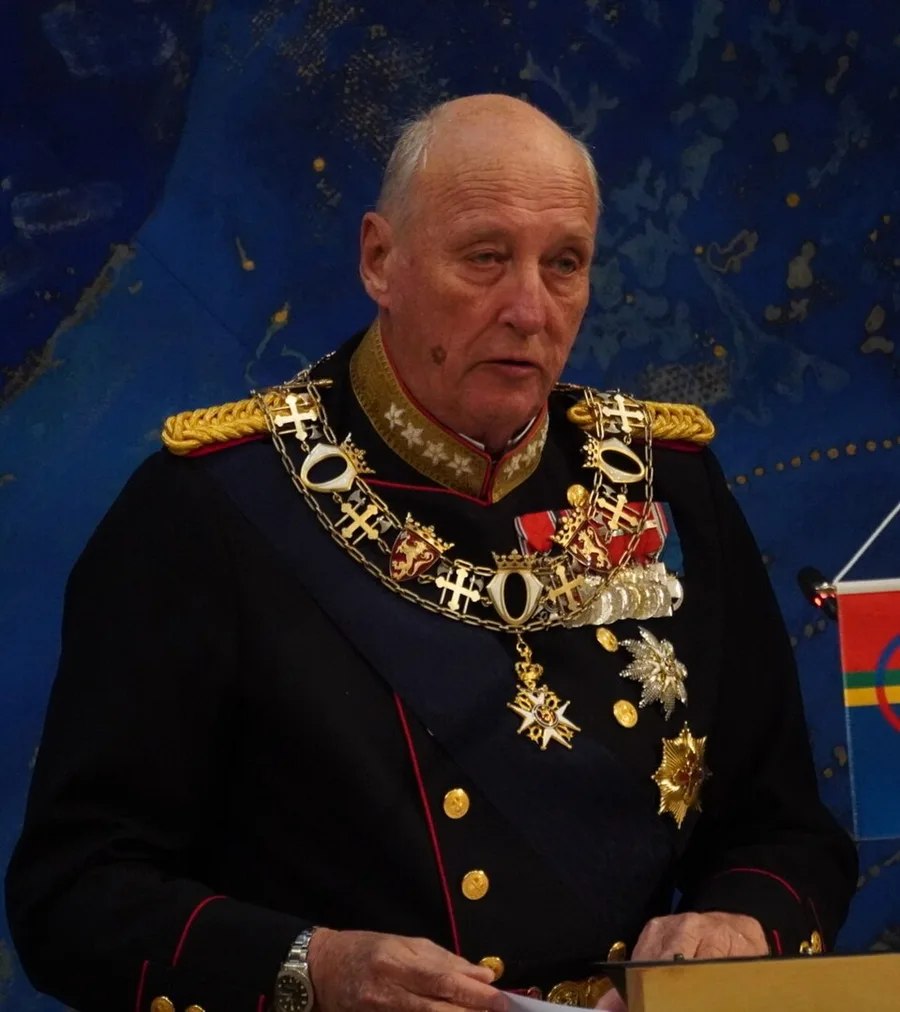 Vaino Rensberg/Sametinget (2021), CC BY 2.0 Harald V reading at a lectern inside the Sámediggi's plenary hall in 2021, the Sámi flag at his shoulder — the ceremonial head of state opening a session of the elected Sámi parliament. King of Norway since 1991, born 1937, son of Olav V and grandson
of Haakon VII. Acceded on his father's death; consecrated at
Nidaros Cathedral on 23 June 1991 — the first Norwegian monarch
consecrated under the post-1908 rite, in which the 1818 crown is
borne into the cathedral and displayed but not placed on the king's
head. Married to Sonja Haraldsen (Queen Sonja) since 1968. Has
reigned through the country's transformation into the wealthiest
small democracy in modern history; one of the longest reigns in
Norwegian history.
Also discussed in The King Who Became a Saint — how the Nordmen came to Christ , on the throne since 1991 — is head of state, a ceremonial figure with no real political power and a great deal of quiet public affection. Actual governing is done by the Storting, Storting
Vaino Rensberg/Sametinget (2021), CC BY 2.0 Harald V reading at a lectern inside the Sámediggi's plenary hall in 2021, the Sámi flag at his shoulder — the ceremonial head of state opening a session of the elected Sámi parliament. King of Norway since 1991, born 1937, son of Olav V and grandson
of Haakon VII. Acceded on his father's death; consecrated at
Nidaros Cathedral on 23 June 1991 — the first Norwegian monarch
consecrated under the post-1908 rite, in which the 1818 crown is
borne into the cathedral and displayed but not placed on the king's
head. Married to Sonja Haraldsen (Queen Sonja) since 1968. Has
reigned through the country's transformation into the wealthiest
small democracy in modern history; one of the longest reigns in
Norwegian history.
Also discussed in The King Who Became a Saint — how the Nordmen came to Christ , on the throne since 1991 — is head of state, a ceremonial figure with no real political power and a great deal of quiet public affection. Actual governing is done by the Storting, Storting 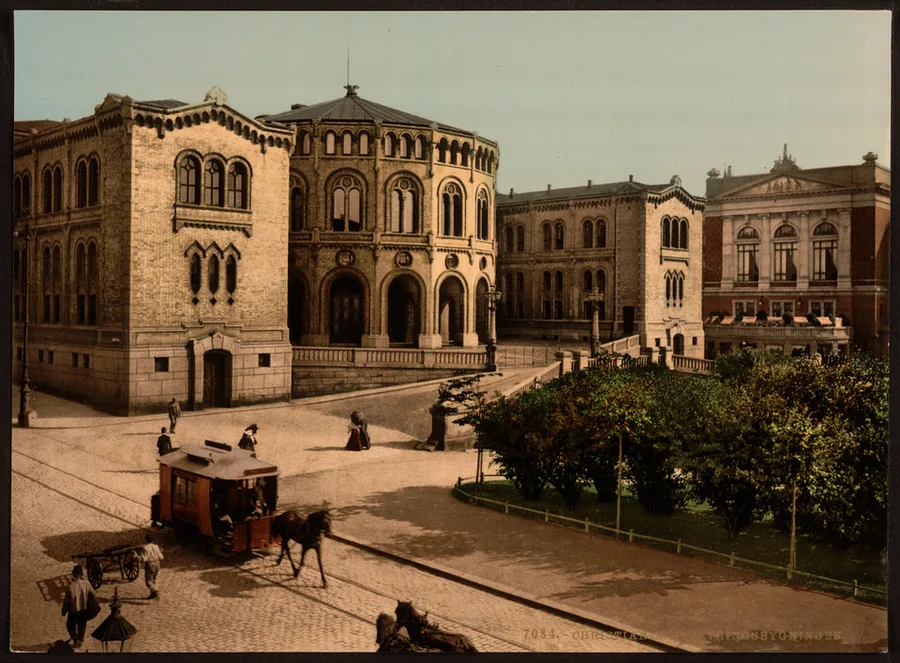 Detroit Publishing Company, Storthings Bygningen, Christiania, Norway (c. 1890-1900), Library of Congress / World Digital Library The Storting building in Kristiania (Oslo), Norway's parliament since the 1814 Constitution and the seat of the legislature that still governs the country. The Grand Assembly — the parliament of independent
Norway, established by the Eidsvoll Constitution of 17 May
1814 as the country's sovereign legislature. The name
Storting (Stór-Þing, the great assembly) deliberately
reaches back to the medieval Norwegian thing tradition,
asserting institutional continuity with the pre-Danish
Norwegian state. Under the 1814 constitution the Storting
divided into two chambers — Lagting and Odelsting —
for legislative purposes; the two-chamber arrangement was
abolished in 2009 and the Storting has been a single
chamber since. The current building, in central Oslo,
opened in 1866.
Also discussed in The 400-Year Night — when the Northern Lion lay dormantLutheran Norway and Pietism — a farmer named Hans Nielsen Hauge and a lay revival that could not be silencedThe Constitution That Saved a Nation — five radical weeks at Eidsvoll, 1814The Quiet Revolution — how Norway won its independence without a warThe 'Lucky Country' — the discovery that changed everythingWorld War II — the King’s “No” and the Nazis in NorwayAllemannsretten — the right to roam , and by a government drawn from it. The 1814 constitution that frames it is the second-oldest still in force anywhere in the world, signed at Eidsvoll
Detroit Publishing Company, Storthings Bygningen, Christiania, Norway (c. 1890-1900), Library of Congress / World Digital Library The Storting building in Kristiania (Oslo), Norway's parliament since the 1814 Constitution and the seat of the legislature that still governs the country. The Grand Assembly — the parliament of independent
Norway, established by the Eidsvoll Constitution of 17 May
1814 as the country's sovereign legislature. The name
Storting (Stór-Þing, the great assembly) deliberately
reaches back to the medieval Norwegian thing tradition,
asserting institutional continuity with the pre-Danish
Norwegian state. Under the 1814 constitution the Storting
divided into two chambers — Lagting and Odelsting —
for legislative purposes; the two-chamber arrangement was
abolished in 2009 and the Storting has been a single
chamber since. The current building, in central Oslo,
opened in 1866.
Also discussed in The 400-Year Night — when the Northern Lion lay dormantLutheran Norway and Pietism — a farmer named Hans Nielsen Hauge and a lay revival that could not be silencedThe Constitution That Saved a Nation — five radical weeks at Eidsvoll, 1814The Quiet Revolution — how Norway won its independence without a warThe 'Lucky Country' — the discovery that changed everythingWorld War II — the King’s “No” and the Nazis in NorwayAllemannsretten — the right to roam , and by a government drawn from it. The 1814 constitution that frames it is the second-oldest still in force anywhere in the world, signed at Eidsvoll 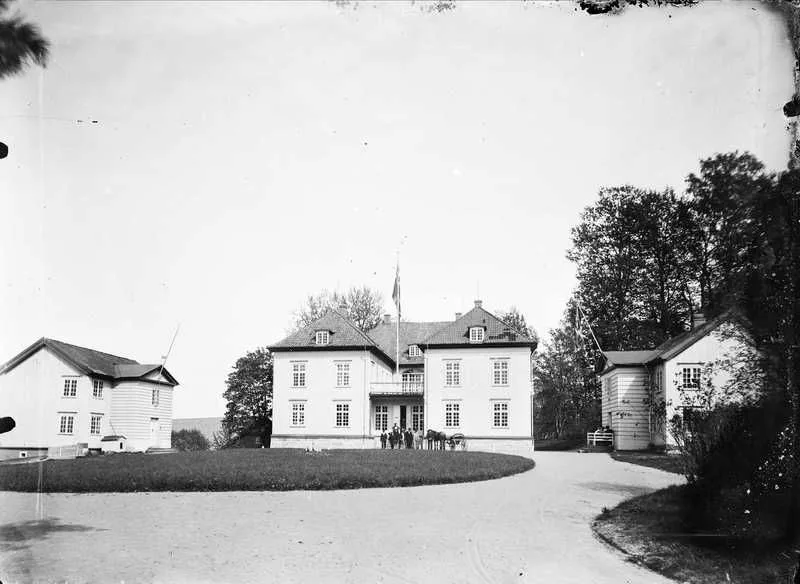 Unknown photographer, Eidsvollsbygningen (c. 1890), Oslo Museum, CC BY-SA 4.0 The white manor house at Eidsvoll where 112 delegates drafted and signed Norway's Constitution in 1814 — the building the whole constitutional story turns on. Municipality in Akershus county in southeastern Norway,
about seventy kilometres north of Oslo. Site of the
constitutional assembly that drafted and ratified the
Norwegian Constitution between 10 April and 20 May 1814.
The 112 delegates met at Eidsvollsbygningen, the country
house of the wealthy merchant and ironworks owner Carsten
Anker, who had offered the use of his estate at his own
expense. They signed the Constitution on 17 May 1814 —
Syttende mai, Norway's national day ever since — and
elected Prince Christian Frederik as king the same day.
The house is preserved as a national museum. Modern
Eidsvoll is also a stop on the main railway line north
from Oslo and the site of the country's principal
international airport (Oslo Gardermoen) ten kilometres south.
Also discussed in The 400-Year Night — when the Northern Lion lay dormantLutheran Norway and Pietism — a farmer named Hans Nielsen Hauge and a lay revival that could not be silencedThe Constitution That Saved a Nation — five radical weeks at Eidsvoll, 1814The Quiet Revolution — how Norway won its independence without a warTradisjoner — celebrations across the Norwegian year in the brief independence window between Danish rule and the union with Sweden. The framework is old and settled; nobody campaigns against it.
Unknown photographer, Eidsvollsbygningen (c. 1890), Oslo Museum, CC BY-SA 4.0 The white manor house at Eidsvoll where 112 delegates drafted and signed Norway's Constitution in 1814 — the building the whole constitutional story turns on. Municipality in Akershus county in southeastern Norway,
about seventy kilometres north of Oslo. Site of the
constitutional assembly that drafted and ratified the
Norwegian Constitution between 10 April and 20 May 1814.
The 112 delegates met at Eidsvollsbygningen, the country
house of the wealthy merchant and ironworks owner Carsten
Anker, who had offered the use of his estate at his own
expense. They signed the Constitution on 17 May 1814 —
Syttende mai, Norway's national day ever since — and
elected Prince Christian Frederik as king the same day.
The house is preserved as a national museum. Modern
Eidsvoll is also a stop on the main railway line north
from Oslo and the site of the country's principal
international airport (Oslo Gardermoen) ten kilometres south.
Also discussed in The 400-Year Night — when the Northern Lion lay dormantLutheran Norway and Pietism — a farmer named Hans Nielsen Hauge and a lay revival that could not be silencedThe Constitution That Saved a Nation — five radical weeks at Eidsvoll, 1814The Quiet Revolution — how Norway won its independence without a warTradisjoner — celebrations across the Norwegian year in the brief independence window between Danish rule and the union with Sweden. The framework is old and settled; nobody campaigns against it.
A politics of coalitions
No single party wins a majority in Norway, and none expects to. Government is built by coalition and by negotiation, and power passes between center-left and center-right blocs without the transfer feeling like a rupture. The baseline almost everyone governs from is a social-democratic one — a large velferdsstat (welfare state), universal health care and education, high taxes accepted as the price of all of it — and the real argument is over adjustments at the margins, not over the model itself.
Arbeiderpartiet (Labour) and Høyre (the Conservatives) anchor the two blocs. Around them: the Centre Party (rural), the Progress Party (populist right), the Socialist Left, the Liberals, the Christian Democrats, the Greens, and Rødt (to Labour’s left). The list looks crowded; coalition arithmetic clusters them into two workable groupings.
The current moment is less placid than the model suggests. Jonas Gahr Støre’s Labour-led coalition lost Senterpartiet — the Centre Party — in January 2025 over an EU energy directive; Labour comes out of the September 2025 election as clearly the largest party but governs alone, as a minority, leaning on the left bloc for confidence. Fremskrittspartiet, the Progress Party, doubled its vote share and is now the second-largest party. The consensus model is under more strain than at any time since the 1990s — the arguments about immigration, electricity prices, and centralization have sharpened, and the parties at the edges of both blocs have grown.
The labor-and-government bargain
The spine of Norwegian social democracy is older than the welfare state and broader than any party. The 1899 founding of LO (Landsorganisasjonen, the Trade Union Federation) and the 1900 founding of NHO’s predecessor on the employers’ side produced a century-long trepartssamarbeid — the three-party cooperation among unions, employers, and government that negotiates wages, pension rules, and working conditions in roughly two-year cycles. Arbeiderpartiet and LO grew up together. The coordinated wage-setting and the famously compressed wage scale — the best-paid tenth of Norwegian workers earn about two and a half times what the lowest-paid tenth do, the narrowest gap in any major economy; the American multiple is roughly five — come from this bargain, not from any single law.
The fund
Norway’s offshore oil and gas revenue does not go into the annual budget. It goes into the Statens pensjonsfond utland, the Government Pension Fund Global 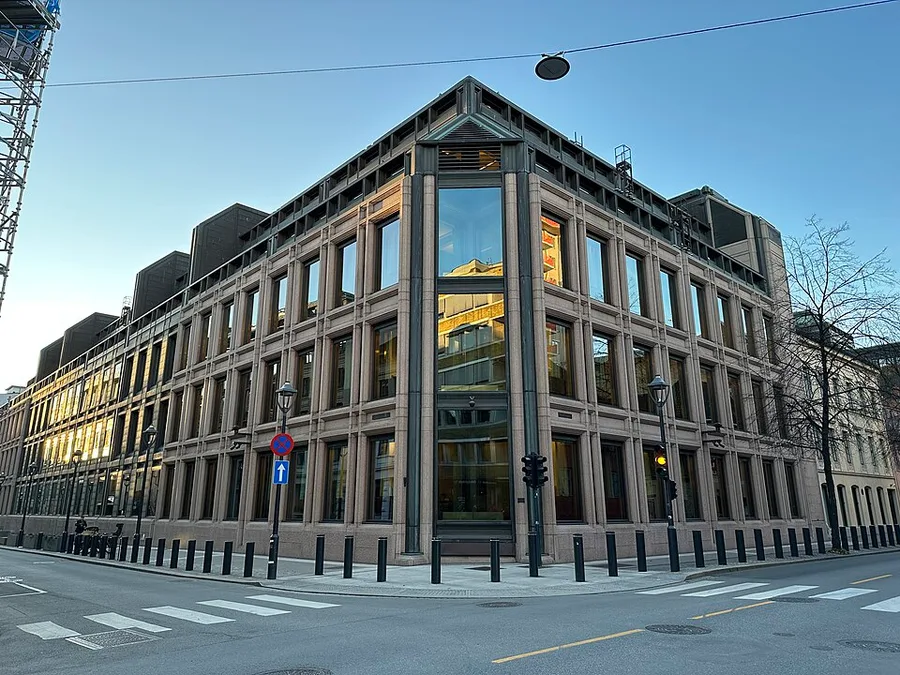 Ssu, Norges Bank, Bankplassen 2, Oslo (2024), CC BY-SA 4.0, Wikimedia Commons The Norges Bank headquarters on Bankplassen in Oslo — the building where Norges Bank Investment Management runs the fund's roughly two-trillion-dollar portfolio of global equity, fixed income, and real estate. Statens pensjonsfond utland — the Norwegian state
sovereign wealth fund into which petroleum revenues are
sequestered. Established by Storting act of 22 June 1990 as
Statens petroleumsfond (the State Petroleum Fund); first
capital injection in 1996; renamed in 2006. The mandate is
to invest the petroleum revenues abroad in diversified
global equity, fixed income, and real estate, with the
fiscal rule limiting annual draws to the fund's expected
long-term real return of about three per cent of its value.
By 2026 the fund holds more than two trillion dollars in
assets, owns approximately 1.5 per cent of the world's
listed-company equity, and is the largest sovereign wealth
fund in human history. Managed by Norges Bank Investment
Management (NBIM).
Also discussed in The 'Lucky Country' — the discovery that changed everything — the largest sovereign wealth fund on earth, invested entirely abroad in global stocks, bonds, and property. As of 2026 it holds over NOK 22 trillion — more than $2.2 trillion — or roughly $400,000 per Norwegian alive. The handlingsregelen — the spending rule lowered from 4% to 3% of the fund’s expected real return in 2017 — limits how much of those returns the government may spend in any year. The principal is preserved for the Norwegians who come after.
Ssu, Norges Bank, Bankplassen 2, Oslo (2024), CC BY-SA 4.0, Wikimedia Commons The Norges Bank headquarters on Bankplassen in Oslo — the building where Norges Bank Investment Management runs the fund's roughly two-trillion-dollar portfolio of global equity, fixed income, and real estate. Statens pensjonsfond utland — the Norwegian state
sovereign wealth fund into which petroleum revenues are
sequestered. Established by Storting act of 22 June 1990 as
Statens petroleumsfond (the State Petroleum Fund); first
capital injection in 1996; renamed in 2006. The mandate is
to invest the petroleum revenues abroad in diversified
global equity, fixed income, and real estate, with the
fiscal rule limiting annual draws to the fund's expected
long-term real return of about three per cent of its value.
By 2026 the fund holds more than two trillion dollars in
assets, owns approximately 1.5 per cent of the world's
listed-company equity, and is the largest sovereign wealth
fund in human history. Managed by Norges Bank Investment
Management (NBIM).
Also discussed in The 'Lucky Country' — the discovery that changed everything — the largest sovereign wealth fund on earth, invested entirely abroad in global stocks, bonds, and property. As of 2026 it holds over NOK 22 trillion — more than $2.2 trillion — or roughly $400,000 per Norwegian alive. The handlingsregelen — the spending rule lowered from 4% to 3% of the fund’s expected real return in 2017 — limits how much of those returns the government may spend in any year. The principal is preserved for the Norwegians who come after.
Most Norwegian political debate happens against a structurally secure budget. That shifts the terrain: fights turn on distribution and timing, with the country’s ability to afford something rarely in question.
Norway in the world
Norway is a founding member of NATO and one of its most reliable, sitting beside Russia along a short Arctic border that has always kept Norwegian security policy serious and unsentimental. It is not a member of the European Union; Norwegians voted no twice — by 53.5% in 1972 and a much narrower 52.2% in 1994. Instead it participates in the European single market through the EØS-avtalen, the EEA Agreement — most of the EU’s economic integration and none of its vote, an arrangement Norwegians grumble about and have repeatedly declined to change.
Within its own borders, Norway recognizes the self-governance of the The Sámi 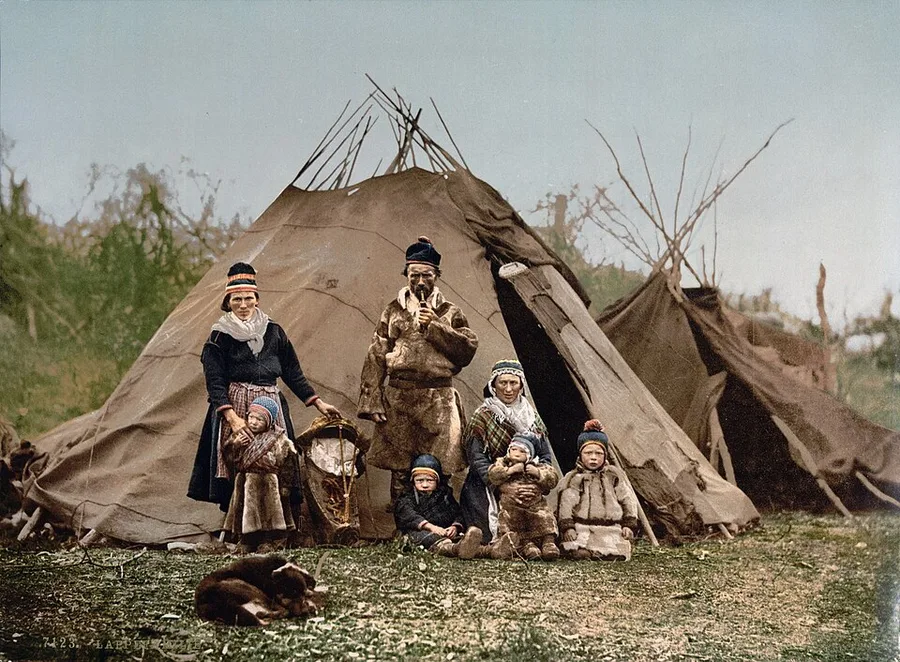 Unknown photographer, Saami Family (c. 1896, Kanstadfjord near Lødingen), Library of Congress A hand-tinted photochrom of a Sámi family in gákti dress outside their lávvu tents, around 1896. A late photograph of a very old fact: alongside and north of Norse Norway, the Sámi have always been a parallel people, with their own languages, livelihoods, and religious world. The Indigenous people of Sápmi, the cultural region across the
northern interior of present-day Norway, Sweden, Finland, and the
Russian Kola Peninsula. Sámi languages belong to the Uralic family,
unrelated to Norse. A distinctly Sámi material culture is visible
in the archaeological record from about 500 BCE. The traditional
Sámi economy ran on hunting, fishing, and trapping, with
semi-domesticated reindeer used for transport long before the
large-scale reindeer pastoralism of later centuries. Sámi religious
life centred on the noaidi (ritual specialist), the goavddis
(painted ritual drum), and the sieidi (sacred natural places).
Modern Sámi political representation runs through the Sámi
parliaments in Norway, Sweden, and Finland.
Also discussed in Samene — the other people of NorwayBefore There Was Norway — petty kingdoms at the edge of the worldWorshiping Odin and Thor — the lived religion of pre-Christian NorwayThe Reformation, 1537 — one church eradicated and another imposedWorld War II — the King’s “No” and the Nazis in Norway through the Sámediggi, the Sametinget (Sámi Parliament)
Unknown photographer, Saami Family (c. 1896, Kanstadfjord near Lødingen), Library of Congress A hand-tinted photochrom of a Sámi family in gákti dress outside their lávvu tents, around 1896. A late photograph of a very old fact: alongside and north of Norse Norway, the Sámi have always been a parallel people, with their own languages, livelihoods, and religious world. The Indigenous people of Sápmi, the cultural region across the
northern interior of present-day Norway, Sweden, Finland, and the
Russian Kola Peninsula. Sámi languages belong to the Uralic family,
unrelated to Norse. A distinctly Sámi material culture is visible
in the archaeological record from about 500 BCE. The traditional
Sámi economy ran on hunting, fishing, and trapping, with
semi-domesticated reindeer used for transport long before the
large-scale reindeer pastoralism of later centuries. Sámi religious
life centred on the noaidi (ritual specialist), the goavddis
(painted ritual drum), and the sieidi (sacred natural places).
Modern Sámi political representation runs through the Sámi
parliaments in Norway, Sweden, and Finland.
Also discussed in Samene — the other people of NorwayBefore There Was Norway — petty kingdoms at the edge of the worldWorshiping Odin and Thor — the lived religion of pre-Christian NorwayThe Reformation, 1537 — one church eradicated and another imposedWorld War II — the King’s “No” and the Nazis in Norway through the Sámediggi, the Sametinget (Sámi Parliament) 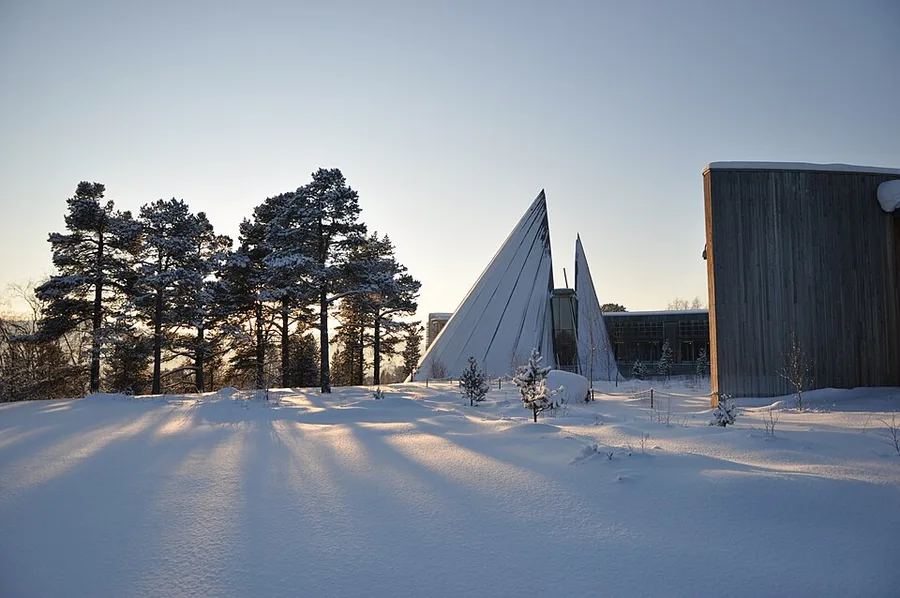 HanneHolmgren, Sametinget i Karasjok, CC BY-SA 3.0, via Wikimedia Commons The Sametinget plenary assembly hall in Karasjok — the distinctive curved timber-and-glass building housing the elected Sámi Parliament the card describes. Norway's elected representative body for Sámi affairs, known in Norwegian as Sametinget and in North Sámi as Sámediggi. Its first session opened on 9 October 1989, opened by King Olav V, at Karasjok (Kárášjohka) in Finnmark — the outcome of a process the Alta conflict of the 1970s–80s (opposition to damming the Alta and Kautokeino watercourses) forced onto the Norwegian state. Thirty-nine representatives are elected from seven constituencies to serve four-year terms. The Sámediggi administers Sámi language, education, and cultural funding and is consulted on land and resource questions affecting Sámi interests, but it operates within the Norwegian constitutional order rather than as a sovereign legislature — a formal instrument of Sámi self-governance, not independence. Karasjok / Kárášjohka In this article One of the concrete shapes Norway's consensus politics takes: the state formalizing Sámi self-governance within its own constitutional order rather than governing the Sámi directly, opened in 1989 alongside the ordinary machinery of the Storting. Also discussed in Samene — the other people of Norway opened in 1989.
Norwegian politics works most of the time and argues sharply about the rest. From the outside it rarely makes the news — but in 2026, with a minority government, a populist right at record strength, and electricity and immigration on every front page, the arguing is louder than it has been in a generation.