The Quiet Revolution — how Norway won its independence without a war
In 1905 Norway dissolved its ninety-one-year union with Sweden through a Storting vote, an August referendum that ran 368,208 to 184, and a Danish prince invited to be king. No shot was fired.
On the Seventh of June Declaration 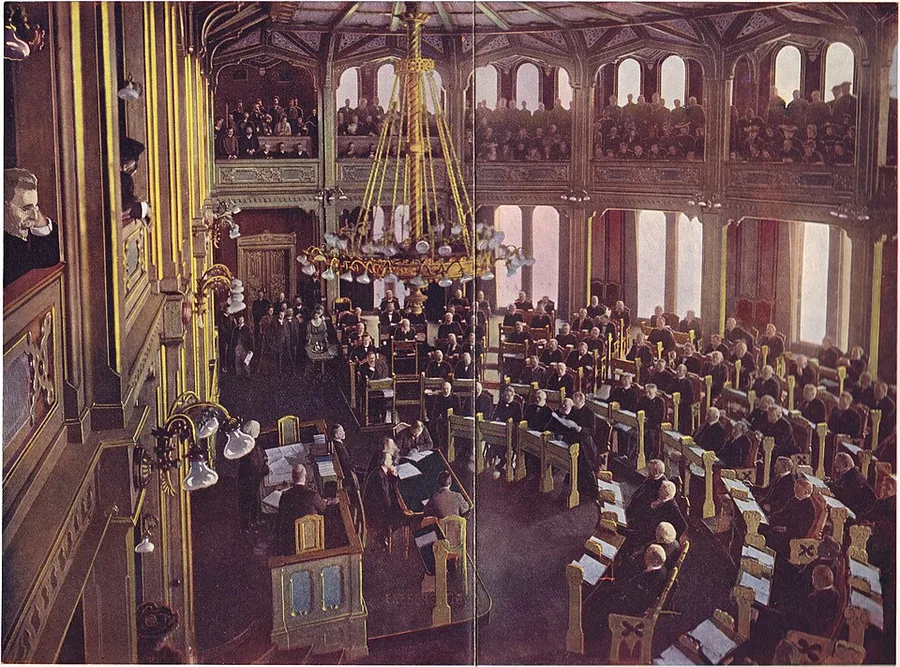 Frederik Hilfling-Rasmussen, Stortingets møte 7. juni 1905, from Norges historie (Aschehoug, 1909) The photograph catches the moment itself: the Storting assembled to hear the declaration that Oscar II, having failed to form a new government, had vacated the Norwegian throne — the constitutional finding that ended the union on 7 June 1905. Declaration of the Norwegian Storting on 7 June 1905,
passed unanimously by the 117 members present, dissolving
the personal union with Sweden. Framed in strict
constitutional language drawn from the 1814 Constitution:
Oscar II, by refusing to appoint a new Norwegian government
after the Michelsen ministry's resignation, had failed to
perform his constitutional functions; he had thereby
vacated the Norwegian throne; the union between the two
kingdoms was at an end; the Storting would conduct the
executive functions of government on its own authority
pending a new monarchy. The genius of the declaration was
its purely constitutional character — not a revolution but
a constitutional finding. The 7 June is a Norwegian flag
day; the day independent Norway began.
the Norwegian Storting
Frederik Hilfling-Rasmussen, Stortingets møte 7. juni 1905, from Norges historie (Aschehoug, 1909) The photograph catches the moment itself: the Storting assembled to hear the declaration that Oscar II, having failed to form a new government, had vacated the Norwegian throne — the constitutional finding that ended the union on 7 June 1905. Declaration of the Norwegian Storting on 7 June 1905,
passed unanimously by the 117 members present, dissolving
the personal union with Sweden. Framed in strict
constitutional language drawn from the 1814 Constitution:
Oscar II, by refusing to appoint a new Norwegian government
after the Michelsen ministry's resignation, had failed to
perform his constitutional functions; he had thereby
vacated the Norwegian throne; the union between the two
kingdoms was at an end; the Storting would conduct the
executive functions of government on its own authority
pending a new monarchy. The genius of the declaration was
its purely constitutional character — not a revolution but
a constitutional finding. The 7 June is a Norwegian flag
day; the day independent Norway began.
the Norwegian Storting 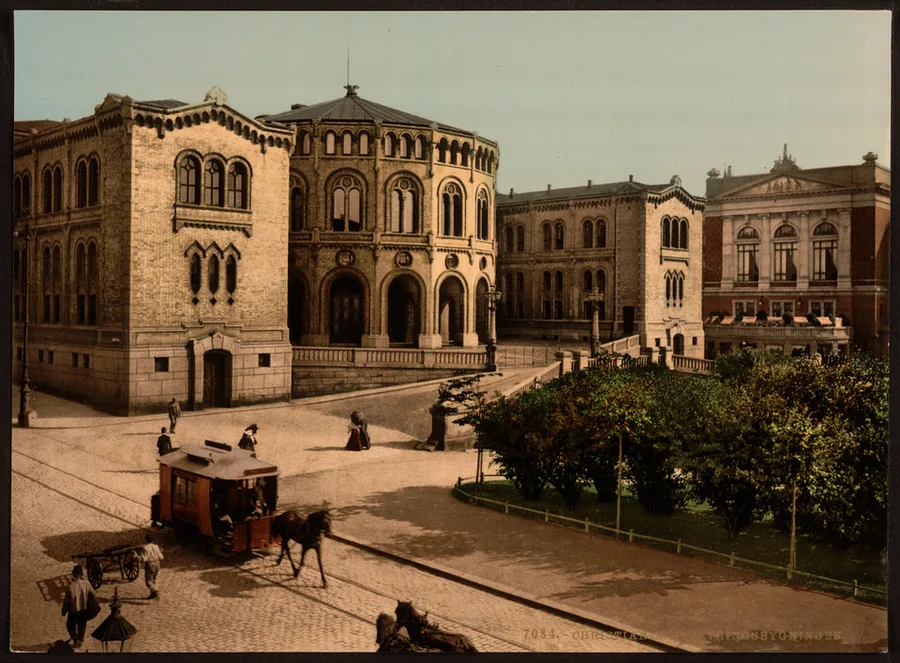 Detroit Publishing Company, Storthings Bygningen, Christiania, Norway (c. 1890-1900), Library of Congress / World Digital Library Inside this hall at noon on 7 June 1905, all 117 members voted the union with Sweden dissolved — the photochrom shows the building in exactly its 1905 dress, horse tram and cobbles in the plaza outside. The Grand Assembly — the parliament of independent
Norway, established by the Eidsvoll Constitution of 17 May
1814 as the country's sovereign legislature. The name
Storting (Stór-Þing, the great assembly) deliberately
reaches back to the medieval Norwegian thing tradition,
asserting institutional continuity with the pre-Danish
Norwegian state. Under the 1814 constitution the Storting
divided into two chambers — Lagting and Odelsting —
for legislative purposes; the two-chamber arrangement was
abolished in 2009 and the Storting has been a single
chamber since. The current building, in central Oslo,
opened in 1866.
Also discussed in The 400-Year Night — when the Northern Lion lay dormantLutheran Norway and Pietism — a farmer named Hans Nielsen Hauge and a lay revival that could not be silencedThe Constitution That Saved a Nation — five radical weeks at Eidsvoll, 1814The 'Lucky Country' — the discovery that changed everythingWorld War II — the King’s “No” and the Nazis in NorwayAllemannsretten — the right to roamPolitikk — the left, the right, and the Norwegian way , by unanimous vote of one hundred and seventeen members present, declares the personal union with Sweden
Detroit Publishing Company, Storthings Bygningen, Christiania, Norway (c. 1890-1900), Library of Congress / World Digital Library Inside this hall at noon on 7 June 1905, all 117 members voted the union with Sweden dissolved — the photochrom shows the building in exactly its 1905 dress, horse tram and cobbles in the plaza outside. The Grand Assembly — the parliament of independent
Norway, established by the Eidsvoll Constitution of 17 May
1814 as the country's sovereign legislature. The name
Storting (Stór-Þing, the great assembly) deliberately
reaches back to the medieval Norwegian thing tradition,
asserting institutional continuity with the pre-Danish
Norwegian state. Under the 1814 constitution the Storting
divided into two chambers — Lagting and Odelsting —
for legislative purposes; the two-chamber arrangement was
abolished in 2009 and the Storting has been a single
chamber since. The current building, in central Oslo,
opened in 1866.
Also discussed in The 400-Year Night — when the Northern Lion lay dormantLutheran Norway and Pietism — a farmer named Hans Nielsen Hauge and a lay revival that could not be silencedThe Constitution That Saved a Nation — five radical weeks at Eidsvoll, 1814The 'Lucky Country' — the discovery that changed everythingWorld War II — the King’s “No” and the Nazis in NorwayAllemannsretten — the right to roamPolitikk — the left, the right, and the Norwegian way , by unanimous vote of one hundred and seventeen members present, declares the personal union with Sweden 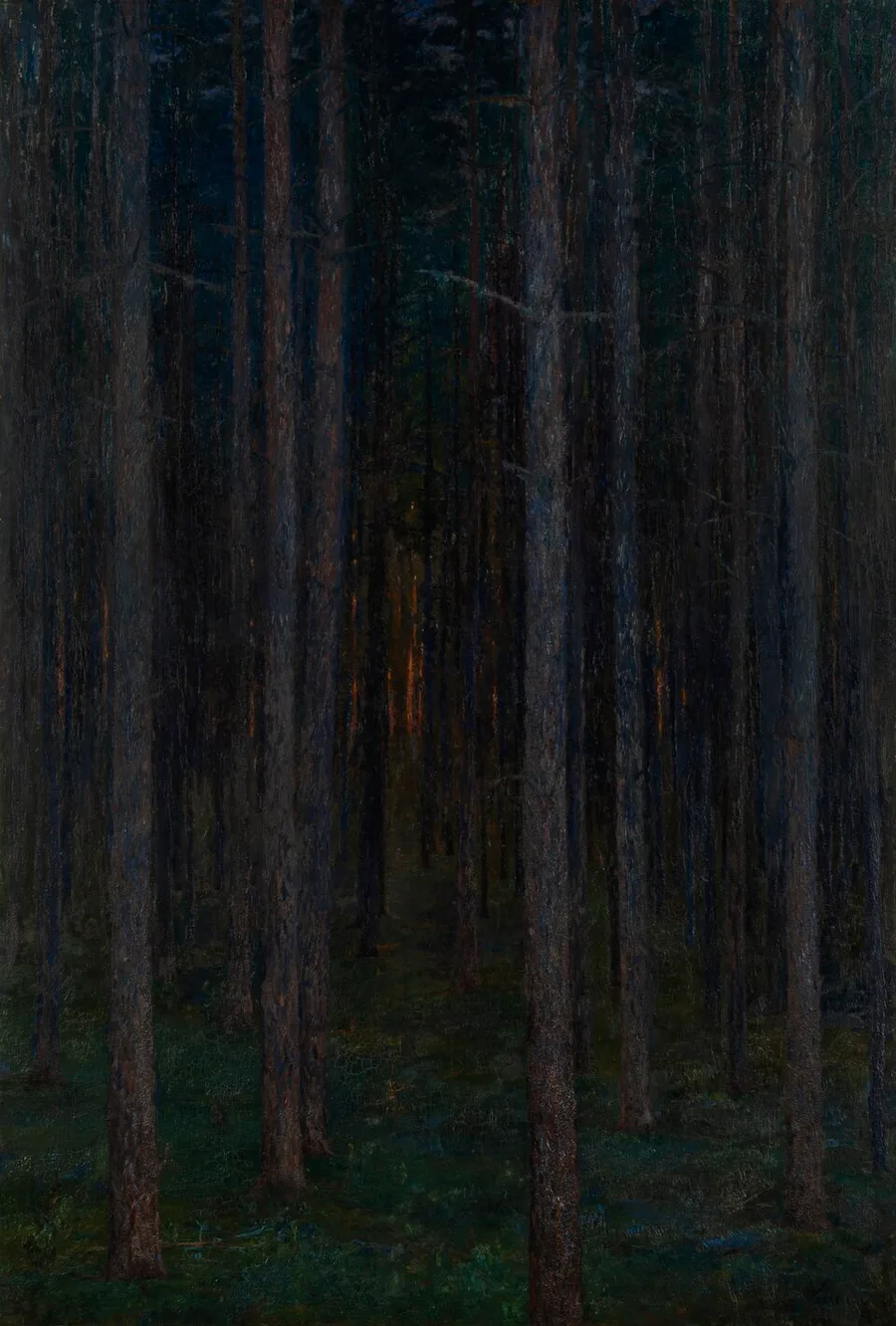 Prince Eugen, Skogen / The Forest (1892), Göteborgs konstmuseum (photo CC BY 4.0) Skogen (The Forest), painted in 1892 by Prince Eugen — a son of Oscar II, the Swedish king Norway broke from in 1905. His twilight wall of pine trunks became a defining image of Swedish national-romantic landscape: the neighbour kingdom rendered as its own deep forest. The largest of the three Scandinavian kingdoms, occupying
the eastern two-thirds of the Scandinavian peninsula.
Unified in stages through the early medieval period and
Christianised from the eleventh century onward. United
with Norway and Denmark in the 1397 Kalmar Union under
Margaret I and her great-nephew Erik of Pomerania; broke
away under Gustav Vasa in 1523, ending the union. Modern
Sweden's borders were largely set by the 1658 Treaty of
Roskilde, which transferred the formerly Danish provinces
of Skåne, Halland, Blekinge, and Bohuslän to the Swedish
crown.
Also discussed in The Long Fall — the sudden loss of Norwegian nobility, the end of the kings, and half of Norway gone foreverThe 400-Year Night — when the Northern Lion lay dormantWorld War II — the King’s “No” and the Nazis in Norway dissolved on the grounds that the Swedish king Oscar II of Sweden
Prince Eugen, Skogen / The Forest (1892), Göteborgs konstmuseum (photo CC BY 4.0) Skogen (The Forest), painted in 1892 by Prince Eugen — a son of Oscar II, the Swedish king Norway broke from in 1905. His twilight wall of pine trunks became a defining image of Swedish national-romantic landscape: the neighbour kingdom rendered as its own deep forest. The largest of the three Scandinavian kingdoms, occupying
the eastern two-thirds of the Scandinavian peninsula.
Unified in stages through the early medieval period and
Christianised from the eleventh century onward. United
with Norway and Denmark in the 1397 Kalmar Union under
Margaret I and her great-nephew Erik of Pomerania; broke
away under Gustav Vasa in 1523, ending the union. Modern
Sweden's borders were largely set by the 1658 Treaty of
Roskilde, which transferred the formerly Danish provinces
of Skåne, Halland, Blekinge, and Bohuslän to the Swedish
crown.
Also discussed in The Long Fall — the sudden loss of Norwegian nobility, the end of the kings, and half of Norway gone foreverThe 400-Year Night — when the Northern Lion lay dormantWorld War II — the King’s “No” and the Nazis in Norway dissolved on the grounds that the Swedish king Oscar II of Sweden 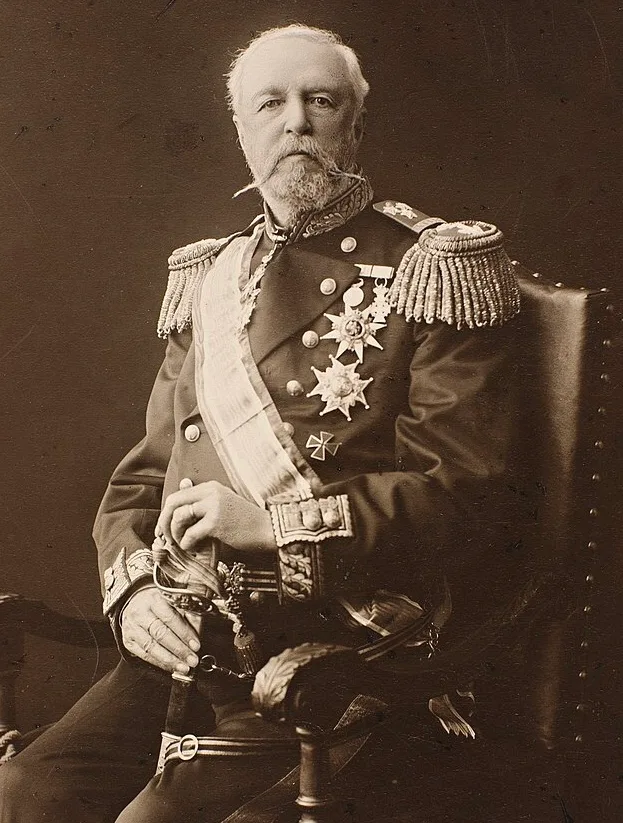 Stanislaw Szaciński, portrait of Oscar II (c. 1905), Nasjonalbiblioteket Oscar II was the last king of the union, whose refusal to authorize military action against the Storting's 7 June 1905 declaration and eventual formal renunciation of the Norwegian throne in October 1905 ended ninety-one years of union peacefully. King of Sweden (1829–1907), reigned 1872–1907; King of
Norway 1872–1905. The last Bernadotte to hold the Norwegian
crown. Cultivated; spoke seven languages; published poetry
and music criticism. His Norwegian reign was dominated by
the slow exhaustion of the personal union — recurring
conflict over Norwegian consular representation, the
successive resignations of Norwegian governments after
Swedish vetoes, and finally the constitutional crisis of
spring 1905. Refused to authorise Swedish military action
when the Storting declared the union dissolved on 7 June
1905. Formally renounced the Norwegian throne on 26
October 1905; signed the Karlstad Agreement the following
month. Died of pneumonia at Stockholm in December 1907.
has refused to appoint a new Norwegian government after the existing one resigned. The Storting’s declaration is procedurally and constitutionally exact, framed in the language of the 1814 Norwegian Constitution rather than in the rhetoric of revolution. The king has failed to perform his constitutional functions. The king has therefore vacated the throne. The union between two kingdoms that have shared a king for ninety-one years is by that single procedural step terminated. The Storting will, in the meantime, conduct the executive functions of the Norwegian government on its own authority pending the establishment of a new monarchy or republic. The declaration is read out at the Storting’s chamber in Christiania
Stanislaw Szaciński, portrait of Oscar II (c. 1905), Nasjonalbiblioteket Oscar II was the last king of the union, whose refusal to authorize military action against the Storting's 7 June 1905 declaration and eventual formal renunciation of the Norwegian throne in October 1905 ended ninety-one years of union peacefully. King of Sweden (1829–1907), reigned 1872–1907; King of
Norway 1872–1905. The last Bernadotte to hold the Norwegian
crown. Cultivated; spoke seven languages; published poetry
and music criticism. His Norwegian reign was dominated by
the slow exhaustion of the personal union — recurring
conflict over Norwegian consular representation, the
successive resignations of Norwegian governments after
Swedish vetoes, and finally the constitutional crisis of
spring 1905. Refused to authorise Swedish military action
when the Storting declared the union dissolved on 7 June
1905. Formally renounced the Norwegian throne on 26
October 1905; signed the Karlstad Agreement the following
month. Died of pneumonia at Stockholm in December 1907.
has refused to appoint a new Norwegian government after the existing one resigned. The Storting’s declaration is procedurally and constitutionally exact, framed in the language of the 1814 Norwegian Constitution rather than in the rhetoric of revolution. The king has failed to perform his constitutional functions. The king has therefore vacated the throne. The union between two kingdoms that have shared a king for ninety-one years is by that single procedural step terminated. The Storting will, in the meantime, conduct the executive functions of the Norwegian government on its own authority pending the establishment of a new monarchy or republic. The declaration is read out at the Storting’s chamber in Christiania 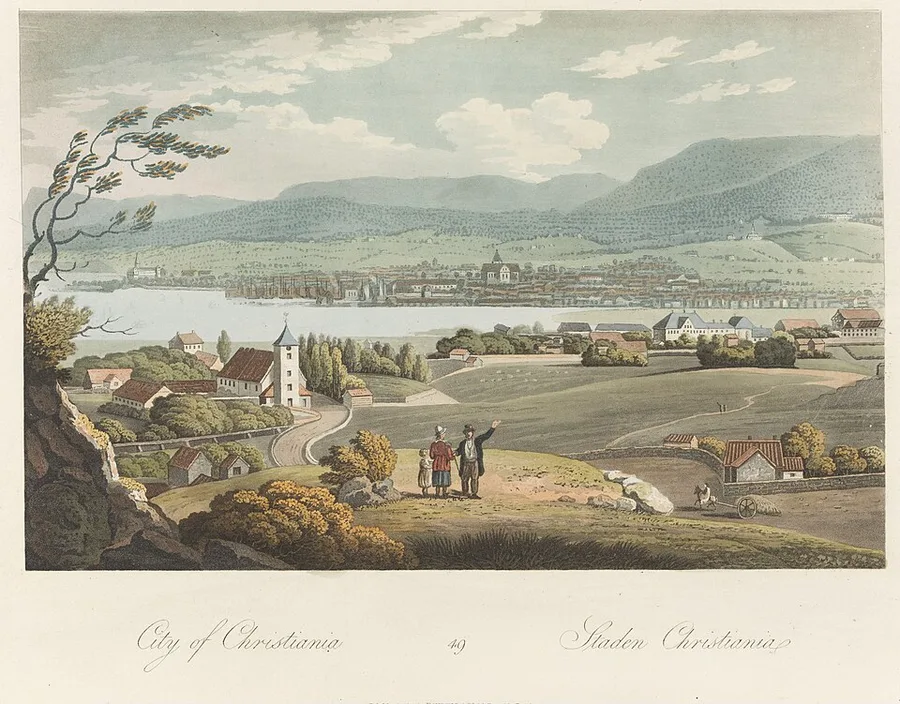 John William Edy, City of Christiania (1814), Boydell's Picturesque Scenery of Norway — National Museum of Art, Architecture and Design John William Edy's 1814 view of the small grid-planned capital across the water. This is the town King Christian IV laid out beneath Akershus after the 1624 fire razed medieval Oslo, and named for himself; its Kvadraturen grid survives today. Capital of Norway from 1624 to 1925 — the rebuilt town that
King Christian IV laid out west of the medieval Oslo after
the fire of August 1624 destroyed the old city. Christian
founded the new town on a grid plan beneath Akershus
fortress, named it for himself, and ordered the surviving
Oslo burghers to move into it. Christiania was the
capital's name through the four-hundred-year night, the
brief war of 1814, the constitutional Eidsvoll moment, the
ninety-one-year personal union with Sweden, and the first
two decades of fully independent Norway after 1905. In 1877
the spelling was modernised to Kristiania; in 1925 the
city formally returned to the medieval name Oslo. The
Kvadraturen district preserves Christian IV's grid intact
today.
On the trip Days 1–2 in Oslo bring both groups through Christiania —
Christian IV's seventeenth-century planned grid, still
visible today as the Kvadraturen district just below
Akershus fortress.
Also discussed in The 400-Year Night — when the Northern Lion lay dormantLutheran Norway and Pietism — a farmer named Hans Nielsen Hauge and a lay revival that could not be silencedThe Constitution That Saved a Nation — five radical weeks at Eidsvoll, 1814800,000 Norwegians Leave — the century that built a Second NorwayWorld War II — the King’s “No” and the Nazis in NorwayNorske eventyr — the folk tales almost lost foreverStedssagn — local legends, told as warningsUtburd — the unbaptized child that will not rest at noon. The country immediately begins the careful work of making it stick.
John William Edy, City of Christiania (1814), Boydell's Picturesque Scenery of Norway — National Museum of Art, Architecture and Design John William Edy's 1814 view of the small grid-planned capital across the water. This is the town King Christian IV laid out beneath Akershus after the 1624 fire razed medieval Oslo, and named for himself; its Kvadraturen grid survives today. Capital of Norway from 1624 to 1925 — the rebuilt town that
King Christian IV laid out west of the medieval Oslo after
the fire of August 1624 destroyed the old city. Christian
founded the new town on a grid plan beneath Akershus
fortress, named it for himself, and ordered the surviving
Oslo burghers to move into it. Christiania was the
capital's name through the four-hundred-year night, the
brief war of 1814, the constitutional Eidsvoll moment, the
ninety-one-year personal union with Sweden, and the first
two decades of fully independent Norway after 1905. In 1877
the spelling was modernised to Kristiania; in 1925 the
city formally returned to the medieval name Oslo. The
Kvadraturen district preserves Christian IV's grid intact
today.
On the trip Days 1–2 in Oslo bring both groups through Christiania —
Christian IV's seventeenth-century planned grid, still
visible today as the Kvadraturen district just below
Akershus fortress.
Also discussed in The 400-Year Night — when the Northern Lion lay dormantLutheran Norway and Pietism — a farmer named Hans Nielsen Hauge and a lay revival that could not be silencedThe Constitution That Saved a Nation — five radical weeks at Eidsvoll, 1814800,000 Norwegians Leave — the century that built a Second NorwayWorld War II — the King’s “No” and the Nazis in NorwayNorske eventyr — the folk tales almost lost foreverStedssagn — local legends, told as warningsUtburd — the unbaptized child that will not rest at noon. The country immediately begins the careful work of making it stick.
A generation of friction
The crisis that produced the seventh of June declaration had been building for a generation. The Norwegian-Swedish personal union established by the Mossekonvensjonen 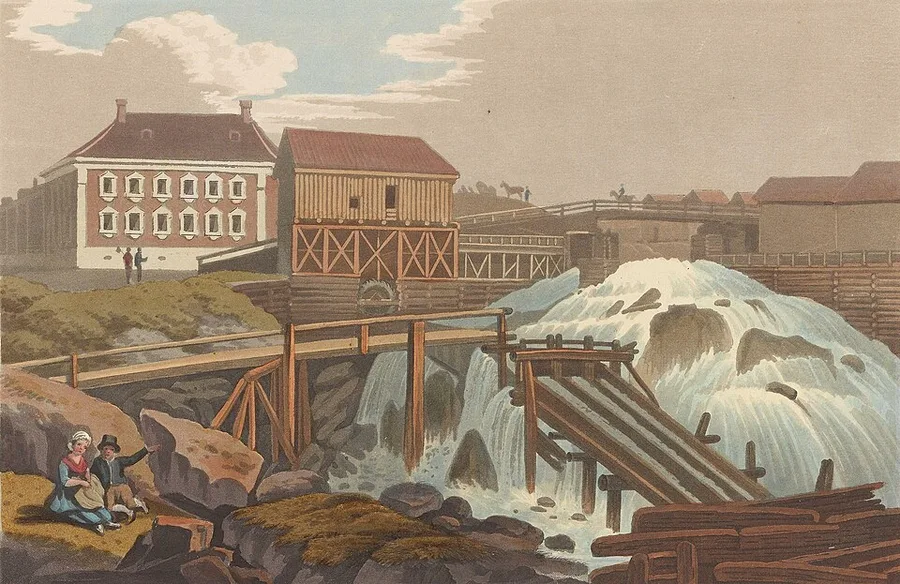 John William Edy, B. Ankers House at Moss, from Boydells Picturesque Scenery of Norway (National Museum) Bernt Anker's mansion at Moss, visible on the rise above the falls in this Edy print, is Konvensjonsgården — the house where Karl Johan's Swedish negotiators and Christian Frederik's Norwegian government signed the armistice on 14 August 1814. The Convention of Moss — the armistice signed at Moss
on 14 August 1814 between the Swedish forces of Crown
Prince Karl Johan and the Norwegian government of King
Christian Frederik, ending the brief summer war that had
followed Norway's rejection of the Treaty of Kiel. The
Convention's terms were strikingly mild: Norway entered a
personal union with Sweden, sharing the Swedish king but
retaining its Eidsvoll constitution, its Storting, its own
government, its own church, and its own administrative life
in Christiania. Karl Johan also accepted in principle the
Norwegian Constitution as the basis of government — a
concession that produced the remarkably durable
constitutional framework that lasted ninety-one years
until the peaceful dissolution of the union in 1905.
Also discussed in The 400-Year Night — when the Northern Lion lay dormantThe Constitution That Saved a Nation — five radical weeks at Eidsvoll, 1814 in 1814 left Norway with extensive domestic autonomy but with foreign affairs unified under the Swedish king and the Swedish foreign ministry. The arrangement worked tolerably in the 1820s and 1830s while Norway was reorganizing itself after centuries of Danish rule. It began to chafe in the 1850s and 1860s as the Norwegian economy and Norwegian merchant marine grew larger than the Swedish economy could accommodate without conflict of interest. The specific point of friction by the 1890s was consular representation. Norwegian shipping, by then one of the world’s largest merchant marines — fourth after Britain, Germany, and the United States by the turn of the century — required consular protection in foreign ports for Norwegian-flagged ships in trade. The Swedish foreign ministry handled all consular appointments. Norwegian shippers wanted Norwegian consuls. The Norwegian parliament repeatedly passed laws establishing a separate Norwegian consular service. The Swedish crown repeatedly refused to ratify the laws. The Norwegian government repeatedly resigned in protest. By the spring of 1905 the cycle had exhausted itself: the Norwegian coalition government under Christian Michelsen
John William Edy, B. Ankers House at Moss, from Boydells Picturesque Scenery of Norway (National Museum) Bernt Anker's mansion at Moss, visible on the rise above the falls in this Edy print, is Konvensjonsgården — the house where Karl Johan's Swedish negotiators and Christian Frederik's Norwegian government signed the armistice on 14 August 1814. The Convention of Moss — the armistice signed at Moss
on 14 August 1814 between the Swedish forces of Crown
Prince Karl Johan and the Norwegian government of King
Christian Frederik, ending the brief summer war that had
followed Norway's rejection of the Treaty of Kiel. The
Convention's terms were strikingly mild: Norway entered a
personal union with Sweden, sharing the Swedish king but
retaining its Eidsvoll constitution, its Storting, its own
government, its own church, and its own administrative life
in Christiania. Karl Johan also accepted in principle the
Norwegian Constitution as the basis of government — a
concession that produced the remarkably durable
constitutional framework that lasted ninety-one years
until the peaceful dissolution of the union in 1905.
Also discussed in The 400-Year Night — when the Northern Lion lay dormantThe Constitution That Saved a Nation — five radical weeks at Eidsvoll, 1814 in 1814 left Norway with extensive domestic autonomy but with foreign affairs unified under the Swedish king and the Swedish foreign ministry. The arrangement worked tolerably in the 1820s and 1830s while Norway was reorganizing itself after centuries of Danish rule. It began to chafe in the 1850s and 1860s as the Norwegian economy and Norwegian merchant marine grew larger than the Swedish economy could accommodate without conflict of interest. The specific point of friction by the 1890s was consular representation. Norwegian shipping, by then one of the world’s largest merchant marines — fourth after Britain, Germany, and the United States by the turn of the century — required consular protection in foreign ports for Norwegian-flagged ships in trade. The Swedish foreign ministry handled all consular appointments. Norwegian shippers wanted Norwegian consuls. The Norwegian parliament repeatedly passed laws establishing a separate Norwegian consular service. The Swedish crown repeatedly refused to ratify the laws. The Norwegian government repeatedly resigned in protest. By the spring of 1905 the cycle had exhausted itself: the Norwegian coalition government under Christian Michelsen 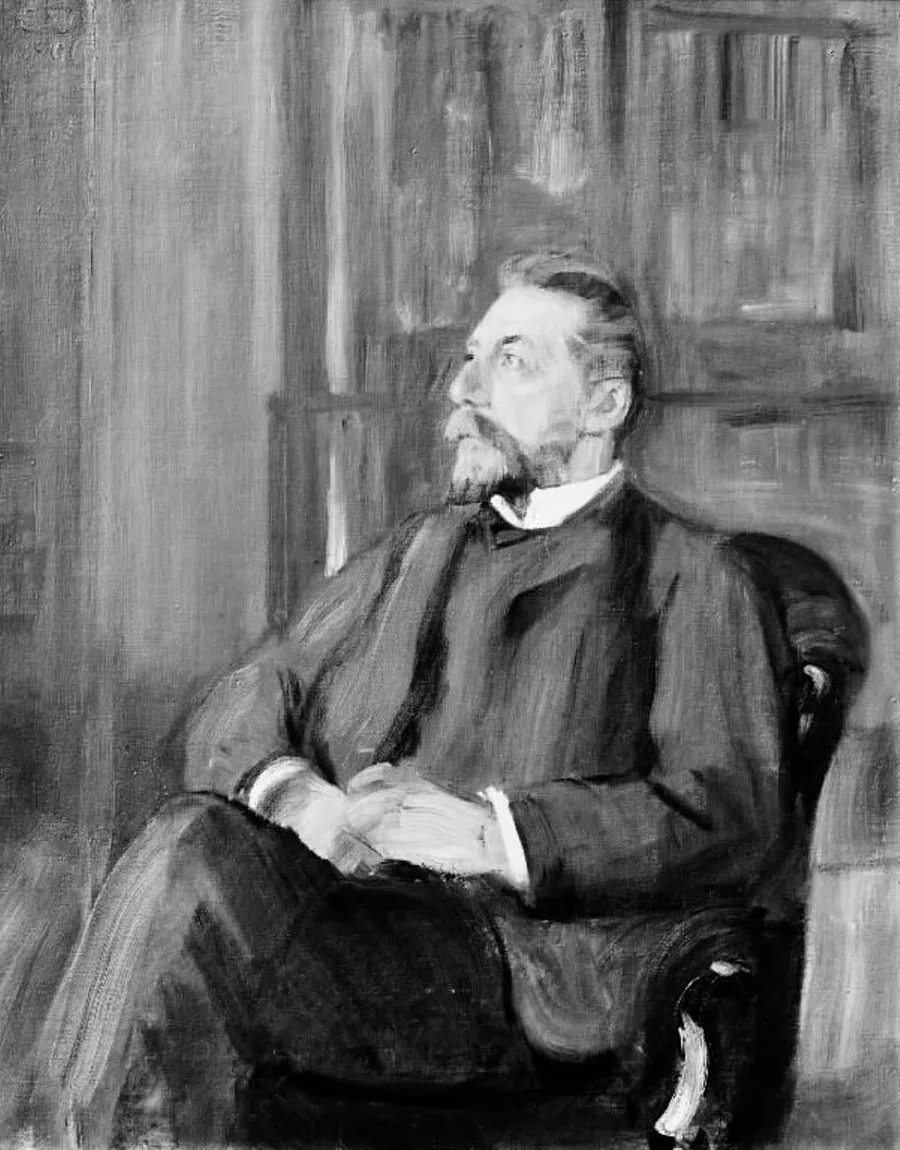 Erik Werenskiold, Portræt af statsminister Michelsen (1906), Statens Museum for Kunst Michelsen was the Norwegian prime minister who engineered the constitutional maneuver ending the union with Sweden, negotiated the Karlstad Agreement, and brought Prince Carl of Denmark to the throne as Haakon VII; this Werenskiold portrait is a contemporary painted likeness from the year after the events he led. Norwegian shipping magnate and Prime Minister (1857–1925),
in office 11 March 1905 to 23 October 1907. Born in Bergen
to a German-Norwegian merchant family; built one of the
largest Norwegian shipping firms of his generation. Took
the premiership as head of a broad coalition formed
specifically to resolve the consular crisis with Sweden.
After Oscar II vetoed the Storting's consular bill,
Michelsen staged the constitutional manoeuvre that produced
the Storting declaration of 7 June 1905 — his cabinet
resigned; the king could not find a successor; therefore
(the Storting reasoned) the king had vacated the throne
and the union was at an end. Negotiated the Karlstad
Agreement in September 1905 and led the diplomacy that
brought Prince Carl of Denmark to the Norwegian throne as
Haakon VII.
had passed a Storting bill establishing the consular service, the Swedish king had vetoed it, the Michelsen government had resigned in protest, and Oscar II had been unable to find any Norwegian politician willing to form a new government on Swedish terms.
Erik Werenskiold, Portræt af statsminister Michelsen (1906), Statens Museum for Kunst Michelsen was the Norwegian prime minister who engineered the constitutional maneuver ending the union with Sweden, negotiated the Karlstad Agreement, and brought Prince Carl of Denmark to the throne as Haakon VII; this Werenskiold portrait is a contemporary painted likeness from the year after the events he led. Norwegian shipping magnate and Prime Minister (1857–1925),
in office 11 March 1905 to 23 October 1907. Born in Bergen
to a German-Norwegian merchant family; built one of the
largest Norwegian shipping firms of his generation. Took
the premiership as head of a broad coalition formed
specifically to resolve the consular crisis with Sweden.
After Oscar II vetoed the Storting's consular bill,
Michelsen staged the constitutional manoeuvre that produced
the Storting declaration of 7 June 1905 — his cabinet
resigned; the king could not find a successor; therefore
(the Storting reasoned) the king had vacated the throne
and the union was at an end. Negotiated the Karlstad
Agreement in September 1905 and led the diplomacy that
brought Prince Carl of Denmark to the Norwegian throne as
Haakon VII.
had passed a Storting bill establishing the consular service, the Swedish king had vetoed it, the Michelsen government had resigned in protest, and Oscar II had been unable to find any Norwegian politician willing to form a new government on Swedish terms.
The Storting’s move
The Storting’s response is the seventh of June declaration. The genius of the declaration is that it operates entirely within the 1814 Constitution. The Storting is not seizing power. The Storting is observing that the king has failed in his constitutional duties and is therefore no longer functionally king. The country needs a new sovereign. The Storting will arrange one. The constitutional structure that the Eidsvoll Constituent Assembly 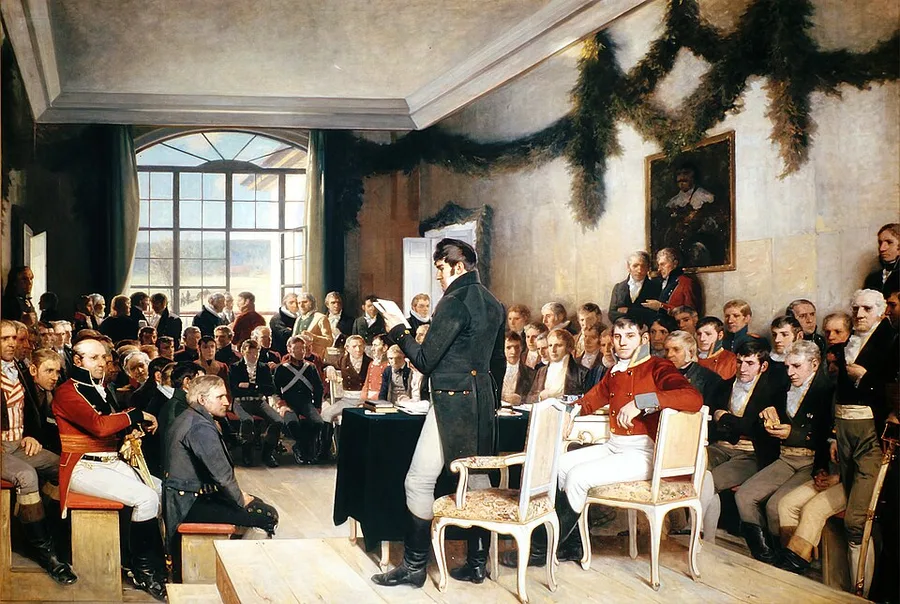 Oscar Wergeland, Eidsvold 1814 (1885), Archives of the Storting Wergeland's 1885 canvas restages the Assembly's final working day, 11 May 1814, when the delegates debated and adopted the constitution's last paragraph — the scene the Storting itself chose to hang behind its own speaker's podium. Riksforsamlingen — the Norwegian Constituent Assembly of
spring 1814. One hundred and twelve men, elected by parish
congregations and military regiments across Norway over a
six-week period in February and March 1814 on Christian
Frederik's call, convened at the Eidsvoll country estate
of the merchant Carsten Anker on 10 April 1814 and worked
for five weeks drafting and debating the constitutional
document. The Constitution was settled in final form on 16
May 1814 and dated and signed on 17 May, the day the
Assembly unanimously elected Christian Frederik king. The 112 signatures are preserved on the original
document, which is held in the National Archives of Norway
in Oslo. The Assembly's working table and chamber are
preserved at Eidsvollsbygningen as a national museum.
Also discussed in The Constitution That Saved a Nation — five radical weeks at Eidsvoll, 1814 had built into the country ninety-one years earlier is doing the heavy lifting of what would in other European countries have been a revolution. The technique works.
Oscar Wergeland, Eidsvold 1814 (1885), Archives of the Storting Wergeland's 1885 canvas restages the Assembly's final working day, 11 May 1814, when the delegates debated and adopted the constitution's last paragraph — the scene the Storting itself chose to hang behind its own speaker's podium. Riksforsamlingen — the Norwegian Constituent Assembly of
spring 1814. One hundred and twelve men, elected by parish
congregations and military regiments across Norway over a
six-week period in February and March 1814 on Christian
Frederik's call, convened at the Eidsvoll country estate
of the merchant Carsten Anker on 10 April 1814 and worked
for five weeks drafting and debating the constitutional
document. The Constitution was settled in final form on 16
May 1814 and dated and signed on 17 May, the day the
Assembly unanimously elected Christian Frederik king. The 112 signatures are preserved on the original
document, which is held in the National Archives of Norway
in Oslo. The Assembly's working table and chamber are
preserved at Eidsvollsbygningen as a national museum.
Also discussed in The Constitution That Saved a Nation — five radical weeks at Eidsvoll, 1814 had built into the country ninety-one years earlier is doing the heavy lifting of what would in other European countries have been a revolution. The technique works.
The Swedish response
The Swedish response is to threaten war. Sweden orders a partial mobilization in mid-July 1905; through the tense weeks that follow, the two sides stand at heightened readiness across the Halden 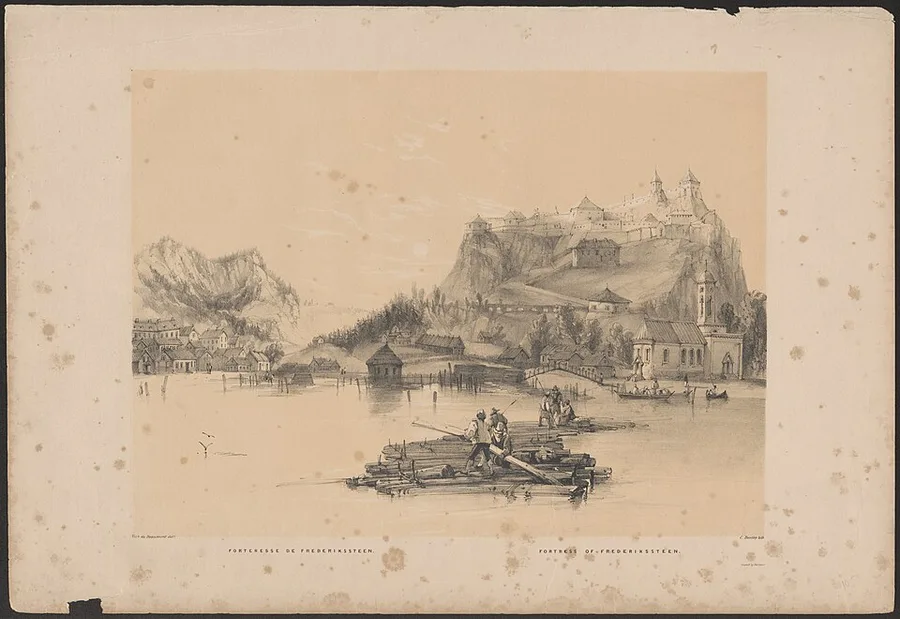 Unknown artist, Fredriksten Festning (Riksantikvaren archive) Fredriksten Fortress, shown here in a period lithograph above the Halden waterfront, anchored the Norwegian defense of the town during the 1814 war and was never taken by a Swedish army in six sieges. Border town in southeastern Norway, on the Iddefjord arm of
the Oslofjord facing Sweden across the narrowest of the
border crossings. Dominated by Fredriksten Fortress on the
ridge above the town — the seventeenth-century star fort
that, though besieged six times, was never captured by a
Swedish army. Site of the principal Norwegian holding
actions in the brief Swedish-Norwegian war of summer 1814,
when Karl Johan's army crossed into eastern Norway on 26
July and the Norwegian defenders fought a series of
delaying engagements through the Halden and Fredrikstad
districts before the Convention of Moss ended the war on
14 August. Modern Halden has about thirty thousand people
and hosts a major Norwegian nuclear-research reactor.
Also discussed in The Constitution That Saved a Nation — five radical weeks at Eidsvoll, 1814 and Fredrikstad districts, and by mid-September — with negotiations already under way — Sweden has some fifty thousand men under arms and Norway has called up twenty-two thousand in response. Neither side attacks. None of the great powers is willing to back a Swedish war over the union. Inside Sweden itself, Hjalmar Branting
Unknown artist, Fredriksten Festning (Riksantikvaren archive) Fredriksten Fortress, shown here in a period lithograph above the Halden waterfront, anchored the Norwegian defense of the town during the 1814 war and was never taken by a Swedish army in six sieges. Border town in southeastern Norway, on the Iddefjord arm of
the Oslofjord facing Sweden across the narrowest of the
border crossings. Dominated by Fredriksten Fortress on the
ridge above the town — the seventeenth-century star fort
that, though besieged six times, was never captured by a
Swedish army. Site of the principal Norwegian holding
actions in the brief Swedish-Norwegian war of summer 1814,
when Karl Johan's army crossed into eastern Norway on 26
July and the Norwegian defenders fought a series of
delaying engagements through the Halden and Fredrikstad
districts before the Convention of Moss ended the war on
14 August. Modern Halden has about thirty thousand people
and hosts a major Norwegian nuclear-research reactor.
Also discussed in The Constitution That Saved a Nation — five radical weeks at Eidsvoll, 1814 and Fredrikstad districts, and by mid-September — with negotiations already under way — Sweden has some fifty thousand men under arms and Norway has called up twenty-two thousand in response. Neither side attacks. None of the great powers is willing to back a Swedish war over the union. Inside Sweden itself, Hjalmar Branting 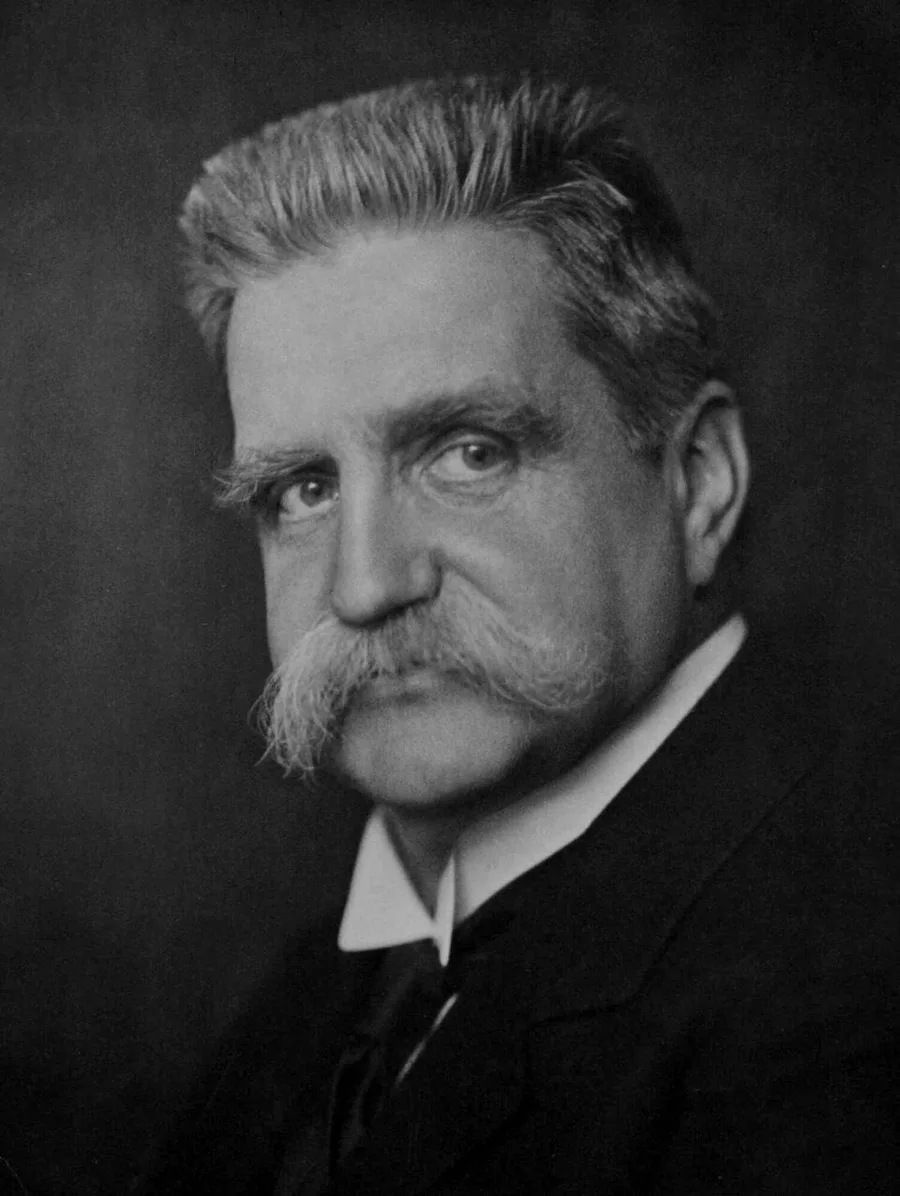 Henry B. Goodwin, Hjalmar Branting (1917), Wikimedia Commons, public domain Branting led the Swedish anti-war movement during the summer 1905 crisis, organizing mass demonstrations and threatening a general strike against any Swedish move on Norway — the domestic pressure his movement generated was decisive in keeping the dissolution peaceful. Swedish journalist, Social Democratic politician, and three-
time Prime Minister of Sweden (1860–1925). Founder and
long-time chairman of the Swedish Social Democratic Party.
During the summer 1905 crisis with Norway, Branting led the
Swedish anti-war movement: he organised a twenty-thousand-
strong demonstration in Stockholm against any Swedish
military action over the dissolution; coined the slogan
Bort händerna från Norge, kung Oscar! — Hands off
Norway, King Oscar! — which became the rallying cry of
the Swedish left; and threatened a general strike if Oscar
II ordered a call-up of reserves. The Swedish anti-war
pressure he organised was one of the decisive factors in
the bloodless settlement. Awarded the Nobel Peace Prize in
1921 jointly with Christian Lange.
and the Social Democrats organize publicly against a war over Norway, coining the slogan “Hands off Norway, King!”, leading a twenty-thousand-strong antiwar demonstration in Stockholm
Henry B. Goodwin, Hjalmar Branting (1917), Wikimedia Commons, public domain Branting led the Swedish anti-war movement during the summer 1905 crisis, organizing mass demonstrations and threatening a general strike against any Swedish move on Norway — the domestic pressure his movement generated was decisive in keeping the dissolution peaceful. Swedish journalist, Social Democratic politician, and three-
time Prime Minister of Sweden (1860–1925). Founder and
long-time chairman of the Swedish Social Democratic Party.
During the summer 1905 crisis with Norway, Branting led the
Swedish anti-war movement: he organised a twenty-thousand-
strong demonstration in Stockholm against any Swedish
military action over the dissolution; coined the slogan
Bort händerna från Norge, kung Oscar! — Hands off
Norway, King Oscar! — which became the rallying cry of
the Swedish left; and threatened a general strike if Oscar
II ordered a call-up of reserves. The Swedish anti-war
pressure he organised was one of the decisive factors in
the bloodless settlement. Awarded the Nobel Peace Prize in
1921 jointly with Christian Lange.
and the Social Democrats organize publicly against a war over Norway, coining the slogan “Hands off Norway, King!”, leading a twenty-thousand-strong antiwar demonstration in Stockholm 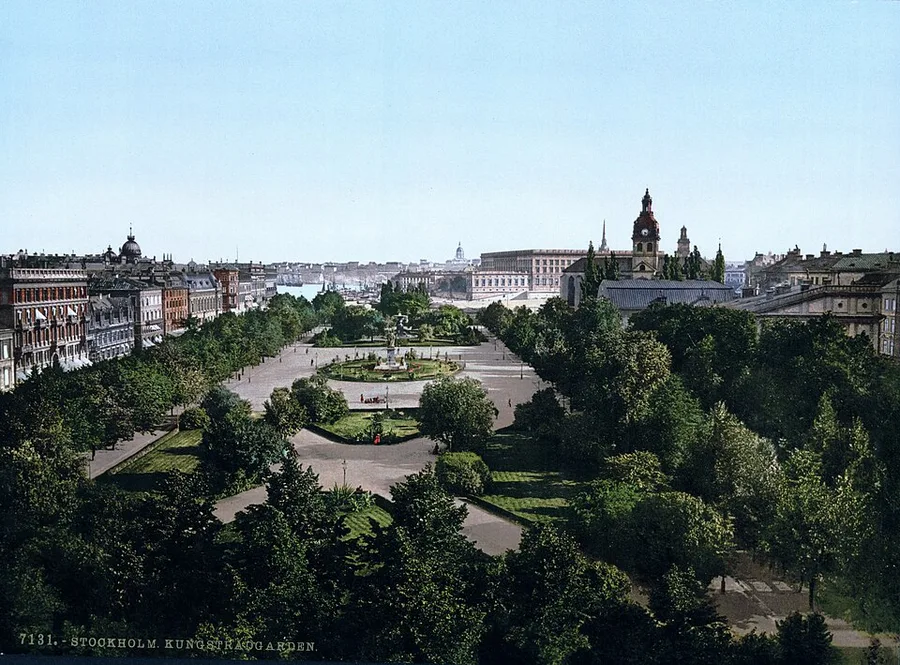 Unknown photographer, Stockholm, Kungsträdgården (c. 1890-1900), Library of Congress, public domain A view of Stockholm around 1900, the Swedish capital from which Norway's foreign affairs were conducted during the 1814-1905 union, and the city where Hjalmar Branting led the summer 1905 anti-war demonstrations against Swedish military action toward Norway. Capital of Sweden, built across a string of fourteen islands
where Lake Mälaren meets the Baltic. Founded in the
thirteenth century by Birger Jarl; capital of the unified
Swedish kingdom from the fifteenth century. Site of the
Stockholm Bloodbath of November 1520 — Christian II's
execution of roughly eighty Swedish nobles and clergy that
triggered Gustav Vasa's revolt and the end of the Kalmar
Union. Through the 1814–1905 Swedish-Norwegian personal
union, Stockholm was the capital from which Norway's
foreign affairs were conducted, and the city in which
Hjalmar Branting led the summer 1905 anti-war
demonstrations against any Swedish military move against
Norway. Modern Stockholm has about a million people in the
inner city and roughly two and a half million in the
metropolitan region.
, and threatening a general strike if the call-up of reserves proceeds.
Unknown photographer, Stockholm, Kungsträdgården (c. 1890-1900), Library of Congress, public domain A view of Stockholm around 1900, the Swedish capital from which Norway's foreign affairs were conducted during the 1814-1905 union, and the city where Hjalmar Branting led the summer 1905 anti-war demonstrations against Swedish military action toward Norway. Capital of Sweden, built across a string of fourteen islands
where Lake Mälaren meets the Baltic. Founded in the
thirteenth century by Birger Jarl; capital of the unified
Swedish kingdom from the fifteenth century. Site of the
Stockholm Bloodbath of November 1520 — Christian II's
execution of roughly eighty Swedish nobles and clergy that
triggered Gustav Vasa's revolt and the end of the Kalmar
Union. Through the 1814–1905 Swedish-Norwegian personal
union, Stockholm was the capital from which Norway's
foreign affairs were conducted, and the city in which
Hjalmar Branting led the summer 1905 anti-war
demonstrations against any Swedish military move against
Norway. Modern Stockholm has about a million people in the
inner city and roughly two and a half million in the
metropolitan region.
, and threatening a general strike if the call-up of reserves proceeds.
The August referendum
On the August 1905 referendum 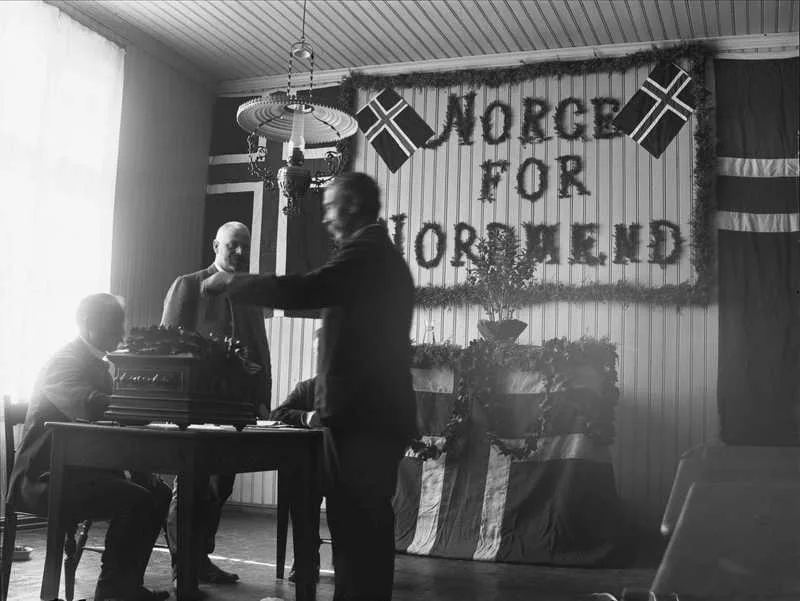 Jesper Jespersen / Oslo Museum, Folkeavstemningen 13. august 1905, Maridalen skole (OB.NW2889), CC BY-SA 3.0 This is the vote itself: a decorated polling place on 13 August 1905, the day roughly 368,000 Norwegian men cast a 'yes' ballot to just 184 'no' votes, ratifying the Storting's dissolution of the union with Sweden by one of the most lopsided margins in democratic history. Norwegian popular referendum held on 13 August 1905
confirming the Storting's 7 June declaration that the
personal union with Sweden was dissolved. Eligible voters
were all Norwegian men over twenty-five; the women's
suffrage extension would not come until 1913, though a
parallel petition campaign organised by the women's
suffrage movement collected approximately 245,000 women's
signatures in support. Turnout: roughly 85 per cent. The
result was 368,208 votes in favour of dissolution; 184
against — a 99.95% yes vote, among the most lopsided
referendum results in European democratic history. The
result was framed expressly as evidence of the
Norwegian popular will for international audiences, to
preempt any Swedish claim that the dissolution lacked
popular legitimacy.
, in the middle of the standoff, the Norwegians submit the dissolution to a popular referendum, to ensure that the international community will accept it as the expressed will of the Norwegian people. The results are as one-sided as referendum results in democratic countries ever are. 368,208 Norwegian men vote in favor. 184 vote against. The eligible electorate in 1905 is all male Norwegians over twenty-five, and turnout comes in at approximately eighty-five percent. Women have not yet been granted the parliamentary suffrage they will receive in 1913, but a parallel petition campaign organized by the Norwegian women’s suffrage movement collects approximately 245,000 women’s signatures in support of the dissolution and presents them to the Storting, making the women’s political voice visible in the moment even without the formal ballot. The 99.95% yes vote is one of the most lopsided results in European referendum history.
Jesper Jespersen / Oslo Museum, Folkeavstemningen 13. august 1905, Maridalen skole (OB.NW2889), CC BY-SA 3.0 This is the vote itself: a decorated polling place on 13 August 1905, the day roughly 368,000 Norwegian men cast a 'yes' ballot to just 184 'no' votes, ratifying the Storting's dissolution of the union with Sweden by one of the most lopsided margins in democratic history. Norwegian popular referendum held on 13 August 1905
confirming the Storting's 7 June declaration that the
personal union with Sweden was dissolved. Eligible voters
were all Norwegian men over twenty-five; the women's
suffrage extension would not come until 1913, though a
parallel petition campaign organised by the women's
suffrage movement collected approximately 245,000 women's
signatures in support. Turnout: roughly 85 per cent. The
result was 368,208 votes in favour of dissolution; 184
against — a 99.95% yes vote, among the most lopsided
referendum results in European democratic history. The
result was framed expressly as evidence of the
Norwegian popular will for international audiences, to
preempt any Swedish claim that the dissolution lacked
popular legitimacy.
, in the middle of the standoff, the Norwegians submit the dissolution to a popular referendum, to ensure that the international community will accept it as the expressed will of the Norwegian people. The results are as one-sided as referendum results in democratic countries ever are. 368,208 Norwegian men vote in favor. 184 vote against. The eligible electorate in 1905 is all male Norwegians over twenty-five, and turnout comes in at approximately eighty-five percent. Women have not yet been granted the parliamentary suffrage they will receive in 1913, but a parallel petition campaign organized by the Norwegian women’s suffrage movement collects approximately 245,000 women’s signatures in support of the dissolution and presents them to the Storting, making the women’s political voice visible in the moment even without the formal ballot. The 99.95% yes vote is one of the most lopsided results in European referendum history.
Karlstad
The Swedish government, faced with the prospect of a war with Norway that would gain it nothing, would damage its standing with the great European powers, and would meet substantial internal Swedish opposition, declines to attack. Negotiations open at Karlstad 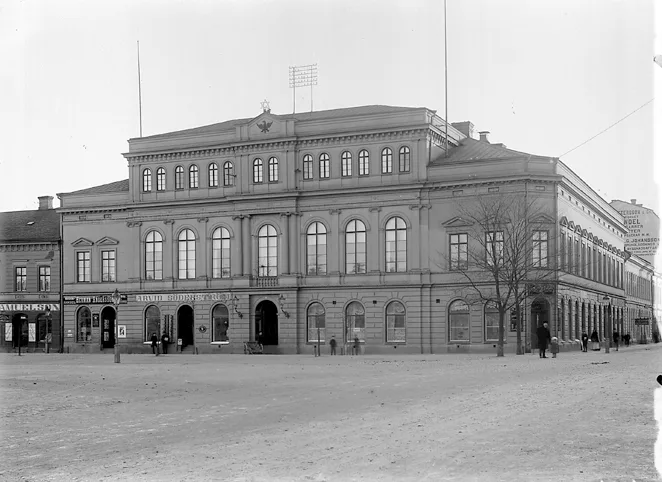 Unknown photographer, Frimurarelogen, Karlstad (1922), Carlstad gillet photo archive The Freemasons' lodge on Karlstad's main square — the building where the Norwegian and Swedish delegations met in September 1905 to negotiate the union's dissolution, in the neutral-ground town the two sides chose seventy kilometres from the border. Photographed in 1922. City in west-central Sweden on Lake Vänern in Värmland
county, about seventy kilometres from the Norwegian border.
Founded in 1584 and named for King Karl IX. Site of the
Karlstad negotiations of September 1905 between Sweden
and Norway, in which the two countries' delegations met to
resolve the dissolution of the personal union after the
Storting's 7 June 1905 declaration. The negotiations
produced the Karlstad Agreement of 23 September 1905,
which formally dissolved the union, required Norway to
tear down its eastern border fortifications inside a newly
demilitarised zone, and arranged the procedures for
separate Norwegian and Swedish foreign relations going
forward. Modern Karlstad has about sixty-five thousand
people and is the seat of Karlstad University.
in west-central Sweden, seventy kilometers from the Norwegian border, at the end of August. The Karlstad Agreement
Unknown photographer, Frimurarelogen, Karlstad (1922), Carlstad gillet photo archive The Freemasons' lodge on Karlstad's main square — the building where the Norwegian and Swedish delegations met in September 1905 to negotiate the union's dissolution, in the neutral-ground town the two sides chose seventy kilometres from the border. Photographed in 1922. City in west-central Sweden on Lake Vänern in Värmland
county, about seventy kilometres from the Norwegian border.
Founded in 1584 and named for King Karl IX. Site of the
Karlstad negotiations of September 1905 between Sweden
and Norway, in which the two countries' delegations met to
resolve the dissolution of the personal union after the
Storting's 7 June 1905 declaration. The negotiations
produced the Karlstad Agreement of 23 September 1905,
which formally dissolved the union, required Norway to
tear down its eastern border fortifications inside a newly
demilitarised zone, and arranged the procedures for
separate Norwegian and Swedish foreign relations going
forward. Modern Karlstad has about sixty-five thousand
people and is the seat of Karlstad University.
in west-central Sweden, seventy kilometers from the Norwegian border, at the end of August. The Karlstad Agreement 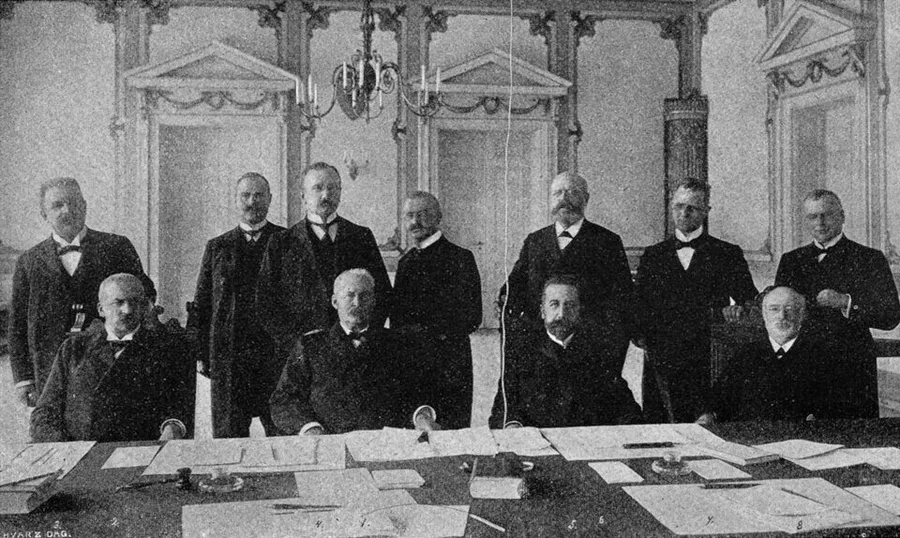 K. Nyström, Karlstad, published in Hvar 8 Dag (1905) Published within weeks of the signing, this 1905 photograph shows the actual Norwegian and Swedish negotiators who met at Karlstad and worked out the peaceful terms — border demilitarisation, separate foreign affairs — that dissolved the ninety-one-year union on 23 September 1905. Diplomatic agreement signed at Karlstad on 23 September
1905 between Norway and Sweden, formally ending the ninety-
one-year personal union. Ratified by both parliaments in
October 1905. The Agreement arranged the procedures for
the dissolution: Norway agreed to dismantle its eastern
border fortifications and participate in a newly
demilitarised border zone of about 60 kilometres; the two
countries agreed to separate conduct of foreign affairs;
commercial, transit, and reindeer-grazing arrangements
across the new state border were specified. Oscar II's
formal renunciation of the Norwegian throne followed on 26
October 1905. One of the most remarkable peaceful state-
dissolutions in European history.
, signed on the twenty-third of September 1905 and ratified by both parliaments in October, formally dissolves the union, requires Norway to tear down its own border fortifications inside a newly demilitarized zone, and lays out the procedures by which Norway will conduct its now-separate foreign relations. The Swedish king Oscar II formally renounces his Norwegian throne and his Bernadotte-dynasty descendants’ claim to it on the twenty-sixth of October 1905. The Storting receives his renunciation on the twenty-seventh. The ninety-one-year personal union is over.
K. Nyström, Karlstad, published in Hvar 8 Dag (1905) Published within weeks of the signing, this 1905 photograph shows the actual Norwegian and Swedish negotiators who met at Karlstad and worked out the peaceful terms — border demilitarisation, separate foreign affairs — that dissolved the ninety-one-year union on 23 September 1905. Diplomatic agreement signed at Karlstad on 23 September
1905 between Norway and Sweden, formally ending the ninety-
one-year personal union. Ratified by both parliaments in
October 1905. The Agreement arranged the procedures for
the dissolution: Norway agreed to dismantle its eastern
border fortifications and participate in a newly
demilitarised border zone of about 60 kilometres; the two
countries agreed to separate conduct of foreign affairs;
commercial, transit, and reindeer-grazing arrangements
across the new state border were specified. Oscar II's
formal renunciation of the Norwegian throne followed on 26
October 1905. One of the most remarkable peaceful state-
dissolutions in European history.
, signed on the twenty-third of September 1905 and ratified by both parliaments in October, formally dissolves the union, requires Norway to tear down its own border fortifications inside a newly demilitarized zone, and lays out the procedures by which Norway will conduct its now-separate foreign relations. The Swedish king Oscar II formally renounces his Norwegian throne and his Bernadotte-dynasty descendants’ claim to it on the twenty-sixth of October 1905. The Storting receives his renunciation on the twenty-seventh. The ninety-one-year personal union is over.
Prince Carl of Denmark
The question of what kind of state Norway is to be next is decided over the autumn. The Storting has reserved the option of either monarchy or republic, and the choice is to be made by the Norwegian people. The Storting’s preferred option is monarchy, partly because the Norwegian government anticipates that a king will give the new state more diplomatic weight in the European system, and partly because the moderate-conservative majority in the Storting is uncomfortable with the republican option. The Storting approaches Prince Carl of Denmark 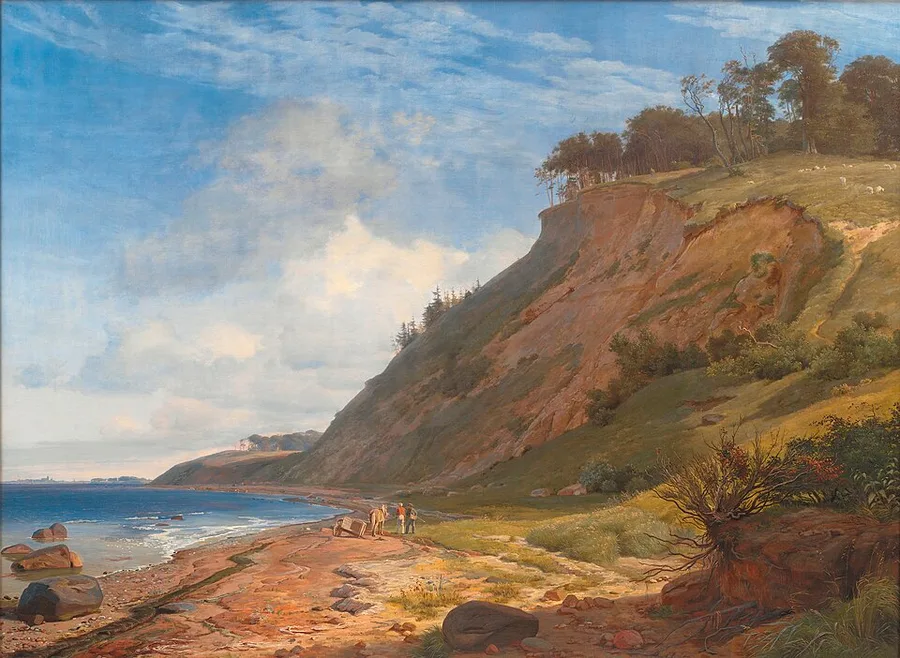 Johan Thomas Lundbye, En dansk kyst (A Danish Coast, 1843), Statens Museum for Kunst Lundbye painted this stretch of Roskilde Fjord shoreline in 1843 and titled it simply "A Danish Coast" — a Golden Age portrait of the low, mild landscape of Denmark itself, the neighbour kingdom that ran the joint Scandinavian monarchy from Copenhagen and governed Norway for close to four centuries. The southernmost of the three Scandinavian kingdoms,
consisting of the Jutland peninsula and the islands between
Jutland and the Swedish coast. Unified under Harald Bluetooth
in the late tenth century and Christianised in his reign,
Denmark was the dominant Scandinavian power through most of
the medieval and early modern centuries. From the 1397
Kalmar Union onward Denmark ran the joint Scandinavian
monarchy from Copenhagen; after Sweden left the union in
1523, Denmark and Norway remained joined as the Dano-
Norwegian state until 1814, with Norway governed as a Danish
province through that period.
Also discussed in The Long Fall — the sudden loss of Norwegian nobility, the end of the kings, and half of Norway gone foreverThe 400-Year Night — when the Northern Lion lay dormantWorld War II — the King’s “No” and the Nazis in Norway , a thirty-three-year-old career naval officer who is married to Maud of Wales
Johan Thomas Lundbye, En dansk kyst (A Danish Coast, 1843), Statens Museum for Kunst Lundbye painted this stretch of Roskilde Fjord shoreline in 1843 and titled it simply "A Danish Coast" — a Golden Age portrait of the low, mild landscape of Denmark itself, the neighbour kingdom that ran the joint Scandinavian monarchy from Copenhagen and governed Norway for close to four centuries. The southernmost of the three Scandinavian kingdoms,
consisting of the Jutland peninsula and the islands between
Jutland and the Swedish coast. Unified under Harald Bluetooth
in the late tenth century and Christianised in his reign,
Denmark was the dominant Scandinavian power through most of
the medieval and early modern centuries. From the 1397
Kalmar Union onward Denmark ran the joint Scandinavian
monarchy from Copenhagen; after Sweden left the union in
1523, Denmark and Norway remained joined as the Dano-
Norwegian state until 1814, with Norway governed as a Danish
province through that period.
Also discussed in The Long Fall — the sudden loss of Norwegian nobility, the end of the kings, and half of Norway gone foreverThe 400-Year Night — when the Northern Lion lay dormantWorld War II — the King’s “No” and the Nazis in Norway , a thirty-three-year-old career naval officer who is married to Maud of Wales 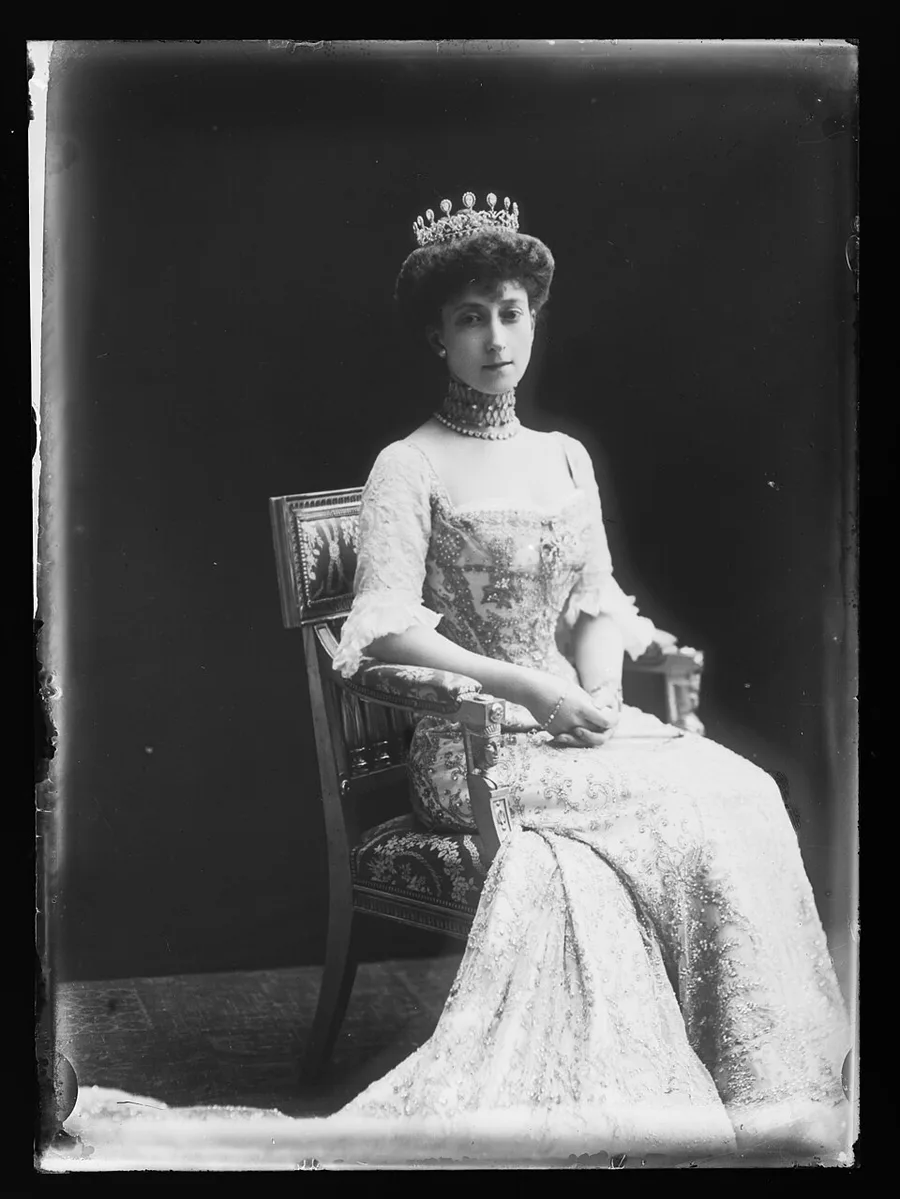 National Library of Norway, Dronning Maud (1906) Maud, King Edward VII's daughter, became Queen of Norway when her husband accepted the throne as Haakon VII in November 1905; this 1906 portrait shows her in the coronation year, the British royal connection she embodied a key diplomatic asset for the new kingdom. Queen of Norway (1869–1938), consort of Haakon VII from his
1905 accession until her death. Born Princess Maud of
Wales on 26 November 1869, the youngest daughter of the
future King Edward VII of Britain and Alexandra of
Denmark; granddaughter of Queen Victoria. Married her
first cousin Prince Carl of Denmark in 1896 and took the
regnal name Maud when he became Haakon VII of Norway. The
British connection she brought to the Norwegian royal
family was a significant diplomatic consideration in the
1905 selection: a Norwegian king married to a daughter of
the British royal house tied the new state to the great
European maritime power and to Norwegian shipping's
largest trading partner. Died in London in November 1938
and is buried at Akershus Castle.
of Britain, the youngest daughter of King Edward VII
National Library of Norway, Dronning Maud (1906) Maud, King Edward VII's daughter, became Queen of Norway when her husband accepted the throne as Haakon VII in November 1905; this 1906 portrait shows her in the coronation year, the British royal connection she embodied a key diplomatic asset for the new kingdom. Queen of Norway (1869–1938), consort of Haakon VII from his
1905 accession until her death. Born Princess Maud of
Wales on 26 November 1869, the youngest daughter of the
future King Edward VII of Britain and Alexandra of
Denmark; granddaughter of Queen Victoria. Married her
first cousin Prince Carl of Denmark in 1896 and took the
regnal name Maud when he became Haakon VII of Norway. The
British connection she brought to the Norwegian royal
family was a significant diplomatic consideration in the
1905 selection: a Norwegian king married to a daughter of
the British royal house tied the new state to the great
European maritime power and to Norwegian shipping's
largest trading partner. Died in London in November 1938
and is buried at Akershus Castle.
of Britain, the youngest daughter of King Edward VII 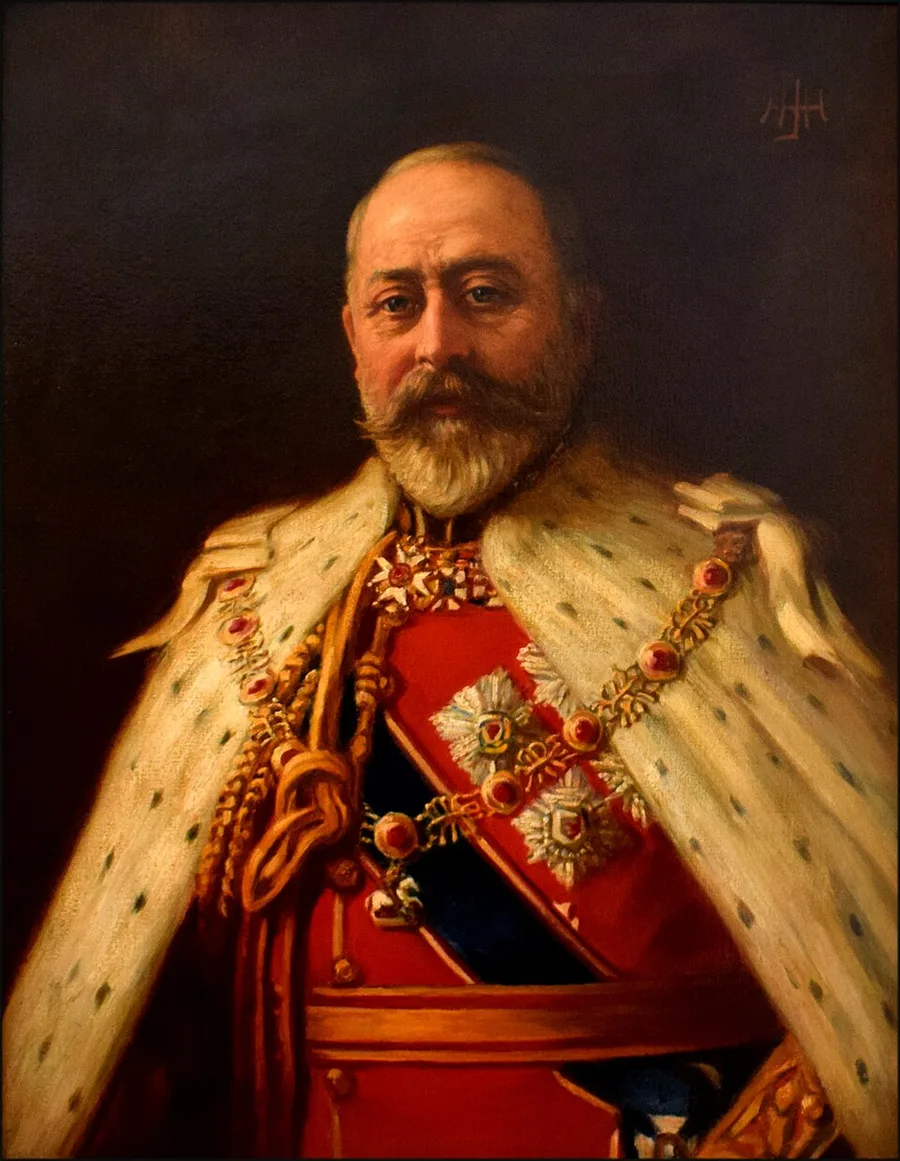 Henry John Hudson, Portrait of H.M. King Edward VII (1903) Edward VII was Maud's father and Haakon VII's father-in-law; his refusal to let Britain back any Swedish military move, and his backing of his daughter's new Norwegian throne, were decisive international constraints on Oscar II during the 1905 crisis. King of the United Kingdom and the British dominions and
Emperor of India (1841–1910), reigned January 1901 –
May 1910. Eldest son of Queen Victoria and Prince Albert
of Saxe-Coburg and Gotha. Father of Maud of Wales, who
married the future Haakon VII of Norway in 1896 and
became Queen of Norway at the 1905 dissolution. Edward
VII's diplomatic support for his daughter's new dynasty
and the unwillingness of the British government to back
any Swedish military move against Norway were among the
decisive international constraints on Oscar II that
summer. Known for the Edwardian Era of European diplomacy
he gave his name to and for his role in the Entente
Cordiale (1904) and the Anglo-Russian Convention (1907).
Died at Buckingham Palace; succeeded by his son George V.
. The Norwegian government wants him because his Danish background gives him a connection to Norway’s long Danish past, his British marriage gives him a connection to the great European maritime power and to the largest single trading partner of Norwegian shipping, and his naval career gives him an honorable record that the Norwegian public will respect. The explorer Fridtjof Nansen
Henry John Hudson, Portrait of H.M. King Edward VII (1903) Edward VII was Maud's father and Haakon VII's father-in-law; his refusal to let Britain back any Swedish military move, and his backing of his daughter's new Norwegian throne, were decisive international constraints on Oscar II during the 1905 crisis. King of the United Kingdom and the British dominions and
Emperor of India (1841–1910), reigned January 1901 –
May 1910. Eldest son of Queen Victoria and Prince Albert
of Saxe-Coburg and Gotha. Father of Maud of Wales, who
married the future Haakon VII of Norway in 1896 and
became Queen of Norway at the 1905 dissolution. Edward
VII's diplomatic support for his daughter's new dynasty
and the unwillingness of the British government to back
any Swedish military move against Norway were among the
decisive international constraints on Oscar II that
summer. Known for the Edwardian Era of European diplomacy
he gave his name to and for his role in the Entente
Cordiale (1904) and the Anglo-Russian Convention (1907).
Died at Buckingham Palace; succeeded by his son George V.
. The Norwegian government wants him because his Danish background gives him a connection to Norway’s long Danish past, his British marriage gives him a connection to the great European maritime power and to the largest single trading partner of Norwegian shipping, and his naval career gives him an honorable record that the Norwegian public will respect. The explorer Fridtjof Nansen 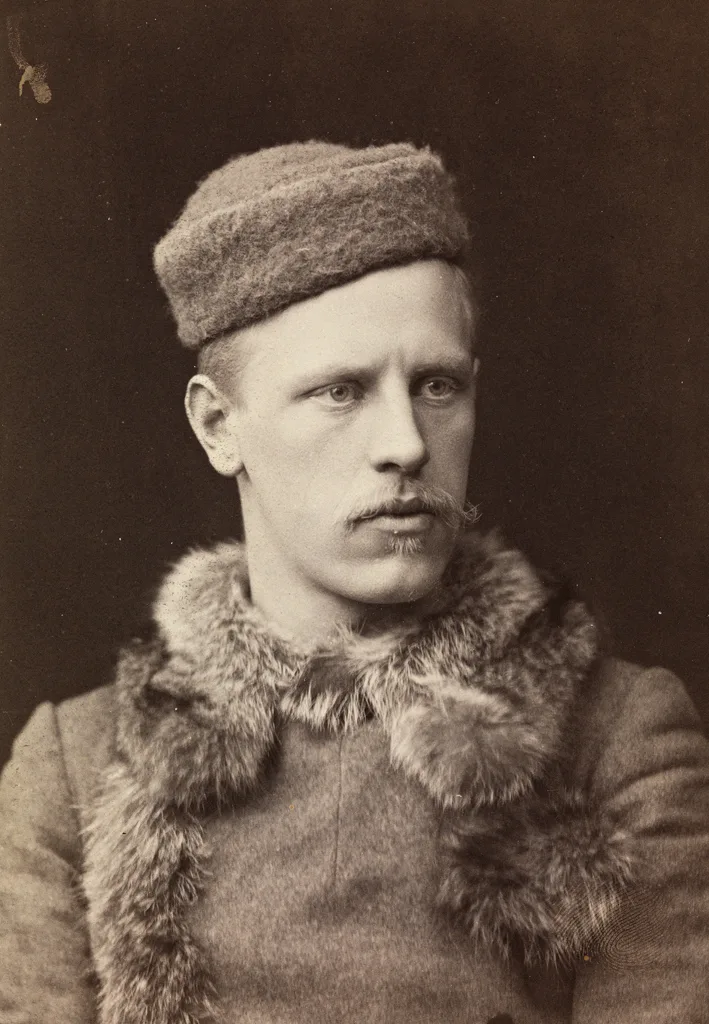 Ludwik Szaciński, Portrett av Fridtjof Nansen (1888), Nasjonalbiblioteket Szaciński photographs Nansen in 1888, the year he skis across the Greenland ice cap at twenty-six — the expedition that makes him the national exhibit for what an ordinary Sunday habit can grow into. Norwegian polar explorer, scientist, diplomat, and statesman (1861–1930). Led the first crossing of the Greenland ice sheet on skis in 1888, then let his ship Fram freeze into the Arctic pack ice from 1893 to 1896, drifting to a record northern latitude of 86°14′. Lectured and wrote widely on skiing and mountain life in the decades Norway built its outdoor-recreation identity toward independence from Sweden (1905), becoming friluftsliv's most visible public face. After the First World War, served as the League of Nations' High Commissioner for Refugees, repatriating roughly 450,000 prisoners of war and creating the Nansen passport, a travel document for stateless refugees. Awarded the Nobel Peace Prize in 1922 for this humanitarian work. Also discussed in Friluftsliv — the open-air lifeSøndagstur — the Sunday walk — the most internationally famous Norwegian alive, whose writings and unofficial diplomacy in London have spent the year lending the Norwegian case legitimacy abroad — is sent to Copenhagen to help persuade the prince to accept. Prince Carl accepts the offer in principle but requires that a Norwegian referendum first confirm the popular preference for monarchy over republic. The November 1905 monarchy referendum
 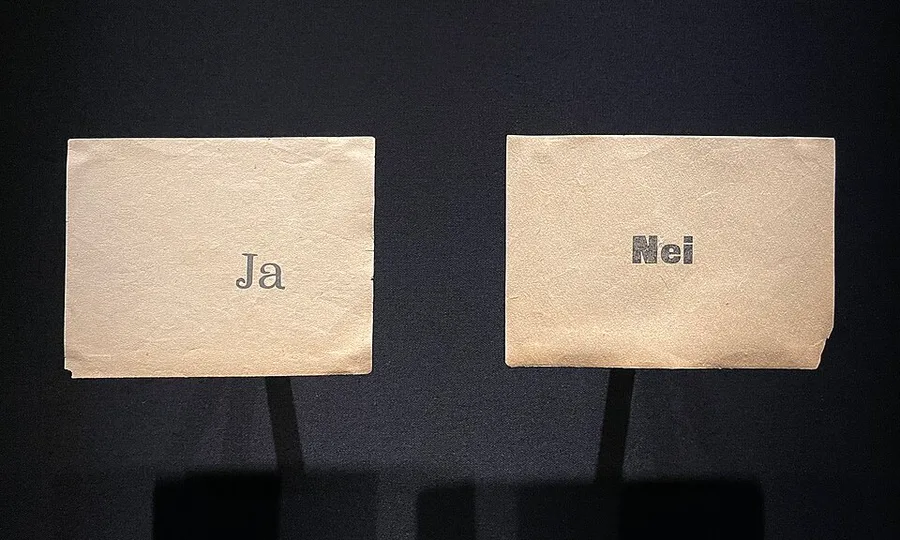 Wolfmann (photograph), 1905 monarchy-referendum ballot papers, National Library of Norway exhibition (2021), CC BY-SA 4.0 Prince Carl required popular confirmation before accepting Norway's throne; these are the actual 'ja' and 'nei' ballots Norwegians marked in the 12-13 November 1905 vote that chose monarchy over a republic by nearly four to one and cleared his path to becoming Haakon VII. Norwegian popular referendum held on 12 and 13 November
1905 to determine whether independent Norway should be a
monarchy or a republic. Held at the insistence of Prince
Carl of Denmark, who had been offered the Norwegian throne
by the Storting but who required popular confirmation of
the monarchical option before accepting. Result: 259,563
for monarchy, 69,264 for republic — roughly 78.9% for
monarchy, 21.1% for republic, on a turnout of about 75 per
cent. Five days after the result was certified, Prince
Carl accepted the throne and took the regnal name Haakon
VII. The two 1905 referendums (August on dissolution,
November on monarchy) together formed the popular
legitimation of the new Norwegian state.
. 259,563 Norwegians vote for monarchy. 69,264 vote for republic. The monarchical option wins by roughly seventy-nine percent. Prince Carl, satisfied that the country wants what he is willing to give, accepts the throne on the eighteenth of November.
Wolfmann (photograph), 1905 monarchy-referendum ballot papers, National Library of Norway exhibition (2021), CC BY-SA 4.0 Prince Carl required popular confirmation before accepting Norway's throne; these are the actual 'ja' and 'nei' ballots Norwegians marked in the 12-13 November 1905 vote that chose monarchy over a republic by nearly four to one and cleared his path to becoming Haakon VII. Norwegian popular referendum held on 12 and 13 November
1905 to determine whether independent Norway should be a
monarchy or a republic. Held at the insistence of Prince
Carl of Denmark, who had been offered the Norwegian throne
by the Storting but who required popular confirmation of
the monarchical option before accepting. Result: 259,563
for monarchy, 69,264 for republic — roughly 78.9% for
monarchy, 21.1% for republic, on a turnout of about 75 per
cent. Five days after the result was certified, Prince
Carl accepted the throne and took the regnal name Haakon
VII. The two 1905 referendums (August on dissolution,
November on monarchy) together formed the popular
legitimation of the new Norwegian state.
. 259,563 Norwegians vote for monarchy. 69,264 vote for republic. The monarchical option wins by roughly seventy-nine percent. Prince Carl, satisfied that the country wants what he is willing to give, accepts the throne on the eighteenth of November.
Haakon VII
He takes the regnal name Haakon VII 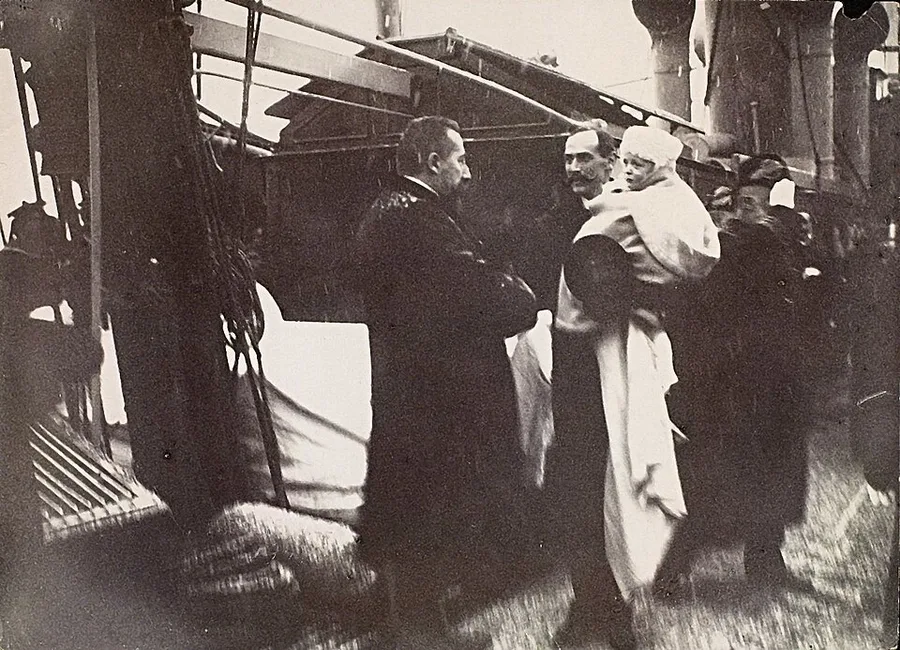 Frederik Hilfling-Rasmussen, the king's arrival, 25 November 1905, National Library of Norway The settlement gets its king: photographed on arrival day, 25 November 1905 — Prince Carl of Denmark, now Haakon VII, steps aboard the Norwegian command ship Heimdal in the Drøbak narrows with two-year-old Olav on his arm, greeted by Christian Michelsen, the prime minister who engineered the year. King of Norway 1905–1957. Born Prince Carl of Denmark in 1872, the
thirty-three-year-old career naval officer was offered the
Norwegian throne after the dissolution of the Norwegian-Swedish
union in 1905, accepted after a confirmatory referendum, and took
the regnal name Haakon — last used by a Norwegian king at the
death of Haakon VI in 1380. Crowned at Nidaros Cathedral on 22
June 1906 — the last coronation in Norwegian history; the
coronation requirement was struck from the constitution in 1908.
His refusal to recognise the Quisling government in April 1940
became the founding constitutional act of the Norwegian wartime
resistance. Returned to Oslo on 7 June 1945 after five years of
exile in London; died in 1957.
Also discussed in The King Who Became a Saint — how the Nordmen came to ChristWorld War II — the King’s “No” and the Nazis in NorwayPolitikk — the left, the right, and the Norwegian way , a name that had not been used by a Norwegian king since Haakon VI Magnusson
Frederik Hilfling-Rasmussen, the king's arrival, 25 November 1905, National Library of Norway The settlement gets its king: photographed on arrival day, 25 November 1905 — Prince Carl of Denmark, now Haakon VII, steps aboard the Norwegian command ship Heimdal in the Drøbak narrows with two-year-old Olav on his arm, greeted by Christian Michelsen, the prime minister who engineered the year. King of Norway 1905–1957. Born Prince Carl of Denmark in 1872, the
thirty-three-year-old career naval officer was offered the
Norwegian throne after the dissolution of the Norwegian-Swedish
union in 1905, accepted after a confirmatory referendum, and took
the regnal name Haakon — last used by a Norwegian king at the
death of Haakon VI in 1380. Crowned at Nidaros Cathedral on 22
June 1906 — the last coronation in Norwegian history; the
coronation requirement was struck from the constitution in 1908.
His refusal to recognise the Quisling government in April 1940
became the founding constitutional act of the Norwegian wartime
resistance. Returned to Oslo on 7 June 1945 after five years of
exile in London; died in 1957.
Also discussed in The King Who Became a Saint — how the Nordmen came to ChristWorld War II — the King’s “No” and the Nazis in NorwayPolitikk — the left, the right, and the Norwegian way , a name that had not been used by a Norwegian king since Haakon VI Magnusson 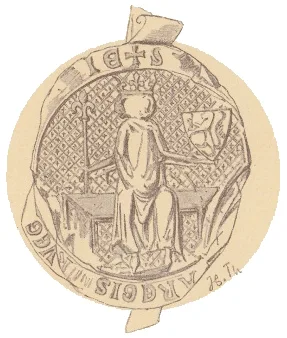 Drawing by Hakon Thorsen, after the seal of Haakon VI Magnusson (1358–76), public domain No painted portrait of Haakon VI survives; his royal seal — the wax impression that authenticated his charters — is the closest thing to an official image of the king whose marriage to the ten-year-old Margaret set up the Kalmar Union two generations later. King of Norway (1340–1380), only surviving son of Magnus VII
Eriksson and the last king of the Sverre dynasty in the male
line. Proclaimed king of Norway as a child in 1343, he assumed
personal rule at fifteen in 1355 when his father Magnus formally
handed over the Norwegian crown under pressure
from the depleted post-plague Council. Briefly co-ruled Sweden
in 1362–1364 before being driven out by Albert of Mecklenburg.
Married the ten-year-old Margaret of Denmark in 1363 — the
marriage that would, through their son Olav IV, join the
Norwegian and Danish crowns and open the way to the Kalmar
Union. Died in 1380 at forty, leaving the ten-year-old Olav
as king of both Norway and Denmark.
Also discussed in The Long Fall — the sudden loss of Norwegian nobility, the end of the kings, and half of Norway gone foreverThe 400-Year Night — when the Northern Lion lay dormant , who died in 1380. He chooses it deliberately to claim continuity with the medieval Norwegian dynasty whose extinction at Falsterbo
Drawing by Hakon Thorsen, after the seal of Haakon VI Magnusson (1358–76), public domain No painted portrait of Haakon VI survives; his royal seal — the wax impression that authenticated his charters — is the closest thing to an official image of the king whose marriage to the ten-year-old Margaret set up the Kalmar Union two generations later. King of Norway (1340–1380), only surviving son of Magnus VII
Eriksson and the last king of the Sverre dynasty in the male
line. Proclaimed king of Norway as a child in 1343, he assumed
personal rule at fifteen in 1355 when his father Magnus formally
handed over the Norwegian crown under pressure
from the depleted post-plague Council. Briefly co-ruled Sweden
in 1362–1364 before being driven out by Albert of Mecklenburg.
Married the ten-year-old Margaret of Denmark in 1363 — the
marriage that would, through their son Olav IV, join the
Norwegian and Danish crowns and open the way to the Kalmar
Union. Died in 1380 at forty, leaving the ten-year-old Olav
as king of both Norway and Denmark.
Also discussed in The Long Fall — the sudden loss of Norwegian nobility, the end of the kings, and half of Norway gone foreverThe 400-Year Night — when the Northern Lion lay dormant , who died in 1380. He chooses it deliberately to claim continuity with the medieval Norwegian dynasty whose extinction at Falsterbo 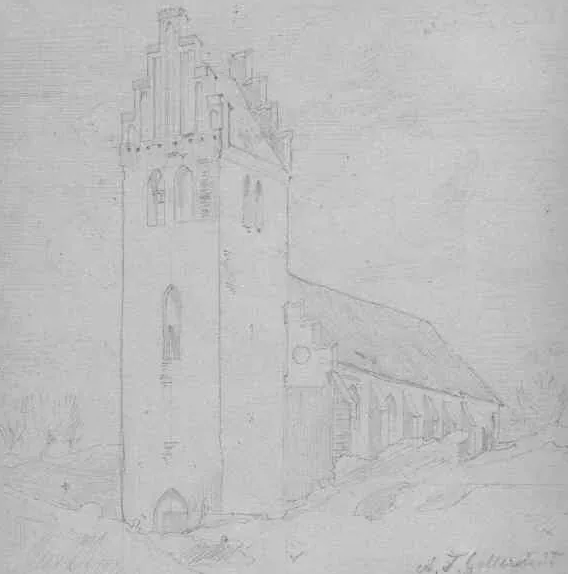 A. T. Gellerstedt, Falsterbo Church from the southwest (undated drawing), Riksantikvarieämbetet (KMB) Gellerstedt drew St Gertrude's, the medieval church of Falsterbo — the building left standing from the great herring-fair town where King Olav IV, the last of the sagas' Fairhair line, died at sixteen in August 1387. Small town on the southwestern tip of the Skåne peninsula,
facing the entrance to the Øresund. In the late medieval
period one of the most important seasonal trading sites in
the Baltic — the August Skånemarknad (Scania Fair) drew
Hanseatic merchants from across northern Europe to its
herring market. Falsterbo Castle was a Danish royal
residence through the fourteenth century. King Olav IV
Håkonsson of Norway and Denmark died there in August 1387
at sixteen, ending the medieval Norwegian male royal line
the sagas had traced from Harald Fairhair. Today a small
resort town in southwestern Sweden.
Also discussed in The Long Fall — the sudden loss of Norwegian nobility, the end of the kings, and half of Norway gone foreverThe 400-Year Night — when the Northern Lion lay dormant seven years later ended the country’s independent royal line. He calls himself Haakon VII, numbering himself as the seventh king of that name in Norwegian history, the previous six being medieval. His infant son, born at Sandringham
A. T. Gellerstedt, Falsterbo Church from the southwest (undated drawing), Riksantikvarieämbetet (KMB) Gellerstedt drew St Gertrude's, the medieval church of Falsterbo — the building left standing from the great herring-fair town where King Olav IV, the last of the sagas' Fairhair line, died at sixteen in August 1387. Small town on the southwestern tip of the Skåne peninsula,
facing the entrance to the Øresund. In the late medieval
period one of the most important seasonal trading sites in
the Baltic — the August Skånemarknad (Scania Fair) drew
Hanseatic merchants from across northern Europe to its
herring market. Falsterbo Castle was a Danish royal
residence through the fourteenth century. King Olav IV
Håkonsson of Norway and Denmark died there in August 1387
at sixteen, ending the medieval Norwegian male royal line
the sagas had traced from Harald Fairhair. Today a small
resort town in southwestern Sweden.
Also discussed in The Long Fall — the sudden loss of Norwegian nobility, the end of the kings, and half of Norway gone foreverThe 400-Year Night — when the Northern Lion lay dormant seven years later ended the country’s independent royal line. He calls himself Haakon VII, numbering himself as the seventh king of that name in Norwegian history, the previous six being medieval. His infant son, born at Sandringham 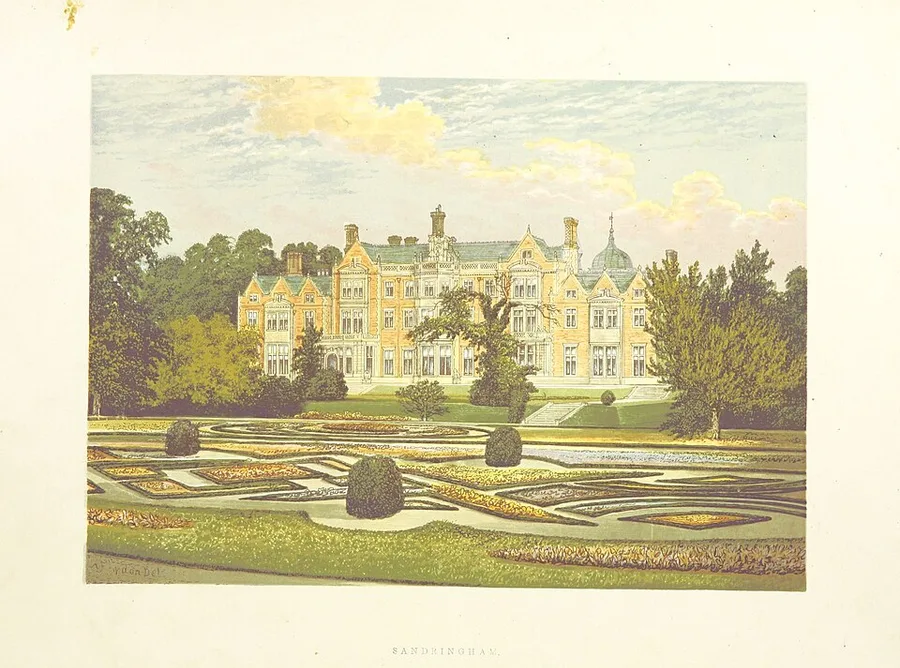 Illustration from Francis Orpen Morris, The County Seats of Great Britain and Ireland (1879), British Library Sandringham, the Wales family's Norfolk estate, was the birthplace of the future King Olav V on 2 July 1903, born there to Prince Carl and Princess Maud two years before the family took the Norwegian crown. Sandringham House — the country residence of the British
royal family in north Norfolk, England, near the village of
Sandringham about eight miles northeast of King's Lynn.
Built in the 1870s for Albert Edward, Prince of Wales (later
Edward VII), as a private royal estate distinct from the
state-owned Buckingham Palace and Windsor Castle. Birthplace
of the future King Olav V of Norway on 2 July 1903 (born
Prince Alexander Edward Christian Frederik of Denmark to
Prince Carl of Denmark and Princess Maud of Wales). Renamed
Olav at the family's arrival in Norway in 1905. Still a
privately held royal residence and the British monarch's
traditional Christmas residence.
in 1903 and christened Alexander, is renamed Olav V
Illustration from Francis Orpen Morris, The County Seats of Great Britain and Ireland (1879), British Library Sandringham, the Wales family's Norfolk estate, was the birthplace of the future King Olav V on 2 July 1903, born there to Prince Carl and Princess Maud two years before the family took the Norwegian crown. Sandringham House — the country residence of the British
royal family in north Norfolk, England, near the village of
Sandringham about eight miles northeast of King's Lynn.
Built in the 1870s for Albert Edward, Prince of Wales (later
Edward VII), as a private royal estate distinct from the
state-owned Buckingham Palace and Windsor Castle. Birthplace
of the future King Olav V of Norway on 2 July 1903 (born
Prince Alexander Edward Christian Frederik of Denmark to
Prince Carl of Denmark and Princess Maud of Wales). Renamed
Olav at the family's arrival in Norway in 1905. Still a
privately held royal residence and the British monarch's
traditional Christmas residence.
in 1903 and christened Alexander, is renamed Olav V 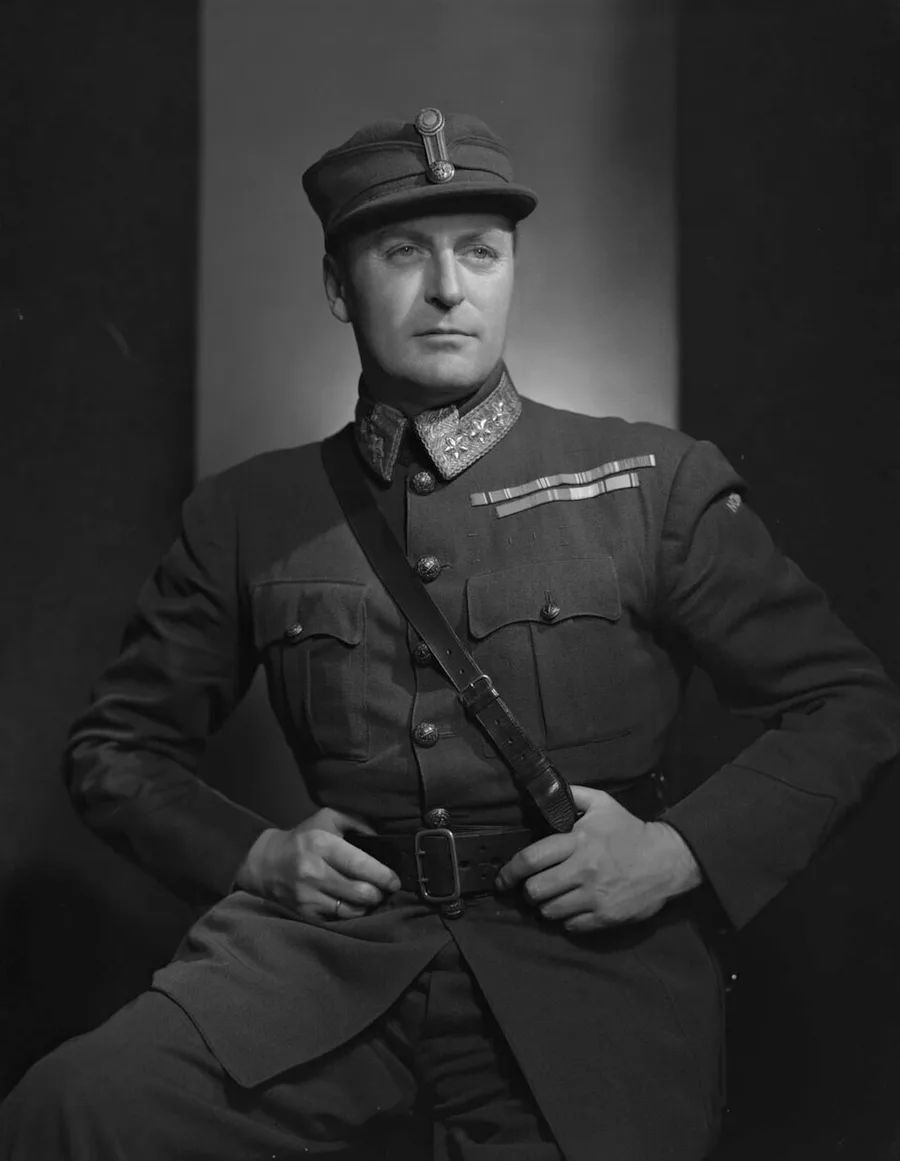 Yousuf Karsh, H.R.H. Crown Prince Olav of Norway (c. 1943), Library and Archives Canada Karsh's wartime London portrait of Crown Prince Olav in field uniform — the Sandringham-born infant of 1905, renamed for the saint-king, grown into the public face of the Norwegian resistance beside his father; from 1957 the *Folkekongen*, the People's King. King of Norway 1957–1991. Born Prince Alexander Edward Christian
Frederik in Sandringham, England, in 1903 to the future Haakon VII
and his British wife Princess Maud; renamed Olav on the family's
arrival in Norway in 1905, after the medieval patron saint of the
country. Crown Prince through the German occupation, during which
he served alongside his father as the public face of Norwegian
resistance from London. Acceded in 1957 on his father's death;
consecrated at Nidaros Cathedral in 1958 rather than crowned (the
coronation requirement had been removed in 1908). Bynamed
Folkekongen — the People's King — for his unaffected
approachability across thirty-four years on the throne.
Also discussed in The King Who Became a Saint — how the Nordmen came to Christ800,000 Norwegians Leave — the century that built a Second NorwayWorld War II — the King’s “No” and the Nazis in Norway after his arrival in Norway, claiming the same medieval continuity through the patron saint of the country. The new royal family arrives in Christiania on the twenty-fifth of November 1905 and is met at the harbor by a vast crowd of Norwegians. Haakon VII is crowned at Nidaros Cathedral
Yousuf Karsh, H.R.H. Crown Prince Olav of Norway (c. 1943), Library and Archives Canada Karsh's wartime London portrait of Crown Prince Olav in field uniform — the Sandringham-born infant of 1905, renamed for the saint-king, grown into the public face of the Norwegian resistance beside his father; from 1957 the *Folkekongen*, the People's King. King of Norway 1957–1991. Born Prince Alexander Edward Christian
Frederik in Sandringham, England, in 1903 to the future Haakon VII
and his British wife Princess Maud; renamed Olav on the family's
arrival in Norway in 1905, after the medieval patron saint of the
country. Crown Prince through the German occupation, during which
he served alongside his father as the public face of Norwegian
resistance from London. Acceded in 1957 on his father's death;
consecrated at Nidaros Cathedral in 1958 rather than crowned (the
coronation requirement had been removed in 1908). Bynamed
Folkekongen — the People's King — for his unaffected
approachability across thirty-four years on the throne.
Also discussed in The King Who Became a Saint — how the Nordmen came to Christ800,000 Norwegians Leave — the century that built a Second NorwayWorld War II — the King’s “No” and the Nazis in Norway after his arrival in Norway, claiming the same medieval continuity through the patron saint of the country. The new royal family arrives in Christiania on the twenty-fifth of November 1905 and is met at the harbor by a vast crowd of Norwegians. Haakon VII is crowned at Nidaros Cathedral 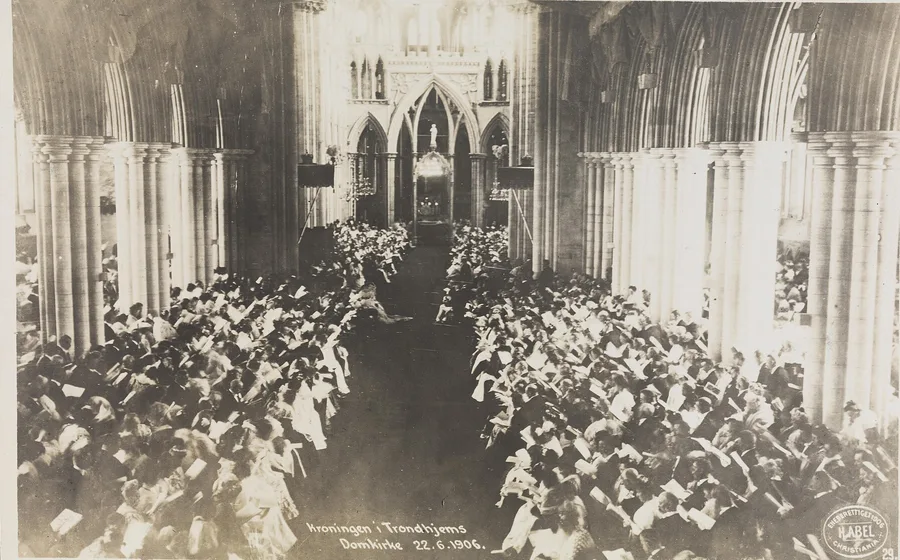 H. Abel (publisher), Kroningen i Trondhjems Domkirke 22.6.1906, National Library of Norway The settlement's formal completion photographed from inside: the congregation massed in the nave on 22 June 1906 for the crowning of Haakon VII — the first coronation of a king of an independent Norway ever held in the cathedral. The principal cathedral of Norway and the burial place of Saint
Olav, on the bank of the Nid River in Trondheim. Built and rebuilt
in stages from the late eleventh through the early fourteenth
centuries around the shrine site at the cathedral's east end. The
octagonal east end, raised directly over Olav's grave, was the
devotional core of the medieval building. Substantially damaged
by fires and the 1531 lightning strike, then by neglect across the
Lutheran centuries. The west front a visitor sees today is a
nineteenth- and twentieth-century reconstruction, completed only
in 1983. The cathedral is the coronation and consecration church
of Norwegian kings; Haakon VII was crowned there in 1906, Olav V
consecrated in 1958, Harald V in 1991.
On the trip Day 3 of the trip brings the Gråhårsklubben (the Oldsters) to
Nidaros Cathedral. The shrine is gone but
the spot is marked on the cathedral floor in the octagonal east
end. The west front is the twentieth-century reconstruction of
the face the medieval pilgrims saw. The pilgrim road comes in
past the south door — the same door medieval pilgrims walked
through.
Nidaros Cathedral, Trondheim Also discussed in The King Who Became a Saint — how the Nordmen came to ChristA Catholic Norway — the faith that gave the kingdom its first institutions and the stave churchesThe Crusades?!!!! — sixty ships from Bergen, bound for the Holy LandThe Golden Age — a North Atlantic empire … reaching farther than you thinkThe Long Fall — the sudden loss of Norwegian nobility, the end of the kings, and half of Norway gone foreverThe 400-Year Night — when the Northern Lion lay dormantThe Reformation, 1537 — one church eradicated and another imposedLutheran Norway and Pietism — a farmer named Hans Nielsen Hauge and a lay revival that could not be silencedTradisjoner — celebrations across the Norwegian year on the twenty-second of June 1906, the first coronation of a king of an independent Norway ever held at Nidaros — the cathedral’s three medieval coronations had all crowned union kings — and the fourth since the 1814 constitution fixed Nidaros as the coronation church, after Karl Johan
H. Abel (publisher), Kroningen i Trondhjems Domkirke 22.6.1906, National Library of Norway The settlement's formal completion photographed from inside: the congregation massed in the nave on 22 June 1906 for the crowning of Haakon VII — the first coronation of a king of an independent Norway ever held in the cathedral. The principal cathedral of Norway and the burial place of Saint
Olav, on the bank of the Nid River in Trondheim. Built and rebuilt
in stages from the late eleventh through the early fourteenth
centuries around the shrine site at the cathedral's east end. The
octagonal east end, raised directly over Olav's grave, was the
devotional core of the medieval building. Substantially damaged
by fires and the 1531 lightning strike, then by neglect across the
Lutheran centuries. The west front a visitor sees today is a
nineteenth- and twentieth-century reconstruction, completed only
in 1983. The cathedral is the coronation and consecration church
of Norwegian kings; Haakon VII was crowned there in 1906, Olav V
consecrated in 1958, Harald V in 1991.
On the trip Day 3 of the trip brings the Gråhårsklubben (the Oldsters) to
Nidaros Cathedral. The shrine is gone but
the spot is marked on the cathedral floor in the octagonal east
end. The west front is the twentieth-century reconstruction of
the face the medieval pilgrims saw. The pilgrim road comes in
past the south door — the same door medieval pilgrims walked
through.
Nidaros Cathedral, Trondheim Also discussed in The King Who Became a Saint — how the Nordmen came to ChristA Catholic Norway — the faith that gave the kingdom its first institutions and the stave churchesThe Crusades?!!!! — sixty ships from Bergen, bound for the Holy LandThe Golden Age — a North Atlantic empire … reaching farther than you thinkThe Long Fall — the sudden loss of Norwegian nobility, the end of the kings, and half of Norway gone foreverThe 400-Year Night — when the Northern Lion lay dormantThe Reformation, 1537 — one church eradicated and another imposedLutheran Norway and Pietism — a farmer named Hans Nielsen Hauge and a lay revival that could not be silencedTradisjoner — celebrations across the Norwegian year on the twenty-second of June 1906, the first coronation of a king of an independent Norway ever held at Nidaros — the cathedral’s three medieval coronations had all crowned union kings — and the fourth since the 1814 constitution fixed Nidaros as the coronation church, after Karl Johan 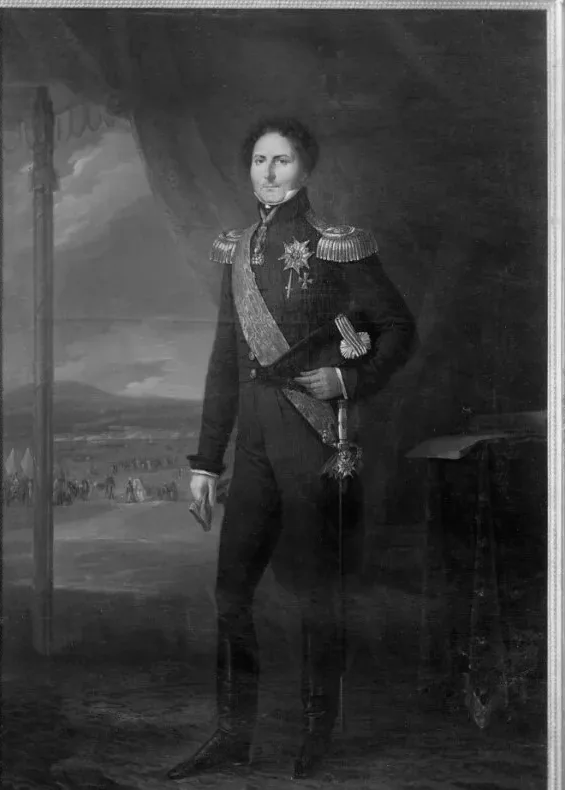 Fredric Westin, Karl XIV Johan, king of Sweden and Norway, Nationalmuseum (NMGrh 1943) Fredric Westin's state portrait of Karl XIV Johan, the former Napoleonic marshal who became king of Sweden and Norway after taking Norway from Denmark in 1814. King of Sweden and Norway (1763–1844), reigned 1818–1844.
Born Jean-Baptiste Bernadotte, the son of a French country
lawyer; rose through the French Revolutionary armies to
become one of Napoleon's marshals (1804) and Prince of
Pontecorvo (1806). Adopted in 1810 as heir to the childless
Swedish king Karl XIII, took the name Karl Johan, and ran
Swedish foreign policy as Crown Prince Regent. Joined the
Sixth Coalition against Napoleon and at the war's end
demanded Norway from Denmark as compensation. After the
brief Swedish-Norwegian war of summer 1814, accepted the
mild terms of the Convention of Moss that left Norway with
its own constitution, Storting, government, and church
under a shared crown. The Karl Johans gate boulevard in
central Oslo carries his name.
On the trip Day 2's e-bike tour rides the length of Karl Johans gate — the
central Oslo boulevard that carries his name — and passes the
Royal Palace begun as his Norwegian residence, with both groups
together in the capital.
Also discussed in The 400-Year Night — when the Northern Lion lay dormantThe Constitution That Saved a Nation — five radical weeks at Eidsvoll, 1814 in 1818, Carl IV in 1860, and Oscar II in 1873, all under the Swedish union. The coronation ceremony is the formal completion of the 1905 settlement.
Fredric Westin, Karl XIV Johan, king of Sweden and Norway, Nationalmuseum (NMGrh 1943) Fredric Westin's state portrait of Karl XIV Johan, the former Napoleonic marshal who became king of Sweden and Norway after taking Norway from Denmark in 1814. King of Sweden and Norway (1763–1844), reigned 1818–1844.
Born Jean-Baptiste Bernadotte, the son of a French country
lawyer; rose through the French Revolutionary armies to
become one of Napoleon's marshals (1804) and Prince of
Pontecorvo (1806). Adopted in 1810 as heir to the childless
Swedish king Karl XIII, took the name Karl Johan, and ran
Swedish foreign policy as Crown Prince Regent. Joined the
Sixth Coalition against Napoleon and at the war's end
demanded Norway from Denmark as compensation. After the
brief Swedish-Norwegian war of summer 1814, accepted the
mild terms of the Convention of Moss that left Norway with
its own constitution, Storting, government, and church
under a shared crown. The Karl Johans gate boulevard in
central Oslo carries his name.
On the trip Day 2's e-bike tour rides the length of Karl Johans gate — the
central Oslo boulevard that carries his name — and passes the
Royal Palace begun as his Norwegian residence, with both groups
together in the capital.
Also discussed in The 400-Year Night — when the Northern Lion lay dormantThe Constitution That Saved a Nation — five radical weeks at Eidsvoll, 1814 in 1818, Carl IV in 1860, and Oscar II in 1873, all under the Swedish union. The coronation ceremony is the formal completion of the 1905 settlement.
Since 1380
Norwegian independence — the actual operating sovereignty of a Norwegian state in modern conditions — returns in 1905 five hundred and twenty-five years after the death of Haakon VI in 1380 passed the Norwegian crown to his son Olav IV Håkonsson 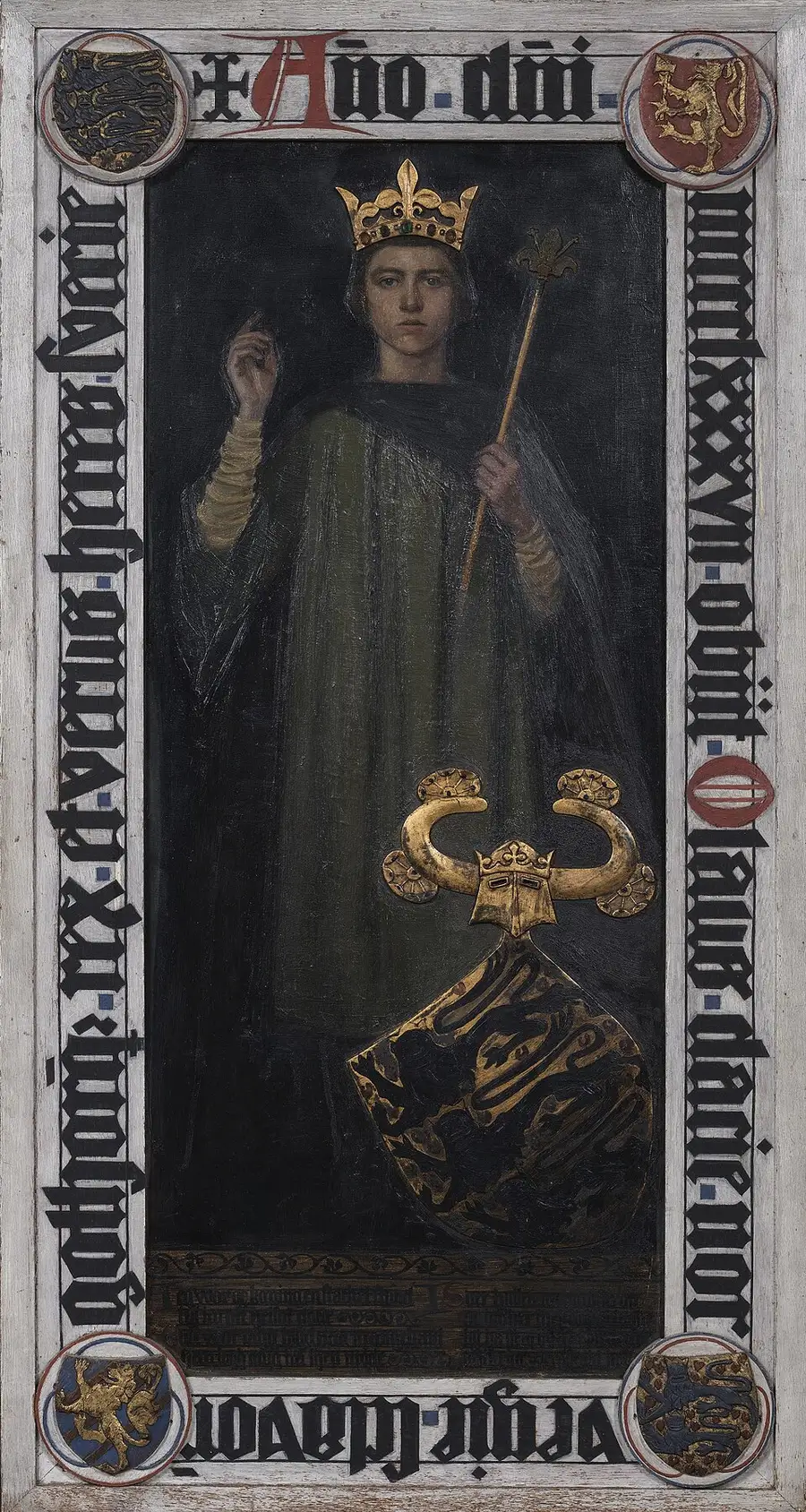 Agnes Slott-Møller, Oluf, Margrethes søn (1890s), public domain Danish National Romantic painter Agnes Slott-Møller devoted an 1890s canvas to the boy who briefly ruled two crowns at once — Olav IV, elected king of Denmark at five and of Norway at ten, dead at sixteen without an heir, the last king in the line the sagas traced to Harald Fairhair. King of Denmark and Norway (1370–1387), only son of King Haakon
VI of Norway and Margaret of Denmark. Born during the marriage
alliance his maternal grandfather Valdemar IV had arranged to
link the two crowns. Elected king of Denmark in May 1376 at
five years old after Valdemar's death without a male heir, with
his mother Margaret as regent. Became king of Norway in his own
right on his father Haakon's death in 1380, joining the two
crowns on a single ten-year-old. Died at Falsterbo on the
southern coast of Skåne in August 1387 at sixteen — cause
recorded only as illness — leaving no son and no will. With his
death ended the line of Norwegian kings that the sagas had
traced back to Harald Fairhair.
Also discussed in The Long Fall — the sudden loss of Norwegian nobility, the end of the kings, and half of Norway gone foreverThe 400-Year Night — when the Northern Lion lay dormant , who already held Denmark. The dynastic chain finally broke seven years later, in 1387, when Olav IV died at Falsterbo and his mother Margaret I of Denmark
Agnes Slott-Møller, Oluf, Margrethes søn (1890s), public domain Danish National Romantic painter Agnes Slott-Møller devoted an 1890s canvas to the boy who briefly ruled two crowns at once — Olav IV, elected king of Denmark at five and of Norway at ten, dead at sixteen without an heir, the last king in the line the sagas traced to Harald Fairhair. King of Denmark and Norway (1370–1387), only son of King Haakon
VI of Norway and Margaret of Denmark. Born during the marriage
alliance his maternal grandfather Valdemar IV had arranged to
link the two crowns. Elected king of Denmark in May 1376 at
five years old after Valdemar's death without a male heir, with
his mother Margaret as regent. Became king of Norway in his own
right on his father Haakon's death in 1380, joining the two
crowns on a single ten-year-old. Died at Falsterbo on the
southern coast of Skåne in August 1387 at sixteen — cause
recorded only as illness — leaving no son and no will. With his
death ended the line of Norwegian kings that the sagas had
traced back to Harald Fairhair.
Also discussed in The Long Fall — the sudden loss of Norwegian nobility, the end of the kings, and half of Norway gone foreverThe 400-Year Night — when the Northern Lion lay dormant , who already held Denmark. The dynastic chain finally broke seven years later, in 1387, when Olav IV died at Falsterbo and his mother Margaret I of Denmark 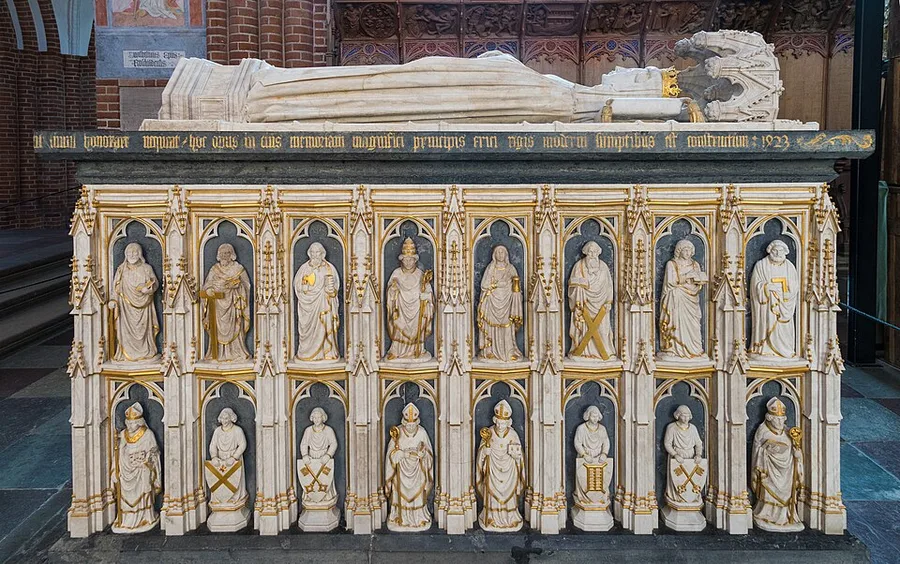 Photo: Jebulon, Tomb of Margrete I (1423), Roskilde Cathedral — CC0 Margrete's gilt alabaster sarcophagus at Roskilde, completed within a decade of her 1412 death, is where the queen who founded the Kalmar Union still lies — her effigy crowned and robed exactly as the constitutional language of three kingdoms could never quite name her. Queen-regnant of Denmark, Norway, and Sweden (1353–1412),
daughter of King Valdemar IV Atterdag of Denmark and wife of
King Haakon VI of Norway, mother of King Olav IV. After her
son's death at sixteen in 1387 she was acknowledged as ruler
in her own right by all three Scandinavian kingdoms in turn
— the first woman in Danish history acclaimed sovereign — and
was titled by the Swedes fullmäktig fru och rätt husbonde,
plenipotentiary lady and rightful master, the constitutional
language having no formula for a queen who governed three
kingdoms in her own name. In 1397 she gathered the three
realms at Kalmar to crown her great-nephew Erik of Pomerania
as joint king, founding the Kalmar Union. Died at Flensburg
in 1412.
Also discussed in The Long Fall — the sudden loss of Norwegian nobility, the end of the kings, and half of Norway gone foreverThe 400-Year Night — when the Northern Lion lay dormant took the joined kingdoms in her own name. The country had been bound to the Danish crown for more than four centuries and then under personal union with Sweden for ninety-one. By the time of Haakon VII’s coronation at Nidaros in 1906, the country was, for the first time since 1380, governed by an independent Norwegian crown. Few European countries have gone that long under a foreign crown and recovered with this little violence.
Photo: Jebulon, Tomb of Margrete I (1423), Roskilde Cathedral — CC0 Margrete's gilt alabaster sarcophagus at Roskilde, completed within a decade of her 1412 death, is where the queen who founded the Kalmar Union still lies — her effigy crowned and robed exactly as the constitutional language of three kingdoms could never quite name her. Queen-regnant of Denmark, Norway, and Sweden (1353–1412),
daughter of King Valdemar IV Atterdag of Denmark and wife of
King Haakon VI of Norway, mother of King Olav IV. After her
son's death at sixteen in 1387 she was acknowledged as ruler
in her own right by all three Scandinavian kingdoms in turn
— the first woman in Danish history acclaimed sovereign — and
was titled by the Swedes fullmäktig fru och rätt husbonde,
plenipotentiary lady and rightful master, the constitutional
language having no formula for a queen who governed three
kingdoms in her own name. In 1397 she gathered the three
realms at Kalmar to crown her great-nephew Erik of Pomerania
as joint king, founding the Kalmar Union. Died at Flensburg
in 1412.
Also discussed in The Long Fall — the sudden loss of Norwegian nobility, the end of the kings, and half of Norway gone foreverThe 400-Year Night — when the Northern Lion lay dormant took the joined kingdoms in her own name. The country had been bound to the Danish crown for more than four centuries and then under personal union with Sweden for ninety-one. By the time of Haakon VII’s coronation at Nidaros in 1906, the country was, for the first time since 1380, governed by an independent Norwegian crown. Few European countries have gone that long under a foreign crown and recovered with this little violence.
The settlement holds
The 1905 settlement holds. The Norwegian constitution drafted at Eidsvoll 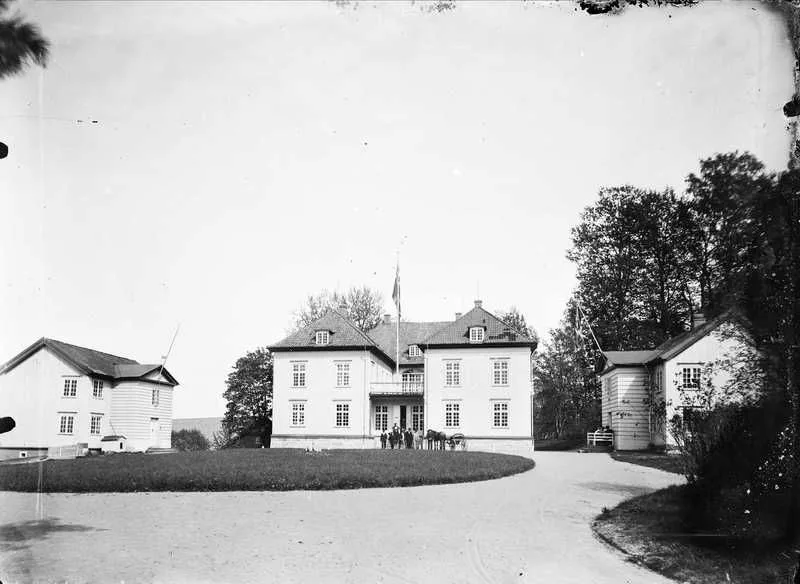 Unknown photographer, Eidsvollsbygningen (c. 1890), Oslo Museum, CC BY-SA 4.0 The white manor house at Eidsvoll where 112 delegates drafted and signed Norway's Constitution in 1814 — the building the whole constitutional story turns on. Municipality in Akershus county in southeastern Norway,
about seventy kilometres north of Oslo. Site of the
constitutional assembly that drafted and ratified the
Norwegian Constitution between 10 April and 20 May 1814.
The 112 delegates met at Eidsvollsbygningen, the country
house of the wealthy merchant and ironworks owner Carsten
Anker, who had offered the use of his estate at his own
expense. They signed the Constitution on 17 May 1814 —
Syttende mai, Norway's national day ever since — and
elected Prince Christian Frederik as king the same day.
The house is preserved as a national museum. Modern
Eidsvoll is also a stop on the main railway line north
from Oslo and the site of the country's principal
international airport (Oslo Gardermoen) ten kilometres south.
Also discussed in The 400-Year Night — when the Northern Lion lay dormantLutheran Norway and Pietism — a farmer named Hans Nielsen Hauge and a lay revival that could not be silencedThe Constitution That Saved a Nation — five radical weeks at Eidsvoll, 1814Tradisjoner — celebrations across the Norwegian yearPolitikk — the left, the right, and the Norwegian way in 1814 remains the operating constitution, with the new royal succession established under its terms. The Norwegian government continues to operate from Christiania, the city that will be renamed Oslo
Unknown photographer, Eidsvollsbygningen (c. 1890), Oslo Museum, CC BY-SA 4.0 The white manor house at Eidsvoll where 112 delegates drafted and signed Norway's Constitution in 1814 — the building the whole constitutional story turns on. Municipality in Akershus county in southeastern Norway,
about seventy kilometres north of Oslo. Site of the
constitutional assembly that drafted and ratified the
Norwegian Constitution between 10 April and 20 May 1814.
The 112 delegates met at Eidsvollsbygningen, the country
house of the wealthy merchant and ironworks owner Carsten
Anker, who had offered the use of his estate at his own
expense. They signed the Constitution on 17 May 1814 —
Syttende mai, Norway's national day ever since — and
elected Prince Christian Frederik as king the same day.
The house is preserved as a national museum. Modern
Eidsvoll is also a stop on the main railway line north
from Oslo and the site of the country's principal
international airport (Oslo Gardermoen) ten kilometres south.
Also discussed in The 400-Year Night — when the Northern Lion lay dormantLutheran Norway and Pietism — a farmer named Hans Nielsen Hauge and a lay revival that could not be silencedThe Constitution That Saved a Nation — five radical weeks at Eidsvoll, 1814Tradisjoner — celebrations across the Norwegian yearPolitikk — the left, the right, and the Norwegian way in 1814 remains the operating constitution, with the new royal succession established under its terms. The Norwegian government continues to operate from Christiania, the city that will be renamed Oslo 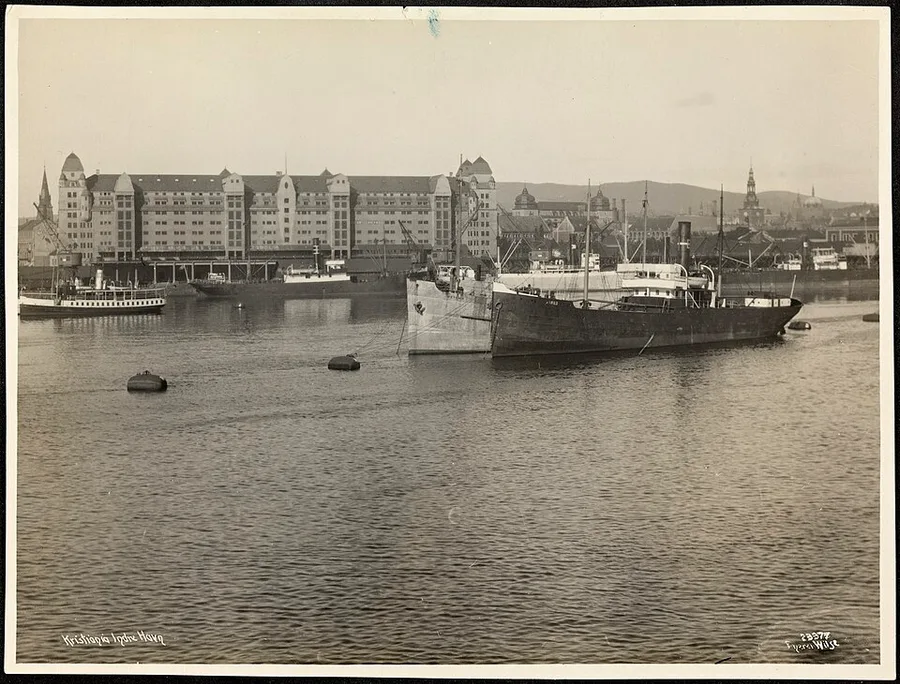 Anders Beer Wilse, Kristiania Indre Havn (1923), National Library of Norway Wilse's 1923 photograph of the inner harbor at Bjørvika, two years before Kristiania took back its old name Oslo — steamers at the quays beneath the spires of the city that grew from a medieval royal seat into Norway's capital. Capital of modern Norway, at the head of the Oslofjord on
the country's southeastern coast. Founded according to the
sagas by Harald Hardrada about 1049 and known through the
medieval period as a secondary royal seat behind Bergen and
Nidaros. Hákon V moved the royal residence permanently to
Oslo about 1300 and built Akershus Fortress to guard the
harbour. After a fire in 1624 the medieval town was
abandoned and Christian IV rebuilt the city to the west
under the new name Christiania (later Kristiania); the
name Oslo was restored in 1925. The original medieval
street pattern survives as the Gamlebyen district east of
the modern centre.
On the trip Days 1–2 belong to Oslo, with both groups together —
Roseslottet and the harbourside museums on Day 1, then the
Day-2 e-bike tour through Akershus Fortress, up Karl Johans
gate, and out to Vigeland Park.
Oslo Also discussed in The Long Fall — the sudden loss of Norwegian nobility, the end of the kings, and half of Norway gone foreverA Catholic Norway — the faith that gave the kingdom its first institutions and the stave churchesThe 400-Year Night — when the Northern Lion lay dormantThe Reformation, 1537 — one church eradicated and another imposedLutheran Norway and Pietism — a farmer named Hans Nielsen Hauge and a lay revival that could not be silencedThe Constitution That Saved a Nation — five radical weeks at Eidsvoll, 1814800,000 Norwegians Leave — the century that built a Second NorwayWorld War II — the King’s “No” and the Nazis in NorwayAlcohol and Vinmonopolet — when and where to buy a drinkEveryday etiquette — quiet voices, wide space, no smiling🚨 Emergencies - important numbers, hospitals, and what you can doLanding in Norway — off the plane in Oslo, where to go, step by stepMoney — currency, cards, prices, and tipping in 1925. The Norwegian Storting continues to be elected on the timetable it has been elected on since 1814. The next chapter of the country’s history opens in the long Edwardian summer of European peace that lasts from 1905 through to 1914 and breaks in the trench mud of the Western Front. Norway will remain neutral through the First World War. The new royal family will rule into the German occupation of the next world war, where Haakon VII’s refusal to ratify the Vidkun Quisling
Anders Beer Wilse, Kristiania Indre Havn (1923), National Library of Norway Wilse's 1923 photograph of the inner harbor at Bjørvika, two years before Kristiania took back its old name Oslo — steamers at the quays beneath the spires of the city that grew from a medieval royal seat into Norway's capital. Capital of modern Norway, at the head of the Oslofjord on
the country's southeastern coast. Founded according to the
sagas by Harald Hardrada about 1049 and known through the
medieval period as a secondary royal seat behind Bergen and
Nidaros. Hákon V moved the royal residence permanently to
Oslo about 1300 and built Akershus Fortress to guard the
harbour. After a fire in 1624 the medieval town was
abandoned and Christian IV rebuilt the city to the west
under the new name Christiania (later Kristiania); the
name Oslo was restored in 1925. The original medieval
street pattern survives as the Gamlebyen district east of
the modern centre.
On the trip Days 1–2 belong to Oslo, with both groups together —
Roseslottet and the harbourside museums on Day 1, then the
Day-2 e-bike tour through Akershus Fortress, up Karl Johans
gate, and out to Vigeland Park.
Oslo Also discussed in The Long Fall — the sudden loss of Norwegian nobility, the end of the kings, and half of Norway gone foreverA Catholic Norway — the faith that gave the kingdom its first institutions and the stave churchesThe 400-Year Night — when the Northern Lion lay dormantThe Reformation, 1537 — one church eradicated and another imposedLutheran Norway and Pietism — a farmer named Hans Nielsen Hauge and a lay revival that could not be silencedThe Constitution That Saved a Nation — five radical weeks at Eidsvoll, 1814800,000 Norwegians Leave — the century that built a Second NorwayWorld War II — the King’s “No” and the Nazis in NorwayAlcohol and Vinmonopolet — when and where to buy a drinkEveryday etiquette — quiet voices, wide space, no smiling🚨 Emergencies - important numbers, hospitals, and what you can doLanding in Norway — off the plane in Oslo, where to go, step by stepMoney — currency, cards, prices, and tipping in 1925. The Norwegian Storting continues to be elected on the timetable it has been elected on since 1814. The next chapter of the country’s history opens in the long Edwardian summer of European peace that lasts from 1905 through to 1914 and breaks in the trench mud of the Western Front. Norway will remain neutral through the First World War. The new royal family will rule into the German occupation of the next world war, where Haakon VII’s refusal to ratify the Vidkun Quisling  Henriksen & Steen, National Library of Norway, CC BY-SA 4.0 Quisling founded Nasjonal Samling and declared himself prime minister by radio on the night of the 9 April 1940 invasion; the Germans deposed him within a week, then restored him as puppet Ministerpräsident in 1942 — the arc this article follows to his 1945 execution. Norwegian fascist politician (1887–1945) and collaborator
prime minister of German-occupied Norway. Trained as an
army officer; served as Defence Minister 1931–1933.
Founded the Norwegian fascist party Nasjonal Samling in
1933; pre-war electoral support peaked at 2.2% in 1933 and
fell below 2% by 1936. Attempted an unauthorised coup the
evening of 9 April 1940 by broadcasting from the NRK
studio that he was forming a government; the Germans
pushed him aside within six days. Given the title
Ministerpräsident by Terboven on 1 February 1942 with
formal authority over a puppet Norwegian government.
Executed by firing squad at Akershus fortress on 24
October 1945. His name entered English as a common noun
for a traitorous collaborator.
Also discussed in World War II — the King’s “No” and the Nazis in Norway in early April 1940 will become the founding act of the Norwegian wartime resistance.
Henriksen & Steen, National Library of Norway, CC BY-SA 4.0 Quisling founded Nasjonal Samling and declared himself prime minister by radio on the night of the 9 April 1940 invasion; the Germans deposed him within a week, then restored him as puppet Ministerpräsident in 1942 — the arc this article follows to his 1945 execution. Norwegian fascist politician (1887–1945) and collaborator
prime minister of German-occupied Norway. Trained as an
army officer; served as Defence Minister 1931–1933.
Founded the Norwegian fascist party Nasjonal Samling in
1933; pre-war electoral support peaked at 2.2% in 1933 and
fell below 2% by 1936. Attempted an unauthorised coup the
evening of 9 April 1940 by broadcasting from the NRK
studio that he was forming a government; the Germans
pushed him aside within six days. Given the title
Ministerpräsident by Terboven on 1 February 1942 with
formal authority over a puppet Norwegian government.
Executed by firing squad at Akershus fortress on 24
October 1945. His name entered English as a common noun
for a traitorous collaborator.
Also discussed in World War II — the King’s “No” and the Nazis in Norway in early April 1940 will become the founding act of the Norwegian wartime resistance.
The seventh of June
The seventeenth of May celebrates the Constitution. The seventh of June quietly marks the moment that constitution finally got the country to itself. The country had been waiting for that moment since 1380.
The pause that began in 1380 ended on a Wednesday at noon in Christiania, with one hundred and seventeen men voting unanimously. No shot was fired.