Alcohol and Vinmonopolet — When and where to buy a drink
What Norwegians actually drink (pils, brown beer, akevitt, julebrygg), where you buy it (Vinmonopolet for anything stronger than 4.7%), and when. Norway's alcohol system runs on its own rhythms — plan ahead or go thirsty on a Sunday.
Norway treats alcohol with caution. The state runs the strong-drink monopoly, the hours are tight, and the taxes are heavy enough that a bottle costs roughly half again to double what it would in the US. None of this is hard once you know it.
What Norwegians actually drink
Pils. Mass-market Norwegian lager — Ringnes, Hansa, Mack, Aass — the everyday beer. Light, clean, around 4.5–4.7% ABV (engineered to fit under the grocery-store sales cutoff). The default in any bar; the default in any fridge.
Brown beers and craft. Norway has had a real craft-brewing scene since about 2010 — Nøgne Ø, Lervig, 7 Fjell, Kinn, Ægir are the names worth knowing, the last brewed at the Viking-hall brewpub on Flåm’s harbour. Bayer (a malty dark amber) and modern IPAs are both well-represented. Bars in Oslo and Bergen carry deep craft taps.
Akevitt 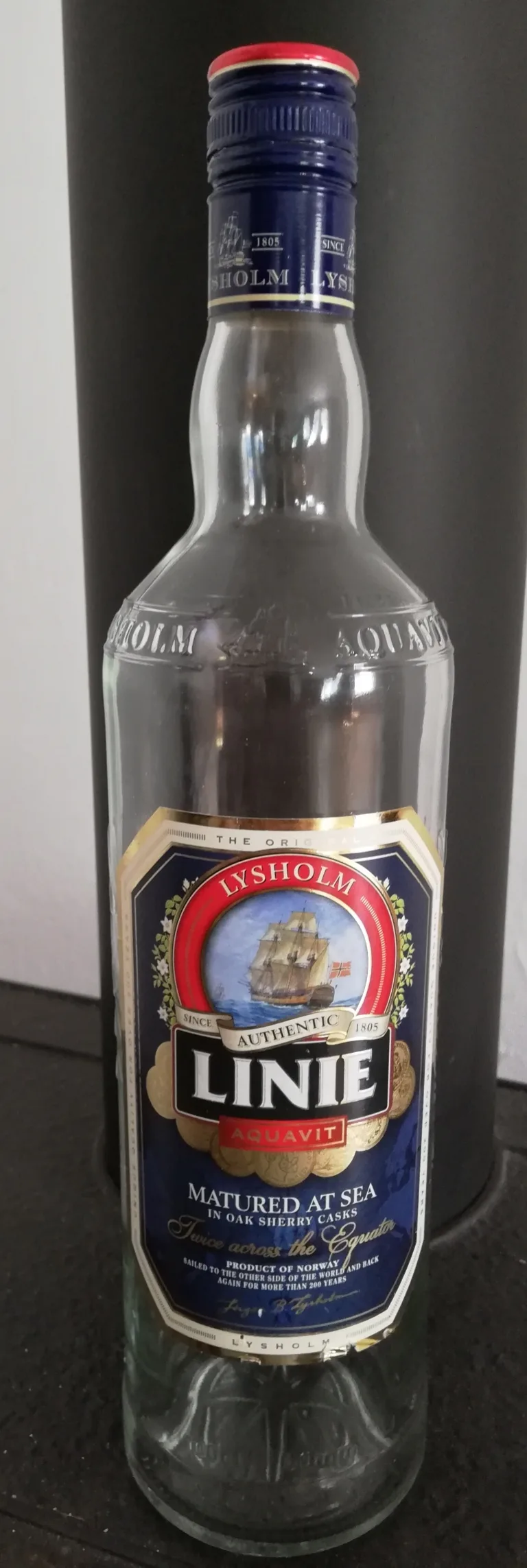 Mojmir Churavy, Lysholm LINIE Aquavit bottle (2023), CC0 The bottle shown is Lysholm's Linie Aquavit, whose label names the equator-crossing sea voyage that matures it in oak sherry casks — the single most storied bottling of the caraway spirit this card describes. Norway's signature distilled spirit — a grain- or potato-based spirit redistilled with caraway as its dominant spice, often alongside dill, fennel, anise, or citrus peel, and bottled around 40% alcohol by volume (the Nordic akvavit designation sets a minimum of 37.5%). The name descends from the Latin aqua vitae, "water of life." Its most storied expression is Linie akevitt — matured in oak sherry casks stowed in a ship's hold that crosses the equator (the linje) and back, a voyage the maker credits with rounding out the spirit; every bottle carries the name of the ship and the dates of its crossing on the label. Traditionally poured in small glasses alongside rich, fatty holiday food — lutefisk, smoked lamb, the Christmas table — where its bite is said to cut through the fat. In this article Given its own paragraph among the drinks worth knowing — the caraway-and-dill spirit sold at Vinmonopolet, its most mythologized bottling the equator-crossing Linie akevitt, and the natural pairing for a gift bought at the Gardermoen duty-free. On the trip A small glass of akevitt is the traditional accompaniment to a festive Norwegian meal, and if a Norwegian relative pours one during the trip, the polite answer is yes — refusing the offered glass reads as a minor slight, and the pour is small by design. Gardermoen's arrivals duty-free is the easiest place to pick up a bottle of Linie akevitt as a gift on the way in, before the group ever reaches a Vinmonopolet counter. Also discussed in Food and dining customs — having patience, free water, brunost on everything . The Norwegian spirit. A grain-based distillate flavored with caraway and often dill, fennel, or anise — about 40–46% ABV. The traditional partner for rich food: lutefisk, smoked lamb, the Christmas feast. The most-mythologized version is Linie aquavit — aged in oak sherry casks aboard a ship that crosses the equator twice (the linje), bottled with the ship’s name and the voyage dates printed on the back label.
Wine. Almost entirely imported, almost entirely bought through Vinmonopolet. Norwegian restaurants carry a serious wine list; the markup is real.
Julebrygg. The Christmas beer — a strong, malty, slightly spiced seasonal style released by Norwegian breweries in early November. Not on the July trip, but it is the most beloved Norwegian beer moment of the year.
Utepils. The first outdoor beer of spring. In practice it just means that on the first genuinely warm afternoon of the year, every café terrace and harbor patio fills up at once. By late July the phenomenon is well past — but the open-air drinking habit it kicks off is still in full swing.
Where you buy it
| Alcohol | Where | Hours (weekdays) | Saturday | Sunday |
|---|---|---|---|---|
| Beer ≤ 4.7% ABV | Grocery stores (Kiwi, Rema 1000, Coop, Meny) | Until 20:00 | Until 18:00 | No sale |
| Anything > 4.7% ABV — strong beer, wine, spirits | Vinmonopolet only | 10:00–18:00 (varies by store; many close 17:00–18:00) | 10:00–16:00 (smaller stores may close 15:00) | Closed |
| By the glass | Bars, restaurants, hotel bars | Per their license | Per their license | Per their license |
| Duty-free | Gardermoen on arrival (international arrivals only — the trip’s Bergen flight is domestic) | Open with flights | Open with flights | Open with flights |
A few notes that catch travelers out:
- Vinmonopolet closes for every public holiday. A holiday that falls on a Saturday closes it for the whole weekend. Check the calendar before depending on a Friday-night Vinmonopolet stop.
- The purchase age is 18 for beer and wine, 20 for spirits. Vinmonopolet and grocery checkouts ask for photo ID when there is any doubt.
- The grocery beer cutoff is enforced. At 20:01 on a Tuesday the cashier physically cannot ring up your beer; the register blocks it. Lines build up before the cutoff.
- The airport duty-free is often genuinely cheaper than Vinmonopolet for spirits and decent wine. If anyone wants a bottle of akevitt to bring to a Norwegian relative as a gift, buy it at Oslo Airport (Gardermoen)
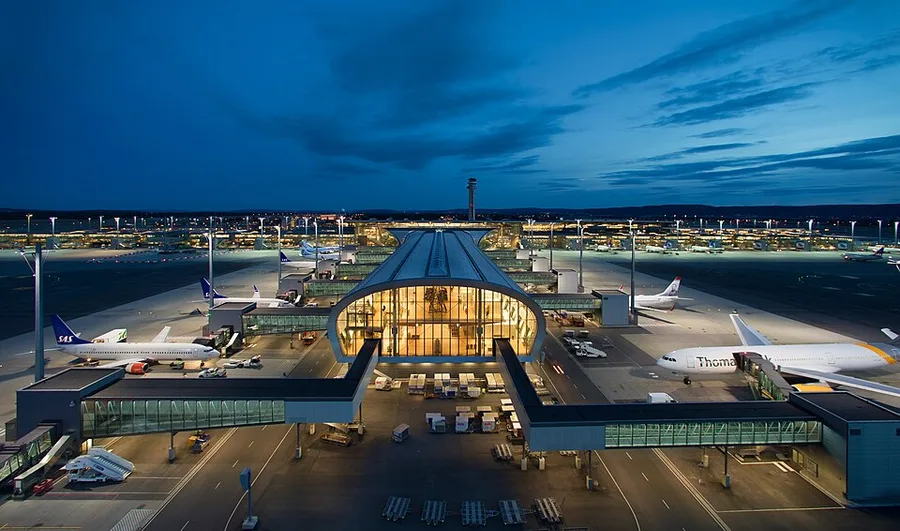 Espen Solli / Avinor Oslo lufthavn, Oslo Airport terminal night view (2017), CC BY 3.0 The terminal every traveler passes through on arrival, and again before the final morning's flights home — the Gardermobanen rail line into Oslo S starts just beneath this building. Norway's principal airport (IATA: OSL), opened on 8 October 1998 roughly 50 km north-northeast of central Oslo near the town of Gardermoen, in Ullensaker municipality, replacing the smaller in-town airport at Fornebu. Built at a cost of some NOK 11.4 billion, Gardermoen handles the overwhelming majority of Norway's international air traffic and anchors the dedicated Gardermobanen high-speed rail line into Oslo Central Station — one of the fastest airport-to-city rail connections in Europe, run by both Flytoget and the ordinary Vy trains. In this article The arrivals-hall duty-free shop, reached before the customs exit, is cheaper than any in-town Vinmonopolet for a bottle of akevitt bought as a gift. On the trip The whole family's Norway begins and ends at Gardermoen — everyone lands here before Day 1 and rides the train into Oslo S, and on Day 7 the group returns to spend one last Norwegian night near the airport before the flights home the next morning. Gardermoen Also discussed in Landing in Norway — off the plane in Oslo, where to go, step by stepHotels in Norway — frokost, check-in, and the luggage-room habit🚨 Emergencies - important numbers, hospitals, and what you can doMoney — currency, cards, prices, and tippingWhat to wear — the layering system, on the groundPublic transit basics — trains, trams, boats, and buying tickets on the way in, not later. It will be cheaper, and the arrivals Tax Free shop is in the baggage-claim hall, before the customs exit — buy it before you walk out.
 - Duty-free allowances are set per adult — roughly one litre of spirits, one and a half litres of wine, and two litres of beer. Worth knowing before loading up on gift bottles at arrivals.
Vinmonopolet
Norway’s state alcohol monopoly was established in 1922 in the aftermath of a national prohibition referendum, and is one of the most beloved-and-resented institutions in the country. About 350 stores nationwide. The selection is enormous and well-organized; staff are knowledgeable and will recommend specific bottles by what you are eating. Prices are public and uniform across the country. The store on Karl Johans gate 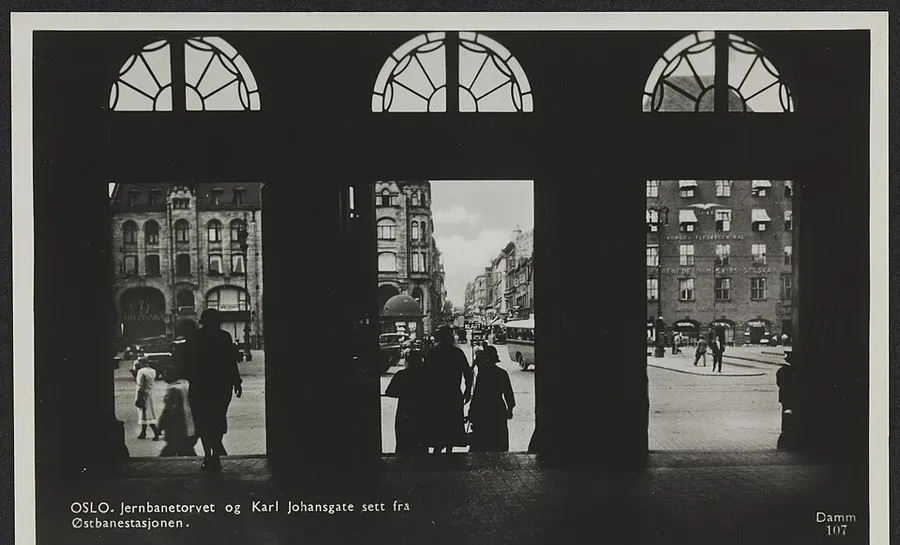 Unknown photographer, postcard "Jernbanetorvet og Karl Johansgate sett fra Østbanestasjonen", National Library of Norway, public domain This is the boulevard itself, photographed from the station end the family exits toward the Palace on foot and by e-bike — the same corridor Oslo S signage points travelers down on arrival. Oslo's principal boulevard, roughly 1.2 kilometers long, running from Jernbanetorget and Oslo S in the east to the Royal Palace at Slottsplassen in the west. Named in 1852 for the recently deceased King Karl Johan (Karl XIV Johan of Sweden and Norway), whose bronze equestrian statue by Brynjulf Bergslien has stood before the Palace since 1875. Its eastern stretch descends from streets laid inside Christian IV's seventeenth-century ramparts; the broader western avenue was built in the 1840s to connect the newly erected Palace to the rest of the city. The route passes the Storting (parliament), the National Theatre, the old University buildings, and the pond at Eidsvolls plass — Oslo's busiest pedestrian corridor and the default walking route between the station and the harbor. In this article The Day 2 e-bike route rolls down Karl Johans gate past a Vinmonopolet outlet, one of the state monopoly's central-Oslo locations. On the trip Every traveler walks a stretch of Karl Johans gate in the first two Oslo days — it's the natural route on foot between Oslo S and the Royal Palace and harbor beyond. On the Day 2 e-bike ride the whole group rolls up it to the Palace, and it's the easiest stretch to find a late-open shop for last picnic supplies before an early train departure. Oslo Also discussed in Everyday etiquette — quiet voices, wide space, no smilingLanding in Norway — off the plane in Oslo, where to go, step by stepPolitikk — the left, the right, and the Norwegian wayIdentitet — what it means to be Norwegian in Oslo
 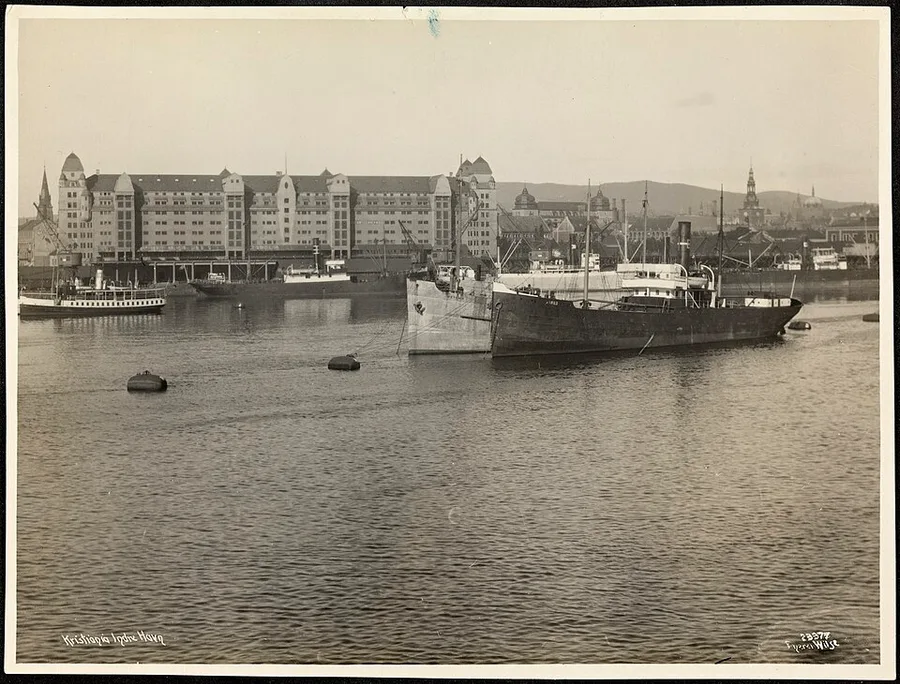 Anders Beer Wilse, Kristiania Indre Havn (1923), National Library of Norway Wilse's 1923 photograph of the inner harbor at Bjørvika, two years before Kristiania took back its old name Oslo — steamers at the quays beneath the spires of the city that grew from a medieval royal seat into Norway's capital. Capital of modern Norway, at the head of the Oslofjord on
the country's southeastern coast. Founded according to the
sagas by Harald Hardrada about 1049 and known through the
medieval period as a secondary royal seat behind Bergen and
Nidaros. Hákon V moved the royal residence permanently to
Oslo about 1300 and built Akershus Fortress to guard the
harbour. After a fire in 1624 the medieval town was
abandoned and Christian IV rebuilt the city to the west
under the new name Christiania (later Kristiania); the
name Oslo was restored in 1925. The original medieval
street pattern survives as the Gamlebyen district east of
the modern centre.
On the trip Days 1–2 belong to Oslo, with both groups together —
Roseslottet and the harbourside museums on Day 1, then the
Day-2 e-bike tour through Akershus Fortress, up Karl Johans
gate, and out to Vigeland Park.
Oslo Also discussed in The Long Fall — the sudden loss of Norwegian nobility, the end of the kings, and half of Norway gone foreverA Catholic Norway — the faith that gave the kingdom its first institutions and the stave churchesThe 400-Year Night — when the Northern Lion lay dormantThe Reformation, 1537 — one church eradicated and another imposedLutheran Norway and Pietism — a farmer named Hans Nielsen Hauge and a lay revival that could not be silencedThe Constitution That Saved a Nation — five radical weeks at Eidsvoll, 1814800,000 Norwegians Leave — the century that built a Second NorwayThe Quiet Revolution — how Norway won its independence without a warWorld War II — the King’s “No” and the Nazis in NorwayEveryday etiquette — quiet voices, wide space, no smiling🚨 Emergencies - important numbers, hospitals, and what you can doLanding in Norway — off the plane in Oslo, where to go, step by stepMoney — currency, cards, prices, and tipping and the one on Valkendorfsgaten, a few minutes from Bryggen
Anders Beer Wilse, Kristiania Indre Havn (1923), National Library of Norway Wilse's 1923 photograph of the inner harbor at Bjørvika, two years before Kristiania took back its old name Oslo — steamers at the quays beneath the spires of the city that grew from a medieval royal seat into Norway's capital. Capital of modern Norway, at the head of the Oslofjord on
the country's southeastern coast. Founded according to the
sagas by Harald Hardrada about 1049 and known through the
medieval period as a secondary royal seat behind Bergen and
Nidaros. Hákon V moved the royal residence permanently to
Oslo about 1300 and built Akershus Fortress to guard the
harbour. After a fire in 1624 the medieval town was
abandoned and Christian IV rebuilt the city to the west
under the new name Christiania (later Kristiania); the
name Oslo was restored in 1925. The original medieval
street pattern survives as the Gamlebyen district east of
the modern centre.
On the trip Days 1–2 belong to Oslo, with both groups together —
Roseslottet and the harbourside museums on Day 1, then the
Day-2 e-bike tour through Akershus Fortress, up Karl Johans
gate, and out to Vigeland Park.
Oslo Also discussed in The Long Fall — the sudden loss of Norwegian nobility, the end of the kings, and half of Norway gone foreverA Catholic Norway — the faith that gave the kingdom its first institutions and the stave churchesThe 400-Year Night — when the Northern Lion lay dormantThe Reformation, 1537 — one church eradicated and another imposedLutheran Norway and Pietism — a farmer named Hans Nielsen Hauge and a lay revival that could not be silencedThe Constitution That Saved a Nation — five radical weeks at Eidsvoll, 1814800,000 Norwegians Leave — the century that built a Second NorwayThe Quiet Revolution — how Norway won its independence without a warWorld War II — the King’s “No” and the Nazis in NorwayEveryday etiquette — quiet voices, wide space, no smiling🚨 Emergencies - important numbers, hospitals, and what you can doLanding in Norway — off the plane in Oslo, where to go, step by stepMoney — currency, cards, prices, and tipping and the one on Valkendorfsgaten, a few minutes from Bryggen 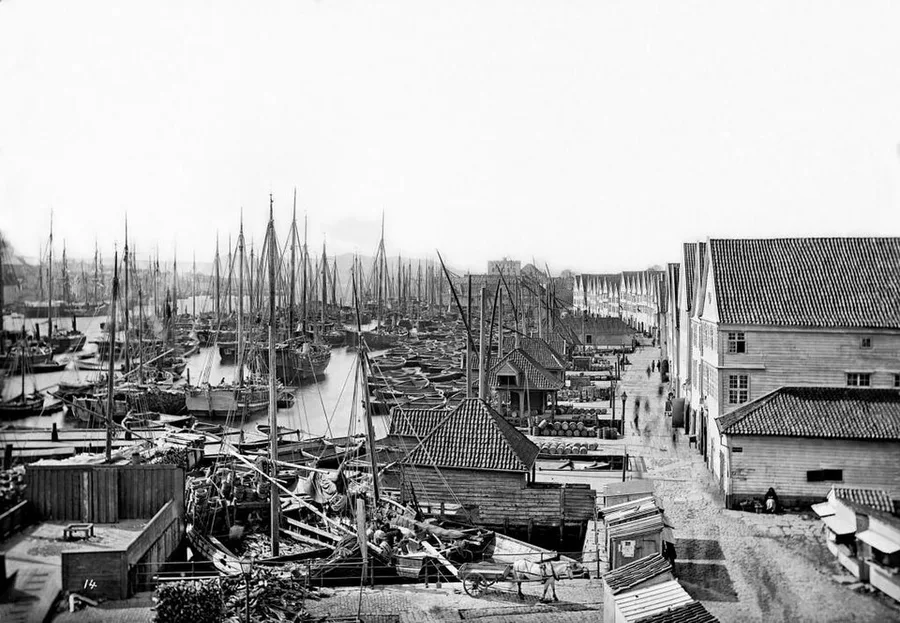 Knud Knudsen, Bryggen in Bergen (1865), University of Bergen Library Knudsen's 1865 photograph shows Bryggen still standing to its post-1702-fire medieval footprint -- the same wharf the Hanseatic kontor traded stockfish out of for four centuries, captured by one of Norway's first professional photographers. The Hanseatic wharf at Bergen — a long row of narrow
gable-fronted wooden warehouses and trading houses lining
the eastern shore of the Vågen harbour. From around 1360
the German Hansa established its Bergen kontor here, and
for nearly four hundred years (until 1754) the buildings
housed German merchants who controlled the export of
Norwegian stockfish to Catholic Europe. The structures
burned and were rebuilt repeatedly to the same medieval
footprint; the surviving wooden buildings (most after the
1702 fire) preserve the medieval urban plan. UNESCO World
Heritage site since 1979 and Bergen's most-visited landmark.
On the trip Day 4 in Bergen lands the Ungdommene (the Youngsters) directly
on the Bryggen waterfront — the wharf the Hanseatic trade in
Norwegian stockfish built and rebuilt for four centuries.
Also discussed in The Golden Age — a North Atlantic empire … reaching farther than you thinkThe Long Fall — the sudden loss of Norwegian nobility, the end of the kings, and half of Norway gone foreverThe Germans Who "Ruled" Bergen — the Hanseatic merchants on Bryggen WharfThe 400-Year Night — when the Northern Lion lay dormantRespecting nature — why you can roam and camp on private landWhat to wear — the layering system, on the ground in Bergen
Knud Knudsen, Bryggen in Bergen (1865), University of Bergen Library Knudsen's 1865 photograph shows Bryggen still standing to its post-1702-fire medieval footprint -- the same wharf the Hanseatic kontor traded stockfish out of for four centuries, captured by one of Norway's first professional photographers. The Hanseatic wharf at Bergen — a long row of narrow
gable-fronted wooden warehouses and trading houses lining
the eastern shore of the Vågen harbour. From around 1360
the German Hansa established its Bergen kontor here, and
for nearly four hundred years (until 1754) the buildings
housed German merchants who controlled the export of
Norwegian stockfish to Catholic Europe. The structures
burned and were rebuilt repeatedly to the same medieval
footprint; the surviving wooden buildings (most after the
1702 fire) preserve the medieval urban plan. UNESCO World
Heritage site since 1979 and Bergen's most-visited landmark.
On the trip Day 4 in Bergen lands the Ungdommene (the Youngsters) directly
on the Bryggen waterfront — the wharf the Hanseatic trade in
Norwegian stockfish built and rebuilt for four centuries.
Also discussed in The Golden Age — a North Atlantic empire … reaching farther than you thinkThe Long Fall — the sudden loss of Norwegian nobility, the end of the kings, and half of Norway gone foreverThe Germans Who "Ruled" Bergen — the Hanseatic merchants on Bryggen WharfThe 400-Year Night — when the Northern Lion lay dormantRespecting nature — why you can roam and camp on private landWhat to wear — the layering system, on the ground in Bergen 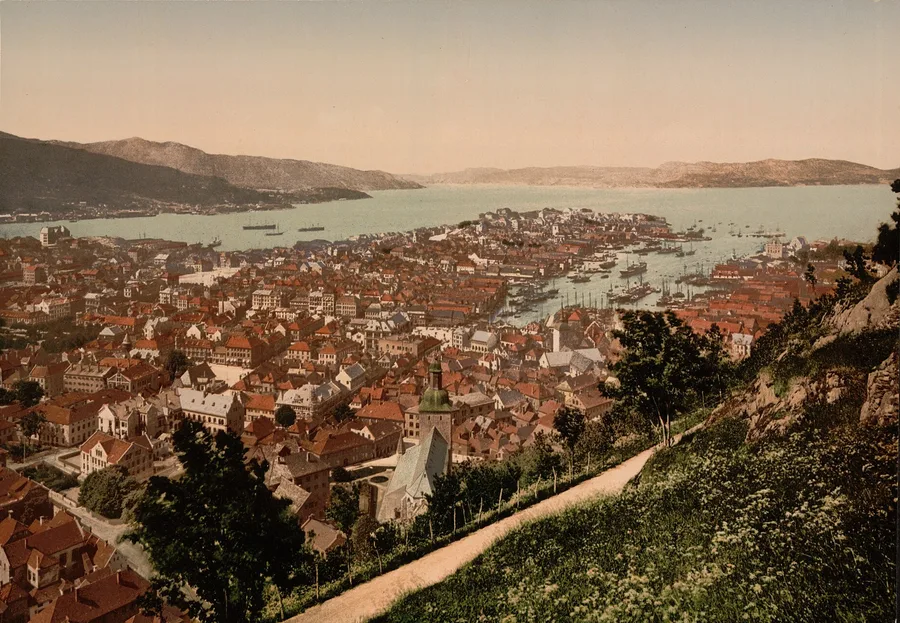 Photochrom print, General view from Fjeldveien, Bergen (c. 1890–1900), Library of Congress Bergen in the 1890s from the Fjellveien path on Fløyfjellet — the whole city between its mountains, Vågen harbour still crowded with sailing ships at its heart. For four centuries Norway's largest city, and the wharf through which the entire western export economy ran. Norway's western trading capital, founded around 1070 on the
inner Byfjorden. For four centuries the largest city in the
country and the wharf through which the entire western export
economy ran — dried cod from the Lofoten fisheries, stockpiled
and traded by the Hanseatic merchants at Bryggen from 1360 to
1754. Norway's commercial and intellectual heart through the
Hanseatic period; overtaken in size by Christiania (Oslo) in the
1830s. The painted wooden Bryggen wharf is on the UNESCO World
Heritage list and substantially what it was in the late
seventeenth century.
On the trip The Ungdommene (the Youngsters) reach Bergen late on Day 3
via the Norway-in-a-Nutshell train-and-ferry route from
Oslo. On the Day 4 morning they walk Bryggen and ride the
funicular up Mount Fløyen before flying back to Oslo and driving
on to Lillehammer that evening — a day ahead of the Gråhårsklubben
(the Oldsters), who spend the split days north in Trondheim and
the heritage country of Stjørdal, Hegra, and Kylloplass and come
south on Day 5.
Bergen Also discussed in The Germans Who "Ruled" Bergen — the Hanseatic merchants on Bryggen WharfBefore There Was Norway — petty kingdoms at the edge of the worldThe King Who Became a Saint — how the Nordmen came to ChristA Catholic Norway — the faith that gave the kingdom its first institutions and the stave churchesThe Long Fall — the sudden loss of Norwegian nobility, the end of the kings, and half of Norway gone foreverThe Golden Age — a North Atlantic empire … reaching farther than you thinkThe 400-Year Night — when the Northern Lion lay dormantThe Crusades?!!!! — sixty ships from Bergen, bound for the Holy LandThe Reformation, 1537 — one church eradicated and another imposedWorld War II — the King’s “No” and the Nazis in NorwayKraken — the island-sized beast, logged as factSjøormer — the serpents in the deep lakes and fjordsPesta — an old woman walking from farm to farmFossegrimen — the waterfall fiddler who teaches you to playEveryday etiquette — quiet voices, wide space, no smilingFood and dining customs — having patience, free water, brunost on everything🚨 Emergencies - important numbers, hospitals, and what you can doLanguage basics — just enough Norwegian to be politeWhat to wear — the layering system, on the ground , are both convenient to the trip’s itinerary.
Photochrom print, General view from Fjeldveien, Bergen (c. 1890–1900), Library of Congress Bergen in the 1890s from the Fjellveien path on Fløyfjellet — the whole city between its mountains, Vågen harbour still crowded with sailing ships at its heart. For four centuries Norway's largest city, and the wharf through which the entire western export economy ran. Norway's western trading capital, founded around 1070 on the
inner Byfjorden. For four centuries the largest city in the
country and the wharf through which the entire western export
economy ran — dried cod from the Lofoten fisheries, stockpiled
and traded by the Hanseatic merchants at Bryggen from 1360 to
1754. Norway's commercial and intellectual heart through the
Hanseatic period; overtaken in size by Christiania (Oslo) in the
1830s. The painted wooden Bryggen wharf is on the UNESCO World
Heritage list and substantially what it was in the late
seventeenth century.
On the trip The Ungdommene (the Youngsters) reach Bergen late on Day 3
via the Norway-in-a-Nutshell train-and-ferry route from
Oslo. On the Day 4 morning they walk Bryggen and ride the
funicular up Mount Fløyen before flying back to Oslo and driving
on to Lillehammer that evening — a day ahead of the Gråhårsklubben
(the Oldsters), who spend the split days north in Trondheim and
the heritage country of Stjørdal, Hegra, and Kylloplass and come
south on Day 5.
Bergen Also discussed in The Germans Who "Ruled" Bergen — the Hanseatic merchants on Bryggen WharfBefore There Was Norway — petty kingdoms at the edge of the worldThe King Who Became a Saint — how the Nordmen came to ChristA Catholic Norway — the faith that gave the kingdom its first institutions and the stave churchesThe Long Fall — the sudden loss of Norwegian nobility, the end of the kings, and half of Norway gone foreverThe Golden Age — a North Atlantic empire … reaching farther than you thinkThe 400-Year Night — when the Northern Lion lay dormantThe Crusades?!!!! — sixty ships from Bergen, bound for the Holy LandThe Reformation, 1537 — one church eradicated and another imposedWorld War II — the King’s “No” and the Nazis in NorwayKraken — the island-sized beast, logged as factSjøormer — the serpents in the deep lakes and fjordsPesta — an old woman walking from farm to farmFossegrimen — the waterfall fiddler who teaches you to playEveryday etiquette — quiet voices, wide space, no smilingFood and dining customs — having patience, free water, brunost on everything🚨 Emergencies - important numbers, hospitals, and what you can doLanguage basics — just enough Norwegian to be politeWhat to wear — the layering system, on the ground , are both convenient to the trip’s itinerary.
What the trip will probably want
- A bottle of wine for a dinner in someone’s home, or for the hotel room. Buy at Vinmonopolet, not the airport — they’ll have the better selection.
- A small bottle of akevitt as a gift for a Norwegian relative. Buy at Gardermoen duty-free on the way in.
- A six-pack of pils for the room. Any Kiwi or Rema 1000, before 20:00.
The 0.02 driving limit
Norway’s blood-alcohol limit for driving is The 0.02% blood-alcohol limit Norway's legal blood-alcohol limit for driving: 0.2 per mille, equivalent to 0.02% BAC — a quarter of the 0.08% limit common in the United States. The limit applies uniformly to every driver, with no separate, higher allowance for experienced license-holders. It was lowered from an earlier 0.5 per mille (0.05%) limit effective 1 January 2001, following Sweden's identical cut a decade earlier, part of a broader Nordic move toward near-zero-tolerance drink-driving law. In practice the limit means a single standard beer or glass of wine with a meal can put a driver over it, and Norwegian penalties for exceeding it — fines scaled to income, license suspension, and possible jail time at higher readings — are enforced strictly and escalate fast. In this article Gets its own closing section in the alcohol article too — the same 0.02% figure, framed as the reason the designated driver skips the akevitt and the wine at dinner. On the trip The Gråhårsklubben (the Oldsters) drive themselves for the Slektsreisen leg north to Trondheim, Hegra, and Kylloplass, which puts Norway's near-zero limit directly in play: whoever is behind the wheel that day skips the wine at dinner and the akevitt with the meal, full stop. The same rule holds for anyone renting a car on any other leg of the trip — one beer is already too many before driving. Also discussed in Driving in Norway — tolls, ferries, and a near-zero alcohol limit — effectively zero. A single beer at dinner puts you over. If anyone in the group drinks at dinner, the driver doesn’t.