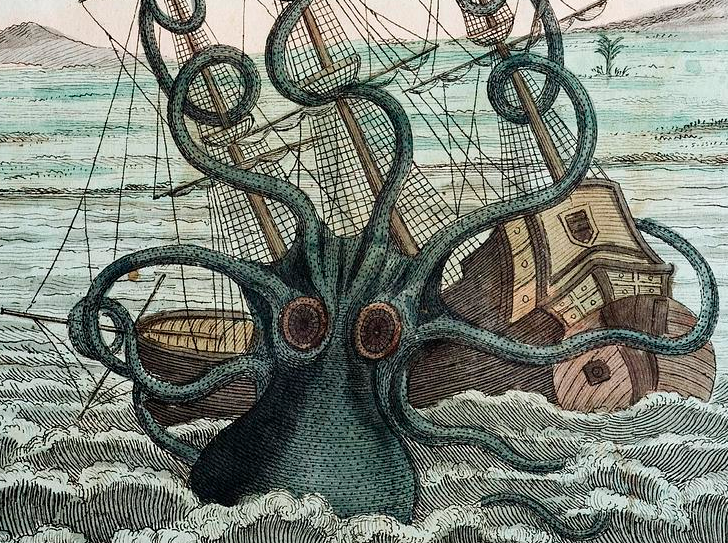
Kraken — The island-sized beast, logged as fact
The world's most famous sea monster is Norwegian by paperwork — described as natural history (not folklore) by Bishop Erik Pontoppidan of Bergen in his 1752–53 Natural History of Norway, which claimed it was the size of a floating island and seen by reliable witnesses.
The kraken has an unusual claim among Norwegian sea-creatures: it did not enter the world as a folktale. It entered as natural history, in a serious book, written by a bishop.
Erik Pontoppidan 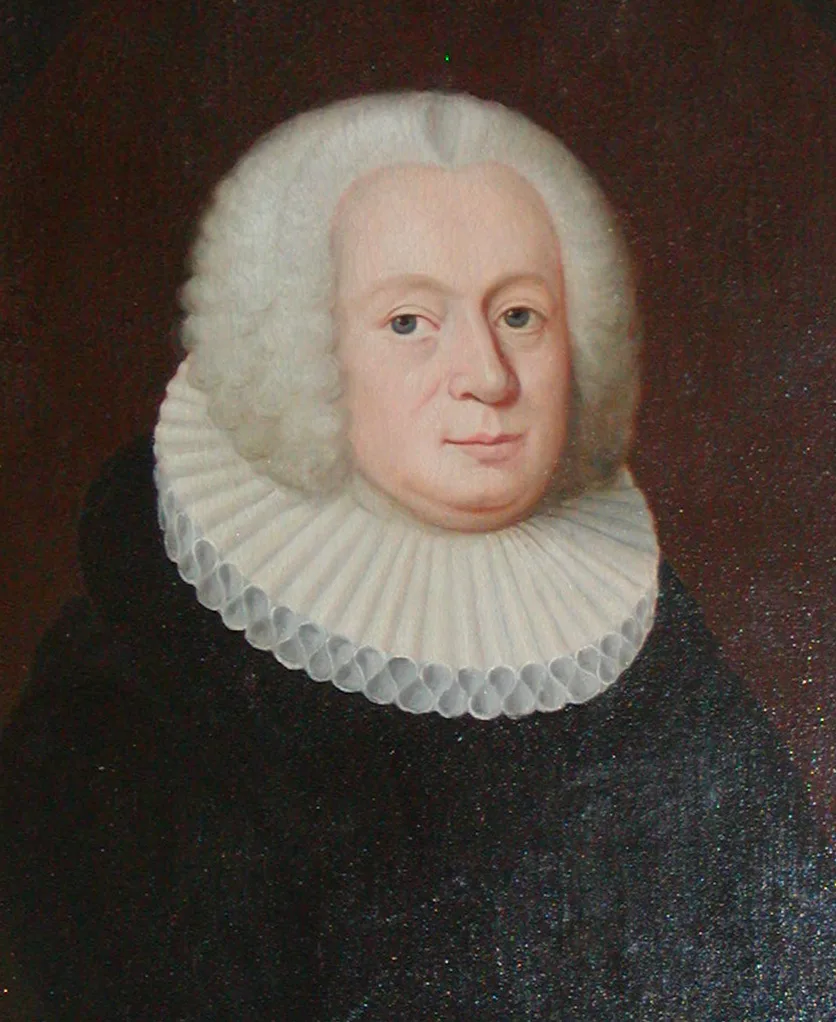 Unknown artist, portrait of Erik Pontoppidan (first half of the 1700s) The bishop who filed the kraken as fauna — in his 1752–53 *Natural History of Norway*, Pontoppidan set the island-sized beast among the fjord birds and whales on the word of sober witnesses; the catechism that schooled Norway's confirmands was his other book. Danish-Norwegian Lutheran theologian, bishop, and natural
historian (1698–1764). Court preacher and personal chaplain
to King Christian VI from 1735, who commissioned him to
write the standard catechism that would accompany the new
compulsory confirmation: Sandhed til Gudfrygtighed —
Truth unto Godliness — published 1737 and the principal
instrument of Norwegian Lutheran religious education for
well over a century, into the late 1800s. Appointed Bishop
of Bergen 1747; in that
capacity wrote his two-volume Det første Forsøg paa
Norges naturlige Historie (1752–53), the standard
eighteenth-century natural history of Norway and the work
that first describes the kraken under that name. Later
vice-chancellor of the University of Copenhagen.
Also discussed in The Reformation, 1537 — one church eradicated and another imposedLutheran Norway and Pietism — a farmer named Hans Nielsen Hauge and a lay revival that could not be silencedSjøormer — the serpents in the deep lakes and fjords was the Bishop of Bergen
Unknown artist, portrait of Erik Pontoppidan (first half of the 1700s) The bishop who filed the kraken as fauna — in his 1752–53 *Natural History of Norway*, Pontoppidan set the island-sized beast among the fjord birds and whales on the word of sober witnesses; the catechism that schooled Norway's confirmands was his other book. Danish-Norwegian Lutheran theologian, bishop, and natural
historian (1698–1764). Court preacher and personal chaplain
to King Christian VI from 1735, who commissioned him to
write the standard catechism that would accompany the new
compulsory confirmation: Sandhed til Gudfrygtighed —
Truth unto Godliness — published 1737 and the principal
instrument of Norwegian Lutheran religious education for
well over a century, into the late 1800s. Appointed Bishop
of Bergen 1747; in that
capacity wrote his two-volume Det første Forsøg paa
Norges naturlige Historie (1752–53), the standard
eighteenth-century natural history of Norway and the work
that first describes the kraken under that name. Later
vice-chancellor of the University of Copenhagen.
Also discussed in The Reformation, 1537 — one church eradicated and another imposedLutheran Norway and Pietism — a farmer named Hans Nielsen Hauge and a lay revival that could not be silencedSjøormer — the serpents in the deep lakes and fjords was the Bishop of Bergen 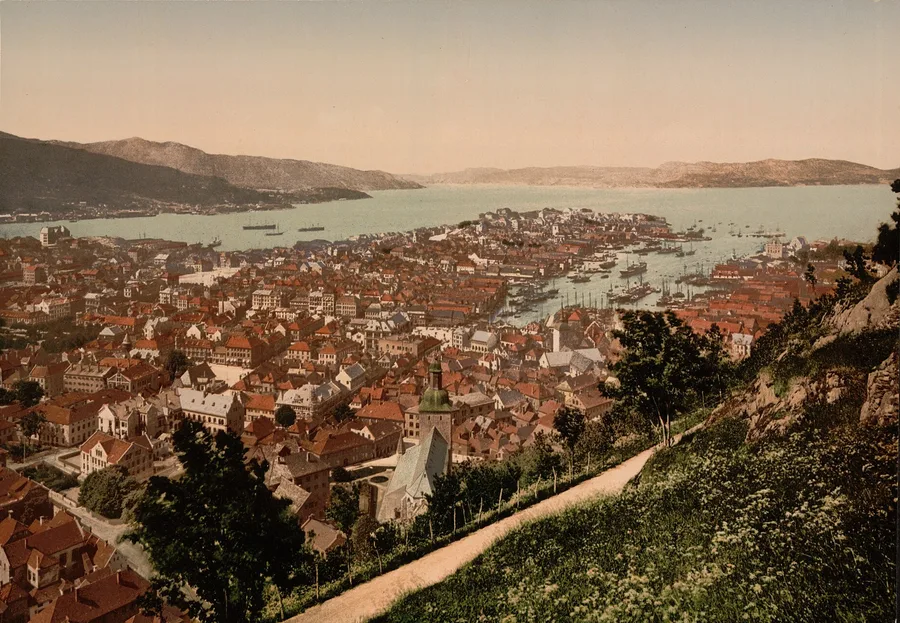 Photochrom print, General view from Fjeldveien, Bergen (c. 1890–1900), Library of Congress Pontoppidan's own bishopric — Bergen between its mountains, the harbour town where he wrote the natural history that filed the kraken as fauna, and whose court took the sworn sea-serpent deposition he printed. Norway's western trading capital, founded around 1070 on the
inner Byfjorden. For four centuries the largest city in the
country and the wharf through which the entire western export
economy ran — dried cod from the Lofoten fisheries, stockpiled
and traded by the Hanseatic merchants at Bryggen from 1360 to
1754. Norway's commercial and intellectual heart through the
Hanseatic period; overtaken in size by Christiania (Oslo) in the
1830s. The painted wooden Bryggen wharf is on the UNESCO World
Heritage list and substantially what it was in the late
seventeenth century.
On the trip The Ungdommene (the Youngsters) reach Bergen late on Day 3
via the Norway-in-a-Nutshell train-and-ferry route from
Oslo. On the Day 4 morning they walk Bryggen and ride the
funicular up Mount Fløyen before flying back to Oslo and driving
on to Lillehammer that evening — a day ahead of the Gråhårsklubben
(the Oldsters), who spend the split days north in Trondheim and
the heritage country of Stjørdal, Hegra, and Kylloplass and come
south on Day 5.
Bergen Also discussed in The Germans Who "Ruled" Bergen — the Hanseatic merchants on Bryggen WharfBefore There Was Norway — petty kingdoms at the edge of the worldThe King Who Became a Saint — how the Nordmen came to ChristA Catholic Norway — the faith that gave the kingdom its first institutions and the stave churchesThe Long Fall — the sudden loss of Norwegian nobility, the end of the kings, and half of Norway gone foreverThe Golden Age — a North Atlantic empire … reaching farther than you thinkThe 400-Year Night — when the Northern Lion lay dormantThe Crusades?!!!! — sixty ships from Bergen, bound for the Holy LandThe Reformation, 1537 — one church eradicated and another imposedWorld War II — the King’s “No” and the Nazis in NorwaySjøormer — the serpents in the deep lakes and fjordsPesta — an old woman walking from farm to farmFossegrimen — the waterfall fiddler who teaches you to playAlcohol and Vinmonopolet — when and where to buy a drinkEveryday etiquette — quiet voices, wide space, no smilingFood and dining customs — having patience, free water, brunost on everything🚨 Emergencies - important numbers, hospitals, and what you can doLanguage basics — just enough Norwegian to be politeWhat to wear — the layering system, on the ground , and in 1752 and 1753 he published a two-volume work with the earnest title The Natural History of Norway
Photochrom print, General view from Fjeldveien, Bergen (c. 1890–1900), Library of Congress Pontoppidan's own bishopric — Bergen between its mountains, the harbour town where he wrote the natural history that filed the kraken as fauna, and whose court took the sworn sea-serpent deposition he printed. Norway's western trading capital, founded around 1070 on the
inner Byfjorden. For four centuries the largest city in the
country and the wharf through which the entire western export
economy ran — dried cod from the Lofoten fisheries, stockpiled
and traded by the Hanseatic merchants at Bryggen from 1360 to
1754. Norway's commercial and intellectual heart through the
Hanseatic period; overtaken in size by Christiania (Oslo) in the
1830s. The painted wooden Bryggen wharf is on the UNESCO World
Heritage list and substantially what it was in the late
seventeenth century.
On the trip The Ungdommene (the Youngsters) reach Bergen late on Day 3
via the Norway-in-a-Nutshell train-and-ferry route from
Oslo. On the Day 4 morning they walk Bryggen and ride the
funicular up Mount Fløyen before flying back to Oslo and driving
on to Lillehammer that evening — a day ahead of the Gråhårsklubben
(the Oldsters), who spend the split days north in Trondheim and
the heritage country of Stjørdal, Hegra, and Kylloplass and come
south on Day 5.
Bergen Also discussed in The Germans Who "Ruled" Bergen — the Hanseatic merchants on Bryggen WharfBefore There Was Norway — petty kingdoms at the edge of the worldThe King Who Became a Saint — how the Nordmen came to ChristA Catholic Norway — the faith that gave the kingdom its first institutions and the stave churchesThe Long Fall — the sudden loss of Norwegian nobility, the end of the kings, and half of Norway gone foreverThe Golden Age — a North Atlantic empire … reaching farther than you thinkThe 400-Year Night — when the Northern Lion lay dormantThe Crusades?!!!! — sixty ships from Bergen, bound for the Holy LandThe Reformation, 1537 — one church eradicated and another imposedWorld War II — the King’s “No” and the Nazis in NorwaySjøormer — the serpents in the deep lakes and fjordsPesta — an old woman walking from farm to farmFossegrimen — the waterfall fiddler who teaches you to playAlcohol and Vinmonopolet — when and where to buy a drinkEveryday etiquette — quiet voices, wide space, no smilingFood and dining customs — having patience, free water, brunost on everything🚨 Emergencies - important numbers, hospitals, and what you can doLanguage basics — just enough Norwegian to be politeWhat to wear — the layering system, on the ground , and in 1752 and 1753 he published a two-volume work with the earnest title The Natural History of Norway 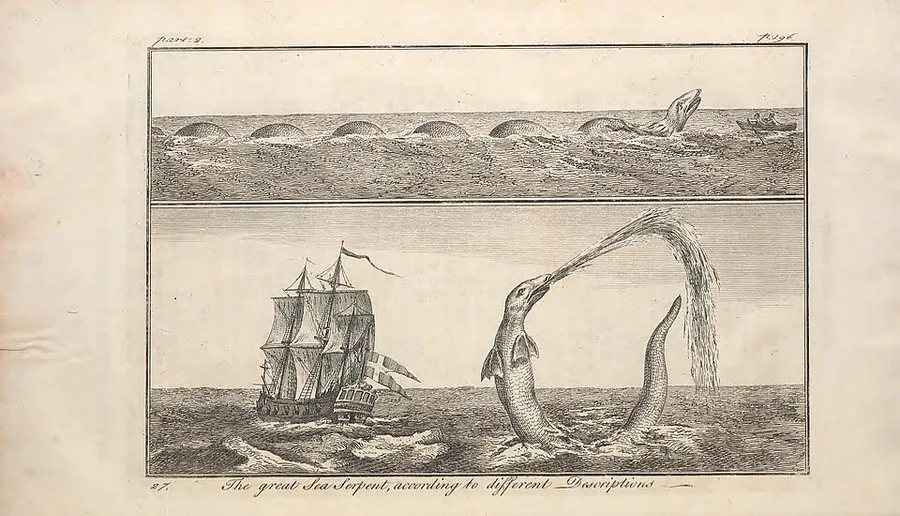 Plate 27, Erik Pontoppidan, The Natural History of Norway (London, 1755), Biodiversity Heritage Library The kraken itself went unfigured — nowhere in the book's plates does the creature appear; plate 27 shows its fellow sea-beast, the great serpent, instead. Pontoppidan's kraken lived in sworn testimony and sober prose, a thing witnesses took for a chain of islands. Erik Pontoppidan's two-volume Det første Forsøg paa
Norges naturlige Historie — the first attempt at a
natural history of Norway — published in Copenhagen in
1752 and 1753 while its author held the bishopric of
Bergen, and translated into English in London in 1755 as
The Natural History of Norway. It catalogued the
country's air, mountains, waters, plants, minerals,
animals, birds, and fish — and, in the second volume, in
the same sober register, its sea-creatures: the havmann,
the sea serpent, and the first detailed printed description
of the kraken, a beast said by witnesses to be
mistaken for a chain of islands. Among the evidence stood
the sworn Bergen court testimony of pilot-master Lawrence
de Ferry, who fired on a serpent off Molde in August 1746.
Also discussed in Sjøormer — the serpents in the deep lakes and fjords . It was meant as exactly that — a catalog of the country’s animals, plants, minerals, and weather, compiled by an educated man before modern scientific classification had fully arrived. And among the fjord birds and the whales and the fish, Pontoppidan described, in the same matter-of-fact register, the kraken.
Plate 27, Erik Pontoppidan, The Natural History of Norway (London, 1755), Biodiversity Heritage Library The kraken itself went unfigured — nowhere in the book's plates does the creature appear; plate 27 shows its fellow sea-beast, the great serpent, instead. Pontoppidan's kraken lived in sworn testimony and sober prose, a thing witnesses took for a chain of islands. Erik Pontoppidan's two-volume Det første Forsøg paa
Norges naturlige Historie — the first attempt at a
natural history of Norway — published in Copenhagen in
1752 and 1753 while its author held the bishopric of
Bergen, and translated into English in London in 1755 as
The Natural History of Norway. It catalogued the
country's air, mountains, waters, plants, minerals,
animals, birds, and fish — and, in the second volume, in
the same sober register, its sea-creatures: the havmann,
the sea serpent, and the first detailed printed description
of the kraken, a beast said by witnesses to be
mistaken for a chain of islands. Among the evidence stood
the sworn Bergen court testimony of pilot-master Lawrence
de Ferry, who fired on a serpent off Molde in August 1746.
Also discussed in Sjøormer — the serpents in the deep lakes and fjords . It was meant as exactly that — a catalog of the country’s animals, plants, minerals, and weather, compiled by an educated man before modern scientific classification had fully arrived. And among the fjord birds and the whales and the fish, Pontoppidan described, in the same matter-of-fact register, the kraken.
His kraken was enormous. By his account it was a creature a mile and a half around, so vast that sailors mistook its back for a chain of islands and dropped anchor on it. When it submerged, the whirlpool of its descent could pull a ship down. None of it was offered as legend: the kraken stood in his catalog as a poorly-studied but real piece of Norwegian fauna, attested, he insisted, by reliable witnesses — fishermen and ship’s officers, sober men, who had no reason to invent it.
Pontoppidan did not invent the kraken. He collected it. The northern sailing cultures had long carried traditions of vast things in the deep water — sea-serpents, the havmann or sea-man, shapes that surfaced and sank — and Pontoppidan, doing his best as a naturalist, in good faith, wrote those traditions down as data.
And the data was not pure fantasy. The North Atlantic contains the giant squid, Architeuthis — a real animal, many meters long, with eyes the size of dinner plates, that lives in deep water and was effectively never seen alive until modern times. A dying giant squid at the surface, or a carcass, glimpsed by a fishing crew with no framework for what they were looking at, is a perfectly good seed for a monster the size of islands. The kraken is what happens when a real and genuinely strange animal is reported by people without a science to file it under.
Once Pontoppidan had given the kraken the dignity of print, it never left. Tennyson wrote it a poem — “The Kraken,” the monster sleeping its ancient dreamless sleep far down in the sea. It swam out of Norwegian natural history into the literature and the films and the games of the whole world, and it is now probably the most famous sea monster there is.
It also never quite stopped being Norwegian, or being a working sailor’s idea — born in the cod waters and carried down the same long coast the Hurtigruten runs today. And the truth underneath it is the interesting one: there is something very large and very strange down there, it has eyes the size of plates, and the bishop was not entirely wrong.