The Golden Age — A North Atlantic empire … reaching farther than you think
Under Hákon IV and his son Magnus Lagabøte, the medieval Norwegian kingdom held the Norse North Atlantic from the Hebrides to Greenland, sent a daughter to Castile in marriage, and gave Europe one of its earliest unified national law codes in any European vernacular.
In the autumn of 1256, a delegation from the court of King Alfonso X of Castile 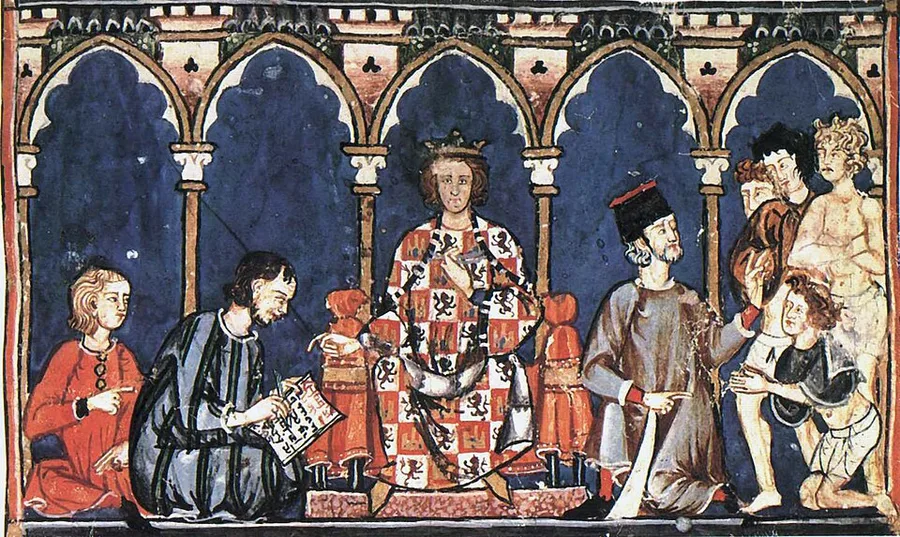 Alfonso X's scriptorium, Libro de los juegos (1283), public domain Alfonso X commissioned this games manuscript himself in 1283 — the miniature shows him seated among his court, the same king whose diplomatic ambitions sent his brother Felipe to marry the Norwegian princess Kristina in 1258. King of Castile and León 1252–1284, bynamed El Sabio — Alfonso
the Wise — for his patronage of law, learning, and translation.
Compiled the Siete Partidas legal code, sponsored the
Cantigas de Santa María and the Alfonsine astronomical tables,
and ran the famous translation school at Toledo where Arabic
scientific and philosophical texts were rendered into Castilian
and Latin for the wider Western Christian world. Negotiated the
marriage of his younger brother Infante Felipe to Kristina
Hákonsdatter of Norway in 1256-1258 as part of his diplomatic
campaign for election as Holy Roman Emperor — the candidacy
ultimately failed. Died at Seville in 1284.
and León (modern-day central and northwestern Spain) came north to Tønsberg
Alfonso X's scriptorium, Libro de los juegos (1283), public domain Alfonso X commissioned this games manuscript himself in 1283 — the miniature shows him seated among his court, the same king whose diplomatic ambitions sent his brother Felipe to marry the Norwegian princess Kristina in 1258. King of Castile and León 1252–1284, bynamed El Sabio — Alfonso
the Wise — for his patronage of law, learning, and translation.
Compiled the Siete Partidas legal code, sponsored the
Cantigas de Santa María and the Alfonsine astronomical tables,
and ran the famous translation school at Toledo where Arabic
scientific and philosophical texts were rendered into Castilian
and Latin for the wider Western Christian world. Negotiated the
marriage of his younger brother Infante Felipe to Kristina
Hákonsdatter of Norway in 1256-1258 as part of his diplomatic
campaign for election as Holy Roman Emperor — the candidacy
ultimately failed. Died at Seville in 1284.
and León (modern-day central and northwestern Spain) came north to Tønsberg 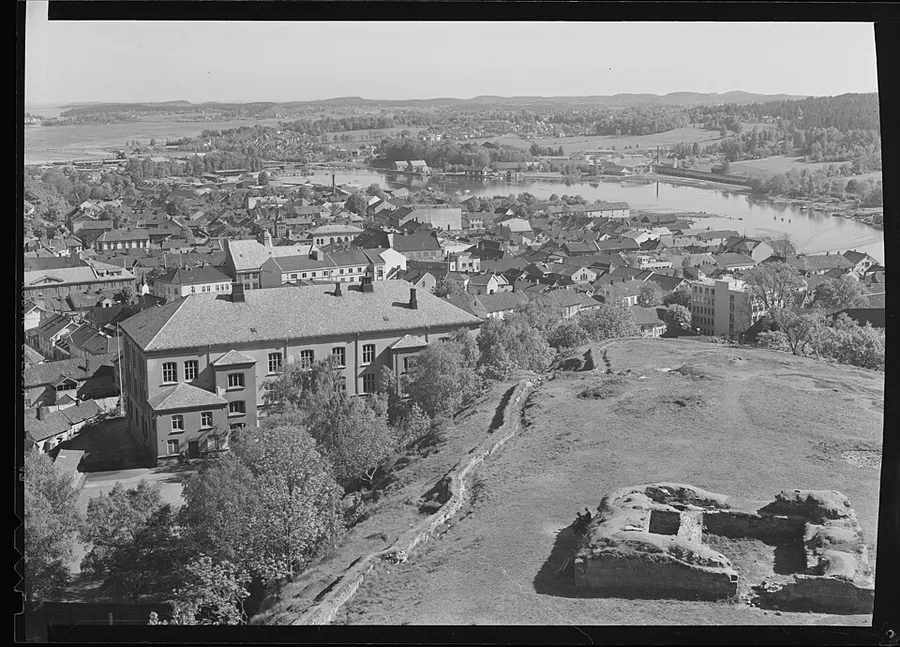 Mittet & Co., photograph of Tønsberg (c. 1939-1949), National Library of Norway Looking down from Slottsfjellet — the fortress hill of Tunsberghus, the royal seat above the town — over the rooftops where the delegation from Castile landed in 1256 to ask for a Norwegian princess. City in Vestfold County, often cited as Norway's oldest town;
attested in the Heimskringla as a royal seat from the late
ninth century. Site of the medieval Premonstratensian monastery
of St. Olav, founded in the late twelfth century, and of the
royal fortress of Tunsberghus on the rocky hill above the town.
About fifty thousand people today; one of the principal
recreational and historical centres of the inner Oslofjord
region, with the Borre Mound Cemetery (the Yngling royal mounds)
just north of the city.
Tønsberg, Vestfold Also discussed in A Catholic Norway — the faith that gave the kingdom its first institutions and the stave churches on the Oslofjord
Mittet & Co., photograph of Tønsberg (c. 1939-1949), National Library of Norway Looking down from Slottsfjellet — the fortress hill of Tunsberghus, the royal seat above the town — over the rooftops where the delegation from Castile landed in 1256 to ask for a Norwegian princess. City in Vestfold County, often cited as Norway's oldest town;
attested in the Heimskringla as a royal seat from the late
ninth century. Site of the medieval Premonstratensian monastery
of St. Olav, founded in the late twelfth century, and of the
royal fortress of Tunsberghus on the rocky hill above the town.
About fifty thousand people today; one of the principal
recreational and historical centres of the inner Oslofjord
region, with the Borre Mound Cemetery (the Yngling royal mounds)
just north of the city.
Tønsberg, Vestfold Also discussed in A Catholic Norway — the faith that gave the kingdom its first institutions and the stave churches on the Oslofjord 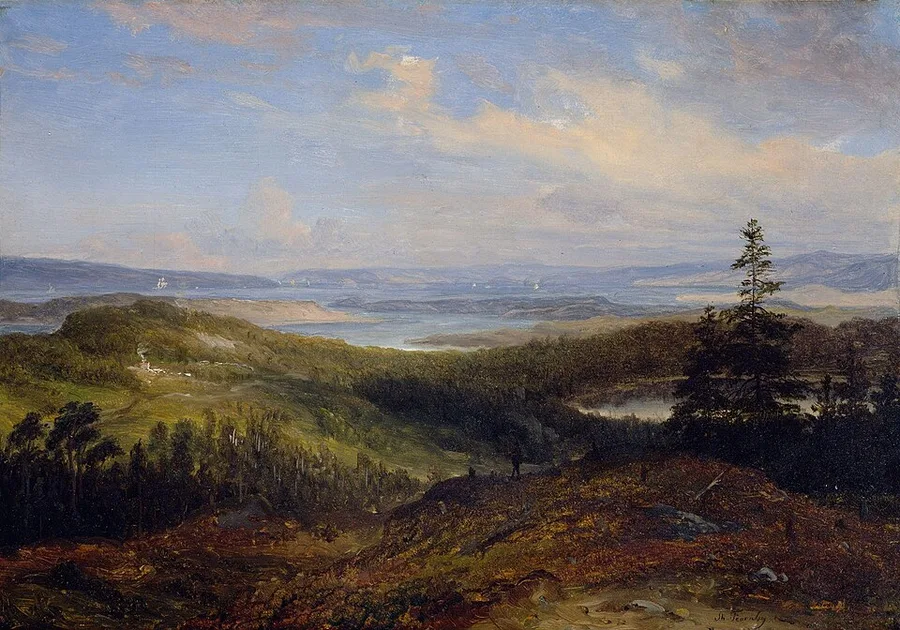 Thomas Fearnley, Utsikt over Oslofjorden (1839), Nasjonalmuseet Thomas Fearnley's serene 1839 view of the fjord — Vestfold on its western shore, Østfold on its eastern. Up this water in the summer of 1256 sailed the embassy of Castile, bound for Tønsberg and the negotiations that sent Kristina Hákonsdatter south. The hundred-kilometre fjord cutting north into southeastern Norway
from the Skagerrak to the present-day capital Oslo. In the
petty-kingdom era its western shore was Vestfold and its eastern
shore Østfold; the fjord controlled access to the Baltic trade
routes. The royal family fled south through it in April 1940 when
the Germans attacked Oslo, and the fortress at Oscarsborg sank the
German cruiser Blücher at its narrow Drøbak passage on the morning
of the invasion.
Oslofjord Also discussed in Before There Was Norway — petty kingdoms at the edge of the worldWorld War II — the King’s “No” and the Nazis in Norway . They had come to negotiate the hand of the Norwegian king’s eldest daughter for one of Alfonso’s brothers. The princess was twenty-two. Her name was Kristina Hákonsdatter
Thomas Fearnley, Utsikt over Oslofjorden (1839), Nasjonalmuseet Thomas Fearnley's serene 1839 view of the fjord — Vestfold on its western shore, Østfold on its eastern. Up this water in the summer of 1256 sailed the embassy of Castile, bound for Tønsberg and the negotiations that sent Kristina Hákonsdatter south. The hundred-kilometre fjord cutting north into southeastern Norway
from the Skagerrak to the present-day capital Oslo. In the
petty-kingdom era its western shore was Vestfold and its eastern
shore Østfold; the fjord controlled access to the Baltic trade
routes. The royal family fled south through it in April 1940 when
the Germans attacked Oslo, and the fortress at Oscarsborg sank the
German cruiser Blücher at its narrow Drøbak passage on the morning
of the invasion.
Oslofjord Also discussed in Before There Was Norway — petty kingdoms at the edge of the worldWorld War II — the King’s “No” and the Nazis in Norway . They had come to negotiate the hand of the Norwegian king’s eldest daughter for one of Alfonso’s brothers. The princess was twenty-two. Her name was Kristina Hákonsdatter 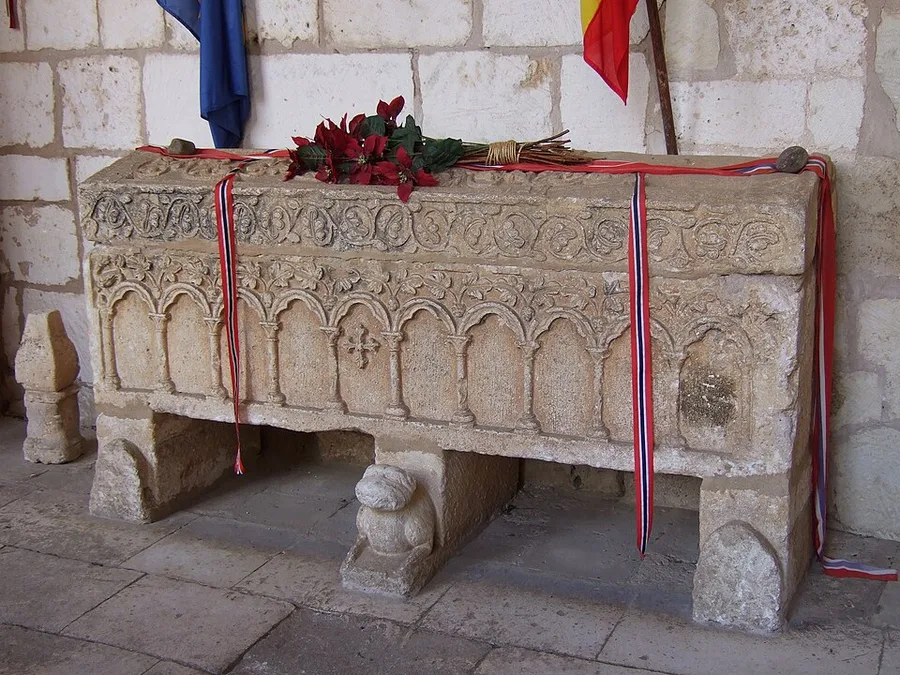 Ecelan, tomb of Kristina of Norway, Colegiata de Covarrubias (CC BY-SA 4.0) Kristina's actual tomb, in the cloister of the Covarrubias church where Felipe buried her in 1262 — the sarcophagus that lay sealed and unrecognized until 1952-58, when restoration work found her mummified remains and funerary dress still inside. Norwegian princess (1234–1262), eldest daughter of King Hákon IV
Hákonarson and Queen Margrete Skulesdatter. Sent to Castile in
1257 to marry into the royal house there as part of Alfonso X's
imperial diplomatic strategy. Married Infante Felipe of Castile
at the collegiate church of Santa María at Valladolid on
31 March 1258. Moved south with him to Seville and died there
childless in 1262, four years after the wedding. Felipe had her
body buried at the collegiate church of San Cosme y San Damián
in Covarrubias, north of Burgos. The sarcophagus, opened
inadvertently in 1952 and formally examined in 1958, still
contained her remains and her funerary dress; the tomb is now
a joint Norwegian-Castilian cultural-historic site.
. Within two years she would be married into the Castilian royal house in a church at Valladolid
Ecelan, tomb of Kristina of Norway, Colegiata de Covarrubias (CC BY-SA 4.0) Kristina's actual tomb, in the cloister of the Covarrubias church where Felipe buried her in 1262 — the sarcophagus that lay sealed and unrecognized until 1952-58, when restoration work found her mummified remains and funerary dress still inside. Norwegian princess (1234–1262), eldest daughter of King Hákon IV
Hákonarson and Queen Margrete Skulesdatter. Sent to Castile in
1257 to marry into the royal house there as part of Alfonso X's
imperial diplomatic strategy. Married Infante Felipe of Castile
at the collegiate church of Santa María at Valladolid on
31 March 1258. Moved south with him to Seville and died there
childless in 1262, four years after the wedding. Felipe had her
body buried at the collegiate church of San Cosme y San Damián
in Covarrubias, north of Burgos. The sarcophagus, opened
inadvertently in 1952 and formally examined in 1958, still
contained her remains and her funerary dress; the tomb is now
a joint Norwegian-Castilian cultural-historic site.
. Within two years she would be married into the Castilian royal house in a church at Valladolid 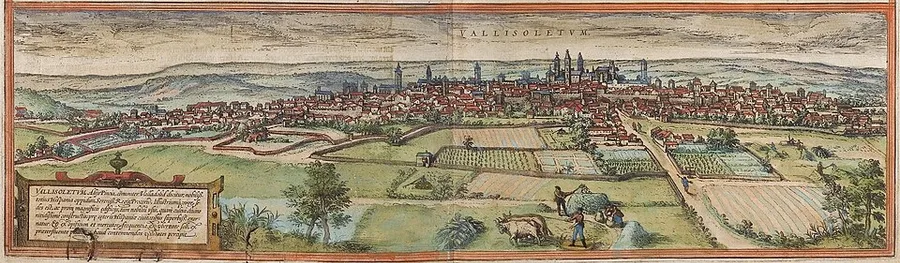 Georg Braun & Frans Hogenberg, Valladolid, Civitates Orbis Terrarum (1572) The collegiate church of Santa María, where Kristina Hákonsdatter married Infante Felipe on 31 March 1258, stood among the towers this engraving captures roughly three centuries later — Valladolid was already a favored seat of the Castilian court in her lifetime. City on the Pisuerga River in north-central Castile, in modern
Castile and León. A favoured residence of the Castilian court
in the medieval and early-modern centuries; effective Spanish
capital under Philip II and Philip III. The marriage of Infante
Felipe of Castile to the Norwegian princess Kristina
Hákonsdatter was celebrated at the collegiate church of Santa
María in Valladolid on 31 March 1258. Modern Valladolid is the
capital of the autonomous community of Castile and León, with
around three hundred thousand people in the municipality.
, dead childless in Seville (medieval Castilian)
Georg Braun & Frans Hogenberg, Valladolid, Civitates Orbis Terrarum (1572) The collegiate church of Santa María, where Kristina Hákonsdatter married Infante Felipe on 31 March 1258, stood among the towers this engraving captures roughly three centuries later — Valladolid was already a favored seat of the Castilian court in her lifetime. City on the Pisuerga River in north-central Castile, in modern
Castile and León. A favoured residence of the Castilian court
in the medieval and early-modern centuries; effective Spanish
capital under Philip II and Philip III. The marriage of Infante
Felipe of Castile to the Norwegian princess Kristina
Hákonsdatter was celebrated at the collegiate church of Santa
María in Valladolid on 31 March 1258. Modern Valladolid is the
capital of the autonomous community of Castile and León, with
around three hundred thousand people in the municipality.
, dead childless in Seville (medieval Castilian) 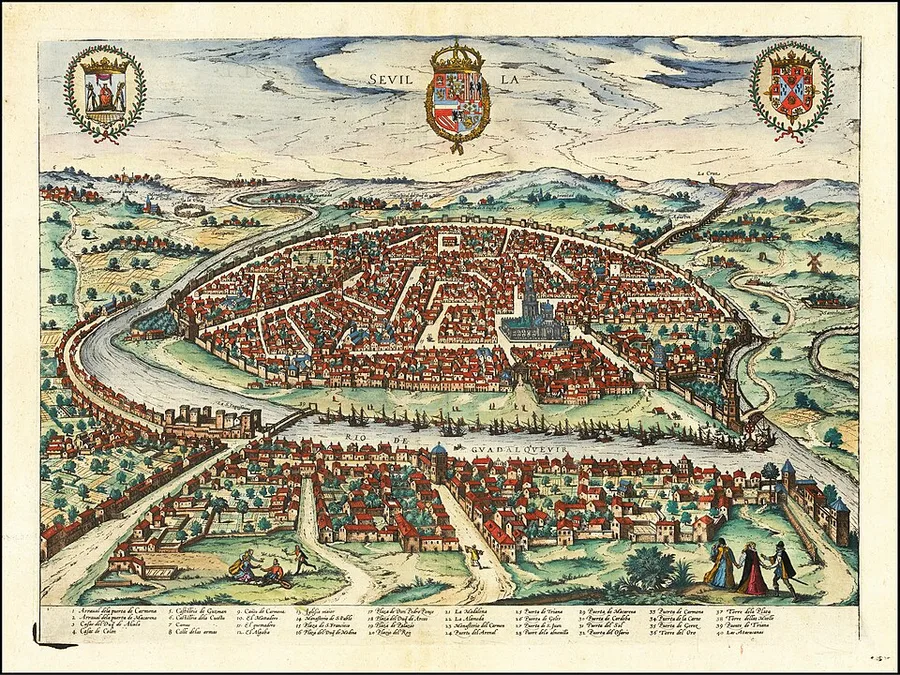 Georg Braun & Frans Hogenberg, Sevilla, Civitates Orbis Terrarum (1588) This bird's-eye view captures the Guadalquivir river city Kristina Hákonsdatter moved to with Felipe after their 1258 wedding, and where she died in 1262 — the same walled Castilian capital where Alfonso X also kept his court. Major city in southern Spain on the Guadalquivir River, taken
from its Almohad Muslim rulers by King Ferdinand III of Castile
in 1248 — twelve years before Kristina Hákonsdatter of Norway
moved south with her husband Infante Felipe to live there.
Through the second half of the thirteenth century Seville was
the southern capital of the Castilian crown and the wealthiest
city in Western Christendom outside Italy. Alfonso X kept his
court at Seville for substantial parts of his reign. Kristina
died there in 1262 four years after the wedding; Felipe brought
her body north and buried her at Covarrubias near Burgos.
four years after that, and buried in a small Castilian collegiate church whose tomb would lie undisturbed in a side chapel for seven centuries.
Georg Braun & Frans Hogenberg, Sevilla, Civitates Orbis Terrarum (1588) This bird's-eye view captures the Guadalquivir river city Kristina Hákonsdatter moved to with Felipe after their 1258 wedding, and where she died in 1262 — the same walled Castilian capital where Alfonso X also kept his court. Major city in southern Spain on the Guadalquivir River, taken
from its Almohad Muslim rulers by King Ferdinand III of Castile
in 1248 — twelve years before Kristina Hákonsdatter of Norway
moved south with her husband Infante Felipe to live there.
Through the second half of the thirteenth century Seville was
the southern capital of the Castilian crown and the wealthiest
city in Western Christendom outside Italy. Alfonso X kept his
court at Seville for substantial parts of his reign. Kristina
died there in 1262 four years after the wedding; Felipe brought
her body north and buried her at Covarrubias near Burgos.
four years after that, and buried in a small Castilian collegiate church whose tomb would lie undisturbed in a side chapel for seven centuries.
A medieval kingdom whose princess could be sent to Castile 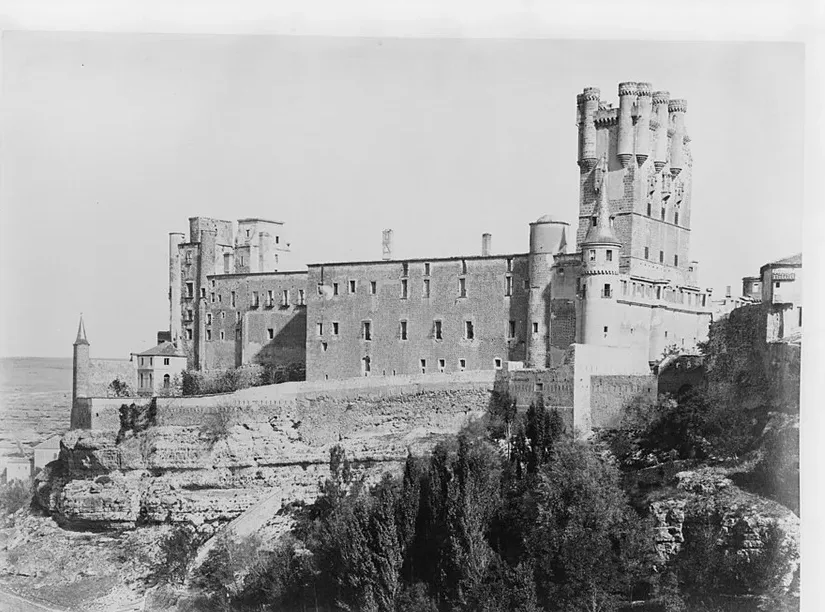 Jean Laurent, El Alcázar visto desde la cuesta de los Hoyos (c. 1870), Library of Congress Jean Laurent's photograph, from about 1870, of the royal castle of Segovia — a stronghold where King Alfonso X held court in the very years the Norwegian princess Kristina Hákonsdatter came south to marry his brother Felipe. One iconic Castilian fortress standing in view for the kingdom. The largest of the medieval Christian kingdoms of the Iberian
peninsula, centred on the high plateau of the central Iberian
meseta around the city of Burgos. United with the kingdom of
León in 1230 to form the Crown of Castile and León, which
remained the dominant Christian power on the peninsula through
the late medieval period. Under King Alfonso X (1252–1284), in
the years when his brother Felipe married Kristina Hákonsdatter
of Norway, Castile was at its peak as a centre of legal,
scientific, and literary translation. Joined with Aragon in
1469 by the marriage of Isabella of Castile to Ferdinand of
Aragon to form the kingdom that became modern Spain.
to marry into the royal house there, on terms negotiated as between peers, was not the marginal northern country most general histories of Norway describe. By the middle of the thirteenth century, Norway held a maritime realm that ran the length of the Norse North Atlantic from the Sudreyjar
Jean Laurent, El Alcázar visto desde la cuesta de los Hoyos (c. 1870), Library of Congress Jean Laurent's photograph, from about 1870, of the royal castle of Segovia — a stronghold where King Alfonso X held court in the very years the Norwegian princess Kristina Hákonsdatter came south to marry his brother Felipe. One iconic Castilian fortress standing in view for the kingdom. The largest of the medieval Christian kingdoms of the Iberian
peninsula, centred on the high plateau of the central Iberian
meseta around the city of Burgos. United with the kingdom of
León in 1230 to form the Crown of Castile and León, which
remained the dominant Christian power on the peninsula through
the late medieval period. Under King Alfonso X (1252–1284), in
the years when his brother Felipe married Kristina Hákonsdatter
of Norway, Castile was at its peak as a centre of legal,
scientific, and literary translation. Joined with Aragon in
1469 by the marriage of Isabella of Castile to Ferdinand of
Aragon to form the kingdom that became modern Spain.
to marry into the royal house there, on terms negotiated as between peers, was not the marginal northern country most general histories of Norway describe. By the middle of the thirteenth century, Norway held a maritime realm that ran the length of the Norse North Atlantic from the Sudreyjar 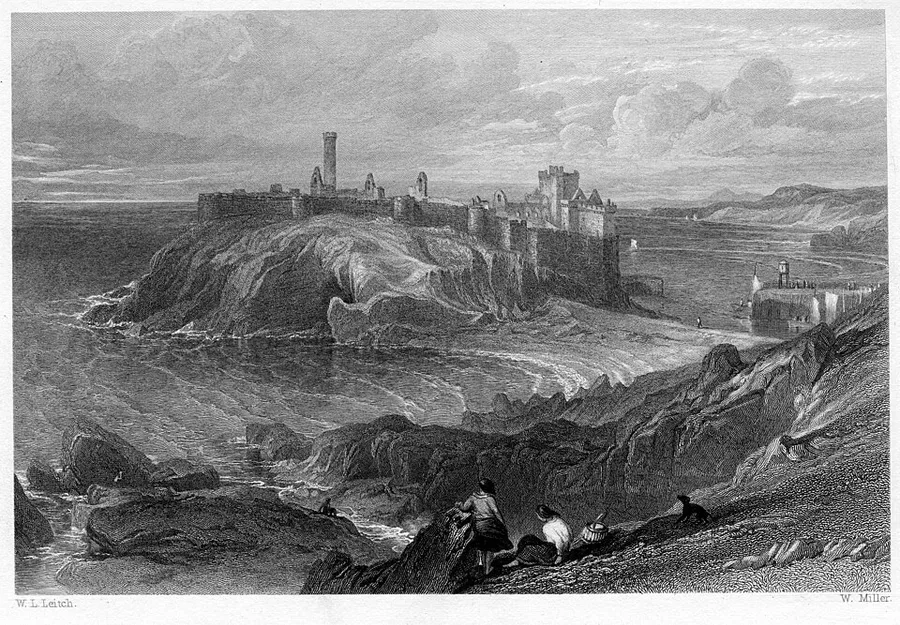 William Miller after William Leighton Leitch, Peel Castle, Isle of Man (1845), Waverley Novels (Abbotsford Edition) Peel Castle on St Patrick's Isle held the cathedral of the medieval diocese of Sudreyjar — the 'southern isles' see stretching across the Hebrides and Man — a Nidaros suffragan bishopric until Norway ceded the islands to Scotland under the 1266 Treaty of Perth. Old Norse for "southern isles" — the diocese encompassing the
southern Hebrides off the western coast of Scotland and the Isle
of Man in the Irish Sea. One of the suffragan dioceses under the
new Norwegian archdiocese of Nidaros from 1152 to 1266, when
Norwegian sovereignty over the Hebrides and Man was ceded to
Scotland under the Treaty of Perth. The diocese (the modern
Diocese of Sodor and Man) survives in the Church of England as
one of its smallest, comprising the Isle of Man alone.
Also discussed in A Catholic Norway — the faith that gave the kingdom its first institutions and the stave churches to Greenland
William Miller after William Leighton Leitch, Peel Castle, Isle of Man (1845), Waverley Novels (Abbotsford Edition) Peel Castle on St Patrick's Isle held the cathedral of the medieval diocese of Sudreyjar — the 'southern isles' see stretching across the Hebrides and Man — a Nidaros suffragan bishopric until Norway ceded the islands to Scotland under the 1266 Treaty of Perth. Old Norse for "southern isles" — the diocese encompassing the
southern Hebrides off the western coast of Scotland and the Isle
of Man in the Irish Sea. One of the suffragan dioceses under the
new Norwegian archdiocese of Nidaros from 1152 to 1266, when
Norwegian sovereignty over the Hebrides and Man was ceded to
Scotland under the Treaty of Perth. The diocese (the modern
Diocese of Sodor and Man) survives in the Church of England as
one of its smallest, comprising the Isle of Man alone.
Also discussed in A Catholic Norway — the faith that gave the kingdom its first institutions and the stave churches to Greenland 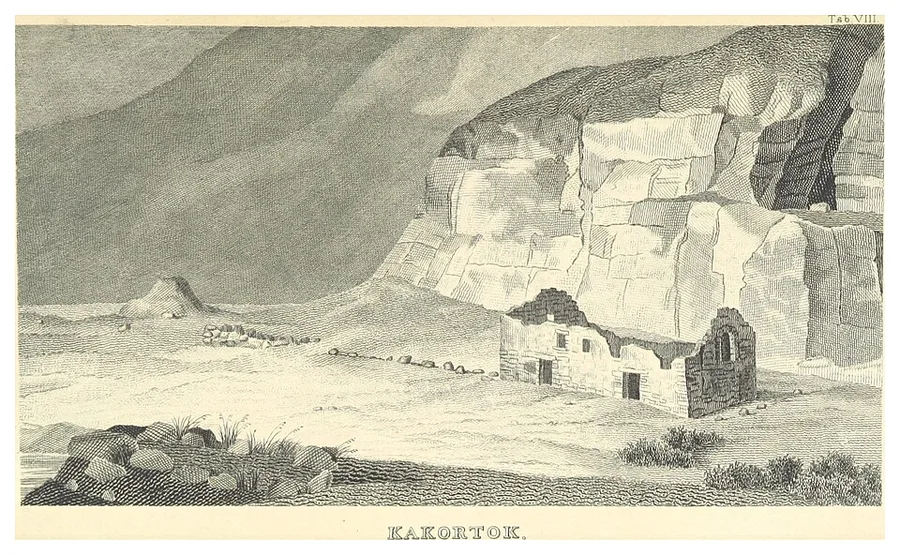 Grønlands historiske Mindesmærker vol. 3 (1845), plate VIII, British Library The stone church at Hvalsey, the best-preserved building of Norse Greenland — drawn in 1845 for the Danish survey that went looking for the lost colony. A wedding held here in 1408 is the last event anyone recorded before the settlements Erik the Red founded fell silent. The world's largest island, lying between the Arctic and Atlantic
Oceans west of Iceland. Colonised by Norse settlers led by Erik the
Red beginning in 985 — the name "Greenland" was Erik's marketing,
chosen to attract colonists to a marginally agricultural land. The
Norse Eastern and Western Settlements on the southwestern coast
sustained perhaps two or three thousand people at peak across four
centuries before steadily diminishing in the cooling climate of the
Little Ice Age and disappearing by around 1450. Today a self-
governing territory within the Kingdom of Denmark.
Also discussed in The Viking Age — longships, legends, and the first "Norway"The King Who Became a Saint — how the Nordmen came to ChristA Catholic Norway — the faith that gave the kingdom its first institutions and the stave churchesThe Long Fall — the sudden loss of Norwegian nobility, the end of the kings, and half of Norway gone foreverThe 400-Year Night — when the Northern Lion lay dormant . Its king held metropolitan ecclesiastical authority across that same arc through his archbishop at Nidaros Cathedral
Grønlands historiske Mindesmærker vol. 3 (1845), plate VIII, British Library The stone church at Hvalsey, the best-preserved building of Norse Greenland — drawn in 1845 for the Danish survey that went looking for the lost colony. A wedding held here in 1408 is the last event anyone recorded before the settlements Erik the Red founded fell silent. The world's largest island, lying between the Arctic and Atlantic
Oceans west of Iceland. Colonised by Norse settlers led by Erik the
Red beginning in 985 — the name "Greenland" was Erik's marketing,
chosen to attract colonists to a marginally agricultural land. The
Norse Eastern and Western Settlements on the southwestern coast
sustained perhaps two or three thousand people at peak across four
centuries before steadily diminishing in the cooling climate of the
Little Ice Age and disappearing by around 1450. Today a self-
governing territory within the Kingdom of Denmark.
Also discussed in The Viking Age — longships, legends, and the first "Norway"The King Who Became a Saint — how the Nordmen came to ChristA Catholic Norway — the faith that gave the kingdom its first institutions and the stave churchesThe Long Fall — the sudden loss of Norwegian nobility, the end of the kings, and half of Norway gone foreverThe 400-Year Night — when the Northern Lion lay dormant . Its king held metropolitan ecclesiastical authority across that same arc through his archbishop at Nidaros Cathedral 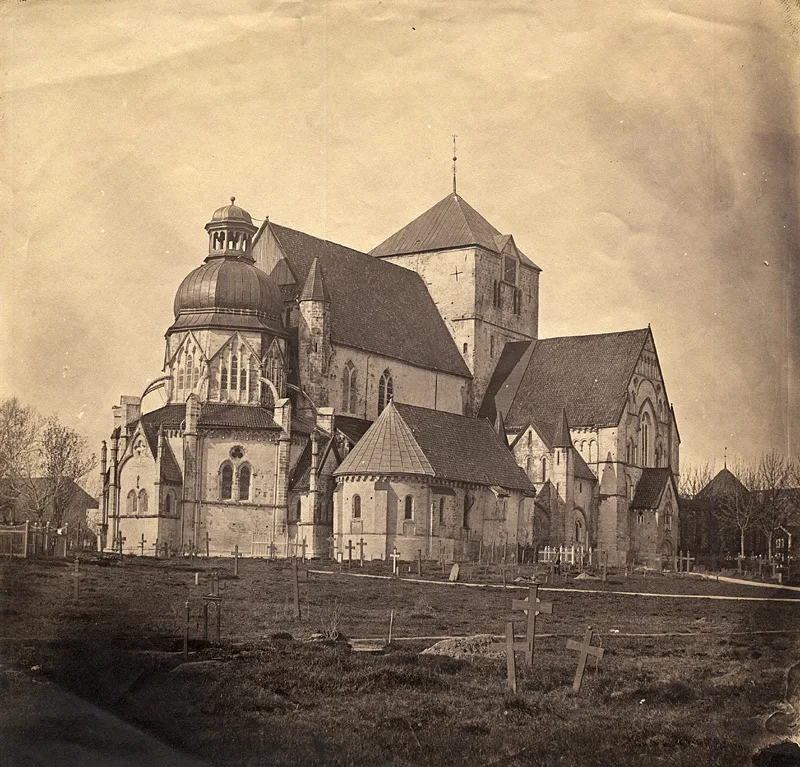 Unknown photographer, Nidaros Cathedral from the northeast (1857), Wikimedia Commons One of the earliest surviving photographs of Norway, taken in 1857 — decades before the west front's twentieth-century reconstruction — showing the cathedral over Olav's grave much as centuries of fire, neglect, and weather had left it. The principal cathedral of Norway and the burial place of Saint
Olav, on the bank of the Nid River in Trondheim. Built and rebuilt
in stages from the late eleventh through the early fourteenth
centuries around the shrine site at the cathedral's east end. The
octagonal east end, raised directly over Olav's grave, was the
devotional core of the medieval building. Substantially damaged
by fires and the 1531 lightning strike, then by neglect across the
Lutheran centuries. The west front a visitor sees today is a
nineteenth- and twentieth-century reconstruction, completed only
in 1983. The cathedral is the coronation and consecration church
of Norwegian kings; Haakon VII was crowned there in 1906, Olav V
consecrated in 1958, Harald V in 1991.
On the trip Day 3 of the trip brings the Gråhårsklubben (the Oldsters) to
Nidaros Cathedral. The shrine is gone but
the spot is marked on the cathedral floor in the octagonal east
end. The west front is the twentieth-century reconstruction of
the face the medieval pilgrims saw. The pilgrim road comes in
past the south door — the same door medieval pilgrims walked
through.
Nidaros Cathedral, Trondheim Also discussed in The King Who Became a Saint — how the Nordmen came to ChristA Catholic Norway — the faith that gave the kingdom its first institutions and the stave churchesThe Crusades?!!!! — sixty ships from Bergen, bound for the Holy LandThe Long Fall — the sudden loss of Norwegian nobility, the end of the kings, and half of Norway gone foreverThe 400-Year Night — when the Northern Lion lay dormantThe Reformation, 1537 — one church eradicated and another imposedLutheran Norway and Pietism — a farmer named Hans Nielsen Hauge and a lay revival that could not be silencedThe Quiet Revolution — how Norway won its independence without a warTradisjoner — celebrations across the Norwegian year . Its court at Bergen
Unknown photographer, Nidaros Cathedral from the northeast (1857), Wikimedia Commons One of the earliest surviving photographs of Norway, taken in 1857 — decades before the west front's twentieth-century reconstruction — showing the cathedral over Olav's grave much as centuries of fire, neglect, and weather had left it. The principal cathedral of Norway and the burial place of Saint
Olav, on the bank of the Nid River in Trondheim. Built and rebuilt
in stages from the late eleventh through the early fourteenth
centuries around the shrine site at the cathedral's east end. The
octagonal east end, raised directly over Olav's grave, was the
devotional core of the medieval building. Substantially damaged
by fires and the 1531 lightning strike, then by neglect across the
Lutheran centuries. The west front a visitor sees today is a
nineteenth- and twentieth-century reconstruction, completed only
in 1983. The cathedral is the coronation and consecration church
of Norwegian kings; Haakon VII was crowned there in 1906, Olav V
consecrated in 1958, Harald V in 1991.
On the trip Day 3 of the trip brings the Gråhårsklubben (the Oldsters) to
Nidaros Cathedral. The shrine is gone but
the spot is marked on the cathedral floor in the octagonal east
end. The west front is the twentieth-century reconstruction of
the face the medieval pilgrims saw. The pilgrim road comes in
past the south door — the same door medieval pilgrims walked
through.
Nidaros Cathedral, Trondheim Also discussed in The King Who Became a Saint — how the Nordmen came to ChristA Catholic Norway — the faith that gave the kingdom its first institutions and the stave churchesThe Crusades?!!!! — sixty ships from Bergen, bound for the Holy LandThe Long Fall — the sudden loss of Norwegian nobility, the end of the kings, and half of Norway gone foreverThe 400-Year Night — when the Northern Lion lay dormantThe Reformation, 1537 — one church eradicated and another imposedLutheran Norway and Pietism — a farmer named Hans Nielsen Hauge and a lay revival that could not be silencedThe Quiet Revolution — how Norway won its independence without a warTradisjoner — celebrations across the Norwegian year . Its court at Bergen 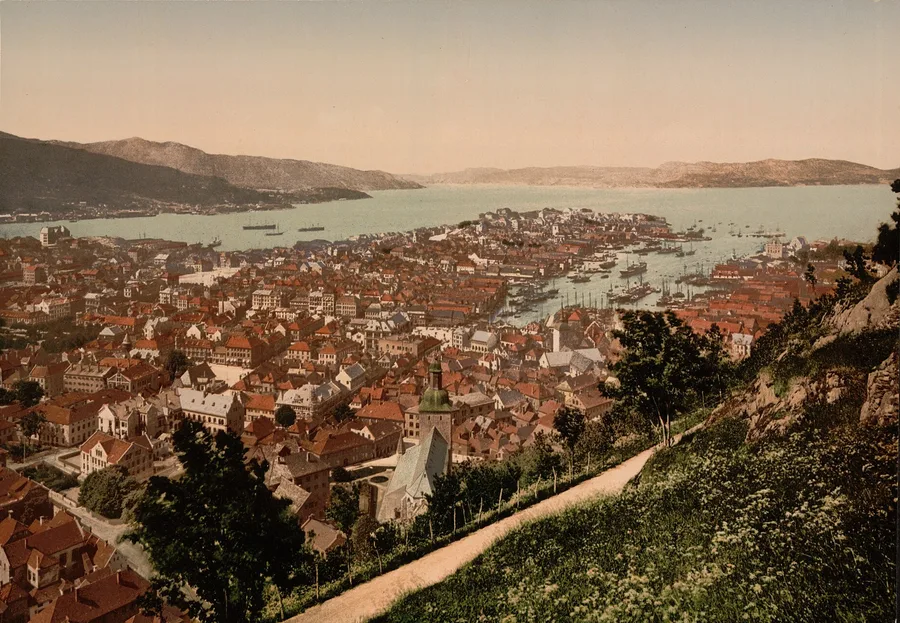 Photochrom print, General view from Fjeldveien, Bergen (c. 1890–1900), Library of Congress Bergen in the 1890s from the Fjellveien path on Fløyfjellet — the whole city between its mountains, Vågen harbour still crowded with sailing ships at its heart. For four centuries Norway's largest city, and the wharf through which the entire western export economy ran. Norway's western trading capital, founded around 1070 on the
inner Byfjorden. For four centuries the largest city in the
country and the wharf through which the entire western export
economy ran — dried cod from the Lofoten fisheries, stockpiled
and traded by the Hanseatic merchants at Bryggen from 1360 to
1754. Norway's commercial and intellectual heart through the
Hanseatic period; overtaken in size by Christiania (Oslo) in the
1830s. The painted wooden Bryggen wharf is on the UNESCO World
Heritage list and substantially what it was in the late
seventeenth century.
In this article The royal court of Hákon IV operated from Bergen through most
of the thirteenth century. The Bergenhus fortress (begun in
the 1240s) housed the king's hall; the cathedral school
produced the Konungs skuggsjá.
On the trip The Ungdommene (the Youngsters) reach Bergen late on Day 3
via the Norway-in-a-Nutshell train-and-ferry route from
Oslo. On the Day 4 morning they walk Bryggen and ride the
funicular up Mount Fløyen before flying back to Oslo and driving
on to Lillehammer that evening — a day ahead of the Gråhårsklubben
(the Oldsters), who spend the split days north in Trondheim and
the heritage country of Stjørdal, Hegra, and Kylloplass and come
south on Day 5.
Bergen Also discussed in The Germans Who "Ruled" Bergen — the Hanseatic merchants on Bryggen WharfBefore There Was Norway — petty kingdoms at the edge of the worldThe King Who Became a Saint — how the Nordmen came to ChristA Catholic Norway — the faith that gave the kingdom its first institutions and the stave churchesThe Long Fall — the sudden loss of Norwegian nobility, the end of the kings, and half of Norway gone foreverThe 400-Year Night — when the Northern Lion lay dormantThe Crusades?!!!! — sixty ships from Bergen, bound for the Holy LandThe Reformation, 1537 — one church eradicated and another imposedWorld War II — the King’s “No” and the Nazis in NorwayKraken — the island-sized beast, logged as factSjøormer — the serpents in the deep lakes and fjordsPesta — an old woman walking from farm to farmFossegrimen — the waterfall fiddler who teaches you to playAlcohol and Vinmonopolet — when and where to buy a drinkEveryday etiquette — quiet voices, wide space, no smilingFood and dining customs — having patience, free water, brunost on everything🚨 Emergencies - important numbers, hospitals, and what you can doLanguage basics — just enough Norwegian to be politeWhat to wear — the layering system, on the ground sat in active conversation with the literary world of medieval Europe. The Norwegian state in the high Middle Ages was at the peak of its institutional and diplomatic development. The century roughly between 1217 and 1319 is what Norwegian historians call the Storhetstiden
Photochrom print, General view from Fjeldveien, Bergen (c. 1890–1900), Library of Congress Bergen in the 1890s from the Fjellveien path on Fløyfjellet — the whole city between its mountains, Vågen harbour still crowded with sailing ships at its heart. For four centuries Norway's largest city, and the wharf through which the entire western export economy ran. Norway's western trading capital, founded around 1070 on the
inner Byfjorden. For four centuries the largest city in the
country and the wharf through which the entire western export
economy ran — dried cod from the Lofoten fisheries, stockpiled
and traded by the Hanseatic merchants at Bryggen from 1360 to
1754. Norway's commercial and intellectual heart through the
Hanseatic period; overtaken in size by Christiania (Oslo) in the
1830s. The painted wooden Bryggen wharf is on the UNESCO World
Heritage list and substantially what it was in the late
seventeenth century.
In this article The royal court of Hákon IV operated from Bergen through most
of the thirteenth century. The Bergenhus fortress (begun in
the 1240s) housed the king's hall; the cathedral school
produced the Konungs skuggsjá.
On the trip The Ungdommene (the Youngsters) reach Bergen late on Day 3
via the Norway-in-a-Nutshell train-and-ferry route from
Oslo. On the Day 4 morning they walk Bryggen and ride the
funicular up Mount Fløyen before flying back to Oslo and driving
on to Lillehammer that evening — a day ahead of the Gråhårsklubben
(the Oldsters), who spend the split days north in Trondheim and
the heritage country of Stjørdal, Hegra, and Kylloplass and come
south on Day 5.
Bergen Also discussed in The Germans Who "Ruled" Bergen — the Hanseatic merchants on Bryggen WharfBefore There Was Norway — petty kingdoms at the edge of the worldThe King Who Became a Saint — how the Nordmen came to ChristA Catholic Norway — the faith that gave the kingdom its first institutions and the stave churchesThe Long Fall — the sudden loss of Norwegian nobility, the end of the kings, and half of Norway gone foreverThe 400-Year Night — when the Northern Lion lay dormantThe Crusades?!!!! — sixty ships from Bergen, bound for the Holy LandThe Reformation, 1537 — one church eradicated and another imposedWorld War II — the King’s “No” and the Nazis in NorwayKraken — the island-sized beast, logged as factSjøormer — the serpents in the deep lakes and fjordsPesta — an old woman walking from farm to farmFossegrimen — the waterfall fiddler who teaches you to playAlcohol and Vinmonopolet — when and where to buy a drinkEveryday etiquette — quiet voices, wide space, no smilingFood and dining customs — having patience, free water, brunost on everything🚨 Emergencies - important numbers, hospitals, and what you can doLanguage basics — just enough Norwegian to be politeWhat to wear — the layering system, on the ground sat in active conversation with the literary world of medieval Europe. The Norwegian state in the high Middle Ages was at the peak of its institutional and diplomatic development. The century roughly between 1217 and 1319 is what Norwegian historians call the Storhetstiden 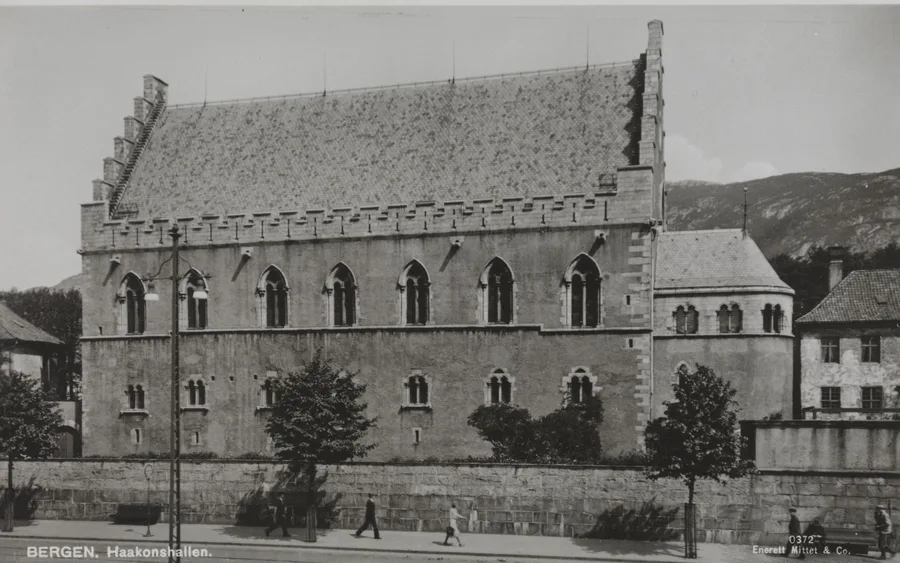 Mittet & Co., Bergen. Haakonshallen (postcard, early 20th century), National Library of Norway Hákon IV's stone great hall at Bergenhus, completed in 1261 for his son Magnus's royal wedding — the largest secular building of medieval Norway, and the most tangible monument the age of greatness left standing. The age of greatness — the Norwegian historiographical
term for the thirteenth-century high point of the medieval
Norwegian kingdom, roughly the reigns of Hákon IV
(1217–1263) and his son Magnus VI Lagabøte (1263–1280). The
period combines maximum territorial extent (Norgesveldet),
the codification of national law in the Landslov of 1274,
the regulation of royal succession (Tronfølgeloven of 1260),
flourishing court culture (translated Arthurian romance,
Sturla Þórðarson's Hákonar saga), the high diplomacy of
the Castilian marriage, and the building of Bergen as a
Hanseatic-tied European city. The phrase frames the medieval
kingdom as a peer of contemporary European powers — the
reference point Norwegians return to after the long centuries
under Denmark.
— the time of greatness. “Golden Age” is an English gloss of the term.
Mittet & Co., Bergen. Haakonshallen (postcard, early 20th century), National Library of Norway Hákon IV's stone great hall at Bergenhus, completed in 1261 for his son Magnus's royal wedding — the largest secular building of medieval Norway, and the most tangible monument the age of greatness left standing. The age of greatness — the Norwegian historiographical
term for the thirteenth-century high point of the medieval
Norwegian kingdom, roughly the reigns of Hákon IV
(1217–1263) and his son Magnus VI Lagabøte (1263–1280). The
period combines maximum territorial extent (Norgesveldet),
the codification of national law in the Landslov of 1274,
the regulation of royal succession (Tronfølgeloven of 1260),
flourishing court culture (translated Arthurian romance,
Sturla Þórðarson's Hákonar saga), the high diplomacy of
the Castilian marriage, and the building of Bergen as a
Hanseatic-tied European city. The phrase frames the medieval
kingdom as a peer of contemporary European powers — the
reference point Norwegians return to after the long centuries
under Denmark.
— the time of greatness. “Golden Age” is an English gloss of the term.
The Norgesveldet
The Norway of Hákon IV Hákonarson 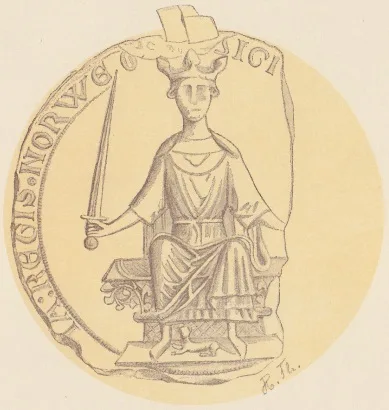 Drawing by Hakon Thorsen after the 1247/48 seal of Håkon IV, in Chr. Brinchmann, Norske Konge-sigiller (1924) The great seal Håkon IV affixed to royal charters — a crowned king enthroned with a sword, the authority behind the "Golden Age" reign that brought Iceland under the Norwegian crown and produced the Konungs skuggsjá. King of Norway 1217–1263, bynamed Hákon the Old in later
tradition. His reign opened the Golden Age of medieval Norway —
the country's last sustained period as an independent international
power before the dynastic absorption into Denmark a century later.
Brought the long civil war period to an end, extended Norwegian
sovereignty to Iceland (which acknowledged him as king in 1262)
and the Hebrides and Isle of Man, codified Norwegian law, and
presided over the literary court that produced the Konungs
skuggsjá (The King's Mirror) around 1250. Died on Orkney in
December 1263 returning from his unsuccessful Scottish campaign.
Also discussed in A Catholic Norway — the faith that gave the kingdom its first institutions and the stave churchesThe Long Fall — the sudden loss of Norwegian nobility, the end of the kings, and half of Norway gone foreverThe Germans Who "Ruled" Bergen — the Hanseatic merchants on Bryggen Wharf at mid-century held, in various forms of sovereignty, the entire Norse-speaking North Atlantic. Iceland
Drawing by Hakon Thorsen after the 1247/48 seal of Håkon IV, in Chr. Brinchmann, Norske Konge-sigiller (1924) The great seal Håkon IV affixed to royal charters — a crowned king enthroned with a sword, the authority behind the "Golden Age" reign that brought Iceland under the Norwegian crown and produced the Konungs skuggsjá. King of Norway 1217–1263, bynamed Hákon the Old in later
tradition. His reign opened the Golden Age of medieval Norway —
the country's last sustained period as an independent international
power before the dynastic absorption into Denmark a century later.
Brought the long civil war period to an end, extended Norwegian
sovereignty to Iceland (which acknowledged him as king in 1262)
and the Hebrides and Isle of Man, codified Norwegian law, and
presided over the literary court that produced the Konungs
skuggsjá (The King's Mirror) around 1250. Died on Orkney in
December 1263 returning from his unsuccessful Scottish campaign.
Also discussed in A Catholic Norway — the faith that gave the kingdom its first institutions and the stave churchesThe Long Fall — the sudden loss of Norwegian nobility, the end of the kings, and half of Norway gone foreverThe Germans Who "Ruled" Bergen — the Hanseatic merchants on Bryggen Wharf at mid-century held, in various forms of sovereignty, the entire Norse-speaking North Atlantic. Iceland 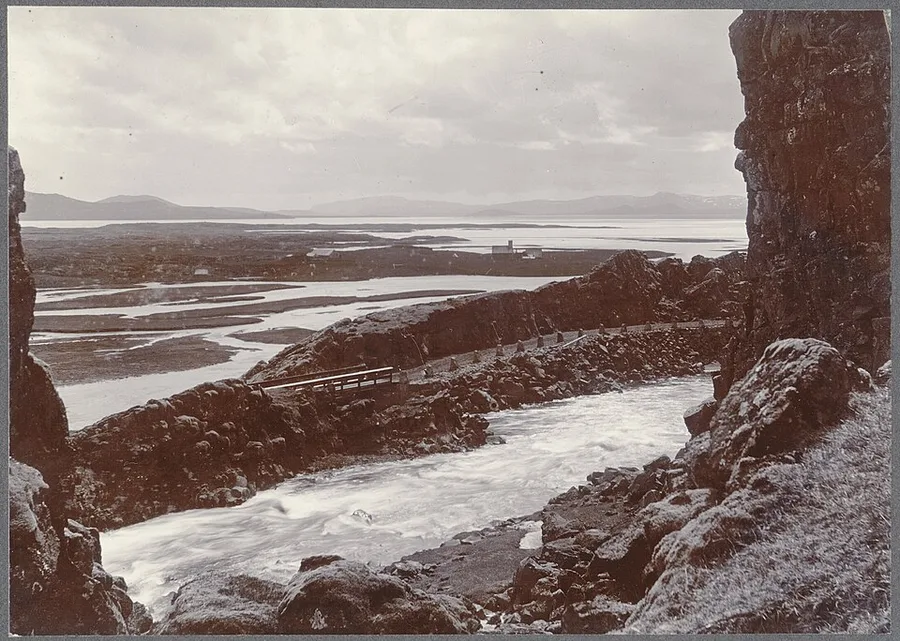 Frederick W. W. Howell, Þingvellir from Almannagjá (c. 1900), Fiske Icelandic Collection, Cornell University Library The Þingvellir assembly plain seen from the Almannagjá rift — the ground where the Alþing met each summer, and where in 1262 the Old Covenant was accepted, ending the kingless commonwealth and passing Iceland under Hákon IV's crown. The North Atlantic island settled from Norway in the ninth and
tenth centuries by chieftains and their followings who refused to
accept Harald Fairhair's authority on the Norwegian mainland and
emigrated rather than submit. They built a country without a king,
governed by an annual open-air assembly at Þingvellir called the
Alþing — the oldest parliament in the world by date of founding. Three centuries after the migration, their descendants
(notably Snorri Sturluson) composed the prose sagas that became
almost the only literary memory of the Norwegian petty kingdoms.
Also discussed in Before There Was Norway — petty kingdoms at the edge of the worldThe Viking Age — longships, legends, and the first "Norway"Worshiping Odin and Thor — the lived religion of pre-Christian NorwayThe King Who Became a Saint — how the Nordmen came to ChristA Catholic Norway — the faith that gave the kingdom its first institutions and the stave churchesThe 400-Year Night — when the Northern Lion lay dormant in the west submitted to the Norwegian crown in 1262 by treaty, the Gamli sáttmáli The Old Covenant — the treaty by which the Icelandic
Commonwealth voluntarily submitted to the Norwegian crown,
ratified at the Althing in stages between 1262 and 1264.
After decades of internal feuding (the Sturlung Age),
Iceland's chieftains agreed to recognise Hákon IV as king
in exchange for guaranteed shipping connections, fixed tax
obligations, and the right to repudiate the agreement if the
king broke his side. The Covenant ended three centuries of
Icelandic independence and incorporated Iceland into the
Norwegian realm. With the Kalmar Union (1397) and the union
with Denmark, Iceland passed under Danish rule until 1944.
that ended the Icelandic commonwealth — by then more than three centuries old. Greenland had been paying tribute to Norway since 1261. The Faroe Islands
Frederick W. W. Howell, Þingvellir from Almannagjá (c. 1900), Fiske Icelandic Collection, Cornell University Library The Þingvellir assembly plain seen from the Almannagjá rift — the ground where the Alþing met each summer, and where in 1262 the Old Covenant was accepted, ending the kingless commonwealth and passing Iceland under Hákon IV's crown. The North Atlantic island settled from Norway in the ninth and
tenth centuries by chieftains and their followings who refused to
accept Harald Fairhair's authority on the Norwegian mainland and
emigrated rather than submit. They built a country without a king,
governed by an annual open-air assembly at Þingvellir called the
Alþing — the oldest parliament in the world by date of founding. Three centuries after the migration, their descendants
(notably Snorri Sturluson) composed the prose sagas that became
almost the only literary memory of the Norwegian petty kingdoms.
Also discussed in Before There Was Norway — petty kingdoms at the edge of the worldThe Viking Age — longships, legends, and the first "Norway"Worshiping Odin and Thor — the lived religion of pre-Christian NorwayThe King Who Became a Saint — how the Nordmen came to ChristA Catholic Norway — the faith that gave the kingdom its first institutions and the stave churchesThe 400-Year Night — when the Northern Lion lay dormant in the west submitted to the Norwegian crown in 1262 by treaty, the Gamli sáttmáli The Old Covenant — the treaty by which the Icelandic
Commonwealth voluntarily submitted to the Norwegian crown,
ratified at the Althing in stages between 1262 and 1264.
After decades of internal feuding (the Sturlung Age),
Iceland's chieftains agreed to recognise Hákon IV as king
in exchange for guaranteed shipping connections, fixed tax
obligations, and the right to repudiate the agreement if the
king broke his side. The Covenant ended three centuries of
Icelandic independence and incorporated Iceland into the
Norwegian realm. With the Kalmar Union (1397) and the union
with Denmark, Iceland passed under Danish rule until 1944.
that ended the Icelandic commonwealth — by then more than three centuries old. Greenland had been paying tribute to Norway since 1261. The Faroe Islands 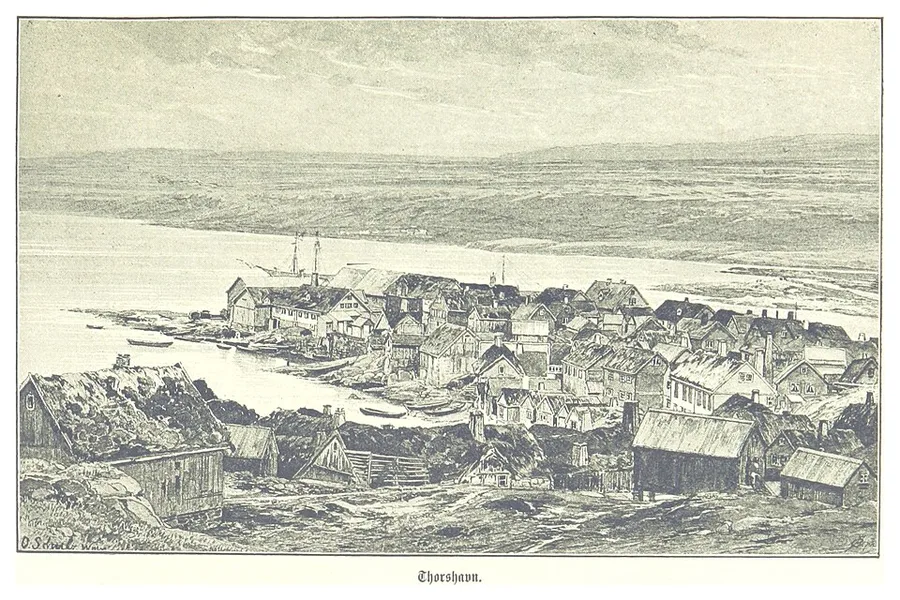 O. Schulz, Thorshavn, from A. Baumgartner, Nordische Fahrten: Island und die Färöer (1889), British Library Tórshavn, the Faroes' harbour town, engraved in 1889: turf-roofed houses crowd toward Tinganes, the low point where the Norse settlers' assembly met from around 900 and where the islands' government still sits. Archipelago of eighteen volcanic islands in the North Atlantic
between Norway, Iceland, and Scotland. Settled by Norse colonists
beginning in the early ninth century, the Faroes were under
Norwegian sovereignty by 1035; passed with Norway to Denmark in
1380 and remained under Danish rule after Norway's independence
in 1814. Today a self-governing nation within the Kingdom of
Denmark, with about fifty-three thousand people speaking Faroese
(a North Germanic language closely related to Icelandic and to
the western Norwegian dialects of Old Norse). The devotion to
Saint Olav was carried across the Faroes by the medieval Norwegian
archbishopric of Nidaros, and Olsok is still observed there.
Also discussed in The King Who Became a Saint — how the Nordmen came to ChristA Catholic Norway — the faith that gave the kingdom its first institutions and the stave churchesThe 400-Year Night — when the Northern Lion lay dormant had been a dependent province since the early eleventh century. Orkney
O. Schulz, Thorshavn, from A. Baumgartner, Nordische Fahrten: Island und die Färöer (1889), British Library Tórshavn, the Faroes' harbour town, engraved in 1889: turf-roofed houses crowd toward Tinganes, the low point where the Norse settlers' assembly met from around 900 and where the islands' government still sits. Archipelago of eighteen volcanic islands in the North Atlantic
between Norway, Iceland, and Scotland. Settled by Norse colonists
beginning in the early ninth century, the Faroes were under
Norwegian sovereignty by 1035; passed with Norway to Denmark in
1380 and remained under Danish rule after Norway's independence
in 1814. Today a self-governing nation within the Kingdom of
Denmark, with about fifty-three thousand people speaking Faroese
(a North Germanic language closely related to Icelandic and to
the western Norwegian dialects of Old Norse). The devotion to
Saint Olav was carried across the Faroes by the medieval Norwegian
archbishopric of Nidaros, and Olsok is still observed there.
Also discussed in The King Who Became a Saint — how the Nordmen came to ChristA Catholic Norway — the faith that gave the kingdom its first institutions and the stave churchesThe 400-Year Night — when the Northern Lion lay dormant had been a dependent province since the early eleventh century. Orkney 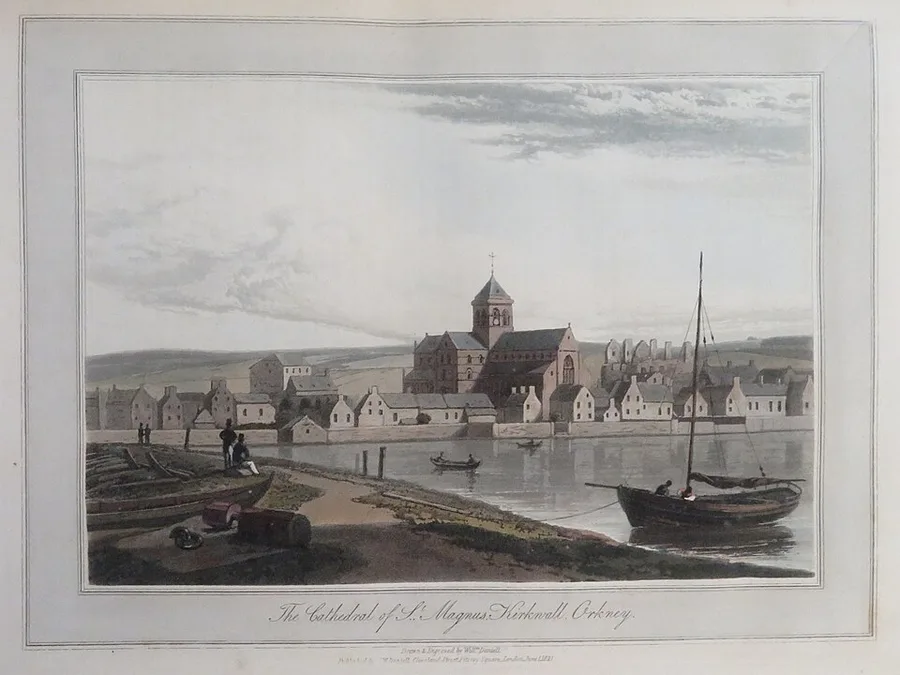 William Daniell, The Cathedral of St Magnus, Kirkwall (1821), A Voyage Round Great Britain William Daniell's 1821 view shows St Magnus Cathedral in Kirkwall, seat of the diocese of Orkney — a suffragan bishopric under the Norwegian archbishopric of Nidaros from 1152 until the Scottish crown absorbed the earldom in 1468. Archipelago of around seventy islands off the northeastern coast
of Scotland, settled heavily by Norse from the ninth century
onward and ruled as the Earldom of Orkney under the Norwegian
crown until 1468, when the islands were pledged to Scotland as
surety for the dowry of a Norwegian princess and never redeemed.
The diocese of Orkney was one of the suffragan dioceses under
the Norwegian archdiocese of Nidaros from 1152 onward, with the
cathedral at Kirkwall — St. Magnus Cathedral, founded 1137 by
Earl Rognvald in honour of his martyred uncle Magnus Erlendsson —
one of the most northerly Romanesque cathedrals in Europe.
Hákon IV of Norway died at the Bishop's Palace in Kirkwall in
December 1263 after the unsuccessful Scottish campaign.
Also discussed in A Catholic Norway — the faith that gave the kingdom its first institutions and the stave churches was an earldom held by jarls who swore homage to Bergen; Shetland
William Daniell, The Cathedral of St Magnus, Kirkwall (1821), A Voyage Round Great Britain William Daniell's 1821 view shows St Magnus Cathedral in Kirkwall, seat of the diocese of Orkney — a suffragan bishopric under the Norwegian archbishopric of Nidaros from 1152 until the Scottish crown absorbed the earldom in 1468. Archipelago of around seventy islands off the northeastern coast
of Scotland, settled heavily by Norse from the ninth century
onward and ruled as the Earldom of Orkney under the Norwegian
crown until 1468, when the islands were pledged to Scotland as
surety for the dowry of a Norwegian princess and never redeemed.
The diocese of Orkney was one of the suffragan dioceses under
the Norwegian archdiocese of Nidaros from 1152 onward, with the
cathedral at Kirkwall — St. Magnus Cathedral, founded 1137 by
Earl Rognvald in honour of his martyred uncle Magnus Erlendsson —
one of the most northerly Romanesque cathedrals in Europe.
Hákon IV of Norway died at the Bishop's Palace in Kirkwall in
December 1263 after the unsuccessful Scottish campaign.
Also discussed in A Catholic Norway — the faith that gave the kingdom its first institutions and the stave churches was an earldom held by jarls who swore homage to Bergen; Shetland 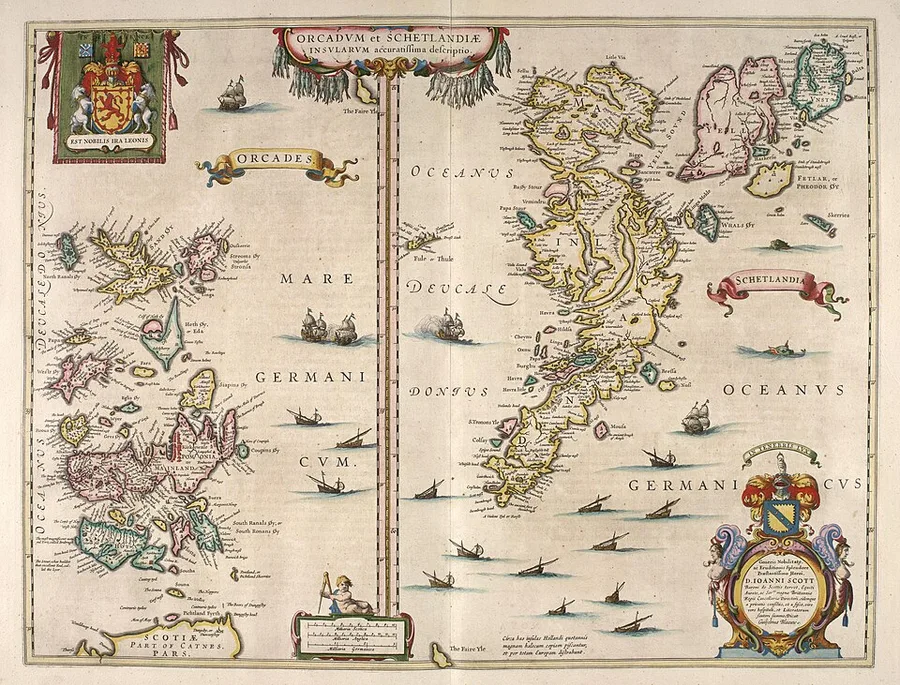 Joan Blaeu, Orcades and Schetlandia, Atlas of Scotland (1654), National Library of Scotland Blaeu's 1654 chart still pairs Shetland with Orkney four centuries after Norway administered both directly as crown land -- the cartographic pairing outlived the political one by less than two centuries. Archipelago of around a hundred islands off the northeastern
coast of Scotland, about a hundred kilometres north of Orkney.
Settled heavily by Norse from the late ninth century onward
and ruled as crown land directly under the Norwegian royal
administration through the medieval period. Pledged to Scotland
in 1469 alongside Orkney as surety for the unpaid dowry of
Margaret of Denmark, daughter of King Christian I — never
redeemed; the islands have been Scottish ever since. The Norn
language (a North Germanic dialect descended from Old Norse)
was spoken there until the eighteenth century; Norse-derived
place-names dominate the islands today.
was crown land more directly under royal administration; the Hebrides off the western Scottish coast and the Isle of Man
Joan Blaeu, Orcades and Schetlandia, Atlas of Scotland (1654), National Library of Scotland Blaeu's 1654 chart still pairs Shetland with Orkney four centuries after Norway administered both directly as crown land -- the cartographic pairing outlived the political one by less than two centuries. Archipelago of around a hundred islands off the northeastern
coast of Scotland, about a hundred kilometres north of Orkney.
Settled heavily by Norse from the late ninth century onward
and ruled as crown land directly under the Norwegian royal
administration through the medieval period. Pledged to Scotland
in 1469 alongside Orkney as surety for the unpaid dowry of
Margaret of Denmark, daughter of King Christian I — never
redeemed; the islands have been Scottish ever since. The Norn
language (a North Germanic dialect descended from Old Norse)
was spoken there until the eighteenth century; Norse-derived
place-names dominate the islands today.
was crown land more directly under royal administration; the Hebrides off the western Scottish coast and the Isle of Man 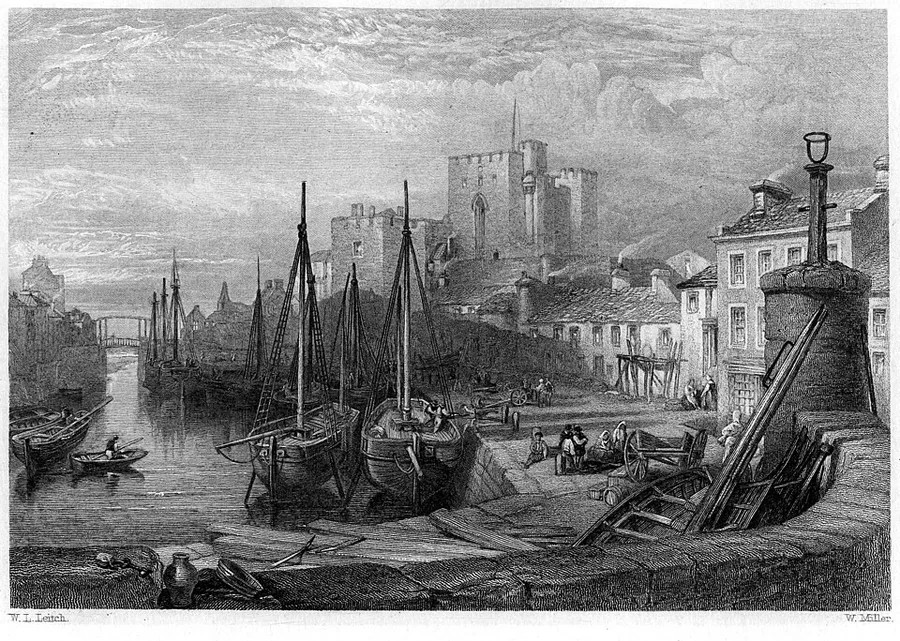 William Miller after William L. Leitch, Castle Rushen (1845), Waverley Novels Castle Rushen rising over Castletown harbour — a seat of the Norse-Gaelic Kings of Mann and the Isles, who held the island in suzerainty under the Norwegian crown until the Treaty of Perth ceded it to Scotland in 1266. Island in the Irish Sea between Britain and Ireland, about
fifty-two kilometres long. Settled heavily by Norse from the
ninth century onward and ruled through the medieval period
by Norse-Gaelic kings (the Kingdom of Mann and the Isles)
in suzerainty under the Norwegian crown. Ceded to Scotland
with the Hebrides in 1266 by the Treaty of Perth. The Isle
of Man's Tynwald, a Norse-derived open-air parliament
meeting annually on Tynwald Hill since the medieval period,
is one of the oldest continuously functioning legislatures
in the world. Today a self-governing British Crown
Dependency, neither part of the United Kingdom nor of the
European Union.
in the Irish Sea were held in suzerainty through the local Norse-Gaelic kings. (Today the Faroes are an autonomous Danish territory; Orkney, Shetland, and the Hebrides are part of Scotland; the Isle of Man is a self-governing British dependency in the sea between Britain and Ireland; Iceland and Greenland are independent or autonomous in their own right.) The Norwegian term for the whole arc is the Norgesveldet
William Miller after William L. Leitch, Castle Rushen (1845), Waverley Novels Castle Rushen rising over Castletown harbour — a seat of the Norse-Gaelic Kings of Mann and the Isles, who held the island in suzerainty under the Norwegian crown until the Treaty of Perth ceded it to Scotland in 1266. Island in the Irish Sea between Britain and Ireland, about
fifty-two kilometres long. Settled heavily by Norse from the
ninth century onward and ruled through the medieval period
by Norse-Gaelic kings (the Kingdom of Mann and the Isles)
in suzerainty under the Norwegian crown. Ceded to Scotland
with the Hebrides in 1266 by the Treaty of Perth. The Isle
of Man's Tynwald, a Norse-derived open-air parliament
meeting annually on Tynwald Hill since the medieval period,
is one of the oldest continuously functioning legislatures
in the world. Today a self-governing British Crown
Dependency, neither part of the United Kingdom nor of the
European Union.
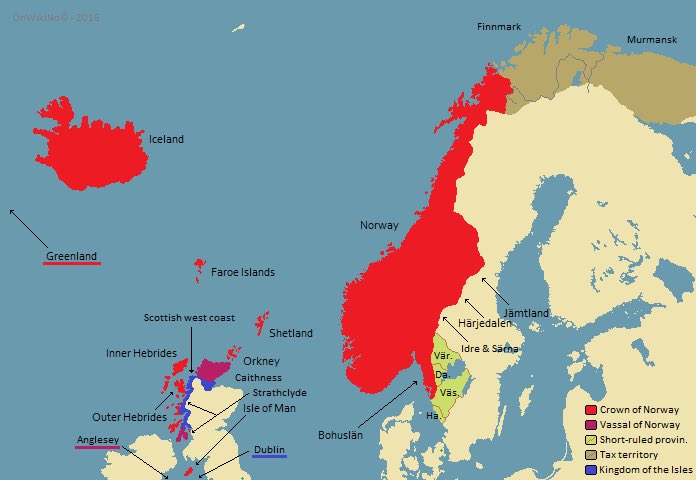
in the Irish Sea were held in suzerainty through the local Norse-Gaelic kings. (Today the Faroes are an autonomous Danish territory; Orkney, Shetland, and the Hebrides are part of Scotland; the Isle of Man is a self-governing British dependency in the sea between Britain and Ireland; Iceland and Greenland are independent or autonomous in their own right.) The Norwegian term for the whole arc is the Norgesveldet 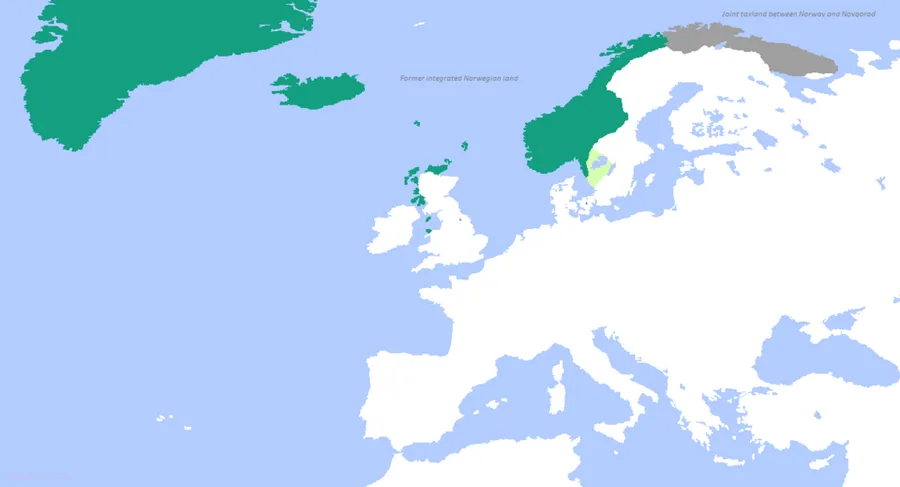 OnWikiNo, Norway About 1265 (2016), Wikimedia Commons This modern map plots Norgesveldet at its widest point, just before the 1266 Treaty of Perth trimmed the western edge — the mainland plus every North Atlantic and Irish Sea possession this card names. The Norwegian realm — the modern Norwegian term for the
thirteenth-century maximum extent of Norwegian royal
suzerainty: the Kingdom of Norway proper plus its tributary
lands in the North Atlantic and the Irish Sea. At its
greatest under Hákon IV (r. 1217–1263) the realm included
mainland Norway, Iceland (incorporated 1262–1264), Greenland
(incorporated 1261), the Faroes, Shetland, Orkney, the
Hebrides, and the Isle of Man — the largest North Atlantic
polity of the high Middle Ages. Most of the overseas
possessions were lost piecemeal: the Hebrides and Man in
1266, Shetland and Orkney in 1469. Iceland and the Faroes
remained until the modern era.
— the Norwegian realm — and at its widest it stretched roughly four thousand kilometres of saltwater. From the archbishopric at Nidaros the metropolitan see held authority over every Norwegian diocese and over the sees of Iceland, Greenland, the Faroes, Orkney, and the Sudreyjar. Few European monarchies of the period held a single oceanic arc of comparable length.
OnWikiNo, Norway About 1265 (2016), Wikimedia Commons This modern map plots Norgesveldet at its widest point, just before the 1266 Treaty of Perth trimmed the western edge — the mainland plus every North Atlantic and Irish Sea possession this card names. The Norwegian realm — the modern Norwegian term for the
thirteenth-century maximum extent of Norwegian royal
suzerainty: the Kingdom of Norway proper plus its tributary
lands in the North Atlantic and the Irish Sea. At its
greatest under Hákon IV (r. 1217–1263) the realm included
mainland Norway, Iceland (incorporated 1262–1264), Greenland
(incorporated 1261), the Faroes, Shetland, Orkney, the
Hebrides, and the Isle of Man — the largest North Atlantic
polity of the high Middle Ages. Most of the overseas
possessions were lost piecemeal: the Hebrides and Man in
1266, Shetland and Orkney in 1469. Iceland and the Faroes
remained until the modern era.
— the Norwegian realm — and at its widest it stretched roughly four thousand kilometres of saltwater. From the archbishopric at Nidaros the metropolitan see held authority over every Norwegian diocese and over the sees of Iceland, Greenland, the Faroes, Orkney, and the Sudreyjar. Few European monarchies of the period held a single oceanic arc of comparable length.
The realm was held thinly. Medieval Norway in the middle of the thirteenth century had perhaps three to five hundred thousand people; Bergen, the capital, perhaps seven to ten thousand; Norse Greenland two or three thousand at its peak. The arc was vast, the population thin, and what carried the realm across it was not coercive power so much as institutional reach: an archbishopric, a customs system, a single law code, a court translating Chrétien de Troyes.
The boy-king who built it
Hákon IV Hákonarson was born in 1204 to a low-born concubine named Inga of Varteig 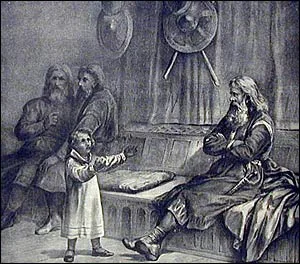 Inga fra Varteig: Den lille Håkon Håkonsson hos Helge Vasse (undated engraving) The engraving shows the infant Håkon sheltered at the farmer Helge Vasse's house — part of the itinerant hiding and protection Inga arranged for her son during the Birkebeiner-Bagler civil war, before the more famous 1206 ski rescue. Norwegian mother of King Hákon IV Hákonarson (c. 1185–1234). A
woman of low birth from the Varteig parish in Østfold,
southeastern Norway; mother of the future king through her
relationship with King Hákon III Sverresson, who died in 1204
before the child was born. Carried by Birkebeiner partisans
with her infant son across the central Norwegian highland in
the winter of 1205–06 to bring him to safety at Nidaros — the
ski-rescue commemorated by the modern Birkebeinerrennet race.
In 1218 at Bergen, with her son acclaimed king, Inga submitted
to the iron ordeal — carrying red-hot iron unharmed before the
assembled court — to establish her son's paternity and his
legitimate right to the throne.
and a king, Hákon III Sverresson
Inga fra Varteig: Den lille Håkon Håkonsson hos Helge Vasse (undated engraving) The engraving shows the infant Håkon sheltered at the farmer Helge Vasse's house — part of the itinerant hiding and protection Inga arranged for her son during the Birkebeiner-Bagler civil war, before the more famous 1206 ski rescue. Norwegian mother of King Hákon IV Hákonarson (c. 1185–1234). A
woman of low birth from the Varteig parish in Østfold,
southeastern Norway; mother of the future king through her
relationship with King Hákon III Sverresson, who died in 1204
before the child was born. Carried by Birkebeiner partisans
with her infant son across the central Norwegian highland in
the winter of 1205–06 to bring him to safety at Nidaros — the
ski-rescue commemorated by the modern Birkebeinerrennet race.
In 1218 at Bergen, with her son acclaimed king, Inga submitted
to the iron ordeal — carrying red-hot iron unharmed before the
assembled court — to establish her son's paternity and his
legitimate right to the throne.
and a king, Hákon III Sverresson 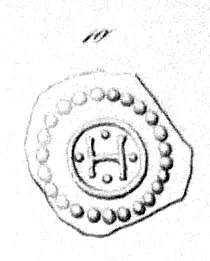 C. I. Schive, Norges Mynter i Middelalderen (Christiania, 1865), plate drawing No portrait of Håkon exists. This small bracteate coin, drawn for C. I. Schive's 1865 atlas of medieval Norwegian coinage, was struck during his two-year reign; the letter H may stand for Håkon himself or for the mint town of Hamar. King of Norway 1202–1204 (Hákon III), son of King Sverre
Sigurdsson of the Birkebeiner faction. Reigned only two years
before dying at Bergen on 1 January 1204, possibly poisoned by
his stepmother Margrete according to suspicion that produced a
formal trial. Fathered the future Hákon IV Hákonarson with a
low-born concubine named Inga of Varteig; the child was born
later in 1204 and inherited the Birkebeiner claim to the throne
amid the ongoing civil wars.
, who died the same year. In the winter of 1205–06, two of the surviving Birkebeiner
C. I. Schive, Norges Mynter i Middelalderen (Christiania, 1865), plate drawing No portrait of Håkon exists. This small bracteate coin, drawn for C. I. Schive's 1865 atlas of medieval Norwegian coinage, was struck during his two-year reign; the letter H may stand for Håkon himself or for the mint town of Hamar. King of Norway 1202–1204 (Hákon III), son of King Sverre
Sigurdsson of the Birkebeiner faction. Reigned only two years
before dying at Bergen on 1 January 1204, possibly poisoned by
his stepmother Margrete according to suspicion that produced a
formal trial. Fathered the future Hákon IV Hákonarson with a
low-born concubine named Inga of Varteig; the child was born
later in 1204 and inherited the Birkebeiner claim to the throne
amid the ongoing civil wars.
, who died the same year. In the winter of 1205–06, two of the surviving Birkebeiner 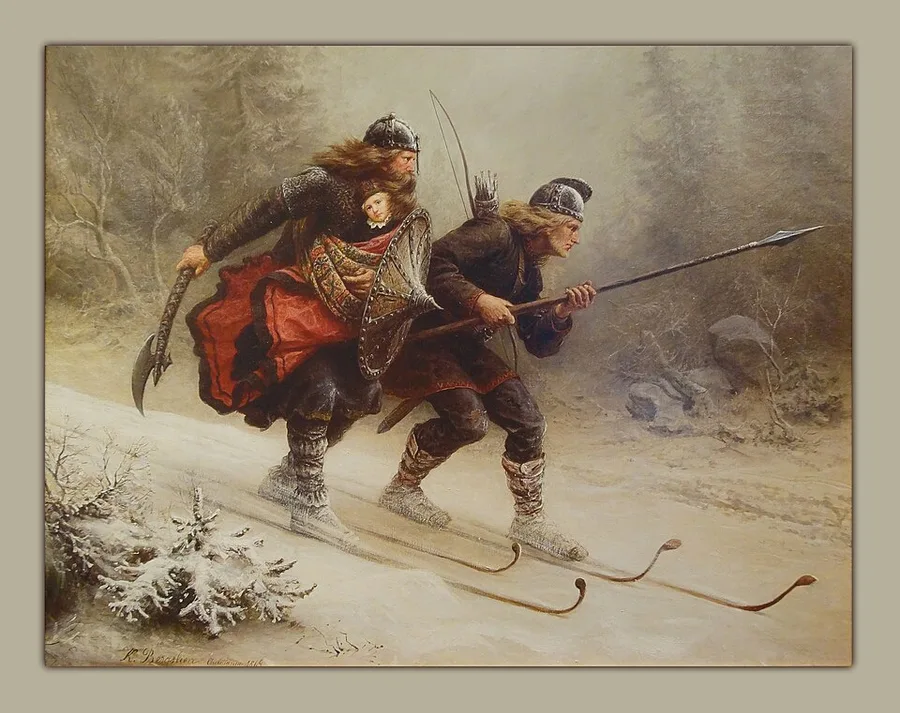 Knud Bergslien, Birkebeinerne på Ski over Fjeldet med Kongsbarnet (1869), Skimuseet, Holmenkollen Bergslien's 1869 canvas fixed the national image of the Birkebeiner rescue — two warriors skiing the two-year-old future Håkon IV across the mountains from Lillehammer to safety in the winter of 1206, the act that gave the rebel faction its enduring legend. The birch-leggers — the rebel faction that emerged in
Norway in 1174 from the rural districts of inland Trøndelag
and the upland valleys, named in mockery (their poverty was
such that they wrapped birch bark around their legs in place
of proper leg-wraps). Initially a disorganised peasant
rising, the movement found a leader in the priest-turned-king
Sverre Sigurdsson, who took the kingship in 1184 and founded
the dynasty that would rule Norway through the thirteenth-
century Golden Age. The Birkebeiners' iconic moment is the
1206 midwinter rescue of the infant Hákon Hákonsson — future
Hákon IV — skied across the mountains from Lillehammer to
safety.
partisans — the rival faction the new king’s family had led — carried the two-year-old Hákon on skis across the mountains of central Norway in a snowstorm to bring him safely to Nidaros. The Birkebeinerrennet
Knud Bergslien, Birkebeinerne på Ski over Fjeldet med Kongsbarnet (1869), Skimuseet, Holmenkollen Bergslien's 1869 canvas fixed the national image of the Birkebeiner rescue — two warriors skiing the two-year-old future Håkon IV across the mountains from Lillehammer to safety in the winter of 1206, the act that gave the rebel faction its enduring legend. The birch-leggers — the rebel faction that emerged in
Norway in 1174 from the rural districts of inland Trøndelag
and the upland valleys, named in mockery (their poverty was
such that they wrapped birch bark around their legs in place
of proper leg-wraps). Initially a disorganised peasant
rising, the movement found a leader in the priest-turned-king
Sverre Sigurdsson, who took the kingship in 1184 and founded
the dynasty that would rule Norway through the thirteenth-
century Golden Age. The Birkebeiners' iconic moment is the
1206 midwinter rescue of the infant Hákon Hákonsson — future
Hákon IV — skied across the mountains from Lillehammer to
safety.
partisans — the rival faction the new king’s family had led — carried the two-year-old Hákon on skis across the mountains of central Norway in a snowstorm to bring him safely to Nidaros. The Birkebeinerrennet 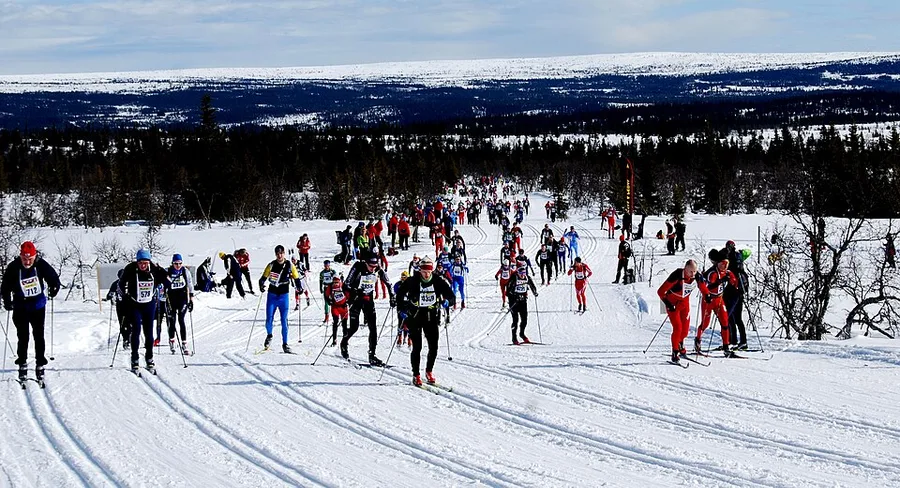 Torstein Frogner, Birkebeinerrennet race near Midtfjellet (2010), CC BY-SA 3.0 A modern field of Birkebeinerrennet racers, each required to carry a 3.5 kg pack standing in for the infant prince, retraces on skis the same Rena-to-Lillehammer ridge the legendary 1206 rescue crossed. Modern long-distance cross-country ski race held annually in
March from Rena to Lillehammer — a 54-kilometre course over
the Birkebeiner mountain ridge, with each skier carrying a
3.5-kilogram pack symbolising the infant Hákon Hákonsson.
The race commemorates the legendary midwinter rescue of the
two-year-old future King Hákon IV in 1206, when the
Birkebeiner warriors Torstein Skevla and Skjervald Skrukka
skied him across the mountains from Lillehammer to Østerdalen
to escape the rival Bagler faction during the Norwegian civil
wars. Founded in 1932, the race grew into one of the largest
participation ski events in the world.
On the trip The race finishes in Lillehammer each March — the same
town where the trip's two family groups reunite on Day 5.
, the long-distance Norwegian ski race held each March between Rena and Lillehammer, commemorates the rescue. In 1218, at Bergen, the boy’s mother Inga submitted to the iron ordeal — carrying red-hot iron unharmed before the assembled court — to establish her son’s legitimacy as the rightful heir. The child had already been acclaimed king at the Øyrating The medieval thing (assembly) that met at the mouth of
the Nidelva river in Trondheim, on the sand-bar (Norse
eyrr) at Øra where the river opens to the fjord. From
the Viking Age onward Øyrating served as the place of
acclamation for new Norwegian kings — the king-making
assembly of Trøndelag, parallel to the Mostertinget at
Moster and the regional law-things. Hákon IV was acclaimed
there as a thirteen-year-old in 1217 after his father's
death, beginning the long reign that would steady the
Sverre dynasty and open the Norwegian Golden Age.
assembly outside Trondheim
Torstein Frogner, Birkebeinerrennet race near Midtfjellet (2010), CC BY-SA 3.0 A modern field of Birkebeinerrennet racers, each required to carry a 3.5 kg pack standing in for the infant prince, retraces on skis the same Rena-to-Lillehammer ridge the legendary 1206 rescue crossed. Modern long-distance cross-country ski race held annually in
March from Rena to Lillehammer — a 54-kilometre course over
the Birkebeiner mountain ridge, with each skier carrying a
3.5-kilogram pack symbolising the infant Hákon Hákonsson.
The race commemorates the legendary midwinter rescue of the
two-year-old future King Hákon IV in 1206, when the
Birkebeiner warriors Torstein Skevla and Skjervald Skrukka
skied him across the mountains from Lillehammer to Østerdalen
to escape the rival Bagler faction during the Norwegian civil
wars. Founded in 1932, the race grew into one of the largest
participation ski events in the world.
On the trip The race finishes in Lillehammer each March — the same
town where the trip's two family groups reunite on Day 5.
, the long-distance Norwegian ski race held each March between Rena and Lillehammer, commemorates the rescue. In 1218, at Bergen, the boy’s mother Inga submitted to the iron ordeal — carrying red-hot iron unharmed before the assembled court — to establish her son’s legitimacy as the rightful heir. The child had already been acclaimed king at the Øyrating The medieval thing (assembly) that met at the mouth of
the Nidelva river in Trondheim, on the sand-bar (Norse
eyrr) at Øra where the river opens to the fjord. From
the Viking Age onward Øyrating served as the place of
acclamation for new Norwegian kings — the king-making
assembly of Trøndelag, parallel to the Mostertinget at
Moster and the regional law-things. Hákon IV was acclaimed
there as a thirteen-year-old in 1217 after his father's
death, beginning the long reign that would steady the
Sverre dynasty and open the Norwegian Golden Age.
assembly outside Trondheim 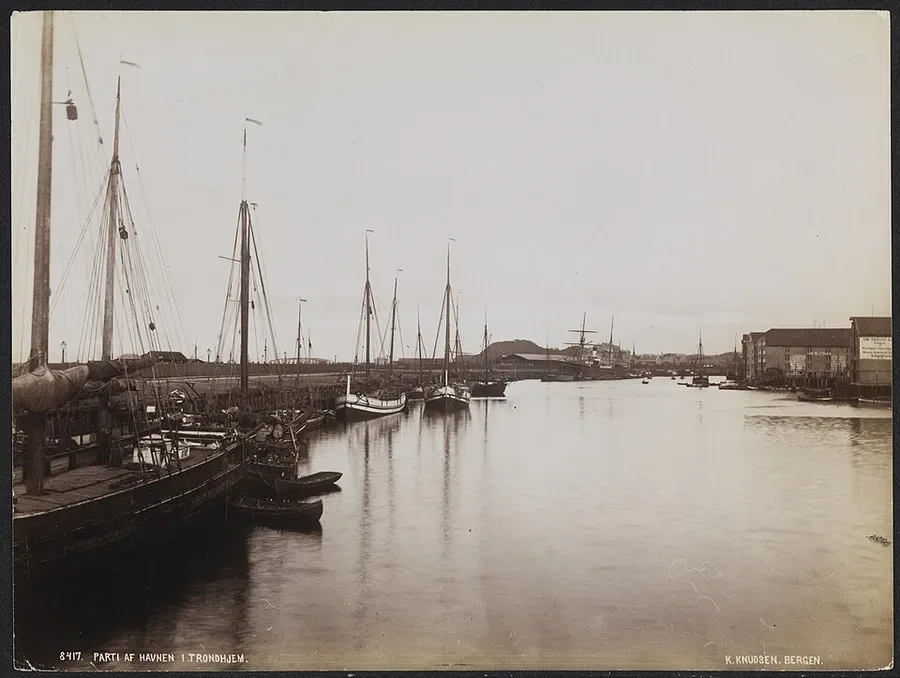 Knud Knudsen, Parti af Havnen i Trondhjem (1888-1894), National Library of Norway Knud Knudsen's photograph of Trondheim harbour in the early 1890s. Founded by Olav Tryggvason in 997 as Nidaros, the city was Norway's medieval capital and the seat of the archbishopric and the Olav cult that anchored the country's Christianity. Norway's third-largest city, founded by Olav Tryggvason in 997 as
Nidaros at the mouth of the Nid River on the inner Trondheim
Fjord. Capital of the Norwegian kingdom for much of the medieval
period; seat of the Norwegian archbishopric from 1153 and of the
Olav cult that anchored medieval Norwegian Christianity. Renamed
Trondheim in 1931 — after a controversial one-year spell
officially named Nidaros from 1930 — replacing the Danish-era
spelling Trondhjem and reviving the medieval Old Norse district
name (Þrándheimr). About two hundred thousand people in the municipality
today. Home to Nidaros Cathedral, NTNU (the Norwegian University
of Science and Technology), and the Trondheim Fjord harbour.
On the trip Day 3 of the trip routes the Gråhårsklubben (the Oldsters) through
Trondheim. The visit centres on Nidaros Cathedral — the building
the Olav devotion raised, and the architectural inheritance of
Bishop Grimkell's pronouncement on a summer day in 1031.
Trondheim Also discussed in The King Who Became a Saint — how the Nordmen came to ChristA Catholic Norway — the faith that gave the kingdom its first institutions and the stave churchesThe Crusades?!!!! — sixty ships from Bergen, bound for the Holy LandThe Long Fall — the sudden loss of Norwegian nobility, the end of the kings, and half of Norway gone foreverThe 400-Year Night — when the Northern Lion lay dormantThe Reformation, 1537 — one church eradicated and another imposedLutheran Norway and Pietism — a farmer named Hans Nielsen Hauge and a lay revival that could not be silencedWorld War II — the King’s “No” and the Nazis in NorwayBefore There Was Norway — petty kingdoms at the edge of the worldDriving in Norway — tolls, ferries, and a near-zero alcohol limitEveryday etiquette — quiet voices, wide space, no smiling🚨 Emergencies - important numbers, hospitals, and what you can doLanguage basics — just enough Norwegian to be polite in June 1217, at thirteen years old. He spent the first decade of his reign navigating the surviving factions of the Norwegian Civil Wars
Knud Knudsen, Parti af Havnen i Trondhjem (1888-1894), National Library of Norway Knud Knudsen's photograph of Trondheim harbour in the early 1890s. Founded by Olav Tryggvason in 997 as Nidaros, the city was Norway's medieval capital and the seat of the archbishopric and the Olav cult that anchored the country's Christianity. Norway's third-largest city, founded by Olav Tryggvason in 997 as
Nidaros at the mouth of the Nid River on the inner Trondheim
Fjord. Capital of the Norwegian kingdom for much of the medieval
period; seat of the Norwegian archbishopric from 1153 and of the
Olav cult that anchored medieval Norwegian Christianity. Renamed
Trondheim in 1931 — after a controversial one-year spell
officially named Nidaros from 1930 — replacing the Danish-era
spelling Trondhjem and reviving the medieval Old Norse district
name (Þrándheimr). About two hundred thousand people in the municipality
today. Home to Nidaros Cathedral, NTNU (the Norwegian University
of Science and Technology), and the Trondheim Fjord harbour.
On the trip Day 3 of the trip routes the Gråhårsklubben (the Oldsters) through
Trondheim. The visit centres on Nidaros Cathedral — the building
the Olav devotion raised, and the architectural inheritance of
Bishop Grimkell's pronouncement on a summer day in 1031.
Trondheim Also discussed in The King Who Became a Saint — how the Nordmen came to ChristA Catholic Norway — the faith that gave the kingdom its first institutions and the stave churchesThe Crusades?!!!! — sixty ships from Bergen, bound for the Holy LandThe Long Fall — the sudden loss of Norwegian nobility, the end of the kings, and half of Norway gone foreverThe 400-Year Night — when the Northern Lion lay dormantThe Reformation, 1537 — one church eradicated and another imposedLutheran Norway and Pietism — a farmer named Hans Nielsen Hauge and a lay revival that could not be silencedWorld War II — the King’s “No” and the Nazis in NorwayBefore There Was Norway — petty kingdoms at the edge of the worldDriving in Norway — tolls, ferries, and a near-zero alcohol limitEveryday etiquette — quiet voices, wide space, no smiling🚨 Emergencies - important numbers, hospitals, and what you can doLanguage basics — just enough Norwegian to be polite in June 1217, at thirteen years old. He spent the first decade of his reign navigating the surviving factions of the Norwegian Civil Wars 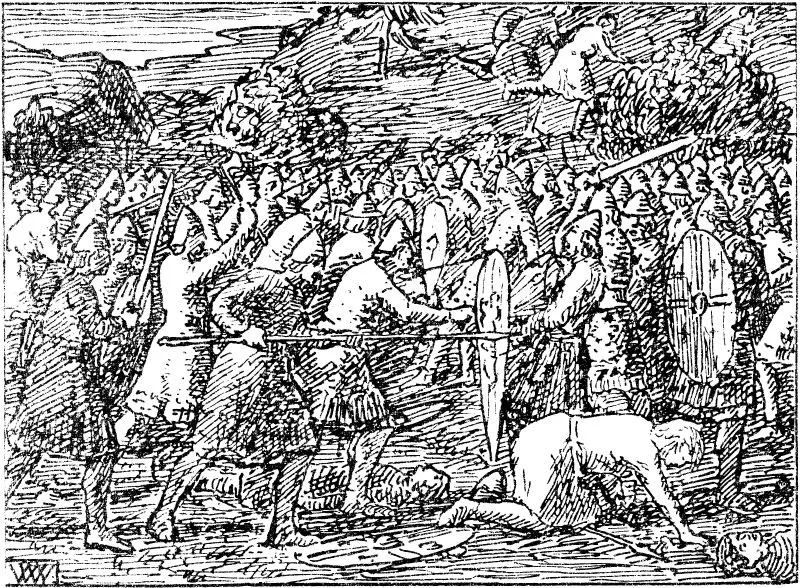 Wilhelm Wetlesen, "Slaget ved Minne", illustration for Haraldssønnenes saga, Snorre 1899-edition The Battle of Minne (1136), fought between rival claimants within a year of Sigurd Jorsalfar's death, is one of the opening clashes of the century of civil war his contested succession set off. The hundred-year period of intermittent civil war over the
Norwegian throne (c. 1130–1240) that followed the contested
succession at the death of Sigurd Jorsalfar in 1130. Multiple
pretenders and pretender-factions — the Birkebeinar (the
"Birch-Legs," supporters of the pretender Sverre Sigurdsson),
the Baglar (church-supported rivals), and various claimants
through legitimate and contested descent — fought across
Norway in shifting coalitions. The civil wars were finally
brought to an end by the kings of the thirteenth-century
Golden Age, particularly Hákon IV Hákonarson, whose long
reign (1217–1263) established the stable royal succession that
Norway had lacked for over a century.
Also discussed in The Crusades?!!!! — sixty ships from Bergen, bound for the Holy Land that Sigurd Jorsalfar
Wilhelm Wetlesen, "Slaget ved Minne", illustration for Haraldssønnenes saga, Snorre 1899-edition The Battle of Minne (1136), fought between rival claimants within a year of Sigurd Jorsalfar's death, is one of the opening clashes of the century of civil war his contested succession set off. The hundred-year period of intermittent civil war over the
Norwegian throne (c. 1130–1240) that followed the contested
succession at the death of Sigurd Jorsalfar in 1130. Multiple
pretenders and pretender-factions — the Birkebeinar (the
"Birch-Legs," supporters of the pretender Sverre Sigurdsson),
the Baglar (church-supported rivals), and various claimants
through legitimate and contested descent — fought across
Norway in shifting coalitions. The civil wars were finally
brought to an end by the kings of the thirteenth-century
Golden Age, particularly Hákon IV Hákonarson, whose long
reign (1217–1263) established the stable royal succession that
Norway had lacked for over a century.
Also discussed in The Crusades?!!!! — sixty ships from Bergen, bound for the Holy Land that Sigurd Jorsalfar 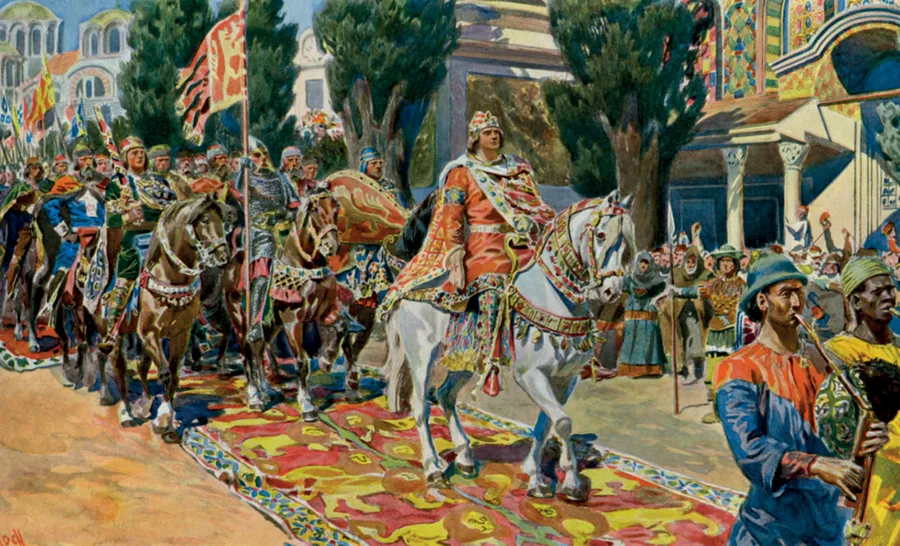 Andreas Bloch, Sigurd Entering Constantinople, in Noregs soge i bilete og ord (Mittet & Co., 1926) Sigurd Jorsalfar riding into Constantinople at the head of his crusaders — the triumph he is remembered by. Here he matters for what followed him: his death in 1130 left a contested succession that opened the century of civil wars. Sigurd I Magnusson (c. 1090 – 26 March 1130), king of Norway
1103–1130, bynamed Jorsalfar — "the Jerusalem-farer" — for
leading the Norwegian Crusade of 1107–1111. The first reigning
European monarch ever to lead a crusade to the Holy Land in
person. Ruled jointly with his brothers Eystein I (until 1123)
and Olav (until 1115), then alone for his last seven years.
Brought a splinter of the True Cross back from the siege of
Sidon and kept it at his border town of Konungahella; after
the 1135 Wendish sack of the town the relic disappears from
the record. His contested succession at his death in 1130
opened the century of the Norwegian civil wars.
Also discussed in The Crusades?!!!! — sixty ships from Bergen, bound for the Holy Land ’s death in 1130 had set in motion, and by 1240 the last serious rebellion against him had been put down. The hundred-year fight over the throne was over.
Andreas Bloch, Sigurd Entering Constantinople, in Noregs soge i bilete og ord (Mittet & Co., 1926) Sigurd Jorsalfar riding into Constantinople at the head of his crusaders — the triumph he is remembered by. Here he matters for what followed him: his death in 1130 left a contested succession that opened the century of civil wars. Sigurd I Magnusson (c. 1090 – 26 March 1130), king of Norway
1103–1130, bynamed Jorsalfar — "the Jerusalem-farer" — for
leading the Norwegian Crusade of 1107–1111. The first reigning
European monarch ever to lead a crusade to the Holy Land in
person. Ruled jointly with his brothers Eystein I (until 1123)
and Olav (until 1115), then alone for his last seven years.
Brought a splinter of the True Cross back from the siege of
Sidon and kept it at his border town of Konungahella; after
the 1135 Wendish sack of the town the relic disappears from
the record. His contested succession at his death in 1130
opened the century of the Norwegian civil wars.
Also discussed in The Crusades?!!!! — sixty ships from Bergen, bound for the Holy Land ’s death in 1130 had set in motion, and by 1240 the last serious rebellion against him had been put down. The hundred-year fight over the throne was over.
In 1247 the papal legate William of Sabina 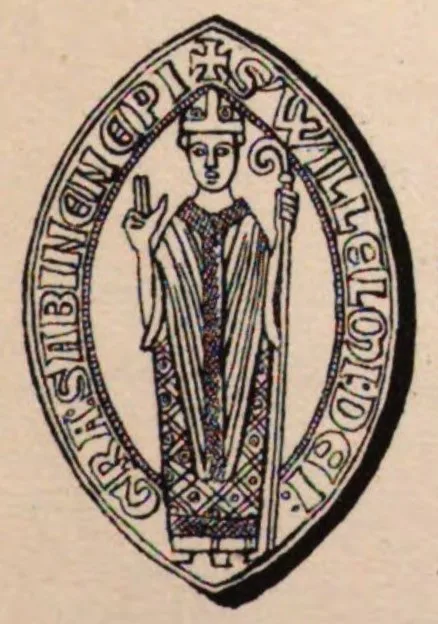 Seal of William of Sabina (1247), reproduced in Ilmari Salomies, Suomen kirkon historia I (1944) No portrait of William survives; this is his own seal — the mark he pressed into documents as papal legate — dated 1247, the very year he crowned Hákon IV at Christ Church in Bergen. Italian cardinal-bishop (c. 1184–1251), Bishop of Sabina from
1244, papal legate to Northern Europe under Popes Gregory IX,
Innocent IV, and others. Crowned King Hákon IV Hákonarson at
Bergen in 1247 — the first Norwegian king consecrated by a
papal legate in person and the first formal royal coronation
in Norway since the saga-tradition rite for Magnus Erlingsson
in 1163. The ceremony at Bergen formalised the international
recognition of Hákon's rule and brought the medieval Norwegian
monarchy into ritual alignment with the European norm. William
died at Lyon in 1251 on his way to a papal council.
crowned Hákon at Bergen — the first Norwegian king consecrated by a papal legate in person. His forty-six-year reign on the throne was the longest any Norwegian king had reigned since Harald Fairhair
Seal of William of Sabina (1247), reproduced in Ilmari Salomies, Suomen kirkon historia I (1944) No portrait of William survives; this is his own seal — the mark he pressed into documents as papal legate — dated 1247, the very year he crowned Hákon IV at Christ Church in Bergen. Italian cardinal-bishop (c. 1184–1251), Bishop of Sabina from
1244, papal legate to Northern Europe under Popes Gregory IX,
Innocent IV, and others. Crowned King Hákon IV Hákonarson at
Bergen in 1247 — the first Norwegian king consecrated by a
papal legate in person and the first formal royal coronation
in Norway since the saga-tradition rite for Magnus Erlingsson
in 1163. The ceremony at Bergen formalised the international
recognition of Hákon's rule and brought the medieval Norwegian
monarchy into ritual alignment with the European norm. William
died at Lyon in 1251 on his way to a papal council.
crowned Hákon at Bergen — the first Norwegian king consecrated by a papal legate in person. His forty-six-year reign on the throne was the longest any Norwegian king had reigned since Harald Fairhair 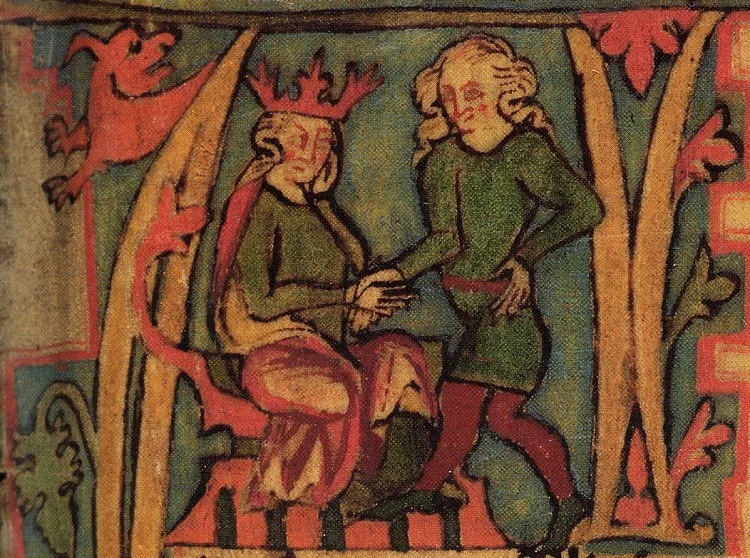 Flateyjarbók illumination, Harald Fairhair receives the kingdom (c. 1387–1394), Árni Magnússon Institute A page from the medieval saga manuscript Flateyjarbók, painted around 1390 — Harald crowned and enthroned, receiving the kingdom out of his father's line, some five centuries after he actually lived. Traditionally remembered as the first king of a unified Norway,
reigning ca. 872 to ca. 933. Inherited the small kingdom of Vestfold
at ten on the death of his father Halfdan the Black; over two decades
subdued the petty kingdoms of the western coast, climaxing at the
sea-battle of Hafrsfjord. His court poet's Haraldskvæði calls him
lúfa ("shock-head"); Hárfagri ("Fairhair") appears in verse of
debated authenticity attributed to his skalds, and is first securely
attested in twelfth-century prose (Íslendingabók). The famous
oath not to cut his hair until he had subjected every petty king is
later saga construction. His actual authority stopped short of the Arctic
north and the inland mountains, but he established the durable idea
of a single Norwegian crown.
Also discussed in Before There Was Norway — petty kingdoms at the edge of the worldThe Viking Age — longships, legends, and the first "Norway"The Long Fall — the sudden loss of Norwegian nobility, the end of the kings, and half of Norway gone forever .
Flateyjarbók illumination, Harald Fairhair receives the kingdom (c. 1387–1394), Árni Magnússon Institute A page from the medieval saga manuscript Flateyjarbók, painted around 1390 — Harald crowned and enthroned, receiving the kingdom out of his father's line, some five centuries after he actually lived. Traditionally remembered as the first king of a unified Norway,
reigning ca. 872 to ca. 933. Inherited the small kingdom of Vestfold
at ten on the death of his father Halfdan the Black; over two decades
subdued the petty kingdoms of the western coast, climaxing at the
sea-battle of Hafrsfjord. His court poet's Haraldskvæði calls him
lúfa ("shock-head"); Hárfagri ("Fairhair") appears in verse of
debated authenticity attributed to his skalds, and is first securely
attested in twelfth-century prose (Íslendingabók). The famous
oath not to cut his hair until he had subjected every petty king is
later saga construction. His actual authority stopped short of the Arctic
north and the inland mountains, but he established the durable idea
of a single Norwegian crown.
Also discussed in Before There Was Norway — petty kingdoms at the edge of the worldThe Viking Age — longships, legends, and the first "Norway"The Long Fall — the sudden loss of Norwegian nobility, the end of the kings, and half of Norway gone forever .
A kingdom paid for in fish
The realm was paid for by a single export commodity. The Atlantic cod that spawned every February off the Lofoten 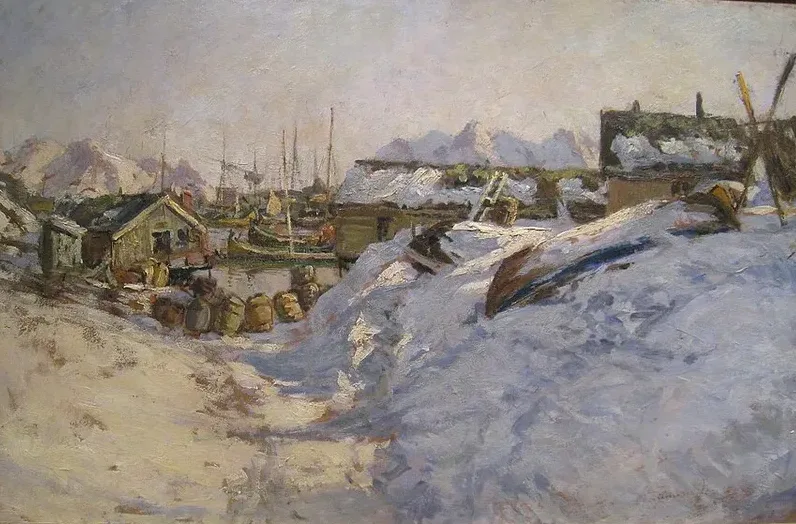 Gunnar Berg, Vinter i Lofoten (before 1893), via Wikimedia Commons Gunnar Berg's winter scene of a Lofoten fishing hamlet, barrels stacked by the boathouses. The archipelago's centuries-old winter cod fishery produced the dried stockfish that Bergen's Hanseatic merchants traded across Europe. Archipelago in Nordland County in northern Norway, lying north of
the Arctic Circle and stretching about a hundred and seventy
kilometres off the mainland coast. Famous for dramatic peaks
rising directly out of the sea, traditional fishing villages built
on stilts (rorbuer), and the centuries-old winter cod-fishing
industry that supplied the dried-stockfish trade Bergen ran during
the Hanseatic era. Site of the reconstructed Viking-Age chieftain's
hall at Borg — the largest known Viking-Age building in Scandinavia.
Lofoten Islands Also discussed in The Viking Age — longships, legends, and the first "Norway"The Germans Who "Ruled" Bergen — the Hanseatic merchants on Bryggen WharfDraugen — the drowned man who never came home archipelago, above the Arctic Circle, was caught by Norwegian fishermen, split and gutted on the wharves, and hung in pairs on wooden drying racks in the polar winter wind. By spring the fish had become Stockfish
Gunnar Berg, Vinter i Lofoten (before 1893), via Wikimedia Commons Gunnar Berg's winter scene of a Lofoten fishing hamlet, barrels stacked by the boathouses. The archipelago's centuries-old winter cod fishery produced the dried stockfish that Bergen's Hanseatic merchants traded across Europe. Archipelago in Nordland County in northern Norway, lying north of
the Arctic Circle and stretching about a hundred and seventy
kilometres off the mainland coast. Famous for dramatic peaks
rising directly out of the sea, traditional fishing villages built
on stilts (rorbuer), and the centuries-old winter cod-fishing
industry that supplied the dried-stockfish trade Bergen ran during
the Hanseatic era. Site of the reconstructed Viking-Age chieftain's
hall at Borg — the largest known Viking-Age building in Scandinavia.
Lofoten Islands Also discussed in The Viking Age — longships, legends, and the first "Norway"The Germans Who "Ruled" Bergen — the Hanseatic merchants on Bryggen WharfDraugen — the drowned man who never came home archipelago, above the Arctic Circle, was caught by Norwegian fishermen, split and gutted on the wharves, and hung in pairs on wooden drying racks in the polar winter wind. By spring the fish had become Stockfish 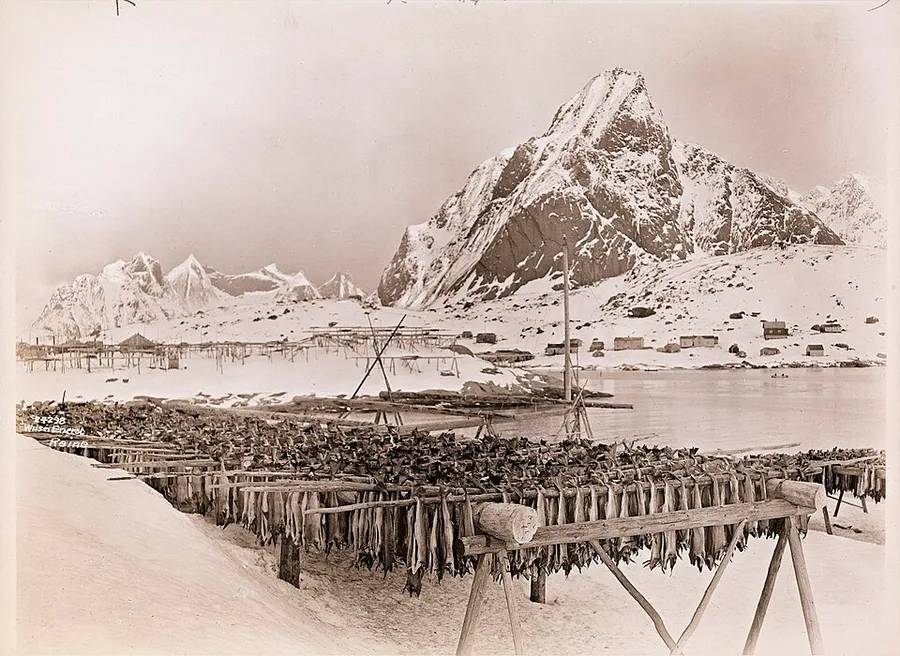 Anders Beer Wilse, Reine, Moskenes (1924), National Library of Norway Wilse's 1924 photograph shows Lofoten hjell racks doing the same job dried Norwegian cod has done since the Middle Ages -- turning the winter catch into the stockfish that built Bergen's Hanseatic trade. Air-dried cod, the principal Norwegian export through the
high and late Middle Ages and the commodity that built
Bergen. Whole gutted cod from the Lofoten winter fishery
are hung on wooden racks (hjell) in the open February
air; in three months the fish loses about three-quarters of
its weight and becomes a hard, lightweight, almost
indefinitely keeping protein source. The Catholic Church's
fast-day rules — meat forbidden on Fridays, during Lent,
and on the vigils of major feasts (roughly a third of the
days of the year) — created a continent-wide market. The Hanseatic
Bergen kontor controlled the export from the fourteenth
century onward. Norwegian stockfish (tørrfisk) is still
produced in Lofoten today.
Also discussed in The Germans Who "Ruled" Bergen — the Hanseatic merchants on Bryggen WharfMat og Drikke — Norwegian food and drink — hard and light and edible for years without salt — the perfect protein for a Christian Europe whose religious calendar banned meat on more than a hundred days a year. The dried cod travelled south from Lofoten to Bergen, where it was graded, packed, and sold to merchants from the north German Hanseatic cities, from English ports like Hull and King’s Lynn, and from Bruges
Anders Beer Wilse, Reine, Moskenes (1924), National Library of Norway Wilse's 1924 photograph shows Lofoten hjell racks doing the same job dried Norwegian cod has done since the Middle Ages -- turning the winter catch into the stockfish that built Bergen's Hanseatic trade. Air-dried cod, the principal Norwegian export through the
high and late Middle Ages and the commodity that built
Bergen. Whole gutted cod from the Lofoten winter fishery
are hung on wooden racks (hjell) in the open February
air; in three months the fish loses about three-quarters of
its weight and becomes a hard, lightweight, almost
indefinitely keeping protein source. The Catholic Church's
fast-day rules — meat forbidden on Fridays, during Lent,
and on the vigils of major feasts (roughly a third of the
days of the year) — created a continent-wide market. The Hanseatic
Bergen kontor controlled the export from the fourteenth
century onward. Norwegian stockfish (tørrfisk) is still
produced in Lofoten today.
Also discussed in The Germans Who "Ruled" Bergen — the Hanseatic merchants on Bryggen WharfMat og Drikke — Norwegian food and drink — hard and light and edible for years without salt — the perfect protein for a Christian Europe whose religious calendar banned meat on more than a hundred days a year. The dried cod travelled south from Lofoten to Bergen, where it was graded, packed, and sold to merchants from the north German Hanseatic cities, from English ports like Hull and King’s Lynn, and from Bruges 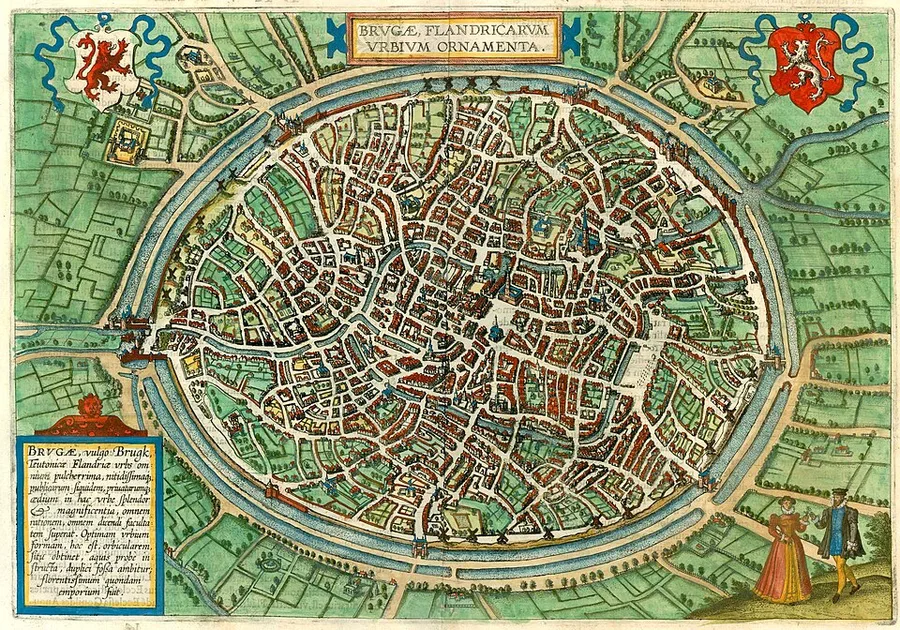 Georg Braun & Frans Hogenberg, Bruges, Civitates Orbis Terrarum (1st ed. 1572, this print 1635) Bruges was the Hanseatic terminal where Norwegian stockfish reached the Catholic fast-day markets of continental Europe -- this engraved view shows the canals and church towers of the trading city that anchored the Bergen fish trade's western end. Medieval Flemish port city, today the capital of West Flanders
in modern Belgium. One of the leading commercial centres of
northern Europe through the high and late Middle Ages — the
pre-eminent northern outpost of the international Italian
banking houses and one of the principal terminals of the
Hanseatic trade. The Bergen stockfish trade reached Bruges
through the Hanseatic merchant networks, and the city was the
main market through which Norwegian dried cod entered the
Catholic European fast-day economy. Modern Bruges preserves
its medieval centre largely intact and is a UNESCO World
Heritage site.
Also discussed in The Germans Who "Ruled" Bergen — the Hanseatic merchants on Bryggen Wharf in Flanders (modern-day northern Belgium). Through the later thirteenth and fourteenth centuries the trade dominated the Norwegian export economy: at its peak, by the reconstruction modern historians make from the Bergen customs records, more than eighty per cent of Norway’s exports by value moved through it. The crown’s customs revenue on the trade was the largest single source of royal income in the country. The cathedral at Nidaros, the royal court at Bergen, the diplomatic missions to the European courts, and the fleets that kept the Atlantic dependencies in the realm were all paid for in dried fish.
Georg Braun & Frans Hogenberg, Bruges, Civitates Orbis Terrarum (1st ed. 1572, this print 1635) Bruges was the Hanseatic terminal where Norwegian stockfish reached the Catholic fast-day markets of continental Europe -- this engraved view shows the canals and church towers of the trading city that anchored the Bergen fish trade's western end. Medieval Flemish port city, today the capital of West Flanders
in modern Belgium. One of the leading commercial centres of
northern Europe through the high and late Middle Ages — the
pre-eminent northern outpost of the international Italian
banking houses and one of the principal terminals of the
Hanseatic trade. The Bergen stockfish trade reached Bruges
through the Hanseatic merchant networks, and the city was the
main market through which Norwegian dried cod entered the
Catholic European fast-day economy. Modern Bruges preserves
its medieval centre largely intact and is a UNESCO World
Heritage site.
Also discussed in The Germans Who "Ruled" Bergen — the Hanseatic merchants on Bryggen Wharf in Flanders (modern-day northern Belgium). Through the later thirteenth and fourteenth centuries the trade dominated the Norwegian export economy: at its peak, by the reconstruction modern historians make from the Bergen customs records, more than eighty per cent of Norway’s exports by value moved through it. The crown’s customs revenue on the trade was the largest single source of royal income in the country. The cathedral at Nidaros, the royal court at Bergen, the diplomatic missions to the European courts, and the fleets that kept the Atlantic dependencies in the realm were all paid for in dried fish.
The court at Bergen
The court that Hákon IV gathered at Bergen sustained an active literary culture in Old Norwegian. The Konungs skuggsjá 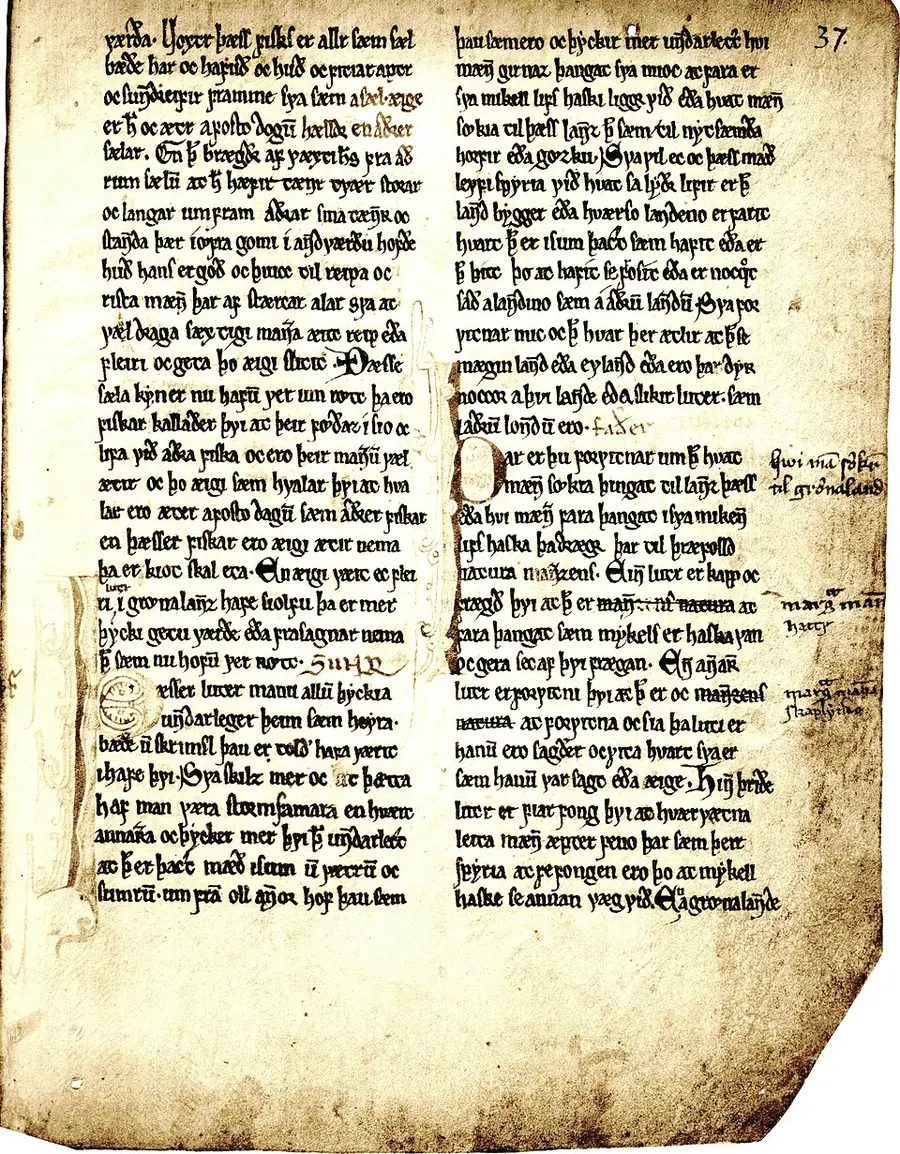 Konungs skuggsjá manuscript leaf, reproduced in Kristian Kålund, Palæografisk Atlas (1905) A leaf of the anonymous mid-13th-century text staged as a father-son dialogue on law, manners, and the natural world — the King's Mirror survives only through manuscript and print copies, not one showcase original, so a page like this stands for the whole copying tradition. The King's Mirror — the richest single Old Norwegian literary
document of the medieval Norwegian church period. Composed
anonymously around 1250 during the reign of Hákon IV as a long
conversation between father and son, the Konungs skuggsjá
covers law, courtly manners, geography, natural science, and
theology in a single sustained voice — a Norwegian contribution
to the medieval European mirror-for-princes genre. Particularly
important as one of the few medieval Scandinavian sources
containing detailed observations of the Atlantic — including
the earliest known European descriptions of Greenland's ice
floes, the aurora borealis, and the natural history of the
northern seas.
Also discussed in A Catholic Norway — the faith that gave the kingdom its first institutions and the stave churches — the King’s Mirror — was composed in or around 1250 as a long didactic dialogue between a father and a son covering courtly conduct, naval navigation, polar geography, mercantile law, theology, and the proper relation between royal authority and divine law. It is the single richest document the medieval Norwegian court produced. Alongside the original work, Hákon’s court sponsored a major translation movement: continental chivalric romance was rendered into Old Norwegian for the king’s reading — the courtly poems of Chrétien de Troyes
Konungs skuggsjá manuscript leaf, reproduced in Kristian Kålund, Palæografisk Atlas (1905) A leaf of the anonymous mid-13th-century text staged as a father-son dialogue on law, manners, and the natural world — the King's Mirror survives only through manuscript and print copies, not one showcase original, so a page like this stands for the whole copying tradition. The King's Mirror — the richest single Old Norwegian literary
document of the medieval Norwegian church period. Composed
anonymously around 1250 during the reign of Hákon IV as a long
conversation between father and son, the Konungs skuggsjá
covers law, courtly manners, geography, natural science, and
theology in a single sustained voice — a Norwegian contribution
to the medieval European mirror-for-princes genre. Particularly
important as one of the few medieval Scandinavian sources
containing detailed observations of the Atlantic — including
the earliest known European descriptions of Greenland's ice
floes, the aurora borealis, and the natural history of the
northern seas.
Also discussed in A Catholic Norway — the faith that gave the kingdom its first institutions and the stave churches — the King’s Mirror — was composed in or around 1250 as a long didactic dialogue between a father and a son covering courtly conduct, naval navigation, polar geography, mercantile law, theology, and the proper relation between royal authority and divine law. It is the single richest document the medieval Norwegian court produced. Alongside the original work, Hákon’s court sponsored a major translation movement: continental chivalric romance was rendered into Old Norwegian for the king’s reading — the courtly poems of Chrétien de Troyes 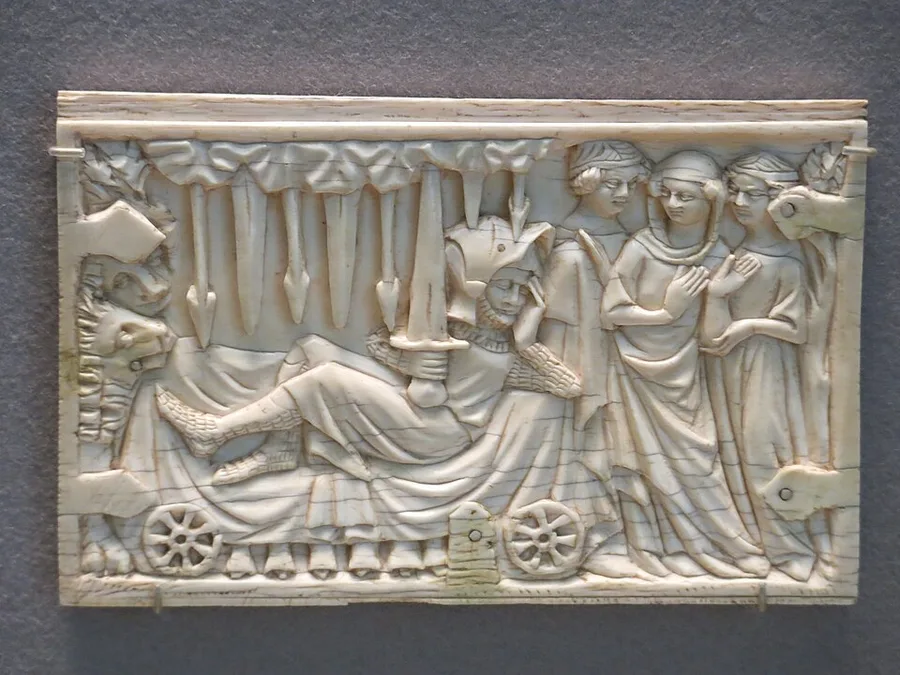 Ivory casket panel, Gauvain au lit périlleux (Paris, c. 1340-1350), Musée du Louvre; photo Tangopaso No portrait of Chrétien de Troyes survives, so this ivory casket panel carrying one of his own scenes — Gawain in the Perilous Bed, from Perceval — stands for the poet whose Arthurian romances the Bergen court had translated into Old Norwegian for Hákon IV to read. French courtly poet of the late twelfth century (c. 1135 – c.
1190), the founding author of medieval Arthurian romance.
Composed five major romances in Old French — Erec et Enide,
Cligès, Lancelot, the Knight of the Cart, Yvain, the
Knight of the Lion, and the unfinished Perceval, the Story
of the Grail. Established several of the most enduring
Arthurian narrative motifs: the affair of Lancelot and
Guinevere, the Grail quest, the knight's identity-and-honour
quest. His works were translated into Old Norwegian at the
Bergen court of Hákon IV in the thirteenth century as part of
the Norwegian royal sponsorship of continental chivalric
romance.
, the Arthurian cycle, and Thomas of Britain’s Tristan (translated as Tristrams saga ok Ísöndar in 1226 at Hákon’s commission) all rendered into the king’s tongue. The intellectual reach of the Bergen court in the middle of the thirteenth century was the most extensive in the medieval North.
Ivory casket panel, Gauvain au lit périlleux (Paris, c. 1340-1350), Musée du Louvre; photo Tangopaso No portrait of Chrétien de Troyes survives, so this ivory casket panel carrying one of his own scenes — Gawain in the Perilous Bed, from Perceval — stands for the poet whose Arthurian romances the Bergen court had translated into Old Norwegian for Hákon IV to read. French courtly poet of the late twelfth century (c. 1135 – c.
1190), the founding author of medieval Arthurian romance.
Composed five major romances in Old French — Erec et Enide,
Cligès, Lancelot, the Knight of the Cart, Yvain, the
Knight of the Lion, and the unfinished Perceval, the Story
of the Grail. Established several of the most enduring
Arthurian narrative motifs: the affair of Lancelot and
Guinevere, the Grail quest, the knight's identity-and-honour
quest. His works were translated into Old Norwegian at the
Bergen court of Hákon IV in the thirteenth century as part of
the Norwegian royal sponsorship of continental chivalric
romance.
, the Arthurian cycle, and Thomas of Britain’s Tristan (translated as Tristrams saga ok Ísöndar in 1226 at Hákon’s commission) all rendered into the king’s tongue. The intellectual reach of the Bergen court in the middle of the thirteenth century was the most extensive in the medieval North.
The Icelandic historian and saga-writer Snorri Sturluson 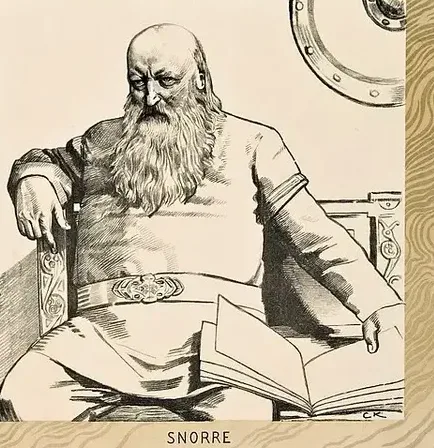 Christian Krohg, Snorre Sturlason (1899), from Norges Kongesagaer; scan: National Library of Norway Christian Krohg's portrait of Snorri from the 1899 folk edition of Heimskringla — the historian seated with a great open book across his knees. No contemporary likeness of Snorri exists; Krohg's drawing is the face Norway gave its most important medieval source. Thirteenth-century Icelandic chieftain, poet, and historian.
Composed the Heimskringla and the Prose Edda in the 1220s
from oral tradition and skaldic verse — three hundred years after
the Viking-age events he describes. The single richest source for
Norway's pre-conversion centuries and also the most aware
Christian-Icelandic editor of them. Modern scholarship accepts
what other sources independently confirm and treats his richest
expansions as the work of a poet writing about a kingdom he had
never seen. Assassinated at Reykholt on 23 September 1241 by
agents of King Hákon IV after a falling-out at court.
In this article Snorri served briefly as a courtier at Hákon IV's court before
falling out with the king and being assassinated by Hákon's
agents at Reykholt on 23 September 1241. The saga of Hákon's
own reign was written after the king's death by Snorri's nephew,
Sturla Thordarson.
Also discussed in The Viking Age — longships, legends, and the first "Norway"Before There Was Norway — petty kingdoms at the edge of the worldWorshiping Odin and Thor — the lived religion of pre-Christian NorwayThe King Who Became a Saint — how the Nordmen came to ChristA Catholic Norway — the faith that gave the kingdom its first institutions and the stave churchesThe Crusades?!!!! — sixty ships from Bergen, bound for the Holy LandNordisk Mytologi — Odin, the giants, and Ragnarok was briefly a courtier at Hákon’s court before falling out with the king. In September 1241 Hákon’s agents assassinated him in his cellar at Reykholt
Christian Krohg, Snorre Sturlason (1899), from Norges Kongesagaer; scan: National Library of Norway Christian Krohg's portrait of Snorri from the 1899 folk edition of Heimskringla — the historian seated with a great open book across his knees. No contemporary likeness of Snorri exists; Krohg's drawing is the face Norway gave its most important medieval source. Thirteenth-century Icelandic chieftain, poet, and historian.
Composed the Heimskringla and the Prose Edda in the 1220s
from oral tradition and skaldic verse — three hundred years after
the Viking-age events he describes. The single richest source for
Norway's pre-conversion centuries and also the most aware
Christian-Icelandic editor of them. Modern scholarship accepts
what other sources independently confirm and treats his richest
expansions as the work of a poet writing about a kingdom he had
never seen. Assassinated at Reykholt on 23 September 1241 by
agents of King Hákon IV after a falling-out at court.
In this article Snorri served briefly as a courtier at Hákon IV's court before
falling out with the king and being assassinated by Hákon's
agents at Reykholt on 23 September 1241. The saga of Hákon's
own reign was written after the king's death by Snorri's nephew,
Sturla Thordarson.
Also discussed in The Viking Age — longships, legends, and the first "Norway"Before There Was Norway — petty kingdoms at the edge of the worldWorshiping Odin and Thor — the lived religion of pre-Christian NorwayThe King Who Became a Saint — how the Nordmen came to ChristA Catholic Norway — the faith that gave the kingdom its first institutions and the stave churchesThe Crusades?!!!! — sixty ships from Bergen, bound for the Holy LandNordisk Mytologi — Odin, the giants, and Ragnarok was briefly a courtier at Hákon’s court before falling out with the king. In September 1241 Hákon’s agents assassinated him in his cellar at Reykholt 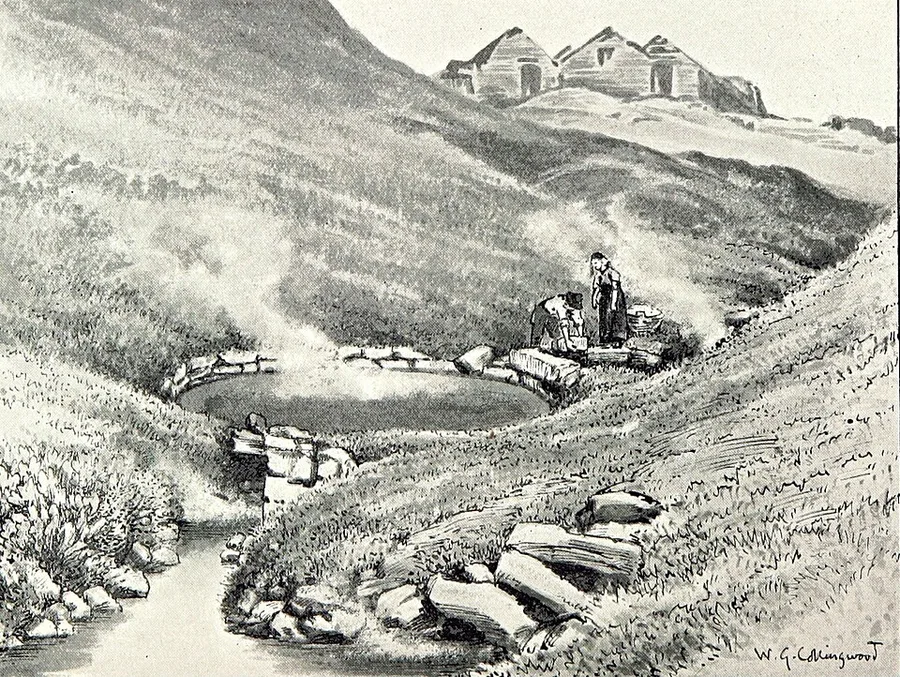 W. G. Collingwood, Snorri's Bathhouse at Reykholt (1899), Pilgrimage to the Saga-Steads of Iceland Collingwood's 1899 sketch shows Snorralaug much as generations of saga pilgrims found it -- the pool the sagas record Snorri using, a short tunnel from the cellar where his son-in-law's men killed him in 1241. Small farming settlement in Borgarfjörður, western Iceland,
about a hundred kilometres north of Reykjavík. Home of
Snorri Sturluson — Iceland's pre-eminent saga-writer and
chieftain — through the height of his power in the early
thirteenth century. Snorri composed the Prose Edda and
Heimskringla at Reykholt and was killed there on the
night of 22–23 September 1241 in his own cellar by retainers
of his son-in-law Gissur Þorvaldsson, acting under orders
from King Hákon IV. The geothermal pool Snorralaug, where
Snorri is recorded as bathing, survives at the site and is
one of Iceland's oldest preserved built structures.
in western Iceland; the saga tradition records his last words as Eigi skal höggva! — do not strike. After Hákon’s death two decades later, his son Magnus VI Lagabøte
W. G. Collingwood, Snorri's Bathhouse at Reykholt (1899), Pilgrimage to the Saga-Steads of Iceland Collingwood's 1899 sketch shows Snorralaug much as generations of saga pilgrims found it -- the pool the sagas record Snorri using, a short tunnel from the cellar where his son-in-law's men killed him in 1241. Small farming settlement in Borgarfjörður, western Iceland,
about a hundred kilometres north of Reykjavík. Home of
Snorri Sturluson — Iceland's pre-eminent saga-writer and
chieftain — through the height of his power in the early
thirteenth century. Snorri composed the Prose Edda and
Heimskringla at Reykholt and was killed there on the
night of 22–23 September 1241 in his own cellar by retainers
of his son-in-law Gissur Þorvaldsson, acting under orders
from King Hákon IV. The geothermal pool Snorralaug, where
Snorri is recorded as bathing, survives at the site and is
one of Iceland's oldest preserved built structures.
in western Iceland; the saga tradition records his last words as Eigi skal höggva! — do not strike. After Hákon’s death two decades later, his son Magnus VI Lagabøte 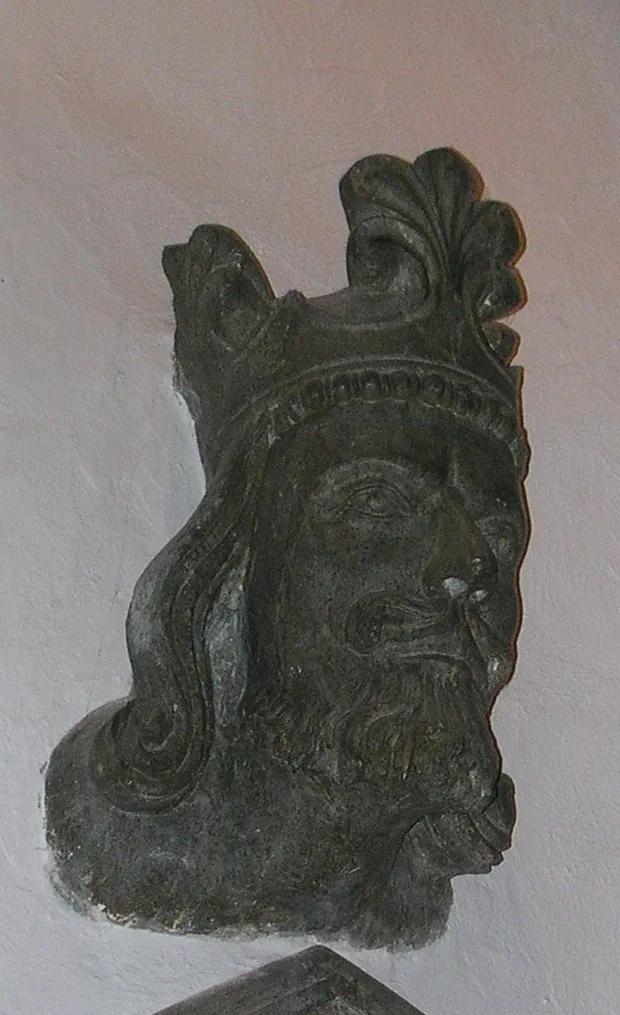 Stone head of Magnus VI Lagabøte (13th c.), Stavanger Cathedral; photo: Gunleiv Hadland (CC BY-SA 3.0) A crowned stone head carved in Stavanger Cathedral within living memory of the king — the nearest thing to a likeness of Magnus VI, the 'Law-mender' whose 1274 national code held as Norway's law for more than four hundred years. King of Norway 1263-1280, bynamed Lagabøte ("Law-mender") in
recognition of his promulgation in 1274 of the Landslov, the
Code of National Law that unified the four regional thing-law
traditions (Gulating, Frostating, Borgarting, Eidsivating) into
a single national code. The Landslov remained the law of Norway
for more than four hundred years and made Norway one of the first
European kingdoms with a unified national legal code.
Also discussed in Before There Was Norway — petty kingdoms at the edge of the worldThe Long Fall — the sudden loss of Norwegian nobility, the end of the kings, and half of Norway gone foreverThe Germans Who "Ruled" Bergen — the Hanseatic merchants on Bryggen WharfThe 400-Year Night — when the Northern Lion lay dormantAllemannsretten — the right to roam commissioned Snorri’s nephew Sturla Þórðarson
Stone head of Magnus VI Lagabøte (13th c.), Stavanger Cathedral; photo: Gunleiv Hadland (CC BY-SA 3.0) A crowned stone head carved in Stavanger Cathedral within living memory of the king — the nearest thing to a likeness of Magnus VI, the 'Law-mender' whose 1274 national code held as Norway's law for more than four hundred years. King of Norway 1263-1280, bynamed Lagabøte ("Law-mender") in
recognition of his promulgation in 1274 of the Landslov, the
Code of National Law that unified the four regional thing-law
traditions (Gulating, Frostating, Borgarting, Eidsivating) into
a single national code. The Landslov remained the law of Norway
for more than four hundred years and made Norway one of the first
European kingdoms with a unified national legal code.
Also discussed in Before There Was Norway — petty kingdoms at the edge of the worldThe Long Fall — the sudden loss of Norwegian nobility, the end of the kings, and half of Norway gone foreverThe Germans Who "Ruled" Bergen — the Hanseatic merchants on Bryggen WharfThe 400-Year Night — when the Northern Lion lay dormantAllemannsretten — the right to roam commissioned Snorri’s nephew Sturla Þórðarson 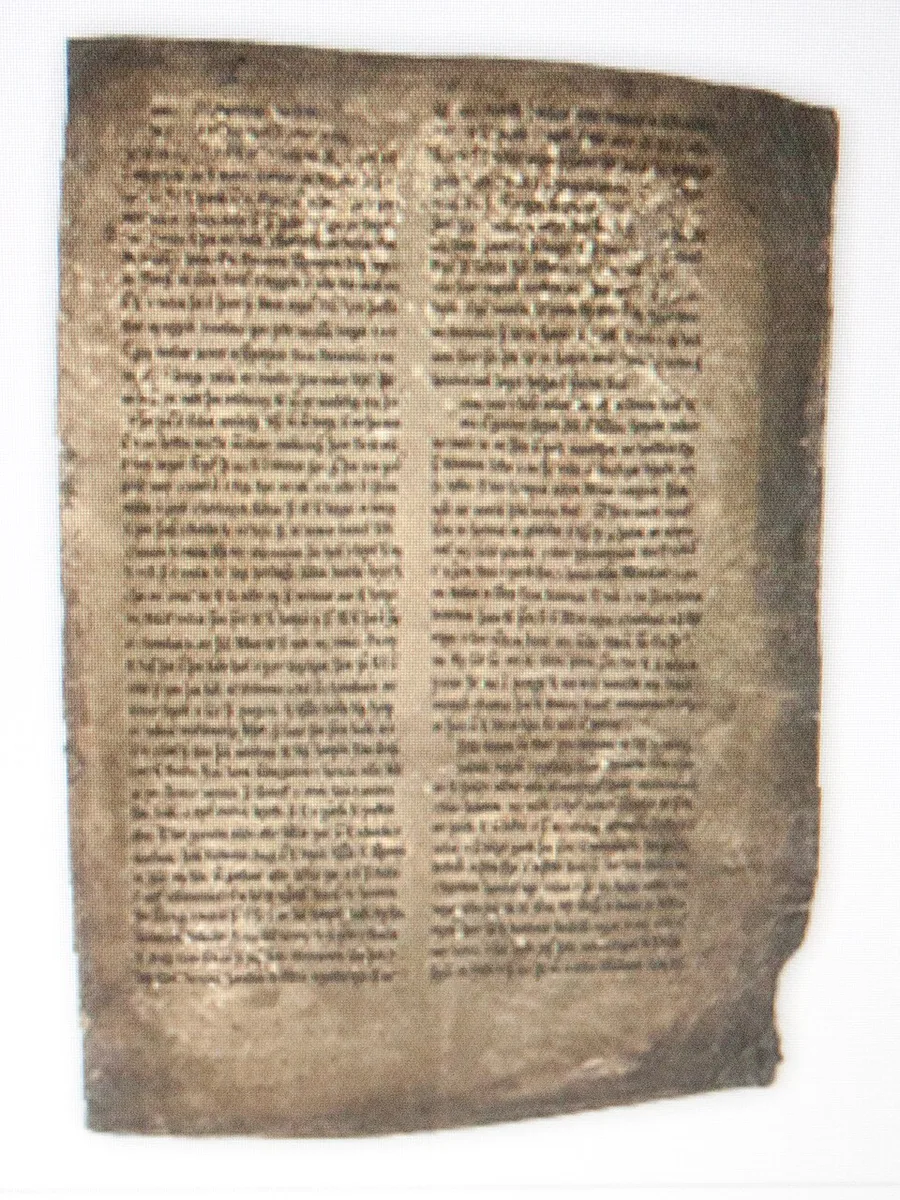 Íslendinga saga within Sturlunga saga, composed by Sturla Þórðarson; National Museum of Iceland, photo by Szilas No portrait of Sturla survives; this browned vellum leaf is from the Sturlunga saga compilation built around his own Íslendinga saga. He enters this story as the man Magnus VI commissioned in 1263 to write the Hákonar saga — the fullest surviving record of Hákon IV's reign. Icelandic saga-writer, lawman, and politician (1214–1284),
nephew of Snorri Sturluson. Among the most prolific of
thirteenth-century Icelandic historians. Commissioned by King
Magnus VI Lagabøte shortly after the death of Hákon IV in 1263
to write the saga of the dead king's reign — the Hákonar saga
Hákonarsonar, completed within a year or two and the longest
medieval royal saga ever composed about a Norwegian king. Also
authored the Íslendinga saga (the principal chronicle of the
late Icelandic commonwealth and the political crisis that
ended in submission to Norway in 1262) and a saga of King
Magnus VI's own reign. Served briefly as Magnus VI's lawman in
Iceland after the Old Covenant submission.
— an Icelander like his uncle — to write the saga of the dead king’s reign. The result, the Hákonar saga Hákonarsonar
Íslendinga saga within Sturlunga saga, composed by Sturla Þórðarson; National Museum of Iceland, photo by Szilas No portrait of Sturla survives; this browned vellum leaf is from the Sturlunga saga compilation built around his own Íslendinga saga. He enters this story as the man Magnus VI commissioned in 1263 to write the Hákonar saga — the fullest surviving record of Hákon IV's reign. Icelandic saga-writer, lawman, and politician (1214–1284),
nephew of Snorri Sturluson. Among the most prolific of
thirteenth-century Icelandic historians. Commissioned by King
Magnus VI Lagabøte shortly after the death of Hákon IV in 1263
to write the saga of the dead king's reign — the Hákonar saga
Hákonarsonar, completed within a year or two and the longest
medieval royal saga ever composed about a Norwegian king. Also
authored the Íslendinga saga (the principal chronicle of the
late Icelandic commonwealth and the political crisis that
ended in submission to Norway in 1262) and a saga of King
Magnus VI's own reign. Served briefly as Magnus VI's lawman in
Iceland after the Old Covenant submission.
— an Icelander like his uncle — to write the saga of the dead king’s reign. The result, the Hákonar saga Hákonarsonar 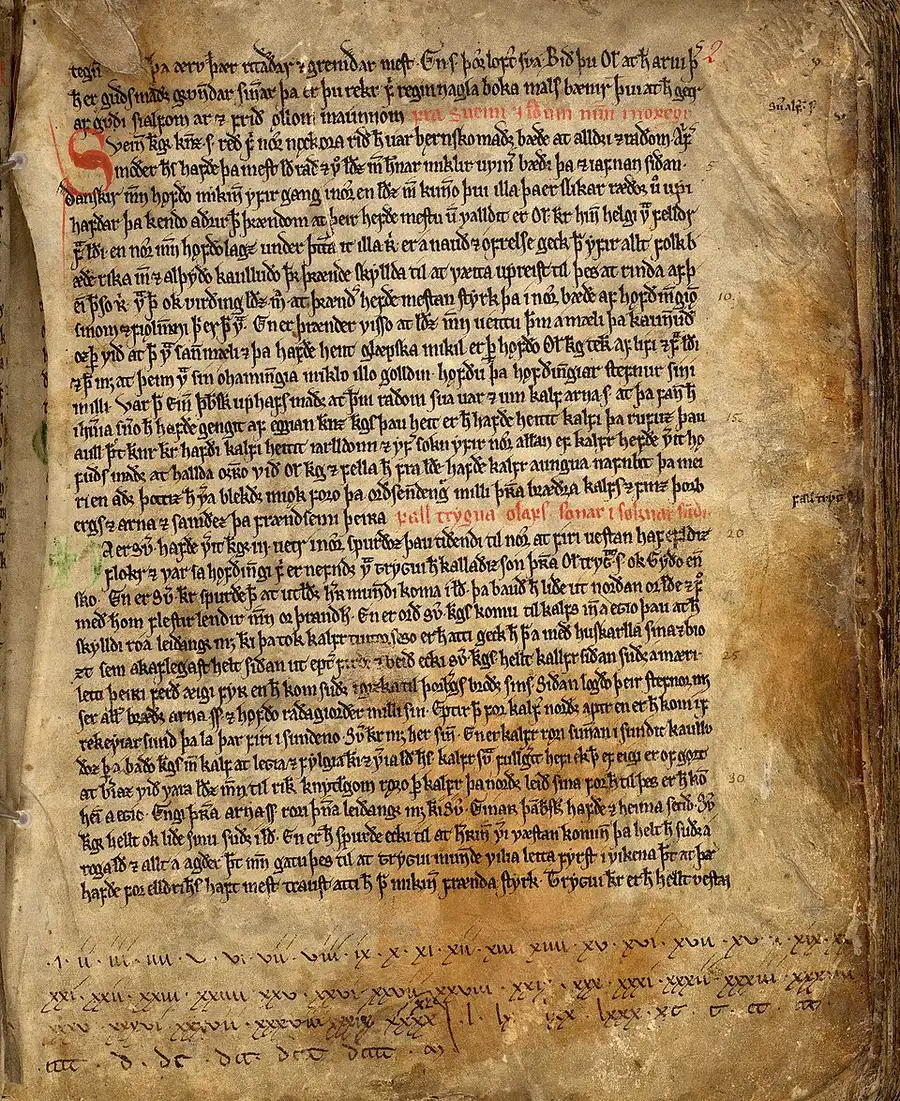 Eirspennill (AM 47 fol), folio 2r (c. 1300–25), Arnamagnæan Institute / handrit.is This vellum leaf opens Eirspennill, the fourteenth-century Icelandic codex that also carries, later in its pages, the fullest surviving copy of Sturla's Hákonar saga Hákonarsonar — the source for nearly everything known about Hákon IV's reign. The Saga of Hákon Hákonsson — the contemporary biography
of King Hákon IV of Norway, written in Old Norse by the
Icelandic chieftain and historian Sturla Þórðarson at the
commission of Hákon's son Magnus VI immediately after
Hákon's death in 1263. Sturla — nephew of Snorri Sturluson —
drew on royal records, the testimony of the king's retainers,
and his own visits to the Norwegian court. The saga is the
fullest narrative source for the Norwegian Golden Age: the
child-king's rescue and acclamation, the long reign, the
building of Bergen, the Castilian marriage, and the final
voyage west to Orkney. Survives in Icelandic manuscripts of
the late thirteenth and fourteenth centuries.
, completed within a year or two of Hákon’s death in 1263, is the longest medieval royal saga ever composed about a Norwegian king and the principal narrative source for everything the modern reader knows about his reign.
Eirspennill (AM 47 fol), folio 2r (c. 1300–25), Arnamagnæan Institute / handrit.is This vellum leaf opens Eirspennill, the fourteenth-century Icelandic codex that also carries, later in its pages, the fullest surviving copy of Sturla's Hákonar saga Hákonarsonar — the source for nearly everything known about Hákon IV's reign. The Saga of Hákon Hákonsson — the contemporary biography
of King Hákon IV of Norway, written in Old Norse by the
Icelandic chieftain and historian Sturla Þórðarson at the
commission of Hákon's son Magnus VI immediately after
Hákon's death in 1263. Sturla — nephew of Snorri Sturluson —
drew on royal records, the testimony of the king's retainers,
and his own visits to the Norwegian court. The saga is the
fullest narrative source for the Norwegian Golden Age: the
child-king's rescue and acclamation, the long reign, the
building of Bergen, the Castilian marriage, and the final
voyage west to Orkney. Survives in Icelandic manuscripts of
the late thirteenth and fourteenth centuries.
, completed within a year or two of Hákon’s death in 1263, is the longest medieval royal saga ever composed about a Norwegian king and the principal narrative source for everything the modern reader knows about his reign.
Kristina to Castile
The marriage that brought the Castilian delegation to Tønsberg in 1256 was the clearest external acknowledgment of Norway’s standing among the medieval European monarchies. Alfonso X — remembered in Castile as Alfonso the Wise for his patronage of law and learning — was searching for royal marriages for his younger brothers as part of his diplomatic case for election as Holy Roman Emperor. He sent his emissaries to Norway, among other places, and Hákon agreed to send his eldest daughter south. Kristina’s mother was Margrete Skulesdatter, daughter of Duke Skule Bårdsson 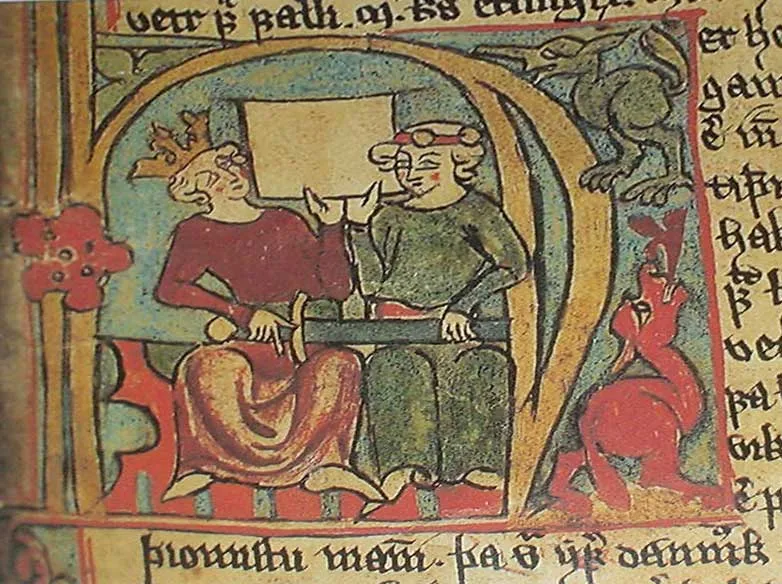 Flateyjarbók miniature of Håkon the Old and Skule Bårdsson (c. 1387–94) The great fourteenth-century Icelandic manuscript Flateyjarbók pairs Skule with his son-in-law and rival Håkon IV in this miniature — the two men whose two-decade power-sharing arrangement collapsed into Skule's 1239 revolt and death the following year. Norwegian noble (1189–1240), the principal rival to King Hákon
IV through the first two decades of Hákon's reign. Duke (the
first man to hold that title in Norway) from 1237; his daughter
Margrete Skulesdatter married Hákon in 1225 as part of the
initial settlement between the two men. The settlement broke
down through the 1230s, and Skule had himself acclaimed king at
the Øyrating at Trondheim in 1239 in open revolt. Defeated by
Hákon's forces at Oslo in May 1240; killed shortly afterward at
Elgeseter Abbey outside Trondheim. His death ended the last
serious challenge of the century-long Norwegian civil wars.
Henrik Ibsen's 1863 play The Pretenders dramatises the conflict.
— the rival whose revolt of 1239–40 against Hákon had been the last serious challenge of the civil wars, and whose defeat had ended them. The woman whose father’s defeat had ended the war and the woman sent abroad to confirm the realm’s standing were mother and daughter.
Flateyjarbók miniature of Håkon the Old and Skule Bårdsson (c. 1387–94) The great fourteenth-century Icelandic manuscript Flateyjarbók pairs Skule with his son-in-law and rival Håkon IV in this miniature — the two men whose two-decade power-sharing arrangement collapsed into Skule's 1239 revolt and death the following year. Norwegian noble (1189–1240), the principal rival to King Hákon
IV through the first two decades of Hákon's reign. Duke (the
first man to hold that title in Norway) from 1237; his daughter
Margrete Skulesdatter married Hákon in 1225 as part of the
initial settlement between the two men. The settlement broke
down through the 1230s, and Skule had himself acclaimed king at
the Øyrating at Trondheim in 1239 in open revolt. Defeated by
Hákon's forces at Oslo in May 1240; killed shortly afterward at
Elgeseter Abbey outside Trondheim. His death ended the last
serious challenge of the century-long Norwegian civil wars.
Henrik Ibsen's 1863 play The Pretenders dramatises the conflict.
— the rival whose revolt of 1239–40 against Hákon had been the last serious challenge of the civil wars, and whose defeat had ended them. The woman whose father’s defeat had ended the war and the woman sent abroad to confirm the realm’s standing were mother and daughter.
Kristina sailed from Tønsberg in the summer of 1257 with a Norwegian retinue, made the slow voyage by sea and land through France and Aragon (modern-day eastern Spain), reached Burgos 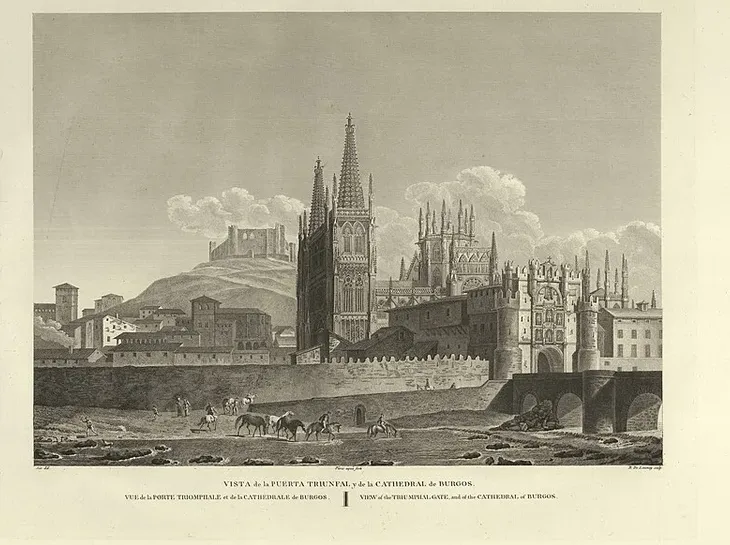 Six / R. de Launay, in Alexandre de Laborde, Voyage pittoresque et historique de l'Espagne (1820) Kristina and her Norwegian retinue reached Burgos by Christmas 1257 and were received at the Castilian court here before continuing on to the Valladolid wedding — this engraving shows the cathedral gate that would have framed that royal reception. Historic capital city of medieval Castile, in modern northern
Spain. Royal capital of the unified Castile-León from the
thirteenth century onward. Site of the Romanesque-Gothic
Burgos Cathedral, begun in 1221 and a UNESCO World Heritage
site since 1984. Kristina Hákonsdatter and her Norwegian
retinue reached Burgos by Christmas 1257 on the long voyage
south from Norway, and were received with ceremony at the
Castilian court before continuing to Valladolid for the
wedding in March 1258. Covarrubias, where Kristina is buried,
is about forty kilometres southeast.
(in modern-day northern Spain) by Christmas, and was received with ceremony at the Castilian court. The following spring, on the thirty-first of March 1258, she was married to the Infante Felipe of Castile
Six / R. de Launay, in Alexandre de Laborde, Voyage pittoresque et historique de l'Espagne (1820) Kristina and her Norwegian retinue reached Burgos by Christmas 1257 and were received at the Castilian court here before continuing on to the Valladolid wedding — this engraving shows the cathedral gate that would have framed that royal reception. Historic capital city of medieval Castile, in modern northern
Spain. Royal capital of the unified Castile-León from the
thirteenth century onward. Site of the Romanesque-Gothic
Burgos Cathedral, begun in 1221 and a UNESCO World Heritage
site since 1984. Kristina Hákonsdatter and her Norwegian
retinue reached Burgos by Christmas 1257 on the long voyage
south from Norway, and were received with ceremony at the
Castilian court before continuing to Valladolid for the
wedding in March 1258. Covarrubias, where Kristina is buried,
is about forty kilometres southeast.
(in modern-day northern Spain) by Christmas, and was received with ceremony at the Castilian court. The following spring, on the thirty-first of March 1258, she was married to the Infante Felipe of Castile 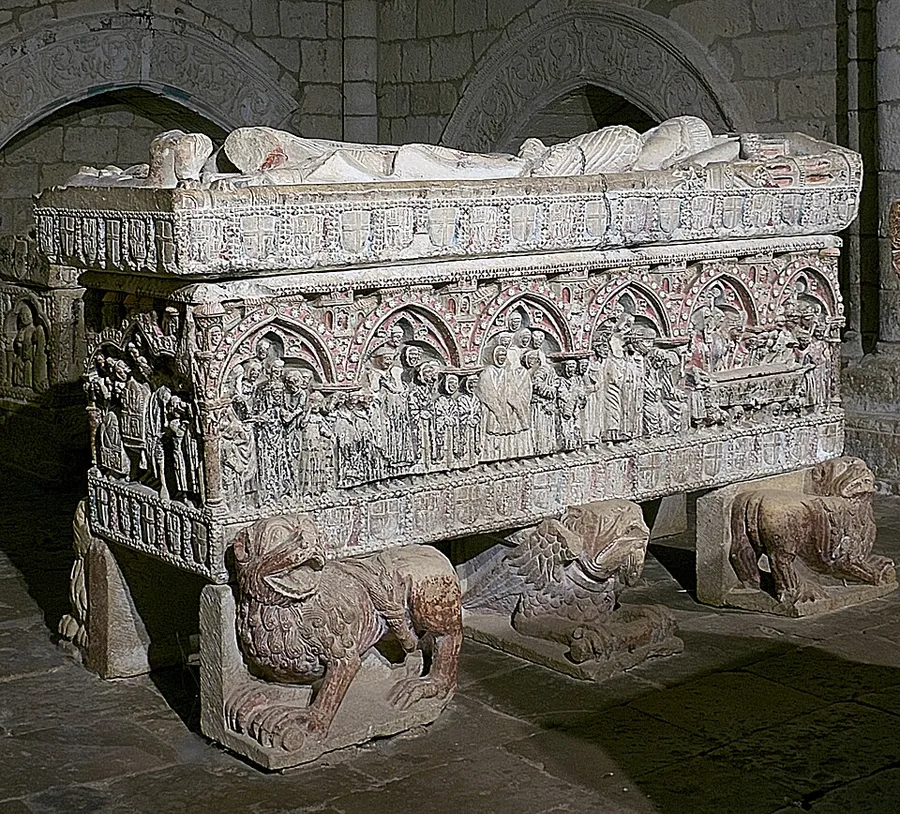 Tiberioclaudio99, tomb of Infante Felipe of Castile, Villalcázar de Sirga (CC0) Felipe's own tomb effigy at Villalcázar de Sirga in Palencia. Husband and wife lie in different churches — Kristina in her plain arcaded sarcophagus at Covarrubias, where Felipe buried her in 1262; Felipe under this ornate lion-borne monument after his own death twelve years later. Younger brother of King Alfonso X of Castile (1231–1274). Held
the collegiate church of San Cosme y San Damián at Covarrubias
as a clerical benefice in his youth, with the prospect of
becoming Archbishop of Seville; renounced the church career to
marry the Norwegian princess Kristina Hákonsdatter on 31 March
1258 at the collegiate church of Santa María in Valladolid.
Kristina had been offered the choice among Alfonso's brothers
and chose Felipe. Moved with her to Seville, where Kristina
died childless in 1262. Felipe transported her body north and
buried her at Covarrubias, the church he had once held. Later
rebelled against his brother Alfonso in the noble revolt of
1272–73 before being reconciled to the crown. Died in 1274.
at the collegiate church of Santa María in Valladolid. She had been offered the choice among Alfonso’s brothers and had chosen Felipe; the chronicle tradition records that she preferred his bearing. She moved with her new husband to Seville, the southern city the Castilian crown had taken from its Muslim rulers a decade before. She died there in 1262, childless, four years after the wedding. Felipe transported her body north and had it buried at the collegiate church of San Cosme y San Damián in Covarrubias
Tiberioclaudio99, tomb of Infante Felipe of Castile, Villalcázar de Sirga (CC0) Felipe's own tomb effigy at Villalcázar de Sirga in Palencia. Husband and wife lie in different churches — Kristina in her plain arcaded sarcophagus at Covarrubias, where Felipe buried her in 1262; Felipe under this ornate lion-borne monument after his own death twelve years later. Younger brother of King Alfonso X of Castile (1231–1274). Held
the collegiate church of San Cosme y San Damián at Covarrubias
as a clerical benefice in his youth, with the prospect of
becoming Archbishop of Seville; renounced the church career to
marry the Norwegian princess Kristina Hákonsdatter on 31 March
1258 at the collegiate church of Santa María in Valladolid.
Kristina had been offered the choice among Alfonso's brothers
and chose Felipe. Moved with her to Seville, where Kristina
died childless in 1262. Felipe transported her body north and
buried her at Covarrubias, the church he had once held. Later
rebelled against his brother Alfonso in the noble revolt of
1272–73 before being reconciled to the crown. Died in 1274.
at the collegiate church of Santa María in Valladolid. She had been offered the choice among Alfonso’s brothers and had chosen Felipe; the chronicle tradition records that she preferred his bearing. She moved with her new husband to Seville, the southern city the Castilian crown had taken from its Muslim rulers a decade before. She died there in 1262, childless, four years after the wedding. Felipe transported her body north and had it buried at the collegiate church of San Cosme y San Damián in Covarrubias 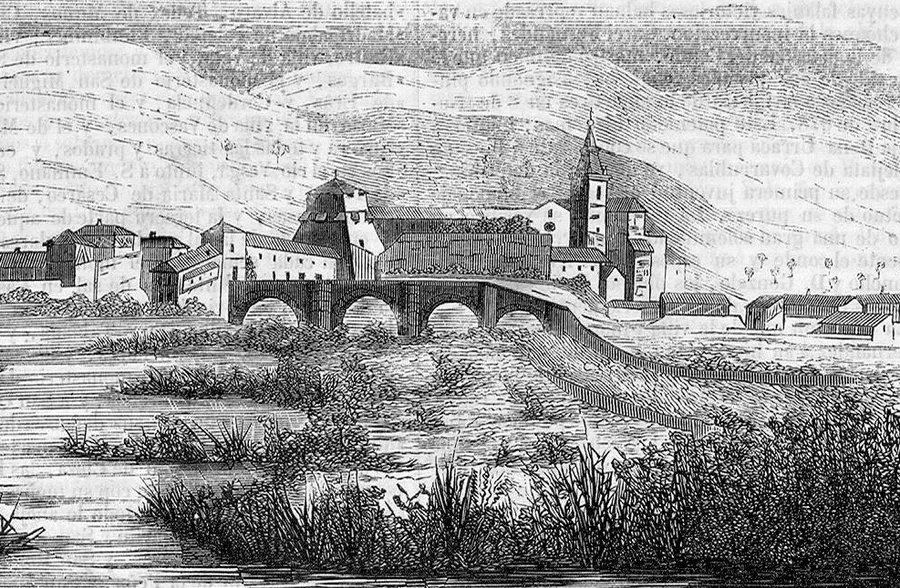 "España pintoresca. Covarrubias," Semanario Pintoresco Español (11 April 1847) A period view of the town itself, not the tomb, where Kristina Hákonsdatter has lain since 1262; the collegiate church tower above the rooftops is the same building whose side chapel held her sealed tomb for nearly seven centuries. Small medieval town in Burgos province of northern Castile,
about forty kilometres southeast of Burgos. Site of the
collegiate church of San Cosme y San Damián, where the
Norwegian princess Kristina Hákonsdatter has been buried since
her husband Infante Felipe of Castile transported her body
north from Seville in 1262. The stone sarcophagus stood in a
side chapel for nearly seven centuries until it was opened
accidentally during a 1952 restoration and formally examined
in 1958 — Kristina's remains and funerary dress were intact
inside. The tomb is now a joint Norwegian-Castilian cultural-
historic site, with a small modern exhibition on her marriage.
— a church he himself had held as a clerical benefice before renouncing it to marry her. The marriage produced no heirs and no continuing dynastic union. But it confirmed in a way that no document could match what the Norwegian kingdom was: a country whose princess could be married, on terms negotiated as between equals, into the royal house of one of the most powerful kingdoms in Europe.
"España pintoresca. Covarrubias," Semanario Pintoresco Español (11 April 1847) A period view of the town itself, not the tomb, where Kristina Hákonsdatter has lain since 1262; the collegiate church tower above the rooftops is the same building whose side chapel held her sealed tomb for nearly seven centuries. Small medieval town in Burgos province of northern Castile,
about forty kilometres southeast of Burgos. Site of the
collegiate church of San Cosme y San Damián, where the
Norwegian princess Kristina Hákonsdatter has been buried since
her husband Infante Felipe of Castile transported her body
north from Seville in 1262. The stone sarcophagus stood in a
side chapel for nearly seven centuries until it was opened
accidentally during a 1952 restoration and formally examined
in 1958 — Kristina's remains and funerary dress were intact
inside. The tomb is now a joint Norwegian-Castilian cultural-
historic site, with a small modern exhibition on her marriage.
— a church he himself had held as a clerical benefice before renouncing it to marry her. The marriage produced no heirs and no continuing dynastic union. But it confirmed in a way that no document could match what the Norwegian kingdom was: a country whose princess could be married, on terms negotiated as between equals, into the royal house of one of the most powerful kingdoms in Europe.
The succession law and the Landslov
The structural foundation for what came next had been laid by Hákon himself, three years before his death. In 1260 he promulgated the Tronfølgeloven The Norwegian Law of Royal Succession enacted in 1260 under King Hákon IV. It replaced the old system of joint kingship and elective acclamation — which had fuelled the civil-war century — with strict male-line primogeniture: the eldest legitimate son inherits, undivided, with the succession of younger brothers only if the elder line fails. The law was a precondition for the orderly transitions of Magnus VI (1263), Eirik II (1280), and Hákon V (1299), and it ended a hundred and ten years of dynastic civil war. It was the kind of structural reform that defines the Sverre-dynasty Golden Age — bureaucratic state-building rather than military expansion. , a new law of royal succession that replaced the older combination of inheritance and election with strict primogeniture: the throne would pass, from this point forward, to the eldest legitimate son of the reigning king. The civil-war century the country had endured before the 1240s had been driven, more than by any other single cause, by the old system’s habit of producing competing claimants and contested elections among them. The 1260 law made hereditary monarchy the constitutional principle of medieval Norway. It is the single institutional act of the period most often missed in general histories.
The work of Hákon’s son Magnus VI — called Magnus Lagabøte, Magnus the Lawmender — followed in 1274. Before his reign, Norway had operated under four separate regional codes, one for each of the great assemblies at Gulating  Jeblad, Steinkorset ved porten til Eivindvik kirke (2008), Wikimedia Commons, CC BY-SA 3.0 The early-medieval stone cross at Eivindvik, by the church gate at Gulen. The law assemblies raised no buildings that survive; this weathered cross, standing near the Gulating's traditional meeting ground, is what still marks the shore where western Norway's freemen gathered. The regional thing-law assembly of southwestern Norway, meeting
traditionally at Gulen in present-day Sogn og Fjordane. One of the
four great medieval Norwegian regional law traditions; its
jurisdiction covered the western coast from Agder to Sunnmøre and
produced the Gulatingslova, recorded in writing by the twelfth
century. The Gulating tradition was rolled into Magnus Lagabøte's
Landslov of 1274. The modern Gulating Court of Appeal in Bergen
inherits the name.
Also discussed in Before There Was Norway — petty kingdoms at the edge of the worldThe King Who Became a Saint — how the Nordmen came to ChristA Catholic Norway — the faith that gave the kingdom its first institutions and the stave churches in the west, Frostating
Jeblad, Steinkorset ved porten til Eivindvik kirke (2008), Wikimedia Commons, CC BY-SA 3.0 The early-medieval stone cross at Eivindvik, by the church gate at Gulen. The law assemblies raised no buildings that survive; this weathered cross, standing near the Gulating's traditional meeting ground, is what still marks the shore where western Norway's freemen gathered. The regional thing-law assembly of southwestern Norway, meeting
traditionally at Gulen in present-day Sogn og Fjordane. One of the
four great medieval Norwegian regional law traditions; its
jurisdiction covered the western coast from Agder to Sunnmøre and
produced the Gulatingslova, recorded in writing by the twelfth
century. The Gulating tradition was rolled into Magnus Lagabøte's
Landslov of 1274. The modern Gulating Court of Appeal in Bergen
inherits the name.
Also discussed in Before There Was Norway — petty kingdoms at the edge of the worldThe King Who Became a Saint — how the Nordmen came to ChristA Catholic Norway — the faith that gave the kingdom its first institutions and the stave churches in the west, Frostating 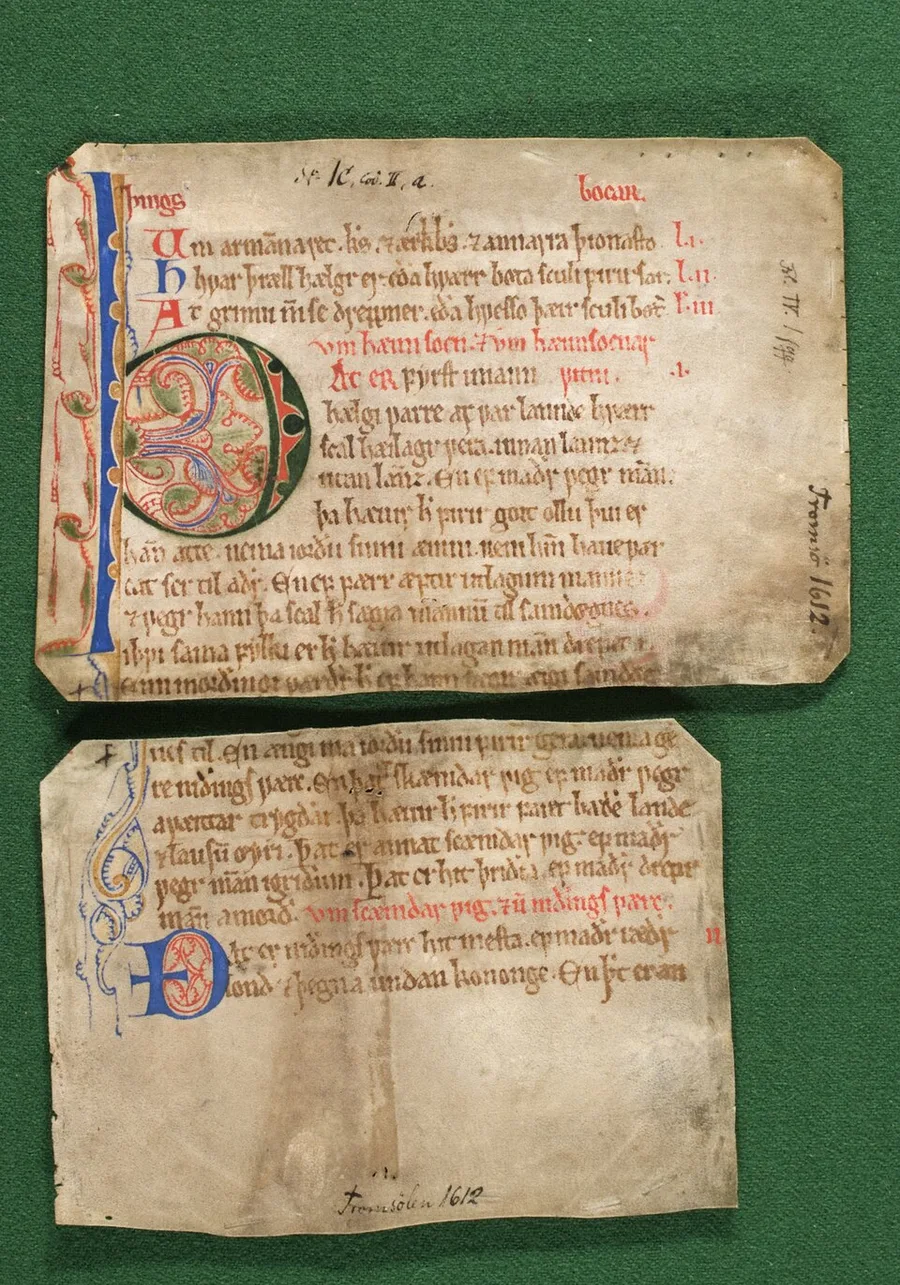 Frostatingslova fragment (c. 1260), National Archives of Norway (Riksarkivet), CC BY-SA 4.0 Two parchment leaves of the Frostatingslova, c. 1260 — the written law code of the central-Norway thing assembly that met at Frosta on the Trondheim Fjord, its customary law far older than the ink. The regional thing-law assembly of central Norway, meeting at
Frosta on the Trondheim Fjord. Jurisdiction covered Trøndelag and
the surrounding northern districts. Its codification, the
Frostatingslova, dates to the twelfth century in its surviving
form but preserves substantially older customary law. Rolled into
Magnus Lagabøte's Landslov of 1274. The modern Frostating Court
of Appeal in Trondheim carries the name.
Also discussed in Before There Was Norway — petty kingdoms at the edge of the worldWorshiping Odin and Thor — the lived religion of pre-Christian NorwayThe King Who Became a Saint — how the Nordmen came to ChristA Catholic Norway — the faith that gave the kingdom its first institutions and the stave churches in Trøndelag, Borgarting
Frostatingslova fragment (c. 1260), National Archives of Norway (Riksarkivet), CC BY-SA 4.0 Two parchment leaves of the Frostatingslova, c. 1260 — the written law code of the central-Norway thing assembly that met at Frosta on the Trondheim Fjord, its customary law far older than the ink. The regional thing-law assembly of central Norway, meeting at
Frosta on the Trondheim Fjord. Jurisdiction covered Trøndelag and
the surrounding northern districts. Its codification, the
Frostatingslova, dates to the twelfth century in its surviving
form but preserves substantially older customary law. Rolled into
Magnus Lagabøte's Landslov of 1274. The modern Frostating Court
of Appeal in Trondheim carries the name.
Also discussed in Before There Was Norway — petty kingdoms at the edge of the worldWorshiping Odin and Thor — the lived religion of pre-Christian NorwayThe King Who Became a Saint — how the Nordmen came to ChristA Catholic Norway — the faith that gave the kingdom its first institutions and the stave churches in Trøndelag, Borgarting 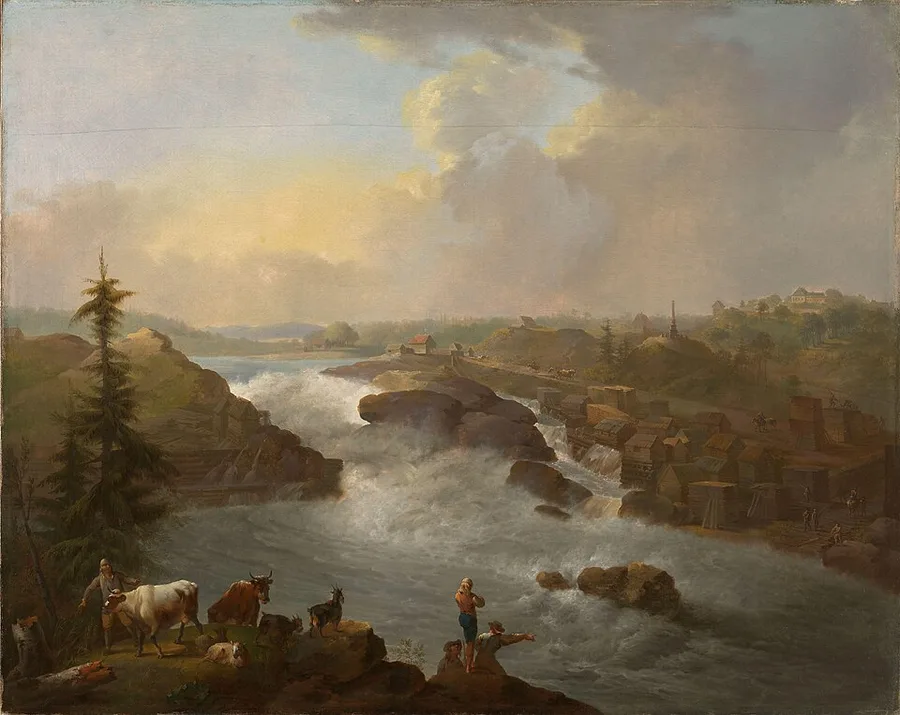 Christian August Lorentzen, The Waterfall Sarpsfossen (1795), Nasjonalmuseet Sarpsfossen, the great falls at Borg — the place that named the assembly. The Borgarting's thing-men met at the town King Olaf Haraldsson founded beside this waterfall in 1016; Lorentzen painted the falls as the sawmill town of the Danish era had grown around them. The regional thing-law assembly of southeastern Norway, meeting
at Borg (modern Sarpsborg). Jurisdiction covered the southeast
including Vestfold and Østfold. Its surviving Borgartingslova
preserves the regional legal tradition of the southeastern petty
kingdoms; rolled into Magnus Lagabøte's Landslov of 1274. The
modern Borgarting Court of Appeal in Oslo carries the name.
Also discussed in Before There Was Norway — petty kingdoms at the edge of the worldA Catholic Norway — the faith that gave the kingdom its first institutions and the stave churches in the southeast, and Eidsivating
Christian August Lorentzen, The Waterfall Sarpsfossen (1795), Nasjonalmuseet Sarpsfossen, the great falls at Borg — the place that named the assembly. The Borgarting's thing-men met at the town King Olaf Haraldsson founded beside this waterfall in 1016; Lorentzen painted the falls as the sawmill town of the Danish era had grown around them. The regional thing-law assembly of southeastern Norway, meeting
at Borg (modern Sarpsborg). Jurisdiction covered the southeast
including Vestfold and Østfold. Its surviving Borgartingslova
preserves the regional legal tradition of the southeastern petty
kingdoms; rolled into Magnus Lagabøte's Landslov of 1274. The
modern Borgarting Court of Appeal in Oslo carries the name.
Also discussed in Before There Was Norway — petty kingdoms at the edge of the worldA Catholic Norway — the faith that gave the kingdom its first institutions and the stave churches in the southeast, and Eidsivating 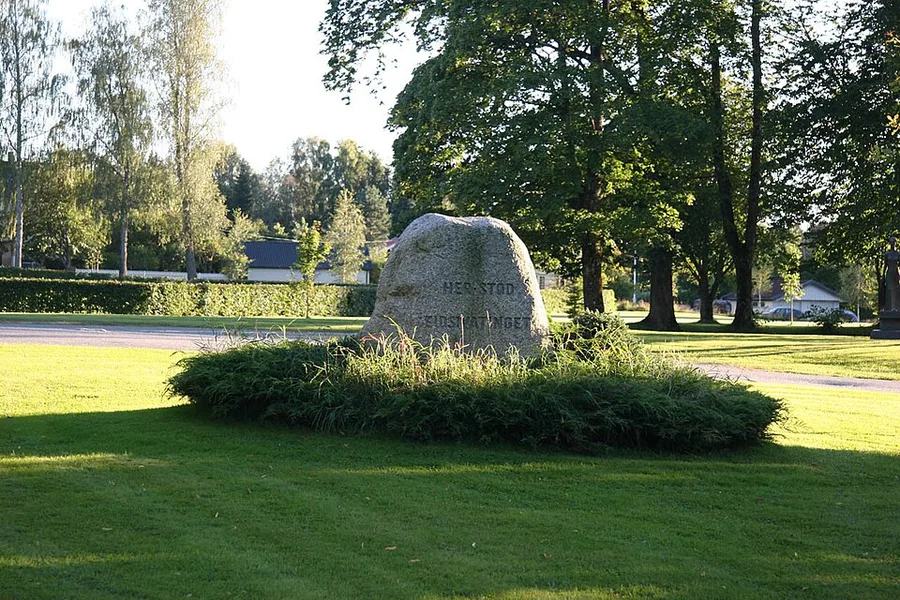 Photo: Harry Wad, Eidsivating memorial stone at Eidsvoll (2007), CC BY 2.5 A memorial stone at Eidsvoll reading 'Her stod Eidsivatinget' — 'here stood the Eidsivating' — planted on the ground where the inland district's law-assembly once gathered, since nothing of the meeting itself survives. The regional thing-law assembly of the inland east of Norway,
meeting traditionally at Eidsvoll — the same Eidsvoll where, eight
centuries later, the Norwegian Constitution was written and signed
in 1814. Jurisdiction covered the inland districts of Hedmark,
Romerike, and the surrounding interior. Its Eidsivatingslova
was rolled into Magnus Lagabøte's Landslov of 1274. The modern
Eidsivating Court of Appeal carries the name; its seat is at
Hamar.
Also discussed in Before There Was Norway — petty kingdoms at the edge of the worldA Catholic Norway — the faith that gave the kingdom its first institutions and the stave churches in the inland. Over the decade after his accession in 1263, Magnus and the lawmen of his court unified the four into a single national code in Old Norwegian. The Landslov (1274)
Photo: Harry Wad, Eidsivating memorial stone at Eidsvoll (2007), CC BY 2.5 A memorial stone at Eidsvoll reading 'Her stod Eidsivatinget' — 'here stood the Eidsivating' — planted on the ground where the inland district's law-assembly once gathered, since nothing of the meeting itself survives. The regional thing-law assembly of the inland east of Norway,
meeting traditionally at Eidsvoll — the same Eidsvoll where, eight
centuries later, the Norwegian Constitution was written and signed
in 1814. Jurisdiction covered the inland districts of Hedmark,
Romerike, and the surrounding interior. Its Eidsivatingslova
was rolled into Magnus Lagabøte's Landslov of 1274. The modern
Eidsivating Court of Appeal carries the name; its seat is at
Hamar.
Also discussed in Before There Was Norway — petty kingdoms at the edge of the worldA Catholic Norway — the faith that gave the kingdom its first institutions and the stave churches in the inland. Over the decade after his accession in 1263, Magnus and the lawmen of his court unified the four into a single national code in Old Norwegian. The Landslov (1274) 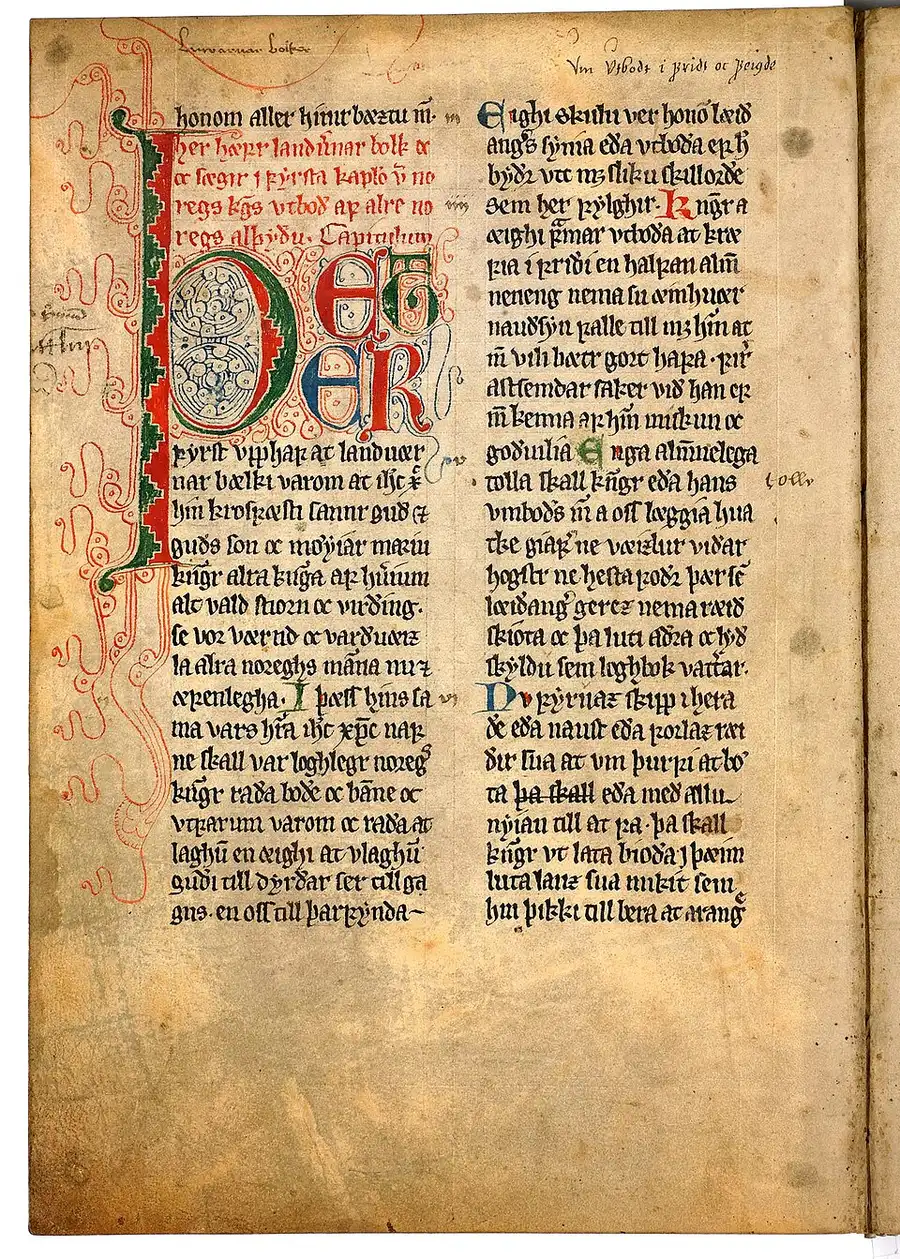 Magnus Lagabøtes landslov, AM 305 fol., fol. 10v (13th-14th c.), via Wikimedia Commons A page from a medieval handwritten copy of Magnus Lagabøte's 1274 law code, its two columns of Old Norse opening the land-defence section beneath a red, green, and blue interlace initial — the national law as scribes preserved it. Norwegian Magnus Lagabøtes landslov — the Code of National Law
promulgated by King Magnus VI Lagabøte in 1274. Unified the four
separate regional thing-law traditions (Gulating, Frostating,
Borgarting, Eidsivating) into a single code applying across the
whole Norwegian kingdom. Made Norway one of the first European
kingdoms with a unified national legal code, decades ahead of
similar developments in England or France. Remained the law of
Norway for more than four hundred years, until Christian V's
Norske Lov superseded it in 1687.
Also discussed in Before There Was Norway — petty kingdoms at the edge of the worldThe 400-Year Night — when the Northern Lion lay dormantAllemannsretten — the right to roam — the Law of the Land — was among the earliest unified national codes written in any European vernacular, and among the most durable: it remained the law of Norway, with revisions, for more than four hundred years, until its replacement by Christian V’s Norwegian Law in 1687.
Magnus Lagabøtes landslov, AM 305 fol., fol. 10v (13th-14th c.), via Wikimedia Commons A page from a medieval handwritten copy of Magnus Lagabøte's 1274 law code, its two columns of Old Norse opening the land-defence section beneath a red, green, and blue interlace initial — the national law as scribes preserved it. Norwegian Magnus Lagabøtes landslov — the Code of National Law
promulgated by King Magnus VI Lagabøte in 1274. Unified the four
separate regional thing-law traditions (Gulating, Frostating,
Borgarting, Eidsivating) into a single code applying across the
whole Norwegian kingdom. Made Norway one of the first European
kingdoms with a unified national legal code, decades ahead of
similar developments in England or France. Remained the law of
Norway for more than four hundred years, until Christian V's
Norske Lov superseded it in 1687.
Also discussed in Before There Was Norway — petty kingdoms at the edge of the worldThe 400-Year Night — when the Northern Lion lay dormantAllemannsretten — the right to roam — the Law of the Land — was among the earliest unified national codes written in any European vernacular, and among the most durable: it remained the law of Norway, with revisions, for more than four hundred years, until its replacement by Christian V’s Norwegian Law in 1687.
Several of its provisions were striking by the legal standards of medieval Europe. It expanded women’s inheritance rights beyond what the older regional codes had recognised. It treated theft from necessity — food taken by the destitute who could not otherwise feed themselves — as a lesser offence than ordinary theft. It established a single uniform standard of justice across what had been four distinct jurisdictions. A separate Town’s-Law followed in 1276 for the urban districts. By the close of Magnus VI’s reign — in 1280, when he died at forty-two — the Norwegian kingdom held a unified national law in its own vernacular, a hereditary succession secured by Hákon’s 1260 statute, an institutional church under its own archbishop, a maritime realm across the Norse-speaking North Atlantic, marriage ties to Castile, and a literary culture both producing original work and translating continental work into the same Old Norwegian tongue. It was, by the institutional and diplomatic standards of its century, a successful medium-rank European monarchy.
Largs, Perth, and the slide
The first piece of the realm to fall away came while Hákon was still on the throne. The Hebrides and the Isle of Man, Norwegian since the eleventh century, were under increasing pressure through the early 1260s from the Scottish king Alexander III of Scotland 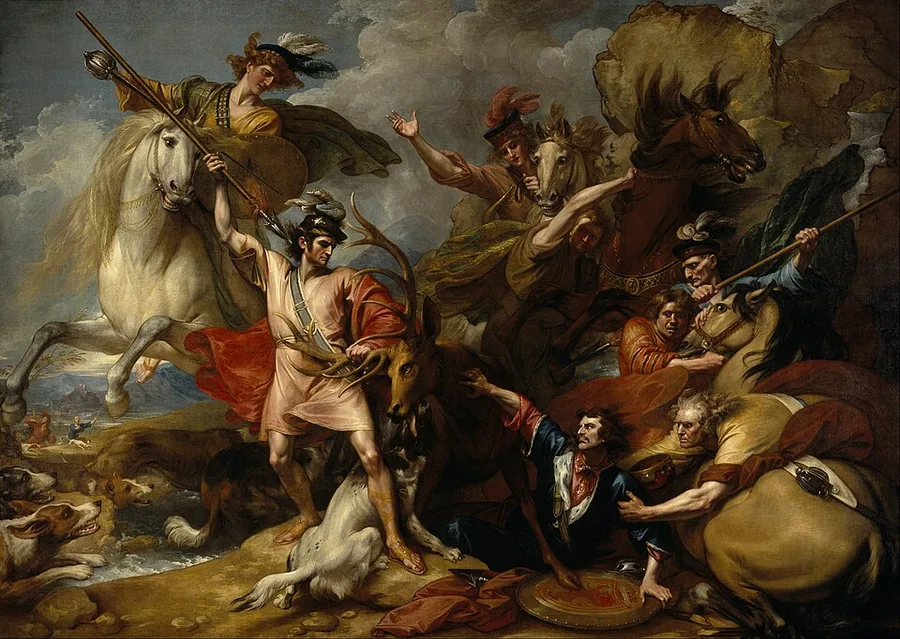 Benjamin West, Alexander III Rescued from a Stag (1786), National Galleries of Scotland Benjamin West's 1786 canvas is the best-known painted image of Alexander III -- a legendary hunting rescue rather than a life portrait, but it is the picture museums and textbooks reach for when illustrating this king. King of Scots 1249–1286, son of Alexander II. Acceded at age
seven and consolidated royal authority across his long reign.
Pressed Norwegian sovereignty over the Hebrides and the Isle
of Man through the early 1260s, provoking King Hákon IV's last
campaign and the inconclusive Battle of Largs on 2 October
1263. Three years later, by the Treaty of Perth (1266),
Alexander purchased Norwegian sovereignty over the Hebrides
and Man from Hákon's son Magnus VI for four thousand marks
and a hundred-mark annual tribute in perpetuity. His own death
in a riding accident in 1286 left the Scottish throne in a
succession crisis — eventually leading to the Wars of Scottish
Independence against the Plantagenet English crown.
. In the summer of 1263 Hákon assembled a large fleet at Bergen, sailed south to the western Scottish coast to defend the southern frontier of the realm, and fought an inconclusive engagement at Battle of Largs
Benjamin West, Alexander III Rescued from a Stag (1786), National Galleries of Scotland Benjamin West's 1786 canvas is the best-known painted image of Alexander III -- a legendary hunting rescue rather than a life portrait, but it is the picture museums and textbooks reach for when illustrating this king. King of Scots 1249–1286, son of Alexander II. Acceded at age
seven and consolidated royal authority across his long reign.
Pressed Norwegian sovereignty over the Hebrides and the Isle
of Man through the early 1260s, provoking King Hákon IV's last
campaign and the inconclusive Battle of Largs on 2 October
1263. Three years later, by the Treaty of Perth (1266),
Alexander purchased Norwegian sovereignty over the Hebrides
and Man from Hákon's son Magnus VI for four thousand marks
and a hundred-mark annual tribute in perpetuity. His own death
in a riding accident in 1286 left the Scottish throne in a
succession crisis — eventually leading to the Wars of Scottish
Independence against the Plantagenet English crown.
. In the summer of 1263 Hákon assembled a large fleet at Bergen, sailed south to the western Scottish coast to defend the southern frontier of the realm, and fought an inconclusive engagement at Battle of Largs 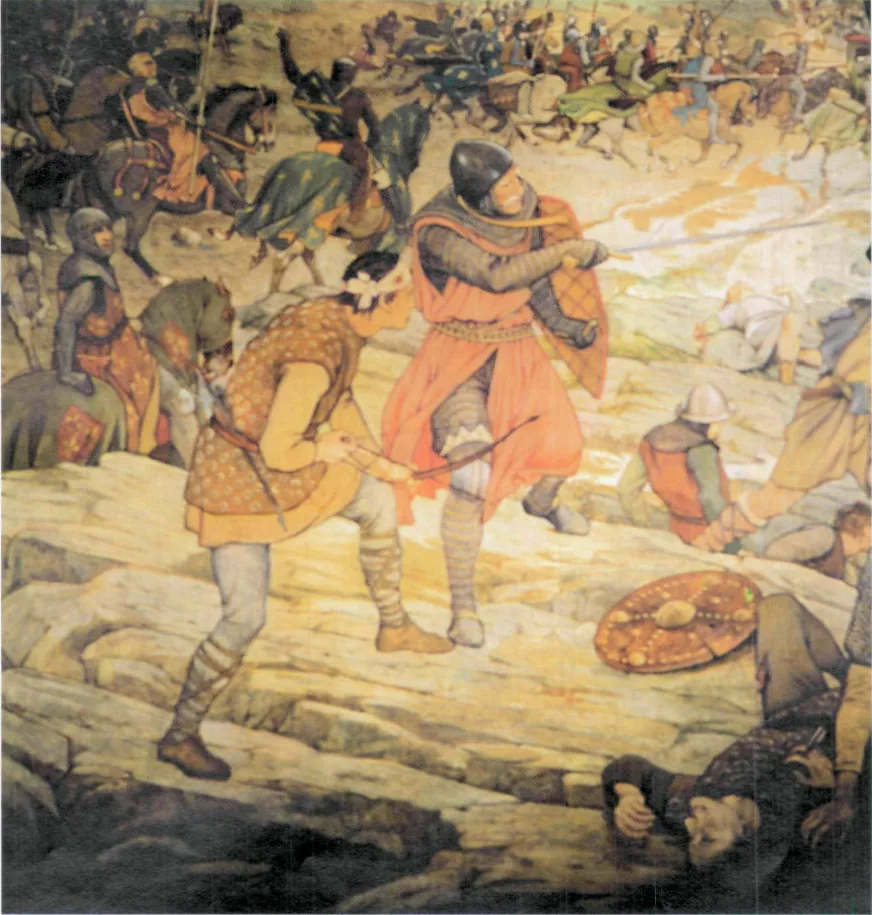 William Hole, The Battle of Largs, Scottish National Portrait Gallery mural William Hole's mural stages the fight itself — Hákon IV's storm-wrecked landing party grappling with Scottish riders on the beach at Largs, 2 October 1263, the engagement that ended Norwegian military power in the Irish Sea. Inconclusive but strategically decisive engagement on
2 October 1263 between the Norwegian fleet of King Hákon IV
and Scottish forces under Alexander III at Largs on the Firth
of Clyde. Hákon had sailed west to enforce Norwegian
suzerainty over the Hebrides; an autumn storm scattered his
ships, the landing party was driven back from the beach, and
the king withdrew north to Orkney, where he died in
Kirkwall that December. The battle ended Norwegian military
power in the Irish Sea. Three years later, Hákon's son
Magnus VI ceded the Hebrides and the Isle of Man to Scotland
in the Treaty of Perth (1266) in exchange for an annual
payment that was rarely paid.
on the second of October. He withdrew to Orkney for the winter and died at the bishop’s palace at Kirkwall
William Hole, The Battle of Largs, Scottish National Portrait Gallery mural William Hole's mural stages the fight itself — Hákon IV's storm-wrecked landing party grappling with Scottish riders on the beach at Largs, 2 October 1263, the engagement that ended Norwegian military power in the Irish Sea. Inconclusive but strategically decisive engagement on
2 October 1263 between the Norwegian fleet of King Hákon IV
and Scottish forces under Alexander III at Largs on the Firth
of Clyde. Hákon had sailed west to enforce Norwegian
suzerainty over the Hebrides; an autumn storm scattered his
ships, the landing party was driven back from the beach, and
the king withdrew north to Orkney, where he died in
Kirkwall that December. The battle ended Norwegian military
power in the Irish Sea. Three years later, Hákon's son
Magnus VI ceded the Hebrides and the Isle of Man to Scotland
in the Treaty of Perth (1266) in exchange for an annual
payment that was rarely paid.
on the second of October. He withdrew to Orkney for the winter and died at the bishop’s palace at Kirkwall 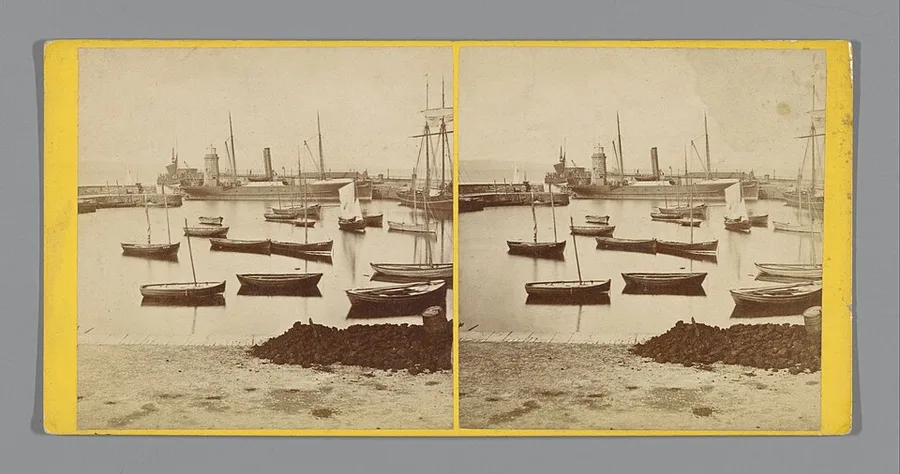 G. W. Wilson & Co. (attrib.), Kirkwall Harbour (c. 1850-80), Rijksmuseum A working view of the harbour town where Hakon IV's storm-battered fleet put in after Largs, and where the king died that December at the Bishop's Palace a few streets up from this quay. Principal town of the Orkney Islands, on the largest island
(Mainland), about a kilometre inland from the harbour. Founded
by the Norse and remained the seat of the Earls of Orkney —
ruled in suzerainty under the Norwegian crown — through the
medieval period. Site of St Magnus Cathedral, begun in 1137
in honour of the martyred Earl Magnus Erlendsson, and the
Bishop's Palace, where King Hákon IV of Norway died on the
night of 15–16 December 1263 after his withdrawal from the
Scottish coast. Orkney passed to Scotland in 1469. The name
Kirkjuvágr — "church bay" — is Norse.
on the sixteenth of December, never having returned to Norway. The saga tradition records that on his last evenings he had Latin books read aloud to him, tired of them, and asked instead for the kings’ sagas of his own dynasty — the histories of the line he came from, in the language of the country he had reigned over for forty-six years. He died, the saga says, to a recitation of the Saga of his grandfather, King Sverre Sigurdsson
G. W. Wilson & Co. (attrib.), Kirkwall Harbour (c. 1850-80), Rijksmuseum A working view of the harbour town where Hakon IV's storm-battered fleet put in after Largs, and where the king died that December at the Bishop's Palace a few streets up from this quay. Principal town of the Orkney Islands, on the largest island
(Mainland), about a kilometre inland from the harbour. Founded
by the Norse and remained the seat of the Earls of Orkney —
ruled in suzerainty under the Norwegian crown — through the
medieval period. Site of St Magnus Cathedral, begun in 1137
in honour of the martyred Earl Magnus Erlendsson, and the
Bishop's Palace, where King Hákon IV of Norway died on the
night of 15–16 December 1263 after his withdrawal from the
Scottish coast. Orkney passed to Scotland in 1469. The name
Kirkjuvágr — "church bay" — is Norse.
on the sixteenth of December, never having returned to Norway. The saga tradition records that on his last evenings he had Latin books read aloud to him, tired of them, and asked instead for the kings’ sagas of his own dynasty — the histories of the line he came from, in the language of the country he had reigned over for forty-six years. He died, the saga says, to a recitation of the Saga of his grandfather, King Sverre Sigurdsson 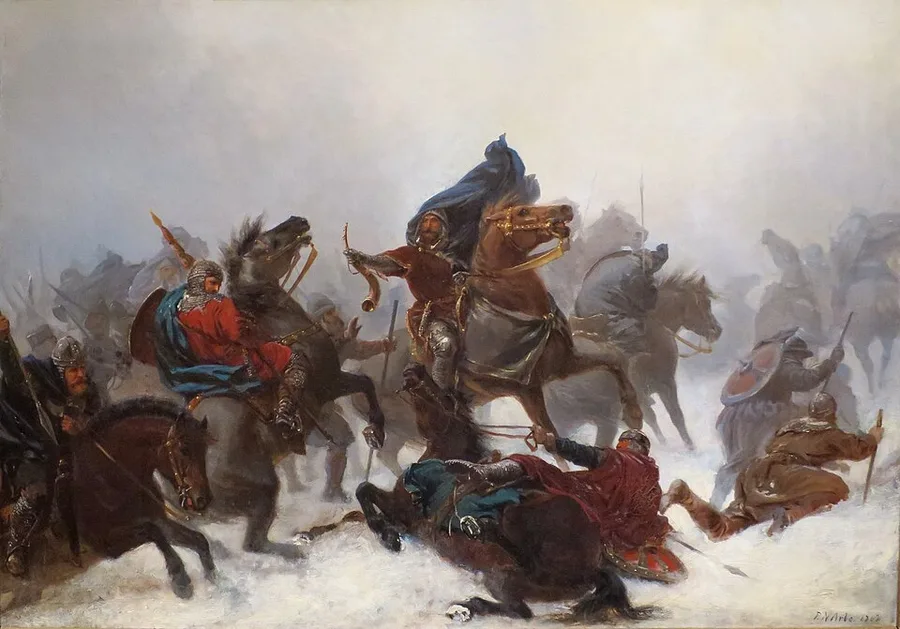 Peter Nicolai Arbo, Kong Sverres flukt (1862), KODE Art Museums, Bergen Arbo's 1862 history painting imagines King Sverre and his Birkebeiner riders in flight — one of the desperate marches of the decade-long guerrilla campaign the priest-turned-king waged before winning the Norwegian throne at Fimreite in 1184. King of Norway 1184–1202 (Sverre I), founder of the Birkebeiner
dynasty and grandfather of Hákon IV. Born in the Faroes around
1151; emerged in the 1170s as leader of the Birkebeinar
(the "Birch-Legs"), a faction of poor and propertyless
Norwegians named for the birch-bark they wrapped their feet in
when their boots wore out. Took the Norwegian throne in 1184
after defeating King Magnus V Erlingsson at the sea-battle of
Fimreite. His own saga — Sverris saga, written under his
supervision by the Icelandic abbot Karl Jónsson — is one of
the great medieval Norwegian biographical works, the
recitation of which the dying Hákon IV asked for at Kirkwall
in December 1263. Excommunicated by Pope Innocent III in 1198;
reconciled with the church only posthumously.
.
Peter Nicolai Arbo, Kong Sverres flukt (1862), KODE Art Museums, Bergen Arbo's 1862 history painting imagines King Sverre and his Birkebeiner riders in flight — one of the desperate marches of the decade-long guerrilla campaign the priest-turned-king waged before winning the Norwegian throne at Fimreite in 1184. King of Norway 1184–1202 (Sverre I), founder of the Birkebeiner
dynasty and grandfather of Hákon IV. Born in the Faroes around
1151; emerged in the 1170s as leader of the Birkebeinar
(the "Birch-Legs"), a faction of poor and propertyless
Norwegians named for the birch-bark they wrapped their feet in
when their boots wore out. Took the Norwegian throne in 1184
after defeating King Magnus V Erlingsson at the sea-battle of
Fimreite. His own saga — Sverris saga, written under his
supervision by the Icelandic abbot Karl Jónsson — is one of
the great medieval Norwegian biographical works, the
recitation of which the dying Hákon IV asked for at Kirkwall
in December 1263. Excommunicated by Pope Innocent III in 1198;
reconciled with the church only posthumously.
.
Three years later his son Magnus signed the Treaty of Perth 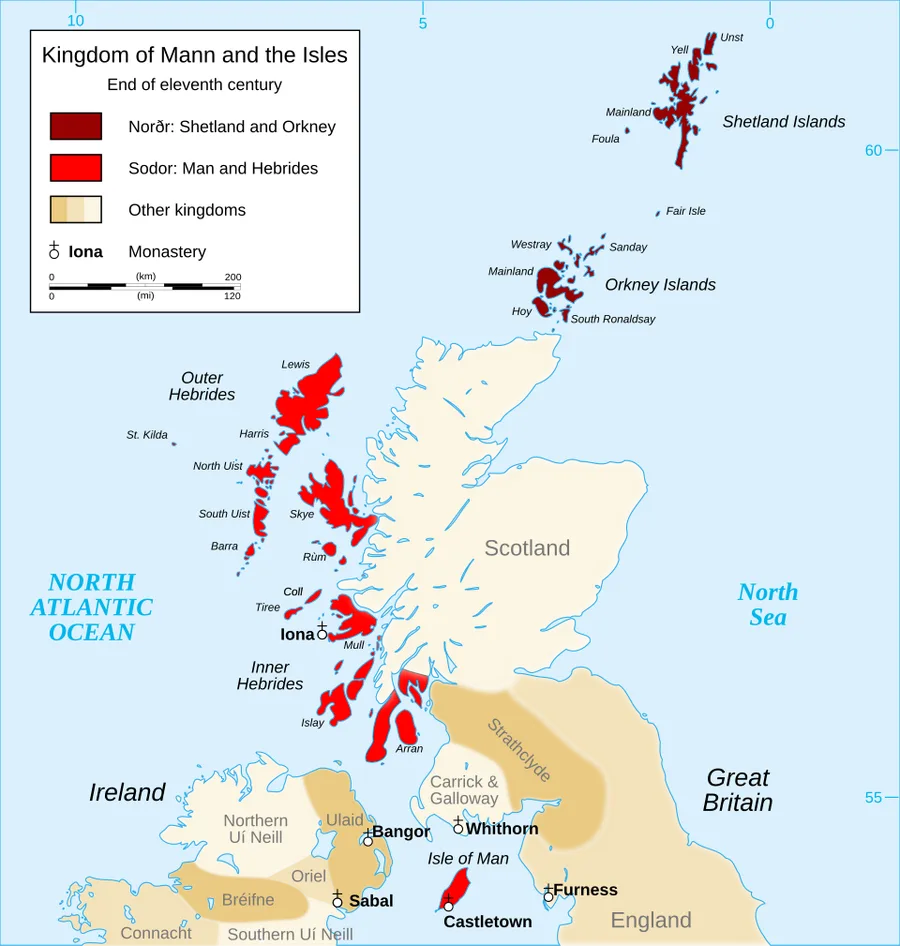 Semhur, Kingdom of Mann and the Isles (2007), Wikimedia Commons The map’s two shaded blocs — Nordr (Orkney and Shetland) and Sodor (the Hebrides and Man) — are the line the Treaty of Perth drew in 1266: Sodor went to Scotland for cash, Nordr stayed Norwegian two more centuries. The map itself predates the treaty by ~200 years, showing the realm, not the signing. The 1266 treaty by which King Magnus VI of Norway ceded the
Hebrides and the Isle of Man to King Alexander III of
Scotland in exchange for 4,000 marks paid in four annual
instalments and an annual rent of 100 marks in perpetuity
(the latter rarely paid in practice). Orkney and Shetland
remained under Norwegian sovereignty. The treaty followed
the Norwegian withdrawal after the Battle of Largs (1263)
and the death of Hákon IV in Kirkwall that December — it
ended Norwegian military involvement in the Irish Sea and
formally drew the western boundary of Norgesveldet.
Scotland recognised Norwegian sovereignty over Orkney and
Shetland in the same document — those islands were not
ceded until 1469 as surety for an unpaid royal dowry.
: Norway received four thousand marks in four annual installments and a hundred-mark annual tribute in perpetuity, and ceded sovereignty over the Hebrides and the Isle of Man to the Scottish crown. The realm kept Orkney and Shetland, Iceland and Greenland, the Faroes and the rest intact. But its southern reach had been negotiated away.
Semhur, Kingdom of Mann and the Isles (2007), Wikimedia Commons The map’s two shaded blocs — Nordr (Orkney and Shetland) and Sodor (the Hebrides and Man) — are the line the Treaty of Perth drew in 1266: Sodor went to Scotland for cash, Nordr stayed Norwegian two more centuries. The map itself predates the treaty by ~200 years, showing the realm, not the signing. The 1266 treaty by which King Magnus VI of Norway ceded the
Hebrides and the Isle of Man to King Alexander III of
Scotland in exchange for 4,000 marks paid in four annual
instalments and an annual rent of 100 marks in perpetuity
(the latter rarely paid in practice). Orkney and Shetland
remained under Norwegian sovereignty. The treaty followed
the Norwegian withdrawal after the Battle of Largs (1263)
and the death of Hákon IV in Kirkwall that December — it
ended Norwegian military involvement in the Irish Sea and
formally drew the western boundary of Norgesveldet.
Scotland recognised Norwegian sovereignty over Orkney and
Shetland in the same document — those islands were not
ceded until 1469 as surety for an unpaid royal dowry.
: Norway received four thousand marks in four annual installments and a hundred-mark annual tribute in perpetuity, and ceded sovereignty over the Hebrides and the Isle of Man to the Scottish crown. The realm kept Orkney and Shetland, Iceland and Greenland, the Faroes and the rest intact. But its southern reach had been negotiated away.
The slide that began at Largs accelerated through the decades that followed. The Hanseatic merchants of Lübeck 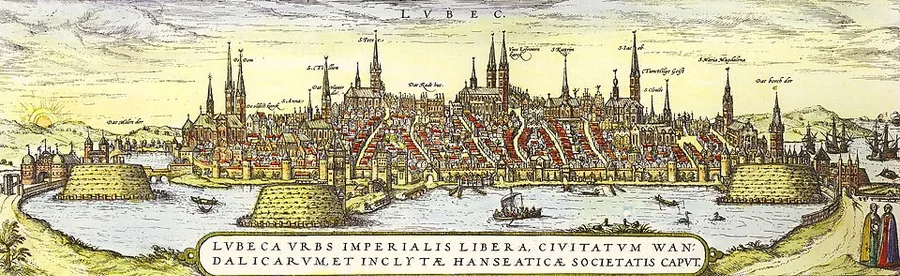 Georg Braun & Frans Hogenberg, Lübeck, Civitates Orbis Terrarum (16th c.) The 'Queen of the Hansa' ran the Bergen kontor at Bryggen and controlled the stockfish trade that linked Norway to Catholic Europe's fast-day economy — this engraved panorama shows the Trave-river capital from which that trade was directed. North German port city on the Baltic, founded in 1143 and
granted imperial-free-city status in 1226. Capital of the
Hanseatic League, the merchant confederation that dominated
northern European trade from the thirteenth through the
fifteenth centuries. From Lübeck the Hansa established its
great trading kontor at Bergen — the Bryggen wharf — and
controlled the stockfish export trade that linked Norway
to the Catholic fast-day economy of Europe. The "Queen of
the Hansa." Lübeck's medieval old town, dominated by the
twin spires of the Marienkirche, is a UNESCO World Heritage
site.
Also discussed in The Germans Who "Ruled" Bergen — the Hanseatic merchants on Bryggen Wharf and Hamburg
Georg Braun & Frans Hogenberg, Lübeck, Civitates Orbis Terrarum (16th c.) The 'Queen of the Hansa' ran the Bergen kontor at Bryggen and controlled the stockfish trade that linked Norway to Catholic Europe's fast-day economy — this engraved panorama shows the Trave-river capital from which that trade was directed. North German port city on the Baltic, founded in 1143 and
granted imperial-free-city status in 1226. Capital of the
Hanseatic League, the merchant confederation that dominated
northern European trade from the thirteenth through the
fifteenth centuries. From Lübeck the Hansa established its
great trading kontor at Bergen — the Bryggen wharf — and
controlled the stockfish export trade that linked Norway
to the Catholic fast-day economy of Europe. The "Queen of
the Hansa." Lübeck's medieval old town, dominated by the
twin spires of the Marienkirche, is a UNESCO World Heritage
site.
Also discussed in The Germans Who "Ruled" Bergen — the Hanseatic merchants on Bryggen Wharf and Hamburg 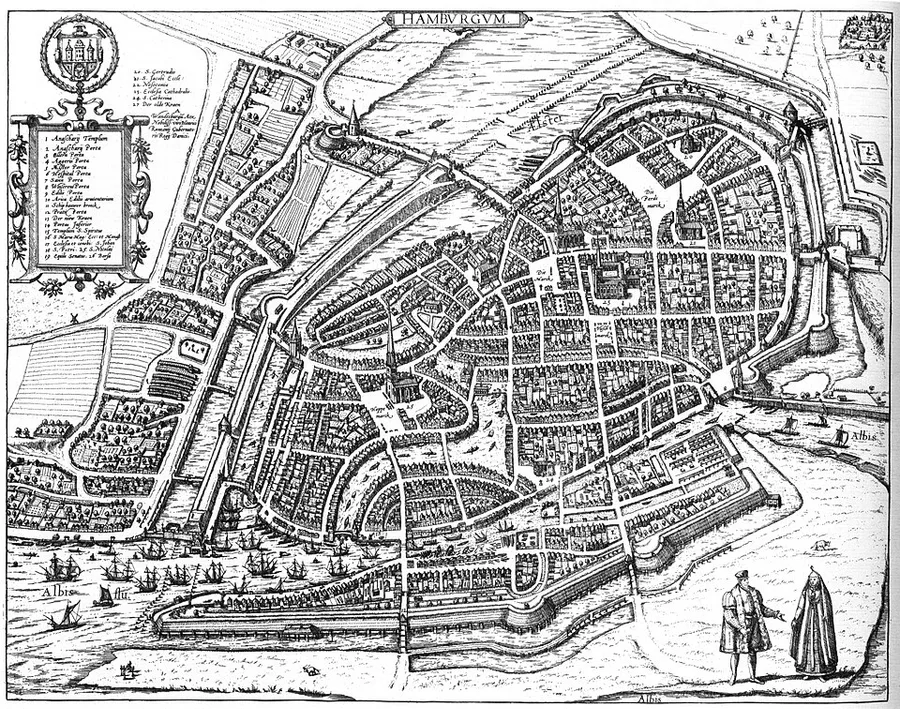 Georg Braun & Frans Hogenberg, Hamburgum, Civitates Orbis Terrarum (1588 ed.) Hamburg co-founded the Hanseatic League with Lubeck and won growing trading privileges at Bergen from the 1270s on -- this bird's-eye engraving shows the Elbe river port whose merchants took an ever-larger share of the Norwegian stockfish trade as the crown's own grip loosened. Major North German port city at the head of the Elbe estuary,
about a hundred kilometres from the open North Sea. Founded
as an archbishopric in 831 by Louis the Pious. Together with
Lübeck a co-founder of the Hanseatic League and one of its
principal western terminals — the Hansa connection that linked
it to the Norwegian stockfish trade through Bergen. An imperial
free city from 1189. Today the second-largest city in modern
Germany and one of the world's great container ports.
secured progressively larger commercial privileges at Bergen, beginning with a grant from Magnus VI in 1278 and a renewal under Eirik II in 1294, and through the early fourteenth century they came to take a growing share of the western North Sea trade in stockfish out of Norwegian hands. The terms of trade slowly turned against Norwegian sellers as the Hanseatic share grew. Greenlandic tribute became inconsistent. Iceland and the Faroes managed their own affairs at greater distance from the Norwegian crown. The line itself ran out. When Hákon V Magnusson
Georg Braun & Frans Hogenberg, Hamburgum, Civitates Orbis Terrarum (1588 ed.) Hamburg co-founded the Hanseatic League with Lubeck and won growing trading privileges at Bergen from the 1270s on -- this bird's-eye engraving shows the Elbe river port whose merchants took an ever-larger share of the Norwegian stockfish trade as the crown's own grip loosened. Major North German port city at the head of the Elbe estuary,
about a hundred kilometres from the open North Sea. Founded
as an archbishopric in 831 by Louis the Pious. Together with
Lübeck a co-founder of the Hanseatic League and one of its
principal western terminals — the Hansa connection that linked
it to the Norwegian stockfish trade through Bergen. An imperial
free city from 1189. Today the second-largest city in modern
Germany and one of the world's great container ports.
secured progressively larger commercial privileges at Bergen, beginning with a grant from Magnus VI in 1278 and a renewal under Eirik II in 1294, and through the early fourteenth century they came to take a growing share of the western North Sea trade in stockfish out of Norwegian hands. The terms of trade slowly turned against Norwegian sellers as the Hanseatic share grew. Greenlandic tribute became inconsistent. Iceland and the Faroes managed their own affairs at greater distance from the Norwegian crown. The line itself ran out. When Hákon V Magnusson 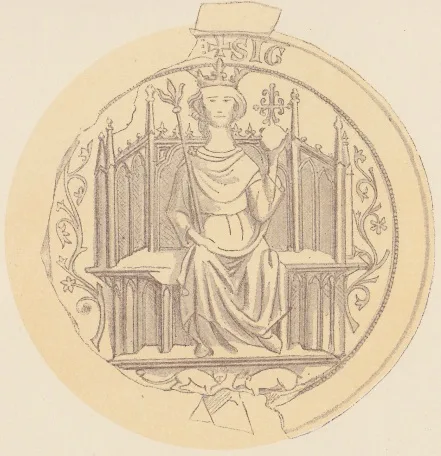 Drawing by Hakon Thorsen after Håkon V's 1300–02 seal, in Chr. Brinchmann, Norske Konge-sigiller (1924) This is Håkon V's own royal seal — the same kind of instrument that authenticated the charters and laws building the administrative state he extended by founding Akershus Fortress and shifting the capital toward Oslo. King of Norway 1299–1319, the last king of the Sverre dynasty.
Younger son of Magnus VI Lagabøte. Moved the de facto capital
from Bergen to Oslo (then a smaller eastern town), began the
construction of Akershus Fortress to defend it, and worked to
rebuild the central royal administration against the growing
Hanseatic dominance of the Bergen-centred export economy.
Died at Tønsberg on 8 May 1319 without a male heir. The
throne passed to his three-year-old grandson Magnus Eriksson
(also elected King of Sweden two months later), beginning the
long series of personal unions that would, in one form or
another, hold the Norwegian crown for the next five centuries.
Also discussed in The Long Fall — the sudden loss of Norwegian nobility, the end of the kings, and half of Norway gone forever died in May 1319 without a male heir, the throne passed to his three-year-old grandson Magnus Eriksson
Drawing by Hakon Thorsen after Håkon V's 1300–02 seal, in Chr. Brinchmann, Norske Konge-sigiller (1924) This is Håkon V's own royal seal — the same kind of instrument that authenticated the charters and laws building the administrative state he extended by founding Akershus Fortress and shifting the capital toward Oslo. King of Norway 1299–1319, the last king of the Sverre dynasty.
Younger son of Magnus VI Lagabøte. Moved the de facto capital
from Bergen to Oslo (then a smaller eastern town), began the
construction of Akershus Fortress to defend it, and worked to
rebuild the central royal administration against the growing
Hanseatic dominance of the Bergen-centred export economy.
Died at Tønsberg on 8 May 1319 without a male heir. The
throne passed to his three-year-old grandson Magnus Eriksson
(also elected King of Sweden two months later), beginning the
long series of personal unions that would, in one form or
another, hold the Norwegian crown for the next five centuries.
Also discussed in The Long Fall — the sudden loss of Norwegian nobility, the end of the kings, and half of Norway gone forever died in May 1319 without a male heir, the throne passed to his three-year-old grandson Magnus Eriksson 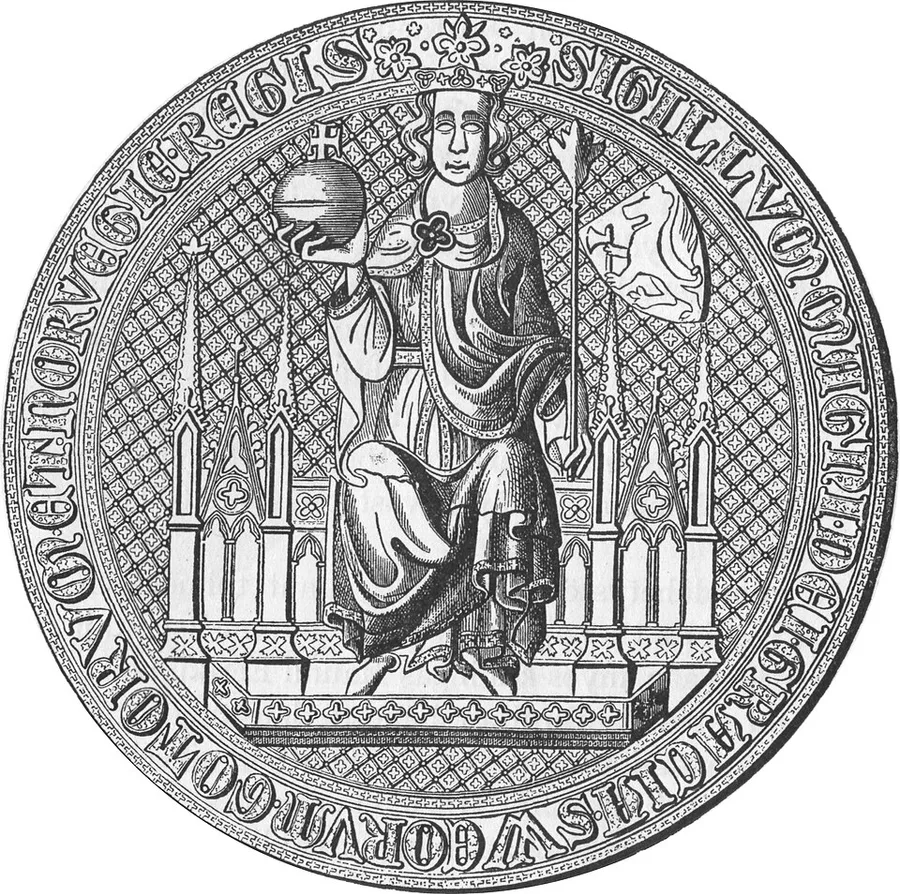 King Magnus Eriksson's judicial seal, Sigillum ad causas (14th century) Magnus Eriksson's own seal of judgment stands for the three-year-old who inherited Håkon V's Norwegian throne in 1319 and, two months later, was elected king of Sweden too — opening five centuries of shared Scandinavian crowns. Magnus IV (in Sweden) or Magnus VII (in Norway), born 1316,
reigned in Sweden 1319–1364 and in Norway 1319–1355. Grandson
of King Hákon V Magnusson of Norway; acceded to the Norwegian
throne in May 1319 at age three when his grandfather died
without a male heir, and was elected King of Sweden two months
later. The dual kingship inaugurated the long series of
Scandinavian personal unions that would hold the Norwegian
crown almost continuously until 1905. Ruled both kingdoms
through regency until 1331; deposed in Sweden in 1364 and in
Norway (in favour of his son Hákon VI) earlier. Died in a
boating accident on Bømlo island in Norway in 1374.
Also discussed in The Long Fall — the sudden loss of Norwegian nobility, the end of the kings, and half of Norway gone forever ; two months later Magnus was elected king of Sweden as well, and the medieval Norwegian state entered the long series of personal unions that would, in one form or another, hold it for the next five centuries.
King Magnus Eriksson's judicial seal, Sigillum ad causas (14th century) Magnus Eriksson's own seal of judgment stands for the three-year-old who inherited Håkon V's Norwegian throne in 1319 and, two months later, was elected king of Sweden too — opening five centuries of shared Scandinavian crowns. Magnus IV (in Sweden) or Magnus VII (in Norway), born 1316,
reigned in Sweden 1319–1364 and in Norway 1319–1355. Grandson
of King Hákon V Magnusson of Norway; acceded to the Norwegian
throne in May 1319 at age three when his grandfather died
without a male heir, and was elected King of Sweden two months
later. The dual kingship inaugurated the long series of
Scandinavian personal unions that would hold the Norwegian
crown almost continuously until 1905. Ruled both kingdoms
through regency until 1331; deposed in Sweden in 1364 and in
Norway (in favour of his son Hákon VI) earlier. Died in a
boating accident on Bømlo island in Norway in 1374.
Also discussed in The Long Fall — the sudden loss of Norwegian nobility, the end of the kings, and half of Norway gone forever ; two months later Magnus was elected king of Sweden as well, and the medieval Norwegian state entered the long series of personal unions that would, in one form or another, hold it for the next five centuries.
What survived
In a small collegiate church at Covarrubias in northern Castile, the stone sarcophagus that Felipe had brought back from Seville in 1262 stood in a side chapel for nearly seven centuries. During a 1952 restoration of the church, craftsmen opened the sarcophagus by accident and found a written parchment inside. Six years later, in 1958 — timed to the seven-hundredth anniversary of the Castile marriage — the tomb was officially opened and examined, and the woman inside was identified as Kristina Hákonsdatter, still in the funerary dress she had been buried in seven centuries before. The tomb is now a Norwegian-Castilian cultural site, kept up jointly by both countries.
The Landslov remained the law of Norway for more than four hundred years. The wharf at Bryggen 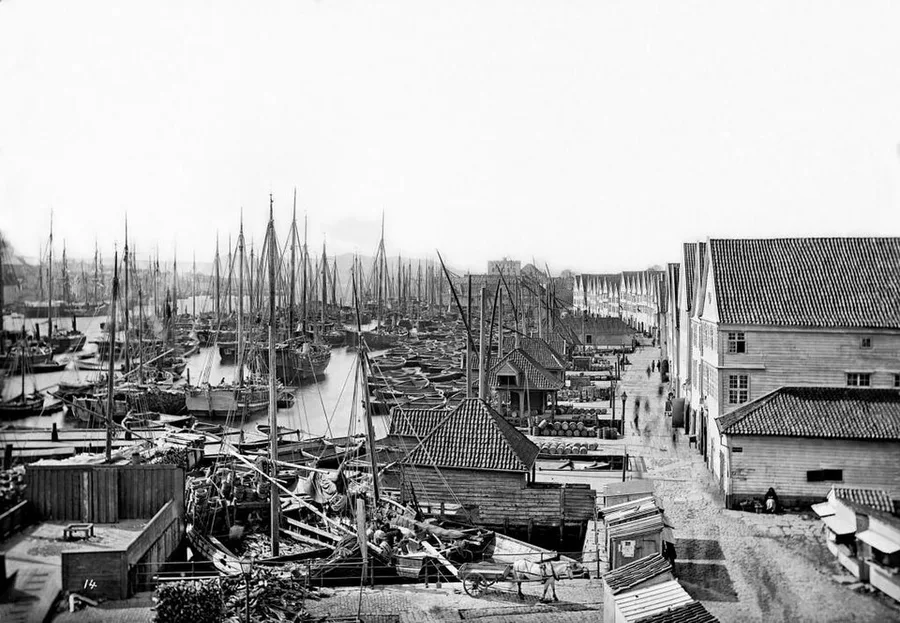 Knud Knudsen, Bryggen in Bergen (1865), University of Bergen Library Knudsen's 1865 photograph shows Bryggen still standing to its post-1702-fire medieval footprint -- the same wharf the Hanseatic kontor traded stockfish out of for four centuries, captured by one of Norway's first professional photographers. The Hanseatic wharf at Bergen — a long row of narrow
gable-fronted wooden warehouses and trading houses lining
the eastern shore of the Vågen harbour. From around 1360
the German Hansa established its Bergen kontor here, and
for nearly four hundred years (until 1754) the buildings
housed German merchants who controlled the export of
Norwegian stockfish to Catholic Europe. The structures
burned and were rebuilt repeatedly to the same medieval
footprint; the surviving wooden buildings (most after the
1702 fire) preserve the medieval urban plan. UNESCO World
Heritage site since 1979 and Bergen's most-visited landmark.
On the trip Day 4 in Bergen lands the Ungdommene (the Youngsters) directly
on the Bryggen waterfront — the wharf the Hanseatic trade in
Norwegian stockfish built and rebuilt for four centuries.
Also discussed in The Long Fall — the sudden loss of Norwegian nobility, the end of the kings, and half of Norway gone foreverThe Germans Who "Ruled" Bergen — the Hanseatic merchants on Bryggen WharfThe 400-Year Night — when the Northern Lion lay dormantAlcohol and Vinmonopolet — when and where to buy a drinkRespecting nature — why you can roam and camp on private landWhat to wear — the layering system, on the ground in Bergen, where the stockfish that paid for the realm was traded, still stands in the medieval footprint. The cathedral at Nidaros, where the archbishop’s metropolitan authority once extended across the North Atlantic, is still the principal Norwegian Lutheran cathedral and the consecration church of Norwegian kings. Between the longships of the Viking Age and the long absorption into Denmark stood the hundred years when Norway sent its daughter to the king of Castile, ran the medieval North Atlantic from a cathedral at Trondheim and a wharf at Bergen, and wrote one of the earliest unified national codes in any European vernacular. The Norwegian rediscovery of the period — the storhetstiden — came in the nineteenth century, bound up with the national-romantic project that produced the modern independent country in 1905. Most of the institutional inheritance the period left has outlasted it by seven centuries.
Knud Knudsen, Bryggen in Bergen (1865), University of Bergen Library Knudsen's 1865 photograph shows Bryggen still standing to its post-1702-fire medieval footprint -- the same wharf the Hanseatic kontor traded stockfish out of for four centuries, captured by one of Norway's first professional photographers. The Hanseatic wharf at Bergen — a long row of narrow
gable-fronted wooden warehouses and trading houses lining
the eastern shore of the Vågen harbour. From around 1360
the German Hansa established its Bergen kontor here, and
for nearly four hundred years (until 1754) the buildings
housed German merchants who controlled the export of
Norwegian stockfish to Catholic Europe. The structures
burned and were rebuilt repeatedly to the same medieval
footprint; the surviving wooden buildings (most after the
1702 fire) preserve the medieval urban plan. UNESCO World
Heritage site since 1979 and Bergen's most-visited landmark.
On the trip Day 4 in Bergen lands the Ungdommene (the Youngsters) directly
on the Bryggen waterfront — the wharf the Hanseatic trade in
Norwegian stockfish built and rebuilt for four centuries.
Also discussed in The Long Fall — the sudden loss of Norwegian nobility, the end of the kings, and half of Norway gone foreverThe Germans Who "Ruled" Bergen — the Hanseatic merchants on Bryggen WharfThe 400-Year Night — when the Northern Lion lay dormantAlcohol and Vinmonopolet — when and where to buy a drinkRespecting nature — why you can roam and camp on private landWhat to wear — the layering system, on the ground in Bergen, where the stockfish that paid for the realm was traded, still stands in the medieval footprint. The cathedral at Nidaros, where the archbishop’s metropolitan authority once extended across the North Atlantic, is still the principal Norwegian Lutheran cathedral and the consecration church of Norwegian kings. Between the longships of the Viking Age and the long absorption into Denmark stood the hundred years when Norway sent its daughter to the king of Castile, ran the medieval North Atlantic from a cathedral at Trondheim and a wharf at Bergen, and wrote one of the earliest unified national codes in any European vernacular. The Norwegian rediscovery of the period — the storhetstiden — came in the nineteenth century, bound up with the national-romantic project that produced the modern independent country in 1905. Most of the institutional inheritance the period left has outlasted it by seven centuries.
Sources & further reading
Primary sources
- Sturla Þórðarson, Hákonar saga Hákonarsonar (c. 1264–65). The longest single medieval Norwegian royal biography, composed by Snorri Sturluson’s nephew for Magnus VI shortly after Hákon IV’s death. Critical edition: Sverrir Jakobsson and Þorleifur Hauksson, eds., Íslenzk fornrit XXXI–XXXII (Hið íslenzka fornritafélag, 2013).
- Konungs skuggsjá (The King’s Mirror), c. 1250. The major didactic document of the medieval Norwegian court. Critical edition: Ludvig Holm-Olsen, ed., Konungs Skuggsiá, 2nd ed. (Norsk historisk kjeldeskrift-institutt, 1983). English translation by Laurence Marcellus Larson (American-Scandinavian Foundation, 1917).
- Magnús lagabœtir landslög (the Landslov of 1274). Critical edition by Magnus Rindal and Bjørg Dale Spørck (Riksarkivet, 2018). Modern Norwegian translation: Jørn Øyrehagen Sunde et al., Landslova av 1274 og 1604 (Fagbokforlaget, 2024).
- Gamli sáttmáli (the Old Covenant, 1262). The treaty of Iceland’s submission to the Norwegian crown.
- Diplomatarium Norvegicum, 23 vols. (Christiania/Oslo, 1847–2011). The standard collection of medieval Norwegian charters and treaties, including the Treaty of Perth (1266) and the Hanseatic privileges. Digitised at https://www.dokpro.uio.no/dipl_norv/diplom_field_eng.html.
Modern scholarship
- Sverre Bagge, From Viking Stronghold to Christian Kingdom: State Formation in Norway, c. 900–1350 (Museum Tusculanum Press, 2010). The standard modern English-language synthesis on medieval Norwegian state formation.
- Sverre Bagge, Cross and Scepter: The Rise of the Scandinavian Kingdoms from the Vikings to the Reformation (Princeton University Press, 2014). Broader Scandinavian context for the Golden Age period.
- Knut Helle, Norge blir en stat 1130–1319, 2nd ed. (Universitetsforlaget, 1974). The classic Norwegian-language treatment of the formation of the medieval Norwegian state under the Sverre dynasty and the Hákonarson line.
- Knut Helle, ed., The Cambridge History of Scandinavia, Volume 1: Prehistory to 1520 (Cambridge University Press, 2003). The reference treatment.
- Hans Jacob Orning, Unpredictability and Presence: Norwegian Kingship in the High Middle Ages, trans. Alan Crozier (Brill, 2008). The leading modern study of how the medieval Norwegian kingship actually operated.
- Steinar Imsen, ed., The Norwegian Domination and the Norse World, c. 1100–c. 1400 (Tapir Academic Press, 2010). The standard treatment of the structure of the Norgesveldet across the Atlantic dependencies.
- Arnved Nedkvitne, The German Hansa and Bergen, 1100–1600 (Böhlau, 2014). The standard study of the Hanseatic merchant presence in Bergen, including the reconstruction of medieval export figures from the customs records.
- Jørn Øyrehagen Sunde, Speculum Legale — Rettsspegelen (Fagbokforlaget, 2005). The standard modern legal-historical treatment of the Landslov tradition.
- Joseph F. O’Callaghan, The Learned King: The Reign of Alfonso X of Castile (University of Pennsylvania Press, 1993). The standard biography of Alfonso X, with the context for the Castile marriage.
- Vicente Almazán, Gallaecia Scandinavica: Introducción ó estudo das relacións galaico-escandinavas durante a Idade Media (Galaxia, 1986). The standard treatment of medieval Iberian-Scandinavian diplomatic relations, including the Kristina marriage.
Reference
- Store norske leksikon (snl.no). The Norwegian peer-reviewed encyclopedia. See in particular Håkon 4 Håkonsson, Magnus 6 Håkonsson Lagabøte, Landsloven, Kristina Håkonsdatter, Norgesveldet, Slaget ved Largs, and Perth-traktaten.
- UNESCO World Heritage Centre, “Bryggen” (1979 inscription): https://whc.unesco.org/en/list/59.
Visit
- Bryggen, Bergen. The medieval merchant wharf where the stockfish that paid for the Norgesveldet was traded; a UNESCO World Heritage site since 1979. The current timber buildings are eighteenth-century replacements of medieval predecessors, but the parcel pattern and street lines are essentially those of the thirteenth-century harbour.
- Nidaros Cathedral, Trondheim. The seat of the archbishopric whose metropolitan authority ran the same North Atlantic arc as the king’s writ.
- Håkonshallen, Bergen. Hákon IV’s great hall, built in stone between about 1247 and 1261 for his son Magnus VI’s wedding and coronation, and the principal surviving stone building of the medieval royal court at Bergen.
- Tønsberg Castle ruins (Slottsfjellet), Tønsberg. The fortified royal centre on the Oslofjord, the medieval seat of the southeastern royal administration and the town to which the Castilian delegation came in 1256.
- Colegiata de San Cosme y San Damián, Covarrubias, Burgos province, Castile. The collegiate church where Kristina Hákonsdatter is buried, with a small modern Norwegian-Castilian exhibition on her marriage and tomb.