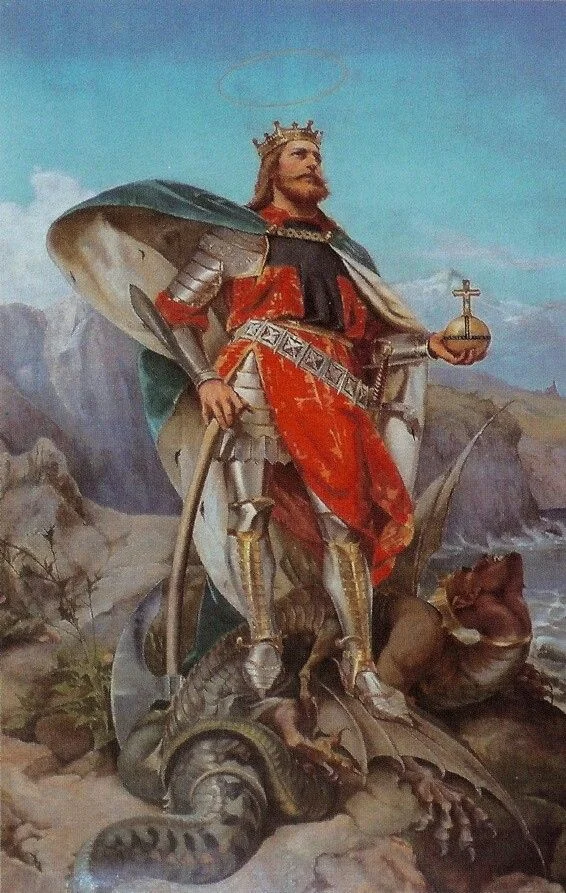
The King Who Became a Saint — how the Nordmen came to Christ
Olav Haraldsson was killed by his own farmers at Stiklestad in July 1030, declared a saint a year later, and made the binding narrative of medieval Christian Norway. His shrine at Nidaros drew the northernmost pilgrim road in Christendom.
On 29 July 1030, a Norwegian king who had been driven from his throne two years earlier came back from exile in Kievan Rus 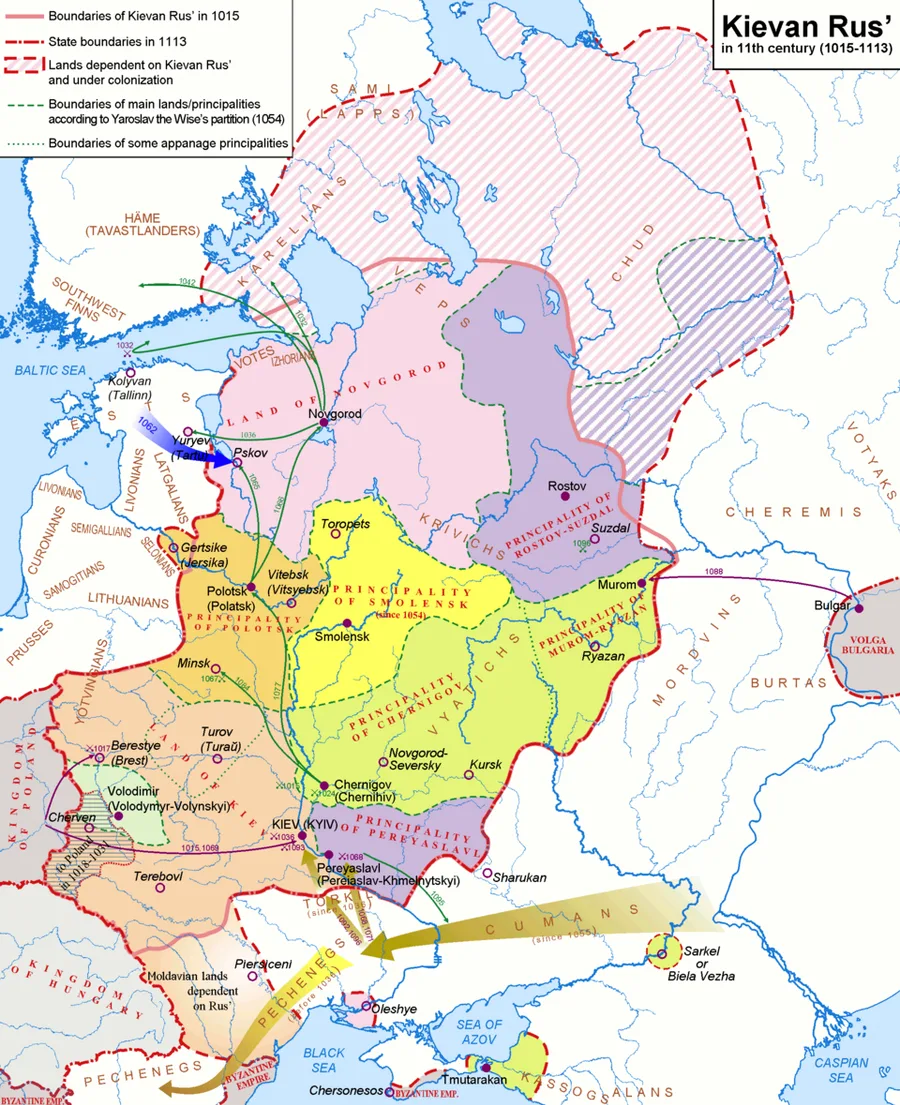 Koryakov Yuri (map); English translation by Hellerick, CC BY-SA 2.5 Medieval Norse-Slavic river-trade kingdom centred on the cities of
Kiev and Novgorod, covering most of modern Ukraine, Belarus, and
the western half of European Russia. Traditionally founded around
862 by the Norse warlord Rurik, the polity took its name from the
Rūs — the Norse traders who had moved down the Volga and Dnieper
river-routes through Slavic country to the Black Sea and the
Caspian. Olav II Haraldsson of Norway spent his two-year exile
(1028–1030) at the court of his brother-in-law Yaroslav the Wise
in Kiev before returning to die at Stiklestad. After Olav's death,
Yaroslav raised the young Magnus the Good until his return to
Norway in 1035.
(the medieval Norse-and-Slavic river-trade kingdom that lay across what is today Ukraine, Belarus, and western Russia) with the army he had been able to raise — the sagas put it at thirty-six hundred men. He met a coalition of Norwegian farmers and chieftains several times stronger on a sloping field at Stiklestad
Koryakov Yuri (map); English translation by Hellerick, CC BY-SA 2.5 Medieval Norse-Slavic river-trade kingdom centred on the cities of
Kiev and Novgorod, covering most of modern Ukraine, Belarus, and
the western half of European Russia. Traditionally founded around
862 by the Norse warlord Rurik, the polity took its name from the
Rūs — the Norse traders who had moved down the Volga and Dnieper
river-routes through Slavic country to the Black Sea and the
Caspian. Olav II Haraldsson of Norway spent his two-year exile
(1028–1030) at the court of his brother-in-law Yaroslav the Wise
in Kiev before returning to die at Stiklestad. After Olav's death,
Yaroslav raised the young Magnus the Good until his return to
Norway in 1035.
(the medieval Norse-and-Slavic river-trade kingdom that lay across what is today Ukraine, Belarus, and western Russia) with the army he had been able to raise — the sagas put it at thirty-six hundred men. He met a coalition of Norwegian farmers and chieftains several times stronger on a sloping field at Stiklestad 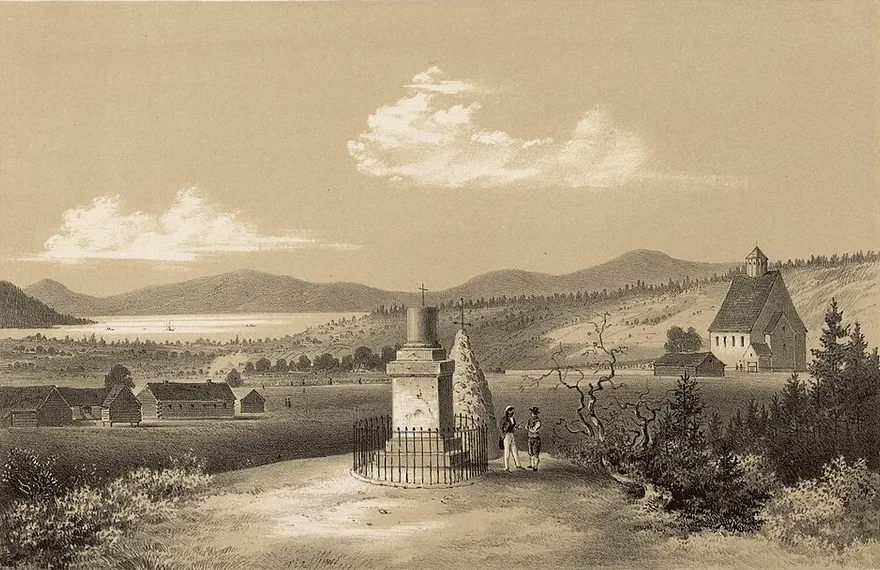 Unknown artist, in P. Chr. Asbjørnsen, Norge fremstillet i Tegninger (1848), National Library of Norway Village and battle site in the Verdal valley of Trøndelag,
about eighty kilometres north of Trondheim. Site of the battle
on 29 July 1030 in which King Olav II Haraldsson of Norway,
returning from exile in Kievan Rus to reclaim his throne, was
defeated and killed by a coalition of Norwegian farmers and
chieftains several times stronger than his own army. Olav's
death made the cult that became medieval Norwegian Christianity.
Marked today by the Stiklestad National Cultural Centre, the
open-air theatre where Spelet om Heilag Olav is performed each
summer, and the medieval Stiklestad Church (built shortly after
the battle as a memorial).
On the trip Day 4 of the trip — Wednesday 29 July 2026 — is the 996th anniversary
of the battle. The Gråhårsklubben (the Oldsters) spend that day out
in the Stjørdal valley — the battlefield at Stiklestad lies an hour
further north up the E6 — on the same date the saint died and the
medieval cult was made.
Stiklestad, Verdal , in the Verdal
Unknown artist, in P. Chr. Asbjørnsen, Norge fremstillet i Tegninger (1848), National Library of Norway Village and battle site in the Verdal valley of Trøndelag,
about eighty kilometres north of Trondheim. Site of the battle
on 29 July 1030 in which King Olav II Haraldsson of Norway,
returning from exile in Kievan Rus to reclaim his throne, was
defeated and killed by a coalition of Norwegian farmers and
chieftains several times stronger than his own army. Olav's
death made the cult that became medieval Norwegian Christianity.
Marked today by the Stiklestad National Cultural Centre, the
open-air theatre where Spelet om Heilag Olav is performed each
summer, and the medieval Stiklestad Church (built shortly after
the battle as a memorial).
On the trip Day 4 of the trip — Wednesday 29 July 2026 — is the 996th anniversary
of the battle. The Gråhårsklubben (the Oldsters) spend that day out
in the Stjørdal valley — the battlefield at Stiklestad lies an hour
further north up the E6 — on the same date the saint died and the
medieval cult was made.
Stiklestad, Verdal , in the Verdal 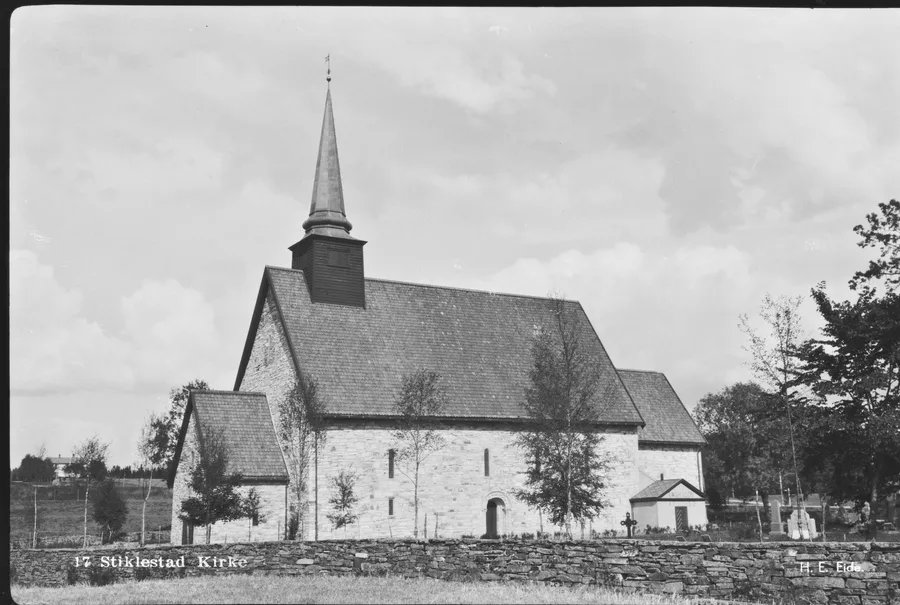 H. E. Eide / Mittet & Co., Stiklestad Kirke (early 20th c.), National Library of Norway Stiklestad church — raised over the spot where Olav II Haraldsson fell on 29 July 1030 — photographed amid the farming countryside of the Verdal valley the card describes, a few kilometres east of the modern town centre. Municipality in Trøndelag at the inner end of the Trondheim Fjord,
about eighty kilometres north of Trondheim. The Verdal valley
opens inland from the fjord through the farming countryside of
central Trøndelag. Stiklestad — the battle site where Olav II
Haraldsson was killed on 29 July 1030 — lies in the valley a few
kilometres east of the modern town centre.
Verdal, Trøndelag , eighty kilometres north of what is now Trondheim
H. E. Eide / Mittet & Co., Stiklestad Kirke (early 20th c.), National Library of Norway Stiklestad church — raised over the spot where Olav II Haraldsson fell on 29 July 1030 — photographed amid the farming countryside of the Verdal valley the card describes, a few kilometres east of the modern town centre. Municipality in Trøndelag at the inner end of the Trondheim Fjord,
about eighty kilometres north of Trondheim. The Verdal valley
opens inland from the fjord through the farming countryside of
central Trøndelag. Stiklestad — the battle site where Olav II
Haraldsson was killed on 29 July 1030 — lies in the valley a few
kilometres east of the modern town centre.
Verdal, Trøndelag , eighty kilometres north of what is now Trondheim 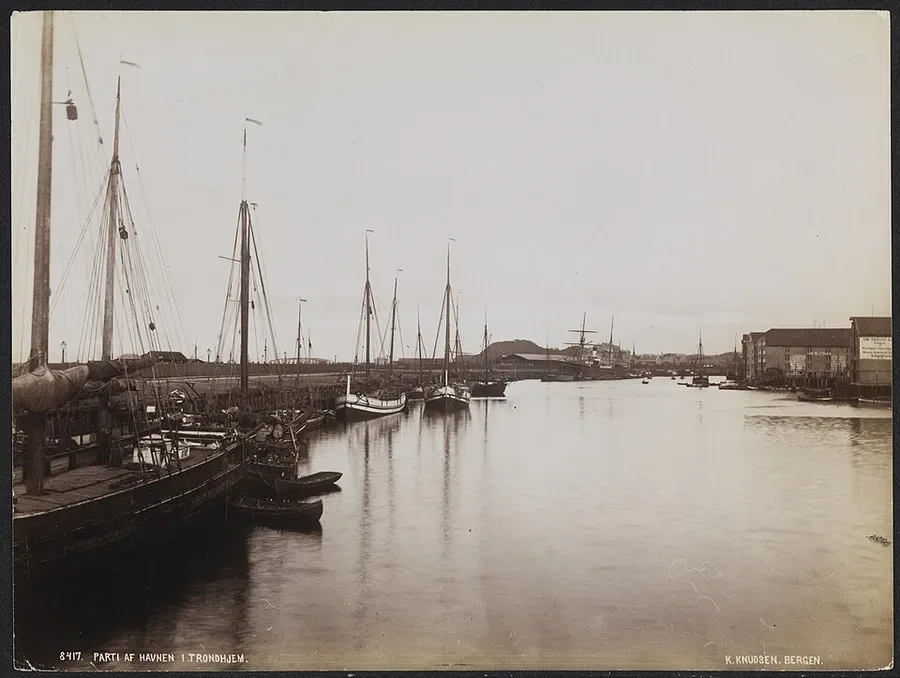 Knud Knudsen, Parti af Havnen i Trondhjem (1888-1894), National Library of Norway Knud Knudsen's photograph of Trondheim harbour in the early 1890s. Founded by Olav Tryggvason in 997 as Nidaros, the city was Norway's medieval capital and the seat of the archbishopric and the Olav cult that anchored the country's Christianity. Norway's third-largest city, founded by Olav Tryggvason in 997 as
Nidaros at the mouth of the Nid River on the inner Trondheim
Fjord. Capital of the Norwegian kingdom for much of the medieval
period; seat of the Norwegian archbishopric from 1153 and of the
Olav cult that anchored medieval Norwegian Christianity. Renamed
Trondheim in 1931 — after a controversial one-year spell
officially named Nidaros from 1930 — replacing the Danish-era
spelling Trondhjem and reviving the medieval Old Norse district
name (Þrándheimr). About two hundred thousand people in the municipality
today. Home to Nidaros Cathedral, NTNU (the Norwegian University
of Science and Technology), and the Trondheim Fjord harbour.
On the trip Day 3 of the trip routes the Gråhårsklubben (the Oldsters) through
Trondheim. The visit centres on Nidaros Cathedral — the building
the Olav devotion raised, and the architectural inheritance of
Bishop Grimkell's pronouncement on a summer day in 1031.
Trondheim Also discussed in A Catholic Norway — the faith that gave the kingdom its first institutions and the stave churchesThe Crusades?!!!! — sixty ships from Bergen, bound for the Holy LandThe Golden Age — a North Atlantic empire … reaching farther than you thinkThe Long Fall — the sudden loss of Norwegian nobility, the end of the kings, and half of Norway gone foreverThe 400-Year Night — when the Northern Lion lay dormantThe Reformation, 1537 — one church eradicated and another imposedLutheran Norway and Pietism — a farmer named Hans Nielsen Hauge and a lay revival that could not be silencedWorld War II — the King’s “No” and the Nazis in NorwayBefore There Was Norway — petty kingdoms at the edge of the worldDriving in Norway — tolls, ferries, and a near-zero alcohol limitEveryday etiquette — quiet voices, wide space, no smiling🚨 Emergencies - important numbers, hospitals, and what you can doLanguage basics — just enough Norwegian to be polite . In the sagas’ telling, his army called itself forward into the battle with the cry Fram, fram, kristsmenn, krossmenn, konungsmenn — forward, forward, men of Christ, men of the cross, men of the king. The farmer-army answered with Fram, fram, búandmenn — forward, forward, free men of the land. The king took a wound in the knee, and as he leaned against a large stone a spear-thrust under his mail-shirt and into his belly, and at last a blow to the neck. By the afternoon it was over. The king was dead at thirty-five. The farmers went home.
Knud Knudsen, Parti af Havnen i Trondhjem (1888-1894), National Library of Norway Knud Knudsen's photograph of Trondheim harbour in the early 1890s. Founded by Olav Tryggvason in 997 as Nidaros, the city was Norway's medieval capital and the seat of the archbishopric and the Olav cult that anchored the country's Christianity. Norway's third-largest city, founded by Olav Tryggvason in 997 as
Nidaros at the mouth of the Nid River on the inner Trondheim
Fjord. Capital of the Norwegian kingdom for much of the medieval
period; seat of the Norwegian archbishopric from 1153 and of the
Olav cult that anchored medieval Norwegian Christianity. Renamed
Trondheim in 1931 — after a controversial one-year spell
officially named Nidaros from 1930 — replacing the Danish-era
spelling Trondhjem and reviving the medieval Old Norse district
name (Þrándheimr). About two hundred thousand people in the municipality
today. Home to Nidaros Cathedral, NTNU (the Norwegian University
of Science and Technology), and the Trondheim Fjord harbour.
On the trip Day 3 of the trip routes the Gråhårsklubben (the Oldsters) through
Trondheim. The visit centres on Nidaros Cathedral — the building
the Olav devotion raised, and the architectural inheritance of
Bishop Grimkell's pronouncement on a summer day in 1031.
Trondheim Also discussed in A Catholic Norway — the faith that gave the kingdom its first institutions and the stave churchesThe Crusades?!!!! — sixty ships from Bergen, bound for the Holy LandThe Golden Age — a North Atlantic empire … reaching farther than you thinkThe Long Fall — the sudden loss of Norwegian nobility, the end of the kings, and half of Norway gone foreverThe 400-Year Night — when the Northern Lion lay dormantThe Reformation, 1537 — one church eradicated and another imposedLutheran Norway and Pietism — a farmer named Hans Nielsen Hauge and a lay revival that could not be silencedWorld War II — the King’s “No” and the Nazis in NorwayBefore There Was Norway — petty kingdoms at the edge of the worldDriving in Norway — tolls, ferries, and a near-zero alcohol limitEveryday etiquette — quiet voices, wide space, no smiling🚨 Emergencies - important numbers, hospitals, and what you can doLanguage basics — just enough Norwegian to be polite . In the sagas’ telling, his army called itself forward into the battle with the cry Fram, fram, kristsmenn, krossmenn, konungsmenn — forward, forward, men of Christ, men of the cross, men of the king. The farmer-army answered with Fram, fram, búandmenn — forward, forward, free men of the land. The king took a wound in the knee, and as he leaned against a large stone a spear-thrust under his mail-shirt and into his belly, and at last a blow to the neck. By the afternoon it was over. The king was dead at thirty-five. The farmers went home.
He was Saint Olav 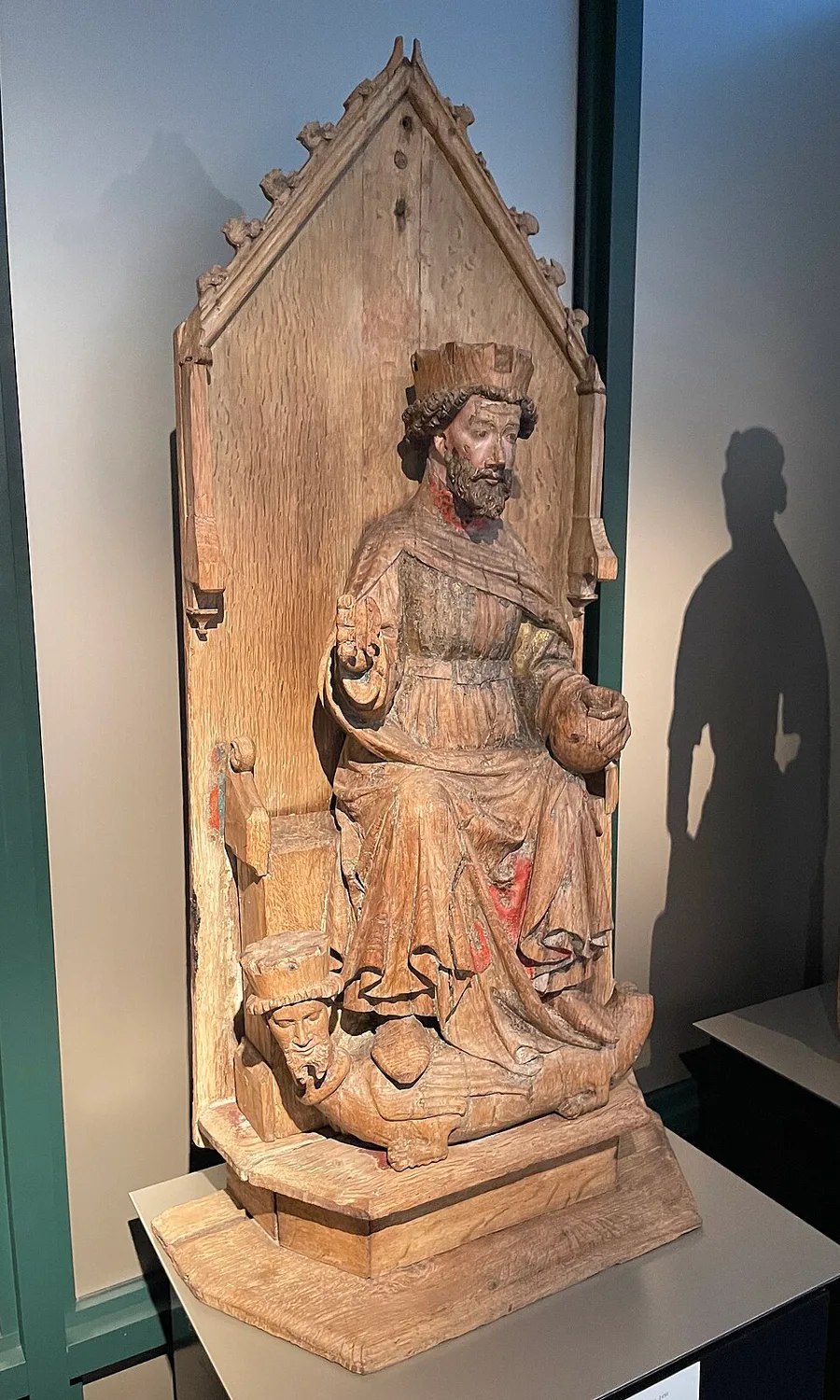 Saint Olav from Austevoll church (c. 1450), University Museum of Bergen; photo Wolfmann, Wikimedia Commons, CC BY-SA 4.0 Olav as medieval Norway saw him: the eternal king crowned and enthroned, trampling a dragon whose crowned human head stands for the heathendom he overcame. Carved around 1450 for Austevoll church south of Bergen — one of the polychrome Olav figures that stood in churches across Norway before the Reformation. Olav Haraldsson, king of Norway 1015–1028, killed at the Battle
of Stiklestad on 29 July 1030 and canonized one year and five days
later by his English bishop Grimkell. Rex Perpetuus Norvegiae —
the Eternal King of Norway. His shrine at Nidaros became the
northernmost pilgrimage destination in medieval Christendom and
the binding narrative of a converted country. The Norwegian Lion
on the modern coat of arms — a golden lion bearing a golden axe
on a red shield — is Saint Olav's iconography.
On the trip The Gråhårsklubben (the Oldsters) visit Nidaros Cathedral on
Tuesday 28 July 2026 — the day before the 996th anniversary of
the Battle of Stiklestad. The Olafskrinet was broken up at the
1537 Reformation and the body buried somewhere inside the
cathedral in a spot no medieval source preserved. The building
is what the nine-and-a-half centuries of devotion built. The
pilgrim road, the Pilegrimsleden, runs past the cathedral's
south door — the same door the medieval pilgrims walked through.
Nidaros Cathedral, Trondheim Also discussed in The Viking Age — longships, legends, and the first "Norway"Worshiping Odin and Thor — the lived religion of pre-Christian NorwayA Catholic Norway — the faith that gave the kingdom its first institutions and the stave churchesThe Reformation, 1537 — one church eradicated and another imposedLutheran Norway and Pietism — a farmer named Hans Nielsen Hauge and a lay revival that could not be silencedThe Crusades?!!!! — sixty ships from Bergen, bound for the Holy LandThe 400-Year Night — when the Northern Lion lay dormantThe Quiet Revolution — how Norway won its independence without a warWorld War II — the King’s “No” and the Nazis in Norway . He had reigned thirteen years. About a year after his death his English bishop would declare him a saint, and the veneration begun in a small wooden church on the river Nid would, before the next century was out, organise the religious life of Norway from the Skerries to the Greenland
Saint Olav from Austevoll church (c. 1450), University Museum of Bergen; photo Wolfmann, Wikimedia Commons, CC BY-SA 4.0 Olav as medieval Norway saw him: the eternal king crowned and enthroned, trampling a dragon whose crowned human head stands for the heathendom he overcame. Carved around 1450 for Austevoll church south of Bergen — one of the polychrome Olav figures that stood in churches across Norway before the Reformation. Olav Haraldsson, king of Norway 1015–1028, killed at the Battle
of Stiklestad on 29 July 1030 and canonized one year and five days
later by his English bishop Grimkell. Rex Perpetuus Norvegiae —
the Eternal King of Norway. His shrine at Nidaros became the
northernmost pilgrimage destination in medieval Christendom and
the binding narrative of a converted country. The Norwegian Lion
on the modern coat of arms — a golden lion bearing a golden axe
on a red shield — is Saint Olav's iconography.
On the trip The Gråhårsklubben (the Oldsters) visit Nidaros Cathedral on
Tuesday 28 July 2026 — the day before the 996th anniversary of
the Battle of Stiklestad. The Olafskrinet was broken up at the
1537 Reformation and the body buried somewhere inside the
cathedral in a spot no medieval source preserved. The building
is what the nine-and-a-half centuries of devotion built. The
pilgrim road, the Pilegrimsleden, runs past the cathedral's
south door — the same door the medieval pilgrims walked through.
Nidaros Cathedral, Trondheim Also discussed in The Viking Age — longships, legends, and the first "Norway"Worshiping Odin and Thor — the lived religion of pre-Christian NorwayA Catholic Norway — the faith that gave the kingdom its first institutions and the stave churchesThe Reformation, 1537 — one church eradicated and another imposedLutheran Norway and Pietism — a farmer named Hans Nielsen Hauge and a lay revival that could not be silencedThe Crusades?!!!! — sixty ships from Bergen, bound for the Holy LandThe 400-Year Night — when the Northern Lion lay dormantThe Quiet Revolution — how Norway won its independence without a warWorld War II — the King’s “No” and the Nazis in Norway . He had reigned thirteen years. About a year after his death his English bishop would declare him a saint, and the veneration begun in a small wooden church on the river Nid would, before the next century was out, organise the religious life of Norway from the Skerries to the Greenland 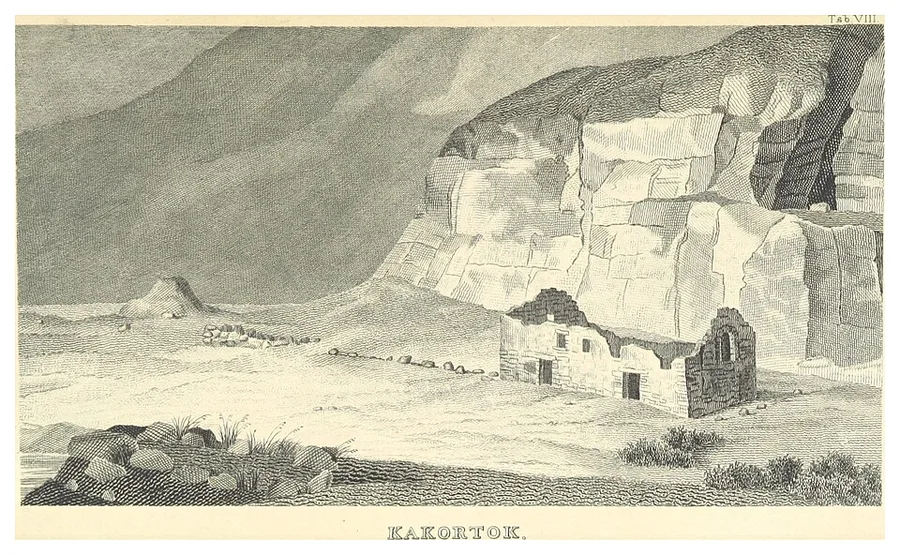 Grønlands historiske Mindesmærker vol. 3 (1845), plate VIII, British Library The stone church at Hvalsey, the best-preserved building of Norse Greenland — drawn in 1845 for the Danish survey that went looking for the lost colony. A wedding held here in 1408 is the last event anyone recorded before the settlements Erik the Red founded fell silent. The world's largest island, lying between the Arctic and Atlantic
Oceans west of Iceland. Colonised by Norse settlers led by Erik the
Red beginning in 985 — the name "Greenland" was Erik's marketing,
chosen to attract colonists to a marginally agricultural land. The
Norse Eastern and Western Settlements on the southwestern coast
sustained perhaps two or three thousand people at peak across four
centuries before steadily diminishing in the cooling climate of the
Little Ice Age and disappearing by around 1450. Today a self-
governing territory within the Kingdom of Denmark.
Also discussed in The Viking Age — longships, legends, and the first "Norway"A Catholic Norway — the faith that gave the kingdom its first institutions and the stave churchesThe Golden Age — a North Atlantic empire … reaching farther than you thinkThe Long Fall — the sudden loss of Norwegian nobility, the end of the kings, and half of Norway gone foreverThe 400-Year Night — when the Northern Lion lay dormant ice. The Christianization the king had failed to impose by sword and law was carried through by his sainthood. The country that had refused him in life accepted him, in something close to worship, in death.
Grønlands historiske Mindesmærker vol. 3 (1845), plate VIII, British Library The stone church at Hvalsey, the best-preserved building of Norse Greenland — drawn in 1845 for the Danish survey that went looking for the lost colony. A wedding held here in 1408 is the last event anyone recorded before the settlements Erik the Red founded fell silent. The world's largest island, lying between the Arctic and Atlantic
Oceans west of Iceland. Colonised by Norse settlers led by Erik the
Red beginning in 985 — the name "Greenland" was Erik's marketing,
chosen to attract colonists to a marginally agricultural land. The
Norse Eastern and Western Settlements on the southwestern coast
sustained perhaps two or three thousand people at peak across four
centuries before steadily diminishing in the cooling climate of the
Little Ice Age and disappearing by around 1450. Today a self-
governing territory within the Kingdom of Denmark.
Also discussed in The Viking Age — longships, legends, and the first "Norway"A Catholic Norway — the faith that gave the kingdom its first institutions and the stave churchesThe Golden Age — a North Atlantic empire … reaching farther than you thinkThe Long Fall — the sudden loss of Norwegian nobility, the end of the kings, and half of Norway gone foreverThe 400-Year Night — when the Northern Lion lay dormant ice. The Christianization the king had failed to impose by sword and law was carried through by his sainthood. The country that had refused him in life accepted him, in something close to worship, in death.
The thirteen years
He had been a viking before he was a king. Born around 995 into a chieftain family of Vestfold 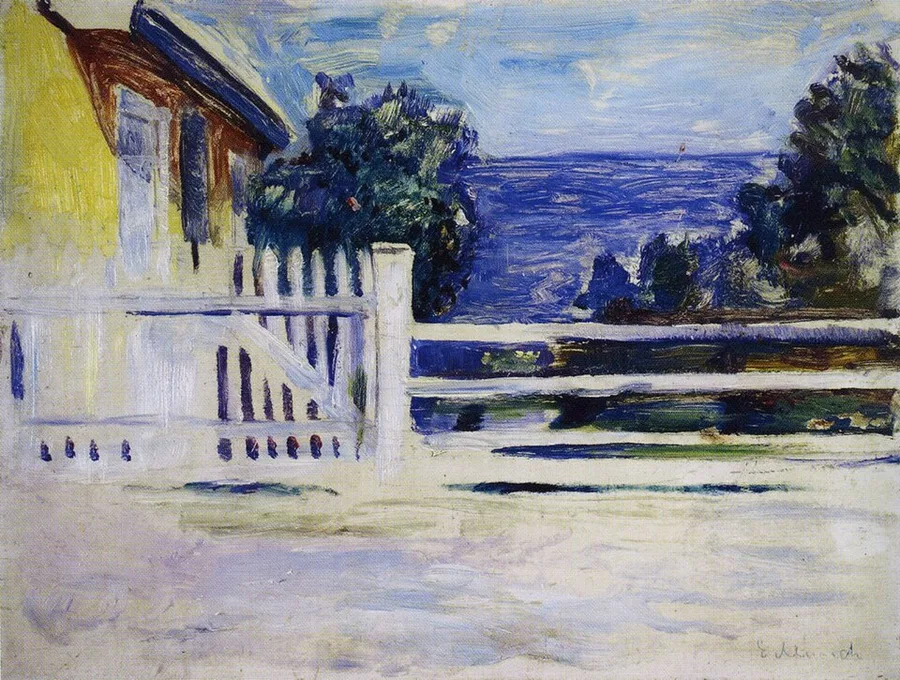 Edvard Munch, Summer in Asgardstrand (1889), Woll 185, private collection Munch's summer shore at Åsgårdstrand — the same Vestfold fjord shore the Yngling kings ruled from their halls at Borre, painted a millennium later. The quiet seaside town sits on the coast of what was the richest of the petty kingdoms. Coastal region on the western shore of the Oslofjord in southeastern
Norway, the richest of the petty-kingdom-era Norwegian polities.
Controlled the trade routes through the Skagerrak between the North
Sea and the Baltic; the wealth in its royal mounds at Borre marks it
as the dominant southern Norwegian power of the seventh through
ninth centuries. The Yngling dynasty held the throne here. Modern
Vestfold is the county containing Tønsberg, Sandefjord, and the
Borre Mound Cemetery archaeological site.
Vestfold Also discussed in Before There Was Norway — petty kingdoms at the edge of the worldThe Viking Age — longships, legends, and the first "Norway"A Catholic Norway — the faith that gave the kingdom its first institutions and the stave churches , the Oslo-fjord region that had been the cradle of the Norwegian royal line for generations, he spent his teens and early twenties on raiding voyages down the English, Frankish, and Iberian coasts under the Norse banner. Somewhere in Normandy
Edvard Munch, Summer in Asgardstrand (1889), Woll 185, private collection Munch's summer shore at Åsgårdstrand — the same Vestfold fjord shore the Yngling kings ruled from their halls at Borre, painted a millennium later. The quiet seaside town sits on the coast of what was the richest of the petty kingdoms. Coastal region on the western shore of the Oslofjord in southeastern
Norway, the richest of the petty-kingdom-era Norwegian polities.
Controlled the trade routes through the Skagerrak between the North
Sea and the Baltic; the wealth in its royal mounds at Borre marks it
as the dominant southern Norwegian power of the seventh through
ninth centuries. The Yngling dynasty held the throne here. Modern
Vestfold is the county containing Tønsberg, Sandefjord, and the
Borre Mound Cemetery archaeological site.
Vestfold Also discussed in Before There Was Norway — petty kingdoms at the edge of the worldThe Viking Age — longships, legends, and the first "Norway"A Catholic Norway — the faith that gave the kingdom its first institutions and the stave churches , the Oslo-fjord region that had been the cradle of the Norwegian royal line for generations, he spent his teens and early twenties on raiding voyages down the English, Frankish, and Iberian coasts under the Norse banner. Somewhere in Normandy 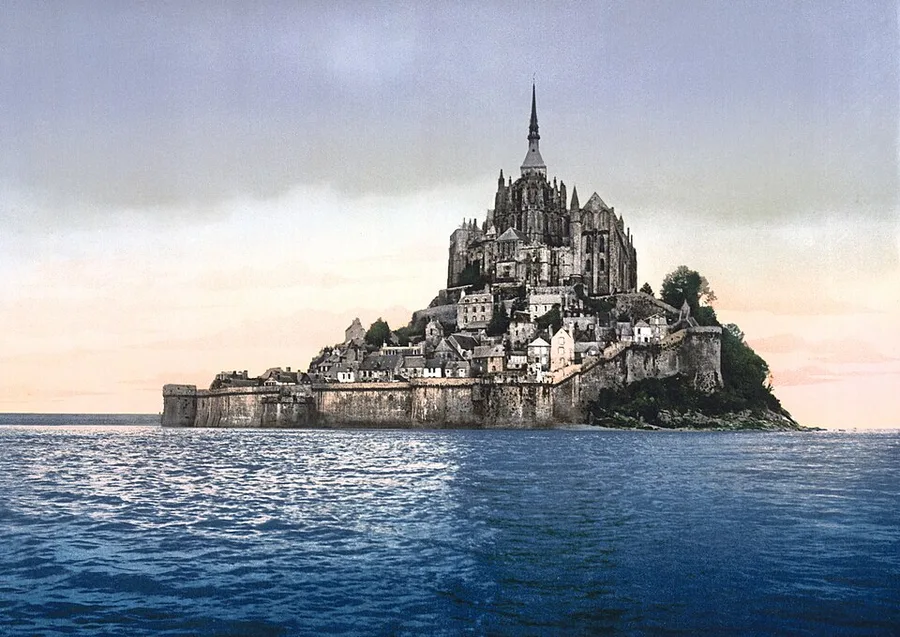 Photochrom print, Mont St. Michel at high water (c. 1900), Library of Congress Mont-Saint-Michel, the abbey-island off Normandy's coast, photographed at high tide around 1900. The land around it began as Norse country: Charles the Simple ceded the lower Seine to Rollo's Northmen in 911, and their name — Normanni — became Normandy's own. Historical region of northwestern France along the lower Seine and
the Channel coast. The territory was ceded to the Norse warrior
Rollo and his followers by the West Frankish king Charles the Simple
in the Treaty of Saint-Clair-sur-Epte (911), in exchange for nominal
vassalage and defence against further Norse raiding. The name comes
from Normanni, "Northmen." Rollo's descendants ruled as Dukes of
Normandy; his great-great-great-grandson William the Conqueror
invaded England in 1066, putting a Norse-descended Norman dynasty
on the English throne.
Also discussed in The Viking Age — longships, legends, and the first "Norway" around 1014 he was baptised. In 1015 he came home to Norway, fought down the surviving sons of the Earl of Lade
Photochrom print, Mont St. Michel at high water (c. 1900), Library of Congress Mont-Saint-Michel, the abbey-island off Normandy's coast, photographed at high tide around 1900. The land around it began as Norse country: Charles the Simple ceded the lower Seine to Rollo's Northmen in 911, and their name — Normanni — became Normandy's own. Historical region of northwestern France along the lower Seine and
the Channel coast. The territory was ceded to the Norse warrior
Rollo and his followers by the West Frankish king Charles the Simple
in the Treaty of Saint-Clair-sur-Epte (911), in exchange for nominal
vassalage and defence against further Norse raiding. The name comes
from Normanni, "Northmen." Rollo's descendants ruled as Dukes of
Normandy; his great-great-great-grandson William the Conqueror
invaded England in 1066, putting a Norse-descended Norman dynasty
on the English throne.
Also discussed in The Viking Age — longships, legends, and the first "Norway" around 1014 he was baptised. In 1015 he came home to Norway, fought down the surviving sons of the Earl of Lade 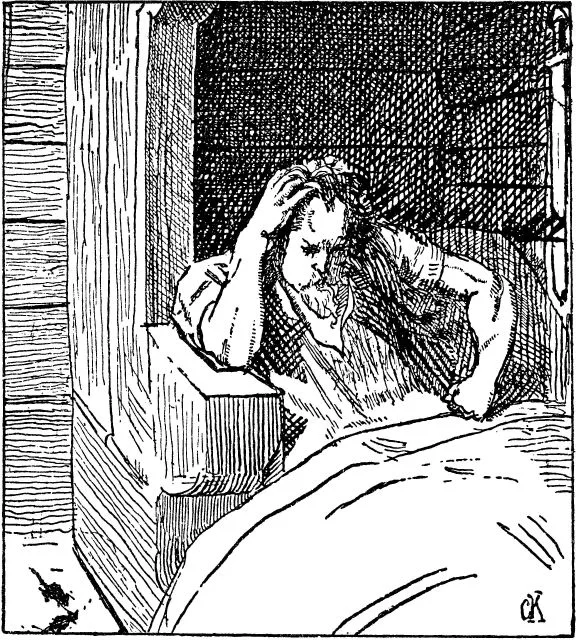 Christian Krohg, Håkon jarl, illustration for Olav Tryggvasons saga, Heimskringla folk edition (J.M. Stenersen & Co, 1899) Christian Krohg's 1899 Heimskringla illustration of Håkon jarl brooding in the dark — the mightiest of the Lade earls, whose dynasty ran Trøndelag as a rival to the Norwegian crown for two centuries. The Lade dynasty held the rich Trøndelag farmland from its seat
on the inner Trondheim Fjord — for two centuries the principal
rival to the Fairhair-line Norwegian crown. From Hákon Sigurdsson
(Hákon Jarl, d. 995) through Eirik Hákonsson (d. ~1023), the Lade
earls ran central Norway as their own polity, sometimes acclaimed
king, sometimes regent under a foreign overlord, always in tension
with the southern royal court. Their seat at Lade is now a quiet
residential district on the inner Trondheim Fjord.
Lade peninsula, Trondheim Fjord In this article Olav Haraldsson conquered the throne from the surviving sons
of the last Lade earls in 1015. After his death at Stiklestad,
the surviving Lade-line claimants did not recover the kingdom
in any lasting way. The dynasty effectively ended with the
early eleventh century.
Also discussed in The Viking Age — longships, legends, and the first "Norway"Before There Was Norway — petty kingdoms at the edge of the world — the rival Trøndelag
Christian Krohg, Håkon jarl, illustration for Olav Tryggvasons saga, Heimskringla folk edition (J.M. Stenersen & Co, 1899) Christian Krohg's 1899 Heimskringla illustration of Håkon jarl brooding in the dark — the mightiest of the Lade earls, whose dynasty ran Trøndelag as a rival to the Norwegian crown for two centuries. The Lade dynasty held the rich Trøndelag farmland from its seat
on the inner Trondheim Fjord — for two centuries the principal
rival to the Fairhair-line Norwegian crown. From Hákon Sigurdsson
(Hákon Jarl, d. 995) through Eirik Hákonsson (d. ~1023), the Lade
earls ran central Norway as their own polity, sometimes acclaimed
king, sometimes regent under a foreign overlord, always in tension
with the southern royal court. Their seat at Lade is now a quiet
residential district on the inner Trondheim Fjord.
Lade peninsula, Trondheim Fjord In this article Olav Haraldsson conquered the throne from the surviving sons
of the last Lade earls in 1015. After his death at Stiklestad,
the surviving Lade-line claimants did not recover the kingdom
in any lasting way. The dynasty effectively ended with the
early eleventh century.
Also discussed in The Viking Age — longships, legends, and the first "Norway"Before There Was Norway — petty kingdoms at the edge of the world — the rival Trøndelag 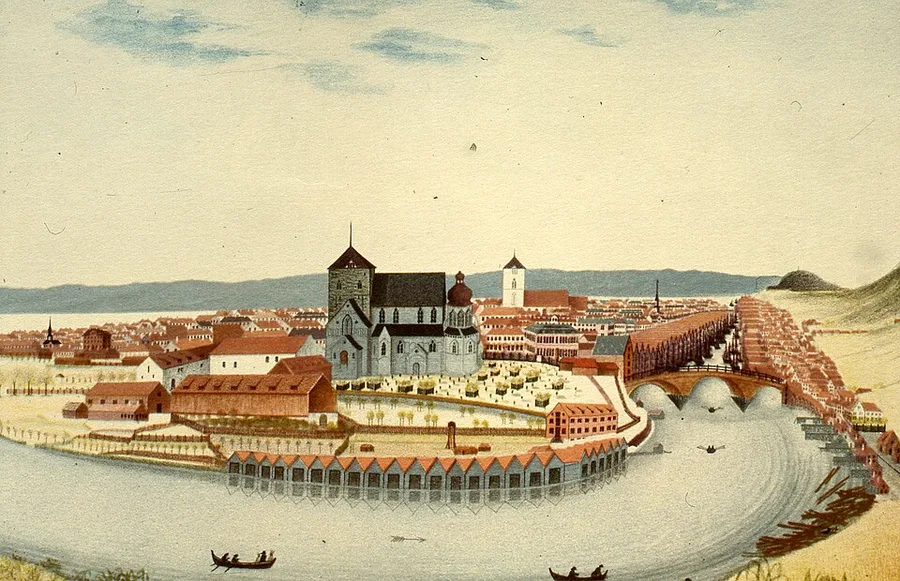 Johannes Aas, Prospect af Staden Trondhiem (1826), Municipal Archives of Trondheim (CC BY 2.0) An 1826 prospect of Trondheim, Nidaros Cathedral rising over the river bend. Founded by Olav Tryggvason as Nidaros in 997, the town became the seat of Norway's archbishopric in 1153 and the country's ecclesiastical capital. Region of central Norway around the Trondheim Fjord, north of Stadt
and south of Hålogaland. Its agriculturally rich Trondheim plain
is the second-largest area of arable land in the country and the
base of the medieval earls of Lade. Trondheim — founded by Olav
Tryggvason in 997 as Nidaros — became the seat of the Norwegian
archbishopric in 1153 and remains the country's third-largest city
and ecclesiastical capital.
On the trip Day 3-5 of the trip routes the Gråhårsklubben (the Oldsters) through
Trøndelag for the Slektsreisen heritage drive — Trondheim and the
Nidaros Cathedral on Day 3, then Stjørdal and Hegra, then on up
the Stjørdalen valley to Kylloplass.
Trøndelag (Trondheim) Also discussed in Before There Was Norway — petty kingdoms at the edge of the worldWorshiping Odin and Thor — the lived religion of pre-Christian NorwayThe Long Fall — the sudden loss of Norwegian nobility, the end of the kings, and half of Norway gone foreverLutheran Norway and Pietism — a farmer named Hans Nielsen Hauge and a lay revival that could not be silencedDraugen — the drowned man who never came homeThe Hytte — a sacred pastime of modern Norway dynasty whose seat lay near the modern Trondheim — and the Norwegian partisans of the Danish crown — soon gathered under King Cnut the Great
Johannes Aas, Prospect af Staden Trondhiem (1826), Municipal Archives of Trondheim (CC BY 2.0) An 1826 prospect of Trondheim, Nidaros Cathedral rising over the river bend. Founded by Olav Tryggvason as Nidaros in 997, the town became the seat of Norway's archbishopric in 1153 and the country's ecclesiastical capital. Region of central Norway around the Trondheim Fjord, north of Stadt
and south of Hålogaland. Its agriculturally rich Trondheim plain
is the second-largest area of arable land in the country and the
base of the medieval earls of Lade. Trondheim — founded by Olav
Tryggvason in 997 as Nidaros — became the seat of the Norwegian
archbishopric in 1153 and remains the country's third-largest city
and ecclesiastical capital.
On the trip Day 3-5 of the trip routes the Gråhårsklubben (the Oldsters) through
Trøndelag for the Slektsreisen heritage drive — Trondheim and the
Nidaros Cathedral on Day 3, then Stjørdal and Hegra, then on up
the Stjørdalen valley to Kylloplass.
Trøndelag (Trondheim) Also discussed in Before There Was Norway — petty kingdoms at the edge of the worldWorshiping Odin and Thor — the lived religion of pre-Christian NorwayThe Long Fall — the sudden loss of Norwegian nobility, the end of the kings, and half of Norway gone foreverLutheran Norway and Pietism — a farmer named Hans Nielsen Hauge and a lay revival that could not be silencedDraugen — the drowned man who never came homeThe Hytte — a sacred pastime of modern Norway dynasty whose seat lay near the modern Trondheim — and the Norwegian partisans of the Danish crown — soon gathered under King Cnut the Great 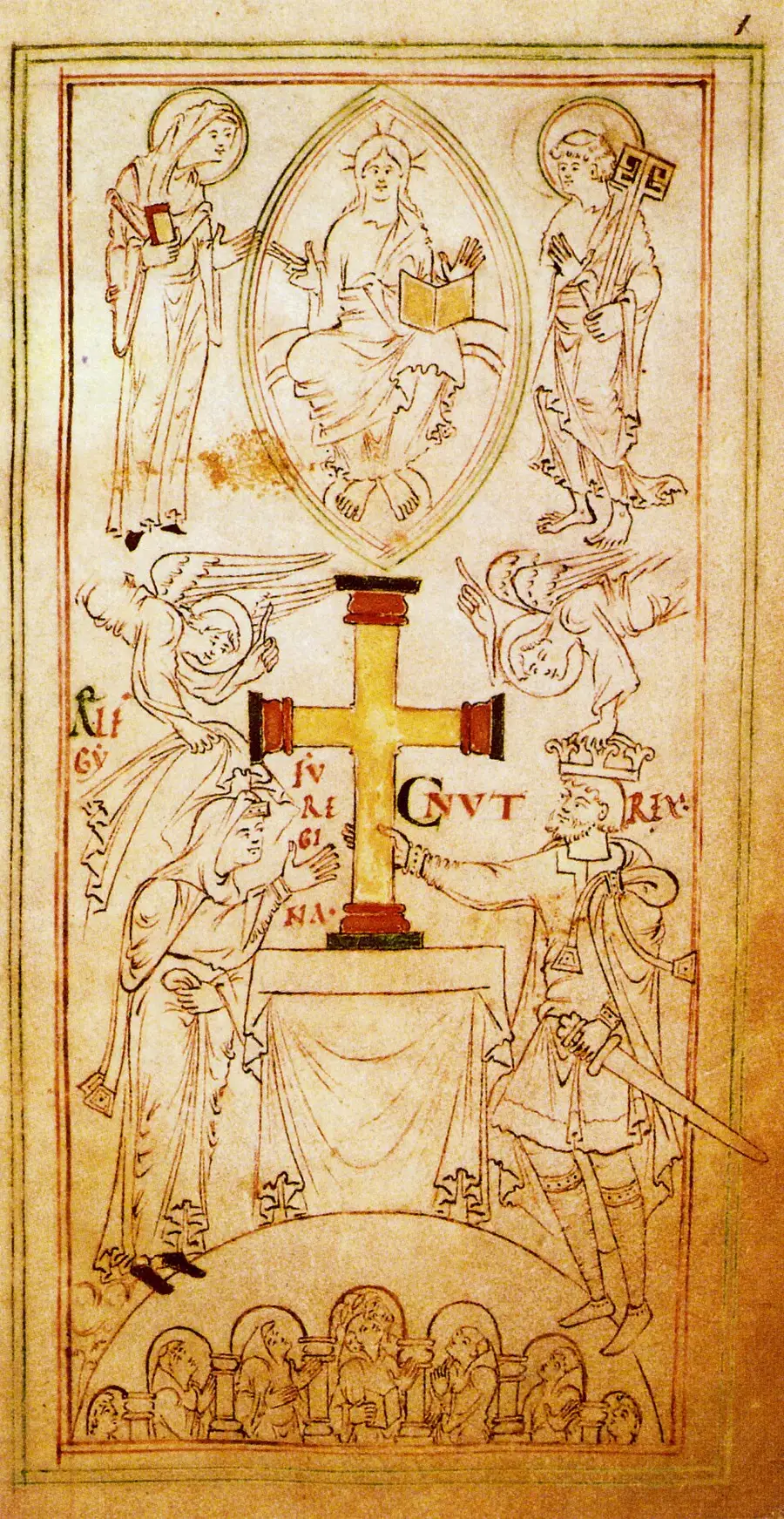 New Minster Liber Vitae, BL Stowe MS 944 fol. 6r (1031), British Library Cnut Sweynsson (c. 995–1035), Danish king who ruled the North Sea
Empire — Denmark, England (from 1016), Norway (from 1028), and parts
of Sweden. His silver bought the Norwegian magnates against King
Olav II Haraldsson in 1028 and drove Olav into exile; Olav's
attempted return ended at Stiklestad in 1030. After Olav's death and
the rapid emergence of his sainthood, Cnut's regime nevertheless
took up the dead king's veneration without hesitation, and within
five years brought Olav's son Magnus the Good back from Kievan Rus
as king of Norway — the Christianization Olav had failed to impose
in life carried through, in part, by his enemies.
, who within a few years of Olav’s homecoming was king of England and Denmark both, building the North Sea empire that would dominate the Atlantic for a generation. Olav took the throne and held it.
New Minster Liber Vitae, BL Stowe MS 944 fol. 6r (1031), British Library Cnut Sweynsson (c. 995–1035), Danish king who ruled the North Sea
Empire — Denmark, England (from 1016), Norway (from 1028), and parts
of Sweden. His silver bought the Norwegian magnates against King
Olav II Haraldsson in 1028 and drove Olav into exile; Olav's
attempted return ended at Stiklestad in 1030. After Olav's death and
the rapid emergence of his sainthood, Cnut's regime nevertheless
took up the dead king's veneration without hesitation, and within
five years brought Olav's son Magnus the Good back from Kievan Rus
as king of Norway — the Christianization Olav had failed to impose
in life carried through, in part, by his enemies.
, who within a few years of Olav’s homecoming was king of England and Denmark both, building the North Sea empire that would dominate the Atlantic for a generation. Olav took the throne and held it.
What he then made was something that has lasted.
The Christian Law
At an assembly held in 1024 — the Mostertinget 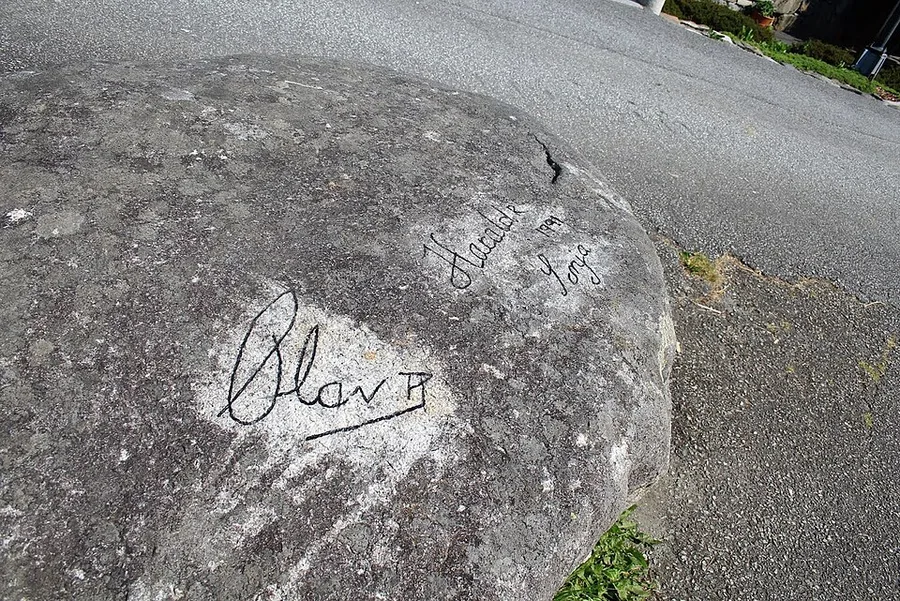 Krage52, Kongesteinen ved Moster gamle kirke (2020), Wikimedia Commons, CC BY-SA 4.0 Kongesteinen beside Moster old church carries carved royal signatures — Olav V's, then Harald and Sonja's dated 1991 — kings still setting their names on the assembly ground where Olav Haraldsson and Bishop Grimkell proclaimed the Christian Law around 1024; Norway kept the millennium there in 2024. The assembly at Moster on Bømlo island, off the southwestern coast
of Norway, around 1024 — where King Olav II Haraldsson and his
English bishop Grimkell promulgated the Kristenrett (the
Christian Law). Conventionally treated as the legal beginning of
the Christianisation of Norway, and the moment from which the
Christian provisions in the subsequent regional law codes descend.
The Mostertinget millennium was kept by Norway as a national
event in 2024.
— at Moster
Krage52, Kongesteinen ved Moster gamle kirke (2020), Wikimedia Commons, CC BY-SA 4.0 Kongesteinen beside Moster old church carries carved royal signatures — Olav V's, then Harald and Sonja's dated 1991 — kings still setting their names on the assembly ground where Olav Haraldsson and Bishop Grimkell proclaimed the Christian Law around 1024; Norway kept the millennium there in 2024. The assembly at Moster on Bømlo island, off the southwestern coast
of Norway, around 1024 — where King Olav II Haraldsson and his
English bishop Grimkell promulgated the Kristenrett (the
Christian Law). Conventionally treated as the legal beginning of
the Christianisation of Norway, and the moment from which the
Christian provisions in the subsequent regional law codes descend.
The Mostertinget millennium was kept by Norway as a national
event in 2024.
— at Moster 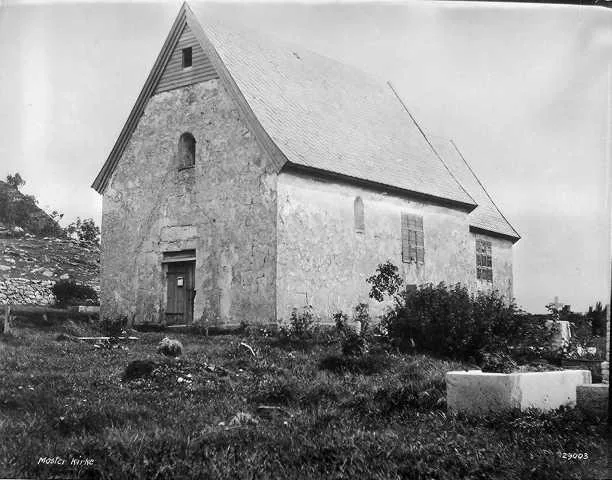 Anders Beer Wilse, Moster gamle kyrkje (1926), Wikimedia Commons Coastal settlement at the southwestern end of Bømlo island in
Vestland County. Site of the assembly (the Mostertinget) where
Olav II Haraldsson and his English bishop Grimkell promulgated
the Kristenrett — the Christian Law — around 1024, conventionally
treated as the legal beginning of Christianisation in Norway. The
Mostertinget millennium was kept by Norway as a national event in
2024. The medieval Old Moster Church on the site is one of the
oldest stone churches in Norway, traditionally said to have been
founded by Olav Tryggvason in 995.
Moster, Bømlo , on the island of Bømlo
Anders Beer Wilse, Moster gamle kyrkje (1926), Wikimedia Commons Coastal settlement at the southwestern end of Bømlo island in
Vestland County. Site of the assembly (the Mostertinget) where
Olav II Haraldsson and his English bishop Grimkell promulgated
the Kristenrett — the Christian Law — around 1024, conventionally
treated as the legal beginning of Christianisation in Norway. The
Mostertinget millennium was kept by Norway as a national event in
2024. The medieval Old Moster Church on the site is one of the
oldest stone churches in Norway, traditionally said to have been
founded by Olav Tryggvason in 995.
Moster, Bømlo , on the island of Bømlo 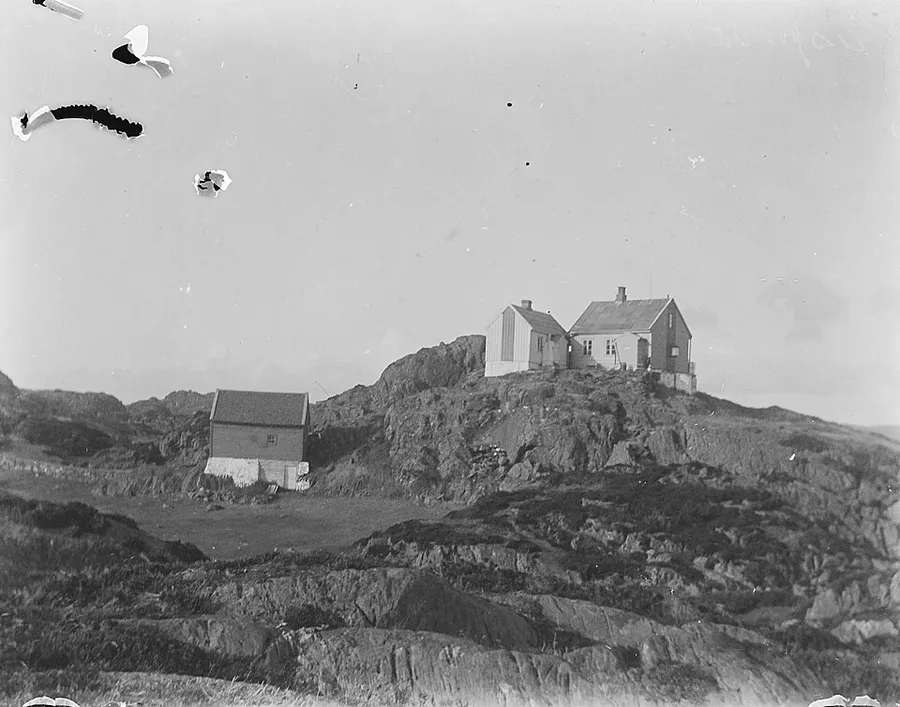 Riksarkivet (National Archives of Norway), Espevær, Bømlo (c. 1890–1900) Island and municipality in Vestland County off the southwestern
coast of Norway, the location of Moster — the assembly site
where Olav II Haraldsson and his English bishop Grimkell
promulgated the Kristenrett (the Christian Law) around 1024.
Moster is the southwestern end of Bømlo island. The Mostertinget
millennium was kept by Norway as a national event in 2024.
Bømlo, Vestland off the south-western coast, Olav and his English-born bishop Bishop Grimkell
Riksarkivet (National Archives of Norway), Espevær, Bømlo (c. 1890–1900) Island and municipality in Vestland County off the southwestern
coast of Norway, the location of Moster — the assembly site
where Olav II Haraldsson and his English bishop Grimkell
promulgated the Kristenrett (the Christian Law) around 1024.
Moster is the southwestern end of Bømlo island. The Mostertinget
millennium was kept by Norway as a national event in 2024.
Bømlo, Vestland off the south-western coast, Olav and his English-born bishop Bishop Grimkell 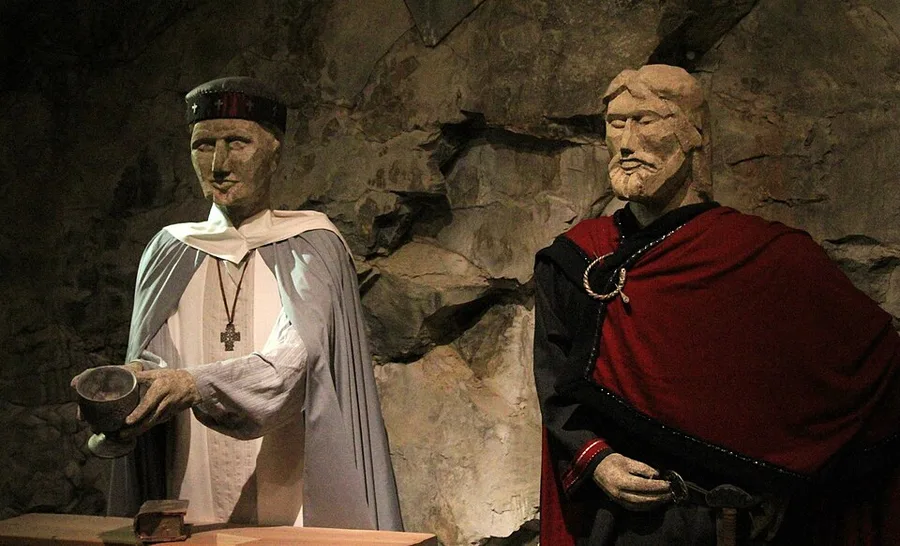 Krage52, exhibition depiction of Grimkjell and Olav, "Fra hedendom til kristendom," Moster Amfi (2020), Wikimedia Commons, CC0 No likeness of Bishop Grimkell survives; these carved figures at Moster Amfi stage him beside King Olav at Moster, where in 1024 the two proclaimed Norway's Christian law — the English bishop who shaped Olav's church, holding the chalice of the new faith. English missionary bishop (d. c. 1047) who served King Olav II
Haraldsson of Norway from c. 1015 through Olav's death at
Stiklestad in 1030. Of Anglo-Scandinavian background, probably
ordained at Bremen, brought from Wessex to Norway with Olav in
1015. Co-author of the Kristenrett — the Christian Law
promulgated at Moster around 1024. On 3 August 1031, a year and
five days after the battle, Grimkell convened the examination
of Olav's body before the clergy and people of Nidaros, declared
him a saint, and inaugurated the formal devotion. Returned to
England after Olav's death; later bishop of Selsey.
promulgated a body of law called the Kristenrett
Krage52, exhibition depiction of Grimkjell and Olav, "Fra hedendom til kristendom," Moster Amfi (2020), Wikimedia Commons, CC0 No likeness of Bishop Grimkell survives; these carved figures at Moster Amfi stage him beside King Olav at Moster, where in 1024 the two proclaimed Norway's Christian law — the English bishop who shaped Olav's church, holding the chalice of the new faith. English missionary bishop (d. c. 1047) who served King Olav II
Haraldsson of Norway from c. 1015 through Olav's death at
Stiklestad in 1030. Of Anglo-Scandinavian background, probably
ordained at Bremen, brought from Wessex to Norway with Olav in
1015. Co-author of the Kristenrett — the Christian Law
promulgated at Moster around 1024. On 3 August 1031, a year and
five days after the battle, Grimkell convened the examination
of Olav's body before the clergy and people of Nidaros, declared
him a saint, and inaugurated the formal devotion. Returned to
England after Olav's death; later bishop of Selsey.
promulgated a body of law called the Kristenrett 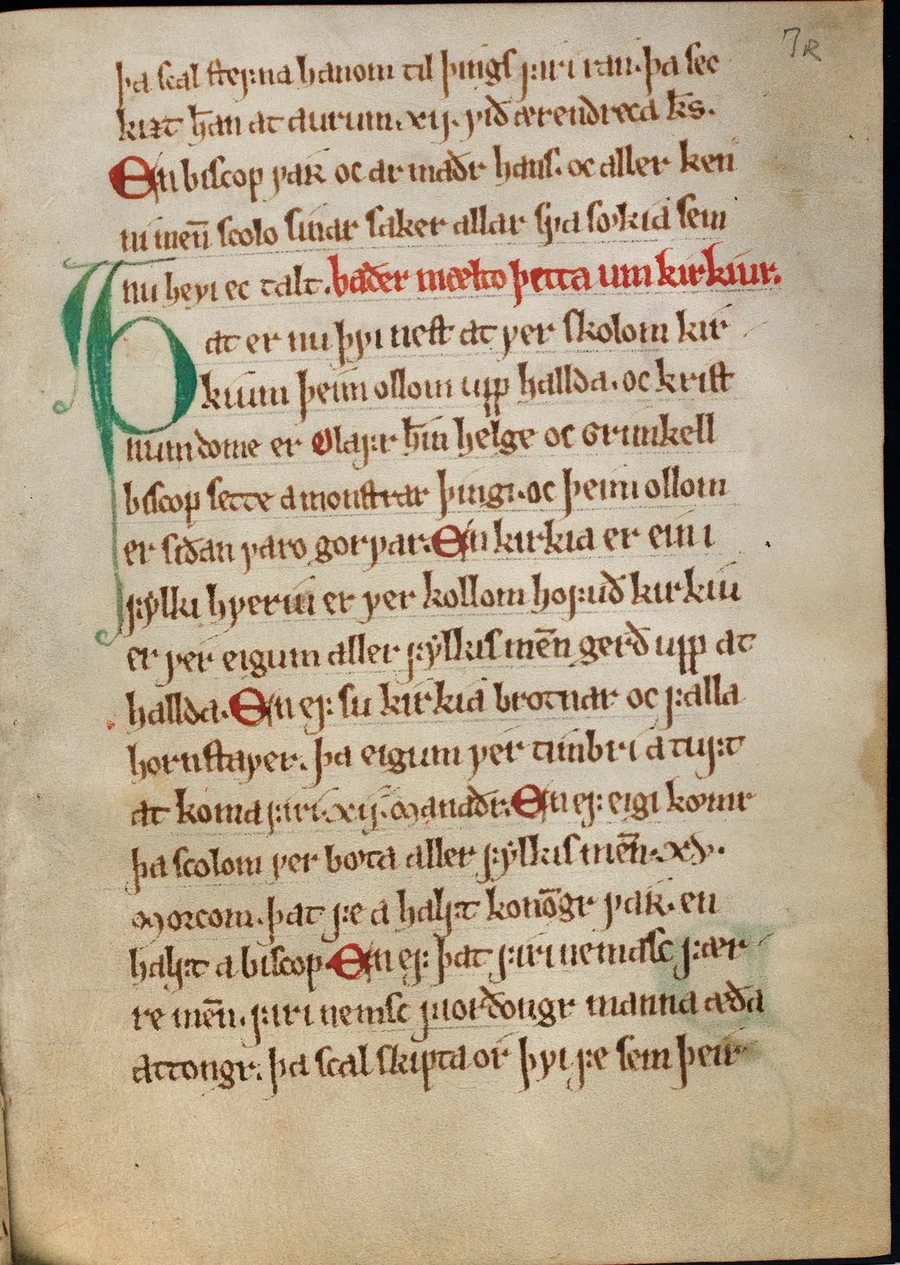 Codex Rantzovianus (E don. var. 137 4to), fol. 7r, c. 1250, Royal Danish Library — via Wikimedia Commons A leaf of the oldest complete Gulathing law-book. The Moster text itself does not survive — this is how the Christian Law comes down: the green-initialed chapter on this very page binds men to maintain the churches and the Christendom "that Olav the Holy and Bishop Grimkell set at the Moster assembly." The Christian Law promulgated at Moster around 1024 by King Olav II
Haraldsson and his English bishop Grimkell. The Moster text itself
does not survive; what is known is reconstructed from the
Christian sections of the later Gulating and Frostating regional
law-codes attributed to Olav and Grimkell. The Kristenrett began
the long abolition of slavery, criminalised the exposure of
unwanted infants, banned ritual human sacrifice, established
Christian marriage, gave women a voice in spouse-choice, prohibited
blood-revenge in favour of church-court mediation, and structured
the year around the Christian calendar. The thousandth anniversary
of its promulgation was kept by Norway as a national event in 2024.
— the Christian Law. The Moster text itself does not survive; what is known of its provisions is reconstructed from the later regional law-codes attributed to Olav and Grimkell — the Christian sections of the Gulating
Codex Rantzovianus (E don. var. 137 4to), fol. 7r, c. 1250, Royal Danish Library — via Wikimedia Commons A leaf of the oldest complete Gulathing law-book. The Moster text itself does not survive — this is how the Christian Law comes down: the green-initialed chapter on this very page binds men to maintain the churches and the Christendom "that Olav the Holy and Bishop Grimkell set at the Moster assembly." The Christian Law promulgated at Moster around 1024 by King Olav II
Haraldsson and his English bishop Grimkell. The Moster text itself
does not survive; what is known is reconstructed from the
Christian sections of the later Gulating and Frostating regional
law-codes attributed to Olav and Grimkell. The Kristenrett began
the long abolition of slavery, criminalised the exposure of
unwanted infants, banned ritual human sacrifice, established
Christian marriage, gave women a voice in spouse-choice, prohibited
blood-revenge in favour of church-court mediation, and structured
the year around the Christian calendar. The thousandth anniversary
of its promulgation was kept by Norway as a national event in 2024.
— the Christian Law. The Moster text itself does not survive; what is known of its provisions is reconstructed from the later regional law-codes attributed to Olav and Grimkell — the Christian sections of the Gulating 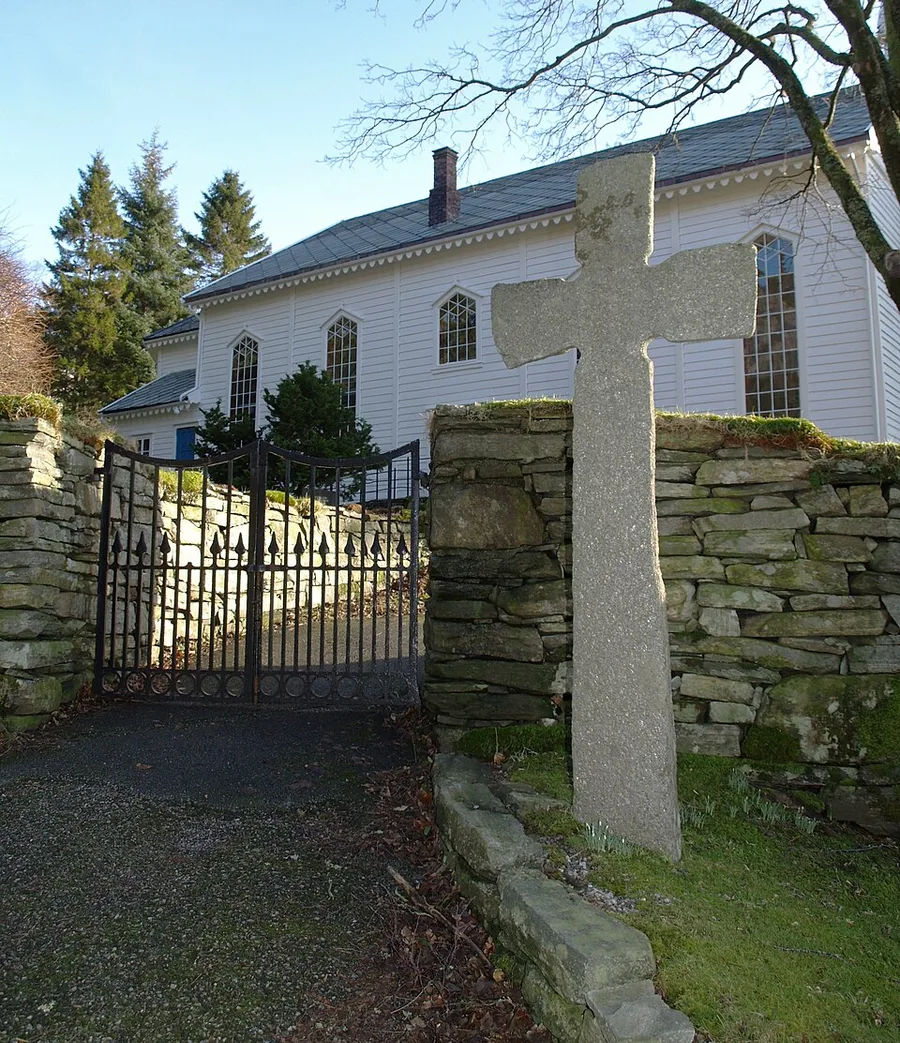 Jeblad, Steinkorset ved porten til Eivindvik kirke (2008), Wikimedia Commons, CC BY-SA 3.0 The early-medieval stone cross at Eivindvik, by the church gate at Gulen. The law assemblies raised no buildings that survive; this weathered cross, standing near the Gulating's traditional meeting ground, is what still marks the shore where western Norway's freemen gathered. The regional thing-law assembly of southwestern Norway, meeting
traditionally at Gulen in present-day Sogn og Fjordane. One of the
four great medieval Norwegian regional law traditions; its
jurisdiction covered the western coast from Agder to Sunnmøre and
produced the Gulatingslova, recorded in writing by the twelfth
century. The Gulating tradition was rolled into Magnus Lagabøte's
Landslov of 1274. The modern Gulating Court of Appeal in Bergen
inherits the name.
Also discussed in Before There Was Norway — petty kingdoms at the edge of the worldA Catholic Norway — the faith that gave the kingdom its first institutions and the stave churchesThe Golden Age — a North Atlantic empire … reaching farther than you think and Frostating
Jeblad, Steinkorset ved porten til Eivindvik kirke (2008), Wikimedia Commons, CC BY-SA 3.0 The early-medieval stone cross at Eivindvik, by the church gate at Gulen. The law assemblies raised no buildings that survive; this weathered cross, standing near the Gulating's traditional meeting ground, is what still marks the shore where western Norway's freemen gathered. The regional thing-law assembly of southwestern Norway, meeting
traditionally at Gulen in present-day Sogn og Fjordane. One of the
four great medieval Norwegian regional law traditions; its
jurisdiction covered the western coast from Agder to Sunnmøre and
produced the Gulatingslova, recorded in writing by the twelfth
century. The Gulating tradition was rolled into Magnus Lagabøte's
Landslov of 1274. The modern Gulating Court of Appeal in Bergen
inherits the name.
Also discussed in Before There Was Norway — petty kingdoms at the edge of the worldA Catholic Norway — the faith that gave the kingdom its first institutions and the stave churchesThe Golden Age — a North Atlantic empire … reaching farther than you think and Frostating 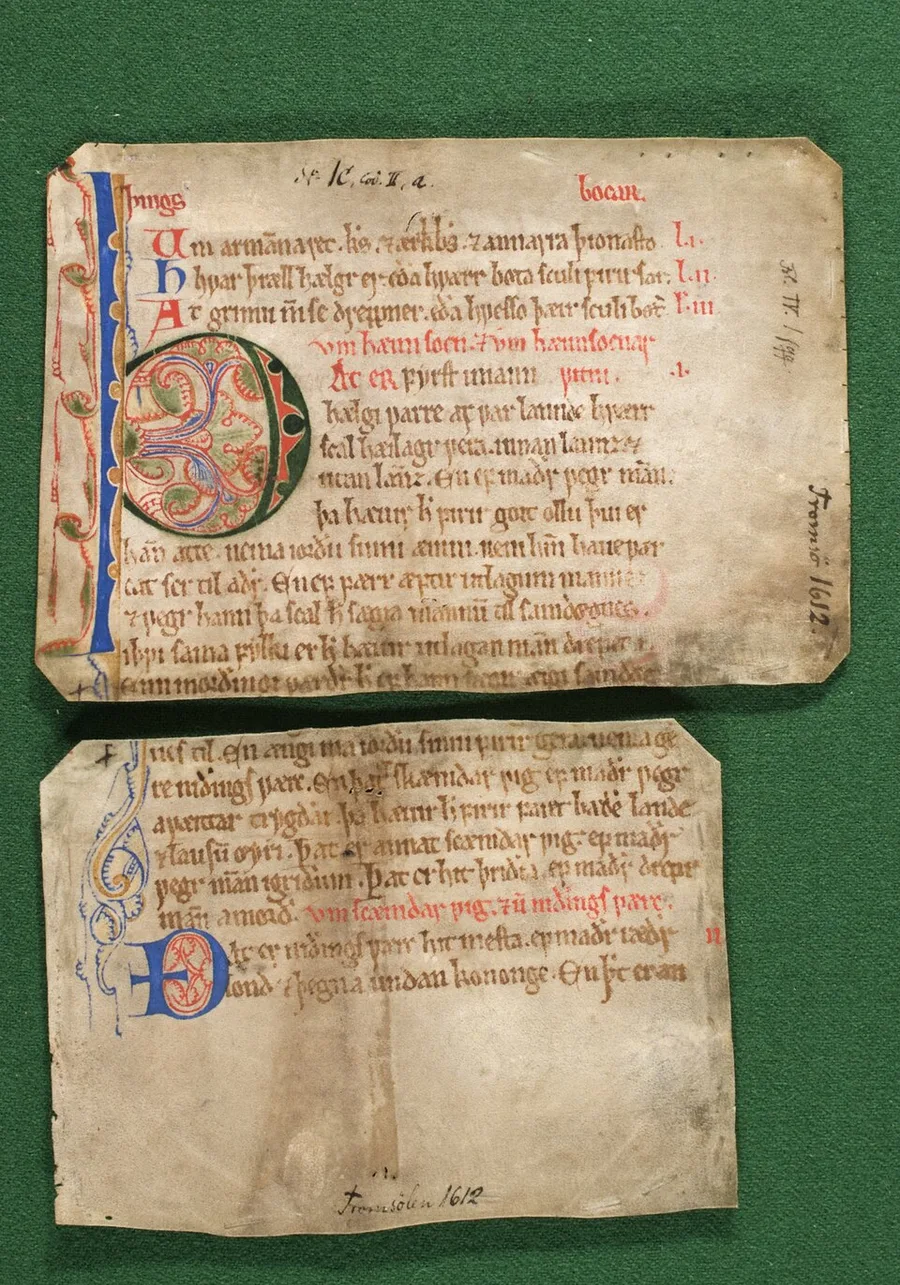 Frostatingslova fragment (c. 1260), National Archives of Norway (Riksarkivet), CC BY-SA 4.0 Two parchment leaves of the Frostatingslova, c. 1260 — the written law code of the central-Norway thing assembly that met at Frosta on the Trondheim Fjord, its customary law far older than the ink. The regional thing-law assembly of central Norway, meeting at
Frosta on the Trondheim Fjord. Jurisdiction covered Trøndelag and
the surrounding northern districts. Its codification, the
Frostatingslova, dates to the twelfth century in its surviving
form but preserves substantially older customary law. Rolled into
Magnus Lagabøte's Landslov of 1274. The modern Frostating Court
of Appeal in Trondheim carries the name.
Also discussed in Before There Was Norway — petty kingdoms at the edge of the worldWorshiping Odin and Thor — the lived religion of pre-Christian NorwayA Catholic Norway — the faith that gave the kingdom its first institutions and the stave churchesThe Golden Age — a North Atlantic empire … reaching farther than you think laws set down in the decades that followed. By that reconstruction, the Kristenrett reached well beyond the institutional Norwegian church that was its visible product.
Frostatingslova fragment (c. 1260), National Archives of Norway (Riksarkivet), CC BY-SA 4.0 Two parchment leaves of the Frostatingslova, c. 1260 — the written law code of the central-Norway thing assembly that met at Frosta on the Trondheim Fjord, its customary law far older than the ink. The regional thing-law assembly of central Norway, meeting at
Frosta on the Trondheim Fjord. Jurisdiction covered Trøndelag and
the surrounding northern districts. Its codification, the
Frostatingslova, dates to the twelfth century in its surviving
form but preserves substantially older customary law. Rolled into
Magnus Lagabøte's Landslov of 1274. The modern Frostating Court
of Appeal in Trondheim carries the name.
Also discussed in Before There Was Norway — petty kingdoms at the edge of the worldWorshiping Odin and Thor — the lived religion of pre-Christian NorwayA Catholic Norway — the faith that gave the kingdom its first institutions and the stave churchesThe Golden Age — a North Atlantic empire … reaching farther than you think laws set down in the decades that followed. By that reconstruction, the Kristenrett reached well beyond the institutional Norwegian church that was its visible product.
It began the long abolition of slavery, by requiring that slaves be redeemed and freed at the major assemblies and on the holy days. It made the exposure of unwanted infants a crime where it had been a recognised heathen custom. It banned the ritual human sacrifice that had occasionally accompanied the great Blót 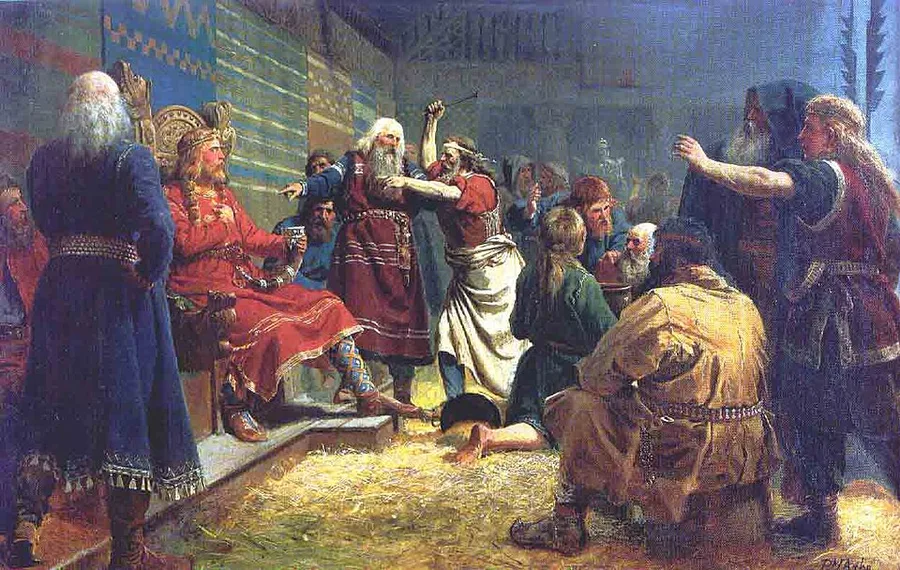 Peter Nicolai Arbo, Håkon den Gode og bøndene ved blotet på Mære (1860) Peter Nicolai Arbo's 1860 scene of the midwinter sacrifice at Mære, where Trøndelag farmers press the Christian-raised King Håkon to take part in the heathen feast — a saga moment dramatizing the blót at its most fraught. The central religious act of pre-Christian Norse society. A blót
was a sacrifice — typically of an animal — followed by a communal
feast that bound the household to its gods for the season ahead.
The shape held across rituals: an animal killed, the blood caught
and used to redden the altar and the worshippers (rjóða, "to
redden"), the meat boiled and shared between the gods (through the
flames) and the people (at the table), the drinking horn passed
with each draught dedicated to a god or to the dead. There was no
liturgy in the medieval-church sense — no book, no creed — just
the form the household had always done at that turn of the year.
Also discussed in Worshiping Odin and Thor — the lived religion of pre-Christian NorwayNordisk Mytologi — Odin, the giants, and Ragnarok . It established Christian marriage in place of concubinage and gave women a voice in the choice of a spouse. It prohibited blood-revenge. It set Sunday aside as a day of rest and structured the year around the Christian calendar.
Peter Nicolai Arbo, Håkon den Gode og bøndene ved blotet på Mære (1860) Peter Nicolai Arbo's 1860 scene of the midwinter sacrifice at Mære, where Trøndelag farmers press the Christian-raised King Håkon to take part in the heathen feast — a saga moment dramatizing the blót at its most fraught. The central religious act of pre-Christian Norse society. A blót
was a sacrifice — typically of an animal — followed by a communal
feast that bound the household to its gods for the season ahead.
The shape held across rituals: an animal killed, the blood caught
and used to redden the altar and the worshippers (rjóða, "to
redden"), the meat boiled and shared between the gods (through the
flames) and the people (at the table), the drinking horn passed
with each draught dedicated to a god or to the dead. There was no
liturgy in the medieval-church sense — no book, no creed — just
the form the household had always done at that turn of the year.
Also discussed in Worshiping Odin and Thor — the lived religion of pre-Christian NorwayNordisk Mytologi — Odin, the giants, and Ragnarok . It established Christian marriage in place of concubinage and gave women a voice in the choice of a spouse. It prohibited blood-revenge. It set Sunday aside as a day of rest and structured the year around the Christian calendar.
The Kristenrett did not transform Norwegian society in a generation. Slavery died out only across the next two centuries, and the old religion held on in the inland districts well into the twelfth. But it set the legal direction the country would travel for the next nine hundred years. Norway in 2024 kept the thousandth anniversary of its promulgation as a national event.
Violence and refusal
Alongside the law-making, the sagas describe a king of considerable violence. They have Olav forcing conversion at sword-point in the inland farms of Trøndelag, cutting sacred trees, burning Hov 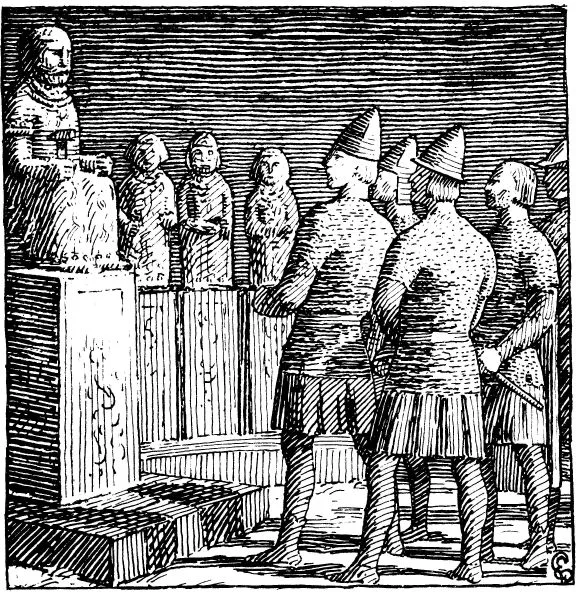 Halfdan Egedius, illustration for Óláfs saga Tryggvasonar, Heimskringla folk edition (J.M. Stenersen & Co, 1899) Egedius's illustration of Olav Tryggvason inside 'Thor's hov' pictures the building type this card describes — the timber hall doubling as cult-house, the god's image set at the high seat — at the very moment Snorri's saga has Olav confront it at Mære. The Norse indoor cult-house — a timber building, often the
chieftain's own longhouse serving double duty as the cult-house
of the district. Benches down its length, a fire down its centre,
the images of the gods set at the high seat. Floor deposits
thickening over the generations with animal bone and broken
cooking-ware are the archaeologist's signature of the place.
The clearest case excavated in Norway lies under the medieval
church at Mære, in Trøndelag, where the floor of the older timber
hall still holds a scatter of gullgubber. The hov was a hall,
not a temple in the Mediterranean sense — no paid clergy lived
inside it doing nothing else.
Also discussed in Worshiping Odin and Thor — the lived religion of pre-Christian Norway -sanctuaries, killing chieftains who resisted, and mutilating those who relapsed. Modern scholarship treats much of this as hagiographic embellishment — the pious dramatisation that medieval Christian writers added to the lives of warrior-saints to make their later sanctity look the more striking. The contemporary record of Olav’s missionary work is thin. Christianity had been moving forward through earlier kings and through trade with Christian Europe for decades before he came home in 1015.
Halfdan Egedius, illustration for Óláfs saga Tryggvasonar, Heimskringla folk edition (J.M. Stenersen & Co, 1899) Egedius's illustration of Olav Tryggvason inside 'Thor's hov' pictures the building type this card describes — the timber hall doubling as cult-house, the god's image set at the high seat — at the very moment Snorri's saga has Olav confront it at Mære. The Norse indoor cult-house — a timber building, often the
chieftain's own longhouse serving double duty as the cult-house
of the district. Benches down its length, a fire down its centre,
the images of the gods set at the high seat. Floor deposits
thickening over the generations with animal bone and broken
cooking-ware are the archaeologist's signature of the place.
The clearest case excavated in Norway lies under the medieval
church at Mære, in Trøndelag, where the floor of the older timber
hall still holds a scatter of gullgubber. The hov was a hall,
not a temple in the Mediterranean sense — no paid clergy lived
inside it doing nothing else.
Also discussed in Worshiping Odin and Thor — the lived religion of pre-Christian Norway -sanctuaries, killing chieftains who resisted, and mutilating those who relapsed. Modern scholarship treats much of this as hagiographic embellishment — the pious dramatisation that medieval Christian writers added to the lives of warrior-saints to make their later sanctity look the more striking. The contemporary record of Olav’s missionary work is thin. Christianity had been moving forward through earlier kings and through trade with Christian Europe for decades before he came home in 1015.
The opposition that killed him at Stiklestad was as much political as religious. The chieftains who marched against him included Christians as well as pagans. They were defending their regional power against a centralising king at least as much as they were defending the old gods against the new. In 1028, after losing political support across most of the country and finding that King Cnut of Denmark was willing to buy the Norwegian magnates with silver, Olav fled east across the Baltic to the court of his brother-in-law Yaroslav the Wise 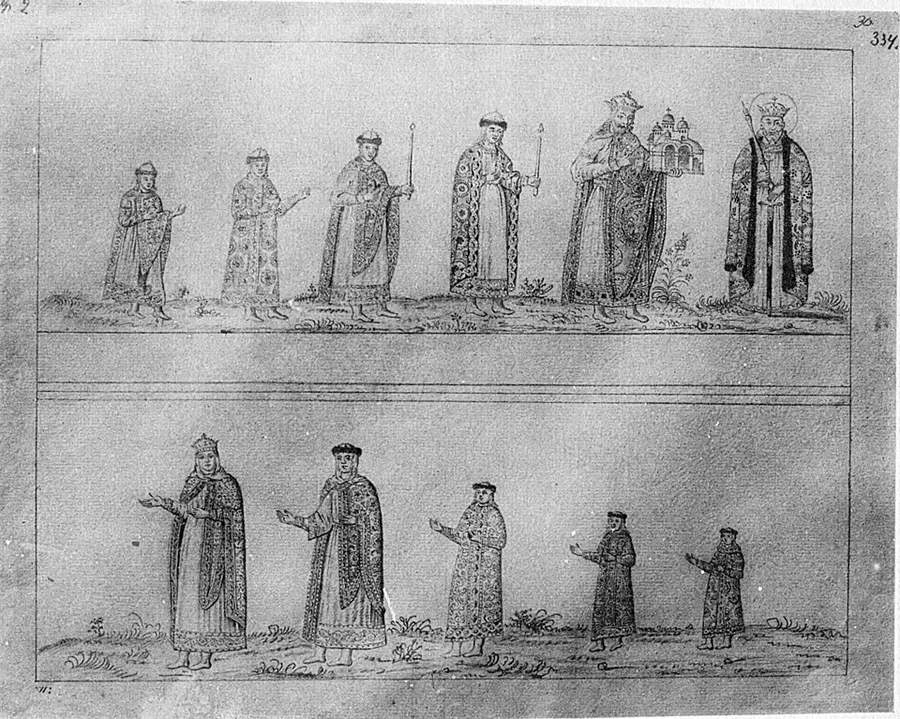 Abraham van Westerveld, after the St Sophia fresco, Kyiv (1651 copy) This 1651 drawing preserves a copy of the 11th-century family fresco from Kyiv's St Sophia Cathedral, showing Grand Prince Yaroslav the Wise's family in procession — the court where Yaroslav sheltered the exiled Olav Haraldsson and later raised Olav's son Magnus the Good. Grand Prince of Kievan Rus (978–1054), the most powerful eastern
European ruler of the early eleventh century. Brother-in-law to
Olav II Haraldsson of Norway through Olav's marriage to Yaroslav's
sister-in-law Ingegerd (or through Yaroslav's wife Ingegerd
Olofsdotter of Sweden, depending on the version followed). Hosted
Olav at his court in Kiev from 1028 to 1030 during the king's exile
before Stiklestad, and afterwards raised Olav's son Magnus the
Good until the boy was returned to Norway in 1035.
, the grand prince of Kievan Rus. He spent two years there gathering men and waiting for an opening. Battle of Stiklestad
Abraham van Westerveld, after the St Sophia fresco, Kyiv (1651 copy) This 1651 drawing preserves a copy of the 11th-century family fresco from Kyiv's St Sophia Cathedral, showing Grand Prince Yaroslav the Wise's family in procession — the court where Yaroslav sheltered the exiled Olav Haraldsson and later raised Olav's son Magnus the Good. Grand Prince of Kievan Rus (978–1054), the most powerful eastern
European ruler of the early eleventh century. Brother-in-law to
Olav II Haraldsson of Norway through Olav's marriage to Yaroslav's
sister-in-law Ingegerd (or through Yaroslav's wife Ingegerd
Olofsdotter of Sweden, depending on the version followed). Hosted
Olav at his court in Kiev from 1028 to 1030 during the king's exile
before Stiklestad, and afterwards raised Olav's son Magnus the
Good until the boy was returned to Norway in 1035.
, the grand prince of Kievan Rus. He spent two years there gathering men and waiting for an opening. Battle of Stiklestad 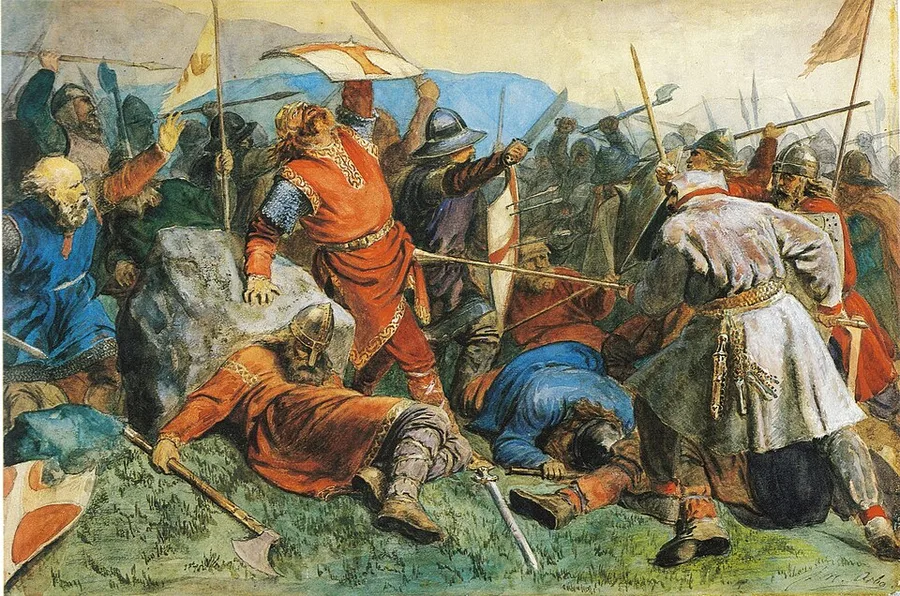 Peter Nicolai Arbo, Olav den helliges fall i slaget på Stiklestad (1859), Wikimedia Commons Arbo's 1859 history painting stages the moment itself — Olav Haraldsson going down under the blows of the farmer-army at Stiklestad on 29 July 1030, the death that made him a saint and Norway's patron king. Battle fought on 29 July 1030 at Stiklestad in the Verdal valley
of Trøndelag between King Olav II Haraldsson of Norway, returning
from his two-year exile in Kievan Rus to reclaim the throne, and
a coalition of Norwegian farmers and chieftains organised against
him by the regime that ruled Norway in King Cnut of Denmark's
name. Saga tradition puts Olav's army at thirty-six hundred men,
the farmer-army at several times that. Olav was killed late in
the day, struck three times — knee, neck, belly — as he leaned
against a large stone. His death made the cult that became
medieval Norwegian Christianity. Conventionally treated as the
end of the Viking Age in Norway.
Also discussed in Tradisjoner — celebrations across the Norwegian year was his attempt at return. The opening had not been there.
Peter Nicolai Arbo, Olav den helliges fall i slaget på Stiklestad (1859), Wikimedia Commons Arbo's 1859 history painting stages the moment itself — Olav Haraldsson going down under the blows of the farmer-army at Stiklestad on 29 July 1030, the death that made him a saint and Norway's patron king. Battle fought on 29 July 1030 at Stiklestad in the Verdal valley
of Trøndelag between King Olav II Haraldsson of Norway, returning
from his two-year exile in Kievan Rus to reclaim the throne, and
a coalition of Norwegian farmers and chieftains organised against
him by the regime that ruled Norway in King Cnut of Denmark's
name. Saga tradition puts Olav's army at thirty-six hundred men,
the farmer-army at several times that. Olav was killed late in
the day, struck three times — knee, neck, belly — as he leaned
against a large stone. His death made the cult that became
medieval Norwegian Christianity. Conventionally treated as the
end of the Viking Age in Norway.
Also discussed in Tradisjoner — celebrations across the Norwegian year was his attempt at return. The opening had not been there.
The making of a saint
The veneration began almost at once. The saga tradition reports a strange light over the field where Olav fell on the night of his death; that the sun had darkened over the battle that afternoon; and that the wounded received healing the next day from water touched by the dead king’s blood. The only solar eclipse over Norway in 1030 fell on 31 August, a month after Stiklestad, and most historians read the darkened sun as a second remembered event folded back into the day of the king’s death. The body was hidden in a sandbank along the river Nid — the river that ran past the small Norwegian trading town of Nidaros at its mouth — by a local farmer, Torgils Hålmuson, his son, and a handful of loyal men. From there it was secretly translated to a small wooden Church of Saint Clement (Nidaros) The small wooden church at Nidaros where Olav Haraldsson's body was
first laid after its translation from the sandbank along the Nid
River where the farmer Torgils Hålmuson and his son Grim had hidden
it. Bishop Grimkell
examined the body in the church on 3 August 1031 and pronounced
Olav a saint there, beginning the formal devotion. The wooden
church was eventually replaced by Christ Church (the predecessor
of Nidaros Cathedral); the precise location of Saint Clement's has
been the subject of long archaeological debate. A 2016 excavation
on Søndre gate in central Trondheim may have identified the site,
but the identification is not yet universally accepted.
in the town itself, where Grimkell, the English bishop Olav had brought from Wessex 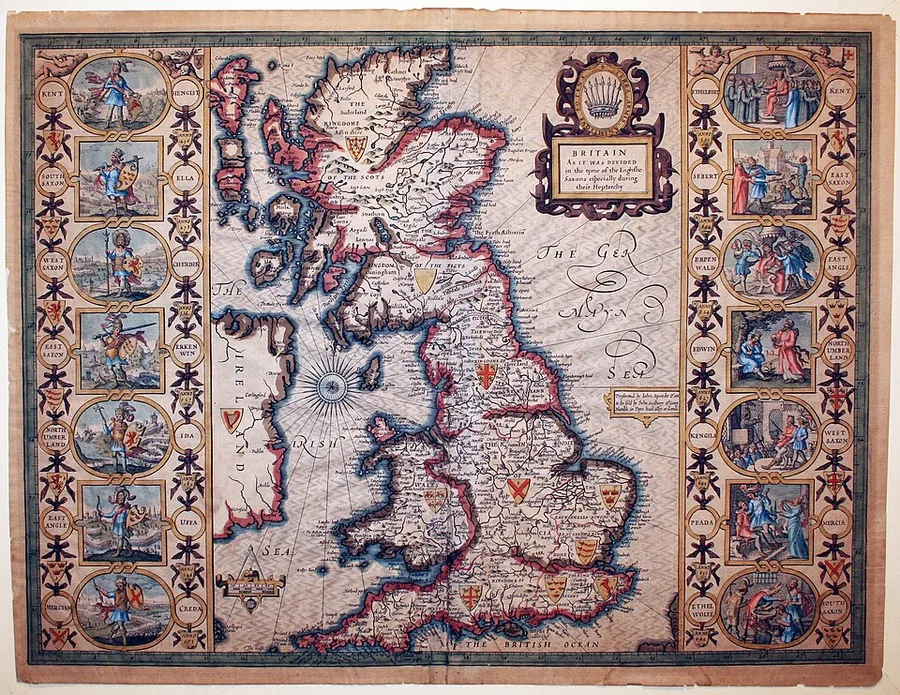 John Speed / Jodocus Hondius, Heptarchy, The Theatre of the Empire of Great Britaine (1610–11) Anglo-Saxon kingdom of southwestern England, the only major
Anglo-Saxon polity to survive the Viking Great Heathen Army of
the late ninth century. Under Alfred the Great (r. 871–899) and
his successors Wessex unified England across the tenth century.
By Olav II Haraldsson's time the kingdom had been absorbed into
Cnut's North Sea Empire, but the English cathedral schools of
Wessex continued training the kind of missionary bishops Olav
brought home — including Bishop Grimkell, the English-ordained
bishop who declared Olav a saint at Nidaros in 1031.
(modern-day southwestern England) in 1015 and who had been administering the rough Norwegian church through the king’s reign, took charge of the relics.
John Speed / Jodocus Hondius, Heptarchy, The Theatre of the Empire of Great Britaine (1610–11) Anglo-Saxon kingdom of southwestern England, the only major
Anglo-Saxon polity to survive the Viking Great Heathen Army of
the late ninth century. Under Alfred the Great (r. 871–899) and
his successors Wessex unified England across the tenth century.
By Olav II Haraldsson's time the kingdom had been absorbed into
Cnut's North Sea Empire, but the English cathedral schools of
Wessex continued training the kind of missionary bishops Olav
brought home — including Bishop Grimkell, the English-ordained
bishop who declared Olav a saint at Nidaros in 1031.
(modern-day southwestern England) in 1015 and who had been administering the rough Norwegian church through the king’s reign, took charge of the relics.
On 3 August 1031 — a year and five days after the battle — Grimkell convened an examination of the body before the assembled clergy and people of Nidaros. The coffin was opened. Witnesses reported that the body was uncorrupted, that the hair and nails had grown, that a fragrance like the smell of summer came from the casket, and that the wound in the king’s throat had closed. Grimkell pronounced Olav a saint, the body was moved to a place of honour in the church of Saint Clement, and the formal devotion began. The English-Norman canonisation procedure of the eleventh century required no Roman ratification. A local bishop with the will to do it could declare a saint. Grimkell had the will.
The new devotion found its sponsors in an unexpected quarter. The Danish-installed regime that now ruled Norway in Cnut’s name took up the dead king’s veneration without hesitation; praise-poems on the miracles at his grave appeared from court poets working for the men whose silver had bought the magnates against him. Within five years the same chieftains who had stood against him at Stiklestad brought his eleven-year-old son Magnus the Good 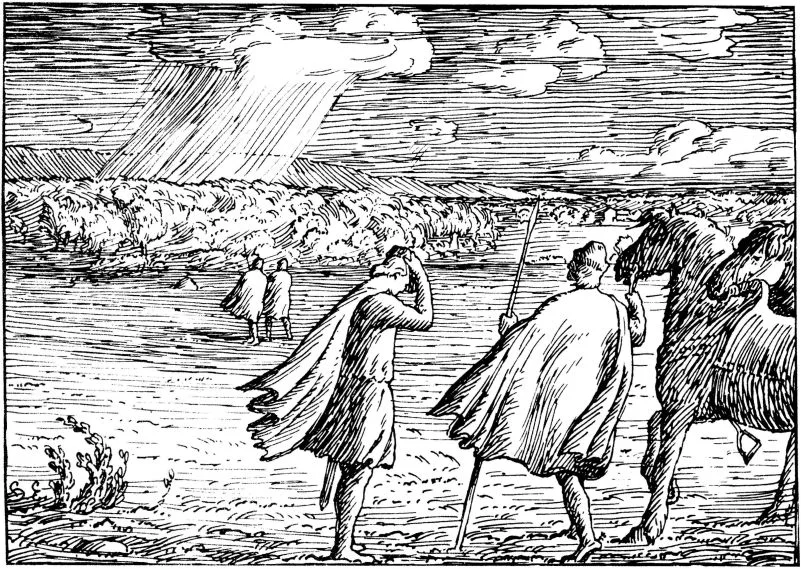 Halfdan Egedius, Kong Magnus og Kalv Arnesson på Stiklestad (1898), Heimskringla 1899 ed. Egedius stages a quieter aftermath moment than Arbo's battle scene — two cloaked figures, read as Magnus and Kalv Arnesson, pause over the ground where Olav fell, the chieftain who once fought against the father now standing beside the son he helped bring home as king. Magnus Olavsson (1024–1047), only son of King Olav II Haraldsson
(Saint Olav) of Norway. Taken to Kievan Rus as a child of around
four after his father's exile in 1028; raised at the court of
Yaroslav the Wise. Brought back to Norway in 1035 by the same
chieftains who had stood against his father at Stiklestad five
years before, and acclaimed king at age eleven — the country now
venerating its dead king as a saint. Reigned 1035–1047 in Norway;
also king of Denmark 1042–1047 after the death of Cnut's son
Harthacnut. The first reigning Norwegian king to hold the throne
as the eternal saint-king's deputy.
home from Kievan Rus and acclaimed the boy king of a country that was now venerating its dead king as a saint. The Christianization the living Olav had failed to impose was being carried through, before his bones were five years cold, by his own enemies.
Halfdan Egedius, Kong Magnus og Kalv Arnesson på Stiklestad (1898), Heimskringla 1899 ed. Egedius stages a quieter aftermath moment than Arbo's battle scene — two cloaked figures, read as Magnus and Kalv Arnesson, pause over the ground where Olav fell, the chieftain who once fought against the father now standing beside the son he helped bring home as king. Magnus Olavsson (1024–1047), only son of King Olav II Haraldsson
(Saint Olav) of Norway. Taken to Kievan Rus as a child of around
four after his father's exile in 1028; raised at the court of
Yaroslav the Wise. Brought back to Norway in 1035 by the same
chieftains who had stood against his father at Stiklestad five
years before, and acclaimed king at age eleven — the country now
venerating its dead king as a saint. Reigned 1035–1047 in Norway;
also king of Denmark 1042–1047 after the death of Cnut's son
Harthacnut. The first reigning Norwegian king to hold the throne
as the eternal saint-king's deputy.
home from Kievan Rus and acclaimed the boy king of a country that was now venerating its dead king as a saint. The Christianization the living Olav had failed to impose was being carried through, before his bones were five years cold, by his own enemies.
Rex Perpetuus Norvegiae
What Grimkell began locally, the wider Church confirmed a century later. Pope Alexander III 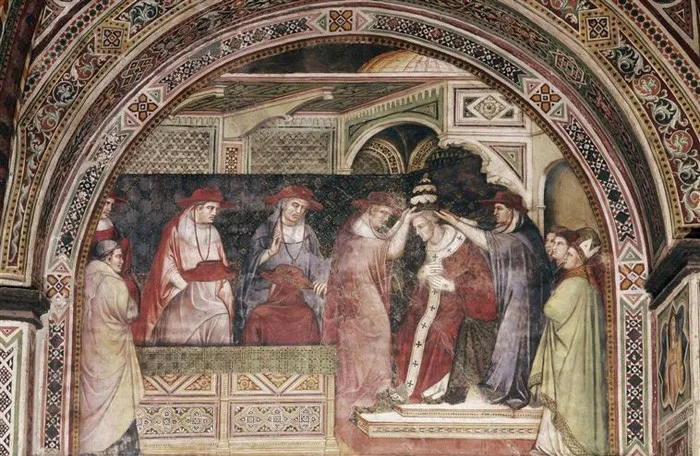 Spinello Aretino, Coronation of Pope Alexander III (fresco), Palazzo Pubblico, Siena Pope from 1159 to 1181 (Rolando Bandinelli, c. 1105–1181), one of
the most consequential popes of the High Middle Ages. Confirmed
the canonisation of Olav Haraldsson from Rome in 1164 — the formal
papal sanction of a sainthood that had been functional in Norway
since 1031. Best known internationally for his protracted conflict
with King Henry II of England that produced the murder of Thomas
Becket at Canterbury in 1170 and for his presidency over the
Third Lateran Council of 1179.
confirmed Olav’s canonization from Rome (medieval pilgrim city)
Spinello Aretino, Coronation of Pope Alexander III (fresco), Palazzo Pubblico, Siena Pope from 1159 to 1181 (Rolando Bandinelli, c. 1105–1181), one of
the most consequential popes of the High Middle Ages. Confirmed
the canonisation of Olav Haraldsson from Rome in 1164 — the formal
papal sanction of a sainthood that had been functional in Norway
since 1031. Best known internationally for his protracted conflict
with King Henry II of England that produced the murder of Thomas
Becket at Canterbury in 1170 and for his presidency over the
Third Lateran Council of 1179.
confirmed Olav’s canonization from Rome (medieval pilgrim city) 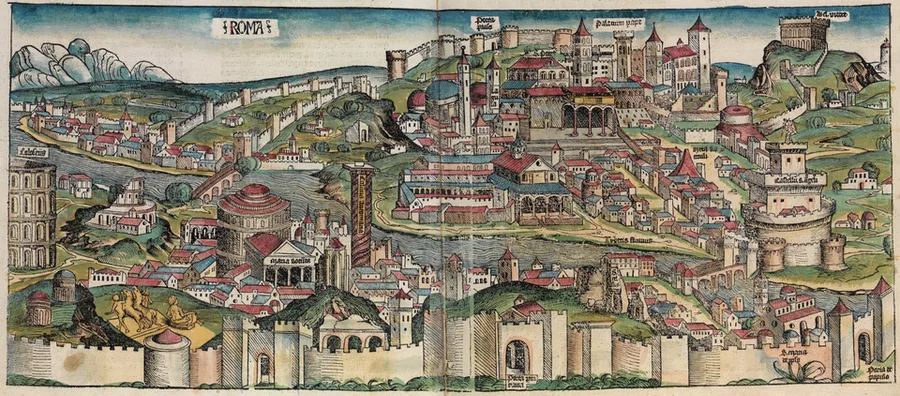 Michael Wolgemut & Wilhelm Pleydenwurff, Roma, in Hartmann Schedel's Nuremberg Chronicle (1493) Capital of the medieval Papal States and the most important Western
Christian pilgrimage destination of the Middle Ages, drawing
pilgrims to the tombs of Saint Peter and Saint Paul, the catacombs,
and the seven principal basilicas. In the high medieval era the
pilgrimage to Rome stood alongside Santiago de Compostela in
Spain, Canterbury in England, and Nidaros (Trondheim) in Norway
as one of the great pan-European pilgrimage routes. The Roman
road network — and the inn-and-hospice infrastructure built along
the Via Francigena from Canterbury south to Rome — set the
pattern that the Norwegian sælehus and the Pilegrimsleden
inherited.
in 1164, and the title fixed to him from that period forward was Rex Perpetuus Norvegiae
Michael Wolgemut & Wilhelm Pleydenwurff, Roma, in Hartmann Schedel's Nuremberg Chronicle (1493) Capital of the medieval Papal States and the most important Western
Christian pilgrimage destination of the Middle Ages, drawing
pilgrims to the tombs of Saint Peter and Saint Paul, the catacombs,
and the seven principal basilicas. In the high medieval era the
pilgrimage to Rome stood alongside Santiago de Compostela in
Spain, Canterbury in England, and Nidaros (Trondheim) in Norway
as one of the great pan-European pilgrimage routes. The Roman
road network — and the inn-and-hospice infrastructure built along
the Via Francigena from Canterbury south to Rome — set the
pattern that the Norwegian sælehus and the Pilegrimsleden
inherited.
in 1164, and the title fixed to him from that period forward was Rex Perpetuus Norvegiae 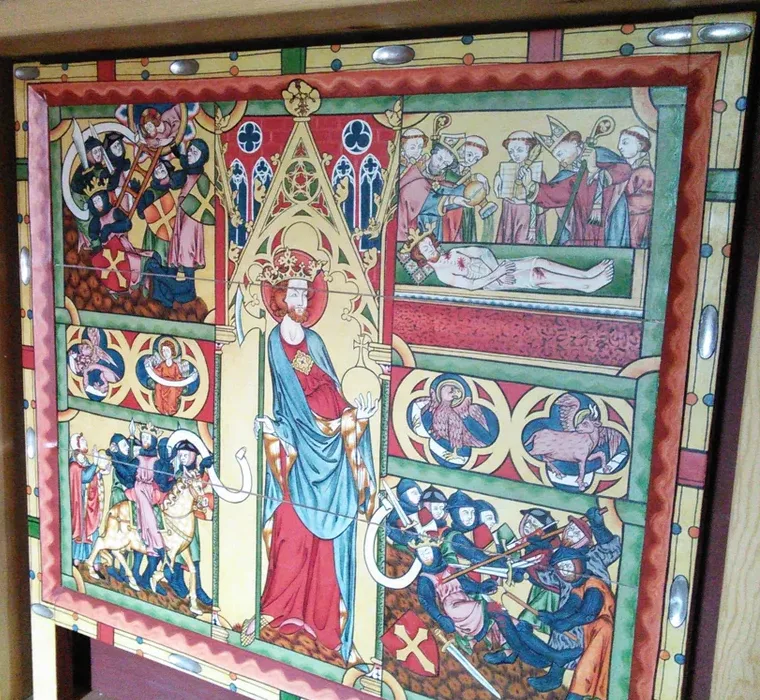 Photo of a replica of the Olav Altar Frontal (Nidaros, c. 1320–30), Wikimedia Commons, public domain The four painted scenes trace Olav from death at Stiklestad to sainthood and enthronement in glory — the same afterlife-as-king logic Rex Perpetuus Norvegiae names outright. The original hung at Nidaros; this photograph shows a full-scale replica at a stave church in Iceland's Westman Islands. "Eternal King of Norway" — the title formally fixed to Saint Olav
from 1163 forward, when the realm was dedicated to him at the
coronation of Magnus Erlingsson and the new ceremony (designed
by Archbishop Eystein Erlendsson) treated every reigning Norwegian
king from that day as the saint's deputy on the throne. Pope
Alexander III confirmed Olav's canonisation from Rome in 1164,
cementing the formula. The Rex Perpetuus language became the
constitutional shorthand of medieval Norwegian kingship and
survives in modern Norwegian ceremonial usage.
— the Eternal King of Norway. The formula had been set the year before, at Magnus Erlingsson
Photo of a replica of the Olav Altar Frontal (Nidaros, c. 1320–30), Wikimedia Commons, public domain The four painted scenes trace Olav from death at Stiklestad to sainthood and enthronement in glory — the same afterlife-as-king logic Rex Perpetuus Norvegiae names outright. The original hung at Nidaros; this photograph shows a full-scale replica at a stave church in Iceland's Westman Islands. "Eternal King of Norway" — the title formally fixed to Saint Olav
from 1163 forward, when the realm was dedicated to him at the
coronation of Magnus Erlingsson and the new ceremony (designed
by Archbishop Eystein Erlendsson) treated every reigning Norwegian
king from that day as the saint's deputy on the throne. Pope
Alexander III confirmed Olav's canonisation from Rome in 1164,
cementing the formula. The Rex Perpetuus language became the
constitutional shorthand of medieval Norwegian kingship and
survives in modern Norwegian ceremonial usage.
— the Eternal King of Norway. The formula had been set the year before, at Magnus Erlingsson 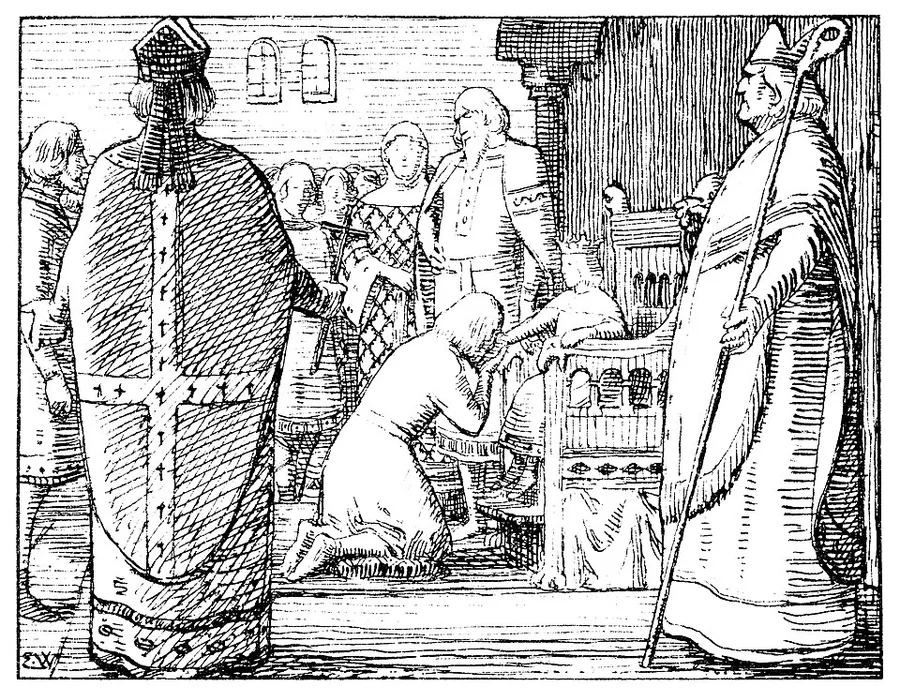 Erik Werenskiold, Kongen tek hyllest av lendmennene etter vigsla (1899), Heimskringla 1899 ed. Norway's noblemen kneel in homage to seven-year-old King Magnus Erlingsson just after his 1163 consecration — the first Norwegian coronation rite, which bound the crown to Saint Olav as the realm's eternal, unseen king. King of Norway 1163–1184 (1156–1184 depending on dating), son of
the chieftain Erling Skakke. Crowned in 1163 at age seven in the
first Norwegian royal coronation rite — the new ceremony, designed
by Archbishop Eystein Erlendsson, formally dedicated the realm to
Saint Olav as Rex Perpetuus Norvegiae (the Eternal King of
Norway), with the reigning king holding the throne as the saint's
deputy. The formula became the constitutional language of
medieval Norwegian kingship. Killed in 1184 at the Battle of
Fimreite by Sverre Sigurdsson.
’s coronation in 1163, when the realm itself was formally dedicated to Saint Olav: every reigning Norwegian king from that day forward held the throne, in the language of medieval royal documents, as the eternal king’s deputy.
Erik Werenskiold, Kongen tek hyllest av lendmennene etter vigsla (1899), Heimskringla 1899 ed. Norway's noblemen kneel in homage to seven-year-old King Magnus Erlingsson just after his 1163 consecration — the first Norwegian coronation rite, which bound the crown to Saint Olav as the realm's eternal, unseen king. King of Norway 1163–1184 (1156–1184 depending on dating), son of
the chieftain Erling Skakke. Crowned in 1163 at age seven in the
first Norwegian royal coronation rite — the new ceremony, designed
by Archbishop Eystein Erlendsson, formally dedicated the realm to
Saint Olav as Rex Perpetuus Norvegiae (the Eternal King of
Norway), with the reigning king holding the throne as the saint's
deputy. The formula became the constitutional language of
medieval Norwegian kingship. Killed in 1184 at the Battle of
Fimreite by Sverre Sigurdsson.
’s coronation in 1163, when the realm itself was formally dedicated to Saint Olav: every reigning Norwegian king from that day forward held the throne, in the language of medieval royal documents, as the eternal king’s deputy.
The devotion spread quickly. Within two decades of the death, miracle stories were collecting at the Norwegian shrine; by 1170 they filled a book. Within a generation, pilgrim traffic to the tomb was the most consistent source of cash income for the church in Nidaros. Within a century, the route to the tomb was marked, the inland network of pilgrim hostels — the Sælehus Pilgrim hostels — literally "soul-houses" — built along the
medieval Norwegian pilgrim routes to Nidaros. A network of small
wooden inn-buildings where a walking pilgrim could expect food
and a bed without payment, stationed at roughly day-march intervals
along the principal routes. The sælehus network was maintained by
the medieval Norwegian church and supported by donations and
pilgrim offerings. Closed at the Reformation in 1537; in stages
replaced by the modern Pilegrimsleden hostel-and-stamping system
along the reopened pilgrim paths from 1997 onward.
— was in place, and the veneration had spread to Iceland 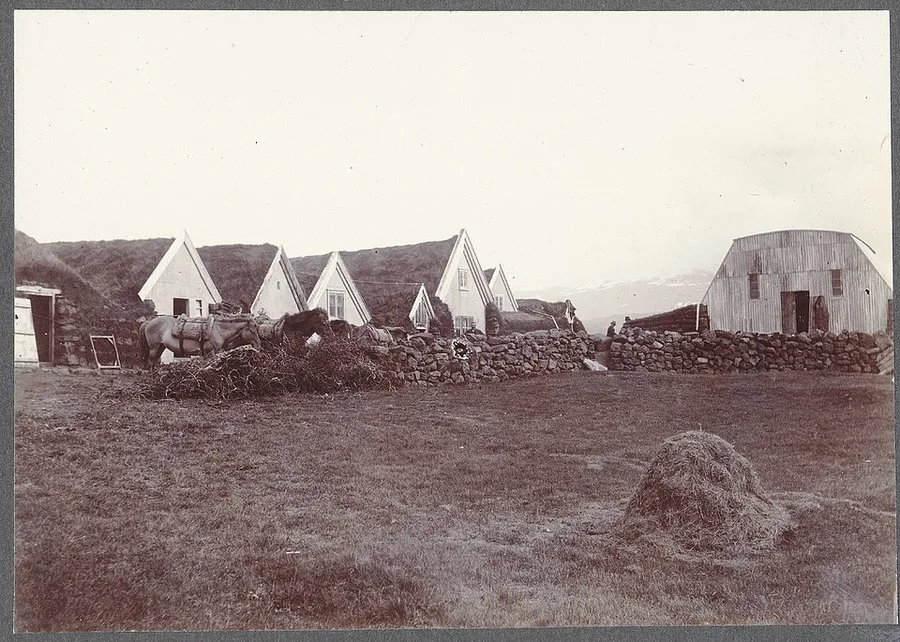 Frederick W. W. Howell, Galtalækur and Hekla (c. 1900), Fiske Icelandic Collection, Cornell University Library A turf-walled farm under Hekla, photographed about 1900 — Iceland as the settlers from Norway made it: a country of farms without a king or towns, governed by the annual open-air Alþing and remembered in the sagas their descendants wrote. The North Atlantic island settled from Norway in the ninth and
tenth centuries by chieftains and their followings who refused to
accept Harald Fairhair's authority on the Norwegian mainland and
emigrated rather than submit. They built a country without a king,
governed by an annual open-air assembly at Þingvellir called the
Alþing — the oldest parliament in the world by date of founding. Three centuries after the migration, their descendants
(notably Snorri Sturluson) composed the prose sagas that became
almost the only literary memory of the Norwegian petty kingdoms.
Also discussed in Before There Was Norway — petty kingdoms at the edge of the worldThe Viking Age — longships, legends, and the first "Norway"Worshiping Odin and Thor — the lived religion of pre-Christian NorwayA Catholic Norway — the faith that gave the kingdom its first institutions and the stave churchesThe Golden Age — a North Atlantic empire … reaching farther than you thinkThe 400-Year Night — when the Northern Lion lay dormant , the Faroe Islands
Frederick W. W. Howell, Galtalækur and Hekla (c. 1900), Fiske Icelandic Collection, Cornell University Library A turf-walled farm under Hekla, photographed about 1900 — Iceland as the settlers from Norway made it: a country of farms without a king or towns, governed by the annual open-air Alþing and remembered in the sagas their descendants wrote. The North Atlantic island settled from Norway in the ninth and
tenth centuries by chieftains and their followings who refused to
accept Harald Fairhair's authority on the Norwegian mainland and
emigrated rather than submit. They built a country without a king,
governed by an annual open-air assembly at Þingvellir called the
Alþing — the oldest parliament in the world by date of founding. Three centuries after the migration, their descendants
(notably Snorri Sturluson) composed the prose sagas that became
almost the only literary memory of the Norwegian petty kingdoms.
Also discussed in Before There Was Norway — petty kingdoms at the edge of the worldThe Viking Age — longships, legends, and the first "Norway"Worshiping Odin and Thor — the lived religion of pre-Christian NorwayA Catholic Norway — the faith that gave the kingdom its first institutions and the stave churchesThe Golden Age — a North Atlantic empire … reaching farther than you thinkThe 400-Year Night — when the Northern Lion lay dormant , the Faroe Islands 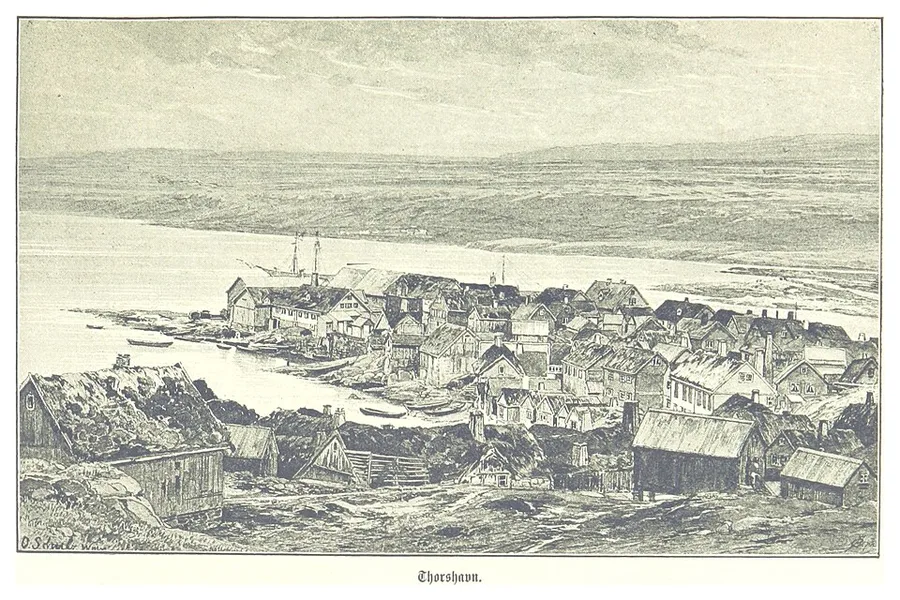 O. Schulz, Thorshavn, from A. Baumgartner, Nordische Fahrten: Island und die Färöer (1889), British Library Tórshavn, the Faroes' harbour town, engraved in 1889: turf-roofed houses crowd toward Tinganes, the low point where the Norse settlers' assembly met from around 900 and where the islands' government still sits. Archipelago of eighteen volcanic islands in the North Atlantic
between Norway, Iceland, and Scotland. Settled by Norse colonists
beginning in the early ninth century, the Faroes were under
Norwegian sovereignty by 1035; passed with Norway to Denmark in
1380 and remained under Danish rule after Norway's independence
in 1814. Today a self-governing nation within the Kingdom of
Denmark, with about fifty-three thousand people speaking Faroese
(a North Germanic language closely related to Icelandic and to
the western Norwegian dialects of Old Norse). The devotion to
Saint Olav was carried across the Faroes by the medieval Norwegian
archbishopric of Nidaros, and Olsok is still observed there.
Also discussed in A Catholic Norway — the faith that gave the kingdom its first institutions and the stave churchesThe Golden Age — a North Atlantic empire … reaching farther than you thinkThe 400-Year Night — when the Northern Lion lay dormant , Greenland, the Norse settlements in the British Isles, and across the Baltic to the Russian Orthodox cathedrals at Novgorod
O. Schulz, Thorshavn, from A. Baumgartner, Nordische Fahrten: Island und die Färöer (1889), British Library Tórshavn, the Faroes' harbour town, engraved in 1889: turf-roofed houses crowd toward Tinganes, the low point where the Norse settlers' assembly met from around 900 and where the islands' government still sits. Archipelago of eighteen volcanic islands in the North Atlantic
between Norway, Iceland, and Scotland. Settled by Norse colonists
beginning in the early ninth century, the Faroes were under
Norwegian sovereignty by 1035; passed with Norway to Denmark in
1380 and remained under Danish rule after Norway's independence
in 1814. Today a self-governing nation within the Kingdom of
Denmark, with about fifty-three thousand people speaking Faroese
(a North Germanic language closely related to Icelandic and to
the western Norwegian dialects of Old Norse). The devotion to
Saint Olav was carried across the Faroes by the medieval Norwegian
archbishopric of Nidaros, and Olsok is still observed there.
Also discussed in A Catholic Norway — the faith that gave the kingdom its first institutions and the stave churchesThe Golden Age — a North Atlantic empire … reaching farther than you thinkThe 400-Year Night — when the Northern Lion lay dormant , Greenland, the Norse settlements in the British Isles, and across the Baltic to the Russian Orthodox cathedrals at Novgorod 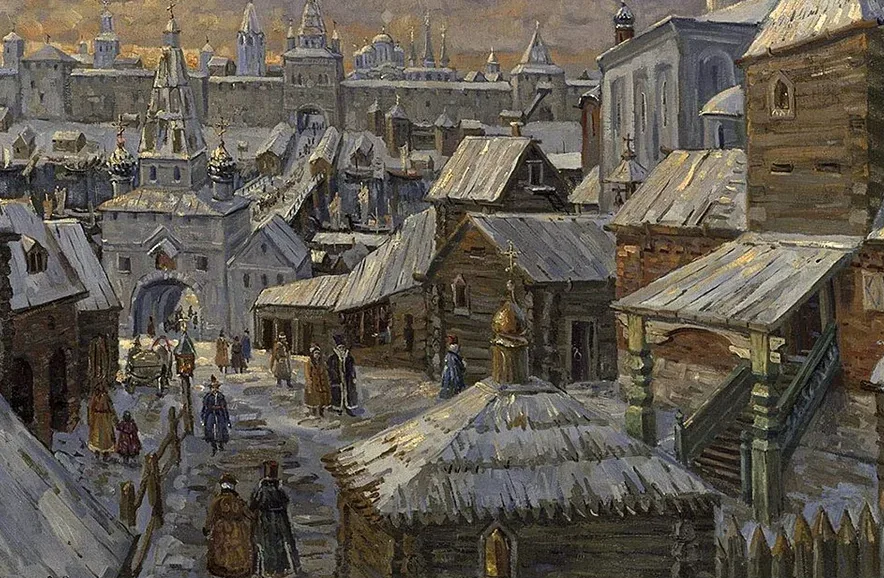 Apollinary Vasnetsov, Medieval Novgorod in Winter (1909) Apollinary Vasnetsov's painted reconstruction of medieval Novgorod in winter — the wooden river town on the Volkhov that legend says began as the Norse trader-prince Rurik's seat, and that grew into one of the two great cities of the Rus. City on the Volkhov River in northwestern Russia, traditionally
founded by the Norse Rūs warlord Rurik around 862 as part of the
Varangian river-trade network. With Kiev to the south, one of the
two principal centres of the Kievan Rus state that emerged from the
Norse trading towns. The chronicle tradition that traces the
Russian state to a Norse founding (the "Varangian thesis") is
contested in modern Russian historiography but supported by both
archaeology and the linguistic record.
Also discussed in The Viking Age — longships, legends, and the first "Norway"The Germans Who "Ruled" Bergen — the Hanseatic merchants on Bryggen Wharf (in modern-day northwestern Russia).
Apollinary Vasnetsov, Medieval Novgorod in Winter (1909) Apollinary Vasnetsov's painted reconstruction of medieval Novgorod in winter — the wooden river town on the Volkhov that legend says began as the Norse trader-prince Rurik's seat, and that grew into one of the two great cities of the Rus. City on the Volkhov River in northwestern Russia, traditionally
founded by the Norse Rūs warlord Rurik around 862 as part of the
Varangian river-trade network. With Kiev to the south, one of the
two principal centres of the Kievan Rus state that emerged from the
Norse trading towns. The chronicle tradition that traces the
Russian state to a Norse founding (the "Varangian thesis") is
contested in modern Russian historiography but supported by both
archaeology and the linguistic record.
Also discussed in The Viking Age — longships, legends, and the first "Norway"The Germans Who "Ruled" Bergen — the Hanseatic merchants on Bryggen Wharf (in modern-day northwestern Russia).
In Novgorod he appears as a saint in the icon-corner — the household prayer-niche of Eastern Christianity, where families keep the painted images of the saints they venerate. He is one of the Western saints venerated in the Orthodox East, and he survives in that tradition because his canonisation in 1031 predated the The Great Schism (1054) 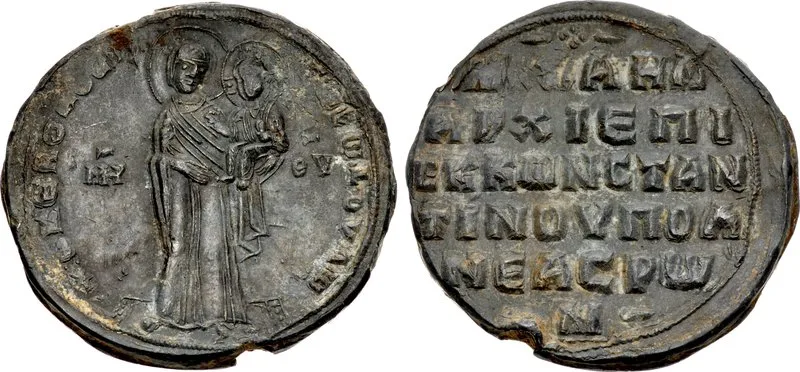 Lead seal of Michael Keroularios (1043–1058), photo Classical Numismatic Group (CNG), CC BY-SA 2.5 The Patriarch of Constantinople's own lead seal, standing in for the 1054 schism itself (no contemporary image of the event survives) — Keroularios's refusal of the Roman legates' demands produced the mutual excommunications that made the East-West split permanent. The formal break between the Eastern (Greek-speaking,
Constantinople-based) and Western (Latin-speaking, Rome-based)
Christian communions in 1054, producing the Roman Catholic and
Eastern Orthodox churches as the two principal branches of
medieval Christianity. Saint Olav of Norway's 1031 canonisation
predated the Schism by twenty-three years, which is why he is
one of the few Western saints venerated in the Eastern Orthodox
tradition — particularly in Russia, where he appears in
icon-corner devotions to this day.
by twenty-three years — the formal split that produced the Roman Catholic and Eastern Orthodox churches as separate communions. His feast day on 29 July, the anniversary of his death, became the great summer holiday across northern Europe, kept under the name Olsok
Lead seal of Michael Keroularios (1043–1058), photo Classical Numismatic Group (CNG), CC BY-SA 2.5 The Patriarch of Constantinople's own lead seal, standing in for the 1054 schism itself (no contemporary image of the event survives) — Keroularios's refusal of the Roman legates' demands produced the mutual excommunications that made the East-West split permanent. The formal break between the Eastern (Greek-speaking,
Constantinople-based) and Western (Latin-speaking, Rome-based)
Christian communions in 1054, producing the Roman Catholic and
Eastern Orthodox churches as the two principal branches of
medieval Christianity. Saint Olav of Norway's 1031 canonisation
predated the Schism by twenty-three years, which is why he is
one of the few Western saints venerated in the Eastern Orthodox
tradition — particularly in Russia, where he appears in
icon-corner devotions to this day.
by twenty-three years — the formal split that produced the Roman Catholic and Eastern Orthodox churches as separate communions. His feast day on 29 July, the anniversary of his death, became the great summer holiday across northern Europe, kept under the name Olsok 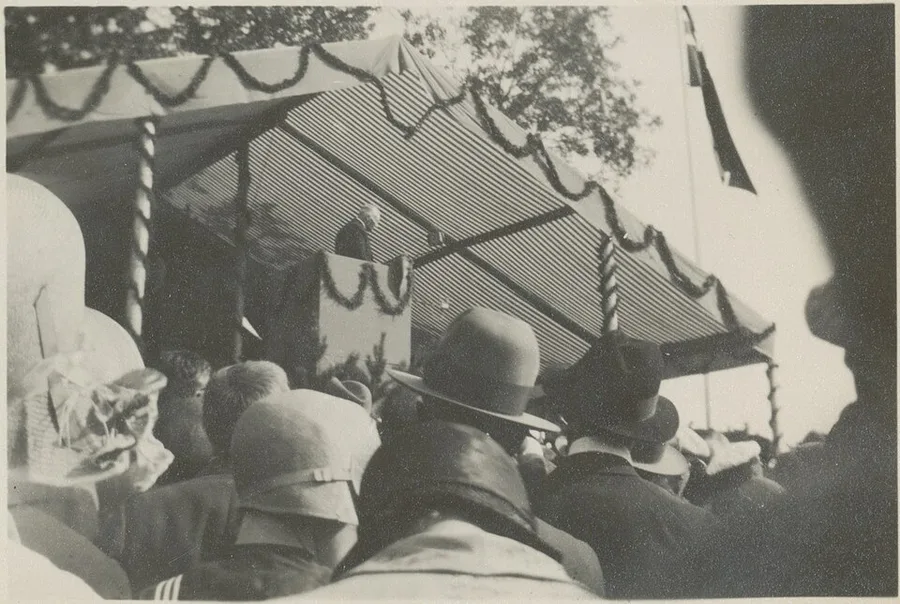 Åsen Museum og Historielag (1930), CC BY 2.0 A crowd gathers at Stiklestad on 29 July 1930 — Olsok itself, the anniversary of Olav's death — photographed decades before the Cultural Centre or the annual play existed, when the observance was simply people turning up at the site on the day. The feast day of Saint Olav — Olav's wake, observed on 29 July,
the anniversary of the king's death at Stiklestad in 1030. Across
the medieval period Olsok was the great summer holiday of the
Norse Atlantic, kept across Norway, Iceland, the Faroes, Greenland,
and the Norse colonies of the British Isles. The Reformation
stripped the religious content from the Norwegian observance after
1537, but the day persisted as a folk holiday and was made the
national flag-day of Norway in 1948. Today Olsok centres on the
Stiklestad commemoration, with the open-air Spelet om Heilag
Olav drawing audiences in the tens of thousands.
On the trip Day 4 of the trip is olsok itself — 29 July. The Gråhårsklubben (the Oldsters) spend it in the Stjørdal heritage country and return to Trondheim for the night, with the Olavsfest filling the city around the cathedral. Also discussed in A Catholic Norway — the faith that gave the kingdom its first institutions and the stave churchesThe Reformation, 1537 — one church eradicated and another imposedTradisjoner — celebrations across the Norwegian year — Olav’s wake — in Norway, the Faroes, and across the Norse Atlantic.
Åsen Museum og Historielag (1930), CC BY 2.0 A crowd gathers at Stiklestad on 29 July 1930 — Olsok itself, the anniversary of Olav's death — photographed decades before the Cultural Centre or the annual play existed, when the observance was simply people turning up at the site on the day. The feast day of Saint Olav — Olav's wake, observed on 29 July,
the anniversary of the king's death at Stiklestad in 1030. Across
the medieval period Olsok was the great summer holiday of the
Norse Atlantic, kept across Norway, Iceland, the Faroes, Greenland,
and the Norse colonies of the British Isles. The Reformation
stripped the religious content from the Norwegian observance after
1537, but the day persisted as a folk holiday and was made the
national flag-day of Norway in 1948. Today Olsok centres on the
Stiklestad commemoration, with the open-air Spelet om Heilag
Olav drawing audiences in the tens of thousands.
On the trip Day 4 of the trip is olsok itself — 29 July. The Gråhårsklubben (the Oldsters) spend it in the Stjørdal heritage country and return to Trondheim for the night, with the Olavsfest filling the city around the cathedral. Also discussed in A Catholic Norway — the faith that gave the kingdom its first institutions and the stave churchesThe Reformation, 1537 — one church eradicated and another imposedTradisjoner — celebrations across the Norwegian year — Olav’s wake — in Norway, the Faroes, and across the Norse Atlantic.
The pilgrim economy that grew around the devotion became the backbone of medieval Norwegian Christianity. The longest single route, the Gudbrandsdalsleden 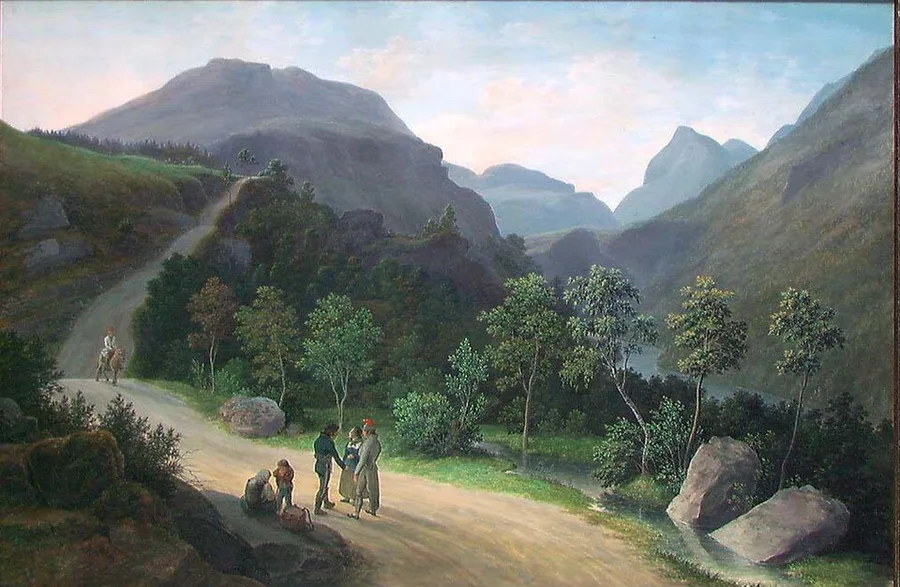 Johannes Flintoe, Vårstigen over Dovre (1835), Nasjonalmuseet Vårstigen, the old road over Dovrefjell at the head of Gudbrandsdalen, is the mountain stretch the pilgrim way to Nidaros shared with every traveller headed north — the climb Flintoe painted is walked again today as a marked stage of the reopened route. "The Gudbrandsdal Way" — the longest of the medieval Norwegian
pilgrim routes to Nidaros, running 643 kilometres from Oslo north
through the long Gudbrandsdalen valley in central Norway to
Trondheim. Named for the valley it followed through the central
Norwegian highland. Marked in the medieval period by stone crosses
and small wayside chapels and serviced by the network of sælehus
(pilgrim hostels). Closed at the Reformation; reopened and re-
marked in stages between 1997 and 2013 as the principal route of
the modern Pilegrimsleden. Walked again every summer.
Also discussed in The Reformation, 1537 — one church eradicated and another imposed , named for the long Gudbrandsdalen valley it followed through the central Norwegian highland, ran from Oslo north to Trondheim — six hundred and forty-three kilometres on foot, marked by stone crosses and small wayside chapels and the network of sælehus where a pilgrim could expect food and a bed without payment. The St. Olavsleden
Johannes Flintoe, Vårstigen over Dovre (1835), Nasjonalmuseet Vårstigen, the old road over Dovrefjell at the head of Gudbrandsdalen, is the mountain stretch the pilgrim way to Nidaros shared with every traveller headed north — the climb Flintoe painted is walked again today as a marked stage of the reopened route. "The Gudbrandsdal Way" — the longest of the medieval Norwegian
pilgrim routes to Nidaros, running 643 kilometres from Oslo north
through the long Gudbrandsdalen valley in central Norway to
Trondheim. Named for the valley it followed through the central
Norwegian highland. Marked in the medieval period by stone crosses
and small wayside chapels and serviced by the network of sælehus
(pilgrim hostels). Closed at the Reformation; reopened and re-
marked in stages between 1997 and 2013 as the principal route of
the modern Pilegrimsleden. Walked again every summer.
Also discussed in The Reformation, 1537 — one church eradicated and another imposed , named for the long Gudbrandsdalen valley it followed through the central Norwegian highland, ran from Oslo north to Trondheim — six hundred and forty-three kilometres on foot, marked by stone crosses and small wayside chapels and the network of sælehus where a pilgrim could expect food and a bed without payment. The St. Olavsleden 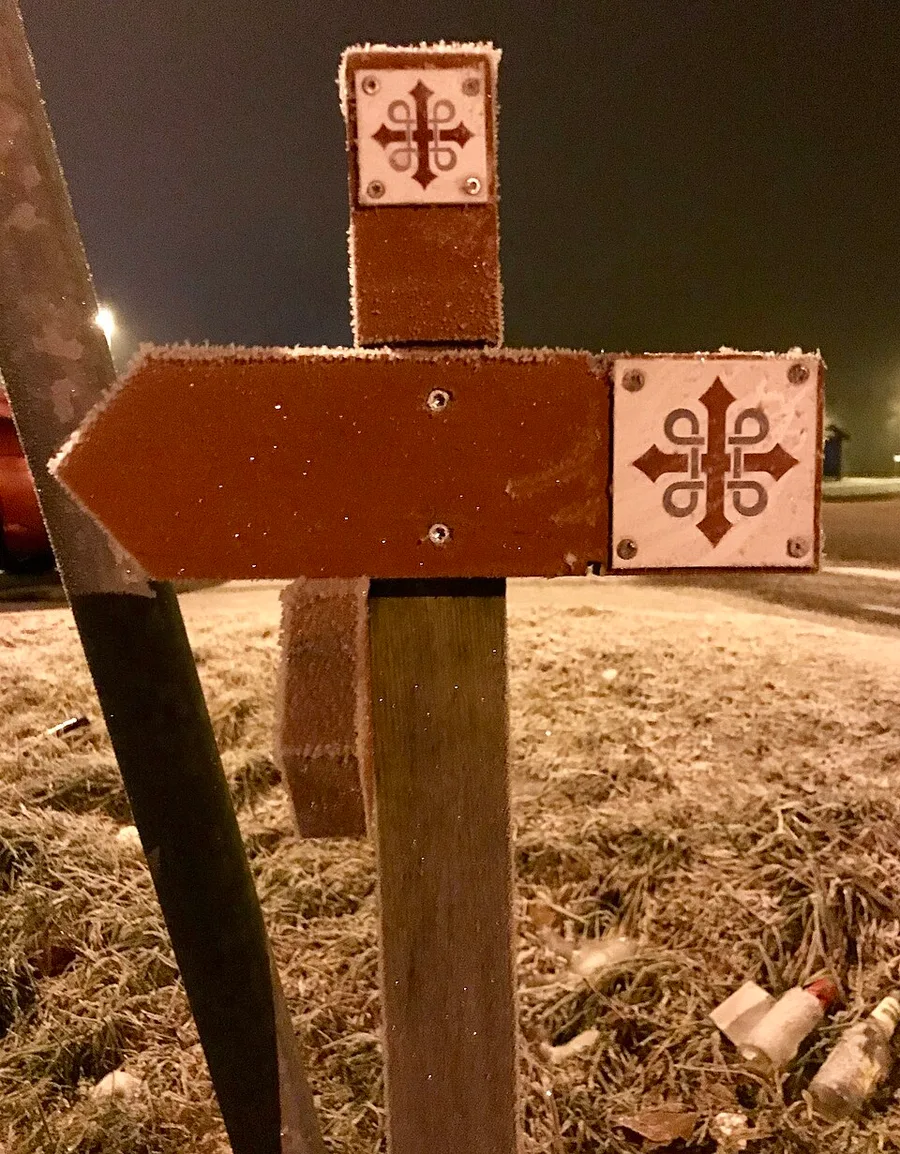 Vogler, Olofsmärke Greåker (2019), Wikimedia Commons, CC BY-SA 4.0 A frosted waymark on the modern route — the red Olav's cross that carries walkers 580 kilometres from Selånger on the Bothnian coast to the west door of Nidaros, along the path Olav's own return from exile traced in the summer of 1030. "Saint Olav's Way" — the 580-kilometre pilgrim route from the
Bothnian Sea coast at Selånger (in modern eastern Sweden) west
through Jämtland and across the border to Trondheim. The route
retraces the actual path Olav II Haraldsson took on his return
from exile in Kievan Rus in the summer of 1030. One of the two
principal modern Norwegian pilgrim routes (alongside the longer
Gudbrandsdalsleden from Oslo); reopened in 2013 as a marked
walking path with the modern Pilegrimsleden hostel and
stamping system.
Also discussed in Tradisjoner — celebrations across the Norwegian year , five hundred and eighty kilometres from the Bothnian Sea coast at Selånger (in modern-day Sweden) through to Trondheim, retraced the actual route Olav had taken on his return from Kievan Rus in the summer of 1030. The pilgrimage to Nidaros stood alongside Rome, Santiago de Compostela
Vogler, Olofsmärke Greåker (2019), Wikimedia Commons, CC BY-SA 4.0 A frosted waymark on the modern route — the red Olav's cross that carries walkers 580 kilometres from Selånger on the Bothnian coast to the west door of Nidaros, along the path Olav's own return from exile traced in the summer of 1030. "Saint Olav's Way" — the 580-kilometre pilgrim route from the
Bothnian Sea coast at Selånger (in modern eastern Sweden) west
through Jämtland and across the border to Trondheim. The route
retraces the actual path Olav II Haraldsson took on his return
from exile in Kievan Rus in the summer of 1030. One of the two
principal modern Norwegian pilgrim routes (alongside the longer
Gudbrandsdalsleden from Oslo); reopened in 2013 as a marked
walking path with the modern Pilegrimsleden hostel and
stamping system.
Also discussed in Tradisjoner — celebrations across the Norwegian year , five hundred and eighty kilometres from the Bothnian Sea coast at Selånger (in modern-day Sweden) through to Trondheim, retraced the actual route Olav had taken on his return from Kievan Rus in the summer of 1030. The pilgrimage to Nidaros stood alongside Rome, Santiago de Compostela 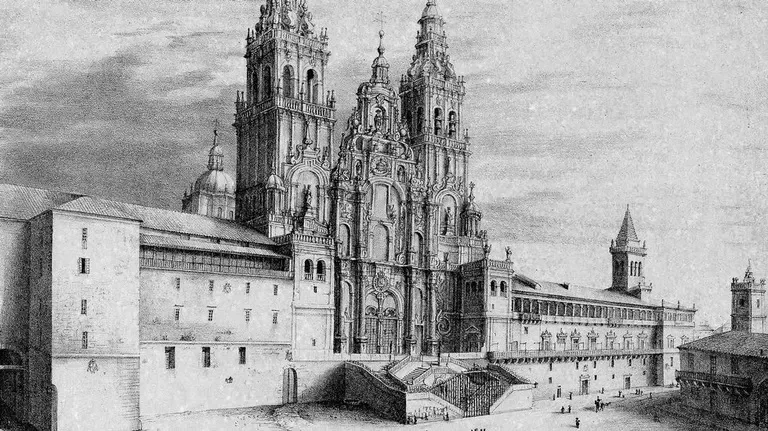 Ramón Gil Rey, lithograph of Santiago cathedral from the Praza do Obradoiro (1838) The Obradoiro facade of the cathedral raised over the apostle's tomb — the goal of the Camino and one of the great pilgrimage destinations of medieval Christendom, the southern counterpart of the pilgrim roads that led north to Nidaros. City in northwestern Spain, capital of Galicia. The discovery of
what was believed to be the tomb of Saint James the Greater in
the early ninth century made the city one of the three great
pilgrimage destinations of medieval Western Christendom —
alongside Rome and Jerusalem, and from the twelfth century
alongside Nidaros and Canterbury as the principal national
pilgrimage sites of northern Europe. The Camino de Santiago
network of pilgrim roads converging on the cathedral is the
largest pilgrim infrastructure that survives from the Middle Ages,
walked again by hundreds of thousands of pilgrims each year.
Also discussed in The Crusades?!!!! — sixty ships from Bergen, bound for the Holy Land in Spain, and Canterbury
Ramón Gil Rey, lithograph of Santiago cathedral from the Praza do Obradoiro (1838) The Obradoiro facade of the cathedral raised over the apostle's tomb — the goal of the Camino and one of the great pilgrimage destinations of medieval Christendom, the southern counterpart of the pilgrim roads that led north to Nidaros. City in northwestern Spain, capital of Galicia. The discovery of
what was believed to be the tomb of Saint James the Greater in
the early ninth century made the city one of the three great
pilgrimage destinations of medieval Western Christendom —
alongside Rome and Jerusalem, and from the twelfth century
alongside Nidaros and Canterbury as the principal national
pilgrimage sites of northern Europe. The Camino de Santiago
network of pilgrim roads converging on the cathedral is the
largest pilgrim infrastructure that survives from the Middle Ages,
walked again by hundreds of thousands of pilgrims each year.
Also discussed in The Crusades?!!!! — sixty ships from Bergen, bound for the Holy Land in Spain, and Canterbury 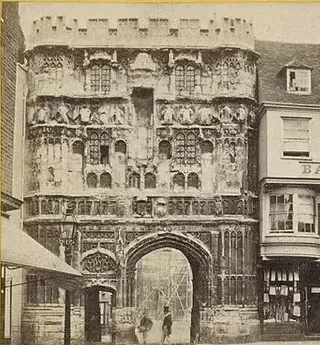 Frank Mason Good, Christ Church Gate, Canterbury Cathedral (c. 1850–1880), Rijksmuseum Christ Church Gate, the ceremonial entrance to Canterbury Cathedral's precincts — the doorway medieval pilgrims passed through to reach Becket's shrine, placing Canterbury alongside Nidaros as one of Europe's great national pilgrimage churches. Cathedral city in Kent, southeastern England. The seat of the
Archbishop of Canterbury and the mother church of the Anglican
Communion since the conversion of England in 597. After the
murder of Archbishop Thomas Becket at the high altar of
Canterbury Cathedral on 29 December 1170 — at the instigation of
King Henry II — the city became one of the principal pilgrimage
destinations of medieval Europe, alongside Rome, Santiago de
Compostela, and Nidaros in Norway.
in England as one of the great pilgrimages of medieval Europe. The traffic funded the rebuilding of the small wooden church at Nidaros into a Romanesque-Gothic Nidaros Cathedral
Frank Mason Good, Christ Church Gate, Canterbury Cathedral (c. 1850–1880), Rijksmuseum Christ Church Gate, the ceremonial entrance to Canterbury Cathedral's precincts — the doorway medieval pilgrims passed through to reach Becket's shrine, placing Canterbury alongside Nidaros as one of Europe's great national pilgrimage churches. Cathedral city in Kent, southeastern England. The seat of the
Archbishop of Canterbury and the mother church of the Anglican
Communion since the conversion of England in 597. After the
murder of Archbishop Thomas Becket at the high altar of
Canterbury Cathedral on 29 December 1170 — at the instigation of
King Henry II — the city became one of the principal pilgrimage
destinations of medieval Europe, alongside Rome, Santiago de
Compostela, and Nidaros in Norway.
in England as one of the great pilgrimages of medieval Europe. The traffic funded the rebuilding of the small wooden church at Nidaros into a Romanesque-Gothic Nidaros Cathedral 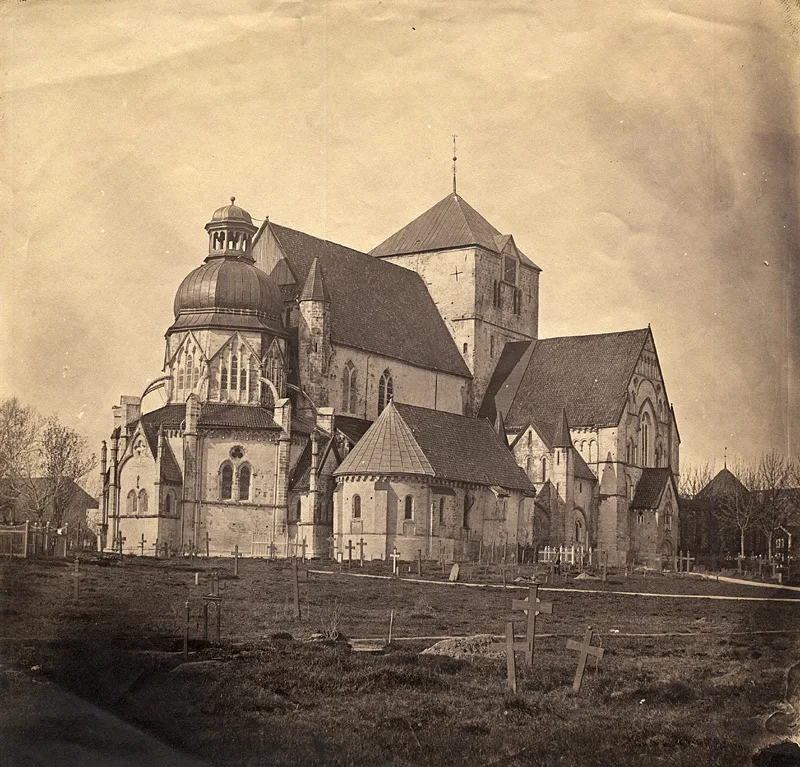 Unknown photographer, Nidaros Cathedral from the northeast (1857), Wikimedia Commons One of the earliest surviving photographs of Norway, taken in 1857 — decades before the west front's twentieth-century reconstruction — showing the cathedral over Olav's grave much as centuries of fire, neglect, and weather had left it. The principal cathedral of Norway and the burial place of Saint
Olav, on the bank of the Nid River in Trondheim. Built and rebuilt
in stages from the late eleventh through the early fourteenth
centuries around the shrine site at the cathedral's east end. The
octagonal east end, raised directly over Olav's grave, was the
devotional core of the medieval building. Substantially damaged
by fires and the 1531 lightning strike, then by neglect across the
Lutheran centuries. The west front a visitor sees today is a
nineteenth- and twentieth-century reconstruction, completed only
in 1983. The cathedral is the coronation and consecration church
of Norwegian kings; Haakon VII was crowned there in 1906, Olav V
consecrated in 1958, Harald V in 1991.
On the trip Day 3 of the trip brings the Gråhårsklubben (the Oldsters) to
Nidaros Cathedral. The shrine is gone but
the spot is marked on the cathedral floor in the octagonal east
end. The west front is the twentieth-century reconstruction of
the face the medieval pilgrims saw. The pilgrim road comes in
past the south door — the same door medieval pilgrims walked
through.
Nidaros Cathedral, Trondheim Also discussed in A Catholic Norway — the faith that gave the kingdom its first institutions and the stave churchesThe Crusades?!!!! — sixty ships from Bergen, bound for the Holy LandThe Golden Age — a North Atlantic empire … reaching farther than you thinkThe Long Fall — the sudden loss of Norwegian nobility, the end of the kings, and half of Norway gone foreverThe 400-Year Night — when the Northern Lion lay dormantThe Reformation, 1537 — one church eradicated and another imposedLutheran Norway and Pietism — a farmer named Hans Nielsen Hauge and a lay revival that could not be silencedThe Quiet Revolution — how Norway won its independence without a warTradisjoner — celebrations across the Norwegian year whose octagonal east end, raised over the shrine site itself, was the medieval devotional core of the building; the west front a visitor sees today is a nineteenth- and twentieth-century reconstruction, its rebuilding finished in 1969 and the last of its statues set in place only in 1983. The bishop of Nidaros became an archbishop in the winter of 1152–53, and the archdiocese that the English papal legate Nicholas Breakspear (Pope Adrian IV)
Unknown photographer, Nidaros Cathedral from the northeast (1857), Wikimedia Commons One of the earliest surviving photographs of Norway, taken in 1857 — decades before the west front's twentieth-century reconstruction — showing the cathedral over Olav's grave much as centuries of fire, neglect, and weather had left it. The principal cathedral of Norway and the burial place of Saint
Olav, on the bank of the Nid River in Trondheim. Built and rebuilt
in stages from the late eleventh through the early fourteenth
centuries around the shrine site at the cathedral's east end. The
octagonal east end, raised directly over Olav's grave, was the
devotional core of the medieval building. Substantially damaged
by fires and the 1531 lightning strike, then by neglect across the
Lutheran centuries. The west front a visitor sees today is a
nineteenth- and twentieth-century reconstruction, completed only
in 1983. The cathedral is the coronation and consecration church
of Norwegian kings; Haakon VII was crowned there in 1906, Olav V
consecrated in 1958, Harald V in 1991.
On the trip Day 3 of the trip brings the Gråhårsklubben (the Oldsters) to
Nidaros Cathedral. The shrine is gone but
the spot is marked on the cathedral floor in the octagonal east
end. The west front is the twentieth-century reconstruction of
the face the medieval pilgrims saw. The pilgrim road comes in
past the south door — the same door medieval pilgrims walked
through.
Nidaros Cathedral, Trondheim Also discussed in A Catholic Norway — the faith that gave the kingdom its first institutions and the stave churchesThe Crusades?!!!! — sixty ships from Bergen, bound for the Holy LandThe Golden Age — a North Atlantic empire … reaching farther than you thinkThe Long Fall — the sudden loss of Norwegian nobility, the end of the kings, and half of Norway gone foreverThe 400-Year Night — when the Northern Lion lay dormantThe Reformation, 1537 — one church eradicated and another imposedLutheran Norway and Pietism — a farmer named Hans Nielsen Hauge and a lay revival that could not be silencedThe Quiet Revolution — how Norway won its independence without a warTradisjoner — celebrations across the Norwegian year whose octagonal east end, raised over the shrine site itself, was the medieval devotional core of the building; the west front a visitor sees today is a nineteenth- and twentieth-century reconstruction, its rebuilding finished in 1969 and the last of its statues set in place only in 1983. The bishop of Nidaros became an archbishop in the winter of 1152–53, and the archdiocese that the English papal legate Nicholas Breakspear (Pope Adrian IV) 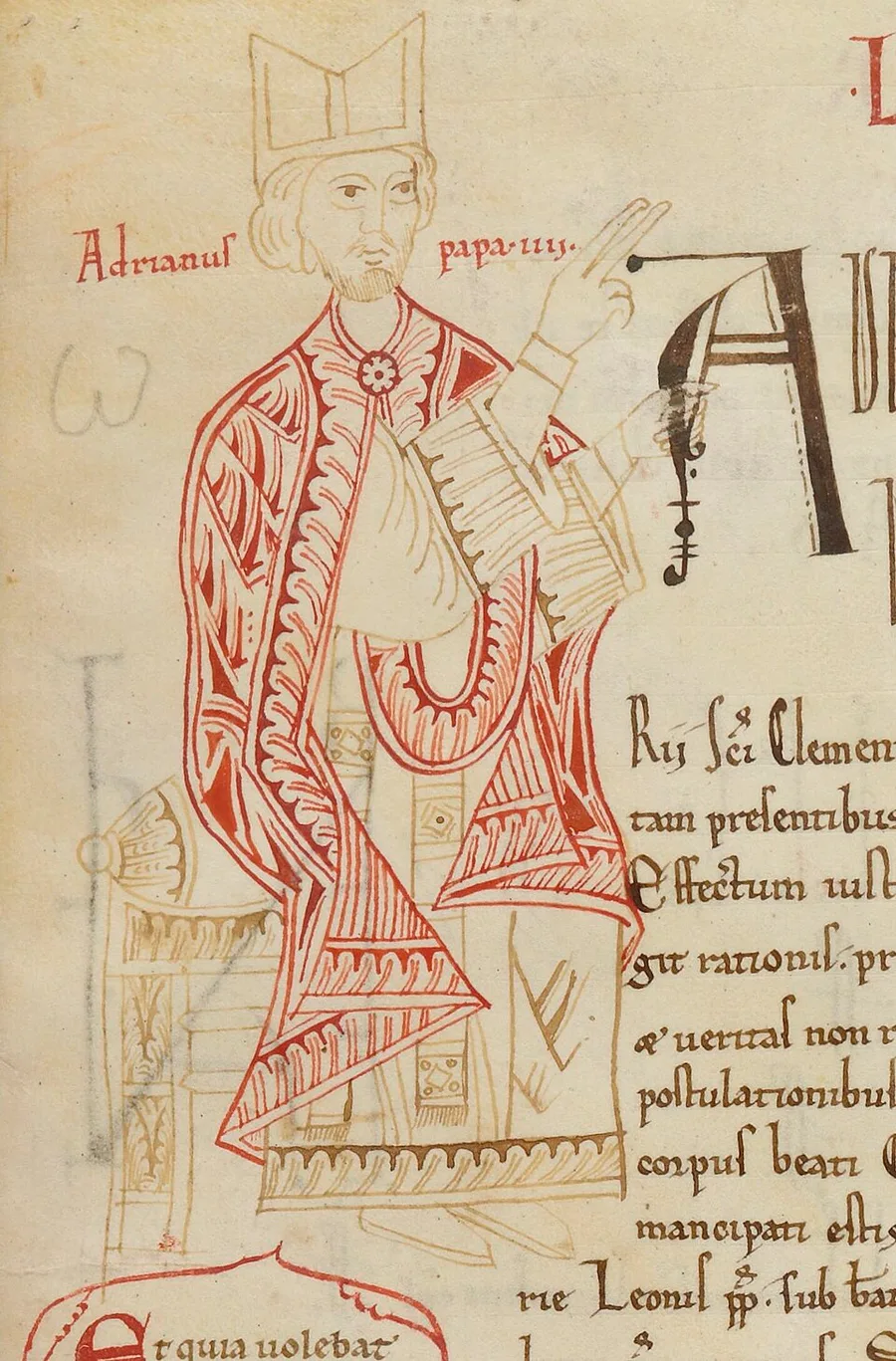 Adrian IV, Chartularium monasterii Casauriensis (c. 1150-1200), Bibliothèque nationale de France (Gallica) A near-contemporary manuscript miniature of Adrian IV — the English cardinal Nicholas Breakspear, sent north as papal legate in 1152, who detached the Norwegian church from Lund and raised Nidaros to an archbishopric two years before he became the only English pope. English cardinal (c. 1100–1159) and, as Pope Adrian IV (1154–1159),
the only Englishman to have held the papacy. In 1152 — two years
before his election to the throne of Saint Peter — Breakspear was
sent as papal legate to Scandinavia and reorganised the Norwegian
church around a new archdiocese at Nidaros, raising the bishop of
Nidaros to archbishop and giving Norway its own ecclesiastical
province independent of Lund. The province stretched from
Trondheim to the Faroes, Greenland, and the Norse colonies of the
British Isles. Died at Anagni in 1159.
Also discussed in A Catholic Norway — the faith that gave the kingdom its first institutions and the stave churchesThe Crusades?!!!! — sixty ships from Bergen, bound for the Holy Land — the future Pope Adrian IV — organised for the Norwegian church stretched from Trondheim to the Faroes, Greenland, and the Norse colonies of the British Isles.
Adrian IV, Chartularium monasterii Casauriensis (c. 1150-1200), Bibliothèque nationale de France (Gallica) A near-contemporary manuscript miniature of Adrian IV — the English cardinal Nicholas Breakspear, sent north as papal legate in 1152, who detached the Norwegian church from Lund and raised Nidaros to an archbishopric two years before he became the only English pope. English cardinal (c. 1100–1159) and, as Pope Adrian IV (1154–1159),
the only Englishman to have held the papacy. In 1152 — two years
before his election to the throne of Saint Peter — Breakspear was
sent as papal legate to Scandinavia and reorganised the Norwegian
church around a new archdiocese at Nidaros, raising the bishop of
Nidaros to archbishop and giving Norway its own ecclesiastical
province independent of Lund. The province stretched from
Trondheim to the Faroes, Greenland, and the Norse colonies of the
British Isles. Died at Anagni in 1159.
Also discussed in A Catholic Norway — the faith that gave the kingdom its first institutions and the stave churchesThe Crusades?!!!! — sixty ships from Bergen, bound for the Holy Land — the future Pope Adrian IV — organised for the Norwegian church stretched from Trondheim to the Faroes, Greenland, and the Norse colonies of the British Isles.
What the saint built
Norway became, in the high medieval period, the farthest-north member of Latin Christendom. The country built stave churches and stone cathedrals on the continental model. It produced the first generation of Norwegian Latin literacy in the cathedral schools at Nidaros and Bergen 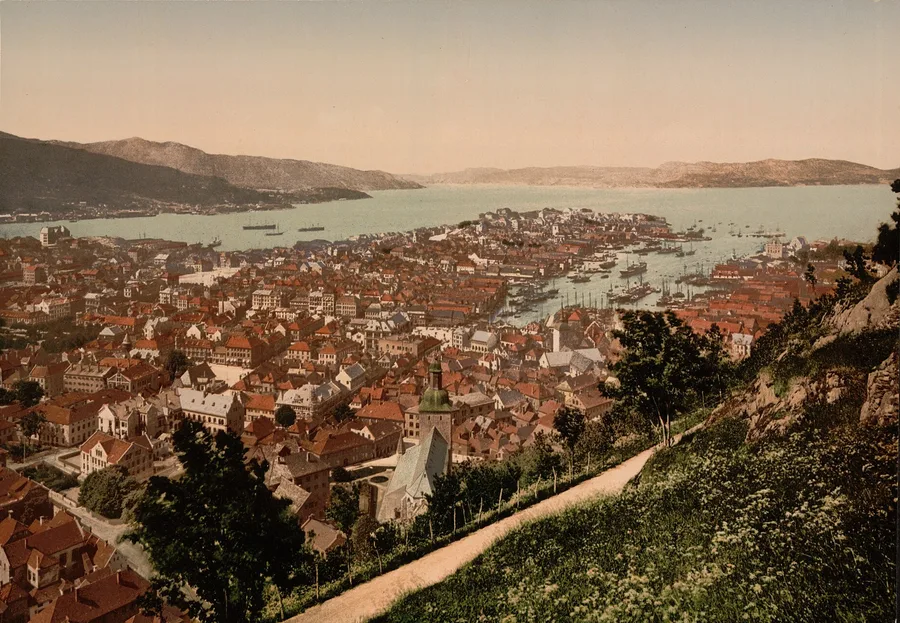 Photochrom print, General view from Fjeldveien, Bergen (c. 1890–1900), Library of Congress Bergen in the 1890s from the Fjellveien path on Fløyfjellet — the whole city between its mountains, Vågen harbour still crowded with sailing ships at its heart. For four centuries Norway's largest city, and the wharf through which the entire western export economy ran. Norway's western trading capital, founded around 1070 on the
inner Byfjorden. For four centuries the largest city in the
country and the wharf through which the entire western export
economy ran — dried cod from the Lofoten fisheries, stockpiled
and traded by the Hanseatic merchants at Bryggen from 1360 to
1754. Norway's commercial and intellectual heart through the
Hanseatic period; overtaken in size by Christiania (Oslo) in the
1830s. The painted wooden Bryggen wharf is on the UNESCO World
Heritage list and substantially what it was in the late
seventeenth century.
In this article Bergen produced one of the early Catholic cathedral schools
and the first generation of Norwegian Latin literacy alongside
Nidaros. Less central to the Olav cult than Nidaros itself, but
the secondary western anchor of medieval Norwegian Catholicism.
On the trip The Ungdommene (the Youngsters) reach Bergen late on Day 3
via the Norway-in-a-Nutshell train-and-ferry route from
Oslo. On the Day 4 morning they walk Bryggen and ride the
funicular up Mount Fløyen before flying back to Oslo and driving
on to Lillehammer that evening — a day ahead of the Gråhårsklubben
(the Oldsters), who spend the split days north in Trondheim and
the heritage country of Stjørdal, Hegra, and Kylloplass and come
south on Day 5.
Bergen Also discussed in The Germans Who "Ruled" Bergen — the Hanseatic merchants on Bryggen WharfBefore There Was Norway — petty kingdoms at the edge of the worldA Catholic Norway — the faith that gave the kingdom its first institutions and the stave churchesThe Long Fall — the sudden loss of Norwegian nobility, the end of the kings, and half of Norway gone foreverThe Golden Age — a North Atlantic empire … reaching farther than you thinkThe 400-Year Night — when the Northern Lion lay dormantThe Crusades?!!!! — sixty ships from Bergen, bound for the Holy LandThe Reformation, 1537 — one church eradicated and another imposedWorld War II — the King’s “No” and the Nazis in NorwayKraken — the island-sized beast, logged as factSjøormer — the serpents in the deep lakes and fjordsPesta — an old woman walking from farm to farmFossegrimen — the waterfall fiddler who teaches you to playAlcohol and Vinmonopolet — when and where to buy a drinkEveryday etiquette — quiet voices, wide space, no smilingFood and dining customs — having patience, free water, brunost on everything🚨 Emergencies - important numbers, hospitals, and what you can doLanguage basics — just enough Norwegian to be politeWhat to wear — the layering system, on the ground . It exported its dried cod to feed the Lenten tables of Catholic Europe, where the practice of abstaining from meat during Lent and on Fridays drove an enormous demand for preserved fish. By the early thirteenth century, the longest single saga in the great medieval Icelandic king-collection, the Heimskringla
Photochrom print, General view from Fjeldveien, Bergen (c. 1890–1900), Library of Congress Bergen in the 1890s from the Fjellveien path on Fløyfjellet — the whole city between its mountains, Vågen harbour still crowded with sailing ships at its heart. For four centuries Norway's largest city, and the wharf through which the entire western export economy ran. Norway's western trading capital, founded around 1070 on the
inner Byfjorden. For four centuries the largest city in the
country and the wharf through which the entire western export
economy ran — dried cod from the Lofoten fisheries, stockpiled
and traded by the Hanseatic merchants at Bryggen from 1360 to
1754. Norway's commercial and intellectual heart through the
Hanseatic period; overtaken in size by Christiania (Oslo) in the
1830s. The painted wooden Bryggen wharf is on the UNESCO World
Heritage list and substantially what it was in the late
seventeenth century.
In this article Bergen produced one of the early Catholic cathedral schools
and the first generation of Norwegian Latin literacy alongside
Nidaros. Less central to the Olav cult than Nidaros itself, but
the secondary western anchor of medieval Norwegian Catholicism.
On the trip The Ungdommene (the Youngsters) reach Bergen late on Day 3
via the Norway-in-a-Nutshell train-and-ferry route from
Oslo. On the Day 4 morning they walk Bryggen and ride the
funicular up Mount Fløyen before flying back to Oslo and driving
on to Lillehammer that evening — a day ahead of the Gråhårsklubben
(the Oldsters), who spend the split days north in Trondheim and
the heritage country of Stjørdal, Hegra, and Kylloplass and come
south on Day 5.
Bergen Also discussed in The Germans Who "Ruled" Bergen — the Hanseatic merchants on Bryggen WharfBefore There Was Norway — petty kingdoms at the edge of the worldA Catholic Norway — the faith that gave the kingdom its first institutions and the stave churchesThe Long Fall — the sudden loss of Norwegian nobility, the end of the kings, and half of Norway gone foreverThe Golden Age — a North Atlantic empire … reaching farther than you thinkThe 400-Year Night — when the Northern Lion lay dormantThe Crusades?!!!! — sixty ships from Bergen, bound for the Holy LandThe Reformation, 1537 — one church eradicated and another imposedWorld War II — the King’s “No” and the Nazis in NorwayKraken — the island-sized beast, logged as factSjøormer — the serpents in the deep lakes and fjordsPesta — an old woman walking from farm to farmFossegrimen — the waterfall fiddler who teaches you to playAlcohol and Vinmonopolet — when and where to buy a drinkEveryday etiquette — quiet voices, wide space, no smilingFood and dining customs — having patience, free water, brunost on everything🚨 Emergencies - important numbers, hospitals, and what you can doLanguage basics — just enough Norwegian to be politeWhat to wear — the layering system, on the ground . It exported its dried cod to feed the Lenten tables of Catholic Europe, where the practice of abstaining from meat during Lent and on Fridays drove an enormous demand for preserved fish. By the early thirteenth century, the longest single saga in the great medieval Icelandic king-collection, the Heimskringla 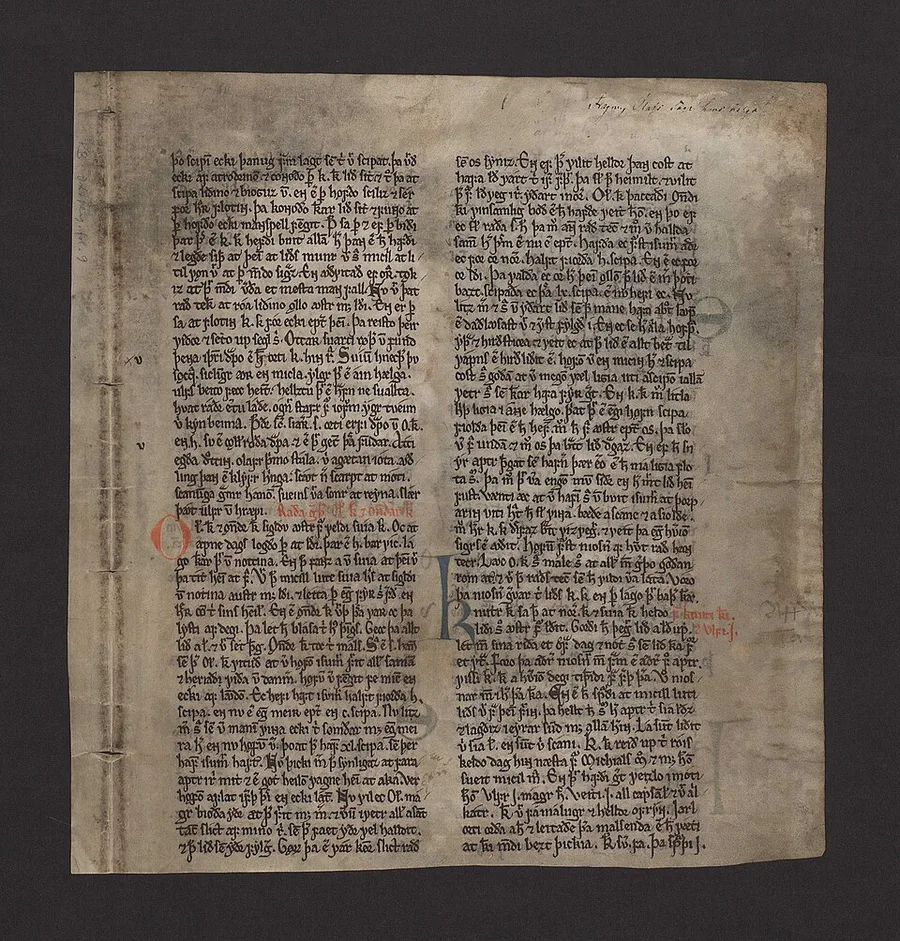 Kringlublaðið (the Kringla leaf), Lbs fragm 82, c. 1260 — National and University Library of Iceland This single surviving vellum leaf is all that remains of the original Kringla manuscript — the best medieval copy of Heimskringla — after the rest burned in Copenhagen's 1728 fire. Snorri Sturluson's prose history of the kings of Norway, composed
in the 1220s. Sixteen sagas running from the semi-mythical Yngling
line through to the late twelfth century. The single most extensive
medieval source for Norway's Viking and Christianization centuries
— trusted on the broad shape of political history, questioned in
the literary expansions, and written by a Christian Icelander
three hundred years after the events.
In this article The longest single saga in the Heimskringla is the Saga of
Olav the Holy — Snorri's expansive life of the saint-king
whose story this article tells. The Stiklestad battle cry
quoted here is one of its most-cited passages.
Also discussed in The Viking Age — longships, legends, and the first "Norway"Worshiping Odin and Thor — the lived religion of pre-Christian NorwayA Catholic Norway — the faith that gave the kingdom its first institutions and the stave churchesThe Golden Age — a North Atlantic empire … reaching farther than you thinkThe Crusades?!!!! — sixty ships from Bergen, bound for the Holy Land — and by a substantial margin — was the Saga of Olav the Holy. The man who could not hold his throne in life held the country’s narrative for the next five hundred years.
Kringlublaðið (the Kringla leaf), Lbs fragm 82, c. 1260 — National and University Library of Iceland This single surviving vellum leaf is all that remains of the original Kringla manuscript — the best medieval copy of Heimskringla — after the rest burned in Copenhagen's 1728 fire. Snorri Sturluson's prose history of the kings of Norway, composed
in the 1220s. Sixteen sagas running from the semi-mythical Yngling
line through to the late twelfth century. The single most extensive
medieval source for Norway's Viking and Christianization centuries
— trusted on the broad shape of political history, questioned in
the literary expansions, and written by a Christian Icelander
three hundred years after the events.
In this article The longest single saga in the Heimskringla is the Saga of
Olav the Holy — Snorri's expansive life of the saint-king
whose story this article tells. The Stiklestad battle cry
quoted here is one of its most-cited passages.
Also discussed in The Viking Age — longships, legends, and the first "Norway"Worshiping Odin and Thor — the lived religion of pre-Christian NorwayA Catholic Norway — the faith that gave the kingdom its first institutions and the stave churchesThe Golden Age — a North Atlantic empire … reaching farther than you thinkThe Crusades?!!!! — sixty ships from Bergen, bound for the Holy Land — and by a substantial margin — was the Saga of Olav the Holy. The man who could not hold his throne in life held the country’s narrative for the next five hundred years.
1537
The Reformation broke the official devotion. In 1537 the Lutheran settlement imposed from Copenhagen abolished the veneration of saints, dissolved the monasteries, and ordered the relics destroyed. The silver shrine over the high altar at Nidaros — the Olafskrinet 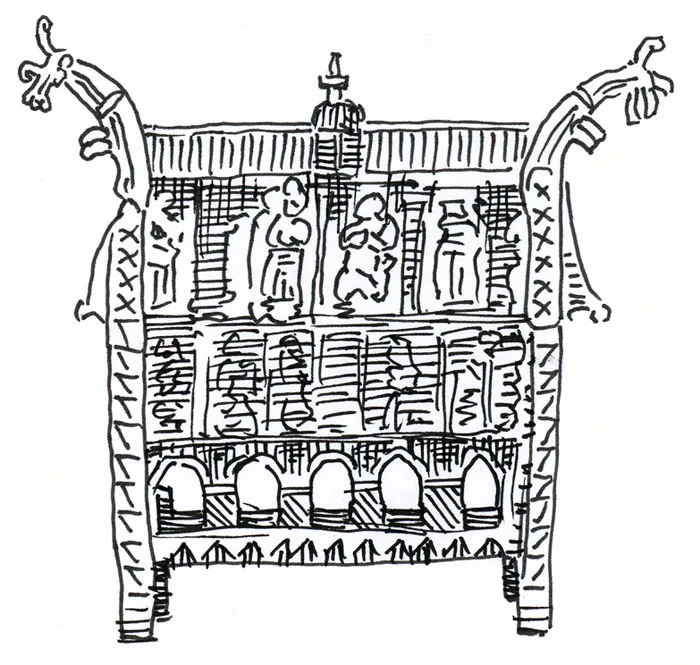 Finn Bjørklid, sketch of a presumed medieval Norwegian reliquary shrine, public domain No period depiction of Olav's actual shrine survives — the object itself was melted down in 1568. This modern line drawing reconstructs the general house-roofed casket form medieval sources describe, standing in for an object no image or fragment records directly. The silver reliquary shrine of Saint Olav at Nidaros Cathedral —
the principal devotional object of the medieval Norwegian church
and the centre of the pilgrim economy that funded the cathedral.
Commissioned across multiple decades of the eleventh and twelfth
centuries, the shrine stood on the high altar of the cathedral
through the medieval Catholic period. The Lutheran Reformation
imposed from Copenhagen in 1537 dissolved the cult of saints and
ordered the shrine destroyed; the silver was sent at once to the
Copenhagen mint. The body itself outlasted the silver by a
generation. The final destruction of the remaining shrine came in
1568; Olav was reburied somewhere within the cathedral after that,
in a location that has not been recovered since.
Also discussed in The Reformation, 1537 — one church eradicated and another imposed — was broken up at once and the silver sent to the Copenhagen
Finn Bjørklid, sketch of a presumed medieval Norwegian reliquary shrine, public domain No period depiction of Olav's actual shrine survives — the object itself was melted down in 1568. This modern line drawing reconstructs the general house-roofed casket form medieval sources describe, standing in for an object no image or fragment records directly. The silver reliquary shrine of Saint Olav at Nidaros Cathedral —
the principal devotional object of the medieval Norwegian church
and the centre of the pilgrim economy that funded the cathedral.
Commissioned across multiple decades of the eleventh and twelfth
centuries, the shrine stood on the high altar of the cathedral
through the medieval Catholic period. The Lutheran Reformation
imposed from Copenhagen in 1537 dissolved the cult of saints and
ordered the shrine destroyed; the silver was sent at once to the
Copenhagen mint. The body itself outlasted the silver by a
generation. The final destruction of the remaining shrine came in
1568; Olav was reburied somewhere within the cathedral after that,
in a location that has not been recovered since.
Also discussed in The Reformation, 1537 — one church eradicated and another imposed — was broken up at once and the silver sent to the Copenhagen 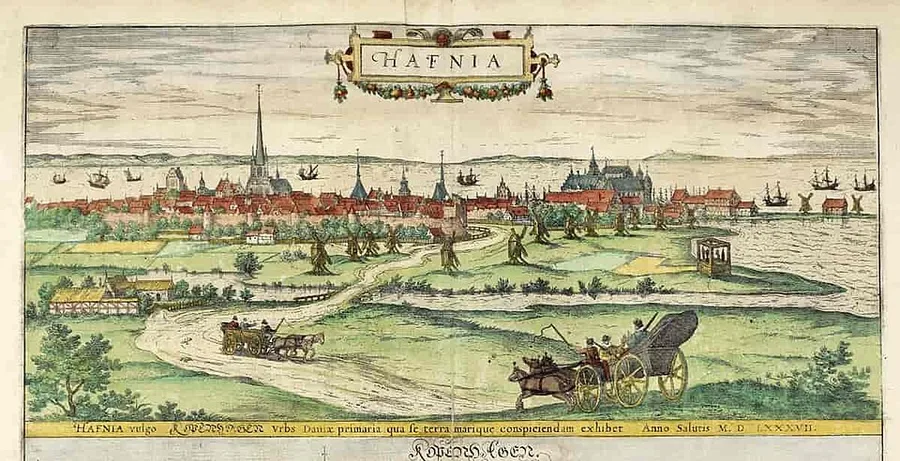 Georg Braun & Frans Hogenberg, view of Copenhagen from Vesterbro (1587), Civitates Orbis Terrarum Braun & Hogenberg's 1587 prospect of Copenhagen, capital of the Danish-Norwegian union from which the 1537 Reformation was imposed on Norway and to which the melted-down silver of Olav's shrine was sent after Nidaros Cathedral was stripped. Capital of Denmark, on the eastern coast of the island of Zealand
across the Øresund strait from Sweden. Founded as a fishing town
in the early medieval period, formal city in 1167, royal capital
from the early fifteenth century. The administrative centre of the
Danish kingdom and, from 1380 to 1814, of the Danish-Norwegian
union — the place where the 1537 Lutheran Reformation in Norway
was decided and from which the silver of the Olafskrinet was
sent to the Copenhagen mint after the destruction of the shrine
at Nidaros.
Also discussed in A Catholic Norway — the faith that gave the kingdom its first institutions and the stave churchesThe 400-Year Night — when the Northern Lion lay dormantThe Reformation, 1537 — one church eradicated and another imposedWorld War II — the King’s “No” and the Nazis in Norway mint. The body itself outlasted the silver by a generation. The final destruction of what remained of the shrine came in 1568; the saint was reburied somewhere within the cathedral after that, in a place that has not been recovered since. The pilgrim hostels were closed, the route markers came down, and Olsok became a folk holiday with the religious content stripped out.
Georg Braun & Frans Hogenberg, view of Copenhagen from Vesterbro (1587), Civitates Orbis Terrarum Braun & Hogenberg's 1587 prospect of Copenhagen, capital of the Danish-Norwegian union from which the 1537 Reformation was imposed on Norway and to which the melted-down silver of Olav's shrine was sent after Nidaros Cathedral was stripped. Capital of Denmark, on the eastern coast of the island of Zealand
across the Øresund strait from Sweden. Founded as a fishing town
in the early medieval period, formal city in 1167, royal capital
from the early fifteenth century. The administrative centre of the
Danish kingdom and, from 1380 to 1814, of the Danish-Norwegian
union — the place where the 1537 Lutheran Reformation in Norway
was decided and from which the silver of the Olafskrinet was
sent to the Copenhagen mint after the destruction of the shrine
at Nidaros.
Also discussed in A Catholic Norway — the faith that gave the kingdom its first institutions and the stave churchesThe 400-Year Night — when the Northern Lion lay dormantThe Reformation, 1537 — one church eradicated and another imposedWorld War II — the King’s “No” and the Nazis in Norway mint. The body itself outlasted the silver by a generation. The final destruction of what remained of the shrine came in 1568; the saint was reburied somewhere within the cathedral after that, in a place that has not been recovered since. The pilgrim hostels were closed, the route markers came down, and Olsok became a folk holiday with the religious content stripped out.
What ended in 1537 was the Norwegian state-administered devotion to Olav. The wider Catholic Church did not stop. Olav’s feast day was kept across Catholic Europe through the four centuries of Protestant rule in Norway, and Catholic missionaries returning to the country in the nineteenth century carried the devotion back with them. The first Catholic parish in Norway since the Reformation was established in Oslo in 1843. The St. Olav's Catholic Cathedral (Oslo) 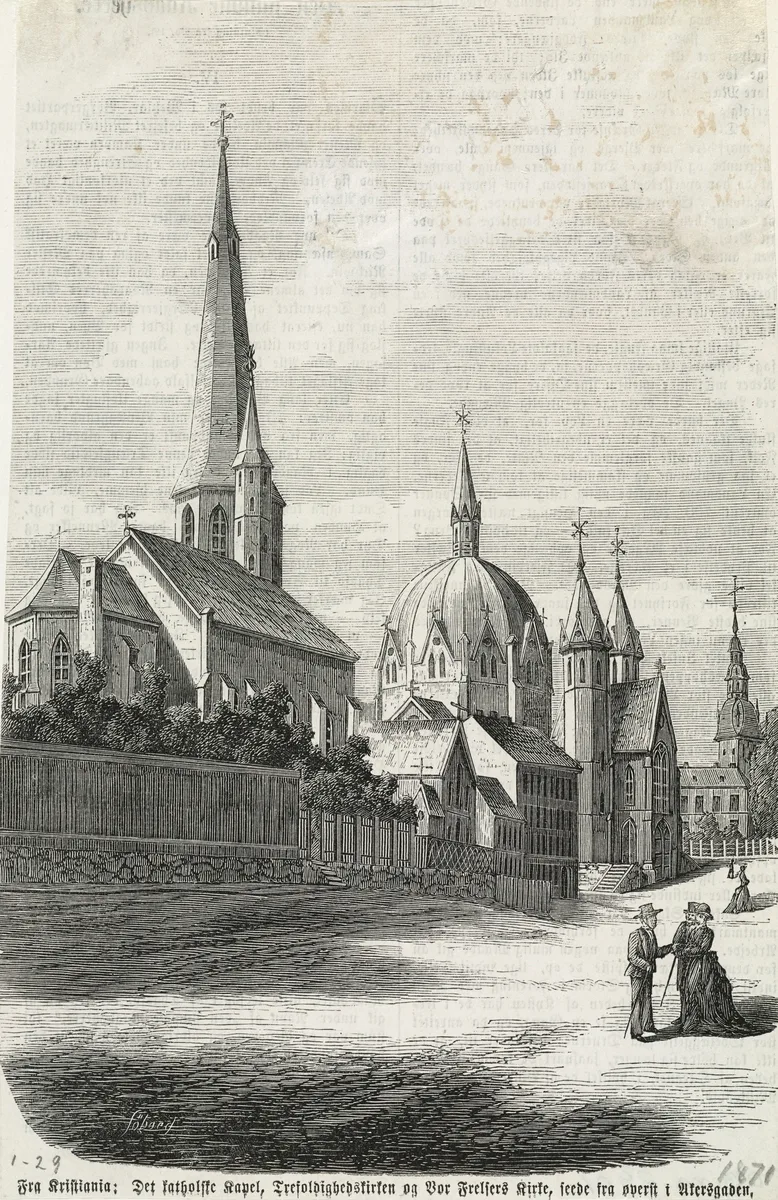 Andreas Ludvig Søborg, St. Olavs kirke og Trefoldighetskirken (1871), Oslo Museum, CC BY 4.0 An 1871 engraving of the cathedral not long after its 1856 opening — the first Catholic parish church built in Norway since the Reformation, and the building that today holds the relic identified as Olav's own calf-bone. The cathedral of the Roman Catholic Diocese of Oslo, at Akersveien 5
in central Oslo. Opened with its first mass on 24 August 1856 —
the first Catholic parish church in Norway since the 1537
Reformation. A relic of Saint Olav was transferred from the
Danish National Museum in Copenhagen and given to the Cathedral
in 1862; modern forensic examination has identified it as the
left calf-bone of a male who died around 1030 from battle wounds,
at least consistent with the king who fell at Stiklestad. The
relic is venerated at the cathedral today.
St. Olav's Catholic Cathedral, Oslo in the same city opened with its first mass on 24 August 1856. A relic was given to the new Cathedral in 1862, transferred from the Danish National Museum in Copenhagen. Its earlier provenance is undocumented; it had been identified with Olav only in the early nineteenth century, and was traditionally called his arm-bone. Modern forensic examination has identified it as the left calf-bone of a male who died around 1030 from battle wounds — at least consistent with the king who fell at Stiklestad. It is venerated in the Cathedral today.
Andreas Ludvig Søborg, St. Olavs kirke og Trefoldighetskirken (1871), Oslo Museum, CC BY 4.0 An 1871 engraving of the cathedral not long after its 1856 opening — the first Catholic parish church built in Norway since the Reformation, and the building that today holds the relic identified as Olav's own calf-bone. The cathedral of the Roman Catholic Diocese of Oslo, at Akersveien 5
in central Oslo. Opened with its first mass on 24 August 1856 —
the first Catholic parish church in Norway since the 1537
Reformation. A relic of Saint Olav was transferred from the
Danish National Museum in Copenhagen and given to the Cathedral
in 1862; modern forensic examination has identified it as the
left calf-bone of a male who died around 1030 from battle wounds,
at least consistent with the king who fell at Stiklestad. The
relic is venerated at the cathedral today.
St. Olav's Catholic Cathedral, Oslo in the same city opened with its first mass on 24 August 1856. A relic was given to the new Cathedral in 1862, transferred from the Danish National Museum in Copenhagen. Its earlier provenance is undocumented; it had been identified with Olav only in the early nineteenth century, and was traditionally called his arm-bone. Modern forensic examination has identified it as the left calf-bone of a male who died around 1030 from battle wounds — at least consistent with the king who fell at Stiklestad. It is venerated in the Cathedral today.
What did not die
Inside Lutheran Norway, the folk-memory of Olav as a hero-king survived in the rural districts through the four centuries between the Reformation and the modern revival. Place-names along the old pilgrim routes still carry his name — Sankt Olavs vei, Saint Olav’s road; Olavsstenen, Olav’s stone; Olavskilden, Olav’s spring. Local churches kept stone crosses and weathered altar-fragments from the medieval period.
The 1930 commemoration of the nine-hundredth anniversary of Stiklestad was a major Norwegian national event. In 1954 the playwright Olav Gullvåg  Unknown photographer, portrait of Olav Gullvåg (c. 1930), via Wikimedia Commons Gullvåg around 1930, in his newspaper years — some two decades before he wrote *Spelet om Heilag Olav*, the open-air Stiklestad drama that turned the battlefield of 1030 into an annual midsummer stage. Norwegian playwright and journalist (1885–1961), best remembered as
the author of Spelet om Heilag Olav ("The Play of the Holy Olav"),
the open-air drama about Olav II Haraldsson and the Battle of
Stiklestad that he wrote in collaboration with the composer Paul
Okkenhaug. The play premiered at the Stiklestad battle site in
1954 and has been performed there every summer since 1960, broken
only by the pandemic summers of 2020 and 2021, drawing audiences
in the tens of thousands across the days leading up to the Olsok
feast on 29 July.
and the composer Paul Okkenhaug
Unknown photographer, portrait of Olav Gullvåg (c. 1930), via Wikimedia Commons Gullvåg around 1930, in his newspaper years — some two decades before he wrote *Spelet om Heilag Olav*, the open-air Stiklestad drama that turned the battlefield of 1030 into an annual midsummer stage. Norwegian playwright and journalist (1885–1961), best remembered as
the author of Spelet om Heilag Olav ("The Play of the Holy Olav"),
the open-air drama about Olav II Haraldsson and the Battle of
Stiklestad that he wrote in collaboration with the composer Paul
Okkenhaug. The play premiered at the Stiklestad battle site in
1954 and has been performed there every summer since 1960, broken
only by the pandemic summers of 2020 and 2021, drawing audiences
in the tens of thousands across the days leading up to the Olsok
feast on 29 July.
and the composer Paul Okkenhaug 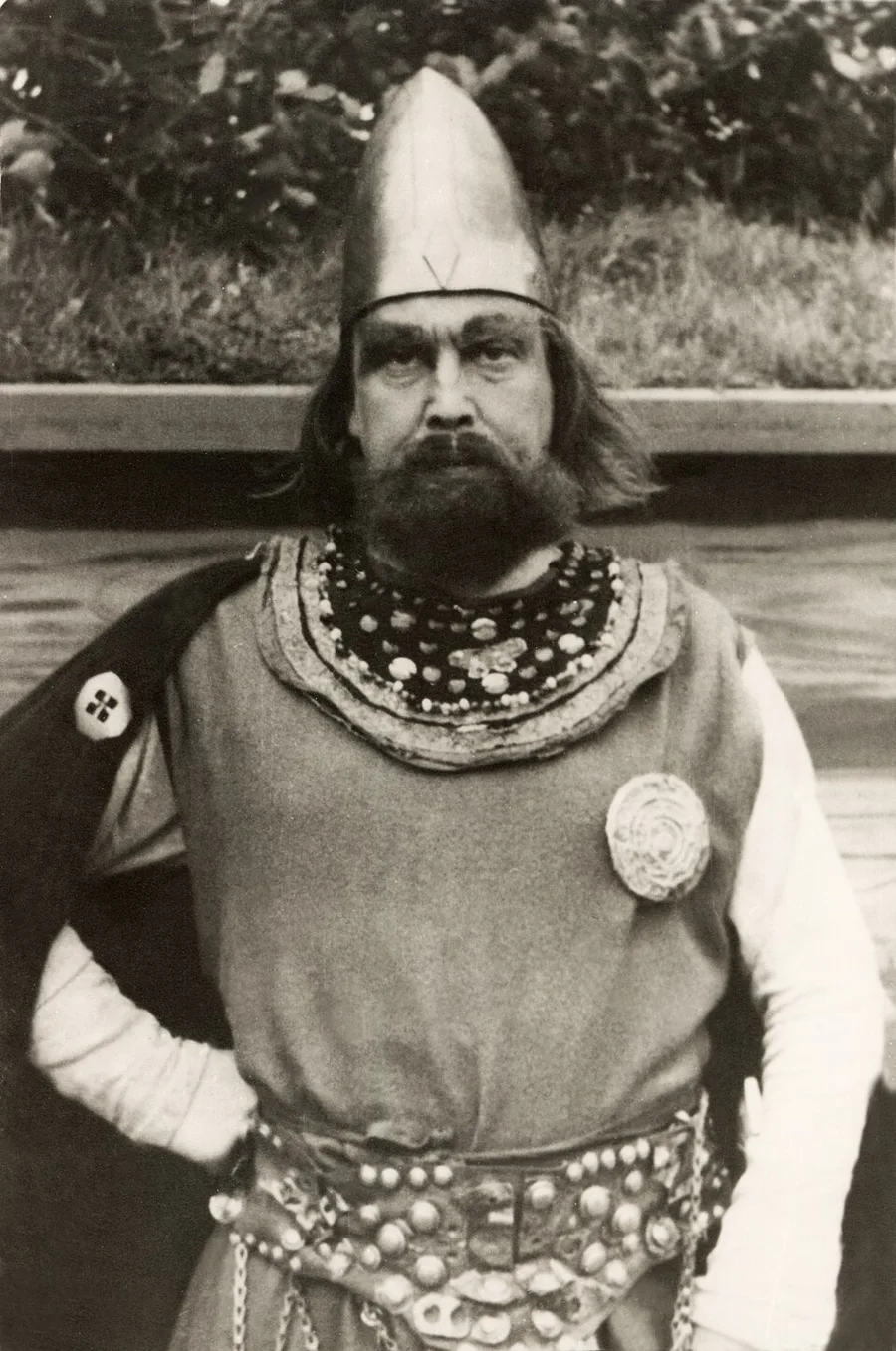 Stiklestad Nasjonale Kultursenter, Gisle Straume as the King in Spelet om Heilag Olav (1954), CC BY-SA 3.0 No free portrait of the composer exists. This is the premiere staging of Spelet om Heilag Olav at Stiklestad in 1954 — Gisle Straume as King Olav — the production whose score Okkenhaug wrote and which has carried his music every summer since 1960, the pandemic years 2020–21 excepted. Norwegian composer (1908–1975), best remembered as the composer of
the musical score for Spelet om Heilag Olav — the open-air play
about Olav II Haraldsson and the Battle of Stiklestad written by
Olav Gullvåg. The play premiered at Stiklestad in 1954 and has
been performed there every summer since 1960, broken only by the
pandemic summers of 2020 and 2021, with Okkenhaug's score carried
forward as the central musical tradition of the modern Olsok
observance.
premiered Spelet om Heilag Olav — the play of the holy Olav — at the battle site; after early stagings in 1954–55 it has been performed at Stiklestad every summer since 1960, broken only by the two pandemic summers of 2020 and 2021. The pilgrim routes were re-marked and reopened in stages between 1997 and 2013; the modern Pilegrimsleden
Stiklestad Nasjonale Kultursenter, Gisle Straume as the King in Spelet om Heilag Olav (1954), CC BY-SA 3.0 No free portrait of the composer exists. This is the premiere staging of Spelet om Heilag Olav at Stiklestad in 1954 — Gisle Straume as King Olav — the production whose score Okkenhaug wrote and which has carried his music every summer since 1960, the pandemic years 2020–21 excepted. Norwegian composer (1908–1975), best remembered as the composer of
the musical score for Spelet om Heilag Olav — the open-air play
about Olav II Haraldsson and the Battle of Stiklestad written by
Olav Gullvåg. The play premiered at Stiklestad in 1954 and has
been performed there every summer since 1960, broken only by the
pandemic summers of 2020 and 2021, with Okkenhaug's score carried
forward as the central musical tradition of the modern Olsok
observance.
premiered Spelet om Heilag Olav — the play of the holy Olav — at the battle site; after early stagings in 1954–55 it has been performed at Stiklestad every summer since 1960, broken only by the two pandemic summers of 2020 and 2021. The pilgrim routes were re-marked and reopened in stages between 1997 and 2013; the modern Pilegrimsleden 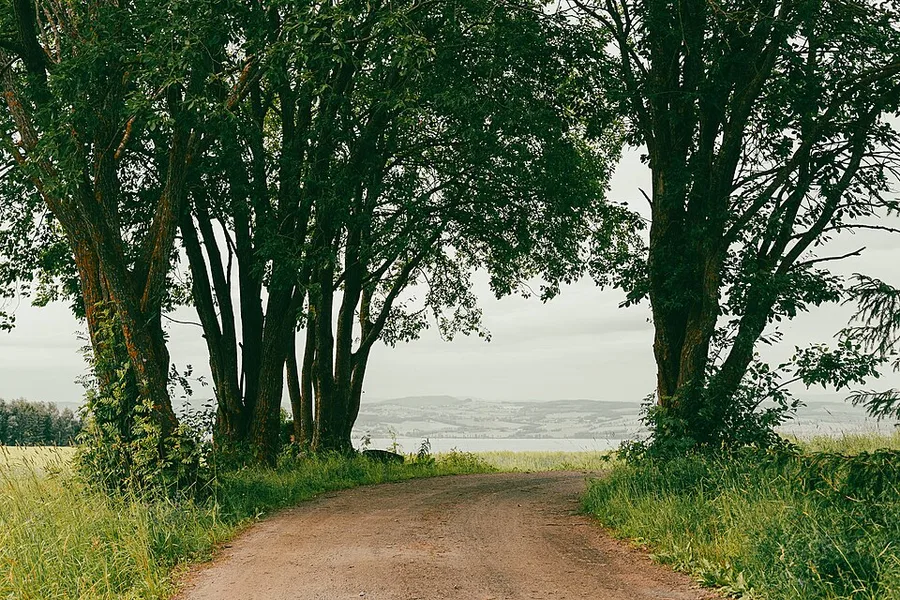 Øyvind Holmstad, Pilegrimsleden between Hoff church and Kapp, Toten (2021), Wikimedia Commons, CC BY-SA 4.0 The reopened route in walking use: a stretch of the Gudbrandsdalsleden's western branch between Hoff medieval church and Kapp on Toten, with Lake Mjøsa beyond the trees. Farm lanes like this one carry the modern pilgrim's-passport walkers north toward Nidaros every summer. The modern network of marked pilgrim walking paths to Trondheim —
the inheritance of the medieval pilgrim economy around the Olav
cult. The two principal routes are the Gudbrandsdalsleden (Oslo
to Trondheim, 643 km) and the St. Olavsleden (Selånger in Sweden
to Trondheim, 580 km); a network of shorter feeders and side-
routes connects to both. Re-opened in stages between 1997 and
2013 with a modern hostel-and-stamping system; the Pilegrims-
kontoret in Oslo and the Pilegrimssenter in Trondheim issue the
pilgrim's passport. Walked again every summer by thousands.
Also discussed in The Reformation, 1537 — one church eradicated and another imposed800,000 Norwegians Leave — the century that built a Second Norway , the network of marked walking paths to Trondheim, is walked again every summer.
Øyvind Holmstad, Pilegrimsleden between Hoff church and Kapp, Toten (2021), Wikimedia Commons, CC BY-SA 4.0 The reopened route in walking use: a stretch of the Gudbrandsdalsleden's western branch between Hoff medieval church and Kapp on Toten, with Lake Mjøsa beyond the trees. Farm lanes like this one carry the modern pilgrim's-passport walkers north toward Nidaros every summer. The modern network of marked pilgrim walking paths to Trondheim —
the inheritance of the medieval pilgrim economy around the Olav
cult. The two principal routes are the Gudbrandsdalsleden (Oslo
to Trondheim, 643 km) and the St. Olavsleden (Selånger in Sweden
to Trondheim, 580 km); a network of shorter feeders and side-
routes connects to both. Re-opened in stages between 1997 and
2013 with a modern hostel-and-stamping system; the Pilegrims-
kontoret in Oslo and the Pilegrimssenter in Trondheim issue the
pilgrim's passport. Walked again every summer by thousands.
Also discussed in The Reformation, 1537 — one church eradicated and another imposed800,000 Norwegians Leave — the century that built a Second Norway , the network of marked walking paths to Trondheim, is walked again every summer.
The figure on the modern Norwegian coat of arms — the red lion with the golden axe known as the Norwegian Lion  Nico Jungmann, title page, Norway (1905), Wikimedia Commons, CC BY-SA 4.0 A 1905 book decoration renders the same crowned lion and axe that still appear on every Norwegian passport — Saint Olav's iconography carried forward into a national emblem, shown here in an older artistic rendering rather than the modern coat-of-arms graphic already used elsewhere. The crowned golden lion bearing Saint Olav's silver axe on a red
shield — the central charge of the Norwegian coat of arms, and
the iconographic survival of the medieval Olav cult into modern
national emblem. The lion appears on every Norwegian government
document, every Norwegian passport, every official building. The
axe is the weapon with which Olav is conventionally portrayed in
medieval painting, occasionally identified with the spear that
killed him at Stiklestad; the lion itself is the heraldic addition
of the High Middle Ages. The arms have been adapted forward through
every reorganisation of the country since the medieval period.
— is the iconography of Saint Olav. The axe is the weapon with which he is conventionally portrayed in medieval painting, remembered as the instrument of his martyrdom at Stiklestad. The lion is the heraldic addition of the high Middle Ages. The coat of arms appears on every Norwegian government document, every Norwegian passport, every official building. Through every reorganisation of the country in the centuries between Stiklestad and the present, the iconography of Saint Olav has been adapted forward.
Nico Jungmann, title page, Norway (1905), Wikimedia Commons, CC BY-SA 4.0 A 1905 book decoration renders the same crowned lion and axe that still appear on every Norwegian passport — Saint Olav's iconography carried forward into a national emblem, shown here in an older artistic rendering rather than the modern coat-of-arms graphic already used elsewhere. The crowned golden lion bearing Saint Olav's silver axe on a red
shield — the central charge of the Norwegian coat of arms, and
the iconographic survival of the medieval Olav cult into modern
national emblem. The lion appears on every Norwegian government
document, every Norwegian passport, every official building. The
axe is the weapon with which Olav is conventionally portrayed in
medieval painting, occasionally identified with the spear that
killed him at Stiklestad; the lion itself is the heraldic addition
of the High Middle Ages. The arms have been adapted forward through
every reorganisation of the country since the medieval period.
— is the iconography of Saint Olav. The axe is the weapon with which he is conventionally portrayed in medieval painting, remembered as the instrument of his martyrdom at Stiklestad. The lion is the heraldic addition of the high Middle Ages. The coat of arms appears on every Norwegian government document, every Norwegian passport, every official building. Through every reorganisation of the country in the centuries between Stiklestad and the present, the iconography of Saint Olav has been adapted forward.
The cathedral on the river
Nidaros Cathedral stands today on the bank of the river where the body was hidden in 1030 — pale stone in twin towers above the saint’s burial place, the architectural inheritance of a bishop’s pronouncement on a summer day in 1031. It is the principal Norwegian Lutheran cathedral and the coronation-and-consecration church of Norwegian kings. Haakon VII 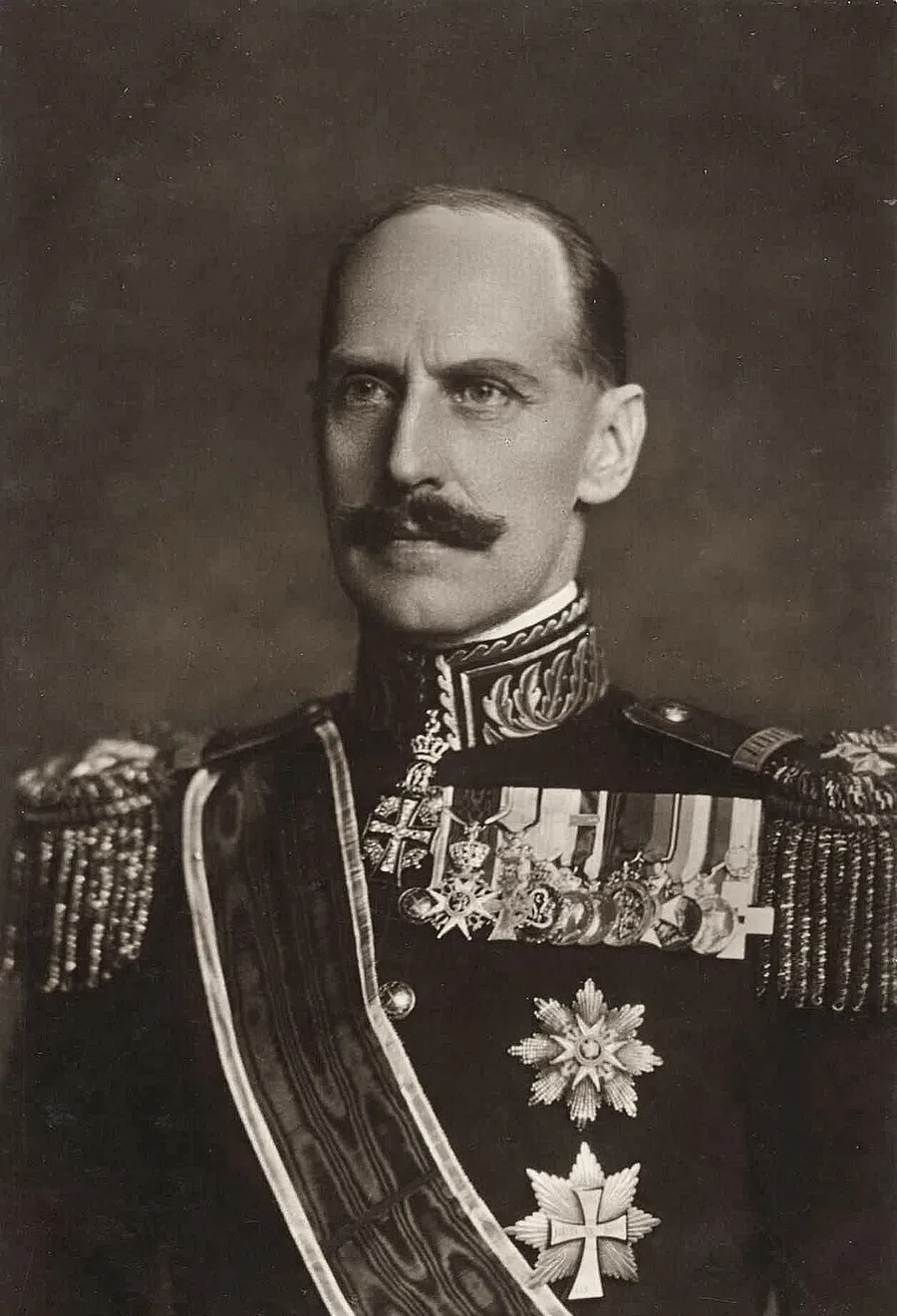 Mittet & Co., King Haakon VII of Norway (c. 1942), Library of Congress Mittet's wartime portrait of Haakon VII, around 1942 — the Danish-born naval officer elected to the Norwegian throne by referendum in 1905, aged here into the exile king whose April 1940 refusal of the German ultimatum made him the symbol of the resistance. King of Norway 1905–1957. Born Prince Carl of Denmark in 1872, the
thirty-three-year-old career naval officer was offered the
Norwegian throne after the dissolution of the Norwegian-Swedish
union in 1905, accepted after a confirmatory referendum, and took
the regnal name Haakon — last used by a Norwegian king at the
death of Haakon VI in 1380. Crowned at Nidaros Cathedral on 22
June 1906 — the last coronation in Norwegian history; the
coronation requirement was struck from the constitution in 1908.
His refusal to recognise the Quisling government in April 1940
became the founding constitutional act of the Norwegian wartime
resistance. Returned to Oslo on 7 June 1945 after five years of
exile in London; died in 1957.
Also discussed in The Quiet Revolution — how Norway won its independence without a warWorld War II — the King’s “No” and the Nazis in NorwayPolitikk — the left, the right, and the Norwegian way was crowned there in 1906, the last coronation in Norway; the coronation requirement was struck from the constitution in 1908, and his successors — Olav V
Mittet & Co., King Haakon VII of Norway (c. 1942), Library of Congress Mittet's wartime portrait of Haakon VII, around 1942 — the Danish-born naval officer elected to the Norwegian throne by referendum in 1905, aged here into the exile king whose April 1940 refusal of the German ultimatum made him the symbol of the resistance. King of Norway 1905–1957. Born Prince Carl of Denmark in 1872, the
thirty-three-year-old career naval officer was offered the
Norwegian throne after the dissolution of the Norwegian-Swedish
union in 1905, accepted after a confirmatory referendum, and took
the regnal name Haakon — last used by a Norwegian king at the
death of Haakon VI in 1380. Crowned at Nidaros Cathedral on 22
June 1906 — the last coronation in Norwegian history; the
coronation requirement was struck from the constitution in 1908.
His refusal to recognise the Quisling government in April 1940
became the founding constitutional act of the Norwegian wartime
resistance. Returned to Oslo on 7 June 1945 after five years of
exile in London; died in 1957.
Also discussed in The Quiet Revolution — how Norway won its independence without a warWorld War II — the King’s “No” and the Nazis in NorwayPolitikk — the left, the right, and the Norwegian way was crowned there in 1906, the last coronation in Norway; the coronation requirement was struck from the constitution in 1908, and his successors — Olav V 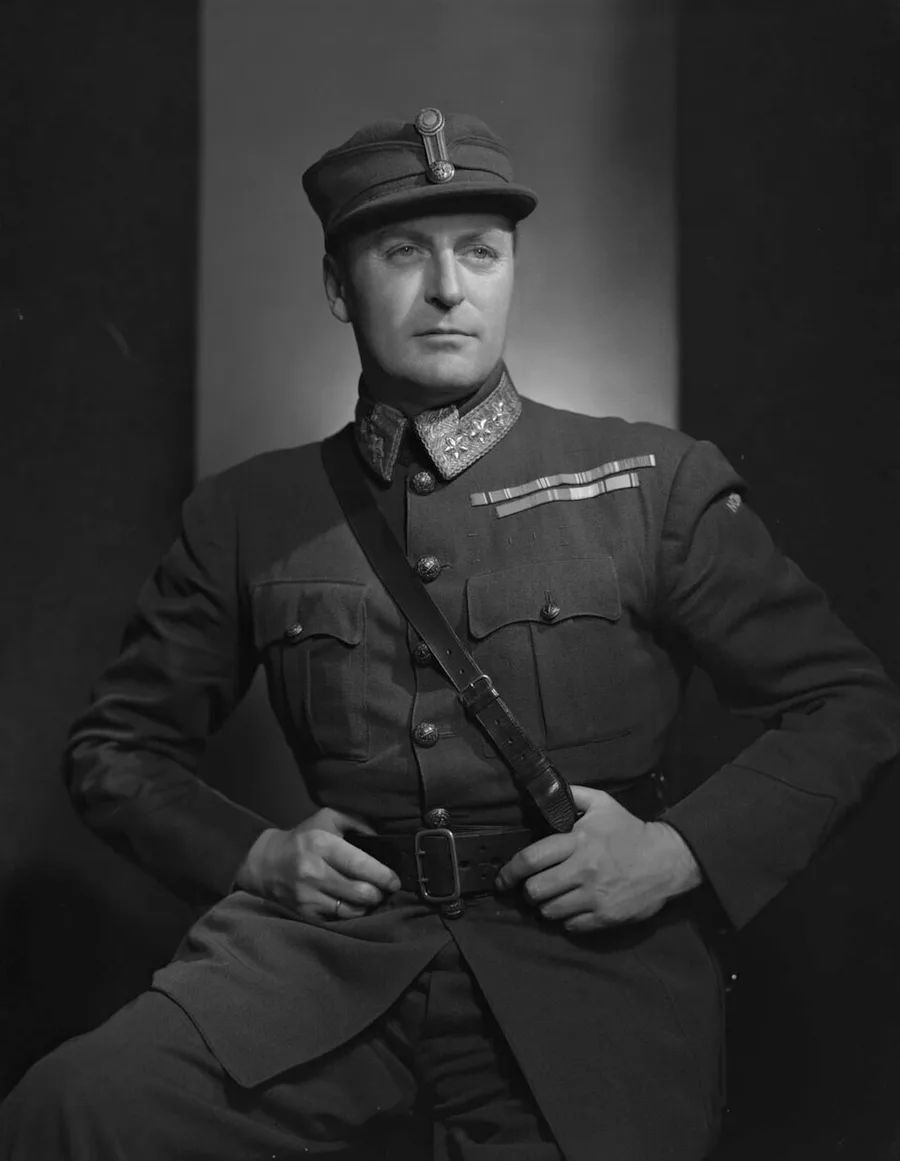 Yousuf Karsh, H.R.H. Crown Prince Olav of Norway (c. 1943), Library and Archives Canada Karsh's wartime London portrait of Crown Prince Olav in field uniform — the Sandringham-born infant of 1905, renamed for the saint-king, grown into the public face of the Norwegian resistance beside his father; from 1957 the *Folkekongen*, the People's King. King of Norway 1957–1991. Born Prince Alexander Edward Christian
Frederik in Sandringham, England, in 1903 to the future Haakon VII
and his British wife Princess Maud; renamed Olav on the family's
arrival in Norway in 1905, after the medieval patron saint of the
country. Crown Prince through the German occupation, during which
he served alongside his father as the public face of Norwegian
resistance from London. Acceded in 1957 on his father's death;
consecrated at Nidaros Cathedral in 1958 rather than crowned (the
coronation requirement had been removed in 1908). Bynamed
Folkekongen — the People's King — for his unaffected
approachability across thirty-four years on the throne.
Also discussed in 800,000 Norwegians Leave — the century that built a Second NorwayThe Quiet Revolution — how Norway won its independence without a warWorld War II — the King’s “No” and the Nazis in Norway in 1958 and Harald V
Yousuf Karsh, H.R.H. Crown Prince Olav of Norway (c. 1943), Library and Archives Canada Karsh's wartime London portrait of Crown Prince Olav in field uniform — the Sandringham-born infant of 1905, renamed for the saint-king, grown into the public face of the Norwegian resistance beside his father; from 1957 the *Folkekongen*, the People's King. King of Norway 1957–1991. Born Prince Alexander Edward Christian
Frederik in Sandringham, England, in 1903 to the future Haakon VII
and his British wife Princess Maud; renamed Olav on the family's
arrival in Norway in 1905, after the medieval patron saint of the
country. Crown Prince through the German occupation, during which
he served alongside his father as the public face of Norwegian
resistance from London. Acceded in 1957 on his father's death;
consecrated at Nidaros Cathedral in 1958 rather than crowned (the
coronation requirement had been removed in 1908). Bynamed
Folkekongen — the People's King — for his unaffected
approachability across thirty-four years on the throne.
Also discussed in 800,000 Norwegians Leave — the century that built a Second NorwayThe Quiet Revolution — how Norway won its independence without a warWorld War II — the King’s “No” and the Nazis in Norway in 1958 and Harald V 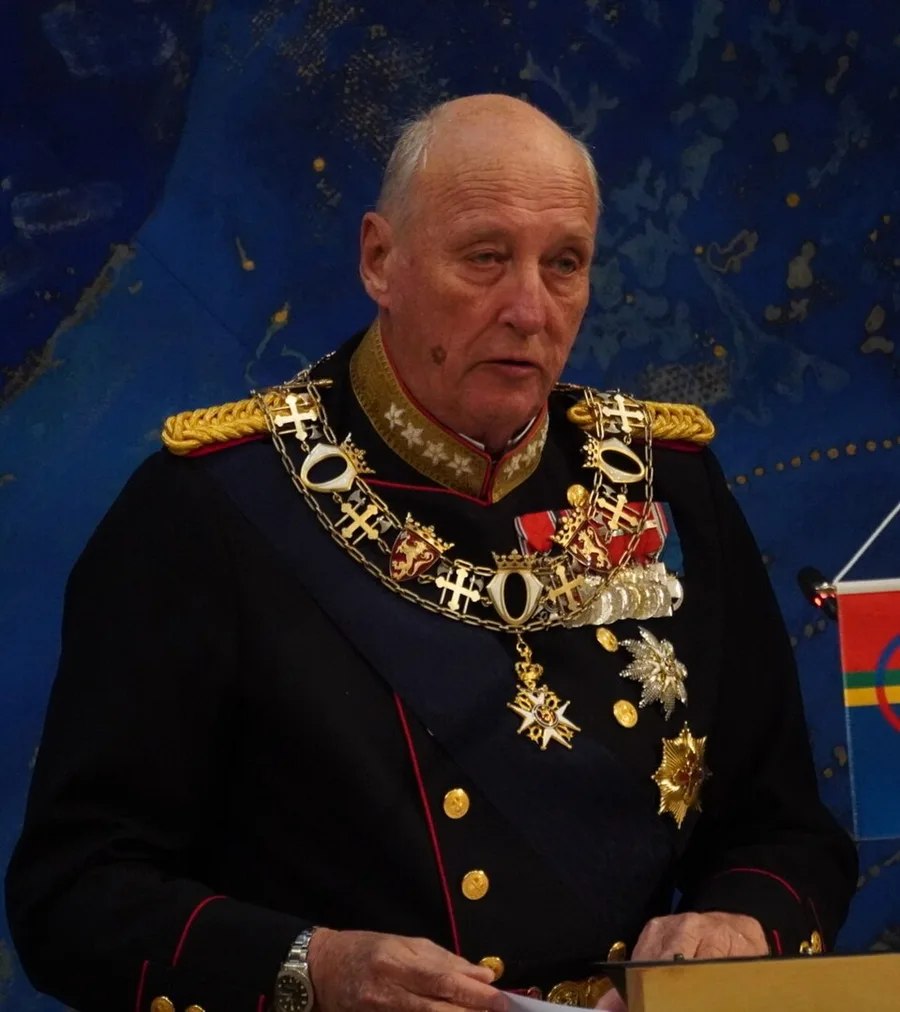 Vaino Rensberg/Sametinget (2021), CC BY 2.0 Harald V reading at a lectern inside the Sámediggi's plenary hall in 2021, the Sámi flag at his shoulder — the ceremonial head of state opening a session of the elected Sámi parliament. King of Norway since 1991, born 1937, son of Olav V and grandson
of Haakon VII. Acceded on his father's death; consecrated at
Nidaros Cathedral on 23 June 1991 — the first Norwegian monarch
consecrated under the post-1908 rite, in which the 1818 crown is
borne into the cathedral and displayed but not placed on the king's
head. Married to Sonja Haraldsen (Queen Sonja) since 1968. Has
reigned through the country's transformation into the wealthiest
small democracy in modern history; one of the longest reigns in
Norwegian history.
Also discussed in Politikk — the left, the right, and the Norwegian way in 1991 — have been consecrated at Nidaros instead, with the 1818 crown borne into the cathedral and displayed but not placed on the king’s head. The pilgrim road comes in past the south door, the same door the medieval pilgrims walked through. The shrine is gone, but the spot is marked. The saint himself is buried somewhere within the cathedral, in a location no medieval source preserved through the Reformation and no modern excavation has yet conclusively located.
Vaino Rensberg/Sametinget (2021), CC BY 2.0 Harald V reading at a lectern inside the Sámediggi's plenary hall in 2021, the Sámi flag at his shoulder — the ceremonial head of state opening a session of the elected Sámi parliament. King of Norway since 1991, born 1937, son of Olav V and grandson
of Haakon VII. Acceded on his father's death; consecrated at
Nidaros Cathedral on 23 June 1991 — the first Norwegian monarch
consecrated under the post-1908 rite, in which the 1818 crown is
borne into the cathedral and displayed but not placed on the king's
head. Married to Sonja Haraldsen (Queen Sonja) since 1968. Has
reigned through the country's transformation into the wealthiest
small democracy in modern history; one of the longest reigns in
Norwegian history.
Also discussed in Politikk — the left, the right, and the Norwegian way in 1991 — have been consecrated at Nidaros instead, with the 1818 crown borne into the cathedral and displayed but not placed on the king’s head. The pilgrim road comes in past the south door, the same door the medieval pilgrims walked through. The shrine is gone, but the spot is marked. The saint himself is buried somewhere within the cathedral, in a location no medieval source preserved through the Reformation and no modern excavation has yet conclusively located.
The king lasted thirteen years on the throne. The saint has lasted nine hundred and ninety-six.
Sources & further reading
Primary sources
- Snorri Sturluson
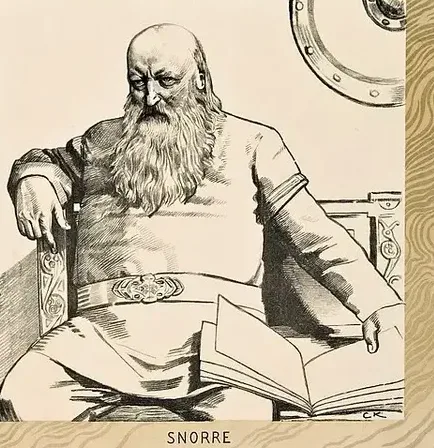 Christian Krohg, Snorre Sturlason (1899), from Norges Kongesagaer; scan: National Library of Norway Christian Krohg's portrait of Snorri from the 1899 folk edition of Heimskringla — the historian seated with a great open book across his knees. No contemporary likeness of Snorri exists; Krohg's drawing is the face Norway gave its most important medieval source. Thirteenth-century Icelandic chieftain, poet, and historian.
Composed the Heimskringla and the Prose Edda in the 1220s
from oral tradition and skaldic verse — three hundred years after
the Viking-age events he describes. The single richest source for
Norway's pre-conversion centuries and also the most aware
Christian-Icelandic editor of them. Modern scholarship accepts
what other sources independently confirm and treats his richest
expansions as the work of a poet writing about a kingdom he had
never seen. Assassinated at Reykholt on 23 September 1241 by
agents of King Hákon IV after a falling-out at court.
In this article Snorri's Heimskringla supplies the Stiklestad battle cry quoted
in this article. The depiction of Olav's pre-saintly violence —
conversion at sword-point, the burning of hov sanctuaries — is
also Snorri's, and modern scholarship treats much of it as
hagiographic dramatization rather than documentary record.
Also discussed in The Viking Age — longships, legends, and the first "Norway"Before There Was Norway — petty kingdoms at the edge of the worldWorshiping Odin and Thor — the lived religion of pre-Christian NorwayA Catholic Norway — the faith that gave the kingdom its first institutions and the stave churchesThe Golden Age — a North Atlantic empire … reaching farther than you thinkThe Crusades?!!!! — sixty ships from Bergen, bound for the Holy LandNordisk Mytologi — Odin, the giants, and Ragnarok , Heimskringla, “Óláfs saga helga” (c. 1230). The longest saga in the Norwegian king-cycle and the principal medieval narrative of Olav’s reign, death, and sainthood. English translation in Snorri Sturluson, Heimskringla, trans. Alison Finlay and Anthony Faulkes, 3 vols. (Viking Society for Northern Research, 2011–2015).
Christian Krohg, Snorre Sturlason (1899), from Norges Kongesagaer; scan: National Library of Norway Christian Krohg's portrait of Snorri from the 1899 folk edition of Heimskringla — the historian seated with a great open book across his knees. No contemporary likeness of Snorri exists; Krohg's drawing is the face Norway gave its most important medieval source. Thirteenth-century Icelandic chieftain, poet, and historian.
Composed the Heimskringla and the Prose Edda in the 1220s
from oral tradition and skaldic verse — three hundred years after
the Viking-age events he describes. The single richest source for
Norway's pre-conversion centuries and also the most aware
Christian-Icelandic editor of them. Modern scholarship accepts
what other sources independently confirm and treats his richest
expansions as the work of a poet writing about a kingdom he had
never seen. Assassinated at Reykholt on 23 September 1241 by
agents of King Hákon IV after a falling-out at court.
In this article Snorri's Heimskringla supplies the Stiklestad battle cry quoted
in this article. The depiction of Olav's pre-saintly violence —
conversion at sword-point, the burning of hov sanctuaries — is
also Snorri's, and modern scholarship treats much of it as
hagiographic dramatization rather than documentary record.
Also discussed in The Viking Age — longships, legends, and the first "Norway"Before There Was Norway — petty kingdoms at the edge of the worldWorshiping Odin and Thor — the lived religion of pre-Christian NorwayA Catholic Norway — the faith that gave the kingdom its first institutions and the stave churchesThe Golden Age — a North Atlantic empire … reaching farther than you thinkThe Crusades?!!!! — sixty ships from Bergen, bound for the Holy LandNordisk Mytologi — Odin, the giants, and Ragnarok , Heimskringla, “Óláfs saga helga” (c. 1230). The longest saga in the Norwegian king-cycle and the principal medieval narrative of Olav’s reign, death, and sainthood. English translation in Snorri Sturluson, Heimskringla, trans. Alison Finlay and Anthony Faulkes, 3 vols. (Viking Society for Northern Research, 2011–2015). - Passio et miracula beati Olavi The Passion and Miracles of the Blessed Olav — the medieval Norwegian shrine's collected miracle-book, compiled in Latin at Nidaros around 1170, in association with the archbishopric of Eystein Erlendsson. Records the dramatic miracles credited to Olav's intercession across the first century of the devotion: healings at the shrine, restorations of sight, the recovery of the lost or possessed, the safety of seafarers calling on the saint. The principal medieval Latin source for the institutional cult, alongside Snorri's later vernacular saga and the short Latin history of Theodoricus Monachus. (twelfth century). The Norwegian shrine’s collected miracle-book, compiled at Nidaros around 1170. Critical edition by Lenka Jiroušková, Der heilige Wikingerkönig Olav Haraldsson und sein hagiographisches Dossier (Leiden: Brill, 2014). English translation in Devra Kunin and Carl Phelpstead, eds., A History of Norway and the Passion and Miracles of the Blessed Óláfr (Viking Society for Northern Research, 2001).
- Theodoricus Monachus
 Editio princeps of Theodoricus, in Commentarii historici duo (Amsterdam, 1684), National Library of Norway No likeness of Theodoricus exists and the medieval codex of his history is lost; this 1684 Amsterdam title page is where his work enters print — "by Theodoric, monk of Nidaros, written five hundred years ago," drawn from a Lübeck manuscript that has since vanished too. Norwegian monk and historian, active in the late twelfth century
(probably c. 1175–c. 1185). Author of Historia de antiquitate
regum Norwagiensium ("History of the Antiquity of the Norwegian
Kings"), a short Latin history covering the Norwegian kings from
Harald Fairhair to the death of Sigurd the Crusader (d. 1130). One of the earliest
written accounts of Olav II Haraldsson's sainthood; pre-dates
Snorri Sturluson's Heimskringla by half a century. Almost
certainly a Premonstratensian or Augustinian canon attached to
the cathedral at Nidaros, though the precise identification has
not been settled.
Also discussed in A Catholic Norway — the faith that gave the kingdom its first institutions and the stave churchesThe Crusades?!!!! — sixty ships from Bergen, bound for the Holy Land , Historia de antiquitate regum Norwagiensium (c. 1180). A short Latin history of the Norwegian kings, with one of the earliest written accounts of Olav’s sainthood.
Editio princeps of Theodoricus, in Commentarii historici duo (Amsterdam, 1684), National Library of Norway No likeness of Theodoricus exists and the medieval codex of his history is lost; this 1684 Amsterdam title page is where his work enters print — "by Theodoric, monk of Nidaros, written five hundred years ago," drawn from a Lübeck manuscript that has since vanished too. Norwegian monk and historian, active in the late twelfth century
(probably c. 1175–c. 1185). Author of Historia de antiquitate
regum Norwagiensium ("History of the Antiquity of the Norwegian
Kings"), a short Latin history covering the Norwegian kings from
Harald Fairhair to the death of Sigurd the Crusader (d. 1130). One of the earliest
written accounts of Olav II Haraldsson's sainthood; pre-dates
Snorri Sturluson's Heimskringla by half a century. Almost
certainly a Premonstratensian or Augustinian canon attached to
the cathedral at Nidaros, though the precise identification has
not been settled.
Also discussed in A Catholic Norway — the faith that gave the kingdom its first institutions and the stave churchesThe Crusades?!!!! — sixty ships from Bergen, bound for the Holy Land , Historia de antiquitate regum Norwagiensium (c. 1180). A short Latin history of the Norwegian kings, with one of the earliest written accounts of Olav’s sainthood. - William of Jumièges, Gesta Normannorum ducum (eleventh century). The Norman chronicle that places Olav’s baptism in Normandy around 1014.
Modern scholarship
- Sverre Bagge, Cross and Scepter: The Rise of the Scandinavian Kingdoms from the Vikings to the Reformation (Princeton University Press, 2014). The standard modern synthesis on the political-religious formation of medieval Scandinavia, with extensive treatment of Olav’s reign and the devotion.
- Knut Helle, ed., The Cambridge History of Scandinavia, Volume 1: Prehistory to 1520 (Cambridge University Press, 2003). The reference treatment of Norway’s Christianization and the medieval archbishopric.
- Øystein Ekroll, The Octagonal Shrine Chapel of St Olav at Nidaros Cathedral (NTNU, 2015). The architectural and devotional history of the shrine chapel.
- Erik Gunnes, Erkebiskop Øystein: Statsmann og kirkebygger (Aschehoug, 1996). The standard Norwegian biography of the twelfth-century archbishop who shaped the devotion’s institutional reach.
- Eric Waldram Kemp, Canonization and Authority in the Western Church (Oxford: Clarendon Press, 1948). On the eleventh-century English-Norman canonisation procedure that allowed local bishops to declare saints without Roman ratification.
Reference
- Store norske leksikon (snl.no). The Norwegian peer-reviewed encyclopedia. See in particular Olav 2 Haraldsson den hellige, Stiklestad, Mostertinget, kristenrett, Nidaros domkirke, Olsok, and Pilegrimsleden.
Visit
- Nidaros Cathedral Unknown photographer, Nidaros Cathedral from the northeast (1857), Wikimedia Commons One of the earliest surviving photographs of Norway, taken in 1857 — decades before the west front's twentieth-century reconstruction — showing the cathedral over Olav's grave much as centuries of fire, neglect, and weather had left it. The principal cathedral of Norway and the burial place of Saint
Olav, on the bank of the Nid River in Trondheim. Built and rebuilt
in stages from the late eleventh through the early fourteenth
centuries around the shrine site at the cathedral's east end. The
octagonal east end, raised directly over Olav's grave, was the
devotional core of the medieval building. Substantially damaged
by fires and the 1531 lightning strike, then by neglect across the
Lutheran centuries. The west front a visitor sees today is a
nineteenth- and twentieth-century reconstruction, completed only
in 1983. The cathedral is the coronation and consecration church
of Norwegian kings; Haakon VII was crowned there in 1906, Olav V
consecrated in 1958, Harald V in 1991.
On the trip Day 3 of the trip brings the Gråhårsklubben (the Oldsters) to
Nidaros Cathedral. The shrine is gone but
the spot is marked on the cathedral floor in the octagonal east
end. The west front is the twentieth-century reconstruction of
the face the medieval pilgrims saw. The pilgrim road comes in
past the south door — the same door medieval pilgrims walked
through.
Nidaros Cathedral, Trondheim Also discussed in A Catholic Norway — the faith that gave the kingdom its first institutions and the stave churchesThe Crusades?!!!! — sixty ships from Bergen, bound for the Holy LandThe Golden Age — a North Atlantic empire … reaching farther than you thinkThe Long Fall — the sudden loss of Norwegian nobility, the end of the kings, and half of Norway gone foreverThe 400-Year Night — when the Northern Lion lay dormantThe Reformation, 1537 — one church eradicated and another imposedLutheran Norway and Pietism — a farmer named Hans Nielsen Hauge and a lay revival that could not be silencedThe Quiet Revolution — how Norway won its independence without a warTradisjoner — celebrations across the Norwegian year , Trondheim. The cathedral over Olav’s burial place. The west front, the south door (the pilgrim entrance), and the rebuilt octagonal east end behind the high altar are the architectural heart of the site. The Norwegian crown jewels are on display in the adjoining Archbishop’s Palace.
- Stiklestad National Cultural Centre Cultural-historical centre and open-air theatre at the Stiklestad
battle site in Verdal, Trøndelag, about an hour's drive north of
Trondheim on the E6. Includes museums covering the battle and its
medieval afterlife, the open-air amphitheatre where Spelet om
Heilag Olav is performed each summer in late July, and the
twelfth-century Stiklestad Church on the battlefield itself. The
Centre opened in 1992 and serves as the principal site of the
modern national Olsok observance on 29 July.
Stiklestad National Cultural Centre , Verdal, about an hour’s drive north of Trondheim on the E6. The battle site, the medieval Stiklestad Church
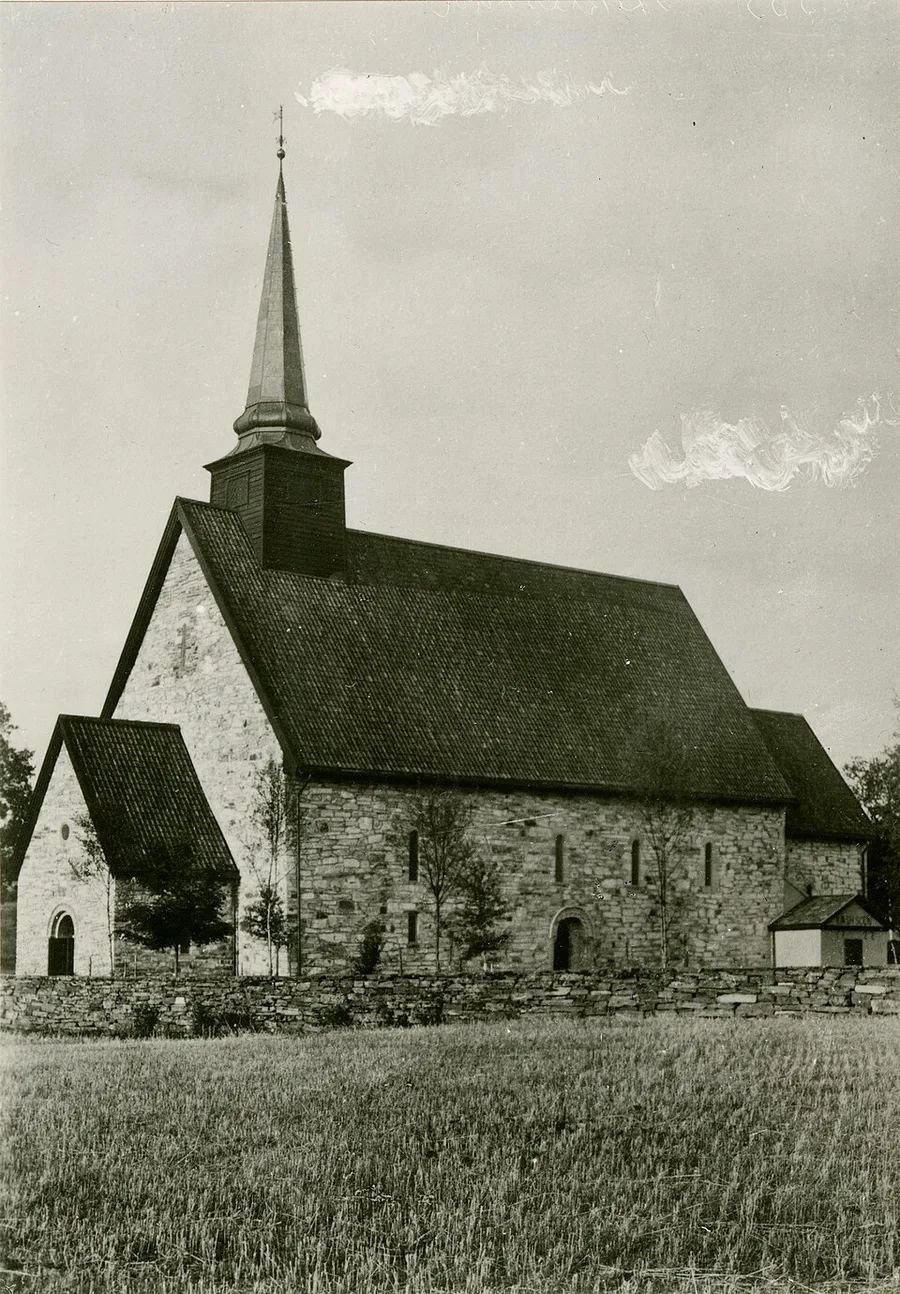 Christian Christensen Thomhav (1930), Norwegian Directorate for Cultural Heritage Medieval stone church at Stiklestad in the Verdal valley of
Trøndelag, founded shortly after the Battle of Stiklestad in
1030 as a memorial to King Olav II Haraldsson. Built into the
church's interior wall is a stone said to be the one against
which Olav leaned as he received his death-wound. The current
building dates to the twelfth century and has been substantially
restored, most recently in the 1920s; it remains an active parish
church and a focal point of the modern Olsok observance.
Stiklestad Church (founded shortly after the battle as a memorial), and the open-air theatre where Spelet om Heilag Olav is performed each summer in late July.
Christian Christensen Thomhav (1930), Norwegian Directorate for Cultural Heritage Medieval stone church at Stiklestad in the Verdal valley of
Trøndelag, founded shortly after the Battle of Stiklestad in
1030 as a memorial to King Olav II Haraldsson. Built into the
church's interior wall is a stone said to be the one against
which Olav leaned as he received his death-wound. The current
building dates to the twelfth century and has been substantially
restored, most recently in the 1920s; it remains an active parish
church and a focal point of the modern Olsok observance.
Stiklestad Church (founded shortly after the battle as a memorial), and the open-air theatre where Spelet om Heilag Olav is performed each summer in late July. - St. Olav’s Catholic Cathedral, Akersveien 5, Oslo. The Catholic cathedral opened in 1856, holding the 1862 relic of the saint.
- The Pilegrimsleden, the marked pilgrim-route network. The Gudbrandsdalsleden from Oslo to Trondheim (643 km) and the St. Olavsleden from Sweden (580 km) are the two principal modern routes; the Pilegrimskontoret in Oslo and the Pilegrimssenter in Trondheim issue the pilgrim’s passport for those walking either.