Tradisjoner — Celebrations across the Norwegian year
The Norwegian calendar — 17. mai as the loudest day of a quiet country, the long July daylight, Olsok at Nidaros on the 29th (the day the heritage drive lands on), bunad and hardingfele, the Norwegian instinct for tending graves across generations.
Norway keeps a relatively small number of celebration days, but the ones it keeps it keeps wholeheartedly. The calendar runs from Easter through the long-light summer and back around to Christmas — fewer feast days than a Catholic Mediterranean country, each observed with real attention.
Påske — Easter in the mountains
Norwegian Easter is not primarily a church holiday. It is a ski week. Schools and most workplaces close from the Wednesday before Easter through Easter Monday, and the country shifts north and up — to the hytte, to the DNT cabins, to the marked trails of påskefjellet. Oranges and Kvikk Lunsj travel in the daypack. The publishing industry releases mystery novels (påskekrim) timed for the week; television runs crime serials; the milk cartons used to print short mini-mysteries on their sides.
The seventeenth of May
The biggest day in the Norwegian calendar is Syttende mai 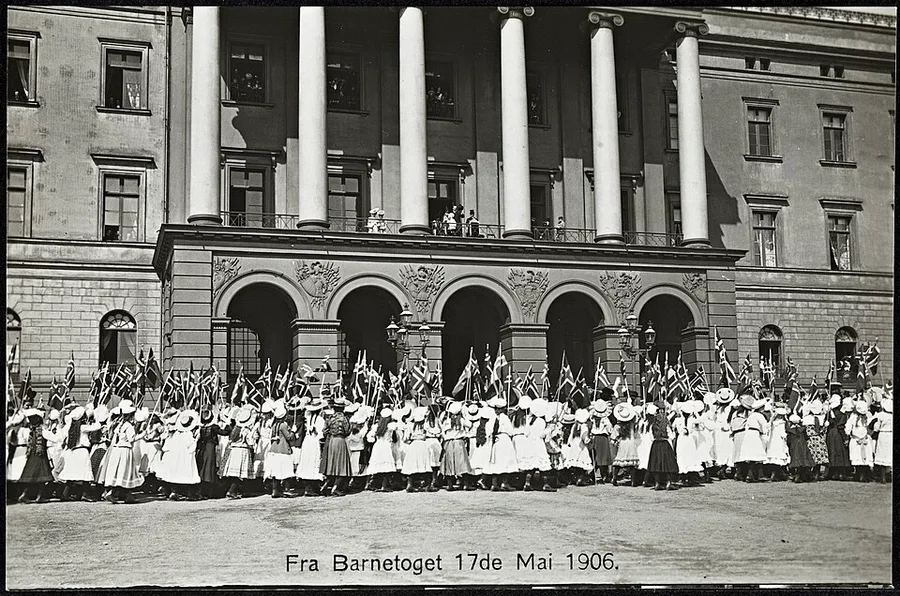 Unknown photographer, postcard (1906), National Library of Norway, via Flickr Commons A 1906 postcard of the barnetog, the children's flag parade at Christiania's Slottsplassen that has opened Constitution Day since 1870, when Bjørnstjerne Bjørnson first proposed it to the city. The seventeenth of May — Norway's national day,
celebrating the signing of the Eidsvoll Constitution on 17
May 1814. Marked across the country by children's parades
in every town carrying Norwegian flags, by speeches by
elected officials reading from the Constitution, by the
singing of Ja, vi elsker dette landet, by the wearing of
regional bunad folk dress, and by a general public
conviviality that is the loudest day of the Norwegian
year. The children's parade tradition began at Christiania
in 1870 (girls' participation following in 1889) at the
suggestion of Bjørnstjerne Bjørnson. Celebrated by every
Norwegian school and every Norwegian-American community
abroad, with Minnesota, Wisconsin, and Iowa communities
keeping the holiday vigorously.
Also discussed in The Constitution That Saved a Nation — five radical weeks at Eidsvoll, 1814800,000 Norwegians Leave — the century that built a Second Norway , the seventeenth of May — Constitution Day, marking the 1814 signing at Eidsvoll
Unknown photographer, postcard (1906), National Library of Norway, via Flickr Commons A 1906 postcard of the barnetog, the children's flag parade at Christiania's Slottsplassen that has opened Constitution Day since 1870, when Bjørnstjerne Bjørnson first proposed it to the city. The seventeenth of May — Norway's national day,
celebrating the signing of the Eidsvoll Constitution on 17
May 1814. Marked across the country by children's parades
in every town carrying Norwegian flags, by speeches by
elected officials reading from the Constitution, by the
singing of Ja, vi elsker dette landet, by the wearing of
regional bunad folk dress, and by a general public
conviviality that is the loudest day of the Norwegian
year. The children's parade tradition began at Christiania
in 1870 (girls' participation following in 1889) at the
suggestion of Bjørnstjerne Bjørnson. Celebrated by every
Norwegian school and every Norwegian-American community
abroad, with Minnesota, Wisconsin, and Iowa communities
keeping the holiday vigorously.
Also discussed in The Constitution That Saved a Nation — five radical weeks at Eidsvoll, 1814800,000 Norwegians Leave — the century that built a Second Norway , the seventeenth of May — Constitution Day, marking the 1814 signing at Eidsvoll 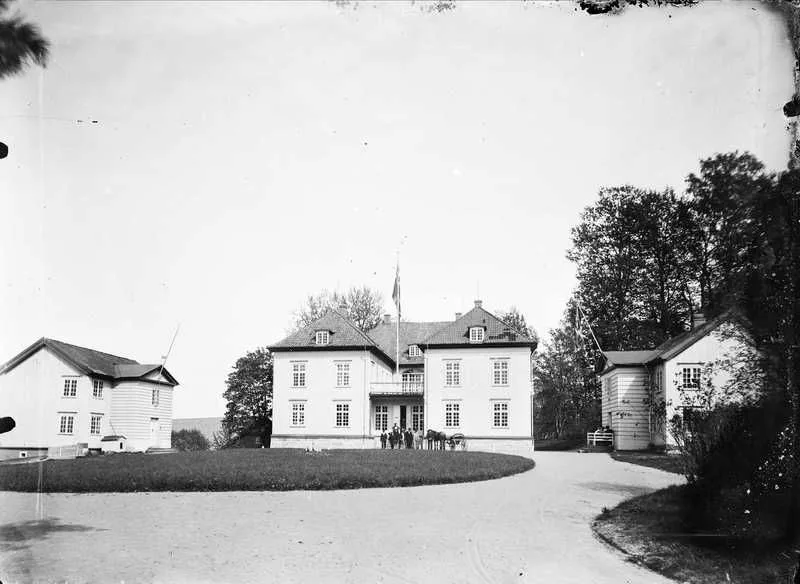 Unknown photographer, Eidsvollsbygningen (c. 1890), Oslo Museum, CC BY-SA 4.0 The white manor house at Eidsvoll where 112 delegates drafted and signed Norway's Constitution in 1814 — the building the whole constitutional story turns on. Municipality in Akershus county in southeastern Norway,
about seventy kilometres north of Oslo. Site of the
constitutional assembly that drafted and ratified the
Norwegian Constitution between 10 April and 20 May 1814.
The 112 delegates met at Eidsvollsbygningen, the country
house of the wealthy merchant and ironworks owner Carsten
Anker, who had offered the use of his estate at his own
expense. They signed the Constitution on 17 May 1814 —
Syttende mai, Norway's national day ever since — and
elected Prince Christian Frederik as king the same day.
The house is preserved as a national museum. Modern
Eidsvoll is also a stop on the main railway line north
from Oslo and the site of the country's principal
international airport (Oslo Gardermoen) ten kilometres south.
Also discussed in The 400-Year Night — when the Northern Lion lay dormantLutheran Norway and Pietism — a farmer named Hans Nielsen Hauge and a lay revival that could not be silencedThe Constitution That Saved a Nation — five radical weeks at Eidsvoll, 1814The Quiet Revolution — how Norway won its independence without a warPolitikk — the left, the right, and the Norwegian way . It is not a military day. There are no parading soldiers. It is a children’s day: town after town puts its schoolchildren at the head of a parade, flags in hand, and the adults line the route. People wear the Bunad
Unknown photographer, Eidsvollsbygningen (c. 1890), Oslo Museum, CC BY-SA 4.0 The white manor house at Eidsvoll where 112 delegates drafted and signed Norway's Constitution in 1814 — the building the whole constitutional story turns on. Municipality in Akershus county in southeastern Norway,
about seventy kilometres north of Oslo. Site of the
constitutional assembly that drafted and ratified the
Norwegian Constitution between 10 April and 20 May 1814.
The 112 delegates met at Eidsvollsbygningen, the country
house of the wealthy merchant and ironworks owner Carsten
Anker, who had offered the use of his estate at his own
expense. They signed the Constitution on 17 May 1814 —
Syttende mai, Norway's national day ever since — and
elected Prince Christian Frederik as king the same day.
The house is preserved as a national museum. Modern
Eidsvoll is also a stop on the main railway line north
from Oslo and the site of the country's principal
international airport (Oslo Gardermoen) ten kilometres south.
Also discussed in The 400-Year Night — when the Northern Lion lay dormantLutheran Norway and Pietism — a farmer named Hans Nielsen Hauge and a lay revival that could not be silencedThe Constitution That Saved a Nation — five radical weeks at Eidsvoll, 1814The Quiet Revolution — how Norway won its independence without a warPolitikk — the left, the right, and the Norwegian way . It is not a military day. There are no parading soldiers. It is a children’s day: town after town puts its schoolchildren at the head of a parade, flags in hand, and the adults line the route. People wear the Bunad 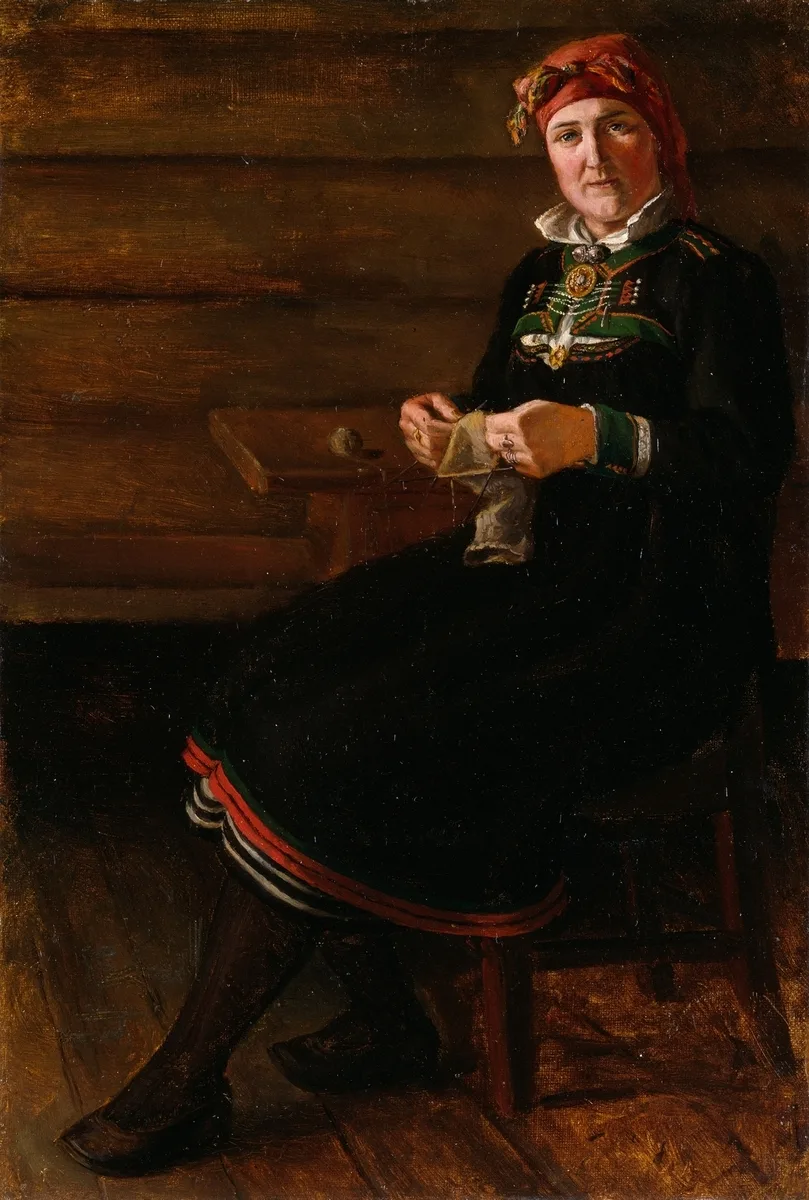 August Schneider, Sittende kvinne i Setesdals-bunad (1870), Nasjonalmuseet Schneider's seated knitter shows the bunad at close range — the embroidered panel, the sølje at the collar, the striped apron band — the detail a parade crowd never lets you see. Made once, often for a confirmation, and worn for decades of seventeenths of May. Norwegian regional folk costume — the rural traditional
dress that survived the four-hundred-year Danish period
intact, parish by parish, fjord by fjord. Each Norwegian
region (and many individual valleys) has its own bunad,
varying in colour, embroidery pattern, silver brooch
(sølje), shawl, and apron. The modern bunad tradition was
systematised in the late nineteenth and early twentieth
centuries by the textile historian Hulda Garborg and
others, but the underlying garments are pre-modern. Worn
on 17 May, at weddings, at confirmations, and at other
formal national occasions. The persistence of the bunad is
one of the most visible single signs of how the regional
substrate of Norway outlasted the long Danish absorption.
Also discussed in The 400-Year Night — when the Northern Lion lay dormantLutheran Norway and Pietism — a farmer named Hans Nielsen Hauge and a lay revival that could not be silencedThe Constitution That Saved a Nation — five radical weeks at Eidsvoll, 1814800,000 Norwegians Leave — the century that built a Second NorwayWorld War II — the King’s “No” and the Nazis in Norway — the regional folk costume, embroidered, specific down to the valley, often handed down or made for a confirmation and worn for decades. The day is loud, warm, and unembarrassed in a way the rest of the Norwegian year usually is not.
August Schneider, Sittende kvinne i Setesdals-bunad (1870), Nasjonalmuseet Schneider's seated knitter shows the bunad at close range — the embroidered panel, the sølje at the collar, the striped apron band — the detail a parade crowd never lets you see. Made once, often for a confirmation, and worn for decades of seventeenths of May. Norwegian regional folk costume — the rural traditional
dress that survived the four-hundred-year Danish period
intact, parish by parish, fjord by fjord. Each Norwegian
region (and many individual valleys) has its own bunad,
varying in colour, embroidery pattern, silver brooch
(sølje), shawl, and apron. The modern bunad tradition was
systematised in the late nineteenth and early twentieth
centuries by the textile historian Hulda Garborg and
others, but the underlying garments are pre-modern. Worn
on 17 May, at weddings, at confirmations, and at other
formal national occasions. The persistence of the bunad is
one of the most visible single signs of how the regional
substrate of Norway outlasted the long Danish absorption.
Also discussed in The 400-Year Night — when the Northern Lion lay dormantLutheran Norway and Pietism — a farmer named Hans Nielsen Hauge and a lay revival that could not be silencedThe Constitution That Saved a Nation — five radical weeks at Eidsvoll, 1814800,000 Norwegians Leave — the century that built a Second NorwayWorld War II — the King’s “No” and the Nazis in Norway — the regional folk costume, embroidered, specific down to the valley, often handed down or made for a confirmation and worn for decades. The day is loud, warm, and unembarrassed in a way the rest of the Norwegian year usually is not.
The light, and the bonfires
Late June brings jonsok or sankthans — midsummer — celebrated with bonfires along the water on the lightest nights of the year. Late July sits in the long tail of that light: roughly seventeen hours of daylight in the south, a sky that never goes fully dark, a sun setting around ten in the evening. True midnight sun belongs to the far north above the Arctic Circle. The northern lights belong to the dark season, roughly late September through March.
Olsok — 29 July at Nidaros
One Norwegian holiday lands directly inside the trip. On Olsok 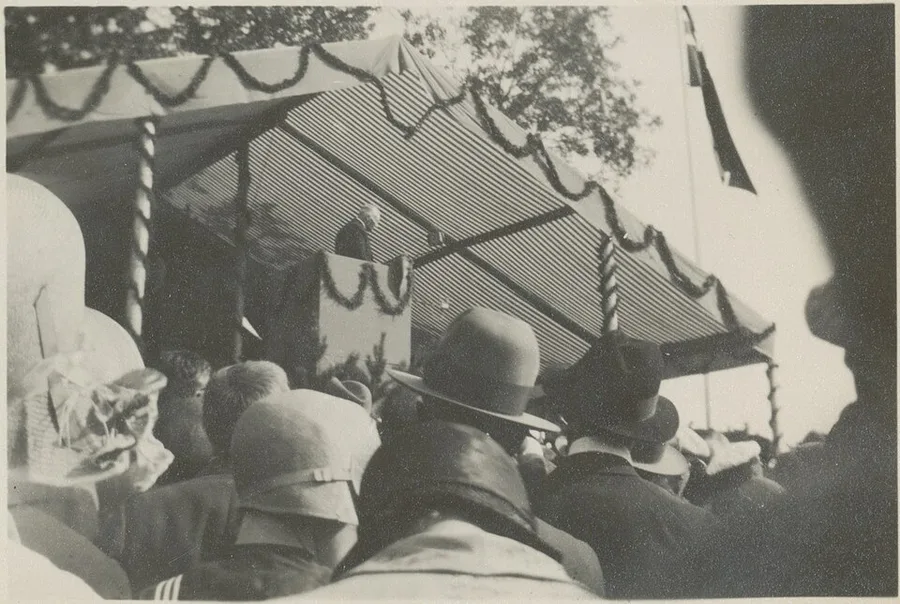 Åsen Museum og Historielag (1930), CC BY 2.0 A crowd gathers at Stiklestad on 29 July 1930 — Olsok itself, the anniversary of Olav's death — photographed decades before the Cultural Centre or the annual play existed, when the observance was simply people turning up at the site on the day. The feast day of Saint Olav — Olav's wake, observed on 29 July,
the anniversary of the king's death at Stiklestad in 1030. Across
the medieval period Olsok was the great summer holiday of the
Norse Atlantic, kept across Norway, Iceland, the Faroes, Greenland,
and the Norse colonies of the British Isles. The Reformation
stripped the religious content from the Norwegian observance after
1537, but the day persisted as a folk holiday and was made the
national flag-day of Norway in 1948. Today Olsok centres on the
Stiklestad commemoration, with the open-air Spelet om Heilag
Olav drawing audiences in the tens of thousands.
On the trip Day 4 of the trip is olsok itself — 29 July. The Gråhårsklubben (the Oldsters) spend it in the Stjørdal heritage country and return to Trondheim for the night, with the Olavsfest filling the city around the cathedral. Also discussed in The King Who Became a Saint — how the Nordmen came to ChristA Catholic Norway — the faith that gave the kingdom its first institutions and the stave churchesThe Reformation, 1537 — one church eradicated and another imposed , the 29th of July, Norway marks the death of Olav Haraldsson at Battle of Stiklestad
Åsen Museum og Historielag (1930), CC BY 2.0 A crowd gathers at Stiklestad on 29 July 1930 — Olsok itself, the anniversary of Olav's death — photographed decades before the Cultural Centre or the annual play existed, when the observance was simply people turning up at the site on the day. The feast day of Saint Olav — Olav's wake, observed on 29 July,
the anniversary of the king's death at Stiklestad in 1030. Across
the medieval period Olsok was the great summer holiday of the
Norse Atlantic, kept across Norway, Iceland, the Faroes, Greenland,
and the Norse colonies of the British Isles. The Reformation
stripped the religious content from the Norwegian observance after
1537, but the day persisted as a folk holiday and was made the
national flag-day of Norway in 1948. Today Olsok centres on the
Stiklestad commemoration, with the open-air Spelet om Heilag
Olav drawing audiences in the tens of thousands.
On the trip Day 4 of the trip is olsok itself — 29 July. The Gråhårsklubben (the Oldsters) spend it in the Stjørdal heritage country and return to Trondheim for the night, with the Olavsfest filling the city around the cathedral. Also discussed in The King Who Became a Saint — how the Nordmen came to ChristA Catholic Norway — the faith that gave the kingdom its first institutions and the stave churchesThe Reformation, 1537 — one church eradicated and another imposed , the 29th of July, Norway marks the death of Olav Haraldsson at Battle of Stiklestad 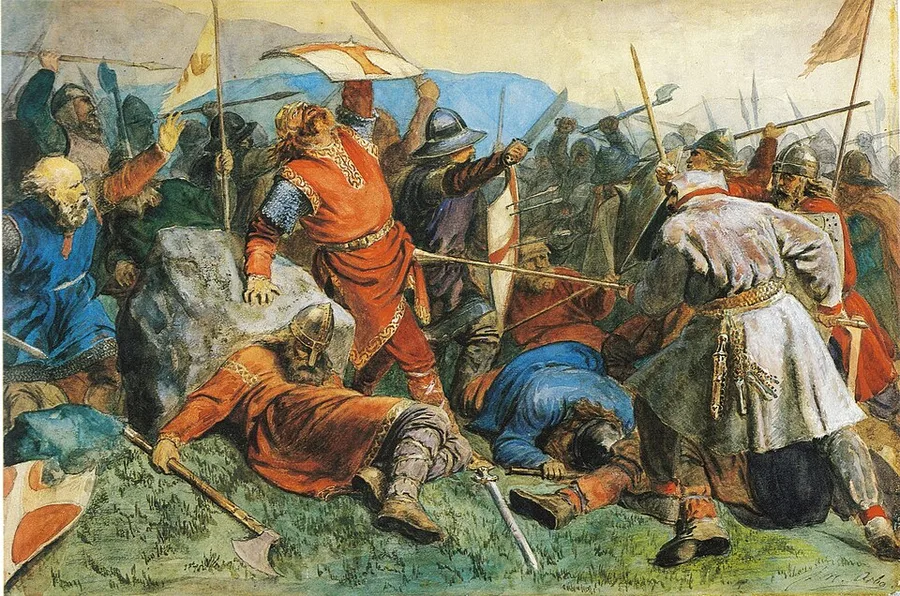 Peter Nicolai Arbo, Olav den helliges fall i slaget på Stiklestad (1859), Wikimedia Commons Arbo's 1859 history painting stages the moment itself — Olav Haraldsson going down under the blows of the farmer-army at Stiklestad on 29 July 1030, the death that made him a saint and Norway's patron king. Battle fought on 29 July 1030 at Stiklestad in the Verdal valley
of Trøndelag between King Olav II Haraldsson of Norway, returning
from his two-year exile in Kievan Rus to reclaim the throne, and
a coalition of Norwegian farmers and chieftains organised against
him by the regime that ruled Norway in King Cnut of Denmark's
name. Saga tradition puts Olav's army at thirty-six hundred men,
the farmer-army at several times that. Olav was killed late in
the day, struck three times — knee, neck, belly — as he leaned
against a large stone. His death made the cult that became
medieval Norwegian Christianity. Conventionally treated as the
end of the Viking Age in Norway.
Also discussed in The King Who Became a Saint — how the Nordmen came to Christ in 1030 — the king carried south from the battlefield, buried in secret by a riverbank, and exhumed a year later in front of a country that had decided it had killed a saint. The cult around him built Nidaros Cathedral
Peter Nicolai Arbo, Olav den helliges fall i slaget på Stiklestad (1859), Wikimedia Commons Arbo's 1859 history painting stages the moment itself — Olav Haraldsson going down under the blows of the farmer-army at Stiklestad on 29 July 1030, the death that made him a saint and Norway's patron king. Battle fought on 29 July 1030 at Stiklestad in the Verdal valley
of Trøndelag between King Olav II Haraldsson of Norway, returning
from his two-year exile in Kievan Rus to reclaim the throne, and
a coalition of Norwegian farmers and chieftains organised against
him by the regime that ruled Norway in King Cnut of Denmark's
name. Saga tradition puts Olav's army at thirty-six hundred men,
the farmer-army at several times that. Olav was killed late in
the day, struck three times — knee, neck, belly — as he leaned
against a large stone. His death made the cult that became
medieval Norwegian Christianity. Conventionally treated as the
end of the Viking Age in Norway.
Also discussed in The King Who Became a Saint — how the Nordmen came to Christ in 1030 — the king carried south from the battlefield, buried in secret by a riverbank, and exhumed a year later in front of a country that had decided it had killed a saint. The cult around him built Nidaros Cathedral 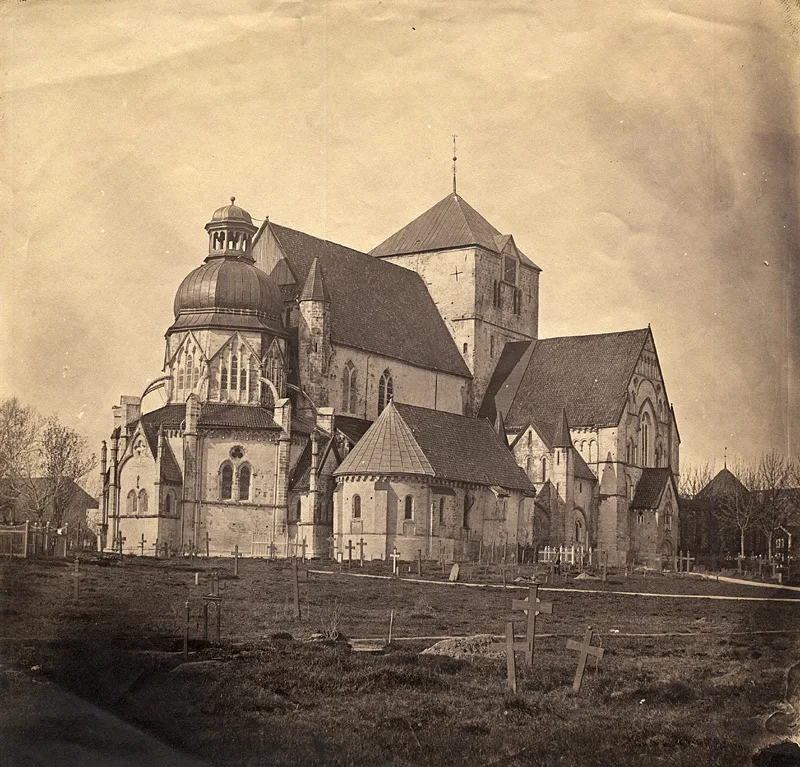 Unknown photographer, Nidaros Cathedral from the northeast (1857), Wikimedia Commons One of the earliest surviving photographs of Norway, taken in 1857 — decades before the west front's twentieth-century reconstruction — showing the cathedral over Olav's grave much as centuries of fire, neglect, and weather had left it. The principal cathedral of Norway and the burial place of Saint
Olav, on the bank of the Nid River in Trondheim. Built and rebuilt
in stages from the late eleventh through the early fourteenth
centuries around the shrine site at the cathedral's east end. The
octagonal east end, raised directly over Olav's grave, was the
devotional core of the medieval building. Substantially damaged
by fires and the 1531 lightning strike, then by neglect across the
Lutheran centuries. The west front a visitor sees today is a
nineteenth- and twentieth-century reconstruction, completed only
in 1983. The cathedral is the coronation and consecration church
of Norwegian kings; Haakon VII was crowned there in 1906, Olav V
consecrated in 1958, Harald V in 1991.
On the trip Day 3 of the trip brings the Gråhårsklubben (the Oldsters) to
Nidaros Cathedral. The shrine is gone but
the spot is marked on the cathedral floor in the octagonal east
end. The west front is the twentieth-century reconstruction of
the face the medieval pilgrims saw. The pilgrim road comes in
past the south door — the same door medieval pilgrims walked
through.
Nidaros Cathedral, Trondheim Also discussed in The King Who Became a Saint — how the Nordmen came to ChristA Catholic Norway — the faith that gave the kingdom its first institutions and the stave churchesThe Crusades?!!!! — sixty ships from Bergen, bound for the Holy LandThe Golden Age — a North Atlantic empire … reaching farther than you thinkThe Long Fall — the sudden loss of Norwegian nobility, the end of the kings, and half of Norway gone foreverThe 400-Year Night — when the Northern Lion lay dormantThe Reformation, 1537 — one church eradicated and another imposedLutheran Norway and Pietism — a farmer named Hans Nielsen Hauge and a lay revival that could not be silencedThe Quiet Revolution — how Norway won its independence without a war over his grave; for five centuries before the Reformation, Trondheim was the northernmost pilgrimage destination in Europe — the end of a walking route from Sundsvall in Sweden that pilgrims still take today.
Unknown photographer, Nidaros Cathedral from the northeast (1857), Wikimedia Commons One of the earliest surviving photographs of Norway, taken in 1857 — decades before the west front's twentieth-century reconstruction — showing the cathedral over Olav's grave much as centuries of fire, neglect, and weather had left it. The principal cathedral of Norway and the burial place of Saint
Olav, on the bank of the Nid River in Trondheim. Built and rebuilt
in stages from the late eleventh through the early fourteenth
centuries around the shrine site at the cathedral's east end. The
octagonal east end, raised directly over Olav's grave, was the
devotional core of the medieval building. Substantially damaged
by fires and the 1531 lightning strike, then by neglect across the
Lutheran centuries. The west front a visitor sees today is a
nineteenth- and twentieth-century reconstruction, completed only
in 1983. The cathedral is the coronation and consecration church
of Norwegian kings; Haakon VII was crowned there in 1906, Olav V
consecrated in 1958, Harald V in 1991.
On the trip Day 3 of the trip brings the Gråhårsklubben (the Oldsters) to
Nidaros Cathedral. The shrine is gone but
the spot is marked on the cathedral floor in the octagonal east
end. The west front is the twentieth-century reconstruction of
the face the medieval pilgrims saw. The pilgrim road comes in
past the south door — the same door medieval pilgrims walked
through.
Nidaros Cathedral, Trondheim Also discussed in The King Who Became a Saint — how the Nordmen came to ChristA Catholic Norway — the faith that gave the kingdom its first institutions and the stave churchesThe Crusades?!!!! — sixty ships from Bergen, bound for the Holy LandThe Golden Age — a North Atlantic empire … reaching farther than you thinkThe Long Fall — the sudden loss of Norwegian nobility, the end of the kings, and half of Norway gone foreverThe 400-Year Night — when the Northern Lion lay dormantThe Reformation, 1537 — one church eradicated and another imposedLutheran Norway and Pietism — a farmer named Hans Nielsen Hauge and a lay revival that could not be silencedThe Quiet Revolution — how Norway won its independence without a war over his grave; for five centuries before the Reformation, Trondheim was the northernmost pilgrimage destination in Europe — the end of a walking route from Sundsvall in Sweden that pilgrims still take today.
Olsok is the day at Nidaros. The cathedral holds its major mass; the Olavsfest festival fills the week around the date with concerts and liturgical music inside the nave; pilgrims who have walked St. Olavsleden 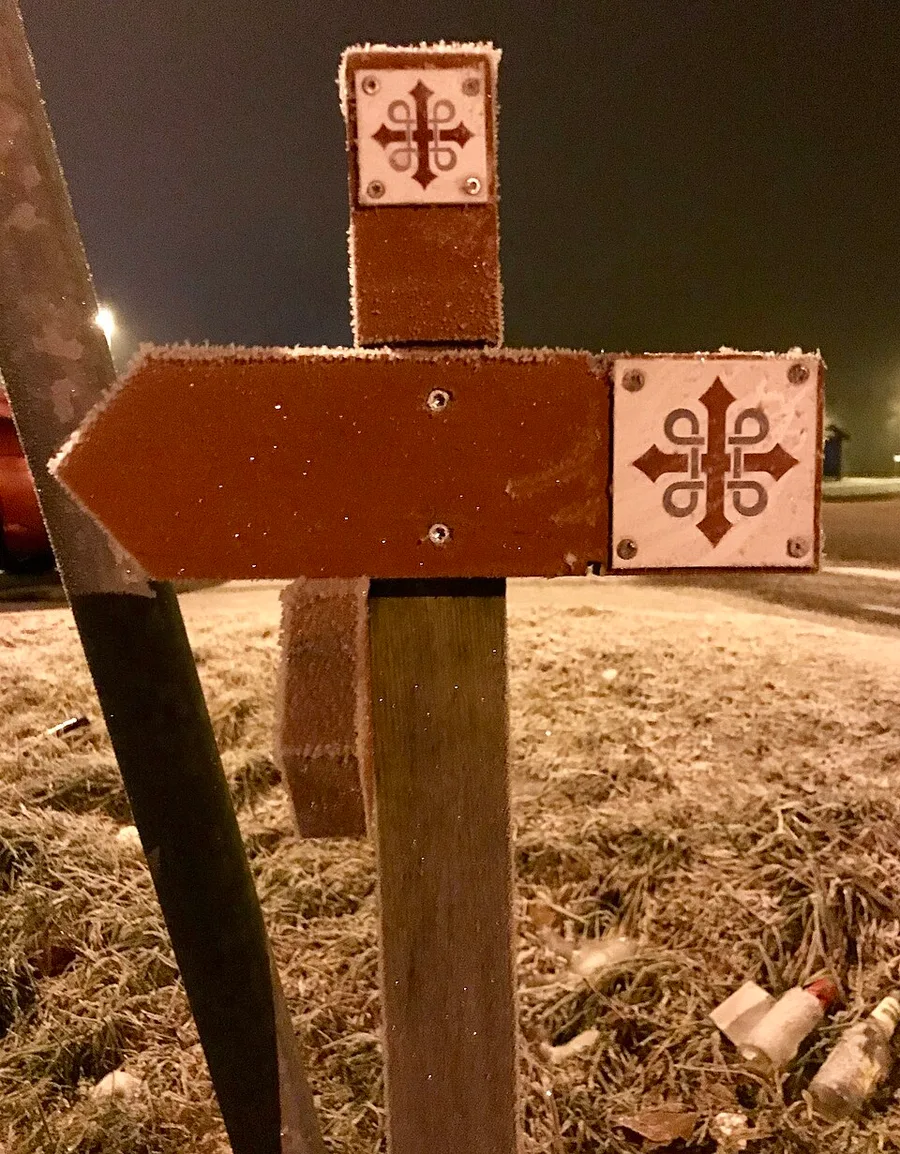 Vogler, Olofsmärke Greåker (2019), Wikimedia Commons, CC BY-SA 4.0 A frosted waymark on the modern route — the red Olav's cross that carries walkers 580 kilometres from Selånger on the Bothnian coast to the west door of Nidaros, along the path Olav's own return from exile traced in the summer of 1030. "Saint Olav's Way" — the 580-kilometre pilgrim route from the
Bothnian Sea coast at Selånger (in modern eastern Sweden) west
through Jämtland and across the border to Trondheim. The route
retraces the actual path Olav II Haraldsson took on his return
from exile in Kievan Rus in the summer of 1030. One of the two
principal modern Norwegian pilgrim routes (alongside the longer
Gudbrandsdalsleden from Oslo); reopened in 2013 as a marked
walking path with the modern Pilegrimsleden hostel and
stamping system.
Also discussed in The King Who Became a Saint — how the Nordmen came to Christ arrive at the west door with the staff and the stamped pilgrim’s pass. The Gråhårsklubben (the Oldsters) sleep in Trondheim on the night of Day 4 — olsok itself, July 29 — and the city around the cathedral will be loud with the festival whether or not anyone attends a service.
Vogler, Olofsmärke Greåker (2019), Wikimedia Commons, CC BY-SA 4.0 A frosted waymark on the modern route — the red Olav's cross that carries walkers 580 kilometres from Selånger on the Bothnian coast to the west door of Nidaros, along the path Olav's own return from exile traced in the summer of 1030. "Saint Olav's Way" — the 580-kilometre pilgrim route from the
Bothnian Sea coast at Selånger (in modern eastern Sweden) west
through Jämtland and across the border to Trondheim. The route
retraces the actual path Olav II Haraldsson took on his return
from exile in Kievan Rus in the summer of 1030. One of the two
principal modern Norwegian pilgrim routes (alongside the longer
Gudbrandsdalsleden from Oslo); reopened in 2013 as a marked
walking path with the modern Pilegrimsleden hostel and
stamping system.
Also discussed in The King Who Became a Saint — how the Nordmen came to Christ arrive at the west door with the staff and the stamped pilgrim’s pass. The Gråhårsklubben (the Oldsters) sleep in Trondheim on the night of Day 4 — olsok itself, July 29 — and the city around the cathedral will be loud with the festival whether or not anyone attends a service.
Jul — the Norwegian Christmas Eve
The Norwegian Christmas is centered on the 24th — Jul 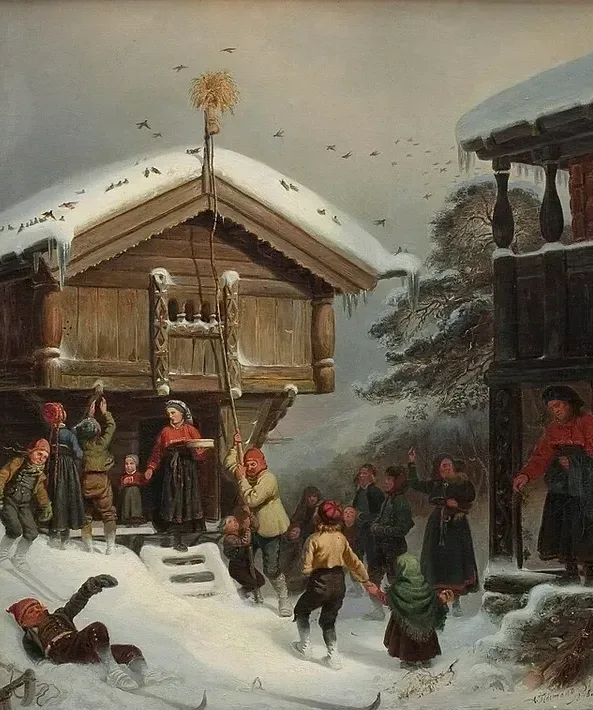 Adolph Tidemand, Norsk juleskik (1846), Trondheim kunstmuseum Adolph Tidemand paints a Norwegian farmyard at Christmas — the julenek sheaf raised for the birds, children on skis — the midwinter feast whose forms carry a pre-Christian inheritance from the Norse jól. The Norwegian (and broadly Scandinavian) midwinter feast — the
modern Christmas, but with a pre-Christian inheritance from the
Norse jól-blót still visible in its structure. The long run of
nights, the great toasts, the porridge bowl set out on the barn
threshold for the unseen one who lives on the farm, the julebukk
(Yule goat) surviving now in a children's costume-walk, the
Swedish Christmas ham traditionally traced back to the
sonargöltr (yule-boar). The Norwegian Jul is the clearest
practical example of how the household religion survived the
official conversion — the form remained, the gods at its centre
changed.
Also discussed in Worshiping Odin and Thor — the lived religion of pre-Christian NorwayJulebukk — the masked goat of midwinterÅsgårdsreien — the storm that rides through the winter sky — not the 25th. The late afternoon is for church bells: NRK broadcasts the julegudstjeneste from Nidarosdomen at 4 PM, and at 5 PM the Sølvguttene choir “sings Christmas in” as bells ring across the country — a national ritual. The evening meal is regional: ribbe (slow-roasted pork belly) in the east and around Oslo; pinnekjøtt (cured-and-steamed lamb ribs) in the west; lutefisk and torsk on the coast. Risengrynsgrøt (rice porridge) is served at lunch with a single almond hidden in the pot — whoever finds it wins a marzipan pig. Seven kinds of cookies (syv slag) line the table from Advent onward. The julenisse arrives at the door with a sack and the question that has become a national in-joke: “Er det noen snille barn her?” — Are there any good children here?
Adolph Tidemand, Norsk juleskik (1846), Trondheim kunstmuseum Adolph Tidemand paints a Norwegian farmyard at Christmas — the julenek sheaf raised for the birds, children on skis — the midwinter feast whose forms carry a pre-Christian inheritance from the Norse jól. The Norwegian (and broadly Scandinavian) midwinter feast — the
modern Christmas, but with a pre-Christian inheritance from the
Norse jól-blót still visible in its structure. The long run of
nights, the great toasts, the porridge bowl set out on the barn
threshold for the unseen one who lives on the farm, the julebukk
(Yule goat) surviving now in a children's costume-walk, the
Swedish Christmas ham traditionally traced back to the
sonargöltr (yule-boar). The Norwegian Jul is the clearest
practical example of how the household religion survived the
official conversion — the form remained, the gods at its centre
changed.
Also discussed in Worshiping Odin and Thor — the lived religion of pre-Christian NorwayJulebukk — the masked goat of midwinterÅsgårdsreien — the storm that rides through the winter sky — not the 25th. The late afternoon is for church bells: NRK broadcasts the julegudstjeneste from Nidarosdomen at 4 PM, and at 5 PM the Sølvguttene choir “sings Christmas in” as bells ring across the country — a national ritual. The evening meal is regional: ribbe (slow-roasted pork belly) in the east and around Oslo; pinnekjøtt (cured-and-steamed lamb ribs) in the west; lutefisk and torsk on the coast. Risengrynsgrøt (rice porridge) is served at lunch with a single almond hidden in the pot — whoever finds it wins a marzipan pig. Seven kinds of cookies (syv slag) line the table from Advent onward. The julenisse arrives at the door with a sack and the question that has become a national in-joke: “Er det noen snille barn her?” — Are there any good children here?
The folk arts
Norway’s traditional culture is a living one. The Hardingfele 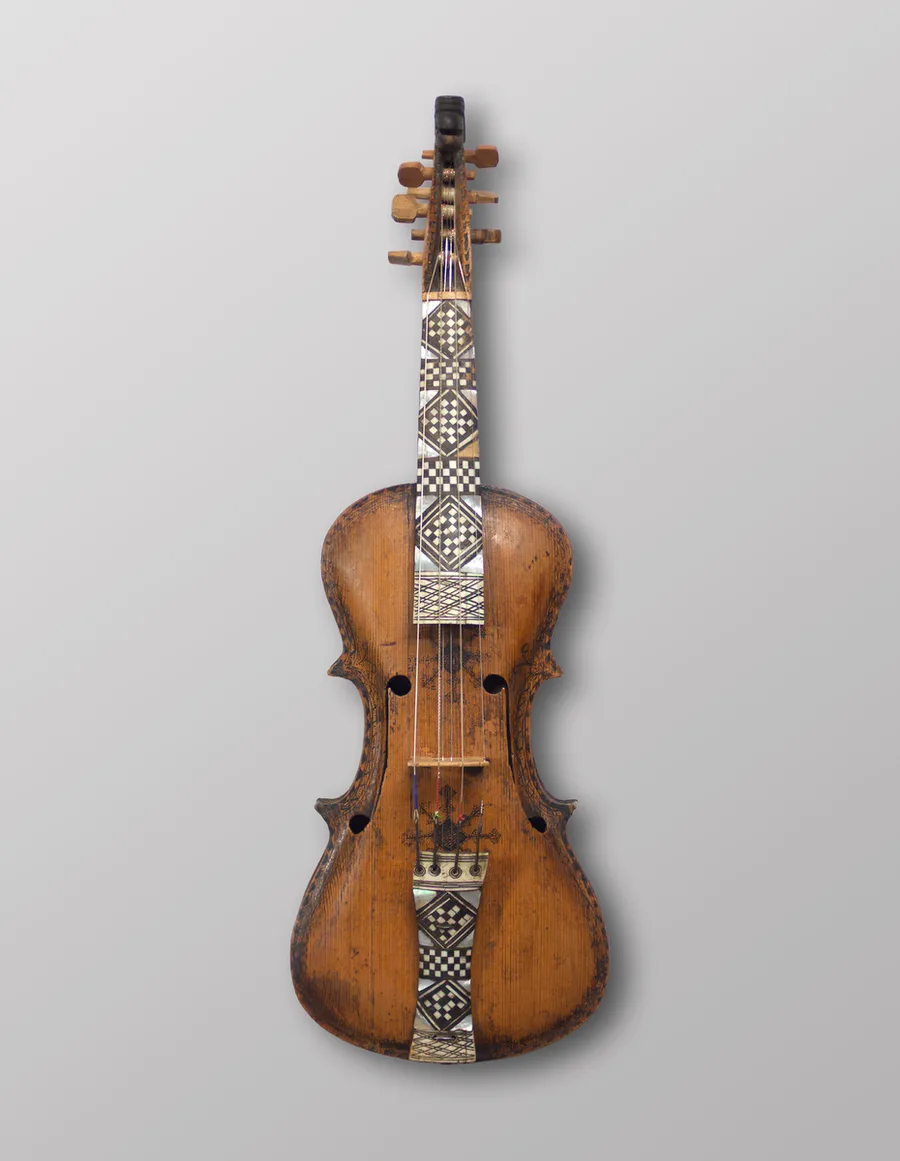 Photo: Svein Skare, Universitetsmuseet i Bergen / DigitaltMuseum — Jaastadfela (1651), CC BY-SA 4.0 The Jaastad fiddle of 1651, the oldest Hardanger fiddle to survive — its sympathetic understrings, inked scrollwork and mother-of-pearl inlay all present in the instrument that carries the dance music of western Norway. The Hardanger fiddle, Norway's national folk instrument: a
violin carrying four or five sympathetic understrings beneath
the bowed strings, which ring untouched and give the sound its
shimmering, slightly unearthly undertone. The body is inked
with rosing scrollwork, the fingerboard and tailpiece inlaid
with mother-of-pearl, and the scroll often carved as a dragon
or lion head. The oldest surviving instrument, the Jaastad
fiddle, bears the date 1651 and is attributed to Ole Jonsen
Jaastad of Ullensvang in Hardanger; it is held by the
University Museum of Bergen. The fiddle carries the dance
music of Vestlandet, Telemark, and the inland valleys —
springar, gangar, halling — and legend priced its
mastery at a goat thrown to the fossegrim behind a waterfall.
Also discussed in Fossegrimen — the waterfall fiddler who teaches you to play , the Hardanger fiddle, plays the old dance tunes at weddings and festivals — its sympathetic understrings give the instrument a ringing, slightly unearthly undertone. Folk dance survives the same way. The trolls and hidden folk of the older imagination are still everywhere on book covers and souvenir shelves and in the names on the map.
Photo: Svein Skare, Universitetsmuseet i Bergen / DigitaltMuseum — Jaastadfela (1651), CC BY-SA 4.0 The Jaastad fiddle of 1651, the oldest Hardanger fiddle to survive — its sympathetic understrings, inked scrollwork and mother-of-pearl inlay all present in the instrument that carries the dance music of western Norway. The Hardanger fiddle, Norway's national folk instrument: a
violin carrying four or five sympathetic understrings beneath
the bowed strings, which ring untouched and give the sound its
shimmering, slightly unearthly undertone. The body is inked
with rosing scrollwork, the fingerboard and tailpiece inlaid
with mother-of-pearl, and the scroll often carved as a dragon
or lion head. The oldest surviving instrument, the Jaastad
fiddle, bears the date 1651 and is attributed to Ole Jonsen
Jaastad of Ullensvang in Hardanger; it is held by the
University Museum of Bergen. The fiddle carries the dance
music of Vestlandet, Telemark, and the inland valleys —
springar, gangar, halling — and legend priced its
mastery at a goat thrown to the fossegrim behind a waterfall.
Also discussed in Fossegrimen — the waterfall fiddler who teaches you to play , the Hardanger fiddle, plays the old dance tunes at weddings and festivals — its sympathetic understrings give the instrument a ringing, slightly unearthly undertone. Folk dance survives the same way. The trolls and hidden folk of the older imagination are still everywhere on book covers and souvenir shelves and in the names on the map.
The graves
Norwegian families keep their graves. They tend them, plant them, visit them, and hold the same family plot across generations. A churchyard in a rural parish is not an abandoned place — it is a maintained one, and the names on the stones are often still the names in the surrounding farms. The visit to the church at Øyer on Day 6 sits inside this tradition: a parish ground where the names being read off the stones still belong to people in the valley.