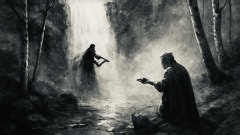
Fossegrimen — The waterfall fiddler who teaches you to play
The spirit who lives behind the white roar of a waterfall and sells you the playing — for a white goat thrown into the falls on a Thursday night. Bring too little and he teaches you only to tune; bring enough and he plays so well the river slows to listen.
The Hardanger fiddlers of nineteenth-century Telemark 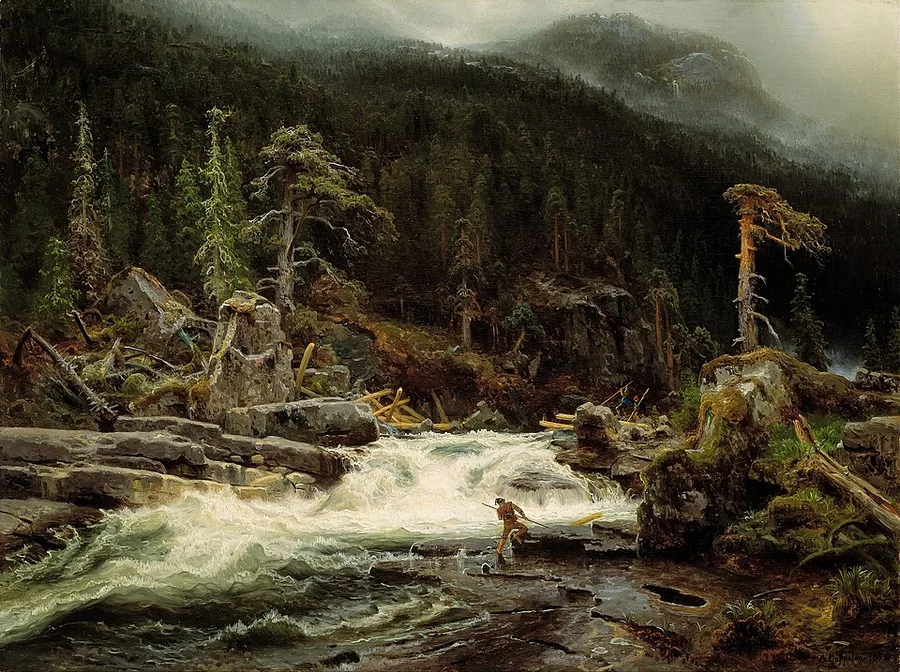 August Cappelen, Foss i nedre Telemark (1852), National Museum of Art, Architecture and Design August Cappelen's 1852 waterfall gorge in lower Telemark — white water tearing through dark forest, log-drivers small at its edge. This is the foss country whose roar the tradition put a fiddle inside; Cappelen paints the very register the legend lives in. Historic region and county in the inland-southern part of
Norway, between the southeastern coast and the central
Hardangervidda plateau. Home to Heddal Stave Church — the
largest of the twenty-eight surviving Norwegian stave churches,
standing nearly thirty metres tall — and to the heavy-water
production facility at Vemork whose sabotage by Norwegian
commandos in February 1943 disrupted the German atomic-weapons
programme. The name Telemark also gives the world the modern
ski-turn technique developed there in the nineteenth century.
In the folklore record Telemark is the deepest vein of all —
the landscape of the ballad collectors, the hardingfele
legends, and the lake serpent of Seljord.
Telemark Also discussed in A Catholic Norway — the faith that gave the kingdom its first institutions and the stave churchesWorld War II — the King’s “No” and the Nazis in NorwayThe Long Fall — the sudden loss of Norwegian nobility, the end of the kings, and half of Norway gone foreverTroll — the monsters of the mountainsUtburd — the unbaptized child that will not restÅsgårdsreien — the storm that rides through the winter skyHuldra — the girl in the forest with a secretSjøormer — the serpents in the deep lakes and fjords played so far past their neighbours that people kept an explanation ready: the man had been to the waterfall. Torgeir Augundsson of Sauherad — Myllarguten
August Cappelen, Foss i nedre Telemark (1852), National Museum of Art, Architecture and Design August Cappelen's 1852 waterfall gorge in lower Telemark — white water tearing through dark forest, log-drivers small at its edge. This is the foss country whose roar the tradition put a fiddle inside; Cappelen paints the very register the legend lives in. Historic region and county in the inland-southern part of
Norway, between the southeastern coast and the central
Hardangervidda plateau. Home to Heddal Stave Church — the
largest of the twenty-eight surviving Norwegian stave churches,
standing nearly thirty metres tall — and to the heavy-water
production facility at Vemork whose sabotage by Norwegian
commandos in February 1943 disrupted the German atomic-weapons
programme. The name Telemark also gives the world the modern
ski-turn technique developed there in the nineteenth century.
In the folklore record Telemark is the deepest vein of all —
the landscape of the ballad collectors, the hardingfele
legends, and the lake serpent of Seljord.
Telemark Also discussed in A Catholic Norway — the faith that gave the kingdom its first institutions and the stave churchesWorld War II — the King’s “No” and the Nazis in NorwayThe Long Fall — the sudden loss of Norwegian nobility, the end of the kings, and half of Norway gone foreverTroll — the monsters of the mountainsUtburd — the unbaptized child that will not restÅsgårdsreien — the storm that rides through the winter skyHuldra — the girl in the forest with a secretSjøormer — the serpents in the deep lakes and fjords played so far past their neighbours that people kept an explanation ready: the man had been to the waterfall. Torgeir Augundsson of Sauherad — Myllarguten 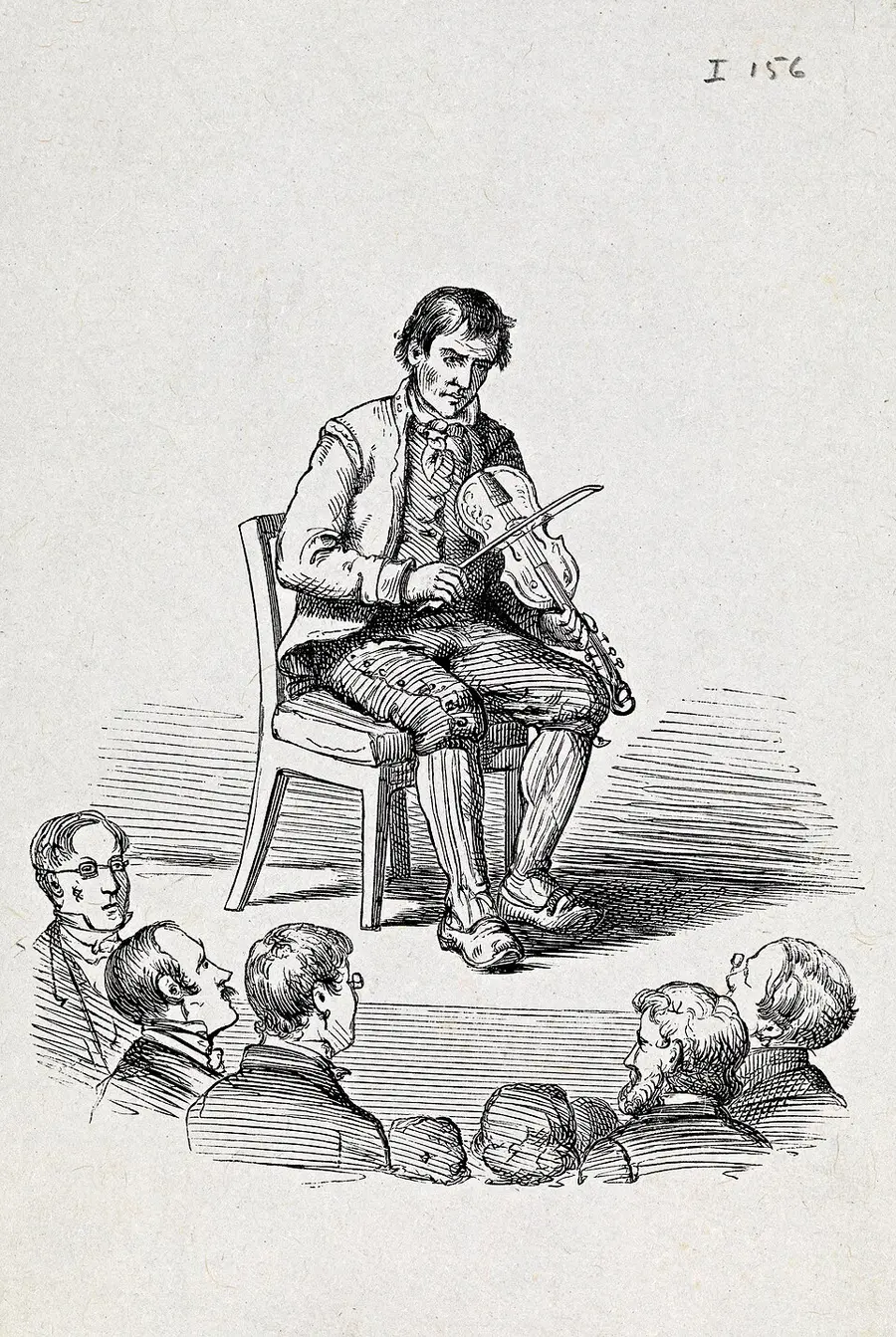 Unknown artist, portrait of Myllarguten (19th century), Nasjonalbiblioteket / National Library of Norway A nineteenth-century drawing of the Telemark fiddler playing to a ring of city listeners, the 1849 Christiania concert that made him the first Norwegian folk musician on a public stage. Country rumour said he had bought such skill from the fossegrim — a rumour he rejected to the end. Torgeir Augundsson (1801–1872), called Myllarguten — the
Miller's Boy, after his father's trade — the most famous
of Telemark's hardingfele fiddlers, born at Sauherad and
playing weddings and markets from childhood. In January
1849 Ole Bull presented him at a concert in Christiania
that drew some 1,500 listeners — the first Norwegian folk
musician on a public concert stage. Playing that far past
his neighbours demanded an explanation, and the
countryside supplied one: he had bought it from the
fossegrim at the waterfall — a rumor he denied flatly his
whole life. The farm his concert earnings bought in
Rauland was lost to debt in 1865; he died there of
tuberculosis in 1872, a pauper.
, the Miller’s Boy — was the most famous of them, and the rumour that he had bought his playing from the fossegrim shadowed him his whole life. He denied it flatly. The rumour outlived him: he died of tuberculosis in Rauland in 1872, a pauper.
Unknown artist, portrait of Myllarguten (19th century), Nasjonalbiblioteket / National Library of Norway A nineteenth-century drawing of the Telemark fiddler playing to a ring of city listeners, the 1849 Christiania concert that made him the first Norwegian folk musician on a public stage. Country rumour said he had bought such skill from the fossegrim — a rumour he rejected to the end. Torgeir Augundsson (1801–1872), called Myllarguten — the
Miller's Boy, after his father's trade — the most famous
of Telemark's hardingfele fiddlers, born at Sauherad and
playing weddings and markets from childhood. In January
1849 Ole Bull presented him at a concert in Christiania
that drew some 1,500 listeners — the first Norwegian folk
musician on a public concert stage. Playing that far past
his neighbours demanded an explanation, and the
countryside supplied one: he had bought it from the
fossegrim at the waterfall — a rumor he denied flatly his
whole life. The farm his concert earnings bought in
Rauland was lost to debt in 1865; he died there of
tuberculosis in 1872, a pauper.
, the Miller’s Boy — was the most famous of them, and the rumour that he had bought his playing from the fossegrim shadowed him his whole life. He denied it flatly. The rumour outlived him: he died of tuberculosis in Rauland in 1872, a pauper.
The fossegrim lives where the water is loudest: behind waterfalls, in the rapids, under the mill-race. He is not the Nøkken 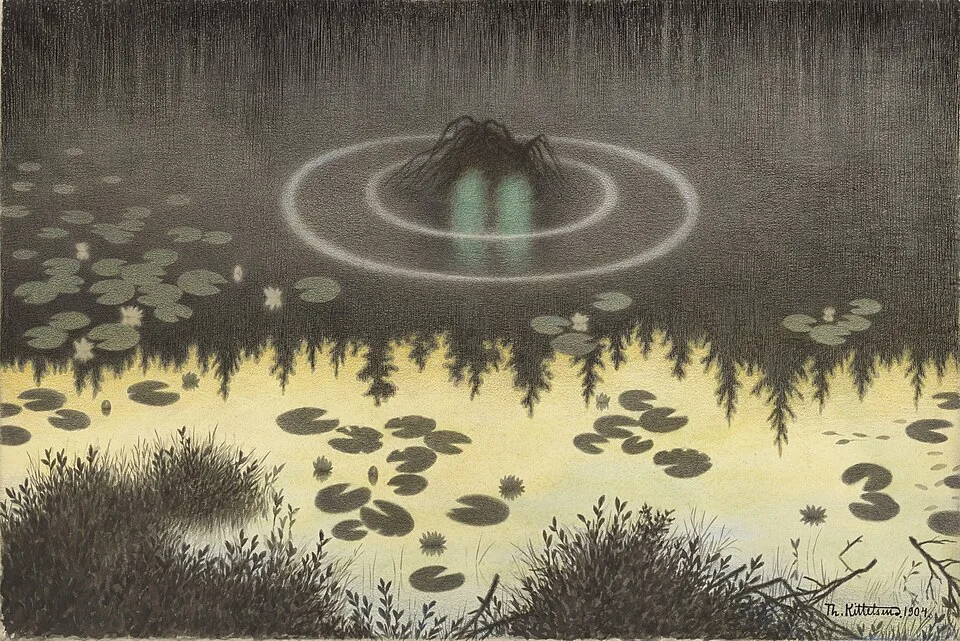 Theodor Kittelsen, Nøkken (1904), Nasjonalmuseet Kittelsen's 1904 'Nøkken,' the painting that fixed the modern picture of the water spirit — a dark tangled head and two pale eyes surfacing among the lilies of a black tarn, waiting to draw the unwary under. The shape-shifting spirit of fresh water in Norwegian folk
tradition — most at home in still water: lakes, tarns, and
mill ponds — recorded as luring people, children above all,
into drowning. He appeared as a handsome young fiddler, as a
white horse that tempted children onto its back, as a drifting
log, or as two pale eyes among the water lilies. The white
water lily is named nøkkerose after him. The name descends
from Old Norse nykr, 'water spirit.' Andreas Faye's Norske
Sagn (1833), the first printed collection of Norwegian
legends, placed nøkker "in most waters and rivers"; Theodor
Kittelsen's 1904 Nøkken (Nasjonalmuseet) fixed the modern
image — a black, lily-choked tarn and two eyes at the surface.
The roaring falls belonged instead to his relative, the
fossegrim.
Also discussed in Nøkken — the water-spirit who pulls you underVardøger — your double, arriving a few minutes before you , who drowns you in still black lakes. The fossegrim teaches — which is a slower kind of danger. What he teaches is the Hardingfele
Theodor Kittelsen, Nøkken (1904), Nasjonalmuseet Kittelsen's 1904 'Nøkken,' the painting that fixed the modern picture of the water spirit — a dark tangled head and two pale eyes surfacing among the lilies of a black tarn, waiting to draw the unwary under. The shape-shifting spirit of fresh water in Norwegian folk
tradition — most at home in still water: lakes, tarns, and
mill ponds — recorded as luring people, children above all,
into drowning. He appeared as a handsome young fiddler, as a
white horse that tempted children onto its back, as a drifting
log, or as two pale eyes among the water lilies. The white
water lily is named nøkkerose after him. The name descends
from Old Norse nykr, 'water spirit.' Andreas Faye's Norske
Sagn (1833), the first printed collection of Norwegian
legends, placed nøkker "in most waters and rivers"; Theodor
Kittelsen's 1904 Nøkken (Nasjonalmuseet) fixed the modern
image — a black, lily-choked tarn and two eyes at the surface.
The roaring falls belonged instead to his relative, the
fossegrim.
Also discussed in Nøkken — the water-spirit who pulls you underVardøger — your double, arriving a few minutes before you , who drowns you in still black lakes. The fossegrim teaches — which is a slower kind of danger. What he teaches is the Hardingfele 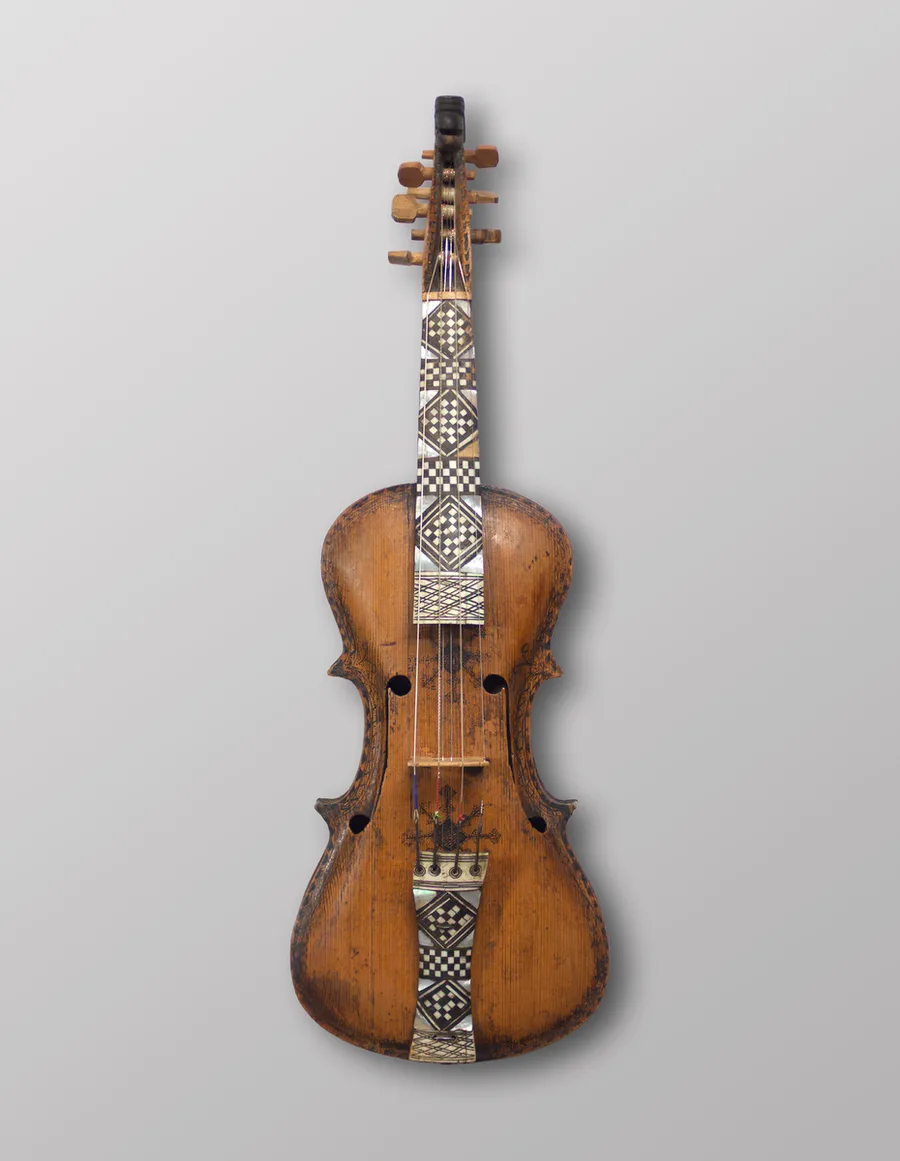 Photo: Svein Skare, Universitetsmuseet i Bergen / DigitaltMuseum — Jaastadfela (1651), CC BY-SA 4.0 The Jaastad fiddle of 1651, the oldest Hardanger fiddle to survive — sympathetic understrings, inked scrollwork, mother-of-pearl down the fingerboard. This is the instrument the legend priced at a goat thrown to the fossegrim behind the waterfall. The Hardanger fiddle, Norway's national folk instrument: a
violin carrying four or five sympathetic understrings beneath
the bowed strings, which ring untouched and give the sound its
shimmering, slightly unearthly undertone. The body is inked
with rosing scrollwork, the fingerboard and tailpiece inlaid
with mother-of-pearl, and the scroll often carved as a dragon
or lion head. The oldest surviving instrument, the Jaastad
fiddle, bears the date 1651 and is attributed to Ole Jonsen
Jaastad of Ullensvang in Hardanger; it is held by the
University Museum of Bergen. The fiddle carries the dance
music of Vestlandet, Telemark, and the inland valleys —
springar, gangar, halling — and legend priced its
mastery at a goat thrown to the fossegrim behind a waterfall.
Also discussed in Tradisjoner — celebrations across the Norwegian year , the Hardanger fiddle whose sympathetic strings ring under the bowed note, and he teaches it for a price set in advance.
Photo: Svein Skare, Universitetsmuseet i Bergen / DigitaltMuseum — Jaastadfela (1651), CC BY-SA 4.0 The Jaastad fiddle of 1651, the oldest Hardanger fiddle to survive — sympathetic understrings, inked scrollwork, mother-of-pearl down the fingerboard. This is the instrument the legend priced at a goat thrown to the fossegrim behind the waterfall. The Hardanger fiddle, Norway's national folk instrument: a
violin carrying four or five sympathetic understrings beneath
the bowed strings, which ring untouched and give the sound its
shimmering, slightly unearthly undertone. The body is inked
with rosing scrollwork, the fingerboard and tailpiece inlaid
with mother-of-pearl, and the scroll often carved as a dragon
or lion head. The oldest surviving instrument, the Jaastad
fiddle, bears the date 1651 and is attributed to Ole Jonsen
Jaastad of Ullensvang in Hardanger; it is held by the
University Museum of Bergen. The fiddle carries the dance
music of Vestlandet, Telemark, and the inland valleys —
springar, gangar, halling — and legend priced its
mastery at a goat thrown to the fossegrim behind a waterfall.
Also discussed in Tradisjoner — celebrations across the Norwegian year , the Hardanger fiddle whose sympathetic strings ring under the bowed note, and he teaches it for a price set in advance.
The price was meat. A white he-goat kid — or a lamb, or a joint of smoked meat — carried to a north-running falls on a Thursday evening and thrown into the water. What came back depended on what you brought. A scrawny, stingy goat bought the right to tune the instrument and nothing more. A good one bought the lesson. A whole fat kid bought mastery. The fossegrim never cheated anyone; he gave exactly what was paid for. In one recorded telling the meat had to be stolen — a leg of smoked mutton lifted from a neighbour’s storehouse and carried to the falls four Thursday evenings running.
The lesson drew blood. The spirit took the pupil’s right hand and dragged the fingers across the strings until they bled raw, and again the next night, until the playing came. At the far end of the lessons the music was past bearing — the trees were said to lean toward the river, and the falls themselves to slow to hear it.
One tune was never for human feet. The fossegrim’s lay ran to eleven variations, and people might dance to only ten of them; the eleventh belonged to the spirit and his host, and, played anywhere, it set tables and benches and grey-beards and grandmothers and the babe in its cradle dancing, and would not let them stop. So the spirit kept it back.
Bergen Day 4 gives the Ungdommene (the Youngsters) a Bergen morning — the city that set Sinding’s fossegrim at Ole Bull’s feet. Go to page → cast the bargain in bronze. At the foot of Stephan Sinding’s statue of the violinist Ole Bull 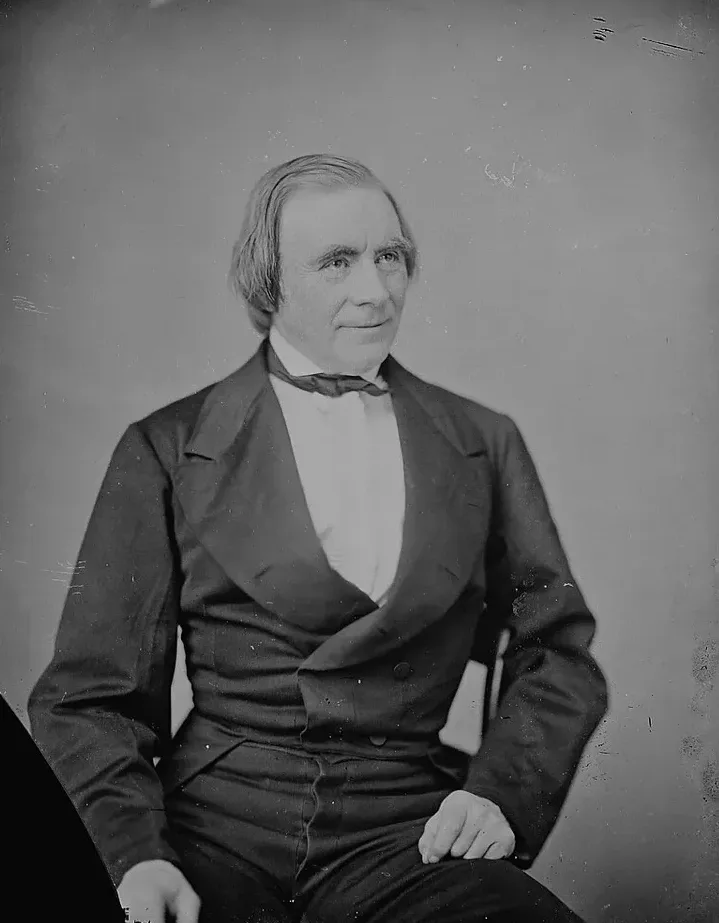 Mathew Brady, Ole Bull, violinist (c. 1860–1865), U.S. National Archives and Records Administration Mathew Brady's studio portrait of Ole Bull from the American touring years — the virtuoso who put Myllarguten and the hardingfele on a Christiania concert stage in January 1849, and whose own legend Bergen answered with Sinding's bronze fossegrim playing at his feet. Norwegian violin virtuoso (1810–1880), born in Bergen, the
first Norwegian performer to win international fame, touring
Europe and America for nearly five decades as a living emblem
of national romanticism. In January 1849 he presented the
Telemark fiddler Myllarguten at a concert in Christiania that
drew some 1,500 listeners — the first time the hardingfele
reached a concert stage. In 1850 he founded Det Norske Theater
in Bergen, the first Norwegian-language stage; in 1852 he
bought over 11,000 acres in Potter County, Pennsylvania, for
Oleana, a colony for Norwegian emigrants that collapsed within
two years. Stephan Sinding's bronze statue of him in Bergen,
unveiled 17 May 1901, seats a fossegrim playing at his feet.
— unveiled on the national day, 17 May 1901 — a small fossegrim sits half-sunk in the water with a harp, playing up at the master he is supposed to have taught.
Mathew Brady, Ole Bull, violinist (c. 1860–1865), U.S. National Archives and Records Administration Mathew Brady's studio portrait of Ole Bull from the American touring years — the virtuoso who put Myllarguten and the hardingfele on a Christiania concert stage in January 1849, and whose own legend Bergen answered with Sinding's bronze fossegrim playing at his feet. Norwegian violin virtuoso (1810–1880), born in Bergen, the
first Norwegian performer to win international fame, touring
Europe and America for nearly five decades as a living emblem
of national romanticism. In January 1849 he presented the
Telemark fiddler Myllarguten at a concert in Christiania that
drew some 1,500 listeners — the first time the hardingfele
reached a concert stage. In 1850 he founded Det Norske Theater
in Bergen, the first Norwegian-language stage; in 1852 he
bought over 11,000 acres in Potter County, Pennsylvania, for
Oleana, a colony for Norwegian emigrants that collapsed within
two years. Stephan Sinding's bronze statue of him in Bergen,
unveiled 17 May 1901, seats a fossegrim playing at his feet.
— unveiled on the national day, 17 May 1901 — a small fossegrim sits half-sunk in the water with a harp, playing up at the master he is supposed to have taught.