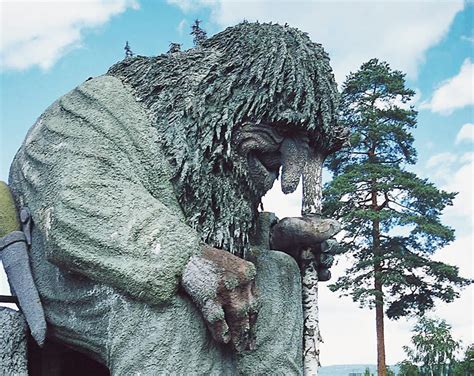
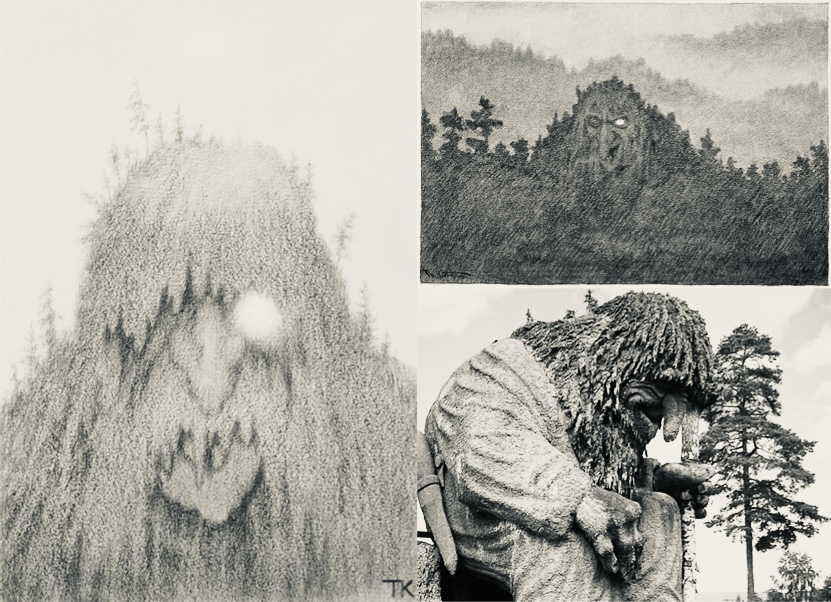
Troll — the monsters of the mountains
A man-eater and a child-stealer, not a cartoon — the worst thing a mountain could be holding. Caught above ground at sunrise it turns to stone, which is why so many Norwegian peaks are said to be giants frozen mid-step.
A troll was the largest thing that could be living in a Norwegian mountain, and the worst — bigger than a bear, strong enough to carry off a grown cow, and hungry for human flesh when it could get it. People near the high forests and the summer pastures guarded against them the way they guarded against weather.
Trolls lived inside the mountains and in caves the daylight never reached, and came out at night. When they could not get human flesh, they took human company by force. A child who did not come down from the pasture, a bride who walked too far into the spruce at dusk, a herder who never came back from the high meadow — these had been taken into the mountain. The word for it was bergtatt, mountain-taken, and the few ever found again could not speak right afterwards. In one of the best-known tellings, Margit Hjukse of Telemark 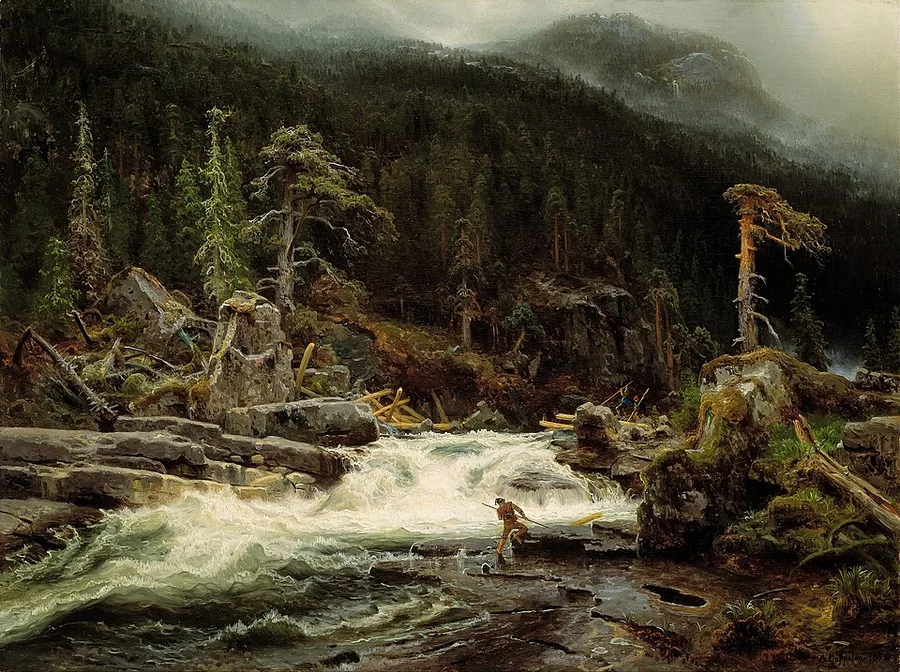 August Cappelen, Foss i nedre Telemark (1852), National Museum of Art, Architecture and Design August Cappelen's 1852 waterfall gorge in lower Telemark — dark forest closing over white water. This is the upland country the taken vanish from: the child on the pasture, the bride in the spruce at dusk, the herder on the high meadow. Telemark keeps the best-known telling — Margit Hjukse, carried into the rock. Historic region and county in the inland-southern part of
Norway, between the southeastern coast and the central
Hardangervidda plateau. Home to Heddal Stave Church — the
largest of the twenty-eight surviving Norwegian stave churches,
standing nearly thirty metres tall — and to the heavy-water
production facility at Vemork whose sabotage by Norwegian
commandos in February 1943 disrupted the German atomic-weapons
programme. The name Telemark also gives the world the modern
ski-turn technique developed there in the nineteenth century.
In the folklore record Telemark is the deepest vein of all —
the landscape of the ballad collectors, the hardingfele
legends, and the lake serpent of Seljord.
Telemark Also discussed in A Catholic Norway — the faith that gave the kingdom its first institutions and the stave churchesWorld War II — the King’s “No” and the Nazis in NorwayThe Long Fall — the sudden loss of Norwegian nobility, the end of the kings, and half of Norway gone foreverFossegrimen — the waterfall fiddler who teaches you to playUtburd — the unbaptized child that will not restÅsgårdsreien — the storm that rides through the winter skyHuldra — the girl in the forest with a secretSjøormer — the serpents in the deep lakes and fjords is carried into the rock and lives there for years; when she is at last allowed home she is soon taken back for good, and her last wish is that the church bells be rung for her. The bells were the thing trolls could not stand, which is why so many tales have them hurling boulders at country churches and missing — the erratic stones left in the fields were the missed throws.
August Cappelen, Foss i nedre Telemark (1852), National Museum of Art, Architecture and Design August Cappelen's 1852 waterfall gorge in lower Telemark — dark forest closing over white water. This is the upland country the taken vanish from: the child on the pasture, the bride in the spruce at dusk, the herder on the high meadow. Telemark keeps the best-known telling — Margit Hjukse, carried into the rock. Historic region and county in the inland-southern part of
Norway, between the southeastern coast and the central
Hardangervidda plateau. Home to Heddal Stave Church — the
largest of the twenty-eight surviving Norwegian stave churches,
standing nearly thirty metres tall — and to the heavy-water
production facility at Vemork whose sabotage by Norwegian
commandos in February 1943 disrupted the German atomic-weapons
programme. The name Telemark also gives the world the modern
ski-turn technique developed there in the nineteenth century.
In the folklore record Telemark is the deepest vein of all —
the landscape of the ballad collectors, the hardingfele
legends, and the lake serpent of Seljord.
Telemark Also discussed in A Catholic Norway — the faith that gave the kingdom its first institutions and the stave churchesWorld War II — the King’s “No” and the Nazis in NorwayThe Long Fall — the sudden loss of Norwegian nobility, the end of the kings, and half of Norway gone foreverFossegrimen — the waterfall fiddler who teaches you to playUtburd — the unbaptized child that will not restÅsgårdsreien — the storm that rides through the winter skyHuldra — the girl in the forest with a secretSjøormer — the serpents in the deep lakes and fjords is carried into the rock and lives there for years; when she is at last allowed home she is soon taken back for good, and her last wish is that the church bells be rung for her. The bells were the thing trolls could not stand, which is why so many tales have them hurling boulders at country churches and missing — the erratic stones left in the fields were the missed throws.
Daylight was the other defence: a troll caught above ground at sunrise turned to stone, and the Norwegian map is full of them. The De syv søstre 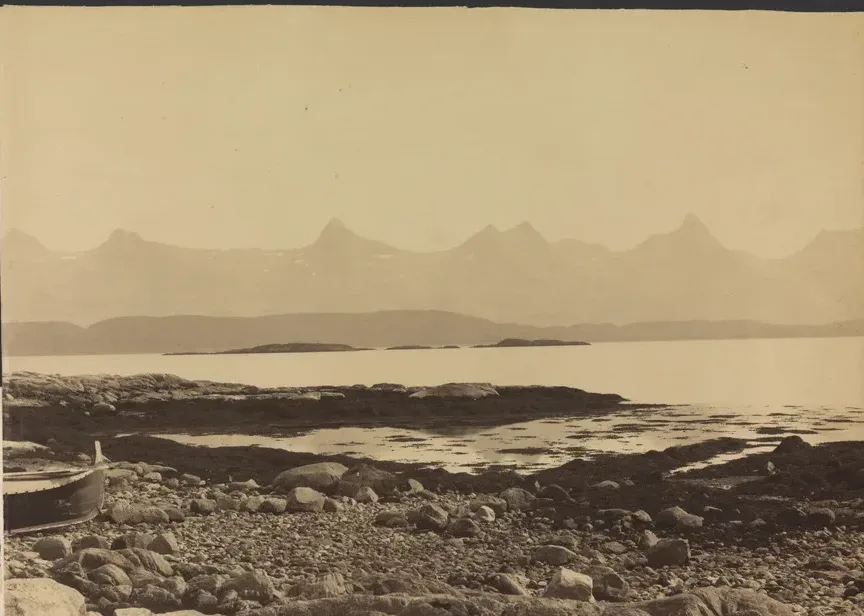 Knud Knudsen, De Syv Søstre, Nordland (c. 1870–1889), National Library of Norway Knud Knudsen's 19th-century photograph of the seven peaks of Alsten rising straight from the sea. In the Helgeland petrification legend they are seven troll-daughters, caught by the rising sun as the troll Hestmannen rode south, and turned to stone where they stood. Range of seven peaks on the island of Alsten in Alstahaug,
on the Helgeland coast, rising straight from the sea to
between 910 and 1,072 m — Botnkrona the highest,
Breitinden the southernmost, above the old church site of
Alstahaug. In the Helgeland petrification legend the peaks
were seven troll-daughters, caught mid-flight by the rising
sun the night the troll Hestmannen rode south along the
coast, and turned to stone where they stood — one legend cycle with
Torghatten and the rider-shaped island of Hestmannen.
Petter Dass, whose vicarage stood at the range's southern
foot from 1689 to 1707, described the Helgeland mountains
in Nordlands Trompet (printed 1739).
De syv søstre on the Helgeland coast are seven troll-daughters frozen mid-flight. They were fleeing the same chase in which the troll Hestmannen loosed an arrow at the maiden Lekamøya — and the king of Sømna flung his hat into the arrow’s path, and the same sunrise that froze the sisters turned the pierced hat to stone where it fell: Torghatten
Knud Knudsen, De Syv Søstre, Nordland (c. 1870–1889), National Library of Norway Knud Knudsen's 19th-century photograph of the seven peaks of Alsten rising straight from the sea. In the Helgeland petrification legend they are seven troll-daughters, caught by the rising sun as the troll Hestmannen rode south, and turned to stone where they stood. Range of seven peaks on the island of Alsten in Alstahaug,
on the Helgeland coast, rising straight from the sea to
between 910 and 1,072 m — Botnkrona the highest,
Breitinden the southernmost, above the old church site of
Alstahaug. In the Helgeland petrification legend the peaks
were seven troll-daughters, caught mid-flight by the rising
sun the night the troll Hestmannen rode south along the
coast, and turned to stone where they stood — one legend cycle with
Torghatten and the rider-shaped island of Hestmannen.
Petter Dass, whose vicarage stood at the range's southern
foot from 1689 to 1707, described the Helgeland mountains
in Nordlands Trompet (printed 1739).
De syv søstre on the Helgeland coast are seven troll-daughters frozen mid-flight. They were fleeing the same chase in which the troll Hestmannen loosed an arrow at the maiden Lekamøya — and the king of Sømna flung his hat into the arrow’s path, and the same sunrise that froze the sisters turned the pierced hat to stone where it fell: Torghatten 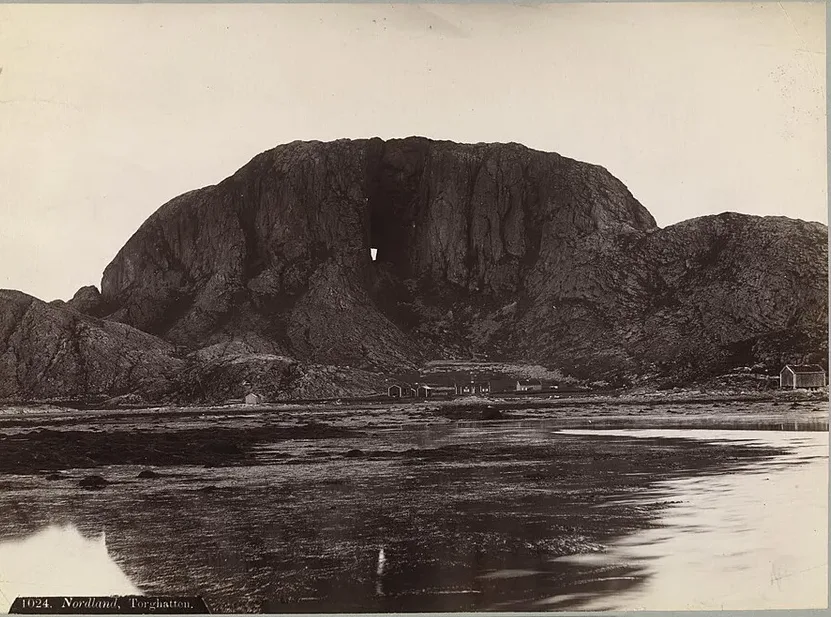 Axel Lindahl, Nordland, Torghatten (1880s), National Library of Norway In Lindahl's plate the tunnel shows as a sliver of daylight through the dark mass, easy to miss until you find it, and the farm buildings at the mountain's foot shrink to specks — the scale that made the hole feel like it needed a giant's arrow to explain. Granite dome on the island of Torget just south of
Brønnøysund, on the Helgeland coast, pierced clean through
by a natural tunnel roughly 160 m long and up to 35 m
high. In the Helgeland petrification legend the mountain
is the hat of the king of Sømna (the Brønnøy king in some
tellings): the troll Hestmannen loosed an arrow after the
fleeing maiden Lekamøya, the king flung his hat into its
path, and the rising sun turned the arrow-pierced hat to
stone where it fell. The tunnel itself is the work of
frost and sea erosion along a fracture zone at the end of
the last ice age.
Torghatten , the hatted mountain with the hole punched clean through it. The Trollveggen
Axel Lindahl, Nordland, Torghatten (1880s), National Library of Norway In Lindahl's plate the tunnel shows as a sliver of daylight through the dark mass, easy to miss until you find it, and the farm buildings at the mountain's foot shrink to specks — the scale that made the hole feel like it needed a giant's arrow to explain. Granite dome on the island of Torget just south of
Brønnøysund, on the Helgeland coast, pierced clean through
by a natural tunnel roughly 160 m long and up to 35 m
high. In the Helgeland petrification legend the mountain
is the hat of the king of Sømna (the Brønnøy king in some
tellings): the troll Hestmannen loosed an arrow after the
fleeing maiden Lekamøya, the king flung his hat into its
path, and the rising sun turned the arrow-pierced hat to
stone where it fell. The tunnel itself is the work of
frost and sea erosion along a fracture zone at the end of
the last ice age.
Torghatten , the hatted mountain with the hole punched clean through it. The Trollveggen 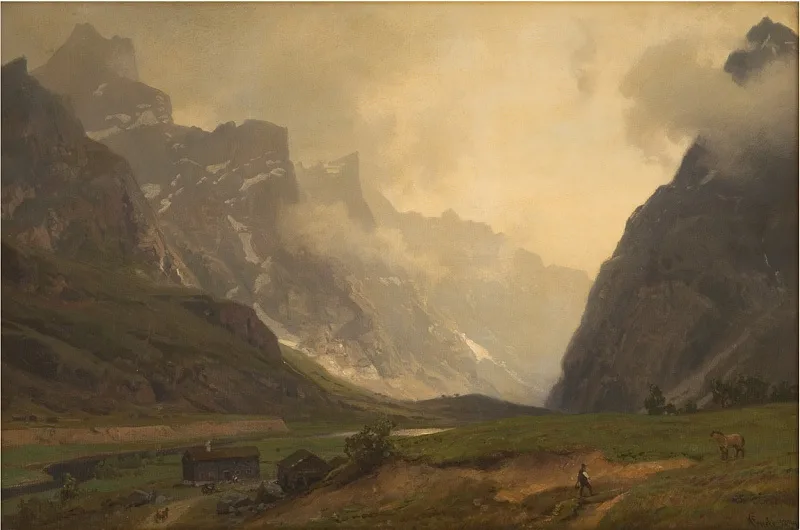 Hans Gude, Troldtinderne i Romsdalen (1894), Statens Museum for Kunst, Copenhagen Hans Gude's 1894 painting of the jagged crest above Romsdalen. In the petrification legend these spires are a troll wedding party that reveled past sunrise and turned to stone where the light caught them, still named Brura the Bride, Brudgommen the Groom, and Trollkjerringa the hag. Rock face in the Trolltindene massif on the west side of
the Romsdalen valley in Møre og Romsdal — the tallest
vertical and partly overhanging cliff in Europe, roughly
1,000 m of sheer gneiss whose summit crest stands about
1,700 m above the valley floor, the rim overhanging the
base by nearly 50 m at its steepest. In the Romsdal
petrification legend the crest's spires are a troll
wedding party that reveled past sunrise and turned to
stone where the light caught it; the pinnacles still carry
the names — Brura (the Bride), Brudgommen (the Groom), and
Trollkjerringa, the troll hag. The wall itself was not
climbed until 1965, when a Norwegian team topped out one
day ahead of a British one.
Trollveggen wall above Romsdalen is a wedding party caught by dawn; a spire on it is still called Trollkjerringa, the troll hag.
Hans Gude, Troldtinderne i Romsdalen (1894), Statens Museum for Kunst, Copenhagen Hans Gude's 1894 painting of the jagged crest above Romsdalen. In the petrification legend these spires are a troll wedding party that reveled past sunrise and turned to stone where the light caught them, still named Brura the Bride, Brudgommen the Groom, and Trollkjerringa the hag. Rock face in the Trolltindene massif on the west side of
the Romsdalen valley in Møre og Romsdal — the tallest
vertical and partly overhanging cliff in Europe, roughly
1,000 m of sheer gneiss whose summit crest stands about
1,700 m above the valley floor, the rim overhanging the
base by nearly 50 m at its steepest. In the Romsdal
petrification legend the crest's spires are a troll
wedding party that reveled past sunrise and turned to
stone where the light caught it; the pinnacles still carry
the names — Brura (the Bride), Brudgommen (the Groom), and
Trollkjerringa, the troll hag. The wall itself was not
climbed until 1965, when a Norwegian team topped out one
day ahead of a British one.
Trollveggen wall above Romsdalen is a wedding party caught by dawn; a spire on it is still called Trollkjerringa, the troll hag.
What turned to stone was the troll the sun had caught. The one a herder still feared at dusk was the one the sun had not — the thing that emptied a summer pasture and left no one behind to say why.