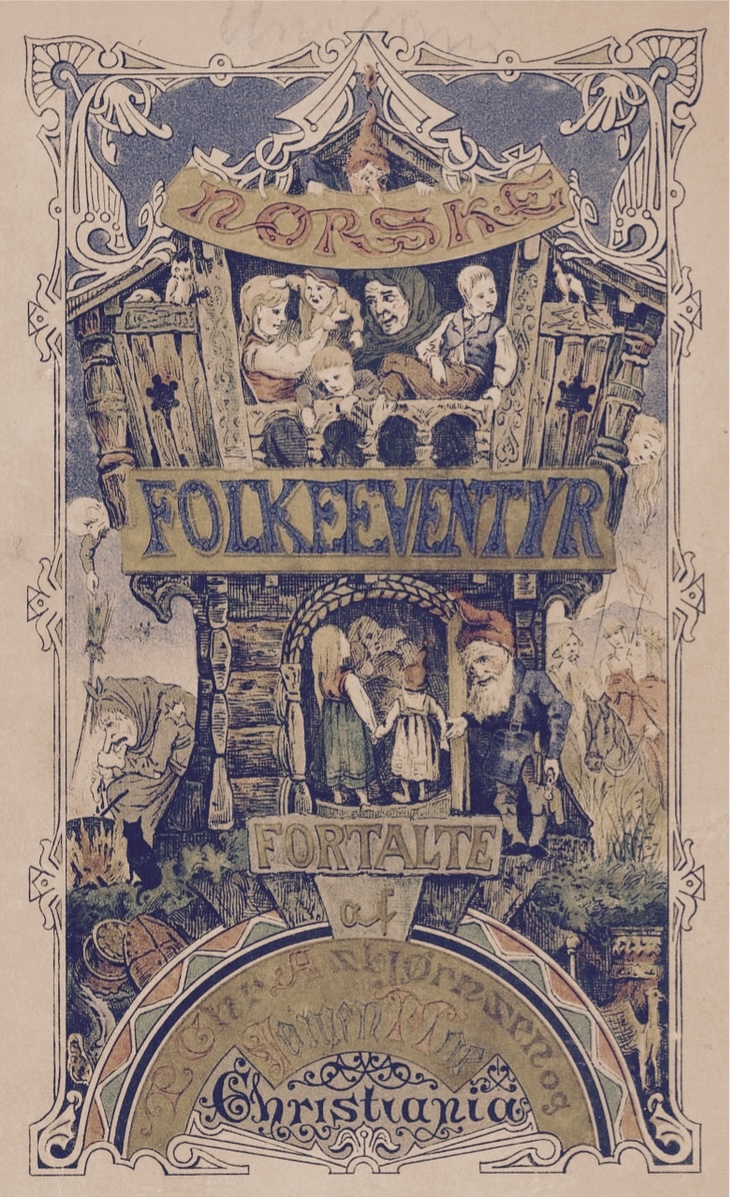
Norske eventyr — The folk tales almost lost forever
The Norwegian folk tales — the Three Billy Goats Gruff, East of the Sun and West of the Moon, the Ash Lad — collected by Asbjørnsen and Moe in the 1840s. Darker than the picture books that followed, and the unlikely place a national written language got its start.
Peter Christen Asbjørnsen and Jørgen Moe met as schoolboys at the rectory school at Norderhov and spent the 1840s walking the eastern valleys with notebooks, sitting at farmhouse hearths and writing down tales that country people had told aloud for generations and never written down. The tales survive only because the two of them did.
The first installment of Norske Folkeeventyr came out of Johan Dahl’s shop in Christiania 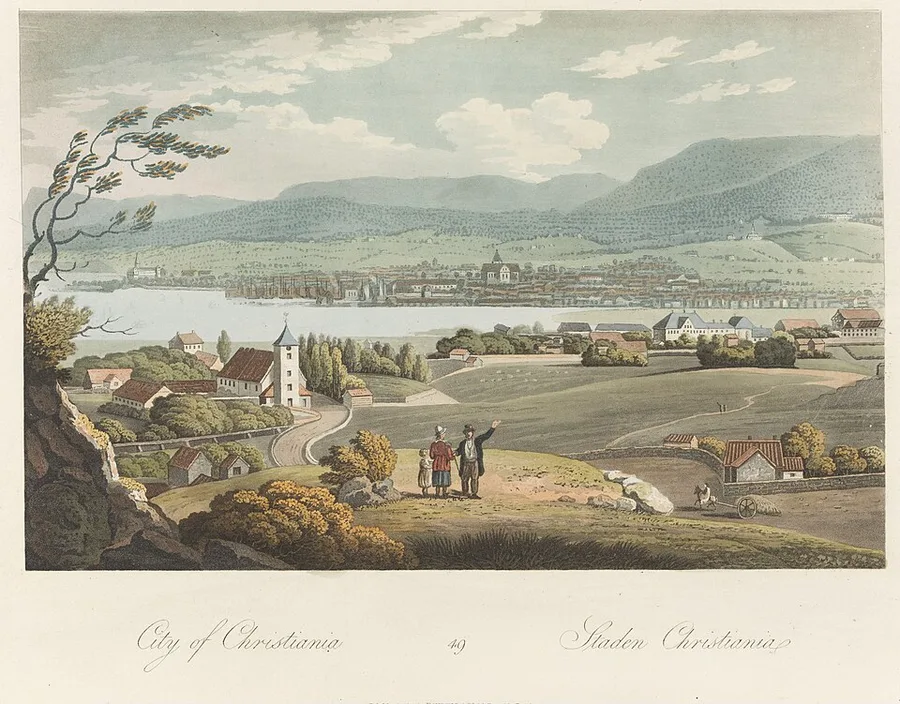 John William Edy, City of Christiania (1814), Boydell's Picturesque Scenery of Norway — National Museum of Art, Architecture and Design Edy's 1814 aquatint of the small capital across the water — the town where, a generation on, Johan Dahl's bookshop put out ninety-six anonymous pages of trolls in December 1841, the first installment of *Norske Folkeeventyr*. Capital of Norway from 1624 to 1925 — the rebuilt town that
King Christian IV laid out west of the medieval Oslo after
the fire of August 1624 destroyed the old city. Christian
founded the new town on a grid plan beneath Akershus
fortress, named it for himself, and ordered the surviving
Oslo burghers to move into it. Christiania was the
capital's name through the four-hundred-year night, the
brief war of 1814, the constitutional Eidsvoll moment, the
ninety-one-year personal union with Sweden, and the first
two decades of fully independent Norway after 1905. In 1877
the spelling was modernised to Kristiania; in 1925 the
city formally returned to the medieval name Oslo. The
Kvadraturen district preserves Christian IV's grid intact
today.
On the trip Days 1–2 in Oslo bring both groups through Christiania —
Christian IV's seventeenth-century planned grid, still
visible today as the Kvadraturen district just below
Akershus fortress.
Also discussed in The 400-Year Night — when the Northern Lion lay dormantLutheran Norway and Pietism — a farmer named Hans Nielsen Hauge and a lay revival that could not be silencedThe Constitution That Saved a Nation — five radical weeks at Eidsvoll, 1814800,000 Norwegians Leave — the century that built a Second NorwayThe Quiet Revolution — how Norway won its independence without a warWorld War II — the King’s “No” and the Nazis in NorwayStedssagn — local legends, told as warningsUtburd — the unbaptized child that will not rest in December 1841 — ninety-six pages, no title page, no editors’ names — with more to follow in 1843 and 1844. The model was the Brothers Grimm, who had done the same for Germany a generation earlier.
John William Edy, City of Christiania (1814), Boydell's Picturesque Scenery of Norway — National Museum of Art, Architecture and Design Edy's 1814 aquatint of the small capital across the water — the town where, a generation on, Johan Dahl's bookshop put out ninety-six anonymous pages of trolls in December 1841, the first installment of *Norske Folkeeventyr*. Capital of Norway from 1624 to 1925 — the rebuilt town that
King Christian IV laid out west of the medieval Oslo after
the fire of August 1624 destroyed the old city. Christian
founded the new town on a grid plan beneath Akershus
fortress, named it for himself, and ordered the surviving
Oslo burghers to move into it. Christiania was the
capital's name through the four-hundred-year night, the
brief war of 1814, the constitutional Eidsvoll moment, the
ninety-one-year personal union with Sweden, and the first
two decades of fully independent Norway after 1905. In 1877
the spelling was modernised to Kristiania; in 1925 the
city formally returned to the medieval name Oslo. The
Kvadraturen district preserves Christian IV's grid intact
today.
On the trip Days 1–2 in Oslo bring both groups through Christiania —
Christian IV's seventeenth-century planned grid, still
visible today as the Kvadraturen district just below
Akershus fortress.
Also discussed in The 400-Year Night — when the Northern Lion lay dormantLutheran Norway and Pietism — a farmer named Hans Nielsen Hauge and a lay revival that could not be silencedThe Constitution That Saved a Nation — five radical weeks at Eidsvoll, 1814800,000 Norwegians Leave — the century that built a Second NorwayThe Quiet Revolution — how Norway won its independence without a warWorld War II — the King’s “No” and the Nazis in NorwayStedssagn — local legends, told as warningsUtburd — the unbaptized child that will not rest in December 1841 — ninety-six pages, no title page, no editors’ names — with more to follow in 1843 and 1844. The model was the Brothers Grimm, who had done the same for Germany a generation earlier.
The tales were far darker than the picture books that came after. De tre bukkene Bruse — the Three Billy Goats Gruff — ends in the printed text with the biggest goat goring the Troll 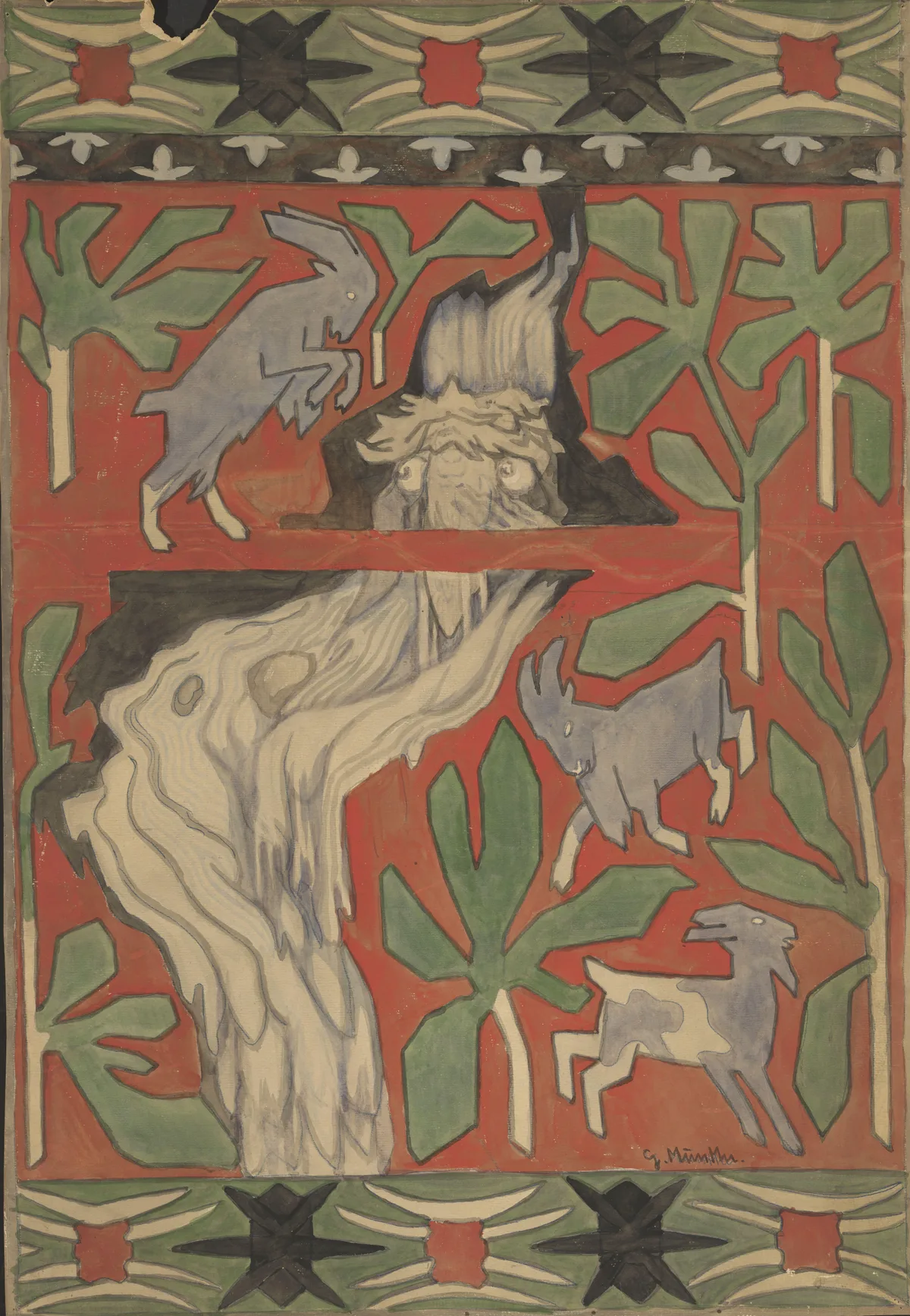 Gerhard Munthe, De tre Bukkene Bruse (1896), Nasjonalmuseet NMK.2019.0410 Munthe sets the tale like a tapestry: the troll's staring face under the bridge, its hair pouring away like the falls, the three goats crossing above. The 1843 printed ending is already waiting — the big goat gores the troll's eyes out, crushes him body and bones, and pitches the pieces into that water. The supernatural mountain-dweller of Norwegian folketro —
sometimes gigantic, like the valley-striding jutul, sometimes
small — living inside mountains and deep forest. Legends set
the troll against the church: it hurls boulders at church
buildings and flees the sound of church bells. Sunlight turns
a troll caught above ground to stone. Andreas Faye's Norske
Sagn (1833, expanded as Norske Folke-Sagn in 1844), Norway's
first legend collection, put the tradition on paper; Asbjørnsen
and Moe's Norske Folkeeventyr (1841–44) fixed the man-eating
troll of the tales in print — "De tre bukkene Bruse" was first
printed in 1843. Theodor Kittelsen (1857–1914) gave the troll
its modern visual form; his Skogtroll (1906) is in the
Nasjonalmuseet.
Also discussed in Troll — the monsters of the mountainsStedssagn — local legends, told as warningsSoria Moria — the shining castle always out of reachHuldra — the girl in the forest with a secretBytting — the changeling left in the cradleVardøger — your double, arriving a few minutes before youTradisjoner — celebrations across the Norwegian year ’s eyes out with his horns, crushing him to bits, body and bones, and pitching the remains into the falls. Østenfor sol og vestenfor måne — East of the Sun and West of the Moon — turns on a white bear who is a man by night, a candle the heroine is forbidden to light, and the three drops of hot tallow that betray her. Askeladden, the Ash Lad, the slow brother who lies in the cinders by the fire, is the one who wins the kingdom in the end — usually after his older brothers have tried first and failed through impatience or pride.
Gerhard Munthe, De tre Bukkene Bruse (1896), Nasjonalmuseet NMK.2019.0410 Munthe sets the tale like a tapestry: the troll's staring face under the bridge, its hair pouring away like the falls, the three goats crossing above. The 1843 printed ending is already waiting — the big goat gores the troll's eyes out, crushes him body and bones, and pitches the pieces into that water. The supernatural mountain-dweller of Norwegian folketro —
sometimes gigantic, like the valley-striding jutul, sometimes
small — living inside mountains and deep forest. Legends set
the troll against the church: it hurls boulders at church
buildings and flees the sound of church bells. Sunlight turns
a troll caught above ground to stone. Andreas Faye's Norske
Sagn (1833, expanded as Norske Folke-Sagn in 1844), Norway's
first legend collection, put the tradition on paper; Asbjørnsen
and Moe's Norske Folkeeventyr (1841–44) fixed the man-eating
troll of the tales in print — "De tre bukkene Bruse" was first
printed in 1843. Theodor Kittelsen (1857–1914) gave the troll
its modern visual form; his Skogtroll (1906) is in the
Nasjonalmuseet.
Also discussed in Troll — the monsters of the mountainsStedssagn — local legends, told as warningsSoria Moria — the shining castle always out of reachHuldra — the girl in the forest with a secretBytting — the changeling left in the cradleVardøger — your double, arriving a few minutes before youTradisjoner — celebrations across the Norwegian year ’s eyes out with his horns, crushing him to bits, body and bones, and pitching the remains into the falls. Østenfor sol og vestenfor måne — East of the Sun and West of the Moon — turns on a white bear who is a man by night, a candle the heroine is forbidden to light, and the three drops of hot tallow that betray her. Askeladden, the Ash Lad, the slow brother who lies in the cinders by the fire, is the one who wins the kingdom in the end — usually after his older brothers have tried first and failed through impatience or pride.
What reads now as a children’s book was also nation-building. Educated Norwegians in the 1840s still wrote in Danish, thirty years after the country had left four centuries of Danish rule, and the schoolroom language was Danish too. Asbjørnsen and Moe split the difference — Danish spelling carrying Norwegian words and Norwegian sentence-rhythm — and the compromise they invented to make trolls sound Norwegian on the page fed straight into Bokmål 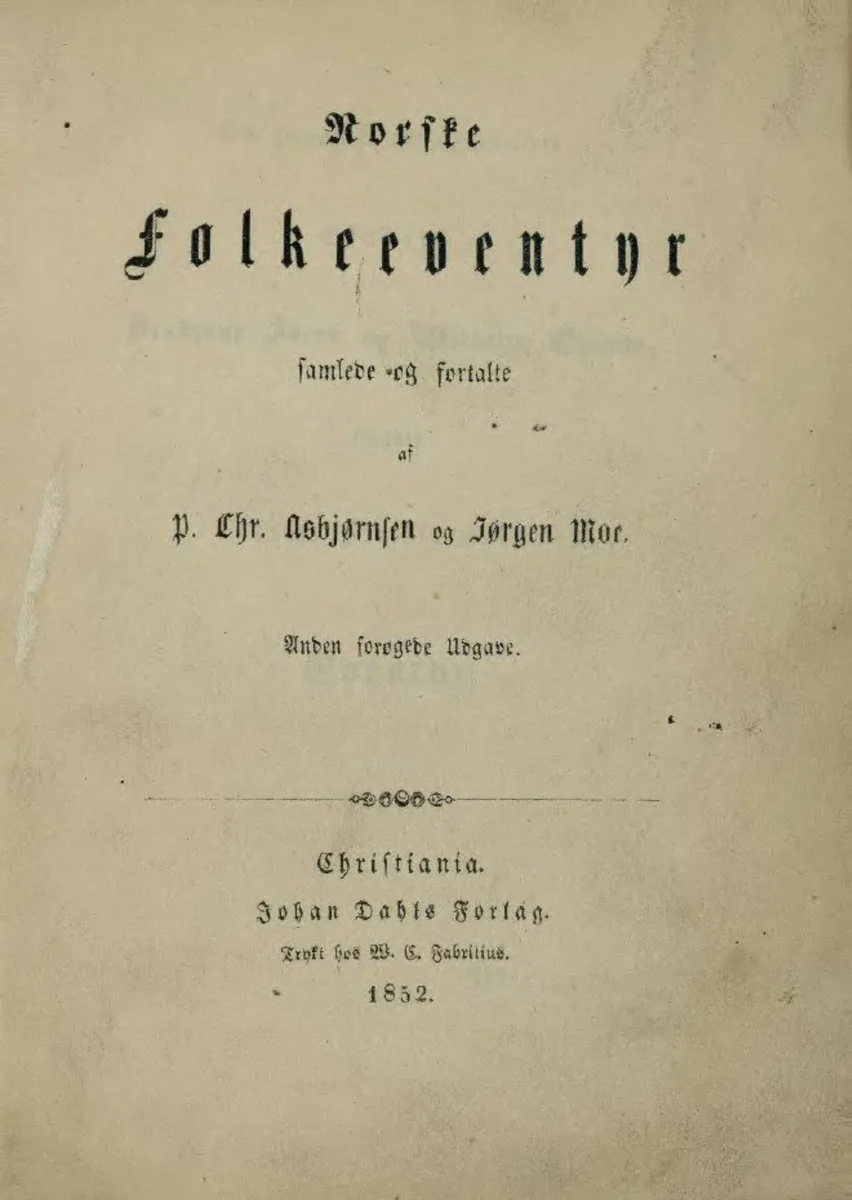 Norske Folkeeventyr, 2nd enlarged ed. (Christiania: Johan Dahl, 1852), title page; Nasjonalbiblioteket The title page of the enlarged 1852 Norske Folkeeventyr, its blackletter still spelling the shared Dano-Norwegian book language — samlede og fortalte af — the very norm Asbjørnsen and Moe bent toward Norwegian by letting the tales keep their spoken words and rhythms. Book language — one of the two official written standards
of modern Norwegian. Descended from the written Dano-
Norwegian (Dansk-norsk) that served as the literary and
administrative language of educated Norwegians through the
late Danish period and through most of the nineteenth
century. Across a series of language reforms between 1907
and 1959, the standard was progressively shifted toward
spoken eastern Norwegian usage and away from Danish
orthography, and the name Riksmål (the older form) was
replaced by Bokmål in 1929. Today roughly 85–90% of
Norwegians use Bokmål as their primary written language.
Bokmål and Nynorsk have equal official status;
municipalities and schools choose between them, and any
Norwegian student is required to learn to write both.
Also discussed in The 400-Year Night — when the Northern Lion lay dormantLanguage basics — just enough Norwegian to be polite , one of the two written forms of Norwegian in everyday use today. The second edition was dedicated to the brothers Grimm, and Jacob Grimm wrote back calling the collection die besten Märchen, die es gibt — the best folk-tales there are.
Norske Folkeeventyr, 2nd enlarged ed. (Christiania: Johan Dahl, 1852), title page; Nasjonalbiblioteket The title page of the enlarged 1852 Norske Folkeeventyr, its blackletter still spelling the shared Dano-Norwegian book language — samlede og fortalte af — the very norm Asbjørnsen and Moe bent toward Norwegian by letting the tales keep their spoken words and rhythms. Book language — one of the two official written standards
of modern Norwegian. Descended from the written Dano-
Norwegian (Dansk-norsk) that served as the literary and
administrative language of educated Norwegians through the
late Danish period and through most of the nineteenth
century. Across a series of language reforms between 1907
and 1959, the standard was progressively shifted toward
spoken eastern Norwegian usage and away from Danish
orthography, and the name Riksmål (the older form) was
replaced by Bokmål in 1929. Today roughly 85–90% of
Norwegians use Bokmål as their primary written language.
Bokmål and Nynorsk have equal official status;
municipalities and schools choose between them, and any
Norwegian student is required to learn to write both.
Also discussed in The 400-Year Night — when the Northern Lion lay dormantLanguage basics — just enough Norwegian to be polite , one of the two written forms of Norwegian in everyday use today. The second edition was dedicated to the brothers Grimm, and Jacob Grimm wrote back calling the collection die besten Märchen, die es gibt — the best folk-tales there are.
The images came later and never left. The first illustrated edition appeared in 1879; Erik Werenskiold 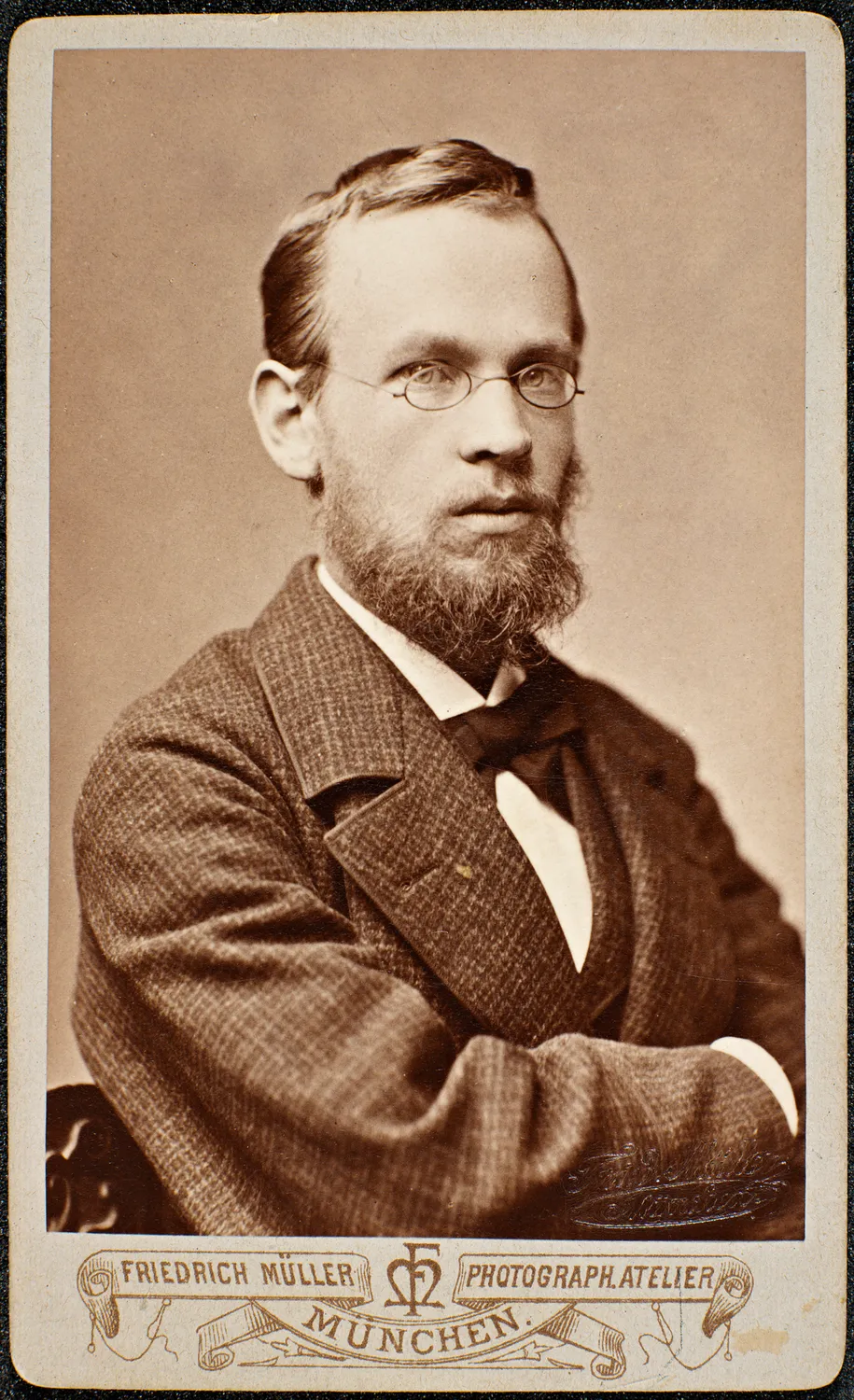 Friedrich Müller (Munich), portrait of Erik Werenskiold (1880), Nasjonalbiblioteket (CC BY 2.0) The illustrator himself, photographed the year after the first illustrated edition of the folktales appeared with his drawings — the young painter who went on to lead the Eventyrbog for Børn volumes and to draw Kittelsen into the folktale work. Norwegian painter and illustrator (1855–1938), born in
Eidskog near Kongsvinger, who with Theodor Kittelsen gave
the Asbjørnsen and Moe folk tales the pictures Norwegian
readers have known ever since. He drew for the first
illustrated edition of 1879, led the illustration of the
three-volume Eventyrbog for Børn through the 1880s, and
brought Kittelsen into the folktale work in the early
1880s. His painting En bondebegravelse (Peasant Burial),
shown at the 1885 Autumn Exhibition and bought at once by
the National Gallery, became a principal work of Norwegian
naturalism; from 1896 to 1899 he led the team of artists
illustrating the folk edition of Snorri's Heimskringla.
brought in Theodor Kittelsen
Friedrich Müller (Munich), portrait of Erik Werenskiold (1880), Nasjonalbiblioteket (CC BY 2.0) The illustrator himself, photographed the year after the first illustrated edition of the folktales appeared with his drawings — the young painter who went on to lead the Eventyrbog for Børn volumes and to draw Kittelsen into the folktale work. Norwegian painter and illustrator (1855–1938), born in
Eidskog near Kongsvinger, who with Theodor Kittelsen gave
the Asbjørnsen and Moe folk tales the pictures Norwegian
readers have known ever since. He drew for the first
illustrated edition of 1879, led the illustration of the
three-volume Eventyrbog for Børn through the 1880s, and
brought Kittelsen into the folktale work in the early
1880s. His painting En bondebegravelse (Peasant Burial),
shown at the 1885 Autumn Exhibition and bought at once by
the National Gallery, became a principal work of Norwegian
naturalism; from 1896 to 1899 he led the team of artists
illustrating the folk edition of Snorri's Heimskringla.
brought in Theodor Kittelsen 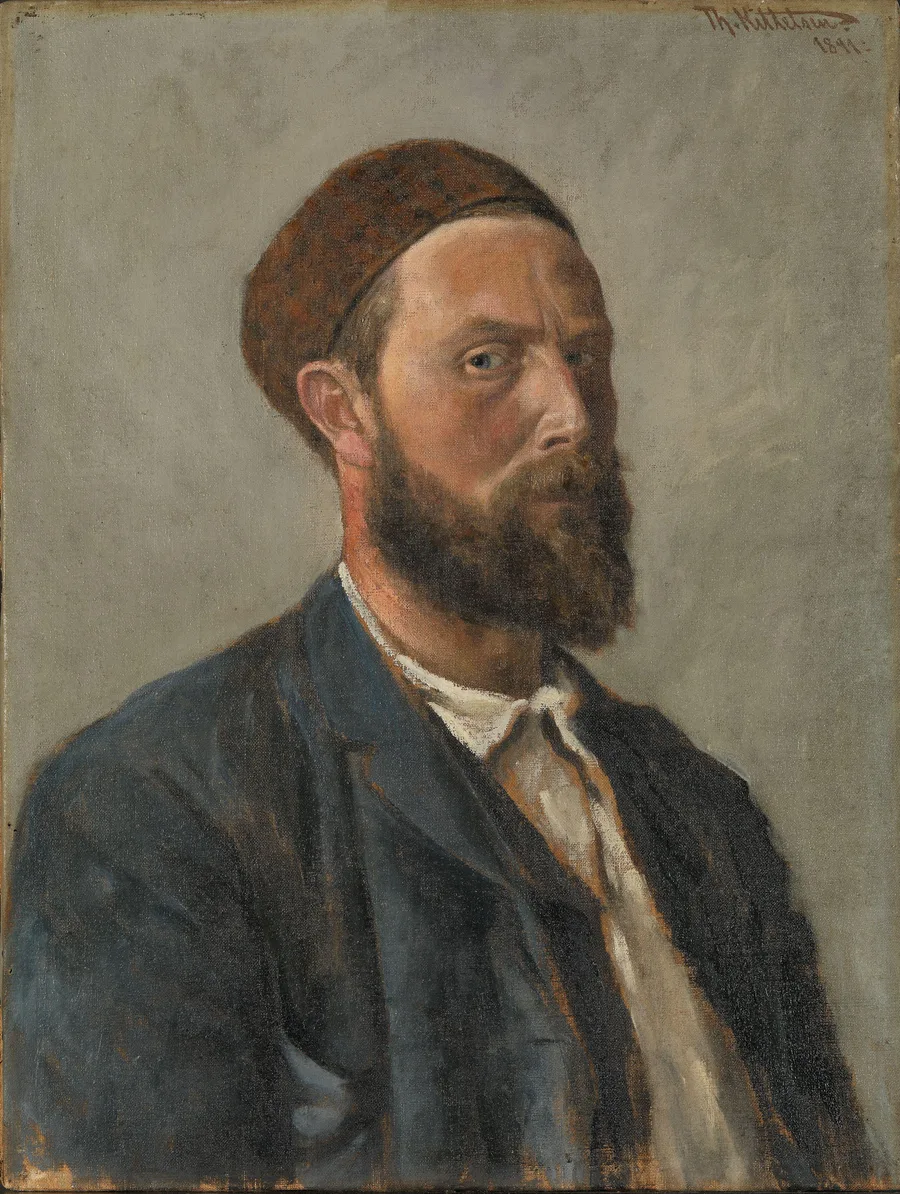 Theodor Kittelsen, Selvportrett (1891), Nasjonalmuseet The man whose trolls sit on the facing page — Kittelsen in his 1891 self-portrait, a decade after Erik Werenskiold brought him into the illustrated Asbjørnsen folktale editions. Norwegian painter and illustrator (1857–1914), born in
Kragerø, who more than any other artist fixed the visual
identity of the country's folklore beings. Erik Werenskiold
brought him into the illustrated Asbjørnsen folktale editions
in the early 1880s. A stay at the Skomvær lighthouse on outer
Lofoten (1887–89), where his brother-in-law served as
assistant keeper, fed Troldskab (1892). His plague-hag
drawings, begun after an encounter with an old woman on the
island of Skåtøy, were published as the book Svartedauen in
1900. The same year, at Lauvlia in Sigdal, he painted his
Soria Moria pictures; the national collection bought them at
once. Nøkken (1904) — two pale eyes in a black lily-pool —
is held by the Nasjonalmuseet; Da Huldra forsvant (1908)
paints her vanishing.
Also discussed in Pesta — an old woman walking from farm to farmDraugen — the drowned man who never came homeHuldra — the girl in the forest with a secretNøkken — the water-spirit who pulls you underSoria Moria — the shining castle always out of reach , and by 1900 Kittelsen had painted his twelve pictures of Soria Moria castle at his cabin in Sigdal. Norwegian children have grown up reading the tales with Kittelsen’s trolls on the facing page ever since.
Theodor Kittelsen, Selvportrett (1891), Nasjonalmuseet The man whose trolls sit on the facing page — Kittelsen in his 1891 self-portrait, a decade after Erik Werenskiold brought him into the illustrated Asbjørnsen folktale editions. Norwegian painter and illustrator (1857–1914), born in
Kragerø, who more than any other artist fixed the visual
identity of the country's folklore beings. Erik Werenskiold
brought him into the illustrated Asbjørnsen folktale editions
in the early 1880s. A stay at the Skomvær lighthouse on outer
Lofoten (1887–89), where his brother-in-law served as
assistant keeper, fed Troldskab (1892). His plague-hag
drawings, begun after an encounter with an old woman on the
island of Skåtøy, were published as the book Svartedauen in
1900. The same year, at Lauvlia in Sigdal, he painted his
Soria Moria pictures; the national collection bought them at
once. Nøkken (1904) — two pale eyes in a black lily-pool —
is held by the Nasjonalmuseet; Da Huldra forsvant (1908)
paints her vanishing.
Also discussed in Pesta — an old woman walking from farm to farmDraugen — the drowned man who never came homeHuldra — the girl in the forest with a secretNøkken — the water-spirit who pulls you underSoria Moria — the shining castle always out of reach , and by 1900 Kittelsen had painted his twelve pictures of Soria Moria castle at his cabin in Sigdal. Norwegian children have grown up reading the tales with Kittelsen’s trolls on the facing page ever since.