Vardøger — Your double, arriving a few minutes before you
The sound of a person arriving before the person does — footsteps, a cough, the latch — and then no one there, the real arrival still minutes away. The one figure the country never had to revive, because the word is still in everyday use.
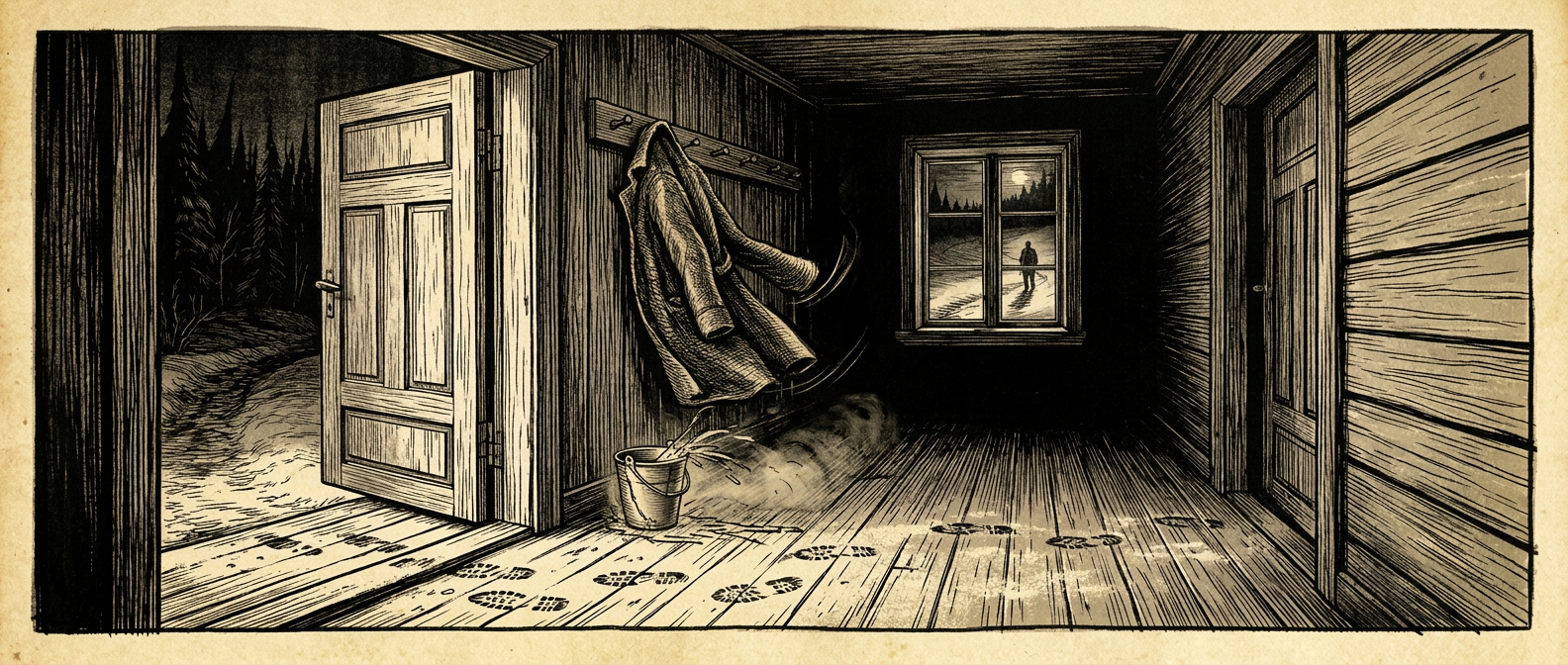
A vardøger is the sound of a person arriving before the person does. Footsteps on the entry stair, the scrape of the boot-mat, the latch, the cough of a man stamping snow off his boots — and then no one there, the man himself still half a kilometre down the road. Fifteen minutes later he comes in and does all of it again, exactly.
It is a kind of half-soul that runs ahead of its owner out of habit or affection. The word is traced to Old Norse varðhygi — vǫrðr, a guardian element, the same root as English warden, plus hugr, the travelling mind-soul of older Norse belief — a lineage that runs back to the saga-era Fylgja 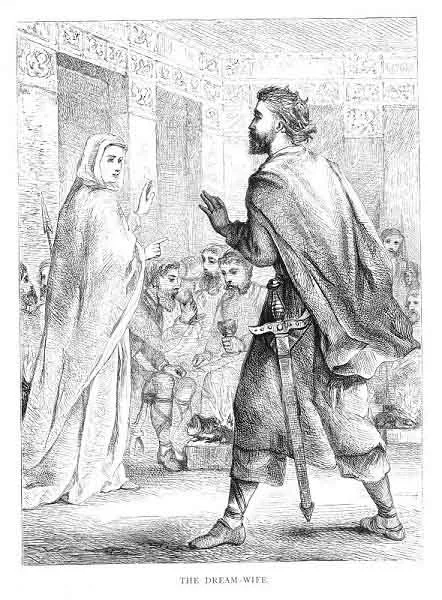 The Dream Wife, from G. W. Dasent, Gisli the Outlaw (1866) An 1866 saga plate shows Gisli's white-clad dream-woman appearing across the hall — the guardian-woman form (fylgjukona) the attendant spirit of this card takes when bound to a family line, and the saga-era companion the vardøger itself is traced back to. Old Norse attendant spirit — a companion soul bound to a
person from birth, normally unseen, showing itself in
dreams or at the edge of waking sight in animal form, or
as a guardian woman (fylgjukona) attached to a whole
family line, passing to a kinsman at her holder's death.
To see one's own fylgja plainly was a death-omen: in
Njáls saga (written c. 1280) Þórðr sees a blood-drenched
goat lying in the hollow that no one else can see, and
Njáll tells him he has seen his fylgja and is a fey man.
Else Mundal's Fylgjemotiva i norrøn litteratur (1974),
the standard study, traced the two forms — animal double
and guardian-woman, kin to the dísir of household
worship — through the sagas and Eddic prose.
Also discussed in Worshiping Odin and Thor — the lived religion of pre-Christian Norway , the spirit-companion whose saga forms Else Mundal’s standard 1974 study mapped.
The Dream Wife, from G. W. Dasent, Gisli the Outlaw (1866) An 1866 saga plate shows Gisli's white-clad dream-woman appearing across the hall — the guardian-woman form (fylgjukona) the attendant spirit of this card takes when bound to a family line, and the saga-era companion the vardøger itself is traced back to. Old Norse attendant spirit — a companion soul bound to a
person from birth, normally unseen, showing itself in
dreams or at the edge of waking sight in animal form, or
as a guardian woman (fylgjukona) attached to a whole
family line, passing to a kinsman at her holder's death.
To see one's own fylgja plainly was a death-omen: in
Njáls saga (written c. 1280) Þórðr sees a blood-drenched
goat lying in the hollow that no one else can see, and
Njáll tells him he has seen his fylgja and is a fey man.
Else Mundal's Fylgjemotiva i norrøn litteratur (1974),
the standard study, traced the two forms — animal double
and guardian-woman, kin to the dísir of household
worship — through the sagas and Eddic prose.
Also discussed in Worshiping Odin and Thor — the lived religion of pre-Christian Norway , the spirit-companion whose saga forms Else Mundal’s standard 1974 study mapped.
Most of the time it was domestic and unalarming. A wife hears her husband come into the kitchen, hang his coat, set down the milk pails — turns, and the room is empty; he is still on the road. What makes it uncanny rather than terrifying is the direction it faces. The German doppelgänger is a thing you see, and to see your own was an omen that you were about to die; the vardøger is above all a thing other people hear, and it walks in front of its owner instead of confronting them.
But the vardøger had an edge. Heard too often, or heard for someone not expected home at all, it was read as a sign of coming illness or death — and the wives of fishermen on the coast were said to hear, some evenings, the boots and the latch of men who would never come through the door.
The vardøger is the one figure of Norway’s old company the country never had to revive, because it never went away. The word is still printed in the current Bokmålsordboka, still alive in the old dialects as vardyvle and vardøgle — Jeg hørte vardøgeret hans i går kveld (I heard his vardøger last night) is a sentence the language still knows how to say — while the Troll 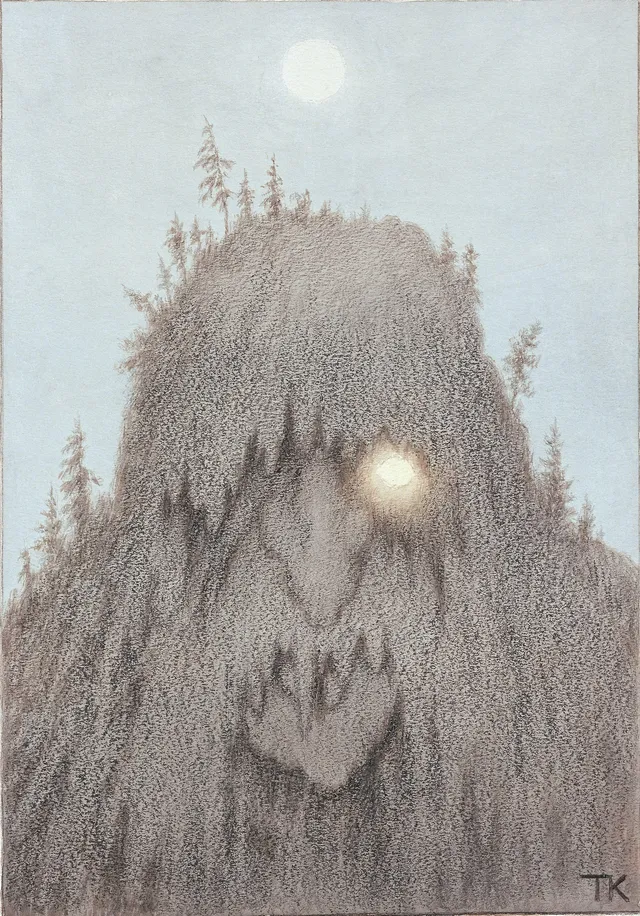 Theodor Kittelsen, Skogtroll (1906), Nasjonalmuseet The card opens on exactly the troll the closing sentence shuts back in its books — Kittelsen's forest troll, a wooded hillside with one glowing eye. Beside the vardøger, still said aloud at Norwegian breakfast tables, this is the being that now lives only on the page. The supernatural mountain-dweller of Norwegian folketro —
sometimes gigantic, like the valley-striding jutul, sometimes
small — living inside mountains and deep forest. Legends set
the troll against the church: it hurls boulders at church
buildings and flees the sound of church bells. Sunlight turns
a troll caught above ground to stone. Andreas Faye's Norske
Sagn (1833, expanded as Norske Folke-Sagn in 1844), Norway's
first legend collection, put the tradition on paper; Asbjørnsen
and Moe's Norske Folkeeventyr (1841–44) fixed the man-eating
troll of the tales in print — "De tre bukkene Bruse" was first
printed in 1843. Theodor Kittelsen (1857–1914) gave the troll
its modern visual form; his Skogtroll (1906) is in the
Nasjonalmuseet.
Also discussed in Troll — the monsters of the mountainsStedssagn — local legends, told as warningsSoria Moria — the shining castle always out of reachNorske eventyr — the folk tales almost lost foreverHuldra — the girl in the forest with a secretBytting — the changeling left in the cradleTradisjoner — celebrations across the Norwegian year and the Nøkken
Theodor Kittelsen, Skogtroll (1906), Nasjonalmuseet The card opens on exactly the troll the closing sentence shuts back in its books — Kittelsen's forest troll, a wooded hillside with one glowing eye. Beside the vardøger, still said aloud at Norwegian breakfast tables, this is the being that now lives only on the page. The supernatural mountain-dweller of Norwegian folketro —
sometimes gigantic, like the valley-striding jutul, sometimes
small — living inside mountains and deep forest. Legends set
the troll against the church: it hurls boulders at church
buildings and flees the sound of church bells. Sunlight turns
a troll caught above ground to stone. Andreas Faye's Norske
Sagn (1833, expanded as Norske Folke-Sagn in 1844), Norway's
first legend collection, put the tradition on paper; Asbjørnsen
and Moe's Norske Folkeeventyr (1841–44) fixed the man-eating
troll of the tales in print — "De tre bukkene Bruse" was first
printed in 1843. Theodor Kittelsen (1857–1914) gave the troll
its modern visual form; his Skogtroll (1906) is in the
Nasjonalmuseet.
Also discussed in Troll — the monsters of the mountainsStedssagn — local legends, told as warningsSoria Moria — the shining castle always out of reachNorske eventyr — the folk tales almost lost foreverHuldra — the girl in the forest with a secretBytting — the changeling left in the cradleTradisjoner — celebrations across the Norwegian year and the Nøkken 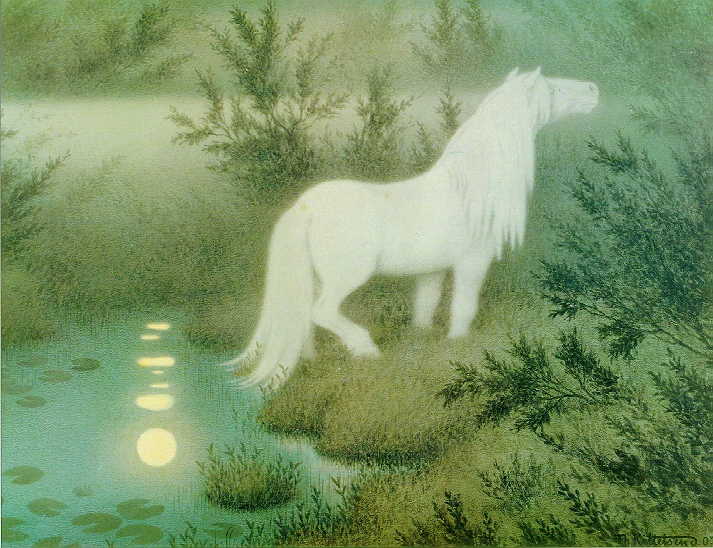 Theodor Kittelsen, Nøkken som hvit hest (1907) The nøkk wearing a white horse's shape — gentle, familiar, and not what it seems. A page about arrivals that are not yet the person gets the lure in its most trusted form: the false, known figure that waits to be believed. The shape-shifting spirit of fresh water in Norwegian folk
tradition — most at home in still water: lakes, tarns, and
mill ponds — recorded as luring people, children above all,
into drowning. He appeared as a handsome young fiddler, as a
white horse that tempted children onto its back, as a drifting
log, or as two pale eyes among the water lilies. The white
water lily is named nøkkerose after him. The name descends
from Old Norse nykr, 'water spirit.' Andreas Faye's Norske
Sagn (1833), the first printed collection of Norwegian
legends, placed nøkker "in most waters and rivers"; Theodor
Kittelsen's 1904 Nøkken (Nasjonalmuseet) fixed the modern
image — a black, lily-choked tarn and two eyes at the surface.
The roaring falls belonged instead to his relative, the
fossegrim.
Also discussed in Nøkken — the water-spirit who pulls you underFossegrimen — the waterfall fiddler who teaches you to play stay shut in their books.
Theodor Kittelsen, Nøkken som hvit hest (1907) The nøkk wearing a white horse's shape — gentle, familiar, and not what it seems. A page about arrivals that are not yet the person gets the lure in its most trusted form: the false, known figure that waits to be believed. The shape-shifting spirit of fresh water in Norwegian folk
tradition — most at home in still water: lakes, tarns, and
mill ponds — recorded as luring people, children above all,
into drowning. He appeared as a handsome young fiddler, as a
white horse that tempted children onto its back, as a drifting
log, or as two pale eyes among the water lilies. The white
water lily is named nøkkerose after him. The name descends
from Old Norse nykr, 'water spirit.' Andreas Faye's Norske
Sagn (1833), the first printed collection of Norwegian
legends, placed nøkker "in most waters and rivers"; Theodor
Kittelsen's 1904 Nøkken (Nasjonalmuseet) fixed the modern
image — a black, lily-choked tarn and two eyes at the surface.
The roaring falls belonged instead to his relative, the
fossegrim.
Also discussed in Nøkken — the water-spirit who pulls you underFossegrimen — the waterfall fiddler who teaches you to play stay shut in their books.