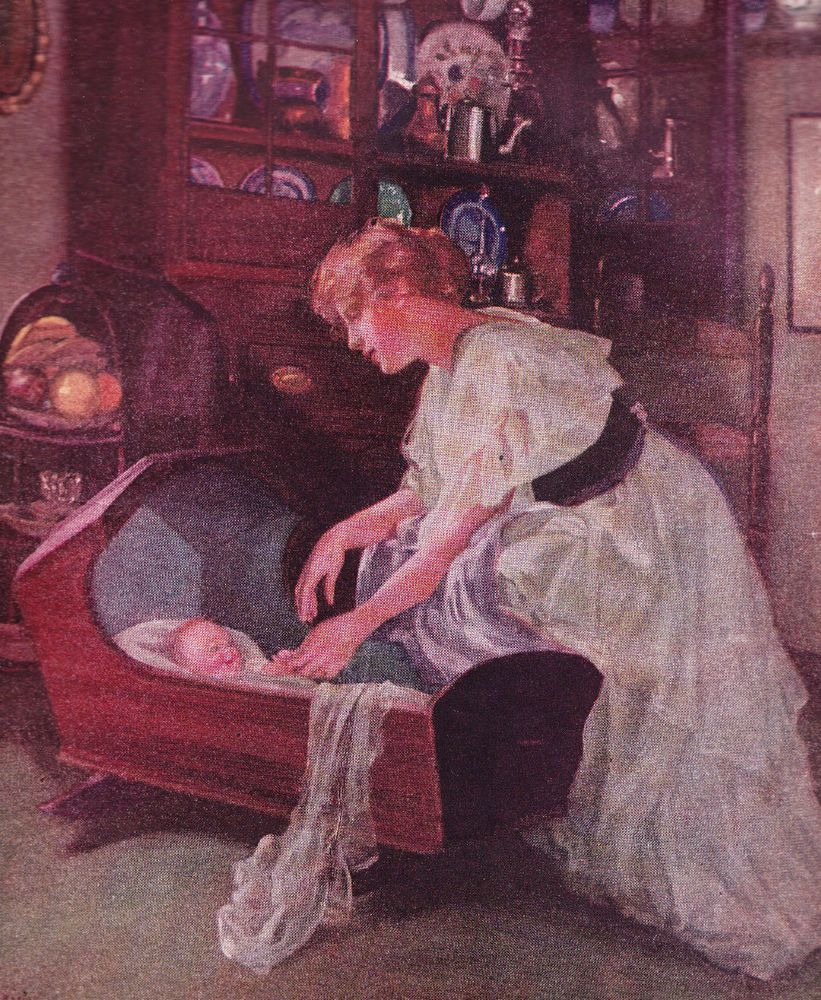
Bytting — The changeling left in the cradle
The non-human child the hidden folk leave in the cradle in place of a stolen human infant. Under the trolls is a colder story — it was the explanation a farm reached for when a baby was born disabled or would not thrive, and the cures the lore prescribed were real.
Between birth and baptism a child was unguarded, and in that gap the De underjordiske 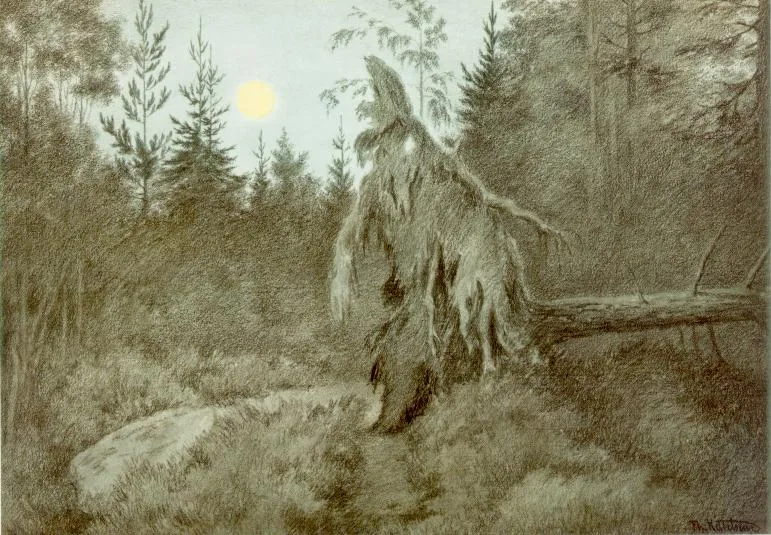 Theodor Kittelsen, Det rusler og tusler, rasler og tasler (1900), from the Tirilil-Tove series Kittelsen's spruce-shagged walker crossing the moonlit heath — the half-seen life of the dark outside the farmhouse wall. These are the neighbors the belief feared: between birth and baptism they could reach an unguarded cradle and leave one of their own in it. The hidden folk of Norwegian tradition — also called vetter,
tusser, or huldrefolk — who lived a parallel life under the
mounds, rocks, and ground of the farm, with cattle, weddings,
and music of their own. Unwitting offence — scalding water
thrown out without a warning shout — explained sudden sickness;
offerings of beer and food at the mound and the farm tree
(tuntre) kept the peace. Nearest of them to the household was
the gardvord, the farm's guardian — sometimes identified with
the first clearer of the ground, buried in the mound at the
farm's edge. Their most-told origin legend — Eve hiding her
unwashed children from God, who decreed that what was hidden
should stay hidden — enters the record in the collecting era
opened by Andreas Faye's Norske Sagn (1833).
Also discussed in De underjordiske — the neighbors living under your hillStedssagn — local legends, told as warnings could lift the human infant out of the cradle and lay one of their own in its place. What they left behind was a bytting.
Theodor Kittelsen, Det rusler og tusler, rasler og tasler (1900), from the Tirilil-Tove series Kittelsen's spruce-shagged walker crossing the moonlit heath — the half-seen life of the dark outside the farmhouse wall. These are the neighbors the belief feared: between birth and baptism they could reach an unguarded cradle and leave one of their own in it. The hidden folk of Norwegian tradition — also called vetter,
tusser, or huldrefolk — who lived a parallel life under the
mounds, rocks, and ground of the farm, with cattle, weddings,
and music of their own. Unwitting offence — scalding water
thrown out without a warning shout — explained sudden sickness;
offerings of beer and food at the mound and the farm tree
(tuntre) kept the peace. Nearest of them to the household was
the gardvord, the farm's guardian — sometimes identified with
the first clearer of the ground, buried in the mound at the
farm's edge. Their most-told origin legend — Eve hiding her
unwashed children from God, who decreed that what was hidden
should stay hidden — enters the record in the collecting era
opened by Andreas Faye's Norske Sagn (1833).
Also discussed in De underjordiske — the neighbors living under your hillStedssagn — local legends, told as warnings could lift the human infant out of the cradle and lay one of their own in its place. What they left behind was a bytting.
A bytting did not thrive. It did not learn to walk. It ate everything brought to it and did not grow, and watched the room with a stare that fixed on nothing in it. There was a country test for it: you set eggshells on the hearth and made a show of brewing beer in them. The thing in the cradle would sit up and speak then — an old man’s voice out of a baby’s throat — saying it had lived long enough to see the forest burn down and grow up again seven times, and never seen anyone brew in an eggshell.
Against the theft, the cradle was armoured: laid crosswise over the child, a psalmbook under the straw, a light kept burning, and the infant baptized as fast as the parish could manage — because the underjordiske could only take a child who had not yet been christened. (The same fear of that gap ran into the law: under Christian V's Norske Lov (1687) 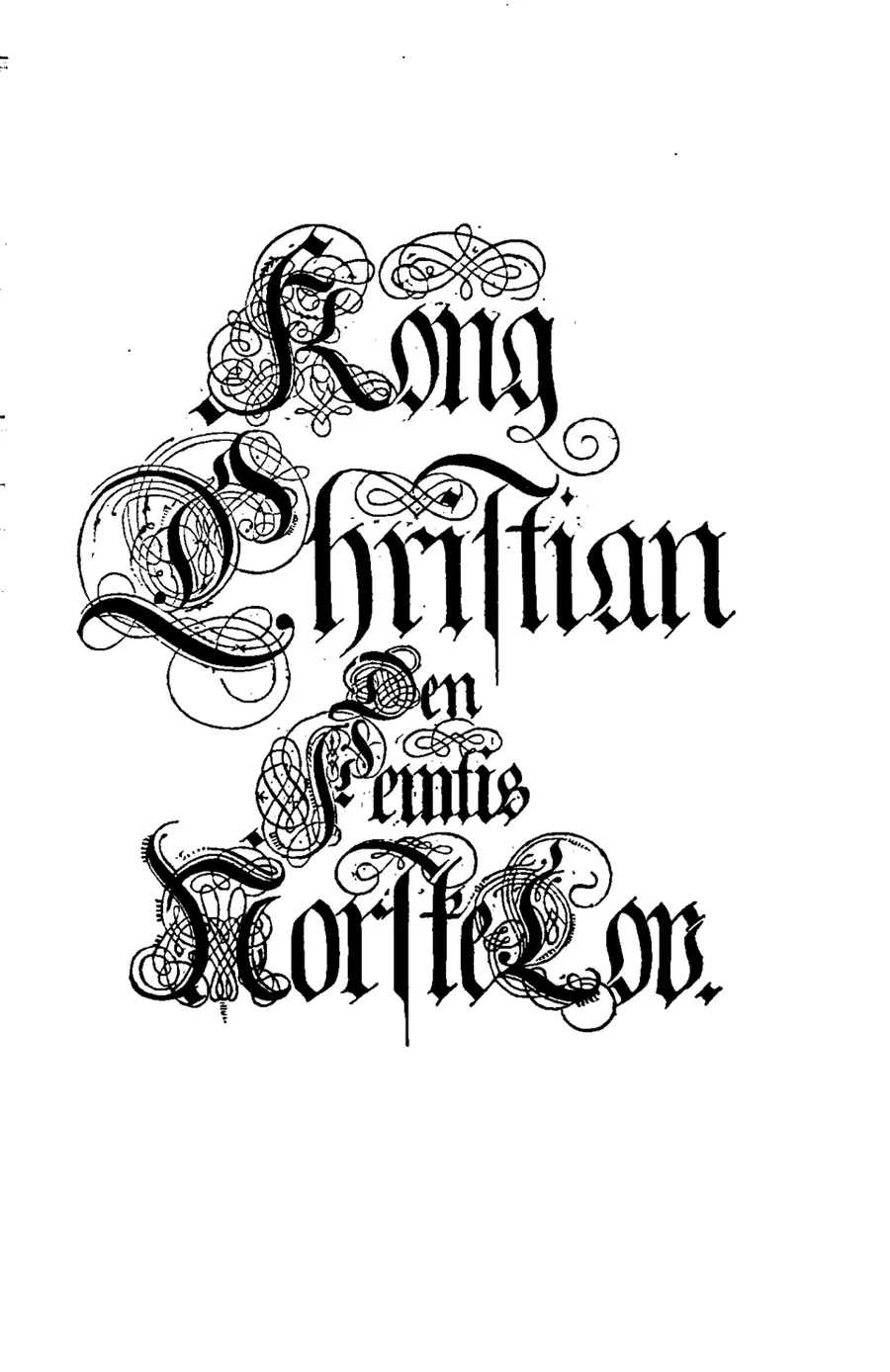 Title page, Kong Christian den Femtis Norske Lov (1687), from Otto Mejlænder's edition (Christiania, 1883) The engraved black-letter title page of King Christian V's 1687 Norwegian Code — the law book whose Sixth Book made concealed birth and child-exposure capital crimes, and parts of which remain in force today. Kong Christian Den Femtis Norske Lov — King Christian V's
Norwegian Code, promulgated 15 April 1687, in force from
1688. A wholly new code, drafted by four Norwegian jurists
adapting the Danish Code (Danske Lov, 1683); it replaced —
rather than revised — Christian IV's 1604 Danish translation
of the medieval Landslov. Its Sixth Book, on crimes, was
ordered after the Ten Commandments. A woman who concealed
her pregnancy, gave birth in secret (fødsel i dølgsmål),
and whose child then died or vanished was presumed to have
killed it with intent; laying a child out on desolate ground
made the exposer a manslayer — both capital crimes. Book Six
governed criminal law until the Criminal Code of 1842;
portions of the code remain in force, the oldest legislation
still operative in Norway.
Also discussed in Utburd — the unbaptized child that will not restThe 400-Year Night — when the Northern Lion lay dormantThe Golden Age — a North Atlantic empire … reaching farther than you think — the one that also haunts the utburd — a woman who concealed her pregnancy and gave birth in secret, and whose newborn was then found dead, could be presumed a murderer.)
Title page, Kong Christian den Femtis Norske Lov (1687), from Otto Mejlænder's edition (Christiania, 1883) The engraved black-letter title page of King Christian V's 1687 Norwegian Code — the law book whose Sixth Book made concealed birth and child-exposure capital crimes, and parts of which remain in force today. Kong Christian Den Femtis Norske Lov — King Christian V's
Norwegian Code, promulgated 15 April 1687, in force from
1688. A wholly new code, drafted by four Norwegian jurists
adapting the Danish Code (Danske Lov, 1683); it replaced —
rather than revised — Christian IV's 1604 Danish translation
of the medieval Landslov. Its Sixth Book, on crimes, was
ordered after the Ten Commandments. A woman who concealed
her pregnancy, gave birth in secret (fødsel i dølgsmål),
and whose child then died or vanished was presumed to have
killed it with intent; laying a child out on desolate ground
made the exposer a manslayer — both capital crimes. Book Six
governed criminal law until the Criminal Code of 1842;
portions of the code remain in force, the oldest legislation
still operative in Norway.
Also discussed in Utburd — the unbaptized child that will not restThe 400-Year Night — when the Northern Lion lay dormantThe Golden Age — a North Atlantic empire … reaching farther than you think — the one that also haunts the utburd — a woman who concealed her pregnancy and gave birth in secret, and whose newborn was then found dead, could be presumed a murderer.)
Strip away the Troll 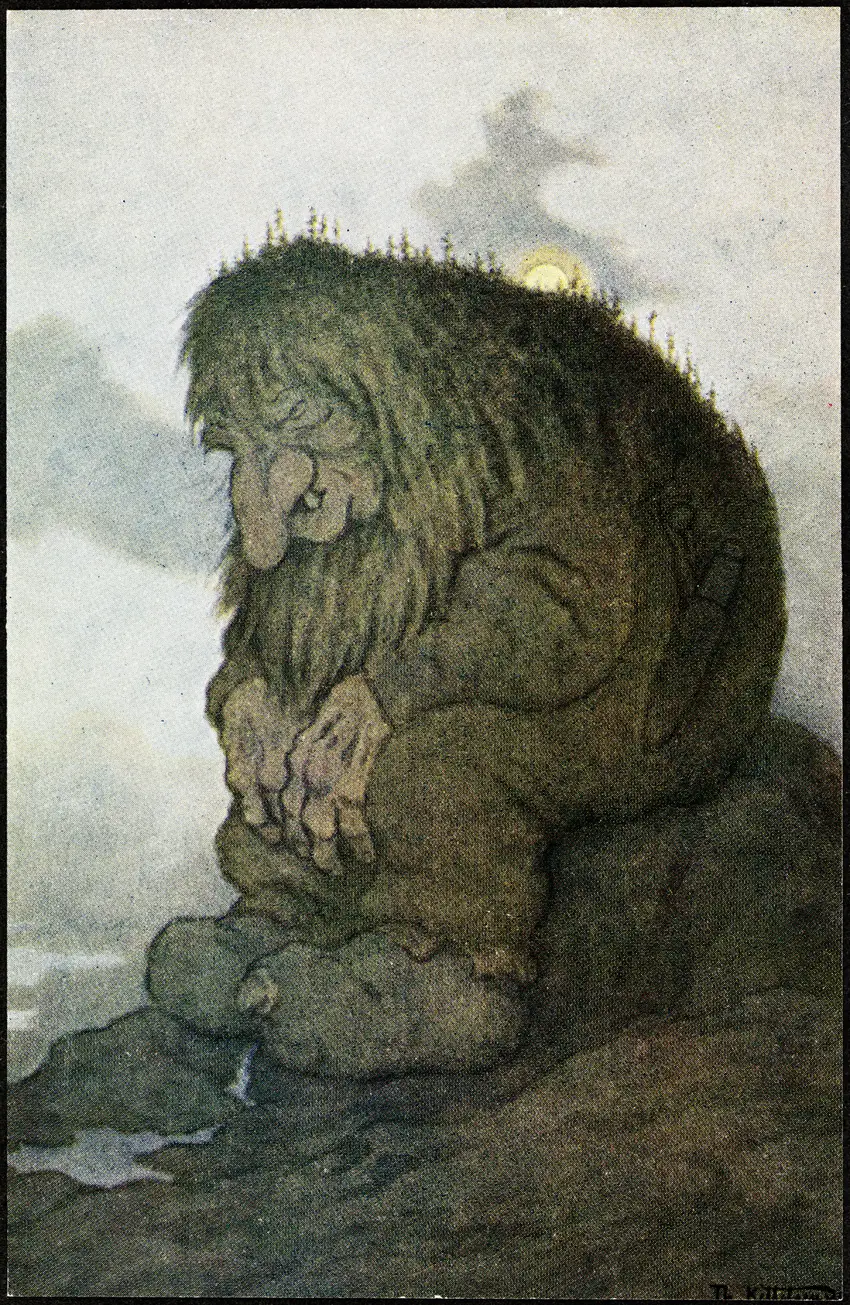 Theodor Kittelsen, Trollet som grunner på hvor gammelt det er (1911), Nasjonalbiblioteket Kittelsen's troll sits trying to reckon its own age — the very thing the eggshell test was built to force out of a bytting. Brew beer in an eggshell by the hearth, and the thing in the cradle forgets itself and speaks with an old man's voice: it has watched the forest burn and grow again seven times. The supernatural mountain-dweller of Norwegian folketro —
sometimes gigantic, like the valley-striding jutul, sometimes
small — living inside mountains and deep forest. Legends set
the troll against the church: it hurls boulders at church
buildings and flees the sound of church bells. Sunlight turns
a troll caught above ground to stone. Andreas Faye's Norske
Sagn (1833, expanded as Norske Folke-Sagn in 1844), Norway's
first legend collection, put the tradition on paper; Asbjørnsen
and Moe's Norske Folkeeventyr (1841–44) fixed the man-eating
troll of the tales in print — "De tre bukkene Bruse" was first
printed in 1843. Theodor Kittelsen (1857–1914) gave the troll
its modern visual form; his Skogtroll (1906) is in the
Nasjonalmuseet.
Also discussed in Troll — the monsters of the mountainsStedssagn — local legends, told as warningsSoria Moria — the shining castle always out of reachNorske eventyr — the folk tales almost lost foreverHuldra — the girl in the forest with a secretVardøger — your double, arriving a few minutes before youTradisjoner — celebrations across the Norwegian year and the bytting is the explanation a farm reached for when an infant was born disabled, would not thrive, or stopped growing — and the cures the lore prescribed were the abuse and killing of those children. The Asbjørnsen and Moe
Theodor Kittelsen, Trollet som grunner på hvor gammelt det er (1911), Nasjonalbiblioteket Kittelsen's troll sits trying to reckon its own age — the very thing the eggshell test was built to force out of a bytting. Brew beer in an eggshell by the hearth, and the thing in the cradle forgets itself and speaks with an old man's voice: it has watched the forest burn and grow again seven times. The supernatural mountain-dweller of Norwegian folketro —
sometimes gigantic, like the valley-striding jutul, sometimes
small — living inside mountains and deep forest. Legends set
the troll against the church: it hurls boulders at church
buildings and flees the sound of church bells. Sunlight turns
a troll caught above ground to stone. Andreas Faye's Norske
Sagn (1833, expanded as Norske Folke-Sagn in 1844), Norway's
first legend collection, put the tradition on paper; Asbjørnsen
and Moe's Norske Folkeeventyr (1841–44) fixed the man-eating
troll of the tales in print — "De tre bukkene Bruse" was first
printed in 1843. Theodor Kittelsen (1857–1914) gave the troll
its modern visual form; his Skogtroll (1906) is in the
Nasjonalmuseet.
Also discussed in Troll — the monsters of the mountainsStedssagn — local legends, told as warningsSoria Moria — the shining castle always out of reachNorske eventyr — the folk tales almost lost foreverHuldra — the girl in the forest with a secretVardøger — your double, arriving a few minutes before youTradisjoner — celebrations across the Norwegian year and the bytting is the explanation a farm reached for when an infant was born disabled, would not thrive, or stopped growing — and the cures the lore prescribed were the abuse and killing of those children. The Asbjørnsen and Moe 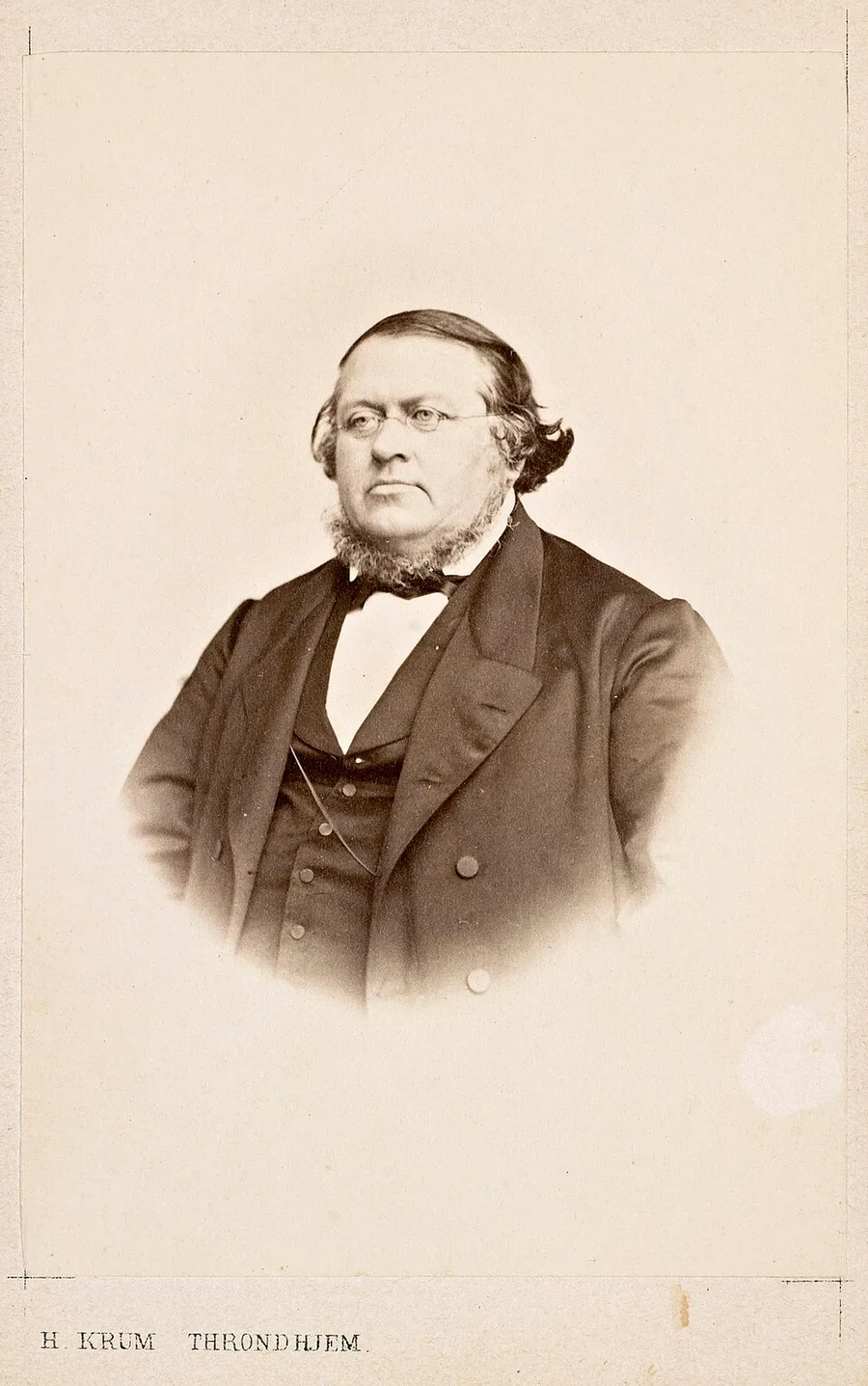 Hans Krum, portrait of Peter Christen Asbjørnsen (c. 1865–1875), Nasjonalbiblioteket Hans Krum's portrait of Peter Christen Asbjørnsen — here the collector working alone: his *Norske Huldreeventyr og Folkesagn*, second collection 1848, carries the changeling tale caught in *En signekjerring* on the same farm-by-farm journeys. Peter Christen Asbjørnsen (1812–1885) and Jørgen Moe
(1813–1882) — the collectors of the Norwegian folktales.
Friends from their schooldays at the Norderhov rectory on
Ringerike from around 1826, they spent the 1840s writing
down oral tales in the eastern valleys. Their joint
Norske Folkeeventyr began in December 1841 as an
anonymous, unbound pamphlet from Johan Dahl's shop in
Christiania, grew by further installments through 1844,
and in its enlarged 1852 edition was dedicated to the
brothers Grimm. Jacob Grimm wrote back that these were
die besten Märchen, die es gibt — the best folktales
there are. Asbjørnsen alone published the legend
collections Norske Huldreeventyr og Folkesagn (1845,
1848). The first fully illustrated edition of the
folktales followed in 1879.
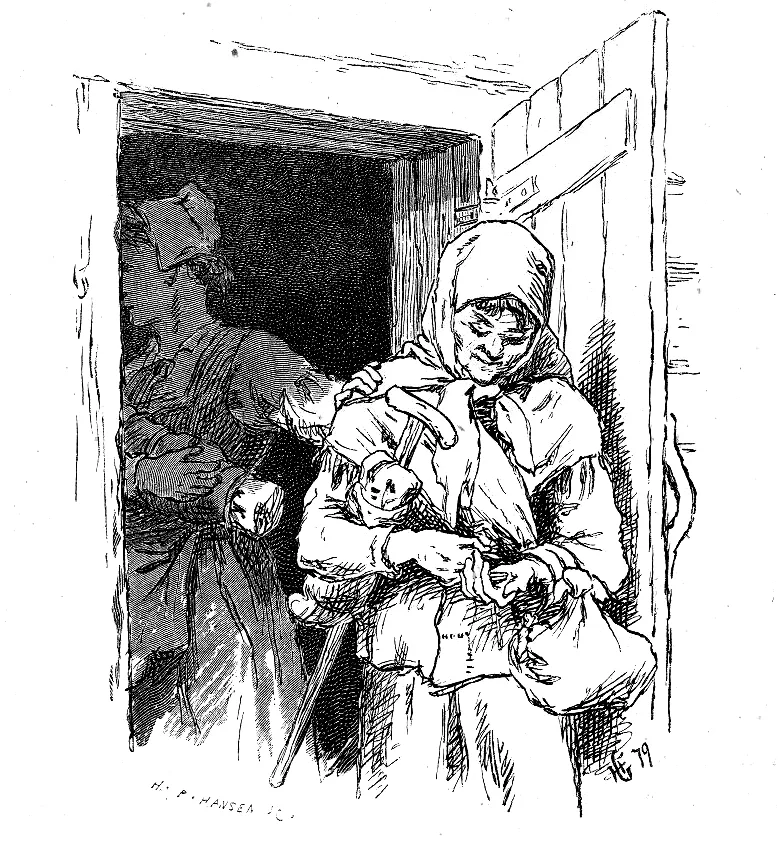
Also discussed in Norske eventyr — the folk tales almost lost foreverSoria Moria — the shining castle always out of reachThe Hytte — a sacred pastime of modern Norway version, gathered into Norske Huldreeventyr og Folkesagn in 1848, has the bytting carried out to the dunghill and whipped, three Thursday evenings running. The recorded prescriptions were worse still: the child held to a heated bakeoven, laid out on the dunghill, beaten, or put in water, on the belief that the hidden folk would take their own back and hand over the real child whole. Court records from Scandinavia, Britain, and Ireland into the nineteenth century show these were not only told but done — suspected changelings tortured and killed, and the killings prosecuted.
Hans Krum, portrait of Peter Christen Asbjørnsen (c. 1865–1875), Nasjonalbiblioteket Hans Krum's portrait of Peter Christen Asbjørnsen — here the collector working alone: his *Norske Huldreeventyr og Folkesagn*, second collection 1848, carries the changeling tale caught in *En signekjerring* on the same farm-by-farm journeys. Peter Christen Asbjørnsen (1812–1885) and Jørgen Moe
(1813–1882) — the collectors of the Norwegian folktales.
Friends from their schooldays at the Norderhov rectory on
Ringerike from around 1826, they spent the 1840s writing
down oral tales in the eastern valleys. Their joint
Norske Folkeeventyr began in December 1841 as an
anonymous, unbound pamphlet from Johan Dahl's shop in
Christiania, grew by further installments through 1844,
and in its enlarged 1852 edition was dedicated to the
brothers Grimm. Jacob Grimm wrote back that these were
die besten Märchen, die es gibt — the best folktales
there are. Asbjørnsen alone published the legend
collections Norske Huldreeventyr og Folkesagn (1845,
1848). The first fully illustrated edition of the
folktales followed in 1879.
Also discussed in Norske eventyr — the folk tales almost lost foreverSoria Moria — the shining castle always out of reachThe Hytte — a sacred pastime of modern Norway version, gathered into Norske Huldreeventyr og Folkesagn in 1848, has the bytting carried out to the dunghill and whipped, three Thursday evenings running. The recorded prescriptions were worse still: the child held to a heated bakeoven, laid out on the dunghill, beaten, or put in water, on the belief that the hidden folk would take their own back and hand over the real child whole. Court records from Scandinavia, Britain, and Ireland into the nineteenth century show these were not only told but done — suspected changelings tortured and killed, and the killings prosecuted.
In the tale Asbjørnsen recorded, the switch comes down for the third time on the bytting they call Tjøstul Gautstigen, and somewhere inside the mountain the stolen child answers: Hver gang du slår ‘n Tjøstul Gautstigen, så slår de meg igjen i berget — every time you strike Tjøstul Gautstigen, they strike me again in the mountain.