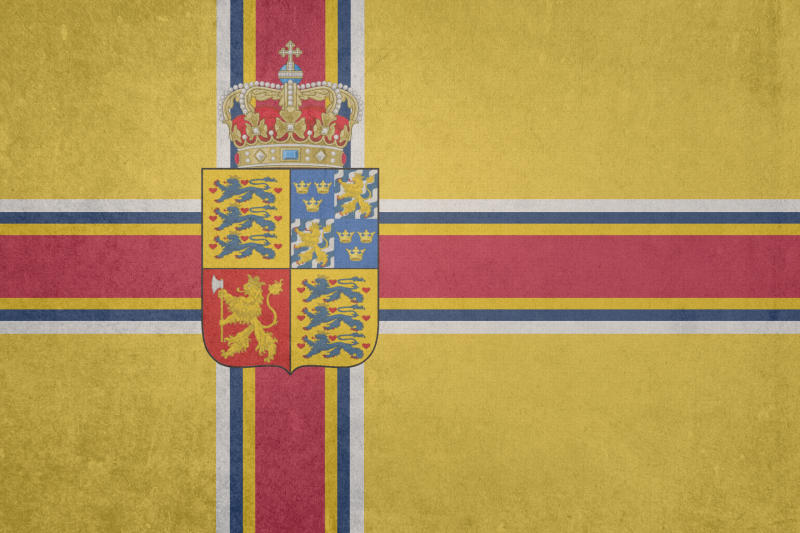
The 400-Year Night — When the Northern Lion lay dormant
From 1380 to 1814 Norway was governed from Denmark — a long absorption that closed the court, faded the written language, and put the medieval law-code into Danish. The country was not destroyed; the substrate of modern Norway was kept alive in the valleys and along the coast.
The joining of the Norwegian and Danish crowns on a single head began in 1380, when Haakon VI Magnusson 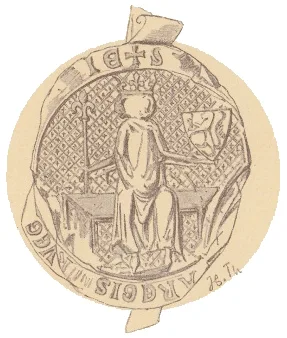 Drawing by Hakon Thorsen, after the seal of Haakon VI Magnusson (1358–76), public domain No painted portrait of Haakon VI survives; his royal seal — the wax impression that authenticated his charters — is the closest thing to an official image of the king whose marriage to the ten-year-old Margaret set up the Kalmar Union two generations later. King of Norway (1340–1380), only surviving son of Magnus VII
Eriksson and the last king of the Sverre dynasty in the male
line. Proclaimed king of Norway as a child in 1343, he assumed
personal rule at fifteen in 1355 when his father Magnus formally
handed over the Norwegian crown under pressure
from the depleted post-plague Council. Briefly co-ruled Sweden
in 1362–1364 before being driven out by Albert of Mecklenburg.
Married the ten-year-old Margaret of Denmark in 1363 — the
marriage that would, through their son Olav IV, join the
Norwegian and Danish crowns and open the way to the Kalmar
Union. Died in 1380 at forty, leaving the ten-year-old Olav
as king of both Norway and Denmark.
Also discussed in The Long Fall — the sudden loss of Norwegian nobility, the end of the kings, and half of Norway gone foreverThe Quiet Revolution — how Norway won its independence without a war of Norway died and his ten-year-old son Olav IV Håkonsson
Drawing by Hakon Thorsen, after the seal of Haakon VI Magnusson (1358–76), public domain No painted portrait of Haakon VI survives; his royal seal — the wax impression that authenticated his charters — is the closest thing to an official image of the king whose marriage to the ten-year-old Margaret set up the Kalmar Union two generations later. King of Norway (1340–1380), only surviving son of Magnus VII
Eriksson and the last king of the Sverre dynasty in the male
line. Proclaimed king of Norway as a child in 1343, he assumed
personal rule at fifteen in 1355 when his father Magnus formally
handed over the Norwegian crown under pressure
from the depleted post-plague Council. Briefly co-ruled Sweden
in 1362–1364 before being driven out by Albert of Mecklenburg.
Married the ten-year-old Margaret of Denmark in 1363 — the
marriage that would, through their son Olav IV, join the
Norwegian and Danish crowns and open the way to the Kalmar
Union. Died in 1380 at forty, leaving the ten-year-old Olav
as king of both Norway and Denmark.
Also discussed in The Long Fall — the sudden loss of Norwegian nobility, the end of the kings, and half of Norway gone foreverThe Quiet Revolution — how Norway won its independence without a war of Norway died and his ten-year-old son Olav IV Håkonsson 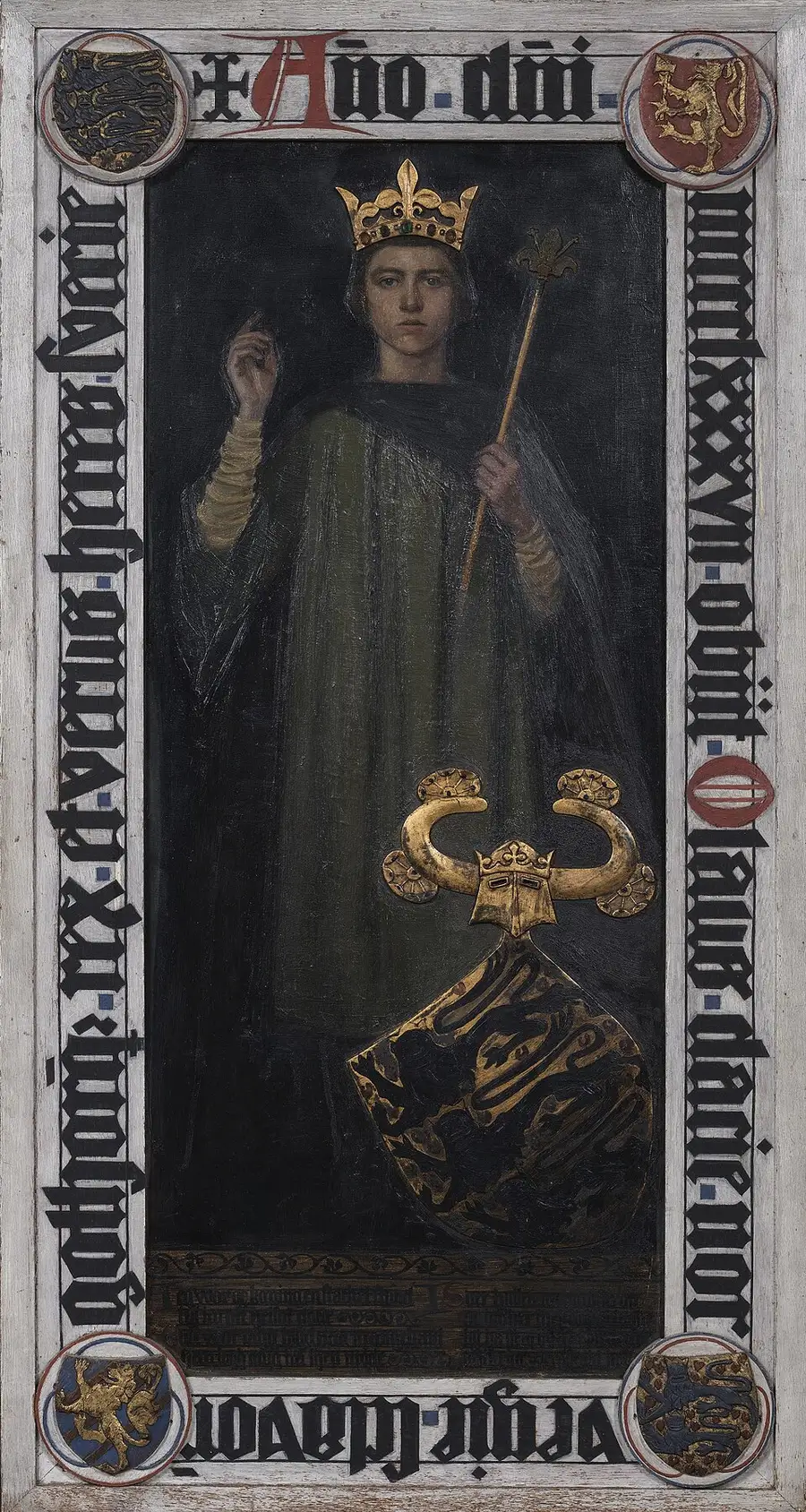 Agnes Slott-Møller, Oluf, Margrethes søn (1890s), public domain Danish National Romantic painter Agnes Slott-Møller devoted an 1890s canvas to the boy who briefly ruled two crowns at once — Olav IV, elected king of Denmark at five and of Norway at ten, dead at sixteen without an heir, the last king in the line the sagas traced to Harald Fairhair. King of Denmark and Norway (1370–1387), only son of King Haakon
VI of Norway and Margaret of Denmark. Born during the marriage
alliance his maternal grandfather Valdemar IV had arranged to
link the two crowns. Elected king of Denmark in May 1376 at
five years old after Valdemar's death without a male heir, with
his mother Margaret as regent. Became king of Norway in his own
right on his father Haakon's death in 1380, joining the two
crowns on a single ten-year-old. Died at Falsterbo on the
southern coast of Skåne in August 1387 at sixteen — cause
recorded only as illness — leaving no son and no will. With his
death ended the line of Norwegian kings that the sagas had
traced back to Harald Fairhair.
Also discussed in The Long Fall — the sudden loss of Norwegian nobility, the end of the kings, and half of Norway gone foreverThe Quiet Revolution — how Norway won its independence without a war , already king of Denmark, inherited the Norwegian throne under his mother Margaret I of Denmark
Agnes Slott-Møller, Oluf, Margrethes søn (1890s), public domain Danish National Romantic painter Agnes Slott-Møller devoted an 1890s canvas to the boy who briefly ruled two crowns at once — Olav IV, elected king of Denmark at five and of Norway at ten, dead at sixteen without an heir, the last king in the line the sagas traced to Harald Fairhair. King of Denmark and Norway (1370–1387), only son of King Haakon
VI of Norway and Margaret of Denmark. Born during the marriage
alliance his maternal grandfather Valdemar IV had arranged to
link the two crowns. Elected king of Denmark in May 1376 at
five years old after Valdemar's death without a male heir, with
his mother Margaret as regent. Became king of Norway in his own
right on his father Haakon's death in 1380, joining the two
crowns on a single ten-year-old. Died at Falsterbo on the
southern coast of Skåne in August 1387 at sixteen — cause
recorded only as illness — leaving no son and no will. With his
death ended the line of Norwegian kings that the sagas had
traced back to Harald Fairhair.
Also discussed in The Long Fall — the sudden loss of Norwegian nobility, the end of the kings, and half of Norway gone foreverThe Quiet Revolution — how Norway won its independence without a war , already king of Denmark, inherited the Norwegian throne under his mother Margaret I of Denmark 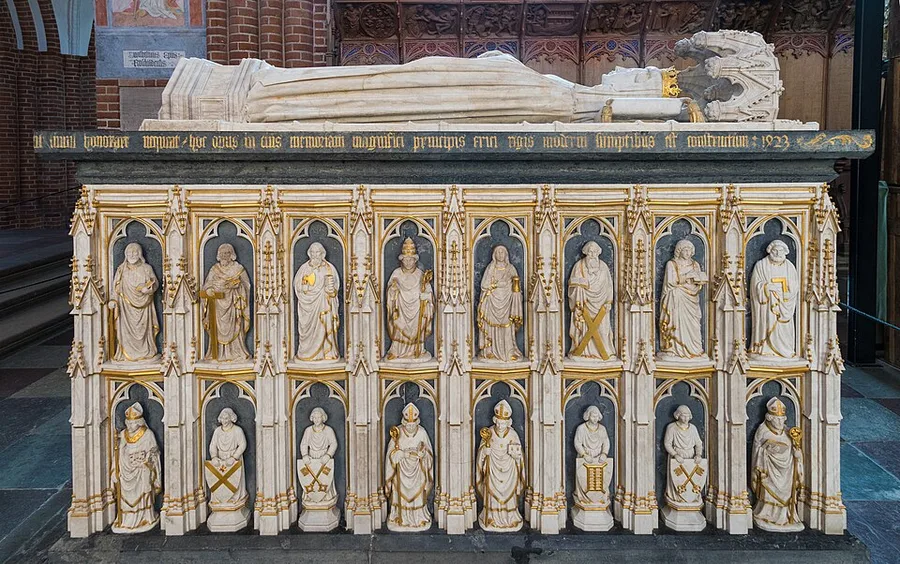 Photo: Jebulon, Tomb of Margrete I (1423), Roskilde Cathedral — CC0 Margrete's gilt alabaster sarcophagus at Roskilde, completed within a decade of her 1412 death, is where the queen who founded the Kalmar Union still lies — her effigy crowned and robed exactly as the constitutional language of three kingdoms could never quite name her. Queen-regnant of Denmark, Norway, and Sweden (1353–1412),
daughter of King Valdemar IV Atterdag of Denmark and wife of
King Haakon VI of Norway, mother of King Olav IV. After her
son's death at sixteen in 1387 she was acknowledged as ruler
in her own right by all three Scandinavian kingdoms in turn
— the first woman in Danish history acclaimed sovereign — and
was titled by the Swedes fullmäktig fru och rätt husbonde,
plenipotentiary lady and rightful master, the constitutional
language having no formula for a queen who governed three
kingdoms in her own name. In 1397 she gathered the three
realms at Kalmar to crown her great-nephew Erik of Pomerania
as joint king, founding the Kalmar Union. Died at Flensburg
in 1412.
Also discussed in The Long Fall — the sudden loss of Norwegian nobility, the end of the kings, and half of Norway gone foreverThe Quiet Revolution — how Norway won its independence without a war ’s regency. Olav died at Falsterbo
Photo: Jebulon, Tomb of Margrete I (1423), Roskilde Cathedral — CC0 Margrete's gilt alabaster sarcophagus at Roskilde, completed within a decade of her 1412 death, is where the queen who founded the Kalmar Union still lies — her effigy crowned and robed exactly as the constitutional language of three kingdoms could never quite name her. Queen-regnant of Denmark, Norway, and Sweden (1353–1412),
daughter of King Valdemar IV Atterdag of Denmark and wife of
King Haakon VI of Norway, mother of King Olav IV. After her
son's death at sixteen in 1387 she was acknowledged as ruler
in her own right by all three Scandinavian kingdoms in turn
— the first woman in Danish history acclaimed sovereign — and
was titled by the Swedes fullmäktig fru och rätt husbonde,
plenipotentiary lady and rightful master, the constitutional
language having no formula for a queen who governed three
kingdoms in her own name. In 1397 she gathered the three
realms at Kalmar to crown her great-nephew Erik of Pomerania
as joint king, founding the Kalmar Union. Died at Flensburg
in 1412.
Also discussed in The Long Fall — the sudden loss of Norwegian nobility, the end of the kings, and half of Norway gone foreverThe Quiet Revolution — how Norway won its independence without a war ’s regency. Olav died at Falsterbo 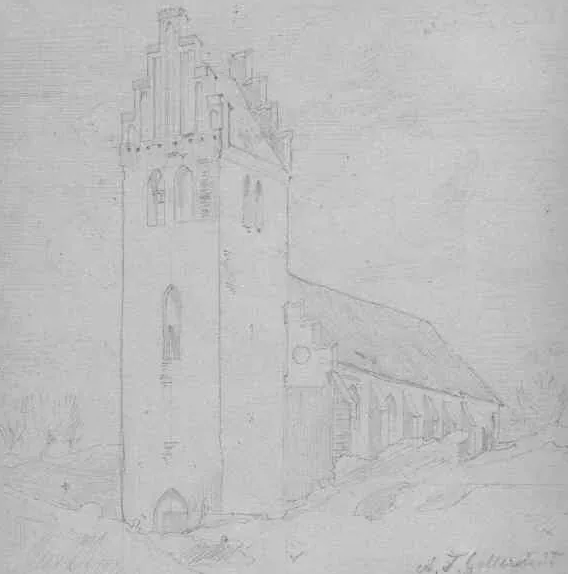 A. T. Gellerstedt, Falsterbo Church from the southwest (undated drawing), Riksantikvarieämbetet (KMB) Gellerstedt drew St Gertrude's, the medieval church of Falsterbo — the building left standing from the great herring-fair town where King Olav IV, the last of the sagas' Fairhair line, died at sixteen in August 1387. Small town on the southwestern tip of the Skåne peninsula,
facing the entrance to the Øresund. In the late medieval
period one of the most important seasonal trading sites in
the Baltic — the August Skånemarknad (Scania Fair) drew
Hanseatic merchants from across northern Europe to its
herring market. Falsterbo Castle was a Danish royal
residence through the fourteenth century. King Olav IV
Håkonsson of Norway and Denmark died there in August 1387
at sixteen, ending the medieval Norwegian male royal line
the sagas had traced from Harald Fairhair. Today a small
resort town in southwestern Sweden.
Also discussed in The Long Fall — the sudden loss of Norwegian nobility, the end of the kings, and half of Norway gone foreverThe Quiet Revolution — how Norway won its independence without a war seven years later and the regency passed into her own name. The Kalmar Union
A. T. Gellerstedt, Falsterbo Church from the southwest (undated drawing), Riksantikvarieämbetet (KMB) Gellerstedt drew St Gertrude's, the medieval church of Falsterbo — the building left standing from the great herring-fair town where King Olav IV, the last of the sagas' Fairhair line, died at sixteen in August 1387. Small town on the southwestern tip of the Skåne peninsula,
facing the entrance to the Øresund. In the late medieval
period one of the most important seasonal trading sites in
the Baltic — the August Skånemarknad (Scania Fair) drew
Hanseatic merchants from across northern Europe to its
herring market. Falsterbo Castle was a Danish royal
residence through the fourteenth century. King Olav IV
Håkonsson of Norway and Denmark died there in August 1387
at sixteen, ending the medieval Norwegian male royal line
the sagas had traced from Harald Fairhair. Today a small
resort town in southwestern Sweden.
Also discussed in The Long Fall — the sudden loss of Norwegian nobility, the end of the kings, and half of Norway gone foreverThe Quiet Revolution — how Norway won its independence without a war seven years later and the regency passed into her own name. The Kalmar Union 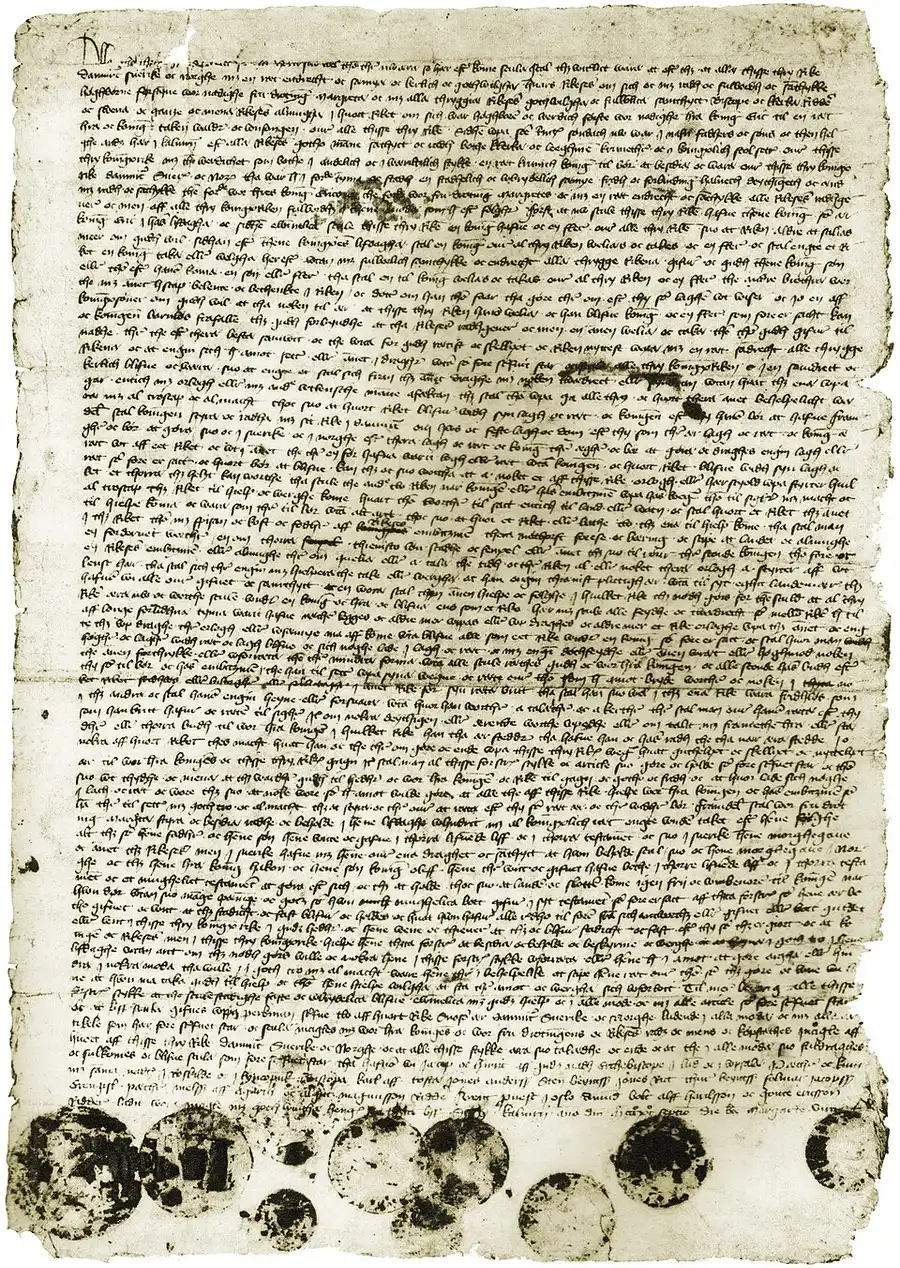 Union letter of Kalmar (1397) The 1397 union letter drafted at Kalmar bound Denmark, Sweden, and Norway under a single crown for 126 years — a realignment that gradually placed senior Norwegian clergy appointments under Danish control, one of the political conditions that made the imposed 1537 Reformation possible. Personal union of the three Scandinavian kingdoms — Denmark,
Sweden, and Norway — under a single monarch, established at
Kalmar (in modern southeastern Sweden) in 1397 by Margaret of
Denmark. Lasted 126 years until Gustav Vasa's revolt of 1523
took Sweden out of the union. Denmark and Norway remained joined
as the Dano-Norwegian union (1523–1814), with Norway treated as
a Danish province governed from Copenhagen. The Kalmar Union
shifted Scandinavian political power decisively to Copenhagen
and gradually placed the senior Norwegian clergy under Danish
appointment — one of the long political conditions for the
imposed Lutheran Reformation in Norway in 1537.
Also discussed in A Catholic Norway — the faith that gave the kingdom its first institutions and the stave churchesThe Long Fall — the sudden loss of Norwegian nobility, the end of the kings, and half of Norway gone forever of 1397 placed the three Scandinavian kingdoms under a single named monarch. Sweden seceded under Gustav Vasa
Union letter of Kalmar (1397) The 1397 union letter drafted at Kalmar bound Denmark, Sweden, and Norway under a single crown for 126 years — a realignment that gradually placed senior Norwegian clergy appointments under Danish control, one of the political conditions that made the imposed 1537 Reformation possible. Personal union of the three Scandinavian kingdoms — Denmark,
Sweden, and Norway — under a single monarch, established at
Kalmar (in modern southeastern Sweden) in 1397 by Margaret of
Denmark. Lasted 126 years until Gustav Vasa's revolt of 1523
took Sweden out of the union. Denmark and Norway remained joined
as the Dano-Norwegian union (1523–1814), with Norway treated as
a Danish province governed from Copenhagen. The Kalmar Union
shifted Scandinavian political power decisively to Copenhagen
and gradually placed the senior Norwegian clergy under Danish
appointment — one of the long political conditions for the
imposed Lutheran Reformation in Norway in 1537.
Also discussed in A Catholic Norway — the faith that gave the kingdom its first institutions and the stave churchesThe Long Fall — the sudden loss of Norwegian nobility, the end of the kings, and half of Norway gone forever of 1397 placed the three Scandinavian kingdoms under a single named monarch. Sweden seceded under Gustav Vasa 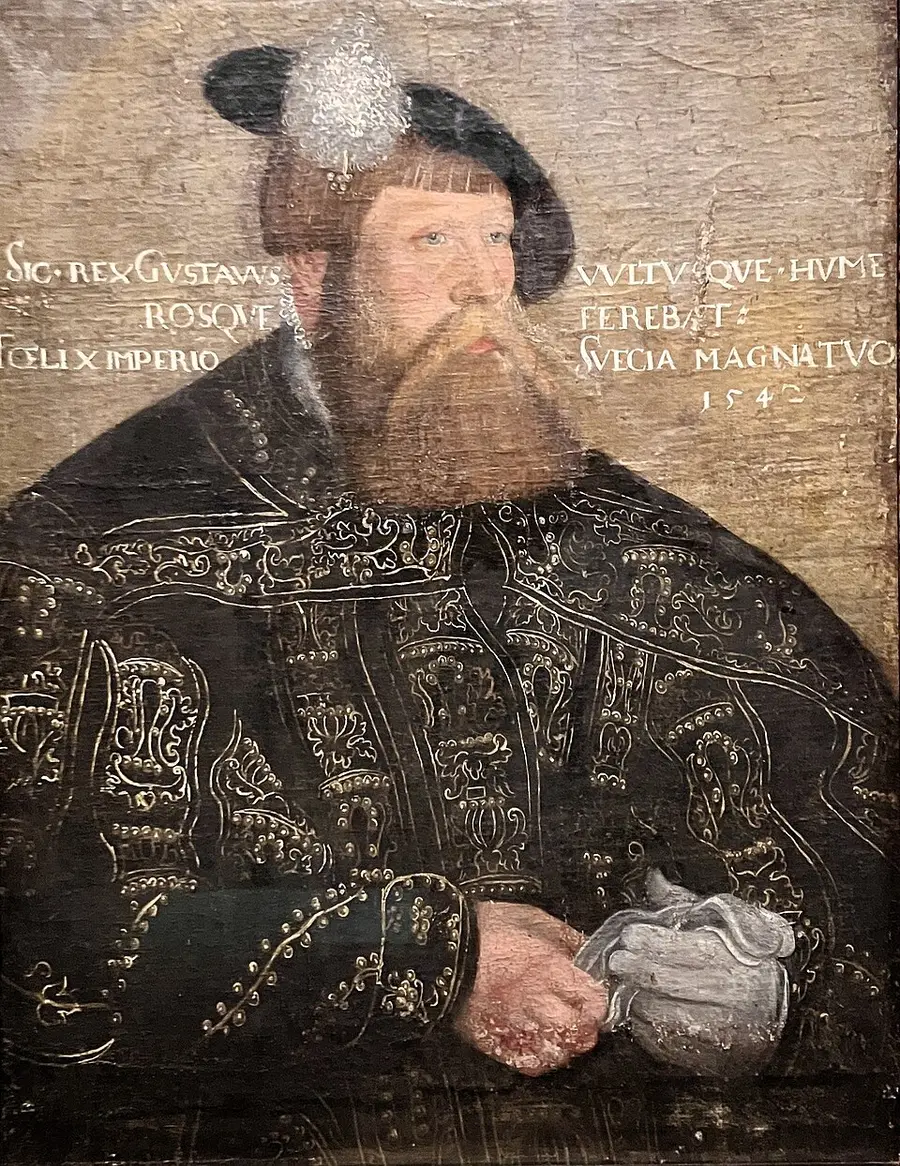 After Jacob Binck, Gustav Vasa (copy after a lost original, 16th c.), Uppsala University Collections Gustav Vasa, the Swedish king whose 1523 rebellion against Denmark ended the Kalmar Union and, with it, the medieval union that had also bound Norway to the shared crown. King of Sweden (1496–1560), reigned 1523–1560. Founder of
the Vasa dynasty and the modern Swedish state. Raised in
rebellion against the Danish king Christian II during the
Stockholm Bloodbath of November 1520, in which Christian
executed roughly eighty Swedish nobles and clergy in the
capital square. Elected king at Strängnäs on 6 June 1523
— Sweden's national day — and immediately took Sweden out
of the Kalmar Union, ending the personal union with Denmark
and Norway after 126 years. Imposed the Lutheran Reformation
on Sweden through the 1527 Västerås Recess. His reign
transformed Sweden from a medieval elective monarchy into a
hereditary national state with a state church and a
centralised treasury.
in 1523. The Danish-Norwegian double monarchy continued for another two hundred and ninety-one years. By the time it ended in 1814, the only living link to an independent Norwegian state was textual — Magnus VI Lagabøte
After Jacob Binck, Gustav Vasa (copy after a lost original, 16th c.), Uppsala University Collections Gustav Vasa, the Swedish king whose 1523 rebellion against Denmark ended the Kalmar Union and, with it, the medieval union that had also bound Norway to the shared crown. King of Sweden (1496–1560), reigned 1523–1560. Founder of
the Vasa dynasty and the modern Swedish state. Raised in
rebellion against the Danish king Christian II during the
Stockholm Bloodbath of November 1520, in which Christian
executed roughly eighty Swedish nobles and clergy in the
capital square. Elected king at Strängnäs on 6 June 1523
— Sweden's national day — and immediately took Sweden out
of the Kalmar Union, ending the personal union with Denmark
and Norway after 126 years. Imposed the Lutheran Reformation
on Sweden through the 1527 Västerås Recess. His reign
transformed Sweden from a medieval elective monarchy into a
hereditary national state with a state church and a
centralised treasury.
in 1523. The Danish-Norwegian double monarchy continued for another two hundred and ninety-one years. By the time it ended in 1814, the only living link to an independent Norwegian state was textual — Magnus VI Lagabøte 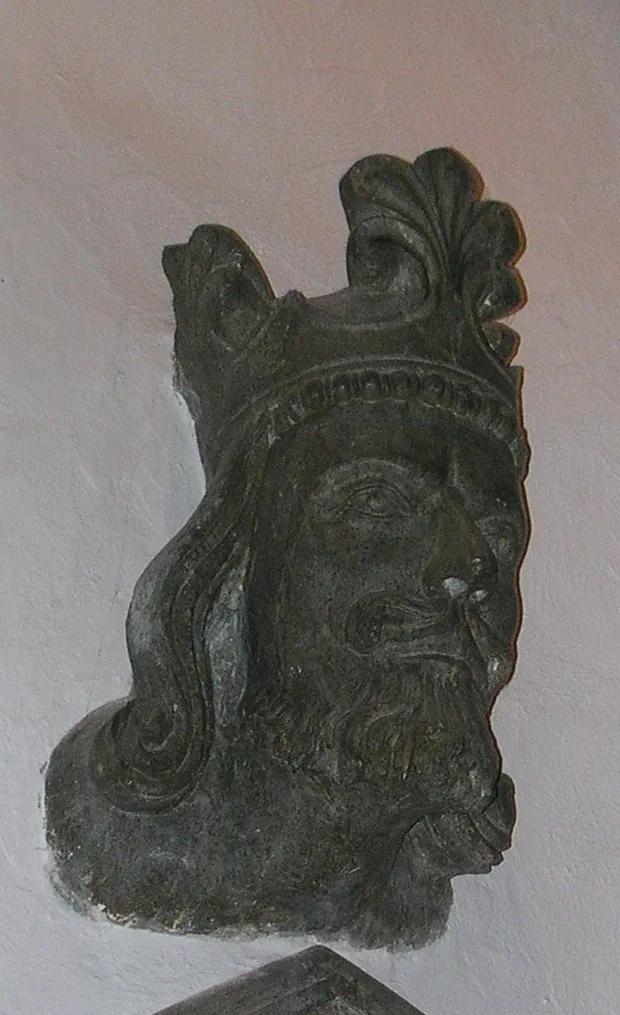 Stone head of Magnus VI Lagabøte (13th c.), Stavanger Cathedral; photo: Gunleiv Hadland (CC BY-SA 3.0) A crowned stone head carved in Stavanger Cathedral within living memory of the king — the nearest thing to a likeness of Magnus VI, the 'Law-mender' whose 1274 national code held as Norway's law for more than four hundred years. King of Norway 1263-1280, bynamed Lagabøte ("Law-mender") in
recognition of his promulgation in 1274 of the Landslov, the
Code of National Law that unified the four regional thing-law
traditions (Gulating, Frostating, Borgarting, Eidsivating) into
a single national code. The Landslov remained the law of Norway
for more than four hundred years and made Norway one of the first
European kingdoms with a unified national legal code.
Also discussed in Before There Was Norway — petty kingdoms at the edge of the worldThe Golden Age — a North Atlantic empire … reaching farther than you thinkThe Long Fall — the sudden loss of Norwegian nobility, the end of the kings, and half of Norway gone foreverThe Germans Who "Ruled" Bergen — the Hanseatic merchants on Bryggen WharfAllemannsretten — the right to roam ’s medieval Landslov (1274)
Stone head of Magnus VI Lagabøte (13th c.), Stavanger Cathedral; photo: Gunleiv Hadland (CC BY-SA 3.0) A crowned stone head carved in Stavanger Cathedral within living memory of the king — the nearest thing to a likeness of Magnus VI, the 'Law-mender' whose 1274 national code held as Norway's law for more than four hundred years. King of Norway 1263-1280, bynamed Lagabøte ("Law-mender") in
recognition of his promulgation in 1274 of the Landslov, the
Code of National Law that unified the four regional thing-law
traditions (Gulating, Frostating, Borgarting, Eidsivating) into
a single national code. The Landslov remained the law of Norway
for more than four hundred years and made Norway one of the first
European kingdoms with a unified national legal code.
Also discussed in Before There Was Norway — petty kingdoms at the edge of the worldThe Golden Age — a North Atlantic empire … reaching farther than you thinkThe Long Fall — the sudden loss of Norwegian nobility, the end of the kings, and half of Norway gone foreverThe Germans Who "Ruled" Bergen — the Hanseatic merchants on Bryggen WharfAllemannsretten — the right to roam ’s medieval Landslov (1274) 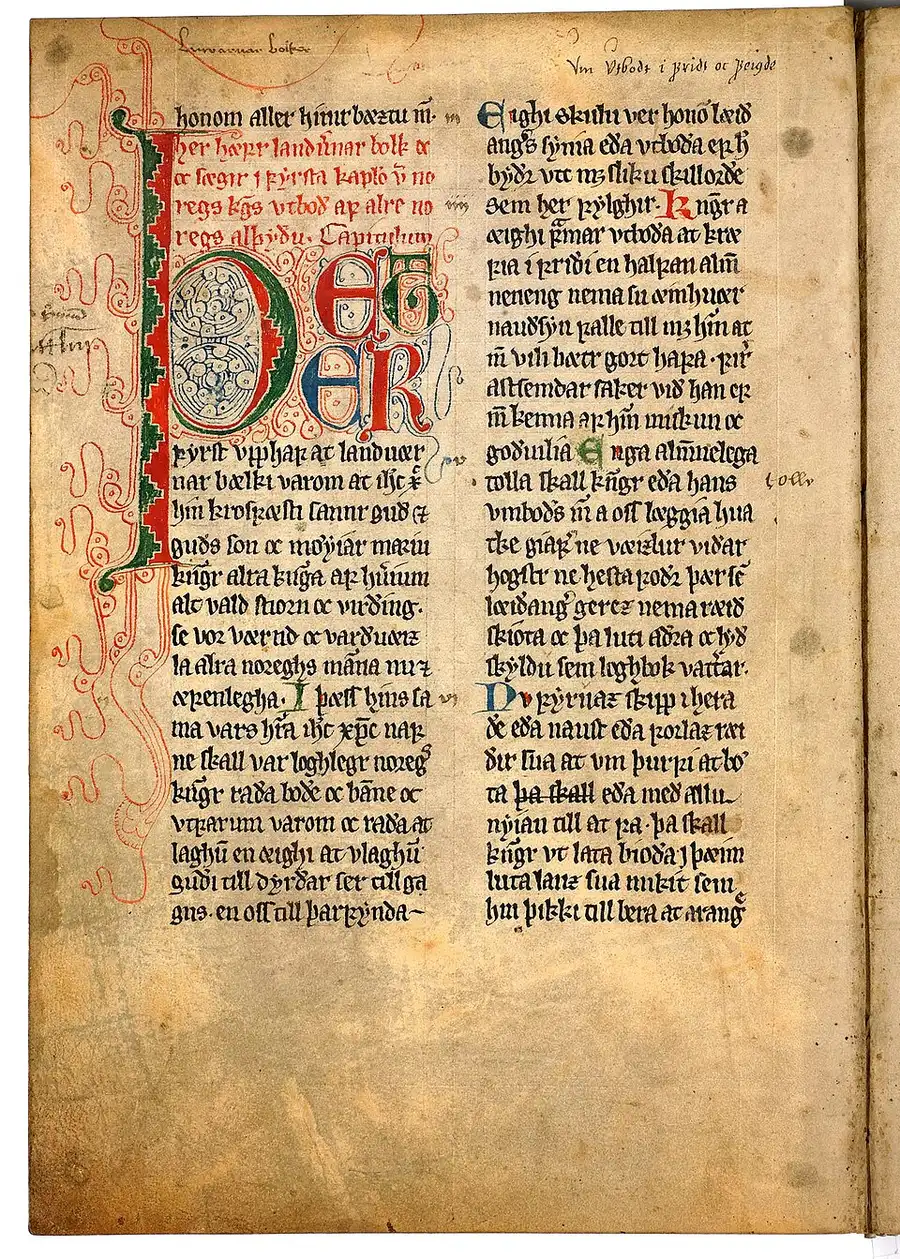 Magnus Lagabøtes landslov, AM 305 fol., fol. 10v (13th-14th c.), via Wikimedia Commons A page from a medieval handwritten copy of Magnus Lagabøte's 1274 law code, its two columns of Old Norse opening the land-defence section beneath a red, green, and blue interlace initial — the national law as scribes preserved it. Norwegian Magnus Lagabøtes landslov — the Code of National Law
promulgated by King Magnus VI Lagabøte in 1274. Unified the four
separate regional thing-law traditions (Gulating, Frostating,
Borgarting, Eidsivating) into a single code applying across the
whole Norwegian kingdom. Made Norway one of the first European
kingdoms with a unified national legal code, decades ahead of
similar developments in England or France. Remained the law of
Norway for more than four hundred years, until Christian V's
Norske Lov superseded it in 1687.
Also discussed in Before There Was Norway — petty kingdoms at the edge of the worldThe Golden Age — a North Atlantic empire … reaching farther than you thinkAllemannsretten — the right to roam , preserved in libraries and no longer operating in any court.
Magnus Lagabøtes landslov, AM 305 fol., fol. 10v (13th-14th c.), via Wikimedia Commons A page from a medieval handwritten copy of Magnus Lagabøte's 1274 law code, its two columns of Old Norse opening the land-defence section beneath a red, green, and blue interlace initial — the national law as scribes preserved it. Norwegian Magnus Lagabøtes landslov — the Code of National Law
promulgated by King Magnus VI Lagabøte in 1274. Unified the four
separate regional thing-law traditions (Gulating, Frostating,
Borgarting, Eidsivating) into a single code applying across the
whole Norwegian kingdom. Made Norway one of the first European
kingdoms with a unified national legal code, decades ahead of
similar developments in England or France. Remained the law of
Norway for more than four hundred years, until Christian V's
Norske Lov superseded it in 1687.
Also discussed in Before There Was Norway — petty kingdoms at the edge of the worldThe Golden Age — a North Atlantic empire … reaching farther than you thinkAllemannsretten — the right to roam , preserved in libraries and no longer operating in any court.
The Norwegian name for the long period is firehundreårsnatten — the four-hundred-year night. Henrik Ibsen 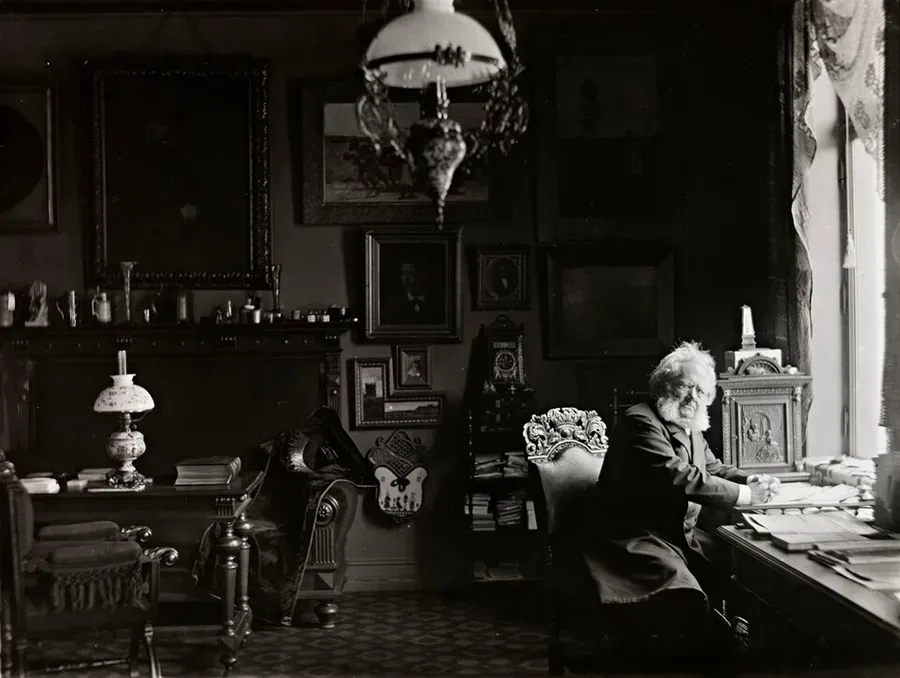 National Library of Norway, photograph of Henrik Ibsen (1897-1898) Ibsen at work in his study late in life — the Norwegian playwright whose plays and Peer Gynt made him the central figure of nineteenth-century European theatre. Norwegian playwright (1828–1906), born in Skien in Telemark
and dead in Christiania. The central figure of nineteenth-
century European theatre and one of the founders of modern
drama. Best known for Brand (1866), Peer Gynt (1867),
A Doll's House (1879), Ghosts (1881), An Enemy of the
People (1882), The Wild Duck (1884), and Hedda Gabler
(1890). Spent twenty-seven years in self-imposed exile in
Italy and Germany before returning to Norway in 1891.
Coined the phrase firehundreårsnatten — the four-
hundred-year night — in Peer Gynt, where it appears in
the Cairo madhouse scene as satire of romantic-nationalist
mythology about Norway's lost language. The phrase was then
adopted in earnest by the mythology Ibsen had been mocking.
Also discussed in Friluftsliv — the open-air lifeSøndagstur — the Sunday walk coined the phrase in Peer Gynt
National Library of Norway, photograph of Henrik Ibsen (1897-1898) Ibsen at work in his study late in life — the Norwegian playwright whose plays and Peer Gynt made him the central figure of nineteenth-century European theatre. Norwegian playwright (1828–1906), born in Skien in Telemark
and dead in Christiania. The central figure of nineteenth-
century European theatre and one of the founders of modern
drama. Best known for Brand (1866), Peer Gynt (1867),
A Doll's House (1879), Ghosts (1881), An Enemy of the
People (1882), The Wild Duck (1884), and Hedda Gabler
(1890). Spent twenty-seven years in self-imposed exile in
Italy and Germany before returning to Norway in 1891.
Coined the phrase firehundreårsnatten — the four-
hundred-year night — in Peer Gynt, where it appears in
the Cairo madhouse scene as satire of romantic-nationalist
mythology about Norway's lost language. The phrase was then
adopted in earnest by the mythology Ibsen had been mocking.
Also discussed in Friluftsliv — the open-air lifeSøndagstur — the Sunday walk coined the phrase in Peer Gynt 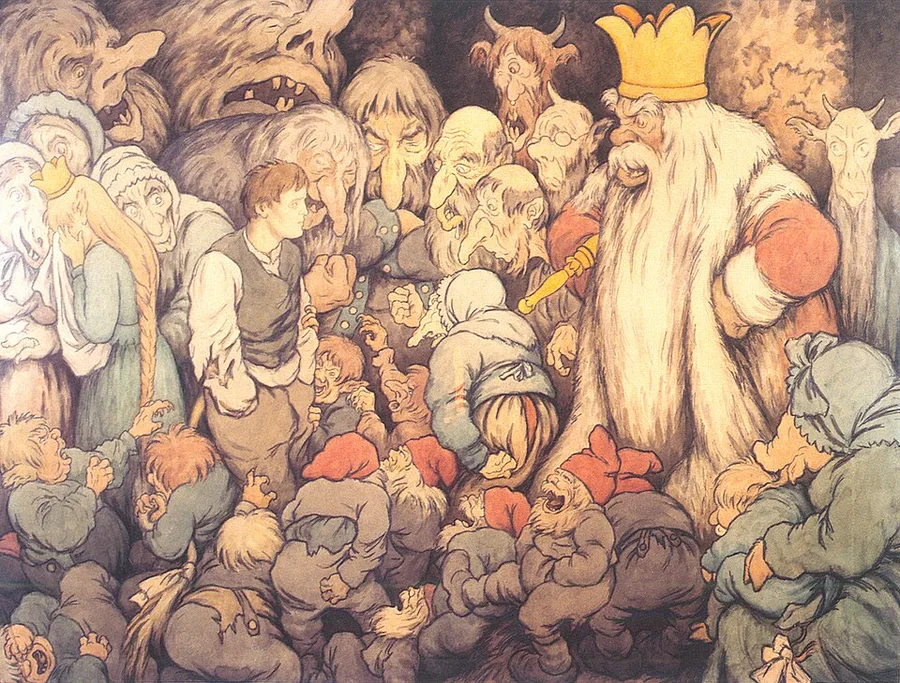 Theodor Kittelsen, Peer Gynt i Dovregubbens hall (1890) Kittelsen's depiction of Peer Gynt's trial before the Dovregubben's troll court in Act 2, the scene Grieg's incidental music made the most recognized passage of the play. Verse drama by Henrik Ibsen, published 1867. A five-act
poetic play following the lifelong wanderings of the
picaresque Norwegian peasant Peer Gynt — through the
mountains of Norway, the trolls' court of the Dovregubben,
Morocco, a Cairo madhouse, and home at last to die in the
arms of Solveig, the woman who had waited for him. The
Cairo madhouse scene in Act 4 contains the first known use
of the phrase firehundreårsnatten — the four-hundred-
year night — placed in the mouth of a satirical character
to mock the romantic-nationalist mythology of Norway's lost
language. Edvard Grieg's 1875 incidental music — Morning
Mood, In the Hall of the Mountain King, Solveig's Song
— became the best-known Norwegian music of the nineteenth
century.
(1867), put in the mouth of Huhu, a satirical madhouse patient in Cairo, mocking the romantic-nationalist mythology that had grown up around Norway’s lost language. The mythology then adopted the phrase in earnest, without the irony, and it has been Norwegian schoolroom common-sense ever since. The round number is itself a polemical flourish, not a measurement: the actual span is four hundred and thirty-four years. Modern historians of Denmark
Theodor Kittelsen, Peer Gynt i Dovregubbens hall (1890) Kittelsen's depiction of Peer Gynt's trial before the Dovregubben's troll court in Act 2, the scene Grieg's incidental music made the most recognized passage of the play. Verse drama by Henrik Ibsen, published 1867. A five-act
poetic play following the lifelong wanderings of the
picaresque Norwegian peasant Peer Gynt — through the
mountains of Norway, the trolls' court of the Dovregubben,
Morocco, a Cairo madhouse, and home at last to die in the
arms of Solveig, the woman who had waited for him. The
Cairo madhouse scene in Act 4 contains the first known use
of the phrase firehundreårsnatten — the four-hundred-
year night — placed in the mouth of a satirical character
to mock the romantic-nationalist mythology of Norway's lost
language. Edvard Grieg's 1875 incidental music — Morning
Mood, In the Hall of the Mountain King, Solveig's Song
— became the best-known Norwegian music of the nineteenth
century.
(1867), put in the mouth of Huhu, a satirical madhouse patient in Cairo, mocking the romantic-nationalist mythology that had grown up around Norway’s lost language. The mythology then adopted the phrase in earnest, without the irony, and it has been Norwegian schoolroom common-sense ever since. The round number is itself a polemical flourish, not a measurement: the actual span is four hundred and thirty-four years. Modern historians of Denmark 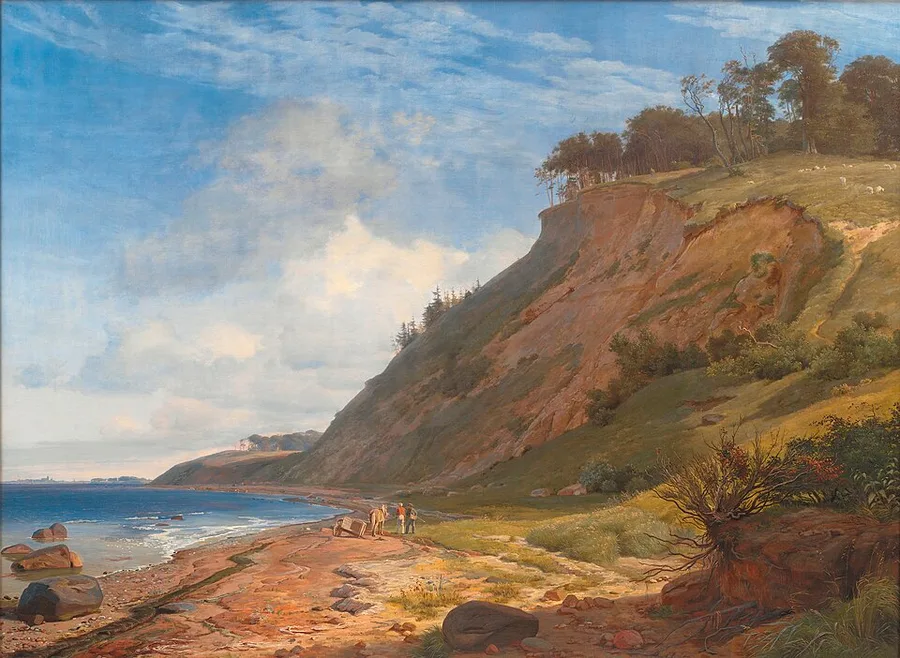 Johan Thomas Lundbye, En dansk kyst (A Danish Coast, 1843), Statens Museum for Kunst Lundbye painted this stretch of Roskilde Fjord shoreline in 1843 and titled it simply "A Danish Coast" — a Golden Age portrait of the low, mild landscape of Denmark itself, the neighbour kingdom that ran the joint Scandinavian monarchy from Copenhagen and governed Norway for close to four centuries. The southernmost of the three Scandinavian kingdoms,
consisting of the Jutland peninsula and the islands between
Jutland and the Swedish coast. Unified under Harald Bluetooth
in the late tenth century and Christianised in his reign,
Denmark was the dominant Scandinavian power through most of
the medieval and early modern centuries. From the 1397
Kalmar Union onward Denmark ran the joint Scandinavian
monarchy from Copenhagen; after Sweden left the union in
1523, Denmark and Norway remained joined as the Dano-
Norwegian state until 1814, with Norway governed as a Danish
province through that period.
Also discussed in The Long Fall — the sudden loss of Norwegian nobility, the end of the kings, and half of Norway gone foreverThe Quiet Revolution — how Norway won its independence without a warWorld War II — the King’s “No” and the Nazis in Norway -Norway handle the period more carefully. There was no formal occupation. Norwegian law continued to apply to Norwegian citizens. The crown lands stayed crown lands. The fishing and timber industries made Norway one of the wealthier provinces in the Danish kingdom. By 1800 the population had reached nearly nine hundred thousand, roughly five times the post-plague floor of three centuries earlier. The four centuries were not empty. They were also not free.
Johan Thomas Lundbye, En dansk kyst (A Danish Coast, 1843), Statens Museum for Kunst Lundbye painted this stretch of Roskilde Fjord shoreline in 1843 and titled it simply "A Danish Coast" — a Golden Age portrait of the low, mild landscape of Denmark itself, the neighbour kingdom that ran the joint Scandinavian monarchy from Copenhagen and governed Norway for close to four centuries. The southernmost of the three Scandinavian kingdoms,
consisting of the Jutland peninsula and the islands between
Jutland and the Swedish coast. Unified under Harald Bluetooth
in the late tenth century and Christianised in his reign,
Denmark was the dominant Scandinavian power through most of
the medieval and early modern centuries. From the 1397
Kalmar Union onward Denmark ran the joint Scandinavian
monarchy from Copenhagen; after Sweden left the union in
1523, Denmark and Norway remained joined as the Dano-
Norwegian state until 1814, with Norway governed as a Danish
province through that period.
Also discussed in The Long Fall — the sudden loss of Norwegian nobility, the end of the kings, and half of Norway gone foreverThe Quiet Revolution — how Norway won its independence without a warWorld War II — the King’s “No” and the Nazis in Norway -Norway handle the period more carefully. There was no formal occupation. Norwegian law continued to apply to Norwegian citizens. The crown lands stayed crown lands. The fishing and timber industries made Norway one of the wealthier provinces in the Danish kingdom. By 1800 the population had reached nearly nine hundred thousand, roughly five times the post-plague floor of three centuries earlier. The four centuries were not empty. They were also not free.
A slow absorption
For the first century and a half, Norway retained the outward forms of statehood. The Council of the Realm — the Riksrådet The Council of the Realm — the medieval and early modern
Norwegian royal council of magnates and bishops, the body
through which the senior secular aristocracy and the
Norwegian church together advised and constrained the king
and negotiated the succession when a line failed. In the
high-medieval kingdom the Council was the institutional
counterweight to the crown; in the post-plague century it
was the body that should have negotiated Norway's next king
on Norway's terms after the dynastic collapse of 1387. The
Black Death reduced both the Council's numbers and the
noble incomes that had sustained its independence — leaving
it unable to assert Norwegian autonomy when the crown
passed by inheritance to Margaret I and her Danish line.
In this article By the fifteenth century the Council was fading — thinned by
the plague's losses among the families that had staffed it,
its noble incomes shrunken, its bishops increasingly appointed
from Copenhagen. In 1536 Christian III abolished it outright,
decreeing that Norway would thereafter be governed as part of
the Danish realm — the erasure of the last institutional form
of a separate Norwegian state.
Also discussed in The Long Fall — the sudden loss of Norwegian nobility, the end of the kings, and half of Norway gone forever of magnates and bishops — continued to meet, though less often and with fewer members at each gathering. Successive Danish kings were still formally elected by the Norwegian Council to the Norwegian throne, and Magnus Lagabøte’s Landslov of 1274 remained the operating law of the country. The plague kept returning in waves through the fifteenth century, knocking back each slow recovery. The Norwegian nobility, never large and reduced to almost nothing by the first wave of mortality, lost its standing as a distinct political class and was absorbed into the Danish nobility. The bishops of Bergen 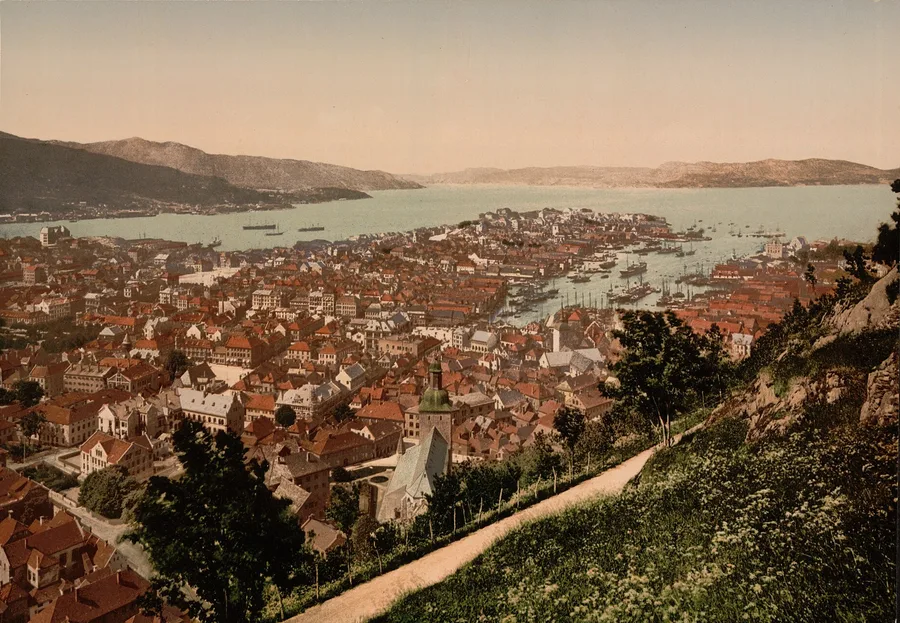 Photochrom print, General view from Fjeldveien, Bergen (c. 1890–1900), Library of Congress Bergen in the 1890s from the Fjellveien path on Fløyfjellet — the whole city between its mountains, Vågen harbour still crowded with sailing ships at its heart. For four centuries Norway's largest city, and the wharf through which the entire western export economy ran. Norway's western trading capital, founded around 1070 on the
inner Byfjorden. For four centuries the largest city in the
country and the wharf through which the entire western export
economy ran — dried cod from the Lofoten fisheries, stockpiled
and traded by the Hanseatic merchants at Bryggen from 1360 to
1754. Norway's commercial and intellectual heart through the
Hanseatic period; overtaken in size by Christiania (Oslo) in the
1830s. The painted wooden Bryggen wharf is on the UNESCO World
Heritage list and substantially what it was in the late
seventeenth century.
In this article The Hanseatic Kontor at Bryggen ran Norway's western export
economy outright through the long Danish-union period, paying
roughly half its profits to the Danish crown in customs and
largely insulating the western coast from the political
relegation of the rest of the country.
On the trip The Ungdommene (the Youngsters) reach Bergen late on Day 3
via the Norway-in-a-Nutshell train-and-ferry route from
Oslo. On the Day 4 morning they walk Bryggen and ride the
funicular up Mount Fløyen before flying back to Oslo and driving
on to Lillehammer that evening — a day ahead of the Gråhårsklubben
(the Oldsters), who spend the split days north in Trondheim and
the heritage country of Stjørdal, Hegra, and Kylloplass and come
south on Day 5.
Bergen Also discussed in The Germans Who "Ruled" Bergen — the Hanseatic merchants on Bryggen WharfBefore There Was Norway — petty kingdoms at the edge of the worldThe King Who Became a Saint — how the Nordmen came to ChristA Catholic Norway — the faith that gave the kingdom its first institutions and the stave churchesThe Long Fall — the sudden loss of Norwegian nobility, the end of the kings, and half of Norway gone foreverThe Golden Age — a North Atlantic empire … reaching farther than you thinkThe Crusades?!!!! — sixty ships from Bergen, bound for the Holy LandThe Reformation, 1537 — one church eradicated and another imposedWorld War II — the King’s “No” and the Nazis in NorwayKraken — the island-sized beast, logged as factSjøormer — the serpents in the deep lakes and fjordsPesta — an old woman walking from farm to farmFossegrimen — the waterfall fiddler who teaches you to playAlcohol and Vinmonopolet — when and where to buy a drinkEveryday etiquette — quiet voices, wide space, no smilingFood and dining customs — having patience, free water, brunost on everything🚨 Emergencies - important numbers, hospitals, and what you can doLanguage basics — just enough Norwegian to be politeWhat to wear — the layering system, on the ground , Nidaros Cathedral
Photochrom print, General view from Fjeldveien, Bergen (c. 1890–1900), Library of Congress Bergen in the 1890s from the Fjellveien path on Fløyfjellet — the whole city between its mountains, Vågen harbour still crowded with sailing ships at its heart. For four centuries Norway's largest city, and the wharf through which the entire western export economy ran. Norway's western trading capital, founded around 1070 on the
inner Byfjorden. For four centuries the largest city in the
country and the wharf through which the entire western export
economy ran — dried cod from the Lofoten fisheries, stockpiled
and traded by the Hanseatic merchants at Bryggen from 1360 to
1754. Norway's commercial and intellectual heart through the
Hanseatic period; overtaken in size by Christiania (Oslo) in the
1830s. The painted wooden Bryggen wharf is on the UNESCO World
Heritage list and substantially what it was in the late
seventeenth century.
In this article The Hanseatic Kontor at Bryggen ran Norway's western export
economy outright through the long Danish-union period, paying
roughly half its profits to the Danish crown in customs and
largely insulating the western coast from the political
relegation of the rest of the country.
On the trip The Ungdommene (the Youngsters) reach Bergen late on Day 3
via the Norway-in-a-Nutshell train-and-ferry route from
Oslo. On the Day 4 morning they walk Bryggen and ride the
funicular up Mount Fløyen before flying back to Oslo and driving
on to Lillehammer that evening — a day ahead of the Gråhårsklubben
(the Oldsters), who spend the split days north in Trondheim and
the heritage country of Stjørdal, Hegra, and Kylloplass and come
south on Day 5.
Bergen Also discussed in The Germans Who "Ruled" Bergen — the Hanseatic merchants on Bryggen WharfBefore There Was Norway — petty kingdoms at the edge of the worldThe King Who Became a Saint — how the Nordmen came to ChristA Catholic Norway — the faith that gave the kingdom its first institutions and the stave churchesThe Long Fall — the sudden loss of Norwegian nobility, the end of the kings, and half of Norway gone foreverThe Golden Age — a North Atlantic empire … reaching farther than you thinkThe Crusades?!!!! — sixty ships from Bergen, bound for the Holy LandThe Reformation, 1537 — one church eradicated and another imposedWorld War II — the King’s “No” and the Nazis in NorwayKraken — the island-sized beast, logged as factSjøormer — the serpents in the deep lakes and fjordsPesta — an old woman walking from farm to farmFossegrimen — the waterfall fiddler who teaches you to playAlcohol and Vinmonopolet — when and where to buy a drinkEveryday etiquette — quiet voices, wide space, no smilingFood and dining customs — having patience, free water, brunost on everything🚨 Emergencies - important numbers, hospitals, and what you can doLanguage basics — just enough Norwegian to be politeWhat to wear — the layering system, on the ground , Nidaros Cathedral 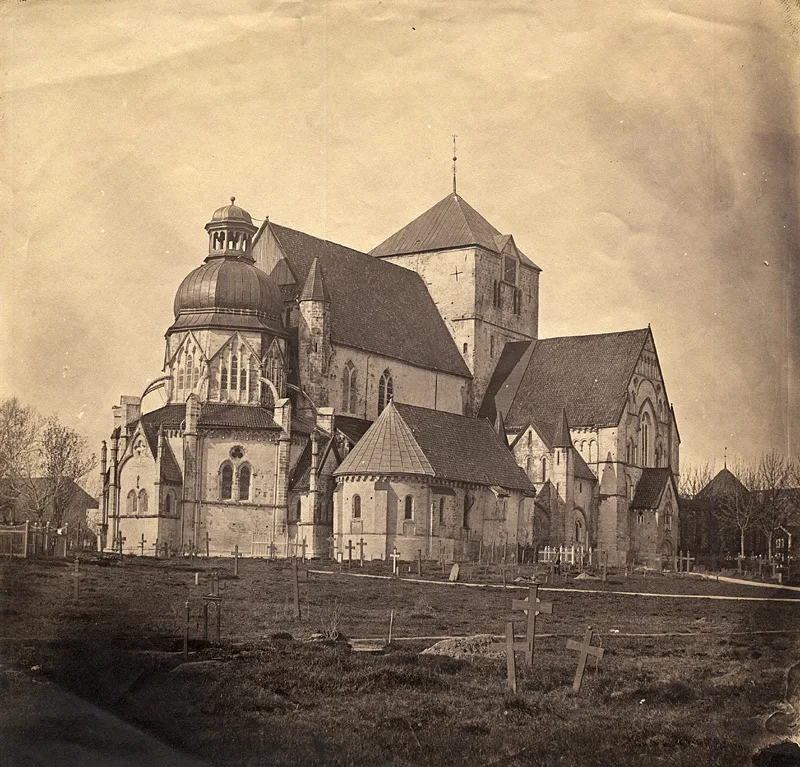 Unknown photographer, Nidaros Cathedral from the northeast (1857), Wikimedia Commons One of the earliest surviving photographs of Norway, taken in 1857 — decades before the west front's twentieth-century reconstruction — showing the cathedral over Olav's grave much as centuries of fire, neglect, and weather had left it. The principal cathedral of Norway and the burial place of Saint
Olav, on the bank of the Nid River in Trondheim. Built and rebuilt
in stages from the late eleventh through the early fourteenth
centuries around the shrine site at the cathedral's east end. The
octagonal east end, raised directly over Olav's grave, was the
devotional core of the medieval building. Substantially damaged
by fires and the 1531 lightning strike, then by neglect across the
Lutheran centuries. The west front a visitor sees today is a
nineteenth- and twentieth-century reconstruction, completed only
in 1983. The cathedral is the coronation and consecration church
of Norwegian kings; Haakon VII was crowned there in 1906, Olav V
consecrated in 1958, Harald V in 1991.
On the trip Day 3 of the trip brings the Gråhårsklubben (the Oldsters) to
Nidaros Cathedral. The shrine is gone but
the spot is marked on the cathedral floor in the octagonal east
end. The west front is the twentieth-century reconstruction of
the face the medieval pilgrims saw. The pilgrim road comes in
past the south door — the same door medieval pilgrims walked
through.
Nidaros Cathedral, Trondheim Also discussed in The King Who Became a Saint — how the Nordmen came to ChristA Catholic Norway — the faith that gave the kingdom its first institutions and the stave churchesThe Crusades?!!!! — sixty ships from Bergen, bound for the Holy LandThe Golden Age — a North Atlantic empire … reaching farther than you thinkThe Long Fall — the sudden loss of Norwegian nobility, the end of the kings, and half of Norway gone foreverThe Reformation, 1537 — one church eradicated and another imposedLutheran Norway and Pietism — a farmer named Hans Nielsen Hauge and a lay revival that could not be silencedThe Quiet Revolution — how Norway won its independence without a warTradisjoner — celebrations across the Norwegian year , Stavanger
Unknown photographer, Nidaros Cathedral from the northeast (1857), Wikimedia Commons One of the earliest surviving photographs of Norway, taken in 1857 — decades before the west front's twentieth-century reconstruction — showing the cathedral over Olav's grave much as centuries of fire, neglect, and weather had left it. The principal cathedral of Norway and the burial place of Saint
Olav, on the bank of the Nid River in Trondheim. Built and rebuilt
in stages from the late eleventh through the early fourteenth
centuries around the shrine site at the cathedral's east end. The
octagonal east end, raised directly over Olav's grave, was the
devotional core of the medieval building. Substantially damaged
by fires and the 1531 lightning strike, then by neglect across the
Lutheran centuries. The west front a visitor sees today is a
nineteenth- and twentieth-century reconstruction, completed only
in 1983. The cathedral is the coronation and consecration church
of Norwegian kings; Haakon VII was crowned there in 1906, Olav V
consecrated in 1958, Harald V in 1991.
On the trip Day 3 of the trip brings the Gråhårsklubben (the Oldsters) to
Nidaros Cathedral. The shrine is gone but
the spot is marked on the cathedral floor in the octagonal east
end. The west front is the twentieth-century reconstruction of
the face the medieval pilgrims saw. The pilgrim road comes in
past the south door — the same door medieval pilgrims walked
through.
Nidaros Cathedral, Trondheim Also discussed in The King Who Became a Saint — how the Nordmen came to ChristA Catholic Norway — the faith that gave the kingdom its first institutions and the stave churchesThe Crusades?!!!! — sixty ships from Bergen, bound for the Holy LandThe Golden Age — a North Atlantic empire … reaching farther than you thinkThe Long Fall — the sudden loss of Norwegian nobility, the end of the kings, and half of Norway gone foreverThe Reformation, 1537 — one church eradicated and another imposedLutheran Norway and Pietism — a farmer named Hans Nielsen Hauge and a lay revival that could not be silencedThe Quiet Revolution — how Norway won its independence without a warTradisjoner — celebrations across the Norwegian year , Stavanger 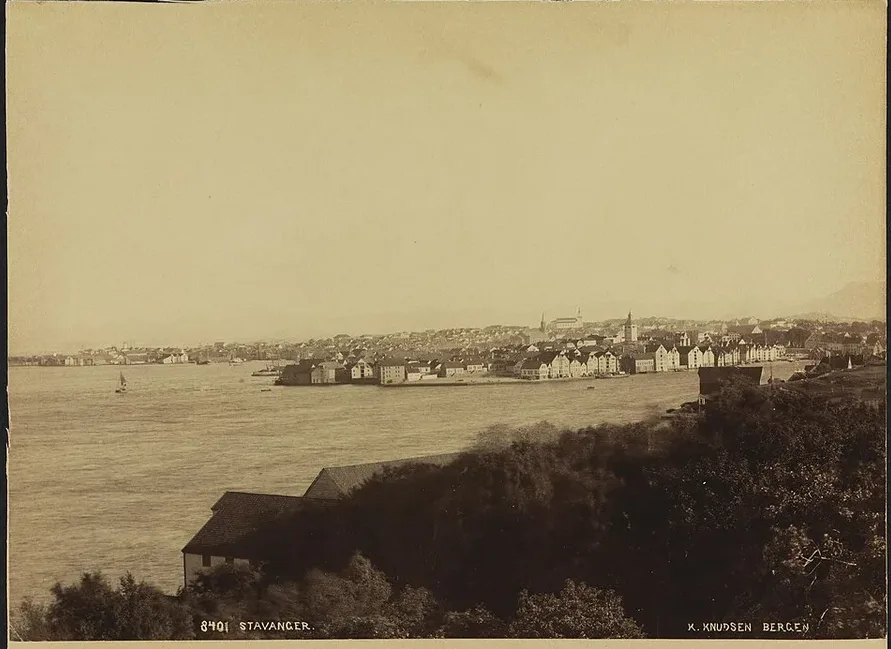 Knud Knudsen, Stavanger (1888-1894), National Library of Norway Stavanger in the late 1880s — the low wooden harbour town, church towers on the skyline, that the emigrant ships had been sailing from for two generations by the time Knudsen photographed it. City on the southwestern Norwegian coast in Rogaland; modern
Norway's fourth-largest city and the operational capital of the
Norwegian petroleum economy since the 1970s. The traditional site
of the sea-battle of Hafrsfjord that completed Harald Fairhair's
consolidation lies at the city's southwestern edge, marked by the
Sverd i fjell monument. The Norwegian Petroleum Directorate, the
safety regulator (Havtil), and Equinor (formerly Statoil) are all
headquartered in or around the city. Population around one hundred
and forty thousand in the municipality; metropolitan area roughly
twice that.
Stavanger Also discussed in Before There Was Norway — petty kingdoms at the edge of the worldThe Viking Age — longships, legends, and the first "Norway"A Catholic Norway — the faith that gave the kingdom its first institutions and the stave churchesThe 'Lucky Country' — the discovery that changed everything800,000 Norwegians Leave — the century that built a Second NorwayWorld War II — the King’s “No” and the Nazis in Norway , Hamar
Knud Knudsen, Stavanger (1888-1894), National Library of Norway Stavanger in the late 1880s — the low wooden harbour town, church towers on the skyline, that the emigrant ships had been sailing from for two generations by the time Knudsen photographed it. City on the southwestern Norwegian coast in Rogaland; modern
Norway's fourth-largest city and the operational capital of the
Norwegian petroleum economy since the 1970s. The traditional site
of the sea-battle of Hafrsfjord that completed Harald Fairhair's
consolidation lies at the city's southwestern edge, marked by the
Sverd i fjell monument. The Norwegian Petroleum Directorate, the
safety regulator (Havtil), and Equinor (formerly Statoil) are all
headquartered in or around the city. Population around one hundred
and forty thousand in the municipality; metropolitan area roughly
twice that.
Stavanger Also discussed in Before There Was Norway — petty kingdoms at the edge of the worldThe Viking Age — longships, legends, and the first "Norway"A Catholic Norway — the faith that gave the kingdom its first institutions and the stave churchesThe 'Lucky Country' — the discovery that changed everything800,000 Norwegians Leave — the century that built a Second NorwayWorld War II — the King’s “No” and the Nazis in Norway , Hamar 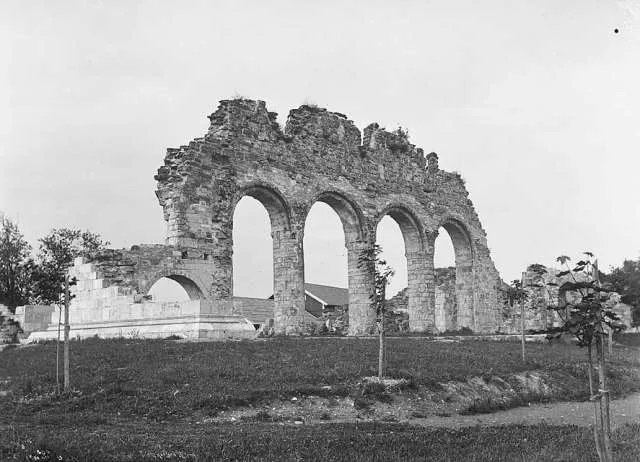 Axel Lindahl, the cathedral ruins in Hamar (c. 1880-1890), Norwegian Museum of Cultural History Hamar's medieval cathedral, seat of the diocese Nicholas Breakspear established in 1152, stood until Swedish forces burned it in 1567; this 1880s photograph shows the roofless nave arches before the ruins were enclosed under their present protective canopy. City on the western shore of Lake Mjøsa in the inland east of
Norway. Founded as a market town and episcopal seat by the papal
legate Nicholas Breakspear in 1152, when it was also made one of
the four Norwegian suffragan dioceses of the new Nidaros
archdiocese. The medieval cathedral was destroyed by Swedish
forces in 1567; the surviving ruins on the Hamar peninsula are
preserved under a protective glass-and-steel canopy. The modern
city has around thirty thousand people and is the seat of the
Eidsivating Court of Appeal — the inheritance of the medieval
inland law-tradition.
Hamar Also discussed in A Catholic Norway — the faith that gave the kingdom its first institutions and the stave churchesThe Reformation, 1537 — one church eradicated and another imposed , and Oslo
Axel Lindahl, the cathedral ruins in Hamar (c. 1880-1890), Norwegian Museum of Cultural History Hamar's medieval cathedral, seat of the diocese Nicholas Breakspear established in 1152, stood until Swedish forces burned it in 1567; this 1880s photograph shows the roofless nave arches before the ruins were enclosed under their present protective canopy. City on the western shore of Lake Mjøsa in the inland east of
Norway. Founded as a market town and episcopal seat by the papal
legate Nicholas Breakspear in 1152, when it was also made one of
the four Norwegian suffragan dioceses of the new Nidaros
archdiocese. The medieval cathedral was destroyed by Swedish
forces in 1567; the surviving ruins on the Hamar peninsula are
preserved under a protective glass-and-steel canopy. The modern
city has around thirty thousand people and is the seat of the
Eidsivating Court of Appeal — the inheritance of the medieval
inland law-tradition.
Hamar Also discussed in A Catholic Norway — the faith that gave the kingdom its first institutions and the stave churchesThe Reformation, 1537 — one church eradicated and another imposed , and Oslo 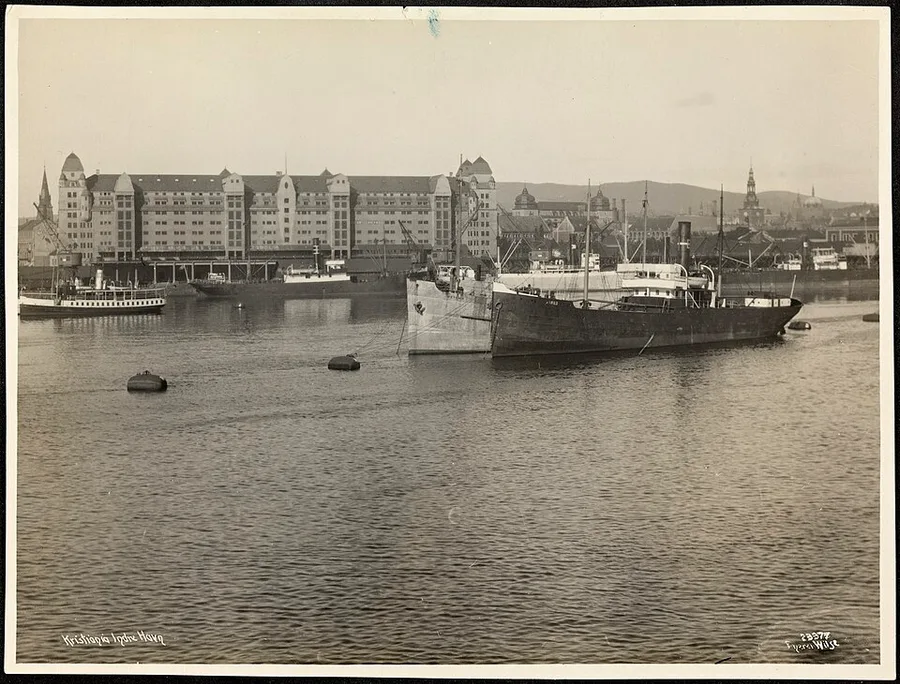 Anders Beer Wilse, Kristiania Indre Havn (1923), National Library of Norway Wilse's 1923 photograph of the inner harbor at Bjørvika, two years before Kristiania took back its old name Oslo — steamers at the quays beneath the spires of the city that grew from a medieval royal seat into Norway's capital. Capital of modern Norway, at the head of the Oslofjord on
the country's southeastern coast. Founded according to the
sagas by Harald Hardrada about 1049 and known through the
medieval period as a secondary royal seat behind Bergen and
Nidaros. Hákon V moved the royal residence permanently to
Oslo about 1300 and built Akershus Fortress to guard the
harbour. After a fire in 1624 the medieval town was
abandoned and Christian IV rebuilt the city to the west
under the new name Christiania (later Kristiania); the
name Oslo was restored in 1925. The original medieval
street pattern survives as the Gamlebyen district east of
the modern centre.
On the trip Days 1–2 belong to Oslo, with both groups together —
Roseslottet and the harbourside museums on Day 1, then the
Day-2 e-bike tour through Akershus Fortress, up Karl Johans
gate, and out to Vigeland Park.
Oslo Also discussed in The Long Fall — the sudden loss of Norwegian nobility, the end of the kings, and half of Norway gone foreverA Catholic Norway — the faith that gave the kingdom its first institutions and the stave churchesThe Reformation, 1537 — one church eradicated and another imposedLutheran Norway and Pietism — a farmer named Hans Nielsen Hauge and a lay revival that could not be silencedThe Constitution That Saved a Nation — five radical weeks at Eidsvoll, 1814800,000 Norwegians Leave — the century that built a Second NorwayThe Quiet Revolution — how Norway won its independence without a warWorld War II — the King’s “No” and the Nazis in NorwayAlcohol and Vinmonopolet — when and where to buy a drinkEveryday etiquette — quiet voices, wide space, no smiling🚨 Emergencies - important numbers, hospitals, and what you can doLanding in Norway — off the plane in Oslo, where to go, step by stepMoney — currency, cards, prices, and tipping continued in their sees, but the appointments increasingly came from Copenhagen
Anders Beer Wilse, Kristiania Indre Havn (1923), National Library of Norway Wilse's 1923 photograph of the inner harbor at Bjørvika, two years before Kristiania took back its old name Oslo — steamers at the quays beneath the spires of the city that grew from a medieval royal seat into Norway's capital. Capital of modern Norway, at the head of the Oslofjord on
the country's southeastern coast. Founded according to the
sagas by Harald Hardrada about 1049 and known through the
medieval period as a secondary royal seat behind Bergen and
Nidaros. Hákon V moved the royal residence permanently to
Oslo about 1300 and built Akershus Fortress to guard the
harbour. After a fire in 1624 the medieval town was
abandoned and Christian IV rebuilt the city to the west
under the new name Christiania (later Kristiania); the
name Oslo was restored in 1925. The original medieval
street pattern survives as the Gamlebyen district east of
the modern centre.
On the trip Days 1–2 belong to Oslo, with both groups together —
Roseslottet and the harbourside museums on Day 1, then the
Day-2 e-bike tour through Akershus Fortress, up Karl Johans
gate, and out to Vigeland Park.
Oslo Also discussed in The Long Fall — the sudden loss of Norwegian nobility, the end of the kings, and half of Norway gone foreverA Catholic Norway — the faith that gave the kingdom its first institutions and the stave churchesThe Reformation, 1537 — one church eradicated and another imposedLutheran Norway and Pietism — a farmer named Hans Nielsen Hauge and a lay revival that could not be silencedThe Constitution That Saved a Nation — five radical weeks at Eidsvoll, 1814800,000 Norwegians Leave — the century that built a Second NorwayThe Quiet Revolution — how Norway won its independence without a warWorld War II — the King’s “No” and the Nazis in NorwayAlcohol and Vinmonopolet — when and where to buy a drinkEveryday etiquette — quiet voices, wide space, no smiling🚨 Emergencies - important numbers, hospitals, and what you can doLanding in Norway — off the plane in Oslo, where to go, step by stepMoney — currency, cards, prices, and tipping continued in their sees, but the appointments increasingly came from Copenhagen 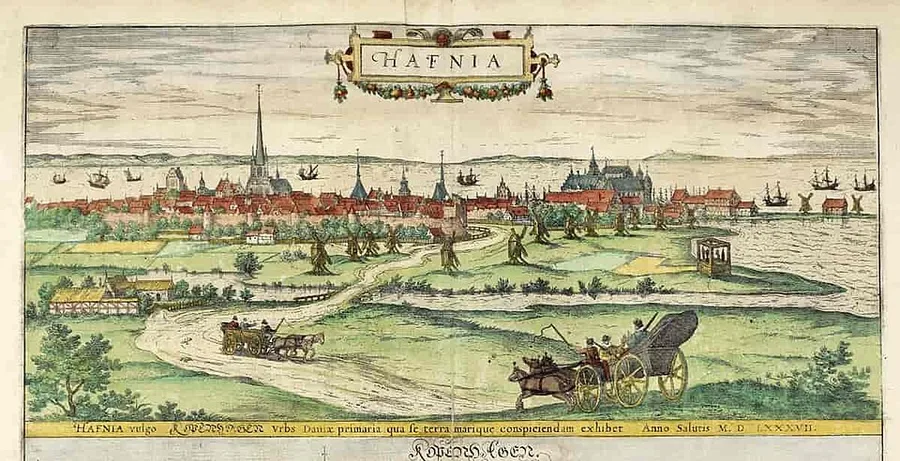 Georg Braun & Frans Hogenberg, view of Copenhagen from Vesterbro (1587), Civitates Orbis Terrarum Braun & Hogenberg's 1587 prospect of Copenhagen, capital of the Danish-Norwegian union from which the 1537 Reformation was imposed on Norway and to which the melted-down silver of Olav's shrine was sent after Nidaros Cathedral was stripped. Capital of Denmark, on the eastern coast of the island of Zealand
across the Øresund strait from Sweden. Founded as a fishing town
in the early medieval period, formal city in 1167, royal capital
from the early fifteenth century. The administrative centre of the
Danish kingdom and, from 1380 to 1814, of the Danish-Norwegian
union — the place where the 1537 Lutheran Reformation in Norway
was decided and from which the silver of the Olafskrinet was
sent to the Copenhagen mint after the destruction of the shrine
at Nidaros.
Also discussed in The King Who Became a Saint — how the Nordmen came to ChristA Catholic Norway — the faith that gave the kingdom its first institutions and the stave churchesThe Reformation, 1537 — one church eradicated and another imposedWorld War II — the King’s “No” and the Nazis in Norway , and the men appointed increasingly arrived from Danish or German training.
Georg Braun & Frans Hogenberg, view of Copenhagen from Vesterbro (1587), Civitates Orbis Terrarum Braun & Hogenberg's 1587 prospect of Copenhagen, capital of the Danish-Norwegian union from which the 1537 Reformation was imposed on Norway and to which the melted-down silver of Olav's shrine was sent after Nidaros Cathedral was stripped. Capital of Denmark, on the eastern coast of the island of Zealand
across the Øresund strait from Sweden. Founded as a fishing town
in the early medieval period, formal city in 1167, royal capital
from the early fifteenth century. The administrative centre of the
Danish kingdom and, from 1380 to 1814, of the Danish-Norwegian
union — the place where the 1537 Lutheran Reformation in Norway
was decided and from which the silver of the Olafskrinet was
sent to the Copenhagen mint after the destruction of the shrine
at Nidaros.
Also discussed in The King Who Became a Saint — how the Nordmen came to ChristA Catholic Norway — the faith that gave the kingdom its first institutions and the stave churchesThe Reformation, 1537 — one church eradicated and another imposedWorld War II — the King’s “No” and the Nazis in Norway , and the men appointed increasingly arrived from Danish or German training.
In 1536, King Christian III of Denmark-Norway 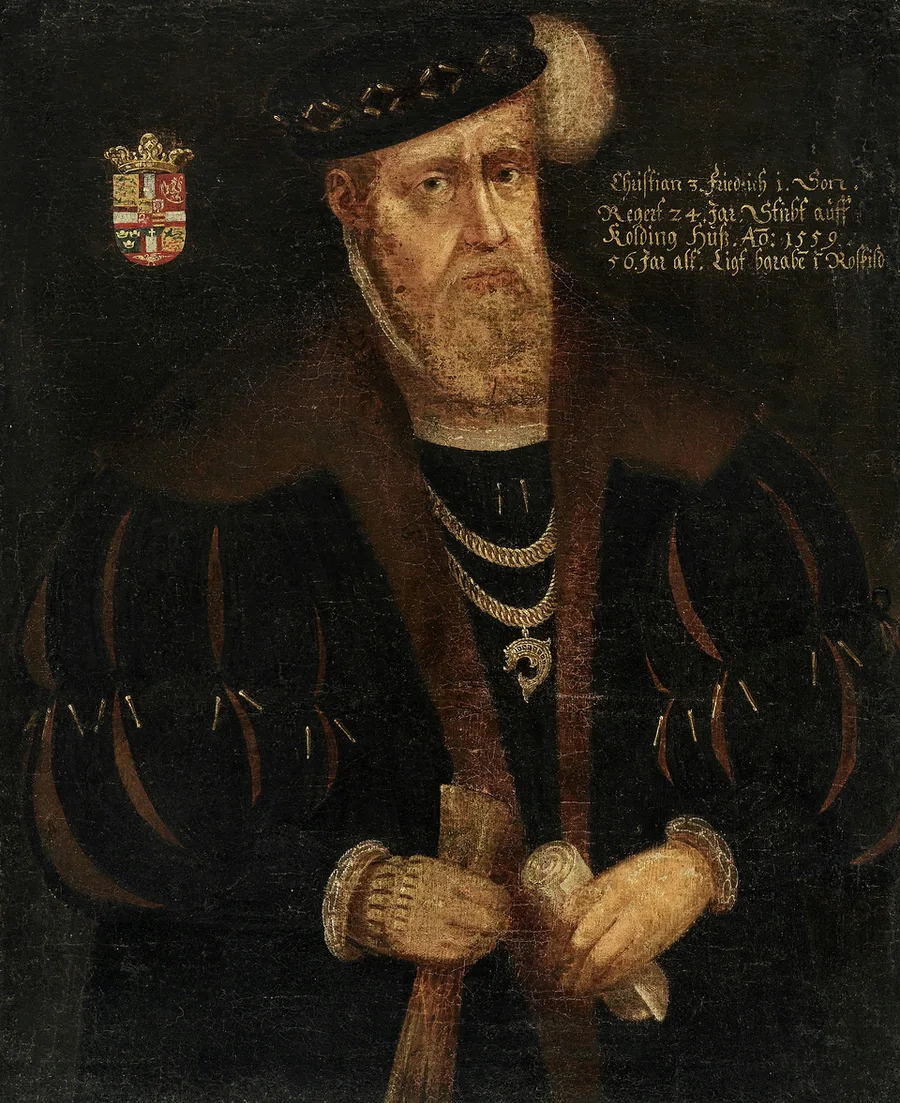 Jacob Binck, Portrait of Christian III (1550s) Jacob Binck's portrait of Christian III, whose 1536 Count's Feud victory and 1537 Kirkeordinansen imposed Lutheranism and dissolved Norway's separate council, folding the kingdom into Denmark for two and a half centuries. King of Denmark and Norway (1503–1559), reigned 1534–1559.
Came to the throne after the Count's Feud (1534–1536), the
civil war that established Lutheranism as the state religion
across his realm. By the Recess of Copenhagen in October
1536 he abolished the Norwegian Council of the Realm and
declared Norway a fully integrated part of the Danish
kingdom rather than a separate one in personal union. The
Reformation followed the next year, imposed across both
Denmark and Norway by royal decree. The last Catholic
archbishop of Nidaros, Olav Engelbrektsson, fled the country
in April 1537. Christian III's reign closed the medieval
Norwegian state as an institutionally distinct entity for
the next two and a half centuries.
Also discussed in The Reformation, 1537 — one church eradicated and another imposed formally abolished the Norwegian Council of the Realm and declared Norway a fully integrated part of the Danish kingdom rather than a separate one in personal union. How completely that integration was realised has been argued by modern historians: Norway kept its royal title, its own law continued to operate, and its administration retained distinct features. But the medieval institutional kingdom, as a self-acting political body, was over. The The Reformation
Jacob Binck, Portrait of Christian III (1550s) Jacob Binck's portrait of Christian III, whose 1536 Count's Feud victory and 1537 Kirkeordinansen imposed Lutheranism and dissolved Norway's separate council, folding the kingdom into Denmark for two and a half centuries. King of Denmark and Norway (1503–1559), reigned 1534–1559.
Came to the throne after the Count's Feud (1534–1536), the
civil war that established Lutheranism as the state religion
across his realm. By the Recess of Copenhagen in October
1536 he abolished the Norwegian Council of the Realm and
declared Norway a fully integrated part of the Danish
kingdom rather than a separate one in personal union. The
Reformation followed the next year, imposed across both
Denmark and Norway by royal decree. The last Catholic
archbishop of Nidaros, Olav Engelbrektsson, fled the country
in April 1537. Christian III's reign closed the medieval
Norwegian state as an institutionally distinct entity for
the next two and a half centuries.
Also discussed in The Reformation, 1537 — one church eradicated and another imposed formally abolished the Norwegian Council of the Realm and declared Norway a fully integrated part of the Danish kingdom rather than a separate one in personal union. How completely that integration was realised has been argued by modern historians: Norway kept its royal title, its own law continued to operate, and its administration retained distinct features. But the medieval institutional kingdom, as a self-acting political body, was over. The The Reformation 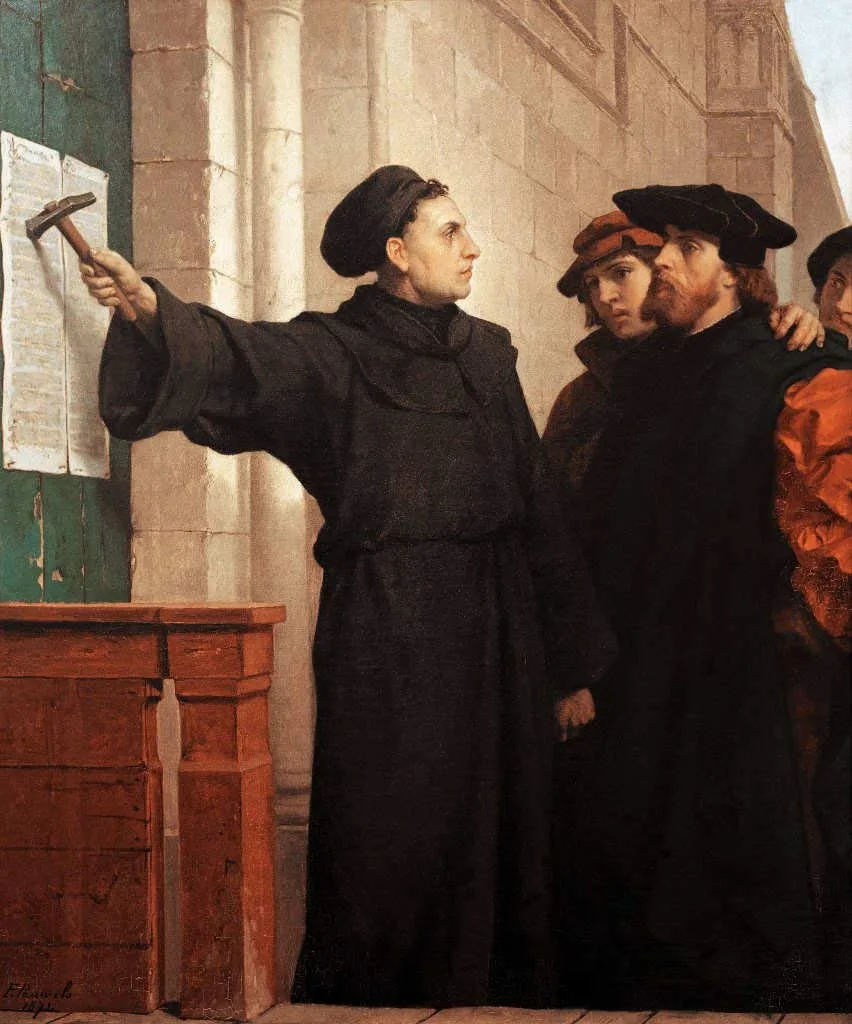 Ferdinand Pauwels, Luther hammers his 95 theses to the door (1872) Pauwels's 1872 history painting stages the 1517 act that began the Lutheran Reformation — the settlement Christian III of Denmark imposed on Norway by royal decree twenty years later, with no Norwegian reformer or domestic movement behind it. The Lutheran religious settlement imposed on Norway in 1537 by
royal decree from Copenhagen. Christian III of Denmark abolished
the Catholic ecclesiastical structure, dissolved the monasteries,
ordered the saints' relics destroyed, and replaced the Latin
liturgy with Danish-language Lutheran services. Unlike the
Reformation elsewhere in northern Europe, Norway's arrived from
outside — no Norwegian Luther, no Norwegian reformers, no
domestic religious movement behind it. The country changed
denomination because the king in Copenhagen ordered it.
In this article The 1537 Reformation completed the Danish consolidation of
Norway that the abolition of the Norwegian Council of the
Realm had begun the year before. Norway became, for the next
277 years, a province administered from Copenhagen on the
same terms as Jutland or Funen.
Also discussed in The Reformation, 1537 — one church eradicated and another imposedThe King Who Became a Saint — how the Nordmen came to ChristA Catholic Norway — the faith that gave the kingdom its first institutions and the stave churchesThe Germans Who "Ruled" Bergen — the Hanseatic merchants on Bryggen WharfLutheran Norway and Pietism — a farmer named Hans Nielsen Hauge and a lay revival that could not be silencedThe Long Fall — the sudden loss of Norwegian nobility, the end of the kings, and half of Norway gone foreverStatskirken — the state church and what's left of it followed the next year, imposed by royal decree across both halves of the realm, the last Catholic archbishop of Nidaros fleeing the country with what treasures he could save.
Ferdinand Pauwels, Luther hammers his 95 theses to the door (1872) Pauwels's 1872 history painting stages the 1517 act that began the Lutheran Reformation — the settlement Christian III of Denmark imposed on Norway by royal decree twenty years later, with no Norwegian reformer or domestic movement behind it. The Lutheran religious settlement imposed on Norway in 1537 by
royal decree from Copenhagen. Christian III of Denmark abolished
the Catholic ecclesiastical structure, dissolved the monasteries,
ordered the saints' relics destroyed, and replaced the Latin
liturgy with Danish-language Lutheran services. Unlike the
Reformation elsewhere in northern Europe, Norway's arrived from
outside — no Norwegian Luther, no Norwegian reformers, no
domestic religious movement behind it. The country changed
denomination because the king in Copenhagen ordered it.
In this article The 1537 Reformation completed the Danish consolidation of
Norway that the abolition of the Norwegian Council of the
Realm had begun the year before. Norway became, for the next
277 years, a province administered from Copenhagen on the
same terms as Jutland or Funen.
Also discussed in The Reformation, 1537 — one church eradicated and another imposedThe King Who Became a Saint — how the Nordmen came to ChristA Catholic Norway — the faith that gave the kingdom its first institutions and the stave churchesThe Germans Who "Ruled" Bergen — the Hanseatic merchants on Bryggen WharfLutheran Norway and Pietism — a farmer named Hans Nielsen Hauge and a lay revival that could not be silencedThe Long Fall — the sudden loss of Norwegian nobility, the end of the kings, and half of Norway gone foreverStatskirken — the state church and what's left of it followed the next year, imposed by royal decree across both halves of the realm, the last Catholic archbishop of Nidaros fleeing the country with what treasures he could save.
What was lost
The Norwegian aristocracy as a class ceased to exist. The royal court ceased to exist; the king visited Norway rarely, and for long stretches not at all. Norwegian — the language of the medieval chanceries, the saga prose, the law-codes — ceased to be a written language at all and survived only as a spoken vernacular. After the Reformation, all administrative correspondence, all legal documents, all liturgical texts, all printed books, and all schoolroom instruction in Norwegian schools were in Danish. In 1604, the Landslov itself was translated into Danish under King Christian IV of Denmark-Norway 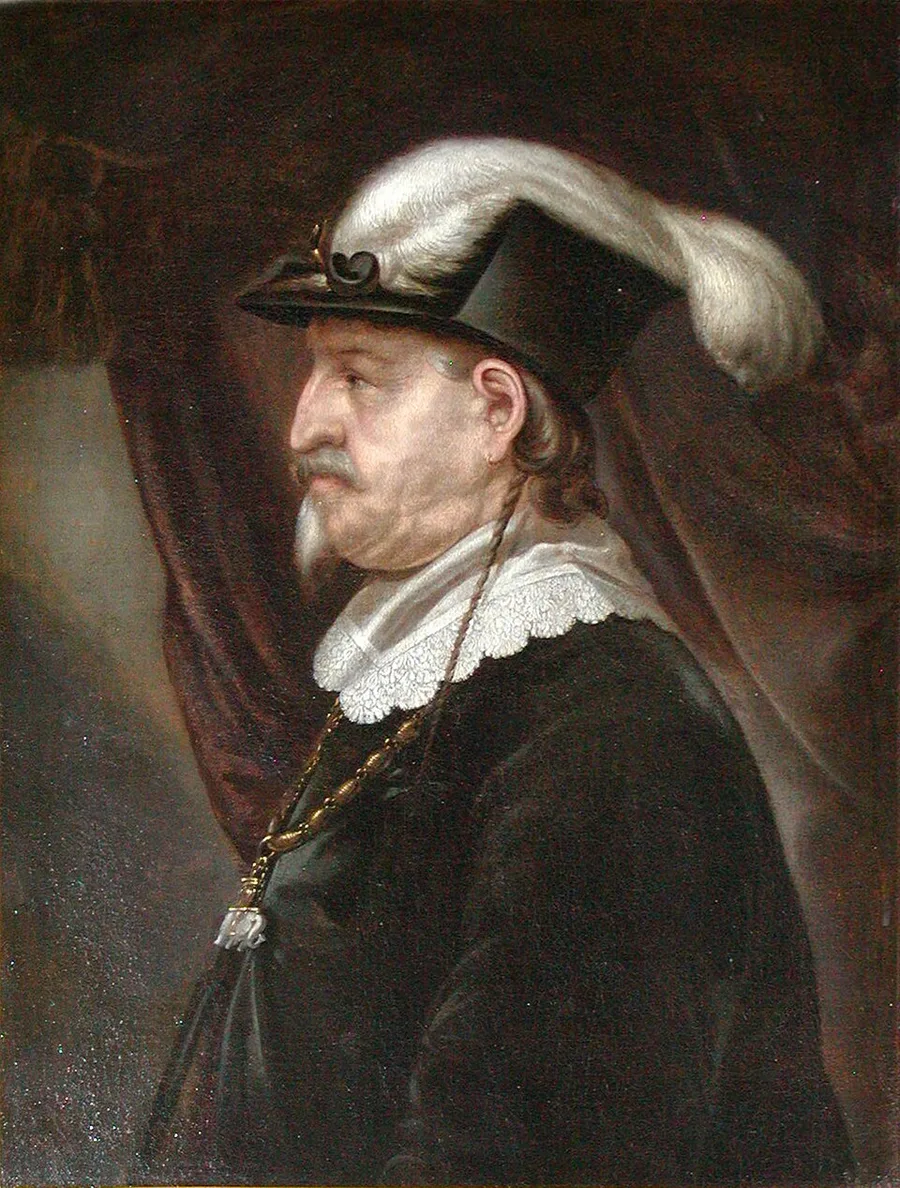 Karel van Mander (III), Christian IV (c. 1645), Frederiksborg Slot Christian IV in old age, painted by his court artist — the builder-king who founded Christiania (Oslo), Kongsberg, and Kristiansand and issued the 1604 Norwegian law-book; his planned grid beneath Akershus, the Kvadraturen, still underlies central Oslo. King of Denmark and Norway (1577–1648), reigned 1588–1648 —
the longest reign in Scandinavian royal history. A builder-
king whose stamp on the urban geography of Norway is the
most visible single legacy of the long Danish period: he
founded Christiania (modern Oslo) in 1624 after the
medieval city burned, Kongsberg in 1624 around newly
discovered silver, Kristiansand in 1641 on the southern
coast, and gave charters or expanded patronage to Trondheim,
Bergen, and other coastal towns. Promulgated the Norske Lov
av 1604 — the Danish translation of Magnus Lagabøte's
medieval Landslov — that became the working text of
Norwegian courts. His reign also brought the costly Kalmar
War (1611–1613) against Sweden and the catastrophic Danish
entry into the Thirty Years' War (1625–1629).
. The Norske Lov av 1604
Karel van Mander (III), Christian IV (c. 1645), Frederiksborg Slot Christian IV in old age, painted by his court artist — the builder-king who founded Christiania (Oslo), Kongsberg, and Kristiansand and issued the 1604 Norwegian law-book; his planned grid beneath Akershus, the Kvadraturen, still underlies central Oslo. King of Denmark and Norway (1577–1648), reigned 1588–1648 —
the longest reign in Scandinavian royal history. A builder-
king whose stamp on the urban geography of Norway is the
most visible single legacy of the long Danish period: he
founded Christiania (modern Oslo) in 1624 after the
medieval city burned, Kongsberg in 1624 around newly
discovered silver, Kristiansand in 1641 on the southern
coast, and gave charters or expanded patronage to Trondheim,
Bergen, and other coastal towns. Promulgated the Norske Lov
av 1604 — the Danish translation of Magnus Lagabøte's
medieval Landslov — that became the working text of
Norwegian courts. His reign also brought the costly Kalmar
War (1611–1613) against Sweden and the catastrophic Danish
entry into the Thirty Years' War (1625–1629).
. The Norske Lov av 1604 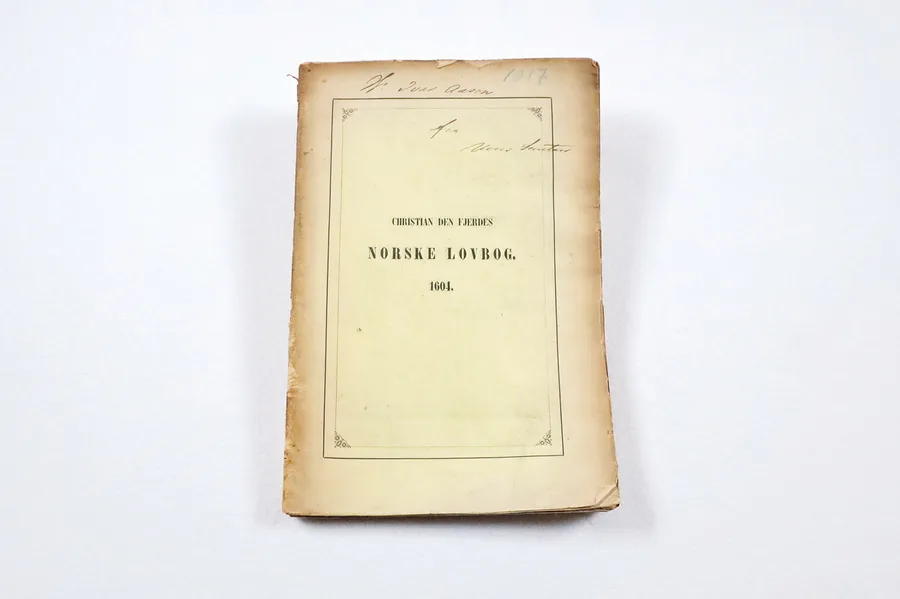 Photo: Stine Stennes Hovdenakk, Kong Christian den fjerdes norske Lovbog af 1604, Nynorsk kultursentrum (Ivar Aasen-tunet), CC BY-SA 4.0 This copy of the 1604 Norwegian law-book once sat in Ivar Aasen's own library — the very Danish-language translation that displaced Magnus Lagabøte's Old Norwegian Landslov and marked the moment Norway's written law itself became Danish. The Norwegian Law of 1604 — the Danish-language
translation and revision of Magnus Lagabøte's medieval
Landslov (1274), promulgated under King Christian IV. The
translation displaced the original Old Norwegian text as
the operating law of Norwegian courts and marked the formal
passage of Norwegian written law into Danish. Replaced in
1687 by Christian V's Norske Lov — a wholly new code
drafted by four Norwegian jurists adapting the Danish Code
(Danske Lov, 1683), which remained the operating
Norwegian law for two centuries.
became the operating text of Norwegian courts, and the medieval Old Norwegian text passed out of working use. In 1665, the Kongeloven
Photo: Stine Stennes Hovdenakk, Kong Christian den fjerdes norske Lovbog af 1604, Nynorsk kultursentrum (Ivar Aasen-tunet), CC BY-SA 4.0 This copy of the 1604 Norwegian law-book once sat in Ivar Aasen's own library — the very Danish-language translation that displaced Magnus Lagabøte's Old Norwegian Landslov and marked the moment Norway's written law itself became Danish. The Norwegian Law of 1604 — the Danish-language
translation and revision of Magnus Lagabøte's medieval
Landslov (1274), promulgated under King Christian IV. The
translation displaced the original Old Norwegian text as
the operating law of Norwegian courts and marked the formal
passage of Norwegian written law into Danish. Replaced in
1687 by Christian V's Norske Lov — a wholly new code
drafted by four Norwegian jurists adapting the Danish Code
(Danske Lov, 1683), which remained the operating
Norwegian law for two centuries.
became the operating text of Norwegian courts, and the medieval Old Norwegian text passed out of working use. In 1665, the Kongeloven 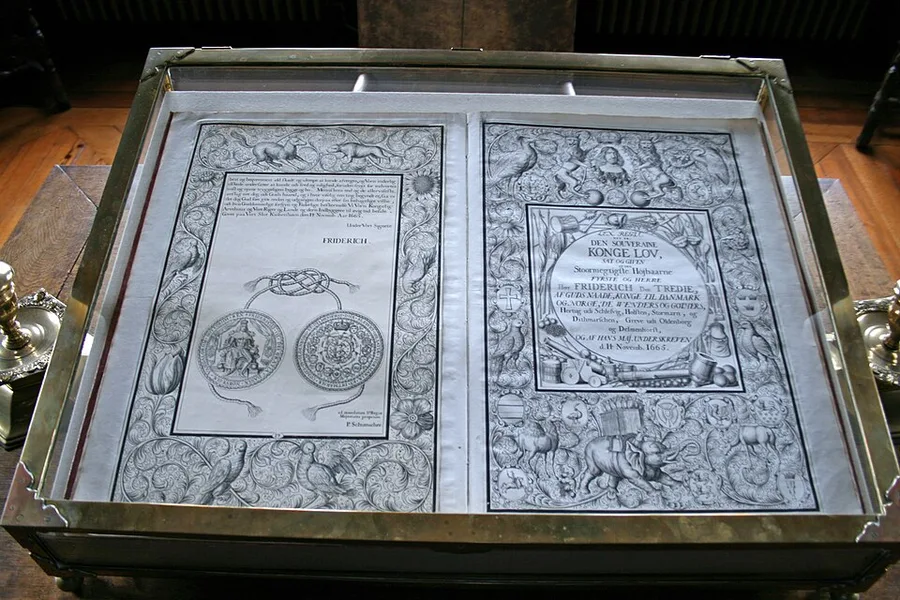 Photo: Thomas Hindsgaul, Kongeloven (1665), Frederiksborg Slot This is the 1665 Kongeloven volume itself, on display at Frederiksborg Castle — the document that made the Danish-Norwegian king's word absolute law, bound only by the Lutheran faith and the unity of the realm. The King's Law — the Danish absolutist constitution
signed by King Frederik III on 14 November 1665 and first
published in print by his grandson Frederik IV in 1709, formalising
the hereditary absolute monarchy that had been established
in Denmark-Norway by the 1660–61 constitutional revolution.
The most thoroughgoing royal-absolutist document of
seventeenth-century Europe: the king holds all legislative,
executive, judicial, and ecclesiastical authority, bound
only by the Christian faith, the indivisibility of the
realm, and the obligation to uphold the Lutheran
confession. Operated as the constitutional law of Denmark-
Norway until 1814 in Norway and 1849 in Denmark, when
Frederik VII signed the Danish constitution that ended
absolutism.
— codified in writing the absolutism established in Denmark-Norway five years earlier. The Danish monarch ruled both kingdoms from Copenhagen with no constitutional check on his authority.
Photo: Thomas Hindsgaul, Kongeloven (1665), Frederiksborg Slot This is the 1665 Kongeloven volume itself, on display at Frederiksborg Castle — the document that made the Danish-Norwegian king's word absolute law, bound only by the Lutheran faith and the unity of the realm. The King's Law — the Danish absolutist constitution
signed by King Frederik III on 14 November 1665 and first
published in print by his grandson Frederik IV in 1709, formalising
the hereditary absolute monarchy that had been established
in Denmark-Norway by the 1660–61 constitutional revolution.
The most thoroughgoing royal-absolutist document of
seventeenth-century Europe: the king holds all legislative,
executive, judicial, and ecclesiastical authority, bound
only by the Christian faith, the indivisibility of the
realm, and the obligation to uphold the Lutheran
confession. Operated as the constitutional law of Denmark-
Norway until 1814 in Norway and 1849 in Denmark, when
Frederik VII signed the Danish constitution that ended
absolutism.
— codified in writing the absolutism established in Denmark-Norway five years earlier. The Danish monarch ruled both kingdoms from Copenhagen with no constitutional check on his authority.
The Nidaros archbishopric, which had been the metropolitan see of the entire Norse Atlantic empire under the Catholic age, became simply one of the Danish-Norwegian bishoprics under the Lutheran establishment, drawing its appointees and its theological direction from Copenhagen. The medieval shrine of Saint Olav 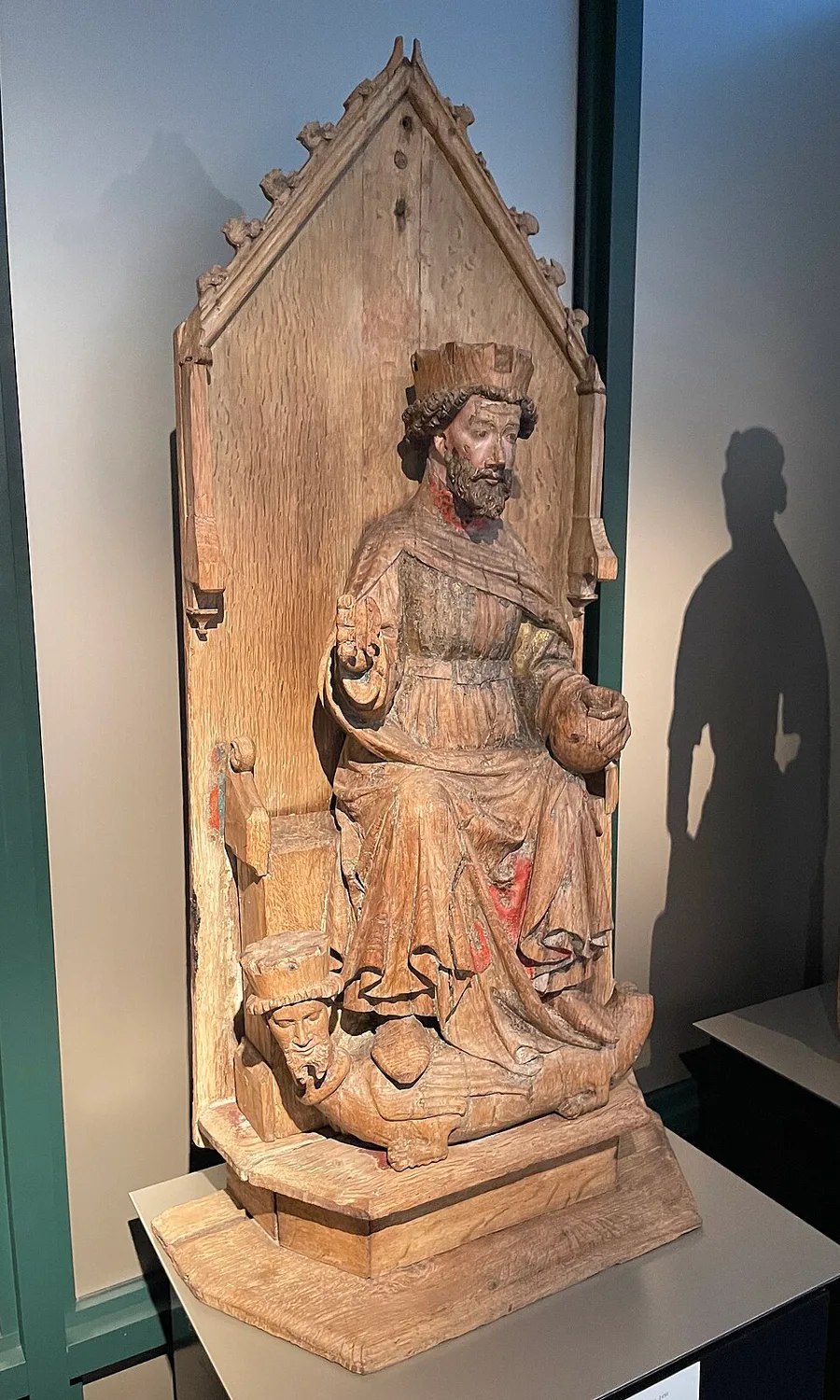 Saint Olav from Austevoll church (c. 1450), University Museum of Bergen; photo Wolfmann, Wikimedia Commons, CC BY-SA 4.0 Olav as medieval Norway saw him: the eternal king crowned and enthroned, trampling a dragon whose crowned human head stands for the heathendom he overcame. Carved around 1450 for Austevoll church south of Bergen — one of the polychrome Olav figures that stood in churches across Norway before the Reformation. Olav Haraldsson, king of Norway 1015–1028, killed at the Battle
of Stiklestad on 29 July 1030 and canonized one year and five days
later by his English bishop Grimkell. Rex Perpetuus Norvegiae —
the Eternal King of Norway. His shrine at Nidaros became the
northernmost pilgrimage destination in medieval Christendom and
the binding narrative of a converted country. The Norwegian Lion
on the modern coat of arms — a golden lion bearing a golden axe
on a red shield — is Saint Olav's iconography.
On the trip The Gråhårsklubben (the Oldsters) visit Nidaros Cathedral on
Tuesday 28 July 2026 — the day before the 996th anniversary of
the Battle of Stiklestad. The Olafskrinet was broken up at the
1537 Reformation and the body buried somewhere inside the
cathedral in a spot no medieval source preserved. The building
is what the nine-and-a-half centuries of devotion built. The
pilgrim road, the Pilegrimsleden, runs past the cathedral's
south door — the same door the medieval pilgrims walked through.
Nidaros Cathedral, Trondheim Also discussed in The King Who Became a Saint — how the Nordmen came to ChristThe Viking Age — longships, legends, and the first "Norway"Worshiping Odin and Thor — the lived religion of pre-Christian NorwayA Catholic Norway — the faith that gave the kingdom its first institutions and the stave churchesThe Reformation, 1537 — one church eradicated and another imposedLutheran Norway and Pietism — a farmer named Hans Nielsen Hauge and a lay revival that could not be silencedThe Crusades?!!!! — sixty ships from Bergen, bound for the Holy LandThe Quiet Revolution — how Norway won its independence without a warWorld War II — the King’s “No” and the Nazis in Norway was broken up. The cathedral that had drawn pilgrims from across northern Europe became a parish church.
Saint Olav from Austevoll church (c. 1450), University Museum of Bergen; photo Wolfmann, Wikimedia Commons, CC BY-SA 4.0 Olav as medieval Norway saw him: the eternal king crowned and enthroned, trampling a dragon whose crowned human head stands for the heathendom he overcame. Carved around 1450 for Austevoll church south of Bergen — one of the polychrome Olav figures that stood in churches across Norway before the Reformation. Olav Haraldsson, king of Norway 1015–1028, killed at the Battle
of Stiklestad on 29 July 1030 and canonized one year and five days
later by his English bishop Grimkell. Rex Perpetuus Norvegiae —
the Eternal King of Norway. His shrine at Nidaros became the
northernmost pilgrimage destination in medieval Christendom and
the binding narrative of a converted country. The Norwegian Lion
on the modern coat of arms — a golden lion bearing a golden axe
on a red shield — is Saint Olav's iconography.
On the trip The Gråhårsklubben (the Oldsters) visit Nidaros Cathedral on
Tuesday 28 July 2026 — the day before the 996th anniversary of
the Battle of Stiklestad. The Olafskrinet was broken up at the
1537 Reformation and the body buried somewhere inside the
cathedral in a spot no medieval source preserved. The building
is what the nine-and-a-half centuries of devotion built. The
pilgrim road, the Pilegrimsleden, runs past the cathedral's
south door — the same door the medieval pilgrims walked through.
Nidaros Cathedral, Trondheim Also discussed in The King Who Became a Saint — how the Nordmen came to ChristThe Viking Age — longships, legends, and the first "Norway"Worshiping Odin and Thor — the lived religion of pre-Christian NorwayA Catholic Norway — the faith that gave the kingdom its first institutions and the stave churchesThe Reformation, 1537 — one church eradicated and another imposedLutheran Norway and Pietism — a farmer named Hans Nielsen Hauge and a lay revival that could not be silencedThe Crusades?!!!! — sixty ships from Bergen, bound for the Holy LandThe Quiet Revolution — how Norway won its independence without a warWorld War II — the King’s “No” and the Nazis in Norway was broken up. The cathedral that had drawn pilgrims from across northern Europe became a parish church.
Through Copenhagen
Individual Norwegians could rise to the very top of the kingdom by one route: through Copenhagen. The clearest example was Ludvig Holberg 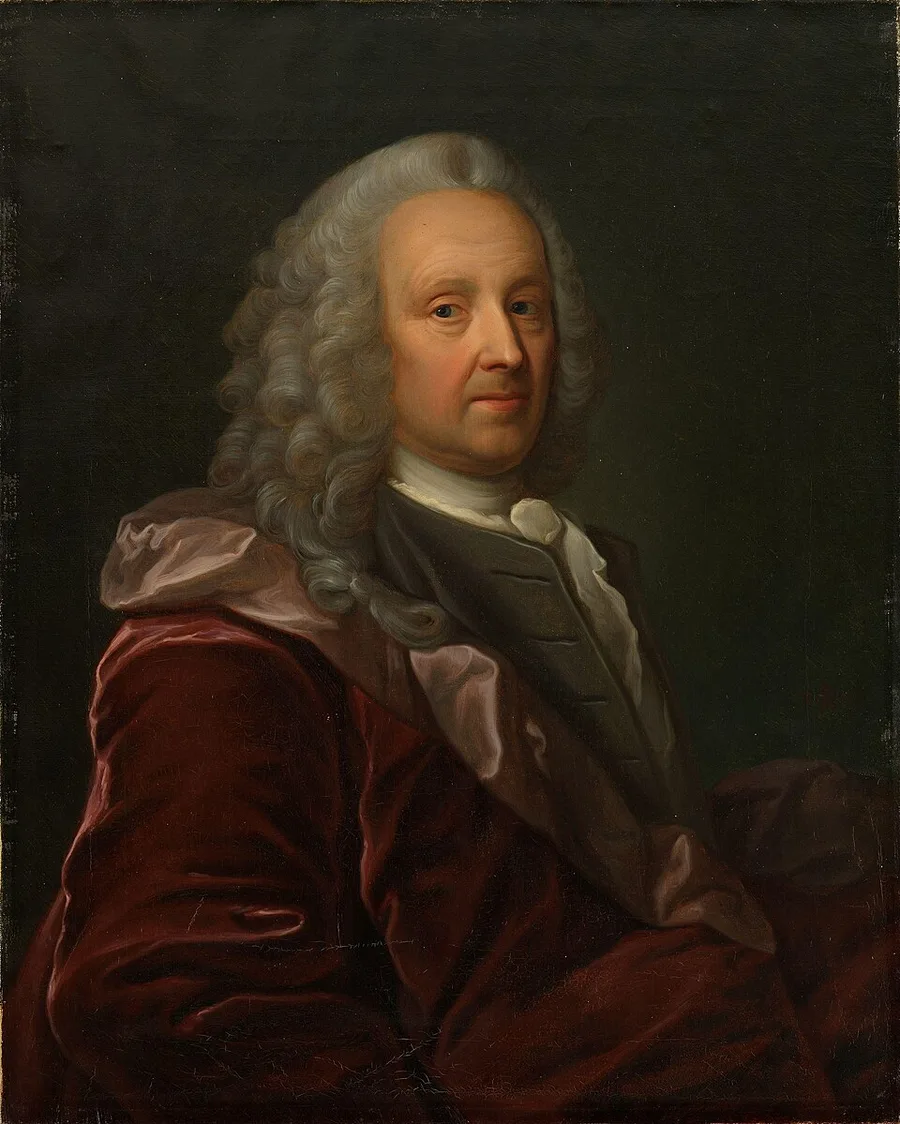 Jørgen Roed, copy after Johan Roselius, Portrait of Ludvig Holberg (1847), Nasjonalmuseet, Oslo Ludvig Holberg, the Bergen-born playwright and scholar who built his career in Copenhagen — the clearest illustration of the path a Norwegian could take to the top of the union. Norwegian-Danish playwright, historian, philosopher, and
university professor (1684–1754), born in Bergen and dead
in Copenhagen. The single clearest individual illustration
of how a Norwegian could rise to the top of the Danish-
Norwegian double monarchy — through Copenhagen. Travelled
there in 1702; took the chair of metaphysics at the
University of Copenhagen in 1717; created the Danish
theatre with a series of satirical comedies still performed
today. His 1741 Latin novel Niels Klim's Underground
Travels, published in Germany to dodge Danish censorship,
was translated into most major European languages within a
generation. Made Baron Holberg by Frederik V in 1747.
Died one of the wealthiest men in Copenhagen. Both Norway
and Denmark claim him.
, born in Bergen in 1684 and orphaned young. He travelled to Copenhagen in 1702 as a teenager, studied at the university there, took its chair of metaphysics in 1717, and across the next three decades created the Danish theatre with a series of satirical comedies still performed today. He wrote the standard contemporary history of Denmark. His 1741 novel Niels Klim's Underground Travels
Jørgen Roed, copy after Johan Roselius, Portrait of Ludvig Holberg (1847), Nasjonalmuseet, Oslo Ludvig Holberg, the Bergen-born playwright and scholar who built his career in Copenhagen — the clearest illustration of the path a Norwegian could take to the top of the union. Norwegian-Danish playwright, historian, philosopher, and
university professor (1684–1754), born in Bergen and dead
in Copenhagen. The single clearest individual illustration
of how a Norwegian could rise to the top of the Danish-
Norwegian double monarchy — through Copenhagen. Travelled
there in 1702; took the chair of metaphysics at the
University of Copenhagen in 1717; created the Danish
theatre with a series of satirical comedies still performed
today. His 1741 Latin novel Niels Klim's Underground
Travels, published in Germany to dodge Danish censorship,
was translated into most major European languages within a
generation. Made Baron Holberg by Frederik V in 1747.
Died one of the wealthiest men in Copenhagen. Both Norway
and Denmark claim him.
, born in Bergen in 1684 and orphaned young. He travelled to Copenhagen in 1702 as a teenager, studied at the university there, took its chair of metaphysics in 1717, and across the next three decades created the Danish theatre with a series of satirical comedies still performed today. He wrote the standard contemporary history of Denmark. His 1741 novel Niels Klim's Underground Travels 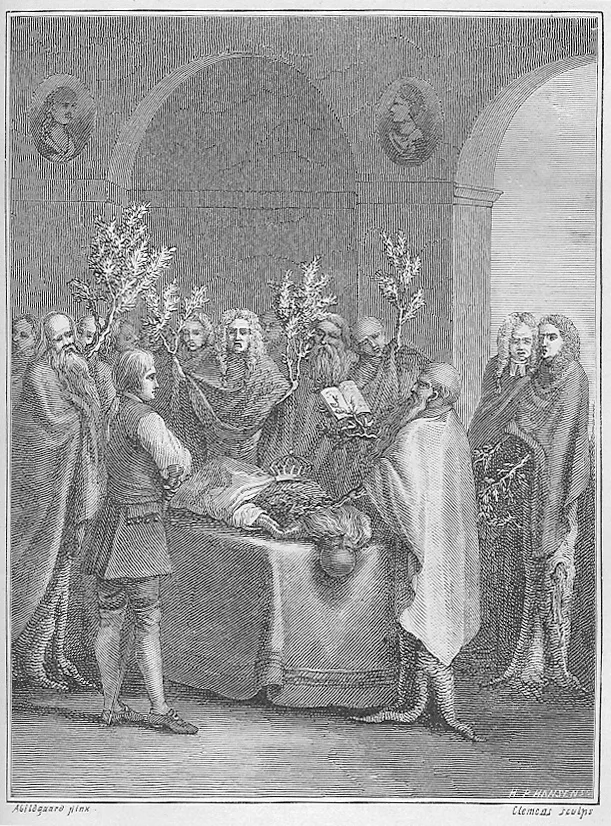 Engraving after Nicolai Abildgaard (J.F. Clemens), Niels Klim among the Potuans, 1789 Ludvig Holberg’s 1741 Latin novel sends the Norwegian Niels Klim falling through a cave into a hollow earth peopled by walking, reasoning trees. This engraving after Abildgaard shows him among the tree-folk of Potu, the utopia at the world’s core. Satirical Latin novel by Ludvig Holberg, published 1741 in
Leipzig under the title Nicolai Klimii Iter Subterraneum
— written in Latin and printed in Germany to dodge Danish
censorship. The narrator Niels Klim, a young Norwegian-
Danish theology graduate, falls through a hole in the
earth into a subterranean kingdom inhabited by sentient,
philosophising trees who live in a measured rational
society — the vehicle for Holberg's Enlightenment satire
of contemporary European religion, politics, and learning.
Translated into Danish, German, Dutch, French, English,
Swedish, and Russian within a generation, and influencing
later subterranean-utopian fiction including Jules Verne's
Journey to the Centre of the Earth.
— written in Latin and published in Germany to dodge Danish censorship — sent its narrator through a hole in the earth into a subterranean kingdom inhabited by sentient, philosophising trees, and was translated into most of the major European languages within a generation. In 1747 King Frederik V of Denmark-Norway
Engraving after Nicolai Abildgaard (J.F. Clemens), Niels Klim among the Potuans, 1789 Ludvig Holberg’s 1741 Latin novel sends the Norwegian Niels Klim falling through a cave into a hollow earth peopled by walking, reasoning trees. This engraving after Abildgaard shows him among the tree-folk of Potu, the utopia at the world’s core. Satirical Latin novel by Ludvig Holberg, published 1741 in
Leipzig under the title Nicolai Klimii Iter Subterraneum
— written in Latin and printed in Germany to dodge Danish
censorship. The narrator Niels Klim, a young Norwegian-
Danish theology graduate, falls through a hole in the
earth into a subterranean kingdom inhabited by sentient,
philosophising trees who live in a measured rational
society — the vehicle for Holberg's Enlightenment satire
of contemporary European religion, politics, and learning.
Translated into Danish, German, Dutch, French, English,
Swedish, and Russian within a generation, and influencing
later subterranean-utopian fiction including Jules Verne's
Journey to the Centre of the Earth.
— written in Latin and published in Germany to dodge Danish censorship — sent its narrator through a hole in the earth into a subterranean kingdom inhabited by sentient, philosophising trees, and was translated into most of the major European languages within a generation. In 1747 King Frederik V of Denmark-Norway 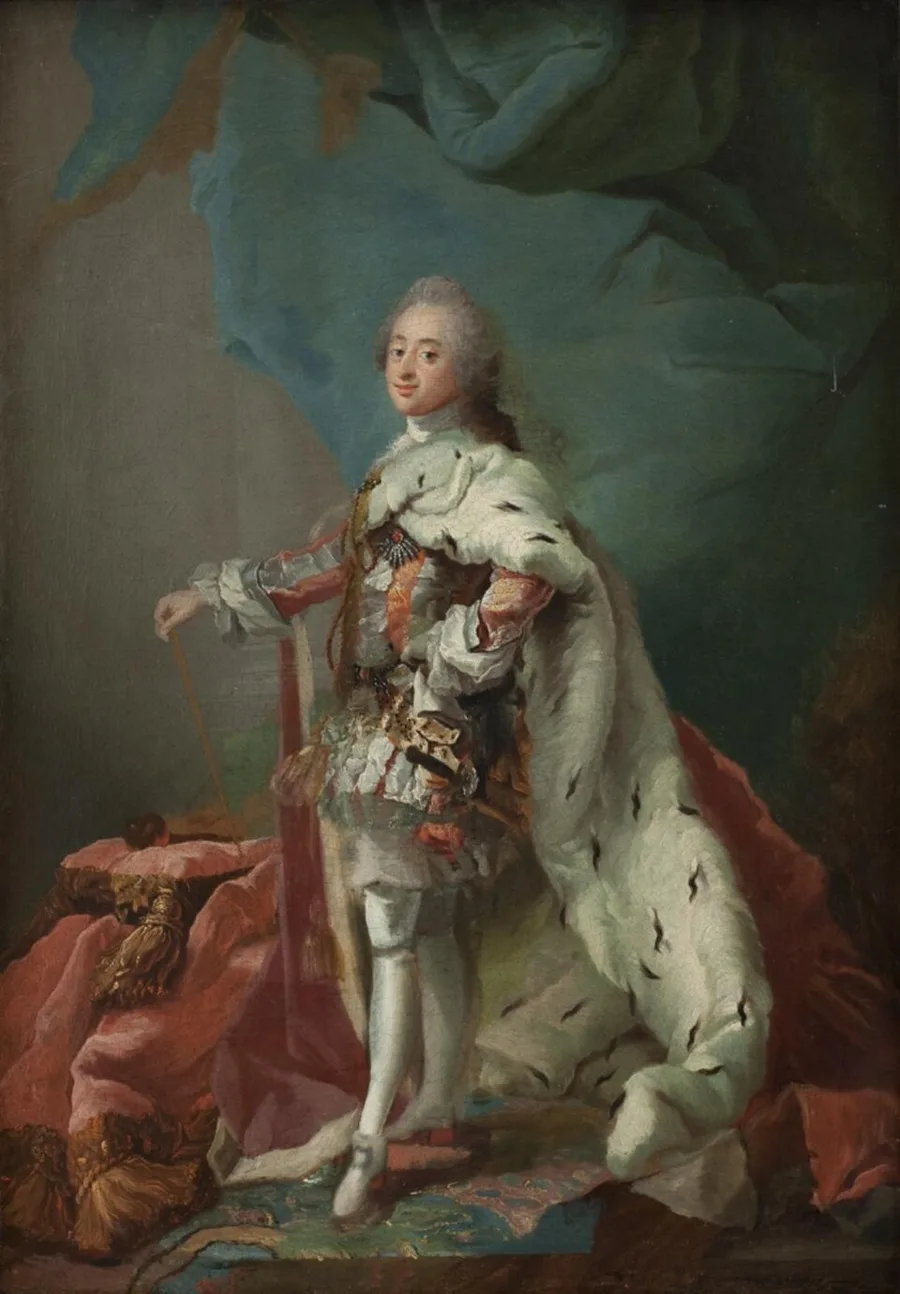 Carl Gustaf Pilo, Portræt af Frederik V i salvingsdragt (1750), Statens Museum for Kunst This 1750 anointing-robes portrait by court painter Carl Gustaf Pilo depicts the king who, by royal resolution in the same reign, authorized the transfer of the German Hanseatic Kontor at Bergen to a Norwegian-citizen successor association, ending the four-century German commercial enclave at Bryggen. King of Denmark and Norway (1723–1766), reigned 1746–1766.
Son of Christian VI; succeeded his father in the second
generation of the Lutheran Pietist Oldenburg line. His reign
is associated with a measured Enlightenment opening — relaxed
press controls, reduced ecclesiastical interference in
university affairs, the founding of the Royal Danish Academy
of Fine Arts (1754) in Copenhagen. In the same year, by royal
resolution, he authorised the transfer of the German Hanseatic
Kontor at Bergen to a Norwegian-citizen successor association,
Det Norske Kontor — the formal end of the four-century
German commercial enclave at Bryggen. Died at forty-two,
reportedly of dropsy.
Also discussed in The Germans Who "Ruled" Bergen — the Hanseatic merchants on Bryggen Wharf made him Baron Holberg of Holberg. He died in 1754 one of the wealthiest men in Copenhagen. Both Norway and Denmark have claimed him ever since.
Carl Gustaf Pilo, Portræt af Frederik V i salvingsdragt (1750), Statens Museum for Kunst This 1750 anointing-robes portrait by court painter Carl Gustaf Pilo depicts the king who, by royal resolution in the same reign, authorized the transfer of the German Hanseatic Kontor at Bergen to a Norwegian-citizen successor association, ending the four-century German commercial enclave at Bryggen. King of Denmark and Norway (1723–1766), reigned 1746–1766.
Son of Christian VI; succeeded his father in the second
generation of the Lutheran Pietist Oldenburg line. His reign
is associated with a measured Enlightenment opening — relaxed
press controls, reduced ecclesiastical interference in
university affairs, the founding of the Royal Danish Academy
of Fine Arts (1754) in Copenhagen. In the same year, by royal
resolution, he authorised the transfer of the German Hanseatic
Kontor at Bergen to a Norwegian-citizen successor association,
Det Norske Kontor — the formal end of the four-century
German commercial enclave at Bryggen. Died at forty-two,
reportedly of dropsy.
Also discussed in The Germans Who "Ruled" Bergen — the Hanseatic merchants on Bryggen Wharf made him Baron Holberg of Holberg. He died in 1754 one of the wealthiest men in Copenhagen. Both Norway and Denmark have claimed him ever since.
His life is the period’s clearest single illustration: a Norwegian could reach the highest peaks of the Danish-Norwegian double monarchy — but the peaks were in Copenhagen, and the writing was in Danish.
What endured
The Norwegian peasantry was never reduced to serfdom. Among the European peasantries of the period this was unusual: in Denmark itself the Stavnsbånd 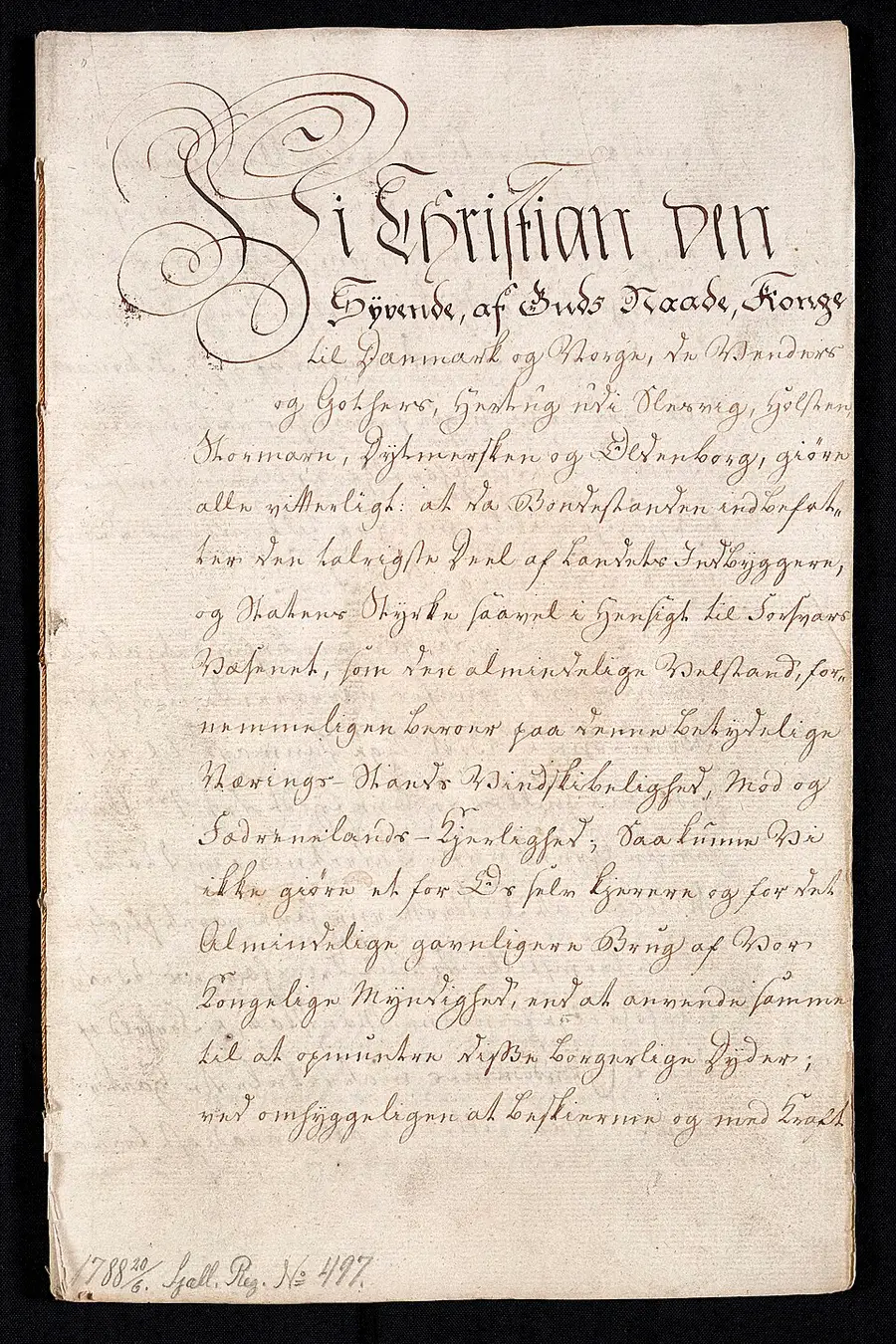 Photo: Tom Jersø, Stavnsbåndet ophæves (1788), Rigsarkivet (Danish National Archives), CC BY-SA 2.0 This is the front page of the actual 20 June 1788 ordinance that freed Danish peasant men from stavnsbånd — the manorial adscription system that, notably, was never extended to Norway. The adscription — the Danish institution that bound male
peasants between the ages of fourteen (later four) and
forty to the manorial estate of their birth, instituted by
royal decree in 1733 by King Christian VI. The system
served the twin purpose of guaranteeing the Danish manorial
nobility a stable supply of labour and the Danish crown a
recruitment pool for the army. Abolished in 1788 under
reforms led by Crown Prince Frederik (later Frederik VI).
Notably, the stavnsbånd never applied in Norway —
manorial estates were impractical in Norwegian terrain,
the rural population kept its own farms, and Norwegian
peasantry retained a degree of personal liberty unusual in
the Europe of the period.
tied peasants to their birth estates from 1733 until its abolition in 1788, and in much of central and eastern Europe the unfree status of agricultural labour ran into the nineteenth century. Norway’s geography made manorial estates impractical, and the rural population stayed in possession of its own farms and its own customs. The dialects spoken in the valleys, varying from one fjord to the next, kept their pre-Danish substrate. The folk costumes — the Bunad
Photo: Tom Jersø, Stavnsbåndet ophæves (1788), Rigsarkivet (Danish National Archives), CC BY-SA 2.0 This is the front page of the actual 20 June 1788 ordinance that freed Danish peasant men from stavnsbånd — the manorial adscription system that, notably, was never extended to Norway. The adscription — the Danish institution that bound male
peasants between the ages of fourteen (later four) and
forty to the manorial estate of their birth, instituted by
royal decree in 1733 by King Christian VI. The system
served the twin purpose of guaranteeing the Danish manorial
nobility a stable supply of labour and the Danish crown a
recruitment pool for the army. Abolished in 1788 under
reforms led by Crown Prince Frederik (later Frederik VI).
Notably, the stavnsbånd never applied in Norway —
manorial estates were impractical in Norwegian terrain,
the rural population kept its own farms, and Norwegian
peasantry retained a degree of personal liberty unusual in
the Europe of the period.
tied peasants to their birth estates from 1733 until its abolition in 1788, and in much of central and eastern Europe the unfree status of agricultural labour ran into the nineteenth century. Norway’s geography made manorial estates impractical, and the rural population stayed in possession of its own farms and its own customs. The dialects spoken in the valleys, varying from one fjord to the next, kept their pre-Danish substrate. The folk costumes — the Bunad 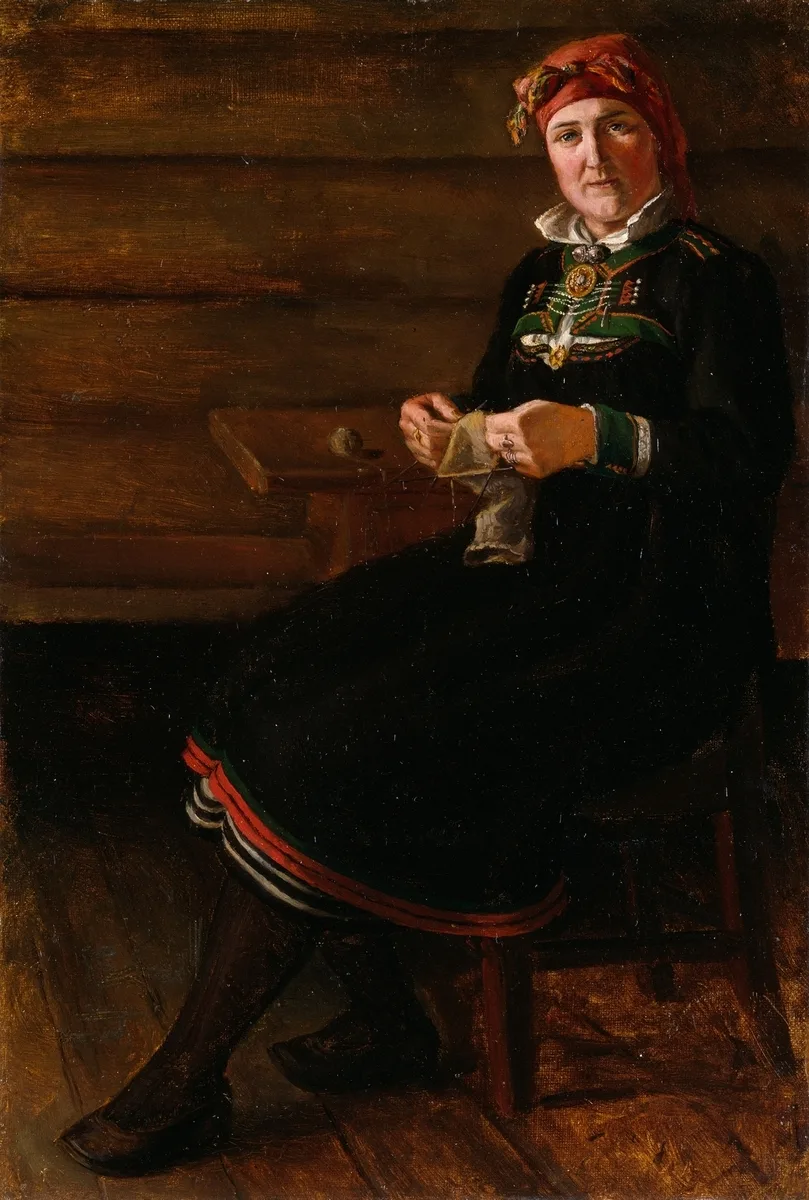 August Schneider, Sittende kvinne i Setesdals-bunad (1870), Nasjonalmuseet Schneider's 1870 painting of a woman in Setesdal folk dress documents one of the regional bunad variants — the parish-by-parish, valley-by-valley costume tradition that survived the Danish period intact. Norwegian regional folk costume — the rural traditional
dress that survived the four-hundred-year Danish period
intact, parish by parish, fjord by fjord. Each Norwegian
region (and many individual valleys) has its own bunad,
varying in colour, embroidery pattern, silver brooch
(sølje), shawl, and apron. The modern bunad tradition was
systematised in the late nineteenth and early twentieth
centuries by the textile historian Hulda Garborg and
others, but the underlying garments are pre-modern. Worn
on 17 May, at weddings, at confirmations, and at other
formal national occasions. The persistence of the bunad is
one of the most visible single signs of how the regional
substrate of Norway outlasted the long Danish absorption.
Also discussed in Lutheran Norway and Pietism — a farmer named Hans Nielsen Hauge and a lay revival that could not be silencedThe Constitution That Saved a Nation — five radical weeks at Eidsvoll, 1814800,000 Norwegians Leave — the century that built a Second NorwayWorld War II — the King’s “No” and the Nazis in NorwayTradisjoner — celebrations across the Norwegian year — varied parish by parish, and still do.
August Schneider, Sittende kvinne i Setesdals-bunad (1870), Nasjonalmuseet Schneider's 1870 painting of a woman in Setesdal folk dress documents one of the regional bunad variants — the parish-by-parish, valley-by-valley costume tradition that survived the Danish period intact. Norwegian regional folk costume — the rural traditional
dress that survived the four-hundred-year Danish period
intact, parish by parish, fjord by fjord. Each Norwegian
region (and many individual valleys) has its own bunad,
varying in colour, embroidery pattern, silver brooch
(sølje), shawl, and apron. The modern bunad tradition was
systematised in the late nineteenth and early twentieth
centuries by the textile historian Hulda Garborg and
others, but the underlying garments are pre-modern. Worn
on 17 May, at weddings, at confirmations, and at other
formal national occasions. The persistence of the bunad is
one of the most visible single signs of how the regional
substrate of Norway outlasted the long Danish absorption.
Also discussed in Lutheran Norway and Pietism — a farmer named Hans Nielsen Hauge and a lay revival that could not be silencedThe Constitution That Saved a Nation — five radical weeks at Eidsvoll, 1814800,000 Norwegians Leave — the century that built a Second NorwayWorld War II — the King’s “No” and the Nazis in NorwayTradisjoner — celebrations across the Norwegian year — varied parish by parish, and still do.
The coast grew rich. Timber from the inland forests went out to Dutch and English shipyards through Christiania 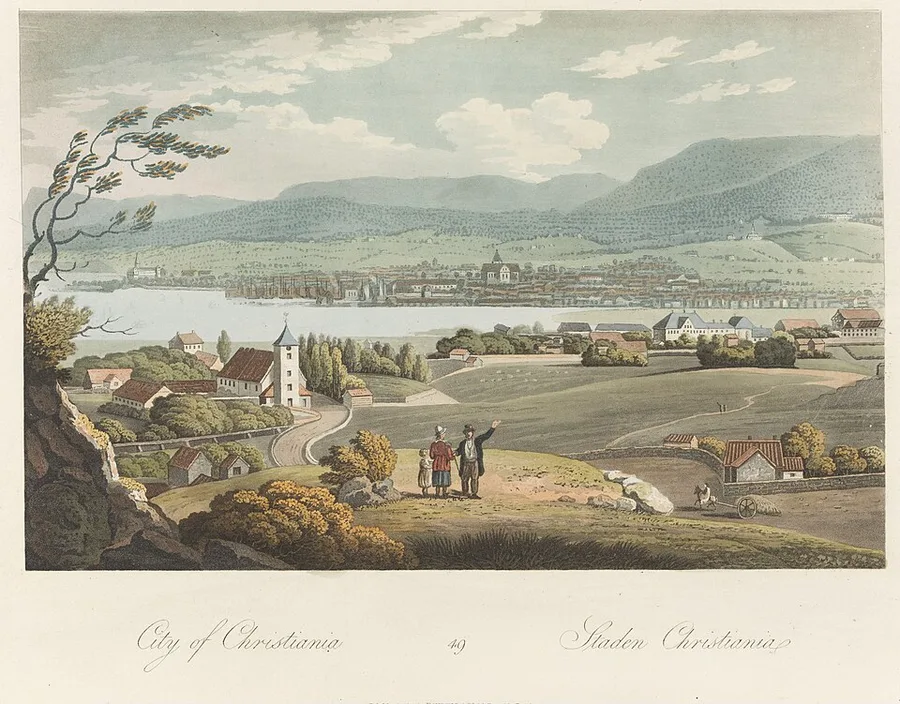 John William Edy, City of Christiania (1814), Boydell's Picturesque Scenery of Norway — National Museum of Art, Architecture and Design John William Edy's 1814 view of the small grid-planned capital across the water. This is the town King Christian IV laid out beneath Akershus after the 1624 fire razed medieval Oslo, and named for himself; its Kvadraturen grid survives today. Capital of Norway from 1624 to 1925 — the rebuilt town that
King Christian IV laid out west of the medieval Oslo after
the fire of August 1624 destroyed the old city. Christian
founded the new town on a grid plan beneath Akershus
fortress, named it for himself, and ordered the surviving
Oslo burghers to move into it. Christiania was the
capital's name through the four-hundred-year night, the
brief war of 1814, the constitutional Eidsvoll moment, the
ninety-one-year personal union with Sweden, and the first
two decades of fully independent Norway after 1905. In 1877
the spelling was modernised to Kristiania; in 1925 the
city formally returned to the medieval name Oslo. The
Kvadraturen district preserves Christian IV's grid intact
today.
On the trip Days 1–2 in Oslo bring both groups through Christiania —
Christian IV's seventeenth-century planned grid, still
visible today as the Kvadraturen district just below
Akershus fortress.
Also discussed in Lutheran Norway and Pietism — a farmer named Hans Nielsen Hauge and a lay revival that could not be silencedThe Constitution That Saved a Nation — five radical weeks at Eidsvoll, 1814800,000 Norwegians Leave — the century that built a Second NorwayThe Quiet Revolution — how Norway won its independence without a warWorld War II — the King’s “No” and the Nazis in NorwayNorske eventyr — the folk tales almost lost foreverStedssagn — local legends, told as warningsUtburd — the unbaptized child that will not rest (founded by Christian IV in 1624 after the medieval Oslo burned), Drammen, Trondheim
John William Edy, City of Christiania (1814), Boydell's Picturesque Scenery of Norway — National Museum of Art, Architecture and Design John William Edy's 1814 view of the small grid-planned capital across the water. This is the town King Christian IV laid out beneath Akershus after the 1624 fire razed medieval Oslo, and named for himself; its Kvadraturen grid survives today. Capital of Norway from 1624 to 1925 — the rebuilt town that
King Christian IV laid out west of the medieval Oslo after
the fire of August 1624 destroyed the old city. Christian
founded the new town on a grid plan beneath Akershus
fortress, named it for himself, and ordered the surviving
Oslo burghers to move into it. Christiania was the
capital's name through the four-hundred-year night, the
brief war of 1814, the constitutional Eidsvoll moment, the
ninety-one-year personal union with Sweden, and the first
two decades of fully independent Norway after 1905. In 1877
the spelling was modernised to Kristiania; in 1925 the
city formally returned to the medieval name Oslo. The
Kvadraturen district preserves Christian IV's grid intact
today.
On the trip Days 1–2 in Oslo bring both groups through Christiania —
Christian IV's seventeenth-century planned grid, still
visible today as the Kvadraturen district just below
Akershus fortress.
Also discussed in Lutheran Norway and Pietism — a farmer named Hans Nielsen Hauge and a lay revival that could not be silencedThe Constitution That Saved a Nation — five radical weeks at Eidsvoll, 1814800,000 Norwegians Leave — the century that built a Second NorwayThe Quiet Revolution — how Norway won its independence without a warWorld War II — the King’s “No” and the Nazis in NorwayNorske eventyr — the folk tales almost lost foreverStedssagn — local legends, told as warningsUtburd — the unbaptized child that will not rest (founded by Christian IV in 1624 after the medieval Oslo burned), Drammen, Trondheim 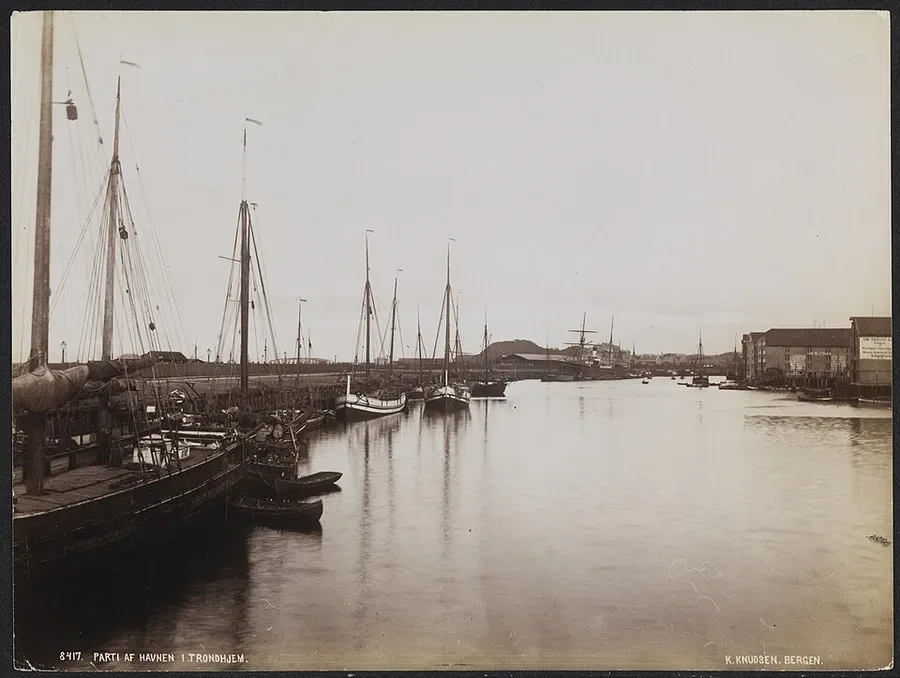 Knud Knudsen, Parti af Havnen i Trondhjem (1888-1894), National Library of Norway Knud Knudsen's photograph of Trondheim harbour in the early 1890s. Founded by Olav Tryggvason in 997 as Nidaros, the city was Norway's medieval capital and the seat of the archbishopric and the Olav cult that anchored the country's Christianity. Norway's third-largest city, founded by Olav Tryggvason in 997 as
Nidaros at the mouth of the Nid River on the inner Trondheim
Fjord. Capital of the Norwegian kingdom for much of the medieval
period; seat of the Norwegian archbishopric from 1153 and of the
Olav cult that anchored medieval Norwegian Christianity. Renamed
Trondheim in 1931 — after a controversial one-year spell
officially named Nidaros from 1930 — replacing the Danish-era
spelling Trondhjem and reviving the medieval Old Norse district
name (Þrándheimr). About two hundred thousand people in the municipality
today. Home to Nidaros Cathedral, NTNU (the Norwegian University
of Science and Technology), and the Trondheim Fjord harbour.
On the trip Day 3 of the trip routes the Gråhårsklubben (the Oldsters) through
Trondheim. The visit centres on Nidaros Cathedral — the building
the Olav devotion raised, and the architectural inheritance of
Bishop Grimkell's pronouncement on a summer day in 1031.
Trondheim Also discussed in The King Who Became a Saint — how the Nordmen came to ChristA Catholic Norway — the faith that gave the kingdom its first institutions and the stave churchesThe Crusades?!!!! — sixty ships from Bergen, bound for the Holy LandThe Golden Age — a North Atlantic empire … reaching farther than you thinkThe Long Fall — the sudden loss of Norwegian nobility, the end of the kings, and half of Norway gone foreverThe Reformation, 1537 — one church eradicated and another imposedLutheran Norway and Pietism — a farmer named Hans Nielsen Hauge and a lay revival that could not be silencedWorld War II — the King’s “No” and the Nazis in NorwayBefore There Was Norway — petty kingdoms at the edge of the worldDriving in Norway — tolls, ferries, and a near-zero alcohol limitEveryday etiquette — quiet voices, wide space, no smiling🚨 Emergencies - important numbers, hospitals, and what you can doLanguage basics — just enough Norwegian to be polite , and the smaller coastal ports. Silver was struck at Kongsberg
Knud Knudsen, Parti af Havnen i Trondhjem (1888-1894), National Library of Norway Knud Knudsen's photograph of Trondheim harbour in the early 1890s. Founded by Olav Tryggvason in 997 as Nidaros, the city was Norway's medieval capital and the seat of the archbishopric and the Olav cult that anchored the country's Christianity. Norway's third-largest city, founded by Olav Tryggvason in 997 as
Nidaros at the mouth of the Nid River on the inner Trondheim
Fjord. Capital of the Norwegian kingdom for much of the medieval
period; seat of the Norwegian archbishopric from 1153 and of the
Olav cult that anchored medieval Norwegian Christianity. Renamed
Trondheim in 1931 — after a controversial one-year spell
officially named Nidaros from 1930 — replacing the Danish-era
spelling Trondhjem and reviving the medieval Old Norse district
name (Þrándheimr). About two hundred thousand people in the municipality
today. Home to Nidaros Cathedral, NTNU (the Norwegian University
of Science and Technology), and the Trondheim Fjord harbour.
On the trip Day 3 of the trip routes the Gråhårsklubben (the Oldsters) through
Trondheim. The visit centres on Nidaros Cathedral — the building
the Olav devotion raised, and the architectural inheritance of
Bishop Grimkell's pronouncement on a summer day in 1031.
Trondheim Also discussed in The King Who Became a Saint — how the Nordmen came to ChristA Catholic Norway — the faith that gave the kingdom its first institutions and the stave churchesThe Crusades?!!!! — sixty ships from Bergen, bound for the Holy LandThe Golden Age — a North Atlantic empire … reaching farther than you thinkThe Long Fall — the sudden loss of Norwegian nobility, the end of the kings, and half of Norway gone foreverThe Reformation, 1537 — one church eradicated and another imposedLutheran Norway and Pietism — a farmer named Hans Nielsen Hauge and a lay revival that could not be silencedWorld War II — the King’s “No” and the Nazis in NorwayBefore There Was Norway — petty kingdoms at the edge of the worldDriving in Norway — tolls, ferries, and a near-zero alcohol limitEveryday etiquette — quiet voices, wide space, no smiling🚨 Emergencies - important numbers, hospitals, and what you can doLanguage basics — just enough Norwegian to be polite , and the smaller coastal ports. Silver was struck at Kongsberg 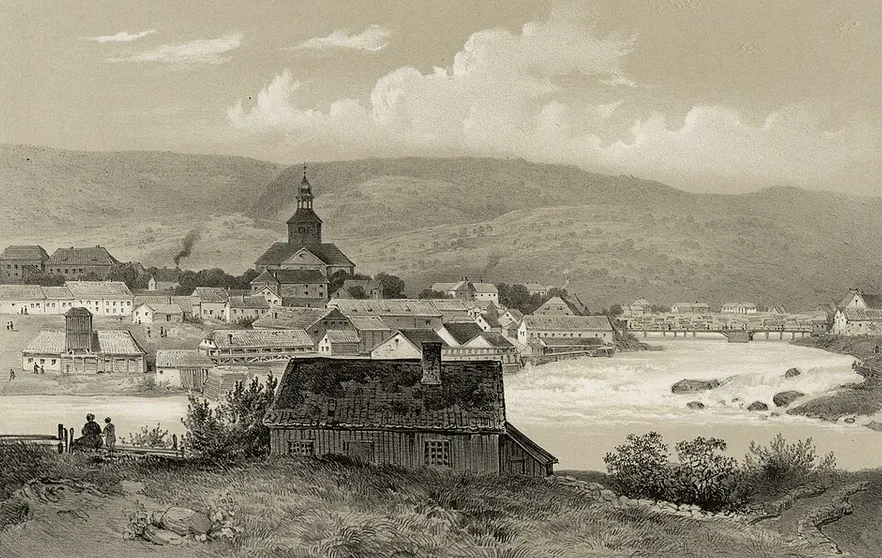 Joachim Frich (lith. C. Müller), Parti af Kongsberg, from Norge fremstillet i Tegninger (1848) Frich's 1848 prospect shows the silver town itself — the great Baroque church above the roofs, the bridge over the Lågen — the royal mining town Christian IV founded in 1624, built on the fortunes of the Sølvverk.
 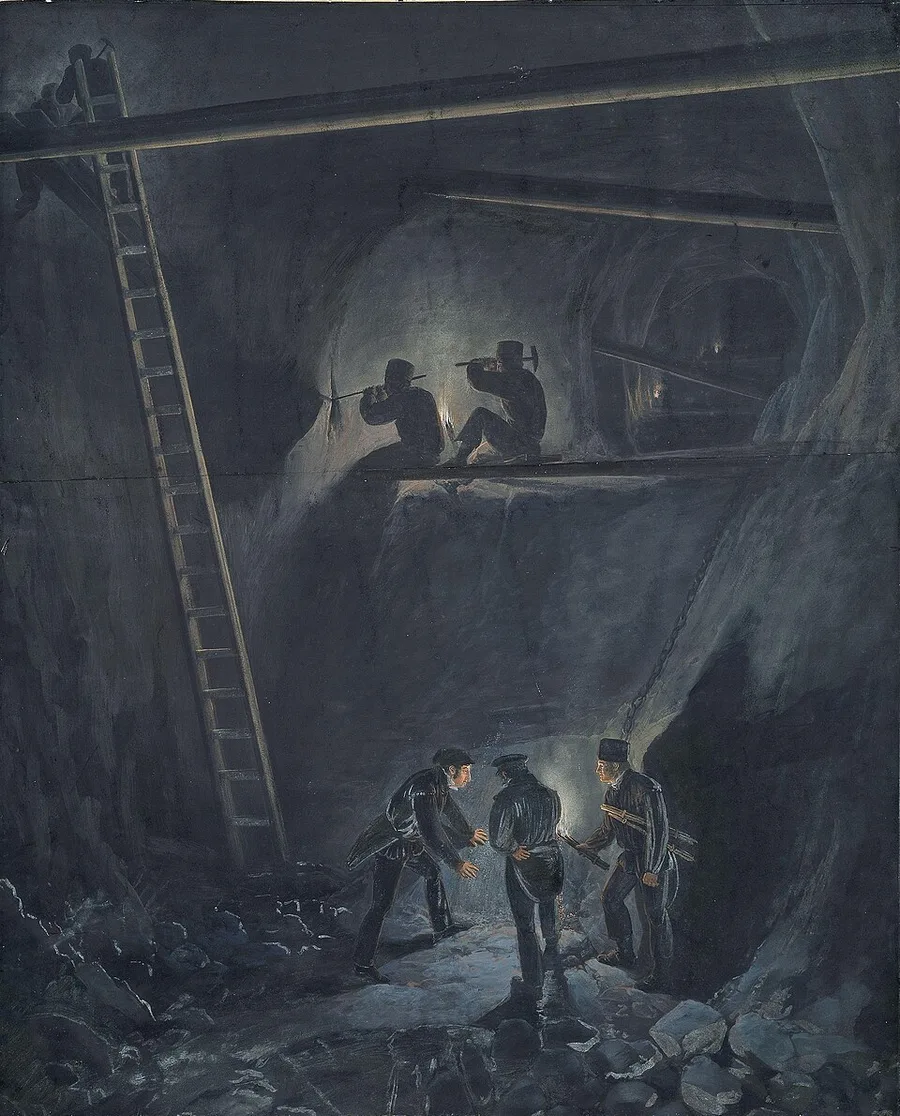 Johannes Flintoe, From the King's Mine at Kongsberg (1834), Nasjonalmuseet Flintoe's 1834 drawing of the underground workings at Kongsberg Sølvverk depicts the royal silver mine the town was founded around in 1624 — the industry that built Kongsberg and funded its Baroque church. Town in Buskerud county in southeastern Norway, founded by
royal decree of King Christian IV in 1624 after silver was
discovered in the surrounding mountains the previous year.
The royal silver mines (Kongsberg Sølvverk) ran from
1624 to 1958 — Norway's principal royal industrial
enterprise through the late Danish period and beyond. The
Royal Mint of Norway was located here from 1686 onward and
is still in operation. Kongsberg church, completed in 1761,
is the largest Baroque church in Norway, built on the
fortunes of the silver. Modern Kongsberg is a centre of the
Norwegian defence and aerospace industries; the silver
works are preserved as a museum.
, opened by royal foundation in 1624, and copper at Røros
Johannes Flintoe, From the King's Mine at Kongsberg (1834), Nasjonalmuseet Flintoe's 1834 drawing of the underground workings at Kongsberg Sølvverk depicts the royal silver mine the town was founded around in 1624 — the industry that built Kongsberg and funded its Baroque church. Town in Buskerud county in southeastern Norway, founded by
royal decree of King Christian IV in 1624 after silver was
discovered in the surrounding mountains the previous year.
The royal silver mines (Kongsberg Sølvverk) ran from
1624 to 1958 — Norway's principal royal industrial
enterprise through the late Danish period and beyond. The
Royal Mint of Norway was located here from 1686 onward and
is still in operation. Kongsberg church, completed in 1761,
is the largest Baroque church in Norway, built on the
fortunes of the silver. Modern Kongsberg is a centre of the
Norwegian defence and aerospace industries; the silver
works are preserved as a museum.
, opened by royal foundation in 1624, and copper at Røros 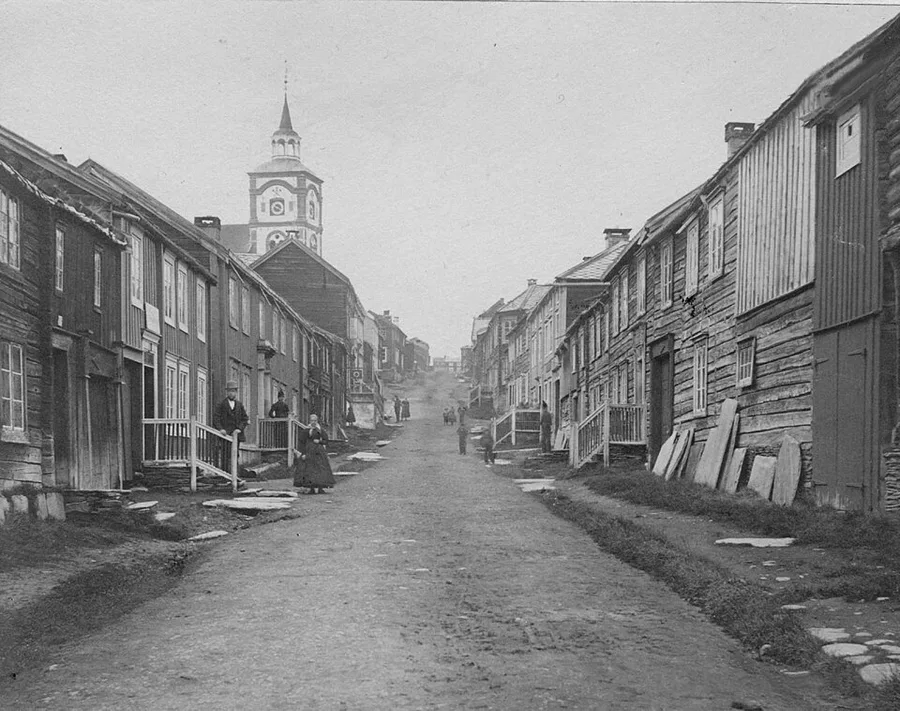 Elen Schomragh, Kjerkgata, Røros (1869) Kjerkgata photographed in 1869, the Bergstaden Ziir tower closing the view up the unpaved street — the black-tarred timber town that grew around the crown's copper works from 1644, Kongsberg's twin among the great mining towns of Denmark-Norway, UNESCO-listed since 1980. Mountain mining town in southeastern Trøndelag, about
thirty-five kilometres west of the Swedish border at an
altitude of 628 metres. Founded in 1644 around the copper
deposits discovered in the surrounding mountains; the Røros
Copper Works ran for 333 years until its closure in 1977.
Through the late seventeenth and eighteenth centuries the
works were one of the largest industrial enterprises in
Denmark-Norway. The historic timber town that grew around
the works — black-tarred wooden houses, the 1784 Bergstaden
Ziir baroque church, and the slag-heap mounds at the edges
of the town — has been preserved largely intact. UNESCO
inscribed Røros on its World Heritage register in 1980.
from 1644. The Norwegian merchant marine grew steadily across the seventeenth and eighteenth centuries — the foundation on which the post-1850 expansion that would eventually put it among the largest fleets in the world was built. The Norwegian population recovered from the plague-reduced floor of around one hundred and seventy thousand in 1500 to roughly four hundred thousand by the mid-seventeenth century and to nearly nine hundred thousand by 1800.
Elen Schomragh, Kjerkgata, Røros (1869) Kjerkgata photographed in 1869, the Bergstaden Ziir tower closing the view up the unpaved street — the black-tarred timber town that grew around the crown's copper works from 1644, Kongsberg's twin among the great mining towns of Denmark-Norway, UNESCO-listed since 1980. Mountain mining town in southeastern Trøndelag, about
thirty-five kilometres west of the Swedish border at an
altitude of 628 metres. Founded in 1644 around the copper
deposits discovered in the surrounding mountains; the Røros
Copper Works ran for 333 years until its closure in 1977.
Through the late seventeenth and eighteenth centuries the
works were one of the largest industrial enterprises in
Denmark-Norway. The historic timber town that grew around
the works — black-tarred wooden houses, the 1784 Bergstaden
Ziir baroque church, and the slag-heap mounds at the edges
of the town — has been preserved largely intact. UNESCO
inscribed Røros on its World Heritage register in 1980.
from 1644. The Norwegian merchant marine grew steadily across the seventeenth and eighteenth centuries — the foundation on which the post-1850 expansion that would eventually put it among the largest fleets in the world was built. The Norwegian population recovered from the plague-reduced floor of around one hundred and seventy thousand in 1500 to roughly four hundred thousand by the mid-seventeenth century and to nearly nine hundred thousand by 1800.
How the night ended
The Napoleonic Wars 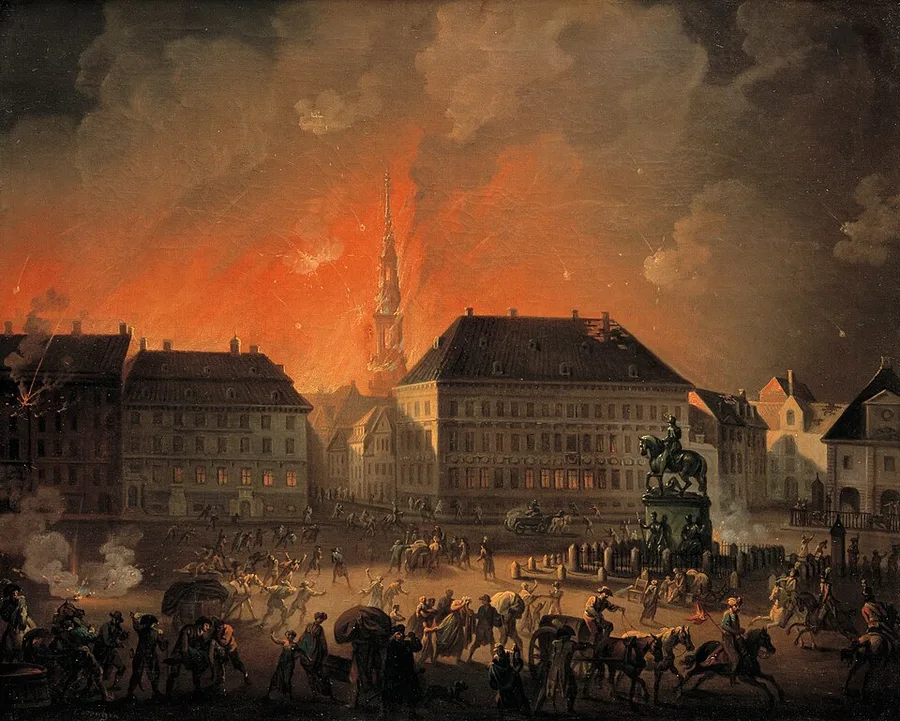 Christian August Lorentzen, The Most Terrible Night (1807-08), Statens Museum for Kunst Lorentzen paints Copenhagen's central square lit by fire during the September 1807 British bombardment — the blow that pushed Denmark into Napoleon's camp and, at Napoleon's defeat in 1814, cost Frederik VI the kingdom of Norway. The series of European wars (1803–1815) fought between
Napoleon Bonaparte's First French Empire and shifting
coalitions of European powers. For Scandinavia the
consequences were structural and lasting: Denmark sided
with Napoleon after Lord Nelson struck the Danish fleet at
Copenhagen in April 1801 and the British returned in 1807
and carried off most of what remained; Sweden joined the
Sixth Coalition under the new Crown Prince Karl Johan
(the former French marshal Bernadotte); and at Napoleon's
defeat Sweden demanded Norway from Denmark as compensation,
taking the country by the Treaty of Kiel in January 1814.
Sweden also lost Finland to Russia in the parallel war of
1808–09, the loss against which the Norwegian acquisition
was meant to compensate.
Also discussed in The Constitution That Saved a Nation — five radical weeks at Eidsvoll, 1814 broke the long arrangement. After Nelson struck the Danish fleet at Copenhagen in 1801, and the British returned in 1807 and carried off most of what remained, Denmark — under the Crown Prince Regent who would become king as Frederik VI of Denmark-Norway
Christian August Lorentzen, The Most Terrible Night (1807-08), Statens Museum for Kunst Lorentzen paints Copenhagen's central square lit by fire during the September 1807 British bombardment — the blow that pushed Denmark into Napoleon's camp and, at Napoleon's defeat in 1814, cost Frederik VI the kingdom of Norway. The series of European wars (1803–1815) fought between
Napoleon Bonaparte's First French Empire and shifting
coalitions of European powers. For Scandinavia the
consequences were structural and lasting: Denmark sided
with Napoleon after Lord Nelson struck the Danish fleet at
Copenhagen in April 1801 and the British returned in 1807
and carried off most of what remained; Sweden joined the
Sixth Coalition under the new Crown Prince Karl Johan
(the former French marshal Bernadotte); and at Napoleon's
defeat Sweden demanded Norway from Denmark as compensation,
taking the country by the Treaty of Kiel in January 1814.
Sweden also lost Finland to Russia in the parallel war of
1808–09, the loss against which the Norwegian acquisition
was meant to compensate.
Also discussed in The Constitution That Saved a Nation — five radical weeks at Eidsvoll, 1814 broke the long arrangement. After Nelson struck the Danish fleet at Copenhagen in 1801, and the British returned in 1807 and carried off most of what remained, Denmark — under the Crown Prince Regent who would become king as Frederik VI of Denmark-Norway 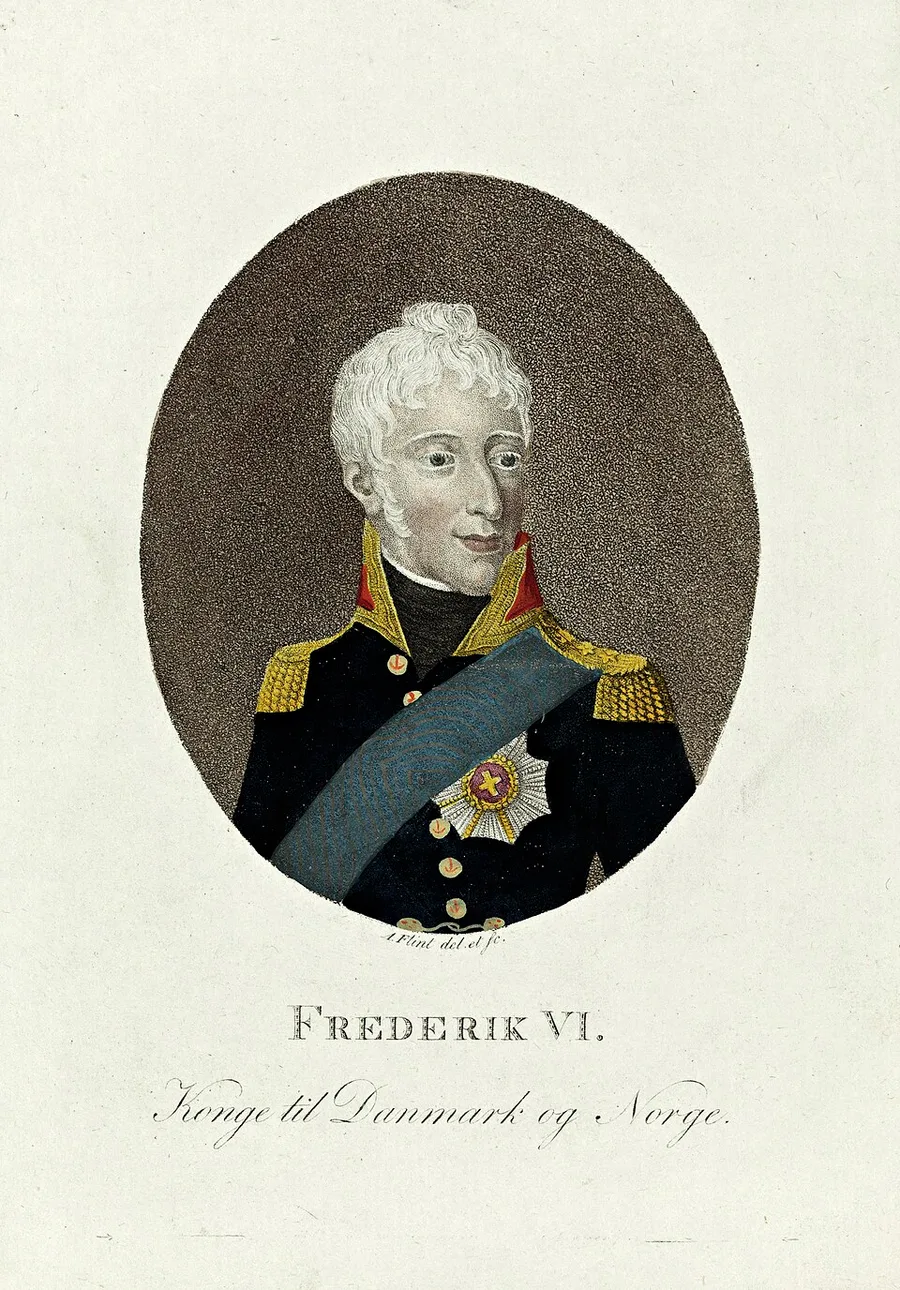 Andreas Flint, Frederik VI Konge til Danmark og Norge, National Library of Norway Frederik VI ruled Denmark-Norway through the Napoleonic Wars and signed away Norway to Sweden in the 1814 Treaty of Kiel — the engraving's caption still styles him 'Konge til Danmark og Norge,' the double title Kiel ended. King of Denmark and Norway (1768–1839), reigned 1808–1839
in Denmark; nominally co-ruler of Norway until the Treaty
of Kiel ceded the country to Sweden in January 1814. As
Crown Prince Regent from 1784 — his father Christian VII
being mentally incapable — he had run the kingdom in
practice for a quarter-century before formally inheriting
the throne. Sided with Napoleon after the British attacks
on Copenhagen of 1801 and 1807 stripped Denmark of its
fleet, a fateful alliance that cost him Norway when
Napoleon's defeat in 1814 forced the cession. Signed the
Treaty of Kiel on 14 January 1814. Reigned over a much-
reduced Denmark for another twenty-five years.
Also discussed in The Constitution That Saved a Nation — five radical weeks at Eidsvoll, 1814 in March 1808 — sided with Napoleon. Britain responded with a naval blockade of the Norwegian coast that ran from 1807 to the war’s end. Norway had been importing grain from Denmark for centuries to make up its inland deficit; the blockade cut that import, and famine followed — worst in the winters of 1808–09 and again in 1812–13, when the death rolls ran at two and three times their normal level, heaviest in the inland districts farthest from the coast. Norwegian merchants began trading directly with Britain through the blockade, in defiance of Copenhagen. A small intellectual class in Christiania — strengthened by the new Royal Frederik University, founded in 1811 — began reading the American and French constitutional documents.
Andreas Flint, Frederik VI Konge til Danmark og Norge, National Library of Norway Frederik VI ruled Denmark-Norway through the Napoleonic Wars and signed away Norway to Sweden in the 1814 Treaty of Kiel — the engraving's caption still styles him 'Konge til Danmark og Norge,' the double title Kiel ended. King of Denmark and Norway (1768–1839), reigned 1808–1839
in Denmark; nominally co-ruler of Norway until the Treaty
of Kiel ceded the country to Sweden in January 1814. As
Crown Prince Regent from 1784 — his father Christian VII
being mentally incapable — he had run the kingdom in
practice for a quarter-century before formally inheriting
the throne. Sided with Napoleon after the British attacks
on Copenhagen of 1801 and 1807 stripped Denmark of its
fleet, a fateful alliance that cost him Norway when
Napoleon's defeat in 1814 forced the cession. Signed the
Treaty of Kiel on 14 January 1814. Reigned over a much-
reduced Denmark for another twenty-five years.
Also discussed in The Constitution That Saved a Nation — five radical weeks at Eidsvoll, 1814 in March 1808 — sided with Napoleon. Britain responded with a naval blockade of the Norwegian coast that ran from 1807 to the war’s end. Norway had been importing grain from Denmark for centuries to make up its inland deficit; the blockade cut that import, and famine followed — worst in the winters of 1808–09 and again in 1812–13, when the death rolls ran at two and three times their normal level, heaviest in the inland districts farthest from the coast. Norwegian merchants began trading directly with Britain through the blockade, in defiance of Copenhagen. A small intellectual class in Christiania — strengthened by the new Royal Frederik University, founded in 1811 — began reading the American and French constitutional documents.
Napoleon’s defeat in 1814 forced the issue. Sweden  Prince Eugen, Skogen / The Forest (1892), Göteborgs konstmuseum (photo CC BY 4.0) Skogen (The Forest), painted in 1892 by Prince Eugen — a son of Oscar II, the Swedish king Norway broke from in 1905. His twilight wall of pine trunks became a defining image of Swedish national-romantic landscape: the neighbour kingdom rendered as its own deep forest. The largest of the three Scandinavian kingdoms, occupying
the eastern two-thirds of the Scandinavian peninsula.
Unified in stages through the early medieval period and
Christianised from the eleventh century onward. United
with Norway and Denmark in the 1397 Kalmar Union under
Margaret I and her great-nephew Erik of Pomerania; broke
away under Gustav Vasa in 1523, ending the union. Modern
Sweden's borders were largely set by the 1658 Treaty of
Roskilde, which transferred the formerly Danish provinces
of Skåne, Halland, Blekinge, and Bohuslän to the Swedish
crown.
In this article Sweden enters this story twice: first on the way out — Gustav
Vasa's 1523 secession broke the Kalmar Union and left Norway
alone under the Danish crown — and then in 1814 as the victor
that demanded Norway from Denmark as compensation for the loss
of Finland, opening the ninety-one-year personal union that
followed the four-hundred-year night.
Also discussed in The Long Fall — the sudden loss of Norwegian nobility, the end of the kings, and half of Norway gone foreverThe Quiet Revolution — how Norway won its independence without a warWorld War II — the King’s “No” and the Nazis in Norway , which had backed the winning side under Crown Prince Karl Johan
Prince Eugen, Skogen / The Forest (1892), Göteborgs konstmuseum (photo CC BY 4.0) Skogen (The Forest), painted in 1892 by Prince Eugen — a son of Oscar II, the Swedish king Norway broke from in 1905. His twilight wall of pine trunks became a defining image of Swedish national-romantic landscape: the neighbour kingdom rendered as its own deep forest. The largest of the three Scandinavian kingdoms, occupying
the eastern two-thirds of the Scandinavian peninsula.
Unified in stages through the early medieval period and
Christianised from the eleventh century onward. United
with Norway and Denmark in the 1397 Kalmar Union under
Margaret I and her great-nephew Erik of Pomerania; broke
away under Gustav Vasa in 1523, ending the union. Modern
Sweden's borders were largely set by the 1658 Treaty of
Roskilde, which transferred the formerly Danish provinces
of Skåne, Halland, Blekinge, and Bohuslän to the Swedish
crown.
In this article Sweden enters this story twice: first on the way out — Gustav
Vasa's 1523 secession broke the Kalmar Union and left Norway
alone under the Danish crown — and then in 1814 as the victor
that demanded Norway from Denmark as compensation for the loss
of Finland, opening the ninety-one-year personal union that
followed the four-hundred-year night.
Also discussed in The Long Fall — the sudden loss of Norwegian nobility, the end of the kings, and half of Norway gone foreverThe Quiet Revolution — how Norway won its independence without a warWorld War II — the King’s “No” and the Nazis in Norway , which had backed the winning side under Crown Prince Karl Johan 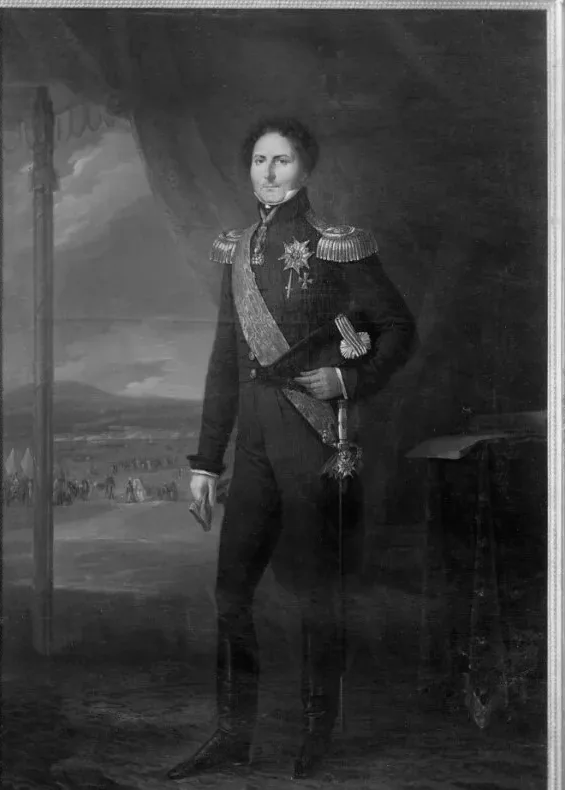 Fredric Westin, Karl XIV Johan, king of Sweden and Norway, Nationalmuseum (NMGrh 1943) Fredric Westin's state portrait of Karl XIV Johan, the former Napoleonic marshal who became king of Sweden and Norway after taking Norway from Denmark in 1814. King of Sweden and Norway (1763–1844), reigned 1818–1844.
Born Jean-Baptiste Bernadotte, the son of a French country
lawyer; rose through the French Revolutionary armies to
become one of Napoleon's marshals (1804) and Prince of
Pontecorvo (1806). Adopted in 1810 as heir to the childless
Swedish king Karl XIII, took the name Karl Johan, and ran
Swedish foreign policy as Crown Prince Regent. Joined the
Sixth Coalition against Napoleon and at the war's end
demanded Norway from Denmark as compensation. After the
brief Swedish-Norwegian war of summer 1814, accepted the
mild terms of the Convention of Moss that left Norway with
its own constitution, Storting, government, and church
under a shared crown. The Karl Johans gate boulevard in
central Oslo carries his name.
On the trip Day 2's e-bike tour rides the length of Karl Johans gate — the
central Oslo boulevard that carries his name — and passes the
Royal Palace begun as his Norwegian residence, with both groups
together in the capital.
Also discussed in The Constitution That Saved a Nation — five radical weeks at Eidsvoll, 1814The Quiet Revolution — how Norway won its independence without a war (Jean-Baptiste Bernadotte, the former French marshal), demanded Norway as compensation for its support, and as recovery for its 1809 loss of Finland to Russia. Frederik VI of Denmark, with his alliance to Napoleon collapsed and a Swedish army advancing through Holstein on his southern border, signed the Kielfreden
Fredric Westin, Karl XIV Johan, king of Sweden and Norway, Nationalmuseum (NMGrh 1943) Fredric Westin's state portrait of Karl XIV Johan, the former Napoleonic marshal who became king of Sweden and Norway after taking Norway from Denmark in 1814. King of Sweden and Norway (1763–1844), reigned 1818–1844.
Born Jean-Baptiste Bernadotte, the son of a French country
lawyer; rose through the French Revolutionary armies to
become one of Napoleon's marshals (1804) and Prince of
Pontecorvo (1806). Adopted in 1810 as heir to the childless
Swedish king Karl XIII, took the name Karl Johan, and ran
Swedish foreign policy as Crown Prince Regent. Joined the
Sixth Coalition against Napoleon and at the war's end
demanded Norway from Denmark as compensation. After the
brief Swedish-Norwegian war of summer 1814, accepted the
mild terms of the Convention of Moss that left Norway with
its own constitution, Storting, government, and church
under a shared crown. The Karl Johans gate boulevard in
central Oslo carries his name.
On the trip Day 2's e-bike tour rides the length of Karl Johans gate — the
central Oslo boulevard that carries his name — and passes the
Royal Palace begun as his Norwegian residence, with both groups
together in the capital.
Also discussed in The Constitution That Saved a Nation — five radical weeks at Eidsvoll, 1814The Quiet Revolution — how Norway won its independence without a war (Jean-Baptiste Bernadotte, the former French marshal), demanded Norway as compensation for its support, and as recovery for its 1809 loss of Finland to Russia. Frederik VI of Denmark, with his alliance to Napoleon collapsed and a Swedish army advancing through Holstein on his southern border, signed the Kielfreden 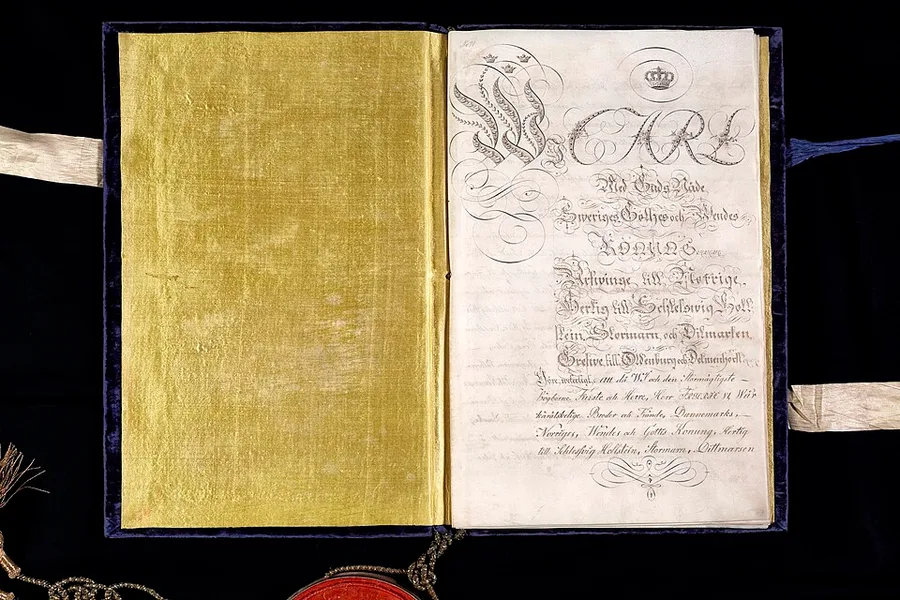 Photo: Tom Jersø, Kielertraktaten (1814), Rigsarkivet (Danish National Archives), CC BY-SA 2.0 This is the actual 14 January 1814 treaty document by which Frederik VI ceded the kingdom of Norway to the Swedish crown — the paper that closed four hundred and thirty-four years of Danish rule in a single stroke. The Peace of Kiel — the treaty signed on 14 January 1814
by which King Frederik VI of Denmark-Norway, his alliance
with Napoleon collapsed and a Swedish army advancing
through Holstein, ceded the Kingdom of Norway to the King
of Sweden in exchange for the remnants of Swedish
Pomerania. The cession excluded the old North Atlantic
dependencies — Greenland, Iceland, and the Faroes —
which remained Danish. The treaty closed the four-hundred-
and-thirty-four-year Danish period in Norwegian history.
Repudiated by the Norwegians within weeks: a constituent
assembly met at Eidsvoll the following April and signed an
independent constitution on 17 May 1814.
Also discussed in The Constitution That Saved a Nation — five radical weeks at Eidsvoll, 1814 on the fourteenth of January 1814 and ceded the Kingdom of Norway to the King of Sweden. Greenland
Photo: Tom Jersø, Kielertraktaten (1814), Rigsarkivet (Danish National Archives), CC BY-SA 2.0 This is the actual 14 January 1814 treaty document by which Frederik VI ceded the kingdom of Norway to the Swedish crown — the paper that closed four hundred and thirty-four years of Danish rule in a single stroke. The Peace of Kiel — the treaty signed on 14 January 1814
by which King Frederik VI of Denmark-Norway, his alliance
with Napoleon collapsed and a Swedish army advancing
through Holstein, ceded the Kingdom of Norway to the King
of Sweden in exchange for the remnants of Swedish
Pomerania. The cession excluded the old North Atlantic
dependencies — Greenland, Iceland, and the Faroes —
which remained Danish. The treaty closed the four-hundred-
and-thirty-four-year Danish period in Norwegian history.
Repudiated by the Norwegians within weeks: a constituent
assembly met at Eidsvoll the following April and signed an
independent constitution on 17 May 1814.
Also discussed in The Constitution That Saved a Nation — five radical weeks at Eidsvoll, 1814 on the fourteenth of January 1814 and ceded the Kingdom of Norway to the King of Sweden. Greenland 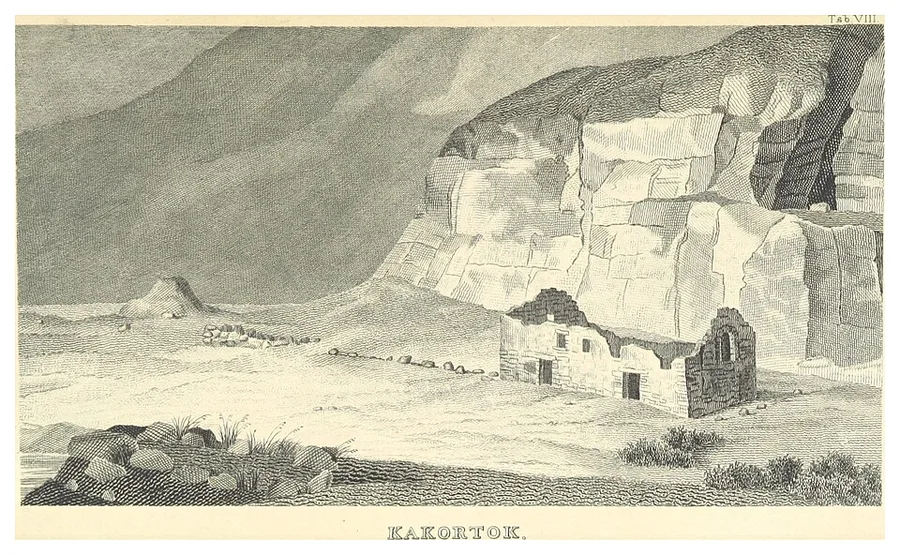 Grønlands historiske Mindesmærker vol. 3 (1845), plate VIII, British Library The stone church at Hvalsey, the best-preserved building of Norse Greenland — drawn in 1845 for the Danish survey that went looking for the lost colony. A wedding held here in 1408 is the last event anyone recorded before the settlements Erik the Red founded fell silent. The world's largest island, lying between the Arctic and Atlantic
Oceans west of Iceland. Colonised by Norse settlers led by Erik the
Red beginning in 985 — the name "Greenland" was Erik's marketing,
chosen to attract colonists to a marginally agricultural land. The
Norse Eastern and Western Settlements on the southwestern coast
sustained perhaps two or three thousand people at peak across four
centuries before steadily diminishing in the cooling climate of the
Little Ice Age and disappearing by around 1450. Today a self-
governing territory within the Kingdom of Denmark.
Also discussed in The Viking Age — longships, legends, and the first "Norway"The King Who Became a Saint — how the Nordmen came to ChristA Catholic Norway — the faith that gave the kingdom its first institutions and the stave churchesThe Golden Age — a North Atlantic empire … reaching farther than you thinkThe Long Fall — the sudden loss of Norwegian nobility, the end of the kings, and half of Norway gone forever , Iceland
Grønlands historiske Mindesmærker vol. 3 (1845), plate VIII, British Library The stone church at Hvalsey, the best-preserved building of Norse Greenland — drawn in 1845 for the Danish survey that went looking for the lost colony. A wedding held here in 1408 is the last event anyone recorded before the settlements Erik the Red founded fell silent. The world's largest island, lying between the Arctic and Atlantic
Oceans west of Iceland. Colonised by Norse settlers led by Erik the
Red beginning in 985 — the name "Greenland" was Erik's marketing,
chosen to attract colonists to a marginally agricultural land. The
Norse Eastern and Western Settlements on the southwestern coast
sustained perhaps two or three thousand people at peak across four
centuries before steadily diminishing in the cooling climate of the
Little Ice Age and disappearing by around 1450. Today a self-
governing territory within the Kingdom of Denmark.
Also discussed in The Viking Age — longships, legends, and the first "Norway"The King Who Became a Saint — how the Nordmen came to ChristA Catholic Norway — the faith that gave the kingdom its first institutions and the stave churchesThe Golden Age — a North Atlantic empire … reaching farther than you thinkThe Long Fall — the sudden loss of Norwegian nobility, the end of the kings, and half of Norway gone forever , Iceland 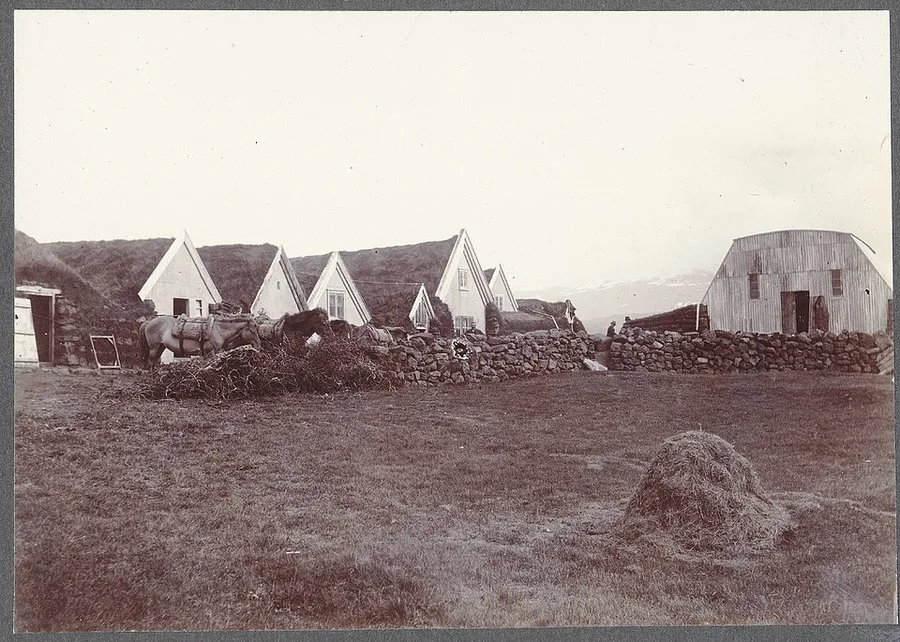 Frederick W. W. Howell, Galtalækur and Hekla (c. 1900), Fiske Icelandic Collection, Cornell University Library A turf-walled farm under Hekla, photographed about 1900 — Iceland as the settlers from Norway made it: a country of farms without a king or towns, governed by the annual open-air Alþing and remembered in the sagas their descendants wrote. The North Atlantic island settled from Norway in the ninth and
tenth centuries by chieftains and their followings who refused to
accept Harald Fairhair's authority on the Norwegian mainland and
emigrated rather than submit. They built a country without a king,
governed by an annual open-air assembly at Þingvellir called the
Alþing — the oldest parliament in the world by date of founding. Three centuries after the migration, their descendants
(notably Snorri Sturluson) composed the prose sagas that became
almost the only literary memory of the Norwegian petty kingdoms.
Also discussed in Before There Was Norway — petty kingdoms at the edge of the worldThe Viking Age — longships, legends, and the first "Norway"Worshiping Odin and Thor — the lived religion of pre-Christian NorwayThe King Who Became a Saint — how the Nordmen came to ChristA Catholic Norway — the faith that gave the kingdom its first institutions and the stave churchesThe Golden Age — a North Atlantic empire … reaching farther than you think , and the Faroe Islands
Frederick W. W. Howell, Galtalækur and Hekla (c. 1900), Fiske Icelandic Collection, Cornell University Library A turf-walled farm under Hekla, photographed about 1900 — Iceland as the settlers from Norway made it: a country of farms without a king or towns, governed by the annual open-air Alþing and remembered in the sagas their descendants wrote. The North Atlantic island settled from Norway in the ninth and
tenth centuries by chieftains and their followings who refused to
accept Harald Fairhair's authority on the Norwegian mainland and
emigrated rather than submit. They built a country without a king,
governed by an annual open-air assembly at Þingvellir called the
Alþing — the oldest parliament in the world by date of founding. Three centuries after the migration, their descendants
(notably Snorri Sturluson) composed the prose sagas that became
almost the only literary memory of the Norwegian petty kingdoms.
Also discussed in Before There Was Norway — petty kingdoms at the edge of the worldThe Viking Age — longships, legends, and the first "Norway"Worshiping Odin and Thor — the lived religion of pre-Christian NorwayThe King Who Became a Saint — how the Nordmen came to ChristA Catholic Norway — the faith that gave the kingdom its first institutions and the stave churchesThe Golden Age — a North Atlantic empire … reaching farther than you think , and the Faroe Islands 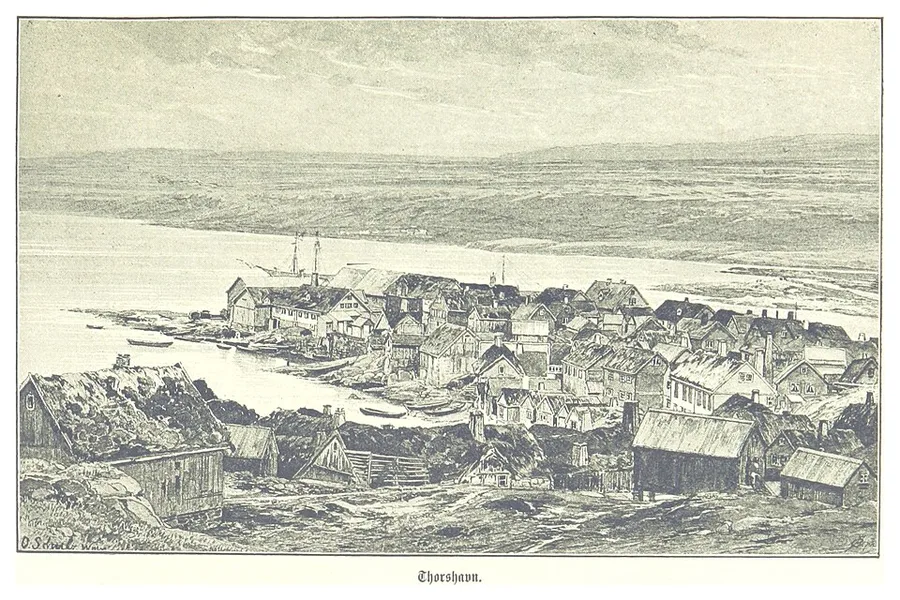 O. Schulz, Thorshavn, from A. Baumgartner, Nordische Fahrten: Island und die Färöer (1889), British Library Tórshavn, the Faroes' harbour town, engraved in 1889: turf-roofed houses crowd toward Tinganes, the low point where the Norse settlers' assembly met from around 900 and where the islands' government still sits. Archipelago of eighteen volcanic islands in the North Atlantic
between Norway, Iceland, and Scotland. Settled by Norse colonists
beginning in the early ninth century, the Faroes were under
Norwegian sovereignty by 1035; passed with Norway to Denmark in
1380 and remained under Danish rule after Norway's independence
in 1814. Today a self-governing nation within the Kingdom of
Denmark, with about fifty-three thousand people speaking Faroese
(a North Germanic language closely related to Icelandic and to
the western Norwegian dialects of Old Norse). The devotion to
Saint Olav was carried across the Faroes by the medieval Norwegian
archbishopric of Nidaros, and Olsok is still observed there.
Also discussed in The King Who Became a Saint — how the Nordmen came to ChristA Catholic Norway — the faith that gave the kingdom its first institutions and the stave churchesThe Golden Age — a North Atlantic empire … reaching farther than you think — the remaining dependencies of the old Atlantic empire — were excluded from the cession and remained Danish.
O. Schulz, Thorshavn, from A. Baumgartner, Nordische Fahrten: Island und die Färöer (1889), British Library Tórshavn, the Faroes' harbour town, engraved in 1889: turf-roofed houses crowd toward Tinganes, the low point where the Norse settlers' assembly met from around 900 and where the islands' government still sits. Archipelago of eighteen volcanic islands in the North Atlantic
between Norway, Iceland, and Scotland. Settled by Norse colonists
beginning in the early ninth century, the Faroes were under
Norwegian sovereignty by 1035; passed with Norway to Denmark in
1380 and remained under Danish rule after Norway's independence
in 1814. Today a self-governing nation within the Kingdom of
Denmark, with about fifty-three thousand people speaking Faroese
(a North Germanic language closely related to Icelandic and to
the western Norwegian dialects of Old Norse). The devotion to
Saint Olav was carried across the Faroes by the medieval Norwegian
archbishopric of Nidaros, and Olsok is still observed there.
Also discussed in The King Who Became a Saint — how the Nordmen came to ChristA Catholic Norway — the faith that gave the kingdom its first institutions and the stave churchesThe Golden Age — a North Atlantic empire … reaching farther than you think — the remaining dependencies of the old Atlantic empire — were excluded from the cession and remained Danish.
The Norwegians refused. Within three months a constituent assembly was meeting at Eidsvoll 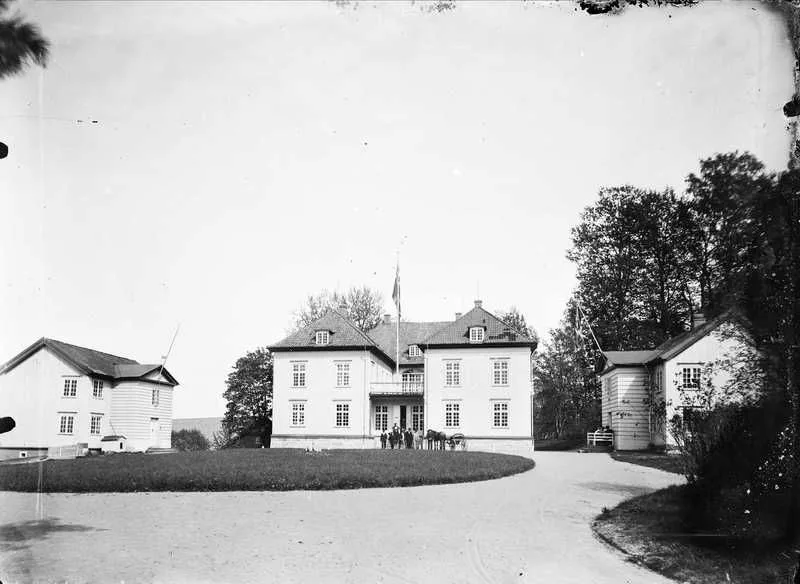 Unknown photographer, Eidsvollsbygningen (c. 1890), Oslo Museum, CC BY-SA 4.0 The white manor house at Eidsvoll where 112 delegates drafted and signed Norway's Constitution in 1814 — the building the whole constitutional story turns on. Municipality in Akershus county in southeastern Norway,
about seventy kilometres north of Oslo. Site of the
constitutional assembly that drafted and ratified the
Norwegian Constitution between 10 April and 20 May 1814.
The 112 delegates met at Eidsvollsbygningen, the country
house of the wealthy merchant and ironworks owner Carsten
Anker, who had offered the use of his estate at his own
expense. They signed the Constitution on 17 May 1814 —
Syttende mai, Norway's national day ever since — and
elected Prince Christian Frederik as king the same day.
The house is preserved as a national museum. Modern
Eidsvoll is also a stop on the main railway line north
from Oslo and the site of the country's principal
international airport (Oslo Gardermoen) ten kilometres south.
Also discussed in Lutheran Norway and Pietism — a farmer named Hans Nielsen Hauge and a lay revival that could not be silencedThe Constitution That Saved a Nation — five radical weeks at Eidsvoll, 1814The Quiet Revolution — how Norway won its independence without a warTradisjoner — celebrations across the Norwegian yearPolitikk — the left, the right, and the Norwegian way north of Christiania, drafting a constitution that on the seventeenth of May 1814 declared the Kingdom of Norway an independent constitutional monarchy. A brief war was fought through the summer against the army Sweden sent across the border. The Mossekonvensjonen
Unknown photographer, Eidsvollsbygningen (c. 1890), Oslo Museum, CC BY-SA 4.0 The white manor house at Eidsvoll where 112 delegates drafted and signed Norway's Constitution in 1814 — the building the whole constitutional story turns on. Municipality in Akershus county in southeastern Norway,
about seventy kilometres north of Oslo. Site of the
constitutional assembly that drafted and ratified the
Norwegian Constitution between 10 April and 20 May 1814.
The 112 delegates met at Eidsvollsbygningen, the country
house of the wealthy merchant and ironworks owner Carsten
Anker, who had offered the use of his estate at his own
expense. They signed the Constitution on 17 May 1814 —
Syttende mai, Norway's national day ever since — and
elected Prince Christian Frederik as king the same day.
The house is preserved as a national museum. Modern
Eidsvoll is also a stop on the main railway line north
from Oslo and the site of the country's principal
international airport (Oslo Gardermoen) ten kilometres south.
Also discussed in Lutheran Norway and Pietism — a farmer named Hans Nielsen Hauge and a lay revival that could not be silencedThe Constitution That Saved a Nation — five radical weeks at Eidsvoll, 1814The Quiet Revolution — how Norway won its independence without a warTradisjoner — celebrations across the Norwegian yearPolitikk — the left, the right, and the Norwegian way north of Christiania, drafting a constitution that on the seventeenth of May 1814 declared the Kingdom of Norway an independent constitutional monarchy. A brief war was fought through the summer against the army Sweden sent across the border. The Mossekonvensjonen 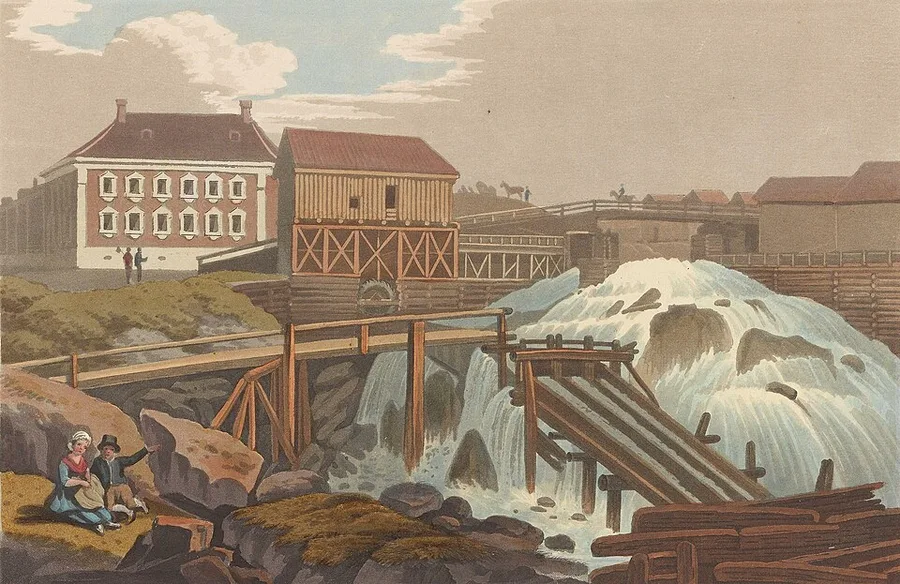 John William Edy, B. Ankers House at Moss, from Boydells Picturesque Scenery of Norway (National Museum) Bernt Anker's mansion at Moss, visible on the rise above the falls in this Edy print, is Konvensjonsgården — the house where Karl Johan's Swedish negotiators and Christian Frederik's Norwegian government signed the armistice on 14 August 1814. The Convention of Moss — the armistice signed at Moss
on 14 August 1814 between the Swedish forces of Crown
Prince Karl Johan and the Norwegian government of King
Christian Frederik, ending the brief summer war that had
followed Norway's rejection of the Treaty of Kiel. The
Convention's terms were strikingly mild: Norway entered a
personal union with Sweden, sharing the Swedish king but
retaining its Eidsvoll constitution, its Storting, its own
government, its own church, and its own administrative life
in Christiania. Karl Johan also accepted in principle the
Norwegian Constitution as the basis of government — a
concession that produced the remarkably durable
constitutional framework that lasted ninety-one years
until the peaceful dissolution of the union in 1905.
Also discussed in The Constitution That Saved a Nation — five radical weeks at Eidsvoll, 1814The Quiet Revolution — how Norway won its independence without a war on the fourteenth of August 1814 settled the conflict on remarkably mild terms: Norway entered a personal union with Sweden, sharing the Swedish king but keeping its own constitution, its own Storting
John William Edy, B. Ankers House at Moss, from Boydells Picturesque Scenery of Norway (National Museum) Bernt Anker's mansion at Moss, visible on the rise above the falls in this Edy print, is Konvensjonsgården — the house where Karl Johan's Swedish negotiators and Christian Frederik's Norwegian government signed the armistice on 14 August 1814. The Convention of Moss — the armistice signed at Moss
on 14 August 1814 between the Swedish forces of Crown
Prince Karl Johan and the Norwegian government of King
Christian Frederik, ending the brief summer war that had
followed Norway's rejection of the Treaty of Kiel. The
Convention's terms were strikingly mild: Norway entered a
personal union with Sweden, sharing the Swedish king but
retaining its Eidsvoll constitution, its Storting, its own
government, its own church, and its own administrative life
in Christiania. Karl Johan also accepted in principle the
Norwegian Constitution as the basis of government — a
concession that produced the remarkably durable
constitutional framework that lasted ninety-one years
until the peaceful dissolution of the union in 1905.
Also discussed in The Constitution That Saved a Nation — five radical weeks at Eidsvoll, 1814The Quiet Revolution — how Norway won its independence without a war on the fourteenth of August 1814 settled the conflict on remarkably mild terms: Norway entered a personal union with Sweden, sharing the Swedish king but keeping its own constitution, its own Storting 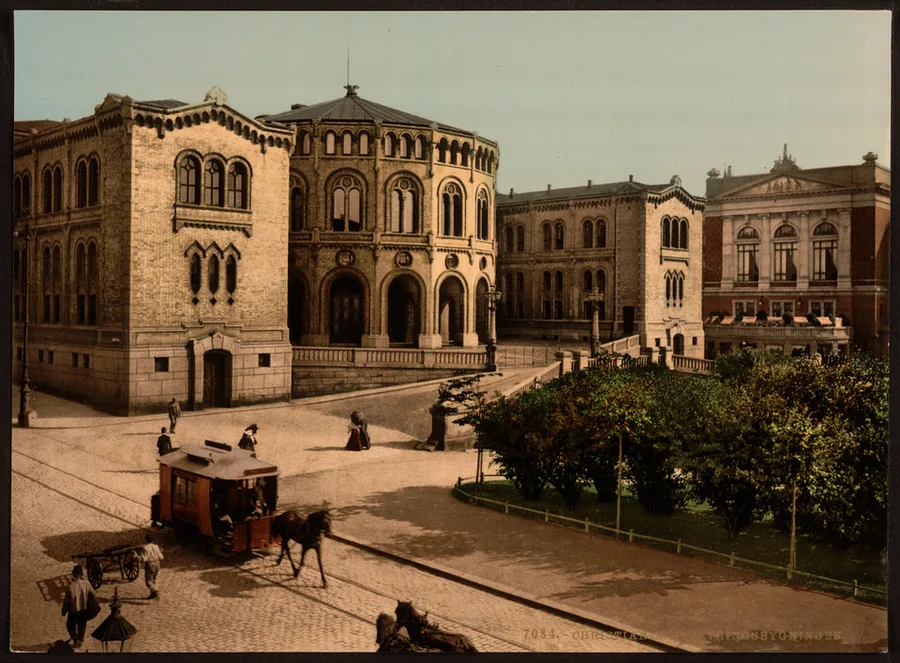 Detroit Publishing Company, Storthings Bygningen, Christiania, Norway (c. 1890-1900), Library of Congress / World Digital Library The Storting building in Kristiania (Oslo), Norway's parliament since the 1814 Constitution and the seat of the legislature that still governs the country. The Grand Assembly — the parliament of independent
Norway, established by the Eidsvoll Constitution of 17 May
1814 as the country's sovereign legislature. The name
Storting (Stór-Þing, the great assembly) deliberately
reaches back to the medieval Norwegian thing tradition,
asserting institutional continuity with the pre-Danish
Norwegian state. Under the 1814 constitution the Storting
divided into two chambers — Lagting and Odelsting —
for legislative purposes; the two-chamber arrangement was
abolished in 2009 and the Storting has been a single
chamber since. The current building, in central Oslo,
opened in 1866.
Also discussed in Lutheran Norway and Pietism — a farmer named Hans Nielsen Hauge and a lay revival that could not be silencedThe Constitution That Saved a Nation — five radical weeks at Eidsvoll, 1814The Quiet Revolution — how Norway won its independence without a warThe 'Lucky Country' — the discovery that changed everythingWorld War II — the King’s “No” and the Nazis in NorwayAllemannsretten — the right to roamPolitikk — the left, the right, and the Norwegian way , its own government, its own church, and its own administrative life in Christiania. The four-hundred-year night was over.
Detroit Publishing Company, Storthings Bygningen, Christiania, Norway (c. 1890-1900), Library of Congress / World Digital Library The Storting building in Kristiania (Oslo), Norway's parliament since the 1814 Constitution and the seat of the legislature that still governs the country. The Grand Assembly — the parliament of independent
Norway, established by the Eidsvoll Constitution of 17 May
1814 as the country's sovereign legislature. The name
Storting (Stór-Þing, the great assembly) deliberately
reaches back to the medieval Norwegian thing tradition,
asserting institutional continuity with the pre-Danish
Norwegian state. Under the 1814 constitution the Storting
divided into two chambers — Lagting and Odelsting —
for legislative purposes; the two-chamber arrangement was
abolished in 2009 and the Storting has been a single
chamber since. The current building, in central Oslo,
opened in 1866.
Also discussed in Lutheran Norway and Pietism — a farmer named Hans Nielsen Hauge and a lay revival that could not be silencedThe Constitution That Saved a Nation — five radical weeks at Eidsvoll, 1814The Quiet Revolution — how Norway won its independence without a warThe 'Lucky Country' — the discovery that changed everythingWorld War II — the King’s “No” and the Nazis in NorwayAllemannsretten — the right to roamPolitikk — the left, the right, and the Norwegian way , its own government, its own church, and its own administrative life in Christiania. The four-hundred-year night was over.
What came after
The ninety-one years that followed were not a Danish period. Norway was no longer governed from Copenhagen. The Swedish king reigned over Norway but did not rule over it in the direct way the Danish kings had ruled the four-hundred-year province. The Storting passed its own laws, the Norwegian government administered its own affairs, the bishops of the Lutheran church were appointed under Norwegian procedures, and the constitution prevented the Swedish monarch from imposing any decision the Storting refused to ratify. The arrangement was contentious in practice, particularly over foreign affairs, which the Swedish foreign ministry handled for both countries, but it was a much lighter structure than the absorption it had replaced.
The written language returned. Ivar Aasen 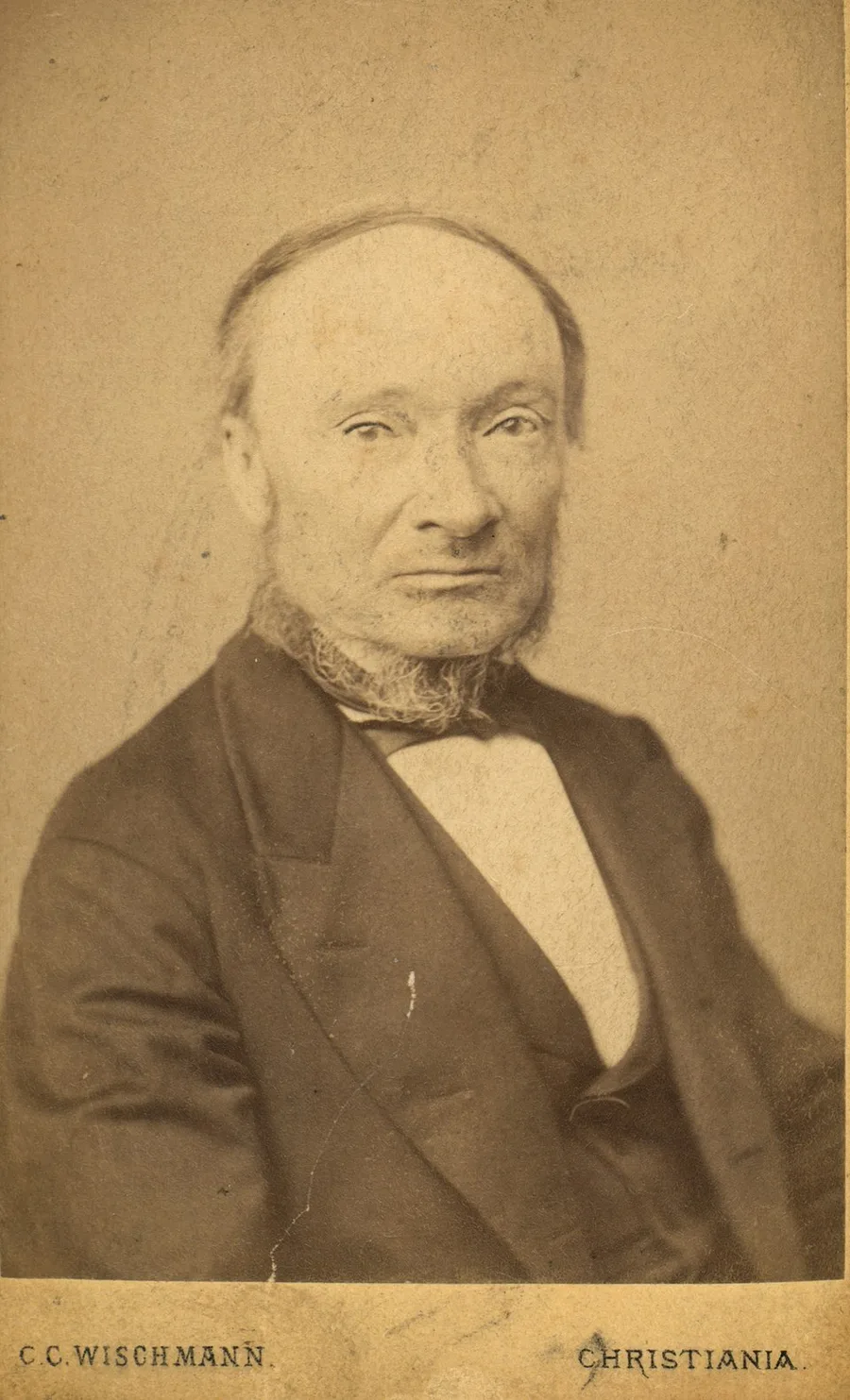 Carl Christian Wischmann, photograph of Ivar Aasen (1871), Ivar Aasen-tunet / Digitalt Museum, CC BY-SA 3.0 This 1871 studio photograph by C. C. Wischmann is the standard portrait of Ivar Aasen, the philologist who reconstructed a written Norwegian language, Landsmål (later Nynorsk), from dialects that survived three centuries of Danish written hegemony. Norwegian philologist, lexicographer, and poet (1813–1896),
born to a smallholding farm family at Ørsta in Sunnmøre on
the western coast. Self-taught — never attended university —
he spent the 1840s and 1850s walking through the rural
districts of southern and western Norway collecting the
dialects that had survived three centuries of Danish written
hegemony. From the surviving spoken Norwegian forms he
reconstructed a written language he called Landsmål —
country-language — later renamed Nynorsk. His major
works are the Det norske Folkesprogs Grammatik (1848) and
Ordbog over det norske Folkesprog (1850), with revised
editions in the 1860s. The two written Norwegian standards
Bokmål and Nynorsk that share the country today are the
direct outcome of his recovery.
Also discussed in The Reformation, 1537 — one church eradicated and another imposedLutheran Norway and Pietism — a farmer named Hans Nielsen Hauge and a lay revival that could not be silencedWorld War II — the King’s “No” and the Nazis in Norway , a self-taught philologist from Sunnmøre
Carl Christian Wischmann, photograph of Ivar Aasen (1871), Ivar Aasen-tunet / Digitalt Museum, CC BY-SA 3.0 This 1871 studio photograph by C. C. Wischmann is the standard portrait of Ivar Aasen, the philologist who reconstructed a written Norwegian language, Landsmål (later Nynorsk), from dialects that survived three centuries of Danish written hegemony. Norwegian philologist, lexicographer, and poet (1813–1896),
born to a smallholding farm family at Ørsta in Sunnmøre on
the western coast. Self-taught — never attended university —
he spent the 1840s and 1850s walking through the rural
districts of southern and western Norway collecting the
dialects that had survived three centuries of Danish written
hegemony. From the surviving spoken Norwegian forms he
reconstructed a written language he called Landsmål —
country-language — later renamed Nynorsk. His major
works are the Det norske Folkesprogs Grammatik (1848) and
Ordbog over det norske Folkesprog (1850), with revised
editions in the 1860s. The two written Norwegian standards
Bokmål and Nynorsk that share the country today are the
direct outcome of his recovery.
Also discussed in The Reformation, 1537 — one church eradicated and another imposedLutheran Norway and Pietism — a farmer named Hans Nielsen Hauge and a lay revival that could not be silencedWorld War II — the King’s “No” and the Nazis in Norway , a self-taught philologist from Sunnmøre 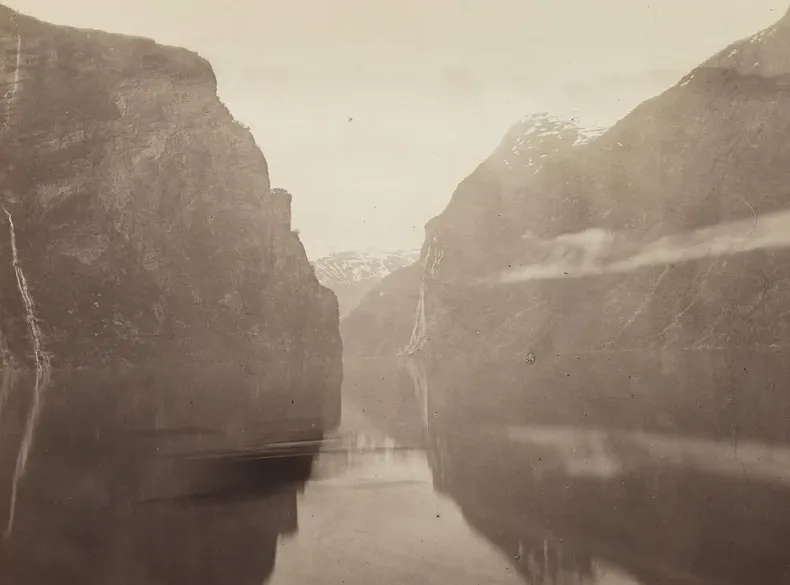 Knud Knudsen, Parti fra Geiranger, Sondmore (1864-1889), National Library of Norway Knud Knudsen's nineteenth-century photograph of the Geirangerfjord — sheer walls, threads of waterfall, mirror-still water. Sunnmøre's interior stands this vertical; its petty kingdom lived off the sea instead, on fishing and coastal trade just south of the Stadt headland. Region on the northwestern Norwegian coast, the southernmost of
the three traditional districts of the modern county of Møre og
Romsdal, sitting just south of the Stadt headland. In the
petty-kingdom era a small maritime kingdom whose wealth came from
coastal trade and fishing rather than agriculture. The principal
modern town is Ålesund, rebuilt in Art Nouveau style after a
devastating fire in 1904.
Sunnmøre Also discussed in Before There Was Norway — petty kingdoms at the edge of the world on the western coast, spent the 1840s and 1850s travelling through the rural districts collecting the dialects the Danish centuries had failed to silence. From them he reconstructed a Norwegian written language he called Nynorsk
Knud Knudsen, Parti fra Geiranger, Sondmore (1864-1889), National Library of Norway Knud Knudsen's nineteenth-century photograph of the Geirangerfjord — sheer walls, threads of waterfall, mirror-still water. Sunnmøre's interior stands this vertical; its petty kingdom lived off the sea instead, on fishing and coastal trade just south of the Stadt headland. Region on the northwestern Norwegian coast, the southernmost of
the three traditional districts of the modern county of Møre og
Romsdal, sitting just south of the Stadt headland. In the
petty-kingdom era a small maritime kingdom whose wealth came from
coastal trade and fishing rather than agriculture. The principal
modern town is Ålesund, rebuilt in Art Nouveau style after a
devastating fire in 1904.
Sunnmøre Also discussed in Before There Was Norway — petty kingdoms at the edge of the world on the western coast, spent the 1840s and 1850s travelling through the rural districts collecting the dialects the Danish centuries had failed to silence. From them he reconstructed a Norwegian written language he called Nynorsk 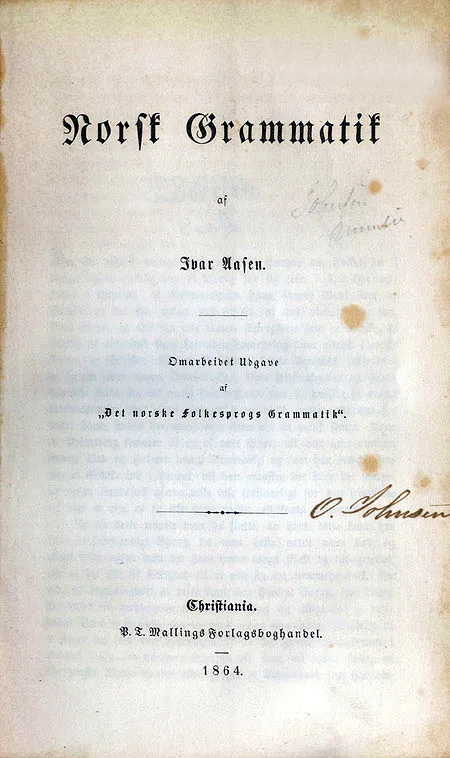 Ivar Aasen, Norsk Grammatik, title page (1864), Språkrådet facsimile library The title page of Aasen's 1864 revised grammar, the scholarly foundation of the written standard renamed Nynorsk in 1929 — where Aasen set out the rural-dialect grammar built to recover a Norwegian written language independent of the Danish overlay. New Norwegian — one of the two official written
standards of modern Norwegian. Originally called Landsmål
(country-language), constructed by the philologist Ivar
Aasen across the 1840s and 1850s from his fieldwork in the
rural dialects of southern and western Norway. Aasen aimed
to recover a written Norwegian that descended from Old
Norwegian without the three centuries of Danish overlay.
Renamed Nynorsk in the 1929 language-reform settlement.
Today roughly 10–15% of Norwegians use Nynorsk as their
primary written language, concentrated in the western
fjord districts; the remainder use Bokmål (descended from
the urban Dano-Norwegian written tradition). Both
standards are taught in school and have equal official
status; municipalities and schools choose between them.
Also discussed in Language basics — just enough Norwegian to be polite . Alongside it, the urban written language descended from Danish was reformed across the same period into what became Bokmål
Ivar Aasen, Norsk Grammatik, title page (1864), Språkrådet facsimile library The title page of Aasen's 1864 revised grammar, the scholarly foundation of the written standard renamed Nynorsk in 1929 — where Aasen set out the rural-dialect grammar built to recover a Norwegian written language independent of the Danish overlay. New Norwegian — one of the two official written
standards of modern Norwegian. Originally called Landsmål
(country-language), constructed by the philologist Ivar
Aasen across the 1840s and 1850s from his fieldwork in the
rural dialects of southern and western Norway. Aasen aimed
to recover a written Norwegian that descended from Old
Norwegian without the three centuries of Danish overlay.
Renamed Nynorsk in the 1929 language-reform settlement.
Today roughly 10–15% of Norwegians use Nynorsk as their
primary written language, concentrated in the western
fjord districts; the remainder use Bokmål (descended from
the urban Dano-Norwegian written tradition). Both
standards are taught in school and have equal official
status; municipalities and schools choose between them.
Also discussed in Language basics — just enough Norwegian to be polite . Alongside it, the urban written language descended from Danish was reformed across the same period into what became Bokmål 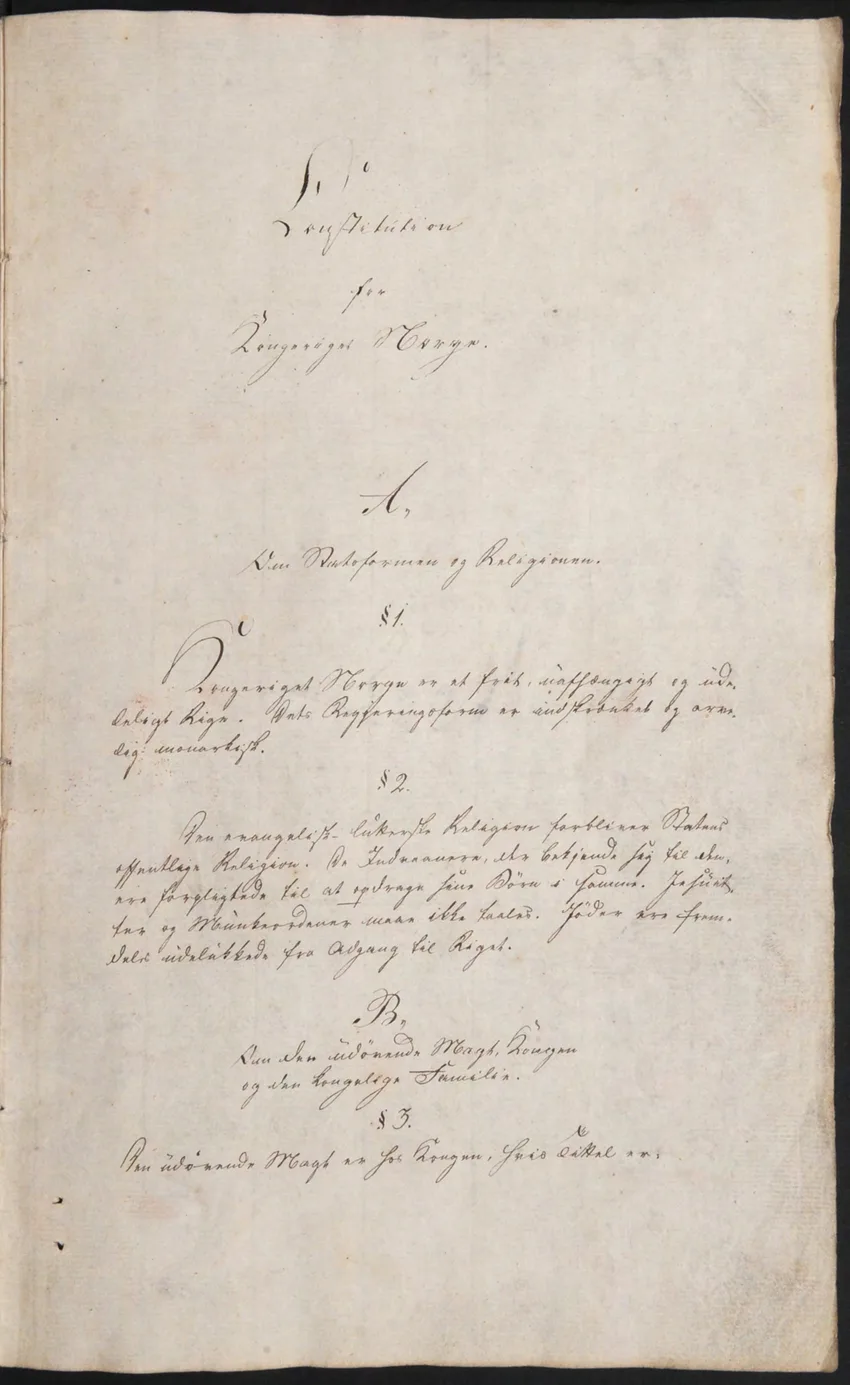 Kongeriget Norges Grundlov, opening page (17 May 1814), Stortingsarkivet The opening page of Norway's 1814 Constitution, penned in the elegant Dano-Norwegian of educated Norwegians — the written language that a century of reforms gradually reshaped into today's Bokmål. Book language — one of the two official written standards
of modern Norwegian. Descended from the written Dano-
Norwegian (Dansk-norsk) that served as the literary and
administrative language of educated Norwegians through the
late Danish period and through most of the nineteenth
century. Across a series of language reforms between 1907
and 1959, the standard was progressively shifted toward
spoken eastern Norwegian usage and away from Danish
orthography, and the name Riksmål (the older form) was
replaced by Bokmål in 1929. Today roughly 85–90% of
Norwegians use Bokmål as their primary written language.
Bokmål and Nynorsk have equal official status;
municipalities and schools choose between them, and any
Norwegian student is required to learn to write both.
Also discussed in Norske eventyr — the folk tales almost lost foreverLanguage basics — just enough Norwegian to be polite . By the end of the nineteenth century, Norway had two living written standards where for three centuries it had had none.
Kongeriget Norges Grundlov, opening page (17 May 1814), Stortingsarkivet The opening page of Norway's 1814 Constitution, penned in the elegant Dano-Norwegian of educated Norwegians — the written language that a century of reforms gradually reshaped into today's Bokmål. Book language — one of the two official written standards
of modern Norwegian. Descended from the written Dano-
Norwegian (Dansk-norsk) that served as the literary and
administrative language of educated Norwegians through the
late Danish period and through most of the nineteenth
century. Across a series of language reforms between 1907
and 1959, the standard was progressively shifted toward
spoken eastern Norwegian usage and away from Danish
orthography, and the name Riksmål (the older form) was
replaced by Bokmål in 1929. Today roughly 85–90% of
Norwegians use Bokmål as their primary written language.
Bokmål and Nynorsk have equal official status;
municipalities and schools choose between them, and any
Norwegian student is required to learn to write both.
Also discussed in Norske eventyr — the folk tales almost lost foreverLanguage basics — just enough Norwegian to be polite . By the end of the nineteenth century, Norway had two living written standards where for three centuries it had had none.
The substrate
The seventeenth of May is Norway’s national day. Across the country, children parade in folk costume — the bunad of their region — and the costumes vary from valley to valley because the country was kept in its valleys for four hundred years and the regional substrate was preserved in what people wore.
The state had been lost. The country had not.
Sources & further reading
Primary sources
- Magnus Lagabøtes Landslov (the Law-code of Magnus the Law-Mender), 1274. The medieval Norwegian national law-code, operating until its 1604 Danish translation displaced the original.
- Norske Lov av 1604 (the Norwegian Law of 1604), replaced in 1687 by Christian V’s Norske Lov, a new code adapting the Danish Danske Lov (1683). The Danish-translated successor that became the working text of Norwegian courts for the rest of the period.
- Kongeloven (the King’s Law), 1665. The Danish absolutist constitution that formalised the hereditary absolute monarchy established in Denmark-Norway in 1660–61.
- Kielfreden (the Treaty of Kiel), 14 January 1814. The Danish cession of Norway to the Swedish crown.
- Mossekonvensjonen (the Convention of Moss), 14 August 1814. The settlement of the brief Swedish-Norwegian war establishing the personal union.
- Henrik Ibsen, Peer Gynt (1867), Act 4 — the Cairo madhouse scene whose satire of the romantic-nationalist language movement contains the first known appearance of the phrase firehundreårsnatten.
Modern scholarship
- Sverre Bagge, Cross and Scepter: The Rise of the Scandinavian Kingdoms from the Vikings to the Reformation (Princeton University Press, 2014). The Scandinavian political context for the formation of the union.
- Knut Helle, ed., The Cambridge History of Scandinavia, Volume 1: Prehistory to 1520 (Cambridge University Press, 2003); E. I. Kouri and Jens E. Olesen, eds., Volume 2 (Cambridge University Press, 2016). The reference treatment of the period.
- Øystein Rian, Den aristokratiske fyrstestaten 1536–1648, in Aschehougs Norgeshistorie (Aschehoug, 1997). The standard Norwegian-language treatment of the period after the 1536 abolition, foundational to the modern “twin realm” reading.
- Ståle Dyrvik, Norsk historie 1625–1814 (Samlaget, 1999). The Norwegian-language history of the long middle and the end of the period.
- T. K. Derry, A History of Modern Norway 1814–1972 (Oxford University Press, 1973). The standard English-language history of the post-1814 period including the personal union with Sweden.
- Vivian Etting, Queen Margrete I (1353–1412) and the Founding of the Nordic Union (Brill, 2004). The standard biography of the queen at whose accession the long period began.
- Eli Fure, Eidsvoll 1814: hvordan grunnloven ble til (Dreyer, 2013). The standard Norwegian-language history of the constitutional moment that closed the period.
Reference
- Store norske leksikon (snl.no). See in particular firehundreårsnatten, Danmark-Norge, Kalmarunionen, Kielfreden, Mossekonvensjonen, Norske Lov av 1604, Christian 5s Norske Lov, Kongeloven, Ludvig Holberg, Ivar Aasen.
Visit
- Akershus Fortress, Oslo. The medieval royal castle built by Haakon V in the early fourteenth century, which from the late fourteenth century onward housed the Danish-appointed administration of Norway. After 1814 it carried the constitutional monarchy’s administration. Open to visitors.
- Bryggen, Bergen. The Hanseatic wharf and its successor structures, the centre of Norwegian western commerce through the first four centuries of the Danish period. UNESCO World Heritage site.
- Ludvig Holberg statue, in front of Nationaltheatret, Oslo. The Norwegian-born playwright whose life is this period’s clearest single illustration. A companion statue stands in front of Det Kongelige Teater in Copenhagen.
- Kongsberg. Founded by royal decree of Christian IV in 1624 around the silver discovered the previous year. The royal silver works closed in 1958; the Royal Silver Mines are now a museum open to visitors.
- Røros. The mining town founded in 1644 around the copper deposits of the surrounding mountains; the historic town and its cultural landscape are a UNESCO World Heritage site, with the eighteenth-century timber buildings and the slag-heap mounds largely intact.
- Eidsvollsbygningen, Eidsvoll north of Oslo. The country house of the merchant Carsten Anker where the constitutional assembly met in April and May 1814 and signed the constitution that closed the four-hundred-year night. Preserved as a museum.