Money — Currency, cards, prices, and tipping
Norwegian kroner (NOK), how to get them, what they convert to, and how cards (which work everywhere) make this much easier than it used to be. Plus the practical answer to "do I need cash?" — *no, but a small amount helps.*
The honest headline on Norwegian money is that you barely have to think about it. Norway is one of the most cashless countries on earth; a card works everywhere, a phone works almost everywhere, and the days of arriving with a thick envelope of foreign bills are over.
The currency
The Norwegian currency is the krone (plural kroner), abbreviated NOK and written kr. Notes come in 50, 100, 200, 500, and 1000. Coins come in 1, 5, 10, and 20. You may go the whole trip without holding many of them.
Conversion at a glance
Exchange rates move, so treat these as approximate and check the live rate the week before departure (xe.com, or your banking app):
- $1 USD ≈ 9.5–10 NOK
- 100 NOK ≈ $10–11 USD
- 500 NOK ≈ $50–53 USD
- 1000 NOK ≈ $100–105 USD
The useful shortcut: drop the last digit and you’re close to dollars. A 350-kroner dinner is roughly $35; a 1200-kroner sweater is roughly $120. It’s a close approximation, not an exact one — the real figure drifts a few percent either side with the day’s exchange rate, so check the live rate the week before if it matters.
Getting kroner
For anyone who hasn’t handled foreign currency before, the process is simple and there are really only two good options:
- Order through your US bank before you leave. Bank of America, Chase, Wells Fargo and the rest let you order foreign currency online about two weeks ahead; it arrives at your local branch for pickup, for a small fee. Ordering $200–300 worth of kroner is plenty.
- Or use a bank ATM (DNB, Nordea) on arrival at Oslo
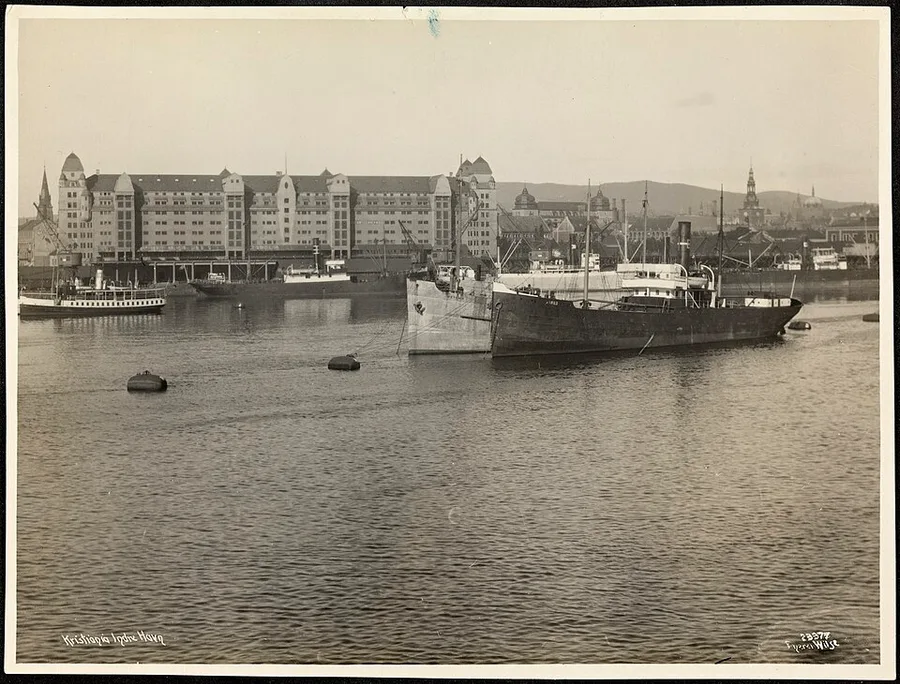 Anders Beer Wilse, Kristiania Indre Havn (1923), National Library of Norway Wilse's 1923 photograph of the inner harbor at Bjørvika, two years before Kristiania took back its old name Oslo — steamers at the quays beneath the spires of the city that grew from a medieval royal seat into Norway's capital. Capital of modern Norway, at the head of the Oslofjord on
the country's southeastern coast. Founded according to the
sagas by Harald Hardrada about 1049 and known through the
medieval period as a secondary royal seat behind Bergen and
Nidaros. Hákon V moved the royal residence permanently to
Oslo about 1300 and built Akershus Fortress to guard the
harbour. After a fire in 1624 the medieval town was
abandoned and Christian IV rebuilt the city to the west
under the new name Christiania (later Kristiania); the
name Oslo was restored in 1925. The original medieval
street pattern survives as the Gamlebyen district east of
the modern centre.
In this article The first two days are Oslo's and nearly cashless — cafés,
transit taps, and the harbour dinner all settled by card; the
kroner from the arrival ATM are mostly a backup that comes home
again.
On the trip Days 1–2 belong to Oslo, with both groups together —
Roseslottet and the harbourside museums on Day 1, then the
Day-2 e-bike tour through Akershus Fortress, up Karl Johans
gate, and out to Vigeland Park.
Oslo Also discussed in The Long Fall — the sudden loss of Norwegian nobility, the end of the kings, and half of Norway gone foreverA Catholic Norway — the faith that gave the kingdom its first institutions and the stave churchesThe 400-Year Night — when the Northern Lion lay dormantThe Reformation, 1537 — one church eradicated and another imposedLutheran Norway and Pietism — a farmer named Hans Nielsen Hauge and a lay revival that could not be silencedThe Constitution That Saved a Nation — five radical weeks at Eidsvoll, 1814800,000 Norwegians Leave — the century that built a Second NorwayThe Quiet Revolution — how Norway won its independence without a warWorld War II — the King’s “No” and the Nazis in NorwayAlcohol and Vinmonopolet — when and where to buy a drinkEveryday etiquette — quiet voices, wide space, no smiling🚨 Emergencies - important numbers, hospitals, and what you can doLanding in Norway — off the plane in Oslo, where to go, step by step Oslo Airport (Gardermoen)
Anders Beer Wilse, Kristiania Indre Havn (1923), National Library of Norway Wilse's 1923 photograph of the inner harbor at Bjørvika, two years before Kristiania took back its old name Oslo — steamers at the quays beneath the spires of the city that grew from a medieval royal seat into Norway's capital. Capital of modern Norway, at the head of the Oslofjord on
the country's southeastern coast. Founded according to the
sagas by Harald Hardrada about 1049 and known through the
medieval period as a secondary royal seat behind Bergen and
Nidaros. Hákon V moved the royal residence permanently to
Oslo about 1300 and built Akershus Fortress to guard the
harbour. After a fire in 1624 the medieval town was
abandoned and Christian IV rebuilt the city to the west
under the new name Christiania (later Kristiania); the
name Oslo was restored in 1925. The original medieval
street pattern survives as the Gamlebyen district east of
the modern centre.
In this article The first two days are Oslo's and nearly cashless — cafés,
transit taps, and the harbour dinner all settled by card; the
kroner from the arrival ATM are mostly a backup that comes home
again.
On the trip Days 1–2 belong to Oslo, with both groups together —
Roseslottet and the harbourside museums on Day 1, then the
Day-2 e-bike tour through Akershus Fortress, up Karl Johans
gate, and out to Vigeland Park.
Oslo Also discussed in The Long Fall — the sudden loss of Norwegian nobility, the end of the kings, and half of Norway gone foreverA Catholic Norway — the faith that gave the kingdom its first institutions and the stave churchesThe 400-Year Night — when the Northern Lion lay dormantThe Reformation, 1537 — one church eradicated and another imposedLutheran Norway and Pietism — a farmer named Hans Nielsen Hauge and a lay revival that could not be silencedThe Constitution That Saved a Nation — five radical weeks at Eidsvoll, 1814800,000 Norwegians Leave — the century that built a Second NorwayThe Quiet Revolution — how Norway won its independence without a warWorld War II — the King’s “No” and the Nazis in NorwayAlcohol and Vinmonopolet — when and where to buy a drinkEveryday etiquette — quiet voices, wide space, no smiling🚨 Emergencies - important numbers, hospitals, and what you can doLanding in Norway — off the plane in Oslo, where to go, step by step Oslo Airport (Gardermoen) 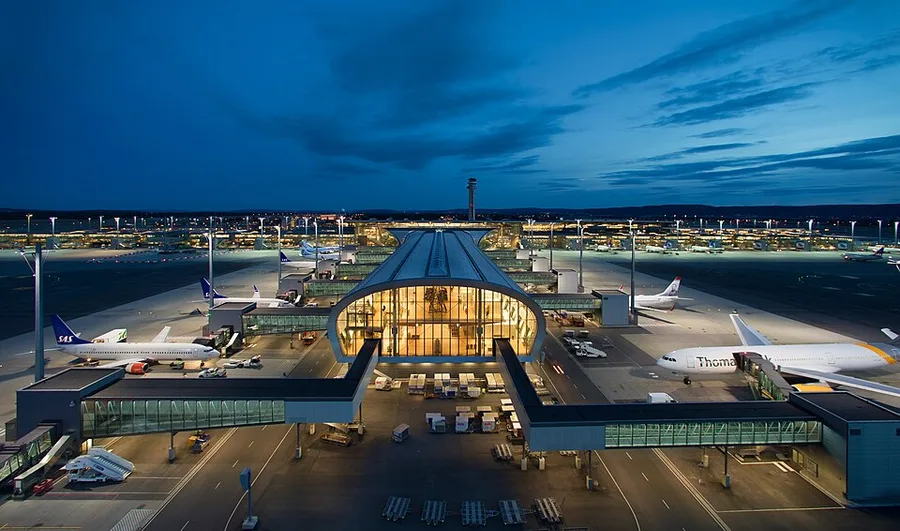 Espen Solli / Avinor Oslo lufthavn, Oslo Airport terminal night view (2017), CC BY 3.0 The terminal every traveler passes through on arrival, and again before the final morning's flights home — the Gardermobanen rail line into Oslo S starts just beneath this building. Norway's principal airport (IATA: OSL), opened on 8 October 1998 roughly 50 km north-northeast of central Oslo near the town of Gardermoen, in Ullensaker municipality, replacing the smaller in-town airport at Fornebu. Built at a cost of some NOK 11.4 billion, Gardermoen handles the overwhelming majority of Norway's international air traffic and anchors the dedicated Gardermobanen high-speed rail line into Oslo Central Station — one of the fastest airport-to-city rail connections in Europe, run by both Flytoget and the ordinary Vy trains. In this article The arrivals-hall bank ATM is where the kroner meet the trip — a better rate than any exchange counter, and a $200–300 backup withdrawal is about all the cash the week needs. On the trip The whole family's Norway begins and ends at Gardermoen — everyone lands here before Day 1 and rides the train into Oslo S, and on Day 7 the group returns to spend one last Norwegian night near the airport before the flights home the next morning. Gardermoen Also discussed in Landing in Norway — off the plane in Oslo, where to go, step by stepHotels in Norway — frokost, check-in, and the luggage-room habit🚨 Emergencies - important numbers, hospitals, and what you can doAlcohol and Vinmonopolet — when and where to buy a drinkWhat to wear — the layering system, on the groundPublic transit basics — trains, trams, boats, and buying tickets airport. Bank-machine rates are usually the best you’ll get. Withdraw $200–300 worth of kroner as a backup and expect to use little of it.
Two things to avoid. Airport currency-exchange counters (Travelex, Forex) run rates 5–10% worse than an ATM — skip them. And don’t bring US dollar bills expecting to spend them — kroner is the only currency Norwegian shops and restaurants take, and dollars will only be accepted, at bad rates, by the same exchange counters you’re already skipping.
Cards work everywhere
One step first, and it matters for every traveler in the group: tell your US bank you’re traveling. Most banking apps let you set a travel notice in about two minutes. Without it, a card transaction in Norway can get flagged as fraud and frozen at an inconvenient moment.
Card acceptance in Norway is essentially universal — restaurants, taxis, parking meters, rural farm stands, paid public restrooms, the Vinmonopolet 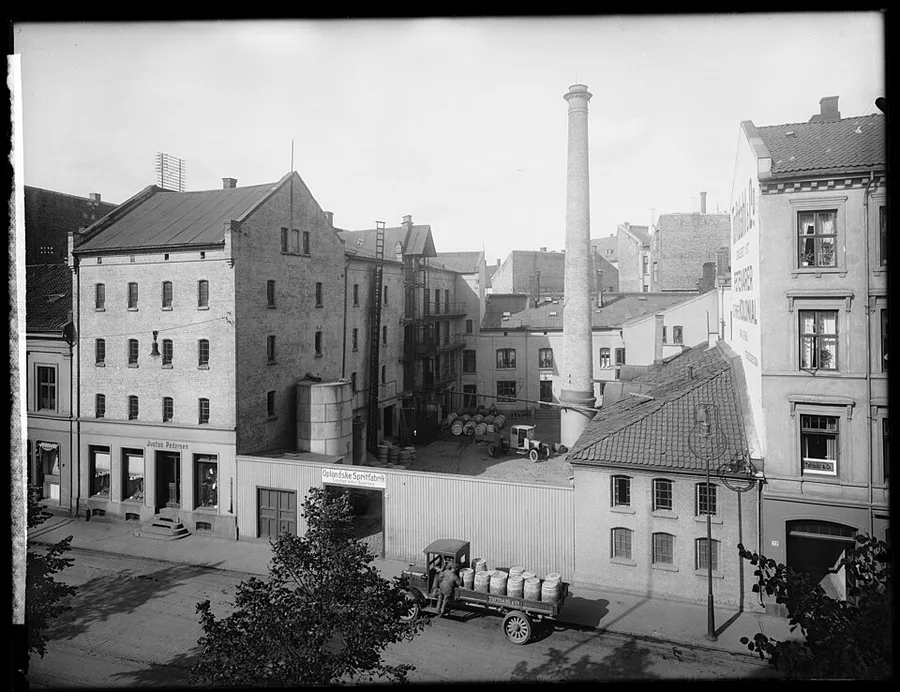 Narve Skarpmoen, A/S Vinmonopolet, Stenersgata 20 (1925), National Library of Norway, public domain The National Library catalogues this as A/S Vinmonopolet’s own Stenersgata 20 property in 1925, three years after the 1922 founding of the state alcohol monopoly — its storage and loading yard rather than a modern store or logo. Norway's state-owned retail monopoly on wine, spirits, and any beverage over 4.7% alcohol by volume — the only legal seller of anything stronger than supermarket beer. Founded in 1922, in the middle of a national prohibition on spirits and fortified wine (1917–1927) that a 1919 referendum had just upheld; the wine-exporting nations Norway depended on to buy its dried and salted fish threatened to stop unless imported wine found a legal outlet again, and Vinmonopolet was created to distribute it under state control. Fully state-owned since 1939, it is now a pure retail monopoly running roughly 350 stores nationwide on short weekday hours, with no Sunday sales. In this article The priciest line on the trip's cost table — a bottle of spirits from Vinmonopolet runs noticeably above its US equivalent, the tax load doing exactly what Norway's alcohol policy intends. On the trip A Vinmonopolet counter sits a short walk from several of the trip's stops — on Karl Johans gate in Oslo, on Valkendorfsgaten in Bergen — and the arrivals duty-free at Gardermoen doubles as the easiest place to pick up a bottle before customs. The whole group passes one on the Day 2 Oslo e-bike route, and the Ungdommene (the Youngsters) pass another near the Fish Market on their Bergen morning; anyone buying wine for a shared dinner, or an akevitt gift for a Norwegian relative, plans around the shop's early close and its closed Sundays. Also discussed in Alcohol and Vinmonopolet — when and where to buy a drinkThe stuff no one warns you about - Bathrooms, shoes off and plastic bagsTime, daylight, and Norwegian hours — late sun and early dark , market stalls. Use a credit or debit card with no foreign transaction fee (Capital One Venture, Chase Sapphire Preferred, the Schwab debit card, and many others qualify). A card that charges a 3% foreign fee quietly costs about $30 for every $1,000 spent — worth getting a no-fee card before the trip if no one in the group has one.
Apple Pay and Google Pay work nearly everywhere too. If your phone is set up for contactless payment, you may rarely touch a physical card at all. Tap-to-pay terminals are standard.
You will see Vipps on signs and market stalls — Norway’s near-universal domestic payment app — but it ties to a Norwegian bank account and national ID number, so foreign visitors can’t sign up for it and don’t need to; cards and Apple or Google Pay cover everything it would.
One trap to refuse: if an ATM or a card reader offers to charge you in USD instead of kroner, always choose kroner. The convenient-looking dollar option — dynamic currency conversion — quietly adds 3–7% to the price.
What things cost
Norway is famously expensive. The shock isn’t the high-end items — it’s the everyday ones. Below is the same item priced in Norway and in a typical US city, at roughly 10 NOK to the dollar.
| Item | Norway (NOK) | Norway (USD) | Typical US | Multiplier |
|---|---|---|---|---|
| Drip coffee at a café | 40–60 | $4–6 | $3–4 | ~1.5× |
| Pastry / waffle | 50–80 | $5–8 | $4–5 | ~1.5× |
| Pint of beer at a bar | 100–130 | $10–13 | $7–9 | ~1.4× |
| Glass of wine | 130–180 | $13–18 | $10–14 | ~1.3× |
| Casual lunch | 180–250 | $18–25 | $14–18 | ~1.3× |
| Sit-down dinner, per person (no drinks) | 350–500 | $35–50 | $25–35 | ~1.4× |
| Bottle of wine at restaurant | 500–800 | $50–80 | $35–55 | ~1.4× |
| Bottle of wine at the store | 150–250 | $15–25 | $12–18 | ~1.3× |
| Bottle of spirits (Vinmonopolet) | 350–550 | $35–55 | $20–35 | ~1.6× |
| McDonald’s Big Mac meal | 130–150 | $13–15 | $9–11 | ~1.4× |
| 1.5 L bottled water (grocery) | 20–30 | $2–3 | $1.50–2 | ~1.4× |
| Single Oslo transit ticket | ~42 | ~$4 | $2.50–3.50 | ~1.3× |
| Public toilet | 10–20 | $1–2 | free | — |
| Souvenir Selbu mittens | 300–600 | $30–60 | not sold | — |
The pattern lands around 1.3 to 1.5× US prices on everyday food and drink, with alcohol running closer to 1.5 to 1.8× because of the taxes. Hotels, transit, and museums are surprisingly close to US prices once you’ve adjusted to the food line. Adjust the budget and the expectations together, and the sticker shock fades by Day 2.
A worked example
A Day-2 lunch in Oslo for four: two bowls of fish soup at 220 NOK each, two open-face sandwiches at 180 NOK each, four coffees at 50 NOK each. Subtotal 1,000 NOK, no tip needed. That is $100 at the trip’s rate — or roughly $70–75 of equivalent food in a US city. Not a rip-off; just Norway.
Tipping
Service is always included in the price — remember that above everything else. Norway has no tipping wage and no tipping obligation; a tip is a small genuine extra, not a top-up the worker is counting on.
- Restaurants — rounding the bill up to the next 10–50 NOK is generous. Ten percent is well above expectation. Fifteen to twenty percent reads as unmistakably American — well-meant, and slightly off.
- Bars — round up or leave nothing. Both are completely normal.
- Taxis — round up to the next 10 NOK.
- Hotel housekeeping — a small thanks is appreciated, never expected.
- Tour guides — a sincere verbal thank-you matters more than the kroner. If a tour was long and good, a 50–100 NOK note is generous.
Card readers in restaurants increasingly copy the American habit and prompt you to pick a tip percentage at checkout. You can tap “no tip” without offending anyone. Norwegians often do. Matching the modest local norm is the courtesy — the same instinct for understatement that shapes everyday Norwegian etiquette.
Cash strategy
A typical traveler spends only 200–300 NOK in cash across the whole week — a tipped tour guide, a paid bathroom, a small market stall, the rare broken card reader. The backup you ordered or withdrew will mostly come home with you. Do not bring a brick of cash. Norway genuinely does not want it.