Landing in Norway — stepping off the plane, where to go, step by step
The first ninety minutes of the trip, walked through one step at a time — Schengen passport control, finding your bag, the Flytoget vs Vy train decision, and a named regroup spot for slower travelers.
The first ninety minutes of the trip. Walk through it once before you fly so it’s familiar when you’re standing there jet-lagged.
1. Off the plane
The jet bridge ends in a glass corridor. Follow signs that say Ankomst (Arrivals). The corridor branches once — left for connecting flights, right for arrivals. You want right.
2. Schengen passport control
A long room with booths and self-service kiosks. Non-EU travelers go to the lanes marked All Passports. Since the EU’s Entry/Exit System (EES) came in, most US travelers no longer get a passport stamp — on your first entry you register at a kiosk or with an officer: a photo and fingerprints, then a short check. Have your US passport open to the photo page, and have the hotel name and city ready (in your phone or on paper) in case you’re asked where you’re staying. Budget a bit more time than the old stamp-and-go — 20 to 45 minutes on a busy late-July afternoon. Norway is in Schengen, so once you’re through here there’s no second border check for the rest of the trip.
3. Baggage claim
One large hall after passport control. Screens overhead show flight numbers and carousel numbers. If your bag doesn’t show, see Step 8.
4. Customs
Just past the carousels comes the arrivals duty-free shop — the one chance to buy spirits or wine at the tax-free price on the way in, cheaper than any in-town Vinmonopolet, and the allowance below is what you can carry through without going red.
Two-channel system. Green if you have nothing to declare — almost all tourists. Red if you’re carrying more than 1 liter of spirits, 1.5 liters of wine, or 200 cigarettes, or anything else above the duty-free allowances. The default is green. You walk through.
5. Land in Norway
Past customs, you’re in the arrivals hall. Currency exchange booths on your right (skip them — ATM rates are better, but you probably don’t need cash for anything anyway). On your left, the meeting hall and a small food court. Trains and taxis straight ahead.
6. The train decision
Two services run from the airport to Oslo S (Oslo Central Station) 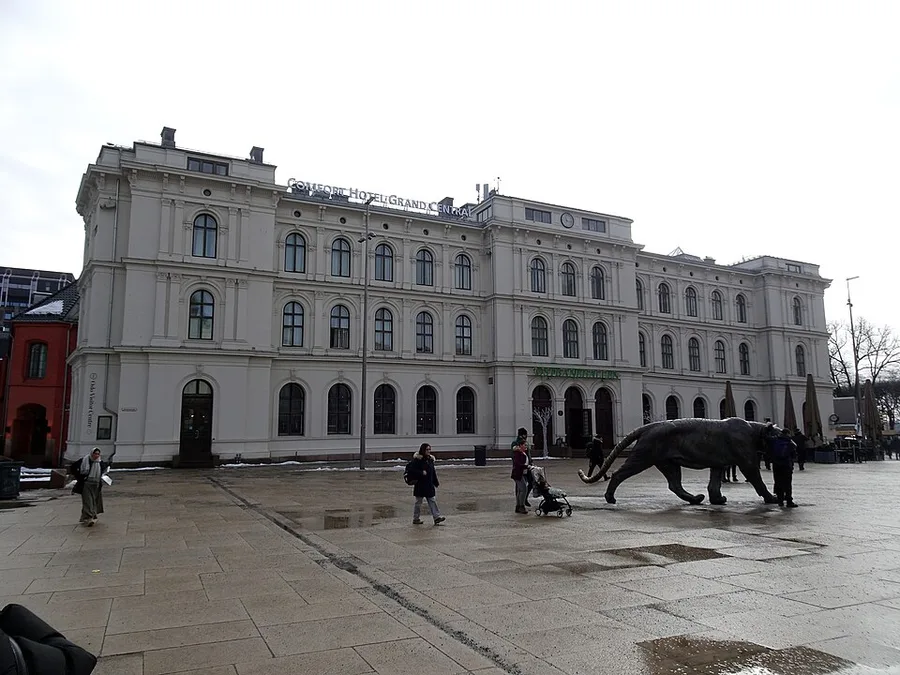 Østbanehallen (the historic 1882 East Station hall), Jernbanetorget, Oslo — Wikimedia Commons Østbanehallen, the 1882 East Station building on Jernbanetorget, is the historic face of Oslo S — Norway’s busiest station, where airport, intercity and local trains and the metro all converge; the bronze tiger gives Oslo its nickname ‘Tigerstaden.’ Norway's largest and busiest railway station, sitting at Jernbanetorget in central Oslo. The current station building opened in 1980, merging two older, separately run stations — the Østbanen (East Line Station) and the Vestbanen (West Line Station) — that had served the country's rail network since its first line opened between Christiania and Eidsvoll in 1854; the merged station took its current name, Oslo S, in 1981. Operated by Bane NOR, it is the hub for the Flytoget airport express, the Vy long-distance and regional trains (to Bergen, Trondheim, Stavanger, and international routes into Sweden and Denmark), and the T-bane metro, trikk (tram) lines, and city buses converging at the adjoining Jernbanetorget square. In this article The first Norwegian rail platform, about twenty minutes off the Flytoget or Vy train from Gardermoen — signs for Jernbanetorget point toward taxis and trams, signs for Karl Johans gate point toward the long walk to the Royal Palace and the harbor. On the trip Every traveler passes through Oslo S more than once — off the Flytoget or Vy train from Gardermoen on arrival, and again when the Ungdommene (the Youngsters) find their platform for the early Bergensbanen departure toward Myrdal and the Norway in a Nutshell route on Day 3. The station's food court past the train gates is the family's fallback meeting point if flights or bags don't land together. Oslo Also discussed in Public transit basics — trains, trams, boats, and buying tickets🚨 Emergencies - important numbers, hospitals, and what you can doHotels in Norway — frokost, check-in, and the luggage-room habit (Oslo Central Station). Same underground station beneath the terminal, very different prices — Flytoget leaves from the inner platforms behind its own gates, Vy from the outer ones, so check the overhead screens before you ride an escalator down.
- Flytoget
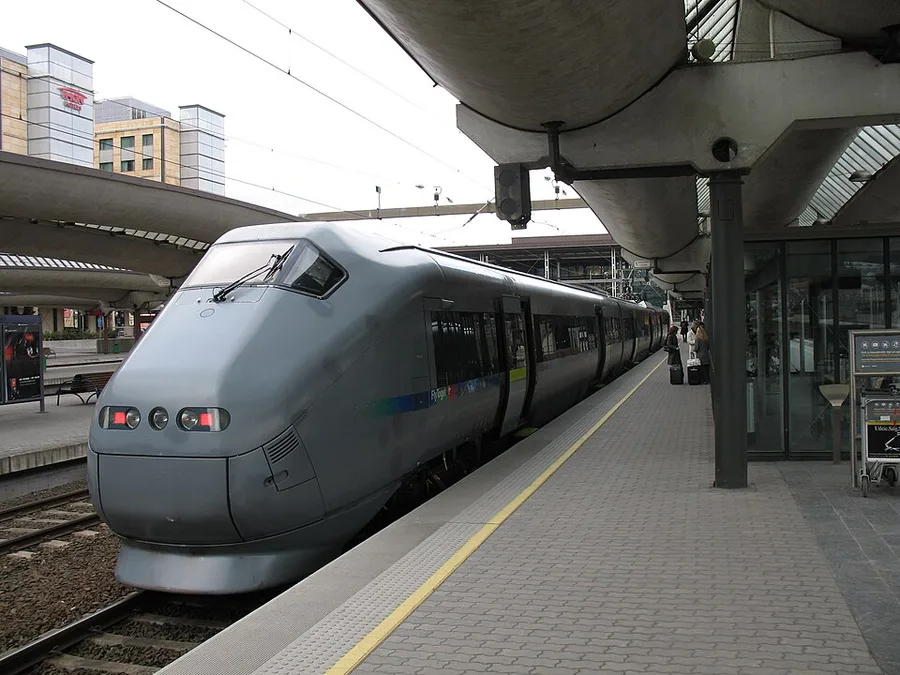 Kjetil Ree, Flytoget Oslo S (2006), CC BY-SA 3.0 The train itself, nose-on at the Oslo S platform where every traveler catches or leaves it on the ride to and from Gardermoen. The Airport Express Train, a dedicated premium rail operator running nonstop between Oslo Airport Gardermoen and Oslo Central Station (Oslo S) in about 19–20 minutes on the shared Gardermobanen line, at a fare above the ordinary Vy trains that also call at the airport. Flytoget runs its own rolling stock at a near-clockwork ten-minute frequency, tapped straight through with a contactless card at the gate. In February 2026 the Norwegian government announced that Flytoget's separate operation will fold into the regional network by December 2027, ending its run as a standalone premium service. On the trip Stepping off the international flight, the family weighs Flytoget against the slower, cheaper Vy train for the ride into Oslo S — about five minutes and ten dollars apart, a pick-by-mood decision. On Day 7's last afternoon, anyone who wants one more stretch of Oslo can ride the Flytoget back into the city and out again before dinner. Also discussed in Hotels in Norway — frokost, check-in, and the luggage-room habit — the airport express. About NOK 245 (roughly $23) — check the current fare, it creeps up. Runs every 10 minutes. About 20 minutes to Oslo S. Tap a contactless card at the gate and walk through; no paper ticket needed.
 - Vy — the regular national-rail trains, which also stop at the airport on their way south. NOK ~125 (about $12). Runs every 10–20 minutes. About 25 minutes to Oslo S. Buy through the Vy app or at a machine.
If anyone in the group already holds a Vy train ticket booked through to a destination further south, the airport-to-Oslo leg is included in it. Otherwise the difference between the two is about five minutes and about ten dollars — pick by mood.
Skip the taxi line. A cab from Oslo Airport (Gardermoen) 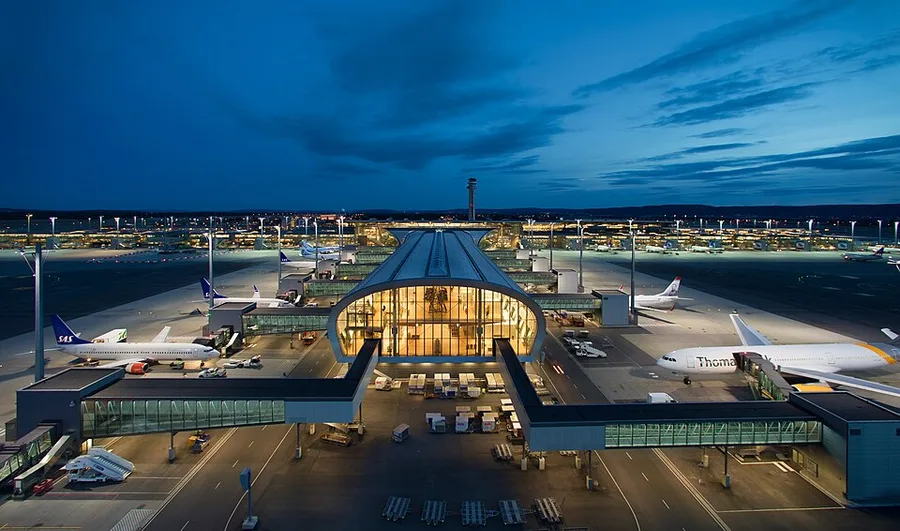 Espen Solli / Avinor Oslo lufthavn, Oslo Airport terminal night view (2017), CC BY 3.0 The terminal every traveler passes through on arrival, and again before the final morning's flights home — the Gardermobanen rail line into Oslo S starts just beneath this building. Norway's principal airport (IATA: OSL), opened on 8 October 1998 roughly 50 km north-northeast of central Oslo near the town of Gardermoen, in Ullensaker municipality, replacing the smaller in-town airport at Fornebu. Built at a cost of some NOK 11.4 billion, Gardermoen handles the overwhelming majority of Norway's international air traffic and anchors the dedicated Gardermobanen high-speed rail line into Oslo Central Station — one of the fastest airport-to-city rail connections in Europe, run by both Flytoget and the ordinary Vy trains. On the trip The whole family's Norway begins and ends at Gardermoen — everyone lands here before Day 1 and rides the train into Oslo S, and on Day 7 the group returns to spend one last Norwegian night near the airport before the flights home the next morning. Gardermoen Also discussed in Hotels in Norway — frokost, check-in, and the luggage-room habit🚨 Emergencies - important numbers, hospitals, and what you can doAlcohol and Vinmonopolet — when and where to buy a drinkMoney — currency, cards, prices, and tippingWhat to wear — the layering system, on the groundPublic transit basics — trains, trams, boats, and buying tickets to central Oslo
 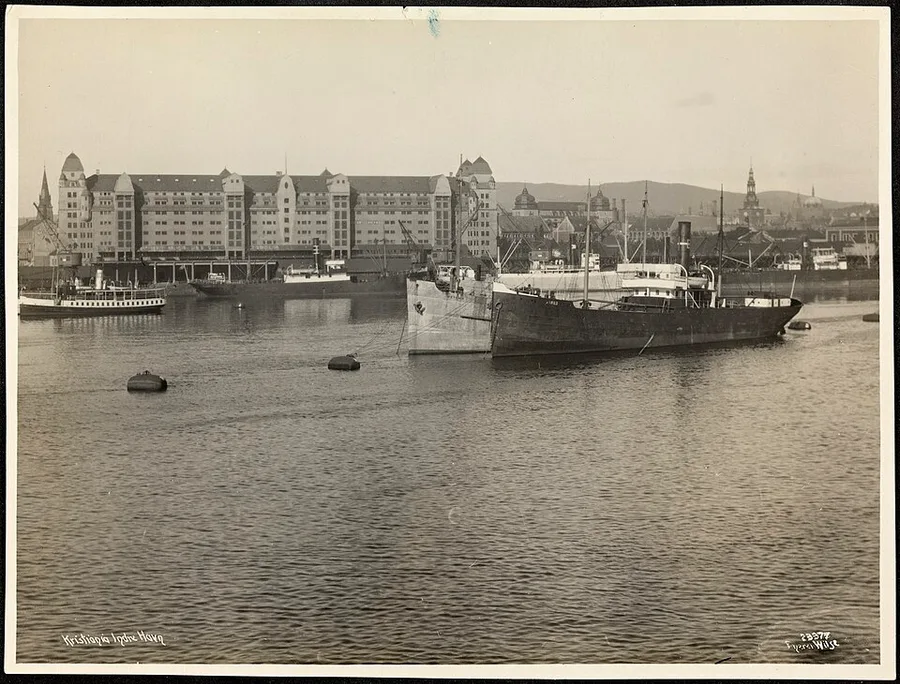 Anders Beer Wilse, Kristiania Indre Havn (1923), National Library of Norway Wilse's 1923 photograph of the inner harbor at Bjørvika, two years before Kristiania took back its old name Oslo — steamers at the quays beneath the spires of the city that grew from a medieval royal seat into Norway's capital. Capital of modern Norway, at the head of the Oslofjord on
the country's southeastern coast. Founded according to the
sagas by Harald Hardrada about 1049 and known through the
medieval period as a secondary royal seat behind Bergen and
Nidaros. Hákon V moved the royal residence permanently to
Oslo about 1300 and built Akershus Fortress to guard the
harbour. After a fire in 1624 the medieval town was
abandoned and Christian IV rebuilt the city to the west
under the new name Christiania (later Kristiania); the
name Oslo was restored in 1925. The original medieval
street pattern survives as the Gamlebyen district east of
the modern centre.
In this article The train from Gardermoen ends at Oslo S on the city's east
side; the first two Oslo days unfold on foot west from there.
On the trip Days 1–2 belong to Oslo, with both groups together —
Roseslottet and the harbourside museums on Day 1, then the
Day-2 e-bike tour through Akershus Fortress, up Karl Johans
gate, and out to Vigeland Park.
Oslo Also discussed in The Long Fall — the sudden loss of Norwegian nobility, the end of the kings, and half of Norway gone foreverA Catholic Norway — the faith that gave the kingdom its first institutions and the stave churchesThe 400-Year Night — when the Northern Lion lay dormantThe Reformation, 1537 — one church eradicated and another imposedLutheran Norway and Pietism — a farmer named Hans Nielsen Hauge and a lay revival that could not be silencedThe Constitution That Saved a Nation — five radical weeks at Eidsvoll, 1814800,000 Norwegians Leave — the century that built a Second NorwayThe Quiet Revolution — how Norway won its independence without a warWorld War II — the King’s “No” and the Nazis in NorwayAlcohol and Vinmonopolet — when and where to buy a drinkEveryday etiquette — quiet voices, wide space, no smiling🚨 Emergencies - important numbers, hospitals, and what you can doMoney — currency, cards, prices, and tipping runs about NOK 1,300–1,800 (roughly $130–180), more at night and on weekends. Not worth it.
Anders Beer Wilse, Kristiania Indre Havn (1923), National Library of Norway Wilse's 1923 photograph of the inner harbor at Bjørvika, two years before Kristiania took back its old name Oslo — steamers at the quays beneath the spires of the city that grew from a medieval royal seat into Norway's capital. Capital of modern Norway, at the head of the Oslofjord on
the country's southeastern coast. Founded according to the
sagas by Harald Hardrada about 1049 and known through the
medieval period as a secondary royal seat behind Bergen and
Nidaros. Hákon V moved the royal residence permanently to
Oslo about 1300 and built Akershus Fortress to guard the
harbour. After a fire in 1624 the medieval town was
abandoned and Christian IV rebuilt the city to the west
under the new name Christiania (later Kristiania); the
name Oslo was restored in 1925. The original medieval
street pattern survives as the Gamlebyen district east of
the modern centre.
In this article The train from Gardermoen ends at Oslo S on the city's east
side; the first two Oslo days unfold on foot west from there.
On the trip Days 1–2 belong to Oslo, with both groups together —
Roseslottet and the harbourside museums on Day 1, then the
Day-2 e-bike tour through Akershus Fortress, up Karl Johans
gate, and out to Vigeland Park.
Oslo Also discussed in The Long Fall — the sudden loss of Norwegian nobility, the end of the kings, and half of Norway gone foreverA Catholic Norway — the faith that gave the kingdom its first institutions and the stave churchesThe 400-Year Night — when the Northern Lion lay dormantThe Reformation, 1537 — one church eradicated and another imposedLutheran Norway and Pietism — a farmer named Hans Nielsen Hauge and a lay revival that could not be silencedThe Constitution That Saved a Nation — five radical weeks at Eidsvoll, 1814800,000 Norwegians Leave — the century that built a Second NorwayThe Quiet Revolution — how Norway won its independence without a warWorld War II — the King’s “No” and the Nazis in NorwayAlcohol and Vinmonopolet — when and where to buy a drinkEveryday etiquette — quiet voices, wide space, no smiling🚨 Emergencies - important numbers, hospitals, and what you can doMoney — currency, cards, prices, and tipping runs about NOK 1,300–1,800 (roughly $130–180), more at night and on weekends. Not worth it.
7. The regroup spot for slow travelers
If two travel groups land on different flights, or if anyone’s bag takes thirty minutes, agree before the trip on where to meet. The cleanest answer: the food court past the train gates, on the same level as the platforms. There’s a Joe & The Juice, a coffee place, and tables. It’s quiet, sit-down, and easy to find.
8. If your bag didn’t make it
File a missing-luggage report at your airline’s baggage desk before you leave the airport. The desks are off to the side of the arrivals hall, signed clearly. Get the reference number on paper. Most delayed bags are delivered to your hotel within 24–48 hours.
9. On the train
The Flytoget cabin is clean, quiet, and has free WiFi. The Vy train is the same. Both are open seating. Twenty to twenty-five minutes from when the doors close, you’re at Oslo S.
10. Out of Oslo S
The station is large and a little confusing the first time. Follow signs for Jernbanetorget (the square out front), where the taxis, trams, and T-bane all leave from. The first night is a jet-lag-recovery stop up on the Holmenkollen ridge above the city — T-bane line 1 from Jernbanetorget climbs straight there. The walk west along Karl Johans gate 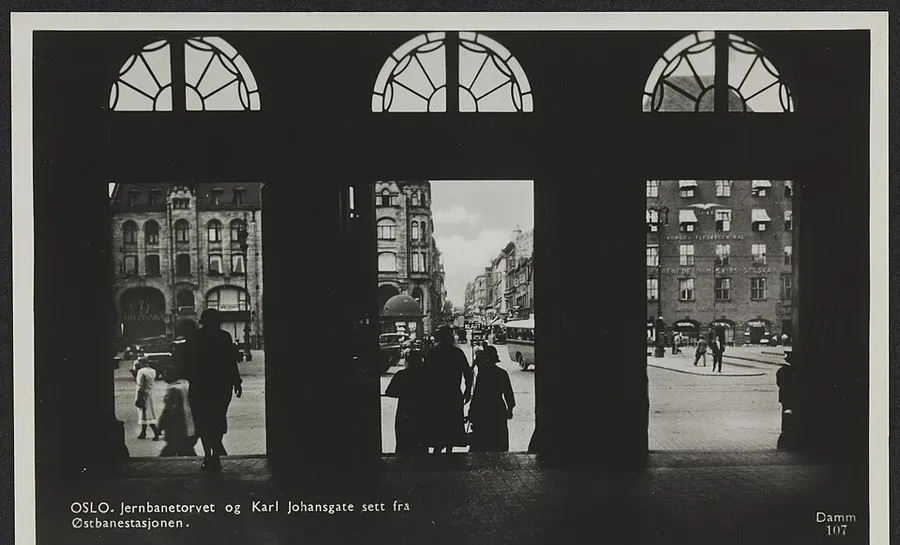 Unknown photographer, postcard "Jernbanetorvet og Karl Johansgate sett fra Østbanestasjonen", National Library of Norway, public domain This is the boulevard itself, photographed from the station end the family exits toward the Palace on foot and by e-bike — the same corridor Oslo S signage points travelers down on arrival. Oslo's principal boulevard, roughly 1.2 kilometers long, running from Jernbanetorget and Oslo S in the east to the Royal Palace at Slottsplassen in the west. Named in 1852 for the recently deceased King Karl Johan (Karl XIV Johan of Sweden and Norway), whose bronze equestrian statue by Brynjulf Bergslien has stood before the Palace since 1875. Its eastern stretch descends from streets laid inside Christian IV's seventeenth-century ramparts; the broader western avenue was built in the 1840s to connect the newly erected Palace to the rest of the city. The route passes the Storting (parliament), the National Theatre, the old University buildings, and the pond at Eidsvolls plass — Oslo's busiest pedestrian corridor and the default walking route between the station and the harbor. In this article Signs for Karl Johans gate point out of Oslo S toward the long walk west to the Royal Palace and the harbor — the alternative to the Jernbanetorget taxi-and-tram exit. On the trip Every traveler walks a stretch of Karl Johans gate in the first two Oslo days — it's the natural route on foot between Oslo S and the Royal Palace and harbor beyond. On the Day 2 e-bike ride the whole group rolls up it to the Palace, and it's the easiest stretch to find a late-open shop for last picnic supplies before an early train departure. Oslo Also discussed in Everyday etiquette — quiet voices, wide space, no smilingAlcohol and Vinmonopolet — when and where to buy a drinkPolitikk — the left, the right, and the Norwegian wayIdentitet — what it means to be Norwegian toward the Royal Palace and the harbor, and the move down to the Tjuvholmen hotel by the water, both belong to Day 1.
And you’re at the hotel, up on the ridge, the trip begun.