Oslo
The capital opens the trip. A WWII memorial, an island in the fjord, Vigeland's sculptures, and the long walk between the palace and the harbor.
Why this place
Oslo is where the trip assembles itself. Flights from across the U.S. and Europe converge in the capital before the first day even ends.
What happens here
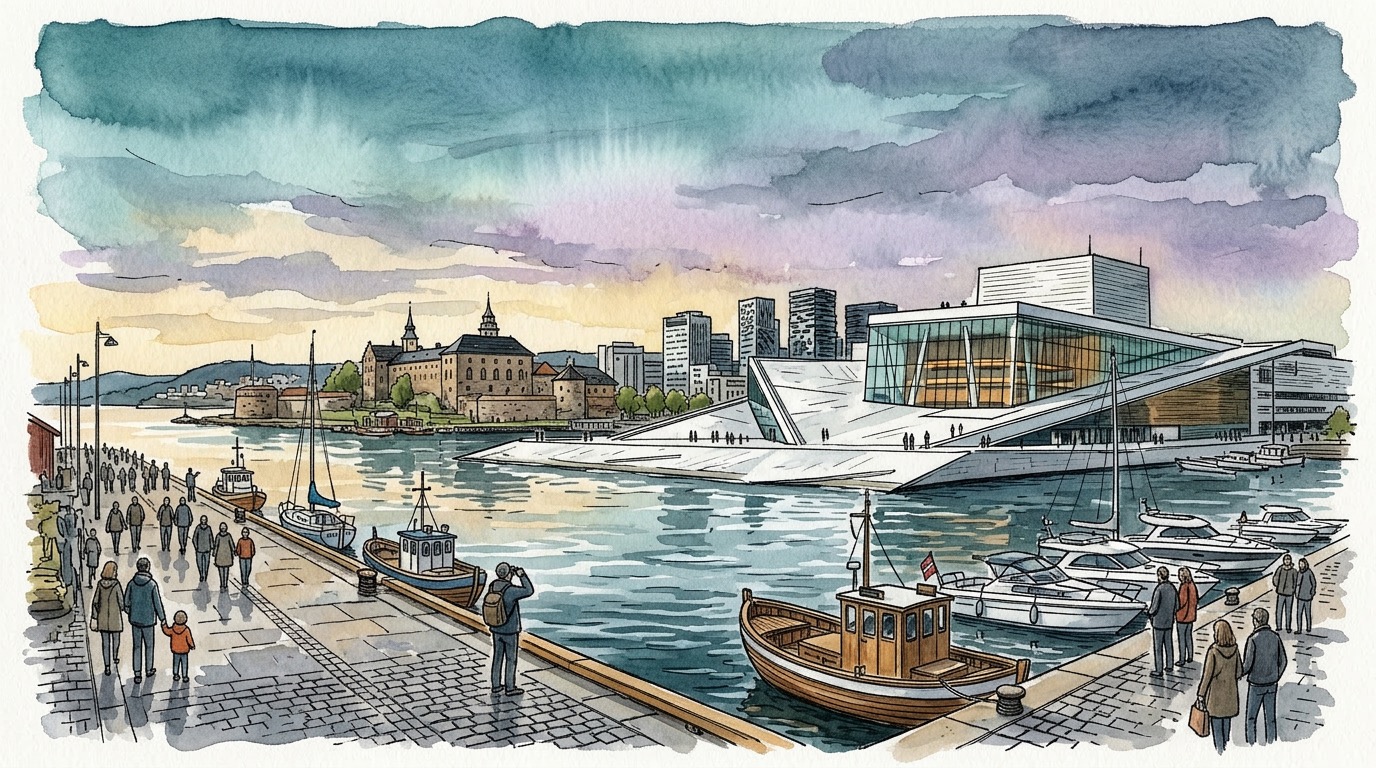
Day 1 stays close to the water. Roseslottet — the open-air WWII memorial in the hills above the city built by the brothers Vebjørn and Eimund Sand on the Holmenkollen ridge — opens the day. From there the group crosses to Hovedøya, the nearest of the Oslofjord islands, with its ruined medieval monastery and quiet swimming coves. In the afternoon the party splits: the older adults take in the Opera House roof and the new Munch Museum on the Bjørvika waterfront while the younger ones wander the city on their own. Dinner is together on the harbor near City Hall. Across the three nights in Oslo: arrival night on the Holmenkollen ridge high above the city; Days 1 and 2 down at the Tjuvholmen waterfront.
Day 2 takes the city on two wheels. A Viking Biking private e-bike tour leaves at 9:30am from Nedre Slottsgate, fifteen minutes’ walk from the hotel, and rides through the old town for the next three hours: Akershus Fortress on the harbor; City Hall, where the Nobel Peace Prize is presented each December; the long sweep of Karl Johans gate to the Royal Palace at its head; the Palace gardens out to Vigeland Sculpture Park and its 200-odd sculptures in bronze, granite and wrought iron; the Frogner neighborhood west of the centre; and back along the harbor through Tjuvholmen and Aker Brygge. The afternoon is unscheduled — sauna, wandering, whatever the day asks for.
Background
Oslo is small for a European capital — about 700,000 people in the city proper, around a million in the metro — and almost everything worth seeing is walkable from the harbor. The fjord folds directly into downtown.
The city is one of the oldest in Scandinavia. Founded around 1040 on the eastern shore of the Oslofjord, it grew into the seat of medieval Norwegian power under King Haakon V around 1300 — after Trondheim and then Bergen had each had their turn as the kingdom’s centre — and has been the capital ever since. A catastrophic fire in 1624 burned the old town to the ground; King Christian IV moved the city west to the foot of Akershus Fortress and rebuilt it on a Renaissance grid, renaming it Christiania in his own honour. The name held for three hundred years before Norway took it back in 1925, two decades after winning independence from Sweden.
What the trip sees today on the waterfront — the Opera House (2008), Aker Brygge, Tjuvholmen, the new Munch Museum (2021), the cluster around Bjørvika — is mostly a 21st-century redevelopment of what used to be shipyards and dockland. The older city sits inland from it, around the palace and Karl Johans gate. The shift from working harbor to walkable cultural front took about twenty years and reshaped the city’s image of itself.
In Oslo
Eat · Buy · Do
A short list of places to taste, things to bring home, and things to see.
Learn more
Journals from Oslo
No posts yet. During the trip, journal entries and photos from Oslo will appear here.