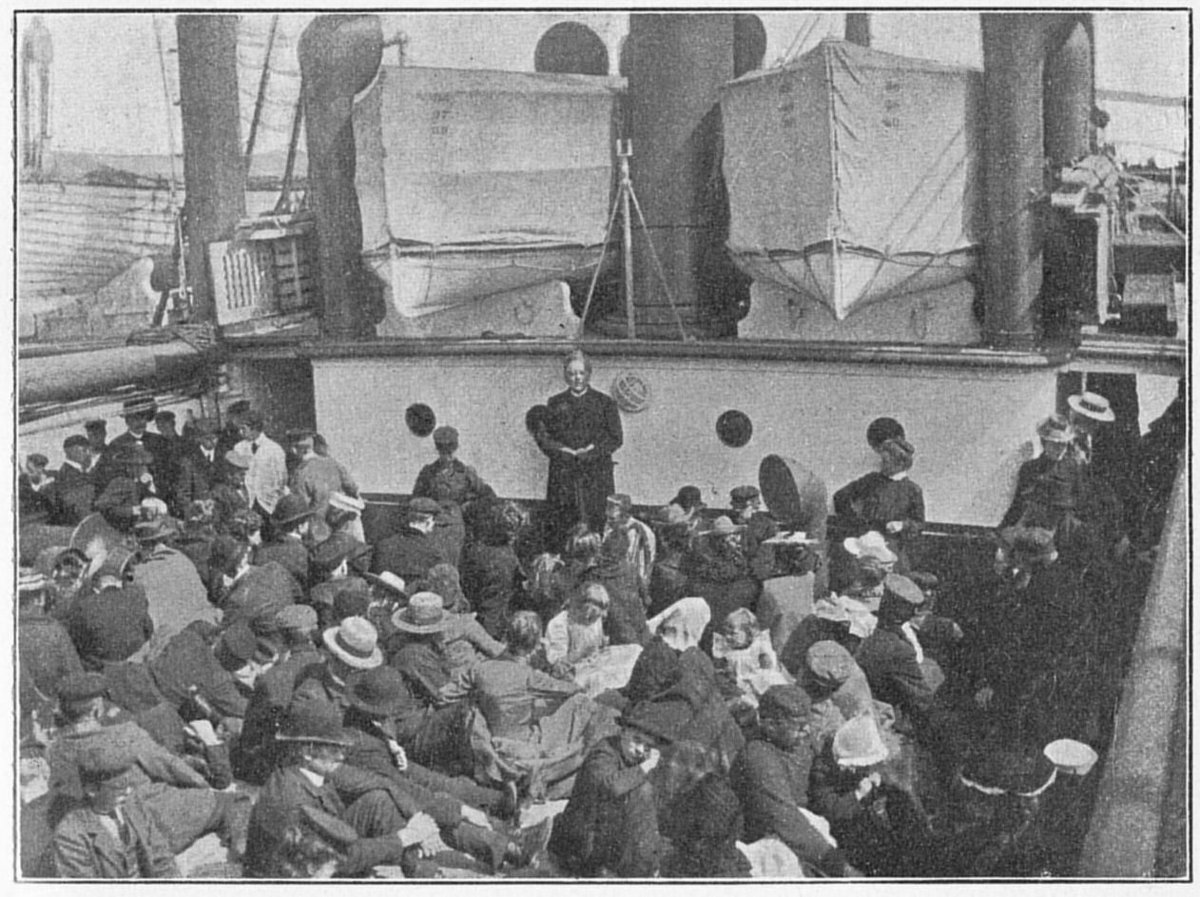
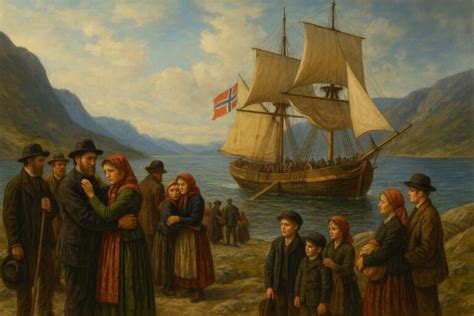
800,000 Norwegians Leave — The century that built a Second Norway
Across a single century, roughly 800,000 Norwegians leave for America, proportionally more of the country than any other in Europe except Ireland. The structural pressures that pushed them out, the people who went, and the Second Norway they built across the Atlantic.
On the fourth of July 1825 a single-masted sloop called the Restauration 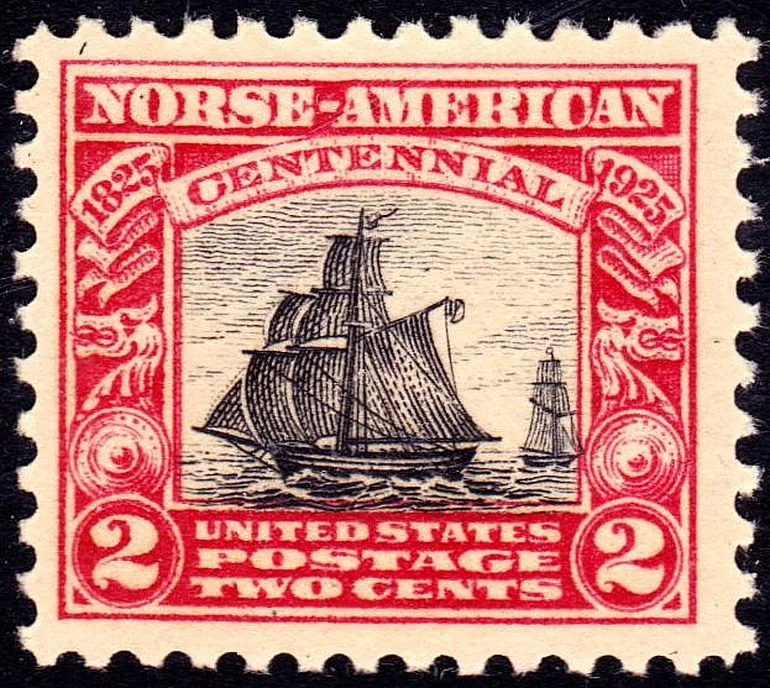 United States Post Office Department, Norse-American Centennial 2c stamp (1925) No period artist ever painted Restauration from life, so the US Post Office engraved this stamp for the ship's own 1925 centennial as the closest thing to an authoritative likeness -- a companion 5-cent stamp in the same series pictured a Viking ship instead. Single-masted Norwegian sloop, fifty-four feet long and
sixteen feet across the beam, that carried the founding
party of Norwegian emigrants to America. Sailed from
Stavanger harbour on 4 July 1825 with seven crew and
forty-five passengers — Norwegian Quakers fleeing the
religious-uniformity laws of the state Lutheran church,
Haugean pietists, and farming families seeking better
land. A baby was born aboard during the fourteen-week
Atlantic crossing. The ship docked at New York harbour on
9 October 1825 and was impounded for carrying more
passengers than the 1819 Steerage Act permitted; President
John Quincy Adams remitted the fine in mid-November.
Known to Norwegian-American history as the Norwegian
Mayflower.
puts out from the harbor of Stavanger
United States Post Office Department, Norse-American Centennial 2c stamp (1925) No period artist ever painted Restauration from life, so the US Post Office engraved this stamp for the ship's own 1925 centennial as the closest thing to an authoritative likeness -- a companion 5-cent stamp in the same series pictured a Viking ship instead. Single-masted Norwegian sloop, fifty-four feet long and
sixteen feet across the beam, that carried the founding
party of Norwegian emigrants to America. Sailed from
Stavanger harbour on 4 July 1825 with seven crew and
forty-five passengers — Norwegian Quakers fleeing the
religious-uniformity laws of the state Lutheran church,
Haugean pietists, and farming families seeking better
land. A baby was born aboard during the fourteen-week
Atlantic crossing. The ship docked at New York harbour on
9 October 1825 and was impounded for carrying more
passengers than the 1819 Steerage Act permitted; President
John Quincy Adams remitted the fine in mid-November.
Known to Norwegian-American history as the Norwegian
Mayflower.
puts out from the harbor of Stavanger 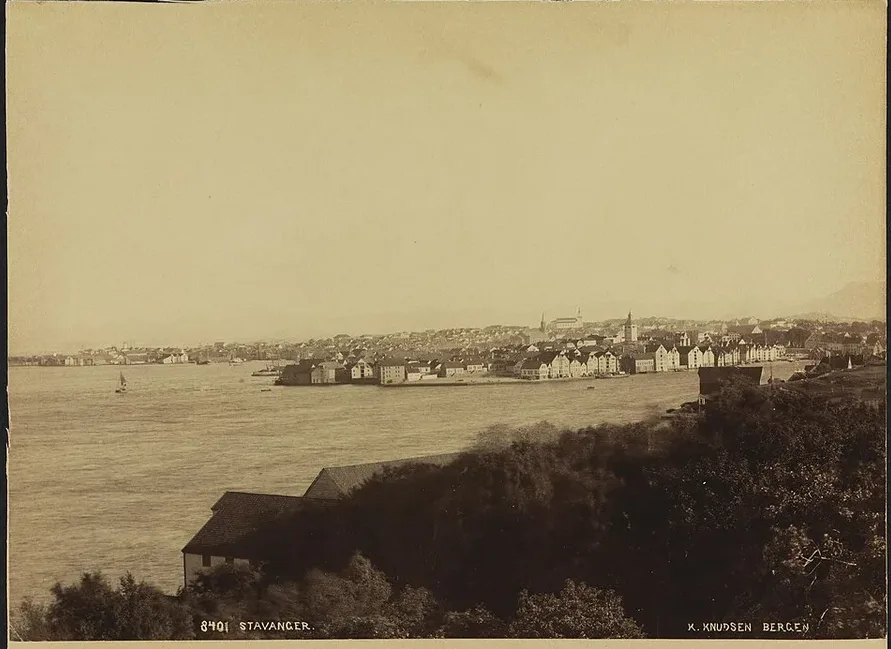 Knud Knudsen, Stavanger (1888-1894), National Library of Norway The harbour the *Restauration* left on 4 July 1825, photographed by Knudsen in the very decades of the peak wave — still the low wooden port town that sixty years of emigrant ships had been sailing from. City on the southwestern Norwegian coast in Rogaland; modern
Norway's fourth-largest city and the operational capital of the
Norwegian petroleum economy since the 1970s. The traditional site
of the sea-battle of Hafrsfjord that completed Harald Fairhair's
consolidation lies at the city's southwestern edge, marked by the
Sverd i fjell monument. The Norwegian Petroleum Directorate, the
safety regulator (Havtil), and Equinor (formerly Statoil) are all
headquartered in or around the city. Population around one hundred
and forty thousand in the municipality; metropolitan area roughly
twice that.
Stavanger Also discussed in Before There Was Norway — petty kingdoms at the edge of the worldThe Viking Age — longships, legends, and the first "Norway"A Catholic Norway — the faith that gave the kingdom its first institutions and the stave churchesThe 400-Year Night — when the Northern Lion lay dormantThe 'Lucky Country' — the discovery that changed everythingWorld War II — the King’s “No” and the Nazis in Norway on the southwestern Norwegian coast and sails southwest into the open Atlantic. The ship is fifty-four feet long and sixteen feet across the beam. The crew is seven men. The passengers are forty-five, of whom nineteen are children, and they include several families of Norwegian Quakers fleeing the religious-uniformity laws of the state Lutheran church, several Haugean Movement
Knud Knudsen, Stavanger (1888-1894), National Library of Norway The harbour the *Restauration* left on 4 July 1825, photographed by Knudsen in the very decades of the peak wave — still the low wooden port town that sixty years of emigrant ships had been sailing from. City on the southwestern Norwegian coast in Rogaland; modern
Norway's fourth-largest city and the operational capital of the
Norwegian petroleum economy since the 1970s. The traditional site
of the sea-battle of Hafrsfjord that completed Harald Fairhair's
consolidation lies at the city's southwestern edge, marked by the
Sverd i fjell monument. The Norwegian Petroleum Directorate, the
safety regulator (Havtil), and Equinor (formerly Statoil) are all
headquartered in or around the city. Population around one hundred
and forty thousand in the municipality; metropolitan area roughly
twice that.
Stavanger Also discussed in Before There Was Norway — petty kingdoms at the edge of the worldThe Viking Age — longships, legends, and the first "Norway"A Catholic Norway — the faith that gave the kingdom its first institutions and the stave churchesThe 400-Year Night — when the Northern Lion lay dormantThe 'Lucky Country' — the discovery that changed everythingWorld War II — the King’s “No” and the Nazis in Norway on the southwestern Norwegian coast and sails southwest into the open Atlantic. The ship is fifty-four feet long and sixteen feet across the beam. The crew is seven men. The passengers are forty-five, of whom nineteen are children, and they include several families of Norwegian Quakers fleeing the religious-uniformity laws of the state Lutheran church, several Haugean Movement 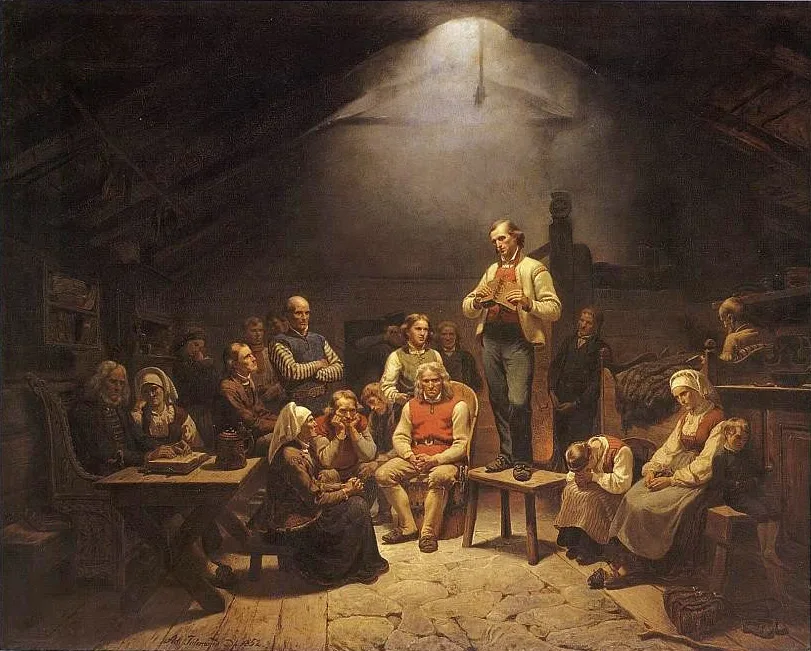 Adolph Tidemand, Haugianerne / Low Church Devotion (1852), Nasjonalmuseet Tidemand's Haugianerne — the lay preacher standing with open book in hand, a farm gathering pressed close under the loft's shaft of light — is the canonical image of the conventicle itself, the illegal farm-kitchen meeting form the movement was built from. The lay-Christian revival that emerged in Norway from Hans
Nielsen Hauge's preaching between 1796 and 1804 and
continued under his followers through the nineteenth
century. De vakte — the awakened — formed networks of
lay-led conventicles in farm kitchens, practising daily
devotional reading, household hymn-singing, and small-
group lay leadership. By Hauge's death (1824) the movement
had organised commercial undertakings — mills, paper-
works, salt-works, fisheries, shipyards, textile factories
— financed by capital pooled across the network. The
frugal, hard-working ethic that came out of this work fed
into Norway's cooperative and savings-bank traditions, and
the movement crossed the Atlantic with the emigrants.
Also discussed in Lutheran Norway and Pietism — a farmer named Hans Nielsen Hauge and a lay revival that could not be silencedIdentitet — what it means to be Norwegian(*Draft)Dugnad — showing up to help , and a handful of farming families who simply want better land than the small Norwegian plot they have inherited can offer. The party’s destination is Kendall, New York
Adolph Tidemand, Haugianerne / Low Church Devotion (1852), Nasjonalmuseet Tidemand's Haugianerne — the lay preacher standing with open book in hand, a farm gathering pressed close under the loft's shaft of light — is the canonical image of the conventicle itself, the illegal farm-kitchen meeting form the movement was built from. The lay-Christian revival that emerged in Norway from Hans
Nielsen Hauge's preaching between 1796 and 1804 and
continued under his followers through the nineteenth
century. De vakte — the awakened — formed networks of
lay-led conventicles in farm kitchens, practising daily
devotional reading, household hymn-singing, and small-
group lay leadership. By Hauge's death (1824) the movement
had organised commercial undertakings — mills, paper-
works, salt-works, fisheries, shipyards, textile factories
— financed by capital pooled across the network. The
frugal, hard-working ethic that came out of this work fed
into Norway's cooperative and savings-bank traditions, and
the movement crossed the Atlantic with the emigrants.
Also discussed in Lutheran Norway and Pietism — a farmer named Hans Nielsen Hauge and a lay revival that could not be silencedIdentitet — what it means to be Norwegian(*Draft)Dugnad — showing up to help , and a handful of farming families who simply want better land than the small Norwegian plot they have inherited can offer. The party’s destination is Kendall, New York 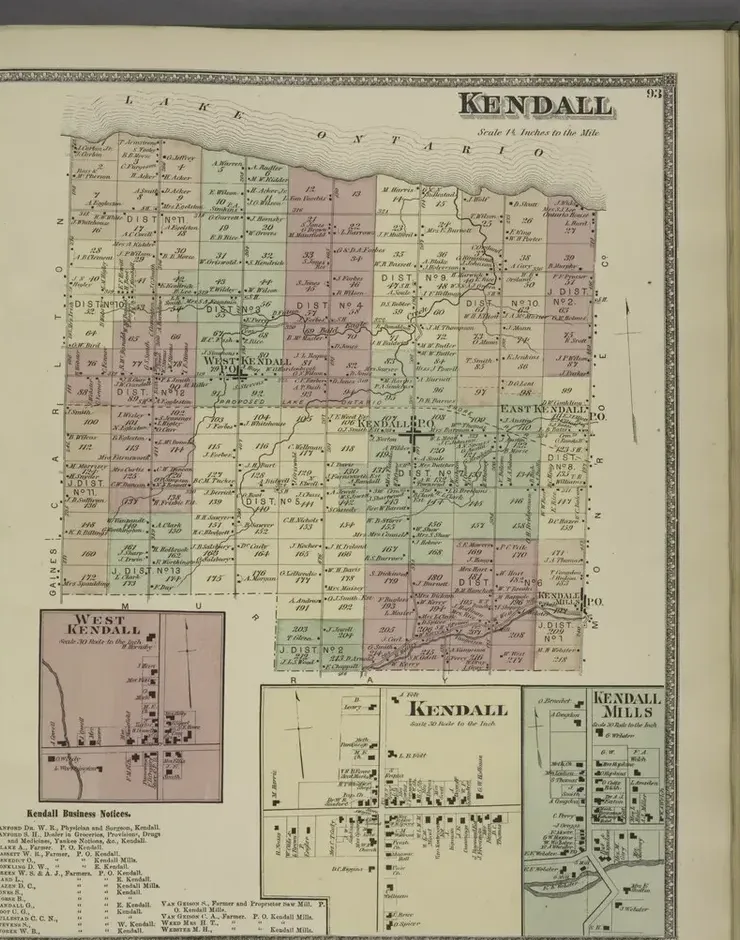 D.G. Beers and Co., Atlas of Niagara and Orleans counties, New York (1875), New York Public Library A county-atlas map of Kendall Township on the Lake Ontario shore — the ground Cleng Peerson chose and the Restauration's passengers settled in 1825 — surveyed fifty years on, when the founding Norwegian colony's farms had long since passed into the township grid. Township in Orleans County in western New York State, on
the Lake Ontario shore about thirty miles northwest of
Rochester. Scouted by Cleng Peerson in 1821–1824 as the
site of the first organised Norwegian emigrant settlement
in the United States. The fifty-three passengers and crew
of the Restauration, on landing at New York harbour in
October 1825, made their way upstate to Kendall, where
Peerson had purchased land for the colony in advance. The
settlement struggled with poor soils and a damp climate
through its first decade and most of the families later
moved west to the Fox River settlement Peerson founded in
Illinois in 1834. The Kendall community is the founding
Norwegian-American colony — the institutional ancestor of
the whole nineteenth-century Norwegian-American world.
— a settlement organized by a forty-two-year-old former farm laborer from Tysvær named Cleng Peerson
D.G. Beers and Co., Atlas of Niagara and Orleans counties, New York (1875), New York Public Library A county-atlas map of Kendall Township on the Lake Ontario shore — the ground Cleng Peerson chose and the Restauration's passengers settled in 1825 — surveyed fifty years on, when the founding Norwegian colony's farms had long since passed into the township grid. Township in Orleans County in western New York State, on
the Lake Ontario shore about thirty miles northwest of
Rochester. Scouted by Cleng Peerson in 1821–1824 as the
site of the first organised Norwegian emigrant settlement
in the United States. The fifty-three passengers and crew
of the Restauration, on landing at New York harbour in
October 1825, made their way upstate to Kendall, where
Peerson had purchased land for the colony in advance. The
settlement struggled with poor soils and a damp climate
through its first decade and most of the families later
moved west to the Fox River settlement Peerson founded in
Illinois in 1834. The Kendall community is the founding
Norwegian-American colony — the institutional ancestor of
the whole nineteenth-century Norwegian-American world.
— a settlement organized by a forty-two-year-old former farm laborer from Tysvær named Cleng Peerson 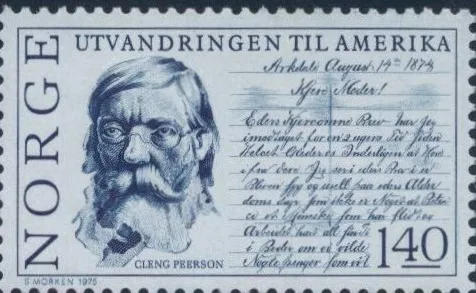 Herbjørn Gausta (portrait), reproduced on Norway Post stamp NK746 (1975) Peerson's engraved likeness, issued on this 1975 stamp marking 150 years of Norwegian emigration, reproduces Herbjørn Gausta's portrait of the scout who recruited and received the Restauration party in America. Norwegian-American emigration scout and settlement organiser
(1783–1865), often called the father of Norwegian
emigration to America. Born Kleng Pedersen Hesthammer to a
cotter family in Tysvær on the southwestern coast. Crossed
to the United States in 1821 to scout for Norwegian Quaker
emigrants seeking refuge from the religious-uniformity laws
of the Norwegian state Lutheran church; returned to Norway
in 1824 to recruit the Restauration party; preceded them
back to America in 1825 to receive them at the Kendall
colony in Orleans County, New York. Subsequently founded
the Fox River settlement in Illinois (1834), scouted further
west across the 1840s and 1850s, and ended his life in
central Texas. Died 1865 in Bosque County, Texas; buried
at the small village of Norse.
, who scouted upstate New York in the years before, returned to Norway to recruit the settlers, and went back to America ahead of the Restauration to receive them on arrival. The voyage takes fourteen weeks. A baby is born aboard during the crossing. The ship docks in New York harbor on the ninth of October 1825.
Herbjørn Gausta (portrait), reproduced on Norway Post stamp NK746 (1975) Peerson's engraved likeness, issued on this 1975 stamp marking 150 years of Norwegian emigration, reproduces Herbjørn Gausta's portrait of the scout who recruited and received the Restauration party in America. Norwegian-American emigration scout and settlement organiser
(1783–1865), often called the father of Norwegian
emigration to America. Born Kleng Pedersen Hesthammer to a
cotter family in Tysvær on the southwestern coast. Crossed
to the United States in 1821 to scout for Norwegian Quaker
emigrants seeking refuge from the religious-uniformity laws
of the Norwegian state Lutheran church; returned to Norway
in 1824 to recruit the Restauration party; preceded them
back to America in 1825 to receive them at the Kendall
colony in Orleans County, New York. Subsequently founded
the Fox River settlement in Illinois (1834), scouted further
west across the 1840s and 1850s, and ended his life in
central Texas. Died 1865 in Bosque County, Texas; buried
at the small village of Norse.
, who scouted upstate New York in the years before, returned to Norway to recruit the settlers, and went back to America ahead of the Restauration to receive them on arrival. The voyage takes fourteen weeks. A baby is born aboard during the crossing. The ship docks in New York harbor on the ninth of October 1825.
Within a week the captain has been arrested for violating American passenger laws — the Restauration carried more people than her size permitted under the 1819 Steerage Act — and the ship has been impounded. President John Quincy Adams 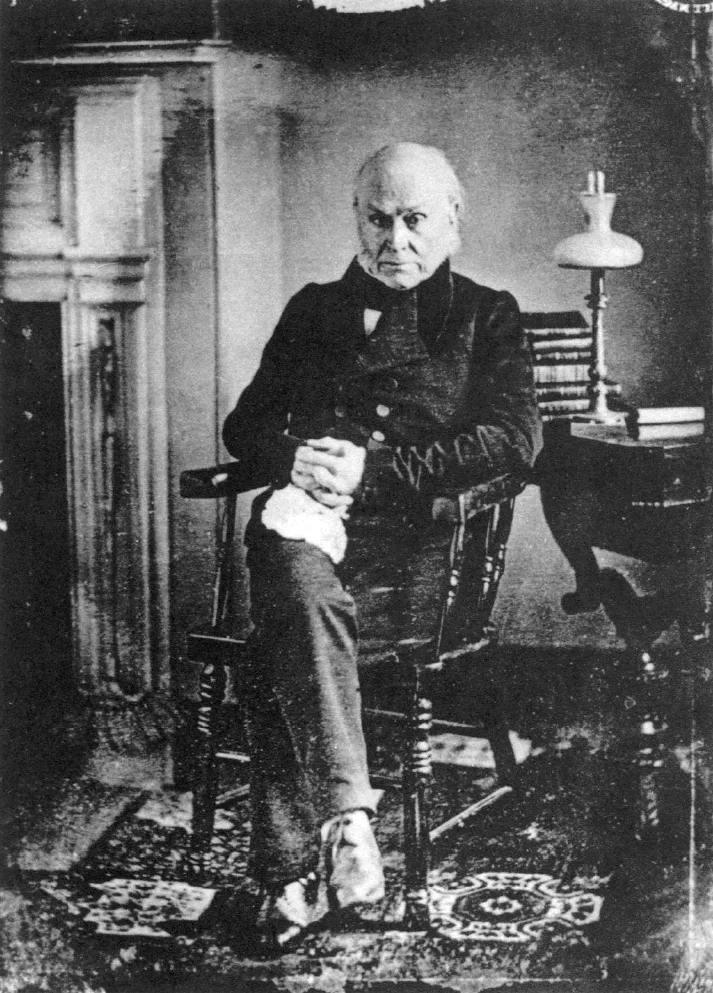 Philip Haas, daguerreotype of John Quincy Adams (1843) As President in November 1825, John Quincy Adams remitted the fine and released the sloop Restauration, impounded at New York for exceeding the 1819 Steerage Act’s passenger limit — the pardon that let the fifty-three Norwegians reach the Kendall colony, the start of Norwegian-American settlement. Sixth President of the United States (1767–1848), in office
1825–1829. Son of the second president John Adams and
Abigail Adams; previously Secretary of State under James
Monroe (1817–1825) and chief American negotiator of the
1814 Treaty of Ghent ending the War of 1812. In November
1825 personally remitted the fine and released the
Norwegian sloop Restauration, which had been impounded
upon arrival at New York for carrying more passengers than
the 1819 Steerage Act permitted. The pardon allowed the
fifty-three Norwegian Quaker and Haugean settlers to
proceed to the Kendall colony in Orleans County — the
founding episode of Norwegian-American settlement. Later
served in Congress until his death and led the
congressional anti-slavery movement of the 1830s and 1840s.
personally remits the penalty and releases the ship in mid-November. The fifty-three Norwegians — forty-five passengers, seven crew, and the baby born at sea — go on to the Kendall colony, the first organized Norwegian-American settlement in the United States.
Philip Haas, daguerreotype of John Quincy Adams (1843) As President in November 1825, John Quincy Adams remitted the fine and released the sloop Restauration, impounded at New York for exceeding the 1819 Steerage Act’s passenger limit — the pardon that let the fifty-three Norwegians reach the Kendall colony, the start of Norwegian-American settlement. Sixth President of the United States (1767–1848), in office
1825–1829. Son of the second president John Adams and
Abigail Adams; previously Secretary of State under James
Monroe (1817–1825) and chief American negotiator of the
1814 Treaty of Ghent ending the War of 1812. In November
1825 personally remitted the fine and released the
Norwegian sloop Restauration, which had been impounded
upon arrival at New York for carrying more passengers than
the 1819 Steerage Act permitted. The pardon allowed the
fifty-three Norwegian Quaker and Haugean settlers to
proceed to the Kendall colony in Orleans County — the
founding episode of Norwegian-American settlement. Later
served in Congress until his death and led the
congressional anti-slavery movement of the 1830s and 1840s.
personally remits the penalty and releases the ship in mid-November. The fifty-three Norwegians — forty-five passengers, seven crew, and the baby born at sea — go on to the Kendall colony, the first organized Norwegian-American settlement in the United States.
A century of leaving
The voyage of the Restauration is the Norwegian Mayflower. It is the founding event of what becomes, over the next century, the second-largest proportional European migration to America after Ireland’s. Between 1825 and 1925, approximately eight hundred thousand Norwegians cross the Atlantic. The country’s total population in 1801 was eight hundred and eighty thousand. The country’s total population in 1900 was two million two hundred thousand. In the conventional summary the figure is given as a fifth of the country across the century. In per-capita terms, no European country except Ireland sent so many of its people across the Atlantic — far more, proportionally, than France, Germany, Italy, Poland, or the Scandinavian neighbors Denmark and Sweden. The structural causes operate in sequence: religious dissent launches the tradition and the route in the 1820s and 1830s; demographic strain and American land drive the volume from mid-century forward.
A doubling country
Demographic pressure builds across the period. Norwegian population more than doubles between 1801 and 1900, from eight hundred and eighty thousand to two million two hundred thousand, on the basis of better nutrition (the introduction of the potato from continental Europe in the eighteenth century roughly doubles the calories per acre that a Norwegian farmer can produce), lower infant mortality (the broad reduction of childhood epidemic disease across the same century), and longer adult life expectancy. The rocky thin soil of the Norwegian fjord-and-mountain landscape, which produces perhaps a quarter of the per-acre yield of the better European farmland, cannot support a population growing at that rate. The food simply runs out for the marginal farms. Younger sons in particular have no land to inherit. Norwegian inheritance custom — the Odelsrett 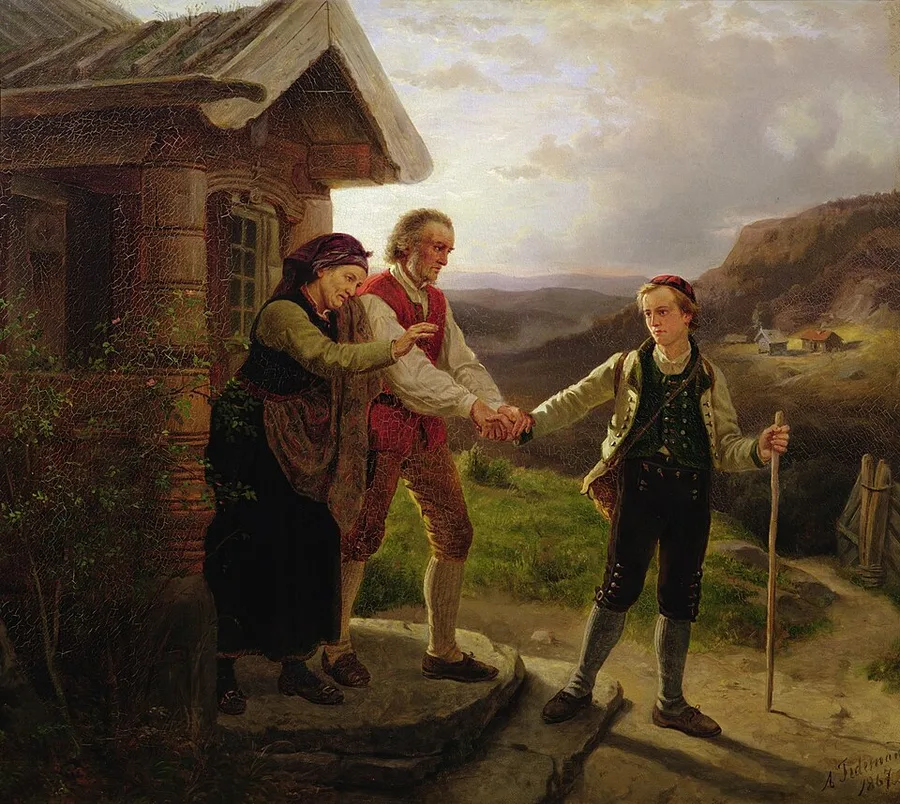 Adolph Tidemand, Den yngste sønnen farvel (1867) Tidemand's 1867 genre scene shows a farm household sending off its youngest son -- exactly the position odelsrett put every non-inheriting child in, since the family farm passed whole to the eldest and everyone else had to make a life, or a passage to America, elsewhere. Allodial right — the Norwegian inheritance system,
recorded in medieval law and continuously operating since,
by which the family farm passes intact to the eldest son
with cash compensation to the other siblings. Protected
in the 1814 Constitution and still in operation today.
The mechanism preserves the working farm as a viable
agricultural unit across generations rather than
fragmenting it into uneconomic parcels, but produces a
structural landless younger generation: across the
nineteenth century the odelsrett combined with rapid
population growth to swell the husmann (cottager) class
and to drive a substantial fraction of younger Norwegian
sons either into the small coastal towns or, in much
greater numbers, across the Atlantic to the upper Midwest
of the United States.
and åsete rights — passes the farm intact to a single heir, traditionally the eldest son, with cash compensation to the other siblings; the mechanism preserves the holding but produces a landless younger generation that swells the Husmann
Adolph Tidemand, Den yngste sønnen farvel (1867) Tidemand's 1867 genre scene shows a farm household sending off its youngest son -- exactly the position odelsrett put every non-inheriting child in, since the family farm passed whole to the eldest and everyone else had to make a life, or a passage to America, elsewhere. Allodial right — the Norwegian inheritance system,
recorded in medieval law and continuously operating since,
by which the family farm passes intact to the eldest son
with cash compensation to the other siblings. Protected
in the 1814 Constitution and still in operation today.
The mechanism preserves the working farm as a viable
agricultural unit across generations rather than
fragmenting it into uneconomic parcels, but produces a
structural landless younger generation: across the
nineteenth century the odelsrett combined with rapid
population growth to swell the husmann (cottager) class
and to drive a substantial fraction of younger Norwegian
sons either into the small coastal towns or, in much
greater numbers, across the Atlantic to the upper Midwest
of the United States.
and åsete rights — passes the farm intact to a single heir, traditionally the eldest son, with cash compensation to the other siblings; the mechanism preserves the holding but produces a landless younger generation that swells the Husmann 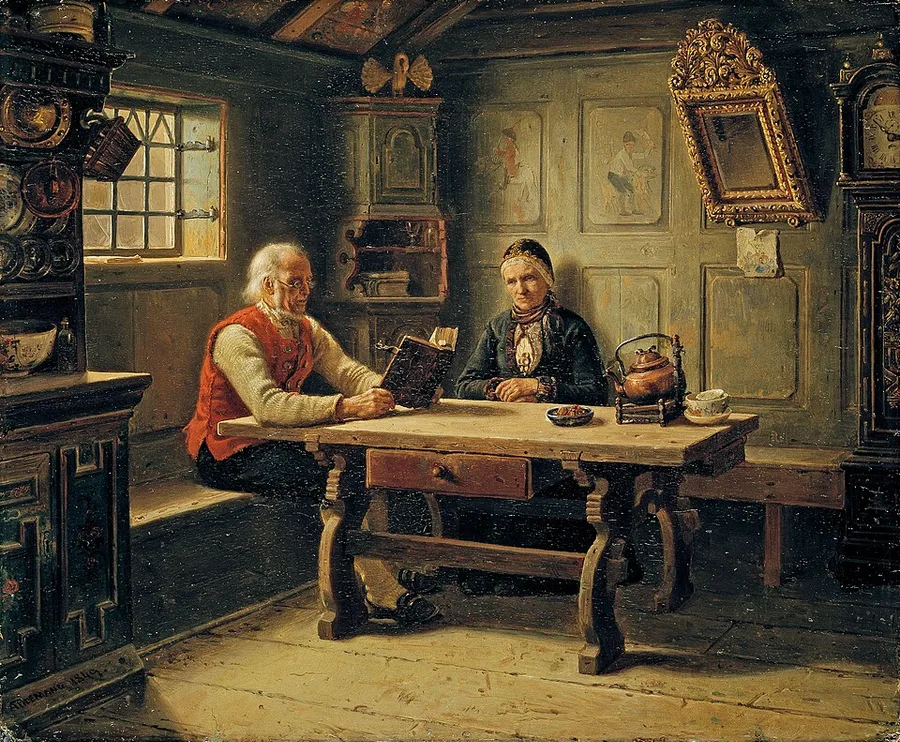 Adolph Tidemand, Old Age Solitude / Husandakt (1849), National Museum of Art, Architecture and Design Tidemand's 1849 interior -- a widow and a smallholder named in the National Museum's own catalogue as a husmann, Rasmus Johnsen Kårmoviken -- pictures the landless rural class that supplied most of the nineteenth-century emigrant flow. Cottager or crofter — the landless rural Norwegian
class who held a small dwelling and a tiny patch of
ground (the husmannsplass) on a working farm in exchange
for labour on the farmer's main holding. Created
structurally by odelsrett, which sent the family farm
intact to the eldest son and left the other children
without land; expanded enormously across the early
nineteenth century as the Norwegian population doubled
while the cultivable area did not. By 1850 husmenn and
their households made up roughly a quarter of the rural
Norwegian population. The class supplied the bulk of the
mid-nineteenth-century emigrant flow to America. The
institution declined steadily from the 1880s and
disappeared in the early twentieth century.
class, the cottagers and crofters who work another farmer’s ground for a small holding and a share of the crop. The choice for the younger generation is to remain as husmann labor, to migrate to the small Norwegian coastal towns and look for industrial work that does not yet exist at scale, or to leave the country entirely.
Adolph Tidemand, Old Age Solitude / Husandakt (1849), National Museum of Art, Architecture and Design Tidemand's 1849 interior -- a widow and a smallholder named in the National Museum's own catalogue as a husmann, Rasmus Johnsen Kårmoviken -- pictures the landless rural class that supplied most of the nineteenth-century emigrant flow. Cottager or crofter — the landless rural Norwegian
class who held a small dwelling and a tiny patch of
ground (the husmannsplass) on a working farm in exchange
for labour on the farmer's main holding. Created
structurally by odelsrett, which sent the family farm
intact to the eldest son and left the other children
without land; expanded enormously across the early
nineteenth century as the Norwegian population doubled
while the cultivable area did not. By 1850 husmenn and
their households made up roughly a quarter of the rural
Norwegian population. The class supplied the bulk of the
mid-nineteenth-century emigrant flow to America. The
institution declined steadily from the 1880s and
disappeared in the early twentieth century.
class, the cottagers and crofters who work another farmer’s ground for a small holding and a share of the crop. The choice for the younger generation is to remain as husmann labor, to migrate to the small Norwegian coastal towns and look for industrial work that does not yet exist at scale, or to leave the country entirely.
The Quakers and the Haugeans
Religious dissent comes first. The Haugean revival of the late eighteenth century — Hans Nielsen Hauge 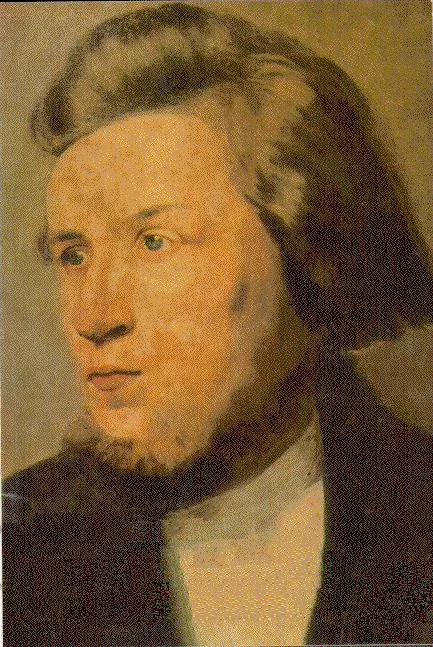 Unknown artist, Portrait of Hans Nielsen Hauge (Copenhagen, c. 1800) The only known original life portrait of Hauge, painted in Copenhagen around 1800 — the farmer's son in his late twenties, midway through the eight walking years in which he preached across Norway and was arrested again and again under the Konventikkelplakaten. Norwegian lay preacher, entrepreneur, and farmer (1771–
1824). The single most influential Norwegian religious
figure of the modern period. Underwent a conversion
experience on his family farm at Rolvsøy in Østfold on 5
April 1796 and spent the next eight years walking across
Norway, preaching and organising lay Christian gatherings
outside the official state church — illegal under the
Konventikkelplakaten of 1741. Arrested fourteen times
across his career; held in prison for roughly nine years
cumulatively — the long final detention, in the Christiania
town prison from 1804 to 1811, was settled at last in 1814
by a judgment reduced to a fine. His followers,
the Haugianere, founded businesses, mills, schools, and
printing presses across nineteenth-century Norway.
Also discussed in The Reformation, 1537 — one church eradicated and another imposedLutheran Norway and Pietism — a farmer named Hans Nielsen Hauge and a lay revival that could not be silencedStatskirken — the state church and what's left of it ’s lay-preaching movement inside the state Lutheran church — produces, by the 1820s and 1830s, a Norwegian Lutheran population that is more religiously self-confident than its state-church bishops permit. The official Lutheran state church continues to suppress religious dissent through the Konventikkelplakaten The Conventicle Ordinance — the royal decree of 13
January 1741 by Christian VI of Denmark-Norway regulating
private religious gatherings within his kingdoms. The
Ordinance permitted lay devotional meetings on the
condition that the parish pastor supervised them; any
unsupervised conventicle was a criminal act, punishable by
fines and imprisonment. Originally framed as a Pietist
instrument to channel lay devotion through the parish, the
Ordinance became within a generation the chief legal tool
for suppressing the lay revival it had been written to
support. Hans Nielsen Hauge was arrested fourteen times
under it. The crown vetoed the Storting's first two repeal
passages in 1836 and 1839; on the third passage in 1842 the
veto was exhausted and the Ordinance fell.
Also discussed in Lutheran Norway and Pietism — a farmer named Hans Nielsen Hauge and a lay revival that could not be silenced until its repeal in 1842, through the prohibition on non-Lutheran organized worship until the Dissenter Act Dissenterloven — the Norwegian Storting act of 16 July
1845 permitting non-Lutheran Christian congregations to
organise legally for the first time since the 1537
Reformation. The Act allowed Catholics, Quakers, Baptists,
Methodists, and other Christian groups to establish
congregations, conduct their own worship, baptise and bury
their members, and educate their children — subject to
registration with the state and the continued legal
monopoly of the Den norske kirke over civil-rite
functions. The Act did not extend to non-Christian
religions; the constitutional ban on Jewish settlement
remained in force until 1851. The first major legal
loosening of the three-century Lutheran establishment.
Also discussed in Lutheran Norway and Pietism — a farmer named Hans Nielsen Hauge and a lay revival that could not be silenced , and through the various social and legal penalties applied to Quakers, Methodists, Baptists, and other religious minorities through the first half of the nineteenth century. The Restauration sailing in 1825 is overwhelmingly a religious-dissent migration. The Quakers who organize the voyage are fleeing legal harassment. The Haugeans who join them are fleeing the same. The pattern persists: through the 1840s and 1850s and 1860s, a substantial fraction of Norwegian emigrants are members of religious minorities who find the American freedom of religion preferable to the Norwegian state-Lutheran establishment. By the second half of the nineteenth century the religious cause has weakened (the Dissenter Act has been in operation for decades), but the migration tradition the religious dissenters established remains.
Unknown artist, Portrait of Hans Nielsen Hauge (Copenhagen, c. 1800) The only known original life portrait of Hauge, painted in Copenhagen around 1800 — the farmer's son in his late twenties, midway through the eight walking years in which he preached across Norway and was arrested again and again under the Konventikkelplakaten. Norwegian lay preacher, entrepreneur, and farmer (1771–
1824). The single most influential Norwegian religious
figure of the modern period. Underwent a conversion
experience on his family farm at Rolvsøy in Østfold on 5
April 1796 and spent the next eight years walking across
Norway, preaching and organising lay Christian gatherings
outside the official state church — illegal under the
Konventikkelplakaten of 1741. Arrested fourteen times
across his career; held in prison for roughly nine years
cumulatively — the long final detention, in the Christiania
town prison from 1804 to 1811, was settled at last in 1814
by a judgment reduced to a fine. His followers,
the Haugianere, founded businesses, mills, schools, and
printing presses across nineteenth-century Norway.
Also discussed in The Reformation, 1537 — one church eradicated and another imposedLutheran Norway and Pietism — a farmer named Hans Nielsen Hauge and a lay revival that could not be silencedStatskirken — the state church and what's left of it ’s lay-preaching movement inside the state Lutheran church — produces, by the 1820s and 1830s, a Norwegian Lutheran population that is more religiously self-confident than its state-church bishops permit. The official Lutheran state church continues to suppress religious dissent through the Konventikkelplakaten The Conventicle Ordinance — the royal decree of 13
January 1741 by Christian VI of Denmark-Norway regulating
private religious gatherings within his kingdoms. The
Ordinance permitted lay devotional meetings on the
condition that the parish pastor supervised them; any
unsupervised conventicle was a criminal act, punishable by
fines and imprisonment. Originally framed as a Pietist
instrument to channel lay devotion through the parish, the
Ordinance became within a generation the chief legal tool
for suppressing the lay revival it had been written to
support. Hans Nielsen Hauge was arrested fourteen times
under it. The crown vetoed the Storting's first two repeal
passages in 1836 and 1839; on the third passage in 1842 the
veto was exhausted and the Ordinance fell.
Also discussed in Lutheran Norway and Pietism — a farmer named Hans Nielsen Hauge and a lay revival that could not be silenced until its repeal in 1842, through the prohibition on non-Lutheran organized worship until the Dissenter Act Dissenterloven — the Norwegian Storting act of 16 July
1845 permitting non-Lutheran Christian congregations to
organise legally for the first time since the 1537
Reformation. The Act allowed Catholics, Quakers, Baptists,
Methodists, and other Christian groups to establish
congregations, conduct their own worship, baptise and bury
their members, and educate their children — subject to
registration with the state and the continued legal
monopoly of the Den norske kirke over civil-rite
functions. The Act did not extend to non-Christian
religions; the constitutional ban on Jewish settlement
remained in force until 1851. The first major legal
loosening of the three-century Lutheran establishment.
Also discussed in Lutheran Norway and Pietism — a farmer named Hans Nielsen Hauge and a lay revival that could not be silenced , and through the various social and legal penalties applied to Quakers, Methodists, Baptists, and other religious minorities through the first half of the nineteenth century. The Restauration sailing in 1825 is overwhelmingly a religious-dissent migration. The Quakers who organize the voyage are fleeing legal harassment. The Haugeans who join them are fleeing the same. The pattern persists: through the 1840s and 1850s and 1860s, a substantial fraction of Norwegian emigrants are members of religious minorities who find the American freedom of religion preferable to the Norwegian state-Lutheran establishment. By the second half of the nineteenth century the religious cause has weakened (the Dissenter Act has been in operation for decades), but the migration tradition the religious dissenters established remains.
More land than farmers
On the American side, the United States in the first half of the nineteenth century has more land than it has farmers. The early Norwegian settlements in New York and northern Illinois and southern Wisconsin, the Fox River Settlement 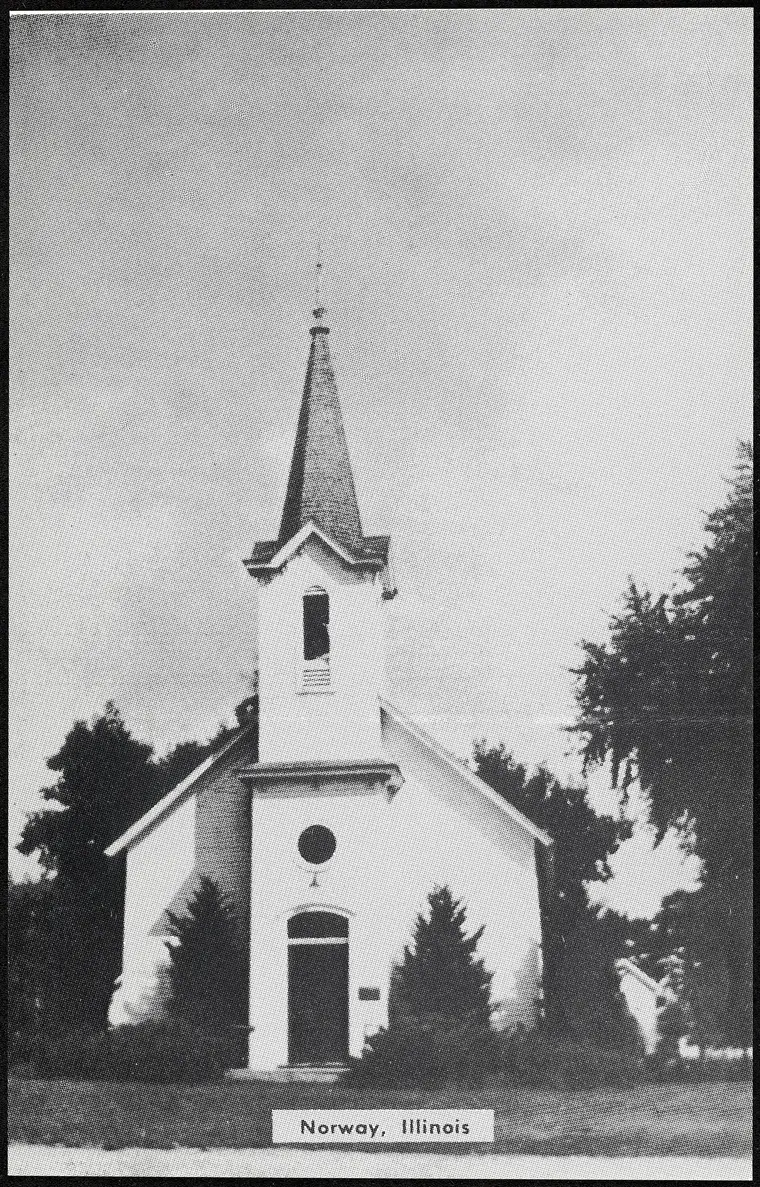 Postcard, Lutheran church at Norway, Illinois (undated), National Library of Norway The Lutheran church at Norway, Illinois — the village that grew up on the Fox River settlement ground. The National Library of Norway filed this postcard under a single line: first permanent Norwegian settlement in America. Norwegian-American settlement founded in 1834 along the Fox
River in La Salle County, north-central Illinois, about
eighty miles southwest of Chicago. Established by Cleng
Peerson after he had abandoned the original Kendall colony
in New York as agriculturally unsuitable; the new site,
with deep prairie soil and a mild continental climate,
proved the model for the upper-Midwest settlement pattern
that followed. Most of the original Kendall settlers
relocated to Fox River across the 1830s, and the colony
served as the staging point for the second generation of
Norwegian-American settlements at Muskego (1839) and
Koshkonong (1840) in southern Wisconsin. The community
produced the first generation of Norwegian-American Lutheran
pastors and lay leaders.
, the Muskego settlement in 1839, and the Koshkonong Settlement
Postcard, Lutheran church at Norway, Illinois (undated), National Library of Norway The Lutheran church at Norway, Illinois — the village that grew up on the Fox River settlement ground. The National Library of Norway filed this postcard under a single line: first permanent Norwegian settlement in America. Norwegian-American settlement founded in 1834 along the Fox
River in La Salle County, north-central Illinois, about
eighty miles southwest of Chicago. Established by Cleng
Peerson after he had abandoned the original Kendall colony
in New York as agriculturally unsuitable; the new site,
with deep prairie soil and a mild continental climate,
proved the model for the upper-Midwest settlement pattern
that followed. Most of the original Kendall settlers
relocated to Fox River across the 1830s, and the colony
served as the staging point for the second generation of
Norwegian-American settlements at Muskego (1839) and
Koshkonong (1840) in southern Wisconsin. The community
produced the first generation of Norwegian-American Lutheran
pastors and lay leaders.
, the Muskego settlement in 1839, and the Koshkonong Settlement 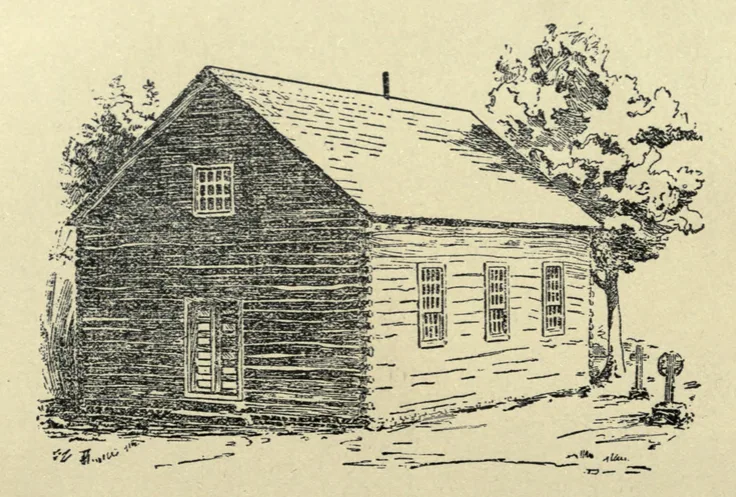 Unknown photographer, in Rasmus B. Anderson, The First Chapter of Norwegian Immigration (Madison, 1896) The pioneer log church Anderson's 1896 emigration history captions 'the first Norwegian Church dedicated in Dane Co., Wis.' — the Koshkonong congregations organized in 1844 built the county's first Norwegian churches and made the settlement the mother colony of Norwegian America. Norwegian-American agricultural settlement founded in 1840
on the rolling glacial-drift country around Lake
Koshkonong in Dane, Jefferson, and Rock counties in
southern Wisconsin, about thirty miles southeast of
Madison. The largest single Norwegian-American settlement
of the nineteenth century at its peak; by 1850 several
thousand Norwegian-born settlers lived in the surrounding
parishes, and the area sent the first generation of
Norwegian-American Lutheran pastors, newspaper editors,
college founders, and political leaders into the wider
Norwegian-American community. The Koshkonong Prairie
Historic District today preserves the country churches and
pioneer cemeteries of the settlement; nearby Stoughton
hosts the largest annual Syttende mai festival outside
Norway.
, develop on the basis of inexpensive but not free land that small Norwegian families with modest capital can clear and plant. The Homestead Act
Unknown photographer, in Rasmus B. Anderson, The First Chapter of Norwegian Immigration (Madison, 1896) The pioneer log church Anderson's 1896 emigration history captions 'the first Norwegian Church dedicated in Dane Co., Wis.' — the Koshkonong congregations organized in 1844 built the county's first Norwegian churches and made the settlement the mother colony of Norwegian America. Norwegian-American agricultural settlement founded in 1840
on the rolling glacial-drift country around Lake
Koshkonong in Dane, Jefferson, and Rock counties in
southern Wisconsin, about thirty miles southeast of
Madison. The largest single Norwegian-American settlement
of the nineteenth century at its peak; by 1850 several
thousand Norwegian-born settlers lived in the surrounding
parishes, and the area sent the first generation of
Norwegian-American Lutheran pastors, newspaper editors,
college founders, and political leaders into the wider
Norwegian-American community. The Koshkonong Prairie
Historic District today preserves the country churches and
pioneer cemeteries of the settlement; nearby Stoughton
hosts the largest annual Syttende mai festival outside
Norway.
, develop on the basis of inexpensive but not free land that small Norwegian families with modest capital can clear and plant. The Homestead Act 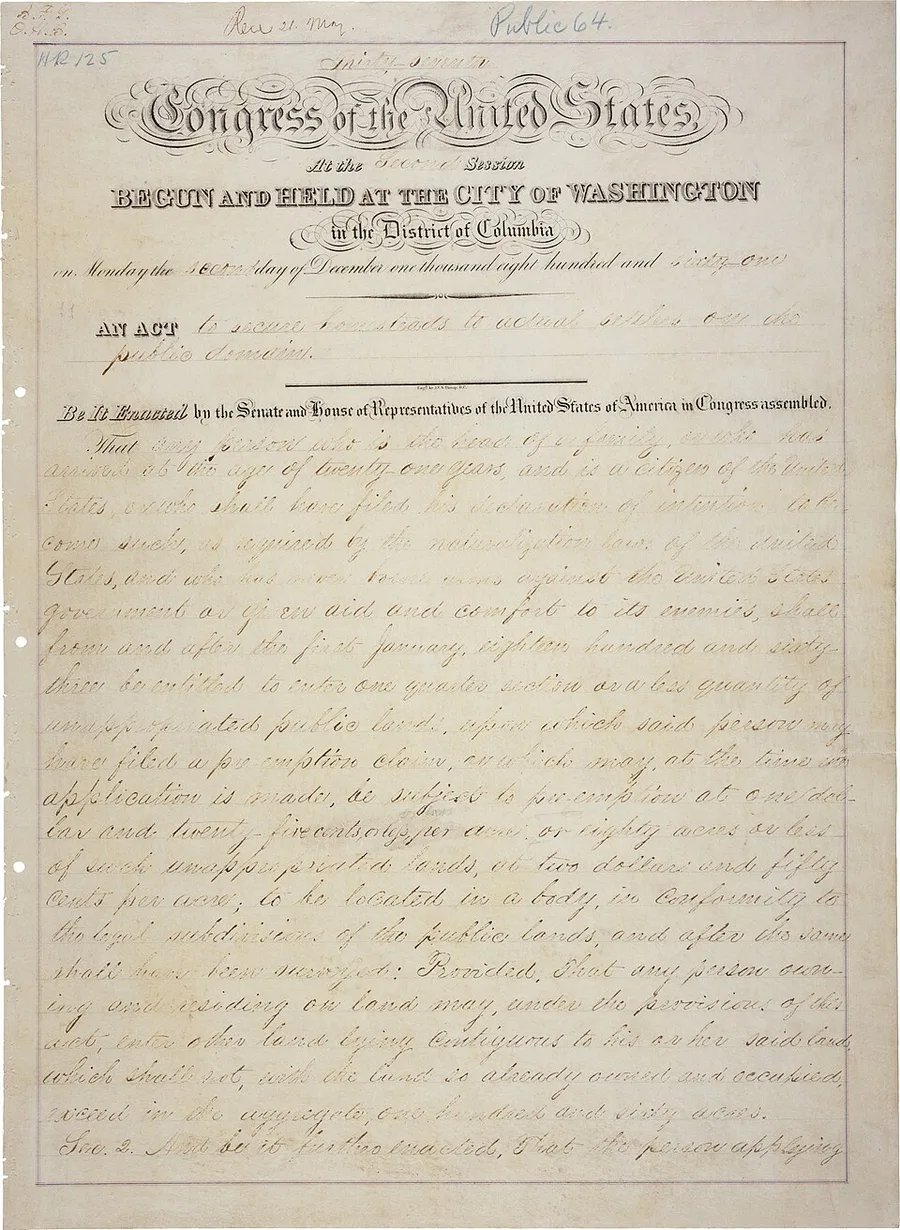 37th U.S. Congress, Homestead Act, first page (1862), National Archives The actual enacted text signed by Lincoln on 20 May 1862 that opened 160-acre parcels of federal land to settlers, including immigrants intending citizenship — the single mechanism that pulled tens of thousands of land-poor Norwegian households toward the American Midwest. United States federal law signed by President Abraham
Lincoln on 20 May 1862. The Act granted any household head
(including women, immigrants intending citizenship, and
freedmen after 1866) one hundred and sixty acres of public-
domain land in the western territories on a small filing
fee and a commitment to live on and improve the parcel for
five years. The principal mechanism driving the peak decades
of Norwegian emigration: for a Norwegian household with no
prospect of owning more than three or four acres in the
home country, the Homestead Act offered a forty-fold
expansion of land in a single transaction. Roughly 270
million acres — about ten per cent of the area of the
United States — passed from federal to private ownership
under the Act before its formal end in 1976 (Alaska 1986).
, signed by President Abraham Lincoln
37th U.S. Congress, Homestead Act, first page (1862), National Archives The actual enacted text signed by Lincoln on 20 May 1862 that opened 160-acre parcels of federal land to settlers, including immigrants intending citizenship — the single mechanism that pulled tens of thousands of land-poor Norwegian households toward the American Midwest. United States federal law signed by President Abraham
Lincoln on 20 May 1862. The Act granted any household head
(including women, immigrants intending citizenship, and
freedmen after 1866) one hundred and sixty acres of public-
domain land in the western territories on a small filing
fee and a commitment to live on and improve the parcel for
five years. The principal mechanism driving the peak decades
of Norwegian emigration: for a Norwegian household with no
prospect of owning more than three or four acres in the
home country, the Homestead Act offered a forty-fold
expansion of land in a single transaction. Roughly 270
million acres — about ten per cent of the area of the
United States — passed from federal to private ownership
under the Act before its formal end in 1976 (Alaska 1986).
, signed by President Abraham Lincoln 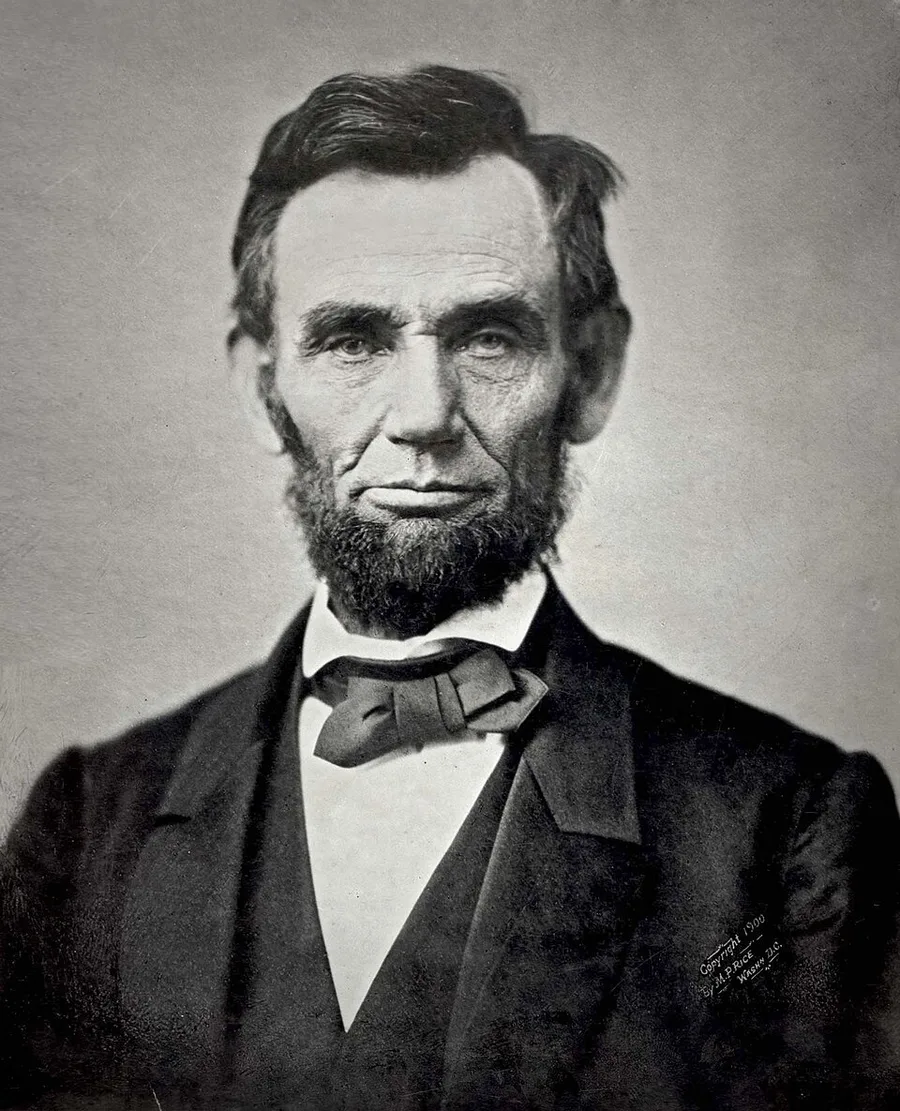 Alexander Gardner, Abraham Lincoln (Nov. 8, 1863) Signed the Homestead Act of 20 May 1862, the single mechanism that pulled tens of thousands of land-poor Norwegian households toward the American Midwest by offering 160 acres of federal land to settlers, including immigrants intending citizenship. Sixteenth President of the United States (1809–1865), in
office 1861–1865. Republican; led the Union through the
Civil War; signed the Emancipation Proclamation (1 January
1863) and the Thirteenth Amendment (passed January 1865)
abolishing slavery. Signed the Homestead Act of 20 May
1862, which transferred 160 acres of federal public-domain
land to any household head who would live on and improve
the parcel for five years and pay a small filing fee. The
Act drew tens of thousands of Norwegian emigrants to the
upper Midwest and the Dakotas through the 1860s, 1870s,
and 1880s — for a Norwegian household with no prospect of
owning more than three or four acres at home, it was a
forty-fold expansion of land in a single transaction.
Assassinated 14 April 1865 at Ford's Theatre in Washington.
during the Civil War, transforms the economic calculus. The Act gives any household head one hundred and sixty acres of public-domain land in the western territories for the price of a small filing fee and a commitment to live on and improve the land for five years. For a Norwegian family with no prospect of owning more than three or four acres in the home country, the Homestead Act offers a forty-fold expansion of land in a single transaction. The post-Civil-War decades, from 1865 through about 1900, are the peak of Norwegian emigration, with the great wave of 1880 to 1893 running on the order of fifteen to thirty thousand departures a year (a mid-1890s slump aside), a per-capita flow second only to Ireland’s among European national communities.
Alexander Gardner, Abraham Lincoln (Nov. 8, 1863) Signed the Homestead Act of 20 May 1862, the single mechanism that pulled tens of thousands of land-poor Norwegian households toward the American Midwest by offering 160 acres of federal land to settlers, including immigrants intending citizenship. Sixteenth President of the United States (1809–1865), in
office 1861–1865. Republican; led the Union through the
Civil War; signed the Emancipation Proclamation (1 January
1863) and the Thirteenth Amendment (passed January 1865)
abolishing slavery. Signed the Homestead Act of 20 May
1862, which transferred 160 acres of federal public-domain
land to any household head who would live on and improve
the parcel for five years and pay a small filing fee. The
Act drew tens of thousands of Norwegian emigrants to the
upper Midwest and the Dakotas through the 1860s, 1870s,
and 1880s — for a Norwegian household with no prospect of
owning more than three or four acres at home, it was a
forty-fold expansion of land in a single transaction.
Assassinated 14 April 1865 at Ford's Theatre in Washington.
during the Civil War, transforms the economic calculus. The Act gives any household head one hundred and sixty acres of public-domain land in the western territories for the price of a small filing fee and a commitment to live on and improve the land for five years. For a Norwegian family with no prospect of owning more than three or four acres in the home country, the Homestead Act offers a forty-fold expansion of land in a single transaction. The post-Civil-War decades, from 1865 through about 1900, are the peak of Norwegian emigration, with the great wave of 1880 to 1893 running on the order of fifteen to thirty thousand departures a year (a mid-1890s slump aside), a per-capita flow second only to Ireland’s among European national communities.
The upper Midwest
The geography of arrival is concentrated. The Norwegian-American population settles overwhelmingly in the upper Midwest: Wisconsin (Koshkonong, Muskego, Stoughton, Wisconsin 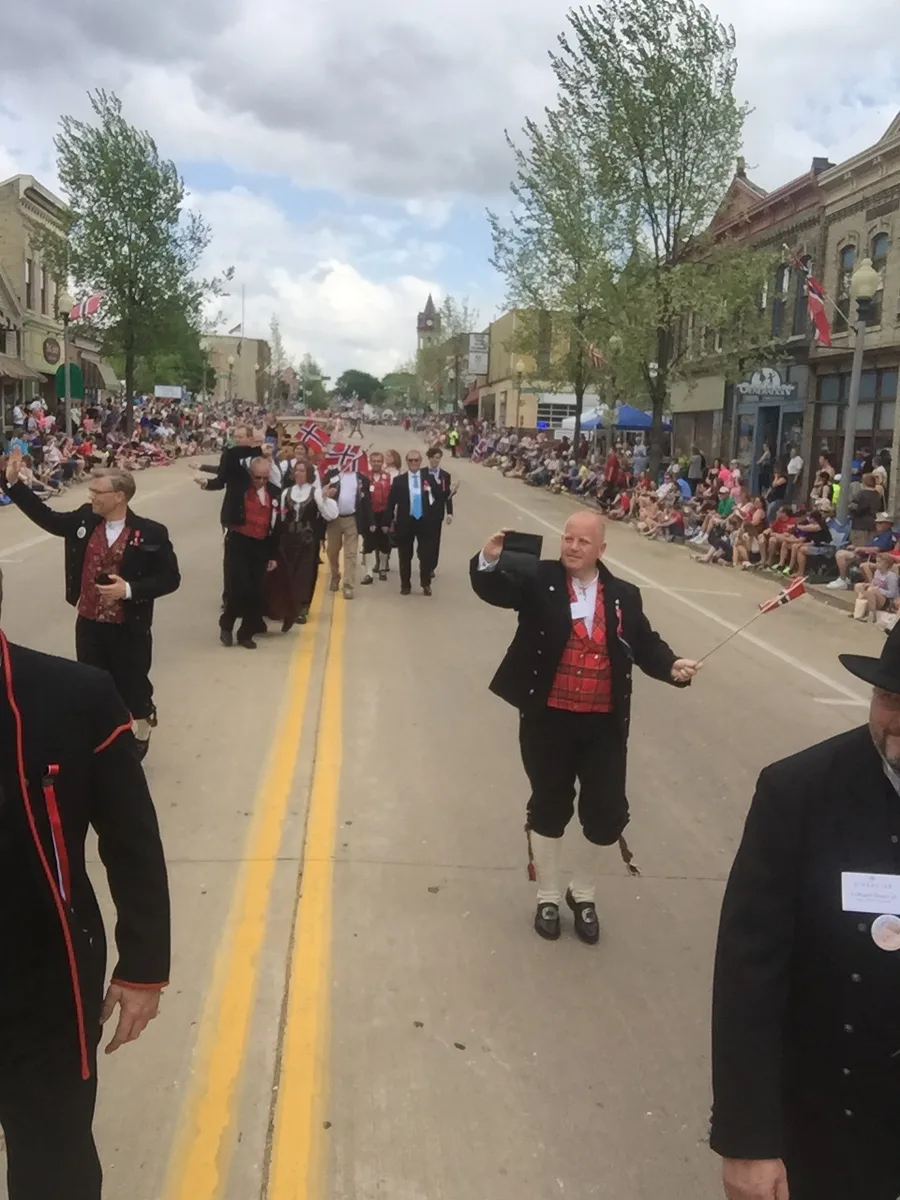 Torvild, 17. mai-paraden i Stoughton, WI (2015), CC BY-SA 4.0 Stoughton's 17 May parade in 2015 — the Syttende mai festival the town has staged since 1953, the largest Norwegian Constitution Day celebration outside Norway and the card's headline claim. Small city of about thirteen thousand people in Dane County,
Wisconsin, about twenty miles southeast of Madison. Founded
in the 1840s in the heart of the Koshkonong Norwegian-
American settlement, with a majority Norwegian-speaking
population through the late nineteenth century. The
community kept a distinctively Norwegian commercial and
religious culture deep into the twentieth century, and
since 1953 the Chamber of Commerce has organised an annual
Syttende mai festival — the largest 17 May celebration
outside Norway, drawing tens of thousands of visitors over
a three-day weekend of parades, bunad costume contests,
lutefisk and lefse dinners, rosemaling exhibitions,
and folk dance. The town is sister-city to Tysvær in
Rogaland, Cleng Peerson's birthplace.
, La Crosse, Madison), Minnesota (the Red River valley, the prairie counties of the southern part of the state, the Twin Cities), Iowa ( Decorah, Iowa
Torvild, 17. mai-paraden i Stoughton, WI (2015), CC BY-SA 4.0 Stoughton's 17 May parade in 2015 — the Syttende mai festival the town has staged since 1953, the largest Norwegian Constitution Day celebration outside Norway and the card's headline claim. Small city of about thirteen thousand people in Dane County,
Wisconsin, about twenty miles southeast of Madison. Founded
in the 1840s in the heart of the Koshkonong Norwegian-
American settlement, with a majority Norwegian-speaking
population through the late nineteenth century. The
community kept a distinctively Norwegian commercial and
religious culture deep into the twentieth century, and
since 1953 the Chamber of Commerce has organised an annual
Syttende mai festival — the largest 17 May celebration
outside Norway, drawing tens of thousands of visitors over
a three-day weekend of parades, bunad costume contests,
lutefisk and lefse dinners, rosemaling exhibitions,
and folk dance. The town is sister-city to Tysvær in
Rogaland, Cleng Peerson's birthplace.
, La Crosse, Madison), Minnesota (the Red River valley, the prairie counties of the southern part of the state, the Twin Cities), Iowa ( Decorah, Iowa 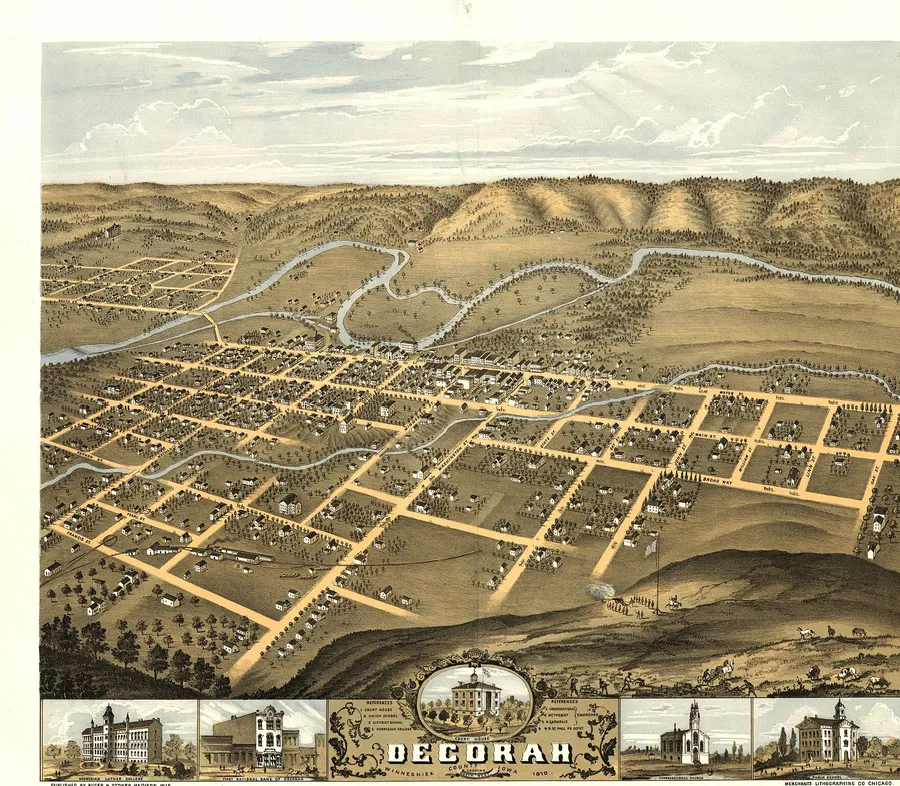 A. Ruger, Decorah, Winneshiek County, Iowa 1870, Merchant's Lithographing Co., Library of Congress Decorah drawn in 1870, thirteen years after its founding and already filling with Norwegian-American families up from the Wisconsin colonies — the first vignette in the bottom margin is the "Norwegian Luther College," nine years old when the lithographer came through. Small city of about eight thousand people in Winneshiek
County in northeastern Iowa, on the Upper Iowa River. The
intellectual and cultural capital of the Norwegian-
American upper Midwest. Founded in 1857 and rapidly
settled by Norwegian-American families relocating from
the southern Wisconsin colonies. The Decorah-Posten
newspaper, founded 1874, ran in Norwegian for nearly a
century and was one of the two principal Norwegian-
language newspapers of the immigrant community. Home of
Luther College (founded 1861 as a Norwegian-Lutheran
institution) and Vesterheim, the Norwegian-American
Museum founded 1877 — the largest museum of any immigrant
ethnic community in the United States, holding the
deepest archive of Norwegian-American material culture.
, Story City, Lake Mills), the Dakotas after the Homestead Act opens the prairies in the 1870s and 1880s, and scattered Norwegian-Lutheran enclaves in Illinois, Michigan, and eventually the Pacific Northwest (Seattle, Tacoma, Astoria, Portland). The reason for the upper-Midwest concentration is partly Cleng Peerson and the founders of the early settlements, who established the chain-migration patterns that brought additional emigrants to existing colonies, and partly climate: the upper Midwest’s continental winters and summer growing seasons match the rural Norwegian climate closely enough that the agricultural skills transfer directly. A Norwegian farmer from Sogn
A. Ruger, Decorah, Winneshiek County, Iowa 1870, Merchant's Lithographing Co., Library of Congress Decorah drawn in 1870, thirteen years after its founding and already filling with Norwegian-American families up from the Wisconsin colonies — the first vignette in the bottom margin is the "Norwegian Luther College," nine years old when the lithographer came through. Small city of about eight thousand people in Winneshiek
County in northeastern Iowa, on the Upper Iowa River. The
intellectual and cultural capital of the Norwegian-
American upper Midwest. Founded in 1857 and rapidly
settled by Norwegian-American families relocating from
the southern Wisconsin colonies. The Decorah-Posten
newspaper, founded 1874, ran in Norwegian for nearly a
century and was one of the two principal Norwegian-
language newspapers of the immigrant community. Home of
Luther College (founded 1861 as a Norwegian-Lutheran
institution) and Vesterheim, the Norwegian-American
Museum founded 1877 — the largest museum of any immigrant
ethnic community in the United States, holding the
deepest archive of Norwegian-American material culture.
, Story City, Lake Mills), the Dakotas after the Homestead Act opens the prairies in the 1870s and 1880s, and scattered Norwegian-Lutheran enclaves in Illinois, Michigan, and eventually the Pacific Northwest (Seattle, Tacoma, Astoria, Portland). The reason for the upper-Midwest concentration is partly Cleng Peerson and the founders of the early settlements, who established the chain-migration patterns that brought additional emigrants to existing colonies, and partly climate: the upper Midwest’s continental winters and summer growing seasons match the rural Norwegian climate closely enough that the agricultural skills transfer directly. A Norwegian farmer from Sogn 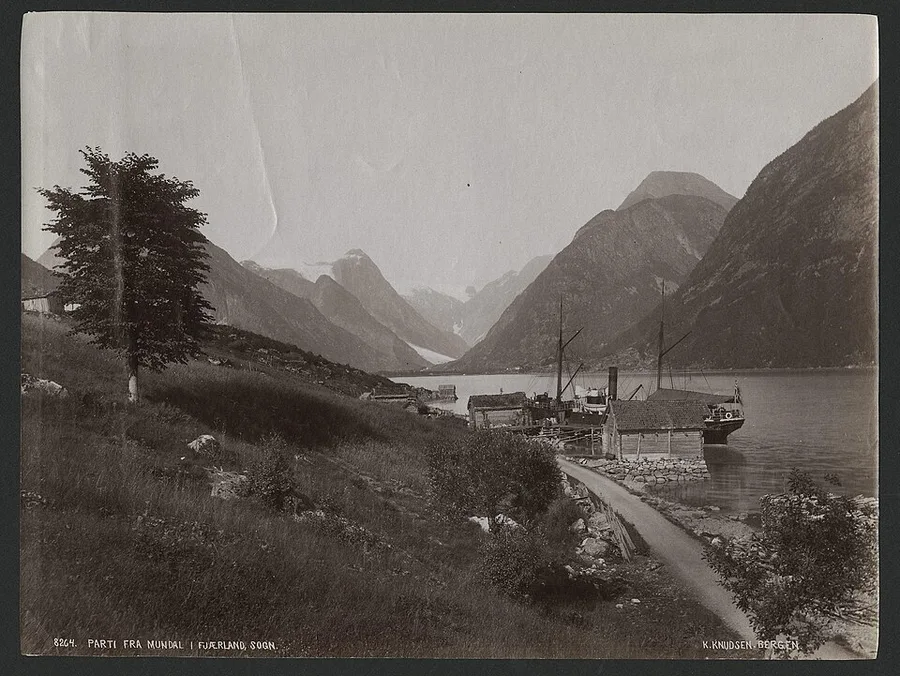 Knud Knudsen, Parti fra Mundal i Fjærland, Sogn (1885), Nasjonalmuseet (NMK.2006.5108) Knudsen photographed Mundal in 1885 — mid-wave — a tiny fjord-arm village pinched between mountain and water: exactly the Sogn landscape that could not feed a doubling population, and sent its younger children to America instead. Region on the western coast of Norway around the long inland
Sognefjord. In the petty-kingdom era a small maritime kingdom whose
wealth came from coastal trade and harbour control rather than
agriculture. The Sogn name survives in modern usage; the region was
folded into the larger administrative county of Vestland in 2020.
On the trip Day 3 carries the Ungdommene (the Youngsters) into Sogn —
the Flåm railway, the Stegastein overlook, and the
Nærøyfjord cruise all lie within the old Sogn district.
Sogn Also discussed in Before There Was Norway — petty kingdoms at the edge of the world or Hardanger could come to Minnesota and plant the same wheat, rye, and oat varieties he had grown at home, run his cattle and sheep through the same kinds of summer pastures, and chop his winter firewood from the same hardwood-and-pine forests, only with better soil and more of it.
Knud Knudsen, Parti fra Mundal i Fjærland, Sogn (1885), Nasjonalmuseet (NMK.2006.5108) Knudsen photographed Mundal in 1885 — mid-wave — a tiny fjord-arm village pinched between mountain and water: exactly the Sogn landscape that could not feed a doubling population, and sent its younger children to America instead. Region on the western coast of Norway around the long inland
Sognefjord. In the petty-kingdom era a small maritime kingdom whose
wealth came from coastal trade and harbour control rather than
agriculture. The Sogn name survives in modern usage; the region was
folded into the larger administrative county of Vestland in 2020.
On the trip Day 3 carries the Ungdommene (the Youngsters) into Sogn —
the Flåm railway, the Stegastein overlook, and the
Nærøyfjord cruise all lie within the old Sogn district.
Sogn Also discussed in Before There Was Norway — petty kingdoms at the edge of the world or Hardanger could come to Minnesota and plant the same wheat, rye, and oat varieties he had grown at home, run his cattle and sheep through the same kinds of summer pastures, and chop his winter firewood from the same hardwood-and-pine forests, only with better soil and more of it.
A parallel institutional world
By the second half of the century the Norwegian-American community has built a dense parallel institutional world. The Norwegian-language press, with newspapers like Skandinaven in Chicago and Decorah-Posten in Iowa, runs for several generations as the daily reading of much of the immigrant community. A dense parallel Lutheran world of competing Norwegian-American synods kept splitting and merging across the second half of the century before consolidating into the modern American Lutheran institutions. Lutheran colleges take root across the upper Midwest — Luther in Iowa, Augsburg and St. Olaf in Minnesota, Concordia in Moorhead — to train the synods’ pastors and the immigrant community’s teachers. The Sons of Norway 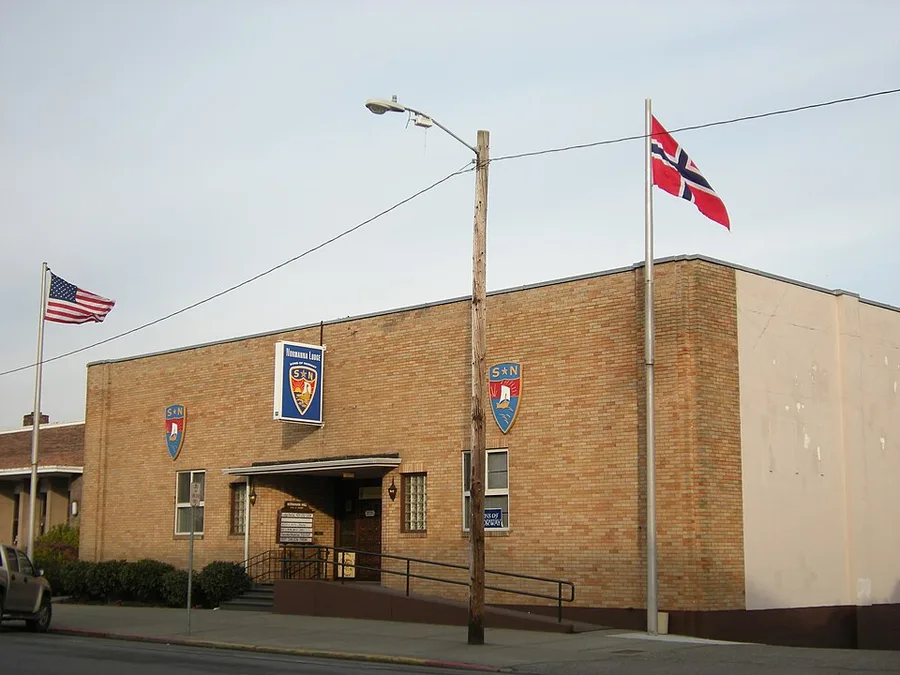 Photo by Joe Mabel (2009), CC BY-SA 3.0, via Wikimedia Commons Normanna Lodge in Everett, Washington — one of the hundreds of local Sons of Norway halls that gave Norwegian-American communities their meeting rooms, choirs, and Syttende mai gatherings at the fraternal order's mid-century peak. Norwegian-American fraternal benefit society founded on 16
January 1895 in Minneapolis by eighteen Norwegian
immigrants who pooled their resources to provide death
benefits, sick relief, and burial insurance to members of
the rapidly growing Norwegian-American community. Across
its first half-century the organisation also served as the
principal social and cultural infrastructure of Norwegian-
America — Norwegian-language meetings, choirs, dance
troupes, and Syttende mai parades. At its mid-twentieth-
century peak Sons of Norway ran more than four hundred
local lodges across the United States and Canada with
roughly seventy thousand members. Headquartered in
Minneapolis; still operating in 2026 as the largest
Norwegian-American fraternal organisation.
Also discussed in Statskirken — the state church and what's left of it fraternal lodge (1895) and its companion Daughters of Norway provide the social-organizational infrastructure. The choral and folk-musical traditions, the Rosemaling
Photo by Joe Mabel (2009), CC BY-SA 3.0, via Wikimedia Commons Normanna Lodge in Everett, Washington — one of the hundreds of local Sons of Norway halls that gave Norwegian-American communities their meeting rooms, choirs, and Syttende mai gatherings at the fraternal order's mid-century peak. Norwegian-American fraternal benefit society founded on 16
January 1895 in Minneapolis by eighteen Norwegian
immigrants who pooled their resources to provide death
benefits, sick relief, and burial insurance to members of
the rapidly growing Norwegian-American community. Across
its first half-century the organisation also served as the
principal social and cultural infrastructure of Norwegian-
America — Norwegian-language meetings, choirs, dance
troupes, and Syttende mai parades. At its mid-twentieth-
century peak Sons of Norway ran more than four hundred
local lodges across the United States and Canada with
roughly seventy thousand members. Headquartered in
Minneapolis; still operating in 2026 as the largest
Norwegian-American fraternal organisation.
Also discussed in Statskirken — the state church and what's left of it fraternal lodge (1895) and its companion Daughters of Norway provide the social-organizational infrastructure. The choral and folk-musical traditions, the Rosemaling 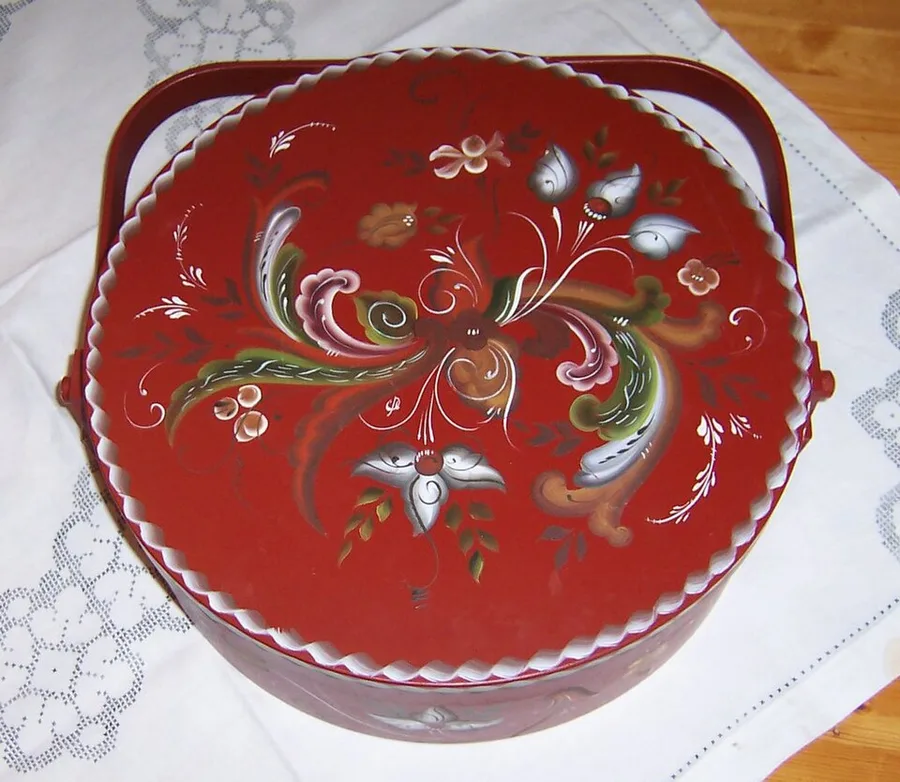 Photo by Erik A. Drabløs, CC BY-SA 2.5, via Wikimedia Commons A tine — the round bentwood box rosemaling was painted onto in farmhouses across Hallingdal, Telemark, and Vestlandet — shown here carrying the ornamental scrollwork and floral motifs the tradition is defined by. Rose-painting — Norwegian decorative painting tradition
developed in the rural southern and western valleys
(Hallingdal, Telemark, Setesdal, Vestlandet) from the
mid-eighteenth century, applying ornamental scrollwork,
flowers, foliage, and sometimes figurative motifs in oil
paint to interior walls, ceilings, furniture, trunks,
and household objects. Regional styles vary — Telemark's
is energetic and asymmetric, Hallingdal's more contained,
Vestlandet's brighter and more floral. The tradition
declined in Norway through the late nineteenth century
but was carried by emigrants to the upper-Midwest
community, where it survived and was revived through the
twentieth century. The largest annual rosemaling
exhibitions in the world are held at Vesterheim in
Decorah, Iowa.
and the Bunad
Photo by Erik A. Drabløs, CC BY-SA 2.5, via Wikimedia Commons A tine — the round bentwood box rosemaling was painted onto in farmhouses across Hallingdal, Telemark, and Vestlandet — shown here carrying the ornamental scrollwork and floral motifs the tradition is defined by. Rose-painting — Norwegian decorative painting tradition
developed in the rural southern and western valleys
(Hallingdal, Telemark, Setesdal, Vestlandet) from the
mid-eighteenth century, applying ornamental scrollwork,
flowers, foliage, and sometimes figurative motifs in oil
paint to interior walls, ceilings, furniture, trunks,
and household objects. Regional styles vary — Telemark's
is energetic and asymmetric, Hallingdal's more contained,
Vestlandet's brighter and more floral. The tradition
declined in Norway through the late nineteenth century
but was carried by emigrants to the upper-Midwest
community, where it survived and was revived through the
twentieth century. The largest annual rosemaling
exhibitions in the world are held at Vesterheim in
Decorah, Iowa.
and the Bunad 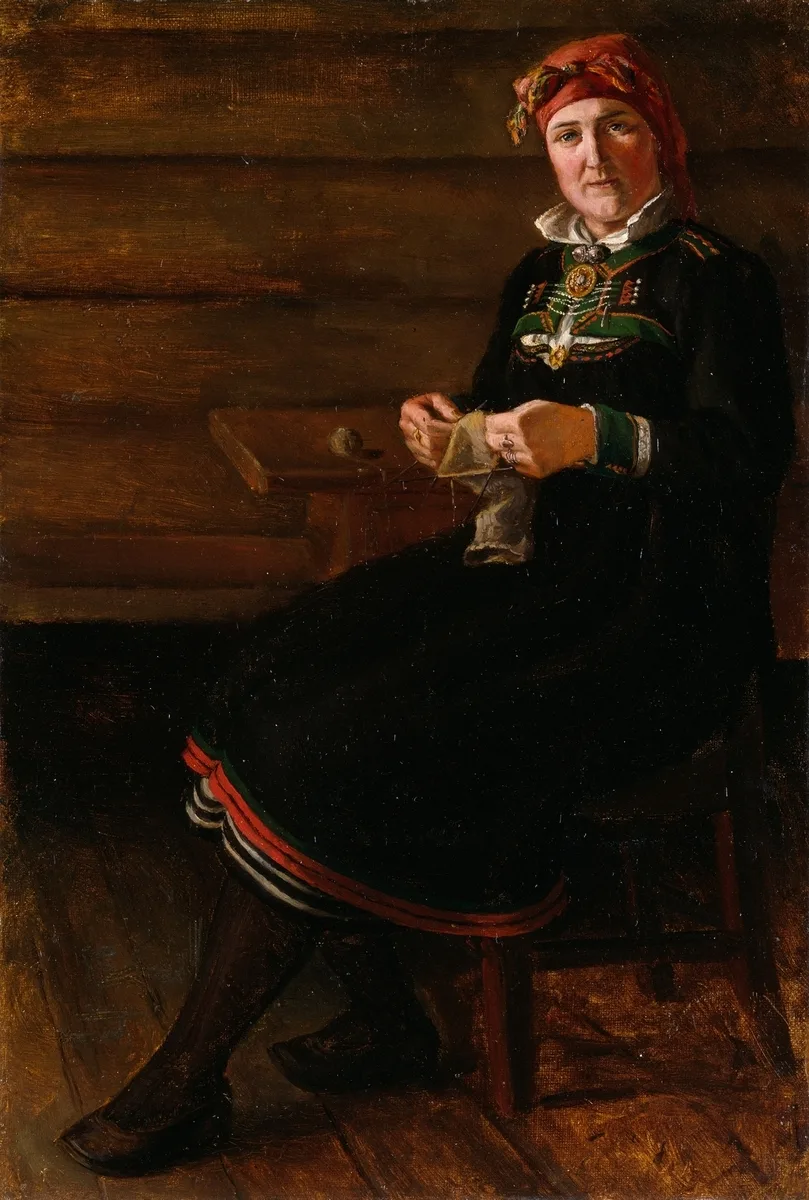 August Schneider, Sittende kvinne i Setesdals-bunad (1870), Nasjonalmuseet A dress like this crossed the Atlantic folded in the emigrant trunk — brought out for Midwest confirmations and Syttende Mai parades, the home parish stitched into the embroidery long after the parish itself was an ocean behind. Norwegian regional folk costume — the rural traditional
dress that survived the four-hundred-year Danish period
intact, parish by parish, fjord by fjord. Each Norwegian
region (and many individual valleys) has its own bunad,
varying in colour, embroidery pattern, silver brooch
(sølje), shawl, and apron. The modern bunad tradition was
systematised in the late nineteenth and early twentieth
centuries by the textile historian Hulda Garborg and
others, but the underlying garments are pre-modern. Worn
on 17 May, at weddings, at confirmations, and at other
formal national occasions. The persistence of the bunad is
one of the most visible single signs of how the regional
substrate of Norway outlasted the long Danish absorption.
Also discussed in The 400-Year Night — when the Northern Lion lay dormantLutheran Norway and Pietism — a farmer named Hans Nielsen Hauge and a lay revival that could not be silencedThe Constitution That Saved a Nation — five radical weeks at Eidsvoll, 1814World War II — the King’s “No” and the Nazis in NorwayTradisjoner — celebrations across the Norwegian year , the holiday observances of the seventeenth of May and Christmas Eve and Saint Lucia’s Day, the Lefse
August Schneider, Sittende kvinne i Setesdals-bunad (1870), Nasjonalmuseet A dress like this crossed the Atlantic folded in the emigrant trunk — brought out for Midwest confirmations and Syttende Mai parades, the home parish stitched into the embroidery long after the parish itself was an ocean behind. Norwegian regional folk costume — the rural traditional
dress that survived the four-hundred-year Danish period
intact, parish by parish, fjord by fjord. Each Norwegian
region (and many individual valleys) has its own bunad,
varying in colour, embroidery pattern, silver brooch
(sølje), shawl, and apron. The modern bunad tradition was
systematised in the late nineteenth and early twentieth
centuries by the textile historian Hulda Garborg and
others, but the underlying garments are pre-modern. Worn
on 17 May, at weddings, at confirmations, and at other
formal national occasions. The persistence of the bunad is
one of the most visible single signs of how the regional
substrate of Norway outlasted the long Danish absorption.
Also discussed in The 400-Year Night — when the Northern Lion lay dormantLutheran Norway and Pietism — a farmer named Hans Nielsen Hauge and a lay revival that could not be silencedThe Constitution That Saved a Nation — five radical weeks at Eidsvoll, 1814World War II — the King’s “No” and the Nazis in NorwayTradisjoner — celebrations across the Norwegian year , the holiday observances of the seventeenth of May and Christmas Eve and Saint Lucia’s Day, the Lefse 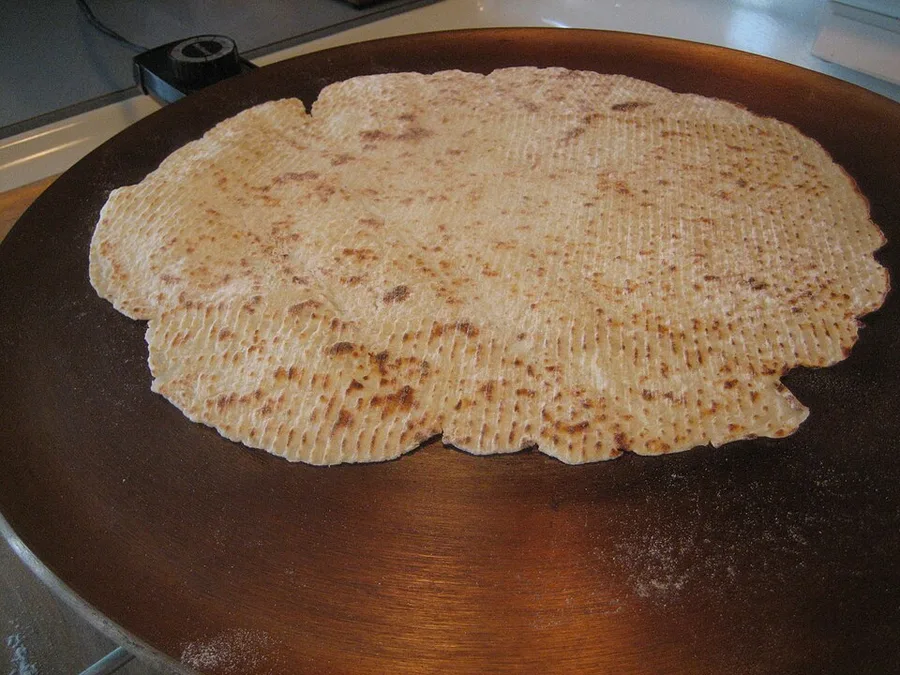 Photo by Lance Fisher (2007), CC BY-SA 2.0, via Wikimedia Commons The potato flatbread mid-griddle, speckled and just turning — the exact moment in the technique passed down through Norwegian-American Lutheran kitchens from grandmothers to granddaughters. Traditional Norwegian potato flatbread, made from a dough
of mashed potato, flour, butter, and cream, rolled paper-
thin with a grooved rolling pin, and cooked briefly on a
hot ungreased griddle until just speckled with brown.
Served folded or rolled around butter and sugar (or butter
and brunost) at coffee, at family meals, and at
Christmas. A staple Norwegian holiday food across most of
the country, and one of the most reliably preserved
Norwegian-American foods in the upper-Midwest immigrant
community — Lutheran church lutefisk and lefse dinners
are a fixture of the Christmas season in the Norwegian-
American Lutheran calendar, the technique passed from
grandmothers to granddaughters across the generations.
and the Lutefisk
Photo by Lance Fisher (2007), CC BY-SA 2.0, via Wikimedia Commons The potato flatbread mid-griddle, speckled and just turning — the exact moment in the technique passed down through Norwegian-American Lutheran kitchens from grandmothers to granddaughters. Traditional Norwegian potato flatbread, made from a dough
of mashed potato, flour, butter, and cream, rolled paper-
thin with a grooved rolling pin, and cooked briefly on a
hot ungreased griddle until just speckled with brown.
Served folded or rolled around butter and sugar (or butter
and brunost) at coffee, at family meals, and at
Christmas. A staple Norwegian holiday food across most of
the country, and one of the most reliably preserved
Norwegian-American foods in the upper-Midwest immigrant
community — Lutheran church lutefisk and lefse dinners
are a fixture of the Christmas season in the Norwegian-
American Lutheran calendar, the technique passed from
grandmothers to granddaughters across the generations.
and the Lutefisk 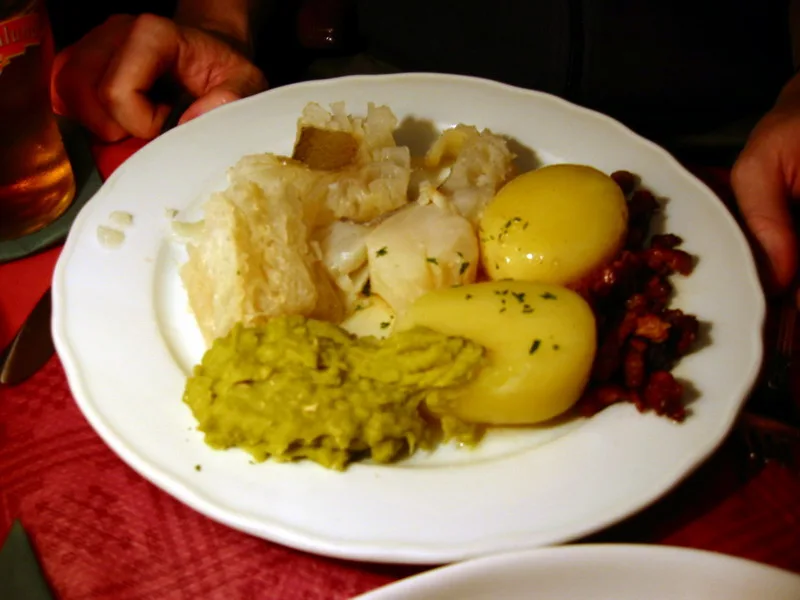 Photo by Ennorehling (2005), public domain, via Wikimedia Commons The rehydrated, lye-treated cod plated with the classic accompaniments — the dish still served every December at the church-basement lutefisk suppers the upper-Midwest Norwegian-American Lutheran congregations keep going, parish by parish. Traditional Norwegian dried-cod preparation, made by
rehydrating air-dried stockfish in lye (the modern process
uses caustic soda; the older process used wood-ash lye),
then rinsing repeatedly in fresh water and serving the
resulting gelatinous flesh poached or baked with butter,
cream sauce, bacon, mashed peas, and potatoes. A holiday
dish in modern Norway, eaten in modest quantities at
Christmas; vastly more important to the Norwegian-American
community of the upper Midwest, where Lutheran
congregations descended from the Norwegian-American synods
still hold annual lutefisk suppers in their church
basements in the weeks before Christmas. The participating
congregations are graying and shrinking but the tradition
is kept up parish by parish, year by year.
Also discussed in Mat og Drikke — Norwegian food and drink and the brunost and the fattigmann cookies, all transfer across the Atlantic and become the cultural inheritance of the third and fourth generation Norwegian-American family.
Photo by Ennorehling (2005), public domain, via Wikimedia Commons The rehydrated, lye-treated cod plated with the classic accompaniments — the dish still served every December at the church-basement lutefisk suppers the upper-Midwest Norwegian-American Lutheran congregations keep going, parish by parish. Traditional Norwegian dried-cod preparation, made by
rehydrating air-dried stockfish in lye (the modern process
uses caustic soda; the older process used wood-ash lye),
then rinsing repeatedly in fresh water and serving the
resulting gelatinous flesh poached or baked with butter,
cream sauce, bacon, mashed peas, and potatoes. A holiday
dish in modern Norway, eaten in modest quantities at
Christmas; vastly more important to the Norwegian-American
community of the upper Midwest, where Lutheran
congregations descended from the Norwegian-American synods
still hold annual lutefisk suppers in their church
basements in the weeks before Christmas. The participating
congregations are graying and shrinking but the tradition
is kept up parish by parish, year by year.
Also discussed in Mat og Drikke — Norwegian food and drink and the brunost and the fattigmann cookies, all transfer across the Atlantic and become the cultural inheritance of the third and fourth generation Norwegian-American family.
The America Letters
The America Letters, the Amerikabrev America Letters — the body of correspondence Norwegian
emigrants wrote home to their families across the second
half of the nineteenth century and the dominant cultural
document of mid-nineteenth-century Norwegian rural life.
The letters described black soil, free land under the
Homestead Act, full plates, schools for the children,
churches with Norwegian-speaking pastors, towns full of
Norwegian neighbours, and prosperity at a scale the home
country had never offered to people of the writer's class.
Read aloud in farm kitchens and church vestries; copied
and recopied parish by parish. They produced Amerikafeber
— America Fever — that captured whole districts in
succession and drove emigration to peak levels in the
1880s and 1890s.
that emigrants write home to their families and that are passed around the local farming communities in Norway, are the dominant cultural document of mid-nineteenth-century Norwegian rural life. The letters describe black soil, free land, full plates, schools for the children, churches with their own Norwegian-speaking pastors, towns full of Norwegian neighbors, and prosperity at a scale the home country has never offered to people of the writer’s class. The letters are read aloud in farm kitchens and church vestries. They are copied and recopied and circulated. They produce a recognized social phenomenon called Amerikafeber 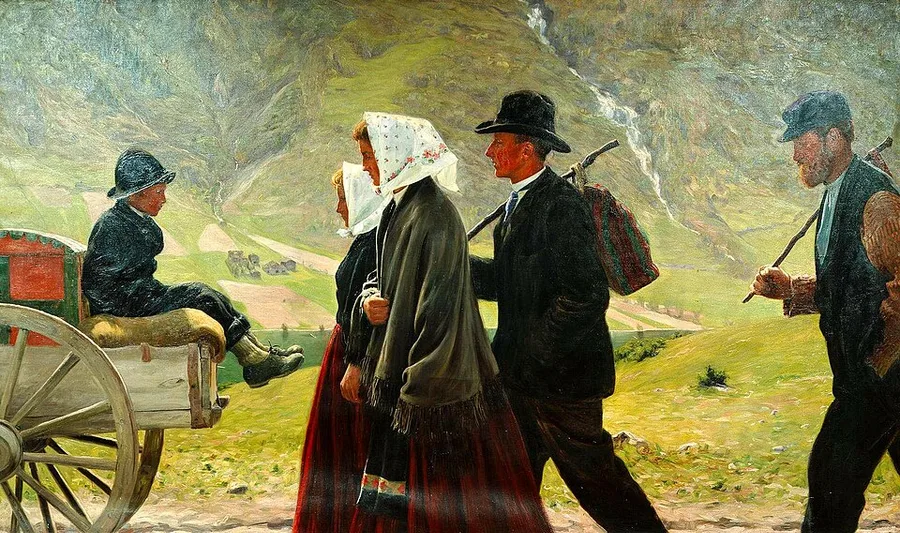 Gustav Wentzel, Utvandrere [Emigrants] (1902), via Aftenposten/O. Væring Wentzel paints a Norwegian farm household at the departure itself, walking sticks and packs shouldered and a child riding the cart, the household-by-household scene Amerikafeber produced across whole rural districts in succession. America Fever — the social phenomenon by which Norwegian
rural districts caught the impulse to emigrate to America
in successive waves across the second half of the
nineteenth century. Driven by the circulating Amerikabrev
read aloud in farm kitchens and church vestries,
supplemented by returning visitors and by shipping-company
recruiting agents working the Norwegian countryside.
Typically captured a whole farming district at once: one
family crossed and prospered, wrote letters, the letters
circulated, and within a year or two further families
followed, until every household in the home district had
kin on both sides of the Atlantic. Drove annual emigration
to its peak in the 1880s and 1890s and produced the
ødegårder still visible in the upland Norwegian valleys.
, the America Fever, that captures whole farming districts in succession and that drives the annual emigration totals to the high levels of the 1880s and 1890s. The home district sends one family across. That family settles and prospers. The family writes letters and the letters circulate. The next year another family from the same district crosses to join the first, and the cycle continues until every household in the home district has kin on both sides of the Atlantic.
Gustav Wentzel, Utvandrere [Emigrants] (1902), via Aftenposten/O. Væring Wentzel paints a Norwegian farm household at the departure itself, walking sticks and packs shouldered and a child riding the cart, the household-by-household scene Amerikafeber produced across whole rural districts in succession. America Fever — the social phenomenon by which Norwegian
rural districts caught the impulse to emigrate to America
in successive waves across the second half of the
nineteenth century. Driven by the circulating Amerikabrev
read aloud in farm kitchens and church vestries,
supplemented by returning visitors and by shipping-company
recruiting agents working the Norwegian countryside.
Typically captured a whole farming district at once: one
family crossed and prospered, wrote letters, the letters
circulated, and within a year or two further families
followed, until every household in the home district had
kin on both sides of the Atlantic. Drove annual emigration
to its peak in the 1880s and 1890s and produced the
ødegårder still visible in the upland Norwegian valleys.
, the America Fever, that captures whole farming districts in succession and that drives the annual emigration totals to the high levels of the 1880s and 1890s. The home district sends one family across. That family settles and prospers. The family writes letters and the letters circulate. The next year another family from the same district crosses to join the first, and the cycle continues until every household in the home district has kin on both sides of the Atlantic.
The doors close
The end of mass emigration comes through American policy. The Johnson-Reed Immigration Act 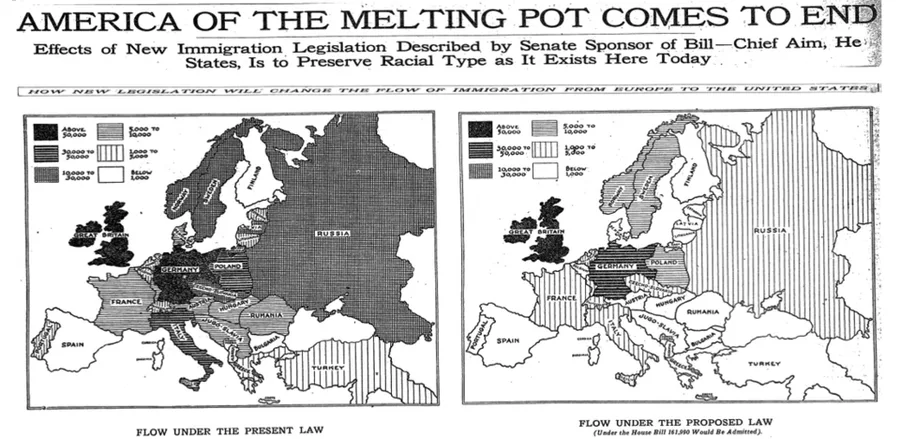 The New York Times, "America of the melting pot comes to end" (Apr. 27, 1924), p. XX3 A New York Times page from the week the Immigration Act of 1924 passed, written by the bill's own Senate sponsor and headlined on its intent — the two maps chart the before/after quota shift that cut the Norwegian allowance to a few thousand a year and effectively closed the emigration era. United States federal law of 26 May 1924 — formally the
Immigration Act of 1924 — imposing strict national-origin
quotas on American immigration. Each European national
group was assigned an annual quota of two per cent of the
number of its national-origin residents recorded in the
1890 US Census. The Act drastically reduced new arrivals
from southern and eastern Europe, ended Asian immigration
almost entirely, and reduced Scandinavian immigration to a
small fraction of its previous level — the Norwegian
quota was set at approximately 6,400 per year under the
1924 formula and reduced to about 2,300 under the 1929
National Origins revision. The Act effectively closed the
century of mass Norwegian emigration to America. Repealed
by the Immigration and Nationality Act of 1965.
imposes national-origin quotas on American immigration that drastically reduce the numbers of new arrivals from southern and eastern Europe. Under the 1924 Act the Norwegian quota is set at approximately sixty-four hundred per year, a fraction of the previous emigration volume; the National Origins revision that takes effect in 1929 reduces it further to about twenty-three hundred. The Norwegian flow through the 1920s and into the 1930s drops to small numbers, the Great Depression makes emigration economically unattractive in any case, the Second World War interrupts the Atlantic crossing for several years, and the post-war recovery of the Norwegian economy through the 1950s and 1960s makes emigration unnecessary for Norwegians of the next generation. The Norwegian-American population from 1925 onward is overwhelmingly a population of the descendants of the 1825-1925 migrants rather than of new arrivals. The Norwegian-American identity that emerges is one that preserves the cultural memory of a Norway that ceased to exist in roughly the 1880s — a Second Norway, frozen across the Atlantic at the moment the emigrants last knew it.
The New York Times, "America of the melting pot comes to end" (Apr. 27, 1924), p. XX3 A New York Times page from the week the Immigration Act of 1924 passed, written by the bill's own Senate sponsor and headlined on its intent — the two maps chart the before/after quota shift that cut the Norwegian allowance to a few thousand a year and effectively closed the emigration era. United States federal law of 26 May 1924 — formally the
Immigration Act of 1924 — imposing strict national-origin
quotas on American immigration. Each European national
group was assigned an annual quota of two per cent of the
number of its national-origin residents recorded in the
1890 US Census. The Act drastically reduced new arrivals
from southern and eastern Europe, ended Asian immigration
almost entirely, and reduced Scandinavian immigration to a
small fraction of its previous level — the Norwegian
quota was set at approximately 6,400 per year under the
1924 formula and reduced to about 2,300 under the 1929
National Origins revision. The Act effectively closed the
century of mass Norwegian emigration to America. Repealed
by the Immigration and Nationality Act of 1965.
imposes national-origin quotas on American immigration that drastically reduce the numbers of new arrivals from southern and eastern Europe. Under the 1924 Act the Norwegian quota is set at approximately sixty-four hundred per year, a fraction of the previous emigration volume; the National Origins revision that takes effect in 1929 reduces it further to about twenty-three hundred. The Norwegian flow through the 1920s and into the 1930s drops to small numbers, the Great Depression makes emigration economically unattractive in any case, the Second World War interrupts the Atlantic crossing for several years, and the post-war recovery of the Norwegian economy through the 1950s and 1960s makes emigration unnecessary for Norwegians of the next generation. The Norwegian-American population from 1925 onward is overwhelmingly a population of the descendants of the 1825-1925 migrants rather than of new arrivals. The Norwegian-American identity that emerges is one that preserves the cultural memory of a Norway that ceased to exist in roughly the 1880s — a Second Norway, frozen across the Atlantic at the moment the emigrants last knew it.
What stayed behind in Norway
The emigration cuts two opposite ways for Norway. The country that the emigrants left behind, in the second half of the nineteenth century, is structurally relieved of much of its surplus rural population. Norwegian wages rise. Land prices in the remaining farming districts stabilize. The smaller, more compact Norwegian economy that develops through the early twentieth century, with its mix of shipping, hydroelectric power, fisheries, forestry, and small-scale manufacturing, would not have been possible without the population pressure-release that emigration provided. The Norwegian welfare state that emerges after the Second World War is partly the product of a country small enough to know its own people. Without the emigration, Norway would have been larger, poorer, and more rural than it actually became. The country that the emigrants left behind benefits from their leaving.
What the emigration left visible on the Norwegian side is harder to see at a distance, but it is still there. At Stavanger, Marshall Fredericks  Marshall Fredericks (sculptor); photo Wikimedia Commons contributor (2005), Brookgreen Gardens, South Carolina casting A different bronze casting of the same 1936 Leaping Gazelle design Fredericks gave King Olav V in 1958 for the Breiavatnet memorial in Stavanger, honoring the emigrants who sailed from that harbor. No freely licensed photo of the Stavanger casting is available; this is the same sculpture. American sculptor (1908–1998), Danish-American by descent.
Born in Rock Island, Illinois; trained at the Cleveland
School of Art and under Carl Milles at Cranbrook. Best
known for monumental public sculpture across the upper
Midwest and Detroit area: the Spirit of Detroit (1958),
the Cleveland War Memorial (1964), the Star Dream
fountain (1995). His Leaping Gazelle (1936), an
art-deco bronze of an arching gazelle in mid-leap, was
reproduced as a gift to King Olav V of Norway in 1958 in
recognition of the Norwegian-American emigration story;
the cast stands at the Breiavatnet lake in central
Stavanger as a memorial to the emigrants who left through
the Stavanger harbour from the 1820s onward.
’s Leaping Gazelle stands at the lake of Breiavatnet — the American sculptor’s 1958 gift to King Olav V
Marshall Fredericks (sculptor); photo Wikimedia Commons contributor (2005), Brookgreen Gardens, South Carolina casting A different bronze casting of the same 1936 Leaping Gazelle design Fredericks gave King Olav V in 1958 for the Breiavatnet memorial in Stavanger, honoring the emigrants who sailed from that harbor. No freely licensed photo of the Stavanger casting is available; this is the same sculpture. American sculptor (1908–1998), Danish-American by descent.
Born in Rock Island, Illinois; trained at the Cleveland
School of Art and under Carl Milles at Cranbrook. Best
known for monumental public sculpture across the upper
Midwest and Detroit area: the Spirit of Detroit (1958),
the Cleveland War Memorial (1964), the Star Dream
fountain (1995). His Leaping Gazelle (1936), an
art-deco bronze of an arching gazelle in mid-leap, was
reproduced as a gift to King Olav V of Norway in 1958 in
recognition of the Norwegian-American emigration story;
the cast stands at the Breiavatnet lake in central
Stavanger as a memorial to the emigrants who left through
the Stavanger harbour from the 1820s onward.
’s Leaping Gazelle stands at the lake of Breiavatnet — the American sculptor’s 1958 gift to King Olav V 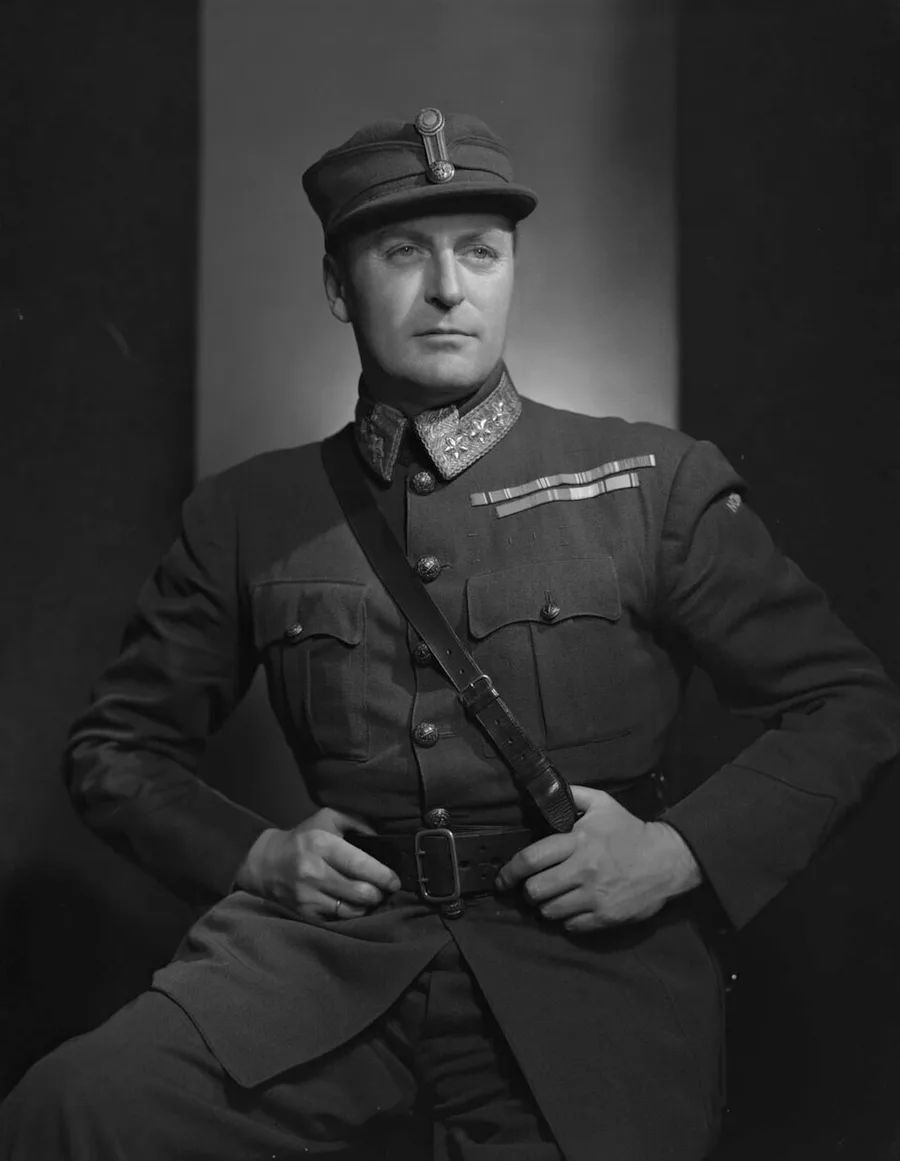 Yousuf Karsh, H.R.H. Crown Prince Olav of Norway (c. 1943), Library and Archives Canada Karsh's wartime London portrait of Crown Prince Olav in field uniform — the Sandringham-born infant of 1905, renamed for the saint-king, grown into the public face of the Norwegian resistance beside his father; from 1957 the *Folkekongen*, the People's King. King of Norway 1957–1991. Born Prince Alexander Edward Christian
Frederik in Sandringham, England, in 1903 to the future Haakon VII
and his British wife Princess Maud; renamed Olav on the family's
arrival in Norway in 1905, after the medieval patron saint of the
country. Crown Prince through the German occupation, during which
he served alongside his father as the public face of Norwegian
resistance from London. Acceded in 1957 on his father's death;
consecrated at Nidaros Cathedral in 1958 rather than crowned (the
coronation requirement had been removed in 1908). Bynamed
Folkekongen — the People's King — for his unaffected
approachability across thirty-four years on the throne.
Also discussed in The King Who Became a Saint — how the Nordmen came to ChristThe Quiet Revolution — how Norway won its independence without a warWorld War II — the King’s “No” and the Nazis in Norway as a memorial to the Norwegian emigrants. Inland, on the steep ground above the inner fjords of Sogn and Hardanger, the foundations of abandoned smallholdings — the Ødegårder
Yousuf Karsh, H.R.H. Crown Prince Olav of Norway (c. 1943), Library and Archives Canada Karsh's wartime London portrait of Crown Prince Olav in field uniform — the Sandringham-born infant of 1905, renamed for the saint-king, grown into the public face of the Norwegian resistance beside his father; from 1957 the *Folkekongen*, the People's King. King of Norway 1957–1991. Born Prince Alexander Edward Christian
Frederik in Sandringham, England, in 1903 to the future Haakon VII
and his British wife Princess Maud; renamed Olav on the family's
arrival in Norway in 1905, after the medieval patron saint of the
country. Crown Prince through the German occupation, during which
he served alongside his father as the public face of Norwegian
resistance from London. Acceded in 1957 on his father's death;
consecrated at Nidaros Cathedral in 1958 rather than crowned (the
coronation requirement had been removed in 1908). Bynamed
Folkekongen — the People's King — for his unaffected
approachability across thirty-four years on the throne.
Also discussed in The King Who Became a Saint — how the Nordmen came to ChristThe Quiet Revolution — how Norway won its independence without a warWorld War II — the King’s “No” and the Nazis in Norway as a memorial to the Norwegian emigrants. Inland, on the steep ground above the inner fjords of Sogn and Hardanger, the foundations of abandoned smallholdings — the Ødegårder 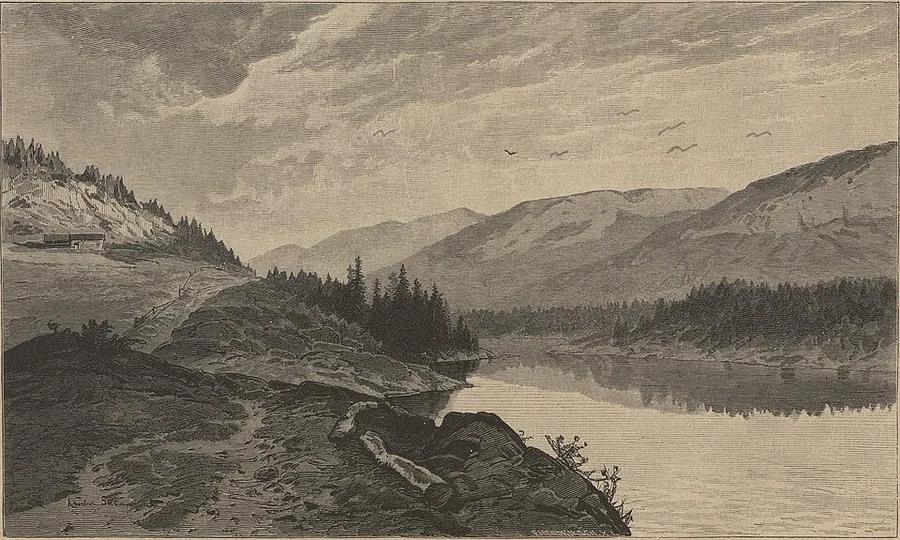 Ludvig Skramstad, Sætersdalen, ved Ose (before 1882) Upper Setesdal drawn in the early 1880s, as the great wave crested: one farm on an empty hillside in a district the medieval registers had already once recorded as ødegårder. When emigration emptied the upland valleys again, Norwegians reached for the same word. Deserted farms — the standard Norwegian historiographical
term for the abandoned farmsteads documented in the long
series of cathedral and royal registers compiled in the
centuries after the Black Death. Comparison of pre-plague
surveys against later compilations shows that between a third
and three-fifths of pre-plague Norwegian farmsteads
disappeared from the rolls. Some were repopulated within a
generation. Many were not. Birch and pine returned to fields
that had been worked for a thousand years. The ghost-farm
pattern in the registers — especially in upland Setesdal,
Telemark, and the upper Gudbrandsdalen — is one of the most
visible long-term traces of the demographic catastrophe.
Also discussed in The Long Fall — the sudden loss of Norwegian nobility, the end of the kings, and half of Norway gone foreverPesta — an old woman walking from farm to farm — still trace the lines of the farms the great migration’s peak decades left empty. In the Aurlandsdalen
Ludvig Skramstad, Sætersdalen, ved Ose (before 1882) Upper Setesdal drawn in the early 1880s, as the great wave crested: one farm on an empty hillside in a district the medieval registers had already once recorded as ødegårder. When emigration emptied the upland valleys again, Norwegians reached for the same word. Deserted farms — the standard Norwegian historiographical
term for the abandoned farmsteads documented in the long
series of cathedral and royal registers compiled in the
centuries after the Black Death. Comparison of pre-plague
surveys against later compilations shows that between a third
and three-fifths of pre-plague Norwegian farmsteads
disappeared from the rolls. Some were repopulated within a
generation. Many were not. Birch and pine returned to fields
that had been worked for a thousand years. The ghost-farm
pattern in the registers — especially in upland Setesdal,
Telemark, and the upper Gudbrandsdalen — is one of the most
visible long-term traces of the demographic catastrophe.
Also discussed in The Long Fall — the sudden loss of Norwegian nobility, the end of the kings, and half of Norway gone foreverPesta — an old woman walking from farm to farm — still trace the lines of the farms the great migration’s peak decades left empty. In the Aurlandsdalen 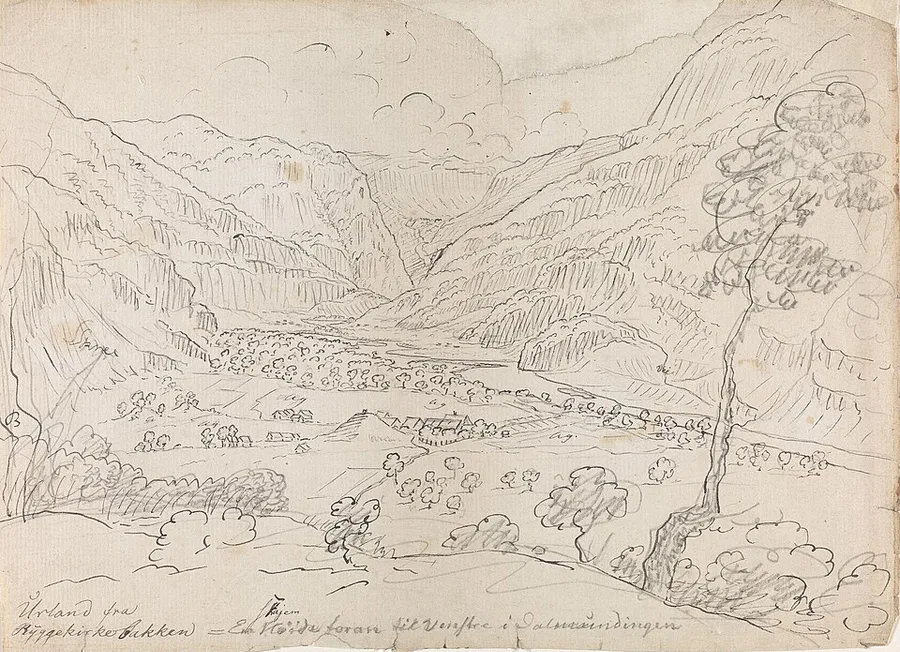 Johannes Flintoe, Aurlandsdalen (c. 1819-1822), National Museum of Art, Architecture and Design Flintoe's early-1800s sketch looks down into Aurlandsdalen, the steep valley of small upland farms that emptied out through the peak emigration decades, its abandoned ødegårder still visible from the modern hiking trail. Steep narrow valley running northeast from Aurland at the
head of the Aurlandsfjord (a side branch of the
Sognefjord) up into the Hardangervidda plateau. About
forty kilometres long. Through the nineteenth century one
of the great Norwegian valleys of marginal upland
smallholdings — small fjord-and-mountain farms perched on
ledges and shelves above the valley floor, working thin
pasture and tiny patches of grain. A large share of the
valley's families emigrated to the upper Midwest of the
United States during the peak emigration decades of the
1860s–1890s; many of the abandoned smallholdings — the
ødegårder — are still visible from the modern hiking
trail down the valley. The valley is now a popular
long-distance hiking route from Finse to Aurland.
On the trip From the Stegastein overlook on Day 3 the Ungdommene (the
Youngsters) look down on the Aurlandsfjord; Aurlandsdalen
climbs inland from Aurland at its head.
alone, a large share of the farms were abandoned during the great migration’s peak decades, many of the households going to America. The Norwegian landscape still wears the emptying.
Johannes Flintoe, Aurlandsdalen (c. 1819-1822), National Museum of Art, Architecture and Design Flintoe's early-1800s sketch looks down into Aurlandsdalen, the steep valley of small upland farms that emptied out through the peak emigration decades, its abandoned ødegårder still visible from the modern hiking trail. Steep narrow valley running northeast from Aurland at the
head of the Aurlandsfjord (a side branch of the
Sognefjord) up into the Hardangervidda plateau. About
forty kilometres long. Through the nineteenth century one
of the great Norwegian valleys of marginal upland
smallholdings — small fjord-and-mountain farms perched on
ledges and shelves above the valley floor, working thin
pasture and tiny patches of grain. A large share of the
valley's families emigrated to the upper Midwest of the
United States during the peak emigration decades of the
1860s–1890s; many of the abandoned smallholdings — the
ødegårder — are still visible from the modern hiking
trail down the valley. The valley is now a popular
long-distance hiking route from Finse to Aurland.
On the trip From the Stegastein overlook on Day 3 the Ungdommene (the
Youngsters) look down on the Aurlandsfjord; Aurlandsdalen
climbs inland from Aurland at its head.
alone, a large share of the farms were abandoned during the great migration’s peak decades, many of the households going to America. The Norwegian landscape still wears the emptying.
A Second Norway
The country that the emigrants built across the Atlantic is the other side. The Norwegian-American community of around four and a half million people in 2026 carries the inheritance forward into the third, fourth, and fifth generations.
In Stoughton, Wisconsin — a small Dane County town that had a majority Norwegian-speaking population through the late nineteenth century — the seventeenth of May is still kept every spring with a Syttende mai 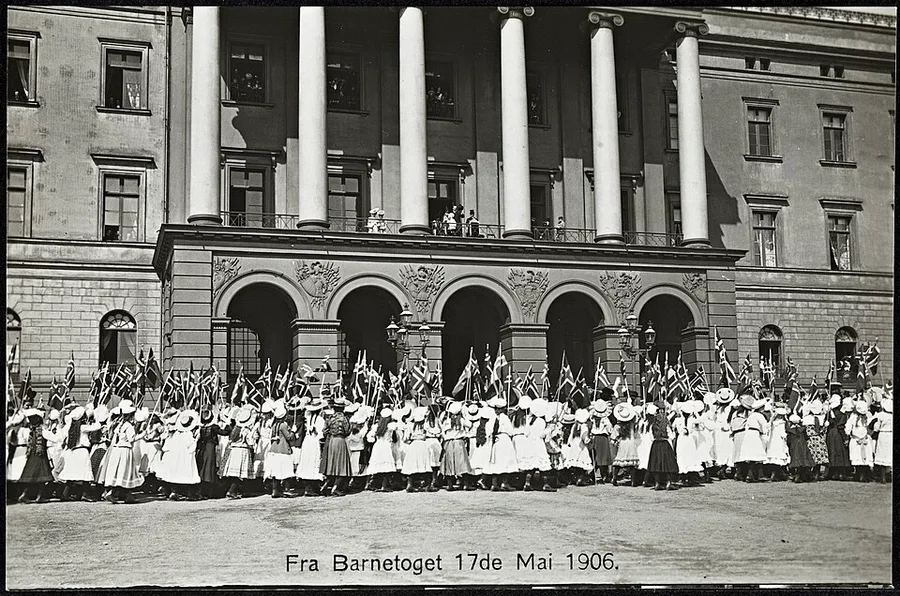 Unknown photographer, postcard (1906), National Library of Norway, via Flickr Commons A 1906 postcard of the barnetog, the children's flag parade at Christiania's Slottsplassen that has opened Constitution Day since 1870, when Bjørnstjerne Bjørnson first proposed it to the city. The seventeenth of May — Norway's national day,
celebrating the signing of the Eidsvoll Constitution on 17
May 1814. Marked across the country by children's parades
in every town carrying Norwegian flags, by speeches by
elected officials reading from the Constitution, by the
singing of Ja, vi elsker dette landet, by the wearing of
regional bunad folk dress, and by a general public
conviviality that is the loudest day of the Norwegian
year. The children's parade tradition began at Christiania
in 1870 (girls' participation following in 1889) at the
suggestion of Bjørnstjerne Bjørnson. Celebrated by every
Norwegian school and every Norwegian-American community
abroad, with Minnesota, Wisconsin, and Iowa communities
keeping the holiday vigorously.
Also discussed in The Constitution That Saved a Nation — five radical weeks at Eidsvoll, 1814Tradisjoner — celebrations across the Norwegian year , organized by the Chamber of Commerce since 1953, that closes the downtown for a weekend of parades, bunad costume contests, and church dinners serving lefse, lutefisk, rømmegrøt, and krumkake. Across the upper Midwest, Lutheran congregations descended from the Norwegian-American synods still hold annual lutefisk suppers in their church basements in the weeks before Christmas — the participating congregations graying and shrinking but the tradition kept up parish by parish, year by year.
Unknown photographer, postcard (1906), National Library of Norway, via Flickr Commons A 1906 postcard of the barnetog, the children's flag parade at Christiania's Slottsplassen that has opened Constitution Day since 1870, when Bjørnstjerne Bjørnson first proposed it to the city. The seventeenth of May — Norway's national day,
celebrating the signing of the Eidsvoll Constitution on 17
May 1814. Marked across the country by children's parades
in every town carrying Norwegian flags, by speeches by
elected officials reading from the Constitution, by the
singing of Ja, vi elsker dette landet, by the wearing of
regional bunad folk dress, and by a general public
conviviality that is the loudest day of the Norwegian
year. The children's parade tradition began at Christiania
in 1870 (girls' participation following in 1889) at the
suggestion of Bjørnstjerne Bjørnson. Celebrated by every
Norwegian school and every Norwegian-American community
abroad, with Minnesota, Wisconsin, and Iowa communities
keeping the holiday vigorously.
Also discussed in The Constitution That Saved a Nation — five radical weeks at Eidsvoll, 1814Tradisjoner — celebrations across the Norwegian year , organized by the Chamber of Commerce since 1953, that closes the downtown for a weekend of parades, bunad costume contests, and church dinners serving lefse, lutefisk, rømmegrøt, and krumkake. Across the upper Midwest, Lutheran congregations descended from the Norwegian-American synods still hold annual lutefisk suppers in their church basements in the weeks before Christmas — the participating congregations graying and shrinking but the tradition kept up parish by parish, year by year.
Cleng Peerson is buried in Texas. He goes on to scout further west after the New York settlement is established, ends up in central Texas, and dies in 1865 in Bosque County, where his grave is marked by a tall stone in the small village of Norse, Texas 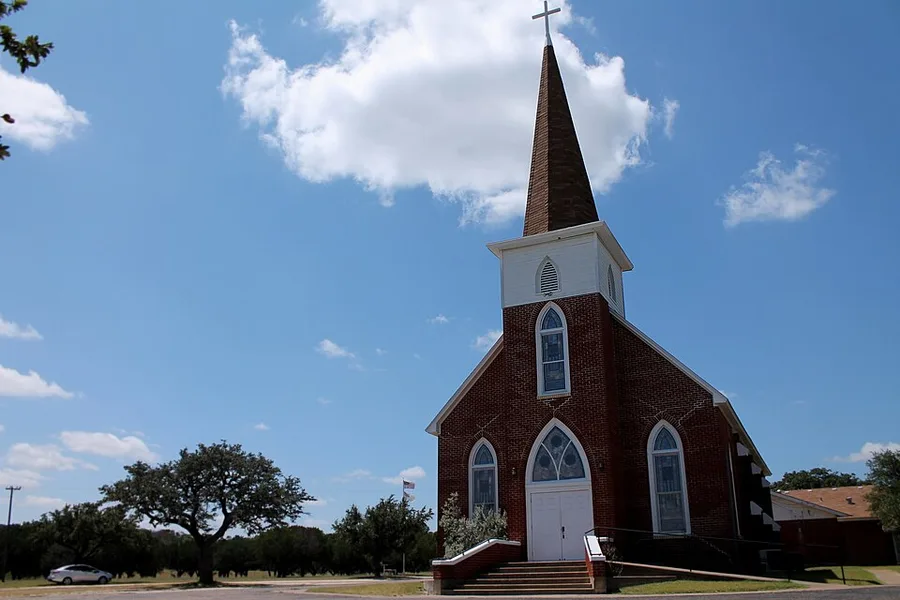 Renelibrary, Our Savior's Lutheran Church, Norse, Texas (2014), CC BY-SA 3.0 Our Savior's Lutheran Church at Norse, the congregation the Norwegian settlers of Bosque County built; in the small cemetery beside it stands the tall stone marker over Cleng Peerson's grave. Unincorporated community in Bosque County in central Texas,
about a hundred miles southwest of Dallas. Founded in the
early 1850s as a Norwegian-American settlement by emigrants
Cleng Peerson had scouted west from the upper-Midwest
colonies; one of the few Norwegian-American settlements
outside the upper Midwest. The Our Saviour's Lutheran
Church (built 1875) and the small cemetery preserve the
Norwegian-American character of the community. Cleng
Peerson — the father of Norwegian emigration to America
— died at Norse on 16 December 1865 and is buried in the
cemetery beside the church under a tall stone marker
raised by later Norwegian-American visitors. The settlement
is the southernmost terminus of the Norwegian-American
emigration story.
.
Renelibrary, Our Savior's Lutheran Church, Norse, Texas (2014), CC BY-SA 3.0 Our Savior's Lutheran Church at Norse, the congregation the Norwegian settlers of Bosque County built; in the small cemetery beside it stands the tall stone marker over Cleng Peerson's grave. Unincorporated community in Bosque County in central Texas,
about a hundred miles southwest of Dallas. Founded in the
early 1850s as a Norwegian-American settlement by emigrants
Cleng Peerson had scouted west from the upper-Midwest
colonies; one of the few Norwegian-American settlements
outside the upper Midwest. The Our Saviour's Lutheran
Church (built 1875) and the small cemetery preserve the
Norwegian-American character of the community. Cleng
Peerson — the father of Norwegian emigration to America
— died at Norse on 16 December 1865 and is buried in the
cemetery beside the church under a tall stone marker
raised by later Norwegian-American visitors. The settlement
is the southernmost terminus of the Norwegian-American
emigration story.
.