The Long Fall — A sudden loss of Norwegian nobility, the end of the kings, and half of Norway gone forever
In 1349 a ship reached Bergen harbour with Yersinia pestis aboard. Within two years half of Norway was dead, the small literate nobility was gone, and the line of kings the sagas traced back to Harald Fairhair would not survive the century.
In the late summer of 1349, a ship from England made fast at the wharves of Bergen 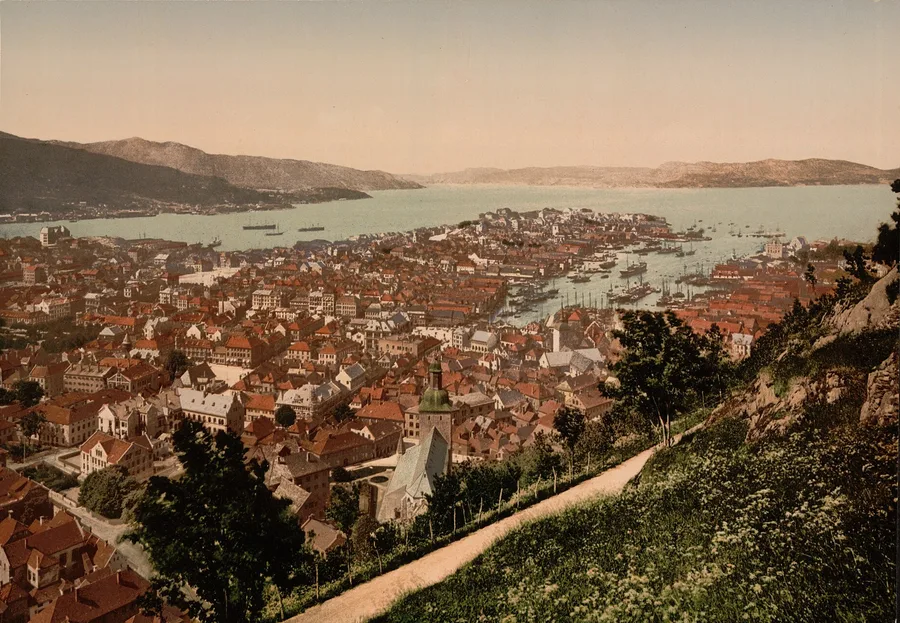 Photochrom print, General view from Fjeldveien, Bergen (c. 1890–1900), Library of Congress Bergen in the 1890s from the Fjellveien path on Fløyfjellet — the whole city between its mountains, Vågen harbour still crowded with sailing ships at its heart. For four centuries Norway's largest city, and the wharf through which the entire western export economy ran. Norway's western trading capital, founded around 1070 on the
inner Byfjorden. For four centuries the largest city in the
country and the wharf through which the entire western export
economy ran — dried cod from the Lofoten fisheries, stockpiled
and traded by the Hanseatic merchants at Bryggen from 1360 to
1754. Norway's commercial and intellectual heart through the
Hanseatic period; overtaken in size by Christiania (Oslo) in the
1830s. The painted wooden Bryggen wharf is on the UNESCO World
Heritage list and substantially what it was in the late
seventeenth century.
In this article The plague's likely arrival point in 1349 — a ship from England
made fast at the wharves of Bergen, and the longshoremen who
unloaded its cargo were sick within days. The town's small
literate class effectively disappeared in the months after.
On the trip The Ungdommene (the Youngsters) reach Bergen late on Day 3
via the Norway-in-a-Nutshell train-and-ferry route from
Oslo. On the Day 4 morning they walk Bryggen and ride the
funicular up Mount Fløyen before flying back to Oslo and driving
on to Lillehammer that evening — a day ahead of the Gråhårsklubben
(the Oldsters), who spend the split days north in Trondheim and
the heritage country of Stjørdal, Hegra, and Kylloplass and come
south on Day 5.
Bergen Also discussed in The Germans Who "Ruled" Bergen — the Hanseatic merchants on Bryggen WharfBefore There Was Norway — petty kingdoms at the edge of the worldThe King Who Became a Saint — how the Nordmen came to ChristA Catholic Norway — the faith that gave the kingdom its first institutions and the stave churchesThe Golden Age — a North Atlantic empire … reaching farther than you thinkThe 400-Year Night — when the Northern Lion lay dormantThe Crusades?!!!! — sixty ships from Bergen, bound for the Holy LandThe Reformation, 1537 — one church eradicated and another imposedWorld War II — the King’s “No” and the Nazis in NorwayKraken — the island-sized beast, logged as factSjøormer — the serpents in the deep lakes and fjordsPesta — an old woman walking from farm to farmFossegrimen — the waterfall fiddler who teaches you to playAlcohol and Vinmonopolet — when and where to buy a drinkEveryday etiquette — quiet voices, wide space, no smilingFood and dining customs — having patience, free water, brunost on everything🚨 Emergencies - important numbers, hospitals, and what you can doLanguage basics — just enough Norwegian to be politeWhat to wear — the layering system, on the ground , and within days the longshoremen who had unloaded its cargo were sick. The priests of Christ Church, Bergen
Photochrom print, General view from Fjeldveien, Bergen (c. 1890–1900), Library of Congress Bergen in the 1890s from the Fjellveien path on Fløyfjellet — the whole city between its mountains, Vågen harbour still crowded with sailing ships at its heart. For four centuries Norway's largest city, and the wharf through which the entire western export economy ran. Norway's western trading capital, founded around 1070 on the
inner Byfjorden. For four centuries the largest city in the
country and the wharf through which the entire western export
economy ran — dried cod from the Lofoten fisheries, stockpiled
and traded by the Hanseatic merchants at Bryggen from 1360 to
1754. Norway's commercial and intellectual heart through the
Hanseatic period; overtaken in size by Christiania (Oslo) in the
1830s. The painted wooden Bryggen wharf is on the UNESCO World
Heritage list and substantially what it was in the late
seventeenth century.
In this article The plague's likely arrival point in 1349 — a ship from England
made fast at the wharves of Bergen, and the longshoremen who
unloaded its cargo were sick within days. The town's small
literate class effectively disappeared in the months after.
On the trip The Ungdommene (the Youngsters) reach Bergen late on Day 3
via the Norway-in-a-Nutshell train-and-ferry route from
Oslo. On the Day 4 morning they walk Bryggen and ride the
funicular up Mount Fløyen before flying back to Oslo and driving
on to Lillehammer that evening — a day ahead of the Gråhårsklubben
(the Oldsters), who spend the split days north in Trondheim and
the heritage country of Stjørdal, Hegra, and Kylloplass and come
south on Day 5.
Bergen Also discussed in The Germans Who "Ruled" Bergen — the Hanseatic merchants on Bryggen WharfBefore There Was Norway — petty kingdoms at the edge of the worldThe King Who Became a Saint — how the Nordmen came to ChristA Catholic Norway — the faith that gave the kingdom its first institutions and the stave churchesThe Golden Age — a North Atlantic empire … reaching farther than you thinkThe 400-Year Night — when the Northern Lion lay dormantThe Crusades?!!!! — sixty ships from Bergen, bound for the Holy LandThe Reformation, 1537 — one church eradicated and another imposedWorld War II — the King’s “No” and the Nazis in NorwayKraken — the island-sized beast, logged as factSjøormer — the serpents in the deep lakes and fjordsPesta — an old woman walking from farm to farmFossegrimen — the waterfall fiddler who teaches you to playAlcohol and Vinmonopolet — when and where to buy a drinkEveryday etiquette — quiet voices, wide space, no smilingFood and dining customs — having patience, free water, brunost on everything🚨 Emergencies - important numbers, hospitals, and what you can doLanguage basics — just enough Norwegian to be politeWhat to wear — the layering system, on the ground , and within days the longshoremen who had unloaded its cargo were sick. The priests of Christ Church, Bergen 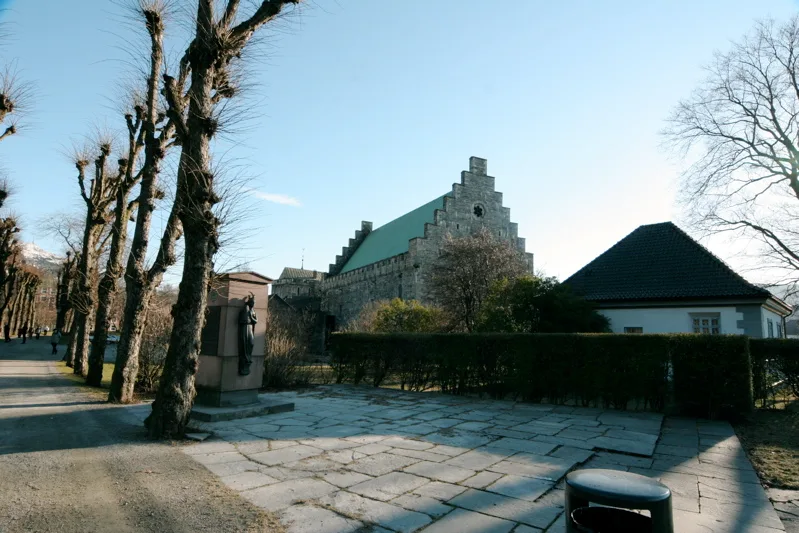 Photo: Nina Aldin Thune, CC BY-SA 3.0 Nothing of the cathedral stands — it was razed in 1531 to clear the fortress's field of fire. The paved plot and low hedges beside Håkon's Hall at Bergenhus mark its site: the footprint of the church where William of Sabina crowned Hákon IV in 1247. Cathedral of medieval Bergen, the seat of the bishop and
the coronation church of the Norwegian kings, located on the
Holmen headland above the Vågen harbour at what is today the
Bergenhus fortress. Begun in the twelfth century by Olav
Kyrre and completed under the early Sverre dynasty; Hákon IV
was crowned there by the papal legate William of Sabina in
1247. Reportedly the first church in Bergen at which the
plague-bearing ship's contagion took hold in the late summer
of 1349, killing the priests of the headland. The cathedral
was later moved to its present site away from the fortress;
the medieval Christ Church itself was demolished after the
Reformation, and only foundation traces remain today within
the Bergenhus complex.
Also discussed in The Reformation, 1537 — one church eradicated and another imposed on the headland above the harbour were among the first to die. In the Lögmanns-annáll
Photo: Nina Aldin Thune, CC BY-SA 3.0 Nothing of the cathedral stands — it was razed in 1531 to clear the fortress's field of fire. The paved plot and low hedges beside Håkon's Hall at Bergenhus mark its site: the footprint of the church where William of Sabina crowned Hákon IV in 1247. Cathedral of medieval Bergen, the seat of the bishop and
the coronation church of the Norwegian kings, located on the
Holmen headland above the Vågen harbour at what is today the
Bergenhus fortress. Begun in the twelfth century by Olav
Kyrre and completed under the early Sverre dynasty; Hákon IV
was crowned there by the papal legate William of Sabina in
1247. Reportedly the first church in Bergen at which the
plague-bearing ship's contagion took hold in the late summer
of 1349, killing the priests of the headland. The cathedral
was later moved to its present site away from the fortress;
the medieval Christ Church itself was demolished after the
Reformation, and only foundation traces remain today within
the Bergenhus complex.
Also discussed in The Reformation, 1537 — one church eradicated and another imposed on the headland above the harbour were among the first to die. In the Lögmanns-annáll 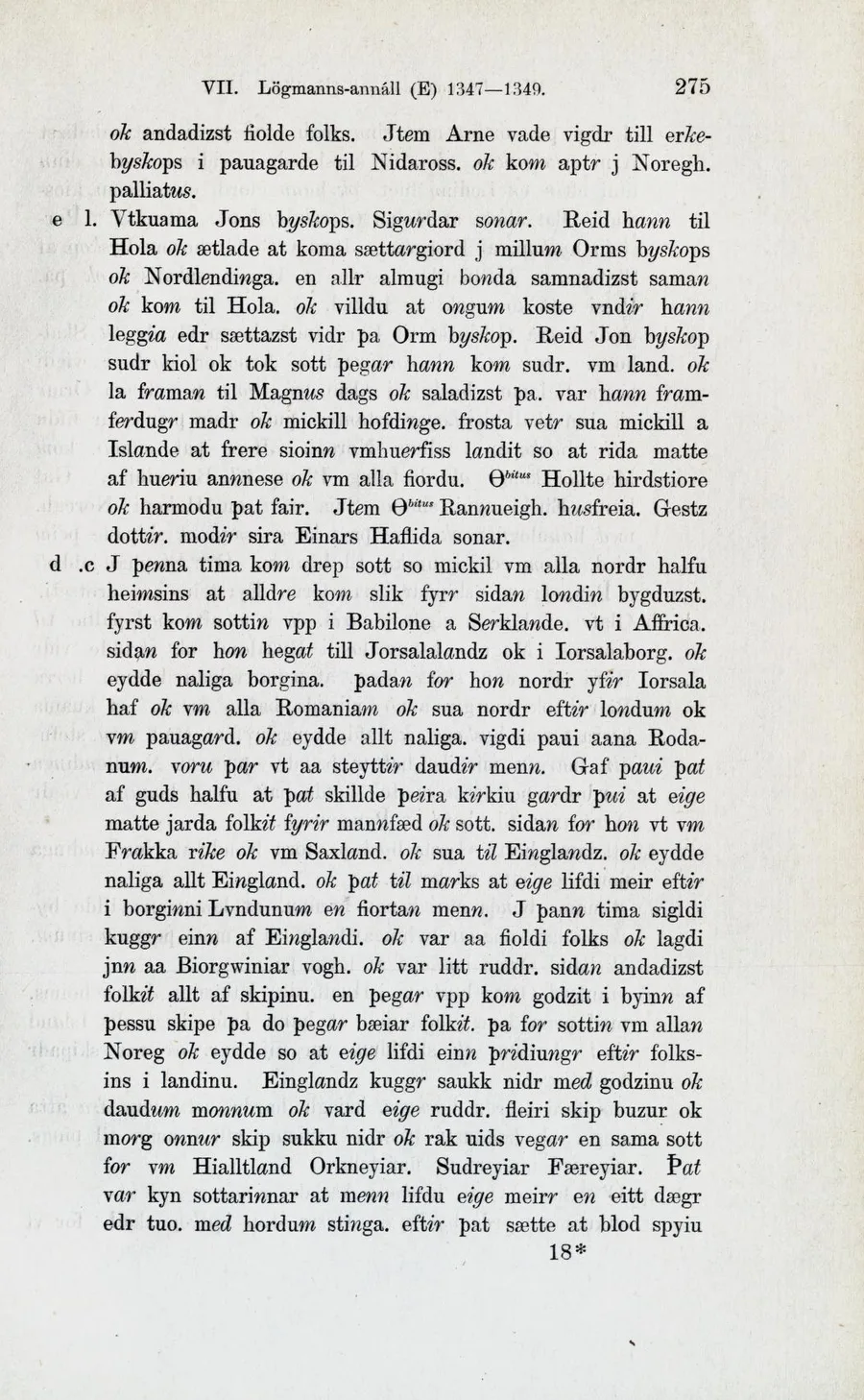 Islandske Annaler indtil 1578, ed. Gustav Storm (Christiania, 1888), p. 275, National Library of Norway The annal's plague entry as Storm's edition prints it: an English cog lays in at Bergen's Vågen, the ship's folk die, the goods come ashore and the town begins dying — "then the sickness went over all Norway, so that not a third of the folk survived." This is the page that dates the catastrophe. The Lawman's Annal — late-medieval Icelandic annal
collection compiled by the priest and law-speaker Einarr
Hafliðason (1307–1393) at Breiðabólstaður in northern
Iceland, covering events from Creation to 1392. Among the
principal late-medieval Icelandic annals and the standard
source for the dating of the Black Death's arrival in
Norway, which the annal records as having reached the
realm through Bergen in 1349 in a single terse entry. The
surviving text is preserved in Islandske Annaler indtil
1578, edited by Gustav Storm (Christiania, 1888).
of the Icelandic chronicler Einarr Hafliðason
Islandske Annaler indtil 1578, ed. Gustav Storm (Christiania, 1888), p. 275, National Library of Norway The annal's plague entry as Storm's edition prints it: an English cog lays in at Bergen's Vågen, the ship's folk die, the goods come ashore and the town begins dying — "then the sickness went over all Norway, so that not a third of the folk survived." This is the page that dates the catastrophe. The Lawman's Annal — late-medieval Icelandic annal
collection compiled by the priest and law-speaker Einarr
Hafliðason (1307–1393) at Breiðabólstaður in northern
Iceland, covering events from Creation to 1392. Among the
principal late-medieval Icelandic annals and the standard
source for the dating of the Black Death's arrival in
Norway, which the annal records as having reached the
realm through Bergen in 1349 in a single terse entry. The
surviving text is preserved in Islandske Annaler indtil
1578, edited by Gustav Storm (Christiania, 1888).
of the Icelandic chronicler Einarr Hafliðason 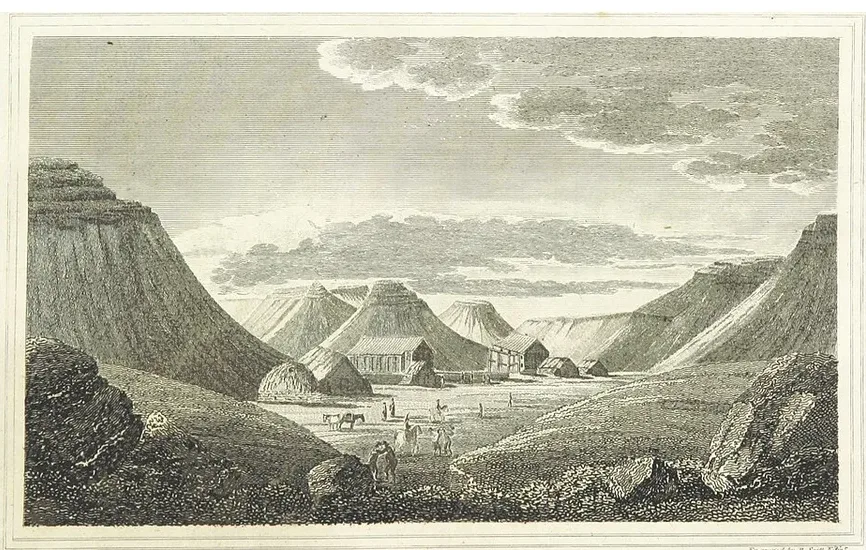 Captain Frisak, View of Holum (1819), from Ebenezer Henderson, Iceland; or the Journal of a Residence in that Island - British Library No portrait of Einarr survives. This 1819 view shows Hólar in Hjaltadalur, the northern bishop's seat where he was schooled and whose diocese he administered as officialis; the annal recording the plague's landfall at Bergen was kept at his parsonage in Vesturhóp. Icelandic priest and chronicler (1307–1393), parish priest at
Breiðabólstaður in Húnaþing and law-speaker of the northern
quarter of Iceland. Compiler of the Lögmanns-annáll — the
Lawman's Annal — one of the principal late-medieval Icelandic
annal collections, which records the arrival of the Black
Death in Norway through Bergen in 1349 in a single terse
entry. The annal is the standard source for the dating of the
plague's entry into the Norwegian realm.
, the year 1349 is marked as the year the great mortality reached Norway through Bergen. The annal’s terse entry does not trace its path; the route — north to Nidaros Cathedral
Captain Frisak, View of Holum (1819), from Ebenezer Henderson, Iceland; or the Journal of a Residence in that Island - British Library No portrait of Einarr survives. This 1819 view shows Hólar in Hjaltadalur, the northern bishop's seat where he was schooled and whose diocese he administered as officialis; the annal recording the plague's landfall at Bergen was kept at his parsonage in Vesturhóp. Icelandic priest and chronicler (1307–1393), parish priest at
Breiðabólstaður in Húnaþing and law-speaker of the northern
quarter of Iceland. Compiler of the Lögmanns-annáll — the
Lawman's Annal — one of the principal late-medieval Icelandic
annal collections, which records the arrival of the Black
Death in Norway through Bergen in 1349 in a single terse
entry. The annal is the standard source for the dating of the
plague's entry into the Norwegian realm.
, the year 1349 is marked as the year the great mortality reached Norway through Bergen. The annal’s terse entry does not trace its path; the route — north to Nidaros Cathedral 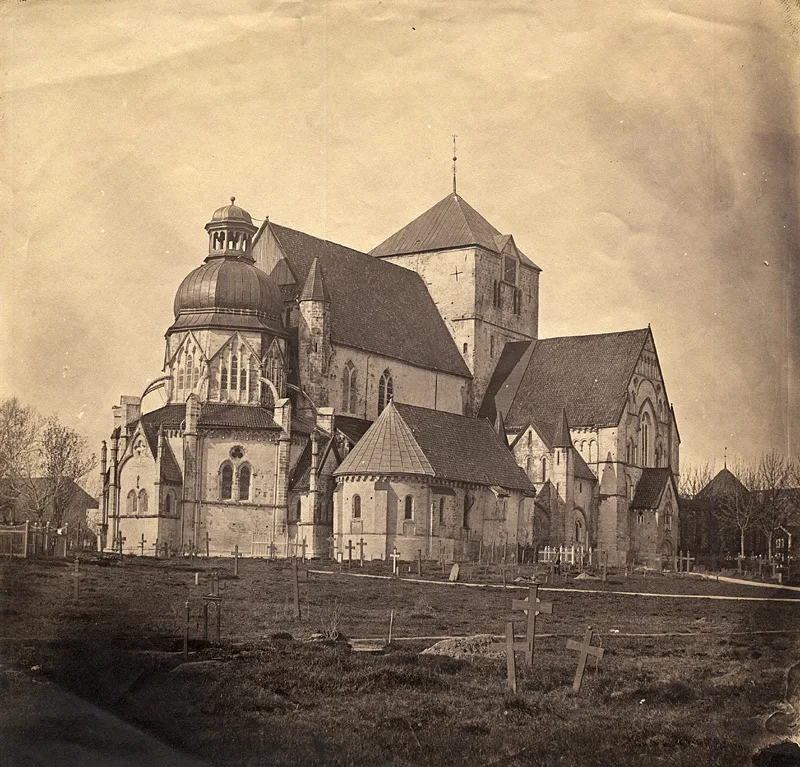 Unknown photographer, Nidaros Cathedral from the northeast (1857), Wikimedia Commons One of the earliest surviving photographs of Norway, taken in 1857 — decades before the west front's twentieth-century reconstruction — showing the cathedral over Olav's grave much as centuries of fire, neglect, and weather had left it. The principal cathedral of Norway and the burial place of Saint
Olav, on the bank of the Nid River in Trondheim. Built and rebuilt
in stages from the late eleventh through the early fourteenth
centuries around the shrine site at the cathedral's east end. The
octagonal east end, raised directly over Olav's grave, was the
devotional core of the medieval building. Substantially damaged
by fires and the 1531 lightning strike, then by neglect across the
Lutheran centuries. The west front a visitor sees today is a
nineteenth- and twentieth-century reconstruction, completed only
in 1983. The cathedral is the coronation and consecration church
of Norwegian kings; Haakon VII was crowned there in 1906, Olav V
consecrated in 1958, Harald V in 1991.
On the trip Day 3 of the trip brings the Gråhårsklubben (the Oldsters) to
Nidaros Cathedral. The shrine is gone but
the spot is marked on the cathedral floor in the octagonal east
end. The west front is the twentieth-century reconstruction of
the face the medieval pilgrims saw. The pilgrim road comes in
past the south door — the same door medieval pilgrims walked
through.
Nidaros Cathedral, Trondheim Also discussed in The King Who Became a Saint — how the Nordmen came to ChristA Catholic Norway — the faith that gave the kingdom its first institutions and the stave churchesThe Crusades?!!!! — sixty ships from Bergen, bound for the Holy LandThe Golden Age — a North Atlantic empire … reaching farther than you thinkThe 400-Year Night — when the Northern Lion lay dormantThe Reformation, 1537 — one church eradicated and another imposedLutheran Norway and Pietism — a farmer named Hans Nielsen Hauge and a lay revival that could not be silencedThe Quiet Revolution — how Norway won its independence without a warTradisjoner — celebrations across the Norwegian year by autumn, south through Oslo
Unknown photographer, Nidaros Cathedral from the northeast (1857), Wikimedia Commons One of the earliest surviving photographs of Norway, taken in 1857 — decades before the west front's twentieth-century reconstruction — showing the cathedral over Olav's grave much as centuries of fire, neglect, and weather had left it. The principal cathedral of Norway and the burial place of Saint
Olav, on the bank of the Nid River in Trondheim. Built and rebuilt
in stages from the late eleventh through the early fourteenth
centuries around the shrine site at the cathedral's east end. The
octagonal east end, raised directly over Olav's grave, was the
devotional core of the medieval building. Substantially damaged
by fires and the 1531 lightning strike, then by neglect across the
Lutheran centuries. The west front a visitor sees today is a
nineteenth- and twentieth-century reconstruction, completed only
in 1983. The cathedral is the coronation and consecration church
of Norwegian kings; Haakon VII was crowned there in 1906, Olav V
consecrated in 1958, Harald V in 1991.
On the trip Day 3 of the trip brings the Gråhårsklubben (the Oldsters) to
Nidaros Cathedral. The shrine is gone but
the spot is marked on the cathedral floor in the octagonal east
end. The west front is the twentieth-century reconstruction of
the face the medieval pilgrims saw. The pilgrim road comes in
past the south door — the same door medieval pilgrims walked
through.
Nidaros Cathedral, Trondheim Also discussed in The King Who Became a Saint — how the Nordmen came to ChristA Catholic Norway — the faith that gave the kingdom its first institutions and the stave churchesThe Crusades?!!!! — sixty ships from Bergen, bound for the Holy LandThe Golden Age — a North Atlantic empire … reaching farther than you thinkThe 400-Year Night — when the Northern Lion lay dormantThe Reformation, 1537 — one church eradicated and another imposedLutheran Norway and Pietism — a farmer named Hans Nielsen Hauge and a lay revival that could not be silencedThe Quiet Revolution — how Norway won its independence without a warTradisjoner — celebrations across the Norwegian year by autumn, south through Oslo 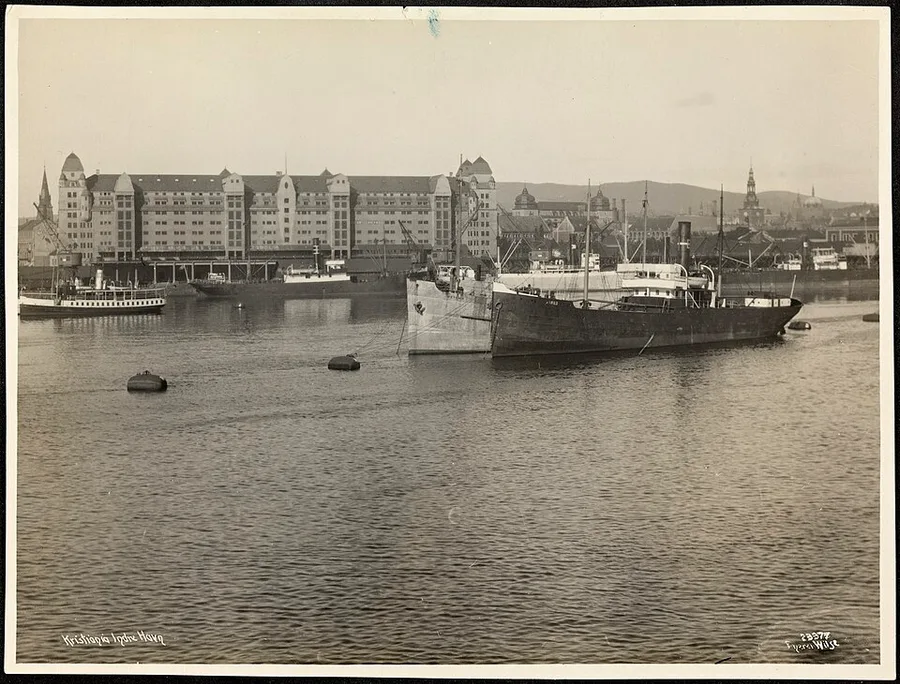 Anders Beer Wilse, Kristiania Indre Havn (1923), National Library of Norway Wilse's 1923 photograph of the inner harbor at Bjørvika, two years before Kristiania took back its old name Oslo — steamers at the quays beneath the spires of the city that grew from a medieval royal seat into Norway's capital. Capital of modern Norway, at the head of the Oslofjord on
the country's southeastern coast. Founded according to the
sagas by Harald Hardrada about 1049 and known through the
medieval period as a secondary royal seat behind Bergen and
Nidaros. Hákon V moved the royal residence permanently to
Oslo about 1300 and built Akershus Fortress to guard the
harbour. After a fire in 1624 the medieval town was
abandoned and Christian IV rebuilt the city to the west
under the new name Christiania (later Kristiania); the
name Oslo was restored in 1925. The original medieval
street pattern survives as the Gamlebyen district east of
the modern centre.
On the trip Days 1–2 belong to Oslo, with both groups together —
Roseslottet and the harbourside museums on Day 1, then the
Day-2 e-bike tour through Akershus Fortress, up Karl Johans
gate, and out to Vigeland Park.
Oslo Also discussed in A Catholic Norway — the faith that gave the kingdom its first institutions and the stave churchesThe 400-Year Night — when the Northern Lion lay dormantThe Reformation, 1537 — one church eradicated and another imposedLutheran Norway and Pietism — a farmer named Hans Nielsen Hauge and a lay revival that could not be silencedThe Constitution That Saved a Nation — five radical weeks at Eidsvoll, 1814800,000 Norwegians Leave — the century that built a Second NorwayThe Quiet Revolution — how Norway won its independence without a warWorld War II — the King’s “No” and the Nazis in NorwayAlcohol and Vinmonopolet — when and where to buy a drinkEveryday etiquette — quiet voices, wide space, no smiling🚨 Emergencies - important numbers, hospitals, and what you can doLanding in Norway — off the plane in Oslo, where to go, step by stepMoney — currency, cards, prices, and tipping into the inland valleys before winter — is the reconstruction of modern scholars from charters, episcopal correspondence, and the dispersed annals of the years that followed.
Anders Beer Wilse, Kristiania Indre Havn (1923), National Library of Norway Wilse's 1923 photograph of the inner harbor at Bjørvika, two years before Kristiania took back its old name Oslo — steamers at the quays beneath the spires of the city that grew from a medieval royal seat into Norway's capital. Capital of modern Norway, at the head of the Oslofjord on
the country's southeastern coast. Founded according to the
sagas by Harald Hardrada about 1049 and known through the
medieval period as a secondary royal seat behind Bergen and
Nidaros. Hákon V moved the royal residence permanently to
Oslo about 1300 and built Akershus Fortress to guard the
harbour. After a fire in 1624 the medieval town was
abandoned and Christian IV rebuilt the city to the west
under the new name Christiania (later Kristiania); the
name Oslo was restored in 1925. The original medieval
street pattern survives as the Gamlebyen district east of
the modern centre.
On the trip Days 1–2 belong to Oslo, with both groups together —
Roseslottet and the harbourside museums on Day 1, then the
Day-2 e-bike tour through Akershus Fortress, up Karl Johans
gate, and out to Vigeland Park.
Oslo Also discussed in A Catholic Norway — the faith that gave the kingdom its first institutions and the stave churchesThe 400-Year Night — when the Northern Lion lay dormantThe Reformation, 1537 — one church eradicated and another imposedLutheran Norway and Pietism — a farmer named Hans Nielsen Hauge and a lay revival that could not be silencedThe Constitution That Saved a Nation — five radical weeks at Eidsvoll, 1814800,000 Norwegians Leave — the century that built a Second NorwayThe Quiet Revolution — how Norway won its independence without a warWorld War II — the King’s “No” and the Nazis in NorwayAlcohol and Vinmonopolet — when and where to buy a drinkEveryday etiquette — quiet voices, wide space, no smiling🚨 Emergencies - important numbers, hospitals, and what you can doLanding in Norway — off the plane in Oslo, where to go, step by stepMoney — currency, cards, prices, and tipping into the inland valleys before winter — is the reconstruction of modern scholars from charters, episcopal correspondence, and the dispersed annals of the years that followed.
Manndauden
The Norwegian word for what came was Manndauden 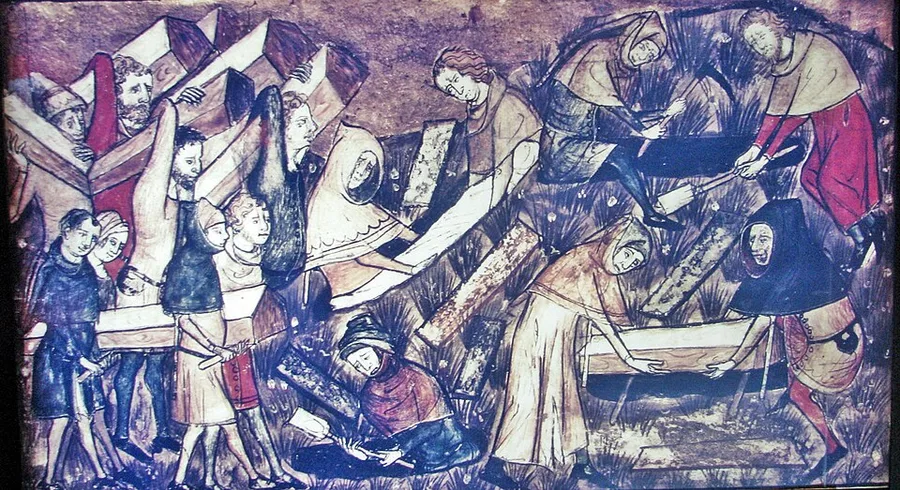 Pierart dou Tielt, burial of plague victims at Tournai (Gilles li Muisit chronicle, c. 1353) This 14th-century Flemish manuscript miniature shows townspeople burying plague dead outside Tournai in 1349 — the same pandemic that reached Norway that same year through Bergen and became known there as manndauden, the death of men. The death of men — the standard medieval Norwegian term for
the Black Death of 1349–1350 and its aftermath, using mann
in the older general sense of human being. The contemporary
Norwegian word for the catastrophe; svartedauden — the
black death — is a later coinage that became common only in
the early modern period. Modern Norwegian historiography uses
both: manndauden for the contemporary Norwegian framing of
the event, svartedauden for the pan-European phenomenon.
Norwegian population loss in the two years following the
plague's arrival at Bergen in autumn 1349 is estimated by
modern scholarship at between one-half and three-fifths.
— the death of men, in the older general sense of mann as human. The disease moved fast across the country in the spring and summer of 1349. By the autumn it was in Trøndelag
Pierart dou Tielt, burial of plague victims at Tournai (Gilles li Muisit chronicle, c. 1353) This 14th-century Flemish manuscript miniature shows townspeople burying plague dead outside Tournai in 1349 — the same pandemic that reached Norway that same year through Bergen and became known there as manndauden, the death of men. The death of men — the standard medieval Norwegian term for
the Black Death of 1349–1350 and its aftermath, using mann
in the older general sense of human being. The contemporary
Norwegian word for the catastrophe; svartedauden — the
black death — is a later coinage that became common only in
the early modern period. Modern Norwegian historiography uses
both: manndauden for the contemporary Norwegian framing of
the event, svartedauden for the pan-European phenomenon.
Norwegian population loss in the two years following the
plague's arrival at Bergen in autumn 1349 is estimated by
modern scholarship at between one-half and three-fifths.
— the death of men, in the older general sense of mann as human. The disease moved fast across the country in the spring and summer of 1349. By the autumn it was in Trøndelag 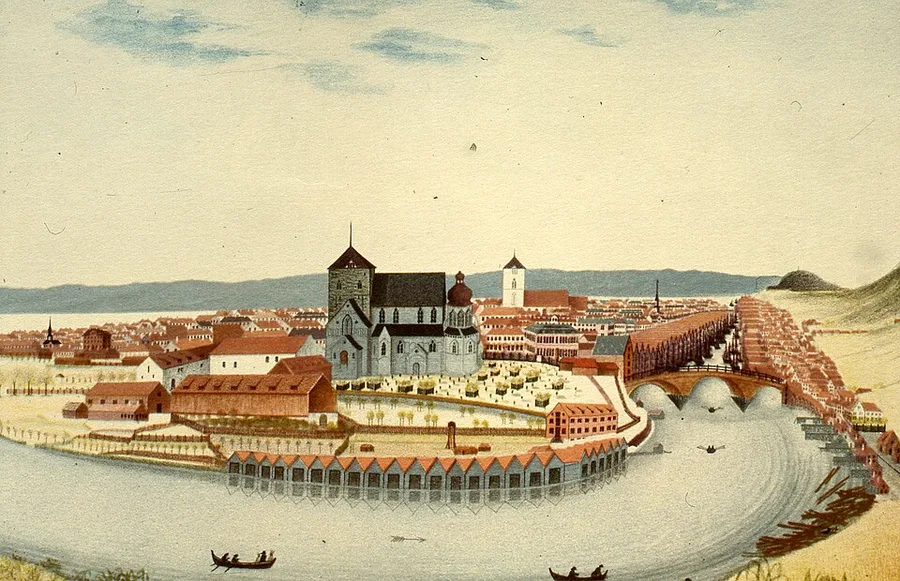 Johannes Aas, Prospect af Staden Trondhiem (1826), Municipal Archives of Trondheim (CC BY 2.0) An 1826 prospect of Trondheim, Nidaros Cathedral rising over the river bend. Founded by Olav Tryggvason as Nidaros in 997, the town became the seat of Norway's archbishopric in 1153 and the country's ecclesiastical capital. Region of central Norway around the Trondheim Fjord, north of Stadt
and south of Hålogaland. Its agriculturally rich Trondheim plain
is the second-largest area of arable land in the country and the
base of the medieval earls of Lade. Trondheim — founded by Olav
Tryggvason in 997 as Nidaros — became the seat of the Norwegian
archbishopric in 1153 and remains the country's third-largest city
and ecclesiastical capital.
On the trip Day 3-5 of the trip routes the Gråhårsklubben (the Oldsters) through
Trøndelag for the Slektsreisen heritage drive — Trondheim and the
Nidaros Cathedral on Day 3, then Stjørdal and Hegra, then on up
the Stjørdalen valley to Kylloplass.
Trøndelag (Trondheim) Also discussed in Before There Was Norway — petty kingdoms at the edge of the worldWorshiping Odin and Thor — the lived religion of pre-Christian NorwayThe King Who Became a Saint — how the Nordmen came to ChristLutheran Norway and Pietism — a farmer named Hans Nielsen Hauge and a lay revival that could not be silencedDraugen — the drowned man who never came homeThe Hytte — a sacred pastime of modern Norway and the high inland farms. By the next year it had reached the western fjords and the eastern lowlands and the cathedral towns and the farthest crofts that anyone still kept track of. There is no medieval account that gives the country a single mortality figure. There is no account that even tries.
Johannes Aas, Prospect af Staden Trondhiem (1826), Municipal Archives of Trondheim (CC BY 2.0) An 1826 prospect of Trondheim, Nidaros Cathedral rising over the river bend. Founded by Olav Tryggvason as Nidaros in 997, the town became the seat of Norway's archbishopric in 1153 and the country's ecclesiastical capital. Region of central Norway around the Trondheim Fjord, north of Stadt
and south of Hålogaland. Its agriculturally rich Trondheim plain
is the second-largest area of arable land in the country and the
base of the medieval earls of Lade. Trondheim — founded by Olav
Tryggvason in 997 as Nidaros — became the seat of the Norwegian
archbishopric in 1153 and remains the country's third-largest city
and ecclesiastical capital.
On the trip Day 3-5 of the trip routes the Gråhårsklubben (the Oldsters) through
Trøndelag for the Slektsreisen heritage drive — Trondheim and the
Nidaros Cathedral on Day 3, then Stjørdal and Hegra, then on up
the Stjørdalen valley to Kylloplass.
Trøndelag (Trondheim) Also discussed in Before There Was Norway — petty kingdoms at the edge of the worldWorshiping Odin and Thor — the lived religion of pre-Christian NorwayThe King Who Became a Saint — how the Nordmen came to ChristLutheran Norway and Pietism — a farmer named Hans Nielsen Hauge and a lay revival that could not be silencedDraugen — the drowned man who never came homeThe Hytte — a sacred pastime of modern Norway and the high inland farms. By the next year it had reached the western fjords and the eastern lowlands and the cathedral towns and the farthest crofts that anyone still kept track of. There is no medieval account that gives the country a single mortality figure. There is no account that even tries.
Modern scholarship places the Norwegian population loss at somewhere between half and three-fifths within two years. The figure ran higher in the towns and royal centres, where the small literate class lived, and lower in the most isolated mountain settlements, where contagion arrived more slowly and the population was thinner to begin with. The class that ran the kingdom was small to begin with — a few hundred secular noble families and a Latin-trained clerical class of similar size — and the plague went through it. Norway, unlike England or France, had no second tier of educated men to replace the dead. There were no spare clerks, no spare lawmen, no spare priests with full Latin.
The church under-staffed
In a letter to Pope Gregory XI 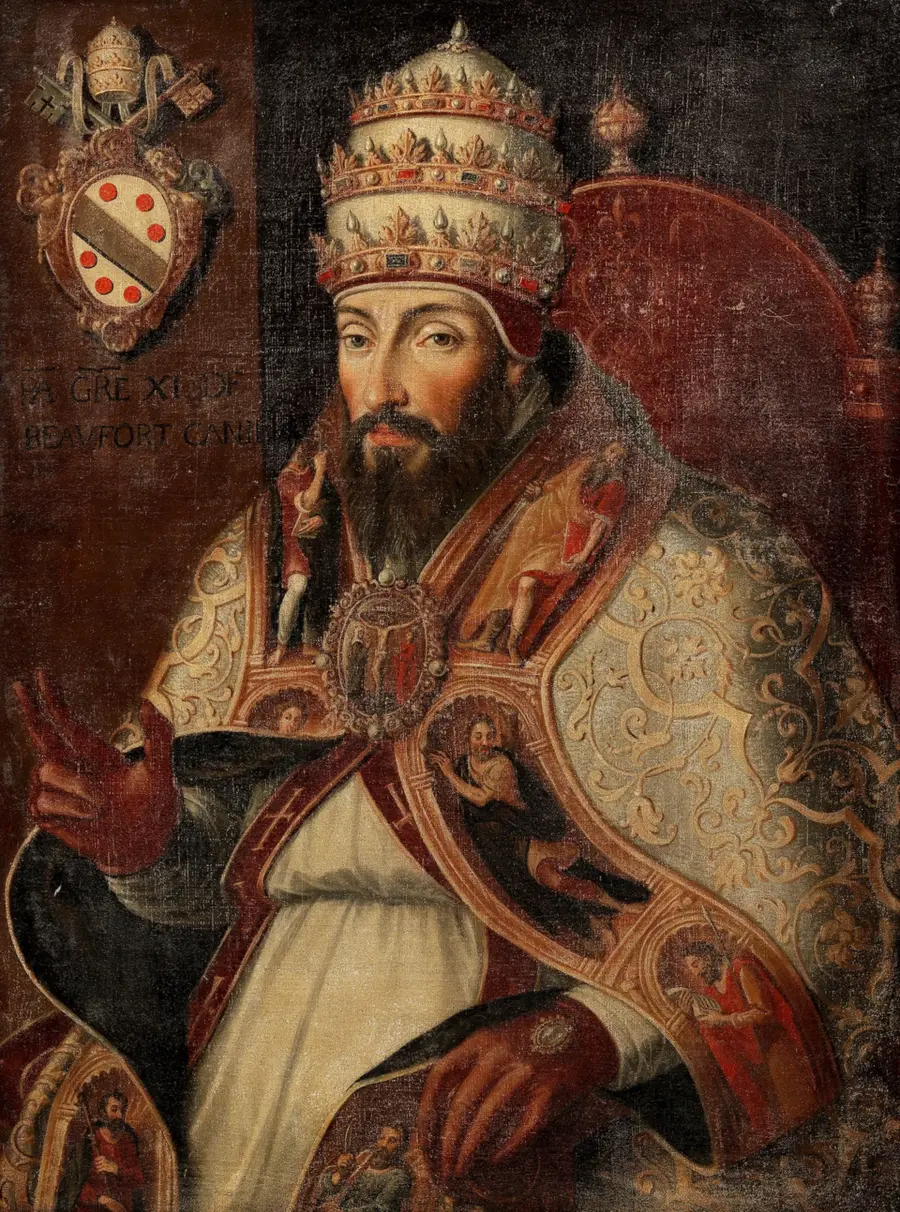 Workshop of Italian schools of painting, Portrait of Pope Gregory XI (18th c., posthumous) Gregory XI, the last Avignon pope, received the letter from Nidaros describing a Norwegian church gutted by the Black Death — only about forty priests left where three hundred had served before the plague. Pierre Roger de Beaufort (c. 1329–1378), pope from 1370 until
his death — the last Avignon pope and the pontiff who returned
the papal see to Rome in 1377 after seven decades of French
exile. His pontificate corresponded to the second generation
after the Black Death, and the surviving correspondence between
his curia and the depleted Norwegian dioceses gives the clearest
contemporary measure of how thoroughly the plague had hollowed
out the medieval Norwegian church. The letter of around 1371 from
Trond Gardarsson, archbishop of Nidaros, reporting only about
forty priests where three hundred had served before the mortality
is among the documents preserved from his pontificate.
around 1371, the archbishop of Nidaros Cathedral Unknown photographer, Nidaros Cathedral from the northeast (1857), Wikimedia Commons One of the earliest surviving photographs of Norway, taken in 1857 — decades before the west front's twentieth-century reconstruction — showing the cathedral over Olav's grave much as centuries of fire, neglect, and weather had left it. The principal cathedral of Norway and the burial place of Saint
Olav, on the bank of the Nid River in Trondheim. Built and rebuilt
in stages from the late eleventh through the early fourteenth
centuries around the shrine site at the cathedral's east end. The
octagonal east end, raised directly over Olav's grave, was the
devotional core of the medieval building. Substantially damaged
by fires and the 1531 lightning strike, then by neglect across the
Lutheran centuries. The west front a visitor sees today is a
nineteenth- and twentieth-century reconstruction, completed only
in 1983. The cathedral is the coronation and consecration church
of Norwegian kings; Haakon VII was crowned there in 1906, Olav V
consecrated in 1958, Harald V in 1991.
On the trip Day 3 of the trip brings the Gråhårsklubben (the Oldsters) to
Nidaros Cathedral. The shrine is gone but
the spot is marked on the cathedral floor in the octagonal east
end. The west front is the twentieth-century reconstruction of
the face the medieval pilgrims saw. The pilgrim road comes in
past the south door — the same door medieval pilgrims walked
through.
Nidaros Cathedral, Trondheim Also discussed in The King Who Became a Saint — how the Nordmen came to ChristA Catholic Norway — the faith that gave the kingdom its first institutions and the stave churchesThe Crusades?!!!! — sixty ships from Bergen, bound for the Holy LandThe Golden Age — a North Atlantic empire … reaching farther than you thinkThe 400-Year Night — when the Northern Lion lay dormantThe Reformation, 1537 — one church eradicated and another imposedLutheran Norway and Pietism — a farmer named Hans Nielsen Hauge and a lay revival that could not be silencedThe Quiet Revolution — how Norway won its independence without a warTradisjoner — celebrations across the Norwegian year , Trond Gardarsson, gave the shape of what the post-plague church looked like a full generation on. Where three hundred priests had served his archdiocese before the mortality, only about forty remained — twenty years after the catastrophe, with no recovery in sight. The figure was not unique to Trøndelag. It was roughly what the Norwegian church reported across the country in the post-plague generations, with surviving priests scattered across parishes that had themselves lost more than half their congregations.
Workshop of Italian schools of painting, Portrait of Pope Gregory XI (18th c., posthumous) Gregory XI, the last Avignon pope, received the letter from Nidaros describing a Norwegian church gutted by the Black Death — only about forty priests left where three hundred had served before the plague. Pierre Roger de Beaufort (c. 1329–1378), pope from 1370 until
his death — the last Avignon pope and the pontiff who returned
the papal see to Rome in 1377 after seven decades of French
exile. His pontificate corresponded to the second generation
after the Black Death, and the surviving correspondence between
his curia and the depleted Norwegian dioceses gives the clearest
contemporary measure of how thoroughly the plague had hollowed
out the medieval Norwegian church. The letter of around 1371 from
Trond Gardarsson, archbishop of Nidaros, reporting only about
forty priests where three hundred had served before the mortality
is among the documents preserved from his pontificate.
around 1371, the archbishop of Nidaros Cathedral Unknown photographer, Nidaros Cathedral from the northeast (1857), Wikimedia Commons One of the earliest surviving photographs of Norway, taken in 1857 — decades before the west front's twentieth-century reconstruction — showing the cathedral over Olav's grave much as centuries of fire, neglect, and weather had left it. The principal cathedral of Norway and the burial place of Saint
Olav, on the bank of the Nid River in Trondheim. Built and rebuilt
in stages from the late eleventh through the early fourteenth
centuries around the shrine site at the cathedral's east end. The
octagonal east end, raised directly over Olav's grave, was the
devotional core of the medieval building. Substantially damaged
by fires and the 1531 lightning strike, then by neglect across the
Lutheran centuries. The west front a visitor sees today is a
nineteenth- and twentieth-century reconstruction, completed only
in 1983. The cathedral is the coronation and consecration church
of Norwegian kings; Haakon VII was crowned there in 1906, Olav V
consecrated in 1958, Harald V in 1991.
On the trip Day 3 of the trip brings the Gråhårsklubben (the Oldsters) to
Nidaros Cathedral. The shrine is gone but
the spot is marked on the cathedral floor in the octagonal east
end. The west front is the twentieth-century reconstruction of
the face the medieval pilgrims saw. The pilgrim road comes in
past the south door — the same door medieval pilgrims walked
through.
Nidaros Cathedral, Trondheim Also discussed in The King Who Became a Saint — how the Nordmen came to ChristA Catholic Norway — the faith that gave the kingdom its first institutions and the stave churchesThe Crusades?!!!! — sixty ships from Bergen, bound for the Holy LandThe Golden Age — a North Atlantic empire … reaching farther than you thinkThe 400-Year Night — when the Northern Lion lay dormantThe Reformation, 1537 — one church eradicated and another imposedLutheran Norway and Pietism — a farmer named Hans Nielsen Hauge and a lay revival that could not be silencedThe Quiet Revolution — how Norway won its independence without a warTradisjoner — celebrations across the Norwegian year , Trond Gardarsson, gave the shape of what the post-plague church looked like a full generation on. Where three hundred priests had served his archdiocese before the mortality, only about forty remained — twenty years after the catastrophe, with no recovery in sight. The figure was not unique to Trøndelag. It was roughly what the Norwegian church reported across the country in the post-plague generations, with surviving priests scattered across parishes that had themselves lost more than half their congregations.
The seat of the archbishop at Nidaros stood empty for years at a stretch in the second half of the century. The Latin of the surviving correspondence became noticeably worse. The cathedral schools at Nidaros and Bergen that had trained the medieval Norwegian clerical class, and the network of monasteries that had supported them, both shrank to a fraction of their pre-plague scale. The institutional church survived. It came out of the fourteenth century dependent on the import of clergy from Denmark 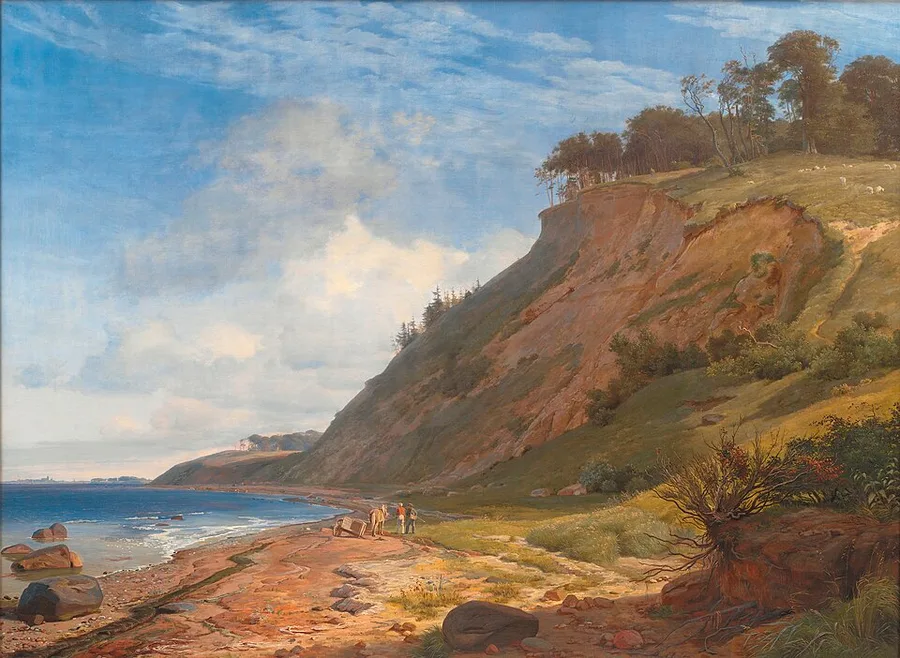 Johan Thomas Lundbye, En dansk kyst (A Danish Coast, 1843), Statens Museum for Kunst Lundbye painted this stretch of Roskilde Fjord shoreline in 1843 and titled it simply "A Danish Coast" — a Golden Age portrait of the low, mild landscape of Denmark itself, the neighbour kingdom that ran the joint Scandinavian monarchy from Copenhagen and governed Norway for close to four centuries. The southernmost of the three Scandinavian kingdoms,
consisting of the Jutland peninsula and the islands between
Jutland and the Swedish coast. Unified under Harald Bluetooth
in the late tenth century and Christianised in his reign,
Denmark was the dominant Scandinavian power through most of
the medieval and early modern centuries. From the 1397
Kalmar Union onward Denmark ran the joint Scandinavian
monarchy from Copenhagen; after Sweden left the union in
1523, Denmark and Norway remained joined as the Dano-
Norwegian state until 1814, with Norway governed as a Danish
province through that period.
Also discussed in The 400-Year Night — when the Northern Lion lay dormantThe Quiet Revolution — how Norway won its independence without a warWorld War II — the King’s “No” and the Nazis in Norway and the German lands — a dependence that would shape every subsequent stage of Norwegian Christianity until the The Reformation
Johan Thomas Lundbye, En dansk kyst (A Danish Coast, 1843), Statens Museum for Kunst Lundbye painted this stretch of Roskilde Fjord shoreline in 1843 and titled it simply "A Danish Coast" — a Golden Age portrait of the low, mild landscape of Denmark itself, the neighbour kingdom that ran the joint Scandinavian monarchy from Copenhagen and governed Norway for close to four centuries. The southernmost of the three Scandinavian kingdoms,
consisting of the Jutland peninsula and the islands between
Jutland and the Swedish coast. Unified under Harald Bluetooth
in the late tenth century and Christianised in his reign,
Denmark was the dominant Scandinavian power through most of
the medieval and early modern centuries. From the 1397
Kalmar Union onward Denmark ran the joint Scandinavian
monarchy from Copenhagen; after Sweden left the union in
1523, Denmark and Norway remained joined as the Dano-
Norwegian state until 1814, with Norway governed as a Danish
province through that period.
Also discussed in The 400-Year Night — when the Northern Lion lay dormantThe Quiet Revolution — how Norway won its independence without a warWorld War II — the King’s “No” and the Nazis in Norway and the German lands — a dependence that would shape every subsequent stage of Norwegian Christianity until the The Reformation 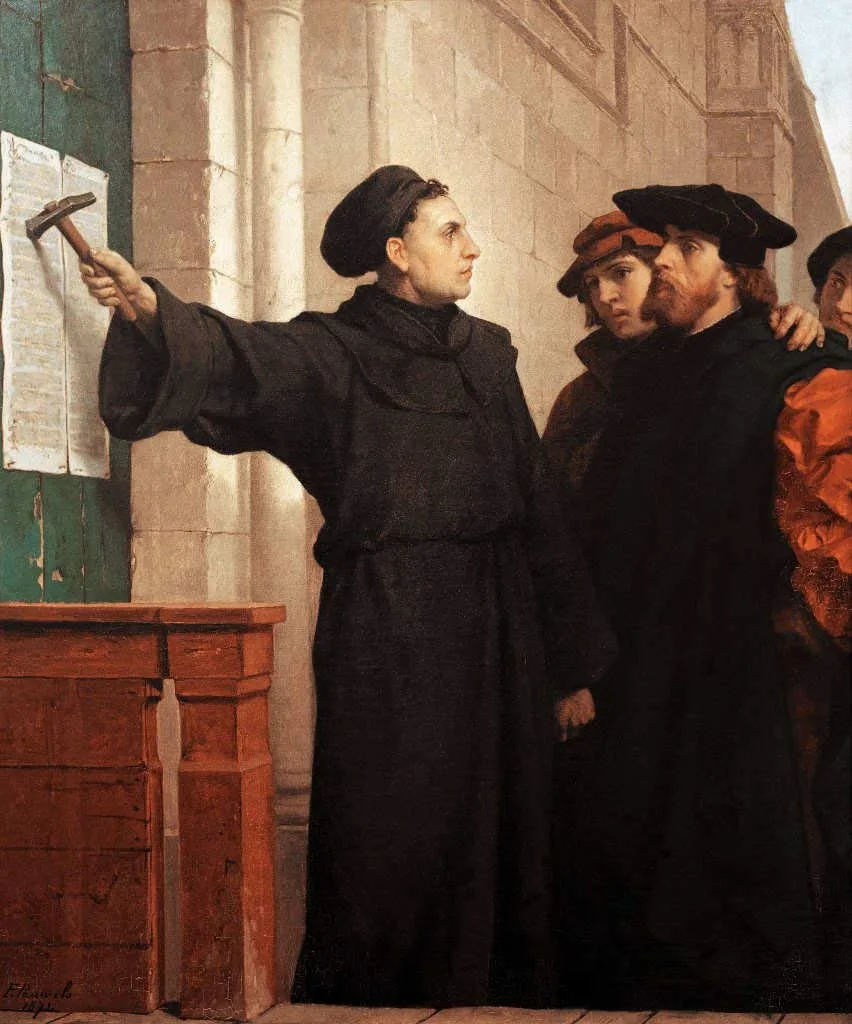 Ferdinand Pauwels, Luther hammers his 95 theses to the door (1872) Pauwels's 1872 history painting stages the 1517 act that began the Lutheran Reformation — the settlement Christian III of Denmark imposed on Norway by royal decree twenty years later, with no Norwegian reformer or domestic movement behind it. The Lutheran religious settlement imposed on Norway in 1537 by
royal decree from Copenhagen. Christian III of Denmark abolished
the Catholic ecclesiastical structure, dissolved the monasteries,
ordered the saints' relics destroyed, and replaced the Latin
liturgy with Danish-language Lutheran services. Unlike the
Reformation elsewhere in northern Europe, Norway's arrived from
outside — no Norwegian Luther, no Norwegian reformers, no
domestic religious movement behind it. The country changed
denomination because the king in Copenhagen ordered it.
Also discussed in The Reformation, 1537 — one church eradicated and another imposedThe King Who Became a Saint — how the Nordmen came to ChristA Catholic Norway — the faith that gave the kingdom its first institutions and the stave churchesThe Germans Who "Ruled" Bergen — the Hanseatic merchants on Bryggen WharfThe 400-Year Night — when the Northern Lion lay dormantLutheran Norway and Pietism — a farmer named Hans Nielsen Hauge and a lay revival that could not be silencedStatskirken — the state church and what's left of it .
Ferdinand Pauwels, Luther hammers his 95 theses to the door (1872) Pauwels's 1872 history painting stages the 1517 act that began the Lutheran Reformation — the settlement Christian III of Denmark imposed on Norway by royal decree twenty years later, with no Norwegian reformer or domestic movement behind it. The Lutheran religious settlement imposed on Norway in 1537 by
royal decree from Copenhagen. Christian III of Denmark abolished
the Catholic ecclesiastical structure, dissolved the monasteries,
ordered the saints' relics destroyed, and replaced the Latin
liturgy with Danish-language Lutheran services. Unlike the
Reformation elsewhere in northern Europe, Norway's arrived from
outside — no Norwegian Luther, no Norwegian reformers, no
domestic religious movement behind it. The country changed
denomination because the king in Copenhagen ordered it.
Also discussed in The Reformation, 1537 — one church eradicated and another imposedThe King Who Became a Saint — how the Nordmen came to ChristA Catholic Norway — the faith that gave the kingdom its first institutions and the stave churchesThe Germans Who "Ruled" Bergen — the Hanseatic merchants on Bryggen WharfThe 400-Year Night — when the Northern Lion lay dormantLutheran Norway and Pietism — a farmer named Hans Nielsen Hauge and a lay revival that could not be silencedStatskirken — the state church and what's left of it .
Ødegårder
Out in the country the same losses appeared as the Ødegårder 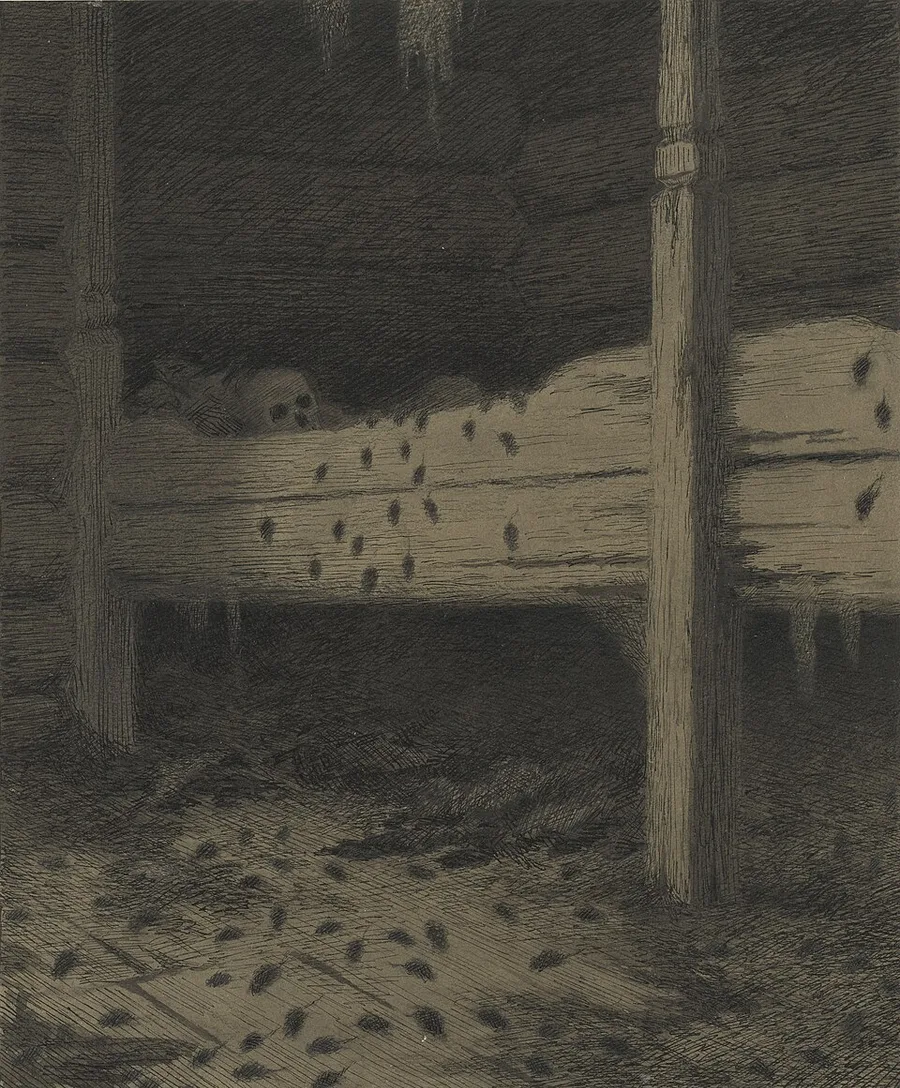 Theodor Kittelsen, Musstad (1894–96), Nasjonalmuseet, Oslo (NG.K&H.1982.0029) Kittelsen's mice swarm the abandoned bed of a plague-emptied farmhouse — the human end of the ødegårder, the deserted farmsteads that vanished from the tax rolls after the Black Death carried off a third to three-fifths of Norway's farms. Deserted farms — the standard Norwegian historiographical
term for the abandoned farmsteads documented in the long
series of cathedral and royal registers compiled in the
centuries after the Black Death. Comparison of pre-plague
surveys against later compilations shows that between a third
and three-fifths of pre-plague Norwegian farmsteads
disappeared from the rolls. Some were repopulated within a
generation. Many were not. Birch and pine returned to fields
that had been worked for a thousand years. The ghost-farm
pattern in the registers — especially in upland Setesdal,
Telemark, and the upper Gudbrandsdalen — is one of the most
visible long-term traces of the demographic catastrophe.
Also discussed in 800,000 Norwegians Leave — the century that built a Second NorwayPesta — an old woman walking from farm to farm — the deserted farms. The pattern is documented in the cathedral and royal registers compiled across the long post-plague century: pre-plague surveys compared against later compilations show that somewhere between a third and three-fifths of pre-plague farmsteads disappeared from the rolls. Some were repopulated within a generation. Some never were. Birch and pine returned to fields that had been worked for a thousand years. Maps drawn by modern Norwegian historians from the surviving registers show ghost farms in Setesdal and Telemark
Theodor Kittelsen, Musstad (1894–96), Nasjonalmuseet, Oslo (NG.K&H.1982.0029) Kittelsen's mice swarm the abandoned bed of a plague-emptied farmhouse — the human end of the ødegårder, the deserted farmsteads that vanished from the tax rolls after the Black Death carried off a third to three-fifths of Norway's farms. Deserted farms — the standard Norwegian historiographical
term for the abandoned farmsteads documented in the long
series of cathedral and royal registers compiled in the
centuries after the Black Death. Comparison of pre-plague
surveys against later compilations shows that between a third
and three-fifths of pre-plague Norwegian farmsteads
disappeared from the rolls. Some were repopulated within a
generation. Many were not. Birch and pine returned to fields
that had been worked for a thousand years. The ghost-farm
pattern in the registers — especially in upland Setesdal,
Telemark, and the upper Gudbrandsdalen — is one of the most
visible long-term traces of the demographic catastrophe.
Also discussed in 800,000 Norwegians Leave — the century that built a Second NorwayPesta — an old woman walking from farm to farm — the deserted farms. The pattern is documented in the cathedral and royal registers compiled across the long post-plague century: pre-plague surveys compared against later compilations show that somewhere between a third and three-fifths of pre-plague farmsteads disappeared from the rolls. Some were repopulated within a generation. Some never were. Birch and pine returned to fields that had been worked for a thousand years. Maps drawn by modern Norwegian historians from the surviving registers show ghost farms in Setesdal and Telemark 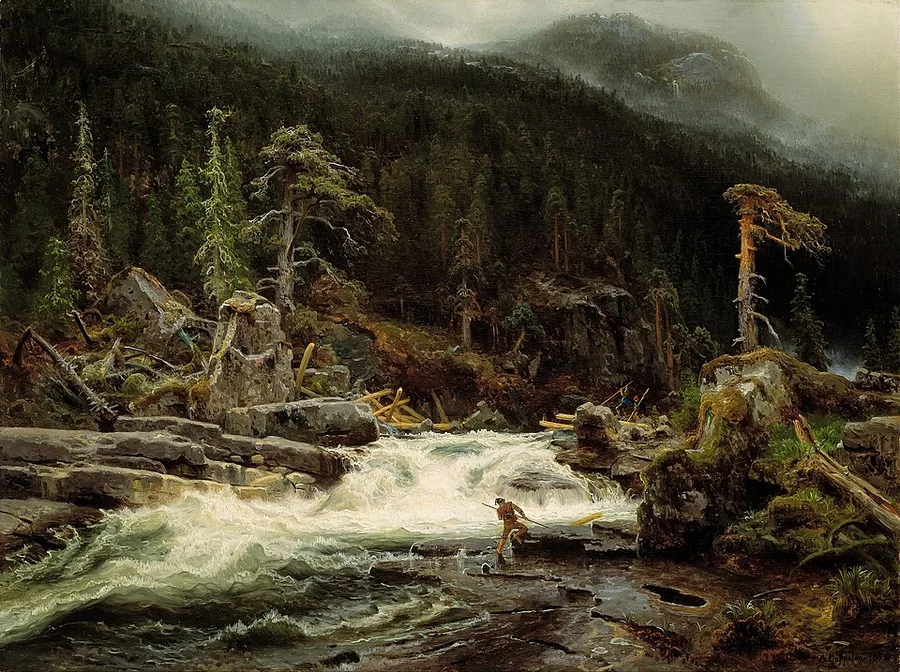 August Cappelen, Foss i nedre Telemark (1852), National Museum of Art, Architecture and Design August Cappelen's 1852 painting of a waterfall gorge in lower Telemark — dark forest closing over white water, log-drivers small at its edge. This is the upland valley country of the Norwegian interior, the kind of forest that has swallowed whole farms when their people vanished from the registers. Historic region and county in the inland-southern part of
Norway, between the southeastern coast and the central
Hardangervidda plateau. Home to Heddal Stave Church — the
largest of the twenty-eight surviving Norwegian stave churches,
standing nearly thirty metres tall — and to the heavy-water
production facility at Vemork whose sabotage by Norwegian
commandos in February 1943 disrupted the German atomic-weapons
programme. The name Telemark also gives the world the modern
ski-turn technique developed there in the nineteenth century.
In the folklore record Telemark is the deepest vein of all —
the landscape of the ballad collectors, the hardingfele
legends, and the lake serpent of Seljord.
Telemark Also discussed in A Catholic Norway — the faith that gave the kingdom its first institutions and the stave churchesWorld War II — the King’s “No” and the Nazis in NorwayFossegrimen — the waterfall fiddler who teaches you to playTroll — the monsters of the mountainsUtburd — the unbaptized child that will not restÅsgårdsreien — the storm that rides through the winter skyHuldra — the girl in the forest with a secretSjøormer — the serpents in the deep lakes and fjords and the upper Gudbrandsdalen
August Cappelen, Foss i nedre Telemark (1852), National Museum of Art, Architecture and Design August Cappelen's 1852 painting of a waterfall gorge in lower Telemark — dark forest closing over white water, log-drivers small at its edge. This is the upland valley country of the Norwegian interior, the kind of forest that has swallowed whole farms when their people vanished from the registers. Historic region and county in the inland-southern part of
Norway, between the southeastern coast and the central
Hardangervidda plateau. Home to Heddal Stave Church — the
largest of the twenty-eight surviving Norwegian stave churches,
standing nearly thirty metres tall — and to the heavy-water
production facility at Vemork whose sabotage by Norwegian
commandos in February 1943 disrupted the German atomic-weapons
programme. The name Telemark also gives the world the modern
ski-turn technique developed there in the nineteenth century.
In the folklore record Telemark is the deepest vein of all —
the landscape of the ballad collectors, the hardingfele
legends, and the lake serpent of Seljord.
Telemark Also discussed in A Catholic Norway — the faith that gave the kingdom its first institutions and the stave churchesWorld War II — the King’s “No” and the Nazis in NorwayFossegrimen — the waterfall fiddler who teaches you to playTroll — the monsters of the mountainsUtburd — the unbaptized child that will not restÅsgårdsreien — the storm that rides through the winter skyHuldra — the girl in the forest with a secretSjøormer — the serpents in the deep lakes and fjords and the upper Gudbrandsdalen 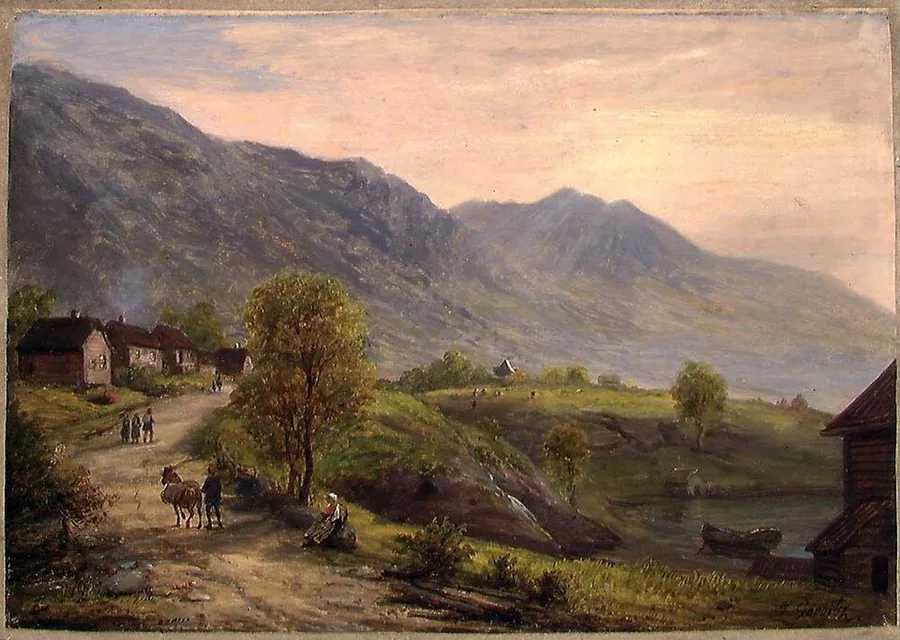 Johan Gørbitz, Fra Fåvang i Gudbrandsdalen (before 1858), National Museum of Art, Architecture and Design Johan Gørbitz's painting of travellers on the valley road at Fåvang. The Gudbrandsdalen was the central overland artery between Oslo and Trondheim, and the Gudbrandsdalsleden pilgrim road to Nidaros ran its length past stave churches like Lom. Long inland valley running about 230 kilometres northwest
through the central Norwegian highland from Lake Mjøsa toward
the Dovre mountain pass, the central traffic artery between
Oslo and Trondheim across both medieval and modern eras. The
Gudbrandsdalsleden pilgrim road to Nidaros runs along the
valley; Lom Stave Church and several other surviving stave
churches stand on its slopes; Lillehammer sits at its
southern entrance. The dialect spoken in the valley is one of
the most distinctive in modern Norwegian.
On the trip The Gråhårsklubben (the Oldsters) drive the length of the
Gudbrandsdalen twice — north up the E6 on Day 3, on the long
road from Oslo to Trondheim, and south again on Day 5 to the
reunion in Lillehammer, the town at the valley's southern
entrance.
Gudbrandsdalen Also discussed in A Catholic Norway — the faith that gave the kingdom its first institutions and the stave churchesThe Reformation, 1537 — one church eradicated and another imposedStedssagn — local legends, told as warnings that disappear in the late-medieval rolls and never reappear under any name.
Johan Gørbitz, Fra Fåvang i Gudbrandsdalen (before 1858), National Museum of Art, Architecture and Design Johan Gørbitz's painting of travellers on the valley road at Fåvang. The Gudbrandsdalen was the central overland artery between Oslo and Trondheim, and the Gudbrandsdalsleden pilgrim road to Nidaros ran its length past stave churches like Lom. Long inland valley running about 230 kilometres northwest
through the central Norwegian highland from Lake Mjøsa toward
the Dovre mountain pass, the central traffic artery between
Oslo and Trondheim across both medieval and modern eras. The
Gudbrandsdalsleden pilgrim road to Nidaros runs along the
valley; Lom Stave Church and several other surviving stave
churches stand on its slopes; Lillehammer sits at its
southern entrance. The dialect spoken in the valley is one of
the most distinctive in modern Norwegian.
On the trip The Gråhårsklubben (the Oldsters) drive the length of the
Gudbrandsdalen twice — north up the E6 on Day 3, on the long
road from Oslo to Trondheim, and south again on Day 5 to the
reunion in Lillehammer, the town at the valley's southern
entrance.
Gudbrandsdalen Also discussed in A Catholic Norway — the faith that gave the kingdom its first institutions and the stave churchesThe Reformation, 1537 — one church eradicated and another imposedStedssagn — local legends, told as warnings that disappear in the late-medieval rolls and never reappear under any name.
The Norwegian population would not recover its pre-plague level for nearly three centuries. The country that emerged from the long demographic depression in the seventeenth century was a different country: less populated, more concentrated along the coast, dependent on Danish administration and German commerce, and with most of the upland marginal farms that the medieval economy had relied on permanently lost to the forest.
The same collapse hit the secular nobility through a different door. Noble income was land income — the rents and dues paid by tenant farmers on noble estates. When the farms went empty, the rents went unpaid, and the small Norwegian aristocracy that had been thin to begin with was left poorer than its Danish and Sweden 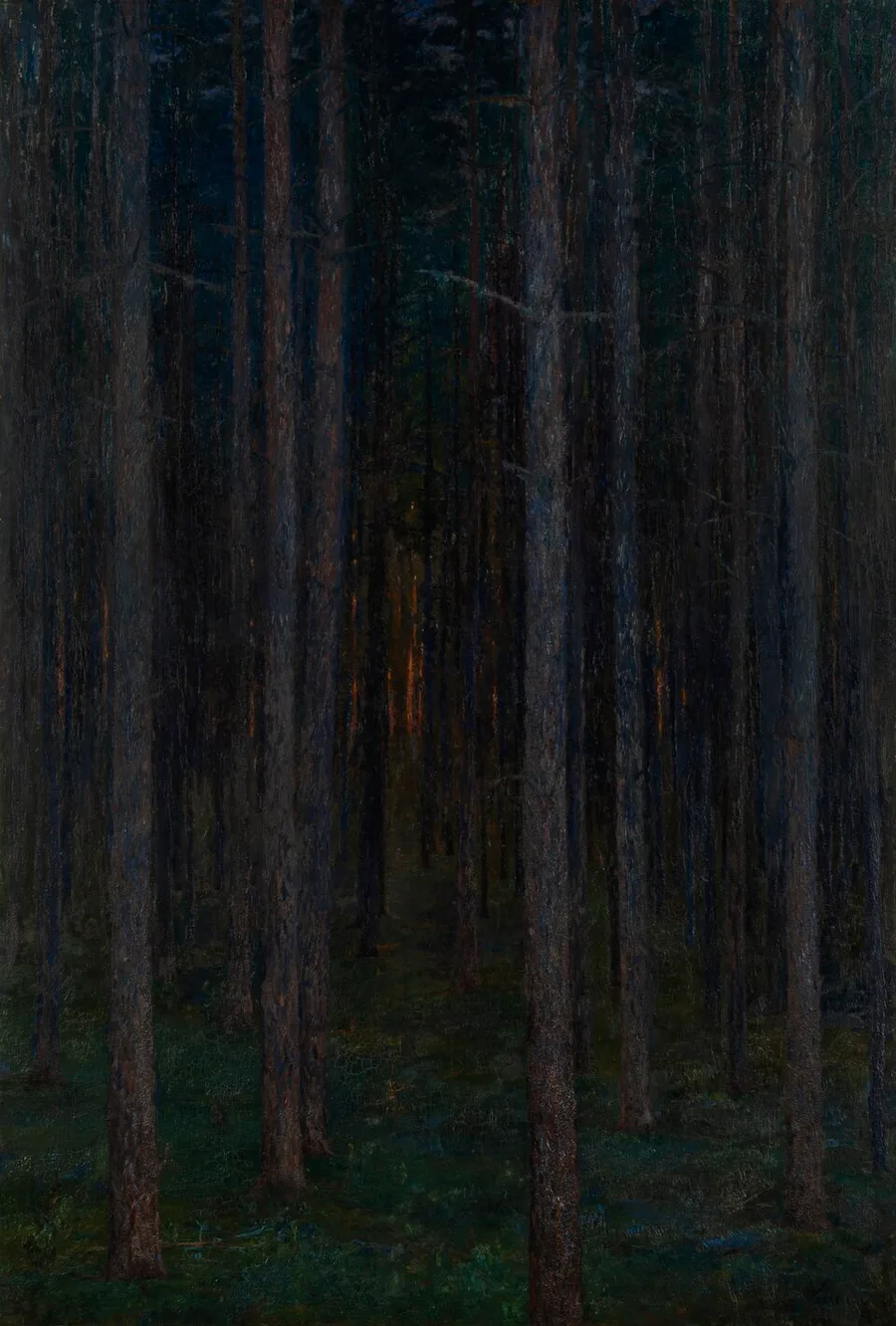 Prince Eugen, Skogen / The Forest (1892), Göteborgs konstmuseum (photo CC BY 4.0) Skogen (The Forest), painted in 1892 by Prince Eugen — a son of Oscar II, the Swedish king Norway broke from in 1905. His twilight wall of pine trunks became a defining image of Swedish national-romantic landscape: the neighbour kingdom rendered as its own deep forest. The largest of the three Scandinavian kingdoms, occupying
the eastern two-thirds of the Scandinavian peninsula.
Unified in stages through the early medieval period and
Christianised from the eleventh century onward. United
with Norway and Denmark in the 1397 Kalmar Union under
Margaret I and her great-nephew Erik of Pomerania; broke
away under Gustav Vasa in 1523, ending the union. Modern
Sweden's borders were largely set by the 1658 Treaty of
Roskilde, which transferred the formerly Danish provinces
of Skåne, Halland, Blekinge, and Bohuslän to the Swedish
crown.
Also discussed in The 400-Year Night — when the Northern Lion lay dormantThe Quiet Revolution — how Norway won its independence without a warWorld War II — the King’s “No” and the Nazis in Norway counterparts at exactly the moment those neighbouring nobilities were expanding. The Riksrådet The Council of the Realm — the medieval and early modern
Norwegian royal council of magnates and bishops, the body
through which the senior secular aristocracy and the
Norwegian church together advised and constrained the king
and negotiated the succession when a line failed. In the
high-medieval kingdom the Council was the institutional
counterweight to the crown; in the post-plague century it
was the body that should have negotiated Norway's next king
on Norway's terms after the dynastic collapse of 1387. The
Black Death reduced both the Council's numbers and the
noble incomes that had sustained its independence — leaving
it unable to assert Norwegian autonomy when the crown
passed by inheritance to Margaret I and her Danish line.
Also discussed in The 400-Year Night — when the Northern Lion lay dormant — the royal council of magnates and bishops, the body that should have negotiated Norway’s next king on Norway’s terms — came out of the plague reduced in numbers and reduced in wealth, with no surplus of younger sons coming up behind them, and no institutional reserves to draw on the next time the kingdom faced a crisis.
Prince Eugen, Skogen / The Forest (1892), Göteborgs konstmuseum (photo CC BY 4.0) Skogen (The Forest), painted in 1892 by Prince Eugen — a son of Oscar II, the Swedish king Norway broke from in 1905. His twilight wall of pine trunks became a defining image of Swedish national-romantic landscape: the neighbour kingdom rendered as its own deep forest. The largest of the three Scandinavian kingdoms, occupying
the eastern two-thirds of the Scandinavian peninsula.
Unified in stages through the early medieval period and
Christianised from the eleventh century onward. United
with Norway and Denmark in the 1397 Kalmar Union under
Margaret I and her great-nephew Erik of Pomerania; broke
away under Gustav Vasa in 1523, ending the union. Modern
Sweden's borders were largely set by the 1658 Treaty of
Roskilde, which transferred the formerly Danish provinces
of Skåne, Halland, Blekinge, and Bohuslän to the Swedish
crown.
Also discussed in The 400-Year Night — when the Northern Lion lay dormantThe Quiet Revolution — how Norway won its independence without a warWorld War II — the King’s “No” and the Nazis in Norway counterparts at exactly the moment those neighbouring nobilities were expanding. The Riksrådet The Council of the Realm — the medieval and early modern
Norwegian royal council of magnates and bishops, the body
through which the senior secular aristocracy and the
Norwegian church together advised and constrained the king
and negotiated the succession when a line failed. In the
high-medieval kingdom the Council was the institutional
counterweight to the crown; in the post-plague century it
was the body that should have negotiated Norway's next king
on Norway's terms after the dynastic collapse of 1387. The
Black Death reduced both the Council's numbers and the
noble incomes that had sustained its independence — leaving
it unable to assert Norwegian autonomy when the crown
passed by inheritance to Margaret I and her Danish line.
Also discussed in The 400-Year Night — when the Northern Lion lay dormant — the royal council of magnates and bishops, the body that should have negotiated Norway’s next king on Norway’s terms — came out of the plague reduced in numbers and reduced in wealth, with no surplus of younger sons coming up behind them, and no institutional reserves to draw on the next time the kingdom faced a crisis.
Out in the Atlantic, the consequences ran further still. The Norse Greenland 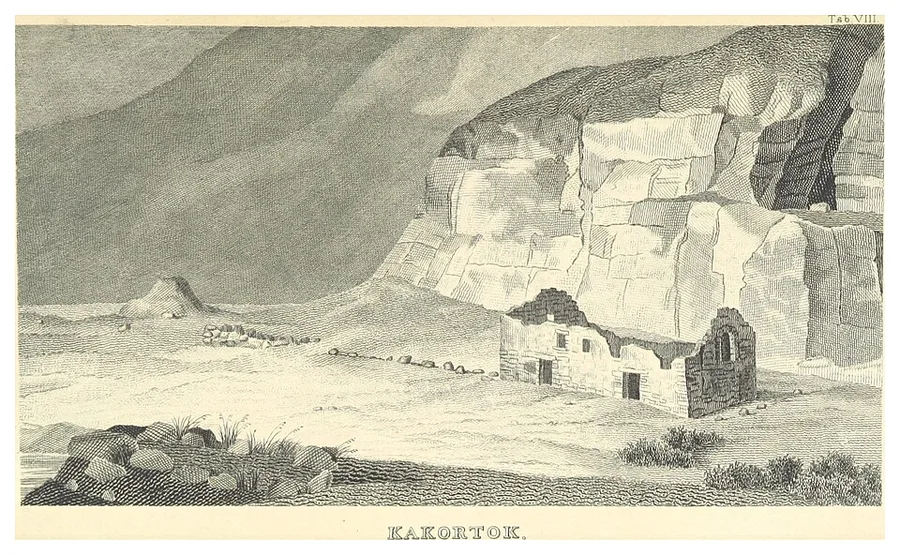 Grønlands historiske Mindesmærker vol. 3 (1845), plate VIII, British Library The stone church at Hvalsey, the best-preserved building of Norse Greenland — drawn in 1845 for the Danish survey that went looking for the lost colony. A wedding held here in 1408 is the last event anyone recorded before the settlements Erik the Red founded fell silent. The world's largest island, lying between the Arctic and Atlantic
Oceans west of Iceland. Colonised by Norse settlers led by Erik the
Red beginning in 985 — the name "Greenland" was Erik's marketing,
chosen to attract colonists to a marginally agricultural land. The
Norse Eastern and Western Settlements on the southwestern coast
sustained perhaps two or three thousand people at peak across four
centuries before steadily diminishing in the cooling climate of the
Little Ice Age and disappearing by around 1450. Today a self-
governing territory within the Kingdom of Denmark.
Also discussed in The Viking Age — longships, legends, and the first "Norway"The King Who Became a Saint — how the Nordmen came to ChristA Catholic Norway — the faith that gave the kingdom its first institutions and the stave churchesThe Golden Age — a North Atlantic empire … reaching farther than you thinkThe 400-Year Night — when the Northern Lion lay dormant colony, which had answered to the Norwegian crown since 1261, lost its last documented contact with home in 1410. The ships from Bergen that had once made the crossing every few summers stopped sailing. The colony lasted in some form for a further generation or more before the archaeological record falls silent, the last Norse Greenlanders unaccounted for somewhere in the later fifteenth century, almost certainly dead.
Grønlands historiske Mindesmærker vol. 3 (1845), plate VIII, British Library The stone church at Hvalsey, the best-preserved building of Norse Greenland — drawn in 1845 for the Danish survey that went looking for the lost colony. A wedding held here in 1408 is the last event anyone recorded before the settlements Erik the Red founded fell silent. The world's largest island, lying between the Arctic and Atlantic
Oceans west of Iceland. Colonised by Norse settlers led by Erik the
Red beginning in 985 — the name "Greenland" was Erik's marketing,
chosen to attract colonists to a marginally agricultural land. The
Norse Eastern and Western Settlements on the southwestern coast
sustained perhaps two or three thousand people at peak across four
centuries before steadily diminishing in the cooling climate of the
Little Ice Age and disappearing by around 1450. Today a self-
governing territory within the Kingdom of Denmark.
Also discussed in The Viking Age — longships, legends, and the first "Norway"The King Who Became a Saint — how the Nordmen came to ChristA Catholic Norway — the faith that gave the kingdom its first institutions and the stave churchesThe Golden Age — a North Atlantic empire … reaching farther than you thinkThe 400-Year Night — when the Northern Lion lay dormant colony, which had answered to the Norwegian crown since 1261, lost its last documented contact with home in 1410. The ships from Bergen that had once made the crossing every few summers stopped sailing. The colony lasted in some form for a further generation or more before the archaeological record falls silent, the last Norse Greenlanders unaccounted for somewhere in the later fifteenth century, almost certainly dead.
A line of kings that runs out
Magnus Eriksson 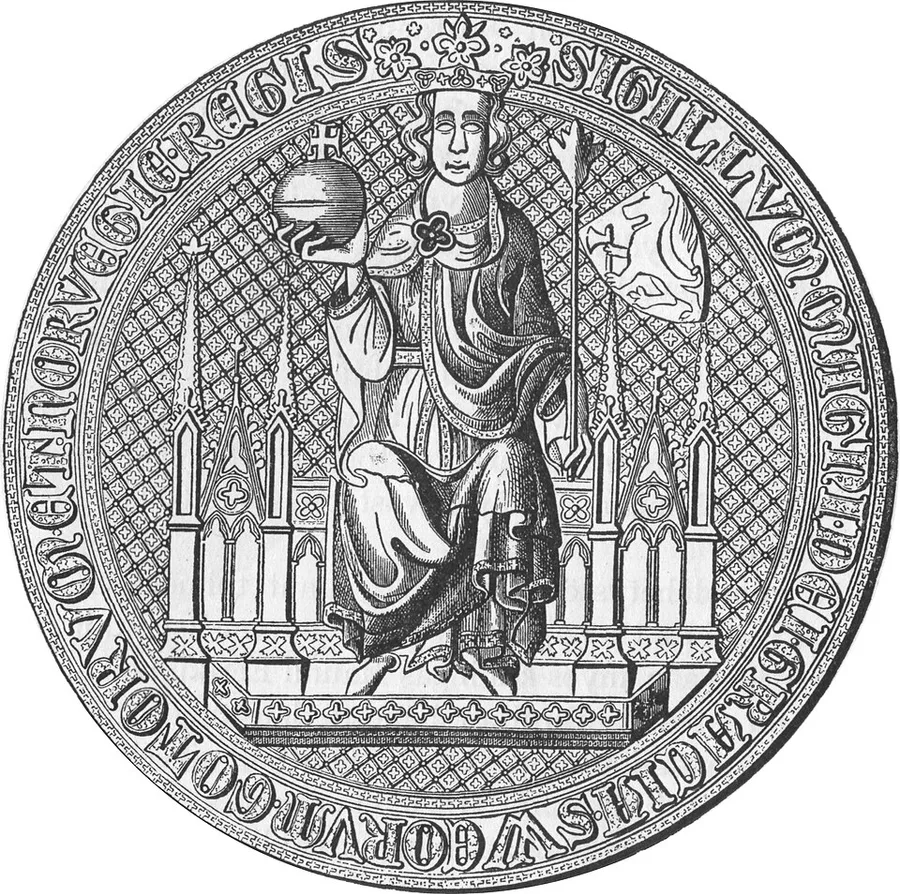 King Magnus Eriksson's judicial seal, Sigillum ad causas (14th century) Magnus Eriksson's own seal of judgment stands for the three-year-old who inherited Håkon V's Norwegian throne in 1319 and, two months later, was elected king of Sweden too — opening five centuries of shared Scandinavian crowns. Magnus IV (in Sweden) or Magnus VII (in Norway), born 1316,
reigned in Sweden 1319–1364 and in Norway 1319–1355. Grandson
of King Hákon V Magnusson of Norway; acceded to the Norwegian
throne in May 1319 at age three when his grandfather died
without a male heir, and was elected King of Sweden two months
later. The dual kingship inaugurated the long series of
Scandinavian personal unions that would hold the Norwegian
crown almost continuously until 1905. Ruled both kingdoms
through regency until 1331; deposed in Sweden in 1364 and in
Norway (in favour of his son Hákon VI) earlier. Died in a
boating accident on Bømlo island in Norway in 1374.
Also discussed in The Golden Age — a North Atlantic empire … reaching farther than you think was thirty-three when the plague reached Norway. He had been king of Norway since the age of three, his mother Ingeborg of Norway
King Magnus Eriksson's judicial seal, Sigillum ad causas (14th century) Magnus Eriksson's own seal of judgment stands for the three-year-old who inherited Håkon V's Norwegian throne in 1319 and, two months later, was elected king of Sweden too — opening five centuries of shared Scandinavian crowns. Magnus IV (in Sweden) or Magnus VII (in Norway), born 1316,
reigned in Sweden 1319–1364 and in Norway 1319–1355. Grandson
of King Hákon V Magnusson of Norway; acceded to the Norwegian
throne in May 1319 at age three when his grandfather died
without a male heir, and was elected King of Sweden two months
later. The dual kingship inaugurated the long series of
Scandinavian personal unions that would hold the Norwegian
crown almost continuously until 1905. Ruled both kingdoms
through regency until 1331; deposed in Sweden in 1364 and in
Norway (in favour of his son Hákon VI) earlier. Died in a
boating accident on Bømlo island in Norway in 1374.
Also discussed in The Golden Age — a North Atlantic empire … reaching farther than you think was thirty-three when the plague reached Norway. He had been king of Norway since the age of three, his mother Ingeborg of Norway 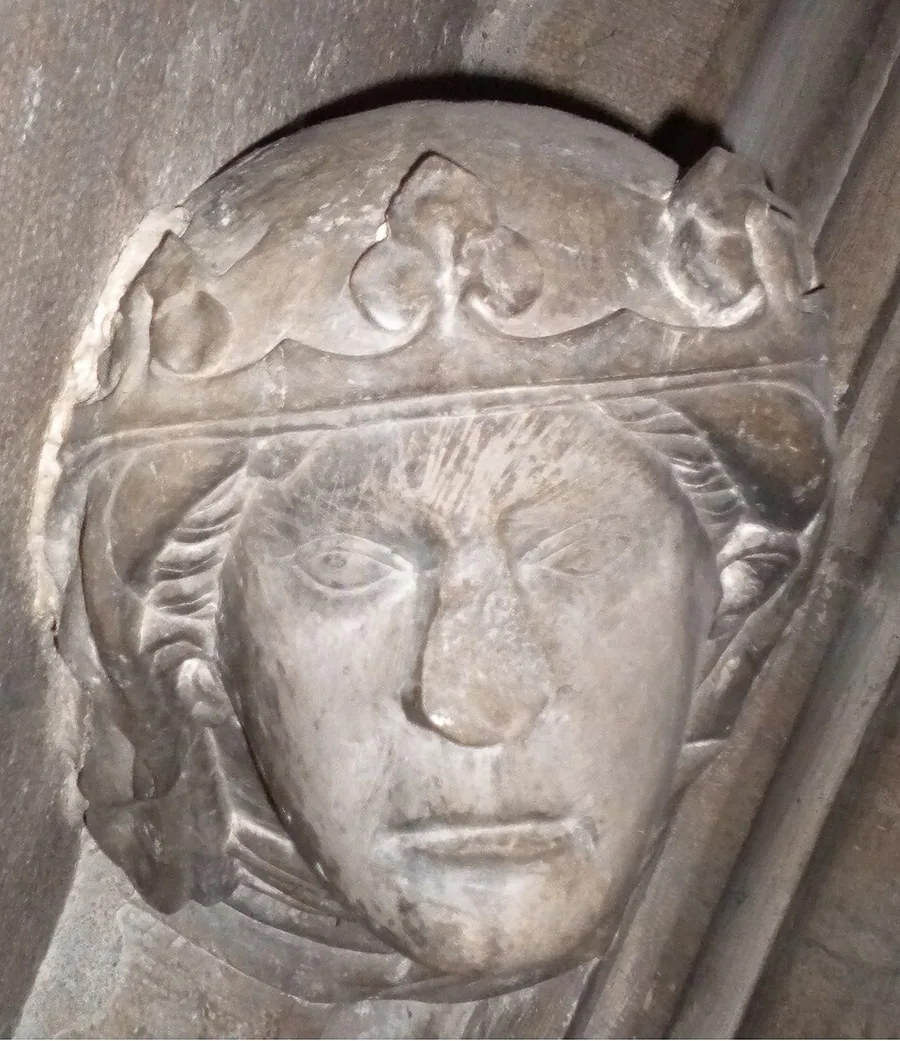 Photo: Jacob Truedson Demitz for Ristesson, stone bust of Duchess Ingiburga (c. 1360), Linköping Cathedral Art historian Jan Svanberg identified this weathered stone bust in Linköping Cathedral as Duchess Ingeborg of Norway, daughter of Håkon V and regent for her three-year-old son Magnus — a rare surviving likeness, if the identification holds, from within her own century. Norwegian princess (1301–1361), daughter of King Hákon V of
Norway and mother of King Magnus VII Eriksson (Magnus IV of
Sweden). Married the Swedish prince Eric Magnusson in 1312;
their son Magnus, born in 1316, inherited the Norwegian crown
on Hákon V's death in 1319 at three years old and was elected
king of Sweden the same year. Ingeborg held the regency in
the first years of her son's Norwegian reign before the
Norwegian Council took over the practical running of the
realm. A powerful political figure in her own right through
the 1320s and 1330s, with extensive Danish and German
diplomatic connections.
holding the regency in the first years before the Norwegian Council took the practical running of the country and continued it through his minority. He had gained Sweden by election the same year. He had grown into the joint office across the decades before the catastrophe — which were not as quiet as the chronicles imply: the Scania acquisition strained his treasury, his Swedish baronage was restive, and in 1343 he had already settled a tentative division of the realms among his sons. He spent the years of the plague watching his administrative class come apart. The clerks who had carried his correspondence died, and so did the lawmen who had drafted his charters, and so did the regional administrators.
Photo: Jacob Truedson Demitz for Ristesson, stone bust of Duchess Ingiburga (c. 1360), Linköping Cathedral Art historian Jan Svanberg identified this weathered stone bust in Linköping Cathedral as Duchess Ingeborg of Norway, daughter of Håkon V and regent for her three-year-old son Magnus — a rare surviving likeness, if the identification holds, from within her own century. Norwegian princess (1301–1361), daughter of King Hákon V of
Norway and mother of King Magnus VII Eriksson (Magnus IV of
Sweden). Married the Swedish prince Eric Magnusson in 1312;
their son Magnus, born in 1316, inherited the Norwegian crown
on Hákon V's death in 1319 at three years old and was elected
king of Sweden the same year. Ingeborg held the regency in
the first years of her son's Norwegian reign before the
Norwegian Council took over the practical running of the
realm. A powerful political figure in her own right through
the 1320s and 1330s, with extensive Danish and German
diplomatic connections.
holding the regency in the first years before the Norwegian Council took the practical running of the country and continued it through his minority. He had gained Sweden by election the same year. He had grown into the joint office across the decades before the catastrophe — which were not as quiet as the chronicles imply: the Scania acquisition strained his treasury, his Swedish baronage was restive, and in 1343 he had already settled a tentative division of the realms among his sons. He spent the years of the plague watching his administrative class come apart. The clerks who had carried his correspondence died, and so did the lawmen who had drafted his charters, and so did the regional administrators.
In 1355, under pressure from a depleted Norwegian Council and with the Swedish nobility increasingly hostile, Magnus formally ceded the practical rule of Norway to his son Haakon VI Magnusson 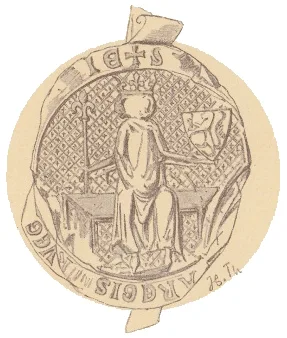 Drawing by Hakon Thorsen, after the seal of Haakon VI Magnusson (1358–76), public domain No painted portrait of Haakon VI survives; his royal seal — the wax impression that authenticated his charters — is the closest thing to an official image of the king whose marriage to the ten-year-old Margaret set up the Kalmar Union two generations later. King of Norway (1340–1380), only surviving son of Magnus VII
Eriksson and the last king of the Sverre dynasty in the male
line. Proclaimed king of Norway as a child in 1343, he assumed
personal rule at fifteen in 1355 when his father Magnus formally
handed over the Norwegian crown under pressure
from the depleted post-plague Council. Briefly co-ruled Sweden
in 1362–1364 before being driven out by Albert of Mecklenburg.
Married the ten-year-old Margaret of Denmark in 1363 — the
marriage that would, through their son Olav IV, join the
Norwegian and Danish crowns and open the way to the Kalmar
Union. Died in 1380 at forty, leaving the ten-year-old Olav
as king of both Norway and Denmark.
Also discussed in The 400-Year Night — when the Northern Lion lay dormantThe Quiet Revolution — how Norway won its independence without a war . Haakon was about fifteen and he ruled the country for the next twenty-five years from a court that was diminished and a treasury that was small. The pilgrim economy that had supported Nidaros never recovered its old volume. The timber and stockfish trades ran increasingly on Hanseatic terms — the German merchants of the Bryggen
Drawing by Hakon Thorsen, after the seal of Haakon VI Magnusson (1358–76), public domain No painted portrait of Haakon VI survives; his royal seal — the wax impression that authenticated his charters — is the closest thing to an official image of the king whose marriage to the ten-year-old Margaret set up the Kalmar Union two generations later. King of Norway (1340–1380), only surviving son of Magnus VII
Eriksson and the last king of the Sverre dynasty in the male
line. Proclaimed king of Norway as a child in 1343, he assumed
personal rule at fifteen in 1355 when his father Magnus formally
handed over the Norwegian crown under pressure
from the depleted post-plague Council. Briefly co-ruled Sweden
in 1362–1364 before being driven out by Albert of Mecklenburg.
Married the ten-year-old Margaret of Denmark in 1363 — the
marriage that would, through their son Olav IV, join the
Norwegian and Danish crowns and open the way to the Kalmar
Union. Died in 1380 at forty, leaving the ten-year-old Olav
as king of both Norway and Denmark.
Also discussed in The 400-Year Night — when the Northern Lion lay dormantThe Quiet Revolution — how Norway won its independence without a war . Haakon was about fifteen and he ruled the country for the next twenty-five years from a court that was diminished and a treasury that was small. The pilgrim economy that had supported Nidaros never recovered its old volume. The timber and stockfish trades ran increasingly on Hanseatic terms — the German merchants of the Bryggen 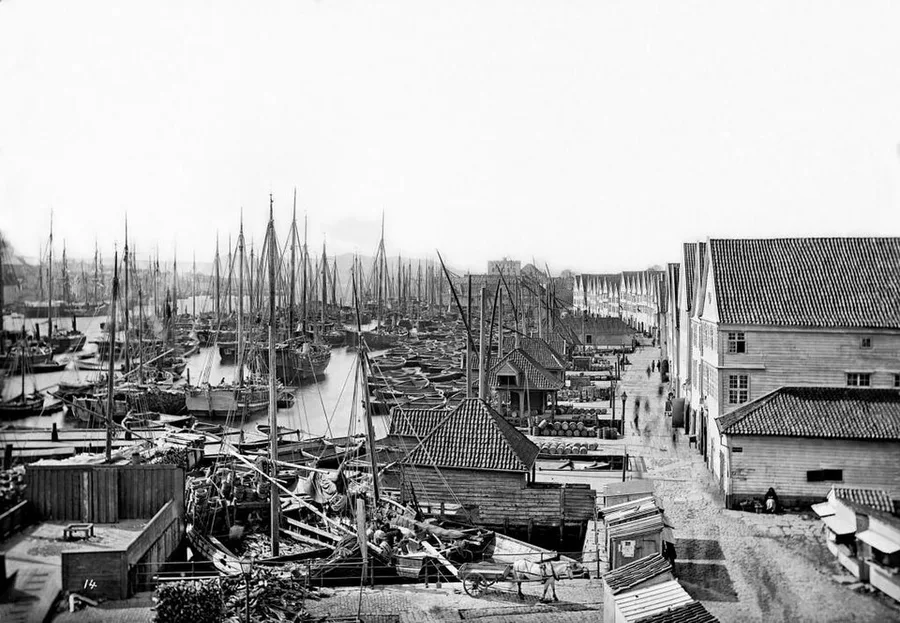 Knud Knudsen, Bryggen in Bergen (1865), University of Bergen Library Knudsen's 1865 photograph shows Bryggen still standing to its post-1702-fire medieval footprint -- the same wharf the Hanseatic kontor traded stockfish out of for four centuries, captured by one of Norway's first professional photographers. The Hanseatic wharf at Bergen — a long row of narrow
gable-fronted wooden warehouses and trading houses lining
the eastern shore of the Vågen harbour. From around 1360
the German Hansa established its Bergen kontor here, and
for nearly four hundred years (until 1754) the buildings
housed German merchants who controlled the export of
Norwegian stockfish to Catholic Europe. The structures
burned and were rebuilt repeatedly to the same medieval
footprint; the surviving wooden buildings (most after the
1702 fire) preserve the medieval urban plan. UNESCO World
Heritage site since 1979 and Bergen's most-visited landmark.
On the trip Day 4 in Bergen lands the Ungdommene (the Youngsters) directly
on the Bryggen waterfront — the wharf the Hanseatic trade in
Norwegian stockfish built and rebuilt for four centuries.
Also discussed in The Golden Age — a North Atlantic empire … reaching farther than you thinkThe Germans Who "Ruled" Bergen — the Hanseatic merchants on Bryggen WharfThe 400-Year Night — when the Northern Lion lay dormantAlcohol and Vinmonopolet — when and where to buy a drinkRespecting nature — why you can roam and camp on private landWhat to wear — the layering system, on the ground wharf, who had been operating with crown-granted privileges since the late thirteenth century, used the post-plague decades to consolidate their grip on western commerce and would hold it for the next four hundred years.
Knud Knudsen, Bryggen in Bergen (1865), University of Bergen Library Knudsen's 1865 photograph shows Bryggen still standing to its post-1702-fire medieval footprint -- the same wharf the Hanseatic kontor traded stockfish out of for four centuries, captured by one of Norway's first professional photographers. The Hanseatic wharf at Bergen — a long row of narrow
gable-fronted wooden warehouses and trading houses lining
the eastern shore of the Vågen harbour. From around 1360
the German Hansa established its Bergen kontor here, and
for nearly four hundred years (until 1754) the buildings
housed German merchants who controlled the export of
Norwegian stockfish to Catholic Europe. The structures
burned and were rebuilt repeatedly to the same medieval
footprint; the surviving wooden buildings (most after the
1702 fire) preserve the medieval urban plan. UNESCO World
Heritage site since 1979 and Bergen's most-visited landmark.
On the trip Day 4 in Bergen lands the Ungdommene (the Youngsters) directly
on the Bryggen waterfront — the wharf the Hanseatic trade in
Norwegian stockfish built and rebuilt for four centuries.
Also discussed in The Golden Age — a North Atlantic empire … reaching farther than you thinkThe Germans Who "Ruled" Bergen — the Hanseatic merchants on Bryggen WharfThe 400-Year Night — when the Northern Lion lay dormantAlcohol and Vinmonopolet — when and where to buy a drinkRespecting nature — why you can roam and camp on private landWhat to wear — the layering system, on the ground wharf, who had been operating with crown-granted privileges since the late thirteenth century, used the post-plague decades to consolidate their grip on western commerce and would hold it for the next four hundred years.
In 1363 Haakon married Margaret I of Denmark 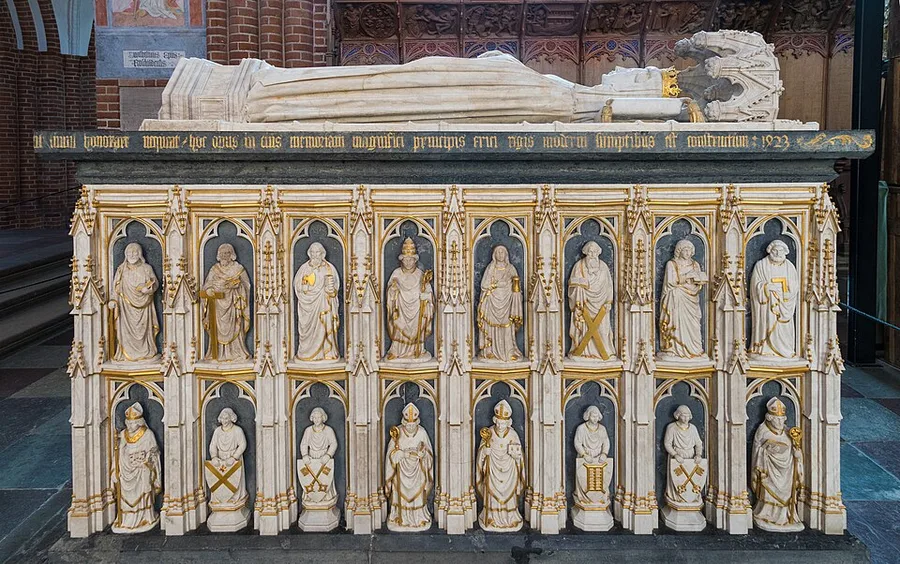 Photo: Jebulon, Tomb of Margrete I (1423), Roskilde Cathedral — CC0 Margrete's gilt alabaster sarcophagus at Roskilde, completed within a decade of her 1412 death, is where the queen who founded the Kalmar Union still lies — her effigy crowned and robed exactly as the constitutional language of three kingdoms could never quite name her. Queen-regnant of Denmark, Norway, and Sweden (1353–1412),
daughter of King Valdemar IV Atterdag of Denmark and wife of
King Haakon VI of Norway, mother of King Olav IV. After her
son's death at sixteen in 1387 she was acknowledged as ruler
in her own right by all three Scandinavian kingdoms in turn
— the first woman in Danish history acclaimed sovereign — and
was titled by the Swedes fullmäktig fru och rätt husbonde,
plenipotentiary lady and rightful master, the constitutional
language having no formula for a queen who governed three
kingdoms in her own name. In 1397 she gathered the three
realms at Kalmar to crown her great-nephew Erik of Pomerania
as joint king, founding the Kalmar Union. Died at Flensburg
in 1412.
Also discussed in The 400-Year Night — when the Northern Lion lay dormantThe Quiet Revolution — how Norway won its independence without a war , the youngest daughter of King Valdemar IV Atterdag
Photo: Jebulon, Tomb of Margrete I (1423), Roskilde Cathedral — CC0 Margrete's gilt alabaster sarcophagus at Roskilde, completed within a decade of her 1412 death, is where the queen who founded the Kalmar Union still lies — her effigy crowned and robed exactly as the constitutional language of three kingdoms could never quite name her. Queen-regnant of Denmark, Norway, and Sweden (1353–1412),
daughter of King Valdemar IV Atterdag of Denmark and wife of
King Haakon VI of Norway, mother of King Olav IV. After her
son's death at sixteen in 1387 she was acknowledged as ruler
in her own right by all three Scandinavian kingdoms in turn
— the first woman in Danish history acclaimed sovereign — and
was titled by the Swedes fullmäktig fru och rätt husbonde,
plenipotentiary lady and rightful master, the constitutional
language having no formula for a queen who governed three
kingdoms in her own name. In 1397 she gathered the three
realms at Kalmar to crown her great-nephew Erik of Pomerania
as joint king, founding the Kalmar Union. Died at Flensburg
in 1412.
Also discussed in The 400-Year Night — when the Northern Lion lay dormantThe Quiet Revolution — how Norway won its independence without a war , the youngest daughter of King Valdemar IV Atterdag 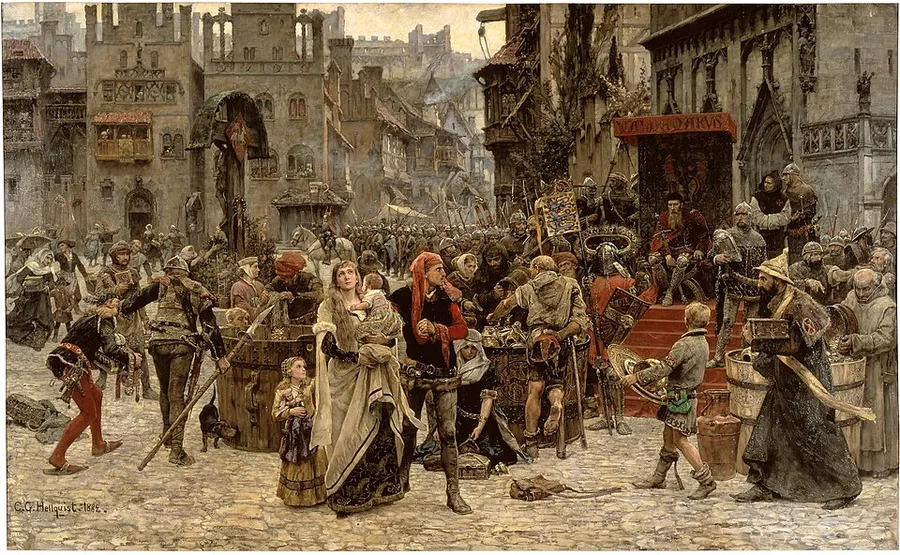 Carl Gustaf Hellqvist, Valdemar Atterdag Holding Visby to Ransom (1882), Nationalmuseum Stockholm Hellqvist's 1882 history painting dramatizes Valdemar's 1361 sack of Visby, the ransom-taking that funded his reconstitution of Danish royal power — the same patient, land-and-coin-by-coin rebuilding that let him marry his daughter Margaret into the Norwegian crown two years later. King of Denmark (c. 1320–1375), reigned 1340–1375. His
by-name Atterdag — "day again" or "another day" — referred
to his patient rebuilding of the Danish crown from a state of
near-collapse when he came to the throne. He systematically
bought back or seized the territories his predecessors had
pawned to German creditors, including the rich province of
Scania (Skåne), and by the 1360s had reconstituted Denmark as
a serious Baltic power. Arranged the 1363 marriage of his
ten-year-old daughter Margaret to Haakon VI of Norway as a
diplomatic move to plant his line in the Norwegian succession.
Died in October 1375 without a surviving male heir; his
grandson Olav inherited the Danish throne the following May.
. Valdemar had arranged the marriage to settle a dispute over the Swedish succession and to plant his line in Norway against the day his grandchildren might inherit both crowns. Margaret was ten years old at the wedding; Haakon was twenty-three. Their son Olav IV Håkonsson
Carl Gustaf Hellqvist, Valdemar Atterdag Holding Visby to Ransom (1882), Nationalmuseum Stockholm Hellqvist's 1882 history painting dramatizes Valdemar's 1361 sack of Visby, the ransom-taking that funded his reconstitution of Danish royal power — the same patient, land-and-coin-by-coin rebuilding that let him marry his daughter Margaret into the Norwegian crown two years later. King of Denmark (c. 1320–1375), reigned 1340–1375. His
by-name Atterdag — "day again" or "another day" — referred
to his patient rebuilding of the Danish crown from a state of
near-collapse when he came to the throne. He systematically
bought back or seized the territories his predecessors had
pawned to German creditors, including the rich province of
Scania (Skåne), and by the 1360s had reconstituted Denmark as
a serious Baltic power. Arranged the 1363 marriage of his
ten-year-old daughter Margaret to Haakon VI of Norway as a
diplomatic move to plant his line in the Norwegian succession.
Died in October 1375 without a surviving male heir; his
grandson Olav inherited the Danish throne the following May.
. Valdemar had arranged the marriage to settle a dispute over the Swedish succession and to plant his line in Norway against the day his grandchildren might inherit both crowns. Margaret was ten years old at the wedding; Haakon was twenty-three. Their son Olav IV Håkonsson 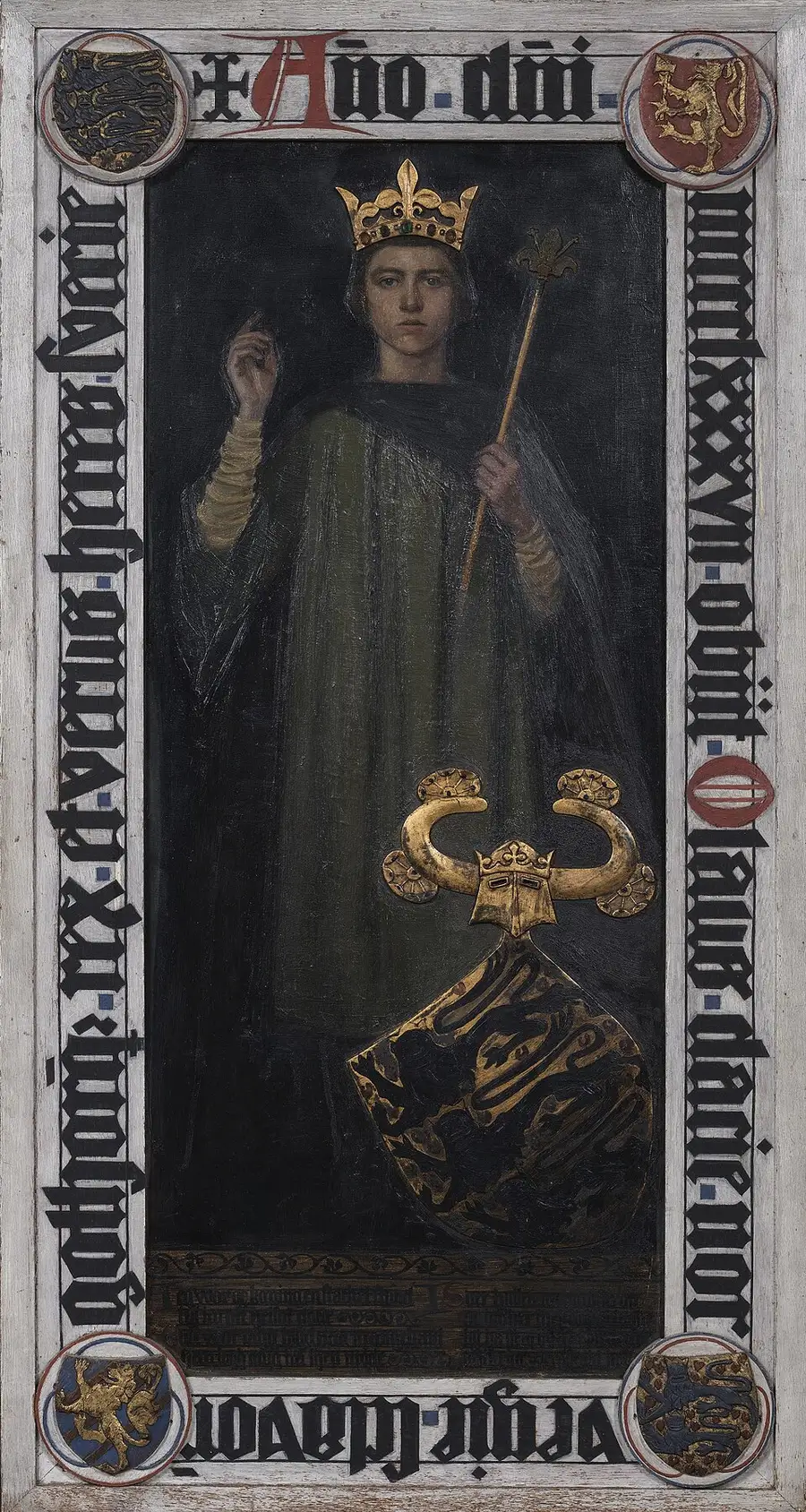 Agnes Slott-Møller, Oluf, Margrethes søn (1890s), public domain Danish National Romantic painter Agnes Slott-Møller devoted an 1890s canvas to the boy who briefly ruled two crowns at once — Olav IV, elected king of Denmark at five and of Norway at ten, dead at sixteen without an heir, the last king in the line the sagas traced to Harald Fairhair. King of Denmark and Norway (1370–1387), only son of King Haakon
VI of Norway and Margaret of Denmark. Born during the marriage
alliance his maternal grandfather Valdemar IV had arranged to
link the two crowns. Elected king of Denmark in May 1376 at
five years old after Valdemar's death without a male heir, with
his mother Margaret as regent. Became king of Norway in his own
right on his father Haakon's death in 1380, joining the two
crowns on a single ten-year-old. Died at Falsterbo on the
southern coast of Skåne in August 1387 at sixteen — cause
recorded only as illness — leaving no son and no will. With his
death ended the line of Norwegian kings that the sagas had
traced back to Harald Fairhair.
Also discussed in The 400-Year Night — when the Northern Lion lay dormantThe Quiet Revolution — how Norway won its independence without a war was born in 1370. When Margaret’s father Valdemar died in October 1375 without a male heir, his grandson Olav was elected king of Denmark the following May at the age of five, with his mother as regent. When his father Haakon died in 1380, Olav also became king of Norway in his own right. For seven years the two crowns sat on a single boy, and it appeared the Norwegian and Danish lines were about to converge in a single child who would rule both kingdoms and produce children who would inherit both.
Agnes Slott-Møller, Oluf, Margrethes søn (1890s), public domain Danish National Romantic painter Agnes Slott-Møller devoted an 1890s canvas to the boy who briefly ruled two crowns at once — Olav IV, elected king of Denmark at five and of Norway at ten, dead at sixteen without an heir, the last king in the line the sagas traced to Harald Fairhair. King of Denmark and Norway (1370–1387), only son of King Haakon
VI of Norway and Margaret of Denmark. Born during the marriage
alliance his maternal grandfather Valdemar IV had arranged to
link the two crowns. Elected king of Denmark in May 1376 at
five years old after Valdemar's death without a male heir, with
his mother Margaret as regent. Became king of Norway in his own
right on his father Haakon's death in 1380, joining the two
crowns on a single ten-year-old. Died at Falsterbo on the
southern coast of Skåne in August 1387 at sixteen — cause
recorded only as illness — leaving no son and no will. With his
death ended the line of Norwegian kings that the sagas had
traced back to Harald Fairhair.
Also discussed in The 400-Year Night — when the Northern Lion lay dormantThe Quiet Revolution — how Norway won its independence without a war was born in 1370. When Margaret’s father Valdemar died in October 1375 without a male heir, his grandson Olav was elected king of Denmark the following May at the age of five, with his mother as regent. When his father Haakon died in 1380, Olav also became king of Norway in his own right. For seven years the two crowns sat on a single boy, and it appeared the Norwegian and Danish lines were about to converge in a single child who would rule both kingdoms and produce children who would inherit both.
Then, in August 1387, Olav fell ill at Falsterbo  A. T. Gellerstedt, Falsterbo Church from the southwest (undated drawing), Riksantikvarieämbetet (KMB) Gellerstedt drew St Gertrude's, the medieval church of Falsterbo — the building left standing from the great herring-fair town where King Olav IV, the last of the sagas' Fairhair line, died at sixteen in August 1387. Small town on the southwestern tip of the Skåne peninsula,
facing the entrance to the Øresund. In the late medieval
period one of the most important seasonal trading sites in
the Baltic — the August Skånemarknad (Scania Fair) drew
Hanseatic merchants from across northern Europe to its
herring market. Falsterbo Castle was a Danish royal
residence through the fourteenth century. King Olav IV
Håkonsson of Norway and Denmark died there in August 1387
at sixteen, ending the medieval Norwegian male royal line
the sagas had traced from Harald Fairhair. Today a small
resort town in southwestern Sweden.
Also discussed in The 400-Year Night — when the Northern Lion lay dormantThe Quiet Revolution — how Norway won its independence without a war on the southern coast of Skåne
A. T. Gellerstedt, Falsterbo Church from the southwest (undated drawing), Riksantikvarieämbetet (KMB) Gellerstedt drew St Gertrude's, the medieval church of Falsterbo — the building left standing from the great herring-fair town where King Olav IV, the last of the sagas' Fairhair line, died at sixteen in August 1387. Small town on the southwestern tip of the Skåne peninsula,
facing the entrance to the Øresund. In the late medieval
period one of the most important seasonal trading sites in
the Baltic — the August Skånemarknad (Scania Fair) drew
Hanseatic merchants from across northern Europe to its
herring market. Falsterbo Castle was a Danish royal
residence through the fourteenth century. King Olav IV
Håkonsson of Norway and Denmark died there in August 1387
at sixteen, ending the medieval Norwegian male royal line
the sagas had traced from Harald Fairhair. Today a small
resort town in southwestern Sweden.
Also discussed in The 400-Year Night — when the Northern Lion lay dormantThe Quiet Revolution — how Norway won its independence without a war on the southern coast of Skåne 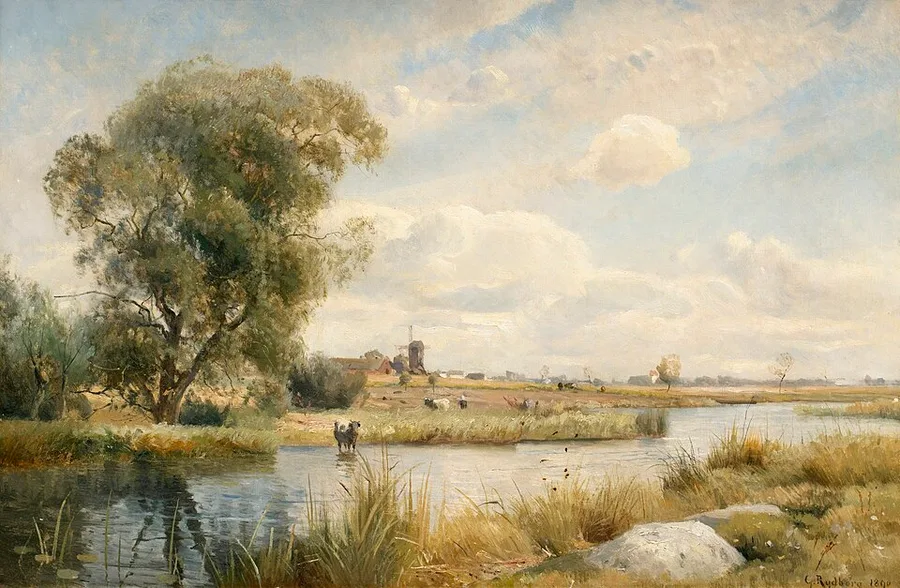 Gustaf Rydberg, Skånskt landskap (1890) Rydberg's summer plain — flat, fertile, a windmill on the low horizon — is the Skåne that made the province the agricultural heart of the Danish realm for five centuries, until Denmark ceded it to Sweden in 1658. Southernmost province of modern Sweden, the flat fertile
peninsula between Kattegat and the Baltic facing Denmark
across the Øresund strait. From the early medieval period
until 1658 Skåne was Danish territory — one of the three
core Danish provinces alongside Halland and Blekinge — and
its principal town Lund was the seat of the archbishopric
of all of Scandinavia from 1103. Valdemar IV Atterdag
recovered Skåne for the Danish crown from German creditors
in the 1360s, restoring it as the agricultural heart of the
Danish realm. Ceded to Sweden in the Treaty of Roskilde
(1658) and has been Swedish ever since.
(today in southern Sweden, then Danish) and died within days. He was sixteen. The chronicles record the cause only as illness. He left no son and no will, and with him ended the line of Norwegian kings that the sagas had traced back across five centuries, from Harald Fairhair
Gustaf Rydberg, Skånskt landskap (1890) Rydberg's summer plain — flat, fertile, a windmill on the low horizon — is the Skåne that made the province the agricultural heart of the Danish realm for five centuries, until Denmark ceded it to Sweden in 1658. Southernmost province of modern Sweden, the flat fertile
peninsula between Kattegat and the Baltic facing Denmark
across the Øresund strait. From the early medieval period
until 1658 Skåne was Danish territory — one of the three
core Danish provinces alongside Halland and Blekinge — and
its principal town Lund was the seat of the archbishopric
of all of Scandinavia from 1103. Valdemar IV Atterdag
recovered Skåne for the Danish crown from German creditors
in the 1360s, restoring it as the agricultural heart of the
Danish realm. Ceded to Sweden in the Treaty of Roskilde
(1658) and has been Swedish ever since.
(today in southern Sweden, then Danish) and died within days. He was sixteen. The chronicles record the cause only as illness. He left no son and no will, and with him ended the line of Norwegian kings that the sagas had traced back across five centuries, from Harald Fairhair 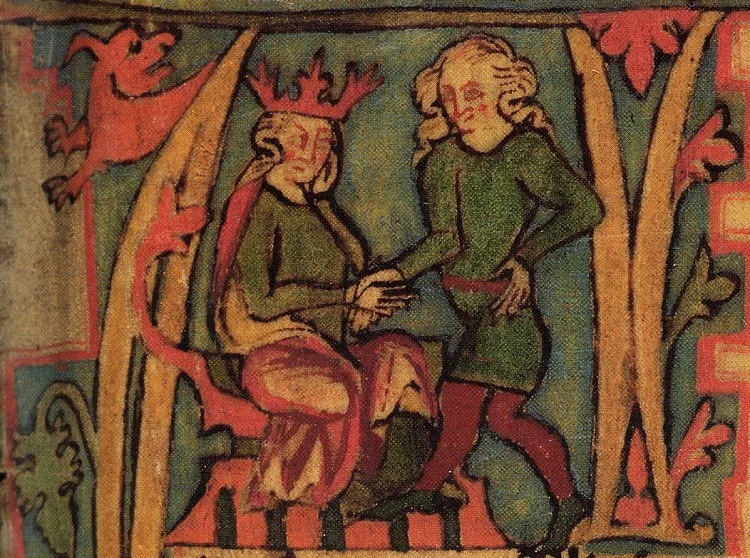 Flateyjarbók illumination, Harald Fairhair receives the kingdom (c. 1387–1394), Árni Magnússon Institute Harald Fairhair crowned and enthroned in the Flateyjarbók — illuminated around 1390, the very years in which the royal line traced from him ran out with the boy-king Olav's death at Falsterbo in 1387. Traditionally remembered as the first king of a unified Norway,
reigning ca. 872 to ca. 933. Inherited the small kingdom of Vestfold
at ten on the death of his father Halfdan the Black; over two decades
subdued the petty kingdoms of the western coast, climaxing at the
sea-battle of Hafrsfjord. His court poet's Haraldskvæði calls him
lúfa ("shock-head"); Hárfagri ("Fairhair") appears in verse of
debated authenticity attributed to his skalds, and is first securely
attested in twelfth-century prose (Íslendingabók). The famous
oath not to cut his hair until he had subjected every petty king is
later saga construction. His actual authority stopped short of the Arctic
north and the inland mountains, but he established the durable idea
of a single Norwegian crown.
Also discussed in Before There Was Norway — petty kingdoms at the edge of the worldThe Viking Age — longships, legends, and the first "Norway"The Golden Age — a North Atlantic empire … reaching farther than you think to the boy at Falsterbo.
Flateyjarbók illumination, Harald Fairhair receives the kingdom (c. 1387–1394), Árni Magnússon Institute Harald Fairhair crowned and enthroned in the Flateyjarbók — illuminated around 1390, the very years in which the royal line traced from him ran out with the boy-king Olav's death at Falsterbo in 1387. Traditionally remembered as the first king of a unified Norway,
reigning ca. 872 to ca. 933. Inherited the small kingdom of Vestfold
at ten on the death of his father Halfdan the Black; over two decades
subdued the petty kingdoms of the western coast, climaxing at the
sea-battle of Hafrsfjord. His court poet's Haraldskvæði calls him
lúfa ("shock-head"); Hárfagri ("Fairhair") appears in verse of
debated authenticity attributed to his skalds, and is first securely
attested in twelfth-century prose (Íslendingabók). The famous
oath not to cut his hair until he had subjected every petty king is
later saga construction. His actual authority stopped short of the Arctic
north and the inland mountains, but he established the durable idea
of a single Norwegian crown.
Also discussed in Before There Was Norway — petty kingdoms at the edge of the worldThe Viking Age — longships, legends, and the first "Norway"The Golden Age — a North Atlantic empire … reaching farther than you think to the boy at Falsterbo.
Margaret and the union
The regency in Norway fell to Olav’s mother. Margaret was thirty-four. She had married into the Norwegian royal line as a child, become a widow at twenty-seven when Haakon died, and lost her only son at thirty-four. She had also, by that summer of 1387, outlived her father Valdemar and most of the Danish privy councillors she had grown up obeying. Within a week of Olav’s death the Skåne ting at Lund 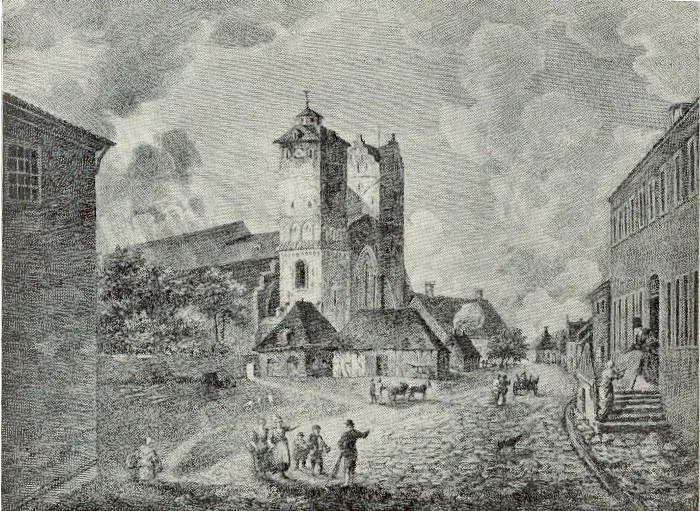 Johan Fredrik Martin after Elias Martin, Lund Cathedral (1782) Lund Cathedral in a 1782 engraving. Here the Skåne landsting acclaimed Margaret "fuldmægtig frue" — ruler in her own right — on 10 August 1387, one week after her son Olav's death at Falsterbo ended the Norwegian royal line. Cathedral city in what is now southern Sweden, just inside the
Skåne region (which was Danish territory until 1658). The seat
of the Scandinavian archdiocese from 1104, when Pope Paschal II
detached the Scandinavian church from the German metropolitan
see at Hamburg-Bremen. From 1104 to 1152 the Norwegian bishops
were suffragans of the Lund archbishopric. The 1152 mission of
Nicholas Breakspear created the independent Norwegian province
at Nidaros, separating the Norwegian church from Lund — though
Lund remained the senior Scandinavian see and the metropolitan
of the Danish and Swedish churches through the medieval period.
Also discussed in A Catholic Norway — the faith that gave the kingdom its first institutions and the stave churchesThe Crusades?!!!! — sixty ships from Bergen, bound for the Holy Land had acclaimed her ruler in her own right, and across the late summer and autumn the other Danish provincial assemblies followed. She was the first woman in Danish history acclaimed ruler in her own right.
Johan Fredrik Martin after Elias Martin, Lund Cathedral (1782) Lund Cathedral in a 1782 engraving. Here the Skåne landsting acclaimed Margaret "fuldmægtig frue" — ruler in her own right — on 10 August 1387, one week after her son Olav's death at Falsterbo ended the Norwegian royal line. Cathedral city in what is now southern Sweden, just inside the
Skåne region (which was Danish territory until 1658). The seat
of the Scandinavian archdiocese from 1104, when Pope Paschal II
detached the Scandinavian church from the German metropolitan
see at Hamburg-Bremen. From 1104 to 1152 the Norwegian bishops
were suffragans of the Lund archbishopric. The 1152 mission of
Nicholas Breakspear created the independent Norwegian province
at Nidaros, separating the Norwegian church from Lund — though
Lund remained the senior Scandinavian see and the metropolitan
of the Danish and Swedish churches through the medieval period.
Also discussed in A Catholic Norway — the faith that gave the kingdom its first institutions and the stave churchesThe Crusades?!!!! — sixty ships from Bergen, bound for the Holy Land had acclaimed her ruler in her own right, and across the late summer and autumn the other Danish provincial assemblies followed. She was the first woman in Danish history acclaimed ruler in her own right.
The Swedish nobility had been at war with their king, Albert of Mecklenburg 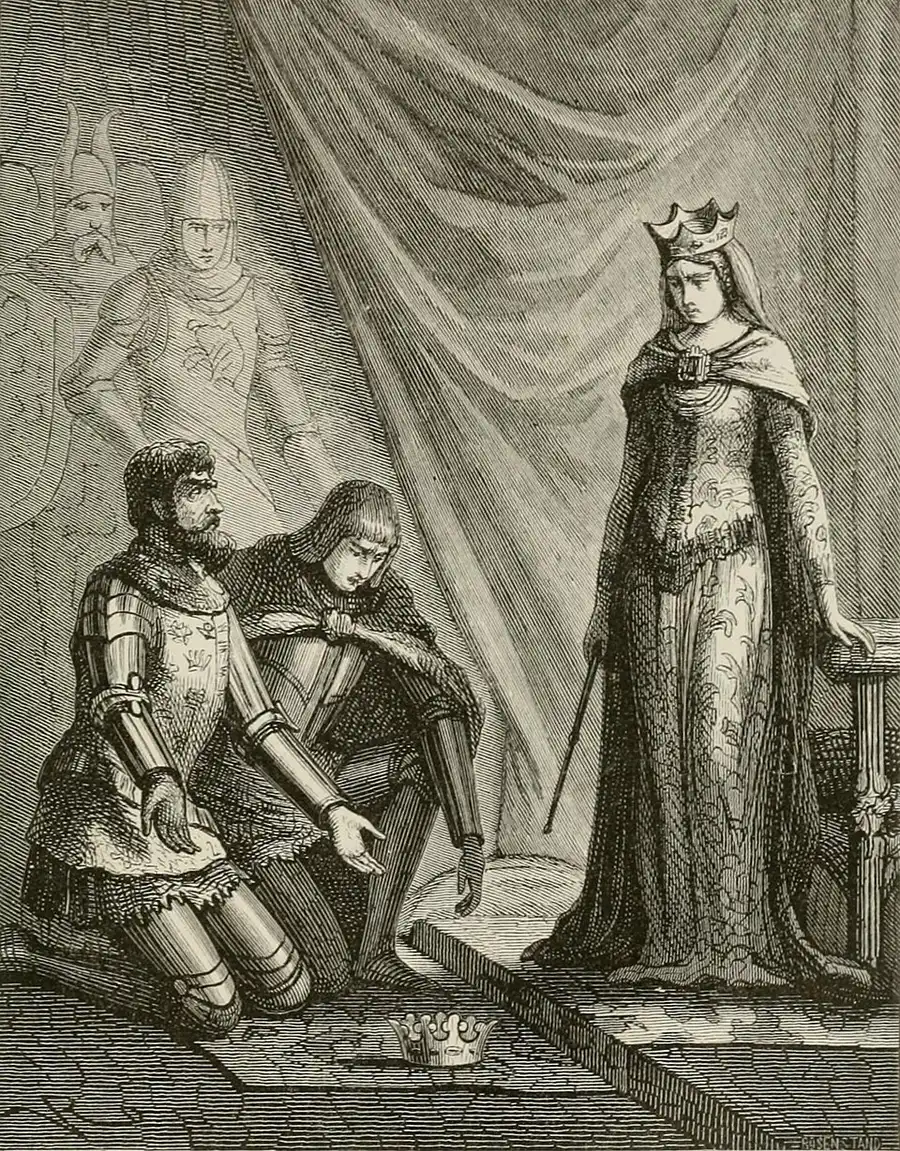 V. R., illustration from Danmarks, Norges og Sverigs historie, public domain This 19th-century illustration stages the moment that opened the way to the Kalmar Union: Albert, defeated and captured at Åsle in February 1389, kneels before the Danish queen the Swedish nobility had already turned to in his place. King of Sweden (1338?–1412), reigned 1364–1389. A German
prince from the Mecklenburg ducal house in the southern Baltic,
brought in as king by the Swedish nobility in 1364 after they
drove out Haakon VI Magnusson. His reign saw progressive
alienation of the Swedish magnates by the favours he showed
his German kinsmen and retainers. In 1388 the Swedish nobility
deserted him and acclaimed Margaret of Denmark as their lawful
ruler instead. Defeated and captured by Margaret's forces at
the Battle of Falköping on 24 February 1389; spent the next
six years in Margaret's custody before his release under the
Treaty of Lindholm in 1395, and formally renounced the
Swedish crown only in 1405. The vacuum left by his defeat
opened the way to the Kalmar Union of 1397.
, for years. In 1388, deserting Albert, they met Margaret at Dalaborg in Dalsland and acknowledged her as their lawful ruler as well. They gave her a title their constitutional language had not previously needed: fullmäktig fru och rätt husbonde — plenipotentiary lady and rightful master — since no formula existed for a woman who would govern three kingdoms in her own right. The next year her army defeated Albert at Falköping and captured him; he spent the next six years in Margaret’s custody, released under the Treaty of Lindholm in 1395 but formally renouncing the Swedish crown only in 1405. In 1397 the three kingdoms gathered at Kalmar
V. R., illustration from Danmarks, Norges og Sverigs historie, public domain This 19th-century illustration stages the moment that opened the way to the Kalmar Union: Albert, defeated and captured at Åsle in February 1389, kneels before the Danish queen the Swedish nobility had already turned to in his place. King of Sweden (1338?–1412), reigned 1364–1389. A German
prince from the Mecklenburg ducal house in the southern Baltic,
brought in as king by the Swedish nobility in 1364 after they
drove out Haakon VI Magnusson. His reign saw progressive
alienation of the Swedish magnates by the favours he showed
his German kinsmen and retainers. In 1388 the Swedish nobility
deserted him and acclaimed Margaret of Denmark as their lawful
ruler instead. Defeated and captured by Margaret's forces at
the Battle of Falköping on 24 February 1389; spent the next
six years in Margaret's custody before his release under the
Treaty of Lindholm in 1395, and formally renounced the
Swedish crown only in 1405. The vacuum left by his defeat
opened the way to the Kalmar Union of 1397.
, for years. In 1388, deserting Albert, they met Margaret at Dalaborg in Dalsland and acknowledged her as their lawful ruler as well. They gave her a title their constitutional language had not previously needed: fullmäktig fru och rätt husbonde — plenipotentiary lady and rightful master — since no formula existed for a woman who would govern three kingdoms in her own right. The next year her army defeated Albert at Falköping and captured him; he spent the next six years in Margaret’s custody, released under the Treaty of Lindholm in 1395 but formally renouncing the Swedish crown only in 1405. In 1397 the three kingdoms gathered at Kalmar 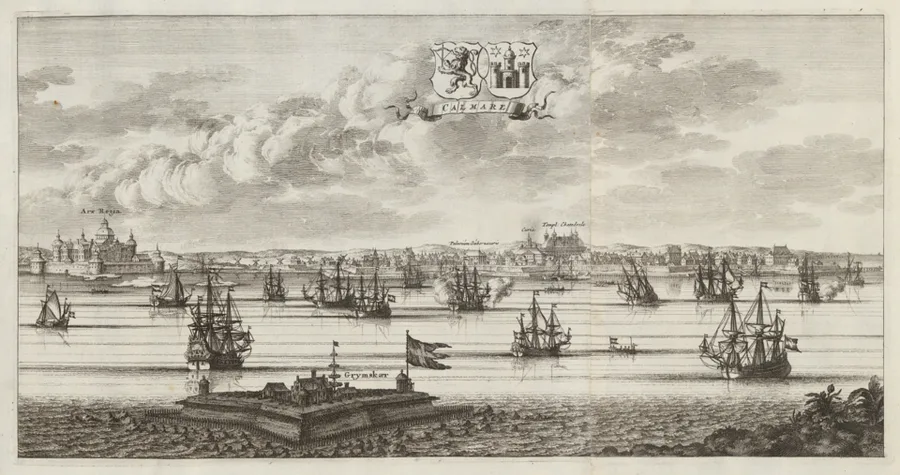 Willem Swidde after Erik Dahlbergh, Kalmar, from Suecia Antiqua et Hodierna (1693), National Library of Sweden This 1693 engraving shows Kalmar and its castle — the fortified town where the three Scandinavian crowns gathered in 1397 to crown Erik of Pomerania joint king, founding the Kalmar Union that bound Norway to Denmark for four centuries. Coastal town in southeastern Sweden on the Baltic, facing
the island of Öland across the Kalmar Sound. In the
medieval period one of Sweden's principal fortified towns —
the medieval Kalmar Castle, on a small islet just south of
the town, was Sweden's strongest southern bulwark against
Danish-held Blekinge. Chosen as the site for the 1397
meeting that crowned Erik of Pomerania joint king of
Denmark, Norway, and Sweden — Swedish border ground a short
sail from the Danish frontier, convenient to all three
realms — and gave the Kalmar Union its name. The medieval castle survives in substantially
altered form, most of the present buildings the sixteenth-
century work of Gustav Vasa and his sons.
— Sweden’s principal southeastern fortress, on the border with Danish Blekinge and convenient to all three realms — to crown her great-nephew Erik of Pomerania
Willem Swidde after Erik Dahlbergh, Kalmar, from Suecia Antiqua et Hodierna (1693), National Library of Sweden This 1693 engraving shows Kalmar and its castle — the fortified town where the three Scandinavian crowns gathered in 1397 to crown Erik of Pomerania joint king, founding the Kalmar Union that bound Norway to Denmark for four centuries. Coastal town in southeastern Sweden on the Baltic, facing
the island of Öland across the Kalmar Sound. In the
medieval period one of Sweden's principal fortified towns —
the medieval Kalmar Castle, on a small islet just south of
the town, was Sweden's strongest southern bulwark against
Danish-held Blekinge. Chosen as the site for the 1397
meeting that crowned Erik of Pomerania joint king of
Denmark, Norway, and Sweden — Swedish border ground a short
sail from the Danish frontier, convenient to all three
realms — and gave the Kalmar Union its name. The medieval castle survives in substantially
altered form, most of the present buildings the sixteenth-
century work of Gustav Vasa and his sons.
— Sweden’s principal southeastern fortress, on the border with Danish Blekinge and convenient to all three realms — to crown her great-nephew Erik of Pomerania 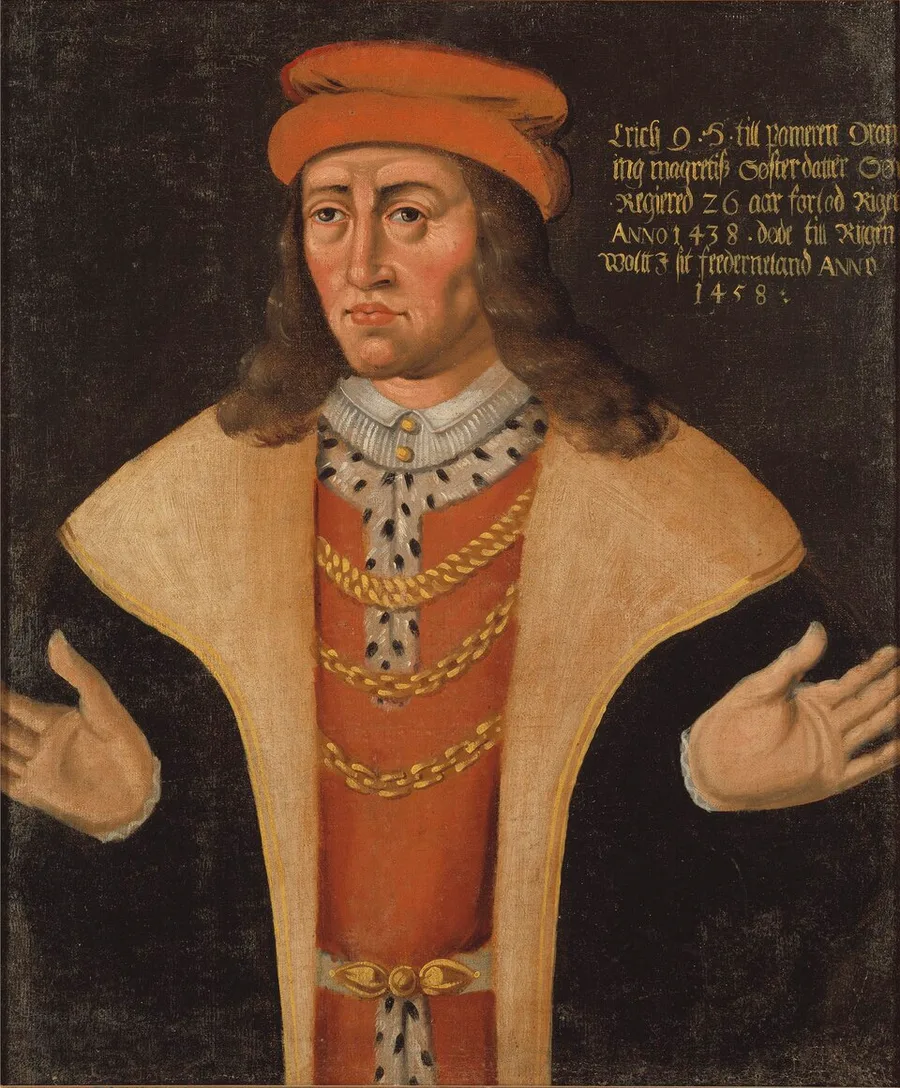 Unknown artist, portrait of Erik of Pomerania, Nationalmuseum Stockholm (Gripsholm Castle collection), public domain No portrait of Erik survives from his own lifetime; this is one of the imagined likenesses later royal portrait galleries (Gripsholm Castle's chain of Scandinavian monarchs) produced for the boy Margaret adopted and crowned at Kalmar in 1397 as her heir to all three thrones. King of Denmark, Norway, and Sweden (c. 1382–1459), reigned
1396–1439 in Denmark and Norway, 1396–1434 in Sweden. Born
Bogislav, a Pomeranian prince, great-nephew of Margaret I of
Denmark (the son of Margaret's niece Maria of Mecklenburg).
Margaret adopted him as her dynastic heir after the death of
her son Olav IV in 1387 and arranged his election as king of
Norway in 1389, Denmark and Sweden in 1396. Crowned joint
king of all three Scandinavian kingdoms at Kalmar in 1397 —
the constitutional founding of the Kalmar Union. Margaret
continued to rule in his name until her death in 1412. Erik
was deposed by all three kingdoms in stages between 1434 and
1442 and died in exile in Pomerania.
as their joint king. Erik would remain the named monarch while Margaret continued to rule in his name until her death.
Unknown artist, portrait of Erik of Pomerania, Nationalmuseum Stockholm (Gripsholm Castle collection), public domain No portrait of Erik survives from his own lifetime; this is one of the imagined likenesses later royal portrait galleries (Gripsholm Castle's chain of Scandinavian monarchs) produced for the boy Margaret adopted and crowned at Kalmar in 1397 as her heir to all three thrones. King of Denmark, Norway, and Sweden (c. 1382–1459), reigned
1396–1439 in Denmark and Norway, 1396–1434 in Sweden. Born
Bogislav, a Pomeranian prince, great-nephew of Margaret I of
Denmark (the son of Margaret's niece Maria of Mecklenburg).
Margaret adopted him as her dynastic heir after the death of
her son Olav IV in 1387 and arranged his election as king of
Norway in 1389, Denmark and Sweden in 1396. Crowned joint
king of all three Scandinavian kingdoms at Kalmar in 1397 —
the constitutional founding of the Kalmar Union. Margaret
continued to rule in his name until her death in 1412. Erik
was deposed by all three kingdoms in stages between 1434 and
1442 and died in exile in Pomerania.
as their joint king. Erik would remain the named monarch while Margaret continued to rule in his name until her death.
The Kalmar Union 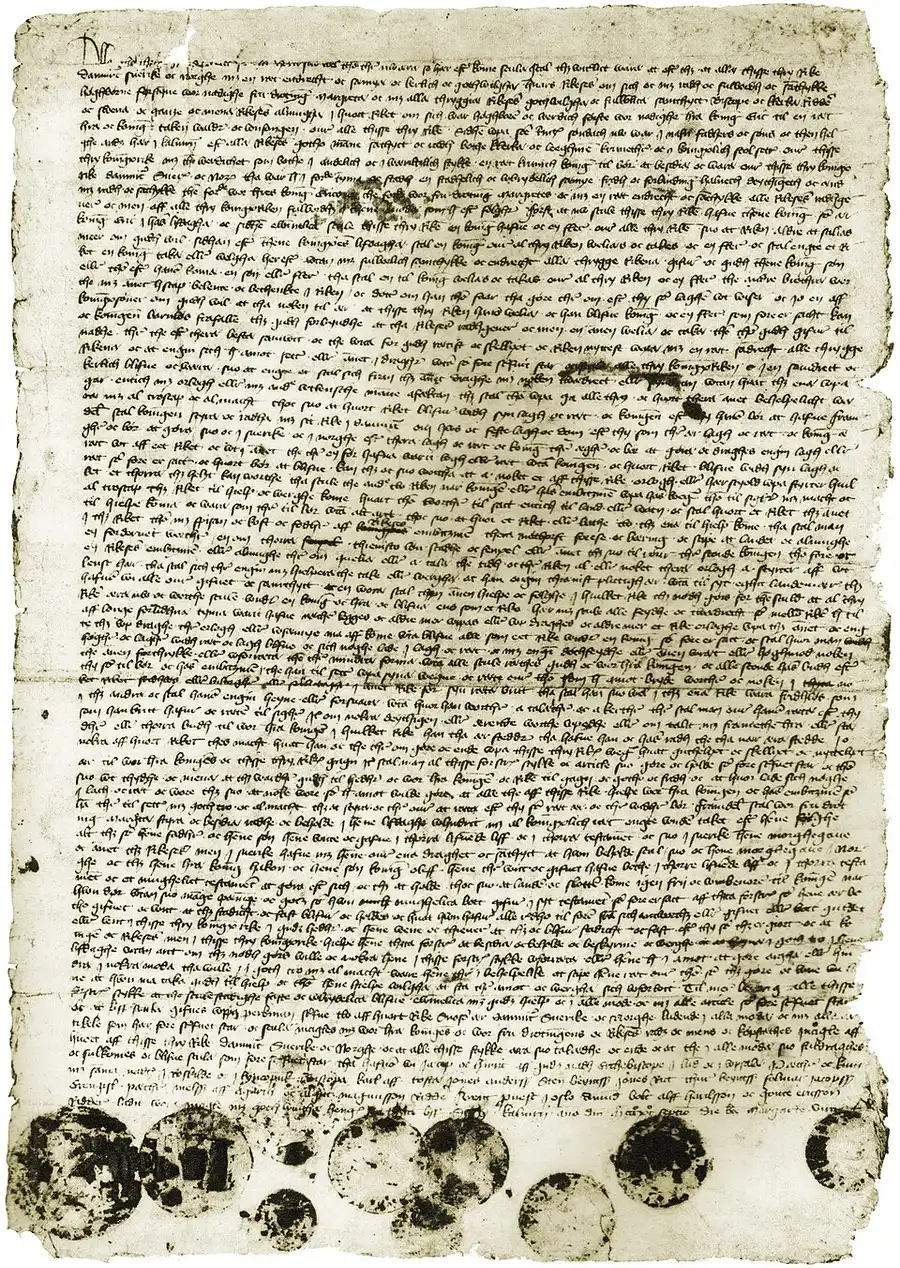 Union letter of Kalmar (1397) The 1397 union letter drafted at Kalmar bound Denmark, Sweden, and Norway under a single crown for 126 years — a realignment that gradually placed senior Norwegian clergy appointments under Danish control, one of the political conditions that made the imposed 1537 Reformation possible. Personal union of the three Scandinavian kingdoms — Denmark,
Sweden, and Norway — under a single monarch, established at
Kalmar (in modern southeastern Sweden) in 1397 by Margaret of
Denmark. Lasted 126 years until Gustav Vasa's revolt of 1523
took Sweden out of the union. Denmark and Norway remained joined
as the Dano-Norwegian union (1523–1814), with Norway treated as
a Danish province governed from Copenhagen. The Kalmar Union
shifted Scandinavian political power decisively to Copenhagen
and gradually placed the senior Norwegian clergy under Danish
appointment — one of the long political conditions for the
imposed Lutheran Reformation in Norway in 1537.
Also discussed in A Catholic Norway — the faith that gave the kingdom its first institutions and the stave churchesThe 400-Year Night — when the Northern Lion lay dormant of 1397 was the form the dynastic settlement took. Margaret died at Flensburg
Union letter of Kalmar (1397) The 1397 union letter drafted at Kalmar bound Denmark, Sweden, and Norway under a single crown for 126 years — a realignment that gradually placed senior Norwegian clergy appointments under Danish control, one of the political conditions that made the imposed 1537 Reformation possible. Personal union of the three Scandinavian kingdoms — Denmark,
Sweden, and Norway — under a single monarch, established at
Kalmar (in modern southeastern Sweden) in 1397 by Margaret of
Denmark. Lasted 126 years until Gustav Vasa's revolt of 1523
took Sweden out of the union. Denmark and Norway remained joined
as the Dano-Norwegian union (1523–1814), with Norway treated as
a Danish province governed from Copenhagen. The Kalmar Union
shifted Scandinavian political power decisively to Copenhagen
and gradually placed the senior Norwegian clergy under Danish
appointment — one of the long political conditions for the
imposed Lutheran Reformation in Norway in 1537.
Also discussed in A Catholic Norway — the faith that gave the kingdom its first institutions and the stave churchesThe 400-Year Night — when the Northern Lion lay dormant of 1397 was the form the dynastic settlement took. Margaret died at Flensburg 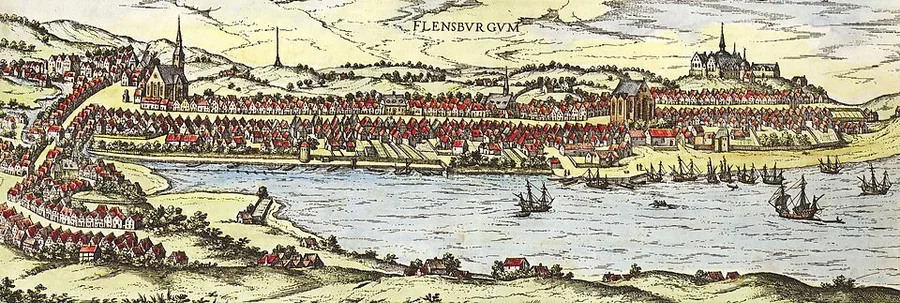 Georg Braun & Frans Hogenberg, Flensburg, Civitates Orbis Terrarum (Liber Quartus, c. 1580s), public domain Braun and Hogenberg's Civitates Orbis Terrarum town view shows Flensburg much as it stood in the late medieval and early modern centuries, the Danish royal town on its fjord where Margaret I of Denmark died aboard ship in 1412. Port town at the head of the Flensburg Fjord, on the
Baltic coast of what is today the northernmost German
state of Schleswig-Holstein, just south of the modern
Danish border. In the late medieval period a Danish royal
town within the duchies of Schleswig — a Danish possession
through most of the medieval and early modern centuries
until 1864. Margaret I of Denmark died there in 1412
while on board ship in the harbour, allegedly of plague.
in 1412. By then the Norwegian crown was effectively a department of the Danish state, and would remain so for the next four centuries.
Georg Braun & Frans Hogenberg, Flensburg, Civitates Orbis Terrarum (Liber Quartus, c. 1580s), public domain Braun and Hogenberg's Civitates Orbis Terrarum town view shows Flensburg much as it stood in the late medieval and early modern centuries, the Danish royal town on its fjord where Margaret I of Denmark died aboard ship in 1412. Port town at the head of the Flensburg Fjord, on the
Baltic coast of what is today the northernmost German
state of Schleswig-Holstein, just south of the modern
Danish border. In the late medieval period a Danish royal
town within the duchies of Schleswig — a Danish possession
through most of the medieval and early modern centuries
until 1864. Margaret I of Denmark died there in 1412
while on board ship in the harbour, allegedly of plague.
in 1412. By then the Norwegian crown was effectively a department of the Danish state, and would remain so for the next four centuries.
What the plague did
The royal line ending was contingency: a boy died at sixteen, of an illness, at Falsterbo in 1387. Kings’ sons died young in plenty of medieval kingdoms that survived perfectly intact. Sweden imported Albert when its nobility broke with its king; the Empire elected its monarchs as a matter of constitutional course. What the plague had done was not, in itself, to kill the Norwegian dynasty. What it had done was hollow out the kingdom’s capacity to respond to a succession vacuum as an independent actor.
An intact Norway in 1387 would have had a functioning Council of magnates and bishops to negotiate its own next king on its own terms. It would have had the noble wealth and clerical literacy to assert that choice against the crown’s other claimants. The plague had taken both. The Council had lost its members and the surviving members had lost their incomes. There were no spare younger sons of magnate houses coming up to fill the empty seats, and no clerical class of full Latin to staff the chancery that would have drafted Norway’s letters of negotiation. The crown was effectively up for inheritance by whichever European royal house held the strongest claim by marriage and survival — and Margaret’s house held the strongest.
Across the rest of Europe the recovery took a different shape. England and France emerged from the catastrophe with their crowns intact and their literate classes rebuilt. The Italian city-states emerged with their merchant fortunes and humanist scholars in place. Even the German lands, hit as hard as anywhere, emerged with their network of Hanseatic cities consolidated and their princely houses extending across central Europe. The institutional reserves were lighter everywhere in 1351 than they had been in 1347, but everywhere except Norway there was a layer beneath the dead that could replace them.
Norway came out of the fourteenth century with no such layer. The institutional church was running on imported clergy. The trade was running on imported merchants. The aristocracy and the Council were running on diminished numbers and diminished incomes. The throne, when the line failed, was not empty — it passed by inheritance to Margaret’s house, was governed by her as regent, and settled on her great-nephew Erik at Kalmar.
The kingdom does not come back.
Sources & further reading
Primary sources
- Einarr Hafliðason, Lögmanns-annáll (the Lawman’s Annal), c. 1393. The Icelandic chronicle whose annal entries for 1349 give the standard dating of the plague’s arrival in Norway. In Islandske Annaler indtil 1578, ed. Gustav Storm (Christiania, 1888).
- Diplomatarium Norvegicum, 23 vols. (Christiania/Oslo, 1847–2011). The standard collection of medieval Norwegian charters and correspondence, including the surviving post-plague episcopal letters. Digitised at https://www.dokpro.uio.no/dipl_norv/diplom_field_eng.html.
Modern scholarship
- Ole Jørgen Benedictow, The Black Death and Later Plague Epidemics in the Scandinavian Countries: Perspectives and Controversies (De Gruyter Open, 2016). The definitive recent scholarly synthesis on the plague in Scandinavia, including the argument for Bergen 1349 as the single point of entry.
- Ole Jørgen Benedictow, The Black Death, 1346–1353: The Complete History (Boydell Press, 2004). The standard modern history of the plague across Europe, with substantial treatment of the Norwegian case.
- Halvard Bjørkvik, Folketap og sammenbrudd 1350–1520, in Aschehougs Norgeshistorie, vol. 4 (Aschehoug, 1996). The standard Norwegian-language treatment of the demographic collapse, the ødegård registers, and the institutional consequences.
- Sverre Bagge, Cross and Scepter: The Rise of the Scandinavian Kingdoms from the Vikings to the Reformation (Princeton University Press, 2014). The Scandinavian political context for the dynastic collapse and the union.
- Vivian Etting, Queen Margrete I (1353–1412) and the Founding of the Nordic Union (Brill, 2004). The standard modern English biography of Margaret.
- Knut Helle, ed., The Cambridge History of Scandinavia, Volume 1: Prehistory to 1520 (Cambridge University Press, 2003). The reference treatment of the period.
Reference
- Store norske leksikon (snl.no). See in particular svartedauden, manndauden, ødegård, Magnus 7 Eriksson, Margrete 1, Kalmarunionen, and Olav 4 Håkonsson.
Visit
- Bergen, harbour. The wharf-front where the plague entered Norway in late summer 1349. The medieval Christ Church on the headland above the harbour is gone — the cathedral seat moved later and the medieval church itself was demolished after the Reformation. The present-day Bryggen UNESCO district occupies the same wharf the plague-bearing ship would have docked at.
- Nidaros Cathedral, Trondheim. The medieval archbishopric whose chair stood empty for years at a stretch in the post-plague generations.
- Akershus Fortress, Oslo. The medieval royal castle, built by Haakon V in the early fourteenth century shortly before the dynastic transition that closed the Golden Age. By the late fourteenth century the fortress had passed under Danish-appointed governance, where it would remain for the next four centuries.
- Bergenhus Fortress, Bergen. The medieval royal seat at Bergen, similarly under Danish-appointed governance from the late fourteenth century onward.
- Kalmar Castle, Kalmar in southeastern Sweden. The fortified site at which the Kalmar Union was constituted in 1397 and Erik of Pomerania crowned joint king of the three Scandinavian kingdoms. The medieval castle survives in substantially altered form, with the present buildings mostly the work of Gustav Vasa and his sons in the sixteenth century.