The Germans Who "Ruled" Bergen — The Hanseatic merchants on Bryggen Wharf
For four centuries the German merchants of the Hanseatic League ran Norway's western trade from the painted wooden wharf of Bryggen. The Kontor formed around 1360, enforced a strict bachelor rule on its members, and dissolved quietly in 1754.
For nearly four hundred years, from around 1360 to 1754, the western trade of Norway ran through a closed German enclave on the eastern shore of Bergen 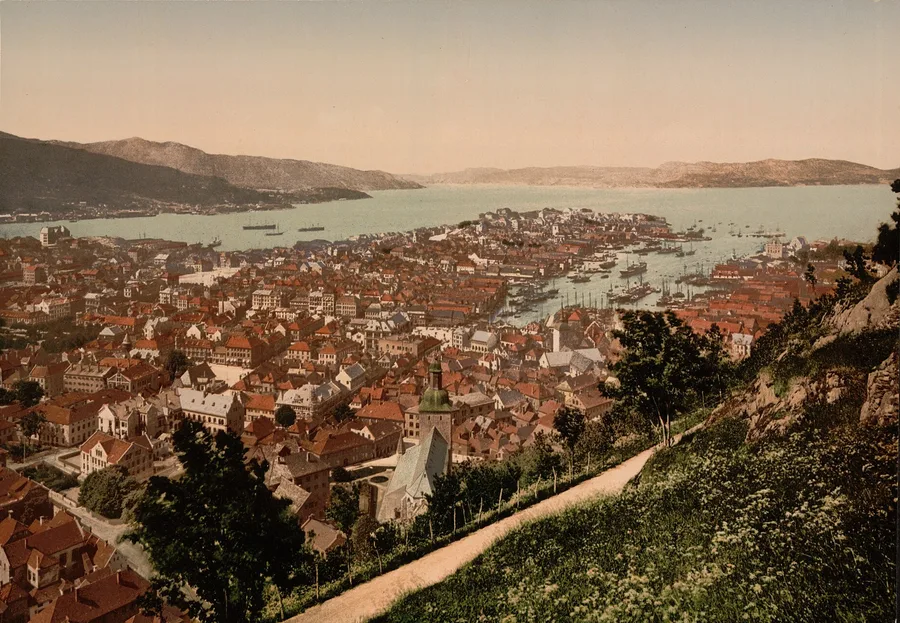 Photochrom print, General view from Fjeldveien, Bergen (c. 1890–1900), Library of Congress Bergen in the 1890s from the Fjellveien path on Fløyfjellet — the whole city between its mountains, Vågen harbour still crowded with sailing ships at its heart. For four centuries Norway's largest city, and the wharf through which the entire western export economy ran. Norway's western trading capital, founded around 1070 on the
inner Byfjorden. For four centuries the largest city in the
country and the wharf through which the entire western export
economy ran — dried cod from the Lofoten fisheries, stockpiled
and traded by the Hanseatic merchants at Bryggen from 1360 to
1754. Norway's commercial and intellectual heart through the
Hanseatic period; overtaken in size by Christiania (Oslo) in the
1830s. The painted wooden Bryggen wharf is on the UNESCO World
Heritage list and substantially what it was in the late
seventeenth century.
On the trip The Ungdommene (the Youngsters) reach Bergen late on Day 3
via the Norway-in-a-Nutshell train-and-ferry route from
Oslo. On the Day 4 morning they walk Bryggen and ride the
funicular up Mount Fløyen before flying back to Oslo and driving
on to Lillehammer that evening — a day ahead of the Gråhårsklubben
(the Oldsters), who spend the split days north in Trondheim and
the heritage country of Stjørdal, Hegra, and Kylloplass and come
south on Day 5.
Bergen Also discussed in Before There Was Norway — petty kingdoms at the edge of the worldThe King Who Became a Saint — how the Nordmen came to ChristA Catholic Norway — the faith that gave the kingdom its first institutions and the stave churchesThe Long Fall — the sudden loss of Norwegian nobility, the end of the kings, and half of Norway gone foreverThe Golden Age — a North Atlantic empire … reaching farther than you thinkThe 400-Year Night — when the Northern Lion lay dormantThe Crusades?!!!! — sixty ships from Bergen, bound for the Holy LandThe Reformation, 1537 — one church eradicated and another imposedWorld War II — the King’s “No” and the Nazis in NorwayKraken — the island-sized beast, logged as factSjøormer — the serpents in the deep lakes and fjordsPesta — an old woman walking from farm to farmFossegrimen — the waterfall fiddler who teaches you to playAlcohol and Vinmonopolet — when and where to buy a drinkEveryday etiquette — quiet voices, wide space, no smilingFood and dining customs — having patience, free water, brunost on everything🚨 Emergencies - important numbers, hospitals, and what you can doLanguage basics — just enough Norwegian to be politeWhat to wear — the layering system, on the ground ’s inner harbour. The colony was the Det tyske kontor i Bergen
Photochrom print, General view from Fjeldveien, Bergen (c. 1890–1900), Library of Congress Bergen in the 1890s from the Fjellveien path on Fløyfjellet — the whole city between its mountains, Vågen harbour still crowded with sailing ships at its heart. For four centuries Norway's largest city, and the wharf through which the entire western export economy ran. Norway's western trading capital, founded around 1070 on the
inner Byfjorden. For four centuries the largest city in the
country and the wharf through which the entire western export
economy ran — dried cod from the Lofoten fisheries, stockpiled
and traded by the Hanseatic merchants at Bryggen from 1360 to
1754. Norway's commercial and intellectual heart through the
Hanseatic period; overtaken in size by Christiania (Oslo) in the
1830s. The painted wooden Bryggen wharf is on the UNESCO World
Heritage list and substantially what it was in the late
seventeenth century.
On the trip The Ungdommene (the Youngsters) reach Bergen late on Day 3
via the Norway-in-a-Nutshell train-and-ferry route from
Oslo. On the Day 4 morning they walk Bryggen and ride the
funicular up Mount Fløyen before flying back to Oslo and driving
on to Lillehammer that evening — a day ahead of the Gråhårsklubben
(the Oldsters), who spend the split days north in Trondheim and
the heritage country of Stjørdal, Hegra, and Kylloplass and come
south on Day 5.
Bergen Also discussed in Before There Was Norway — petty kingdoms at the edge of the worldThe King Who Became a Saint — how the Nordmen came to ChristA Catholic Norway — the faith that gave the kingdom its first institutions and the stave churchesThe Long Fall — the sudden loss of Norwegian nobility, the end of the kings, and half of Norway gone foreverThe Golden Age — a North Atlantic empire … reaching farther than you thinkThe 400-Year Night — when the Northern Lion lay dormantThe Crusades?!!!! — sixty ships from Bergen, bound for the Holy LandThe Reformation, 1537 — one church eradicated and another imposedWorld War II — the King’s “No” and the Nazis in NorwayKraken — the island-sized beast, logged as factSjøormer — the serpents in the deep lakes and fjordsPesta — an old woman walking from farm to farmFossegrimen — the waterfall fiddler who teaches you to playAlcohol and Vinmonopolet — when and where to buy a drinkEveryday etiquette — quiet voices, wide space, no smilingFood and dining customs — having patience, free water, brunost on everything🚨 Emergencies - important numbers, hospitals, and what you can doLanguage basics — just enough Norwegian to be politeWhat to wear — the layering system, on the ground ’s inner harbour. The colony was the Det tyske kontor i Bergen 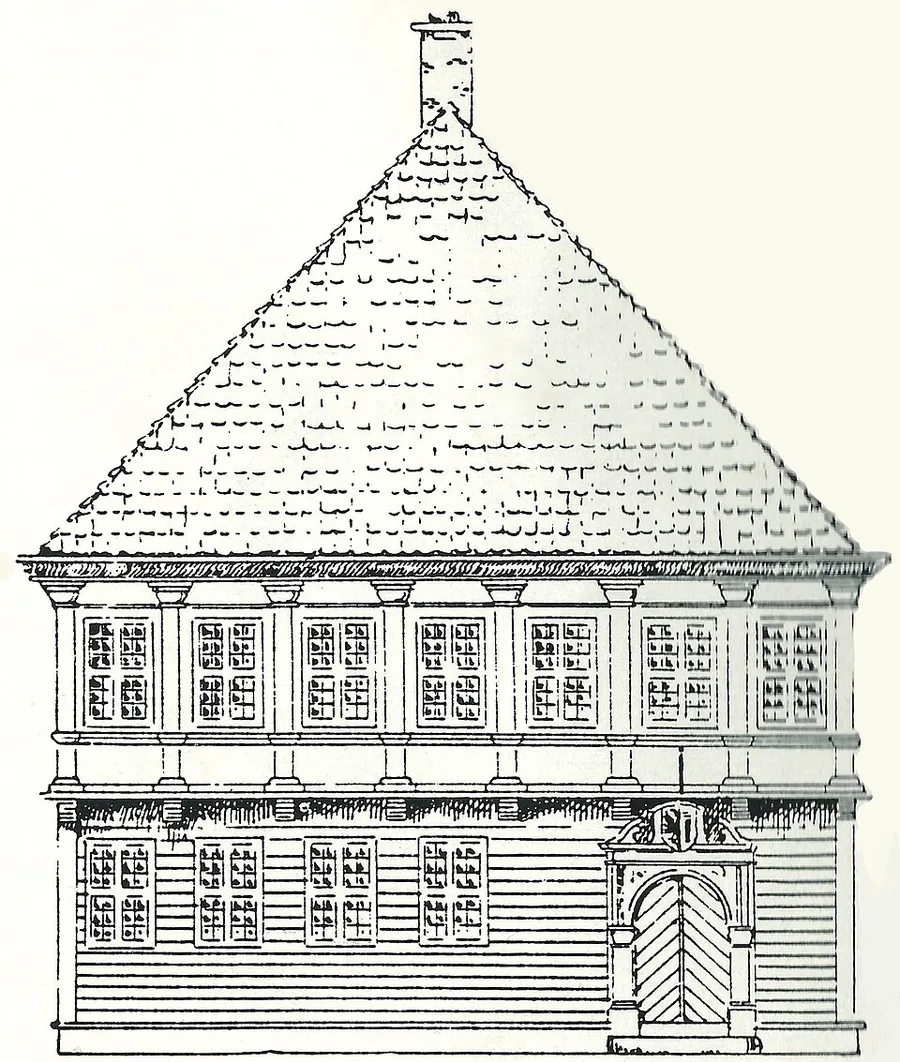 Kaufmannshaus um 1720, Vorderseite, repr. in F. Bruns, Die Sekretäre des deutschen Kontors zu Bergen (1939) This circa-1720 architectural elevation records the street-facing front of one of the Kontor's own gabled merchant houses at Bryggen — the wooden trading-and-residence buildings the German Kontor built, staffed, and governed under the Schra for four centuries. The German Kontor at Bergen — the Hanseatic League's
trading post on the Bryggen wharf, formally consolidated
around 1360 and dissolved in 1754. The longest-lasting of
the four major Hanseatic Kontors (the others being Novgorod,
London, and Bruges) and the most strictly governed. Conducted
business in Middle Low German, ran under its own internal
statutes (the Schra), elected its own Oldermann annually,
and enforced a strict marriage ban on its members. At its
fifteenth-century peak the Kontor held perhaps one to two
thousand men in the summer trading season. Controlled the
Norwegian stockfish trade with near-monopoly intensity for
four centuries. Transferred to a Norwegian successor
association in 1754 by royal resolution of Frederik V.
— a trading post (the Hanseatic League
Kaufmannshaus um 1720, Vorderseite, repr. in F. Bruns, Die Sekretäre des deutschen Kontors zu Bergen (1939) This circa-1720 architectural elevation records the street-facing front of one of the Kontor's own gabled merchant houses at Bryggen — the wooden trading-and-residence buildings the German Kontor built, staffed, and governed under the Schra for four centuries. The German Kontor at Bergen — the Hanseatic League's
trading post on the Bryggen wharf, formally consolidated
around 1360 and dissolved in 1754. The longest-lasting of
the four major Hanseatic Kontors (the others being Novgorod,
London, and Bruges) and the most strictly governed. Conducted
business in Middle Low German, ran under its own internal
statutes (the Schra), elected its own Oldermann annually,
and enforced a strict marriage ban on its members. At its
fifteenth-century peak the Kontor held perhaps one to two
thousand men in the summer trading season. Controlled the
Norwegian stockfish trade with near-monopoly intensity for
four centuries. Transferred to a Norwegian successor
association in 1754 by royal resolution of Frederik V.
— a trading post (the Hanseatic League 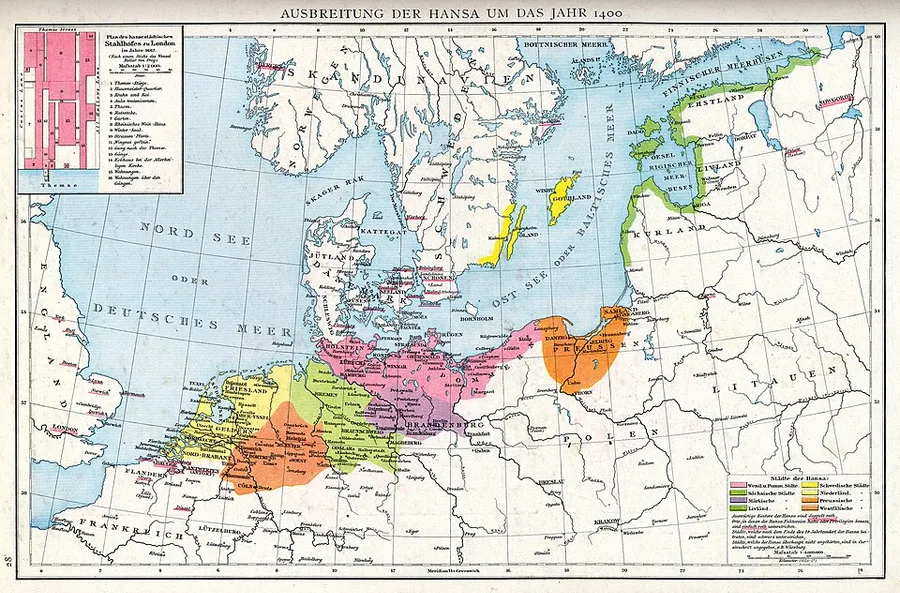 G. Droysen / R. Andrée, Allgemeiner Historischer Handatlas, plate 28 (1886) Droysen's 1886 historical atlas plots the Hanseatic League's full network of cities around 1400, Bergen marked among them on Norway's west coast — the confederation whose common law, common tongue, and collective bargaining power built and ran the Bergen Kontor for four centuries. Confederation of north German trading cities, headquartered
at Lübeck on the southern Baltic, that emerged in the twelfth
and thirteenth centuries to protect long-distance commerce
and to present a common bargaining front to outside powers.
At its medieval peak the League included around seventy
active member cities and a wider penumbra of associated
ports. The Hansa was not a state — no army, no parliament,
no permanent constitution — but a network of cities held
together by a shared body of merchant law, a common Middle
Low German trading vernacular, and the collective political
weight of cities that taken separately would have been bullied
by larger powers. The League declined through the sixteenth
and seventeenth centuries; the last Hansetag met in 1669.
called such a post a Kontor) for the German merchant network that dominated long-distance commerce in northern Europe through the high and late Middle Ages. It was the longest-lasting of the four Kontors the League maintained outside its German member cities, and the most strictly governed. The Kontor was conducted in Middle Low German
G. Droysen / R. Andrée, Allgemeiner Historischer Handatlas, plate 28 (1886) Droysen's 1886 historical atlas plots the Hanseatic League's full network of cities around 1400, Bergen marked among them on Norway's west coast — the confederation whose common law, common tongue, and collective bargaining power built and ran the Bergen Kontor for four centuries. Confederation of north German trading cities, headquartered
at Lübeck on the southern Baltic, that emerged in the twelfth
and thirteenth centuries to protect long-distance commerce
and to present a common bargaining front to outside powers.
At its medieval peak the League included around seventy
active member cities and a wider penumbra of associated
ports. The Hansa was not a state — no army, no parliament,
no permanent constitution — but a network of cities held
together by a shared body of merchant law, a common Middle
Low German trading vernacular, and the collective political
weight of cities that taken separately would have been bullied
by larger powers. The League declined through the sixteenth
and seventeenth centuries; the last Hansetag met in 1669.
called such a post a Kontor) for the German merchant network that dominated long-distance commerce in northern Europe through the high and late Middle Ages. It was the longest-lasting of the four Kontors the League maintained outside its German member cities, and the most strictly governed. The Kontor was conducted in Middle Low German 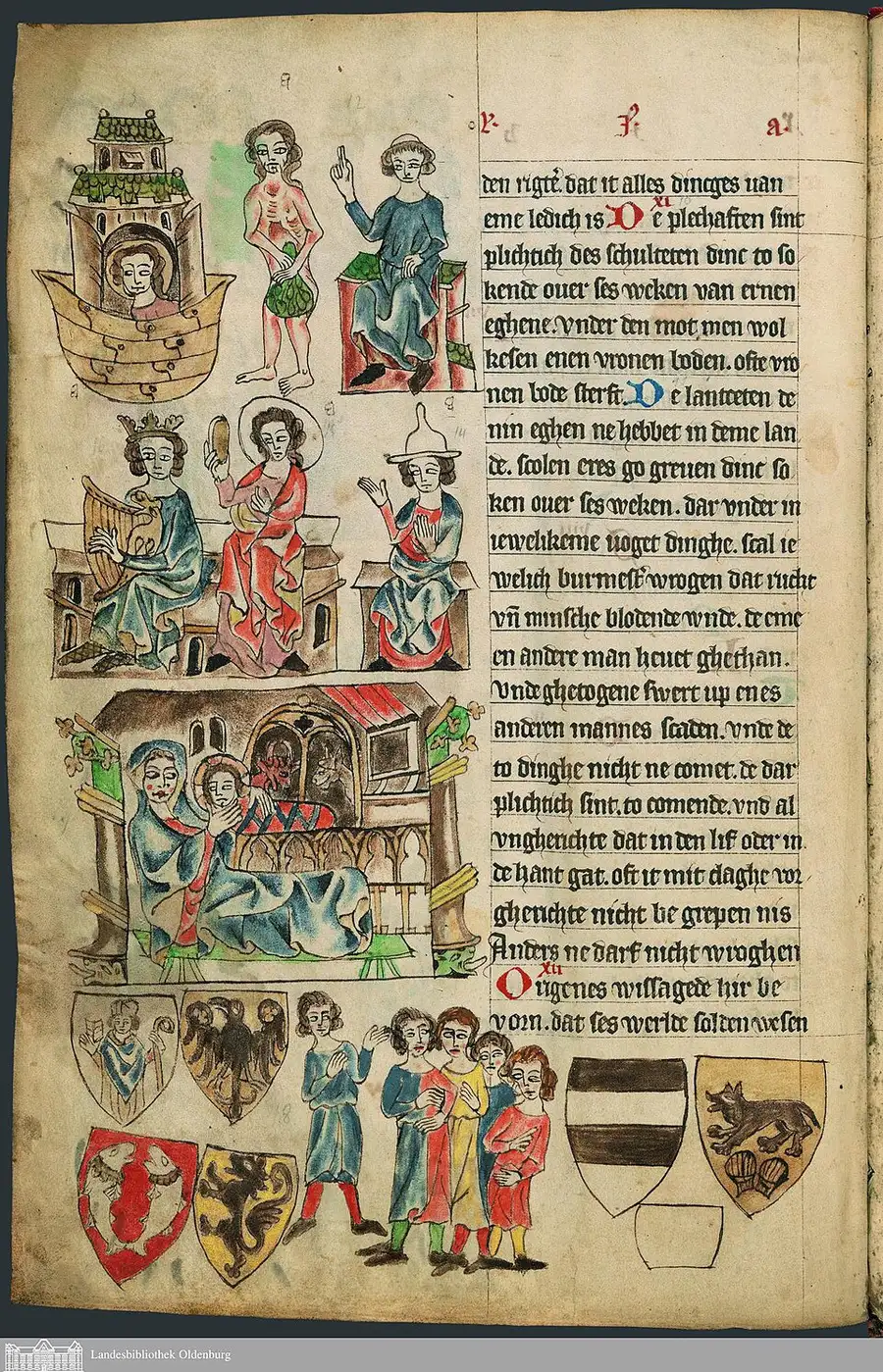 Oldenburger Bilderhandschrift des Sachsenspiegels (1336), Landesbibliothek Oldenburg The Sachsenspiegel, medieval Germany's most influential law book, survives in its classic form written in Middle Low German; this 1336 illuminated page shows the same trading-and-legal vernacular the Bergen Kontor used for its own statutes, ledgers, and correspondence for four centuries. The West Germanic language used as the common trading
vernacular of the Hanseatic League and its merchant network
across northern Europe between roughly the thirteenth and
the sixteenth centuries. Spoken natively across the German
Hansa cities from the Low Countries to the eastern Baltic,
it functioned as a lingua franca in northern European
commerce — comparable in reach and function to medieval
Latin in the church or French in diplomacy. The Hanseatic
Kontor at Bergen conducted all of its internal business and
external correspondence in Middle Low German for nearly four
centuries. The language's substantial loanword contribution
to the Bergen dialect of Norwegian (the bergensk) is the
most durable surviving trace of that long contact.
, run under its own internal statutes called the Schra
Oldenburger Bilderhandschrift des Sachsenspiegels (1336), Landesbibliothek Oldenburg The Sachsenspiegel, medieval Germany's most influential law book, survives in its classic form written in Middle Low German; this 1336 illuminated page shows the same trading-and-legal vernacular the Bergen Kontor used for its own statutes, ledgers, and correspondence for four centuries. The West Germanic language used as the common trading
vernacular of the Hanseatic League and its merchant network
across northern Europe between roughly the thirteenth and
the sixteenth centuries. Spoken natively across the German
Hansa cities from the Low Countries to the eastern Baltic,
it functioned as a lingua franca in northern European
commerce — comparable in reach and function to medieval
Latin in the church or French in diplomacy. The Hanseatic
Kontor at Bergen conducted all of its internal business and
external correspondence in Middle Low German for nearly four
centuries. The language's substantial loanword contribution
to the Bergen dialect of Norwegian (the bergensk) is the
most durable surviving trace of that long contact.
, run under its own internal statutes called the Schra 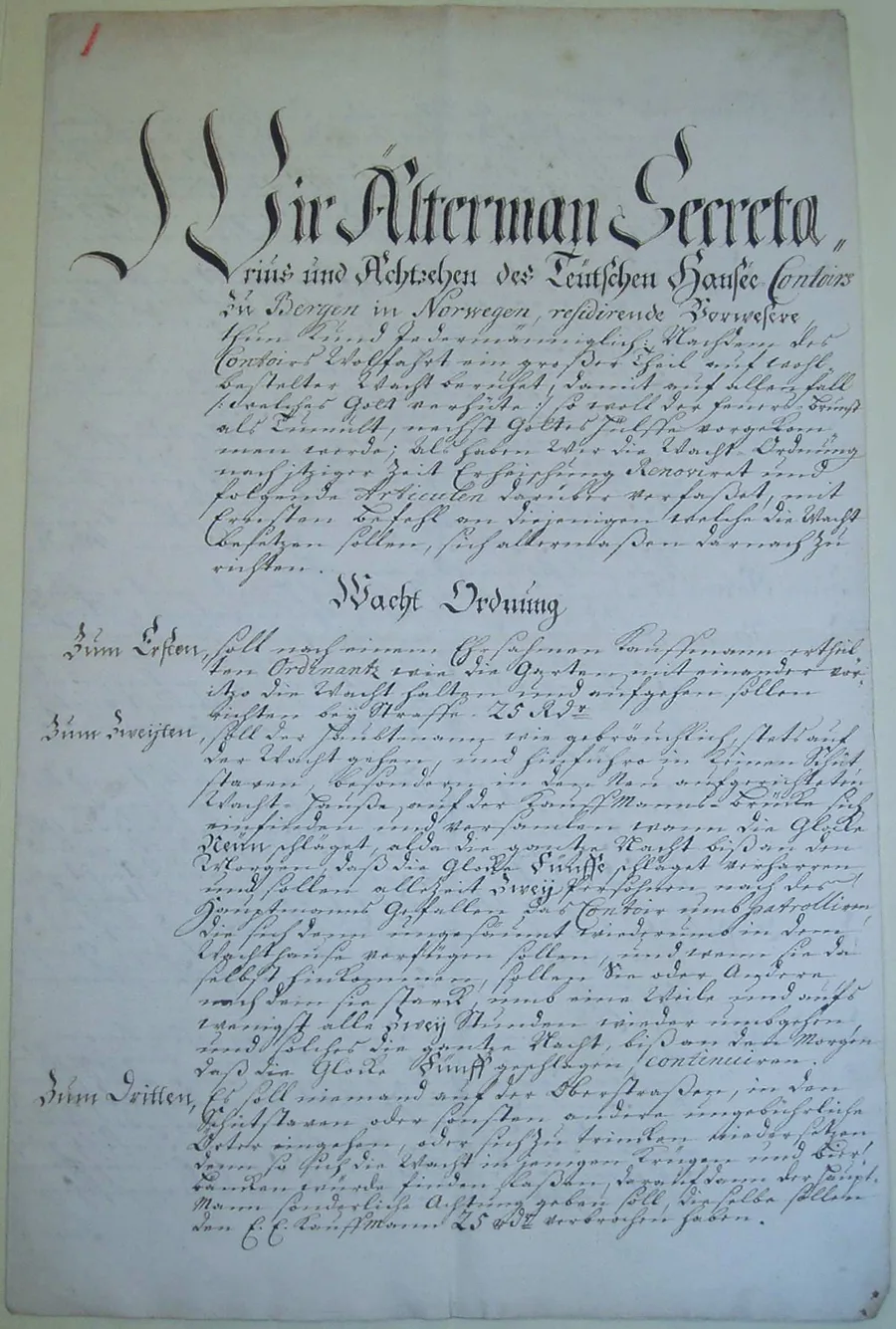 C. W. Höltich, Wacht Ordnung (1704), Bergen City Archives — via Wikimedia Commons No Schra recension has a freely usable scan, so a sibling from the same rulebook tradition stands in: a 1704 watch-ordinance opening "We the Oldermann, Secretary and Eighteen of the German Kontor at Bergen in Norway," laying down the fire-watch discipline the Schra's statutes governed at Bryggen. The internal statutes of the Hanseatic Kontor at Bergen —
the body of commercial and disciplinary rules under which
the German merchant colony at Bryggen ran its internal life.
Written and revised in Middle Low German across the
fourteenth, fifteenth, and sixteenth centuries; the corpus
survives in multiple recensions but has not received a
single modern critical edition. The Schra defined the
marriage ban, the apprenticeship hierarchy, the rules of
fire discipline, the annual election of the Oldermann,
and the Kontor's internal judicial authority over its
members. It was reread aloud to the assembled membership
every year. Cognate Schras governed the other Hanseatic
Kontors at Novgorod, London, and Bruges.
, and built around a single defining rule that forbade its members to marry while in service.
C. W. Höltich, Wacht Ordnung (1704), Bergen City Archives — via Wikimedia Commons No Schra recension has a freely usable scan, so a sibling from the same rulebook tradition stands in: a 1704 watch-ordinance opening "We the Oldermann, Secretary and Eighteen of the German Kontor at Bergen in Norway," laying down the fire-watch discipline the Schra's statutes governed at Bryggen. The internal statutes of the Hanseatic Kontor at Bergen —
the body of commercial and disciplinary rules under which
the German merchant colony at Bryggen ran its internal life.
Written and revised in Middle Low German across the
fourteenth, fifteenth, and sixteenth centuries; the corpus
survives in multiple recensions but has not received a
single modern critical edition. The Schra defined the
marriage ban, the apprenticeship hierarchy, the rules of
fire discipline, the annual election of the Oldermann,
and the Kontor's internal judicial authority over its
members. It was reread aloud to the assembled membership
every year. Cognate Schras governed the other Hanseatic
Kontors at Novgorod, London, and Bruges.
, and built around a single defining rule that forbade its members to marry while in service.
Bergen was not part of the Hanseatic League. Bergen was the trading partner. The Germans inside the wharf at Bryggen 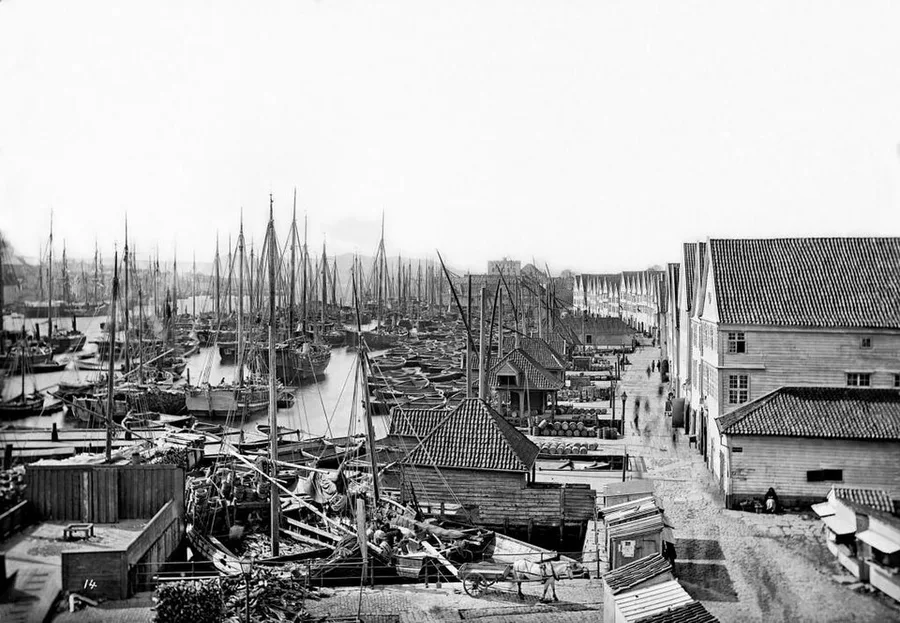 Knud Knudsen, Bryggen in Bergen (1865), University of Bergen Library Knudsen's 1865 photograph shows Bryggen still standing to its post-1702-fire medieval footprint -- the same wharf the Hanseatic kontor traded stockfish out of for four centuries, captured by one of Norway's first professional photographers. The Hanseatic wharf at Bergen — a long row of narrow
gable-fronted wooden warehouses and trading houses lining
the eastern shore of the Vågen harbour. From around 1360
the German Hansa established its Bergen kontor here, and
for nearly four hundred years (until 1754) the buildings
housed German merchants who controlled the export of
Norwegian stockfish to Catholic Europe. The structures
burned and were rebuilt repeatedly to the same medieval
footprint; the surviving wooden buildings (most after the
1702 fire) preserve the medieval urban plan. UNESCO World
Heritage site since 1979 and Bergen's most-visited landmark.
On the trip Day 4 in Bergen lands the Ungdommene (the Youngsters) directly
on the Bryggen waterfront — the wharf the Hanseatic trade in
Norwegian stockfish built and rebuilt for four centuries.
Also discussed in The Golden Age — a North Atlantic empire … reaching farther than you thinkThe Long Fall — the sudden loss of Norwegian nobility, the end of the kings, and half of Norway gone foreverThe 400-Year Night — when the Northern Lion lay dormantAlcohol and Vinmonopolet — when and where to buy a drinkRespecting nature — why you can roam and camp on private landWhat to wear — the layering system, on the ground were, in everything except formal sovereignty, a small German commercial colony on Norwegian soil — running the country’s largest export industry from buildings the colony itself owned, under a body of commercial law its members were sworn to.
Knud Knudsen, Bryggen in Bergen (1865), University of Bergen Library Knudsen's 1865 photograph shows Bryggen still standing to its post-1702-fire medieval footprint -- the same wharf the Hanseatic kontor traded stockfish out of for four centuries, captured by one of Norway's first professional photographers. The Hanseatic wharf at Bergen — a long row of narrow
gable-fronted wooden warehouses and trading houses lining
the eastern shore of the Vågen harbour. From around 1360
the German Hansa established its Bergen kontor here, and
for nearly four hundred years (until 1754) the buildings
housed German merchants who controlled the export of
Norwegian stockfish to Catholic Europe. The structures
burned and were rebuilt repeatedly to the same medieval
footprint; the surviving wooden buildings (most after the
1702 fire) preserve the medieval urban plan. UNESCO World
Heritage site since 1979 and Bergen's most-visited landmark.
On the trip Day 4 in Bergen lands the Ungdommene (the Youngsters) directly
on the Bryggen waterfront — the wharf the Hanseatic trade in
Norwegian stockfish built and rebuilt for four centuries.
Also discussed in The Golden Age — a North Atlantic empire … reaching farther than you thinkThe Long Fall — the sudden loss of Norwegian nobility, the end of the kings, and half of Norway gone foreverThe 400-Year Night — when the Northern Lion lay dormantAlcohol and Vinmonopolet — when and where to buy a drinkRespecting nature — why you can roam and camp on private landWhat to wear — the layering system, on the ground were, in everything except formal sovereignty, a small German commercial colony on Norwegian soil — running the country’s largest export industry from buildings the colony itself owned, under a body of commercial law its members were sworn to.
A trade in dried fish
The Hanseatic merchants came to Bergen for one commodity. Each winter, schools of Atlantic cod migrated southwest from the Barents Sea to spawn in the shallow coastal waters off the Lofoten 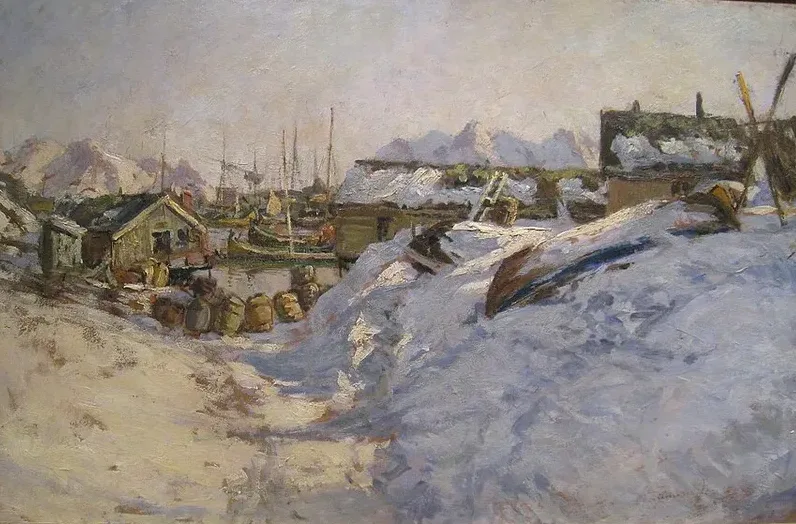 Gunnar Berg, Vinter i Lofoten (before 1893), via Wikimedia Commons Gunnar Berg's winter scene of a Lofoten fishing hamlet, barrels stacked by the boathouses. The archipelago's centuries-old winter cod fishery produced the dried stockfish that Bergen's Hanseatic merchants traded across Europe. Archipelago in Nordland County in northern Norway, lying north of
the Arctic Circle and stretching about a hundred and seventy
kilometres off the mainland coast. Famous for dramatic peaks
rising directly out of the sea, traditional fishing villages built
on stilts (rorbuer), and the centuries-old winter cod-fishing
industry that supplied the dried-stockfish trade Bergen ran during
the Hanseatic era. Site of the reconstructed Viking-Age chieftain's
hall at Borg — the largest known Viking-Age building in Scandinavia.
Lofoten Islands Also discussed in The Viking Age — longships, legends, and the first "Norway"The Golden Age — a North Atlantic empire … reaching farther than you thinkDraugen — the drowned man who never came home archipelago, about six hundred miles north of Bergen by sea, above the Arctic Circle. Norwegian fishermen caught the spawning runs, gutted and split the catch on the wharves, and hung the fish in pairs on wooden drying racks in the polar winter wind. By late spring the cod had become Stockfish
Gunnar Berg, Vinter i Lofoten (before 1893), via Wikimedia Commons Gunnar Berg's winter scene of a Lofoten fishing hamlet, barrels stacked by the boathouses. The archipelago's centuries-old winter cod fishery produced the dried stockfish that Bergen's Hanseatic merchants traded across Europe. Archipelago in Nordland County in northern Norway, lying north of
the Arctic Circle and stretching about a hundred and seventy
kilometres off the mainland coast. Famous for dramatic peaks
rising directly out of the sea, traditional fishing villages built
on stilts (rorbuer), and the centuries-old winter cod-fishing
industry that supplied the dried-stockfish trade Bergen ran during
the Hanseatic era. Site of the reconstructed Viking-Age chieftain's
hall at Borg — the largest known Viking-Age building in Scandinavia.
Lofoten Islands Also discussed in The Viking Age — longships, legends, and the first "Norway"The Golden Age — a North Atlantic empire … reaching farther than you thinkDraugen — the drowned man who never came home archipelago, about six hundred miles north of Bergen by sea, above the Arctic Circle. Norwegian fishermen caught the spawning runs, gutted and split the catch on the wharves, and hung the fish in pairs on wooden drying racks in the polar winter wind. By late spring the cod had become Stockfish 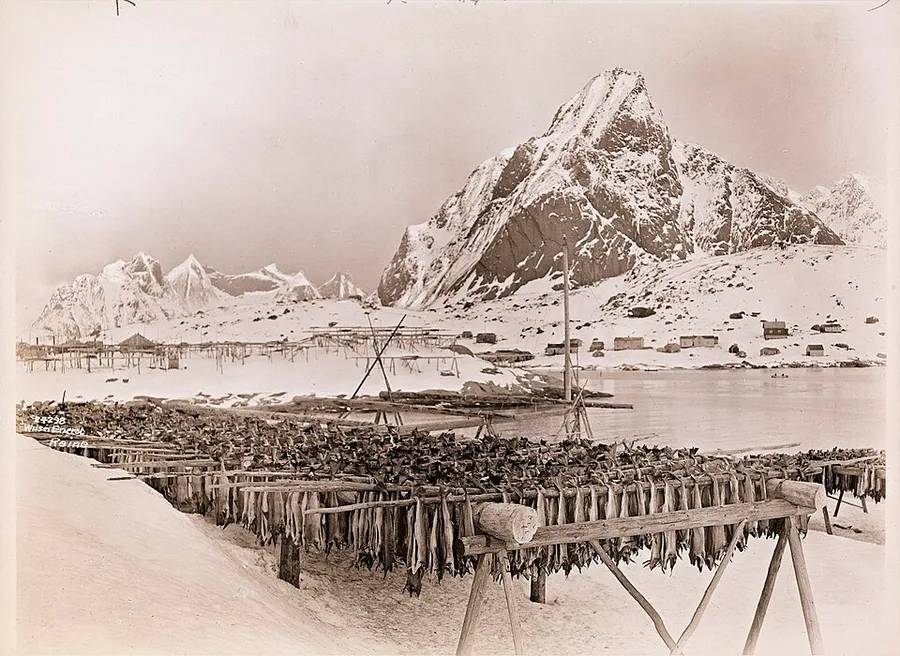 Anders Beer Wilse, Reine, Moskenes (1924), National Library of Norway Wilse's 1924 photograph shows Lofoten hjell racks doing the same job dried Norwegian cod has done since the Middle Ages -- turning the winter catch into the stockfish that built Bergen's Hanseatic trade. Air-dried cod, the principal Norwegian export through the
high and late Middle Ages and the commodity that built
Bergen. Whole gutted cod from the Lofoten winter fishery
are hung on wooden racks (hjell) in the open February
air; in three months the fish loses about three-quarters of
its weight and becomes a hard, lightweight, almost
indefinitely keeping protein source. The Catholic Church's
fast-day rules — meat forbidden on Fridays, during Lent,
and on the vigils of major feasts (roughly a third of the
days of the year) — created a continent-wide market. The Hanseatic
Bergen kontor controlled the export from the fourteenth
century onward. Norwegian stockfish (tørrfisk) is still
produced in Lofoten today.
Also discussed in The Golden Age — a North Atlantic empire … reaching farther than you thinkMat og Drikke — Norwegian food and drink — hard, light, edible for years without salt — and was shipped south to Bergen on the summer sailings, where Hanseatic agents graded and packed it for onward sale.
Anders Beer Wilse, Reine, Moskenes (1924), National Library of Norway Wilse's 1924 photograph shows Lofoten hjell racks doing the same job dried Norwegian cod has done since the Middle Ages -- turning the winter catch into the stockfish that built Bergen's Hanseatic trade. Air-dried cod, the principal Norwegian export through the
high and late Middle Ages and the commodity that built
Bergen. Whole gutted cod from the Lofoten winter fishery
are hung on wooden racks (hjell) in the open February
air; in three months the fish loses about three-quarters of
its weight and becomes a hard, lightweight, almost
indefinitely keeping protein source. The Catholic Church's
fast-day rules — meat forbidden on Fridays, during Lent,
and on the vigils of major feasts (roughly a third of the
days of the year) — created a continent-wide market. The Hanseatic
Bergen kontor controlled the export from the fourteenth
century onward. Norwegian stockfish (tørrfisk) is still
produced in Lofoten today.
Also discussed in The Golden Age — a North Atlantic empire … reaching farther than you thinkMat og Drikke — Norwegian food and drink — hard, light, edible for years without salt — and was shipped south to Bergen on the summer sailings, where Hanseatic agents graded and packed it for onward sale.
The trade answered a defining problem of medieval European diet. Latin Christendom’s calendar banned meat on Fridays, through the forty days of Lent, on the eves of major feast days, and on a long list of other fast days totalling roughly a third of the year. Cathedral chapters, monasteries, and urban households across northern and central Europe needed cheap durable protein they could store and ship over long distances. Norwegian stockfish answered the demand at scale. Through the high and late Middle Ages it was, by the reconstructions modern historians make from the Bergen customs records, more than eighty per cent of Norway’s exports by value.
The Bergen Kontor controlled the trade with a tightness that approached monopoly — a monopoly granted under royal charter and renewable at the Norwegian crown’s pleasure, in exchange for a share of the proceeds in customs duties. Norwegian fishermen sold to the Hanseatic agents on terms the agents set. The agents handled every onward stage of the trade — packaging, shipping, sale in the Baltic and southern North Sea ports — and the Norwegian crown collected its customs revenue without ever directly participating in the commerce. By the late fourteenth century the system was moving between two and three thousand tons of dried cod a year, a substantial share of the Lenten protein consumed in the cathedral towns of northern Europe. By the late fifteenth century the volume had roughly doubled.
The League and the Kontor
The Hanseatic League was not a state. It was a confederation of north German trading cities, headquartered at Lübeck 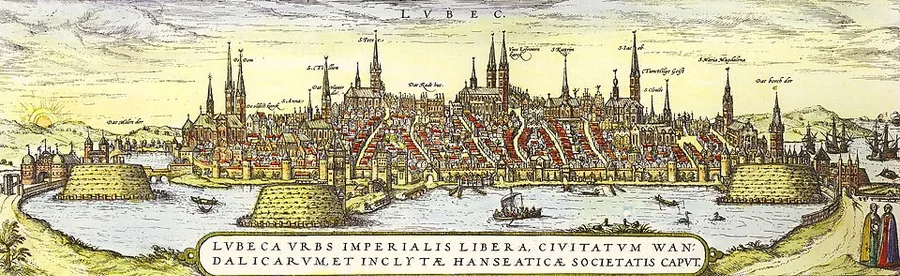 Georg Braun & Frans Hogenberg, Lübeck, Civitates Orbis Terrarum (16th c.) The 'Queen of the Hansa' ran the Bergen kontor at Bryggen and controlled the stockfish trade that linked Norway to Catholic Europe's fast-day economy — this engraved panorama shows the Trave-river capital from which that trade was directed. North German port city on the Baltic, founded in 1143 and
granted imperial-free-city status in 1226. Capital of the
Hanseatic League, the merchant confederation that dominated
northern European trade from the thirteenth through the
fifteenth centuries. From Lübeck the Hansa established its
great trading kontor at Bergen — the Bryggen wharf — and
controlled the stockfish export trade that linked Norway
to the Catholic fast-day economy of Europe. The "Queen of
the Hansa." Lübeck's medieval old town, dominated by the
twin spires of the Marienkirche, is a UNESCO World Heritage
site.
Also discussed in The Golden Age — a North Atlantic empire … reaching farther than you think (in modern-day northern Germany) on the southern Baltic, that had emerged in the twelfth and thirteenth centuries to protect long-distance commerce and to present a common bargaining front to outside powers. At its medieval peak the League included around seventy active member cities and a wider penumbra of associated ports. It had no army, no parliament, no permanent constitution. Its instruments were a shared body of merchant law, a common Middle Low German trading vernacular, and the collective political weight of cities that, taken separately, would have been bullied by larger powers.
Georg Braun & Frans Hogenberg, Lübeck, Civitates Orbis Terrarum (16th c.) The 'Queen of the Hansa' ran the Bergen kontor at Bryggen and controlled the stockfish trade that linked Norway to Catholic Europe's fast-day economy — this engraved panorama shows the Trave-river capital from which that trade was directed. North German port city on the Baltic, founded in 1143 and
granted imperial-free-city status in 1226. Capital of the
Hanseatic League, the merchant confederation that dominated
northern European trade from the thirteenth through the
fifteenth centuries. From Lübeck the Hansa established its
great trading kontor at Bergen — the Bryggen wharf — and
controlled the stockfish export trade that linked Norway
to the Catholic fast-day economy of Europe. The "Queen of
the Hansa." Lübeck's medieval old town, dominated by the
twin spires of the Marienkirche, is a UNESCO World Heritage
site.
Also discussed in The Golden Age — a North Atlantic empire … reaching farther than you think (in modern-day northern Germany) on the southern Baltic, that had emerged in the twelfth and thirteenth centuries to protect long-distance commerce and to present a common bargaining front to outside powers. At its medieval peak the League included around seventy active member cities and a wider penumbra of associated ports. It had no army, no parliament, no permanent constitution. Its instruments were a shared body of merchant law, a common Middle Low German trading vernacular, and the collective political weight of cities that, taken separately, would have been bullied by larger powers.
To conduct business outside member territory the League operated four major foreign trading posts — the Kontore — at Novgorod 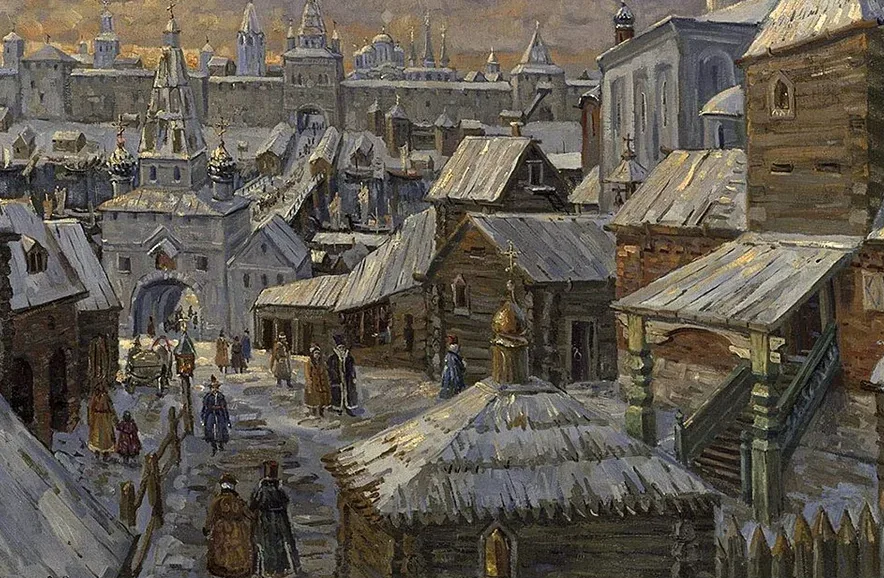 Apollinary Vasnetsov, Medieval Novgorod in Winter (1909) Apollinary Vasnetsov's painted reconstruction of medieval Novgorod in winter — the walled trading city whose Peterhof was the Hanseatic League's oldest Kontor, the eastern sister post of the Kontor at Bergen. City on the Volkhov River in northwestern Russia, traditionally
founded by the Norse Rūs warlord Rurik around 862 as part of the
Varangian river-trade network. With Kiev to the south, one of the
two principal centres of the Kievan Rus state that emerged from the
Norse trading towns. The chronicle tradition that traces the
Russian state to a Norse founding (the "Varangian thesis") is
contested in modern Russian historiography but supported by both
archaeology and the linguistic record.
In this article The Hanseatic League's oldest Kontor, the Peterhof, stood at
Novgorod — the eastern end of the four great trading posts
whose western counterpart was the Kontor at Bergen. Through
the Peterhof the League drew furs and wax out of the Russian
river trade, as it drew stockfish out of Bryggen.
Also discussed in The Viking Age — longships, legends, and the first "Norway"The King Who Became a Saint — how the Nordmen came to Christ (in modern-day Russia), London (Hanseatic Kontor)
Apollinary Vasnetsov, Medieval Novgorod in Winter (1909) Apollinary Vasnetsov's painted reconstruction of medieval Novgorod in winter — the walled trading city whose Peterhof was the Hanseatic League's oldest Kontor, the eastern sister post of the Kontor at Bergen. City on the Volkhov River in northwestern Russia, traditionally
founded by the Norse Rūs warlord Rurik around 862 as part of the
Varangian river-trade network. With Kiev to the south, one of the
two principal centres of the Kievan Rus state that emerged from the
Norse trading towns. The chronicle tradition that traces the
Russian state to a Norse founding (the "Varangian thesis") is
contested in modern Russian historiography but supported by both
archaeology and the linguistic record.
In this article The Hanseatic League's oldest Kontor, the Peterhof, stood at
Novgorod — the eastern end of the four great trading posts
whose western counterpart was the Kontor at Bergen. Through
the Peterhof the League drew furs and wax out of the Russian
river trade, as it drew stockfish out of Bryggen.
Also discussed in The Viking Age — longships, legends, and the first "Norway"The King Who Became a Saint — how the Nordmen came to Christ (in modern-day Russia), London (Hanseatic Kontor) 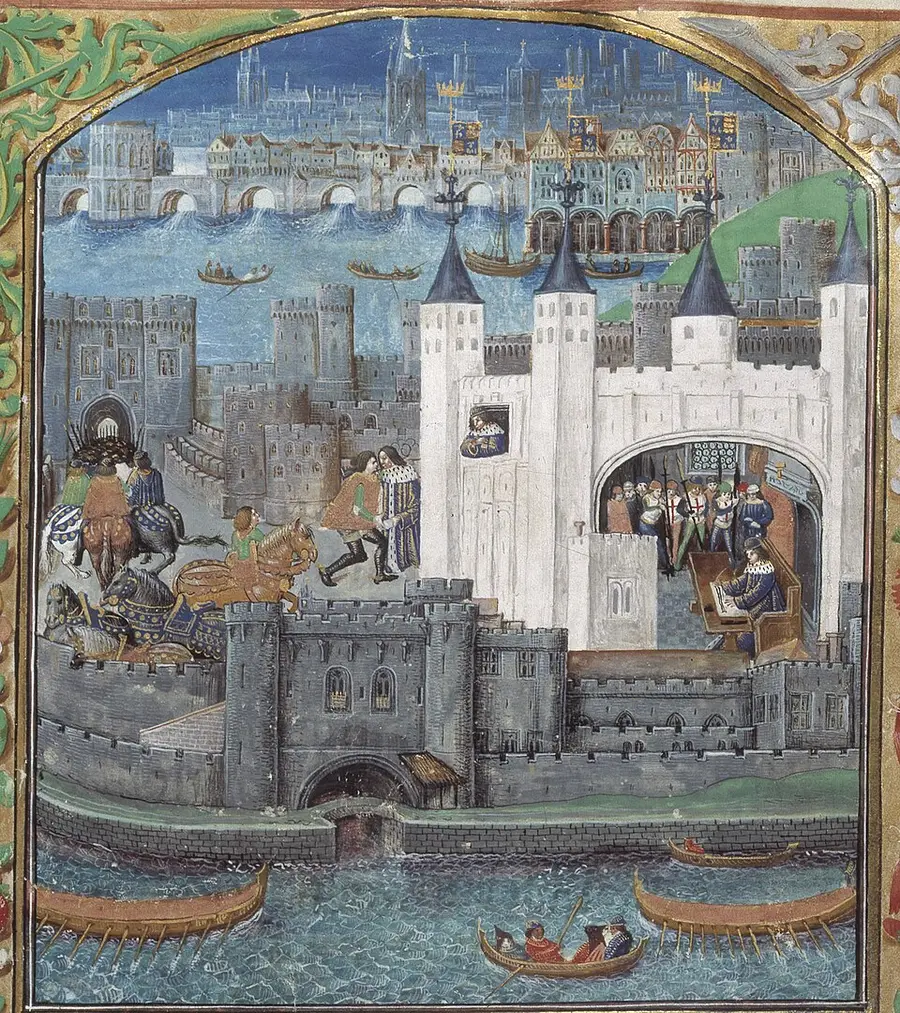 Unknown illuminator, British Library Royal MS 16 F. ii, f. 73 (c. 1483), public domain This famous manuscript miniature is the standard shorthand for medieval London — the Tower and Old London Bridge as a fifteenth-century eye drew them — standing in for the vanished Steelyard on the Thames, where London’s Hanseatic Kontor traded in Middle Low German, just as Bergen’s did on its wharf. London — capital of medieval and modern England — held one
of the four major Hanseatic Kontors, the Steelyard
(Stalhof), on the north bank of the Thames between
Cosin Lane and All Hallows Lane in the City. The Steelyard
was the London branch of the Hansa from the late thirteenth
century until the merchant privileges were withdrawn by
Queen Elizabeth I in 1598. Like its sister Kontor at Bergen,
the Steelyard was a walled enclave governed under its own
internal statutes and conducting its business in Middle Low
German. The buildings were largely cleared in the nineteenth
century to make way for Cannon Street Railway Station; only
the Steelyard's church of All Hallows the Great survived
briefly before its own demolition in 1894.
, Bruges
Unknown illuminator, British Library Royal MS 16 F. ii, f. 73 (c. 1483), public domain This famous manuscript miniature is the standard shorthand for medieval London — the Tower and Old London Bridge as a fifteenth-century eye drew them — standing in for the vanished Steelyard on the Thames, where London’s Hanseatic Kontor traded in Middle Low German, just as Bergen’s did on its wharf. London — capital of medieval and modern England — held one
of the four major Hanseatic Kontors, the Steelyard
(Stalhof), on the north bank of the Thames between
Cosin Lane and All Hallows Lane in the City. The Steelyard
was the London branch of the Hansa from the late thirteenth
century until the merchant privileges were withdrawn by
Queen Elizabeth I in 1598. Like its sister Kontor at Bergen,
the Steelyard was a walled enclave governed under its own
internal statutes and conducting its business in Middle Low
German. The buildings were largely cleared in the nineteenth
century to make way for Cannon Street Railway Station; only
the Steelyard's church of All Hallows the Great survived
briefly before its own demolition in 1894.
, Bruges 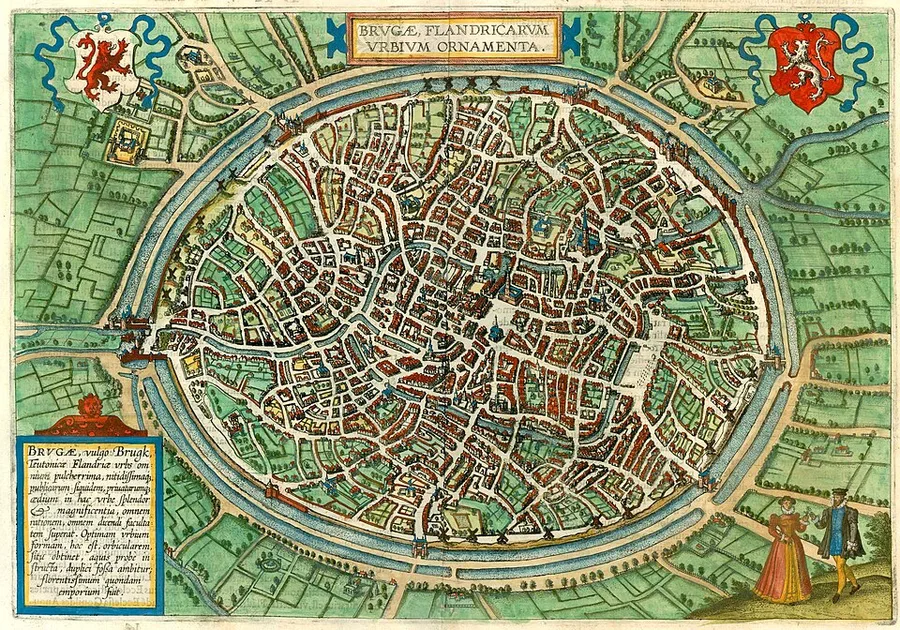 Georg Braun & Frans Hogenberg, Bruges, Civitates Orbis Terrarum (1st ed. 1572, this print 1635) Bruges was the Hanseatic terminal where Norwegian stockfish reached the Catholic fast-day markets of continental Europe -- this engraved view shows the canals and church towers of the trading city that anchored the Bergen fish trade's western end. Medieval Flemish port city, today the capital of West Flanders
in modern Belgium. One of the leading commercial centres of
northern Europe through the high and late Middle Ages — the
pre-eminent northern outpost of the international Italian
banking houses and one of the principal terminals of the
Hanseatic trade. The Bergen stockfish trade reached Bruges
through the Hanseatic merchant networks, and the city was the
main market through which Norwegian dried cod entered the
Catholic European fast-day economy. Modern Bruges preserves
its medieval centre largely intact and is a UNESCO World
Heritage site.
Also discussed in The Golden Age — a North Atlantic empire … reaching farther than you think (in modern-day Belgium), and Bergen. The Bergen office took shape around 1360 as the formal consolidation of more than a century of progressive German trade presence in the city, on the basis of charters granted by successive Norwegian kings: the foundational 1250 treaty between Hákon IV Hákonarson
Georg Braun & Frans Hogenberg, Bruges, Civitates Orbis Terrarum (1st ed. 1572, this print 1635) Bruges was the Hanseatic terminal where Norwegian stockfish reached the Catholic fast-day markets of continental Europe -- this engraved view shows the canals and church towers of the trading city that anchored the Bergen fish trade's western end. Medieval Flemish port city, today the capital of West Flanders
in modern Belgium. One of the leading commercial centres of
northern Europe through the high and late Middle Ages — the
pre-eminent northern outpost of the international Italian
banking houses and one of the principal terminals of the
Hanseatic trade. The Bergen stockfish trade reached Bruges
through the Hanseatic merchant networks, and the city was the
main market through which Norwegian dried cod entered the
Catholic European fast-day economy. Modern Bruges preserves
its medieval centre largely intact and is a UNESCO World
Heritage site.
Also discussed in The Golden Age — a North Atlantic empire … reaching farther than you think (in modern-day Belgium), and Bergen. The Bergen office took shape around 1360 as the formal consolidation of more than a century of progressive German trade presence in the city, on the basis of charters granted by successive Norwegian kings: the foundational 1250 treaty between Hákon IV Hákonarson 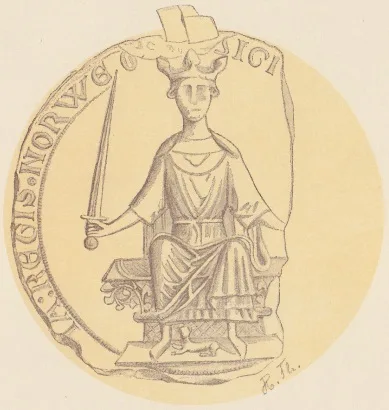 Drawing by Hakon Thorsen after the 1247/48 seal of Håkon IV, in Chr. Brinchmann, Norske Konge-sigiller (1924) The great seal Håkon IV affixed to royal charters — a crowned king enthroned with a sword, the authority behind the "Golden Age" reign that brought Iceland under the Norwegian crown and produced the Konungs skuggsjá. King of Norway 1217–1263, bynamed Hákon the Old in later
tradition. His reign opened the Golden Age of medieval Norway —
the country's last sustained period as an independent international
power before the dynastic absorption into Denmark a century later.
Brought the long civil war period to an end, extended Norwegian
sovereignty to Iceland (which acknowledged him as king in 1262)
and the Hebrides and Isle of Man, codified Norwegian law, and
presided over the literary court that produced the Konungs
skuggsjá (The King's Mirror) around 1250. Died on Orkney in
December 1263 returning from his unsuccessful Scottish campaign.
Also discussed in A Catholic Norway — the faith that gave the kingdom its first institutions and the stave churchesThe Golden Age — a North Atlantic empire … reaching farther than you thinkThe Long Fall — the sudden loss of Norwegian nobility, the end of the kings, and half of Norway gone forever and Lübeck, the 1278 grant from Magnus VI Lagabøte
Drawing by Hakon Thorsen after the 1247/48 seal of Håkon IV, in Chr. Brinchmann, Norske Konge-sigiller (1924) The great seal Håkon IV affixed to royal charters — a crowned king enthroned with a sword, the authority behind the "Golden Age" reign that brought Iceland under the Norwegian crown and produced the Konungs skuggsjá. King of Norway 1217–1263, bynamed Hákon the Old in later
tradition. His reign opened the Golden Age of medieval Norway —
the country's last sustained period as an independent international
power before the dynastic absorption into Denmark a century later.
Brought the long civil war period to an end, extended Norwegian
sovereignty to Iceland (which acknowledged him as king in 1262)
and the Hebrides and Isle of Man, codified Norwegian law, and
presided over the literary court that produced the Konungs
skuggsjá (The King's Mirror) around 1250. Died on Orkney in
December 1263 returning from his unsuccessful Scottish campaign.
Also discussed in A Catholic Norway — the faith that gave the kingdom its first institutions and the stave churchesThe Golden Age — a North Atlantic empire … reaching farther than you thinkThe Long Fall — the sudden loss of Norwegian nobility, the end of the kings, and half of Norway gone forever and Lübeck, the 1278 grant from Magnus VI Lagabøte 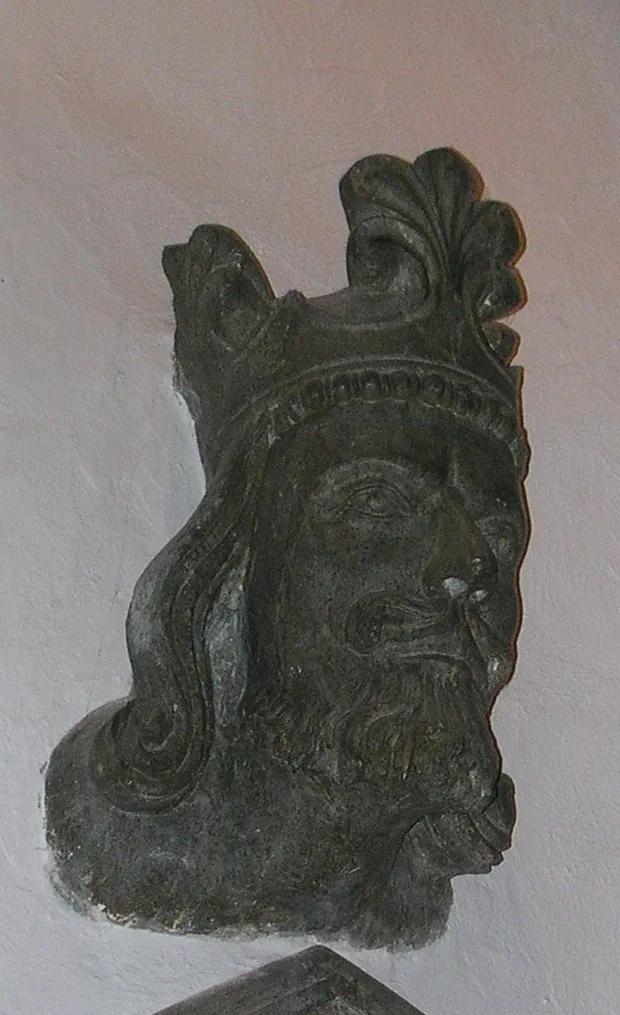 Stone head of Magnus VI Lagabøte (13th c.), Stavanger Cathedral; photo: Gunleiv Hadland (CC BY-SA 3.0) A crowned stone head carved in Stavanger Cathedral within living memory of the king — the nearest thing to a likeness of Magnus VI, the 'Law-mender' whose 1274 national code held as Norway's law for more than four hundred years. King of Norway 1263-1280, bynamed Lagabøte ("Law-mender") in
recognition of his promulgation in 1274 of the Landslov, the
Code of National Law that unified the four regional thing-law
traditions (Gulating, Frostating, Borgarting, Eidsivating) into
a single national code. The Landslov remained the law of Norway
for more than four hundred years and made Norway one of the first
European kingdoms with a unified national legal code.
Also discussed in Before There Was Norway — petty kingdoms at the edge of the worldThe Golden Age — a North Atlantic empire … reaching farther than you thinkThe Long Fall — the sudden loss of Norwegian nobility, the end of the kings, and half of Norway gone foreverThe 400-Year Night — when the Northern Lion lay dormantAllemannsretten — the right to roam that gave Hanseatic merchants in Bergen broad trading privileges, and the 1294 renewal under Eirik II Magnusson
Stone head of Magnus VI Lagabøte (13th c.), Stavanger Cathedral; photo: Gunleiv Hadland (CC BY-SA 3.0) A crowned stone head carved in Stavanger Cathedral within living memory of the king — the nearest thing to a likeness of Magnus VI, the 'Law-mender' whose 1274 national code held as Norway's law for more than four hundred years. King of Norway 1263-1280, bynamed Lagabøte ("Law-mender") in
recognition of his promulgation in 1274 of the Landslov, the
Code of National Law that unified the four regional thing-law
traditions (Gulating, Frostating, Borgarting, Eidsivating) into
a single national code. The Landslov remained the law of Norway
for more than four hundred years and made Norway one of the first
European kingdoms with a unified national legal code.
Also discussed in Before There Was Norway — petty kingdoms at the edge of the worldThe Golden Age — a North Atlantic empire … reaching farther than you thinkThe Long Fall — the sudden loss of Norwegian nobility, the end of the kings, and half of Norway gone foreverThe 400-Year Night — when the Northern Lion lay dormantAllemannsretten — the right to roam that gave Hanseatic merchants in Bergen broad trading privileges, and the 1294 renewal under Eirik II Magnusson 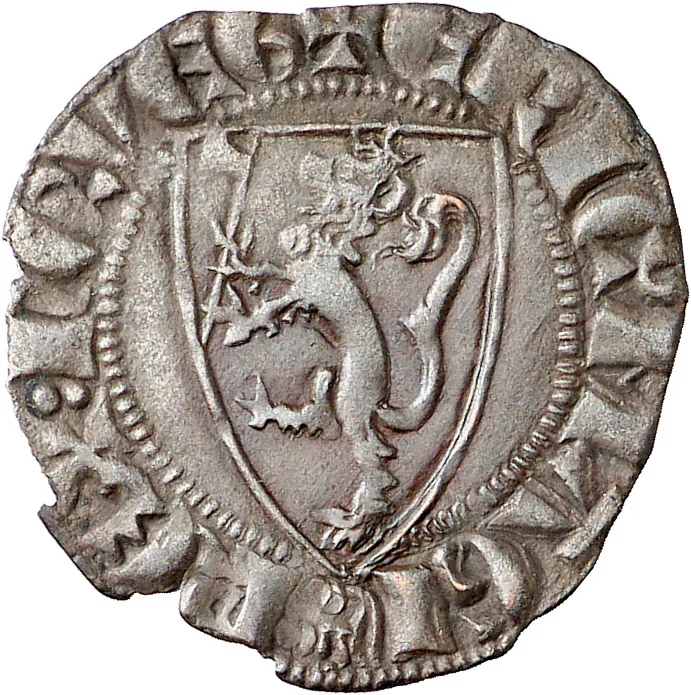 Photo: Lutz-Jürgen Lübke, Münzkabinett, Staatliche Museen zu Berlin — CC0 Struck in Bergen during Eirik's reign, this silver penning carries the Norwegian lion-and-axe and the same royal titulature that authorized the 1294 renewal of Hanseatic trading privileges at the wharf his coin was minted beside. King of Norway (1268–1299), elder son of Magnus VI Lagabøte
and Ingeborg of Denmark. Acclaimed king at twelve on his
father's death in 1280; ruled under a council of regents
through his minority. His reign saw the consolidation of
Hanseatic commercial power at Bergen — the 1294 renewal of
the German privileges granted by Magnus Lagabøte in 1278.
Married Margaret of Scotland in 1281; their only daughter,
the Maid of Norway, was heir presumptive to the Scottish
throne before her death at seven in 1290 in Orkney during
the voyage to Scotland. Died without a male heir; succeeded
by his younger brother Hákon V.
. The Kontor occupied a defined footprint at the Bryggen wharf, ran under its own Schra, elected its own leadership annually, and held judicial authority over its own members in matters internal to the colony. Of the four Kontors, Bergen’s would outlast all the others.
Photo: Lutz-Jürgen Lübke, Münzkabinett, Staatliche Museen zu Berlin — CC0 Struck in Bergen during Eirik's reign, this silver penning carries the Norwegian lion-and-axe and the same royal titulature that authorized the 1294 renewal of Hanseatic trading privileges at the wharf his coin was minted beside. King of Norway (1268–1299), elder son of Magnus VI Lagabøte
and Ingeborg of Denmark. Acclaimed king at twelve on his
father's death in 1280; ruled under a council of regents
through his minority. His reign saw the consolidation of
Hanseatic commercial power at Bergen — the 1294 renewal of
the German privileges granted by Magnus Lagabøte in 1278.
Married Margaret of Scotland in 1281; their only daughter,
the Maid of Norway, was heir presumptive to the Scottish
throne before her death at seven in 1290 in Orkney during
the voyage to Scotland. Died without a male heir; succeeded
by his younger brother Hákon V.
. The Kontor occupied a defined footprint at the Bryggen wharf, ran under its own Schra, elected its own leadership annually, and held judicial authority over its own members in matters internal to the colony. Of the four Kontors, Bergen’s would outlast all the others.
Life inside the Kontor
Membership in the Kontor was restricted to unmarried German men. New apprentices — Lehrlinge — entered around the age of fourteen, escorted by senior merchants from their home cities. They worked their way up through journeyman (Geselle) to full merchant under a strict hierarchy that ended with the annually elected Oldermann 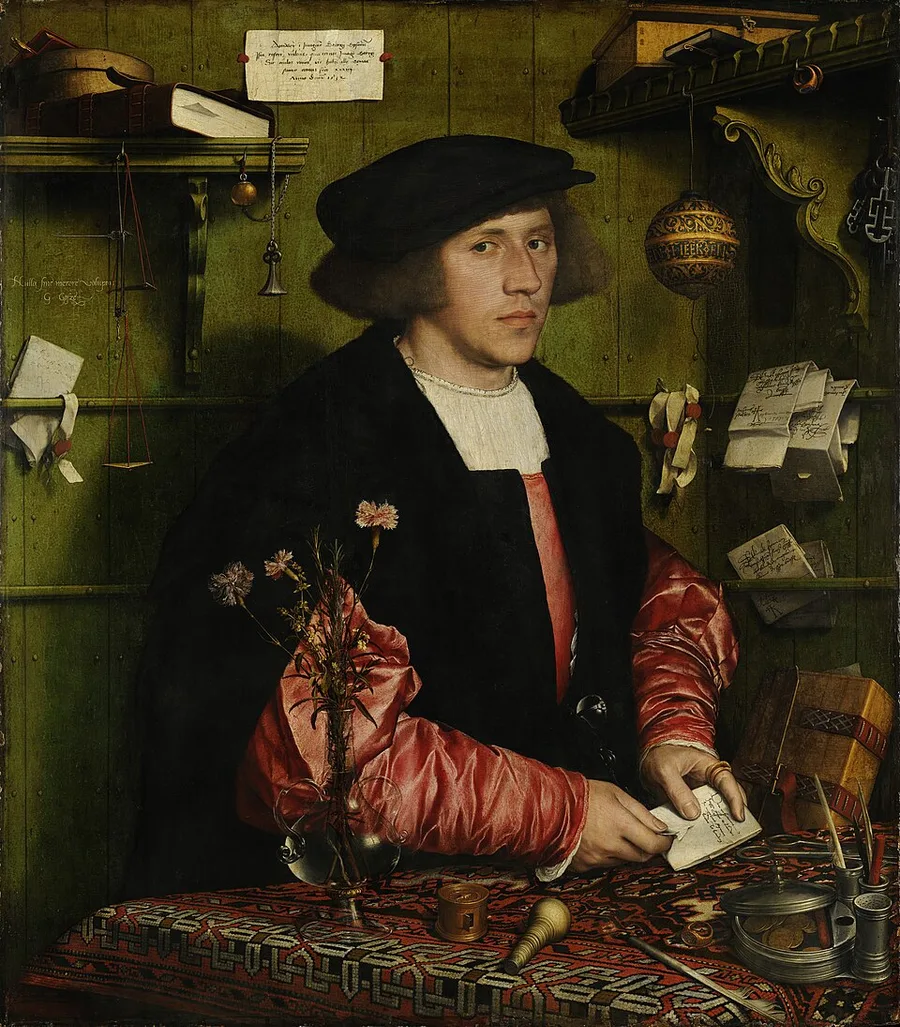 Hans Holbein the Younger, The Merchant Georg Gisze (1532), Gemäldegalerie Berlin Holbein’s 1532 portrait shows Georg Gisze, a Danzig merchant of the Hanseatic Steelyard in London, among the ledgers, scales, and seals of daily Kontor business — a stand-in for the merchant type from which each Bergen Kontor elected its annual Oldermann, not a portrait of any named Bergen alderman. The annually elected head of the Hanseatic Kontor at Bergen.
The Oldermann held internal disciplinary authority over the
Kontor's membership, presided over the colony's judicial
proceedings in matters internal to the wharf, and
represented the Kontor in dealings with the Norwegian crown
and the Bergenhus governor. The office was elected each
year from among the full merchants in residence. Cognate
Oldermann offices governed the other major Hanseatic
Kontors at Novgorod, London, and Bruges. The last German
Kontor Oldermann at Bergen signed the 1754 papers
transferring the buildings, trade rights, and residual
capital to the Norwegian successor association Det Norske
Kontor.
, who held authority over internal disciplinary matters and represented the Kontor to the Norwegian crown. The members slept in wooden bunks in buildings owned by their home cities, worked from offices in the front rooms of the same buildings, stored stockfish and grain in the warehouse sections in the middle, kept the kitchens and the stone-vaulted fireproof cellars at the rear, and conducted every transaction in Middle Low German.
Hans Holbein the Younger, The Merchant Georg Gisze (1532), Gemäldegalerie Berlin Holbein’s 1532 portrait shows Georg Gisze, a Danzig merchant of the Hanseatic Steelyard in London, among the ledgers, scales, and seals of daily Kontor business — a stand-in for the merchant type from which each Bergen Kontor elected its annual Oldermann, not a portrait of any named Bergen alderman. The annually elected head of the Hanseatic Kontor at Bergen.
The Oldermann held internal disciplinary authority over the
Kontor's membership, presided over the colony's judicial
proceedings in matters internal to the wharf, and
represented the Kontor in dealings with the Norwegian crown
and the Bergenhus governor. The office was elected each
year from among the full merchants in residence. Cognate
Oldermann offices governed the other major Hanseatic
Kontors at Novgorod, London, and Bruges. The last German
Kontor Oldermann at Bergen signed the 1754 papers
transferring the buildings, trade rights, and residual
capital to the Norwegian successor association Det Norske
Kontor.
, who held authority over internal disciplinary matters and represented the Kontor to the Norwegian crown. The members slept in wooden bunks in buildings owned by their home cities, worked from offices in the front rooms of the same buildings, stored stockfish and grain in the warehouse sections in the middle, kept the kitchens and the stone-vaulted fireproof cellars at the rear, and conducted every transaction in Middle Low German.
The marriage ban was the institution’s defining feature. The popular shorthand calls it a celibacy rule, but the rule was not a vow of chastity; it was a commercial discipline against local household formation. A Kontor merchant could not marry a Norwegian woman without forfeiting his Hanseatic employment, his lodging at Bryggen, and his access to the trade network. The Hanseatic head cities did not want their merchants forming Norwegian families, acquiring Norwegian property rights, and dissolving the boundary between the German colony and the city around it. The rule was written into the Schra and reread aloud to the membership every year. A man could spend his entire working life inside the Kontor — apprenticed at fourteen, retired at sixty — without ever marrying or holding property in either Norway or the German cities his employer answered to. Plenty of men did leave the Kontor when they wanted to marry, settled in Bergen, and went on to raise Norwegian families that kept the German names of their parents for two and three generations. But to remain inside the wharf was to remain unmarried.
At the Kontor’s fifteenth-century peak, the wharf district held perhaps one to two thousand men during the summer trading season — apprentices, journeymen, merchants, servants, and seasonal labour together. The merchants proper at any given moment numbered in the high hundreds. The whole population lived inside a physical footprint scarcely larger than a few city blocks.
The wharf that kept burning
The Bryggen wharf was the most heavily concentrated wooden urban district in northern Europe. The buildings stood in two parallel rows of long gable-end houses turned toward the harbour, painted in the iron-red ochre and yellow that the surviving facades still carry today. The narrow alleys between the rows were only wide enough for a man with a barrow to pass. The houses were deep — three or four stories tall, with internal courtyards and connecting passages — and the whole complex at its medieval peak ran to roughly eighty separate buildings.
The fire risk was constant. Wooden construction, dry stockfish stacked in the warehouses, and open hearths in any space where flames were allowed made the whole wharf a single mass of kindling that needed only one spark. The Kontor’s response was a strict internal fire discipline: open flames were banned in the residence buildings themselves. The bachelors cooked and ate their daily meals not in their lodgings but in separate fire-safe stone-and-timber assembly halls built behind the wharf, called the Schøtstuene 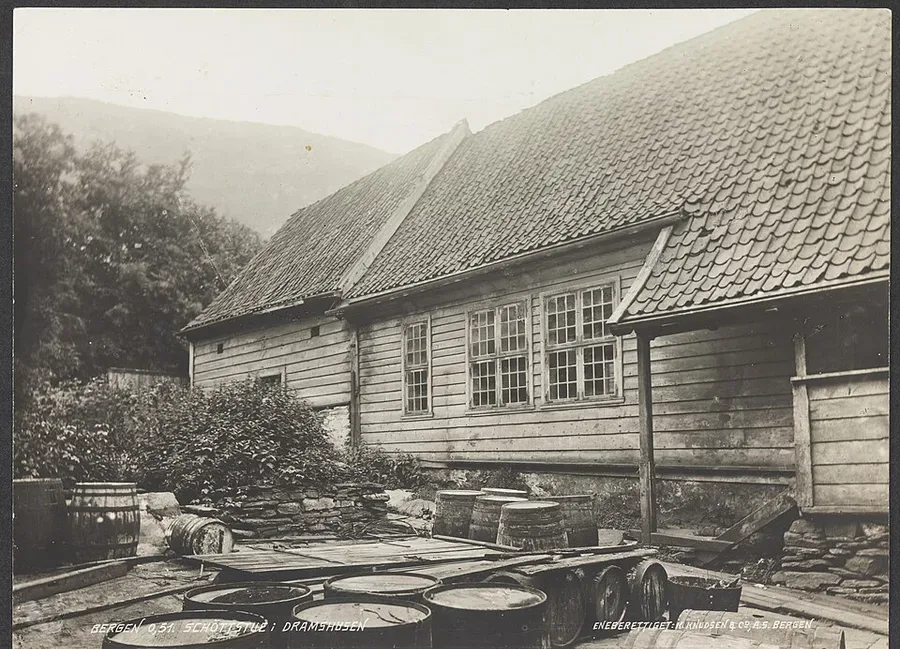 Knud Knudsen, Schøttstue i Dramshusen (1864-1889), National Library of Norway This Knud Knudsen photograph, captioned 'Bergen 0.51. Schötstue i Dramshusen,' shows one of the Schøtstuene assembly halls behind Bryggen where the Kontor's bachelor merchants took their daily meals away from the fire-banned warehouses. The assembly halls of the Hanseatic Kontor at Bergen, built
behind the Bryggen wharf as the only place in the entire
Kontor footprint where open hearths were allowed. Because
the wooden warehouse-residences at Bryggen carried a strict
fire ban on hearths, the bachelor merchants took their daily
meals communally in the Schøtstuene — long stone-and-timber
halls with kitchens, fireplaces, and ranges of trestle
tables. Each home city's Kontor merchants ate in its own
hall. Several of the medieval halls were destroyed in the
great fire of 1702 and rebuilt; the surviving complex behind
Bryggen, restored across the twentieth century, is a museum
of the bachelor Kontor's daily domestic life.
On the trip Day 4 in Bergen lands the Ungdommene (the Youngsters) within
a short walk of the Schøtstuene, behind Bryggen — the
surviving Hanseatic assembly halls where the bachelor
merchants took their daily meals away from the fire-banned
warehouses.
, where the only permitted hearths in the whole district burned. The discipline did not prevent the fires; it slowed them down.
Knud Knudsen, Schøttstue i Dramshusen (1864-1889), National Library of Norway This Knud Knudsen photograph, captioned 'Bergen 0.51. Schötstue i Dramshusen,' shows one of the Schøtstuene assembly halls behind Bryggen where the Kontor's bachelor merchants took their daily meals away from the fire-banned warehouses. The assembly halls of the Hanseatic Kontor at Bergen, built
behind the Bryggen wharf as the only place in the entire
Kontor footprint where open hearths were allowed. Because
the wooden warehouse-residences at Bryggen carried a strict
fire ban on hearths, the bachelor merchants took their daily
meals communally in the Schøtstuene — long stone-and-timber
halls with kitchens, fireplaces, and ranges of trestle
tables. Each home city's Kontor merchants ate in its own
hall. Several of the medieval halls were destroyed in the
great fire of 1702 and rebuilt; the surviving complex behind
Bryggen, restored across the twentieth century, is a museum
of the bachelor Kontor's daily domestic life.
On the trip Day 4 in Bergen lands the Ungdommene (the Youngsters) within
a short walk of the Schøtstuene, behind Bryggen — the
surviving Hanseatic assembly halls where the bachelor
merchants took their daily meals away from the fire-banned
warehouses.
, where the only permitted hearths in the whole district burned. The discipline did not prevent the fires; it slowed them down.
Major burnings ran through the centuries. Some — 1170, 1198, 1248, 1413, 1476, 1623, 1675, 1702, 1955 — were accidental fires of the kindling-mass kind. Others — 1393 and 1428 — were arson during raids on the colony. After each, the Hanseatic owners rebuilt on the same property lines, because the wharf plats were fixed by the original Bryggen charter and the new buildings had to occupy the same footprint as the old. Most of the Bryggen a visitor walks past today is the post-1702 rebuilding — though portions carry datable timber from earlier centuries, and the floor levels and property lines below the buildings keep the medieval pattern unchanged. The wharf’s later losses came by other means: the southern half of the old district was demolished around the turn of the twentieth century to make way for brick buildings, and the fire of 1955 took nearly half of the wooden houses that remained.
When the borders held — and when they broke
The relationship between the Hanseatic Kontor and the Norwegian state ran through repeated cycles of accommodation and rupture. The Norwegian crown licensed the Kontor’s existence through royal charters that conferred commercial privileges in exchange for customs revenue. The Norwegian-speaking population of Bergen lived around the wharf, supplied much of its labour, and conducted business with it at the gates — but did not enter its internal life. Norwegians went into Bryggen only on business. Germans came out mostly on business.
Open violence broke through the arrangement at intervals. In 1393 the Victual Brothers 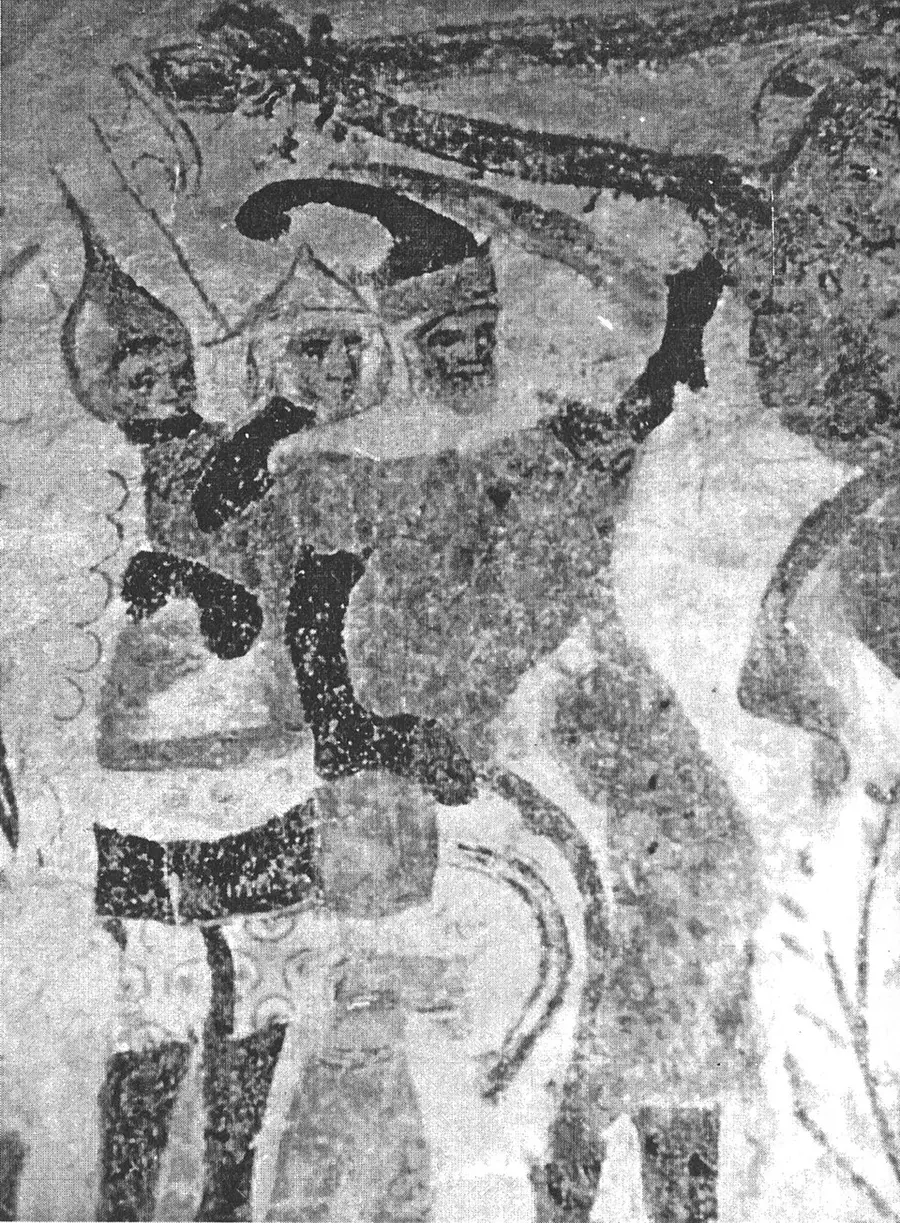 Unknown muralist, Vitalienbrüder wall painting, Bunge Church, Gotland (c. 1405) One of the few contemporary depictions of the Vitalienbrüder — the Baltic pirate-privateers who sacked Bergen and looted the Hanseatic Kontor in 1393 — painted around 1405 in a church on Gotland, one of their island bases. Vitalienbrüder — band of north German privateers originally
raised by Mecklenburg dukes in 1392 to provision Stockholm
during the Danish naval blockade of the city. After 1395 they
turned general pirates and became a standing menace to Baltic
and North Sea shipping for the better part of two decades,
with bases at Gotland, Friesland, and along the western
Norwegian coast. They sacked Bergen and looted the Hanseatic
Kontor in 1393. The Hansa eventually drove the survivors from
Gotland with the help of the Teutonic Order; the last
organised remnants were destroyed by the Hansa-led fleet at
the Battle of Helgoland in 1401, in which the brothers' most
famous captain, Klaus Störtebeker, was captured and executed
at Hamburg.
— German privateers originally raised by the duke of Mecklenburg to provision Stockholm during the Danish naval blockade of the 1390s, who then turned general pirates and became a standing menace to Baltic shipping — attacked Bergen and looted the Kontor. The attack was external rather than internal; the Victual Brothers were not Hansa-aligned, and they raided Hanseatic targets across the Baltic for years.
Unknown muralist, Vitalienbrüder wall painting, Bunge Church, Gotland (c. 1405) One of the few contemporary depictions of the Vitalienbrüder — the Baltic pirate-privateers who sacked Bergen and looted the Hanseatic Kontor in 1393 — painted around 1405 in a church on Gotland, one of their island bases. Vitalienbrüder — band of north German privateers originally
raised by Mecklenburg dukes in 1392 to provision Stockholm
during the Danish naval blockade of the city. After 1395 they
turned general pirates and became a standing menace to Baltic
and North Sea shipping for the better part of two decades,
with bases at Gotland, Friesland, and along the western
Norwegian coast. They sacked Bergen and looted the Hanseatic
Kontor in 1393. The Hansa eventually drove the survivors from
Gotland with the help of the Teutonic Order; the last
organised remnants were destroyed by the Hansa-led fleet at
the Battle of Helgoland in 1401, in which the brothers' most
famous captain, Klaus Störtebeker, was captured and executed
at Hamburg.
— German privateers originally raised by the duke of Mecklenburg to provision Stockholm during the Danish naval blockade of the 1390s, who then turned general pirates and became a standing menace to Baltic shipping — attacked Bergen and looted the Kontor. The attack was external rather than internal; the Victual Brothers were not Hansa-aligned, and they raided Hanseatic targets across the Baltic for years.
The most serious rupture between Kontor and Norwegian state came in September 1455. The Norwegian governor of Bergenhus Fortress 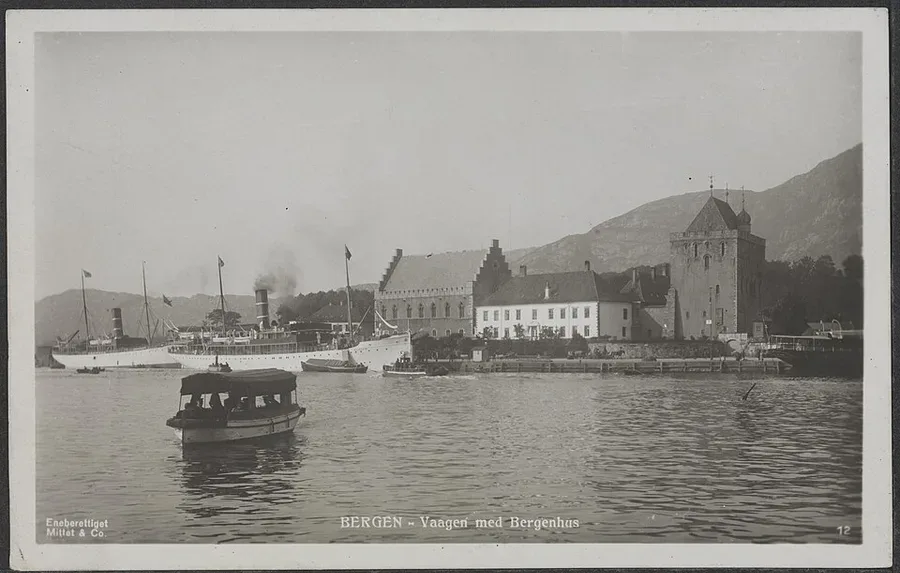 Mittet & Co. postcard, Vågen med Bergenhus (c. 1920-1930), National Library of Norway This 1920s postcard photograph shows Bergenhus much as it appeared for centuries at the entrance to Vågen — Håkonshallen and the Rosenkrantz Tower, the medieval royal seat that later passed under Danish-appointed governance. Medieval royal fortification at the entrance to the Vågen
harbour in Bergen, the royal seat of the Sverre dynasty
through the Norwegian Golden Age. The complex centres on
Håkonshallen — Hákon IV's stone great hall, built in the
1260s — and the Rosenkrantz Tower, a sixteenth-century
addition to a thirteenth-century base. Bergenhus was the
effective capital of medieval Norway until Hákon V moved
the royal seat to Oslo around 1300. From the late
fourteenth century onward the fortress passed under Danish-
appointed governance, where it remained until the 1814
dissolution. Today a preserved historic site at the
northern end of the Bryggen waterfront.
Also discussed in The Long Fall — the sudden loss of Norwegian nobility, the end of the kings, and half of Norway gone foreverThe Reformation, 1537 — one church eradicated and another imposed , Olav Nilsson Norwegian noble (d. 1455), royal governor (høvedsmann) of
Bergenhus fortress under King Christian I of Denmark-Norway.
Spent his years at Bergenhus in escalating conflict with the
Hanseatic Kontor over the limits of his jurisdiction and the
German merchants' commercial privileges in the city. In
September 1455 several hundred armed Hanseatic merchants
marched out of Bryggen, set fire to Munkeliv Abbey on the
western shore of the harbour, and killed Olav Nilsson along
with the Bishop of Bergen Thorleif Olavsson and roughly sixty
Norwegians who had taken sanctuary inside the monastery. The
Danish-Norwegian crown demanded reparations; the Kontor paid
them; both sides reaffirmed the standing arrangement.
, had spent years in escalating conflict with the Kontor over the limits of his jurisdiction and the merchants’ commercial privileges. Several hundred armed Hanseatic merchants marched out of Bryggen, set fire to Munkeliv Abbey
Mittet & Co. postcard, Vågen med Bergenhus (c. 1920-1930), National Library of Norway This 1920s postcard photograph shows Bergenhus much as it appeared for centuries at the entrance to Vågen — Håkonshallen and the Rosenkrantz Tower, the medieval royal seat that later passed under Danish-appointed governance. Medieval royal fortification at the entrance to the Vågen
harbour in Bergen, the royal seat of the Sverre dynasty
through the Norwegian Golden Age. The complex centres on
Håkonshallen — Hákon IV's stone great hall, built in the
1260s — and the Rosenkrantz Tower, a sixteenth-century
addition to a thirteenth-century base. Bergenhus was the
effective capital of medieval Norway until Hákon V moved
the royal seat to Oslo around 1300. From the late
fourteenth century onward the fortress passed under Danish-
appointed governance, where it remained until the 1814
dissolution. Today a preserved historic site at the
northern end of the Bryggen waterfront.
Also discussed in The Long Fall — the sudden loss of Norwegian nobility, the end of the kings, and half of Norway gone foreverThe Reformation, 1537 — one church eradicated and another imposed , Olav Nilsson Norwegian noble (d. 1455), royal governor (høvedsmann) of
Bergenhus fortress under King Christian I of Denmark-Norway.
Spent his years at Bergenhus in escalating conflict with the
Hanseatic Kontor over the limits of his jurisdiction and the
German merchants' commercial privileges in the city. In
September 1455 several hundred armed Hanseatic merchants
marched out of Bryggen, set fire to Munkeliv Abbey on the
western shore of the harbour, and killed Olav Nilsson along
with the Bishop of Bergen Thorleif Olavsson and roughly sixty
Norwegians who had taken sanctuary inside the monastery. The
Danish-Norwegian crown demanded reparations; the Kontor paid
them; both sides reaffirmed the standing arrangement.
, had spent years in escalating conflict with the Kontor over the limits of his jurisdiction and the merchants’ commercial privileges. Several hundred armed Hanseatic merchants marched out of Bryggen, set fire to Munkeliv Abbey 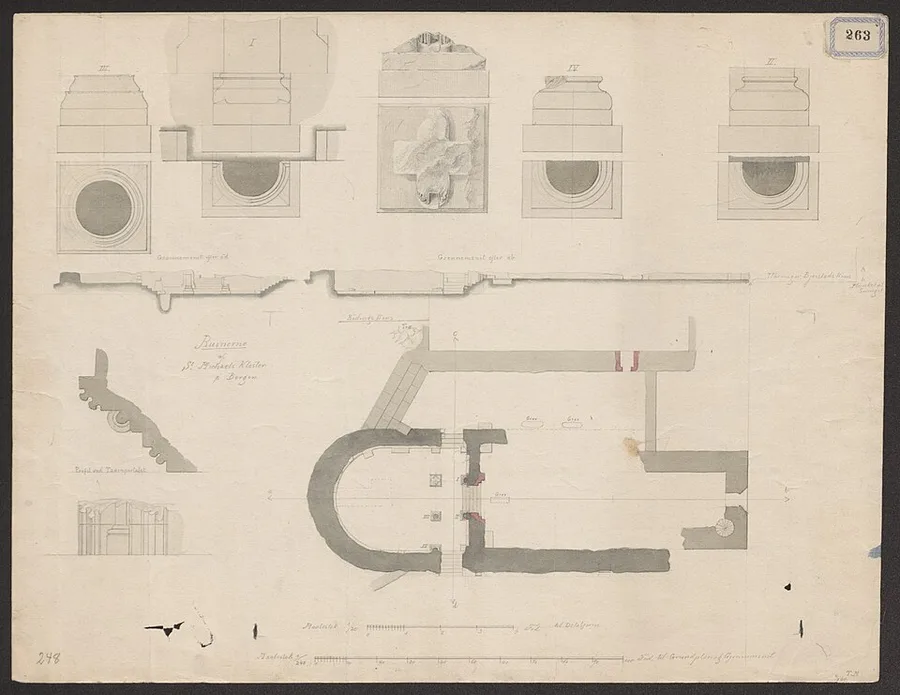 Henrik Thrap-Meyer, Ruins of St Michael's Monastery, Bergen (1860), Fortidsminneforeningen/Riksantikvaren Nothing of Munkeliv Abbey stands today — Bergen's great Benedictine (later Bridgettine) house burned for the last time in 1536 and was never rebuilt. This 1860 antiquarian survey drawing records what the excavation of its buried foundations found. Benedictine (later Bridgettine) monastery on the western shore
of the Vågen harbour at Bergen, founded in the early twelfth
century by King Eystein I. The largest medieval monastic
foundation in Norway. In the 1420s the house was transferred,
with papal approval, to the Swedish Bridgettine order as a
double house of monks and nuns — one of the few Bridgettine
foundations outside Sweden itself. The buildings were burned
in 1455 when the Kontor's merchants stormed the abbey in
fighting with the Norwegian crown; rebuilt over the following
decades — the Bridgettines returned in 1478 — then burned
again in 1536 and never rebuilt. The Munkeliv quarter of
modern Bergen preserves the name.
Also discussed in A Catholic Norway — the faith that gave the kingdom its first institutions and the stave churchesThe Reformation, 1537 — one church eradicated and another imposed on the western shore of the city — the Benedictine monastery King Eystein I Magnusson
Henrik Thrap-Meyer, Ruins of St Michael's Monastery, Bergen (1860), Fortidsminneforeningen/Riksantikvaren Nothing of Munkeliv Abbey stands today — Bergen's great Benedictine (later Bridgettine) house burned for the last time in 1536 and was never rebuilt. This 1860 antiquarian survey drawing records what the excavation of its buried foundations found. Benedictine (later Bridgettine) monastery on the western shore
of the Vågen harbour at Bergen, founded in the early twelfth
century by King Eystein I. The largest medieval monastic
foundation in Norway. In the 1420s the house was transferred,
with papal approval, to the Swedish Bridgettine order as a
double house of monks and nuns — one of the few Bridgettine
foundations outside Sweden itself. The buildings were burned
in 1455 when the Kontor's merchants stormed the abbey in
fighting with the Norwegian crown; rebuilt over the following
decades — the Bridgettines returned in 1478 — then burned
again in 1536 and never rebuilt. The Munkeliv quarter of
modern Bergen preserves the name.
Also discussed in A Catholic Norway — the faith that gave the kingdom its first institutions and the stave churchesThe Reformation, 1537 — one church eradicated and another imposed on the western shore of the city — the Benedictine monastery King Eystein I Magnusson 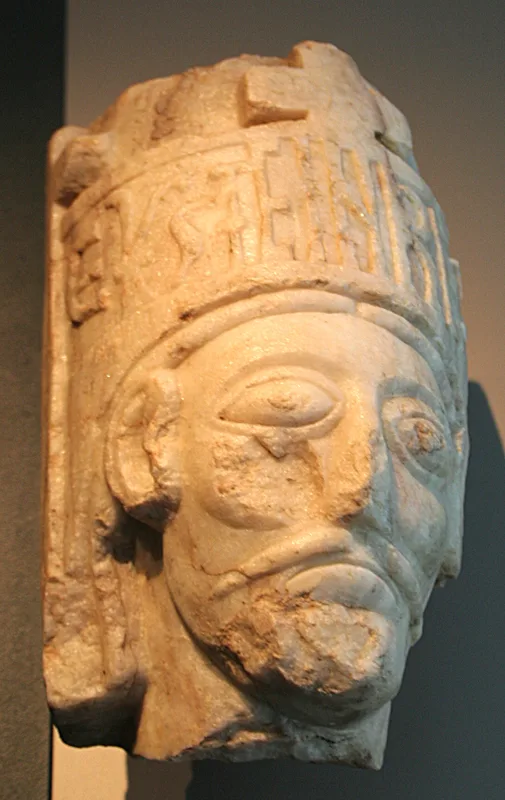 Unknown medieval sculptor, bust of King Eystein I ("EYSTEIN REX"); photo: Nina, University Museum of Bergen, CC BY 2.5 Excavated at Munkeliv Abbey in 1853, this marble head inscribed EYSTEIN REX is the oldest surviving portrait of a Norwegian king — a fitting likeness for the monastery's own founder. King of Norway 1103–1123, sharing the throne with his half-brothers
Sigurd the Crusader and (until 1115) Olav. Remembered chiefly as
a builder and administrator rather than a warrior — the foil to
Sigurd's military exploits in the Mediterranean. Founded the
Benedictine monastery of Munkeliv on the western shore of Bergen
in the early twelfth century, one of the earliest monasteries in
Norway. Sponsored road and harbour improvements across the country
and established the kongsgård (royal estate) infrastructure that
supported the medieval Norwegian court.
Also discussed in A Catholic Norway — the faith that gave the kingdom its first institutions and the stave churchesThe Crusades?!!!! — sixty ships from Bergen, bound for the Holy Land had founded in the early twelfth century — and killed Olav Nilsson, the Bishop of Bergen Thorleif Olavsson
Unknown medieval sculptor, bust of King Eystein I ("EYSTEIN REX"); photo: Nina, University Museum of Bergen, CC BY 2.5 Excavated at Munkeliv Abbey in 1853, this marble head inscribed EYSTEIN REX is the oldest surviving portrait of a Norwegian king — a fitting likeness for the monastery's own founder. King of Norway 1103–1123, sharing the throne with his half-brothers
Sigurd the Crusader and (until 1115) Olav. Remembered chiefly as
a builder and administrator rather than a warrior — the foil to
Sigurd's military exploits in the Mediterranean. Founded the
Benedictine monastery of Munkeliv on the western shore of Bergen
in the early twelfth century, one of the earliest monasteries in
Norway. Sponsored road and harbour improvements across the country
and established the kongsgård (royal estate) infrastructure that
supported the medieval Norwegian court.
Also discussed in A Catholic Norway — the faith that gave the kingdom its first institutions and the stave churchesThe Crusades?!!!! — sixty ships from Bergen, bound for the Holy Land had founded in the early twelfth century — and killed Olav Nilsson, the Bishop of Bergen Thorleif Olavsson 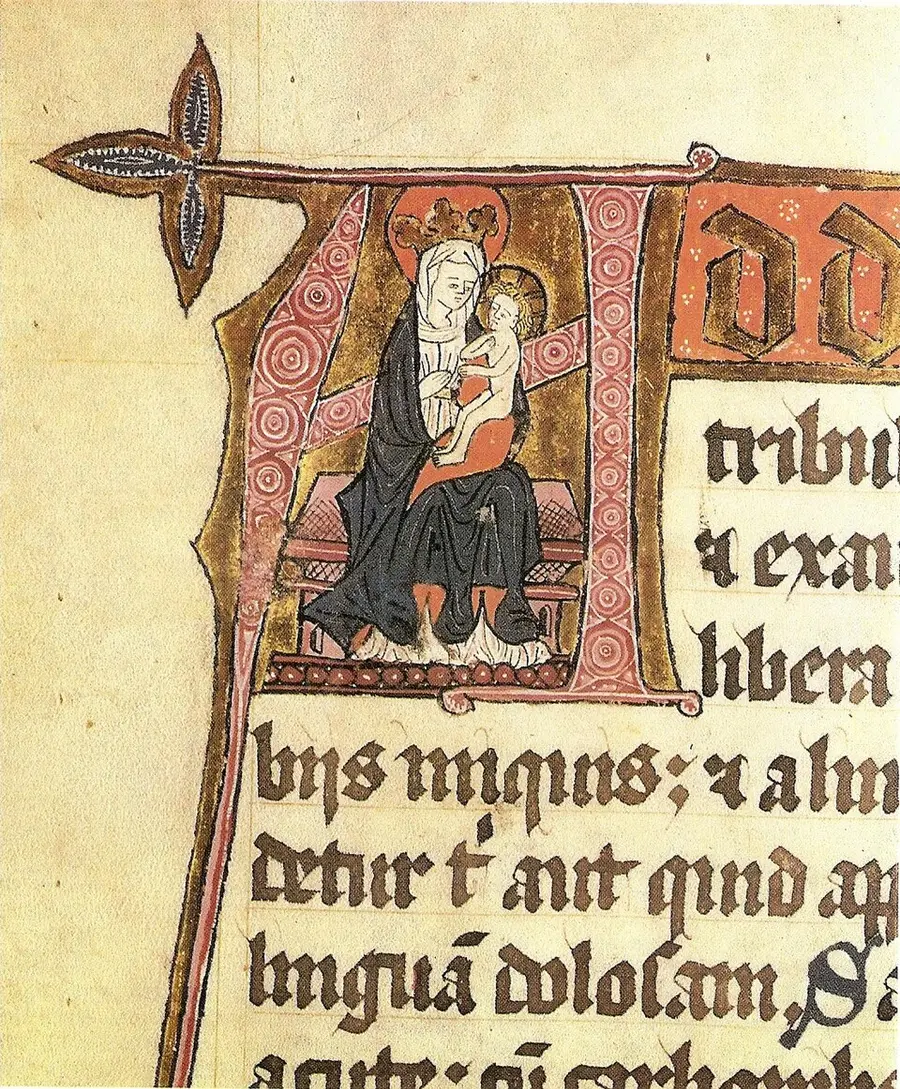 Birgitta Sigfusdatter, initial from a Munkeliv psalter (c. 1450), Prague Metropolitan Chapter Library No portrait of the bishop survives. This initial — the Virgin and Child inside an 'A' — was painted by the nun Birgitta Sigfusdatter at Munkeliv Abbey around 1450: the same Bergen abbey, in the same decade, where Thorleif was killed in the Hanseatic storming of September 1455. Bishop of Bergen (d. 1455), the senior Norwegian ecclesiastical
authority in the western capital at the time of the most
serious rupture between the Hanseatic Kontor and the Norwegian
state. Killed alongside the Bergenhus governor Olav Nilsson and
about sixty Norwegians inside Munkeliv Abbey in September 1455,
when several hundred armed Hanseatic merchants from Bryggen
marched out and stormed the monastery in which the two royal
officials had taken sanctuary. The Bishop's killing — sanctuary
violated, the senior cleric of the diocese murdered in his own
cathedral city's principal monastery — was the most serious
single ecclesiastical outrage of the Bergen Kontor's four-
century history.
, and roughly sixty other Norwegians who had taken sanctuary inside the abbey. The attack badly damaged the monastery but did not destroy it; the Cistercians of Hovedøya took it over and rebuilt it, and the Bridgettine community returned in 1478. Munkeliv survived until the fire of 1536, during the Reformation, which levelled it for good. The Danish-Norwegian crown demanded reparations for the 1455 killings. The Kontor paid them. The crown reconfirmed the Kontor’s privileges within a few years. Neither side had a workable alternative to the arrangement.
Birgitta Sigfusdatter, initial from a Munkeliv psalter (c. 1450), Prague Metropolitan Chapter Library No portrait of the bishop survives. This initial — the Virgin and Child inside an 'A' — was painted by the nun Birgitta Sigfusdatter at Munkeliv Abbey around 1450: the same Bergen abbey, in the same decade, where Thorleif was killed in the Hanseatic storming of September 1455. Bishop of Bergen (d. 1455), the senior Norwegian ecclesiastical
authority in the western capital at the time of the most
serious rupture between the Hanseatic Kontor and the Norwegian
state. Killed alongside the Bergenhus governor Olav Nilsson and
about sixty Norwegians inside Munkeliv Abbey in September 1455,
when several hundred armed Hanseatic merchants from Bryggen
marched out and stormed the monastery in which the two royal
officials had taken sanctuary. The Bishop's killing — sanctuary
violated, the senior cleric of the diocese murdered in his own
cathedral city's principal monastery — was the most serious
single ecclesiastical outrage of the Bergen Kontor's four-
century history.
, and roughly sixty other Norwegians who had taken sanctuary inside the abbey. The attack badly damaged the monastery but did not destroy it; the Cistercians of Hovedøya took it over and rebuilt it, and the Bridgettine community returned in 1478. Munkeliv survived until the fire of 1536, during the Reformation, which levelled it for good. The Danish-Norwegian crown demanded reparations for the 1455 killings. The Kontor paid them. The crown reconfirmed the Kontor’s privileges within a few years. Neither side had a workable alternative to the arrangement.
The quiet end
The Kontor’s eventual end was not driven by war or expulsion. It came by a long demographic and commercial drift across the sixteenth and seventeenth centuries.
Dutch shipping took a growing share of the long-distance North Sea and Baltic routes the Hanseatic cities had once dominated. English deep-sea fishing produced dried cod that competed with the Norwegian product. Lübeck’s political authority within the League declined after a failed war against Denmark in the 1530s. The The Reformation 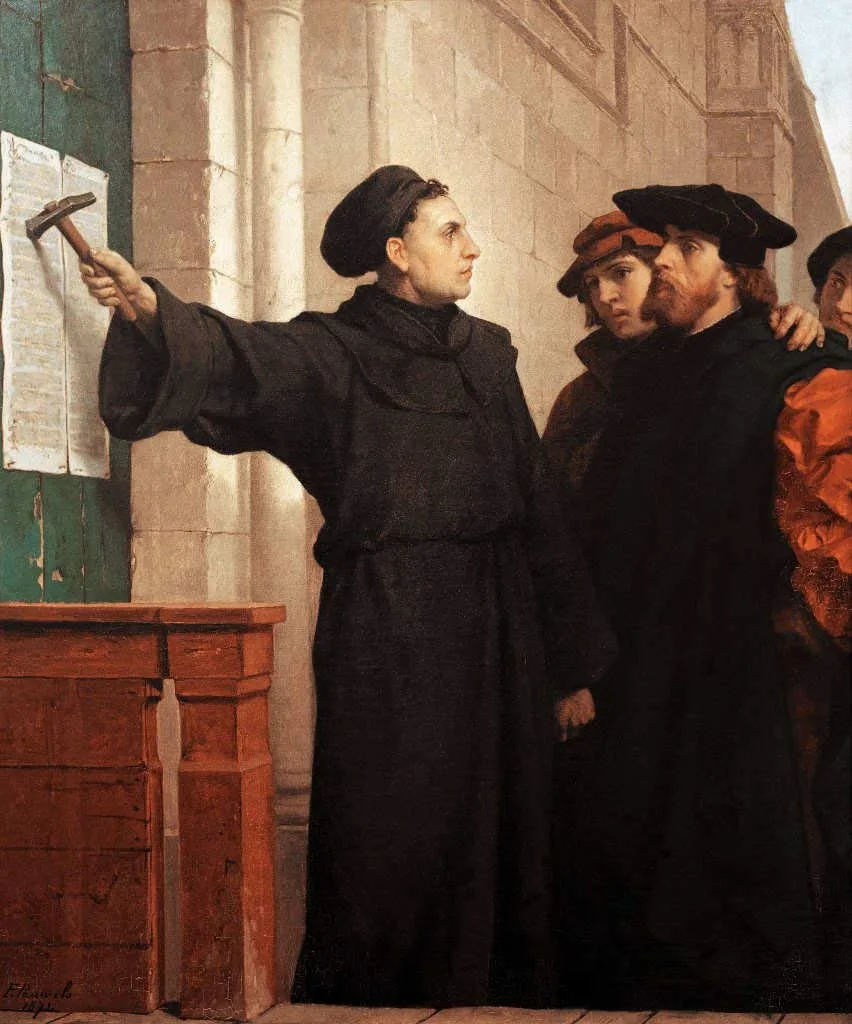 Ferdinand Pauwels, Luther hammers his 95 theses to the door (1872) Pauwels's 1872 history painting stages the 1517 act that began the Lutheran Reformation — the settlement Christian III of Denmark imposed on Norway by royal decree twenty years later, with no Norwegian reformer or domestic movement behind it. The Lutheran religious settlement imposed on Norway in 1537 by
royal decree from Copenhagen. Christian III of Denmark abolished
the Catholic ecclesiastical structure, dissolved the monasteries,
ordered the saints' relics destroyed, and replaced the Latin
liturgy with Danish-language Lutheran services. Unlike the
Reformation elsewhere in northern Europe, Norway's arrived from
outside — no Norwegian Luther, no Norwegian reformers, no
domestic religious movement behind it. The country changed
denomination because the king in Copenhagen ordered it.
In this article The Reformation did not break the Hanseatic system. The Kontor
at Bryggen kept operating; stockfish kept going to Lutheran
cities in the Baltic; the Danish-Norwegian crown kept collecting
customs.
Also discussed in The Reformation, 1537 — one church eradicated and another imposedThe King Who Became a Saint — how the Nordmen came to ChristA Catholic Norway — the faith that gave the kingdom its first institutions and the stave churchesThe 400-Year Night — when the Northern Lion lay dormantLutheran Norway and Pietism — a farmer named Hans Nielsen Hauge and a lay revival that could not be silencedThe Long Fall — the sudden loss of Norwegian nobility, the end of the kings, and half of Norway gone foreverStatskirken — the state church and what's left of it reached Norway in 1537 but did not break the trade — primarily because the long-standing Catholic markets of southern Europe, Italy and Iberia especially, remained large and reliable buyers of Norwegian stockfish through the seventeenth century and beyond, and the demand from those markets carried the Bergen trade through the period in which Protestant northern Europe was slowly abandoning the customary fast days.
Ferdinand Pauwels, Luther hammers his 95 theses to the door (1872) Pauwels's 1872 history painting stages the 1517 act that began the Lutheran Reformation — the settlement Christian III of Denmark imposed on Norway by royal decree twenty years later, with no Norwegian reformer or domestic movement behind it. The Lutheran religious settlement imposed on Norway in 1537 by
royal decree from Copenhagen. Christian III of Denmark abolished
the Catholic ecclesiastical structure, dissolved the monasteries,
ordered the saints' relics destroyed, and replaced the Latin
liturgy with Danish-language Lutheran services. Unlike the
Reformation elsewhere in northern Europe, Norway's arrived from
outside — no Norwegian Luther, no Norwegian reformers, no
domestic religious movement behind it. The country changed
denomination because the king in Copenhagen ordered it.
In this article The Reformation did not break the Hanseatic system. The Kontor
at Bryggen kept operating; stockfish kept going to Lutheran
cities in the Baltic; the Danish-Norwegian crown kept collecting
customs.
Also discussed in The Reformation, 1537 — one church eradicated and another imposedThe King Who Became a Saint — how the Nordmen came to ChristA Catholic Norway — the faith that gave the kingdom its first institutions and the stave churchesThe 400-Year Night — when the Northern Lion lay dormantLutheran Norway and Pietism — a farmer named Hans Nielsen Hauge and a lay revival that could not be silencedThe Long Fall — the sudden loss of Norwegian nobility, the end of the kings, and half of Norway gone foreverStatskirken — the state church and what's left of it reached Norway in 1537 but did not break the trade — primarily because the long-standing Catholic markets of southern Europe, Italy and Iberia especially, remained large and reliable buyers of Norwegian stockfish through the seventeenth century and beyond, and the demand from those markets carried the Bergen trade through the period in which Protestant northern Europe was slowly abandoning the customary fast days.
In Bergen itself, a new merchant class of Norwegian-citizen burghers was steadily absorbing the trade. Many of them were grandsons of retired Hanseatic men who had left the Kontor when they wanted to marry Norwegian women, settled in the city around it, raised families, and passed their trade and their German surnames to a second and third generation. By the early eighteenth century, Norwegian-citizen firms were handling a substantial share of the country’s stockfish exports. The great fire of Bergen on 19 May 1702, which destroyed roughly ninety per cent of the old city including most of the Kontor’s buildings, was the hinge. The Kontor rebuilt, as it had after every previous fire, but never recovered its earlier population or commercial weight.
In 1754, by royal resolution of King Frederik V of Denmark-Norway 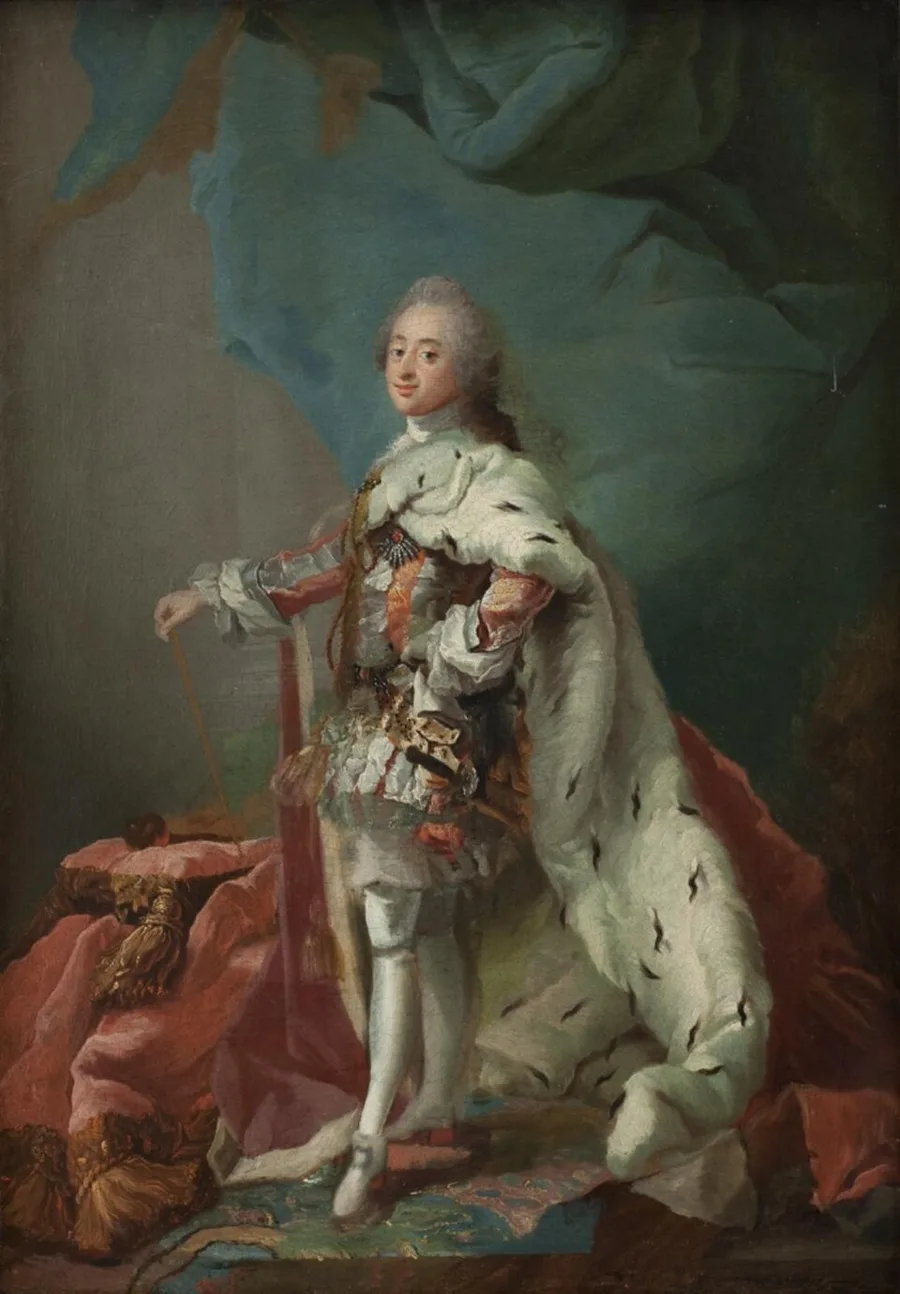 Carl Gustaf Pilo, Portræt af Frederik V i salvingsdragt (1750), Statens Museum for Kunst This 1750 anointing-robes portrait by court painter Carl Gustaf Pilo depicts the king who, by royal resolution in the same reign, authorized the transfer of the German Hanseatic Kontor at Bergen to a Norwegian-citizen successor association, ending the four-century German commercial enclave at Bryggen. King of Denmark and Norway (1723–1766), reigned 1746–1766.
Son of Christian VI; succeeded his father in the second
generation of the Lutheran Pietist Oldenburg line. His reign
is associated with a measured Enlightenment opening — relaxed
press controls, reduced ecclesiastical interference in
university affairs, the founding of the Royal Danish Academy
of Fine Arts (1754) in Copenhagen. In the same year, by royal
resolution, he authorised the transfer of the German Hanseatic
Kontor at Bergen to a Norwegian-citizen successor association,
Det Norske Kontor — the formal end of the four-century
German commercial enclave at Bryggen. Died at forty-two,
reportedly of dropsy.
Also discussed in The 400-Year Night — when the Northern Lion lay dormant , the last German-citizen Oldermann signed papers transferring the buildings, the trade rights, and the residual capital of the Hanseatic Kontor to a Norwegian successor association called Det Norske Kontor The Norwegian Kontor — the successor association to the
German Hanseatic Kontor at Bergen, constituted in 1754 by
royal resolution of King Frederik V of Denmark-Norway. The
Norske Kontor took possession of the buildings, trade
rights, and residual capital of its German predecessor and
was staffed largely by men whose surnames were still German
but whose citizenship and households were Norwegian — sons
and grandsons of retired Hanseatic merchants who had left
the Kontor when they wanted to marry, settled in Bergen, and
raised Norwegian families. The Norske Kontor continued in
some form until its formal dissolution in 1899 — 145 years
after its founding and a century and a half after the last
German merchants had left Bryggen.
— staffed largely by men whose surnames were still German but whose citizenship and households were Norwegian. The Norske Kontor continued in some form until its formal dissolution in 1899. The last German Kontor merchants left Bryggen in the early 1760s. There was no war, no expulsion, no decree against the Germans. The Kontor had simply run out of people willing to live inside its rules.
Carl Gustaf Pilo, Portræt af Frederik V i salvingsdragt (1750), Statens Museum for Kunst This 1750 anointing-robes portrait by court painter Carl Gustaf Pilo depicts the king who, by royal resolution in the same reign, authorized the transfer of the German Hanseatic Kontor at Bergen to a Norwegian-citizen successor association, ending the four-century German commercial enclave at Bryggen. King of Denmark and Norway (1723–1766), reigned 1746–1766.
Son of Christian VI; succeeded his father in the second
generation of the Lutheran Pietist Oldenburg line. His reign
is associated with a measured Enlightenment opening — relaxed
press controls, reduced ecclesiastical interference in
university affairs, the founding of the Royal Danish Academy
of Fine Arts (1754) in Copenhagen. In the same year, by royal
resolution, he authorised the transfer of the German Hanseatic
Kontor at Bergen to a Norwegian-citizen successor association,
Det Norske Kontor — the formal end of the four-century
German commercial enclave at Bryggen. Died at forty-two,
reportedly of dropsy.
Also discussed in The 400-Year Night — when the Northern Lion lay dormant , the last German-citizen Oldermann signed papers transferring the buildings, the trade rights, and the residual capital of the Hanseatic Kontor to a Norwegian successor association called Det Norske Kontor The Norwegian Kontor — the successor association to the
German Hanseatic Kontor at Bergen, constituted in 1754 by
royal resolution of King Frederik V of Denmark-Norway. The
Norske Kontor took possession of the buildings, trade
rights, and residual capital of its German predecessor and
was staffed largely by men whose surnames were still German
but whose citizenship and households were Norwegian — sons
and grandsons of retired Hanseatic merchants who had left
the Kontor when they wanted to marry, settled in Bergen, and
raised Norwegian families. The Norske Kontor continued in
some form until its formal dissolution in 1899 — 145 years
after its founding and a century and a half after the last
German merchants had left Bryggen.
— staffed largely by men whose surnames were still German but whose citizenship and households were Norwegian. The Norske Kontor continued in some form until its formal dissolution in 1899. The last German Kontor merchants left Bryggen in the early 1760s. There was no war, no expulsion, no decree against the Germans. The Kontor had simply run out of people willing to live inside its rules.
What stayed
The wharf at Bryggen is the largest surviving medieval-pattern wooden urban district in northern Europe. Some sixty-two wooden buildings — roughly a quarter of the old wharf — still stand, painted iron-red and ochre, gable-end onto the harbour, most dating from the rebuilding that followed the 1702 fire. UNESCO inscribed Bryggen on its World Heritage register in 1979. The Det Hanseatiske Museum 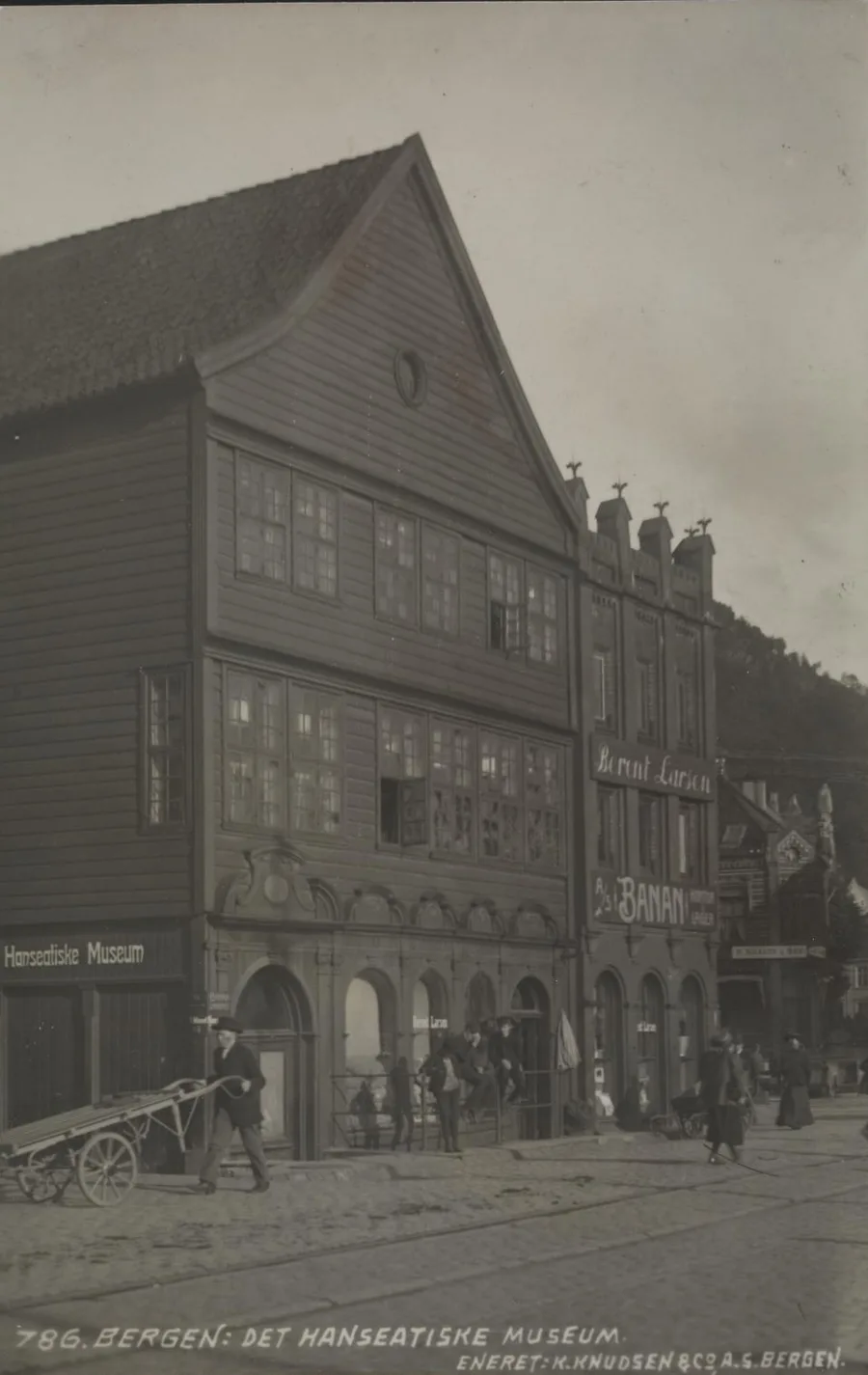 K. Knudsen & Co., Det Hanseatiske Museum (early 20th c.), National Library of Norway The merchant house itself, head-on: Finnegården's gabled timber front at Bryggen, photographed by Bergen's Knudsen firm in the museum's early decades — behind this facade the working Kontor layout survives, from harbour-side office to fireproof cellar. The Hanseatic Museum at Bryggen in Bergen, housed in one of
the original Kontor merchant buildings (Finnegården 1a). The
museum preserves the layout of a working medieval Kontor
merchant house — front office on the harbour side, sleeping
quarters on the upper floors, warehouse in the middle, kitchen
at the rear, and stone-vaulted fireproof cellar beneath —
showing the daily living and working conditions of the
bachelor German merchants. The Hanseatic Museum building has
been undergoing a long restoration; for current opening status
the visitor should check ahead. The associated Schøtstuene
assembly halls behind the wharf are part of the same museum
complex.
On the trip Day 4 in Bergen walks the Ungdommene (the Youngsters) along
the wharf the Hansa ran for four centuries, right past
Finnegården — the Hanseatic Museum's merchant house, closed
for restoration into 2027 — while the Schøtstuene assembly
halls behind the wharf carry the museum's visit.
, housed in one of the original Kontor merchant buildings, preserves the layout of a working merchant house: front office, warehouse in the middle, sleeping quarters above, kitchen at the rear, stone-vaulted cellar beneath. Behind the wharf, the Schøtstuene complex still holds several of the long communal tables and open hearths the bachelor merchants ate their meals around.
K. Knudsen & Co., Det Hanseatiske Museum (early 20th c.), National Library of Norway The merchant house itself, head-on: Finnegården's gabled timber front at Bryggen, photographed by Bergen's Knudsen firm in the museum's early decades — behind this facade the working Kontor layout survives, from harbour-side office to fireproof cellar. The Hanseatic Museum at Bryggen in Bergen, housed in one of
the original Kontor merchant buildings (Finnegården 1a). The
museum preserves the layout of a working medieval Kontor
merchant house — front office on the harbour side, sleeping
quarters on the upper floors, warehouse in the middle, kitchen
at the rear, and stone-vaulted fireproof cellar beneath —
showing the daily living and working conditions of the
bachelor German merchants. The Hanseatic Museum building has
been undergoing a long restoration; for current opening status
the visitor should check ahead. The associated Schøtstuene
assembly halls behind the wharf are part of the same museum
complex.
On the trip Day 4 in Bergen walks the Ungdommene (the Youngsters) along
the wharf the Hansa ran for four centuries, right past
Finnegården — the Hanseatic Museum's merchant house, closed
for restoration into 2027 — while the Schøtstuene assembly
halls behind the wharf carry the museum's visit.
, housed in one of the original Kontor merchant buildings, preserves the layout of a working merchant house: front office, warehouse in the middle, sleeping quarters above, kitchen at the rear, stone-vaulted cellar beneath. Behind the wharf, the Schøtstuene complex still holds several of the long communal tables and open hearths the bachelor merchants ate their meals around.
The four centuries also produced a deep cultural mark on Bergen and on western Norway more generally. The Norwegian dialect of the Bergen district, the Bergensk The Norwegian dialect of the Bergen district, distinctive in Norwegian regional speech for two features attributable to the four centuries of Hanseatic presence: a heavy substrate of Middle Low German loanwords (especially in vocabulary for trade, tools, household objects, building parts, and ship workings) and a striking grammatical simplification — bergensk uses two grammatical genders (common and neuter) rather than the three (masculine, feminine, neuter) of most other Norwegian dialects, the simplification commonly attributed to the influence of German speakers across generations. The dialect is also marked by a uvular /R/-sound rather than the alveolar trill of most other Norwegian dialects, though the German connection for that feature is less certain. On the trip The Ungdommene (the Youngsters) spend the Day 4 morning in Bergen — the Fish Market and the Bryggen wharf — where bergensk is the ordinary speech of the street: the clipped uvular R and the Low German trade-words that four Hanseatic centuries pressed into the local tongue. Also discussed in Language basics — just enough Norwegian to be polite , carries more loanwords from Middle Low German than any other Norwegian regional speech — words for trade, for tools, for household objects, for parts of a building, for the workings of a ship. The architectural pattern of the deep narrow gable-end warehouse-house runs along the western Norwegian coast in trading towns that imitated Bergen’s commercial style. German surnames carried forward in the city’s Norwegian families well into the twentieth century. The Hanseatic-derived guild structures in Norwegian craft trades persisted into the nineteenth century. The trading vocabulary of Norwegian finance and shipping kept its German-derived terms for commercial instruments long after the Kontor itself was gone.
The Norwegian state never fought a war against the Hanseatic League. The Norwegian crown never expelled the Kontor by decree. The German bachelors simply stopped arriving at the rate they had been arriving for four centuries. The Norwegian merchant class absorbed the trade. The property changed hands by negotiation rather than by force. And the painted wooden buildings, with their gable-ends turned to the same harbour they had been turned to in 1360, stayed.
Sources & further reading
Primary sources
- The Bergenfahrer-Schra, the Hanseatic Kontor’s internal statutes at Bergen. Surviving versions are preserved in the Hansisches Urkundenbuch (see below) and in the Bergen archives. The corpus has not received a single modern critical edition but is discussed extensively in Wubs-Mrozewicz’s monograph and in the Cologne Hansisches Geschichtsblätter.
- Hansisches Urkundenbuch, 11 vols. (Halle and Leipzig, 1876–1939). The standard collection of Hanseatic charters, treaties, and commercial documents, including the surviving Schra fragments.
- Diplomatarium Norvegicum, 23 vols. (Christiania/Oslo, 1847–2011). The collection of medieval Norwegian charters including the foundational 1250 treaty between Hákon IV and Lübeck and the successive Hanseatic privilege grants. Digitised at https://www.dokpro.uio.no/dipl_norv/diplom_field_eng.html.
Modern scholarship
- Arnved Nedkvitne, The German Hansa and Bergen 1100–1600 (Köln: Böhlau, 2014). The definitive modern scholarly monograph on the Bergen Kontor.
- Knut Helle, Bergen Bys Historie, vol. 1: Kongssete og Kjøpstad fra Opphavet til 1536 (Universitetsforlaget, 1982). The standard Norwegian-language history of medieval Bergen.
- Anders Bjarne Fossen, Bergen Bys Historie, vol. 2: Borgerskapets By 1536–1800 (Universitetsforlaget, 1979). The continuation through the post-Reformation period and into the Kontor’s decline.
- Justyna Wubs-Mrozewicz, Traders, Ties and Tensions: The Interactions of Lübeckers, Overijsslers and Hollanders in Late Medieval Bergen (Hilversum: Verloren, 2008). The leading modern study of the Kontor’s social structure and the marriage ban.
- Justyna Wubs-Mrozewicz, “Rules of Inclusion, Rules of Exclusion: The Hanseatic Kontor in Bergen in the Late Middle Ages and its Normative Boundaries,” German History 29, no. 1 (2011): 1–22.
- Justyna Wubs-Mrozewicz and Stuart Jenks, eds., The Hanse in Medieval and Early Modern Europe (Leiden: Brill, 2013). An essay collection placing the Bergen Kontor in the wider Hanseatic context.
- Philippe Dollinger, The German Hansa, trans. D. S. Ault and S. H. Steinberg (Stanford University Press, 1970). The standard general history of the Hanseatic League in English.
Reference
- Store norske leksikon (snl.no). See in particular Hansaen, Bryggen i Bergen, Det tyske kontor i Bergen, and Munkeliv kloster.
- UNESCO World Heritage Centre, “Bryggen” (inscribed 1979): https://whc.unesco.org/en/list/59.
Visit
- Bryggen, Bergen. The Hanseatic wharf district — the largest surviving medieval-pattern wooden urban district in northern Europe. Walk through the narrow alleys between the gable-end houses; the property lines at floor level are those the medieval Kontor was built on.
- Bryggens Museum, Bergen. The archaeological museum at the wharf, built around the medieval foundations exposed by the 1955 fire. Holds the wharf’s archaeological finds from a millennium of continuous occupation.
- Det Hanseatiske Museum og Schøtstuene (Hanseatic Museum and Schøtstuene), Bryggen and Øvregaten, Bergen. The museum occupies one of the original Kontor merchant buildings, with the office, sleeping quarters, warehouse, and kitchen preserved. The Schøtstuene assembly halls are a short walk behind the wharf. The Hanseatic Museum building itself has been undergoing a long restoration; check current opening status.
- Bergenhus fortress, at the head of the harbour. The medieval royal seat in Bergen, the residence of Olav Nilsson the governor killed in the 1455 attack, and the centre of crown authority at Bergen across the Kontor’s whole history. The Håkonshallen (Hákon IV’s great hall, completed in the 1260s) and the Rosenkrantz Tower stand within the fortress walls.
- Munkeliv site, on the western shore of the inner harbour at Klosteret. The medieval monastery the Hanseatic merchants attacked in 1455 was rebuilt afterwards and finally destroyed by fire in 1536, during the Reformation, and never rebuilt; the site is marked but the abbey buildings are long gone.