Respecting nature — why you can roam and camp on private land
Norway lets you walk, camp, swim, and pick berries on private land you've never set foot on before — a right older than the country's constitution. It comes with rules, and the rules ask for trade in return.
The right to walk across someone’s land is older than the Norwegian Constitution. Allemannsretten 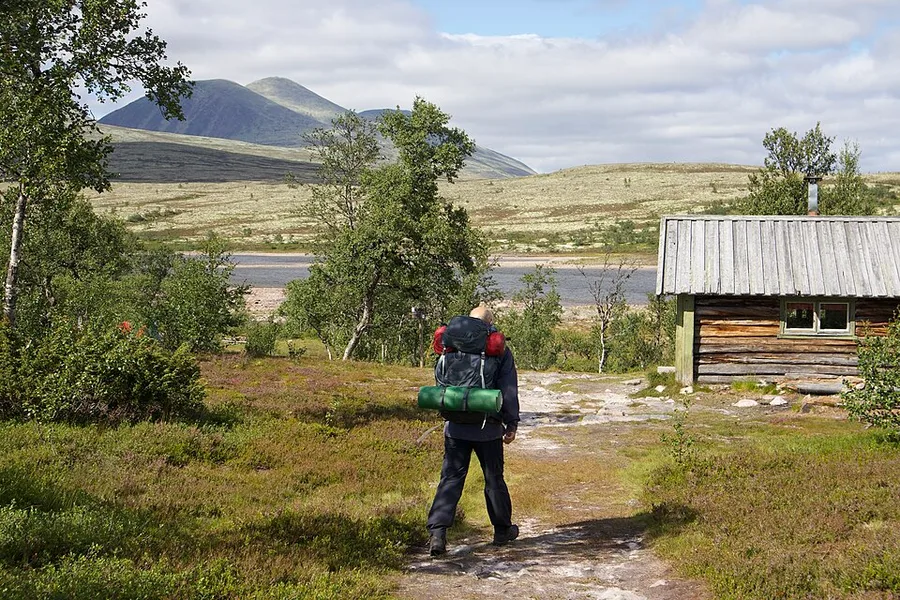 Photo by Anne Sande (2022), CC BY-SA 4.0, via Wikimedia Commons A hiker with a full pack walks across open, unfenced mountain heath toward a hut with no gate, ticket booth, or landowner in sight — the everyday, unticketed access to uncultivated land that allemannsretten protects. Norwegian right of public access to uncultivated land — literally "every-man's right." On anyone's forest, mountain, or shoreline, a person may walk, ski, swim, camp a night, forage, and pick berries without the landowner's permission, subject to limits (a 150-metre tent distance from inhabited houses, seasonal fire bans, and rules on what may be picked). Existed for centuries as customary law traceable to Magnus Lagabøte's Landslov of 1274 before being codified in the Outdoor Recreation Act of 1957 (friluftsloven), among the first laws of its kind anywhere. The statute divides all land into cultivated innmark (private in the ordinary sense) and uncultivated utmark (shared) — and because most of Norway is mountain, forest, bog, and rough coast, most of the country counts as utmark. In this article The dedicated practical treatment of the right — what you may do (walk, camp two nights beyond 150 m, forage) and may not (cross innmark, light a fire 15 April–15 September, drive off-road) on uncultivated land. On the trip No single stop on the itinerary is built around the right to roam, but the family moves through the kind of open, unfenced ground it protects — the walked-over grass of the emptied Kylloplass farm-place, the open slopes around the Stegastein platform above Flåm — without a ticket, a permit, or a landowner's permission ever entering into it. Also discussed in Allemannsretten — the right to roamFriluftsliv — the open-air lifeMat og Drikke — Norwegian food and drink — the everyman’s right — was written into Norwegian statute in 1957 but had been understood for centuries before that: any person, Norwegian or foreign, may walk, ski, ride a bicycle, camp for a night, swim in the lake, build a small fire under restricted conditions, and pick wild berries and mushrooms across uncultivated land owned by someone else. You don’t ask. You don’t pay. You don’t have to be invited. The land is private; the access is universal.
What the right lets you do, in practice. You can walk across pastures and through forests on the route, on the trail, off the trail. You can pitch a tent for up to two nights in any uncultivated spot at least 150 metres from the nearest occupied house, no permission needed; in the mountains or very remote areas you can stay longer without asking. Beyond two nights closer to habitation, you ask the landowner. You can swim in any lake, fjord, or river. You can pick blueberries, lingonberries, and wild mushrooms in any quantity for your own use, and cloudberries too — except in Nordland, Troms and Finnmark, where on marked private marshes you may only eat cloudberries on the spot, not carry them home. You can sleep on uninhabited skerries off the western coast. You can build a small fire on bare rock above the high-tide line at the shore, in winter, in early spring, and in late autumn.
What the right does not let you do is the part most travelers underestimate. From 15 April to 15 September no open fire is permitted in or near forests or other vulnerable terrain anywhere in Norway, full stop — this rule covers the entire summer window of the trip. No driving across the same uncultivated land you may walk freely on; no motorcycles, no ATVs, no camping with vehicles outside marked sites. You may not cross innmark — cultivated land, gardens, fields with growing crops, cultivated pasture, the yard, garden, and private ground immediately around an inhabited building. You may not pick anything cultivated: anyone’s garden, an orchard, a field of cloudberries someone planted. Trash goes with you. Glass goes with you. Cigarette ends go with you. The rule is not carry in, carry out — the rule is leave nothing.
What the right asks for in return is harder to write down because it isn’t legal — it’s social. The Norwegian instinct around shared land is that the country is something you borrow and hand back, briefly improved if you can manage it. A trail you walked on stays exactly as you found it. A campsite you used is invisible the next morning. A berry patch you picked is half-picked, never stripped; the family who owns the land gets to fill their own baskets in turn. You give way to people walking the other direction on a narrow path. You close the gate behind you on a pasture. If you meet livestock on the trail, you go around them quietly, not through them. If a Norwegian on the trail says hei as they pass, you return it — and that, alone, is the entire conversation.
For this trip the practical applications are narrow and easy. The Stegastein platform on Day 3 is a built wooden viewpoint, owned and marked — allemannsretten does not need to apply; you arrive on a tour bus, walk the platform, return. The Bryggen 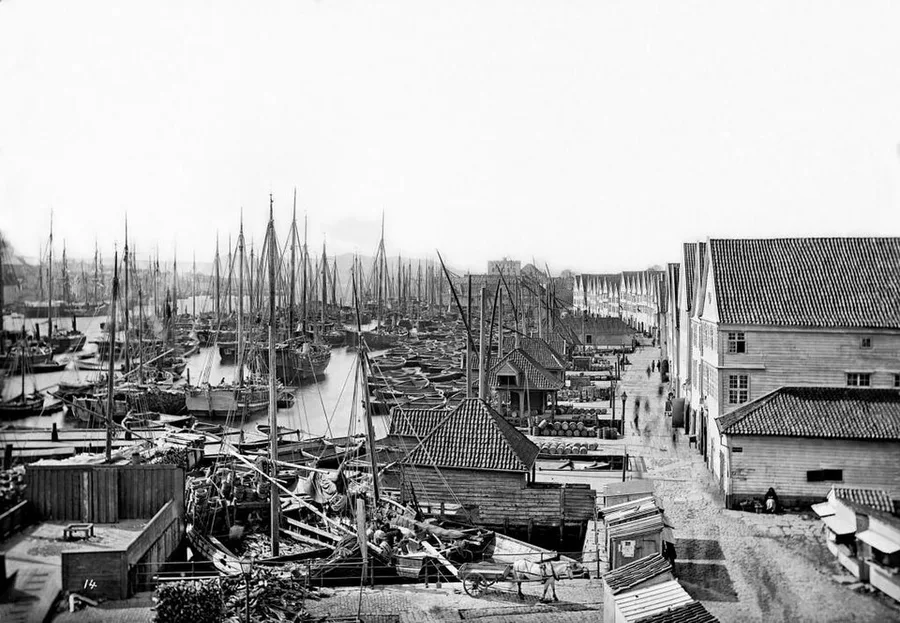 Knud Knudsen, Bryggen in Bergen (1865), University of Bergen Library Knudsen's 1865 photograph shows Bryggen still standing to its post-1702-fire medieval footprint -- the same wharf the Hanseatic kontor traded stockfish out of for four centuries, captured by one of Norway's first professional photographers. The Hanseatic wharf at Bergen — a long row of narrow
gable-fronted wooden warehouses and trading houses lining
the eastern shore of the Vågen harbour. From around 1360
the German Hansa established its Bergen kontor here, and
for nearly four hundred years (until 1754) the buildings
housed German merchants who controlled the export of
Norwegian stockfish to Catholic Europe. The structures
burned and were rebuilt repeatedly to the same medieval
footprint; the surviving wooden buildings (most after the
1702 fire) preserve the medieval urban plan. UNESCO World
Heritage site since 1979 and Bergen's most-visited landmark.
In this article The Bryggen wharf is a city street, not the utmark the right
opens — the roam-right stops where the town begins.
On the trip Day 4 in Bergen lands the Ungdommene (the Youngsters) directly
on the Bryggen waterfront — the wharf the Hanseatic trade in
Norwegian stockfish built and rebuilt for four centuries.
Also discussed in The Golden Age — a North Atlantic empire … reaching farther than you thinkThe Long Fall — the sudden loss of Norwegian nobility, the end of the kings, and half of Norway gone foreverThe Germans Who "Ruled" Bergen — the Hanseatic merchants on Bryggen WharfThe 400-Year Night — when the Northern Lion lay dormantAlcohol and Vinmonopolet — when and where to buy a drinkWhat to wear — the layering system, on the ground wharf in Bergen is a city street. The short climb above Fløyen by funicular in Bergen touches allemannsretten land at every step. Stay on the trail when there is one, walk single file when there isn’t, give way on the climb up, take your trash back to the city. The Norwegians on the same trail will treat you exactly as they would treat each other, which is to say, with calm, distant goodwill. The river below Kylloplass belongs to no one and to everyone; on a warm day someone might wade in, the way people here sometimes do, though the water stays cold.
Knud Knudsen, Bryggen in Bergen (1865), University of Bergen Library Knudsen's 1865 photograph shows Bryggen still standing to its post-1702-fire medieval footprint -- the same wharf the Hanseatic kontor traded stockfish out of for four centuries, captured by one of Norway's first professional photographers. The Hanseatic wharf at Bergen — a long row of narrow
gable-fronted wooden warehouses and trading houses lining
the eastern shore of the Vågen harbour. From around 1360
the German Hansa established its Bergen kontor here, and
for nearly four hundred years (until 1754) the buildings
housed German merchants who controlled the export of
Norwegian stockfish to Catholic Europe. The structures
burned and were rebuilt repeatedly to the same medieval
footprint; the surviving wooden buildings (most after the
1702 fire) preserve the medieval urban plan. UNESCO World
Heritage site since 1979 and Bergen's most-visited landmark.
In this article The Bryggen wharf is a city street, not the utmark the right
opens — the roam-right stops where the town begins.
On the trip Day 4 in Bergen lands the Ungdommene (the Youngsters) directly
on the Bryggen waterfront — the wharf the Hanseatic trade in
Norwegian stockfish built and rebuilt for four centuries.
Also discussed in The Golden Age — a North Atlantic empire … reaching farther than you thinkThe Long Fall — the sudden loss of Norwegian nobility, the end of the kings, and half of Norway gone foreverThe Germans Who "Ruled" Bergen — the Hanseatic merchants on Bryggen WharfThe 400-Year Night — when the Northern Lion lay dormantAlcohol and Vinmonopolet — when and where to buy a drinkWhat to wear — the layering system, on the ground wharf in Bergen is a city street. The short climb above Fløyen by funicular in Bergen touches allemannsretten land at every step. Stay on the trail when there is one, walk single file when there isn’t, give way on the climb up, take your trash back to the city. The Norwegians on the same trail will treat you exactly as they would treat each other, which is to say, with calm, distant goodwill. The river below Kylloplass belongs to no one and to everyone; on a warm day someone might wade in, the way people here sometimes do, though the water stays cold.
The unspoken trade is simple. The country gives you access few other countries in the world grant; you give back the smallest possible footprint. Walk softly. Leave the gate as you found it. Take the trash.