Søndagstur — The Sunday walk
The near-obligatory Sunday walk — an hour in the forest or a loop around the lake, thermos packed, in almost any weather, while the shops stay shut by law.
A Norwegian Sunday resembles the good old days of mid-twentieth-century USA. The supermarkets are shut, the shopping streets are quiet, the offices are closed, and a law on the books since 1995 — the Helligdagsloven — keeps it that way. Cafés, restaurants, museums, and small kiosks under 100 square metres are open; nearly everything else is not.
What Norwegians do with the empty day is walk. The søndagstur is not a hike in the American sense — not necessarily long, not necessarily strenuous, not necessarily in the mountains. It can be an hour along a forest path with the dog, a half-day on a marked trail with a packed lunch, or a slow loop around the neighborhood lake. What matters is that it happens — on Sunday, nearly every Sunday, in almost any weather.
Where the habit comes from
The Sunday walk is a nineteenth-century invention. It grew up alongside friluftsliv in the romantic-nationalist decades when an emerging country was looking for a national vocabulary — the same current that ran through Henrik Ibsen 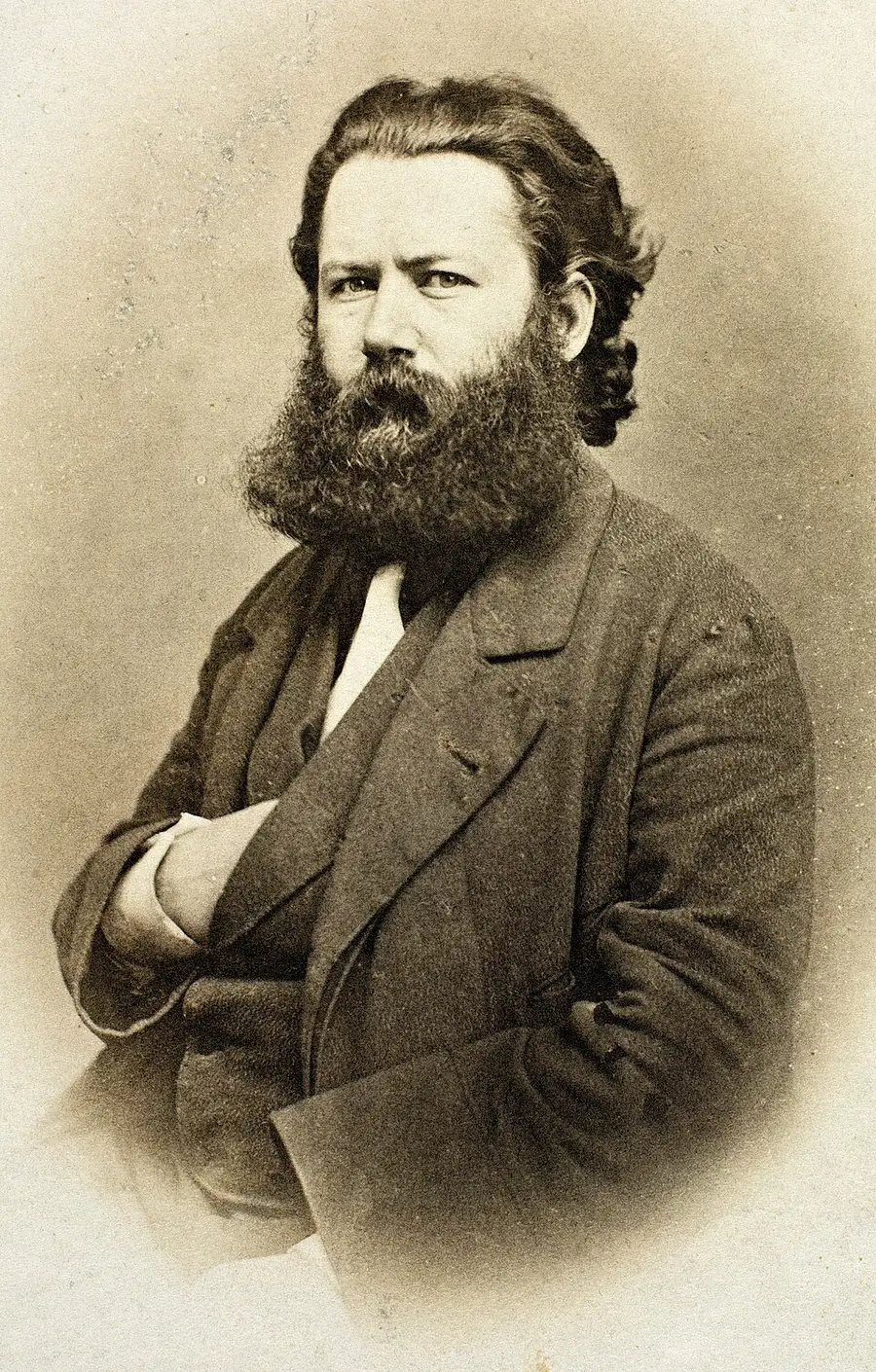 Daniel Georg Nyblin, portrait of Henrik Ibsen (1863–64), National Library of Norway The young Ibsen of the mountain-poetry years, photographed 1863–64 — his *Paa Vidderne* fed the same romantic-nationalist current the Sunday walk grew out of. Norwegian playwright (1828–1906), born in Skien in Telemark
and dead in Christiania. The central figure of nineteenth-
century European theatre and one of the founders of modern
drama. Best known for Brand (1866), Peer Gynt (1867),
A Doll's House (1879), Ghosts (1881), An Enemy of the
People (1882), The Wild Duck (1884), and Hedda Gabler
(1890). Spent twenty-seven years in self-imposed exile in
Italy and Germany before returning to Norway in 1891.
Coined the phrase firehundreårsnatten — the four-
hundred-year night — in Peer Gynt, where it appears in
the Cairo madhouse scene as satire of romantic-nationalist
mythology about Norway's lost language. The phrase was then
adopted in earnest by the mythology Ibsen had been mocking.
In this article Named for his mountain poetry, one current in the romantic-nationalist search for a national vocabulary — the same Ibsen whose 1859 Paa Vidderne coined the word friluftsliv. Also discussed in The 400-Year Night — when the Northern Lion lay dormantFriluftsliv — the open-air life ’s mountain poetry, Fridtjof Nansen
Daniel Georg Nyblin, portrait of Henrik Ibsen (1863–64), National Library of Norway The young Ibsen of the mountain-poetry years, photographed 1863–64 — his *Paa Vidderne* fed the same romantic-nationalist current the Sunday walk grew out of. Norwegian playwright (1828–1906), born in Skien in Telemark
and dead in Christiania. The central figure of nineteenth-
century European theatre and one of the founders of modern
drama. Best known for Brand (1866), Peer Gynt (1867),
A Doll's House (1879), Ghosts (1881), An Enemy of the
People (1882), The Wild Duck (1884), and Hedda Gabler
(1890). Spent twenty-seven years in self-imposed exile in
Italy and Germany before returning to Norway in 1891.
Coined the phrase firehundreårsnatten — the four-
hundred-year night — in Peer Gynt, where it appears in
the Cairo madhouse scene as satire of romantic-nationalist
mythology about Norway's lost language. The phrase was then
adopted in earnest by the mythology Ibsen had been mocking.
In this article Named for his mountain poetry, one current in the romantic-nationalist search for a national vocabulary — the same Ibsen whose 1859 Paa Vidderne coined the word friluftsliv. Also discussed in The 400-Year Night — when the Northern Lion lay dormantFriluftsliv — the open-air life ’s mountain poetry, Fridtjof Nansen 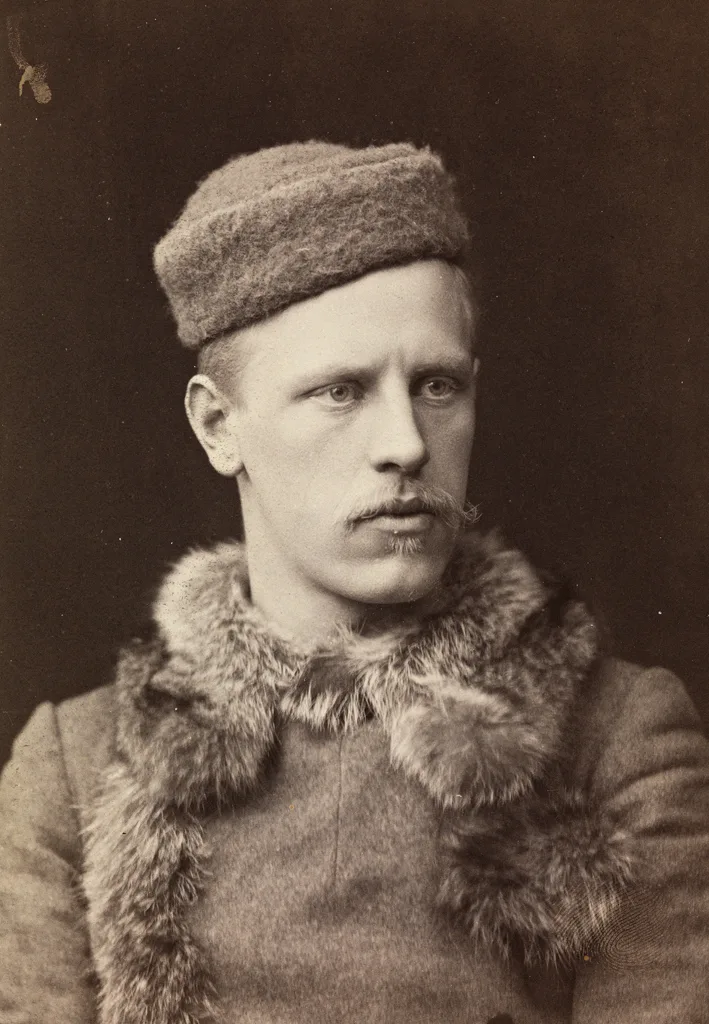 Ludwik Szaciński, Portrett av Fridtjof Nansen (1888), Nasjonalbiblioteket Szaciński photographs Nansen in 1888, the year he skis across the Greenland ice cap at twenty-six — the expedition that makes him the national exhibit for what an ordinary Sunday habit can grow into. Norwegian polar explorer, scientist, diplomat, and statesman (1861–1930). Led the first crossing of the Greenland ice sheet on skis in 1888, then let his ship Fram freeze into the Arctic pack ice from 1893 to 1896, drifting to a record northern latitude of 86°14′. Lectured and wrote widely on skiing and mountain life in the decades Norway built its outdoor-recreation identity toward independence from Sweden (1905), becoming friluftsliv's most visible public face. After the First World War, served as the League of Nations' High Commissioner for Refugees, repatriating roughly 450,000 prisoners of war and creating the Nansen passport, a travel document for stateless refugees. Awarded the Nobel Peace Prize in 1922 for this humanitarian work. In this article Nansen's polar fame is named alongside Ibsen's mountain poetry and the DNT's cabin-building as part of the same romantic-nationalist current that turned the nineteenth-century Sunday walk into an enduring national habit. Also discussed in Friluftsliv — the open-air lifeThe Quiet Revolution — how Norway won its independence without a war ’s polar example, and Den Norske Turistforening (DNT)
 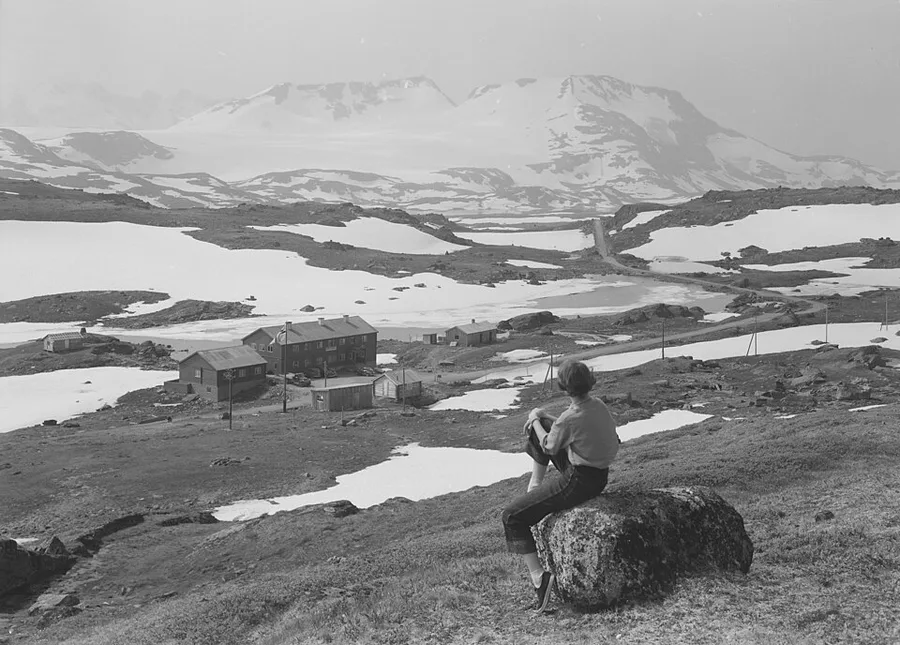 Jac. Brun, Sognefjellshytta (1957), Nasjonalbiblioteket Sognefjellshytta, one of DNT's staffed mountain lodges, photographed on the high Sognefjellet road in 1957 — the same cabin-and-trail network the card says the association has run since 1868. Norway's national trekking association, usually shortened to the DNT, founded in Oslo on 21 January 1868 to develop tourism in the country. Today runs roughly 550 cabins nationwide — a mix of staffed mountain lodges, self-service huts, and unstaffed shelters where members let themselves in with a standard key and pay on the honor system — plus a network of marked trails maintained largely by volunteers. Counts over 300,000 individual members, more than five percent of Norway's population. Local chapters, such as Bergen og Hordaland Turlag (founded 1890), organize regional hikes and maintain trail networks like the ones on Mount Fløyen above Bergen. In this article Named alongside Ibsen's mountain poetry and Nansen's polar fame as one of the forces that built the marked trails and cabins turning the nineteenth-century Sunday walk into a lasting national habit. On the trip The family doesn't overnight in a DNT hut on this itinerary, but the funicular ride up Mount Fløyen in Bergen climbs through trail country the local DNT chapter, Bergen og Hordaland Turlag, has organized hikes on since 1890 — the same trail-and-cabin culture, encountered without ever booking a bunk. Oslo Also discussed in Friluftsliv — the open-air life(*Draft)Ildsjel — the ones who keep it all going building cabins and marking trails. The newly industrial cities — Oslo (then Kristiania), Bergen, and Trondheim — provided the conditions: a new middle class with a free day at the end of the week and an instinct that the day should be spent outdoors. By the early twentieth century the Sunday walk was simply what one did. Post-war prosperity, the car, and a school system that took children outside in any weather made the walk universal.
The kit
A søndagstur has a recognizable kit: a thermos of black coffee, an orange, a Matpakke 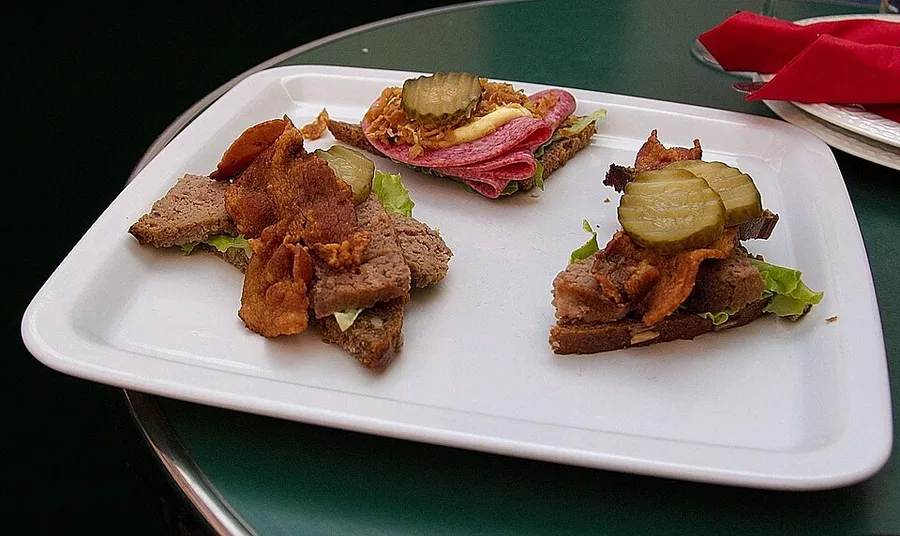 Photo by Anne-Sophie Ofrim (2009), CC BY-SA 4.0, via Wikimedia Commons Open-faced slices in their dressed-up café form — restaurant smørbrød rather than a packed lunch, but built on the same open-faced, nothing-on-top principle the matpakke carries to school and work. Norway's packed lunch — literally food-pack. Four or five open-faced sandwiches, one topping (pålegg) per slice, never stacked or closed, separated by squares of mellomleggspapir (waxed interleaving paper) and stacked flat into a box or wrapped in matpapir. Carried to school and work by nearly everyone regardless of rank — a schoolchild, a bus driver, and a government minister eat the same shape of lunch. The modern habit traces to 1932, when the Oslo school health authority under the physician Carl Schiøtz introduced the Oslofrokost (Oslo Breakfast), a free daily meal for undernourished city schoolchildren; within two decades the model migrated into the home-packed lunchbox, prized by some as an egalitarian habit and criticized by others for keeping Norwegian lunch culture flat. In this article Part of the standard søndagstur kit alongside the thermos, the orange, and the Kvikk Lunsj bar — the packed lunch travels from the school bag and the office desk onto the trail. On the trip The matpakke shows up constantly on travel days. Norwegian hotel breakfast buffets are built for it — bread, cheese, cold cuts, and a stack of mellomleggspapir at the end of the table for anyone assembling a lunch to carry out the door. On the long legs — the Nutshell train and ferry for the Ungdommene (the Youngsters), the Slektsreisen drive north for the Gråhårsklubben (the Oldsters) — a matpakke wrapped at breakfast is the practical way to eat lunch without hunting down a restaurant between train platforms and fjord crossings. Also discussed in (*Draft)Hverdagsliv — Norway on an ordinary Tuesday(*Draft)Pålegg — Norwegian toppingsMat og Drikke — Norwegian food and drink (matpakke), and a bar of Kvikk Lunsj
 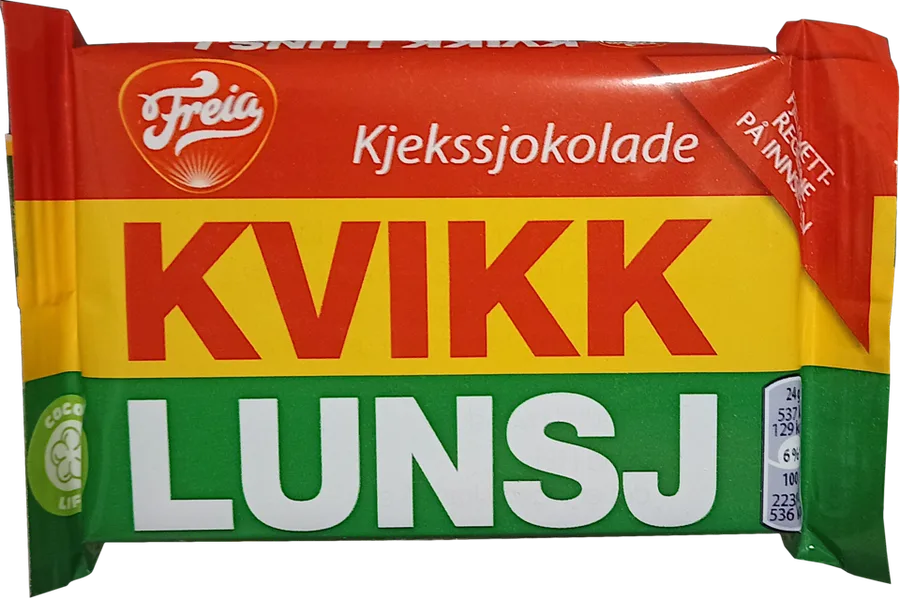 TigerfraMars, Kvikk Lunsj front (2024), CC BY-SA 4.0, via Wikimedia Commons The Freia Kvikk Lunsj bar in its familiar red-yellow-green wrapper — the trail-food staple the card describes as the standard companion to a Norwegian tur since 1937. Norway's traditional hiking-and-skiing chocolate bar — four rectangular wafer fingers under milk chocolate, launched by the Oslo chocolate maker Freia in 1937 and marketed, then and now, as portable trail food (the name means, plainly, quick lunch). An early dark-chocolate version sold poorly and was pulled; production also paused between 1941 and 1949 during and after the wartime sugar shortage. Once reformulated in milk chocolate it became the standard companion to the Norwegian tur — the wrapper printed each season with a different marked DNT trail — and today some sixty million bars leave the factory each year in a country of 5.6 million people. Norwegians are well aware the bar is nearly identical to the British Kit Kat and treat the resemblance as beside the point. On the trip A Kvikk Lunsj bar is the obvious thing to tuck into a daypack on any walking day — the Aurlandsdalen overlook at Stegastein, the Nærøyfjord ferry, a loop around Lillehammer. Both travel groups are equally likely to end up with a wrapper in a pocket: the Ungdommene (the Youngsters) on the Nutshell route west, the Gråhårsklubben (the Oldsters) on the Slektsreisen drive north. Also discussed in The Hytte — a sacred pastime of modern NorwayTradisjoner — celebrations across the Norwegian year — the four-fingered milk-chocolate wafer Freia introduced in 1937 as a portable lunch for skiers and walkers. Sixty million bars a year now leave the factory in a country of 5.6 million. The wrapper is printed with a different DNT-marked trail every season. The Kvikk Lunsj is nearly the same product as the British Kit Kat. Norwegians know, and treat it as beside the point.
What the walk replaced
The country’s churches emptied across the same century the walk filled. The day the church used to organize did not disappear with the doctrine — the day off, the slow morning, the shared meal stayed in place. The contents shifted; weekly churchgoing has fallen to a few percent of the population, and none of it moved the Sunday.
The walk is not the new church. Norwegians would shrug at the comparison. But the functional overlap is hard to miss: a weekly day set apart, a small group of familiar people, an object shared — bread, coffee, chocolate — at a moment of pause, a vague sense that the day is one you ought to use well. The Norwegian Sunday has everything God intended, just setting aside the God part.
The moral weight of the walk
The Norwegian word kondisjon means cardiovascular fitness, and a Norwegian will use it in a sentence that quietly assumes fitness is a moral state — that a person who keeps their kondisjon has something a person who lets it go does not. Janteloven 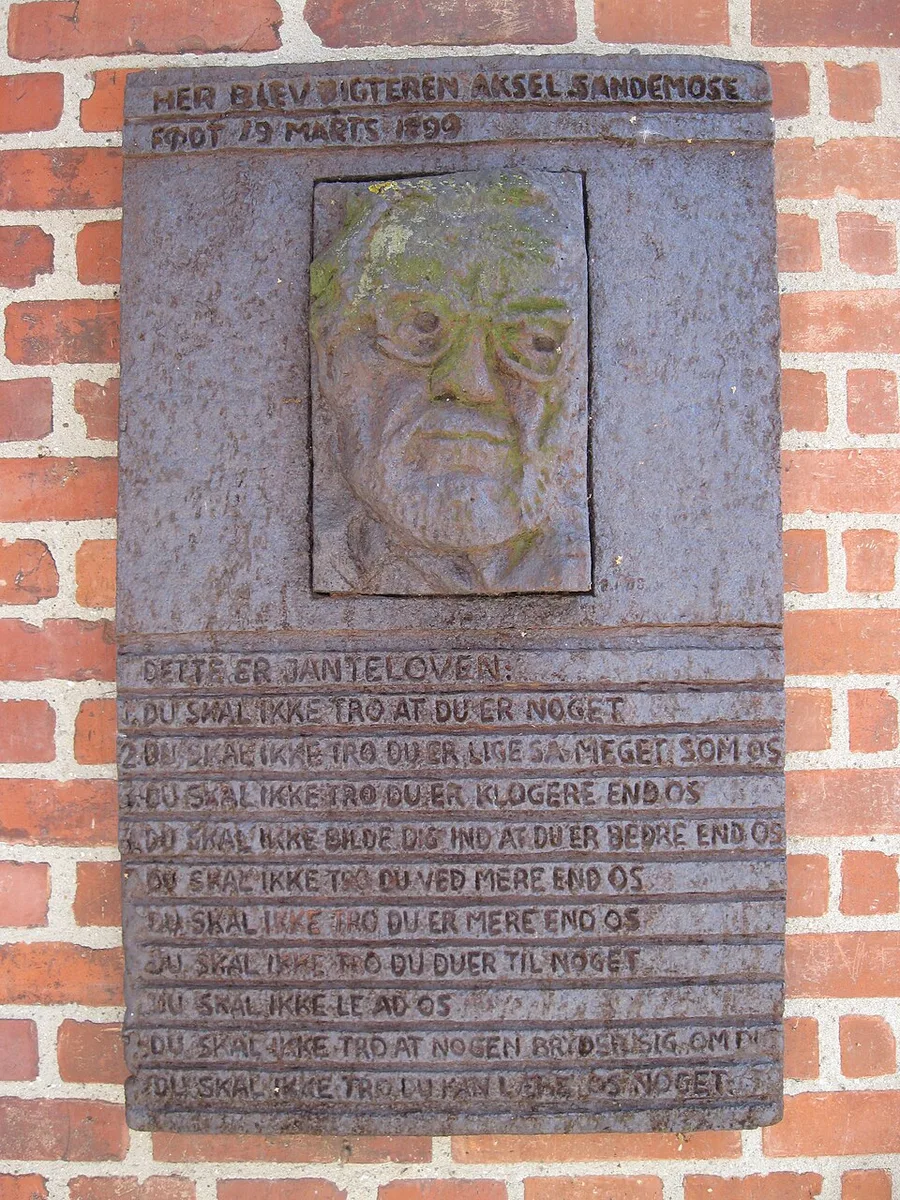 Photo: Poul Krogsgård (2011), CC0, via Wikimedia Commons The memorial plaque on Aksel Sandemose's birth house in Nykøbing Mors — the real town behind fictional Jante — carries his portrait in relief and all ten rules under the heading 'Dette er Janteloven'. The town he indicted wears the law on its wall. The Law of Jante — ten unwritten rules of collective modesty that Norwegians (and other Scandinavians) use to describe their own culture's suspicion of standing out. Formulated by the Danish-Norwegian novelist Aksel Sandemose in his 1933 novel En flyktning krysser sitt spor (A Fugitive Crosses His Tracks) as a satire of his fictional hometown of Jante. Each rule begins Du skal ikke tro (You shall not believe) — the first is Du skal ikke tro at du er noe, "You shall not believe that you are someone." Written as an indictment of one small town's pettiness, the rules were adopted across Norway and Denmark as a portrait of the whole culture, and the reading has held for nearly a century: muted status display, narrow salary differentials, and a real social cost for self-promotion. Also discussed in Janteloven — no one is better than anyone elseIdentitet — what it means to be Norwegian(*Draft)Dugnad — showing up to help(*Draft)Pålegg — Norwegian toppings polices standing out; this instinct polices letting go. To have walked, in any weather, is to have done the right thing by the day.