Food and dining customs — having patience, free water, brunost on everything
How Norwegian restaurants actually work — slower service, free water, brunost on everything, and the small habits that mark you as a tourist if you don't know them. Plus a short menu glossary.
Service is slow on purpose
A sit-down Norwegian dinner often stretches well past an hour. The kitchen is not behind; the server is not neglecting you; the table is yours for the evening. The check does not arrive until you ask for it — kan jeg få regningen, takk? — and until you ask, no one will rush you toward the door. Settle in. Drink slowly. Look out the window.
Water is free, and excellent
Tap water is free — ask for it (say springvann). Norwegian tap water is among the cleanest in the world; the bottled kind is unnecessary. Sparkling is ordered like anywhere in Europe. Top-ups happen without ceremony.
No bread basket, no free anything
Nothing arrives free at the start of the meal — no bread, no chips, no amuse-bouche. Coffee refills are sometimes free at a casual café, not at a sit-down restaurant. The bottomless American cup is not a Norwegian concept.
Ordering and paying
The mechanics depend on the kind of place:
- Casual cafés (kafé) — order at the counter, pay then, take a number, and sit down. Your food is brought to you.
- Sit-down restaurants — order at the table, and pay at the table when you’re done. The server brings a portable card reader over.
- Splitting the bill by individual item is unusual and a little awkward to ask for. The Norwegian norms are to split the total evenly or to have one person pay (and settle up later among yourselves).
On tipping, service is always included, so anything you leave is a bonus — rounding up the bill is already generous.
A menu glossary worth carrying
Words you will meet on Norwegian menus:
- Brunost
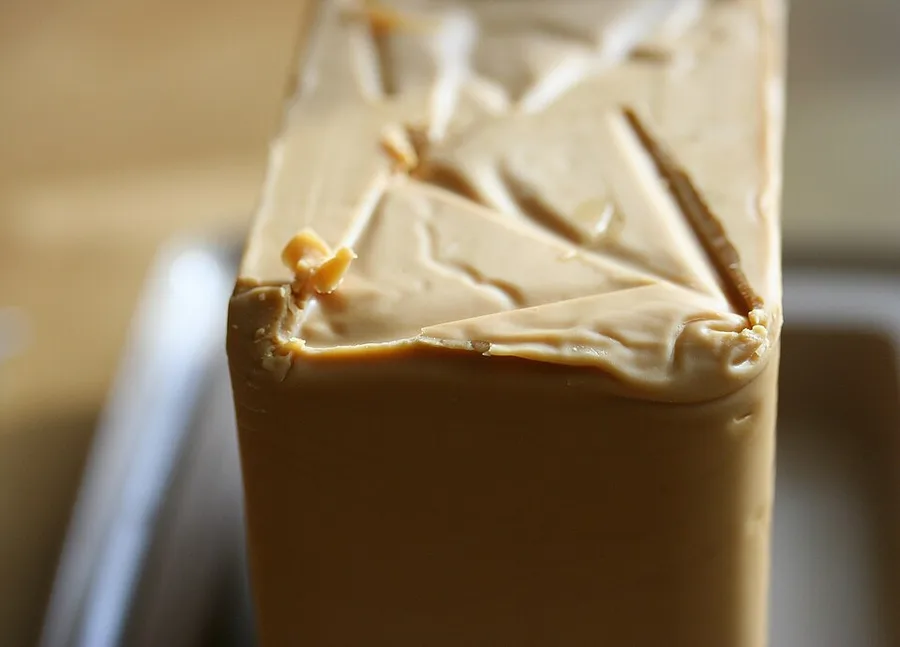 Photo by color line (2006), CC BY 2.0, via Wikimedia Commons A block of brunost up close — the caramel-brown color is the point: whey boiled down with cream, Anne Hov's 1863 refinement, sold as a dense brick and sliced into thin curls for bread or the weekend waffle. Norway's brown cheese — not a cheese in the strict sense but a caramelised whey product, made by boiling cream into leftover whey until the milk sugars reduce and brown. The best-known variety, Gudbrandsdalsost, was given its modern form in 1863 by the farmwife Anne Hov at the Solbråsetra mountain dairy in Gudbrandsdalen; TINE, the national dairy cooperative, still sells the original recipe as Gudbrandsdalsost Anno 1863. Sold as a dense brown brick and sliced into thin curls with the ostehøvel — the cheese plane, itself a Norwegian invention — for bread or a waffle. Foreign visitors tend to find its sweet, faintly goaty caramel flavor bewildering on first taste; to a Norwegian it is the taste of childhood. In this article The headword the menu glossary flags as everywhere — the brown slice on the breakfast buffet, the caramel curl on a waffle, and the distinctly Norwegian flavor a returning traveler misses back home. On the trip Brunost is on every hotel breakfast buffet the family sits down to across the nine days — sliced thin with an ostehøvel next to the bread basket, next to jams and the everyday Norvegia. It turns up again wherever a waffle is served, the classic pairing, and it is one of the easiest ways for a first-time visitor to taste something distinctly Norwegian without leaving the breakfast table. Also discussed in Mat og Drikke — Norwegian food and drink(*Draft)Pålegg — Norwegian toppings(*Draft)Hverdagsliv — Norway on an ordinary Tuesday — brown, faintly caramelized whey cheese. It is everywhere, and worth trying; it tastes nothing like it looks.
 - kjøttkaker — meatballs in brown gravy, the homestyle classic.
- fårikål — lamb-and-cabbage stew. An autumn dish; less likely on a July menu but possible in a mountain town.
- lefse — thin, soft potato flatbread, usually served with butter and sugar or cinnamon.
- fiskesuppe — creamy fish soup, a coastal classic and a very safe order in Bergen
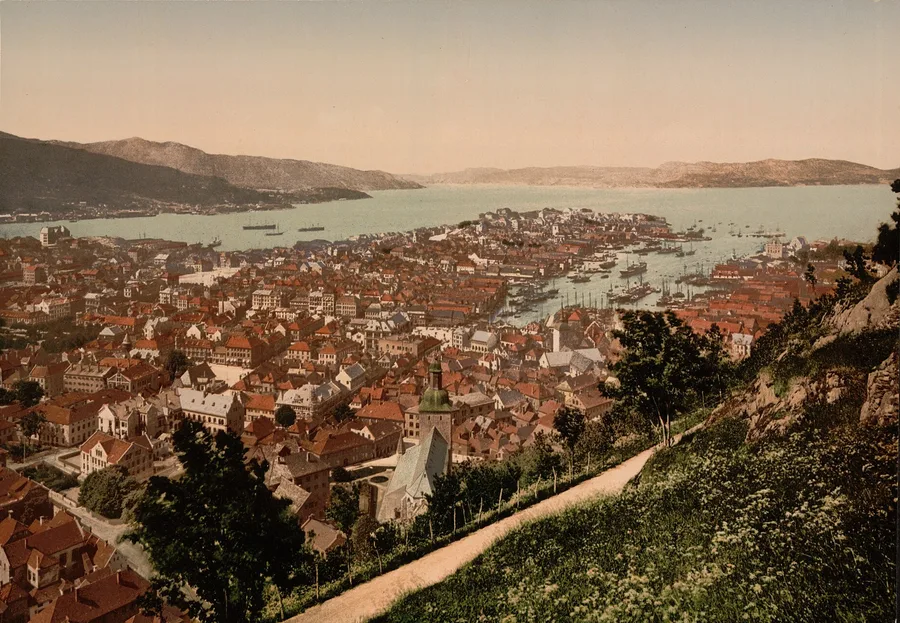 Photochrom print, General view from Fjeldveien, Bergen (c. 1890–1900), Library of Congress Bergen in the 1890s from the Fjellveien path on Fløyfjellet — the whole city between its mountains, Vågen harbour still crowded with sailing ships at its heart. For four centuries Norway's largest city, and the wharf through which the entire western export economy ran. Norway's western trading capital, founded around 1070 on the
inner Byfjorden. For four centuries the largest city in the
country and the wharf through which the entire western export
economy ran — dried cod from the Lofoten fisheries, stockpiled
and traded by the Hanseatic merchants at Bryggen from 1360 to
1754. Norway's commercial and intellectual heart through the
Hanseatic period; overtaken in size by Christiania (Oslo) in the
1830s. The painted wooden Bryggen wharf is on the UNESCO World
Heritage list and substantially what it was in the late
seventeenth century.
In this article Bergen's Fish Market on the Vågen inlet is the coastal larder at
its source — fiskesuppe and reker where the harbour opens to the
sea, and where the Ungdommene (the Youngsters) start Day 4.
On the trip The Ungdommene (the Youngsters) reach Bergen late on Day 3
via the Norway-in-a-Nutshell train-and-ferry route from
Oslo. On the Day 4 morning they walk Bryggen and ride the
funicular up Mount Fløyen before flying back to Oslo and driving
on to Lillehammer that evening — a day ahead of the Gråhårsklubben
(the Oldsters), who spend the split days north in Trondheim and
the heritage country of Stjørdal, Hegra, and Kylloplass and come
south on Day 5.
Bergen Also discussed in The Germans Who "Ruled" Bergen — the Hanseatic merchants on Bryggen WharfBefore There Was Norway — petty kingdoms at the edge of the worldThe King Who Became a Saint — how the Nordmen came to ChristA Catholic Norway — the faith that gave the kingdom its first institutions and the stave churchesThe Long Fall — the sudden loss of Norwegian nobility, the end of the kings, and half of Norway gone foreverThe Golden Age — a North Atlantic empire … reaching farther than you thinkThe 400-Year Night — when the Northern Lion lay dormantThe Crusades?!!!! — sixty ships from Bergen, bound for the Holy LandThe Reformation, 1537 — one church eradicated and another imposedWorld War II — the King’s “No” and the Nazis in NorwayKraken — the island-sized beast, logged as factSjøormer — the serpents in the deep lakes and fjordsPesta — an old woman walking from farm to farmFossegrimen — the waterfall fiddler who teaches you to playAlcohol and Vinmonopolet — when and where to buy a drinkEveryday etiquette — quiet voices, wide space, no smiling🚨 Emergencies - important numbers, hospitals, and what you can doLanguage basics — just enough Norwegian to be politeWhat to wear — the layering system, on the ground .
Photochrom print, General view from Fjeldveien, Bergen (c. 1890–1900), Library of Congress Bergen in the 1890s from the Fjellveien path on Fløyfjellet — the whole city between its mountains, Vågen harbour still crowded with sailing ships at its heart. For four centuries Norway's largest city, and the wharf through which the entire western export economy ran. Norway's western trading capital, founded around 1070 on the
inner Byfjorden. For four centuries the largest city in the
country and the wharf through which the entire western export
economy ran — dried cod from the Lofoten fisheries, stockpiled
and traded by the Hanseatic merchants at Bryggen from 1360 to
1754. Norway's commercial and intellectual heart through the
Hanseatic period; overtaken in size by Christiania (Oslo) in the
1830s. The painted wooden Bryggen wharf is on the UNESCO World
Heritage list and substantially what it was in the late
seventeenth century.
In this article Bergen's Fish Market on the Vågen inlet is the coastal larder at
its source — fiskesuppe and reker where the harbour opens to the
sea, and where the Ungdommene (the Youngsters) start Day 4.
On the trip The Ungdommene (the Youngsters) reach Bergen late on Day 3
via the Norway-in-a-Nutshell train-and-ferry route from
Oslo. On the Day 4 morning they walk Bryggen and ride the
funicular up Mount Fløyen before flying back to Oslo and driving
on to Lillehammer that evening — a day ahead of the Gråhårsklubben
(the Oldsters), who spend the split days north in Trondheim and
the heritage country of Stjørdal, Hegra, and Kylloplass and come
south on Day 5.
Bergen Also discussed in The Germans Who "Ruled" Bergen — the Hanseatic merchants on Bryggen WharfBefore There Was Norway — petty kingdoms at the edge of the worldThe King Who Became a Saint — how the Nordmen came to ChristA Catholic Norway — the faith that gave the kingdom its first institutions and the stave churchesThe Long Fall — the sudden loss of Norwegian nobility, the end of the kings, and half of Norway gone foreverThe Golden Age — a North Atlantic empire … reaching farther than you thinkThe 400-Year Night — when the Northern Lion lay dormantThe Crusades?!!!! — sixty ships from Bergen, bound for the Holy LandThe Reformation, 1537 — one church eradicated and another imposedWorld War II — the King’s “No” and the Nazis in NorwayKraken — the island-sized beast, logged as factSjøormer — the serpents in the deep lakes and fjordsPesta — an old woman walking from farm to farmFossegrimen — the waterfall fiddler who teaches you to playAlcohol and Vinmonopolet — when and where to buy a drinkEveryday etiquette — quiet voices, wide space, no smiling🚨 Emergencies - important numbers, hospitals, and what you can doLanguage basics — just enough Norwegian to be politeWhat to wear — the layering system, on the ground . - rakfisk — fermented fish. A genuine acquired taste; entirely optional.
- rømme — thick sour cream, served alongside many dishes.
- boller — sweet rolls, often spiced with cardamom.
- vafler — heart-shaped waffles, served with sour cream and jam. A coffee-shop staple, frequently available all day.
- reker — shrimp; a traditional summer treat eaten with bread, mayonnaise, and lemon.
- laks / ørret — salmon / trout, on nearly every menu.
Coffee
Norway has the second-highest per-capita coffee consumption in the world, after Finland. The default is filter coffee — strong, black, plentiful. Order en kaffe and that is what arrives. Espresso drinks exist everywhere — cappuccino, latte, americano — and ordering one is fine; they simply aren’t the baseline.
Skål
When a glass is raised with Norwegians, the form is: look the other person in the eye, say skål, drink, and look them in the eye again as you set the glass down. Norwegians take the eye contact seriously enough that skipping it reads as mildly rude. At a long table, you skål each person individually, around the table, with the eye contact each time. It takes a while. The time is the courtesy.
Wine and aquavit
Wine is expensive — a glass at dinner is normal, a whole bottle is a small celebration. The traditional Norwegian spirit is aquavit (akevitt), a caraway-flavored grain spirit most associated with Christmas and with rich, heavy food. If a Norwegian relative offers you a small glass of aquavit in their home, accept it. Refusing the offered drink reads as a minor social slight, and the glass is small by design.