Hotels in Norway — Frokost, check-in, and the luggage-room habit
Seven hotels in nine nights means seven check-ins and one day where you'll need to store bags between rooms. The Norwegian habits to know — included breakfast, the near-universal luggage room, the 15:00-or-16:00 check-in time, and the Day 7 to Day 8 storage problem.
Norwegian hotels run on slightly different defaults than American ones. None of the differences are obstacles, but they’re worth knowing once before the first check-in.
Frokost. Breakfast, almost always included. Even at the big mid-market chains like Scandic, frokost is the social anchor of the morning and the meal Norwegians take most seriously. Hot dishes, six kinds of bread, brown cheese, salmon, pickled herring, fruit, three coffees, juice. Served roughly 07:00–10:00 on weekdays, often later on weekends. Fill up — it doubles as lunch on the road. A second cup of coffee is normal. So is wrapping a roll in a napkin for the train; nobody minds.
Check-in. Usually 15:00 at Thon and Comfort, but 16:00 at Scandic. If you arrive earlier, reception will take your bags and you can wander until the room is ready. They will not pretend you’re not there.
Luggage room — bagasjerom. Common. Free. Standard at most hotels on the route. Ask at reception when you arrive ahead of check-in, or when you’ve checked out but aren’t quite ready to go. They label your bag, hand you a tag, and stack it in a small locked closet behind the desk. This is the single most useful Norwegian-hotel habit to know.
Key cards. Norwegian rooms use plastic card locks. The card usually also runs the elevator (insert it in a slot before pressing the floor) and the room lights (drop it in a slot inside the door to power the room). When you leave the room, the lights time out a few seconds after you pull the card. This is a feature, not a bug. Don’t pull the card while charging your phone.
Reception desk. Open 24 hours at the chain hotels (Scandic, Thon, Comfort). Smaller family-run places lock the door at 22:00 or 23:00 and give you an after-hours code. Confirm the late-arrival policy by email before any leg of the trip where you’re checking in after 21:00.
Boarding-pass printing. A hotel front desk may charge to print a boarding pass. Save your boarding pass in your phone’s wallet app before you leave the room.
Free WiFi. Universal, decent, password printed on the welcome card or asked at reception. Speeds are fine for everything except large uploads.
Tap water. Drinkable everywhere. The carafe on the desk is for you. Refill it.
Tipping the housekeeper. Not expected. A Norwegian krone (NOK) 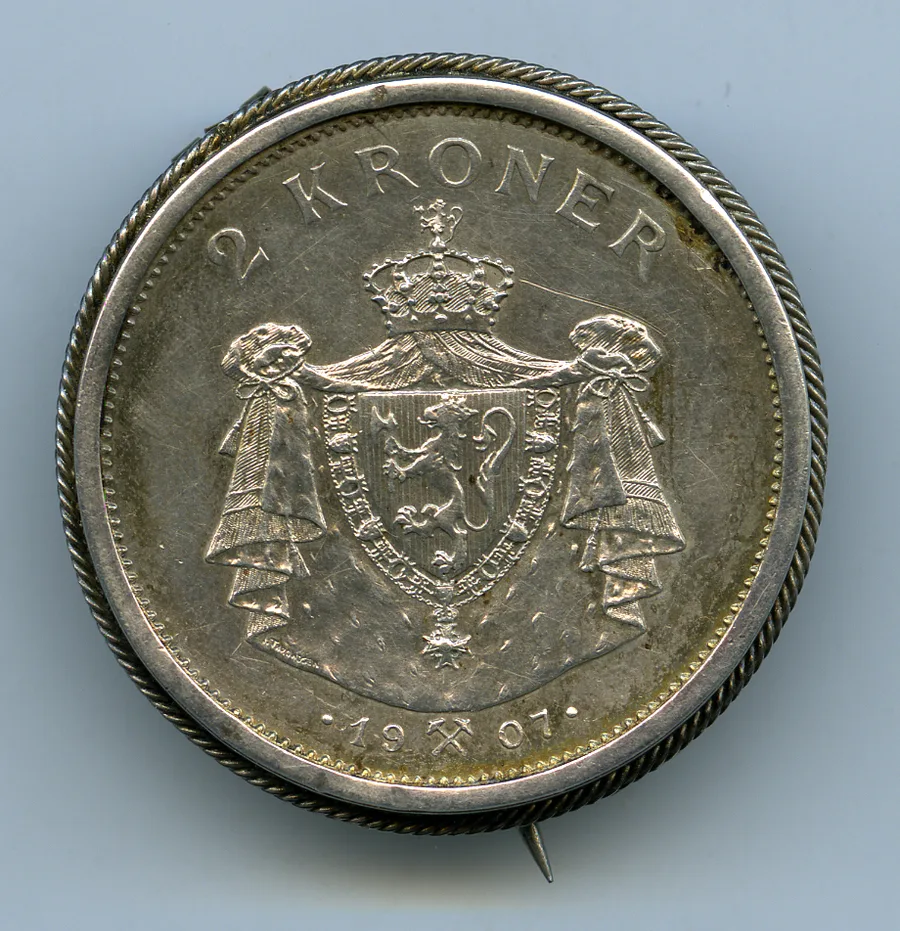 Trondheim Municipal Archives (Trondheim byarkiv), CC BY 2.0, via Wikimedia Commons Struck for the 1906 coronation of Haakon VII (this specimen dated 1907, the commemorative type's second mintage year), a generation into the krone's own history, this coin is a genuine early example of the currency the card describes — not a modern note or coin still in Norges Bank circulation. Norway's currency since 1875, when it replaced the earlier speciedaler (at 4 kroner to 1 speciedaler) and joined the short-lived Scandinavian Monetary Union that pegged the Norwegian, Swedish, and Danish kroner at par. Abbreviated NOK and written kr, nominally subdivided into 100 øre, though no øre coins have circulated since 2012 — cash and card transactions both settle in whole kroner even where a listed price still shows two decimal places. Present-day notes run 50 to 1000 kroner; coins run 1 to 20 kroner. The krone has floated freely since Norway abandoned its currency peg in December 1992, and the country's oil-linked wealth keeps it among Europe's stronger, and more expensive-to-spend, currencies. In this article Small hotel costs still show up in kroner even in a nearly cashless country — a boarding-pass printout, a luggage locker at Oslo S, a note left on the pillow for housekeeping. On the trip The kroner meet the family at Oslo Gardermoen, where an arrival ATM covers a cash backup that mostly goes unused across nine days of tap-to-pay cafés, transit gates, and hotel front desks. The Gråhårsklubben (the Oldsters) watch the krone add up in smaller doses on the Slektsreisen drive north — a fuel stop, a parking meter, a toll gantry reading a plate rather than a card — while the Ungdommene (the Youngsters) spend theirs mostly on trains, ferries, and a Bergen coffee or two. Also discussed in Money — currency, cards, prices, and tippingDriving in Norway — tolls, ferries, and a near-zero alcohol limitPublic transit basics — trains, trams, boats, and buying tickets note left on the pillow at the end of a multi-night stay is a generous gesture, never an obligation.
The Day 7 → Day 8 problem
The trip’s last full day (Saturday, August 1) runs from Lillehammer — Maihaugen in the morning, then the drive south — and ends with check-in at the airport hotel at Oslo Airport (Gardermoen) 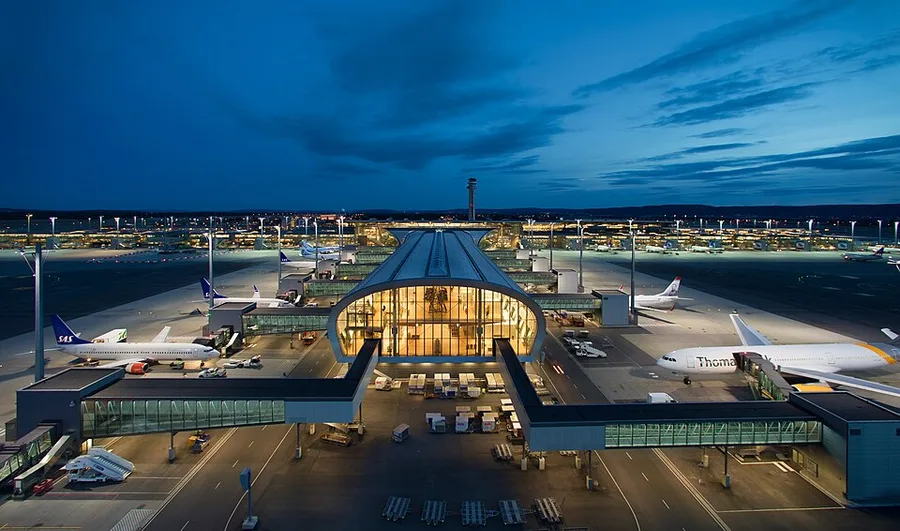 Espen Solli / Avinor Oslo lufthavn, Oslo Airport terminal night view (2017), CC BY 3.0 The terminal every traveler passes through on arrival, and again before the final morning's flights home — the Gardermobanen rail line into Oslo S starts just beneath this building. Norway's principal airport (IATA: OSL), opened on 8 October 1998 roughly 50 km north-northeast of central Oslo near the town of Gardermoen, in Ullensaker municipality, replacing the smaller in-town airport at Fornebu. Built at a cost of some NOK 11.4 billion, Gardermoen handles the overwhelming majority of Norway's international air traffic and anchors the dedicated Gardermobanen high-speed rail line into Oslo Central Station — one of the fastest airport-to-city rail connections in Europe, run by both Flytoget and the ordinary Vy trains. In this article The last Norwegian night is the airport stop on the way home — bags come out of the car and straight to the front desk, an early check-in ahead of the next morning's flights. On the trip The whole family's Norway begins and ends at Gardermoen — everyone lands here before Day 1 and rides the train into Oslo S, and on Day 7 the group returns to spend one last Norwegian night near the airport before the flights home the next morning. Gardermoen Also discussed in Landing in Norway — off the plane in Oslo, where to go, step by step🚨 Emergencies - important numbers, hospitals, and what you can doAlcohol and Vinmonopolet — when and where to buy a drinkMoney — currency, cards, prices, and tippingWhat to wear — the layering system, on the groundPublic transit basics — trains, trams, boats, and buying tickets for the early Sunday flights. The luggage logistics work fine, but only because you do them in this order:
- Saturday morning — check out of the Lillehammer hotel and load the cars for the drive south. Bags travel with you.
- Saturday afternoon — drop bags directly at the airport hotel on arrival. The hotel will check you in or hold the bags until they can. No taxi loop, no airport storage.
- Sunday morning — the airport hotel puts the terminal a few minutes away, so allow for the short morning hop; the bags rolled straight from the car to check-in the night before.
If for any reason the bags need to live somewhere other than a hotel for a few hours, Oslo S (Oslo Central Station) 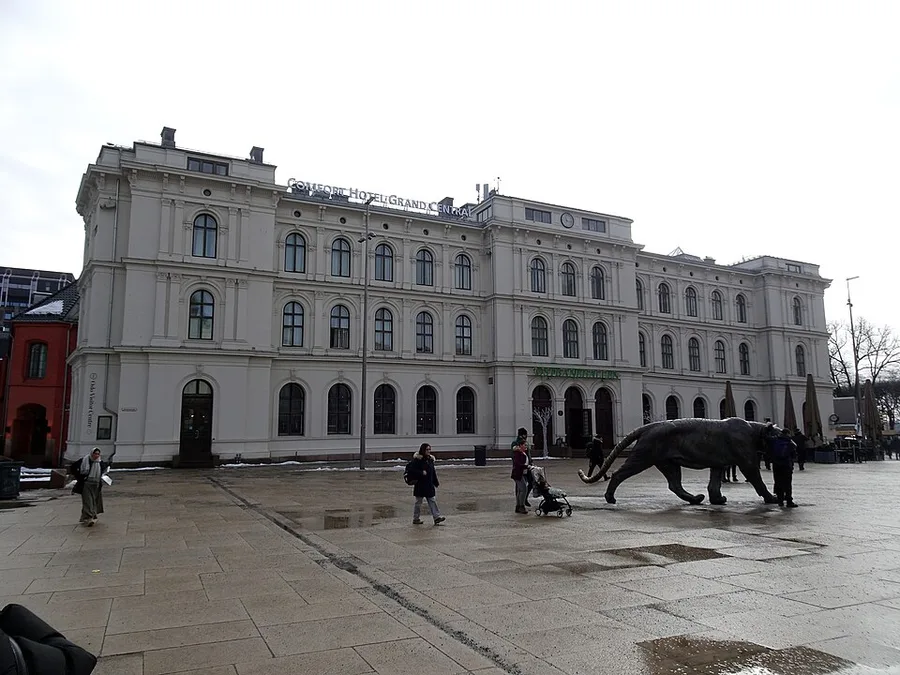 Østbanehallen (the historic 1882 East Station hall), Jernbanetorget, Oslo — Wikimedia Commons Østbanehallen, the 1882 East Station building on Jernbanetorget, is the historic face of Oslo S — Norway’s busiest station, where airport, intercity and local trains and the metro all converge; the bronze tiger gives Oslo its nickname ‘Tigerstaden.’ Norway's largest and busiest railway station, sitting at Jernbanetorget in central Oslo. The current station building opened in 1980, merging two older, separately run stations — the Østbanen (East Line Station) and the Vestbanen (West Line Station) — that had served the country's rail network since its first line opened between Christiania and Eidsvoll in 1854; the merged station took its current name, Oslo S, in 1981. Operated by Bane NOR, it is the hub for the Flytoget airport express, the Vy long-distance and regional trains (to Bergen, Trondheim, Stavanger, and international routes into Sweden and Denmark), and the T-bane metro, trikk (tram) lines, and city buses converging at the adjoining Jernbanetorget square. In this article The station's basement luggage lockers give the group a paid, secure place to stash bags between a morning checkout and an evening flight. On the trip Every traveler passes through Oslo S more than once — off the Flytoget or Vy train from Gardermoen on arrival, and again when the Ungdommene (the Youngsters) find their platform for the early Bergensbanen departure toward Myrdal and the Norway in a Nutshell route on Day 3. The station's food court past the train gates is the family's fallback meeting point if flights or bags don't land together. Oslo Also discussed in Public transit basics — trains, trams, boats, and buying ticketsLanding in Norway — off the plane in Oslo, where to go, step by step🚨 Emergencies - important numbers, hospitals, and what you can do has luggage lockers in the basement near the food court, roughly NOK 130–300 per 24 hours depending on locker size, card payment, English instructions.
The one variant worth flagging: if anyone in the group wants a last stretch of Oslo on Saturday afternoon before heading to the airport, leave the bags at the airport hotel first, then take the Flytoget 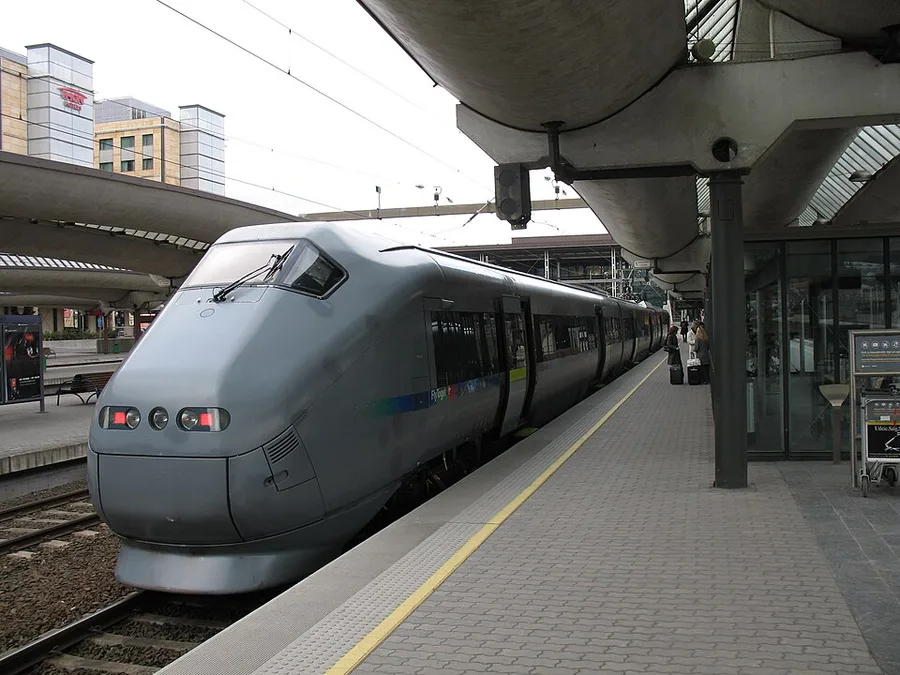 Kjetil Ree, Flytoget Oslo S (2006), CC BY-SA 3.0 The train itself, nose-on at the Oslo S platform where every traveler catches or leaves it on the ride to and from Gardermoen. The Airport Express Train, a dedicated premium rail operator running nonstop between Oslo Airport Gardermoen and Oslo Central Station (Oslo S) in about 19–20 minutes on the shared Gardermobanen line, at a fare above the ordinary Vy trains that also call at the airport. Flytoget runs its own rolling stock at a near-clockwork ten-minute frequency, tapped straight through with a contactless card at the gate. In February 2026 the Norwegian government announced that Flytoget's separate operation will fold into the regional network by December 2027, ending its run as a standalone premium service. In this article A same-day round trip on Flytoget is the cleanest way to fit in a last morning of Oslo shopping on Day 7 before the bags settle at the airport hotel for the night. On the trip Stepping off the international flight, the family weighs Flytoget against the slower, cheaper Vy train for the ride into Oslo S — about five minutes and ten dollars apart, a pick-by-mood decision. On Day 7's last afternoon, anyone who wants one more stretch of Oslo can ride the Flytoget back into the city and out again before dinner. Also discussed in Landing in Norway — off the plane in Oslo, where to go, step by step back into Oslo S for a few hours, and back out again before dinner. Two nineteen-minute rides that cost about NOK 490 round trip per person. It’s the price of the afternoon.