Time, daylight, and Norwegian hours — Seventeen hours of light, six of jet lag
Late-July sun until about 22:00 (bring an eye mask), six hours ahead of US East Coast (treat Day 1 as a slow-arrival day), and shops that close at 18:00 on weekdays and all day Sunday. The Norwegian rhythm runs on a different clock.
The light
Late July in southern Norway runs on roughly seventeen hours of daylight: sunrise around 04:45, sunset around 22:00, and a long pale twilight through the small hours when the sky never goes fully dark. Both ends drift toward darker by August 2 — sunrise a little later, sunset closer to 21:45.
Farther north the days stretch longer still: the Gråhårsklubben (the Oldsters), up in Trondheim across the split days, get roughly eighteen to nineteen hours of light and a twilight that never quite deepens to true dark.
The body wants to keep going at 22:00 because the sky says it is still afternoon. Hotel curtains help; in smaller places they rarely seal completely. Bring an eye mask and force the down-time anyway.
The time zone
Norway runs on Central European Summer Time, UTC+2, through the trip.
| From | Offset | 10:00 in Norway is |
|---|---|---|
| Eastern (New York) | +6 | 04:00 |
| Central (Chicago) | +7 | 03:00 |
| Mountain (Denver) | +8 | 02:00 |
| Pacific (Los Angeles) | +9 | 01:00 |
Day 1 — Sunday, July 26, in Oslo — is a slow-arrival day. Light walking, an early dinner, an early night. The body catches up over Day 2.
Telling the time
Norwegian scheduling runs on the 24-hour clock — a train at 14:30, a dinner booking at 19:00, not 2:30 or 7 pm. One spoken quirk catches visitors out: Norwegians name the half-hour by the hour coming, not the one just gone. Halv tre (literally “half three”) is 2:30, not 3:30 — half an hour short of three. When a relative names a halv hour, count back thirty minutes.
Shop hours
| Day | Most shops |
|---|---|
| Weekdays | 08:00–18:00 (some until 20:00 in central Oslo) |
| Saturday | 10:00–16:00 |
| Sunday | Closed |
The exceptions are narrow: small grocery stores under 100 m² (Bunnpris, some 7-Elevens), kiosks, gas-station shops, and gift shops in tourist areas.
Vinmonopolet
Wine, spirits, and anything stronger than light beer is sold only at the Vinmonopolet 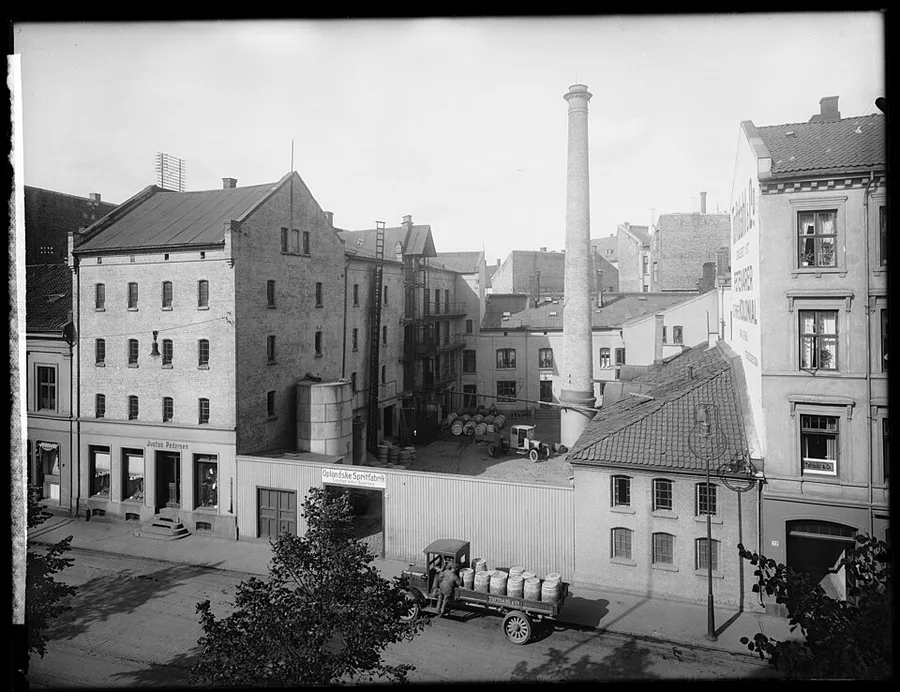 Narve Skarpmoen, A/S Vinmonopolet, Stenersgata 20 (1925), National Library of Norway, public domain The National Library catalogues this as A/S Vinmonopolet’s own Stenersgata 20 property in 1925, three years after the 1922 founding of the state alcohol monopoly — its storage and loading yard rather than a modern store or logo. Norway's state-owned retail monopoly on wine, spirits, and any beverage over 4.7% alcohol by volume — the only legal seller of anything stronger than supermarket beer. Founded in 1922, in the middle of a national prohibition on spirits and fortified wine (1917–1927) that a 1919 referendum had just upheld; the wine-exporting nations Norway depended on to buy its dried and salted fish threatened to stop unless imported wine found a legal outlet again, and Vinmonopolet was created to distribute it under state control. Fully state-owned since 1939, it is now a pure retail monopoly running roughly 350 stores nationwide on short weekday hours, with no Sunday sales. In this article Vinmonopolet keeps the strictest clock of any shop on the trip — 10:00–18:00 on weekdays, 10:00–16:00 Saturdays, and dark every Sunday and holiday. Wine or akevitt for a dinner has to be bought while the counter is still open. On the trip A Vinmonopolet counter sits a short walk from several of the trip's stops — on Karl Johans gate in Oslo, on Valkendorfsgaten in Bergen — and the arrivals duty-free at Gardermoen doubles as the easiest place to pick up a bottle before customs. The whole group passes one on the Day 2 Oslo e-bike route, and the Ungdommene (the Youngsters) pass another near the Fish Market on their Bergen morning; anyone buying wine for a shared dinner, or an akevitt gift for a Norwegian relative, plans around the shop's early close and its closed Sundays. Also discussed in Alcohol and Vinmonopolet — when and where to buy a drinkMoney — currency, cards, prices, and tippingThe stuff no one warns you about - Bathrooms, shoes off and plastic bags . Stricter hours: 10:00–18:00 weekdays, 10:00–15:00 Saturdays, closed Sundays and holidays. Beer under 4.7% ABV sits in regular groceries but only until 20:00 weekdays, 18:00 Saturdays. If a dinner calls for wine, buy ahead.
Restaurant hours
- Lunch: roughly 11:00–14:00
- Dinner: starts 17:00, last orders typically 21:00–22:00
Showing up at 21:30 in Oslo, Bergen, Trondheim, or Lillehammer is a gamble. Book a few days ahead through the restaurant’s own site, or through OpenTable or DinnerBooking, both of which list restaurants in Oslo and other Norwegian cities.
Sundays
Good for: hiking, parks, fjord-side walks, restaurants, most museums. Not good for: shopping. Plan the week so nothing important depends on a Sunday purchase.
One catch that cuts the other way: a fair number of museums close on Mondays instead — check before planning a Monday museum visit.
The dates themselves
July 26 – August 2 sits in a quiet stretch — past Midsummer (June 23–24), before autumn, no public holiday in between. The industrial fellesferien (weeks 28–30 — Monday 6 to Friday 24 July in 2026) thins businesses through mid-to-late July but is over by the 26th.