The stuff no one warns you about — Bathrooms, shoes off and plastic bags
The small things nobody warns you about — public bathrooms, refill culture, taking your shoes off at someone's house, free WiFi, where to do laundry on a nine-day trip, the plastic-bag question at the grocery checkout.
The small stuff that shapes an ordinary day in Norway — none of it a problem, most of it pleasant.
Bathrooms. Paid at Oslo Central Station (about 20 NOK) and in many city centers (5–20 NOK, contactless card); free at the Opera, Rådhuset, and Frognerparken. Reliable at gas stations on the road, McDonald’s and Burger King in cities, every museum. Rare on hiking trails — Stegastein has none. The Norwegian outdoor-pee norm holds in the woods; in town, it does not. The Norwegian word is toalett.
Free WiFi. Universal at hotels, virtually all cafés, all trains (Vy and SJ Nord both offer it), most museums and public buildings. Speeds are decent. Rarely password-gated; when it is, the password is on the receipt or the table card.
Laundry. Most hotels offer laundry but charge per item — 50–80 NOK per shirt is the brutal default and adds up fast. The two reliable self-service options on the route are a Clean Cocos self-service laundromat in central Oslo (about 79 NOK per wash, plus the same to dry) and a Clean Cocos near Bryggen in Bergen (Domkirkegaten 3, a few minutes from the wharf). For a nine-day trip, washing once mid-trip is plenty if anyone packed Merino wool  Bernard Spragg. NZ, public domain (Flickr Public Domain Mark) The fine, densely crimped fleece on a living Merino is exactly what gets sheared, spun, and knit into the wool base layers — sold in Norway as *ullundertøy* — that the Janus and Devold brands built their names on. A fine, soft wool sheared from Merino sheep. Merino fleece runs far finer than ordinary wool — commonly 12 to 24 microns, the softest grades below 18 — so it can be worn directly against the skin without the itch coarser wool causes. It insulates even when damp, wicks moisture rather than holding it, and resists odour far longer than cotton or synthetics — which is why it is the standard base-layer material for the cold, wet, changeable weather Norway's coast and mountains produce most of the year. The Norwegian brands Janus (making merino since 1895 near Bergen) and Devold (founded 1853) are the best-known makers, sold in everyday shops as ullundertøy (wool underwear). In this article A pack of merino base layers is the reason one mid-trip wash is plenty for nine days — the wool doesn't hold odor the way cotton does. On the trip Merino is the base layer under everyone's first shirt on the trip — the Ungdommene (the Youngsters) run the full three-layer stack hardest on the Day 3 Norway in a Nutshell route: cold at the Myrdal platform, warm on the Flåm wharf, cold again on the Nærøyfjord deck by evening. It's also the reason a laundry-light nine days never smells like one. A Flåm Coop rack of Janus or Devold long johns is worth a look for anyone tempted to buy merino for the next twenty Norwegian winters rather than just this one. Also discussed in What to wear — the layering system, on the ground — they don’t smell.
Plastic bags. Norwegian grocery stores charge roughly 6–7 NOK per bag at checkout and most Norwegians bring their own. The cashier will not give you a bag automatically; you have to ask, or grab one off the rack at the end of the belt. A folded reusable bag in a day pack handles a week of grocery stops.
Bottle deposit. Every plastic bottle and drink can carries a pant — a deposit of roughly 2–3 NOK built into the shelf price and refunded when you bring the empty back. Feed the containers into the reverse-vending machine by the grocery entrance; it prints a receipt you redeem at the till (or donate). Norwegians rarely bin a bottle, and the deposit is why.
Refill culture. Restaurants top up your water glass without ceremony, no charge. Refill stations exist in airports, train stations, and the bigger city parks. Coffee refills are not free at restaurants and most sit-down cafés. Some counter-service cafés will refill filter coffee for a small fee or free, but it’s a courtesy, not a right.
Shoes off indoors. At any Norwegian home — a relative’s house, a friend’s apartment, the kind of B&B that feels like someone’s living room — shoes come off at the door. Always. This is non-negotiable; nobody will tell you, and walking through the kitchen in your boots reads as deeply rude. Slippers are sometimes provided, sometimes not; bring a pair of clean socks. Important for any heritage visit to a relative’s home in Oslo, Stjørdal, or Lillehammer.
Sundays. Most shops and Vinmonopolet 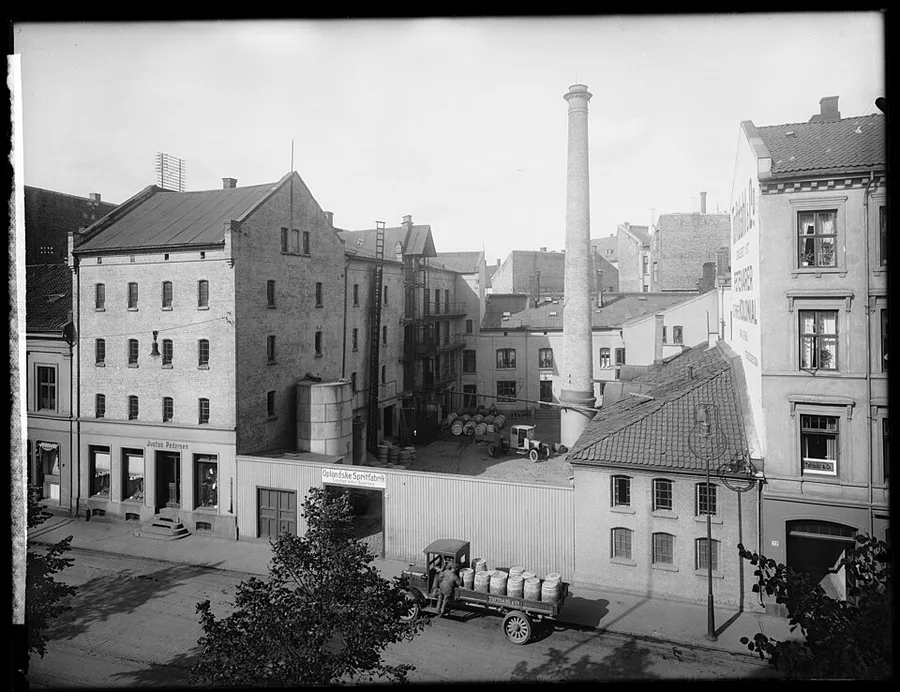 Narve Skarpmoen, A/S Vinmonopolet, Stenersgata 20 (1925), National Library of Norway, public domain The National Library catalogues this as A/S Vinmonopolet’s own Stenersgata 20 property in 1925, three years after the 1922 founding of the state alcohol monopoly — its storage and loading yard rather than a modern store or logo. Norway's state-owned retail monopoly on wine, spirits, and any beverage over 4.7% alcohol by volume — the only legal seller of anything stronger than supermarket beer. Founded in 1922, in the middle of a national prohibition on spirits and fortified wine (1917–1927) that a 1919 referendum had just upheld; the wine-exporting nations Norway depended on to buy its dried and salted fish threatened to stop unless imported wine found a legal outlet again, and Vinmonopolet was created to distribute it under state control. Fully state-owned since 1939, it is now a pure retail monopoly running roughly 350 stores nationwide on short weekday hours, with no Sunday sales. In this article Vinmonopolet keeps stricter hours than the groceries around it — shut every Sunday and closed by mid-afternoon Saturday — so the bottle of wine for a host's table is a Saturday-before errand, not a Sunday afterthought. On the trip A Vinmonopolet counter sits a short walk from several of the trip's stops — on Karl Johans gate in Oslo, on Valkendorfsgaten in Bergen — and the arrivals duty-free at Gardermoen doubles as the easiest place to pick up a bottle before customs. The whole group passes one on the Day 2 Oslo e-bike route, and the Ungdommene (the Youngsters) pass another near the Fish Market on their Bergen morning; anyone buying wine for a shared dinner, or an akevitt gift for a Norwegian relative, plans around the shop's early close and its closed Sundays. Also discussed in Alcohol and Vinmonopolet — when and where to buy a drinkMoney — currency, cards, prices, and tippingTime, daylight, and Norwegian hours — late sun and early dark are closed; museums and restaurants are usually open. Plan the grocery run for Saturday — though a small Bunnpris, Joker, or gas-station shop usually stays open, at a markup.
Tap water. Drinkable everywhere. Don’t buy bottled water — the carafe in the hotel room is for you, the public fountain in the park is fine, the kitchen faucet at a relative’s house is excellent. Most Norwegians find buying bottled water mildly perplexing.
Tipping the host. Visiting a Norwegian relative or friend with a small gift is normal and warm — flowers, a box of chocolates, a bottle of wine. Cash is wrong. The gift goes to the host at the door; thanks at the end is a takk for maten if there was food, a takk for i kveld if there wasn’t.
Tissues. Norwegian pharmacies and groceries carry pocket packs; Apotek 1 and any Kiwi or Rema 1000 has them by the register. Worth one in every coat pocket for the rain, the wind, and the occasional Bergen drizzle that runs eyeliner.