Nøkken — The water-spirit who pulls you under
A shapeshifter in the still lakes and slow rivers — a fiddler, a pale horse, a floating log, or only two eyes among the lilies — who drowns the people who come close. The reason the old people feared the quiet water more than the loud.
The white water-lilies on a Norwegian lake are called nøkkerose — the nøkken’s rose — and where they grew thickest, the old people said, the nøkken was closest. He is the spirit of fresh inland water: the lake, the slow river, the mill pond, the black tarn up in the forest. What he does is drown you.
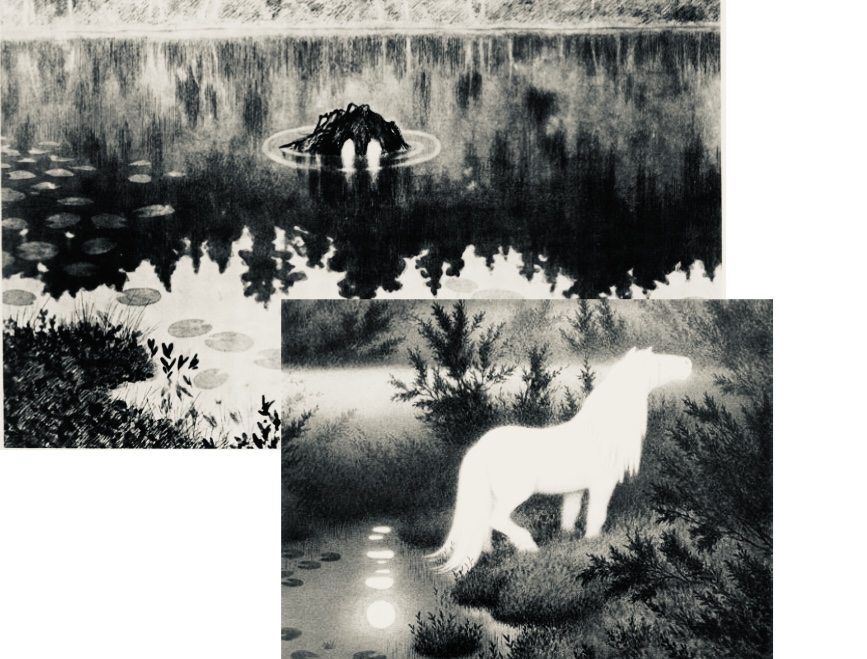
He has no fixed shape. He surfaces as a handsome young man with a fiddle across his knee, or a pale horse standing patient at the bank, or a log that floats and then moves against the current. His own body, when anyone sees it, is a drowned man’s — waterlogged, hair like algae, eyes holding a little light beneath the surface.
He rarely chases. He uses music. The tune carries over the water, and the safe distance shrinks a step at a time as the listener leans toward it; there is no struggle at the end, because the listener walks himself in. The horse works differently. There is room on its back for however many children climb on, and once they are up they cannot get back down — it walks unhurried into the deep, the water closes over them, and the surface goes flat.
He gives warning of his own work. A cry comes off the water at one spot, sharp and carrying, like a loon; and at that spot, later, someone drowns. The defence against him was and a name. You threw a knife or a sewing-needle into the water and said the line children were taught — Nøkk, nøkk, nål i vatnet; jomfru Maria kasta stål i vatnet, needle in the water, the Virgin Mary cast steel in the water — and if you could shout his true name across the surface, he had to let go.
The still water was the dangerous water. The white roar of a waterfall belonged to a different spirit, the fossegrim, who taught the fiddle rather than drowning the fiddler. The nøkken kept the quiet lakes, and the quiet lakes were the ones that took children.
The parson Andreas Faye 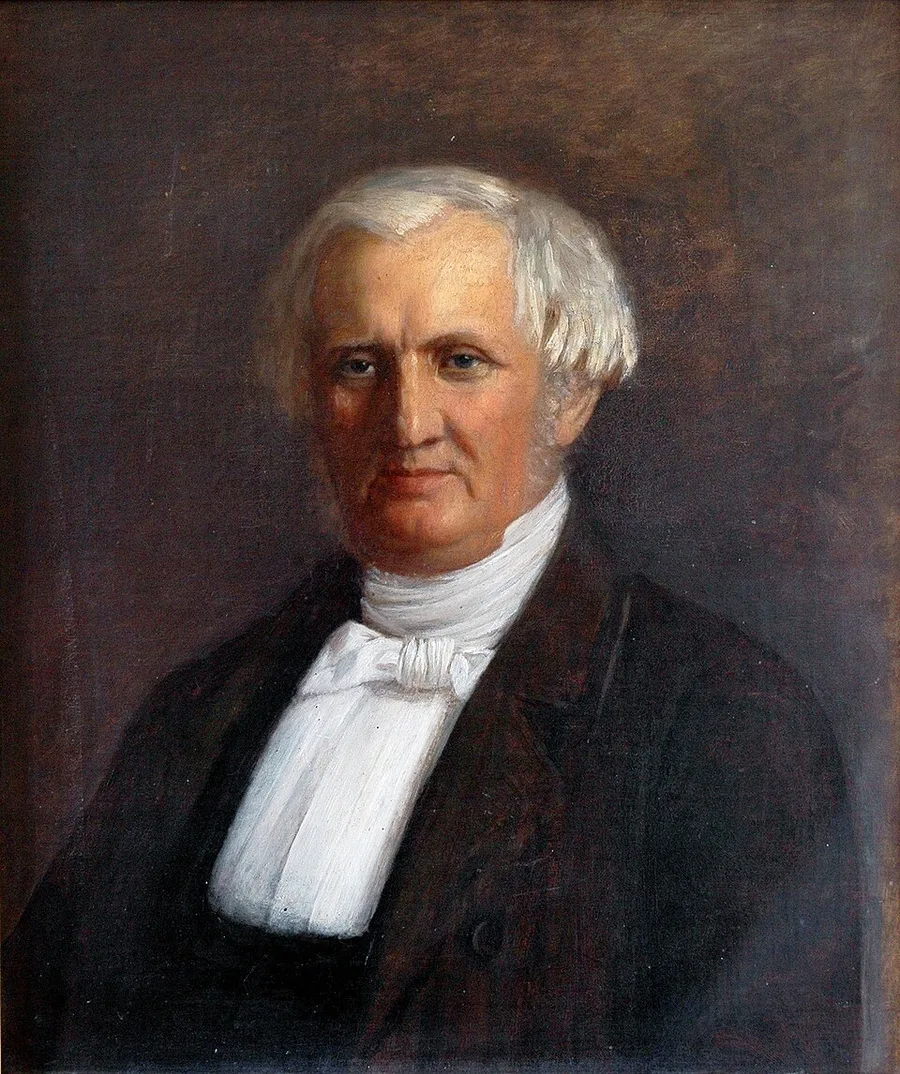 Christiane Schreiber, Portrait of Andreas Faye (1861), Rektorgalleriet, Universitetet i Agder Christiane Schreiber's 1861 portrait of Andreas Faye, the Holt parson-collector whose *Norske Sagn* (1833), enlarged in 1844 as *Norske Folke-Sagn*, first set Norway's legends in print — the draug of the coast, the nøkken of the fresh waters, and the Black Death lore Kittelsen later drew his Pesta from. Norwegian parson, historian and folklore collector
(1802–1869), a teacher in Arendal and from 1833 parish
priest at nearby Holt. His Norske Sagn (Arendal, 1833)
was the first published collection of Norwegian legends
and is counted as the beginning of folklore study in
Norway; a revised, expanded second edition appeared in
1844 as Norske Folke-Sagn. Faye recorded rather than
retold — a documentary register that drew a scathing
anonymous review from the historian P. A. Munch. But the
collection awakened the interest that Asbjørnsen and
Moe's folktale volumes of 1841–44 built on, and it became
Theodor Kittelsen's sourcebook: Kittelsen drew Pesta from
Faye's Black Death chapter for Svartedauen (1900).
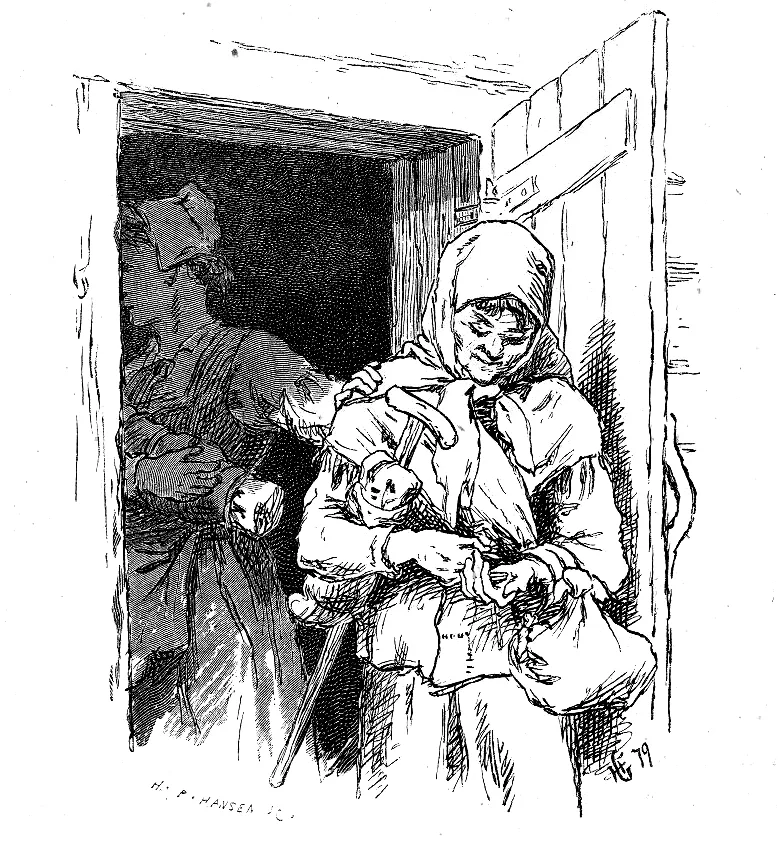
Also discussed in Pesta — an old woman walking from farm to farmDraugen — the drowned man who never came home set him down in the first printed collection of Norwegian legends in 1833 — a passing notice that he was found in most waters and rivers in the country — though the belief was far older than the page. Theodor Kittelsen
Christiane Schreiber, Portrait of Andreas Faye (1861), Rektorgalleriet, Universitetet i Agder Christiane Schreiber's 1861 portrait of Andreas Faye, the Holt parson-collector whose *Norske Sagn* (1833), enlarged in 1844 as *Norske Folke-Sagn*, first set Norway's legends in print — the draug of the coast, the nøkken of the fresh waters, and the Black Death lore Kittelsen later drew his Pesta from. Norwegian parson, historian and folklore collector
(1802–1869), a teacher in Arendal and from 1833 parish
priest at nearby Holt. His Norske Sagn (Arendal, 1833)
was the first published collection of Norwegian legends
and is counted as the beginning of folklore study in
Norway; a revised, expanded second edition appeared in
1844 as Norske Folke-Sagn. Faye recorded rather than
retold — a documentary register that drew a scathing
anonymous review from the historian P. A. Munch. But the
collection awakened the interest that Asbjørnsen and
Moe's folktale volumes of 1841–44 built on, and it became
Theodor Kittelsen's sourcebook: Kittelsen drew Pesta from
Faye's Black Death chapter for Svartedauen (1900).
Also discussed in Pesta — an old woman walking from farm to farmDraugen — the drowned man who never came home set him down in the first printed collection of Norwegian legends in 1833 — a passing notice that he was found in most waters and rivers in the country — though the belief was far older than the page. Theodor Kittelsen 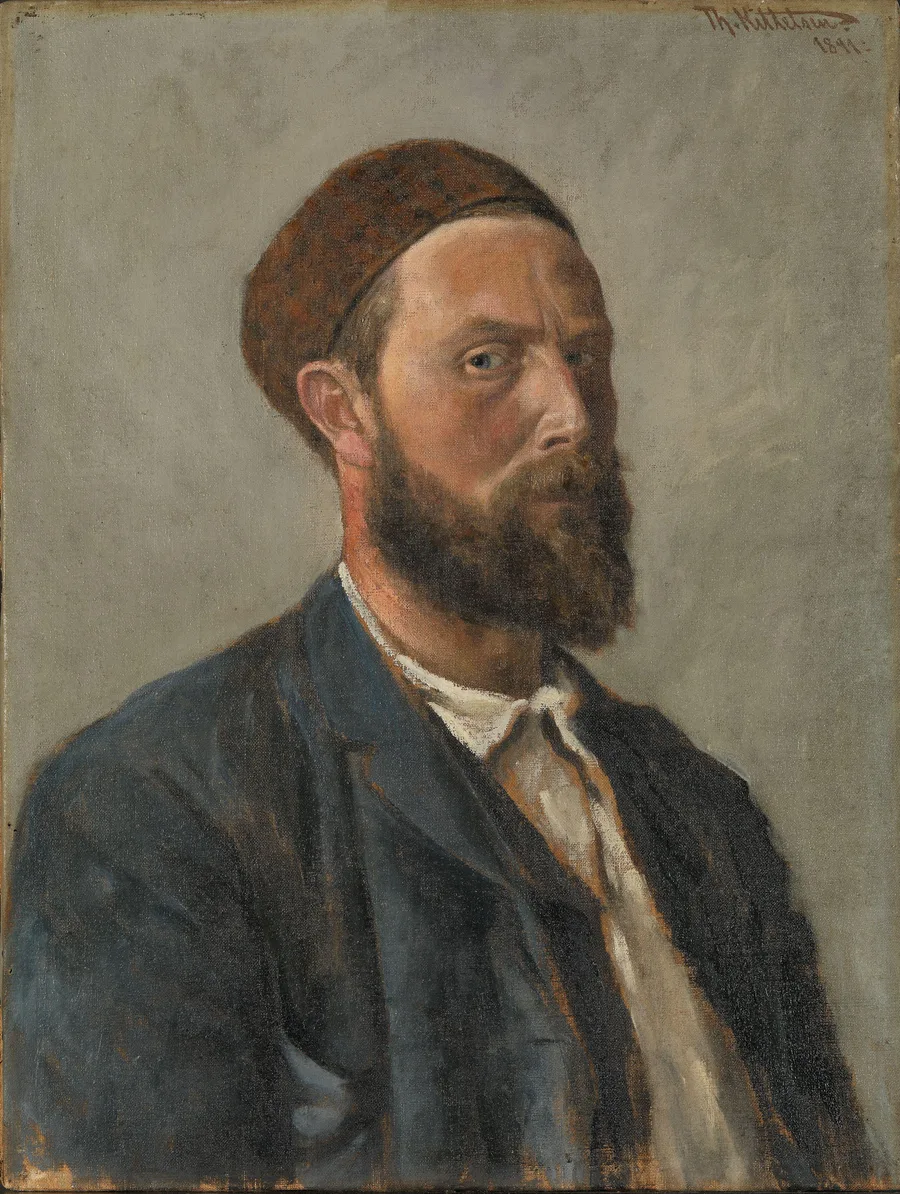 Theodor Kittelsen, Selvportrett (1891), Nasjonalmuseet The man behind the painting the article closes on — in *Nøkken* (1904) Kittelsen paints almost nothing: a black pool choked with lilies, two pale eyes at the surface. Here, thirteen years earlier, is the painter himself. Norwegian painter and illustrator (1857–1914), born in
Kragerø, who more than any other artist fixed the visual
identity of the country's folklore beings. Erik Werenskiold
brought him into the illustrated Asbjørnsen folktale editions
in the early 1880s. A stay at the Skomvær lighthouse on outer
Lofoten (1887–89), where his brother-in-law served as
assistant keeper, fed Troldskab (1892). His plague-hag
drawings, begun after an encounter with an old woman on the
island of Skåtøy, were published as the book Svartedauen in
1900. The same year, at Lauvlia in Sigdal, he painted his
Soria Moria pictures; the national collection bought them at
once. Nøkken (1904) — two pale eyes in a black lily-pool —
is held by the Nasjonalmuseet; Da Huldra forsvant (1908)
paints her vanishing.
Also discussed in Pesta — an old woman walking from farm to farmDraugen — the drowned man who never came homeHuldra — the girl in the forest with a secretNorske eventyr — the folk tales almost lost foreverSoria Moria — the shining castle always out of reach painted him in 1904 and painted almost nothing: a black pool choked with lilies, and two pale eyes at the surface, already close to the bank.
Theodor Kittelsen, Selvportrett (1891), Nasjonalmuseet The man behind the painting the article closes on — in *Nøkken* (1904) Kittelsen paints almost nothing: a black pool choked with lilies, two pale eyes at the surface. Here, thirteen years earlier, is the painter himself. Norwegian painter and illustrator (1857–1914), born in
Kragerø, who more than any other artist fixed the visual
identity of the country's folklore beings. Erik Werenskiold
brought him into the illustrated Asbjørnsen folktale editions
in the early 1880s. A stay at the Skomvær lighthouse on outer
Lofoten (1887–89), where his brother-in-law served as
assistant keeper, fed Troldskab (1892). His plague-hag
drawings, begun after an encounter with an old woman on the
island of Skåtøy, were published as the book Svartedauen in
1900. The same year, at Lauvlia in Sigdal, he painted his
Soria Moria pictures; the national collection bought them at
once. Nøkken (1904) — two pale eyes in a black lily-pool —
is held by the Nasjonalmuseet; Da Huldra forsvant (1908)
paints her vanishing.
Also discussed in Pesta — an old woman walking from farm to farmDraugen — the drowned man who never came homeHuldra — the girl in the forest with a secretNorske eventyr — the folk tales almost lost foreverSoria Moria — the shining castle always out of reach painted him in 1904 and painted almost nothing: a black pool choked with lilies, and two pale eyes at the surface, already close to the bank.