Soria Moria — The shining castle always out of reach
The shimmering golden castle on the horizon that the questing hero of Norwegian folktale sets out to reach. The pure expression of the country's longing for elsewhere.
Soria Moria is not a creature. It is a place — or rather the idea of a place — and of all the figures in Norwegian folklore it may be the one that says the most about the country that dreamed it.
In the Norwegian folktales collected by Asbjørnsen and Moe 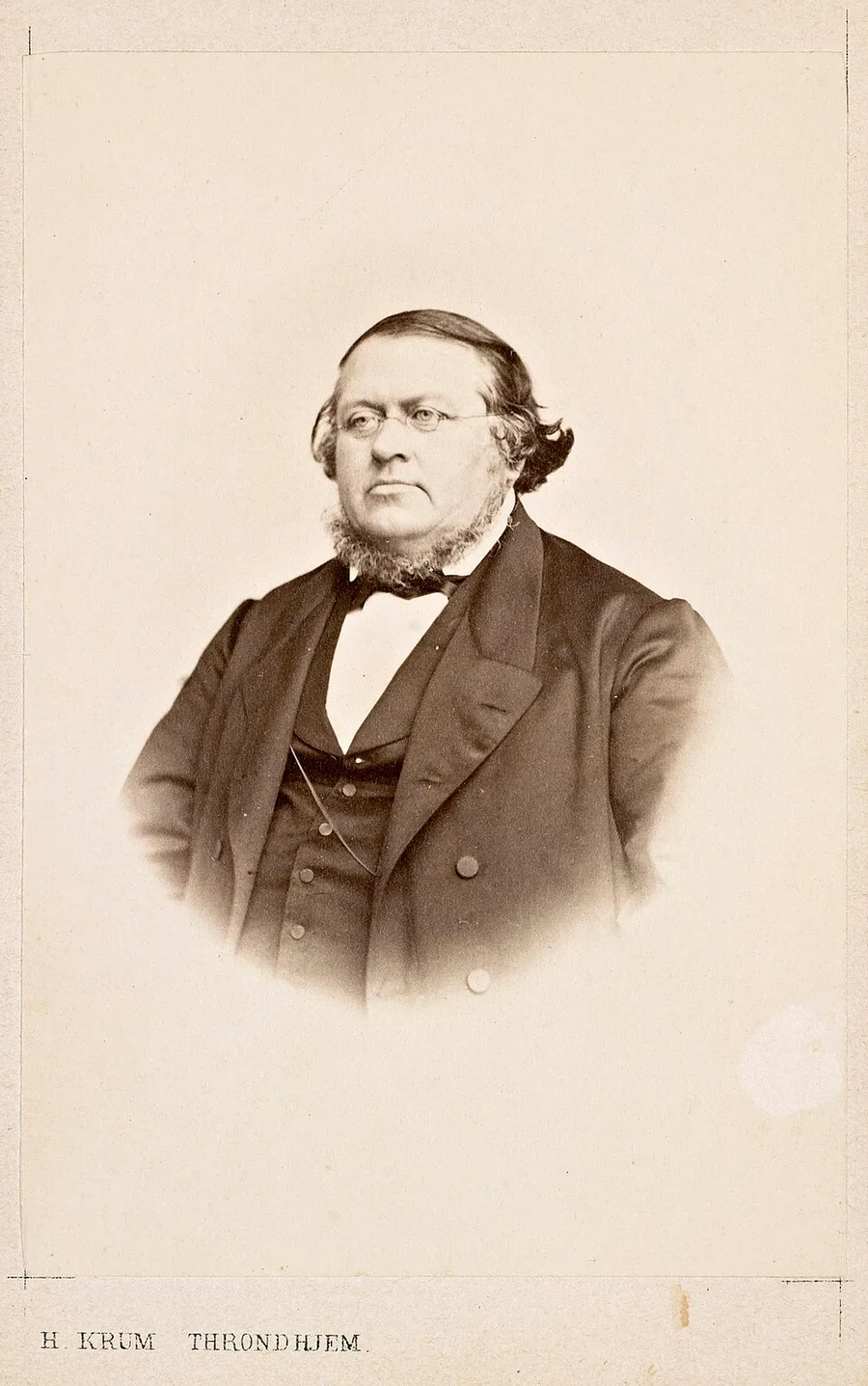 Hans Krum, portrait of Peter Christen Asbjørnsen (c. 1865–1875), Nasjonalbiblioteket The man pictured is Peter Christen Asbjørnsen, the naturalist half of the collecting pair — the wanderer of the two, whose journeys through the eastern valleys brought Soria Moria slott and its fellow tales out of the tellers' kitchens and into Norske Folkeeventyr.
 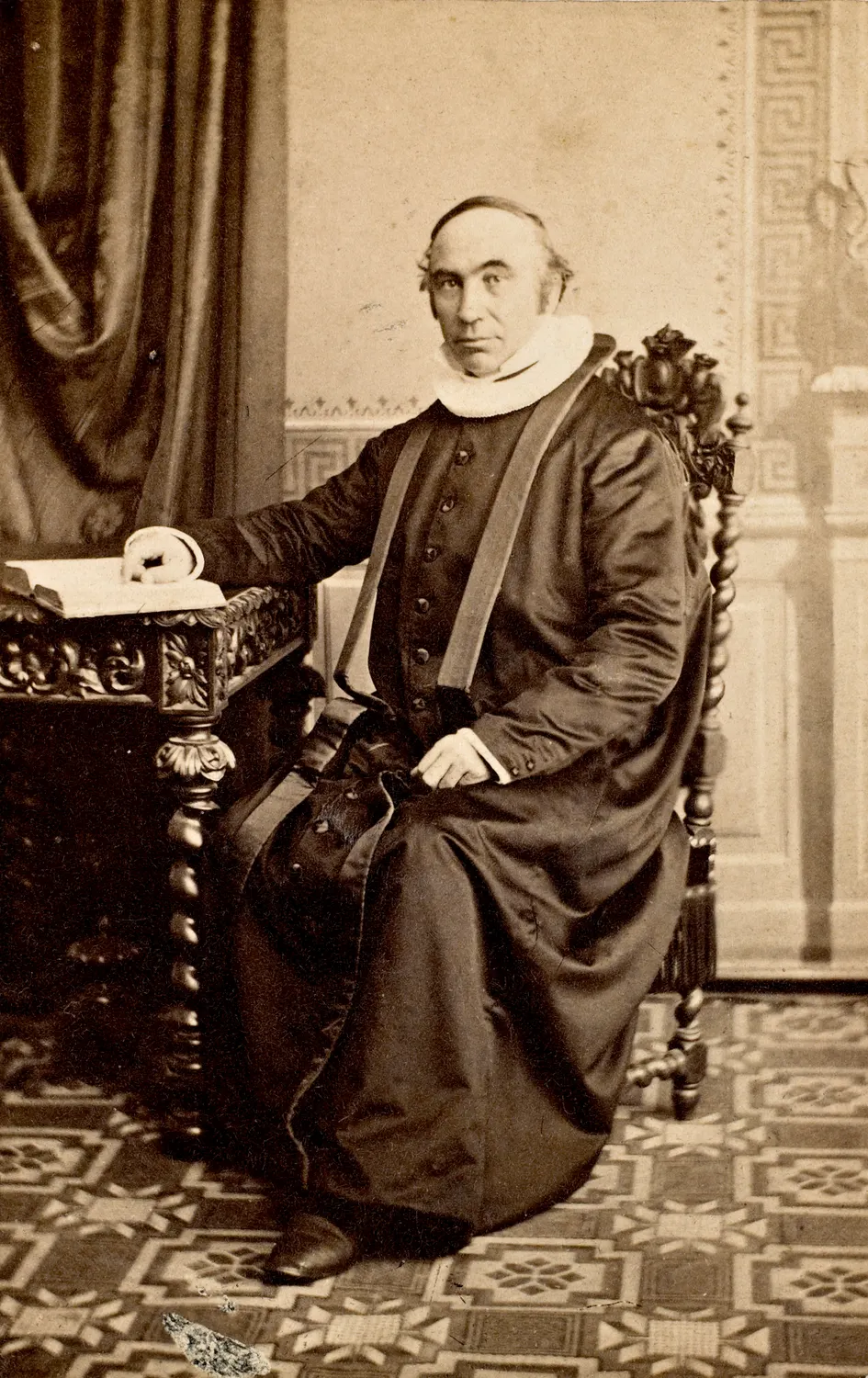 Olsen & Thomsen (Christiania), portrait of Jørgen Moe (c. 1865), Nasjonalbiblioteket The man pictured is Jørgen Moe, the poet of the pair and later a bishop — here in the priest's ruff of his clerical calling. His ear for the spoken cadence shaped the prose of the printed folktales, Soria Moria slott among them. Peter Christen Asbjørnsen (1812–1885) and Jørgen Moe
(1813–1882) — the collectors of the Norwegian folktales.
Friends from their schooldays at the Norderhov rectory on
Ringerike from around 1826, they spent the 1840s writing
down oral tales in the eastern valleys. Their joint
Norske Folkeeventyr began in December 1841 as an
anonymous, unbound pamphlet from Johan Dahl's shop in
Christiania, grew by further installments through 1844,
and in its enlarged 1852 edition was dedicated to the
brothers Grimm. Jacob Grimm wrote back that these were
die besten Märchen, die es gibt — the best folktales
there are. Asbjørnsen alone published the legend
collections Norske Huldreeventyr og Folkesagn (1845,
1848). The first fully illustrated edition of the
folktales followed in 1879.
Also discussed in Norske eventyr — the folk tales almost lost foreverBytting — the changeling left in the cradleThe Hytte — a sacred pastime of modern Norway in the mid-nineteenth century, a particular kind of story recurs. A young man — often the youngest of three brothers, often the one written off as a fool, the Askeladden, the Ash-Lad — sets out from a poor farm with nothing, and in the most famous of these tales, somewhere in the distance, across mountains and through forests and past Troll
Olsen & Thomsen (Christiania), portrait of Jørgen Moe (c. 1865), Nasjonalbiblioteket The man pictured is Jørgen Moe, the poet of the pair and later a bishop — here in the priest's ruff of his clerical calling. His ear for the spoken cadence shaped the prose of the printed folktales, Soria Moria slott among them. Peter Christen Asbjørnsen (1812–1885) and Jørgen Moe
(1813–1882) — the collectors of the Norwegian folktales.
Friends from their schooldays at the Norderhov rectory on
Ringerike from around 1826, they spent the 1840s writing
down oral tales in the eastern valleys. Their joint
Norske Folkeeventyr began in December 1841 as an
anonymous, unbound pamphlet from Johan Dahl's shop in
Christiania, grew by further installments through 1844,
and in its enlarged 1852 edition was dedicated to the
brothers Grimm. Jacob Grimm wrote back that these were
die besten Märchen, die es gibt — the best folktales
there are. Asbjørnsen alone published the legend
collections Norske Huldreeventyr og Folkesagn (1845,
1848). The first fully illustrated edition of the
folktales followed in 1879.
Also discussed in Norske eventyr — the folk tales almost lost foreverBytting — the changeling left in the cradleThe Hytte — a sacred pastime of modern Norway in the mid-nineteenth century, a particular kind of story recurs. A young man — often the youngest of three brothers, often the one written off as a fool, the Askeladden, the Ash-Lad — sets out from a poor farm with nothing, and in the most famous of these tales, somewhere in the distance, across mountains and through forests and past Troll 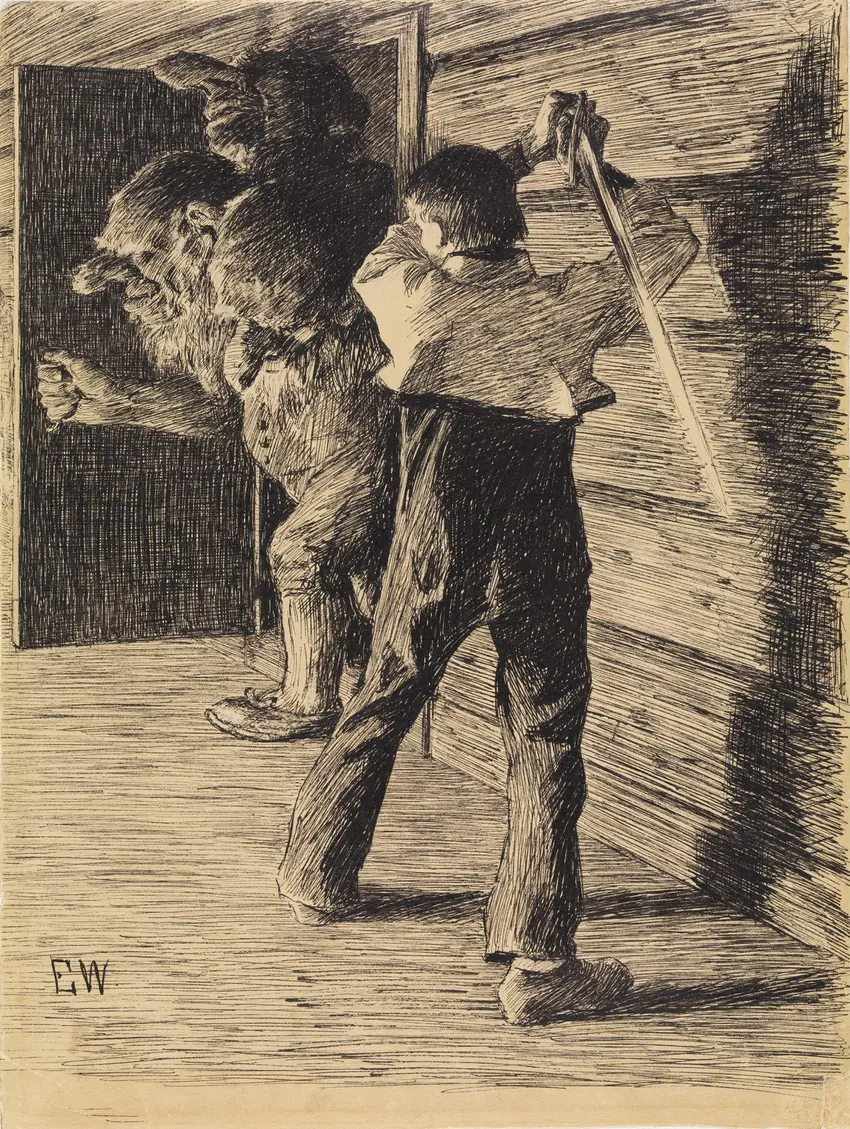 Erik Werenskiold, Soria Moria — Halvor og Trollet (1884), Nasjonalmuseet NG.K&H.B.05123 The road to Soria Moria runs past trolls, and Werenskiold draws the moment the road runs straight through one: the troll bursting into the hall roaring that it smells a Christian man's blood, and Halvor — the farm boy nobody counted on — already lifting the sword. The supernatural mountain-dweller of Norwegian folketro —
sometimes gigantic, like the valley-striding jutul, sometimes
small — living inside mountains and deep forest. Legends set
the troll against the church: it hurls boulders at church
buildings and flees the sound of church bells. Sunlight turns
a troll caught above ground to stone. Andreas Faye's Norske
Sagn (1833, expanded as Norske Folke-Sagn in 1844), Norway's
first legend collection, put the tradition on paper; Asbjørnsen
and Moe's Norske Folkeeventyr (1841–44) fixed the man-eating
troll of the tales in print — "De tre bukkene Bruse" was first
printed in 1843. Theodor Kittelsen (1857–1914) gave the troll
its modern visual form; his Skogtroll (1906) is in the
Nasjonalmuseet.
Also discussed in Troll — the monsters of the mountainsStedssagn — local legends, told as warningsNorske eventyr — the folk tales almost lost foreverHuldra — the girl in the forest with a secretBytting — the changeling left in the cradleVardøger — your double, arriving a few minutes before youTradisjoner — celebrations across the Norwegian year , there is Soria Moria: a castle, golden, shining, glimpsed far off on the horizon. Reaching it is the whole shape of the journey. The princess is there, and the kingdom, and the end of being poor and overlooked. The hero does not know the way. He goes anyway.
Erik Werenskiold, Soria Moria — Halvor og Trollet (1884), Nasjonalmuseet NG.K&H.B.05123 The road to Soria Moria runs past trolls, and Werenskiold draws the moment the road runs straight through one: the troll bursting into the hall roaring that it smells a Christian man's blood, and Halvor — the farm boy nobody counted on — already lifting the sword. The supernatural mountain-dweller of Norwegian folketro —
sometimes gigantic, like the valley-striding jutul, sometimes
small — living inside mountains and deep forest. Legends set
the troll against the church: it hurls boulders at church
buildings and flees the sound of church bells. Sunlight turns
a troll caught above ground to stone. Andreas Faye's Norske
Sagn (1833, expanded as Norske Folke-Sagn in 1844), Norway's
first legend collection, put the tradition on paper; Asbjørnsen
and Moe's Norske Folkeeventyr (1841–44) fixed the man-eating
troll of the tales in print — "De tre bukkene Bruse" was first
printed in 1843. Theodor Kittelsen (1857–1914) gave the troll
its modern visual form; his Skogtroll (1906) is in the
Nasjonalmuseet.
Also discussed in Troll — the monsters of the mountainsStedssagn — local legends, told as warningsNorske eventyr — the folk tales almost lost foreverHuldra — the girl in the forest with a secretBytting — the changeling left in the cradleVardøger — your double, arriving a few minutes before youTradisjoner — celebrations across the Norwegian year , there is Soria Moria: a castle, golden, shining, glimpsed far off on the horizon. Reaching it is the whole shape of the journey. The princess is there, and the kingdom, and the end of being poor and overlooked. The hero does not know the way. He goes anyway.
The name itself means nothing in particular: not a real place, and not quite ordinary Norwegian. That emptiness is part of its power. Soria Moria is wherever the good life is, seen from wherever you currently are. It is the horizon with a castle on it.
In 1900 Theodor Kittelsen 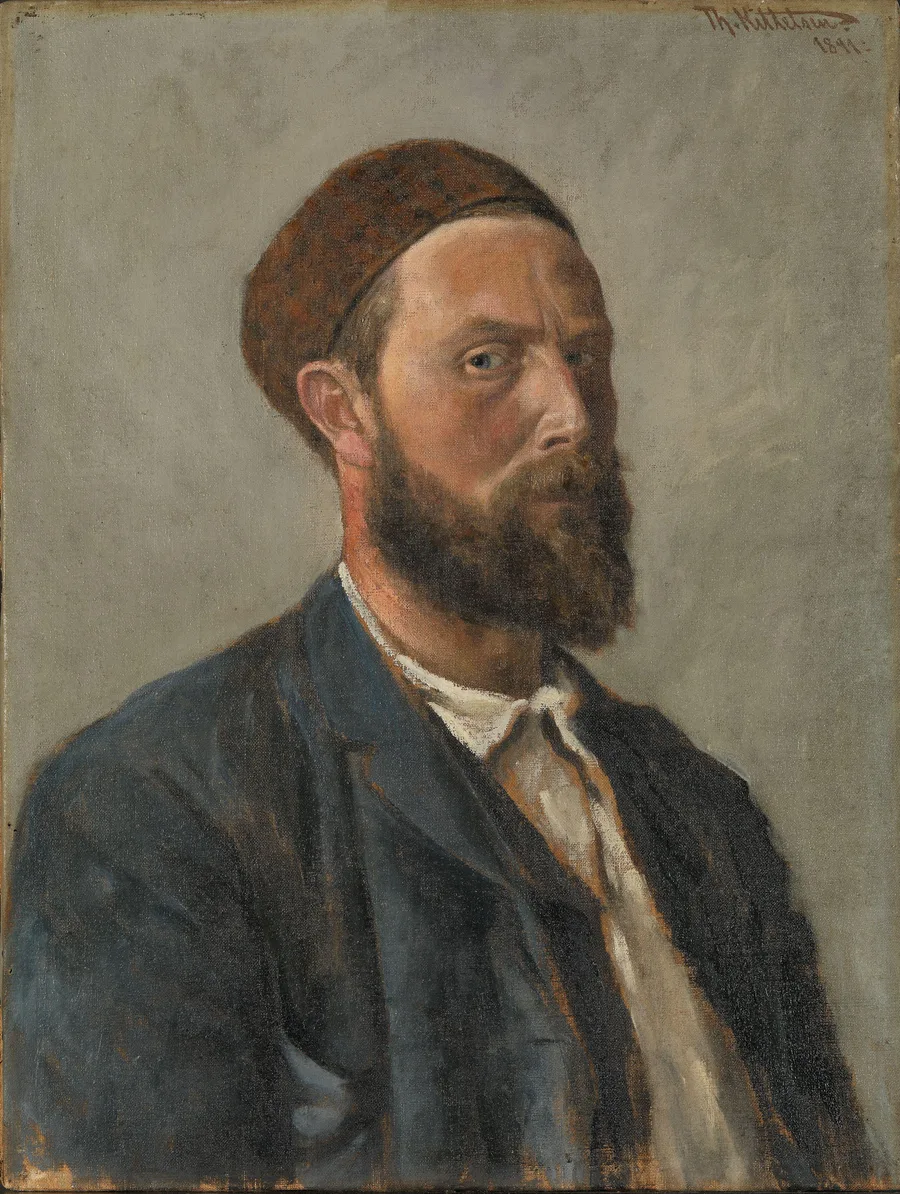 Theodor Kittelsen, Selvportrett (1891), Nasjonalmuseet The painter at thirty-four, nine years before the Lauvlia year that produced his Soria Moria pictures — the National Gallery bought all twelve at once. Norwegian painter and illustrator (1857–1914), born in
Kragerø, who more than any other artist fixed the visual
identity of the country's folklore beings. Erik Werenskiold
brought him into the illustrated Asbjørnsen folktale editions
in the early 1880s. A stay at the Skomvær lighthouse on outer
Lofoten (1887–89), where his brother-in-law served as
assistant keeper, fed Troldskab (1892). His plague-hag
drawings, begun after an encounter with an old woman on the
island of Skåtøy, were published as the book Svartedauen in
1900. The same year, at Lauvlia in Sigdal, he painted his
Soria Moria pictures; the national collection bought them at
once. Nøkken (1904) — two pale eyes in a black lily-pool —
is held by the Nasjonalmuseet; Da Huldra forsvant (1908)
paints her vanishing.
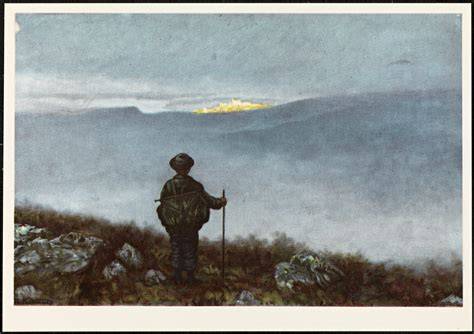
Also discussed in Pesta — an old woman walking from farm to farmDraugen — the drowned man who never came homeHuldra — the girl in the forest with a secretNøkken — the water-spirit who pulls you underNorske eventyr — the folk tales almost lost forever painted it: a boy on a high bare rock in the foreground, small and dark, looking across a vast distance at a far-off castle catching the last gold light. The painting is known simply as Soria Moria slott, and it is one of the most reproduced images in all of Norwegian art. Kittelsen did what the best folklore illustration does — he did not draw the castle so much as draw the looking, the enormous distance, the smallness of the boy and the largeness of the wanting.
Theodor Kittelsen, Selvportrett (1891), Nasjonalmuseet The painter at thirty-four, nine years before the Lauvlia year that produced his Soria Moria pictures — the National Gallery bought all twelve at once. Norwegian painter and illustrator (1857–1914), born in
Kragerø, who more than any other artist fixed the visual
identity of the country's folklore beings. Erik Werenskiold
brought him into the illustrated Asbjørnsen folktale editions
in the early 1880s. A stay at the Skomvær lighthouse on outer
Lofoten (1887–89), where his brother-in-law served as
assistant keeper, fed Troldskab (1892). His plague-hag
drawings, begun after an encounter with an old woman on the
island of Skåtøy, were published as the book Svartedauen in
1900. The same year, at Lauvlia in Sigdal, he painted his
Soria Moria pictures; the national collection bought them at
once. Nøkken (1904) — two pale eyes in a black lily-pool —
is held by the Nasjonalmuseet; Da Huldra forsvant (1908)
paints her vanishing.
Also discussed in Pesta — an old woman walking from farm to farmDraugen — the drowned man who never came homeHuldra — the girl in the forest with a secretNøkken — the water-spirit who pulls you underNorske eventyr — the folk tales almost lost forever painted it: a boy on a high bare rock in the foreground, small and dark, looking across a vast distance at a far-off castle catching the last gold light. The painting is known simply as Soria Moria slott, and it is one of the most reproduced images in all of Norwegian art. Kittelsen did what the best folklore illustration does — he did not draw the castle so much as draw the looking, the enormous distance, the smallness of the boy and the largeness of the wanting.
A country built along a thin, hard, mountainous coast — a country that, in a single century, sent something like a fifth of its own people across an ocean toward a better life they had only heard about — is a country that knows the feeling of Soria Moria in its bones. The shining place that is somewhere else. The journey toward it undertaken without a map. It is no accident that this particular folktale image, of all of them, became a national one.
The proof of how deep it runs is that modern Norway still reaches for the name. When a governing coalition gathered to write its joint political platform — twice, in 2005 and 2009 — it did it at a conference hotel called Soria Moria, and the resulting Soria Moria Declarations carried the name out of the folktale and into the actual running of the country. A nation does not name its government’s founding document after a children’s-story castle by accident. Soria Moria is the Norwegian word for the thing worth walking toward, and the walking is the point — the castle, in the painting as in the phrase, is always still in the distance.