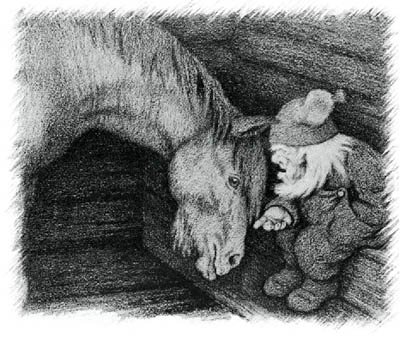
Nisse — The short-tempered spirit of the farm
A grey-bearded farm spirit, knee-high in a red cap, older than anyone alive on the land. Guardian of the barn who keeps the animals fat — and kills the best cow if you skimp his Christmas porridge. How the sharp-tempered household nisse became the julenisse.
On every old Norwegian farm lived a nisse: a grey-bearded man, knee-high, in a knitted red cap, in the barn or under the floor of the farmhouse. He had been on the land longer than anyone now alive on it, and he watched everything the household did.
The name likely comes from Nils, the Nordic form of Nicholas, the gift-giving saint — Nisse is its old Danish pet-form — and the spirit who wears it breaks your tools and kills your cow when you cross him.
Of all the places a nisse might settle on a farm, the fjøs (the cowshed) was the one he defended most jealously, because the animals were his. He worked at night, out among them where the warmth of the cattle kept the winter out, and he picked one favourite horse in the stall, grooming it until its coat shone and its mane was plaited into tight knots called nisseflette. A horse found braided like that in the morning meant the nisse had taken to it. (The same knots, on the same farms, were also blamed on the mare — the night-creature who rode horses to exhaustion — but hers were a wound and his were a blessing, and either way you did not undo them.) A well-kept nisse’s barn was found in the morning with the stalls mucked, the hay down, the cows calm and fat; neighbours could tell, from the sheen on a herd, who had one and who did not.
The other side of him was the danger. He was strong enough to throw a grown man across a barn, and he had a temper. A stable-hand who beat a horse or kicked a cat in the nisse’s barn found things beginning to go wrong for him — his tools missing, his footing bad on the ladder, the hay falling from the loft when he stood under it and not when he did not. The animals were watched over; the people were watched. More than one nineteenth-century farm tale ends with the teasing hand simply dead, pitched off the hayloft, and the horses in his stall found sweat-dark and trembling in the morning, ridden hard by something settling a score.
The famous bargain was Julegrøt 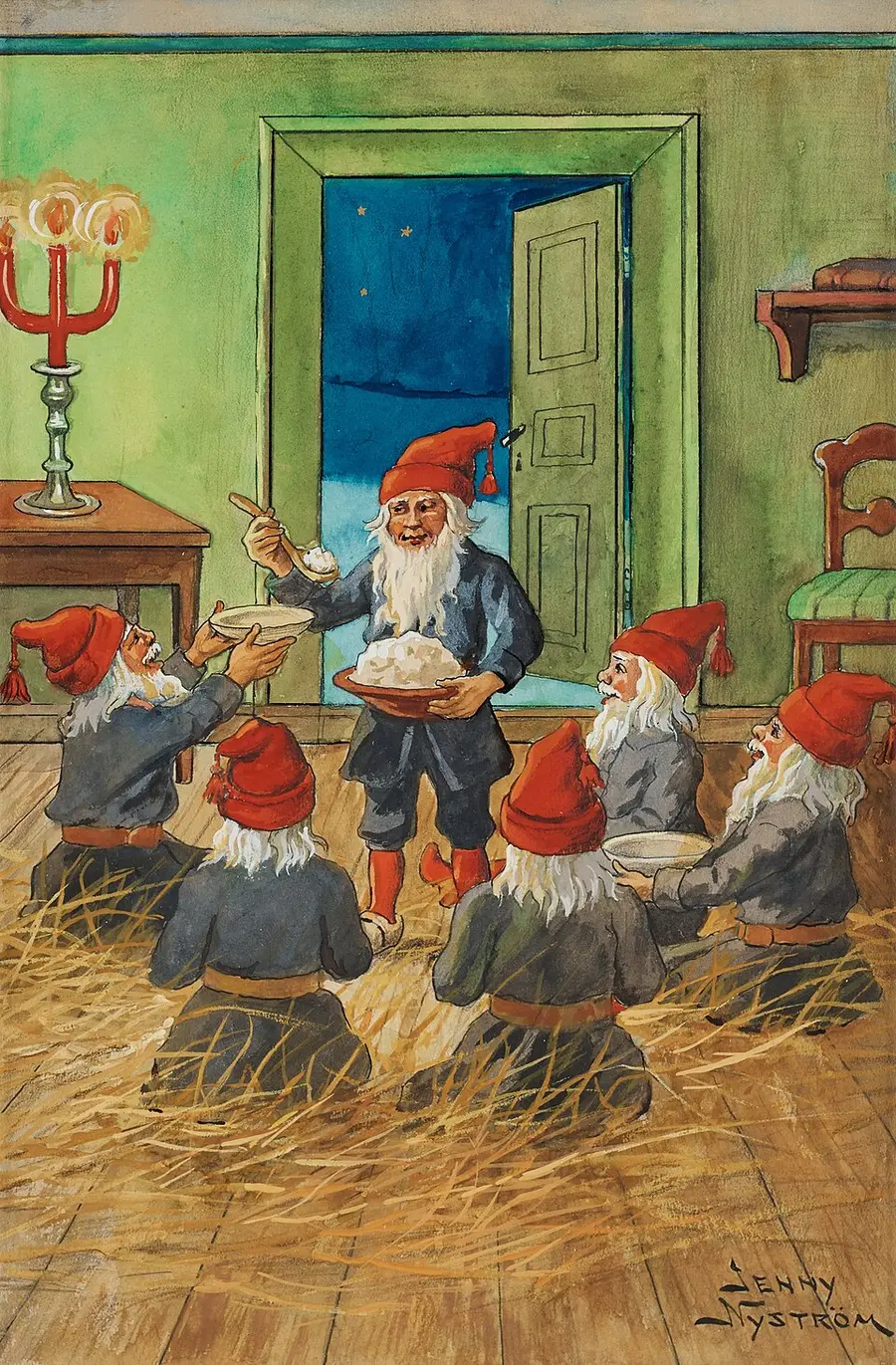 Jenny Nyström, Grötstunden (watercolor, before 1947) Nyström's tomte ladling out the porridge — the wage the whole relationship ran on. The butter mattered as much as the bowl: a nisse who found it skimped stopped working for the farm, and started working against it. Yule porridge — the porridge of the Norwegian Christmas. On the
modern julaften (Christmas Eve) table it is rice porridge,
risengrynsgrøt, with cinnamon, sugar, and a pat of butter; the
older farm offering was cream porridge — fløtegrøt or
rømmegrøt — and that is what the bowl set out on the barn
threshold on Christmas Eve night held for the nisse, the small
unseen helper who lives on the farm.
The custom descends, in part, from the pre-Christian household
practice of feeding the helper-spirit of the byre at midwinter; in
some Norwegian valleys the bowl-on-the-threshold still goes out, a
thousand-year-old domestic religious habit kept by households that
may not consciously remember why.
Also discussed in Worshiping Odin and Thor — the lived religion of pre-Christian Norway — a bowl of fløtegrøt, the good kind made with cream, a lump of butter melting on top, set on the barn floor on the night of the twenty-fourth. The butter mattered as much as the porridge. In one well-known telling, a farm girl skims the butter off and hides it under the porridge, thinking the nisse will not notice. He eats down, finds the butter gone, walks into the barn and kills the best cow — then comes back, finishes the bowl, finds the butter at the bottom, repents, and crosses the field and fetches an identical cow from the neighbour. And the porridge was not optional: the nisse who was forgotten on Christmas Eve, or slighted with thin porridge and the butter left off, stopped working, and then started working against. Milk soured. Cows sickened where they stood. The luck of the barn, which had been his gift, turned out to be removable.
Jenny Nyström, Grötstunden (watercolor, before 1947) Nyström's tomte ladling out the porridge — the wage the whole relationship ran on. The butter mattered as much as the bowl: a nisse who found it skimped stopped working for the farm, and started working against it. Yule porridge — the porridge of the Norwegian Christmas. On the
modern julaften (Christmas Eve) table it is rice porridge,
risengrynsgrøt, with cinnamon, sugar, and a pat of butter; the
older farm offering was cream porridge — fløtegrøt or
rømmegrøt — and that is what the bowl set out on the barn
threshold on Christmas Eve night held for the nisse, the small
unseen helper who lives on the farm.
The custom descends, in part, from the pre-Christian household
practice of feeding the helper-spirit of the byre at midwinter; in
some Norwegian valleys the bowl-on-the-threshold still goes out, a
thousand-year-old domestic religious habit kept by households that
may not consciously remember why.
Also discussed in Worshiping Odin and Thor — the lived religion of pre-Christian Norway — a bowl of fløtegrøt, the good kind made with cream, a lump of butter melting on top, set on the barn floor on the night of the twenty-fourth. The butter mattered as much as the porridge. In one well-known telling, a farm girl skims the butter off and hides it under the porridge, thinking the nisse will not notice. He eats down, finds the butter gone, walks into the barn and kills the best cow — then comes back, finishes the bowl, finds the butter at the bottom, repents, and crosses the field and fetches an identical cow from the neighbour. And the porridge was not optional: the nisse who was forgotten on Christmas Eve, or slighted with thin porridge and the butter left off, stopped working, and then started working against. Milk soured. Cows sickened where they stood. The luck of the barn, which had been his gift, turned out to be removable.
The one thing you could not do was get rid of him. A family on a nisse-plagued farm — one telling of it is set in Hallingdal, others all over the country — finally gives up, packs the cart, and moves. On the road the farmer glances back at his load, and the nisse’s red cap pops up out of the milk churn: “Fine day to be moving, isn’t it?” The nisse belonged to the land itself, not to whoever held the deed. Wherever the household went, the household spirit was part of what they carried.
The figure later softened. From 1881 the Swedish illustrator Jenny Nyström 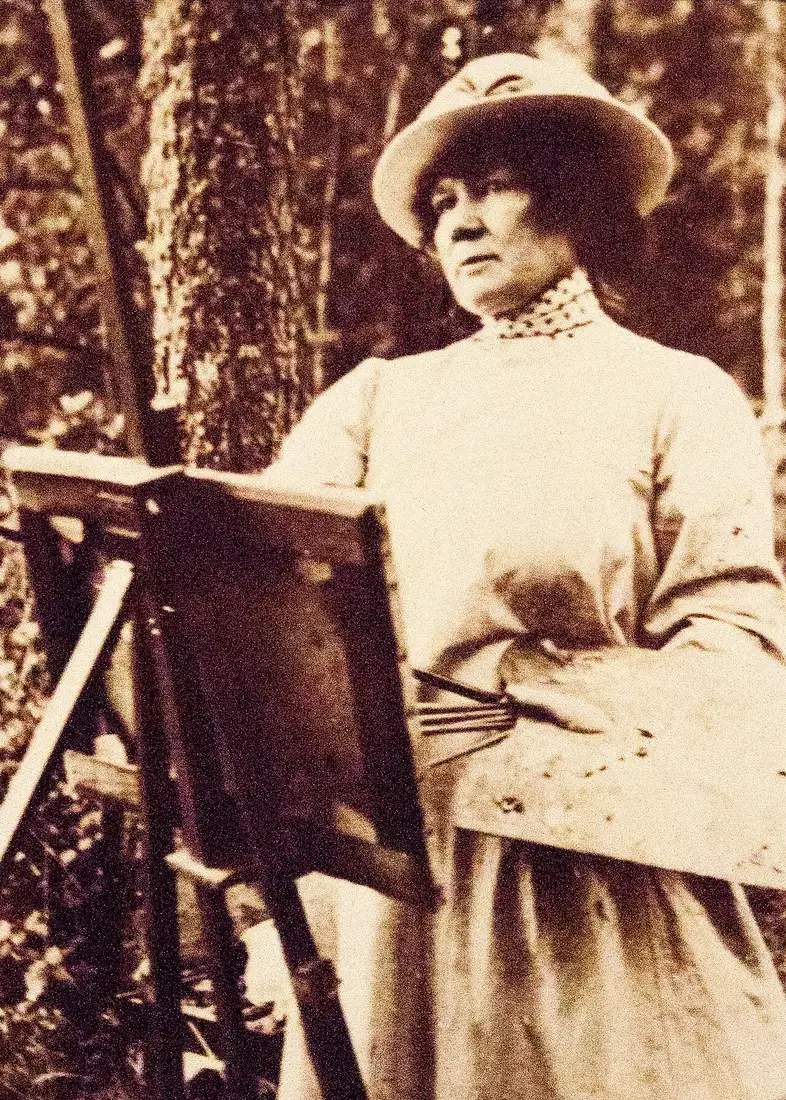 Jenny Nyström at her easel, photographer unknown; Kalmar läns museum The painter herself, photographed at her easel — the Kalmar-born illustrator whose 1881 pictures for Rydberg's poem Tomten fixed the small red-capped figure that turned the farm's sharp-tempered barn spirit into the rosy gift-bringer of the Scandinavian Christmas. Swedish painter and illustrator (1854–1946), born in
Kalmar, who fixed the modern face of the Scandinavian
Christmas tomte — the Norwegian julenisse's Swedish
twin. As an art student she illustrated Viktor Rydberg's
Christmas tale Lille Viggs äfventyr på julafton (1875);
her breakthrough came on 19 February 1881, when Ny
Illustrerad Tidning printed Rydberg's poem Tomten with
her pictures — a small, white-bearded, red-capped figure
keeping watch over a sleeping midwinter farm. Across the
following six decades she produced thousands of Christmas
motifs and card designs, and through them the
sharp-tempered barn spirit of the farm lore crossed into
the rosy household gift-bringer of the modern Scandinavian
Christmas.
drew a rounder, rosier tomte — first for Viktor Rydberg’s poem, then for a flood of Christmas cards — and through them the barn spirit crossed over into the julenisse, the Christmas gift-bringer, back to the saint whose name he had carried all along. In a Norwegian home the presents still come from him — hand-delivered by a relative in a red cap the children pretend not to recognize, who knocks on the door and asks Er det noen snille barn her? (are there any good children here?). The merger with the international Santa Claus ran both directions: the American Santa took on some of the nisse’s domesticity, and the nisse took Santa’s job. The red cap survived. Most of the working-farm menace did not.
Jenny Nyström at her easel, photographer unknown; Kalmar läns museum The painter herself, photographed at her easel — the Kalmar-born illustrator whose 1881 pictures for Rydberg's poem Tomten fixed the small red-capped figure that turned the farm's sharp-tempered barn spirit into the rosy gift-bringer of the Scandinavian Christmas. Swedish painter and illustrator (1854–1946), born in
Kalmar, who fixed the modern face of the Scandinavian
Christmas tomte — the Norwegian julenisse's Swedish
twin. As an art student she illustrated Viktor Rydberg's
Christmas tale Lille Viggs äfventyr på julafton (1875);
her breakthrough came on 19 February 1881, when Ny
Illustrerad Tidning printed Rydberg's poem Tomten with
her pictures — a small, white-bearded, red-capped figure
keeping watch over a sleeping midwinter farm. Across the
following six decades she produced thousands of Christmas
motifs and card designs, and through them the
sharp-tempered barn spirit of the farm lore crossed into
the rosy household gift-bringer of the modern Scandinavian
Christmas.
drew a rounder, rosier tomte — first for Viktor Rydberg’s poem, then for a flood of Christmas cards — and through them the barn spirit crossed over into the julenisse, the Christmas gift-bringer, back to the saint whose name he had carried all along. In a Norwegian home the presents still come from him — hand-delivered by a relative in a red cap the children pretend not to recognize, who knocks on the door and asks Er det noen snille barn her? (are there any good children here?). The merger with the international Santa Claus ran both directions: the American Santa took on some of the nisse’s domesticity, and the nisse took Santa’s job. The red cap survived. Most of the working-farm menace did not.
The old nisse faded with the barns themselves. When the animals left the small farms in the twentieth century, the spirit who lived on their warmth had nowhere to sit. What survives of him moved indoors — a creature who once killed cows over butter, remembered now mostly as the reason a bowl of porridge still goes out, somewhere, on the twenty-fourth of December.